Issue 2Teaching Students, Faculty, and Clients Across the Life-Span of Development
Article 5
10-31-2016
A Comprehensive Review of the 2016 ASHA
Code of Ethics
Robin L. Edge Ph.D., CCC-SLP Jacksonville University, [email protected]
Bess Sirmon-Taylor Ph.D., CCC-SLP
University of Texas at El Paso, [email protected]
Raul F. Prezas Ph.D., CCC-SLP Jacksonville University, [email protected]
Follow this and additional works at:http://scholarworks.sfasu.edu/jhstrp
Part of theHealth and Medical Administration Commons,Health Law and Policy Commons,
Legal Ethics and Professional Responsibility Commons,Speech and Hearing Science Commons, and theSpeech Pathology and Audiology Commons
Tell ushow this article helped you.
This Brief Report is brought to you for free and open access by SFA ScholarWorks. It has been accepted for inclusion in Journal of Human Services: Training, Research, and Practice by an authorized administrator of SFA ScholarWorks. For more information, please contact
[email protected]. Recommended Citation
Edge, Robin L. Ph.D., CCC-SLP; Sirmon-Taylor, Bess Ph.D., CCC-SLP; and Prezas, Raul F. Ph.D., CCC-SLP (2016) "A
Comprehensive Review of the 2016 ASHA Code of Ethics,"Journal of Human Services: Training, Research, and Practice: Vol. 1: Iss. 2, Article 5.
Cover Page Footnote
Correspondence concerning this article should be addressed to Robin Edge, Department of Communication Sciences and Disorders, Jacksonville University, Jacksonville, FL 32207. E-mail: [email protected]
A Comprehensive Review of the 2016 ASHA Code of Ethics
Robin L. Edge, Ph.D., CCC-SLP
Jacksonville University
Bess Sirmon-Taylor, Ph.D., CCC-SLP
University of Texas at El Paso
Raul F. Prezas, Ph.D., CCC-SLP
Jacksonville University
Author Note
Correspondence concerning this article should be addressed to Robin Edge, Department of
Communication Sciences and Disorders, Jacksonville University, 2800 University BLVD N,
Jacksonville, FL 32207.
Abstract
The American Speech-Language-Hearing Association (ASHA) initially implemented a Code of
Ethics in 1952, and has periodically revisited the content of the document with revisions to
reflect the expanding scope of practice within speech-language pathology and audiology and to
clarify certain concepts. Code revision is a cyclical mandated task of the ASHA Board of Ethics
conducted to assure accuracy, currency, and completeness of this most important document
(Solomon-Rice & O’Rourke, 2016). The current version of the Code of Ethics (2016) was
modified from the previous version (2010r), with an updated preamble, definitions of related
vocabulary, and re-organized language in the principles. The new code, which supports
collaboration, competence, and responsibility, serves as the ethical underpinning for students and
clinical fellows, practicing clinicians, researchers, supervisors, and administrators. It is
incumbent on ASHA members to encode this information, and incorporate ethical practices
across the span of their careers. The current article will summarize the changes between the
2010r and 2016 versions of the ASHA Code of Ethics for practicing speech-language
pathologists and audiologists and students studying in these fields. Managers may benefit from
this tutorial in order to be familiar with the standards to which their speech-language pathologists
and audiologists must abide. Official clarification regarding the ASHA Code of Ethics should be
directed to the ASHA Director of Ethics at [email protected].
A Comprehensive Review of the 2016 ASHA Code of Ethics
The American Speech-Language-Hearing Association (ASHA) has recently implemented
a revision to the Code of Ethics, which serves as the governing principles for professional
practice in human communication disorders. In order to best serve patients, clients, and students,
speech-language pathology and audiology professionals must be knowledgeable of ethical
principles and follow important changes to the professions’ guiding principles. This article will
provide a context for, and an overview of the changes and updates to the ASHA Code of Ethics
highlighting the changes between the 2010 revised version (released in 2014) and the 2016
version of the Code of Ethics.
What is a code of ethics?
Codes of ethics have been developed by professions for a variety of purposes, typically
outlining the mission and values of an organization, and defining status and standards of quality
service delivery, protection of the public, and accountability of members. Such codes will
incorporate normative principles of acceptable versus unacceptable conduct based on
professional values as guidelines for acceptable behavior, which can be open to interpretation
(cf. Flite & Harman, 2013; Joyce & Rankin, 2010; Spielthenner, 2015). It is a standard or set of
morals by which a group makes decisions about what is right or wrong. Codes of ethics are
commonplace in many professions such as occupational, physical, and respiratory therapies,
nursing, engineering, law, and medicine. ASHA follows these standards and is no exception.
Why did ASHA change the Code of Ethics?
ASHA’s first formal Code of Ethics was published in 1952 and has been modified and
pathology and audiology (ASHA, 2016b). The Code of Ethics for speech-language pathology
and audiology is composed by the ASHA Board of Ethics, a 16 member appointed committee
charged with oversight of and compliance with ethical standards, including review and
adjudication of complaints. This board is mandated to regularly review the Code (ASHA,
2016c) in an effort to enhance its “currency, accuracy, and comprehensiveness” (Solomon-Rice & O’Rourke, 2016, n. p.). It provides the guiding principles for the practice of speech-language
pathology and audiology.
ASHA’s Code of Ethics is comprised of four principles and 55 rules subsumed under the
four principles. Rules of ethics are specific statements of minimally acceptable professional
conduct or of prohibitions and are applicable to all individuals who fall under that specific code
(ASHA 2016a; see below). The Code of Ethics are standards that govern our practice and apply
to everyone who practices speech-language pathology and audiology, including licensed
clinicians, researchers, interns, and students. Moreover, the ASHA code helps to educate
practitioners and student clinicians within the discipline, including the general public.
The latest version of the Code of Ethics became effective on March 1, 2016. The
fundamental structure of the Code of Ethics remains unchanged from the 2010 revision,
including the four principles which address members’ responsibilities to the persons served
professionally (both clinically and in research involving humans and animals); maintenance of
professional competence; provision of accurate information regarding the professions to the
public; and professional relationships (Solomon-Rice & O’Rourke, 2016).
What is new in the 2016 version of the Code of Ethics?
paragraphs were added to the beginning of the preamble to put the Code of Ethics in a historical
perspective, and to clarify the intention of ASHA’s Code of Ethics. The third paragraph of the
preamble added a phrase at the end of the first sentence articulating the role of speech-language
pathologists and audiologists.
The preservation of the highest standards of integrity and ethical principles is vital to the
responsible discharge of obligations by audiologists, speech-language pathologists, and
speech, language, and hearing scientists who serve as clinicians, educators, mentors,
researchers, supervisors, and administrators [emphasis added]. (ASHA, 2016a, p. 2)
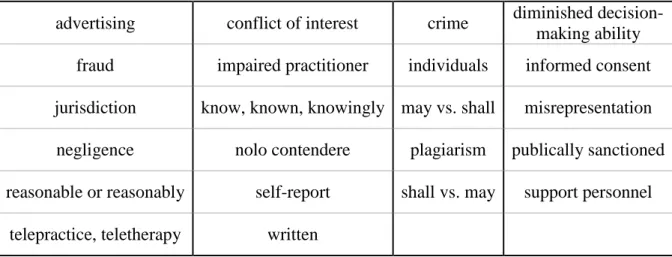
The next major change in the new Code of Ethics is the addition of a terminology section
consisting of 22 terms and definitions helpful in ensuring that all speech-language pathologists
and audiologists are interpreting the terminology in the Code the same way. The terms noted in
Table 1 are defined in the 2016 Code of Ethics. In addition, this section also provides the
mailing address for the Board of Ethics for the filing of complaints. In the 2016 revision of the
Code of Ethics, Principles I and II remain unchanged from the prior version, Principles III and
IV were revised, and fifteen new rules were added.
Insert Table 1 here
Principle I states, “Individuals shall honor their responsibility to hold paramount the welfare of
persons they serve professionally or who are participants in research and scholarly activities, and they shall treat animals involved in research in a humane manner” (ASHA, 2016a, p. 4). The
need to consider the benefits to the clients/patients/students/research participants served by
speech-language pathologists and audiologists remains the prime directive of Principle I. There
referring to other professionals as necessary, not discriminating in delivery of services,
delegating as appropriate, accurately representing the work of those to whom responsibilities are
delegated, obtaining informed consent, using evidence-based practice, maintaining
confidentiality, and reporting ethical violations if observed.
Principle I has four new rules which clarify expected professional behavior related to ethics
and evidence-based practice, exercising independent judgment, and the responsibility to report
ethical violations to the appropriate authorities. From the 2016 ASHA Code of Ethics (pp. 5-6):
Rule J. Individuals shall accurately represent the intended purpose of a service, product, or research endeavor and shall abide by established guidelines for clinical practice and
the responsible conduct of research.
Rule M. Individuals who hold the Certificate of Clinical Competence shall use
independent and evidence based clinical judgment, keeping paramount the best interests
of those being served.
Rule Q. Individuals shall maintain timely records and accurately record and bill for services provided and products dispensed and shall not misrepresent services provided,
products dispensed, or research and scholarly activities conducted.
Rule S. Individuals who have knowledge that a colleague is unable to provide
professional services with reasonable skill and safety shall report this information to the
appropriate authority, internally if a mechanism exists and, otherwise, externally.
Principle II states, “Individuals shall honor their responsibility to achieve and maintain the highest level of professional competence and performance” (ASHA, 2016a, p. 6). This rule
quality services by the awarding of the Certificate of Clinical Competence after completion of a Master’s or AUD degree, and maintain national certification through the acquisition of
continuing education.
There are eight rules under Principle of Ethics II including operating within one’s scope
of competence, being a life-long learner, not compromising patient care or license, and using
technology as appropriate in one’s area of practice. Principle II also has four new rules
regarding compliance with external standards in research practices, monitoring the independent
clinical judgment of individuals being supervised, and the implementation of appropriate
technology in clinical practice.
Rule B. Members who do not hold the Certificate of Clinical Competence may not engage in the provision of clinical services; however, individuals who are in the
certification application process may engage in the provision of clinical services
consistent with current local and state laws and regulations and with ASHA certification
requirements.
Rule C. Individuals who engage in research shall comply with all institutional, state, and federal regulations that address any aspects of research, including those that involve
human participants and animals.
Rule F. Individuals in administrative or supervisory roles shall not require or permit their professional staff to provide services or conduct clinical activities that compromise the staff member’s independent and objective professional judgment.
Rule G. Individuals shall make use of technology and instrumentation consistent with accepted professional guidelines in their areas of practice. When such technology is not
available, an appropriate referral may be made (ASHA, 2016a, pp. 6-7).
Principle III was simplified to clarify meaning, and the examples were removed from the
Principle and moved into the rules. The 2016 version of Principle III is, “Individuals shall honor
their responsibility to the public when advocating for the unmet communication and swallowing
needs of the public and shall provide accurate information involving any aspect of the professions” (ASHA, 2016a, p. 7). There are seven rules under Principle III which address
accurate representation of one’s credentials, competence, and training, avoiding conflicts of
interest, giving appropriate credit, not scheming to defraud, not guaranteeing a favorable
outcome, and appropriately representing services in advertisement and promotion. Rule G, “Individuals shall not knowingly make false financial or nonfinancial statements and shall
complete all materials honestly and without omission” was added to Principle III in the 2016
version (ASHA, 2016a, p. 7).
Principle IV was revised to enhance its aspirational nature, incorporating language from
what was previously Rule A (Solomon-Rice & O’Rourke, 2016). Principle IV states,
“Individuals shall uphold the dignity and autonomy of the professions, maintain collaborative
and harmonious interprofessional and intraprofessional relationships, and accept the professions’
self-imposed standards” (ASHA, 2016a, p. 7). Principle IV has 20 rules which include
guidelines for professional collaboration, accurately representing the professions and avoiding
anything that adversely reflects on the professions, and not engaging in discrimination involving
any other professions. These rules also specifically state members are to have no inappropriate
Principle IV’s rules also state that in a supervisory relationship, we do not allow any violations
of the Code of Ethics, and that appropriate credit is given in research and presentations to avoid
plagiarism. Finally, members must inform the Board of Ethics if ethical violations are observed;
members must comply with local, state, and federal laws, and regulations; and must self-report to
the Board of Ethics if found guilty or pled nolo contendre to certain misdemeanors or a felony.
Six new rules were added to Principle of Ethics IV, which address the need for accurate
statements in all documentation for certification and membership, responsibilities to report
ethical violations of other professions to the appropriate regulatory agencies, the appropriate use
of the procedures for reporting ethical violations, compliance with local, state, and federal laws,
and the need for self-reporting when legal or ethical violations have occurred. From the 2016
ASHA Code of Ethics:
Rule A. Individuals shall work collaboratively, when appropriate, with members of one’s own profession and/or members of other professions to deliver the highest quality of care.
Rule F. Applicants for certification or membership, and individuals making disclosures, shall not knowingly make false statements and shall complete all application and
disclosure materials honestly and without omission.
Rule N. Individuals shall report members of other professions who they know have violated standards of care to the appropriate professional licensing authority or board,
other professional regulatory body, or professional association when such violation
Rule R. Individuals shall comply with local, state, and federal laws and regulations applicable to professional practice, research ethics, and the responsible conduct of
research.
Rule S. Individuals who have been convicted; been found guilty; or entered a plea of guilty or nolo contendere to (1) any misdemeanor involving dishonesty, physical harm-or
the threat of physical harm-to the person or property of another, or (2) any felony, shall
self-report by notifying ASHA Standards and Ethics (see Terminology for mailing
address) in writing within 30 days of the conviction, plea, or finding of guilt. Individuals
shall also provide a certified copy of the conviction, plea, nolo contendere record, or
docket entry to ASHA Standards and Ethics within 30 days of self-reporting.
Rule T. Individuals who have been publicly sanctioned or denied a license or a
professional credential by any professional association, professional licensing authority
or board, or other professional regulatory body shall self-report by notifying ASHA
Standards and Ethics (see Terminology for mailing address) in writing within 30 days of
the final action or disposition. Individuals shall also provide a certified copy of the final
action, sanction, or disposition to ASHA Standards and Ethics within 30 days of
self-reporting (ASHA, 2016a, pp. 7-9).
Discussion
One of the conditions of membership in and certification by the American
Speech-Language-Hearing Association is the understanding that individuals will be governed by and
self-regulate clinical and research practices according to the standards outlined in the Code of
Ethics. The Code serves as an inspirational and aspirational document (ASHA, 2010r), serving
career. For students preparing to enter the field, their ethical responsibilities include
incorporating the code as a means of critical thinking as they are learning and experiencing the
scope of the profession. Clinical Fellows integrate the code into their clinical practices, under
the supervision of an experienced clinician who is expected to model appropriate ethical
behavior. Veteran speech-language pathologists and audiologists utilize the ASHA Code of
Ethics to drive their clinical practice and are expected to abide by each iteration of the Code as it
changes over time. Researchers have a responsibility to abide by the Code when working with
research participants, both human and animal. Speech-language pathologists who have moved
away from direct clinical service provision (e.g., administration, advocacy) are likewise bound
by the standards outlined in the Code and are responsible to oversee that employees act in an
ethical manner.
The full 2016 Code of Ethics is available at
http://www.asha.org/uploadedFiles/ET2016-00342.pdf, and it is every ASHA member’s responsibility to review, understand, and implement
the principles and rules in the current Code of Ethics. The ASHA web site has a wealth of
information to support members in ethical decision making (www.asha.org/Practice/ethics/)
including ethical guidance and sanctions and violation history. Questions regarding official
clarification regarding the ASHA Code of Ethics should be directed to the ASHA Director of
References
American Speech-Language-Hearing Association. (2010r). Code of Ethics. Retrieved
from www.asha.org/policy.
American Speech-Language-Hearing Association. (2016a). Code of Ethics. Retrieved
from www.asha.org/policy.
American Speech-Language-Hearing Association. (2016b). Statement of the Board of Ethics on
ASHA’s Code of Ethics and principles associated with its enforcement. Retrieved from
http://www.asha.org/Practice/ethics/BOE-Code-Enforcement/
American Speech-Language-Hearing Association (2016c, March). New code of ethics takes
effect March 1. The ASHA Leader, 21. Retrieved from
http://leader.pubs.asha.org/article.aspx?articleid=2498601&resultclick=3#.Vx-lqcKzSB8.email
Flite, C. A. & Harman, L. B. (2013). Code of ethics: Principles for ethical leadership.
Perspectives in Health Information Management, 10, 1-11.
Joyce, N. R. & Rankin, T. J. (2010). The lessons of the development of the first APA Ethics
Solomon-Rice, P. & O’Rourke, C. (2016, April). A primer to the 2016 Code of Ethics. Seminar
presented at the Annual Convention of the Council of Academic Programs in
Communication Sciences and Disorders, San Antonio, TX.
Spielthenner, G. (2015). Why comply with a code of ethics? Medicine, Health Care, and
Table 1. Definitions included in the Code of Ethics (ASHA, 2016).
advertising conflict of interest crime diminished decision- making ability fraud impaired practitioner individuals informed consent
jurisdiction know, known, knowingly may vs. shall misrepresentation
negligence nolo contendere plagiarism publically sanctioned
reasonable or reasonably self-report shall vs. may support personnel