The Organizational Improvement Plan at
Western University Education Faculty
6-28-2019
Leading to improve reading comprehension for students in
Leading to improve reading comprehension for students in
Koinonia School Division
Koinonia School Division
Leanne PetersFollow this and additional works at: https://ir.lib.uwo.ca/oip
Part of the Educational Leadership Commons, and the Higher Education Commons
Recommended Citation Recommended Citation
Peters, L. (2019). Leading to improve reading comprehension for students in Koinonia School Division. The Organizational Improvement Plan at Western University, 97. Retrieved from https://ir.lib.uwo.ca/oip/ 97
This Dissertation/Thesis is brought to you for free and open access by the Education Faculty at
Scholarship@Western. It has been accepted for inclusion in The Organizational Improvement Plan at Western University by an authorized administrator of Scholarship@Western. For more information, please contact
WESTERN UNIVERSITY
Leading to improve reading comprehension for students in Koinonia School Division
by
Leanne M. Peters
AN ORGANIZATIONAL IMPROVEMENT PLAN SUBMITTED TO THE SCHOOL OF GRADUATE AND POSTDOCTORAL STUDIES IN PARTIAL FULFILLMENT OF THE
REQUIREMENTS FOR THE DEGREE OF DOCTOR OF EDUCATION
LONDON, ONTARIO
August 22, 2019
Abstract
This Organizational Improvement Plan (OIP) will examine the system and school leadership, required to support all students in improving their reading comprehension skills. This
examination is necessary because students from historically marginalized populations continue to lag behind their peers in reading comprehension which directly impacts their success in school and life. Using Divisional reading comprehension data, Provincial Literacy data, Divisional goals and Provincial aspirational targets will provide baseline evidence as well as targets to reach in implementing this plan. Divisional leadership and school leadership skills are considered and connected to teacher efficacy and deliberate pedagogical choices which lead to students’ improved achievement. From the perspective of transformational leadership and using a social justice lens, systems, school and teacher leadership can align to support organizational
improvement related to students’ reading comprehension skills. As a system, Kotter’s 8-Step Change Model is used to manage change in Koinonia School Division (KSD) – as pseudonym. Using Breakspear’s (2018) Learning Sprints approach in the classroom will focus school teams on the gap specific to students’ reading comprehension levels and on the next best teaching strategies for the teacher to take so students’ growth and achievement can increase. This OIP will be of interest to those examining leadership for change, improvement of student achievement in a rural context.
Keywords: transformational leadership, learning sprints, reading comprehension, organizational improvement, rural school division
Executive Summary
This Organizational Improvement Plan (OIP) focuses on two important lines of inquiry – to improve reading comprehension skills for students in Koinonia School Division (KSD) and to support school-based principals and vice principals as they enact a change process within their school contexts. The problem of practice (PoP) is of significant concern especially when looking through a lens of social justice. Many students in KSD are not reading at grade level. This is having a detrimental affect on their education and impacts their overall capacity to graduate from high school and extends then to students’ lives beyond high school. If all students are able to read and comprehend complex texts at high levels then one can hypothesize, they will have greater success both at school and in pursuing their passions beyond school.
Koinonia School Division (KSD) lying north of a major centre, spans 7000 km2 and encompasses ten schools and two Hutterite Colony schools. There are large numbers of
Indigenous students who attend school in the School Division and the area is considered to be a low socio-economic region in the Province. Divisional student data shows high rates of
transiency, mobility and in some areas, large numbers of students in the care of child welfare agencies.
The leadership approach being used to examine this problem of practice is transformational leadership. Bass (1995) identifies four key factors of transformational leadership: idealized influence, inspirational motivation, intellectual stimulation and
individualized consideration. These four factors are integral to School Division leadership and propelling the organization forward. Intertwined with transformational leadership is Kouzes and Posner’s (2012) five exemplary practices: “Model the Way, Inspire a Shared Vision, Challenge
the Process, Enable Others to Act, Encourage the Heart” (p. 15). Together these ideas create a vision of leadership that leads the people in the organization to a place of self-efficacy where they can effect the kind of change needed to ensure each student is successful. It is imperative that people within the organization have the skill and the desire to implement changes that are contextually relevant and research-informed. To do so, principals and vice principals require the skills to recognize quality literacy instruction and support teachers in making changes to their classroom practice to ensure students’ success.
The change management approach for this OIP utilizes Kotter’s 8-step approach to change (Cawsey, Deszca, & Ingols, 2016; Kotter, 1995). Despite the linearity of this approach, the steps are appropriate to move the organization forward toward its goal of having all students able to read grade level text. The first step is to create a sense of urgency and the need for
change. Teachers recognize the challenges faced by students who are poor readers and want to be able to support students in their acquisition of skills. Using the principals and vice principals as a guiding coalition and co-constructing a vision that has students reading at grade level by the end of grade three are the next steps in the change process. Engaging in Breakspear’s (2019)
Learning Sprints process at the classroom level is a process for teachers to engage in action research in their classrooms and plan, sprint, review as they work on small, manageable learning outcomes for a targeted group of students. The focus is on developing teacher expertise in curricular outcomes that are hard to teach but necessary to learn. The next steps of the change process include taking the time to celebrate successes and continuing to engage in strategies which both ensure ongoing success and embed the change strategies into the culture of the organization.
Using Nadler and Tushman’s (1989) Congruence Model provides a way to analyse the organization from the inputs of: environment, resources, history and strategy, through the transformation process, and leading to the output of successful students and highly skilled teachers, principals and vice principals. This analysis helps to shape how the organization can function as coherent system moving forward.
Three strategies were considered as part of this OIP. Maintaining the status quo was briefly considered but as having high level literacy skills is a critical social justice issue, continuing in the same vein is not an option. Reading Recovery, a tier 3 intervention program, was another considered strategy. There is some value in engaging in Reading Recovery but it has a targeted audience of grade one students and therefore does not allow for a broader participation in the change process. Engaging in the process of Learning Sprints, using classroom-based data, and focusing on research-informed pedagogies is the preferred strategy to promote change within the School Division.
Engaging and supporting teachers to refine their classroom pedagogy will more likely ensure that each child receives the support they need to become successful learners in Koinonia School Division.
Acknowledgements
I am a part of all that I have met; Yet all experience is an arch wherethro'
Gleams that untravell'd world whose margin fades
For ever and forever when I move.”- Alfred Lord Tennyson (Ulysses)
Throughout these last three years of studying, I have gained much knowledge and wisdom from a variety of people who have supported me along the journey. A heartfelt thank you to all the professors at Western University who have guided me along this road and pushed my thinking in new directions. I have also been honoured to have many mentors along the path of my career who have helped to shape me into the educator and leader I am today.
The Superintendent of Koinonia School Division is a brilliant and visionary educational leader, who provided mentorship at the start of my teaching career, when I was just beginning to think about school improvement, then took a chance and hired me as her Assistant
Superintendent. She has been a guide throughout this journey and I am privileged to have her as a colleague and friend.
Many friends in my church family stopped over coffee and asked about my progress and offered words of advice and encouragement. My family also took time to occasionally check in and ask how the writing was coming and if I was spending yet another Saturday reading. I look forward to having more time to spend with them.
To my “cohort besties” I am delighted we found each other in course one, and that the bond has grown as we have journeyed together along this road. I am in awe of your abilities and gifts as educators and I know that I have been made better because of your influence.
Finally, to Dr. Beate Planche, thank you for your unending encouragement and support through this last year. Your ongoing, descriptive feedback has made me a better writer.
Table of Contents Abstract ... i Executive Summary ... ii Acknowledgements ... v List of Tables ... ix List of Figures ... x Acronyms ... xi
Chapter 1: Introduction and Problem ... 12
Organizational Context ... 12
Indigenous students. ... 14
Vision and mission. ... 16
Provincial political climate. ... 18
Building capacity. ... 19
Leadership Problem of Practice ... 20
Leadership Position and Lens Statement ... 23
Framing the Problem of Practice ... 29
Leadership - principals and vice principals. ... 29
Coaching practices. ... 33
Teacher efficacy. ... 33
Challenges. ... 35
Guiding Questions Emerging from the Problem of Practice... 35
Vision for Organizational Change... 38
Organizational Change Readiness ... 42
Chapter 2: Planning and Development ... 47
Leadership Approaches to Change ... 47
Framework for Leading the Change Process ... 52
Critical Organizational Analysis ... 58
Possible Solutions to Address the Problem of Practice... 61
Potential solution 1. ... 61
Potential solution 2. ... 65
Potential solution 3. ... 69
Leadership Ethics and Organizational Change Issues ... 72
Chapter 3: Implementation, Evaluation and Communication... 78
Change Implementation Plan ... 78
Establishing the vision. ... 78
Year one implementation - Board of trustees, principals and vice principals. ... 80
Year one implementation – teachers. ... 83
Change Process Monitoring and Evaluation ... 86
Plan, Do, Study, Act (PDSA) Cycle. ... 92
Communicate the Need for Change ... 95
Communication and the board of trustees. ... 97
Communication with schools. ... 100
Communication with Parents... 103
Communication with additional stakeholders. ... 103
Future Considerations and Next Steps ... 105
Conclusion ... 106 References ... 109 Appendix A ... 122 Appendix B ... 124 Appendix C ... 125 Appendix D ... 126 Appendix E ... 129 Appendix F... 130 Appendix G ... 131
List of Tables
Table 1 On-Time 4-Year Graduation Rates ……… 30
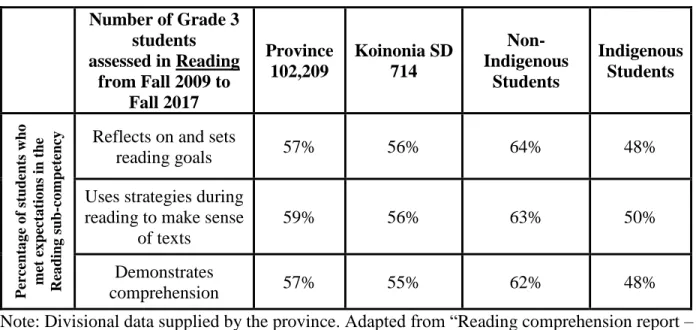
Table 2 Grade Three Reading Data 2009-2017 (Province and Koinonia School Division)… 61
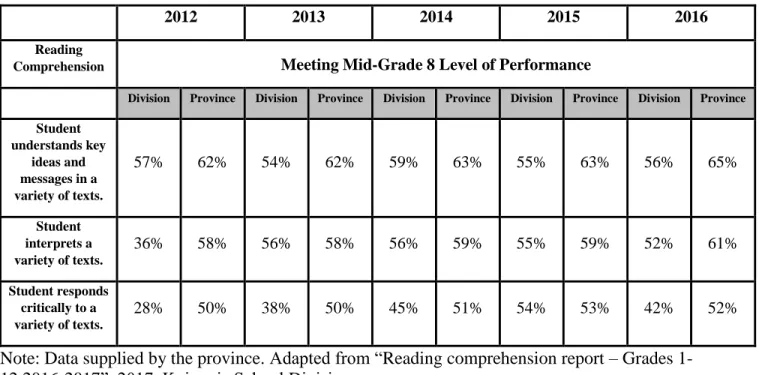
Table 3 Grade 8 Reading Comprehension – Mid Grade 8 Level Performance (Province and Koinonia School Division) ……… 62
List of Figures
Figure 1 Grade 3 Assessment Reading – Percentage of students meeting in all three sub-categories ……… 21
Acronyms
EDI – Early Development Index
F - Female
FTE – Full Time Equivalent
KSD – Koinonia School Division (a pseudonym)
M - Male
OECD – Organization for Economic Co-operation and Development
OIP – Organizational Improvement Plan
PCAP – Pan Canadian Assessment Program
PAC – Parent Advisory Council
PDSA – Plan Do Study Act
PESTE – Political, Economic, Social, Technological, Environmental
PoP – Problem of Practice
SOAR – Scholastic Online Assessment of Reading
SSHRC–CURA – Social Sciences Humanities Research Council – Community-University Research Alliances
Chapter 1: Introduction and Problem
This Organizational Improvement Plan explores the journey of a small, rural school division as teachers and leaders focus their energy to ensure that all children have the literacy skills necessary for success later in life. One purpose of schools is to serve society at large – to create a suitably educated population that can enter the workforce and pay taxes to support the country’s infrastructure. A secondary purpose of education is to foster a love of learning ensuring that children have the requisite skills enabling them to have the life that they want for themselves and to flourish. Ultimately, we want children learn and grow up to be skilled, democratic citizens with the character to be good neighbours and this requires that children can read and comprehend text at high levels. As organizations, schools benefit when the teachers have the skills and capacity to teach students to read and comprehend a variety of texts. While teachers require skills to be able to teach reading, school principals also require skills to be literacy leaders within their schools to ensure that students are achieving grade level reading outcomes. Divisional leadership, superintendents and assistant superintendents, lead their organizations to achieving this goals.
Organizational Context
Koinonia School Division (KSD) (a pseudonym) is a small, rural school division located in the Canadian Prairies. Spanning roughly 7000 km2, there are approximately 1000 students in ten schools. Enrollment has declined over the last five years from 1195 students in 2013-2014 to 1072 students in 2017-2018 (Koinonia School Division, 2017a). The school configurations are as diverse as the communities they serve with the most common being grades K-4, K-8 and 5-12. Given the small student population, most K-8 classrooms are multi-age and teachers typically do not have same grade level teaching colleagues within their own schools. All schools have a
principal, and some have vice principals. The vice principals are in place to develop the Division’s leadership capacity from within and not because there is an inherent need to have them due to the small size of the schools. The largest school would be a grade 5-12 school with approximately 200 students and the smallest, apart from the Hutterite Colony Schools, would be a K-12 school with 46 students. At the time of this Organizational Improvement Plan’s (OIP) publication, I will have left this organization to join another school board. This OIP, written in the present tense, reflects my original status and responsibilities with the organization.
Currently, 60% of the teaching population has ten or less years of experience and their average age is 45 years old. Within the 86 full time equivalent (FTE) teaching staff, there has historically been a 10% turnover each year with one or two retirements and one or two teachers who move on to other, larger centres. Of the principals and vice principals, the average years of experience is four years with formal leadership experience ranging from zero to 11 years of principal experience. The Division’s leadership team is comprised of principals and vice principals, a Literacy Lead Teacher, a Numeracy Lead Teacher, a Student Services
Administrator and senior management (Superintendent, Assistant Superintendent, Director of Operations and Infrastructure and Secretary-Treasurer). This team has also remained very stable with approximately one change every year occurring among the principals, primarily due to retirement. A team of teachers and school principals in the early stages of their respective career journeys provides both opportunities and challenges as personnel develop skills and evolve into their roles.
Koinonia School Division (KSD) serves a low socio-economic region with farming being a major source of income for families. Small family farms are on the decline as larger corporate
farming operations buy up land and consume what was once the family farm. Regional flooding in 2011 had a significant impact on the communities. One First Nations community was
completely flooded and has only recently returned to their homes in the last year. Valuable farmland was flooded and families had a difficult time recovering from this economic impact. The region has no other significant industry that would attract workers and the few immigrant families who have arrived to the area work primarily in the field of health care.
While the School Division understands the provincial drive towards trades and
apprenticeship, turning that into opportunities for students in the region remains limited because there are few businesses who can accommodate a high school apprentice. Following graduation, a small percentage of students move to a larger centre for post-secondary opportunities,
university or college, but many enter the workforce and remain close to their home communities. Two of the communities in the School Division have an interesting dynamic because many of the students’ fathers work away from home for a large power line company. These jobs do not necessarily require a high school diploma and it is sometimes a struggle for educators to support students to complete their requirements for high school graduation. Other students who remain in their communities may work in some of the local businesses or on the family farm. A few of these students will eventually go on to some form of post-secondary education or training.
Indigenous students. Students from several First Nations communities attend school in Koinonia School Division at various entry points. The federally funded, Indigenous education system has K-8 schools which First Nations students attend on their home reserve communities. Most of these students enter Koinonia School Division in grade 9 but some families choose to maintain residences off reserve to access the provincial system as catchment area students in
earlier grades. The Indigenous students who enter the provincial system in grade 9 are typically two to three grade levels behind in literacy. In the school with the highest number of
self-declared Indigenous students in the 2016-2017 school year, 42 self-self-declared Indigenous students started grade 9. Of those, 29 (69%) were more than two years behind in reading comprehension (Koinonia School Division, 2017b). In the same school, a year later, there were 33 self-declared Indigenous students and 13 (39%) of them were reading two or more grade levels below grade 9 using the Scholastic Online Assessment of Reading (SOAR) (Scholastic Canada, 2009) as a measure (Koinonia School Division, 2018). This provides significant challenges for teachers to have supports readily available for students who are reading and comprehending text well below grade level and to then also create a harmonious, integrated school experience for all the students who are entering high school.
A new challenge arose for the 2018-2019 school year. One of the First Nations
communities determined that it was in their students’ best interests to educate their high school students on their First Nation reserve for the upcoming school year. This decision affected one school in particular, effectively cutting their school population by more than a third. In May 2018, the First Nation community leadership provided the School Division with documentation of their intent to withdraw all of their high school aged children which necessitated transferring almost half of the teaching staff out of the school. Through resignations and attrition, the School Division was able to offer every teacher a position within the Division. In total, 63 First Nation students will remain in their community for the remainder of their high school education. This has had a significant impact on the affected school community. The staff was reduced by half and teachers had to accept positions elsewhere in the School Division which is geographically large. The shortest commute is now twenty minutes and the longest upwards of an hour each way
to go to work. The staff have worked hard in the last decade since the First Nation students started attending the school to develop programs and strengthen their curricula by including more Indigenous perspectives to better engage the students and meet their learning needs. There was also a period of mourning where staff and students had to say good bye to each other. There were strong relationships between people so this was and continues to be a time of adjustment.
All the schools have experienced shifts over the last decade with the most significant being declining enrollment. Family farms have been sold, small businesses shuttered as people move to larger, urban centres. The school communities, including staff and the Board of Trustees have had to adjust to this decline in student population which requires creative thinking and leadership to now best serve this changing population. With fewer students, it becomes increasingly challenging to provide a broad level of programming to meet diverse students’ needs. Teachers are required to teach multi-level classrooms not just at early and middle years but also in high schools.
Vision and mission. The School Division’s Vision and Mission were revised three years
ago with input from Senior Administration, staff, and the Board of Trustees who represent the larger community. Stakeholder involvement was important in the development of the statements to ensure that we heard voices from a broad cross section of people. The timeline for the
development of this work was focused and deliberate believing that the important work was is to make the statements come alive in each classroom for every learner. This work has aligned with the Division’s leadership philosophy of focusing on the quality of teaching and learning in each classroom.
The updated mission includes the belief that every child can learn and that high
expectations are held for each child. The mission statement inspires a culture where risk-taking is not only encouraged but expected, as well as the importance of ensuring places and spaces where children and staff are safe and welcomed. Strong relationships are seen as foundational
(Koinonia School Division website, 2019). The Superintendent’s Message points to a shift in the organization’s culture from one of management and operations to one where the focus at the school level is firmly on learning for every child (Koinonia School Division website, 2019).
When I began as Assistant Superintendent in 2011, principals were focused on management tasks like school budgets and fire drills with little time spent on instructional leadership. The current Superintendent had begun the process of shifting the culture from
management to instructional leadership ten years ago when she arrived in the School Division. In December 2012, the School Division, supported by a Ministry consultant and two professors from a local university, embarked on a transformation process to radically reimagine the School Division by September 2014. The process engaged principals, vice principals and teachers to focus on three lines of inquiry:
1. innovative pedagogy to support student learning, 2. technology integration as a pedagogical tool and 3. the learning environment.
Throughout the process, supported by the Board of Trustees, educators from across the vast geography met regularly to inquire into innovative teaching practices to support student achievement, consider ways to improve the overall school environment and examine how technology could be leveraged to engage students in learning. September 2014 marked the predetermined end of the transformation process but there have been residual effects that have
remained part of the School Division’s culture including a perceived willingness that teachers will take pedagogical risks if they might result in improved learning outcomes for students.
Provincial political climate. A consistent Superintendent with a strong vision has ensured a high level of stability for the School Division over the past ten years.As the Assistant Superintendent on the leadership team, the Superintendent and I have complementary skillsets. We have been supported by a Board who, in an era of cutbacks, has maintained $50,000 in the annual budget to support innovative teaching practices. The Board has also retained teaching positions even though staffing makes up more than 80% of the overall budget. There has been stability within the Board of Trustees with a change of only one seat in the 2014 election. In fall 2018, two of the seven seats on the Board changed in the Trustee election.
Politically, this is a time of transition with continued reductions in provincial funding. This year was no different with the School Division seeing a 2% reduction in funding from the Ministry. In the fall, as part of their budgeting process, the provincial government published an online survey which asked residents to support or oppose ideas such as the reduction of school divisions across the province, the reduction of senior administration in school divisions and the reduction of the number of bargaining units in the province, to control overall spending on education and ensure value for dollars spent on education (Province of Manitoba, 2018).
The Provincial government has recently undertaken a K-12 Education Review,
commissioners have been selected, written submissions will be accepted until the end of May 2019 and a series of public hearings will be held beginning in April 2019. The final report is expected to be made public in March 2020 (Manitoba Government, 2019). Alongside the political announcement of the Education Review, the Ministry of Education released its
document on Literacy and Numeracy in the province; a follow up to the Provincial Literacy and Numeracy summit held in January 2018. This document includes aspirational targets whereby 80% of students will be meeting expectations on the grade three and grade eight Provincial assessments and the grade 12 Provincial Standards test by 2027-2028 (Manitoba Government, 2019, p. 16). Education in the province appears to be a government priority and educators are awaiting the findings of the Education Review and the subsequent implementation of any recommendations.
Building capacity. Divisional energy has continued to focus on building the capacity of principals to ensure that student learning and achievement remains central to the work at the school level. This has prompted a year of activity where principals have reflected on their learning and leadership journeys over the last five years. The reflections and the ensuing discussions formed the foundation for the Superintendent’s message on the Division’s website. There is a recognition of the cultural shift from one of isolation to one of strong teacher
collaboration. Divisional schools have shifted from a culture of isolation to one of increased collaboration. Individual teachers may hold some of the answers but by working collaboratively, teachers and staff can more easily unlock the mysteries that impede students from making significant gains in their learning.
Koinonia School Division, though geographically large with few students, has been deliberate in focusing principals and vice principals on instructional leadership to support the academic achievement of each child. Teachers are supported to collaborate with each other as a way to improve student learning.
Leadership Problem of Practice
The issue at the heart of this Organizational Improvement Plan (OIP) is the fact that not all students are able to read and comprehend text at high or even functional levels. This OIP asks how strengthening the skills of principals and vice principals can support improved reading comprehension outcomes for students. A sub-question within this problem of practice identifies a lack of grade level reading comprehension skills for students, specifically self-declared
Indigenous students and a student population that is 40% self-identified Indigenous students (Koinonia School Division, 2018). This is a Divisional average and includes the two Hutterite Colony schools. The two high schools with First Nations that feed into them have a greater self-declared Indigenous population of 65% (Koinonia School Division, 2018). The United Nations Declaration on the Rights of Indigenous Peoples (2007) identifies in Article 17 a need to protect Indigenous children from interference with their education. The Article further identifies the importance of “…taking into account their special vulnerability and the importance of education for their empowerment” (p. 8). In the Truth and Reconciliation Commission of Canada: Calls to Action (2015), education is specifically identified as an action area. Recommendation 10 (ii) states a need to focus on “Improving education attainment levels and success rates” (p. 2). Having a transformative worldview is crucial to ensuring that a historically marginalized group of people can access education, specifically the ability to read and fluently comprehend text at high levels. Shields (2010) posits that the end goal of transformative leadership is one of liberty, justice and emancipation. This is required for our Indigenous students to make the significant educational gains that many of them require to ensure they are successful in achieving high school graduation and in their endeavours thereafter.
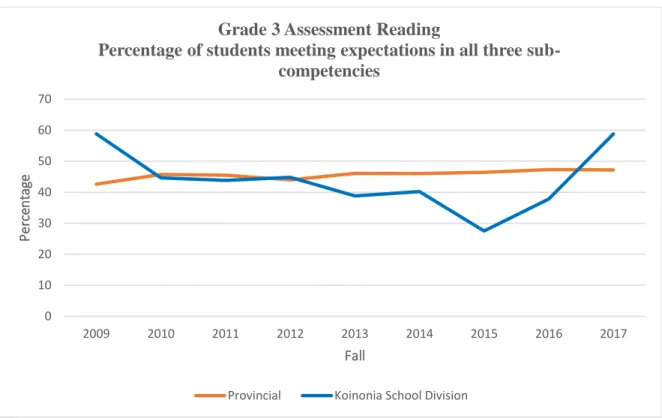
Early Development Index (EDI) data, collected every two years, show that students are increasingly entering grade one not ready in one or more domains (Healthy Child Manitoba, 2016-2017). The provincial grade three assessment in literacy consistently shows that students are not meeting expectations in literacy in this province. The assessment, given in the fall of grade three, measures end of grade two learning outcomes. As shown in Figure 1, the provincial data of students who are meeting expectations in all areas of reading comprehension continues to fall below 50% and the school division data is trending towards a slight improvement as
compared to the provincial data.
Figure 1. Grade 3 Assessment reading: Students meeting all three sub-competencies
Grade 9 credit acquisition in literacy remains low and divisional graduation rates, as calculated by the province are also well below the provincial average. When that data is disaggregated, it
0 10 20 30 40 50 60 70 2009 2010 2011 2012 2013 2014 2015 2016 2017 P e rc ent ag e Fall
Grade 3 Assessment Reading
Percentage of students meeting expectations in all three sub-competencies
shows that self-identified Indigenous students are not performing on par with non-self-identified Indigenous students (Koinonia School Division, 2017, 2018).
Students who graduate from high school as literate members of society have a better quality of life, experience fewer mental health concerns and have greater opportunities and earning potential. The Organization for Economic Co-operation and Development (OECD) (2016) states that:
…literacy is associated with many positive life outcomes: individuals with better literacy proficiency are less likely to be unemployed, earn higher incomes when they are employed, are more likely to report being in good health, to volunteer, trust others and feel that people like them can have a say in what the government does. (p. 1)
The Manitoba government document (2019a) identifies that, “literacy and numeracy skills are strongly correlated with positive health, social and labour market outcomes” (p. 2). The provincial Ministry of Education has placed an increasing emphasis on improving students’ literacy rates. The current government has conducted a large-scale consultation where roughly 1000 stakeholders came together to provide input into the requirements of a provincial literacy and numeracy strategy. The most recent Pan-Canadian Assessment (PCAP) data shows that the province is in the bottom third of the country in reading (O’Grady, Fung, Servage, & Khan, 2016).
The School Division engages in a strategic planning process and the Board of Trustees, as elected members of their communities, represent the public through this process. Parent and community input are sought through meetings with Parent Advisory Councils (PACs). Having children reading at or above grade level continues to be important to stakeholders so students
who graduate from high school have more than a functional literacy level to have access to any opportunities in life which they wish to pursue. The Board of Trustees has not specifically made the statement that all children must be reading by the end of grade one but place an emphasis on having all children reading at grade level by the end of grade three. This takes into consideration some of the socio-economic factors such as mobility and transiency that disrupt children’s learning.
As the Assistant Superintendent, I work with the principals and vice principals to support their skill development as instructional leaders specifically in the area of literacy. I also track and analyse Divisional data about student growth and achievement at the school and Divisional levels.
Leadership Position and Lens Statement
In my leadership role, I embrace a transformational leadership style in supporting and encouraging innovative practices and dealing with individual situations. Northouse (2016) suggests that leaders create the vision which is then embraced by the followers. However, it is up to the leaders to support the followers in making the changes needed to reach the vision. Bass (1995) provides the following definition:
Transformational leaders were defined as those who: (1) motivated you to do more than you originally expected to do, (2) raised your level of awareness about important matters, (3) increased your level of needs from need for security or recognition to need for
achievement or self-actualization, and/ or (4) led you to transcend your own self-interests for the good of the team or the organization. (p. 469)
The reciprocal nature of transformational leadership aligns with the culture of Koinonia School Division (KSD) where ample time is spent developing a broad level of understanding among the principals and vice principals and engaging in small and large group conversations to ensure that all voices can be heard and honoured within that group. Yukl (1999) identifies transformational leadership as being an approach that has identified characteristics that can be taught to and learned by a leader as well. Yukl (1999) also offers that transformational leadership is entirely appropriate when an organization is going through a change process making this leadership style relevant to this Organizational Improvement Plan (OIP). Within Koinonia School Division (KSD), as part of the leadership team, I spend time with each principal and vice principal, in their school, to support them in enacting the vision for change set out by the
Division. Each school leader is given just in time support that is custom fit to the school context so that change may be carried out at the school level. Some schools have sole charge principals and I have become their sounding board as they work through their decision-making processes.
As the Assistant Superintendent, I have developed positive working relationships with the principals and vice principals and my work is to help them to grow and develop as leaders. This is done by exhibiting some of the things identified by Aguilar (2016) and exhibiting genuine interest and care in their schools and in their lives. As well, this is cultivated through an authentic curiosity in the teaching and learning process that occurs in each school. As Leslie (2014)
articulates, “…a society that believes in progress, innovation and creativity will cultivate it, recognizing that the enquiring minds of its people constitute its most valuable asset” (p. 8).
There is an element of distributed leadership here because I do not hold the capacity, the position or the interest to lead each of the schools individually. The principals must be
empowered to make day to day decisions about their schools and their learning agendas based on students’ and teachers’ needs. Prior to entering school and system administration, I was a high school English teacher and I do not hold all the pedagogical answers for early years’ literacy practices. I rely on the considerable skills of some of the early years’ principals when we
consider how to best approach reading comprehension with younger students. As pointed out by Bush and Glover (2014), one of the limitations of transformational leadership is that “…the language of transformation may be used to secure the implementation of centrally determined policies, not the identification of school-level vision and goals” (p. 566). Thus, it will take the collective work of the leadership team to implement a change process that will improve all students’ reading comprehension.
Koinonia School Division (KSD), as outlined on its organizational chart, functions as a hierarchy. The Superintendent/CEO is the sole employee of the Board. There are a number of competing ideologies that impact this problem of practice. As a leadership team, the
Superintendent/CEO and I would in one sense embrace a liberal approach to leadership and the principals in KSD would have opportunity to lead fearlessly in their schools with significant autonomy. One example of the principals’ autonomy is having control over how they spend some of their budgets. Schools receive some of the money that is allocated categorically by the province and they can spend it as they deem appropriate for the work that they wish to do in their schools. One school consistently uses that money to “buy” additional educational assistant time while another school uses that money for additional teaching materials and school resources.
The Board of Trustees would view the world through a conservative lens. As elected officials of the community, they model fiscal restraint and desire robust evidence to ensure that
students are making progress. However, despite their need for quantitative data and a desire to have common, externally driven student assessments, trustees have been continually supportive of setting money aside in the budget to support innovative teaching and learning practices.
Due to the vast geography of the School Division, no two communities are the same and top down, imposed models for the schools would be detrimental to their flourishing as healthy institutions. For example, one K-4 school, with 90 students, groups all the students and all the teachers for a 100-minute literacy block according to students’ and teachers’ abilities. The teachers work with the students they are best able to teach rather than the students in their homerooms. The children move freely between classrooms as they gain skills in reading comprehension based on teachers’ assessments and conversations with the other teachers. This model works in this school because of principal leadership, staff cohesion and communication with the community which has led to a common understanding of the dynamic nature of learning. While there is no specific Board policy regarding the implementation of a balanced literacy program, there was a shared decision-making process at the principals’ leadership table and they had voice in the creation of the School Division’s Balanced Literacy Framework K-8. School visits made by the Superintendent and the Assistant Superintendent focused on the literacy block and the specific progress that the priority learners were making in reading comprehension.
The Senior Leadership team will be encouraged to embrace a critical lens to see this problem of practice. It is imperative that examining the system for inequities and ensuring the same high-quality teaching happens in each school regardless of demographics. Rather than using a formula funding model to resource schools, resources are allocated based on need, which
is determined by school-based data. This data includes student stability, mobility, attendance, behaviour, number of students with special needs, literacy and numeracy levels, credit
acquisition and the number of students in foster care. These criteria were co-constructed by the principals and vice principals eight years ago and marked a shift in thinking from “my school” to “all of our schools.”
There is a neo-liberal aspect to leadership in this problem of practice because students are being prepared to enter the workforce after graduation and it is crucial that students have the skills to be successful. Some students are engaged with high school apprenticeship and work experience opportunities so that they may see what careers are available to them following high school. Koinonia School Division (KSD) supports career fairs and career days so that students can make informed choices about their futures. Since the province introduced legislation to keep students in school until age 18 or until they earn a high school diploma, alternative programming has increased. One example is a grassroots program that focuses on educational growth
opportunities for students who are disengaged from school. Funded in part by a federal employability skills grant, this program offers students who have dropped out of school an opportunity to learn life skills such as cooking, getting regular sleep and packing a lunch while living together for several weeks in a camp. Students learn basic literacy skills in a small group and they participate in several weeks of work experience at a job in which they are interested. At the end of 11 weeks of programming, students earn three credits and are supported to re-engage with school to complete their high school education. This has created some success for a few of the Indigenous learners who had either already dropped out of school or were on the verge of leaving school. These learners built some connections between school and creating a life with
choices and opportunities after school. Some employers expressed interest in hiring the students who had participated in the program once they completed high school.
Embracing change, articulating a vision and walking the messy path of change as a leader is part of my philosophy of change. The challenge is to take this philosophy and adapt it for a functionalist system that, while it wants to change, does not move as radically or as quickly as possible. Further, I have no desire to completely eradicate the functionalist from the system as it allows for the maintenance of positional authority. I embrace a transformational leadership style, described by Northouse (2016) that binds together the follower and the leader to achieve great things. Blackmore (2013) identifies the lack of “theoretical or political position” of the various leadership approaches (p. 140). She goes on to write, “Certainly, some contemporary leadership discourses about transformational and distributed leadership, for example, offer socially just possibilities” (Blackmore, 2013, p. 140). I believe that as a system leader, I have both the capacity and the moral imperative to make the system better for students. As a system leader, I profess to build social and professional capital in principals, teachers and support staff to improve an entire school system. When Hargreaves and Fullan (2012) describe how to enact change, they envision a system where teachers are drawn in to work collaboratively to solve “complex problems” (p. 151) and rather than run from barriers, teachers and principals see them as opportunities. To do so, I would invite input from all stakeholders and with the goal of building social capital, create an organizational culture where risk-taking is the norm. Although the system is hierarchical, through distributed leadership, schools have some autonomy to enact change within their contexts. Imposing one model for all schools will not bring about lasting, systemic change. As Andrews, Cameron and Harris (2008) point out, the “hero leader” (p. 301)
no longer features prominently in organizations; a variety of positions play a role in the change process.
Framing the Problem of Practice
Change and system improvement are critical in this problem of practice. Students, particularly Indigenous students, cannot continue to experience low graduation rates. When students have grade level literacy rates, the overall quality of education improves for all students. The evidence of improvement is also visible in high expectations for all students. No longer are students appeased with less complex material to comprehend which limits access to new ideas and overall capacity to engage in critical thinking and building connections with the world outside of school.
Leadership - principals and vice principals. First, this problem of practice is a challenge for leadership. Principals and vice principals, as the instructional leaders in their school, require the necessary skills to enable them to lead teachers in this change practice. This will frame my work with school leadership teams and with the support of the Literacy Support Teacher will ensure that there is a common understanding of quality literacy instruction. Simply observing a small group of students and a teacher around a horseshoe table does not alone stand as a quality instructional practice.
At the school level, principals will engage their teachers in a collaborative inquiry or action research cycle to address the specific learning needs of teachers and students in a given school context. In an Ontario Ministry of Education (2014) monograph, the authors outline a collaborative inquiry strategy that focuses on deepening the principals’ theory of action which subsequently supports teacher learning. The stages of inquiry are straightforward, observe, plan
and act with reflection built into each level. Breakspear’s (2018) Learning Sprints follow a similar path of plan, sprint and review. Breakspear’s (2018) Learning Sprints are predicated on teachers focusing on their next learning outcomes, with a targeted group of students and making small changes to teaching practice to support teacher learning which will subsequently improve student learning.
Breakspear’s (2018) learning sprints have evolved from the technology sector where missed deadlines and project cost overruns were costing companies millions of dollars. Relying on elaborate planning processes meant that technology was dated before it could get to
development. Recognizing the need for agility, they adapted their processes to move more quickly from the planning stages to the action and reflection components. Sutherland (2014) describes the change process in Scrum which details short, iterative change cycles. A key component of the process is the weekly scrum meeting with team leaders to check for progress, identify roadblocks and determine the path forward.
These change cycles also conform to Lewin’s Action research cycles. According to Burnes (2004), “The theoretical foundations of Action Research lie in Gestalt psychology, which stresses that change can only successfully be achieved by helping individuals to reflect on and gain new insights into the totality of their situation.” (p. 984) So as a conceptual way to manage change, action research then requires that the researchers, as individuals, need to be able to observe and understand the changes that are taking place because of their actions. Burnes (2004) goes on to say that for action research to be effective it must be collaborative and feel
target a group of learners in a learning outcome. Teams collaborate to increase their understanding of the learners and the impact of the teachers’ actions on those learners.
Another strength of this problem of practice is the examination of the leadership required to make the systemic improvements to address the students’ low levels of reading
comprehension. This problem requires transformational leadership at the system level to engage in creative solutions to address a longstanding problem. It also requires school-based leadership that may be transformational but may also be distributed among the principal and the teachers to ensure that teachers acknowledge and understand the need to work at improving reading
comprehension outcomes for students. Although transformational leadership is the main leadership theory to thread through this problem of practice, it is worth considering other
leadership theories such as creative leadership. As Stoll and Temperley (2009) identified in their study of creative leadership teams, there is a need in school leadership to think beyond the status quo and to seek solutions that have not been tried yet. Often, educational practitioners run to tried and true solutions rather than using relevant data to think differently about a problem. Creative leadership is another way of approaching change by using “out of the box” thinking to improve learning outcomes for students. Mainemelis, Kark, and Epitropaki (2015) conjecture that creativity in leadership is no longer just an add-on. Without creativity leaders have little success in moving their organizations to the next level. While reading comprehension has been isolated in this problem of practice, improving reading will also help to improve students’ writing as they are intricately linked together. Improving students’ reading comprehension will serve students as they engage in math as well since much of the focus of problem-solving rests on the ability to be able to read and comprehend what is being asked and then having the
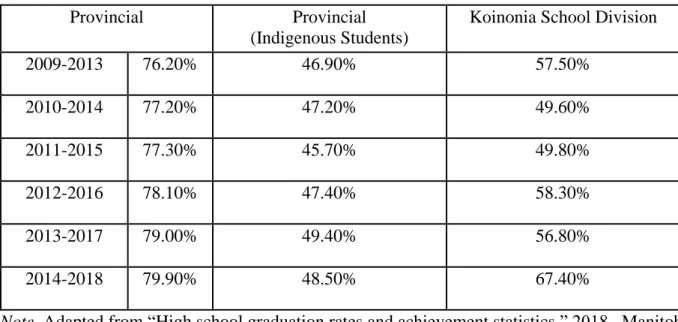
Teaching students to read is one of the foundational tasks of schooling. It is a building block of the education system and having students graduate from schools with well-developed literacy skills is the desired outcome. However, the provincial graduation rates for a four-year, on time graduation from June 2013 to June 2018 continue to range from 76.2% to 79.9%. The disaggregated data paints a different picture with Indigenous students’ graduation rates ranging from 45.7% to 49.4% in the same five-year period (see Table 1). The overall, four-year
graduation rates for Koinonia School Division in the same time period ranges from 49.6% - 67.4%. While this marks an improvement, much work remains to be done.
Table 1 On-Time 4-Year Graduation Rates
Provincial Provincial
(Indigenous Students)
Koinonia School Division
2009-2013 76.20% 46.90% 57.50% 2010-2014 77.20% 47.20% 49.60% 2011-2015 77.30% 45.70% 49.80% 2012-2016 78.10% 47.40% 58.30% 2013-2017 79.00% 49.40% 56.80% 2014-2018 79.90% 48.50% 67.40%
Note. Adapted from “High school graduation rates and achievement statistics,” 2018, Manitoba Education and Training.
If the desired result is to have all students achieve high school graduation, then the evidence is clear that the goal is currently unmet. Further, if low literacy rates are
contributing to poor graduation rates then increasing students’ reading comprehension levels would assist in improving graduation rates even if all other factors contributing to students’ graduation rates remain the same.
Coaching practices. Other literature that is relevant to this problem of practice is the literature around coaching practices and the role of coaching in the schools. The importance of the role of instructional coach as part of the change process is increasingly evident in the literature (Aguilar, 2016; Fullan & Knight, 2011; Knight 2011, 2016). Coaches require specific training to gain a clear understanding of their role, purpose and how they might engage with classroom teachers. Little impact on teaching and learning can be made by deploying coaches to schools without a clear understanding as to their specific role and purpose in the school and in the teacher’s classroom. With clarity, purpose and a vast pedagogical toolkit, coaches could have a profound impact on teacher learning and subsequently on students’ learning outcomes.
Teacher efficacy. Research on teacher efficacy also factors into this problem of practice. Teachers have to believe that the work that they are doing in classrooms can make a difference for the children that they teach. Versland (2016) notes that mastery experiences, vicarious experiences and feedback all factor into students’ and teachers’ self-efficacy. It would be interesting to determine how great an impact a lack of mastery experiences has on students’ achievement levels and furthermore how research on grit and resilience might play into students’ future successes.
PESTE analysis. Political - The provincial political agenda creates a sense of urgency for this problem of practice. Given that the province engaged stakeholders in a large literacy and numeracy summit in January 2018, it is reasonable to assume that improving students’ reading comprehension skills aligns with the provincial agenda. At meetings of School Superintendents, the Assistant Deputy Minister continues to mention
the province’s desire to be the most improved province following the next Pan Canadian Assessment Program (PCAP) assessment which will take place in spring 2019.
Economic – From an economic standpoint, addressing this problem of practice stands to have an impact on the economy. The more students who are highly literate, the better off they are in the future job market which translates to a society in which
everyone is able to contribute fully. When people have well-paying jobs, they are able to buy homes, cars and purchase other goods and services which supports a healthy
economy.
Social – The social standpoint is the most important for this problem of practice because it continues to be a matter of social justice that our Indigenous students are not succeeding at the same rates as their non-Indigenous counterparts. The cycle of failure needs to be replaced with a system where all children truly can learn and reach their full potential.
Technological – There is no technological challenge or requirement for this problem of practice. The schools have the requisite technology required to support learners in diverse contexts. The proposed solutions will not explicitly require a technology component for successful implementation.
Environmental – A scan of the environment encompasses the views of the parents and the communities that encompass Koinonia School Division. We would be wise to continue to invite parents to be part of this process and engage in them in ways to support ongoing learning at home.
Challenges. A challenge of this problem of practice is the lack of clarity around determining grade level reading outcomes at the classroom, school and provincial levels. There is no single tool that is common among educators to determine students’ abilities in grade level reading comprehension. While Koinonia School Division has taken steps to have all grades 1-8 students assessed using the Fountas and Pinnell Benchmark
Assessment (Fountas & Pinnell Literacy, 2019), there are apparent discrepancies in assessment practice among educators relating to students’ results which are especially evident when students transition from one school to the next. Although educators have access to the previous years’ data, sometimes there is an inexplicable drop in a students’ abilities that does not align with previous assessments or report card data specifically i n reading. The province does not have indicators at each grade level to support teachers in determining report card grades making report card data problematic.
A second challenge to this problem of practice is with competing ideologies at work within and around the organization. A neo-liberal Ministry of Education that is focused on improving the economic outcome of people in the province, a conservative Board of Trustees that prides itself on fiscal responsibility while meeting the needs of students stands in some opposition with a more liberal minded senior leadership team who prefer less government involvement and more autonomy to do the right kind of work to meet students’ needs within the local context.
Guiding Questions Emerging from the Problem of Practice
There are several questions of inquiry around leadership and the principals’ abilities to determine whether or not there is effective reading instruction taking place in each classroom on a daily basis. As principals are supervising their teachers, are they seeing effective, high quality
instructional practices taking place in each classroom, every day? Do they recognize quality guided reading lessons or do they assume because the teacher is with a small group of students around a horseshoe table that it must be a quality lesson? Principals come to the role with a variety of backgrounds and experiences and not all have a strong understanding of early literacy. It becomes necessary to create a supportive culture where principals and vice principals are able to talk about their strengths as well as their limitations and to create opportunities for them to develop their skills and hone their abilities to recognize quality literacy instruction.
Other challenges that emerge from the problem of practice are ensuring that all parts of the system are aligned in supporting quality reading instruction. Further, each classroom needs resources to adequately teach children to read. These resources include classroom libraries with high quality children’s literature and books that are organized, accessible and visually appealing to children. Books should be at children’s eye level and made available to them to take home and practice reading. School libraries should have a variety of fiction and non-fiction books as well as poetry and magazines available to engage children on topics that relate to other curricular areas as well as topics that will spark students’ attentions.
Currently there is an inequity in the way classrooms are resourced. Veteran teachers have spent years collecting books for classroom libraries, which vary in quality because they come from garage sales, second-hand stores or have been left by previous teachers. New teachers have not yet amassed a classroom library so children in those classrooms do not have the same access to books. This can be rectified by determining a minimum number of books for a classroom library and then resourcing schools to be able to purchase books to meet the requirement.
There are several additional lines of inquiry that emerge from this problem of practice. The first is a line of inquiry into quality reading instruction. Do teachers have the ability and capacity to effectively teach primary children to learn to read? Allington and Gabriel (2012) identify six elements of reading instruction which include: reading something that a student chooses, reading accurately, hearing an read aloud, reading something they can comprehend, writing something of their own choice and talking about writing with peers. These are echoed in the work of Miller (2009), Atwell (2015), Boushey and Moser (2006), and Ripp (2018) who talk about the need that children have to read something of their own choice and to read for sustained periods of time every day. Is early years reading instruction centred around the pillars of literacy – comprehension, fluency, phonics, phonemic awareness and vocabulary? Are children receiving personalized instruction to assist them in their growth and development as readers? All these questions relate to the skill and experience of the classroom teachers who are teaching children to read.
Contributing to the problem of practice where many students are unable to read and comprehend text at high levels is poverty and transiency. Children come from homes where school is a safe place and much time and energy is spent in schools ensuring that children feel cared for and secure. This comes at a cost of instructional time and sometimes, children are not encouraged to attain high levels of achievement because of their socio-economic status. Teachers spend their time caring for the children and teaching them basic skills but may not maintain high expectations for all students. Consequently, they modify the instruction so students are able to be successful with grade level outcomes. After multiple years of not independently meeting grade level expectations, the gap widens and becomes increasingly difficult to close and keep students engaged in meaningful, grade level work.
Vision for Organizational Change
The vision for organizational change was originally co-constructed by the Superintendent and myself as the Assistant Superintendent. After reviewing report card data specific to reading comprehension and comparing it to the Provincial Assessment data at grades 3 and 8, it is clear that students are not achieving at high enough levels. Lower achievement rates are impacting graduation rates especially for more vulnerable students. In some instances, there is a gap
between students’ report card achievement and their Fountas and Pinnell Benchmark Assessment (grades 1-8) (Fountas & Pinnell, 2019) or Scholastic Online Assessment of Reading (SOAR) (Scholastic Canada, 2009) (grades 5-12) Lexile score. While the report card data specific to reading comprehension showed that the majority of students were getting a 3 or a 4 on the four-point scale, this does not align with how students perform on a reading comprehension
assessment or the numbers of students who are “meeting expectations” on grades 3 and 8 Provincial Assessments.
There are gaps when students transition from grade to grade but more significantly from school to school such as from grade four to grade five. Students who had been performing well beyond grade level on the Fountas and Pinnell Benchmark Assessment in the spring of grade four slid to below grade level in the fall of grade five. These students had presumably already made the shift from learning to read to reading to learn so “summer slide” should not have been a significant factor.
The principals and vice principals, upon reviewing their own disaggregated data, reinforced the need to work harder at supporting students to be successful. As senior
we were not having the desired impact on student learning and student achievement. The Board of Trustees also reviewed broad, Divisional data and echoed the need to have improved reading comprehension as part of the Divisional Learning Vision and one of the Division’s goals. Aligning with Hattie’s (2009) meta-analysis, the vision is articulated in two statements.
1. All students will be reading and writing at grade level at the end of grade 3.
2. All students will demonstrate a year of growth in reading and writing in a school year. (Koinonia School Division, 2015)
These statements speak to both growth and progress and recognize that students may begin the school year not reading at grade level, but they need to make significant gains in order to match the progress of their peers. Also, students who are reading above grade level at the beginning of the school year must also experience growth through enrichment and not be allowed to stagnate simply because they are already capable of handling the grade level materials. Making these statements instilled both trepidation and excitement in principals, vice principals and teachers. There were some who were ready to accept and embrace that challenge. Others were fearful that their students were so far below grade level that there was no way that they would make enough gains in their reading comprehension to come close to reading at grade level. This begs an additional question, do the teachers and principals really believe the students are capable of reading at grade level?
Having a vision cannot come without a balance of pressure and support. Principals and vice principals needed to know that we were supporting them in developing the requisite skills to be able to support their teachers in this challenge. There are also priorities within this change process as the Indigenous students are further behind by the time they are in high school than
their grade level peers. Since two of the schools have students entering from the federally funded First Nations schools at grade nine, that is Koinonia School Division’s first opportunity to
support these students in their learning journey. Until the students reach high school, there is a disconnect between the two systems and the staffs do not work together on any professional learning or moderate student work together to develop a common understanding of what grade level work might look like across schools.
Fullan (2011) identifies several key drivers for whole system reform which are intrinsic motivation, instructional improvement, building capacity by working together and engaging in work collectively as an entire system. Through transformational leadership, principals, vice principals, the Board and teachers are inspired and motivated to engage in the real work of improving reading comprehension outcomes for all students. There is also excitement when teachers consider that they have an opportunity to create enriched learning opportunities for students who have already met grade level reading outcomes and are ready to reach for bigger goals and expand their learning journeys. Fullan (2011) expresses that the drivers of change need to focus on the collective and not just on the individual teacher or the individual principal. To have the greatest impact, the entire system has to be moving forward towards the same goal.
The Board, as elected representatives of communities and as key stakeholders in the School Division, have a vested interest in seeing children be successful. The parents and guardians of the children want the best for their children and continue to be optimistic that the teachers will have the skills to do the best that they can for their children. There may be
opportunities through this change process for parents and community members to engage more actively with supporting children to improve their reading levels. This may look like pre-school
programs working closely with the schools to develop quality early literacy programming to engage the children prior to their entry into Kindergarten. It may involve community resources through some of the library programs and even the community recreation programs which could engage in some literacy activities. Regardless, the principals, vice principals, teachers, staff and the larger community recognize and understand the value to their communities of having children who are highly literate.
Kouzes and Posner (2012) clearly describe the importance of having a shared vision and clarifying values both personally and organizationally. The act of co-constructing a shared vision supports a broad level of engagement from principals and vice principals as well as the Board and community members. They contend, “Leaders ensure that everyone is aligned through the process of affirming shared values – uncovering, reinforcing, and holding one another
accountable to what “we” value” (Kouzes & Posner, 2012, p. 58). For this OIP, principals and vice principals affirm the value that every child must be able to read and comprehend text at high levels and willingly work together to achieve that goal.
As one of the key change leaders in the School Division, my leadership focuses on several factors. I direct the work of the Divisional Literacy Lead Teacher and thus provide the necessary framework and supports to ensure that she is able to spend most of her time in schools and in classrooms. Through the budget, each teacher is allocated one full day with the Literacy Lead Teacher but most teachers access more support than that through their school-based budgets and use of roving substitute teachers. I lead through my work in the schools and the support that I provide principals specific to their literacy data and the next steps that need to happen in the schools to support teacher learning and student achievement. I meet with principals
and vice principals each month and review their school data, tour classrooms, debrief and plan for next steps specific to their identified priority learners. The other vital piece of my leadership is protecting the schools from things that will distract from the real work.
Organizational Change Readiness
This organization’s readiness for change began in 2012 when we embarked on a
Divisional change process. The Superintendent invited teachers to attend an after-school meeting in December. At that meeting she informed the assembled group of teachers that although they were working hard, student achievement was not aligned to the hard work of teachers and continuing to do the same things was not yielding different results. Something had to change to improve student achievement and student engagement. That evening, 70% of teachers were in attendance. Most of them agreed and continued to participate in this change process. Koinonia School Division embarked on a journey called “Reimagine” which led teachers through a five-step design process over the course of two years. The process was supported by the School Board which allocated thirty thousand dollars that year and in subsequent years to support teachers in reimaging learning and teaching in their schools and classrooms. Teachers were asked to think of ways that they wanted to teach and where they believed there were roadblocks. If a roadblock was money, then these additional funds would support removing the roadblock and making the idea a reality. Teachers and principals delved into research, participated in learning tours in the province, in Canada and in the United States to look at exemplary practice and bring ideas back to their context. Additional support was provided by the Provincial Ministry of Education in the form of a Consultant who supported the process with expertise in the design process. Finally, funding was also provided by a local university who had received a Social Sciences and Humanities Research Council–Community-University Research Alliance