A Three Dimensional Perspective
Von der Fakult¨at f¨ur Mathematik, Informatik und Naturwissenschaften der RWTH Aachen University zur Erlangung des akademischen Grades eines Doktors
der Ingenieurwissenschaften genehmigte Dissertation
vorgelegt von
M.S. Fahad Samad aus Karachi, Pakistan
Berichter: Universit¨atsprofessor Dr. rer. nat. Dr. h. c. Otto Spaniol Universit¨atsprofessor Dr. rer. nat. Peter Rossmanith
Tag der m¨undlichen Pr¨ufung: Mittwoch, 22. Juni 2011
Diese Dissertation ist auf den Internetseiten der Hochschulbibliothek online verf¨ugbar.
thick coagulated blood). Read! And your Lord is the Most
Generous. Who has taught (the writing) by the pen. He has
taught man that which he knew not.”
“Coming together is a beginning. Keeping together is progress. Working together is success.”
- Henry Ford (1863-1947)
This work is done at the Department of Computer Science 4 (Informatik 4), the RWTH Aachen University, Germany. The Informatik 4 which is now known as COMSYS targets its research towards the area of communications and distributed systems. I would like to thank Prof. Dr. Otto Spaniol who gave me the possibility to write a doctoral thesis in his research group. He not only supported me as a Ph.D. adviser but he also made me learn far more than just the things that can be learned in a computer science department. Considerable recommendations to this work were provided by my second supervisor Prof. Dr. Peter Rossmanith and also by Prof. Dr. Ulrike Meyer. I would like to thank her for her outstanding help and her commitment to spend so much effort in relation to this work.
There are several more people I need to thank in reference to this work. This work would never be the same without the extensive discussions with my colleagues and friends of Informatik 4 and the other staff of the RWTH Aachen University. Especially, I want to thank in this regard my colleague Mr. Sadeq Ali Makram and my students Mr. Qassem Abu Ahmad and Mr. Shankar Karuppayah who were always available to discuss issues related to this work and helped me to stay on the right track. Finally, I would like to express that I would not be who I am and where I am without my family. I thank my mother and sisters for the love and a sense of association they give me every day. Words can not express what they mean to me.
Wireless Mesh Networks (WMNs) are multi-hop networks that have secured a significant position in the technological world due to their unique charac-teristics. These networks are dynamically self-healing, self-organizing, and self-configurable. They help to realize the future of network connectivity anywhere and anytime. Moreover, WMNs substantially minimize the com-plexity in network deployment and maintenance hence reduce the deployment costs of the networks. A WMN consisting of mesh routers with multiple network interfaces can significantly improve the performance and aggregate capacity of the network. While these mesh routers usually have minimal mobility, mesh clients can be either stationary or mobile. These networks can provide facilities to enhance the performance of wireless local area networks (WLANs), metropolitan area networks (WMANs), and ad hoc networks.
Moreover, they can be utilized for a variety of applications such as broad-band home networking, community networking, transportation systems, and building automations.
In order to provide multi-hop authentication in WMNs, different schemes have been proposed over the years. Many of these schemes have certain limitations. Either the schemes use cryptographic mechanisms which are computationally complex or assume to have centralized key distribution and authentication strategies. However, a WMN does not usually have a centralized trust and being a multi-hop network, does have relay nodes. Therefore, security solutions in these networks must be computationally efficient, lightweight, and must handle the additional threats possible from relay nodes. For instance, WMNs are highly prone to severe security attacks such as denial of service attacks. This sense of being insecure demotiv-ates the companies to deploy and provide state-of-the-art wireless services through WMNs. However, if these security issues are efficiently handled, these networks have the ability to provide multiple services to their users concurrently such as online banking, community based file sharing, and live video streaming etc. Moreover, the nodes in WMNs might have distinct resources available (e.g. hardware) and undergo distinguishable security requirements. The ability of WMNs to provide multiple types of network
services and the presence of distinct resources in these networks raise the importance of having different levels of security services. The customers using the network services should be able to chose the required security level based on the their needs (e.g. based on the type of service/application) and availability of resources.
In this thesis, we try to present the security issues of WMNs in three dimensions. Firstly, we present a protection mechanism based on neigh-borhood trust to gain efficient authentication of nodes and identification privacy in a clustered WMN. Our approach renders a lightweight protection using hash chains and does not require any trusted authority rather develops mutual trust among nodes in the network based on communication history. We then introduce a secure connection establishment scheme based on neigh-borhood trust. It preserves anonymity of any two communication parties using a lightweight authentication scheme. In addition, it also offers seamless and secure connectivity to mobile nodes. Our proposed solution applies to both mesh and ad hoc networks. Secondly, we propose a requirement-and resource-friendly security framework established on Merkle trees requirement-and adaptive security service-level association mechanism to provide fast authen-tication and tunable security association among nodes in WMNs based on the availability of network resources and application requirements. Finally, we propose two schemes to mitigate two rather vicious denial of service attacks known as channel assignment attacks and jellyfish attacks in both wireless mesh and ad hoc networks.
List of Figures xvii
List of Tables xxi
1 Introduction 1
1.1 Motivation . . . 1
1.2 Organization of thesis and summary of contributions . . . . 3
1.3 Publications . . . 4
2 An Overview of Security in Wireless Mesh Networks 5 2.1 Wireless Mesh Networks . . . 5
2.1.1 Classification of WMNs . . . 6
2.1.2 Features of WMNs . . . 7
2.2 Comparison of Wireless Mesh and Ad hoc Networks . . . 8
2.3 Applications of WMNs in the Real World . . . 9
2.4 Open Research Challenges in WMNs . . . 11
2.5 Security in WMNs . . . 12
2.6 Vulnerabilities and Attacks in WMNs . . . 13
2.6.1 Passive Attacks . . . 13
2.6.1.1 Passive Eavesdropping . . . 13
2.6.1.2 Traffic Analysis . . . 13
2.6.2.1 Physical Attacks . . . 14
2.6.2.2 Misbehaviors . . . 14
2.6.2.3 Unauthorized Access . . . 15
2.6.2.4 Message Forgery and Replay Attacks . . . . 15
2.6.2.5 Man-in-the-middle Attack . . . 15
2.6.2.6 Denial of Service Attacks . . . 15
2.7 Characteristics and Demands of a Secure WMN . . . 17
3 Trust Based Protection in Clustered Mesh Networks 21 3.1 Introduction and Motivation . . . 21
3.2 Existing Work and their Limitations . . . 22
3.3 Neighborhood Trust in Clustered Mesh Networks . . . 24
3.3.1 Definitions . . . 24
3.3.2 Assumptions . . . 25
3.3.3 Phases of the Proposed Scheme . . . 26
3.3.3.1 Initial Network Bootstrapping . . . 26
3.3.3.2 Clustering . . . 28
3.3.3.3 Inter-cluster Key Exchange . . . 28
3.3.3.4 Neighborhood Based Trust Management . . 30
3.3.3.5 Secure Intra- and Inter-cluster Message Ex-change . . . 32
3.3.4 Renewal of Credentials . . . 32
3.4 Handling Security Threats and Privacy . . . 34
3.4.1 Security and Privacy Requirements . . . 34
3.4.1.1 Confidentiality . . . 34
3.4.1.2 Integrity . . . 34
3.4.1.3 Authenticity . . . 34
3.4.1.4 Non-repudiation . . . 35
3.4.1.6 Anonymity . . . 35
3.4.2 Principal Attacks and Privacy Protection . . . 35
3.4.2.1 Impersonation Attacks . . . 35
3.4.2.2 Attack on Location Disclosure . . . 36
3.4.2.3 Denial of Service Attacks . . . 36
3.5 Summary . . . 36
4 Secure Mobility and Connection Establishment 37 4.1 Existing Solutions and their Limitations . . . 37
4.2 Definitions . . . 38
4.3 Description of the System Model . . . 39
4.3.1 Initial Bootstrapping and Key Distribution Phase . . 39
4.3.2 Connection Establishment Phase . . . 40
4.3.3 Secure Data Communication Phase . . . 41
4.4 Mobility Management . . . 42
4.5 Renewal of Security Credentials . . . 43
4.6 Monitoring the Behavior of Nodes . . . 44
4.7 Security against Attacks . . . 45
4.7.1 Active Eavesdropping or Packet Alteration . . . 45
4.7.2 Packet Drop Attack . . . 45
4.7.3 Malicious Packet Re-routing Attack . . . 46
4.8 Summary . . . 46
5 Adaptive Security Association in Mesh Networks 49 5.1 Introduction . . . 50
5.2 System Model . . . 50
5.2.1 Construction of a Merkle Hash Tree . . . 51
5.3 Authentication of Nodes . . . 53
5.3.1.1 Authentication of Proprietary Nodes in
Single-hop . . . 54
5.3.1.2 Authentication of Proprietary Nodes in Multi-hop . . . 55
5.3.2 Authentication of Private Nodes . . . 55
5.3.3 Mutual Authentication of Nodes . . . 57
5.3.4 Authentication of Mobile Nodes . . . 58
5.4 Security Service Parameters . . . 59
5.4.1 Pre-defined Level of Security Services . . . 59
5.4.2 Confidentiality Service . . . 59
5.4.3 Authentication, Integrity, and Non-repudiation Service 60 5.4.4 Optional Services and Parameters . . . 60
5.5 Adaptive Security Service-Level Association . . . 60
5.5.1 Adaptive Security Handshake . . . 61
5.5.2 An Example of Adaptive Security Service-level Associ-ation . . . 61
5.5.3 Adaptive Reassociation between Nodes . . . 63
5.5.4 Revocation of Keys . . . 63
5.6 Discussion . . . 64
5.7 Summary . . . 64
6 Palliating Channel Assignment Attacks 65 6.1 Introduction . . . 65
6.2 Currently Existing Schemes . . . 66
6.2.1 Channel Assignment Approaches . . . 66
6.2.2 Security Approaches . . . 67
6.3 Network Model . . . 67
6.3.1 Clustered Channel Assignment . . . 68
6.4 Security Vulnerabilities in Channel Assignment . . . 69
6.5.1 Behavior Observation of Neighboring Nodes . . . 72
6.5.2 Channel Assignment Attacks - Detection Mechanism . 74 6.5.2.1 False Assignment Detection . . . 74
6.5.2.2 Link Disconnectivity Detection . . . 74
6.5.2.3 Misinformation Detection . . . 75
6.6 Secure Channel Assignment . . . 76
6.6.1 Security Model . . . 77
6.6.2 Secure Clustered Channel Assignment . . . 77
6.6.2.1 Intra-cluster Channel Availability . . . 77
6.6.2.2 Inter-cluster Channel Availability . . . 77
6.6.3 Secure Channel Assignment - A Generalized Scheme . 78 6.7 Discussion . . . 79
6.7.1 Link Dis-connectivity Attacks and Prevention . . . 79
6.7.2 False Assignment and its Prevention . . . 80
6.7.3 Spam Request and its Prevention . . . 80
6.7.4 Other Security Issues and Attacks . . . 80
6.8 Summary . . . 81
7 Mitigating Jellyfish Attacks 83 7.1 Motivation . . . 83
7.2 Existing Schemes . . . 85
7.2.1 Schemes Based on Central Entities . . . 85
7.2.2 Trust Based Mechanisms . . . 85
7.2.3 Attacks against TCP Flows . . . 87
7.3 Jellyfish Attacks . . . 87
7.3.1 Jellyfish Reorder Attack . . . 87
7.3.2 Jellyfish Delay Variance Attack . . . 88
7.3.3 Jellyfish Periodic Dropping Attack . . . 89
7.4.1 Average Number of Hops for Received Packets . . . . 91
7.4.2 Total System Goodput . . . 91
7.4.3 System Fairness . . . 91
7.4.4 Ratio of Compromised Routes . . . 92
7.4.5 Placement of Jellyfish Nodes . . . 93
7.4.6 System Size . . . 93
7.5 Proposed Detection and Penalization Model . . . 93
7.5.1 Notations . . . 93
7.5.2 Assumptions for the Proposed Model . . . 93
7.5.3 Detecting Jellyfish Attacks . . . 94
7.5.3.1 Modification of TCP Protocol . . . 95
7.5.3.2 Additional Information for IP Packets . . . . 98
7.5.3.3 Additional Information for Link Layer Ac-knowledgments . . . 99
7.5.3.4 Detecting Jellyfish Periodic Dropping Attack 101 7.5.4 Detecting Jellyfish Reorder Attack . . . 107
7.5.5 Penalization Mechanism . . . 107
7.5.6 Overhead of the Detection Mechanism . . . 109
7.5.7 Limitations of the Detection Mechanism . . . 109
7.5.7.1 Collisions in Wireless Networks . . . 109
7.5.7.2 Limitation due to Delay in Data Link Layer 110 7.6 Summary . . . 110
8 Performance Analysis 113 8.1 Assessing NETCLAW’s Performance . . . 114
8.2 Evaluating MALMA . . . 116
8.2.1 Computational Delay . . . 116
8.2.2 Overhead . . . 117
8.3 Performance Evaluation of ASSA . . . 118
8.3.1 Comparison of Cryptographic Signature Schemes . . . 118
8.3.2 Construction and Traversal of a Merkle Tree . . . 119
8.3.3 Computational Costs and Memory Requirements of ASSA Messages . . . 121
8.4 Analyzing PiCAT’s Performance . . . 124
8.4.1 Small Network Topology . . . 124
8.4.2 Large Network Topology . . . 126
8.5 Performance Analysis of Jellyfish Attack Mitigator . . . 127
8.5.1 Metrics . . . 127
8.5.2 Notations . . . 128
8.5.3 Simulation Setup . . . 128
8.5.4 Results and Analysis . . . 129
8.5.4.1 Ratio and Speed of Detection . . . 130
8.5.4.2 Ratio of Compromised Routes . . . 131
8.5.4.3 System Fairness . . . 132
8.5.4.4 Average Number of Hops . . . 134
8.5.4.5 System Goodput . . . 134
8.5.5 Overhead of the Proposed Model . . . 135
8.5.6 Mobility and the Proposed Model . . . 137
9 Conclusion and Future Work 139 9.1 Conclusive Summary . . . 139
9.2 Future Directions . . . 140
10 141
List of Abbreviations 141
2.1 An example of a wireless mesh network . . . 6
3.1 A hierarchical structure of a wireless mesh network . . . 25
3.2 Network bootstrapping and initial handshake . . . 27
3.3 A model of a clustered wireless mesh network . . . 29
3.4 Possible routes for inter-cluster key request . . . 30
3.5 Renewal of link hash and link key . . . 33
3.6 Renewal of broadcast key . . . 33
4.1 Initial network bootstrapping . . . 40
4.2 Connection establishment . . . 41
4.3 Example of connection establishment . . . 42
4.4 Secure data communication . . . 42
4.5 Seamless and secure mobility . . . 43
4.6 Renewal of link hash and link key . . . 44
4.7 Malicious rerouting attack . . . 46
5.1 A WMN with distributed trusted authorities . . . 52
5.2 A Merkle hash tree of height ‘H’=3 . . . 52
5.3 Adaptive security service-level association- a handshake . . . 61
6.1 An example of multi-channel and multi-radio WMN . . . 68
6.3 Example of some channel assignment attacks . . . 70
6.4 An example of misinformation attack . . . 71
6.5 An example of misinformation detection . . . 76
6.6 Secure cluster channel assignment . . . 78
6.7 Secure channel assignment (generalized) . . . 79
7.1 A typical jellyfish . . . 84
7.2 An example of JF-reorder attack . . . 87
7.3 An example of JF-delay-variance attack . . . 89
7.4 A strategy for JF-periodic-dropping attack . . . 89
7.5 Compromised routes w.r.t. percentage of JF nodes . . . 92
7.6 The modification done on TCP (Flow Diagram). NOW = current time . . . 97
7.7 Impact of sending CHPs on goodput . . . 98
7.8 Structure of the IP header . . . 99
7.9 Structure of the IEEE 802.11 MAC acknowledgment . . . 99
7.10 Structure of the modified IEEE 802.11 MAC acknowledgment 100 7.11 Example of detecting actions using the new modifications . . 100
7.12 A JF-periodic-dropping attack . . . 101
7.13 An example of logging of actions . . . 102
7.14 Transition system depicting actno(p) update . . . 103
7.15 Setting value of DIST AN CES . . . 105
7.16 Detection mechanism of JF-periodic-dropping attacks . . . . 106
7.17 Limitation of JAM . . . 110
8.1 Overhead of initial bootstrapping messages . . . 114
8.2 Overhead ratio of security messages . . . 115
8.3 Performance of MALMA . . . 117
8.4 Comparison of Szydlo’s and Buchmann’s algorithms (worst and average cases runtime) [27] . . . 122
8.5 An example of CA attacks . . . 124
8.6 Securing CA performance in a small topology . . . 125
8.7 Securing CA performance in a large topology . . . 126
8.8 Ratio of detected attackers . . . 130
8.9 Detection speed . . . 130
8.10 Impact of JAM on established routes . . . 131
8.11 Impact of JAM on system fairness . . . 132
8.12 Impact of JAM on average number of hops . . . 134
8.13 Impact of JAM on system goodput . . . 135
8.14 Overhead of the JAM scheme . . . 135
8.15 Overhead of the JAM scheme . . . 136
8.16 Impact of JAM on system fairness (mobile topology) . . . 137 8.17 Impact of JAM on average number of hops (mobile topology) 138
3.1 Notations used in the proposed model NETCLAW . . . 26
3.2 Neighbors’ credential information table . . . 28
3.3 Neighbors’ history table . . . 31
4.1 Notations in our proposed model MALMA . . . 39
5.1 Notations used in our ASSA model . . . 51
5.2 Security services and parameters . . . 60
6.1 Behavior observation of neighboring nodes (by nodeA) . . . 73
6.2 History table of neighbor nodes (at nodeA) . . . 74
6.3 Notations in PiCAT . . . 76
7.1 Notations used in JAM . . . 94
8.1 Acronyms used for exchanged messages . . . 114
8.2 Average speed approximations . . . 119
8.3 Costs and notations associated with ASSA messages . . . 122
8.4 Notations used to analyze JAM’s performance . . . 129
Introduction
“The ignorance of one voter in a democracy impairs the security of all.”
- John F. Kennedy (1917-1963)
In this opening chapter, we provide a helicopter view of the thesis as a whole. We discourse the motivation for our research and delineate the contributions of this thesis to the area of security in wireless mesh networks.
1.1
Motivation
Communication networks have been playing a vital role in helping people exchange valuable information with each other wherever and whenever re-quired. A wide variety of different electronic gadgets and machines such as laptops, mobile phones, digital cameras, and even automobiles are now able to converse by utilizing these inspiring networking technologies. Among these next generation service technologies, one of the key wireless technologies called wireless mesh networks (WMNs) has emerged recently. A WMN consists of mesh routers and mesh clients forming a dynamic, self-organized, and self-healing network. The mesh routers usually have low mobility while the mesh clients can be highly mobile in these networks. These nodes provide mesh connectivity and forward packets on behalf of each other, hence behav-ing as relay nodes. Havbehav-ing these characteristics, WMNs enjoy great benefits such as low-upfront costs, reliability, and prompt troubleshooting.
Despite all these fringe benefits, one of the greatest challenges in wireless mesh networks is that they are exposed to a number of hazardous security vulnerabilities. Although security issues do exist in every type of wireless
networks, these issues become really critical and vital in WMNs because of some very strong reasons described in the following points:
The nature of a WMN is that every (intermediate) node relays or forwards information on behalf of the other to finally deliver it to the destination. Due to this very nature, nodes in WMNs require that the protocols running within these nodes are energy efficient. This is specially true for those mesh clients which have high mobility. Therefore, efficient and robust security algorithms running on these nodes are indispensable.
Many of the proposed security schemes focus on one-hop communication and hence do not suffice for a multi-hop network such as WMN.
WMNs require security at different levels. At wireless access level, security is required from mesh clients to mesh routers. On the other hand, security among mesh routers is also needed. While mesh routers usually belong to a company proving mesh services and mesh clients can be common end-users, the security mechanism needed within mesh routers is different from the one required for the access level. These nodes have different capabilities and resources at their disposal. For example, a mesh router which is considered to have sufficient power and usually has a powerful hardware should be able to perform com-plex computations. These computations, although resource-intensive, usually produce strong security solutions. In contrast, a mesh client in a WMN usually possesses limited power and computing resources. Moreover, end-users enjoying distinct services or applications in WMNs might also have discrete security requirements. Therefore, an adaptive security mechanism is needed.
Additionally, various flavors of recently evolving information and net-work security attacks harm the netnet-works, leaving them in possibly catastrophic states. Various types of denial of service (DoS) attacks can not only partition the network but can also make the network services unavailable to its users. Few examples of these attacks are jellyfish attacks, wormhole attacks, and channel assignment attacks. To cater for these and other attacks in WMNs, efficient security protocols are required to be implemented in such a way that these protocols not only provide adequate security but also consume least possible energy. Computationally complex security solutions might lead to network congestion and overload the network as well as the nodes themselves. On the other hand, trying to implement extremely lightweight solutions for the sake of robustness might result in a vulnerable and insecure network. In multi-hop networks such as WMNs, it is easier to launch
attacks such as DoS attacks because of the nature of these networks. Hence, mitigation of these DoS attacks is indispensable.
1.2
Organization of thesis and summary of
contributions
The next chapter of this thesis introduces the reader to the key technical details of WMNs. In the beginning of chapter 2, we provide the reader an acquaintance to the WMN technology itself. Later, the same chapter focuses on some vital information about the network security issues currently existing in WMNs. Our main contributions are explained from chapter 3 onwards. They are summarized as follows:
In chapter 3, we discuss a protection mechanism called NETCLAW (Neighborhood Trust Based Protection in Clustered Wireless Mesh Networks) to gain efficient authentication and identification privacy in a clustered WMN. Our approach provides a computationally lightweight authentication scheme using hash chains and does not require any trusted authority. The trust among nodes in the network is rather developed based on their communication history.
In chapter 4, we present a secure and anonymity-friendly scheme called MALMA (Mobility, Anonymity and Lightweight Security in Mesh and Ad hoc Networks) for wireless ad hoc and mesh networks. MALMA provides a secure connection establishment mechanism between nodes of WMNs based on neighborhood trust. In addition, this scheme also offers seamless secure connectivity to mobile nodes and is applicable to both mesh and ad hoc networks.
We then put forward a requirement and resource friendly security framework for mobile wireless networks established on Merkle trees. This introduces an adaptive security service-level association mechanism acronymically known as ASSA to provide fast authentication and tunable security association based on the availability of resources and application requirements in WMN. This is explained in chapter 5.
In order to mitigate the security vulnerabilities, we suggest a secure channel assignment scheme called PiCAT (Palliating channel assign-ment assaults using adjustable trust in wireless mesh networks) for Multi-channel and Multi-radio WMNs (MC-MR-WMNs) in chapter 6. This scheme mitigates the channel assignment vulnerabilities that exist in WMNs to achieve the benefits of MC-MR-WMNs.
In chapter 7, we introduce a node-monitoring scheme to mitigate jellyfish attacks in wireless mesh and ad hoc networks called JAM (Jellyfish Attack Mitigator). These attacks target closed-loop flows such as TCP that are responsive to network conditions like delay and packet losses and can easily partition the network. Our proposed scheme can be used to detect, penalize, and hence mitigate jellyfish attacks in wireless networks.
Finally, we present the performance analysis of our proposed approaches in chapter 8 and then conclude with future directions in chapter 9.
1.3
Publications
Various protection schemes and security mechanisms presented in this thesis have already been presented and published in the form of research publications at reputable conferences organized by Institute of Electrical and Electronic Engineers (IEEE) and Association of Computing Machinery (ACM). These research papers consist of the work I have jointly done with my colleague Dr. Sadeq Ali Makram and students Mr. Qassem Abu Ahmad and Mr. Shankar Karuppayah at the Department of Computer Science 4, RWTH Aachen University, Germany. The ideas presented in these publications are discussed in chapter 3 to chapter 8. The scheme NETCLAW has been presented in the IEEE sponsored conference known as NGMAST’09 held in Cardiff, U.K. [120]. MALMA has been introduced in an ACM conference called Q2SWinet’09 held in Spain [90]. ASSA scheme has been presented in IEEE LCN 2010 [121] held in Denver, Colorado, USA. The mechanism to mitigate channel assignment attacks has been introduced in IEEE ICCCN 2010 [88] held in Zurich, Switzerland.
An Overview of Security in
Wireless Mesh Networks
“Distrust and caution are the parents of security.”
- Benjamin Franklin (1706- 1790)
In this chapter we first introduce wireless mesh network, its architecture, and the concept of security in wireless mesh networks briefly. We then identify the security challenges that currently exist in this area. We begin our discussion by precisely unveiling the subject of wireless mesh networks itself.
2.1
Wireless Mesh Networks
The Internet and specially wireless networks are heading towards finding out faster, simpler, and more efficient ways to get the users connected. WMNs are one of the key technologies to provide a solution in this perspective. These networks are dynamic, self-healing, and self-organizing in which the nodes reflexively set-up and maintain mesh connectivity with each other. These networks consist of two basic types of mesh networking nodes called mesh routers and mesh clients. These mesh clients not only function as hosts but also route information packets. Client nodes such as laptops, PDAs, and desktop PCs possessing wireless network interface card (NICs) can communicate directly with mesh routers to keep the users connected anywhere and anytime. In a WMN, mesh routers are usually static (or have minimum mobility) while mesh clients are either static or highly mobile. Mesh routers can be categorized into access, backbone, and gateway mesh
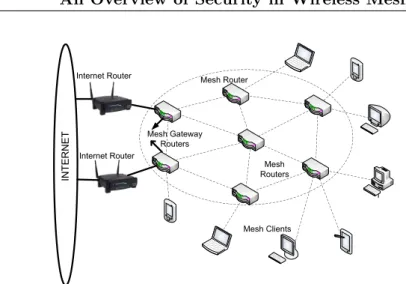
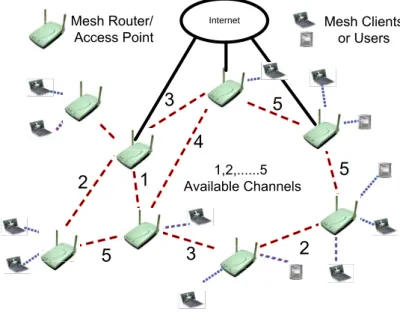
Figure 2.1: An example of a wireless mesh network
routers. Mesh clients approach a mesh network through access mesh routers while the mesh backbone is connected to the Internet through gateway routers. These functionalities can coexist in a single router. Communication in a wireless mesh network is of multi-hop nature in which nodes behaving as routers forward packets on behalf of other nodes that are not in the direct transmission range of their destinations. For detailed technical information, readers can refer to the IEEE standards. The IEEE 802.11s 1 is a draft amendment of the IEEE 802.11 which discusses mesh networking. A simple WMN is shown in Figure 2.1.
2.1.1 Classification of WMNs
In terms of architecture and design, wireless mesh networks can generally be classified into three groups: infrastructure-less, infrastructure, andhybrid
networks. These are briefly discussed in the following discussion.
Infrastructure-less mesh networks are one-tier networks in which client nodes participate in routing architecture and construct the real network. In addition to routing, network configuration functionality is also performed by these client nodes which eliminates the need of any special router. A wireless ad hoc network can be an example of infrastructure-less mesh networks.
In contrast to the infrastructure-less mesh, infrastructure mesh net-works consist of a backbone of mesh routers and are two-tier netnet-works. This backbone or infrastructure can be built using any of the various
1
wireless radio technologies such as the IEEE 802.11. In these networks, mesh routers perform the routing functionalities and provide access to the users and clients. They behave as access points for the con-ventional clients. Usually, mesh routers in these networks use two levels of communication: backbone communication and users’ (access) communication.
Hybrid mesh networks provide combined functionalities of infrastruc-ture and infrastrucinfrastruc-ture-less networks. In addition to mesh routers, mesh clients also participate in routing by either connecting to a mesh router or by meshing with other mesh clients. This property of mesh clients enhances the coverage of the mesh backbone.
2.1.2 Features of WMNs
The key features of WMNs include robustness, reliability, low-cost, easy deployment, and maintenance. These reasons make WMNs worthy to in-tegrate with wireless fidelity (Wi-Fi), cellular networks, sensor networks, and worldwide inter-operatablity for microwave access (WiMAX) [9]. In the forthcoming discussion, we highlight some of the notable features of WMNs.
WMNs provide redundant paths between the source and the destination of a wireless connection. In this way, these networks are capable to re-route messages through various available paths, ruling out or at least reducing to a great extent the possibility of bottlenecks and single points of failure [54]. This boosts reliability and make networks robust against node and path failures. Moreover, it also extends the network operating time in the presence of element failure and network congestion.
Until recently, wireless connections to end-users are offered by using wireless access points (APs). Providing complete coverage spread throughout a metro-scale area requires excessive number of APs as the transmission range of these APs is usually very limited. This increases the infrastructure costs to a great extent since an expensive cabled connection to the wired Internet backbone is necessary for each AP. WMNs reduce these costs as mesh nodes require fewer points of connection to the wired networks using mesh gateways.
Wireless mesh networks are dynamically self-organized and self-configured. The nodes (mesh routers and mesh clients) in WMNs maintain network connections automatically. This makes connectivity among multi-hop nodes seamless and reliable. When new nodes join a WMN, they auto-matically discover their neighbor nodes, accessible routers, and possible
routes to the Internet. The existing routers reorganize themselves accompanying the newly joined nodes and their routes so that the networks can be easily expanded.
WMNs can be used to extend the coverage of wireless networks without sacrificing the channel capacity. To accomplish this task, WMNs make use of multi-hop meshing technique which provides higher throughput, better frequency reuse, and lesser interference among mesh nodes [34].
Mobility among nodes in WMNs varies from node to node. A mesh router usually has minimal mobility while mesh clients might have high mobility. This feature of WMNs distinguishes them from ad hoc networks.
Like mobility, requirements of power consumption also vary in WMNs. Mesh routers do not have strict constraints on power consumption. However, mesh clients, because of being possibly mobile, may have high power constraints. This is one of the reasons that the MAC or routing protocols optimized for mesh routers might not be suitable for mesh clients.
Mesh routers can have multiple radios to perform routing and access functionalities. A mesh router usually handles two types of traffic in the network. On one hand, it regulates the routing and configuration traffic with other mesh routers for which it uses separate radio(s). On the other hand, it also provides dedicated radio(s) access for end users to access the network.
There are many other features of WMNs. For further details, readers can refer to the material provided in the references [9, 54].
2.2
Comparison of Wireless Mesh and Ad hoc
Networks
A WMN is usually considered as a special type of wireless ad hoc network. WMNs can be distinguished from conventional ad hoc networks as follows:
Mesh routers usually have lesser energy constraints and higher capabil-ity than the nodes in ad hoc networks and are capable of forwarding broadband traffic.
While ad hoc networks are mostly dynamic in nature having frequent topology changes, WMNs usually have static mesh nodes (routers) with low or no mobility.
Clients in mesh networks use a kind of infrastructure (i.e. mesh backbone) for routing, while ad hoc clients are generally user-to-user and are not associated with any kind of infrastructure.
2.3
Applications of WMNs in the Real World
Network engineers and companies may argue whether we really need to have wireless mesh networks even though similar networks providing wire range facility such as cellular networks do exist. In order to prove the need and importance of WMNs, we now discuss some of the applications of these networks. A WMN can be deployed to render a wide variety of applications.
Transportation systems: WMNs can be used to provide useful in-formation services in public transport to develop intelligent transport systems. These services include passenger information, inter-driver and driver-station communication, and remote monitoring of vehicle security videos. High-speed mobile back-haul from a vehicle to the Internet and mobile mesh networks with the vehicle are needed for this purpose [9] .
Metropolitan area networks (MANs): These networks might also be useful in MANs. WMNs observe relatively higher transmission rate at the physical-layer than that in any cellular systems, for example, a rate of 54 Mbps in the IEEE 802.11g standard. Wireless mesh MAN provides an economical solution to broadband networking, particularly in underdeveloped regions.
Enterprise networking: This type of networking can be of any scale. It can be a small office, a medium-sized company within a building, or a large-scale network with multiple buildings. Although the standard IEEE 802.11 wireless networks are still in use at various enterprise locations, these networks are still isolated and need wired Ethernets for interconnection. This incurs high costs for these networks. Replacing access points with mesh routers can eliminate the necessity of Ether-net wires. Moreover, WMNs can easily expand with the size of the enterprise.
Broadband home networking: Similar to enterprise locations, broad-band home networking is accomplished by using WLANs and the standard IEEE 802.11 protocol. Home networks using access points usually have zones with no coverage. Performing site surveys and installing multiple access points are expensive and impractical. This is
because the Ethernet wiring from access points to back-haul network access modem or hub costs too much. Additionally, two end-nodes located within two different end-points have to pass through the access hub which is not a feasible and efficient solution.
Community and neighborhood networking: In most cases, the archi-tecture used in communities for network access uses cable or DSL connected to the Internet and at the end-user’s side a wireless router is connected to any of these two options. Accessing the network in this way raises many issues.
– All traffic must flow through the Internet which reduces network resource utilization significantly.
– Some areas in the neighborhood are not covered by wireless ser-vices.
– Only one single route is usually available between the end user’s home and the Internet or with neighbors.
WMNs overcome all these limitations by providing flexible mesh con-nections between homes and communities.
Building automation: Different electrical devices such as fans, lights, and air conditioners etc. should be monitored in a building. Usually wired networks are used for this purpose which are of course expensive. The replacement of access points for building automation and control networks with mesh routers will reduce the cost and simplify the deployment.
Security surveillance systems: To deploy surveillance systems at public and private premises such as company buildings, shopping malls, and grocery stores etc., WMN is a more feasible solution than wired network. Due to the frequent transfer of images and videos, these systems demand high network capacity which can be efficiently managed by WMNs.
Spontaneous and P2P networking: WMNs can also be used for spontan-eous networking and P2P communications. For example, in emergency situations like fire burns in buildings and flood relief in rural areas, one cannot anticipate where the network should be deployed. A WMN can solve this issue easily and a network can quickly be established.
All these applications demonstrate the importance of WMNs in the real world. While these networks provide great benefits to the society but because of their diverse application and properties, they also bring forth security vulnerabilities which lead to several kinds of severe attacks on these networks.
2.4
Open Research Challenges in WMNs
The fascinating characteristics of WMNs also put forward many open research issues and challenges for researchers and companies (deployers or service providers). These issues can either be design issues in the architecture of WMNs or in the communication protocols, ranging from the application to the physical layer [54]. While many research advancements and developments have been done in this area, many issues still need to be dealt with. This in-cludes the performance improvement of protocols at different communication layers, provision of efficient network security, and enhancement of algorithms for network configuration. The shortcomings or critical issues in WMNs which still need to be explored are briefly described in the following points [9, 54]:
Various technologies and schemes such as reconfigurable radios, fre-quency agile/cognitive radios, directional and smart antennas, multiple input multiple output (MIMO) systems, and multi-radio and multichan-nel systems have been recently presented to improve the capacity of WMNs. However, efficient protocol designs are still needed to imple-ment these technologies successfully.
Network security is another domain in WMN which has to be explored further. Most of the existing schemes to provide security in WMNs which are proposed for other wireless networks either show poor per-formance or are not practical for WMNs. Therefore, it is required to develop new security algorithms for efficient authentication, strong encryption, and secure key distribution in WMNs. Moreover, these schemes should also handle and act against devastating security attacks such as DoS attacks and other intrusions in these networks.
WMNs render varying network services to the users– from a simple file transfer to live multimedia streaming. In order to provide these services, various performance metrics are necessary to be handled such as aggregate and per-node fairness, packet loss, delay, and jitter.
In order to deploy WMNs on a large scale with multiple mesh back-bones from different service providers, an inter-system authentication mechanism is needed. This issue should be dealt together with mobility management schemes. Low latency handover and location management algorithms are also needed for seamless mobility and quality of service.
WMNs having very large topologies should not increase the number of network operations exponentially. Moreover, an increase in the number of hops between sender and receiver should have the least possible affect on systems’ performance in order to maintain an adequate fairness
among the nodes in terms of resources. New protocols at different com-munication layers (MAC, network, and transport) with least possible overhead must be designed for improved scalability in WMNs.
In addition to the above-mentioned challenges, there are several other demands associated with WMNs. For further details, readers are advised to read reference material [9, 54]. As discussed in chapter 1, this thesis from here onwards highlights some very important aspects of security in WMNs.
2.5
Security in WMNs
Despite the benefits that can be achieved through wireless mesh networks, security is always a big concern to their users and administrators. Without a satisfactory level of security, users are reluctant and lack motivation to use services provided by WMNs. These networks cannot achieve distinguishable popularity and success in the technological world unless providing overwhelm-ing security and reliable services to their users. Security schemes that have been developed for WLANs1 are not suitable enough to be incorporated in WMNs as there is no centralized trusted authority in WMNs to distribute the public key. There are many reasons supporting the fact that new security protocols and schemes should be developed for WMNs. Some of the very important reasons are highlighted here.
WMNs offer multi-hop architecture which raises many more complex security issues than those existing in other wireless networks that focus on one-hop communications. This makes the current strategies inefficient for multi-hop architectures.
WMNs usually require two levels of security. One level is for wireless access from mesh clients to mesh routers and the other level is among mesh routers. As mesh clients are usually users having distinct security requirements and mesh routers belong to a service provider, the security mechanisms required at these two levels are also divergent. This makes handling security in WMNs different from that of other wireless networks.
In WMNs, usually there is no centralized trusted authority, so security is mostly established based on distributed or mutual trust among the nodes. This makes the security requirements for WMNs dynamic in nature.
1
2.6
Vulnerabilities and Attacks in WMNs
Security in wireless networks can be of two types: information security and network security. Due to the presence of over-the-air transmission and the above described security challenges, WMNs like other wireless networks are vulnerable to various kinds of severe security attacks. Among the various types of attacks which exist in WMNs, some attacks target only information security, while the others aim at network security. Nevertheless, attacks compromising both types of security are also possible. Security attacks in WMNs can generally be categorized into two classes: passive and active
attacks. Here we briefly explain the most common types of security attacks that can jeopardize any WMN [30, 9].
2.6.1 Passive Attacks
Attackers in passive attacks are usually hidden and try to tap in the com-munication channels to get unauthorized data access. In these attacks, the adversaries, rather than actively injecting or manipulating information, just listen to the communication of benign nodes for their own benefits. These types of attacks are usually against data confidentiality. Examples of passive attacks are passive eavesdropping and traffic analysis.
2.6.1.1 Passive Eavesdropping
This attack is successful when communication between benign nodes is in plain text (not encrypted). The attackers can simply read all the information without actively manipulating it. To handle this attack, a strong crypto-graphic scheme should be used. Unencrypted data can be easily eavesdropped by tapping the wireless communication. For example, an adversary can tap information about credit cards, passwords, and other confidential data while this information is being transmitted over a wireless link.
2.6.1.2 Traffic Analysis
In addition to the contents of data packets, the traffic flowing pattern can also be beneficial for the adversary. While this is an attack on information security, it usually does not harm the network security. The traffic analysis can be done using the following techniques:
The carrier is sensed at the physical layer and a particular node is observed for its incoming and outgoing traffic.
The headers of frames can be analyzed for routing details and topology of the network.
Transmission of packets by a node can be correlated to find the routing path in addition to the source and destination nodes.
In a clustered environment, analyzing the traffic of a cluster coordinator (cluster head) might be useful for the adversary.
2.6.2 Active Attacks
In addition to passive attacks , adversaries can execute even worse type of attacks categorized as active attacks. In these attacks, the adversary manip-ulates the communication or operation in the network by forging, altering, blocking, or re-routing messages. Active attacks not only compromise data confidentiality, but also affect data integrity. In the latter case, the attacker by manipulating the communication between the benign nodes, can try for an unauthorized access to network resources. In this way, it performs malicious activities that are detectable. Additionally, gratuitousness is also threatening for wireless networks. This happens when a client or a router node is open to tampering, alteration, and unauthorized access. These threats should also be handled by prescribed security schemes. Active attacks can be broadly categorized into four types:
2.6.2.1 Physical Attacks
This includes damage to hardware, electromagnetic pulse attacks, and micro-probing etc. Physical attacks against hardware can be a serious issue. When nodes are unattended and can be physically reached by the adversary, tampering techniques such as micro-probing, laser cutting, focused ion-beam manipulation, glitch attacks, and power analysis can be used to attack the hardware [71]. This tampering can also help in masquerading and attacks. Electromagnetic pulse (EMP) attack is also a kind of physical attack. It contains a short-burst of extremely intense electromagnetic energy producing voltage surges and hence damages electronic devices.
2.6.2.2 Misbehaviors
Nodes may show selfishness to gain unfair shares of resources or deny to pay for charged services. They may also be selfish by refusing to relay messages for other nodes. Several selfish nodes showing this behavior may lead to a DoS attack. Salemet al.[119] discuss various attacks against the charging schemes in multi-hop networks providing these services:
Dishonesty: In multi-hop networks, intermediate nodes are required to relay the packets to others. Rewarding mechanisms such as ‘paying’ can be designed in this regard. A dishonest node may try to prove that it was involved in the forwarding but actually it is not.
Denial of usage: A node may refuse that it has carried out any com-munication mentioned on the payment bill.
Piggybacking: Intermediate nodes on the route between a source and a destination may piggyback their own packets on to the ongoing communication to avert bill payment.
2.6.2.3 Unauthorized Access
When a node starts communicating in a WMN, it first needs to be au-thenticated and authorized to join and use services of the network. If the authorization and authentication mechanisms fail in the process, any unauthorized node can get access to the network.
2.6.2.4 Message Forgery and Replay Attacks
Attackers can modify the actual message contents maliciously or resend the acknowledged message. These attacks manipulate the message integrity. Adversaries can inject forged messages into the network, resulting the network protocols to malfunction. Even when the message integrity is enforced, the attacker can replay some authorized messages causing the network protocols to malfunction.
2.6.2.5 Man-in-the-middle Attack
An adversary can try to reside between mesh clients and mesh routers or two mesh routers to intercept and manipulate their communication. For example, an adversary can set up a rogue mesh router to induce other routers or clients to communicate with it. This vital attack can compromise both information and network security and can affect any type of nodes (routers or clients).
2.6.2.6 Denial of Service Attacks
A denial of service (DoS) or distributed denial of service (DDoS) attack affects the availability of the network services or simply partitions the net-work. It decreases a network’s ability to perform accurately according to
its anticipated capacity in a timely manner. DoS attacks can be further explained based on the following properties [138]:
Disruptive: It degrades the quality of services provided by the network.
Malicious: It hinders the network from executing its functionalities.
Asymmetric: The adversary can disrupt the network on a large scale by putting just a little effort.
DoS attacks could happen at all the layers in the protocol stack from the physical to the application layer [56]. Various approaches are used to defend against DoS attacks at different layers of the protocol. For example, spread spectrum can be used against jamming (type of DoS attack) and special measures such as rate limitation can be utilized at the MAC layer. Special consideration is needed at the network layer for the defense mechanism against this attack due to the multi-hop routing mechanism in WMN. If a multi-hop routing scheme is not properly designed, it may introduce unfairness or starvation in network traffic. This often leads to DoS at some nodes of the network. Concisely, there is no comprehensive solution to handle DoS attacks. Therefore, a cross-layer security solution might be required for the future networks. Launching these attacks involves active participation of the adversary which affects the communication and therefore can be noticed.
DoS attacks in the network layer are divided into two categories: routing disruption attacks and resource consumption attacks [59]. In routing disrup-tion attack, the adversary aims to dysfuncdisrup-tion the routing scheme which leads to the unavailability of its network services. However, the aim of resource consumption attacks is to unlawfully utilize the network resources such as bandwidth, computational power, and memory. Some well-known examples of DoS attacks at different protocol layers are channel jamming, wormhole attack, hello flooding, Sybil attack, black hole, and gray hole attacks. Here we briefly define some of these attacks [9, 70].
Jamming: It attacks the physical layer and targets the network security. A WMN can easily be brought down by channel jamming. A malicious device can jam a wireless carrier by transmitting a signal at that frequency. The strength of this signal is good enough to deteriorate the signal-to-noise ratio, making the nodes unable to receive data on that channel.
Wormhole attack: In this attack, a malicious node receives data packets at one point and transfers them to the other point of the
network using an out-of-band channel. The second adversary (node) then replays the received packets. This makes the one-hop neighbors of the second malicious node falsely believe that the first malicious node is their one-hop neighbor. In this way, it affects the performance of various network services such as time synchronization, localization, and data fusion.
Hello flooding: A malicious node may broadcast routing or other information with high transmission power to other nodes in the network to make them believe that it is their neighbor. When the other nodes reply to this malicious node, no node exists to receive this packet.
Sybil attack: An adversary may produce multiple identities of nodes in the network. This affects the geographic routing protocols. Moreover, it may also affect the performance of schemes such as misbehavior detection, data aggregation and fusion, and distributed storage.
Black hole attack: An adversarial node may drop all packets it is supposed to forward to other nodes. A successful attack may block all the communication around the victimized node.
Gray hole attack: A malicious node may drop selected packets from the received packets and forward all the others. This makes it difficult to be detected. This attack is also called selective forwarding attack.
DoS attacks can be brutal for any wireless network and may destroy them completely. Hence, serious care has to be taken for the defense when dealing with these attacks. In addition to the above mentioned attacks, there are many other types of DoS attacks. For further details, please consult the provided reference [30].
2.7
Characteristics and Demands of a Secure
WMN
Although security schemes that have been proposed for other wireless net-works are a building block to construct a security framework for WMN, the special characteristics of WMNs invoke the developers and researchers to upgrade these schemes or propose new ones for these networks [9]. This is mainly because of the multi-hop nature of WMNs which makes these schemes insufficient for WMN security. WMNs differ in architecture from the IEEE 802.11 Wireless LANs and the IEEE 802.16 wireless MANs as WMNs have added the mesh architecture into the network replacing the traditional Ethernet connection between APs or base stations. For this
reason, WMNs have to special security requirements: multi-hop network security and multi-tier security. Hence, new security schemes must be intro-duced for mesh networking among mesh routers and clients. In addition, the security protocols for network access from mesh clients to mesh routers need improvement. WMNs face both challenges and opportunities when compared with wireless ad hoc networks. WMNs have their own security needs which are distinct from other wireless networks. On one hand, mesh routers in WMNs have minimal mobility, and on the other hand mesh clients can be highly mobile. Hence, the security schemes formulated for other wireless networks can be too cumbersome for WMNs. Applying those schemes can cause unnecessary overhead and too much complexity. Additionally, mesh routers in the mesh backbone have two types of traffic. First, these routers serve other routers in the backbone for forwarding and relaying of inform-ation. Second, these routers also provide wireless services to mesh clients. Moreover, each mesh node might be connected to a service provider or server which has its own specific security requirements. For example, a node or an autonomous network providing live streaming service or traffic might not require heavy and complex security schemes to be implemented because that would put an extra overhead on a traffic which is delay intolerant. This service, on the contrary, would probably require lightweight security scheme for authenticating paid users of the service specially when the clients are mobile. On the contrary, a set of nodes connected to an online banking system would definitely require very strong security schemes and can tolerate an extra overhead for stiffer security.
After discussing the above arguments, it is obvious that the current WMNs have twofold requirements. Firstly, these networks desperately require to implement robust and efficient security mechanisms which can provide strong but fast authentication of nodes in the network without the need of a centralized trusted authority. Secondly, these new security protocols should also be adaptive according to the resources available at the network nodes and the services they provide. In our work, we present some security schemes covering these aspects.
In multi-hop wireless networks such as mesh networks, the nodes are still vulnerable to security threats even after a successful authentication mechanism is executed. Various kinds of adversaries may launch different types of attacks on the existing nodes to jeopardize the network. DoS attacks are among these attacks which target the availability of network services. The methods of execution, the benefits of launching, and the possible targets of these attacks may vary greatly. This is one of the many reasons why these attacks are considered as lethal for computer networks and specially wireless networks. Although there are many examples of DoS attacks, two of the very important are channel assignment attacks and jellyfish attacks. These
attacks are explained in upcoming chapters in this thesis. This work presents mitigation schemes which successfully handle these two types of DoS attacks.
Trust Based Protection in
Clustered Mesh Networks
“If you think technology can solve your security problems, then you don’t understand the problems and you don’t understand the technology.”
- Bruce Schneier (Born 1963)
In the previous chapter, we explained the basic architecture of WMN and the security issues that make a WMN vulnerable to severe attacks. In this chapter, we introduce our proposed authentication and protection scheme called NETCLAW (NEighborhood Trust in CLustered Wireless Mesh Networks) to provide adequate security and identification privacy in clustered WMNs. This scheme is based on neighborhood trust, offers lightweight security using hash chains, and does not require any trusted authority.
3.1
Introduction and Motivation
WMNs are unquestionably providing real benefits in the field of wireless communication because of their attractive characteristics of self-organization, self-configuration, and reliability. However, the property of being a multi-hop network with intermediate relay nodes puts the level of security in these networks into high risk. Moreover, the absence of a centralized trusted mechanism can also jeopardize the security of these networks. Hence, these networks become extremely vulnerable to intense information disclosure and
network misuse attacks such as eavesdropping, man-in-the-middle attacks, and DoS attacks. In addition, malicious nodes or users might also become a threat. It is therefore required to have an efficient protection mechanism that can mitigate the severity of these attacks and provide seamless authentication scheme with least possible overhead.
Although different security schemes and protocols have already been suggested for WMNs, they usually possess at least one of the following limitations:
They perform end-to-end authentication only. Hence, fabricated pack-ets can merely be rejected at the destination nodes.
They require a trusted authority (TA) for key distribution and authen-tication. WMNs do not usually have any centralized trust.
These keys are required to be distributed before deployment which is infeasible for dynamically deployed networks such as WMNs.
Public key encryption is needed for confidentiality which is computa-tionally complex.
They consider attacks from outsider nodes. Hence, trusted nodes that are part of an existing network are assumed to be benign and considered that they are not behaving maliciously.
We present a security solution for WMNs based on neighborhood trust which provides hop-by-hop authentication with adequate privacy of nodes. It does not need any trusted authority and is computationally efficient. Although this mechanism is specifically designed for WMNs, it can be modified a little to be used in different types of wireless networks. This is discussed in the next chapter.
3.2
Existing Work and their Limitations
Redwanet al.[116] analyze the security characteristics of WMNs focusing on its basic requirements and discuss the various security attacks in WMNs. Salem et al. [15] have studied three key security challenges that need to be dealt with in order to mitigate the possible security attacks in WMNs. They elaborate detection of rogue or corrupted relay nodes, need of having secure routing scheme, and fair bandwidth sharing mechanisms for these networks by explaining examples of security attacks. One example given by Salemet al. [15] considers a corrupt relay in the network while the other explains DoS attack. Siddiquiet al.[124] also discuss the threats that exist in
WMNs like signal jamming, sleep deprivation, and imprinting etc. Focusing on special issues on anonymity and privacy in wireless ad hoc and mesh networks, few approaches are quite relevant. Rajendranet al. [113] propose a lightweight but secure anonymous routing mechanism for ad hoc networks. They make use of the one-way hash function with shared secret key for secure communication. They assume that the secret key has already been shared for every pair of the two communicating parties but do not explain the key-sharing scheme. Liet al.[77] provide an identity-based security (ISA) model for a WMN. In their solution, a central private key generator (PKG) is usually needed (normally a gateway router) which distributes the keys and manages key revocation and removal. This puts a great burden on a single node as the generation and distribution of keys are wearing tasks. Few other works have also been proposed to mitigate the issues of anonymous routing and privacy. Islamet al. [63] propose an anonymous routing strategy between clients and mesh routers in a WMN. The scheme tries to protect identity disclosure besides providing security in communication. This proposal does not cater authentication mechanism for intermediate nodes if the communication is multi-hop. It also lacks the ability to authenticate a foreign mesh client (mobile) trying to get access in a foreign (visiting) mesh network. Ren et al. [117] propose a privacy framework called PEACE. It is an authentication and key management protocol and uses short group signature variation to provide user privacy. This scheme depends on public key certificates that should be provided by an off-line trusted third party.
Inspecting the work done in the area of message authentication and hash chain based signatures and their usage, Perrig et al. [107] propose authentication protocol for broadcast communication. It is developed using hash chains and considering a loose time synchronization between sender and receivers. Liu et al. [82] present another scheme based on TESLA, supporting large number of senders for broadcast authentication in sensor networks. They also propose methods for revocation in case of compromised senders. Cheung [32] introduces a time-based signature for securing for link state routing. Torvinen and Ylitalo [133] use hash-chain-based signatures for mobility and multi-homing signaling in IPv6 networks. Anderson et al.[12] introduce an interactive protocol called Guy Fawkes protocol that utilizes delayed secret disclosure for integrity and authentication. For hop-by-hop authentication, Zhanget al.[142] propose polynomial based cryptography for packet authentication in Wireless Sensor Networks (WSNs). The solution is not suitable for decentralized environments as it assumes a central server to distribute keys to all nodes (single point of failure). Zhu et al. [148] propose a protocol for hop-by-hop authentication in ad hoc networks. It uses TESLA to develop trust relationship between nodes while using tokens for authentication in relaying data packets. Lu and Pooch [83] develop another system HEAP that is based on [148] and secures data transmission between
two adjacent routers. It uses pair-wise symmetric keys with modified HMAC for hop-by-hop authentication. All of these proposals focus on protecting the network from external attacks by unauthorized nodes, but do not discuss internal attacks for example, maliciously altered messages or compromised nodes which were previously trusted. Our proposed mechanism handles both external and internal attacks.
3.3
Neighborhood Trust in Clustered Mesh
Networks
In this section, we explain our scheme consisting of robust authentication of nodes and protection of the clustered mesh network from adversaries through neighborhood based trust. In the beginning, we skim through some definitions used to describe our model and later explain our model in detail.
3.3.1 Definitions
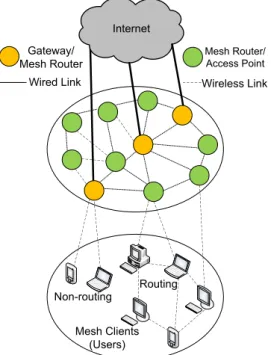
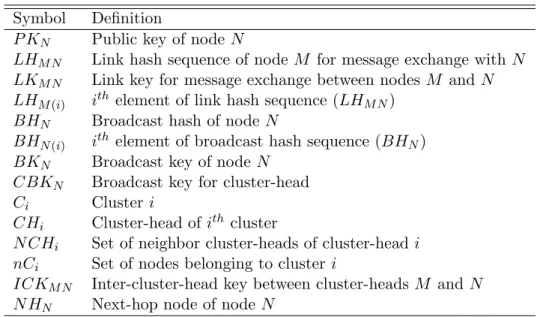
We consider a typical WMN as shown in Figure 3.1. The mesh gateways behave in the same way as mesh routers except that these gateways are directly connected to the Internet by wire. We use some notations to describe our proposed security model. P KN denotes the public key of a node N,
used for special purposes such as initial handshake or for renewal of security credentials. We useLHM N to refer to a sequence of hash chain valuesH0 toHn. This chain is used for the authentication of the sequence of messages
exchanged by arbitrary nodes M and N. A hash chain is constructed by repeatedly applying a one-way hash function sequentially to a seed value
H0. Hash chains are used extensively in cryptographic applications such as one-time passwords, server supported signatures, and micro-payments etc.
H(K, m) is a fast and collision resistant hash function that takes a key (K) and a message (m) as input and maps this input to a fixed length string known as digest or checksum of the message. A hash functionH for which it is computationally infeasible to find any two messagesm1 andm2 such that
H(m1) =H(m2) is called a strongly collision-free hash function. For detailed information about hash functions, refer to the work by Lamport [74]. Another notation LHM N(i) represents the ith element of the hash chain sequence while LKM N represents the link key (symmetric) shared between nodes M
andN for message encryption. BHN denotes the broadcast authentication
hash chain used by node N for broadcasting messages to its immediate neighbors andBKN is the broadcast key for the same node. Similar to the
link hash element,BHN(i) denotes the ith hash element of broadcast hash
each message for its integrity.
There are some notations associated with clustering as well. Ci represents
theith cluster in the network. The cluster-head (CH) ofC
i is represented by
CHi, set of neighbor clusters by N Ci, and set of nodes that belong toCi by
nCi. The broadcast key forCHiis denoted byCBKN and inter-cluster-head
keys between cluster-headsM andN byICKM N. These notations are also
shown in Table 3.1. From here onwards, we use a single termnode for both mesh gateways and mesh routers unless stated otherwise.
Figure 3.1: A hierarchical structure of a wireless mesh network
After defining the terms used in model, now we introduce our authentica-tion and protecauthentica-tion mechanism for clustered WMNs. We start our discussion with some assumptions.
3.3.2 Assumptions
For our proposed model, we have few simple assumptions:
All mesh routers including gateway routers periodically broadcast their self-generated public key (PK).
Every node maintains a table calledNeighbors Info Table that consists of the credentials about its immediate or next-hop neighbor nodes.
Table 3.1: Notations used in the proposed model NETCLAW
Symbol Definition
P KN Public key of node N
LHM N Link hash sequence of nodeM for message exchange withN
LKM N Link key for message exchange between nodes M and N
LHM(i) ith element of link hash sequence (LHM N)
BHN Broadcast hash of node N
BHN(i) ith element of broadcast hash sequence (BHN)
BKN Broadcast key of node N
CBKN Broadcast key for cluster-head
Ci Cluster i
CHi Cluster-head ofith cluster
N CHi Set of neighbor cluster-heads of cluster-headi
nCi Set of nodes belonging to cluster i
ICKM N Inter-cluster-head key between cluster-headsM and N
N HN Next-hop node of node N
3.3.3 Phases of the Proposed Scheme
Our proposed scheme is divided into five sequential phases. These are
initial bootstrapping, clustering, inter-cluster key exchange, neighborhood based trust management, and secure intra/inter-cluster message exchange. In this subsection, we elaborate these steps further.
3.3.3.1 Initial Network Bootstrapping
For bootstrapping, consider an example as shown in Figure 3.2(a). It is a modified version of the mechanism explained by Rajendranet al.[113]. As shown in the figure, there are two nodesX andY deployed by any service provider and are directly connected to the Internet by wire. These two nodes periodically broadcast their self-generated public keysP KX andP KY
respectively. Now the new node, that wants to join the network, makes a handshake. In this example scenario (Figure 3.2(a)), the procedures to join the network for nodesA andB are very similar. The only difference is that the nodes A and B are in the range of different public key broadcasting nodes (X and Y respectively).
Consider now the case of nodeA trying to join the network through node
X. When node A is booted within the transmission range of nodeX, the following procedure is executed:
(a) Bootstrapping (b) Initial handshake
Figure 3.2: Network bootstrapping and initial handshake
2. NodeA generates its own link hash chain LHAX, a link key LKAX, a
broadcast hash chainBHA, and a broadcast key BKA.
3. Node A then encrypts the last element of its hash chain say LHAn,
the link key LKAX, the last element of broadcast hash BHAn, and
its broadcast keyBKA with the public key of nodeX and sends it to
nodeX.
4. Node X decrypts the message received from node A and stores the credentials of node Ain its neighbors’ credential information table as shown in Table 3.2.
5. NodeX then generates its own link hash chainLHXA , a broadcast
hashBHX, and a broadcast key BKX.
6. NodeX then encrypts the last element of its hash chainLHXn, link
keyLKAX, last element of broadcast hash BHXn, and broadcast key
BKX, with the link keyLKAX and sends the message with the hash
elementLHXn to node A as a response.
7. Node Areceives the message from node X, decrypts it using the link key LKAX, and stores the credentials of node X in its neighbors’
information table.
8. NodeA then sends an ACK back to nodeX using the next available hash element.
This initial bootstrapping (handshake) is shown in Figure 3.2(b). After this initial bootstrapping, nodesX and Aare connected to each other. The same procedure is followed by nodes Y andB. Considering that nodesA,
E, andF are immediate neighbors of node X, the entries of the neighbors’ credential information table for node X would be similar to those that are shown in Table 3.2.
Table 3.2: Neighbors’ credential information table
Neighbor Node Credentials
A LHAn,LKA,BHAn,BKA
E LHEn,LKE,BHEn,BKE
F LHF n,LKF,BHF n,BKF
After joining the network, nodesA andB start broadcasting their public keys for other nodes to join and the above-mentioned procedure is repeated. Another new node C follows the same procedure as nodes A and B did to join the network and performs initial handshake with either nodeA or nodeB depending on from which node it first gets the public key broadcast message. After the joining of several mesh routers, the resulting WMN would look similar to the one shown in Fig