(IJSBAR)
ISSN 2307-4531
(Print & Online)
http://gssrr.org/index.php?journal=JournalOfBasicAndApplied
---
104
Formal Versus Informal Training & Tacit Versus Explicit
Knowledge Sharing: What Matters More for the
Entrepreneurially Oriented Firms?
Faten Methammem*
Sousse Higher Institute of Management, University of Sousse, Sousse- 4000, Tunisia Email: [email protected]
Abstract
The beneficial outcome of a firm‟s entrepreneurial orientation (E.O) has been widely researched, but literature and empirical studies about factors that stimulate E.O remain scarce. Previous research has showed that employee training is a crucial mechanism to foster E.O others has exhibited that a higher level of knowledge sharing is related to a stronger E.O. Although, previous researches do not distinguish neither between different type of training, with the most important distinction being between formal and informal nor between different form of knowledge sharing, with the very popular being between tacit and explicit. In view of the difference for each pair contrasts of one over the other, they are widely considered to have different impact on the E.O‟s dimensions namely innovativeness, proactiveness, and risk-taking in SMEs. Our research model is tested with survey data collected from 186 Tunisian small and medium-sized textile & clothing firms. Findings reveal that the level of each dimension of E.O- Innovativeness, proactiveness and risk taking differs based on the form of knowledge sharing either tacit or explicit and the type of training either formal or informal.
Keywords: Entrepreneurial orientation (E.O); employees‟ training (ET); knowledge sharing (KS); textile and clothing industry; Tunisia.
--- * Corresponding author.
105
1.IntroductionSmall and medium enterprises (SMEs) play a vital role in the economic growth of most nations [1]. Tunisia is not an exception. Because of highly uncertain competitive environment and rapidly changing customer demands, SMEs with a flexible, innovative strategic approach that can take the most advantage of emerging opportunities perform better than conservative SMEs [2]. Several research studies imply that this strategic emphasis, labelled in the literature as „entrepreneurial orientation‟ (EO). Entrepreneurial orientation is assumed to be a behavioral phenomenon, with all SMEs along a continuum that ranges from highly conservative to highly entrepreneurial. Entrepreneurial SMEs are risk-taking, innovative and proactive. However, conservative SMEs are risk averse, less innovative and adopt a more „wait and see‟ posture [3]. We argue firstly that E.O in SMEs increases with the free sharing of knowledge across different functional areas. Based on a knowledge-based view, the knowledge inserted within a firm‟s ranks is an important organizational resource for generating entrepreneurial activities because such activities are substantially linked with the firm‟s ability to create new knowledge ([4,5,6]). In fact, effectiveness depends in a large part on how well knowledge is shared between individuals, teams, and/or units ([7,8,9,10]). It is evident that when employees build close relationships with each other, they contribute a significant amount of time to share ideas [11]. Indeed, Employees throughout the firm have pivotal influences on such entrepreneurial posture, which covers innovativeness, risk-taking and proactiveness [3] principally in accordance with their ability to exchange knowledge with colleagues in other functional areas (see for example., [12]). It should be noted that, individual knowledge does not automatically convert into entrepreneurial action; it requires current knowledge sharing routines that link the firm‟s different knowledge domains [13]. An examination of the literature reveals that rigorous knowledge sharing that includes different functional areas brings together complementary knowledge, and therefore refines the firm‟s collective knowledge base ([14,15] ), enhancing its ability to create the new knowledge required to recognize and exploit entrepreneurial opportunities ([16,17]). Secondly we thought that E.O in SMEs increases by providing employees with effective training programs (e.g., [18,19]). It is really hard for an employee to perform well at the job place without any pre-training [20]. Academics representing this stream of research ([21,22,23]) strongly highlighted that trained employees perform well as compared to untrained employees. Indeed, it is very essential for any organization to give its employees training to better achieve overall organisational goals ([24,25]). It is worth noting that, training practices can promote entrepreneurial behaviour to the extent that they are applicable to a broad range of job situations and encourage high employee participation ([26,27]). If firms choose entrepreneurially oriented strategies the role of employee training to achieve strategic goals becomes very significant. Beyond ensuring an entrepreneurial orientation through selective hiring of entrepreneurial employees, relevant abilities also can be acquired through training practices ([28,29]). The existing literature (see for example., [3,30]) reveals that entrepreneurial orientation is a construct observed at organizational level and refers to the behaviors (innovativeness and proactiveness) and attitudes (risk-taking) of its managers and employees. However, what influences those behaviors and attitudes are still an understudied phenomenon. Previous research has showed that employee training is a crucial mechanism to foster EO ([19,31,32]) others has exhibited that a higher level of knowledge sharing is related to a stronger E.O ([33,34]). Although, previous researches do not distinguish neither between different type of training, with the most important distinction being between formal and informal nor between different form of knowledge sharing, with the very popular
106
being between tacit and explicit. In view of the difference for each pair contrasts of one over the other, we think that they are widely considered to have different impact on the E.O‟s dimensions namely innovativeness, proactiveness, and risk-taking in SMEs. We concentrate practically in the Tunisian textile and clothing industry. Our choice of Tunisia as a case study is motivated by the important place and the crucial role that the textile and clothing sector has in the Tunisian economy. It remains a pillar of the Tunisian economy. Tunisia currently has some 2100 textile companies, employing nearly 210,000 employees. It is the biggest industry by employment in Tunisia and more than 85% of their total workforces are permanent jobs. Employments in this sector will reach 10,000 jobs per year and 50,000 jobs over a period of 5 years, from 2019 to 2023 (The Tunisian minister of industry and SMEs). In addition, the sector exports reached about 7.4 billion dinars, or 2.4 billion Euros in 2018, with a significant increase of about 18% in dinars and 3% in Euros, it represents no less than 24% of the total exports of Tunisian manufacturing industries. European countries import 96 per cent of Tunisia‟s total textile and apparel exports; France, Germany and Italy alone receive 75% (The Tunisian minister of industry and SMEs). This sector is, moreover, the second provider of foreign exchange after tourism, with revenues of 4 billion dinars per year on average over the last decade. However, the sector has seen several setbacks and has faced numerous difficulties and over the last 10 years – in 2013 the industry attracted $24.5m in foreign investment, less than half of what it attracted in 2009. In the first three months of 2019, manufacturing value added fell by 0.1% year-on-year, due to lower production in the textile and clothing sector (-6.2%) and the Tunisia's GDP annual growth slowed to 0.8 % in the fourth quarter of 2019 from 1 % in the previous period. It was the weakest expansion since the first quarter of 2016, as output shrank in textiles and clothing (-6.2 percent VS -3.7 percent) (the National Institute of Statistics (INS)). This is mainly due to international competitors. Tunisia has fallen from being the fifth textile supplier to the EU in 2010 to ninth in 2017. Turkey and Morocco, specifically, have gained ground in European markets as credible and affordable manufacturing centres in the Mediterranean region. While the tighter competition seems to represent another challenge for Tunisian textile and clothing firms, it depends more and more on “people embodied know-how” [35]. Accordingly, it is human capital rather than physical or financial capital, that distinguishes the leaders in the market. The focal point of this research is on SMEs because the huge majority of firms operating in the Tunisian textiles and clothing manufacturing industry employing less than 100 people (among 1,298 units) representing 70% of total firms in the sector. These firms need dynamic capabilities that enable them to sense and seize new opportunities and strengthen their competitive positions [36]. It is proposed that entrepreneurial behavior constitutes a potential source of competitive advantage and key to success factors of SMEs [37]. Because SMEs are constrained to limited resources and lack of scale advantage, EO seems to provide an important and unique advantage for SMEs to survive and compete under fierce market competition. SMEs with higher EO were found to be more cost-effective [38], outperform their rivals [39] have higher learning capacities [40], have a higher employment growth [41], were more customer-oriented [42], and have a higher ability to effectively interact with others and influence the actions of others [43]. SMEs with an E.O often introduce pioneering new products to gain competitive advantage and are willing to compete aggressively [44] The rest of the paper is structured as follows: Section 2 presents the study‟s theoretical background Section 3 formulates the main hypotheses; Section 4 describes the survey data, the sample and the measures used for this study; Section 5 presents the results; Section 6 explain the research result and provides some concluding remarks; section 7 provides some theoretical and practical implications, lastly, we present some limitations and
107
future lines of research resulting from the research that we have conducted in section 6.
2.Literature review
2.1. Employee training
Training allows employees doing a specific job or rising up their skill, knowledge, and behavior. It is a process of sharing skill and knowledge to expand and develop capabilities of employees thus they can accomplish better job performance [45]. Organisations are expected to identify training need of their employees and design training programmes that will help to best use their workforce towards achieving organisation objective [46]. Employee training refers to programs that aim to provide employees with required information, new skills to help them by working with others enhance the opportunities of professional development [47] . Training is very important to all employees in order to ensure that they can perform well in their given tasks ([48,49]). Employee training occurs often to bring an employee up to speed upon entering a new job or engaging in new tasks and this through a variety of informal and formal training programs [50]. Formal training in the one hand is defined by the report on the Adult Education and Training Survey (AETS), which looked at the training of Canadian adult workers, as courses or programmes referred to a worker's current or future job [51]. These courses and programmes have a structured plan whereby an employee headed by an instructor or trainer follows a programme and receives some form of formal recognition upon completion, such as a certificate. Courses include seminars, workshops and conferences attended for training purposes [52] , in addition to “management training” defined by [53] as “the process by which managers acquire the knowledge and skills related to their work requirement by formal, structured or guided means”, formal training include also professional training, computer training and occupational health and safety training [50]. Informal training in the other hand, is training that involved little or no reliance on pre-determined guidelines for its organisation, delivery or assessment. It does not lead to any formal qualification or certification and is conducted by the participant with no specific intention of developing job related skills or knowledge [54]. According to [55] and [56] informal training is considered less costly, easily integrated into daily operations of the small firm, and is concentrated more directly on employees‟ specific needs. It implies that employees learn in the context in which their skills are used. Informal training includes; on the job training, job rotation, apprenticeship and traineeship [50].Thereby, “in the job training” is a form of training provided at the workplace which is considered the single most important place for acquiring job skills [57]. It is cost effective and time saving [58] because employees learnt in a practical way [59].
2.2. Entrepreneurial orientation
Previous theory and research make a distinction between the concepts of entrepreneurship and "entrepreneurial orientation” [60] where entrepreneurship refers to the act of creating new business ventures (e.g. [61]). It is essentially concerned with new business entry and addresses questions such as, “What business do we enter?” and “How do we make the new business succeed?” [62]. Entrepreneurial orientation, on the other hand, is relevant to a firm‟s strategic orientation, restricting certain entrepreneurial aspects of decision making styles, practices, and methods [61]. It depicts a firm‟s strategic posture as revealed by the processes, practices, and activities of the business ([63,60]). When it comes to the understanding of EO, we adopt the broadly dispersed
108
concept that was first made by [64] and later extended by [61]. According to them E.O is a multidimensional firm-level concept that incorporates three dimensions: innovativeness, proactiveness and risk-taking ([65] ; [64]) Firstly, innovativeness deliberates a firm‟s tendency “to engage in and support new ideas, novelty, experimentation, and creative processes that may result in new products, services, or technological processes” [60]. Equally it refers to the seeking of creative, unusual or novel solutions to problems and needs. Secondly, proactiveness is relevant to processes geared towards anticipating and acting on future needs. It is the firms‟ ability to wait for any emerging or potential opportunities in their markets and act accordingly, i.e. being the first market mover ([66,67]). It is an act of opportunity seeking, where a proactive firm tries to get hold of initiative by acting opportunistically with a view to affect and shape the competitive environment [60]. In other terms, proactive firms develop new products and services before their competitors, create new markets to turn and reshape existing balances in favor of the company and forecast future demands and dynamics in the markets [68]. Therefore, proactive firms are expected to become market leader and perform better than their rivals because they can adapt changing conditions earlier [69]. Finally, risk taking, is identified as the degree to which firms are willing to make large and risky resource commitments”. [70]. It is a strategic action to seize opportunities even in uncertainty [71]. It implies the willingness to commit major resources to opportunities having a reasonable chance of costly failure. It should be emphasizing that risk taking behaviors have been focused in entrepreneurial activities because in order to take advantage of opportunities in the market, trying new things and differentiating a company from its rivals, firms have to take a certain degree of risk ([72,73]).
2.3. knowledge sharing
Knowledge is depicted as codified information including insight, interpretation, context, experience, wisdom, and so forth [74], which enhances a firm‟s value and the achievement of its objectives, mission and vision. In an organization, job-related knowledge is a vital element shaping the career success of an employee, together with her/his skills and ability. Knowledge is generated and resides in the mind of employees ([75,76]), and will contribute little to the firm if it is not greatly shared among the organizational members. Knowledge sharing is defined as the diffusion of information and knowledge through the whole department and/or organization [77]. According to [78] knowledge sharing is a process where individuals jointly exchange their implicit (tacit) and explicit knowledge to create new knowledge. Thereby, knowledge management literature distinguishes explicit from tacit knowledge sharing. Explicit knowledge in the one hand is defined by [79] as the knowledge, which has been codified and expressed in formal language. Explicit knowledge is usually willingly shared and communicated by employees. Some good examples are technical details of products, materials; tools. Explicit knowledge sharing involves almost all the forms of knowledge sharing that are institutionalized within organizations. Practices of explicit knowledge sharing arise more common in the workplace because explicit knowledge can be easily captured, codified and transmitted. For example; management mechanisms, like procedure, formal language, handbooks, and information technology system will favor employees‟ willingness for sharing their explicit knowledge ([80,81]). On the other hand, tacit knowledge is harder to express, represent and communicate, it is intuitive, unarticulated and cannot be verbalized, it is personal and hard to formalize [82]. It is unwillingly and rarely shared among employees, it is a less familiar, unconventional form of knowledge. Perceptions, belief and experience are good examples. As tacit knowledge is not codified, and not openly communicated, it is acquired by sharing experiences, and by observation and imitation ([83] ; [84].
Face-109
to-face interaction is the basic means for tacit knowledge sharing. The willingness and ability of individuals to share what they know and to use what they learn represent keys components of tacit knowledge sharing [85]. Human experience represents the foundation of tacit knowledge sharing ([86,87]) because individual cannot take advantage of new knowledge unless he or she has earlier „„social software‟‟ connected to it.
3.Hypotheses development
3.1. Knowledge sharing and entrepreneurial orientation 3.1.1. Knowledge sharing and innovativeness
As stated by [88] innovation initiatives depend heavily on employees‟ knowledge, skill, and experience. Employees should have an opportunity to seek new and improved knowledge to generate novel ideas and ways to encourage innovation at the workplace. Some academic researchers (for a review see; [89] ; [90,91]) asserted that knowledge is the most crucial element in developing new products or innovative ideas. Within the same thread of research [92] postulated that constantly collecting and integrating new knowledge will lead to innovativeness. As author in [93] stated, „„in all types of knowledge work, even where technology is very helpful, people require conversation, experimentation and experiences shared with other people who do what they do‟‟. Likewise, [94] and [95] emphasized the significance relationship between knowledge sharing and innovation capability. A review of the existing literature reveals that the strong relation between knowledge sharing and various aspects of innovation have been empirically tested in details (for a review see., [96,97] ; [98,99,100]). In line with research findings in the same area (see for example., [101,102,103]) knowledge sharing is the most essential component that substantially affects innovation due to their ambiguous and unique nature within the firm. A series of recent studies has indicated that knowledge sharing can be viewed as useful inputs for innovation because of their characteristics of firm-specific, socially complex, and path-dependent (for a review see; [104,105,106]). Studies of [107] and [108] are well documented, there are also well acknowledged that a firm‟s ability to transform and exploit knowledge may identify its level of innovation, such as new problem-solving methods and new product for rapid reaction to the market demand. As has been previously reported in the literature (see for example; [103]) employees always have to borrow from tacit knowledge (skills or experiences) of their colleagues or search for explicit knowledge (institutionalized approaches or practices) existing in the company to better achieve innovative tasks. A large number of existing studies in the broader literature have stated that both the explicit and tacit components of organizational knowledge sharing practices play an important role in innovation (for a review see; [109,110,111]). Much of the most current writing on knowledge suggests that a firm‟s tacit knowledge is positively related to the ability to innovate, create value and identify opportunities ([112,113,114] ). Although the relationship between knowledge sharing and innovativeness has been widely discussed in the literature, few researches consider the specific effects that tacit and explicit knowledge sharing have on innovativeness. So this paper proposes the following hypotheses:
H1a: tacit knowledge sharing positively influences innovativeness
H1b: explicit knowledge sharing positively influences innovativeness
110
3.1.2. Knowledge sharing and Risk taking
In the opinion of authors in [115,116] the piece of knowledge shared may enhance abilities to solve complex and nonroutine problems in situations involving risk and vulnerability. Risk-taking as one of the core components of entrepreneurial orientation, it reflects strong organizational trust. Trust influences the nature and depth of interactions in a relationship and social relations characterized by high trust facilitate the share of knowledge in organizational settings, especially tacit knowledge [117]. Numerous studies like [118] revealed that relational embeddedness, which is usually related to high trust which is the most proximal predictor of risk taking and related outcomes ([119,120]) strongly depend on the share of tacit than explicit knowledge [121]. Although the empirical relationship between knowledge sharing and risk taking have been widely examined in the published literature, few researches consider the specific effects that explicit versus tacit knowledge sharing practices have on risk taking. In this paper based on the above discussion, we propose the second three following hypotheses:
H2a: tacit knowledge sharing positively influences risk taking
H2b: explicit knowledge sharing positively influences risk taking
H2c: tacit knowledge sharing has a positive effect on risk taking more than explicit knowledge sharing.
3.1.3. Knowledge sharing and proactiveness
Proactive firms frequently search for market opportunities and experimentation for potential responses to changing environmental trends [122]; they do not just simply replicate what others have already offered. Therefore, some degree of internal experimentation is likely required to respond faster to customer need [123]. Proactive companies should be able to develop knowledge that allows them to generate new product offers in line with changes in customer preferences. Because the characteristics of these customer preferences and how they are suitably satisfied are unknowable, proactive firms benefit from having a knowledge base that can be widely applied for potential products [123]. Worth noting that strong knowledge sharing routines in an organization lead to increased knowledge depth [16] which in turn enhances abilities to identify the value of knowledge for new applications ahead of competitors ([124,125]). Indeed, [126] pointed out that knowledge sharing creates opportunities to maximise an organisation‟s ability to generate solutions and take initiatives. When employees build close relationships with each other, they contribute a crucial amount of time to share and generate new ideas for exploring new business opportunities ([115,127,128]). It should be noted here that explicit knowledge is codified and transferred verbally. However tacit knowledge is more embedded in social relations and transferred primarily through direct contact and observation of behaviour [129] for that reason, explicit knowledge is harder than tacit knowledge to share among employees.
Based on the above discussion, we propose the second three following hypotheses:
111
H3b: explicit knowledge sharing positively influences proactiveness
H3c: tacit knowledge sharing has a positive effect on proactiveness more than explicit knowledge sharing
3.2. employee training and entrepreneurial orientation 3.2.1. employee training and innovativeness
Previous studies have emphasized the significant positive effect of firm training efforts and practices on product innovation (for a review see; [130,131,132]). Author in [133] asserted that hiring skilled employees can not be enough; employees need also to learn to use their skills within the organization. In fact, the follower's desire to learn appropriate skills and useful knowledge diffuses the innovative behaviours ([134,135]). It should be also emphasized that the training and development investments of an organization create a climate for constant learning that facilitates the exchange of knowledge and ideas among employees and eventually encourage the generation of new knowledge and innovation [136]. Indeed, [137] claim that a greater ability to adopt new technologies and methods and enhance innovation in strategies and products are among the target benefits received from employee training. It is noteworthy also that training activities are one of the principal channels to upgrading a firm‟s technological abilities and lead to successful innovation [47]. In the opinion of the author in [138] when people receive an “education” they are learning the theory and information about a subject; training therefore gives people the experience and skills to do something rather than just knowledge about what their job entails. In the same vein [139] revealed that formal training improve organizational-level innovativeness. On the job training, job rotation and on the job apprenticeship are the most popular informal training in the published literature. In fact [140] found a U-shaped relationship between employee job rotation and innovation which have also been documented by some previous studies (see for example. [141]). whereas [142] who revealed that the amount of on-the-job training offered by firms can be much greater than the amount of classroom training and thus may have a larger impact on a firm‟s propensity to innovate. [143] stated that both classroom and on-the-job training have a positive impact on workplace-level innovation performance. For many types of innovation, on-the-job training has as much impact on innovation performance as does classroom training. Indeed, workplaces that offer training are more likely to innovate. The rates of innovation for workplaces that offer on the job training are, on average twice as high as those of workplaces that do not [143]. It is not surprising to find that firms that participate in apprenticeship training (train at least one apprentice) are more innovative than firms that do not participate (have no apprentices) [144]. Although, the relationship between innovativeness and employee training has been broadly examined in the published literature, only few studies have investigated the different impact that formal and informal training have on innovativeness. In the light of the above arguments, we propose the following hypotheses:
H4a: informal employee training positively influences innovativeness
H4b: formal employee training positively influences innovativeness
H3c: informal training has a positive effect on innovativeness more than formal training
112
It is reasonable to believe that trained workers are better prepared than nontrained workers to cope with work-related hazards or uncertainties [145]. Most of the firms, by investing in building new skills by their workforce, enable them to deal with the uncertain conditions that they may face in future. In a new, uncertain and rapidly fast-changing world industrial and commercial environment, it„s becoming increasingly difficult especially for small business to face new challenges with confidence as trying new things and differentiating from their rivals [146]. However, firms investing in training programs and making their employees competent enough to deal with uncertainties or with real world challenges, become faster and better decision makers [146]. Based on the authors‟ opinion in [147] training programs may help labor force to decrease their anxiety or frustration, arises from the work on job. Seminal contributions have been made by several studies (see for example., [148] ) have emphasized that an effective training program helps employees acquiring new competencies, knowledge and skills increasingly required to perform at a particular job and to avoid on the job errors and mistakes related to uncertainties in strategic practices. In fact, the author in [149] claims that employers follow a wide variety of training programs to improve hazard recognition and risk perception. However, the prevalent use of ineffective and poorly designed training programs significantly destroys training efforts. Every small business has risks one could argue. Organizations can put systems in place to reduce their exposures, and employee training program is the optimal option to start with. Employee training is the chance to build risk management into the very fiber of the business [150]. It is worth noting here that, it is very important to know the kind of training and development programme that organizations need to use to change the attitude and/or behaviour of all employees [151]. The study of [152] stated that hard formal vocational skills training referred to technical or administrative procedures related to an organisation‟s business [153] are considered less important compared to different form of soft informal skills training in the workplace pertaining to the personal qualities, habits and attitude that make someone a good employee and compatible co-worker [154]. One of the wide range of competencies is cited in the study of [155] namely the attitude toward taking risks. Considering the above arguments, we hypothesize that:
H5a: informal employee training positively influences risk taking
H5b: formal employee training positively influences risk taking
H5c: informal training has a positive effect on risk taking more than formal training
3.2.3. employee training and proactiveness
As has been previously reported in the literature, the higher the level of trained employees, the higher the firms‟ ability to be the first on adapting new environmental requirements ([155,156]), and one of the most frequently discussed ways to stimulate human capital is through training programmes ([157,158,159]). Indeed, [160] stated that training is a systematic process that aims to help employees learn to be more proactive by improving their knowledge, skills or behaviours through an effective program. In addition, training not only develops the capabilities of the employee but also sharpen their thinking capacity and creativity in order to take better decision in time and in more productive manner before competitors [161]. In every sector the accomplishment of any organization is widely relayed on its employees. Moreover, when employees need required skills and
113
knowledge it should be provide them on the right time without any delay. Therefore, companies should let employees access the learning whenever they need [162]. A non formal training program is more suitable here rather than formal because it can easily and quickly integrated into daily operations and is focused on employees‟ specific needs [54]. Employees learn in the context in which their skills are used. They develop skills for solving diverse problems within the firm faster and better [163] in order to be the first to enter new market or at least be fast followers.
Based on the above discussion, we propose the following hypotheses:
H6a: informal employee training positively influences proactiveness
H6b: formal employee training positively influences proactiveness
H6c: informal training has a positive effect on proactiveness more than formal training
4.Research methodology
4.1. Sample and data collection
The Tunisian small and medium-sized textile & clothing firms established in the central east Tunisian region was selected because this area accounts for more than half of the entire firms operating in the Tunisian textile and clothing industry. The target firms operate in both the local and foreign markets were selected from the National Agency for the Promotion of Industry and Innovation. The details of our sample are displayed in Table 1
Table 1: Demographic profile of sampled firms (N = 186)
Frequency Percentage (%) Town Monastir Sousse Mahdia Total 112 53 21 186 60.21 28.49 11.29 100%
Activities Garment manufacturing Finishing
Spinning Weaving Knitting
Other textile industries Total 108 15 16 3 23 21 186 58.06 8.07 8.60 1.61 12.37 11.29 100%
Years in business Less than 10 years Between 10 and 20 years More than 20 years Total 17 76 93 186 9.13 40.86 50 100% Firm’s Workforce 5-49 50-99 100-199 Total 10 121 56 186 5.37 65.05 30.10 100%
114
199 employees [164]. Thus firms with 5–199 employees were examined. Micro-firms (defined as employing up to four workers) were excluded from the study because of their small employee numbers, their limited employee training [165] and their slowness in adopting formal and systematic knowledge sharing practice [166]. The data collection procedure lasted for a period of nine months from December 2018 to August 2019. Structured questionnaire consisting of close-ended questions was developed. A survey methodology was chosen because it was regarded most suitable to reach a large number of respondents. Questionnaires in particular are one of the most affordable ways to gather quantitative data; they are inexpensive, practical, offer a quick way to get results and allow easy analysis of results. Data were collected by a structured questionnaire through in depth personal interviews with chief executive officers (CEO) / general managers or the immediate subordinate managers. It is appropriate to use these managers as key informants as they usually have the best overview of the entire organization and provide information that is as reliable and valid as multiple informants [167], as they have the most comprehensive knowledge of all aspects of the organizations strategy and other characteristics [168] and as they are responsible for training decisions in most SMEs [169]. The questionnaire was developed and pilot tested before the formal data collection. We tested the questionnaire with twelve SME owner–managers. These actions helped strengthen the validity of items in the questionnaire by omitting and developing items for the measurement scales. The original questionnaire was first developed in English. It was then translated into French language because in Tunisia, French forms part of compulsory education at school. This language is very well mastered, in particular by those aged in their 50s. Following the work of [170] a forward and then a back translation procedure was adopted in which one translator translated the original English version forward into the French language and then another translator back translated the questionnaire from French to English language. The two translators were at a later time asked to meet for few moments and adjust any differences. This procedure helps ensure that there was no loss in meanings after the translation process. Out of 277 SMEs, 48 refused absolutely to take part in the research, only 208 agreed to participate. Also 22 questionnaires were deemed unusable due to large amounts of missing data. Therefore in total 186 questionnaires were included in the data. This resulted in a response rate of 67.14 %. Such a high response rate reflects our extensive use of social network‟s relationships, which proved to be necessary to solicit Tunisian managers‟ participation in the survey of potentially sensitive issues. No significant ethical problems were raised but we promised anonymity to our respondents.
4.2. Development of measures
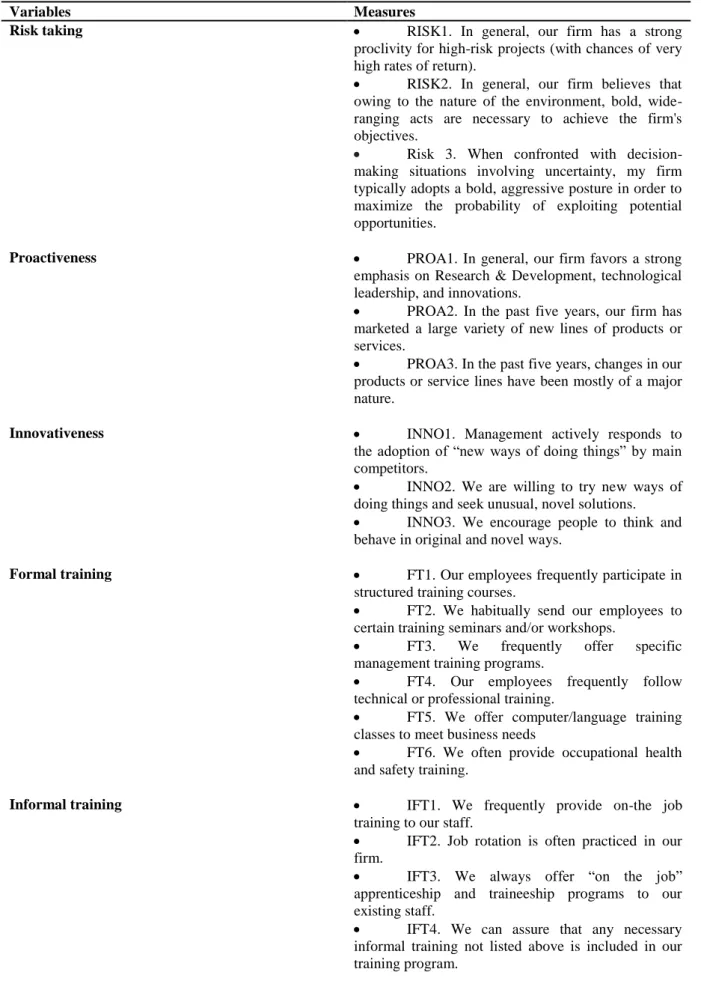
Following [171] this study used almost established constructs available in literature. The questionnaire in this paper is generated based on previous measures. All items were measured using a seven-point Likert scale ranges from 1 “strongly disagree” to 7 “strongly agree” (see Table 2).
115
Table 2: Included measures
Variables Measures
Risk taking RISK1. In general, our firm has a strong proclivity for high-risk projects (with chances of very high rates of return).
RISK2. In general, our firm believes that owing to the nature of the environment, bold, wide-ranging acts are necessary to achieve the firm's objectives.
Risk 3. When confronted with decision-making situations involving uncertainty, my firm typically adopts a bold, aggressive posture in order to maximize the probability of exploiting potential opportunities.
Proactiveness PROA1. In general, our firm favors a strong emphasis on Research & Development, technological leadership, and innovations.
PROA2. In the past five years, our firm has marketed a large variety of new lines of products or services.
PROA3. In the past five years, changes in our products or service lines have been mostly of a major nature.
Innovativeness INNO1. Management actively responds to the adoption of “new ways of doing things” by main competitors.
INNO2. We are willing to try new ways of doing things and seek unusual, novel solutions. INNO3. We encourage people to think and behave in original and novel ways.
Formal training FT1. Our employees frequently participate in structured training courses.
FT2. We habitually send our employees to certain training seminars and/or workshops.
FT3. We frequently offer specific management training programs.
FT4. Our employees frequently follow technical or professional training.
FT5. We offer computer/language training classes to meet business needs
FT6. We often provide occupational health and safety training.
Informal training IFT1. We frequently provide on-the job training to our staff.
IFT2. Job rotation is often practiced in our firm.
IFT3. We always offer “on the job” apprenticeship and traineeship programs to our existing staff.
IFT4. We can assure that any necessary informal training not listed above is included in our training program.
116
Tacit knowledge sharing TKS1. Our employees frequently share knowledge based on their experience
TKS2. Our employees frequently collect knowledge from others based on their experience TKS3. Our employees frequently share knowledge of know-where or know-whom with others.
TKS4. Our employee frequently collect knowledge of know-where or know-whom with others.
TKS5. Our employees frequently share knowledge based on their expertise.
TKS6. Our employees frequently collect knowledge from others based on their expertise. TKS7. Our Employees will share lessons from past failures when they feel necessary.
Explicit knowledge sharing EKS1. Our employees frequently share existing reports and official documents with members of our organization.
EKS2. Our employees frequently share reports and official documents that they prepare by themselves with members of our organization.
EKS3. Our employees frequently collect reports and official documents from others in their work.
EKS4.Our employees are frequently encouraged by knowledge sharing mechanisms. EKS5. Our employees are facilitated by IT systems invested for knowledge sharing.
4.2.1. Dependent variables
[60] Proposed an extension of the EO dimensions (i.e. autonomy and competitive aggressiveness). However, this extension was intended to capture the distinct idea of „first to fight‟ based on the definition of the firm‟s entrepreneurial orientation of authors in [172]. Competitive aggressiveness is not appropriate in cultures such as those of Tunisisan, while autonomy is only concerned with firm ownership, which is already a characteristic of SMEs. These two dimensions of EO, as suggested by [60] will not be included in this study because the context is different. E.O in our study covers three dimensions namely risk taking, proactiveness and innovativeness as suggested by [174].
4.2.1.1. Risk taking
To measure risk taking, a scale that was originally developed by [3] and reused later by several authors (e.g., [60,175]). It is assessed by asking target respondent about the firm‟s propensity to engage in risky projects and managers‟ preference for bold versus cautious acts to achieve firm objectives [60].
4.2.1.2. Proactiveness
117
assessed by asking managers about the firm‟s tendency to lead, rather than follow, in terms of developing new procedures, technologies, and new products or services ( [178] ; [179]).
4.2.1.3. Innovativeness
[60] Reckons that most entrepreneurship research based on [173]‟s concept of innovativeness demonstrates a common weakness, that is, [173] focused exclusively on the product-market and technological aspects of innovation and lacked measures for a firm‟s overall propensity of innovative behavior. Given this, this study followed [175] and adapted two items from [173] and one item from [178] to measure firm innovativeness.
4.2.2. Independent variables
A variety of formal and informal training programs adopted [50] was chosen to measure employee training.
4.2.2.1. Formal training
The measurement of the formal training contained six items reflecting (1) structured training courses; (2) seminars and/or workshops; (3) management training; (4) technical or professional training; (5) computer/software training; and (6) occupational health and safety training. We made some adjustment in the wording.
4.2.2.2. Informal training
The measures of the informal training included four items aimed at capturing (1) on-the job training; (2) job rotation; (3) apprenticeship and traineeship; and (4) “other training.” “Other training” included all other training not covered separately in informal programs.
4.2.2.3. knowledge sharing
The items for the construct of both tacit and explicit knowledge sharing were adapted from [104] with adjustments to the wording.
4.2.2.3.1. Tacit knowledge sharing
Tacit knowledge sharing‟s items were generated by [102] based on a range of previous studies ([71,85,179].). They include seven items to capture employee experience, know who and know where, employee professionalism and lessons from past failures.
4.2.2.3.2. Explicit knowledge sharing
Explicit knowledge sharing is measured via 5 items scale, the scale is build and refined from the work of [103] which originally contained 6 items, To suit the research setting, we should modify the scale for measuring explicit knowledge sharing by dropping the training and development item because it may cause confusion with
118
the other research construct . These items closely capture collecting and using formal reports or documents [179] and IT systems [180]. All variables with their corresponding item and sources are described in the table 2.
5.Research Results
We analysed our hypotheses using partial least squares (PLS) via PLS-Graph Version 3.0, based on the results from our data‟s normality tests. We performed Kolmogorov–Smirnov and Shapiro–Wilk tests to examine the normality of our sample distributions by using SPSS Version 13.0 and show that the sample distributions from our data do not obey the normal distribution. PLS is useful in analysing such data to demonstrate non-normality because it places minimal restrictions on the sample distributions due to resampling by bootstrapping ([181,182]).
5.1. Measurement Model
Table 3: Scale reliabilities and convergent validity
Construct Cronbach’s α CR AVE Items Factor loading
Mean S.D
Risk taking 0.75 0.96 0.95 RISK1 RISK2 RISK3 0.53 1.39 0.56 6.16 6.37 6.32 0.85 0.74 0.72 Innovativeness 0.74 0.99 0.99 INNO1 INNO2 INNO3 0.60 0.96 0.83 5.72 5.88 5.98 0.93 0.93 0.85 Proactiveness 0.75 0.98 0.98 PROA1 PROA2 PROA3 0.74 0.86 0.79 4.02 4.18 4.05 1.01 1.07 1.19 Formal training 0.73 0.80 0.65 FT1 FT2 FT3 FT4 FT5 FT6 0.73 0.71 0.83 0.78 0.72 0.76 3.05 3.37 3.23 3.19 2.96 2.73 1.10 1.15 1.19 1.25 1.62 1.26
Informal training 0.74 0.62 0.59 IFT1 IFT2 IFT3 IFT4 0.69 0.51 0.57 0.56 5.91 5.94 5.91 6.09 0.91 0.92 0.85 0.81 Tacit knowledge sharing 0.74 0.62 0.51 TKS1 TKS2 TKS3 TKS4 TKS5 TKS6 TKS7 0.70 0.63 0.55 0.59 0.54 0.56 0.51 6.17 5.82 5.80 5.94 6.02 5.70 6.00 1.00 0.90 0.80 0.83 0.95 0.93 0.96 Explicit knowledge sharing 0.75 0.76 0.76 EKS1 EKS2 EKS3 EKS4 EKS5 0.60 0.66 0.84 0.77 0.62 2.46 2.58 2.66 2.65 2.56 0.94 1.03 1.01 0.95 0.81 We checked the internal reliability of our measurement items by using Cronbach‟s _. The smallest value of Cronbach‟s _ was 0.736, indicating satisfactory levels of reliability. Confirmatory factor analysis was then
119
conducted to test the measurement model, checking for the convergent validity as well as discriminant validity of the instrument items. First, convergent validity is acceptable if item loadings are 0.50 or greater [183].The smallest loading in this study was 0.51, satisfying convergent validity conditions. Second, to check the reliability of the latent variables, composite reliability (CR) and the average variance extracted (AVE) are assessed using the procedure outlined by [7]. The reliability for CR and the AVE is acceptable if CR is 0.60 or greater and the AVE is 0.50 or greater. As shown in Table 3, the CR and AVE values of the items in this study exceed acceptable values. Third, for discriminant validity, the AVE from the construct should be greater than the variance shared by that construct and the other constructs in the model [184].
Notes: CR: composite reliability; AVE: average variance extracted; SD: standard deviation
Table 4 shows the interconstruct correlations, with the square roots of the AVE of each construct in the diagonal elements. Tacit knowledge sharing and informal training have high intercorrelations, a sign of their strong causal relationships, but the square roots of the AVE exceed the interconstruct correlations, satisfying discriminant validity.
Table 4: Correlation matrix and discriminant assessment
1 2 3 4 5 6 7 1.Risk taking 0.97 2.Proactiveness 0.08 0.99 3.Innovativenness 0.08 0.35 0.99 4.Formal training 0.07 -0.34 0.10 0.80 5.Informal training -0.02 0.08 0.23 0.36 0.77 6.Tacit knowledge sharing 0.03 0.07 0.21 0.27 0.31 0.71 7.Explicit knowledge sharing -0.15 0.09 -0.08 -0.25 -0.25 -0.24 0.87
Notes: diagonal bold letters are the square roots of AVE
5.2. Structural model
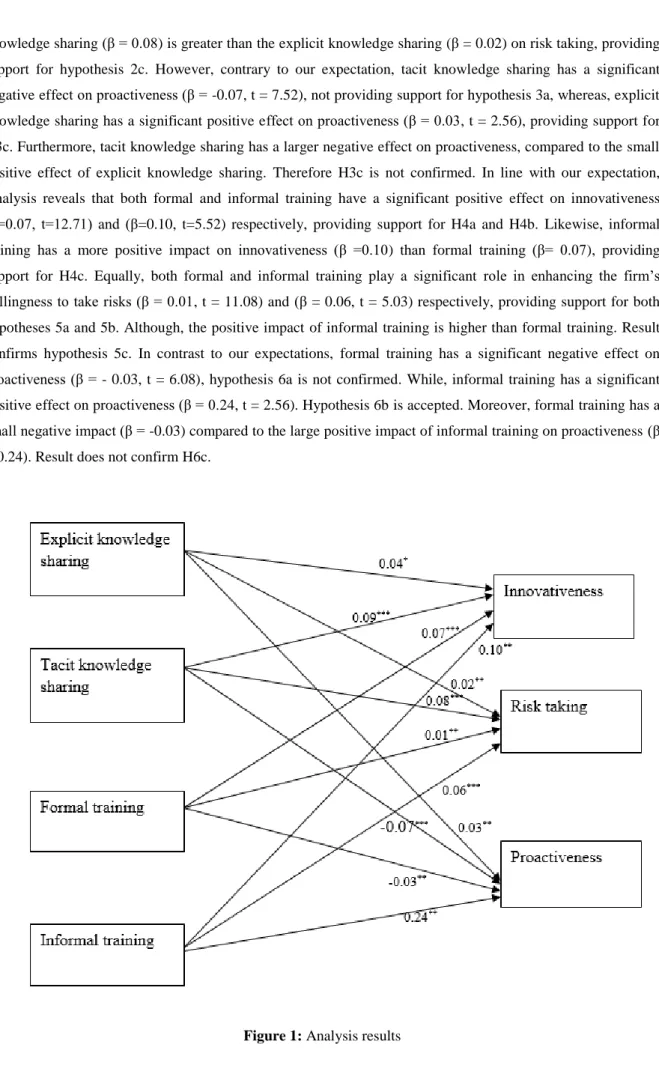
The bootstrap resampling method was used for the analysis to determine the significance of the path coefficient. The structural equation model results are shown in fig.1.Analysis reveals that tacit and explicit knowledge sharing are significantly and positively associate with innovativeness (β= 0.09; t= 8.51) and (β = 0.04; t= 5.24) respectively. Thus, hypotheses 1a and 1b are supported. Consistent with our expectation, tacit knowledge sharing has more positive effect on innovativeness (β= 0.09) than explicit knowledge sharing (β = 0.04), providing support for hypothesis 1c. Similarly, analysis reveals that both tacit and explicit knowledge sharing play an important role in enhancing risk taking (β = 0.08, t = 12.71) and ( β = 0.02, t = 12.71) respectively. Therefore, H2a and H2b are accepted. Consistent with our expectation the positive impact of the tacit
120
knowledge sharing (β = 0.08) is greater than the explicit knowledge sharing (β = 0.02) on risk taking, providing support for hypothesis 2c. However, contrary to our expectation, tacit knowledge sharing has a significant negative effect on proactiveness (β = -0.07, t = 7.52), not providing support for hypothesis 3a, whereas, explicit knowledge sharing has a significant positive effect on proactiveness (β = 0.03, t = 2.56), providing support for H3c. Furthermore, tacit knowledge sharing has a larger negative effect on proactiveness, compared to the small positive effect of explicit knowledge sharing. Therefore H3c is not confirmed. In line with our expectation, Analysis reveals that both formal and informal training have a significant positive effect on innovativeness (β=0.07, t=12.71) and (β=0.10, t=5.52) respectively, providing support for H4a and H4b. Likewise, informal training has a more positive impact on innovativeness (β =0.10) than formal training (β= 0.07), providing support for H4c. Equally, both formal and informal training play a significant role in enhancing the firm‟s willingness to take risks (β = 0.01, t = 11.08) and (β = 0.06, t = 5.03) respectively, providing support for both hypotheses 5a and 5b. Although, the positive impact of informal training is higher than formal training. Result confirms hypothesis 5c. In contrast to our expectations, formal training has a significant negative effect on proactiveness (β = - 0.03, t = 6.08), hypothesis 6a is not confirmed. While, informal training has a significant positive effect on proactiveness (β = 0.24, t = 2.56). Hypothesis 6b is accepted. Moreover, formal training has a small negative impact (β = -0.03) compared to the large positive impact of informal training on proactiveness (β = 0.24). Result does not confirm H6c.
121
6.Discussion and concluding remarksThe Result of our study indicates that entrepreneurial orientation (EO), with its three core dimensions of risk-taking, proactiveness and innovativeness displays differential relationship with knowledge sharing in both tacit and explicit forms and the two components of employee training- formal and informal programs. Consistent with a plethora of previous findings (for a review, see; [185;110,186,111]), this study empirically reveals a positive significant relationship between both tacit and explicit knowledge sharing and innovativeness. Accordingly tacit and explicit knowledge complete each other [187]. However result reveals that the positive impact of tacit knowledge sharing on innovativeness is stronger than explicit knowledge sharing. The principal reason why this has been the case is that tacit knowledge is difficult to imitate ([109,188,189,190]). It should be noted that the more tacit knowledge is shared, the harder is the imitation [191]. In particular [192] has revealed that in case of one innovation, tacit knowledge was important in restricting imitators so that competing firms found difficult to copy or replicate such process. Another advantage enjoyed by an organisation using tacit knowledge in terms of its contribution to innovation is that such knowledge is ambiguous in nature. The ambiguity also makes duplication of the knowledge difficult [98]. Result supports also the idea of the author in [193] suggesting that the concept of tacit knowledge is very important in the context of innovation and its diffusion because it is hard to capture in term of “know how” compared to explicit knowledge which is frequently written down and expressed in formal language such as documents, reports, information technologies, patents, catalogues, presentations, white papers, formulas, computer programs ([194,86]) which therefore can be imitated fairly easily. Consequently tacit knowledge largely acquired on the job, made a greater contribution to innovation than had formal knowledge [195]. Our study reveals also that both tacit and explicit knowledge sharing play an important role in enhancing risk taking, this has been also explored in prior studies (see for example; [115,116]). However result displays that the positive impact of the tacit knowledge sharing in increasing risk propensity is greater than the explicit knowledge. Since tacit knowledge is based on the experience of individuals expressed in human actions in the form of evaluation, attitudes, points of view, commitments and motivation [196], hence sharing detailed information about their past specific work-related experiences, know-how and contextualized knowledge by engaging in deep dialogue creating or informal face to face interaction, meeting and brainstorming which is the most effective technique used in the sharing of knowledge in SME and herewith the respect of the professional capacity of the knowledge„s provider [85] may foster risk taking behaviors especially with those whose background expertise and knowledge are similar rather than those whose knowledge and expertise differ from their own [197]. So the level of risk averse and uncertainty are reduced by trusting relationship. In contrast to our assumption, the above result shows that tacit knowledge has a significant negative effect on proactiveness. However, explicit knowledge sharing has a significant positive effect on proactiveness. Tacit knowledge sharing has a larger negative effect on proactiveness compared to the small positive effect of explicit knowledge. The small positive effect of explicit knowledge can result firstly from the lack of explicit knowledge in SMEs since the type of knowledge in SMEs is almost all in tacit nature [198]. As stated by [199] tacit knowledge sharing cost is bearable for SMEs with Scarce resources [200]. Secondly, it can result from the less effective explicit knowledge in facilitating mutual understanding among members with dissimilar expertise. Therefore, exchanging knowledge and expertise through written documents, data and formulae does not help the individual acquire the substantive contextual
122
information essential to understanding dissimilar knowledge bases and it substantially requires time and effort. For team member with dissimilar expertise, explicit knowledge is less likely to stimulate proactive behavior. Thereby, the codified, written information is very difficult to comprehend and is too rarely taken into consideration resulting to the ignorance of data or stop reading the document [213]. The larger negative effect of tacit knowledge in proactiveness can be resulted from the higher employees quit and fire rate that leads often to an absolute loss of tacit knowledge because key personal or staff that hold valuable tacit knowledge are taken away by competing firms. In addition, the time advantage a firm possesses deserves to be noted in such result which is also important element when considering competitive advantage relating to tacit knowledge [202]. The actual stock of tacit know- how a firm holds even it is large and beneficial enough it must be quickly used, if they do not it can be catching up by firms competitors. Because tacit knowledge which is continually being refreshed and updated enhance proactive capacity so firm need to find way in which the leakage of tacit know-how will be slowed down or halted. Furthermore, the firm‟s tacit knowledge base is not just simply the sum of its individual employees but also key teams of managers and decision makers which help to create environment where tacit knowledge can be more successfully generated [202]. Therefore no or insufficient effort may lead to such result. In line with our expectation, our result shows that both formal and informal training has a positive effect on innovativeness as has been previously reported in the literature (see form example; [143]) suggesting that increases in either classroom or on the job training lead to more innovation. However, result shows that informal training has a more positive effect on innovativeness than formal training. These findings confirmed those of [143] who asserted that informal training (on the job training) appears to have as much an impact on innovation as does formal training (classroom training) and [203] who found that soft skill training (informal training) stimulates the discovery of effective approaches, solutions and innovation and enable employees to push change in organiations. Two main explanations of the present result can be given here; first, we disclose that employee training in SMEs is often described as informal, unplanned, reactive, and short term oriented [55]. Thereby, SMEs rarely carry out formal training need analysis [204]. Secondly informal training is preferred because it is less costly, can be easily integrated into daily operations of SME, and is focused on employees‟ specific needs ([55,56]). So that employees learn in the context in which their skills are used. They develop skills for solving diverse problems within the firm, leading to the development of multiskilled labor force which is widely recognized driver of innovation at the firm level. Equally, our result displays that both formal and informal training are positively and significantly associated with the firm‟s willingness to take risks. This finding confirms those of [206]. Although, the positive impact of informal training is higher than formal training. This has also been reported in prior studies by [207,152,151]. The later stated that employee upon receiving the soft skills (informal) training programme, acquire the skills taught and change their behaviour and attitude including risk taking. The reason why classroom training (formal) was considered to be of declining importance compared to the “on the job training” (informal) is that it appears easier to train, acquire and deal with because , most of time, the skill sets are not brand new to the learner and no unlearning or behavioral change is involved [151]. Our result shows also that formal training has a significant negative effect on proactiveness. Conversely, informal training has a significant positive effect on proactiveness. Informal training has a larger positive effect on proactiveness compared to the small negative effect of formal training. The first half result may seem surprising. Thereby, the small effect of formal training can result from the rareness of such training in SMEs as believed by [204] SMEs rarely apply formal training because relevant cost is unbearable for
123
SMEs with fewer financial resources. It is described as an unaffordable luxury involving not only course fees but also the cost of lost output while employees are off the job ([56,207]). However, to explain the negative effect of formal training on proactiveness we drew our attention to the training transfer. If individuals who have undergone training do not practice quickly the new knowledge, skills, behavior and attitude learned or gained in training that they have participated (course, seminar, workshop, etc) undesirable, unplanned leakage may produce. The longer is the time space break between learning and practicing, the higher is the chance to be lost or catched up by main competitors. The later result exhibits that informal training has a large positive effect on proactiveness. This finding confirmed those of [154,151] who asserted that informal training deal with personal qualities, habits, attitudes and behaviors that make someone a good employee and a compatible co-worker. Therefore it can enhance proaction. People can be asked to assess the extent of their proactive behavior to reflect and identify opportunities. Informal training can highlight each of the elements of such behavior along with planning and commitment to proactive goals and activities. Also essential is the development of skills that both increase the success‟s chance in proactive initiatives and enhance people's confidence [208].
7.theoretical and practical implication
The EO construct has become a core concept that receives a large amount of theoretical and empirical attention in entrepreneurship research [177]. Several researchers have emphasized the valuable outcomes of EO (for an overview, see [211].), however empirical studies about how to insert EO in an organization are so limited [212]. In particular no study, to our knowledge, has considered the impact of both employee training and knowledge sharing on the dimensions of EO even though several authors have called for such research ([154,61,177]). The main purpose of this study was to address this research gap by developing and testing a theoretical model that not only links employee training and knowledge sharing to different dimensions of EO in SMEs but also gives a more specific detail by dividing knowledge sharing in explicit- and tacit and employee training in formal and informal. This study may provide a guide to SMEs as to decide whether to implement formal or informal training and whether to share tacit knowledge or explicit knowledge to achieve better E.O. Scales put forward in this study offer a checklist for companies to evaluate themselves in certain domain. Companies should think over the important antecedents that lead to an entrepreneurial orientation profile through employee training and knowledge sharing.
8.Limitations and future research
Despite its new findings, this study has the following limitations, which may be considered and overcome by future research. Firstly, although this study reveals that the level of each dimension of E.O- Innovativeness, proactiveness and risk taking differs based on the form of knowledge sharing either tacit or explicit and the type of training either formal or informal, many other factors may be also involved. For instance, this study did not address or analyze the potential moderating effects such as the type of industry sector (e.g, the government sector versus the private sector) or the branch of activity (Garment manufacturing, finishing, spinning, weaving, knitting, etc).Secondly, we have not included any control variable, such as the size, the age of the firm or the branch of activity in the model. The use of a single respondent is a third limitation of the study. Moreover, in addition to these three dimensions of E.O- Innovativeness, proactiveness and risk taking, the role of degree of
124
autonomy and aggressiveness [60] can be explored. And, finally, although PLS is an excellent tool for complex models in which the theory is not sufficiently developed, we are aware of the exploratory and predictive nature of the technique, as opposed to other tools of a confirmatory type (LISREL, AMOS, etc.).
References
[1]. R. Thurik., & S. Wennekers. “Entrepreneurship, small business and economic growth”. Journal of Small Business and Enterprise Development, vol. 11, pp. 140–149, 2004.
[2]. M.J.Piore. & C.F. Sabel. “The Second Industrial Divide. New York: Basic books, 354 pp., hc. (1987)”. Journal of Peace Research, vol. 24, pp.206–206, 1984.
[3]. J.G.Covin. “Entrepreneurial versus conservative firms: a comparison of strategies and performance. Journal of management studies, vol.28, pp.439-461, 1991.
[4]. B.O. Carlsson., Z. Acs., D. Audretsch., & P. Braunerhjelm. “The knowledge spillover theory of entrepreneurship”. Small Business Economics, vol. 32, pp.15-30.
[5]. B. Kogut., & U.Zander. “Knowledge of the Firm, Combinative Capabilities, and the Replication of Technology”. Organization Science, vol. 3,pp. 383–39, 1992.
[6]. D.Z. Levin., & R. Cross. “The Strength of Weak Ties You Can Trust: The Mediating Role of Trust in Effective Knowledge Transfer”. Management Science, vol. 50, pp. 1477–1490,2004.
[7]. M. Alavi.,& D.E. Leidner. “Knowledge Management and Knowledge Management Systems: Conceptual Foundations and Research Issues”. MIS Quarterly, vol. 25, pp. 107-136, 2001.
[8]. L. Argote., & P. Ingram. “Knowledge Transfer: A Basis for Competitive Advantage in Firms”. Organizational Behavior and Human Decision Processes, vol. 82,pp. 150-169, 2000.
[9]. R.C. Huseman. & J.P. Goodman. “Knowledge organization: their emergence and impact on corporate training. Annenberg center for communication, university of southern California, USA, 1998.
[10]. B.T. Pentland. “Information systems and organizational knowledge systems”. Accounting, management and information technologies, vol. 5. pp.1-21, 1995.
[11]. C.J. Chen., & J.W.Huang. “Strategic human resource practices and innovation performance: The mediating role of knowledge management capacity”. Journal of Business Research, vol. 62, pp.104-114, 2009.
[12]. F. Deutscher., F.B. Zapkau., C. Schwens., M. Baum., & R. Kabst. “Strategic orientations and performance: a configurational perspective”. Journal of Business Research, vol. 69, pp.849-861, 2016. [13]. S.W. Floyd., & B. Wooldridge. “Knowledge creation and social networks in corporate
entrepreneurship: The renewal of organizational capability”. Entrepreneurship: Theory and Practice, vol. 23, pp.1–21, 1999.
[14]. L.M.D. Luca., & K. Atuahene-Gima. “ Market Knowledge Dimensions and Cross-Functional Collaboration: Examining the Different Routes to Product Innovation Performance”. Journal of Marketing, vol. 71, pp.95–112, 2007.
[15]. J.H.Love. & S.Roper. “Organizing the innovation process: complementarities in innovation networking”. Industry and innovation, vol. 16, pp. 273-290, 2009.
[16]. W.M. Cohen., & D.A. Levinthal. “Absorptive Capacity: A New Perspective on Learning and Innovation”. Administrative Science Quarterly, vol.35, pp.128-152, 1990.
125
[17]. S.W.Floyd., & P.J. Lane. “Strategizing throughout the Organization: Managing Role Conflict in Strategic Renewal”. The Academy of Management Review, vol. 25, pp.154-177, 2000.
[18]. E.K. Kelloway. & J. Barling. “Work as organizational behaviour”. International journal of management reviews, vol. 2, pp. 287-304, 2000.
[19]. M.H. Morris., & F.F Jones. “Human resource management practices and corporate entrepreneurship: an empirical assessment from the USA”. The International Journal of Human Resource Management, vol. 4, pp. 873–896, 1993.
[20]. T.N. Garavan. “Training, Development, Education and Learning: Different or the Same? “. Journal of European Industrial Training, vol. 21, pp.39-50, 1997.
[21]. C.G. Partlow. “Human resources practices of TQM hotels”. The Cornell hotel and restaurant administration quarterly, vol. 37. pp.67-77, 1996.
[22]. L. Tihanyi, “Composition of the top management team and firm international diversification”. Journal of Management, vol. 26, pp. 1157–1177, 2000.
[23]. J.W. Boudreau., W.R. Boswell., & T.A. Judge. “Effects of Personality on Executive Career Success in the United States and Europe”. Journal of Vocational Behavior, vol. 58, pp.53–81, 2001.
[24]. B.B. Flynn., R.G. Schroeder., S. Sakakibara. “The impact of quality management practices on performance and competitive advantage”, Decision Sciences, Vol. 23, pp. 659-91, 1995.
[25]. H. Kaynak. “The relationship between total quality management practices and their effects on firm performance”. Journal of operations management, vol. 21, pp. 405-435, 2003.
[26]. M.A. Maidique., & R.H. Hayes. “The Art of High-Technology Management”. Sloan Management Review, vol. 25, pp. 18 -31, 1984.
[27]. R.S.Schuler. “Fostering and facilitating entrepreneurship in organizations: implications for organization structure and human resource management practices”. Human resource management, vol. 25, pp.614-629, 1986.
[28]. J.T. Delaney., & M.A. Huselid, “The impact of human resource management practices on perceptions of organizational performance”. Academy of Management Journal, vol. 39, pp.949–969, 1996.
[29]. R. Schmelter., R. Mauer., C. Börsch., & M. Brettel. “Boosting corporate entrepreneurship through HRM practices: Evidence from German SMEs”. Human Resource Management, vol. 49, pp. 715–741, 2010.
[30]. M.W. Rutherford., & D.T Holt. “Corporate entrepreneurship: An empirical look at the innovativeness dimension and its antecedents”. Journal of Organizational Change Management, vol. 20, pp. 429–446, 2007.
[31]. H. Florén., J. Rundquist., & S. Fischer. “Entrepreneurial orientation and human resource management: effects from HRM practices”. Journal of Organizational Effectiveness: People and Performance, vol. 3, pp.164–180, 2016.
[32]. C. Zehir., Y. Gurol., T. Karaboga., & M. Kole. “Strategic Human Resource Management and Firm Performance: The Mediating Role of Entrepreneurial Orientation”. Procedia - Social and Behavioral Sciences, vol. 235, pp. 372–381, 2016.
[33]. M. De Clercq., B. Galand., & M. Frenay. “Chicken or the egg: Longitudinal analysis of the causal dilemma between goal orientation, self-regulation and cognitive processing strategies in higher