Declarative Languages for Machine
Learning and Data Mining
Luc De Raedt
ICLP, 2015
with slides from
Angelika Kimmig, Davide Nitti, Siegfried Nijssen, Tias Guns, Paolo Frasconi, Francesco Orsini
Inductive Logic
Programming
•
In 1995 :
•
focus on symbolic data and methods
•
focus on using and producing knowledge
•
learning programs typically written in Prolog
Inductive Logic
Programming
[Srinivasan et al. AIJ 96]
Data = Set of Small Graphs
General Purpose
Logic Learning System
Uses and Produces
Learning from entailment
Learning from entailment -- the setting
Given
mutagenic(225), ...
Find
background
examples
rules
covers(H,e) iff H |= e or B
∪
H
⊧
e
Machine learning and
data mining
•
Today
•
Big data — a lot more data available
•
Low-level and high-level features
•
focus on performance and scalability, less on
understandability
•
kernels, probabilistic methods, constrained
Declarative methods
•
There has been a paradigm shift in the field of AI from
programming
to
solving
(Hector Geffner at ECAI 2012)
•
Use of solvers and declarative languages is common in AI
•
SAT, MAX-SAT, CSP, ASP, MDPs, ILP, MP, …
•
Two sources of inspiration for this talk
•
Statistical learning (convex optimization) — Stephen Boyd
Role of Declarative Methods in
ML and DM ?
Role of Declarative Methods in
ML and DM ?
Role of Declarative Methods in
ML and DM ?
This talk:
This talk
•
Using and developing declarative languages for ML/DM — a
survey
•
inductive query languages (database perspective)
•
modelling languages for ML/DM (constraint / answer set
programming)
•
programming languages for ML/DM (programming language
perspective)
•
probabilistic
Data Mining
Given
•
a database containing instances or transactions D
•the set of instances
•
a hypothesis space or pattern language L
•
a selection predicate, query or set of constraints Q
Find Th(Q,L,D) = { h
∈
L | Q(h,D) = true }
Pattern Mining
Find
patterns that are frequent in mutagenic,
infrequent in clean data.
Imielinski and Mannila (1995)
The concept of data mining as
a querying process.
•
Make first class citizens of patterns.
•
Query not only the data but also the patterns.
•
Tightly integrate databases and data mining.
•
Search for the equivalent of Codd’s relational algebra for data
mining
“From the user perspective, there is no such thing as a real
discovery, just a matter of
the expressive power of the query
language.”
An inductive database example
Virtual Mining Views (Blockeel et al. 12)
Beer
Brand
Color
Alcohol%
1
Westmalle Tripel
Blonde
9.5
2
Orval
Dark
6.2
3
Stra
↵
e Hendrik
Gold
9
4
Stra
↵
e Hendrik
Dark
11
....
...
...
...
Cid
Brand
Color
Alcohol%
c1
Westmalle Tripel
?
?
c2
Westmalle Tripel
Blonde
?
c3
?
Blonde
?
c4
?
Blonde
9.5
c5
Stra↵e Hendrik
?
?
....
...
...
...
cid
frequency
size
c5
2
1
...
...
...
Beer
Brand
Color
Alcohol%
1
Westmalle Tripel
Blonde
9.5
2
Orval
Dark
6.2
3
Stra
↵
e Hendrik
Gold
9
4
Stra
↵
e Hendrik
Dark
11
An inductive database example
Virtual Mining Views (Blockeel et al. 12)
Beer
Brand
Color
Alcohol%
1
Westmalle Tripel
Blonde
9.5
2
Orval
Dark
6.2
3
Stra
↵
e Hendrik
Gold
9
4
Stra
↵
e Hendrik
Dark
11
....
...
...
...
Cid
Brand
Color
Alcohol%
c1
Westmalle Tripel
?
?
c2
Westmalle Tripel
Blonde
?
c3
?
Blonde
?
c4
?
Blonde
9.5
c5
Stra↵e Hendrik
?
?
....
...
...
...
Beer
Brand
Color
Alcohol%
1
Westmalle Tripel
Blonde
9.5
2
Orval
Dark
6.2
3
Stra
↵
e Hendrik
Gold
9
4
Stra
↵
e Hendrik
Dark
11
....
...
...
...
Cid
Brand
Color
Alcohol%
c1
Westmalle Tripel
?
?
c2
Westmalle Tripel
Blonde
?
c3
?
Blonde
?
c4
?
Blonde
9.5
c5
Stra
↵
e Hendrik
?
?
....
...
...
...
cid
frequency
size
c5
2
1
...
...
...
An inductive database example
Virtual Mining Views (Blockeel et al. 12)
Beer
Brand
Color
Alcohol%
1
Westmalle Tripel
Blonde
9.5
2
Orval
Dark
6.2
3
Stra
↵
e Hendrik
Gold
9
4
Stra
↵
e Hendrik
Dark
11
....
...
...
...
Cid
Brand
Color
Alcohol%
c1
Westmalle Tripel
?
?
c2
Westmalle Tripel
Blonde
?
c3
?
Blonde
?
c4
?
Blonde
9.5
c5
Stra↵e Hendrik
?
?
....
...
...
...
Cid
Brand
Color
Alcohol%
c1
Westmalle Tripel
?
?
c2
Westmalle Tripel
Blonde
?
c3
?
Blonde
?
c4
?
Blonde
9.5
c5
Stra
↵
e Hendrik
?
?
....
...
...
...
cid
frequency
size
c5
2
1
...
...
...
SELECT C.*, S.supp, S.sz,
S.supp * S.sz AS area
FROM BeerConcepts C, BeerSets S
WHERE (C.cid = S.cid AND (S.freq * S.sz > 60))
OR (S.freq > 10)
BeerConcepts
Understanding city access patterns
•
How do people get into town? What is the
map of their trips in space and time?
Slides courtesy
Dino Pedreschi
Understanding city access patterns
•
How do people get into town? What is the
map of their trips in space and time?
Slides courtesy
Dino Pedreschi
Understanding city access patterns
A12 Sud
Cascina
Marina di Pisa/Tirrenia Lucca
•
How do people get into town? What is the
map of their trips in space and time?
Slides courtesy
Dino Pedreschi
Marina di Pisa/Tirrenia A12 Sud
1,50
%
2,90
%
Slides courtesy
Dino Pedreschi
M-Atlas kdd.isti.cnr.it
F. Giannotti, M. Nanni, D. Pedreschi, F. Pinelli, C. Renso, S. Rinzivillo, R, Trasarti.
Unveiling the complexity of human mobility by querying and mining massive trajectory data.
VLDB J., 2011
Slides courtesy
Dino Pedreschi
DMQL EXPRESSIVENESS:
How do people leave the city toward suburban areas?
CREATE MODEL MilanODMatrix AS MINE ODMATRIX FROM (SELECT t.id, t.trajectory FROM TrajectoryTable t), (SELECT orig.id, orig.area FROM MunicipalityTable orig), (SELECT dest.id, dest.area FROM MunicipalityTable dest)
CREATE RELATION CenterToNESuburbTrajectories USING ENTAIL
FROM (SELECT t.id, t.trajectory FROM TrajectoryTable t, MilanODMatrix m WHERE m.origin = Milan AND
m.destination IN (Monza, ..., Brugherio))
CREATE MODEL ClusteringTable AS MINE T-CLUSTERING
FROM (Select t.id, t.trajectory from CenterToNESuburbTrajectories t) SET T-CLUSTERING.FUNCTION = ROUTE_SIMILARITY AND
T-CLUSTERING.EPS = 400 AND T-CLUSTERING.MIN_PTS = 5
M-ATLAS --
Gianotti et al. VLDB J. 11
Mobility mining
Inductive databases
•
Many inductive query languages have been developed (supporting decision trees,
complex pattern mining, clustering, geographical information systems …), e.g.
MineRule (Meo), MSQL (Iemielinski), DMQL (Han), IQL (Nijssen), LDL ...
•
How does it work :
•
integration in database system + query optimization + specific type of pattern;
•usually: a call to an external “procedural” solver
•
Challenges :
•
different implementations needed for different pattern types, no “universal”
algebra for data mining known; the quest remains open
•
loose integration among different pattern types, sometimes more a toolbox
•limited expressiveness (e.g. user-defined constraints absent)
Constraint-Based Pattern Mining
Pattern Mining
•
which patterns are frequent ?
•
which patterns are significant w.r.t. classes ? all patterns ? k-best
patterns ?
•
which pattern
set
is the
best
concept-description for the actives ? for
the inactives ?
C. pattern set mining
A. frequent pattern
T h
(
L
, Q,
D
) =
{
p
L|
Q
(
p,
D
) =
true
}
B. Correlated pattern mining = subgroup discovery
T h
(
L
, Q,
D
) = arg
p
L
max
k
(
p,
D
)
Constraint-Based Mining
•
Numerous constraints have been used
•
Numerous systems have been developed
•
And yet,
•
new constraints often require new
implementations
Constraint and Answer Set
Programming
•
Exists since about 20 ? years
•
A general and generic methodology for dealing with constraints
across different domains
•
Efficient, extendable general-purpose systems exist, and key
principles have been identified
•
Surprisingly CP & ASP had not been used for data mining ?
•
CP and ASP systems often more elegant, more flexible and
more efficient than special purpose systems
Itemset mining
Frequent patterns
4
2
3
Data
Frequent Itemset Mining
Find
:
all sets of items appearing frequently
cover( , ) = { , }
frequency( , ) = | { , } | = 2
Frequent Itemset Mining
Given
• I
=
{
1
,
· · ·
, N rI
}
set of items
• T
=
{
1
,
· · ·
, N rT
}
set of transactions
• D
=
{
(
t, I
)
|
t
2
T
, I
✓
I}
dataset
•
Items
✓
I
and
T rans
✓
T
Find
Items
such that
|
covers
(
Items,
D
)
|
> f req
where
covers
(
Items,
D
) =
Frequent Itemset Mining
int
: Freq;
int
: NrI;
int
: NrT;
array
[1..NrT]
of set of
1..NrI: D;
var set of
1..NrI: Item;
var set of
1..NrT: Trans;
constraint
card(Trans) > Freq;
constraint
Trans = covers(Item, D);
solve satisfy
;
function var set of int: cover(Item, D) =
let {
var set of int: Trans,
constraint forall (t in ub(Trans))
(t in Trans
↔
Item subset D[t]) } in Trans;int
: Freq;
int
: NrI;
int
: NrT;
array
[1..NrT]
of set of
1..NrI: D;
var set of
1..NrI: Items;
var set of
1..NrT: Trans;
constraint
card(Trans) > Freq;
constraint
Trans = covers(Items, D);
solve satisfy
;
function var set of int: cover(Items, D) =
let {
var set of int: Trans,
constraint forall (t in ub(Trans))
(t in Trans
↔
Items subset D[t]) } in Trans;Given
• I
=
{
1
,
· · ·
, N rI
}
set of items
• T
=
{
1
,
· · ·
, N rT
}
set of transactions identifiers
• D
=
{
(
t, I
)
|
t
T
, I
I}
Dataset
•
Items
I
and
T rans
T
Find
Items
such that
|
covers
(
Items,
D
)
|
> f req
where
covers
(
Items,
D
) =
{
t
T |
(
t, I
)
D
and
Items
I
}
MiningZinc [Guns et al IJCAI 13, ICDM 13]
Given
• I
=
{
1
,
· · ·
, N rI
}
set of items
• T
=
{
1
,
· · ·
, N rT
}
set of transactions
• D
=
{
(
t, I
)
|
t
2
T
, I
✓
I}
dataset
•
Items
✓
I
and
T rans
✓
T
Find
Items
such that
|
covers
(
Items,
D
)
|
> f req
where
covers
(
Items,
D
) =
Declarative Modeling
•
Language goals:
•
high-level notation (similar to paper definitions)
•
solver-independent
•
user-defined abstractions
•
- mathematical-like language (Zinc)
•
- many solvers
•
- can define custom predicates
and functions
[T. Guns, A. Dries, S. Nijssen, G. Tack, L. De Raedt, IJCAI 2013]
Frequent Itemset Mining
vocabulary FrequentItemsetMiningVoc {
type Transaction
type Item
Freq: int
Includes(Transaction,Item)
FrequentItemset(Item)
}
theory FrequentItemsetMiningTh: FrequentItemsetMiningVoc {
#{t: !i: FrequentItemset(i) => Includes(t,i) } >= Freq.
}
structure Input : FrequentItemsetMiningVoc {
Freq = 7 // threshold for frequent itemsets
Transaction = { t1; ... ; tn } // n transactions
Item = {i1 ; ... ; im } // m items
Includes = {t1,i2; t1,i7; ...} // items of transactions
}
FrequentItemset represents a
set of items
FreqItemset must fulfill
#{t: FreqItemset
⊆
t} >= Freq.
in ASP — See Järvisalo, LPNMR 11
Closed Itemset Mining
int
: Freq;
int
: NrI;
int
: NrT;
array
[1..NrT]
of set of
1..NrI: D;
var set of
1..NrI: Items;
var set of
1..NrT: Trans;
constraint
card(Trans) > Freq;
constraint
Trans = covers(Items, D);
constraint
Items = cover_inv(Trans, D);
solve satisfy
;
function var set of int: cover(Items, D) =
let {
var set of int: Trans,
constraint forall (t in ub(Trans))
(t in Trans
↔
Items subset D[t] ) } in Trans;function var set of int: cover_inv(Trans,D)= let {
var set of int: Items,
constraint forall (i in ub(Items))
(i in Items
↔
Trans subset D’[i] )} in Items;
Generality
Manual Encoding in Zinc
⇤
t
:
T
t
= 1
⇥
i
I
i
(1
D
ti
) = 0
t
T
t
minsup
⇤
i
:
I
i
= 1
⇥
t
T
t
D
ti
minsup
iff
Text
int: Freq;int: NrI; int: NrT;
array [1..NrT] of set of int: D;
array [1..NrI] of var bool: Items;
array [1..NrT] of var bool: Trans;
constraint % encode D: every Trans complement has no supported Items
forall(t in 1..NrT) (
Trans[t] <-> sum(i in 1..NrI) ( Items[i]*(1 - (i in D[t])) ) <= 0
);
constraint % frequency: every Item is supported by sufficently many Trans
forall(i in 1..NrI) (
Items[i] -> sum(t in 1..NrT) ( Trans[t]*(i in D[t]) ) >= Freq
);
Resulting Search Strategy akin
to Zaki’s Eclat [KDD 97]
see
Discriminative Pattern Mining
Alternative opt. functions, for example:
with:
int
: NrI;
int
: NrT;
int
: Freq;
array
[1..NrT]
of set of
int
: D;
set of int
: pos;
set of int
: neg;
var set of
1..NrI: Items;
var set of
1..NrT: Trans;
constraint
Trans = cover(Items, D);
solve maximize
card(Trans
intersect
pos) – card(Trans
intersect
neg
)
neg);
solve maximize
chi2(Trans, pos, neg);
function float
: chi2(Trans, pos, neg)
Correlation function
Projection on PN-space
Nijssen KDID
Declarative Modeling
•
Language goals:
•
high-level notation (similar to paper definitions)
•
solver-independent
•
user-defined abstractions
•
- mathematical-like language (Zinc)
•
- many solvers
•
- can define custom predicates
and functions
[T. Guns, A. Dries, S. Nijssen, G. Tack, L. De Raedt, IJCAI 2013]
Toolchain
1)
Normalize to FlatZinc
(do not flatten lib_itemsetmining.mzn yet)
2)Apply rewrite rules to:
1)
add redundant constraints
2)
detect (partial) applicability of specialised algorithms
3)tailor to constraint solvers
3)
Collect all feasible rewrite combinations = execution plans
4)Heuristically rank + execute a plan
Three categories of execution plans:
A) Specialised algorithms only
−
Eclat-maxfreq(TDB, 20, 40)
−
LCMv2(TDB, 20) + maxcover(Items, TDB, 40)
B) Hybrid decomposition
−
LCMv2(TDB, 20) + gecode(
card(cover(Items, TDB)) =< 40
)
−
LCMv2(TDB, 20) + frequency(Items, TDB, S) + gecode(
S =< 40
)
C) Generic solvers only
−
gecode(...)
−
gecode-bool(...)
−
gecode-bool(...
+ redundant
)
−
or-tools-bool(...)
var set of
1..NrI: Items;
array
[int]
of set of
int
: TDB;
constraint
card(cover(Items, TDB)) >= 20;
constraint
card(cover(Items, TDB)) =< 40;
Experiments, hybrid solving
frequent itemset mining, with minimum size and closure constraint
cis
-regulatory module detection
regulators
Genomic sequences
AGTGAGATAAAAAAAAGTATTGACATGAATTAAAAAACCCAGAAAGCACACTAGGGTGCATCAGTGAGTAGCCTCACAGTCTAAGGGTTTACA GACTTTCTAAACATTCAGA Seq_1 (1,10) (65,74) (12,20) (80,88) (43,51) (53,61) (90,98) (72,78) Seq_2 (33,42) (85,94) (49,57) (56,64) (91,99) (50,56) (52,58) Seq_3 (1,10) (82,91) (45,53) (58,66) (75,83) (90,88) (24,32) (72,80) (89,97)with CP: add domain-specific
constraints
Declarative Pattern Mining
•
Quite some work on data mining and CP
•
pattern mining : P. Boizumault, B. Cremilleux, L. De Raedt, T. Guns,
S. Jabbour, M. Jarvisalo, S. Loudni, S. Nijssen, B. O'Sullivan, W.
Ugarte, A. Kemmar, ….
•
clustering : B. Babaki, I. Davidson, T.B.H. Dao, O. du Merle, S.
Gilpin, P. Hansen, S. Nijssen, C. Vrain, …
•
Several papers at CP 15
•
Still many limitations and challenges
•
Expressive power of modeling tools
•Efficient execution / compilation
Mining graphs
• Three problems• subgraph isomorphism — NP-complete subproblem • enumeration of subgraphs
• requires lower bound
• canonical form (do not generate the same graph more than once)
• independent subproblems reusing previous results;
• Some emerging approaches :
• sequences [Negrevergne, CPAIOR 15],[Kemmar, CP 15], • graphs : [Paramonov, ILP15]
Second-Order Model: Multiple Graphs
Multiple Graph Homomorphism Check:
homo
(
g
)
≈∆ ÷
◊
:
!
bedge
(
x
,
y
)
·
inq
(
x
)
·
inq
(
y
) =
∆
edge
(
g
,
◊
(
x
)
,
◊
(
y
))
.
inq
(
x
)
·
blabel
(
x
) =
y
=
∆
label
(
g
,
◊
(
x
)) =
y
.
x
”
=
y
=
∆
◊
(
x
)
”
=
◊
(
y
)
"
.
Frequency Constraint:
#
{
graph
:
homo
(
graph
)
}
Ø
t
.
13 / 25
Mining graphs
Programming Languages for Machine
Learning
Programming Languages for Machine
Learning
Probabilistic Programming
Tom Mitchell
Can we design programming languages containing
machine learning primitives?
Can a new generation of computer programming
languages directly support writing programs that learn?
Why not design a new computer programming language that
supports writing programs in which some subroutines are
hand-coded while others are specified as “to be learned.” Such a
programming language could allow the programmer to declare the
inputs and outputs of each “to be learned” subroutine, then select a
learning algorithm from the primitives provided by the programming
language.
Tom Mitchell
Can we design programming languages containing
machine learning primitives?
Can a new generation of computer programming
languages directly support writing programs that learn?
Why not design a new computer programming language that
supports writing programs in which some subroutines are
hand-coded while others are specified as “to be learned.” Such a
programming language could allow the programmer
to declare
the
inputs and outputs
of each “to be learned” subroutine,
then select a
learning algorithm
from the primitives provided by the programming
language.
Probabilistic Prologs
CP-Logic & ProbLog
52
[Vennekens et al, ICLP 04]
throws(john).
0.5::throws(mary).
0.8 :: break :- throws(mary).
0.6 :: break :- throws(john).
probabilistic causal laws
John throws
Window breaks
Window breaks
Window breaks
doesn’t break
doesn’t break
doesn’t break
Mary throws
Mary throws
doesn’t throw
doesn’t throw
1.0
0.6
0.4
0.5
0.5
0.5
0.5
0.8
0.8
0.2
0.2
P(break)=0.6
×
0.5
×
0.8+0.6
×
0.5
×
0.2+0.6
×
0.5+0.4
×
0.5
×
0.8
Semantics
(
Broken(G)
:
0.3
)
∨
(
Miss
:
0.7
)
←
ThrowAt(G)
.
I
{
M iss
}
Probability tree is an execution model of theory
iff:
•
Each tree-transition
matches
causal law
•
The tree cannot be extended
Each execution model defines the same
probability distribution over final states
Slides CP-logic courtesy Joost Vennekens
I
[
{
M iss
}
I
[
{
Broken
(
G
)
}
•
0
.
3
0
.
7
•
•
I
|
=
T hrowAt
(
G
)
Discrete- and continuous-valued random variables
Distributional Clauses (DC)
[Gutmann et al, TPLP 11; Nitti et al, IROS 13]
54
Discrete- and continuous-valued random variables
Distributional Clauses (DC)
length(Obj) ~ gaussian(6.0,0.45) :- type(Obj,glass).
[Gutmann et al, TPLP 11; Nitti et al, IROS 13]
random variable
with Gaussian distribution
54
Discrete- and continuous-valued random variables
Distributional Clauses (DC)
length(Obj) ~ gaussian(6.0,0.45) :- type(Obj,glass).
stackable(OBot,OTop) :-
≃
length(OBot)
≥
≃
length(OTop),
≃
width(OBot)
≥
≃
width(OTop).
[Gutmann et al, TPLP 11; Nitti et al, IROS 13]
comparing
values of
random variables
54
Discrete- and continuous-valued random variables
Distributional Clauses (DC)
length(Obj) ~ gaussian(6.0,0.45) :- type(Obj,glass).
stackable(OBot,OTop) :-
≃
length(OBot)
≥
≃
length(OTop),
≃
width(OBot)
≥
≃
width(OTop).
ontype(Obj,plate) ~ finite([0 : glass, 0.0024 : cup,
0 : pitcher, 0.8676 : plate,
0.0284 : bowl, 0 : serving,
0.1016 : none])
:- obj(Obj), on(Obj,O2), type(O2,plate).
[Gutmann et al, TPLP 11; Nitti et al, IROS 13]
random variable
with
discrete distribution
54
Discrete- and continuous-valued random variables
Distributional Clauses (DC)
length(Obj) ~ gaussian(6.0,0.45) :- type(Obj,glass).
stackable(OBot,OTop) :-
≃
length(OBot)
≥
≃
length(OTop),
≃
width(OBot)
≥
≃
width(OTop).
ontype(Obj,plate) ~ finite([0 : glass, 0.0024 : cup,
0 : pitcher, 0.8676 : plate,
0.0284 : bowl, 0 : serving,
0.1016 : none])
:- obj(Obj), on(Obj,O2), type(O2,plate).
[Gutmann et al, TPLP 11; Nitti et al, IROS 13]
54
Distributional Clauses (DC)
•Defines a generative process (as for CP-logic)
•
Tree can become infinitely wide, so exact inference infeasible and
sampling
needed; likelihood weighting or MCMC …
•
Well-defined under reasonable assumptions; see Gutmann et al., TPLP
11; Nitti et al., IROS 13, ICRA 14;
•
Typical inference tasks :
•
marginal probability of a query P(query)
•
conditional probability P(query | evidence )
Inference in PLP
•
As in Prolog and logic programming
•
proof
-based, using knowledge compilation
•
As in Answer Set Programming
•
model
based, using knowledge compilation
•
As in Probabilistic Programming
Learning relational affordances
Learn probabilistic model
From two object interactions
Generalize to N
Shelf
push
Shelf
tap
Shelf
grasp
Learning relational affordances
Learn probabilistic model
From two object interactions
Generalize to N
Shelf
push
Shelf
tap
Shelf
grasp
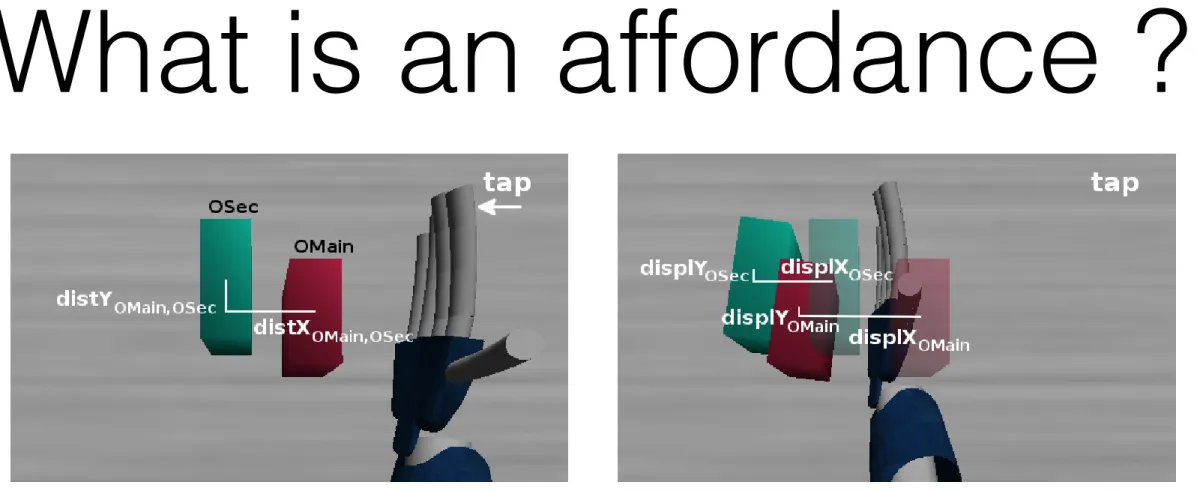
What is an affordance ?
(a) Disparity image (b) Segmented image with landmark points
Clip 7: Illustration of the object size computation. Left-hand image shows the disparity map of the example shown in Figure 5. The orange points in the right-hand image show the points that intersect with the ellipse’s major axis. The orange points are mapped onto 3D using their associated disparity value, and the 3D distance between each pair is defined as the object size.
To learn an a
↵
ordance model, the robot first performs a behavioural babbling
stage, in which it explores the e
↵
ect of its actions on the environment. For
this behavioural babbling stage, for the single-arm actions the robot uses its
right-arm only. For these actions a model of the left-arm will be later built by
exploiting symmetry as in [3]. We include the simultaneous two-arm
push
on
the same object in the babbling phase, allowing for a more accurate modelling
of action e
↵
ects for the iCub.
4The babbling phase consists of placing pairs of objects in front of the robot
at various positions. The robot executes one of its actions
A
described above on
one object (named: main object,
O
M ain).
O
M ainmay interact with the other
object (secondary object,
O
Sec) causing it to also move. Figure 8 shows such
a setting, with the objects’ position before (l) and after (r) a right-arm action
(
tap
(10)) execution.
Clip 8: Relational O before (l), and E after the action execution (r).
4As opposed to the two-arm a↵ordance modelling in [3], we also include in the babbling
phase the two-arm simultaneous actions whose e↵ects might not always be well modelled by the sum of the individual single-arm actions.
15
•
Formalism — related to STRIPS but models delta
•
but also joint probability model over A, E, O
During this behavioural babbling stage, data for O, A and E are collected for each of the robot’s exploratory actions. The robot executed 150 such exploratory actions. One example of collected data during such an action is shown in Table 1. Note that these values are obtained by the robot from its perception, which naturally introduces uncertainty, which the relational a↵ordance model takes into account (e.g., the displacement of OM ain is observed to be a bit more than 10cm).
Table 1: Example collected O, A, E data for action in Figure 8
Object Properties Action E↵ects
shapeOM ain : sprism shapeOSec : sprism distXOM ain,OSec : 6.94cm
distYOM ain,OSec : 1.90cm
tap(10)
displXOM ain : 10.33cm displYOM ain : 0.68cm
displXOSec : 7.43cm displYOSec : 1.31cm
During the babbling phase, we also learn the action space of each action. As the iCub is not mobile, and each arm has a specific action range, each ai 2 A
can be performed when an object is located in a specific action space. An object can be acted upon by both arms, by one arm but not the other, or it can be completely out of the reach of the robot. If the exploratory arm action on an object fails because no inverse kinematics solution was found, then that object is not in that arm’s action space. We will show later how any spatial constraints, such as action space, can be modelled with logical rules.
5.2. Learning the Model
The model will be learnt from the data collected during the robot’s 150 exploratory actions, one instance of such data as illustrated in Table 1. We will model the (relational) object properties: distX, distY (the x and y-axis distance between the centroids of the two objects), and the e↵ects: displX and
displY (the x and y-axis displacement of an object) with continuous distribution random variables. We will start by learning a Linear Conditional Gaussian (LCG) Bayesian Network [26]. An LCG BN specifies a distribution over a mixture of discrete and continuous variables. In an LCG, a discrete random variable may have only discrete parents, while a continuous random variable may have both discrete and continuous parents. A continuous random variable (X) will have a single Gaussian distribution function whose mean depends linearly on the state of its continuous parent variables (Y ) for each configuration of its discrete parent variables (U) [26]. This LCG distribution can be represented as: P(X = x|Y = y, U = u) = N(x|M(u) + W(u)Ty, 2(u)), with M a table of mean values, W a table of regression (weight) coefficient vectors, and a table of variances (independent of Y ). [26]
To learn an LCG BN for our setting, we will approximate displX, displY , and distX and distY by conditional Gaussian distributions over the short dis-tances over which objects interact. These disdis-tances will be enforced by adding logical rules.
Probabilistic Programs
•
Distributional clauses similar in spirit to probabilistic
functional
languages such as
•
BLOG [Russell et al.], ... but embedded in existing logic and
programming language
•
Church [Goodmann et al.] but use of logic instead of functional
programming ...
•
Probabilistic Logic Programming (survey: De Raedt & Kimmig, MLJ
15):
•
natural
possible world semantics
and link with prob. databases.
•somewhat harder to do
meta-programming
Probabilistic Programming
Key idea :
• modeling / programming language
• extend with probabilistic primitives to define probability distribution over possible
worlds or execution traces
• extend with solvers / execution strategies to answer probabilistic queries (marginal,
conditional probabilities, MAP and MPE)
• extend with learning strategies (EM or Bayesian inference) to estimate parameters
and/or learn structure
Many other probabilistic programming languages including
•
PRISM (Sato), Pita (Riguzzi), Blog (Russell), Figaro (Pfeffer), Church
Programming Languages for Machine
Learning
Kernel Programming
Machine learning
Given
•
an unknown target function f: X
→
Y
•
a hypothesis space L containing functions X
→
Y
•
a dataset of examples E = { (x,
f(x)
) | x
∈
X }
•
a loss function loss(h,E)
→
ℝ
Kernels and SVMs
•
A kernel is a
similarity
measure between two
“observations”, a
dot product
in a feature space
•
Kernels are used by
SVMs
to efficiently compute a
linear separator
65φ
( )
φ
( )
φ
( )
φ
( )
φ
( )
φ
( )
φ
( )
φ
( )
φ
(.)
φ
( )
φ
( )
φ
( )
φ
( )
φ
( )
φ
( )
φ
( )
φ
( )
φ
( )
φ
( )
Feature space
Input space
k
(
x, x
0
) =
<
(
x
)
,
(
x
0
)
>
Inductive Logic
Programming
[Srinivasan et al. AIJ 96]
Data = Set of Small Graphs
General Purpose
Logic Learning System
Uses and Produces
Learning from entailment
Given
mutagenic(225), ...
background
examples
covers(H,e) iff H |= e or B
∪
H
⊧
e
how to define a kernel between relational examples ?
how to do that declaratively ?
kLOG [Frasconi et al AIJ 14]
Input
Database
Graphicalize
Graphs
Feature
Generation
Graph
Kernel
Feature Vectors
Kernel Matrix
Classifier
Statistical
Learner
Surgical excision of CNV may allow stabilisation or improvement of vision .
E/R-MODEL
w depHead next wordID depRel lemma POS-tag chunktag wordString NEGenia NEUMLS sentence hasWord class sentID hasCategory nextSs0 s1 s2 s3 next next next s4 s5 s6 s7 s8 s9 title title
Surgical excision of CNV may allow stabilisation or improvement of vision.
background next next dh(nmod) dh(sub) dh(pmod) hasWord
Graphicalization
sentence(s4,4). hasCategory(s4,'background'). w(w4_1,'Surgical','Surgical',b-np,jj,'O','O'). hasWord(s4,w4_1). dh(w4_1,w4_2,nmod). nextW(w4_2,w4_1). w(w4_2,'excision','excision',i-np,nn,'O','O'). hasWord(s4,w4_2). dh(w4_2,w4_5,sub). nextW(w4_3,w4_2). w(w4_3,'of','of',b-pp,in,'O','O'). hasWord(s4,w4_3). dh(w4_3,w4_2,nmod). nextW(w4_4,w4_3). w(w4_4,'CNV','CNV',b-np,nn,'B-protein','O'). hasWord(s4,w4_4). dh(w4_4,w4_3,pmod). nextW(w4_5,w4_4). w(w4_5,'may','may',b-vp,md,'O','O'). hasWord(s4,w4_5). dh(w4_5,w4_0,root). nextW(w4_6,w4_5). ...w(Surgical,Surgical,jj,O,O) w4_1 w(excision,excision,nn,O,O) w4_2 w(of,of,in,O,O) w4_3 w(CNV,CNV,nn,B-protein,O) w4_4 w(may,may,md,O,O) w4_5 w(allow,allow,vb,O,O) w4_6 w(stabilisation,stabilisation,nn,O,O) w4_7 w(or,or,cc,O,O) w4_8 w(improvement,improvement,nn,O,O) w4_9 w(of,of,in,O,O) w4_10 w(vision,vision,nn,O,O) w4_11 w(escpoint,escpoint,o,escpoint,O,O) w4_12 dh(nmod) nextW dh(sub) nextW dh(nmod) nextW dh(pmod) nextW dh(root) nextW dh(vc) nextW dh(nmod) nextW dh(nmod) nextW dh(obj) nextW dh(nmod) nextW dh(pmod) nextW dh(p) sentence[4] s4 word(may) hasCategory(background)
distance = 2
...
radius = 1
w(Surgical,Surgical,jj,O,O) w4_1 w(excision,excision,nn,O,O) w4_2 w(of,of,in,O,O) w4_3 w(CNV,CNV,nn,B-protein,O) w4_4 w(may,may,md,O,O) w4_5 w(allow,allow,vb,O,O) w4_6 w(stabilisation,stabilisation,nn,O,O) w4_7 w(or,or,cc,O,O) w4_8 w(improvement,improvement,nn,O,O) w4_9 w(of,of,in,O,O) w4_10 w(vision,vision,nn,O,O) w4_11 w(escpoint,escpoint,o,escpoint,O,O) w4_12 dh(nmod) nextW dh(sub) nextW dh(nmod) nextW dh(pmod) nextW dh(root) nextW dh(vc) nextW dh(nmod) nextW dh(nmod) nextW dh(obj) nextW dh(nmod) nextW dh(pmod) nextW dh(p) sentence[4] s4 word(may) hasCategory(background)distance = 2
...
radius = 1
w(Surgical,Surgical,jj,O,O) w4_1 w(excision,excision,nn,O,O) w4_2 w(of,of,in,O,O) w4_3 w(CNV,CNV,nn,B-protein,O) w4_4 w(may,may,md,O,O) w4_5 w(allow,allow,vb,O,O) w4_6 w(stabilisation,stabilisation,nn,O,O) w4_7 w(or,or,cc,O,O) w4_8 w(improvement,improvement,nn,O,O) w4_9 w(of,of,in,O,O) w4_10 w(vision,vision,nn,O,O) w4_11 w(escpoint,escpoint,o,escpoint,O,O) w4_12 dh(nmod) nextW dh(sub) nextW dh(nmod) nextW dh(pmod) nextW dh(root) nextW dh(vc) nextW dh(nmod) nextW dh(nmod) nextW dh(obj) nextW dh(nmod) nextW dh(pmod) nextW dh(p) sentence[4] s4 word(may) hasCategory(background)distance = 2
...
Extended feature space
radius = 1
w(Surgical,Surgical,jj,O,O) w4_1 w(excision,excision,nn,O,O) w4_2 w(of,of,in,O,O) w4_3 w(CNV,CNV,nn,B-protein,O) w4_4 w(may,may,md,O,O) w4_5 w(allow,allow,vb,O,O) w4_6 w(stabilisation,stabilisation,nn,O,O) w4_7 w(or,or,cc,O,O) w4_8 w(improvement,improvement,nn,O,O) w4_9 w(of,of,in,O,O) w4_10 w(vision,vision,nn,O,O) w4_11 w(escpoint,escpoint,o,escpoint,O,O) w4_12 dh(nmod) nextW dh(sub) nextW dh(nmod) nextW dh(pmod) nextW dh(root) nextW dh(vc) nextW dh(nmod) nextW dh(nmod) nextW dh(obj) nextW dh(nmod) nextW dh(pmod) nextW dh(p) sentence[4] s4 word(may) hasCategory(background)distance = 2
...
Extended feature space
kernel computation ... NSPDK [Costa et al ICML 10]
Propositional learning setting
Graph Kernels
The decomposition kernel is defined by relations R
r,d:
k((A,B),(A
′
,B
′
)) = 1 iff (A,B) and (A
′
,B
′
) are pairs of isomorphic
subgraphs — hard match kernel
k((A,B),(A
′
,B
′
)): multinomial distribution of labels in (A,B) or
(A’,B’) — soft match kernel
K(G,G’) =
∑
∑
∑
k((A,B),(A
′
,B
′
)).
A,B: Rr,d-1(A,B,G)
A',B': Rr,d-1(A’,B',G')
r=0 d=0
Graph
kernels
domain
representation
machine
learning
prolog facts
&
rules
knowledge base
graph
graph
kernel
. . .
. . .
algebraic labels
meta-functions
. . .
. . .
learning withlinear separators feature vectors
polynomials
for feature extraction
kProlog
vs
Tensor operations
76A
=
1
2
0
3
B
=
2
1
5
1
:- declare(a/2, int).
1::a(0,0).
2::a(0,1).
3::a(1,1).
:- declare(b/2, int).
2::b(0,0).
1::b(0,1).
5::b(1,0).
1::b(1,1).
transpose
A
t
addition
A
+
B
matrix product
AB
c(
I
,
J
a(
J
,
I
).
c(
I
,
J
):- a(
I
,
J
).
c(
I
,
J
):- b(
I
,
J
).
c(
I
,
J
a(
I
,
K
), b(
K
,
J
).
and more…
semi-rings ! cf. Dyna [Eisner]
sum
L
compress
@
id
dot product
@
dot
some relevant operations
77
kProlog
S
[
x
]
semiring sum
=
feature addition
78M
2
⇤
x
green+
3
⇤
x
magenta2
⇤
x
sky+
2
⇤
x
cyan+
x
orange2
⇤
x
green+
3
⇤
x
magenta+
2
⇤
x
sky+
2
⇤
x
cyan+
x
orangekProlog
S
[
x
]
2
⇤
x
magenta
@id
2
⇤
x
orange
1
⇤
x
cyan
1
⇤
x
magenta
+
1
⇤
x
green
@id
1
⇤
x
magenta
@id
1
⇤
x
sky
2
⇤
x
gray
@id
1
⇤
x
magenta
1
⇤
x
gray
@id
1
⇤
x
green
@id function
=
feature compression
analogous of the
f
function in [Shervashidze et al. (2011)]
79
1
⇤
x
magenta
+
1
⇤
x
green
2
⇤
x
magenta
@dot
1
x
0
+
1
x
2
= 2
h
P
(
x
)
,
Q
(
x
)
i
=
X
(p
,
e
)
2
P
X
(q
,
e
)
2
Q
pq
@dot
product
example
80kProlog
S
[
x
]
L
h
(v
) =
⇢
`(v
)
if
h
= 0
f
(
{L
h
1
(w
)
|
w
2
N
(v
)
}
)
if
h >
0
Recoloring step New colors Recoloring step New colorsWeisfeiler-Lehman algorithm
(a.k.a. color refinement)
Can also be used to initialise GI-testing algorithms.
Weisfeiler-Lehman graph kernel
polynomials to represent graph labels 82WL base
features
WL
feature
| {z } phi(1, graph_a) | {z } " phi(2, graph_a) |{z} " phi(0, graph_a) : declare ( v e r t e x / 2 , polynomial ( i n t ) ) . : declare ( edge asymm / 3 , boolean ) .: declare ( edge / 3 , polynomial ( i n t ) ) . 1 ⇤ x ( gray ) : : v e r t e x ( graph a , 1 ) .
1 ⇤ x ( gray ) : : v e r t e x ( graph a , 2 ) . 1 ⇤ x ( gray ) : : v e r t e x ( graph a , 3 ) . 1 ⇤ x ( gray ) : : v e r t e x ( graph a , 4 ) . 1 ⇤ x ( gray ) : : v e r t e x ( graph a , 5 ) .
edge asymm ( graph a , 1 , 2 ) . edge asymm ( graph a , 2 , 3 ) . edge asymm ( graph a , 3 , 4 ) . edge asymm ( graph a , 4 , 5 ) .
1 . 0 : : edge ( Graph , A, B):
edge asymm ( Graph , A, B ) . 1 . 0 : : edge ( Graph , A, B):
Weisfeiler-Lehman graph kernel
polynomials represent multisets of labels @id meta-function for recoloring 83WL base
features
WL
feature
| {z } phi(1, graph_a) | {z } " phi(2, graph_a) |{z} " phi(0, graph_a) : declare ( w l c o l o r / 3 , polynomial ( i n t ) ) . : declare ( w l c o l o r m u l t i s e t / 3 , polynomial ( i n t ) ) . w l c o l o r m u l t i s e t (H, Graph , V): edge ( Graph , V, W) , w l c o l o r (H, Graph , W) . w l c o l o r ( 0 , Graph , V): v e r t e x ( Graph , V ) . w l c o l o r (H, Graph , V): H > 0 , H1 i s H 1 , @id [ w l c o l o r m u l t i s e t (H1, Graph , V ) ] .Weisfeiler-Lehman graph kernel
the base kernel H is the dot product between explicit feature
vector at iteration H
explicit feature vector at iteration H 84
WL base
features
WL
feature
| {z } phi(1, graph_a) | {z } " phi(2, graph_a) |{z} " phi(0, graph_a):
declare ( phi / 2 , r e a l ) .
phi (H, Graph):
w l c o l o r (H, Graph , V ) .
:
declare ( base kernel / 3 , r e a l ) .
base kernel (H, Graph , GraphPrime ):
@dot [ phi (H, Graph ) ,
Weisfeiler-Lehman graph kernel
accumulate base-kernels of successive iterations 85WL base
features
WL
feature
| {z } phi(1, graph_a) | {z } " phi(2, graph_a) |{z} " phi(0, graph_a) : declare ( k e r n e l w l / 3 , r e a l ) . k e r n e l w l ( 0 , Graph , GraphPrime ):base kernel ( 0 , Graph , GraphPrime ) .
k e r n e l w l (H, Graph , GraphPrime ):
H > 0 , H1 i s H 1 ,
k e r n e l w l (H1, Graph , GraphPrime ) . k e r n e l w l (H, Graph , GraphPrime ):
H > 0 ,
kProlog
•
Based on the idea of semi-rings (akin to Dyna
[Eisner] and aProbLog [Kimmig])
•
Combines several semi-rings, employs
meta-functions; semantics based on Tp-operator.
•
Can be used for declarative “kernel programming”
•
[Orsini ILP 15]
•
Two way interaction
•
Many opportunities for ML/DM
•
expressive power, ease of modeling, solver
independent
•
New challenges for Declarative Methods
•
Many open issues and opportunities for research
…
Role of Declarative Methods in
ML and DM ?