USING CROP SIMULATION TO OPTIMIZE VARIABLE RATE
EXPERIMENTATION
BY
GERMAN MANDRINI
THESIS
Submitted in partial fulfillment of the requirements
for the degree of Master of Science in Agricultural and Applied Economics
in the Graduate College of the
University of Illinois at Urbana-Champaign, 2018
Urbana, Illinois
Master’s Committee:
Professor David S. Bullock, Adviser
Professor Taro Mieno, University of Nebraska - Lincoln
Professor Nicolás A. Martín
ii
ABSTRACT
Researchers working on a USDA-sponsored research project are exploring a new concept
of on-farm experimentation (OFE). These trials are implemented by farmers at their fields, in a
similar way to how they would plant a regular production crop. This concept generates large
amounts of data at low cost that, after processing, will generate local models about the yield
response function within a field.
At the time of this work, the research group is running more than 100 trials in different
states and countries. There are questions related to how to optimize OFE. To address those
questions, the APSIM crop growth model was used to simulate the concept of running on-field
trials, use that information to calculate the Economic Optimum Nitrogen Rate (EONR), and
finally use that EONR in a regular crop production. Spatially variable layers of data that
characterized a field were transformed into APSIM parameters. Daily weather events were
obtained from historical weather data for the field’s county. Economic analysis of different
strategies was performed, which involved testing if the increase in revenues due to including
more variables or running more trials outperforms the cost, and how weather affects the results.
The results will help to optimize the actual protocol that is guiding the implementation of
the trials. Key results obtained by this research were: (1) The value of conducting trials and using
that information for N-management advice was 9.8 $/ha. (2) The added value of gathering soil
sampling data at the same time was 7.4 $/ha. (3) The optimal time to stop running trials and start
using the information for N-management advice was one or two years, depending on the
weather. (4) Conducting trials and using that information for N-management advice decreased
leaching by 10.4 kg/ha. Performing soil sampling tests together with running trials made
N-management advice increase the efficiency and reduced N-leaching by 5.9 kg/ha more. (5) A
tentative rule for deciding if a one trial year is sufficient or if one more year is needed was
obtained by determining the likelihood of the weather of the trial year compared with the historic
weather. These results provide insights that will be helpful to optimize the protocol that guide
OFE and help farmers increase profits in the fastest way and decrease the environmental impact
of nitrogen fertilization.
iii
ACKNOWLEDGEMENTS
I would like to thank Professor David S. Bullock for giving me the opportunity to do my
research in such interesting and current topics, for his energy and passion to conduct the DIFM
project and for all the help he provided during this work.
I am very thankful to Professor Taro Mieno, for his help and availability during all the
working period, for sharing his experience and guiding me step by step in my research.
I am also thankful to Professor Nick Paulson and Professor Nicolas Martin for being part
of my committee and for providing me useful comments in my research.
I am grateful to Fulbright for their fellowship that allowed me to achieve this graduate
study.
I am grateful to Brittani Edge and Rose Keane for reviewing my grammar and answering
all my questions about how to say things and sound professional!
Finalmente quiero decir gracias a mi familia, por estar siempre en cada paso. Por
haberme enseñado a trabajar con el ejemplo y motivarme a dar lo mejor de mí. Por haberme
acompañado en cada pequeña decisión y en cada paso que finalmente terminó conduciéndome a
estar en otro país aprendiendo y desarrollándome.
iv
TABLE OF CONTENTS
CHAPTER 1: INTRODUCTION. ... 1
CHAPTER 2: PREVIOUS STUDIES USING CROP SIMULATIONS IN SPATIALLY VARIABLE FIELDS ... 4
CHAPTER 3: CONCEPTUAL FRAMEWORK ... 7
CHAPTER 4: METHODS ... 11
CHAPTER 5: RESULTS ... 31
CHAPTER 6: SUMMARY AND CONCLUSIONS ... 51
1
CHAPTER 1: INTRODUCTION
1.1
EVOLUTION OF ON-FARM, LARGE SCALE FIELD TRIALS
In 1905, the Haber-Bosch process was invented, a process that industrially transforms
nitrogen gas, abundant in the atmosphere, into ammonia, which could be absorbed and used by
plants (Haber, 1905). During the following decades, between the 1930s and the 1960s, a second
shift was produced when crop geneticists began to adapt cultivars to this new way of producing
grains with high inputs (Castleberry et al, 1984). This combination of factors led to increase farm
yields and grew the economic interest in understanding the crop response to inputs. This question
has traditionally been addressed by running field trials that generate data, which is then analyzed
and translated into recommendations for farmers.
Specifically, in corn (Zea Mays L.), this process became very active in the 1950s, 60s and
70s when the numbers of trials and publications increased (Heady and Pesek 1954; Heady et al.
1964, Heady, et al. 1964; Olson et al 1964, Hexem et al. 1976, Shrader et al 1966), opening a
lively debate in major agricultural economics journals about the functional form of crop yield
response functions. This conversation has continued over the last several decades (Swanson et al.
1973; Grimm et al. 1987; Frank et al. 1990; Berck and Helfand 1990; Paris 1992; Bullock and
Bullock 1994; Chambers and Lichtenberg 1996; Llewelyn and Featherstone 1997; MaBL and
Dwyer 1998; Anselin et al. 2006; Tembo et al. 2008; Tumusiime et al. 2011; Brorsen and Richter
2012).
In the first period, the conduction of the trials was done using labor-intensive techniques,
with researchers marking small plots in the field, applying inputs and harvesting by hand or with
small machines, and without the benefit of large-scale farm machinery (Bullock and
Lowenberg-DeBoer 2007). This method was cost intensive, restricting the trials to small plots and mainly on
experiment stations, where workers were available. Recommendations based on these small plots
were extrapolated over large areas (Pan et al., 1997, Bullock, et al. 2002), ignoring variability
and assuming average weather (Swinton and Lowenberg-DeBoer 1998). The results were useful
at this initial stage only to provide a range of Nitrogen (N) rates that could be close to the EONR
with a regional approach for a wide range of field characteristics. This regionals models were not
useful to provide recommendations at a higher detailed level (field or site-specific). For that,
more data, measuring more variables in different sites and weathers was necessary.
2
With the advent of precision agriculture technology starting in the 1990s, machines were
able to control the applied N rate and measure different variables (like soil electro-conductivity,
applied inputs rates or yield) site-specifically. This technological change shifted the demand for
site specific N management recommendations (Bullock 2013). The previous regional
recommendations were not sufficient to approach this new challenge, and new data needed to be
generated that guided how different site-specific characteristics affected the EONR (Bullock et al
1998).
Fortunately, the same new technology could be used to generate agronomic experiments
at low cost and with a high number of repetitions (Bullock et al 2002, Bullock and
Lowendberg-DeBoer 2007). These advantages provided the groundwork for the following breakthrough in
agronomic experimentation. The new concept is that the same farmers can run on-farm,
large-scale field trials, over many fields to inexpensively gather large amounts of data in multiple field
characteristic and weather (Bullock et al. 2009; Casanoves et al. 2007; Peralta, Cordoba, Costas,
and Balzarini 2013). This new concept of on-farm Experimentation (OFE) is being implemented
by collaborating researchers at the University of Illinois, University of Nebraska, Montana State
University, Washington State University, and Louisiana State University, together with several
international research partners, in an USDA-sponsored project called Data Intensive Farm
Management project (DIFM). This work is originated in that project. The trials implemented by
this working group have a “checkerboard” design and feature a large number of repetitions with
plots small enough to explore similar site characteristics. The trials are also large enough to
collect reliable data from the sensors. Researchers designed the trials for the farmers to conduct
in their field, with minimal change in how they would regularly manage a production crop.
Because experiments are run in an automatized way, it is possible to generate more data at lower
cost than with the previously described labor-intensive plots from the past.
1.2
PURPOSE AND CONTRIBUTION
The project that originates this work has a working protocol, that states the instructions
on how trials are designed, conducted and analyzed. The objective of this work is to explore the
economic value of different strategies that could be used in that protocol, together with the
environmental trade-offs from those field trials, and how that value can be optimized. With
simulations we attempt to address: 1) Is the value of generating on-farm information in trials
3
likely to cover the cost of conducting such experiments; 2) What is the set of variables that,
measured in the field and incorporated in the model, maximize profits for the farmer?; 3) What is
the optimal number of years to run trials before moving to regular production using the results of
the experimentation as management advice?; 4) What is the environmental benefit of these
different strategies?; and 5) What insights can be used to detect the optimal number of trials in an
ex-ante situation?
Answering these questions will provide insights that can be used to improve the protocol
while helping the associated farmers of the project to make profitable use of the new concept.
The results obtained in this work should not be taken as absolute values, rather as tendencies that
will allow us to move on the path of discovering the best strategy.
1.3
WORK ORGANIZATION
This study is divided into six chapters. Following this introductory chapter, Chapter 2
provides a narrative review of previous studies that also used crop simulation in a spatially
variable field. Chapter 3 is a review focused in providing the conceptual framework for the
methods than will be used later in this study, paying special attention to models that explain and
compare the value of information and technology. Chapter 4 describes the methods used in this
research to create the field, simulate the crop under different situations and strategies, calculate a
model using spatial techniques and finally analyze the results economically. Chapter 5 provides
results from the simulations and discusses these results in detail. Finally, Chapter 6 summarizes
this study’s results and proposes avenues for future research.
4
CHAPTER 2: PREVIOUS STUDIES USING CROP SIMULATIONS IN
SPATIALLY VARIABLE FIELDS
In Bakhsh et al (2001), the simulation model called Root Zone Water Quality Model
(RZWQM), was used to evaluate the response of soils and crops to different N rates. They had a
data set from 1996 to 1999 of a rotation of corn and soybeans trial data with nine plots where
three different N-rates were applied. Tile flow, NO3-N losses and yield was measured over the
four years. The work showed three parts. In the first part, they calibrated RZWQM by adjusting
some parameters to fit the model output with the real measurements of tile flow data from 1996,
corn yield from 1996 and soybean yield from 1997. Then, in the second part, they evaluated the
model using the data not used during the calibration. The model simulated annual tile flow
adequately, by showing a difference of -8% between measured and simulated values. Similarly,
yield for both crops showed a difference of less than 5% between measured and simulated
values. Finally, in the third part, they use the model to simulate the effect of six different N
rates, including the three tested. The results showed that RZWQM98 model could be used to
assess the effects of N-applications rates on corn yields and NO3-N losses in tile flow, and it may
require further refinements in soybeans. Their article shares with the present work the idea of
using crop simulation to understand the response of corn yield and N losses with different N
rates. Their focus was on calibration and validation of the model, while in the present work no
calibration was performed since we assumed that the model outputs are the real data. Instead, we
focused on creating models that would transform that data into recommendations to farmers,
which can then be evaluated in terms of farmer profits.
Thorp et al (2008) (30) developed a software called APOLLO that allows running
DSSAT, a crop modeling software designed to model a crop in a uniform area, over a spatially
variable area. The most significant incorporation is that it can condense, in a square grid, all the
layers of information that the model needs and then run the model on each of the cells of the
grid. In the second part of the work, they created a spatially variable field and described the
process used to calibrate and validate the model using real data from that same field. Finally, in
the third part they used the system to simulate the effects of climate change over the yield in the
spatially variable field. For this they used two climate scenarios, one from the 1990s and the
5
other was a future prediction for 2040s. They conclude that climate change will decrease average
yield in this situation and the spatial distribution of higher and lower-yielding areas.
The described software, APOLLO, follows a very similar procedure to the one we use in
this work. We both created a grid condensing spatial information that is needed by the crop
modeling software. The difference is that, instead of using a specially designed software to create
the spatially variable grid and then run the crop modeling software, we performed this procedure
using R (R Core Team 2018). Additionally, their crop modeling software was DSSAT and we
used APSIM (Holzworth et al, 2014). However, the objectives of the two works are different,
since they are predicting the effect of climate change over a field and we are creating trials and
trying to fit models that help to provide advice based on those trials.
Although they described APOLLO in detail in the 2008 work, Thorp et al (2006) used it
to jointly analyze the production function and the environmental externalities of different N rates
in corn. In this work, they created a spatially variable field with 100 cells and, after calibration
with real data, they run 13 N application rates over 37 growing seasons (based on 37 historic
weather years) restarting the field every year to the assumed initial conditions. Their output
included the yield of the crop and the amount of total N unused by the crop. They defined the
profits maximizing rate for each cell as the one that maximized the mean profits of the 37 years.
The environmental rate was determined to be the one that left less than 40 kg/ha of N in soil at
harvest with a probability of 80%. In most of the cases, the profits maximizing rate was higher
than the environmental rate. They calculated the opportunity cost of environmental protection as
the difference in profits of decreasing the rates that were higher to the one that achieve the
environmental goal. That opportunity cost was of $48.12 average for the whole field.
A similar approach to the previous article was followed in Miao et al (2006). In their
work, they divided a field into four management zones based on cluster analysis of multiple soil
layers. After calibrating and validating the model with real data, they used crop modeling with
historical data of the previous 15 years to estimate the EONR, testing different strategies: ex-post
estimation, an average of the EONR for each year and choosing the N rate the maximized the
15-year marginal net return. They mentioned that, although the first approach was the most
profitable, it was not realistic since it is assuming full information. They concluded that choosing
the N rate that maximized the 15-year marginal net return should be the method used by farmers
6
since it had higher long-term profits than the more straightforward method of averaging the
yearly’s EONR.
The two-last works, Thorp et (2006) and in Miao et al (2006) have much in common with
the present work. The three works used crop modeling to estimate the response of corn to N in a
spatially variable field. One important difference is that they used crop modeling to obtain the
yield response curve and then EONR by running sequential rates for a same site of the field and
calculating the optimal. In our work, each plot of our field had only one N rate each year, not a
sequence. We pretended real trials over the field and crop simulation was used to start thinking
about possible outcomes of those trials.
As presented in the previous review, there has been research using crop modeling
software to simulate spatially variable fields with different objectives. To the best of our
knowledge, no previous economic studies have used it to analyze the problem we will present
here, combining this new concept of running whole field trials and using crop simulation to
obtain the possible outcomes of those trials, compare strategies and finally optimize how those
trials should be run to maximize farmer’s profits.
7
CHAPTER 3: CONCEPTUAL FRAMEWORK
3.1
NATURE’S META-RESPONSE FUNCTION
To explain how to calculate the value of the new concept of OFE, first it is helpful to
describe the hypothetic function of the response of Yield to inputs. Bullock and Bullock (2000)
and Bullock et. al (2002) provided the “meta-response function” framework to discuss the
concept of how crop yield (Y) responds to all the factors to which is responds. The function
express the Y on a small and uniform site of a field as a function of a vector of “managed inputs”
x = (x1, …, xJ) (decided by the farmer, such us hybrid, seed and fertilizer rates), a vector of
unmanaged spatially dependent “field characteristics” c = (c1 , … , cK) (such as Organic Matter
(OM), elevation, depth of the soil, soil N content) and a vector of stochastic time dependent
variables called “weather” z = (z1,…, zL) (mostly weather variables such as temperature, rain,
radiation, first frost date, but also pest infestations and other factors):
𝑦 = 𝑓(𝒙, 𝒄, 𝒛) (1)
𝑐 = 𝑓(𝒑)
(2)
In this work the concept of past variables p = (p1,…,pm) is incorporated:
This vector is compounded by characteristics of a site measured in the previous season
that affect the present conditions, such as Yt-1, applied Nt-1 rate and the ratio between them Y/Nt-1
(where t-1 means previous year). These past variables do not affect Y directly, if not through an
effect over c. Nevertheless, they may worth being included in the models because with the new
sensors technologies, they have the advantage of being easily measurable at a low cost and being
highly available on most farms. One goal of this work is to explore how using p in the function
would be a promising cost-efficient method to predict the Y response function. For example,
initial N in the soil is a c variable that can be obtained by doing soil sampling (SS), incurring a
certain cost. Instead of using that variable, we can use Y/Nt-1, expecting that when it is high, the
previous crop had used most of the applied N and the residual N in the soil would be low and
vice versa. That way, an important variable of the function, like initial N, can be predicted using
a low-cost variable.
Based on the knowledge of the farmer about the three different vectors, it is possible to
estimate an expected response function. That function can be analyzed and optimized to generate
8
a field’s application map that maximizes the expected profits for the farmer based on the
available information. When more information is available, the farmer’s decision should be
closer to the true EONR.
3.2
CALCULATING THE VALUE OF TECHNOLOGY AND INFORMATION
In the first stages of precision agriculture, many studies were performed on the
economics of the new technology. Unfortunately, these studies used a wide range of assumptions
and methods (Lowenberg-De Boer 2003). Some of them omitted significant cost, made different
assumptions, or compared profits under different situations. A common mistake had been using
rates obtained without trial data for Uniform Rate Application (URA) versus rates obtained by
analyzing trial data for Variable Rate Applications (VRA), confusing the value of technology
with the value of information (Bullock et al. 2009). A Purdue University review from 2000
showed that the number of economist co-authoring articles was increasing between 1991 and
1999, and several authors outlined methods for obtaining reliable economic estimates of the new
technology (Swinton and Lowenberg-DeBoer 1998, Bullock and Bullock 1998).
Bullock et al. (2009) used a methodology to compare the value of different strategies.
They compared three factors that affect the decisions of the farmer:
•
Y response to N knowledge: the knowledge of the exact response function of Y to N rate
(ex-ante, ex-post). “Ex -ante” means that decisions are made before the growing season,
thus the weather is unknown and the farmer does not know the exact yield curve, thus he
must use some historic average. “Ex-post” means that different rates are tested during the
growing season, the exact response curve is known and the optimal N rate selected for
each situation. In “Ex-post” scenario, decisions are optimized for the growing season.
•
Information (I): the availability of site-specific information for the field (yes, no). When
more significant spatial variables are incorporate as predictors to a model, the capacity to
explain and predict the response is usually increased. In their work, no information meant
that the farmer had no knowledge of site-specific characteristics and, in that situation, he
had no incentive to use VRA and he would use URA and a regional model to predict the
EONR.
•
Technology (T): weather the farmer is using uniform rate application (URA) or has
access to Variable Rate Technology (VRT).
9
By combining these three factors, eight structures were created combining information
and technology levels.
It can be easily seen how technology can increase profits, by comparing the achieved
profits with and without the technology. It is more complex to see how information affects
profits. According to Lowenberg-DeBoer (1998), information affects profits if it changes
decisions. If certain decisions are more profitable than the ones that would have been made
without the information, the increase in profit is due to the information. Following that
reasoning, a farmer will choose the N rate that maximizes his expected profits on each of the
eight structures. Then, by comparing the change in actual profits, the marginal value of each
structure can be determined.
The economic analysis of this work built over that approach, with slight adaptations. The
first adaptation is that EONR was calculated only in ex-ante conditions. This is because the
interest of the work was analyzing real strategies under partial-information (unknown weather)
and thus, the ex-post EONR is not meaningful for this goal.
The second adaptation is how information is treated. At present, most of the modern
machines used in the U.S. Corn Belt come with sensors to measure different variables. Since the
price of these sensors has been decreasing over time, nowadays most of the base models of
machinery include them. Moreover, that trend is expected to increase in the future. For that
reason, these sensors are assumed a sunk cost, and the information they provide is assumed to be
free. Researchers in the project, in constant contact with farmers, state that it is common to
observe that modern farmers have accumulated over the years many as-applied maps (that is a
map with points where applied rates of the planter or sprayer are recorded), yield maps (that is a
map with points were yield at harvesting is recorded) and elevation maps from their fields over
time, and they are willing to transform it in information that can be useful. For that reason,
instead of having two levels of information (yes or no), three levels were created. One is the “no”
information level and includes the situation where a farmer does not have -or if he/she has does it
is not used for N management purposes- site-specific information and is not running trials. The
“low” information level is the situation where a farmer run trial/s and has free site-specific
information provided by sensors at no cost or insignificant cost. Finally, the third is the “high”
information level and it is the situation where a farmer has information from trials together with
10
free site-specific information and also gathers soil sampling information every year for initial N
and every four years for OM.
3.3
MAXIMUM RETURN TO N (MRTN)
In 2004, University soil fertility researchers from different States in the corn belt (Illinois,
Iowa, Michigan, Minnesota, Ohio and Wisconsin) with the aim of unifying methods started a
program oriented to provide regional N rate guidelines (Sawyer et al. 2006). In this program,
they collected information from trials across the region, analyzed the data to generate response
models and create, as a final output a N-calculator that is available to the public in their website
(http://cnrc.agron.iastate.edu/).
They way how N-calculator works is allowing the user to select an area within the 6
states, together with management information (rotation, type of fertilizer) and prices of N and
corn. Then the platform provides the result of the model in those conditions, and the suggested
rate to apply to get the Maximum Return to N application (MRTN rate). For the region where the
field is located, the MRTN rate is 224 kg/ha of N.
11
CHAPTER 4: METHODS
4.1
CONCEPTUAL STEPS OVERVIEW
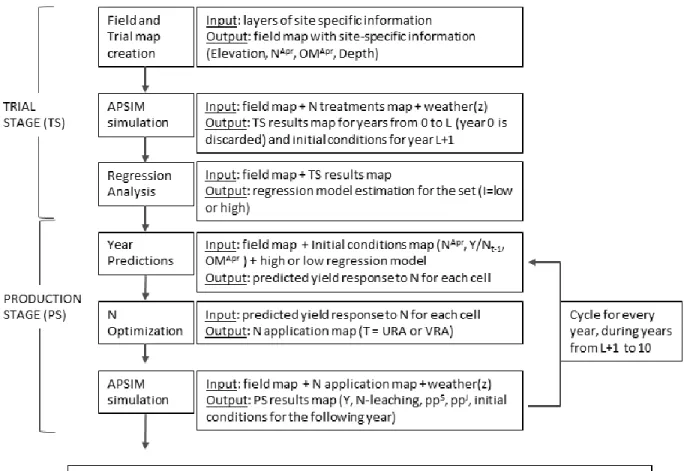
The present work is compound by two parts. First the data generation process and then
the analysis process. Figure 1 shows the workflow followed during the data generation process.
First, a spatially variable field was created. Over that field, one year of a regular crop using
MRTN rate was simulated to set the initial conditions. That simulation year is not part of the
observations. The research process starts with the Trials Stage (TS), where completely
randomized trials were simulated each year. After TS, the trial information was analyzed, and an
econometric regression model was estimated. The Production Stage (PS) is considered the stage
when the field is used for the regular production of a crop using the EONR obtained from the
trial data.
A ten years-long simulation for the whole field (256 cells x 10 years = 2560
observations), composed by TS and PS is called a set (z,L,S
I,T). Different sets were created by
combining the following factors:
-
Weather scenarios (z = 1980, 1985, 1990, 1995, 2000): They were created using historic
weather and named based on the first year of the sequence. That means that z = 1980 uses
the weather from 1980 to 1989. Consecutive years of the historic weather were used, to
capture real patterns in the weather.
-
Number of trials (L = 0 to 5): being 0 when no trials were run and L from 1 to 5 the
number of years when a trial was run over the field.
-
Information (I = No, Low, High): No is the situation where no trials were run; Low is
where trials were run and “free” site-specific variables are collected. High is where trials
were run, “free” site specific information is collected and also soil sampling information
of initial Nitrogen (N
Apr) and Organic Matter (OM
Apr).
-
Technology (T = URT, VRT) was the technology used during PS, being URT when the
farmer was constrained to select only one rate that maximizes expected profits in the
whole field VRT when the farmer had the ability to select the rate that maximizes
expected profits in each site of the field. It is important to note that during TS the farmer
will always use VRT, because changing the rates that is needed to apply the different
treatments in the trial.
12
Strategies (S
I,T) was the word used to describe the possible combinations of Technology
and Information during this work. Since comparisons were done usually by z and at L
OPT, this
will simplify the notation and avoid repeating the first two superscripts.
In this work, it was assumed that a farmed that did not run trials will not have incentive to
use VRA, and will use only URA of MRTN rate. That way, five S (S
no,URA, S
low,URA, S
low,VRA,
S
high,URA, S
high,VRA) were obtained in this work, tested over different L and z.
Having explained what a set and S are, it is possible to account the total number of sets
simulated in this work. The sets are combinations of z,L and S, but not all combinations are
possible. The number of sets that do not involve trials are 5 and they are the combination of
S
no,URAwith L = 0 (if no trials are run, L can only be 0). The number of sets that involves trials
are 100, and they are the combination of the five z (1980,…,2000), with the five L (1,…,5), with
the remaining S that includes trial information (S
low,URA, S
low,VRA, S
high,URA, S
high,VRA). Adding
them, the total of 105 sets simulated in this work are accounted. Considering that each set is 10
years long and that the whole field has 256 cells, that is a total of 268,800 simulations.
13
Figure 1: Data generation process workflow
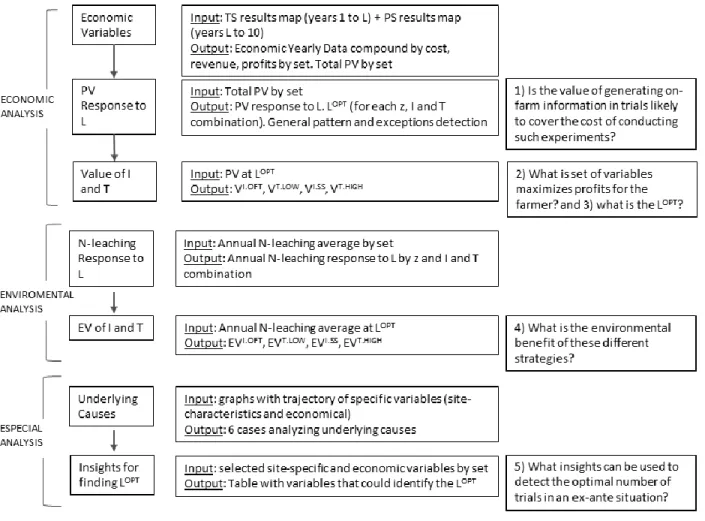
After generating the data, the work continued with the analysis process shown in figure 2.
First, economic variables were computed. The input was the APSIM results map. This map was
condensed into total field values by year (i.e. the N and Y by cell was added for the whole field
to obtain the total N applied and the total grain harvested) and the costs and revenues were
computed by year.
The trajectory of the Present Value (PV) of each set by increasing L was graph and
analyzed to answer question 1 from section 1.2. Using the PV at the L
OPT, the value of the
different combinations of I and T was obtained, answering question 2 and 3. Then,
Environmental Variables trajectory was analyzed to answer question 4. Finally, two especial
analyses were performed to address question 5, one to understand underlying causes of the
results and the other one to find insights that could help to predict the L
OPTin ex-ante conditions.
14
Figure 2: Data analysis process
4.2
FIELD CREATION
4.2.1
INITIAL CONDITIONS
To capture the essence of spatial experimentation and management, a farm field with
spatially heterogeneous field characteristics was modeled. A real 32–ha field owned and
managed by a farmer near Effingham, Illinois (39.1 N latitude and 88.7 W longitude) was used
as starting point.
Spatial site-specific information about elevation, information from soil sampling, and the
soil survey report (SSURGO 2018) were collected. All the variables were edited, following
different procedures. These way, we created a new research field, different than the original, that
could lead us to explore how variability affects the results. The final product is a square grid
(figure 3) with one-ha cells (c = 1,…,32). Each cell had unique site-specific characteristics
obtained by condensing and editing the different layers of site-characteristics information with
the following procedures:
15
•
Soils: because the soil survey report indicated that 85% of the field is classified under the
same soil type, for simplicity we categorized the whole field under that soil type. This
soil is named Cisne silt loam, with 0 to 2 percent slopes. The typical profile is
Ap-E-Bt1-2Bt2-2C. These soil characteristics were reproduced in APSIM following the
methodology described in Archontoulis et al. (2014).
•
Organic Matter in April (OM
Apr): OM was sampled in April 2016 at 32 points, each at the
center of 1-ha grid cell. Since OM was not highly variable over the field, with a mean of
2.42% and standard deviation of 0.15, the residuals between each measurement and the
mean were multiplied by 1.8 to increase the variation. The final OM
Aprhas a mean of
2.42% and a standard deviation of 0.27. The purpose of this was to explore more
variability in the field that the one present in 2016.
•
Nitrogen in April (N
Apr): is the sum of the quantities N available as N-NO3 and N-NH4 in
April, the day before planting. It was estimated by conducting a linear relation with OM.
Also, a spatially autocorrelated error was added to the result of the function using
Gaussian simulation, according to the following autoregressive process:
𝑁. 𝑖𝑛𝑖𝑡𝑖𝑎𝑙 = 25 ∗ 𝑂𝑀 − 38.52 + 𝑄
(1)
𝑄 = 𝜌
𝑞𝑊𝑄 + 𝑒𝑟𝑟𝑜𝑟
𝑒𝑟𝑟𝑜𝑟 ~ 𝑁(0, 𝜎
𝑞2),
where 𝜌
𝑞is the spatial autoregressive parameter, W is the spatial weight matrix,
and 𝜇
𝑞and 𝜎
𝑞2are the expected value and variance of Q. The W is a matrix whose (i,j)
elements are 𝑒
−0.1∗𝑑𝑖𝑗, where 𝑑
𝑖,𝑗
is the distance between the centroid of the i-th and j-th
square of the grid.
With this procedure a spatially autocorrelated N
Aprwas obtained for each cell of
the field. N
Aprvalues varied among cells between 1 kg/ha and 37 kg/ha.
•
Elevation: using high-density point information data from the tractor GPS system, a
point-in-polygon operation was performed, obtaining the median of the elevation points
for each square of the grid.
•
Depth: The original thickness of the soil units’ last layers varied between 153 cm and 196
cm. Spatial variation of the total soil depth was generated by varying only the thickness
16
of the last layer (upper layers were not affected by this procedure). In the same way than
with N
Apr, Depth was calculated as a linear function of Elevation, and an autocorrelated
errors were added:
𝐷𝑒𝑝𝑡ℎ = 3.183 𝐸𝑙𝑒𝑣 − 1806.46 + 𝑄
(2)
𝑄 = 𝜌
𝑞𝑊𝑄 + 𝑒𝑟𝑟𝑜𝑟
With this procedure, a spatially autocorrelated depth was obtained for each cell of
the field, which varied from 153 cm to 200 cm among cells.
As explained before, a set is a 10-year simulation of the whole field. Every set starts with
the field and the initial conditions described above. Then, a regular corn crop was simulated
using a nitrogen fertilizer application at the MRTN rate. These simulations of a regular corn crop
were considered to be in year 0 and they were discarded. Since the initial conditions have an
impact on the result of the trial, the goal of simulating a regular corn before the TS was to expose
those initial conditions to a simulation with a random weather. If this were not done, the first trial
year would always have had the same initial conditions, which would impose the same effect
over the L = 1 strategy in all z scenarios. For example, if the initial conditions have a high N
Apr,
then response to N would be low for L=1 and random for higher values of L, which is not
realistic.
4.2.2
TRIAL DESIGN
Over the previously described field, a trial was created following the protocol used in the
DIFM project. A planter machine width of 12 meters was assumed. A border of 24 meters was
created on the edges of the field and considered an area excluded for experimentation. The
reason is that, in real trials, the edges of the field are exposed to uncontrolled factors that
decreased the quality of the data, like winds, heavy machinery transit or different soil quality.
Even though these factors will not be incorporated in the crop modeling simulations, the border
was included because it will change the relative area of the trial and, since the border will receive
the target rate instead of the different treatments, it will have an impact on the economic result of
the strategy.
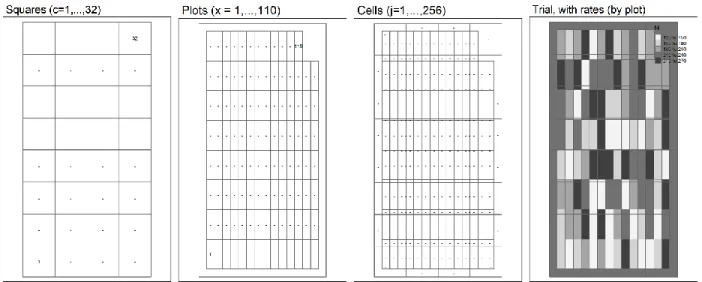
As shown in figure 3, inside the border, a grid of 110 plots was created. Each plot had 24
m width and 85 m length. When overlapping the initial grid of varying c characteristics, with 32
17
squares of 1 ha, with the trial design with 110 plots and a border, 256 cells are gotten. Within
these cells, rather the site-characteristics or the received treatment was different. For that reason,
each of these cells was unique and all APSIM simulations were run for each cell. Then, results
were aggregated, to a dimension that represents what we would obtain in a real situation. For
example, if at the time of analyzing the data from the trials, a plot had three cells, all needed
variables were aggregated weighing by area and that that was the data used for the regression
analysis.
With the aim of using the same naming convention throughout the present discussion,
each of the 32 squares in the initial grid was called a “square”. Each of the 110 trial plots that
was created over the field was called a “plot”. Each of the 256 cells with varying dimensions that
have a unique combination of site-characteristics with treatment is called a “cell”.
Figure 3: Naming convention for field layers and resolution
4.2.3
DYNAMIC TREATMENTS
Farmers run annual field trials with a completely randomized design. Each year, five
nitrogen fertilizer rates were randomized on the 110 plots. That is, each one of the five N Rates
were applied on 22 of the 110 plots. The treatments (T) were selected dynamically based on the
following process:
Each year there was a central target rate (TR) and the other 4 rates were calculated based
on this central rate according to: T1= TR – 90 kg/ha, T2 = TR – 60 kg/ha, T3 = TR – 30 kg/ha,
T4 = TR, T5 = TR + 30 kg/ha. Areas along the field perimeter were placed in a “buffer zone,”
not included in the experiment, and assumed fertilized at rate TR. The first trial year, the TR was
18
the MRTN rate. In subsequent years, the TR was the average among the MRTN rate and the
rates that would have maximized profits in each of the previous trial years.
4.2.4
OTHER MANAGEMENT PRACTICES
All other management practices that are not related with N rate were held constant in all
simulations. Soil sampling was performed on April 29
th(as explained later, this information
could be used or not, depending on the strategy). The field was tilled every year on April 30
thof
every year, at a depth of 11 cm, incorporating 40% of the surface residues. The planting date was
May 1
stof every year. The hybrid was a generic APSIM hybrid with called A110, with 110 days
maturity. The plant population was 8 plants/m
2and the row spacing was 76 cm. No tiling was
included in the field.
4.3
ON-FARM YIELD CURVE ESTIMATION
4.3.1
SOIL SAMPLING SIMULATION
To make results economically realistic, soil sampling variables needed to be transformed.
High-resolution N
Aprand OM
Aprdata were provided for each of the 256 cells, by APSIM every
April. Since soil sampling at that resolution would be economically prohibitive, two new
variables were created. They were the spatial and temporal aggregation of the high-resolution
N
Aprand OM
Aprdata. Although this process decreased the precision of the data, it is imitating
what could be obtained in a real situation.
One of the new variables was the soil N in April obtained by soil sampling (N
Apr.ss). This
variable was the area-weighted average of N
Apr(whose resolution is by cell) with the following
soil sampling strategy:
•
Year 1: by square. Since the field previously had a uniform-rate crop, variation will
depend on site-specific characteristics that varied by square.
•
Year 2 to L +1: by plot. During trial years, since treatments were applied by plot, the soil
sampling was performed at that same scale. Then in the first year after TS (year = L + 1),
since the field still would have high variability in N
Aprbecause it had different rates in the
previous year, N
Apr.ssis still performed by plot (and the border area was characterized by
a single soil sample).
19
•
Year L+2 to 10: by square. Two years after the TS, N
Aprvariation over the field is
smoother, and soil sampling is performed by square.
The other new variable was the soil OM in April obtained by soil sampling (OM
Apr.ss).
This variable was the area-weighted average of OM
Aprsimulating a soil sampling strategy
performed by square every four years (that is in April of year 1, 5 and 9). That means that for one
of the squares OM
Apr.sshad the same value from year 1 to 4, then a new value from year 5 to 8,
and finally another new value from year 9 to 10.
4.3.2
MODEL ESTIMATION
In section 3.2 and 4.1, the concept of how Information was treated in this work was
introduced. The level of information of the set will impact the variables included as regressors in
the model estimation. There are three levels of information (no, low, high). If the information
level was no, that means that the farmer did not conduct trials, thus no regression model was
estimated.
If the information level was low, the model included variables that are considered “free”
nowadays. They are the as-applied N, elevation, Y/Nt-1. The N rate is automatically measured by
sensors in the fertilizer applicator that automatically records the rate. The Elevation is recorded
by the guiding system of the tractor. Y is measure by the yield monitor in the harvesting machine
and then transformed to the Y/N ratio. The Low information model was:
𝑌
𝑖𝑡= 𝛽
0+ 𝛽
𝑁∗ 𝑁
𝑡,𝑖+ 𝛽
𝑁2∗ 𝑁
𝑡,𝑖2+ 𝛼
2∗ 𝑌𝑒𝑎𝑟2 + 𝛼
2∗ 𝑌𝑒𝑎𝑟2 ∗ 𝑁
𝑡,𝑖+
𝛼
2∗ 𝑌𝑒𝑎𝑟2 ∗ 𝑁
𝑡,𝑖2+ 𝛼
3∗ 𝑌𝑒𝑎𝑟3 + 𝛼
3∗ 𝑌𝑒𝑎𝑟3 ∗ 𝑁
𝑡,𝑖+ 𝛼
3∗ 𝑌𝑒𝑎𝑟3 ∗ 𝑁
𝑡,𝑖2+
𝛼
4∗ 𝑌𝑒𝑎𝑟4 + 𝛼
4∗ 𝑌𝑒𝑎𝑟4 ∗ 𝑁
𝑡,𝑖+ 𝛼
2∗ 𝑌𝑒𝑎𝑟4 ∗ 𝑁
𝑡,𝑖2+ 𝛼
5∗ 𝑌𝑒𝑎𝑟5 + 𝛼
5∗
𝑌𝑒𝑎𝑟5 ∗ 𝑁
𝑡,𝑖+ 𝛼
5∗ 𝑌𝑒𝑎𝑟5 ∗ 𝑁
𝑡,𝑖2+
𝛽
𝐸∗ 𝐸
𝑖+ 𝛽
𝐸𝑁∗ 𝐸
𝑖∗ 𝑁
𝑡,𝑖+ 𝛽
𝐸𝑁2∗ 𝐸
𝑖∗ 𝑁
𝑡,𝑖2+ 𝛽
𝑌/𝑁∗ 𝑌/𝑁
𝑡−1,𝑖+ 𝛽
𝑌.𝑁 ∗ 𝑁∗ 𝑌/𝑁
𝑡−1,𝑖∗ 𝑁
𝑡,𝑖+ 𝛽
𝑌/𝑁∗𝑁2∗ 𝑌/𝑁
𝑡−1,𝑖∗ 𝑁
𝑖2+ ε
𝑡,𝑖(3)
𝑤ith ε
𝑡,𝑖= λWε
𝑡,𝑖+ 𝑢
𝑡,𝑖𝑎𝑛𝑑 𝑢~𝑁(0, 𝜎
2𝐼𝑛)
Where,
20
𝛽
0is the parameter for the intercept,
𝑌𝑒𝑎𝑟2 𝑡𝑜 𝑌𝑒𝑎𝑟5 are dummies variables for the respective year. When combine with the
respective parameter 𝛼
2𝑡𝑜 𝛼
5they constituted the year effect, representing the change in the
quadratic response relative to year 1 (omitted category). They estimated unobserved
characteristics that are specific to a particular year,
𝑁
𝑡,𝑖is the N rate, 𝐸
𝑖is the Elevation, 𝑌/𝑁
𝑡−1,𝑖is the Y/N ratio from the previous year,
If the information level was high, the model included all the low information variables,
but also incorporated the soil sampling information. The High information model was:
𝑌
𝑖𝑡= 𝛽
0+ 𝛽
𝑁∗ 𝑁
𝑡,𝑖𝑇+ 𝛽
𝑁2∗ 𝑁
𝑡,𝑖𝑇 2+ 𝛼
2∗ 𝑌𝑒𝑎𝑟2 + 𝛼
2∗ 𝑌𝑒𝑎𝑟2 ∗ 𝑁
𝑡,𝑖𝑇+
𝛼
2∗ 𝑌𝑒𝑎𝑟2 ∗ 𝑁
𝑡,𝑖𝑇 2+ 𝛼
3∗ 𝑌𝑒𝑎𝑟3 + 𝛼
3∗ 𝑌𝑒𝑎𝑟3 ∗ 𝑁
𝑡,𝑖𝑇+ 𝛼
3∗ 𝑌𝑒𝑎𝑟3 ∗ 𝑁
𝑡,𝑖𝑇 2+
𝛼
4∗ 𝑌𝑒𝑎𝑟4 + 𝛼
4∗ 𝑌𝑒𝑎𝑟4 ∗ 𝑁
𝑡,𝑖𝑇+ 𝛼
2∗ 𝑌𝑒𝑎𝑟4 ∗ 𝑁
𝑡,𝑖𝑇 2+ 𝛼
5∗ 𝑌𝑒𝑎𝑟5 + 𝛼
5∗
𝑌𝑒𝑎𝑟5 ∗ 𝑁
𝑡,𝑖𝑇+ 𝛼
5∗ 𝑌𝑒𝑎𝑟5 ∗ 𝑁
𝑡,𝑖𝑇 2+
𝛽
𝐸∗ 𝐸
𝑖+ 𝛽
𝐸𝑁∗ 𝐸
𝑖∗ 𝑁
𝑡,𝑖𝑇+ 𝛽
𝐸𝑁2∗ 𝐸
𝑖∗ 𝑁
𝑡,𝑖𝑇 2+ 𝛽
𝑌/𝑁∗ 𝑌. 𝑁
𝑡−1,𝑖+
𝛽
𝑌/𝑁 ∗ 𝑁∗ 𝑌/𝑁
𝑡−1,𝑖∗ 𝑁
𝑡,𝑖𝑇+ 𝛽
𝑌/𝑁∗𝑁2∗ 𝑌/𝑁
𝑡−1,𝑖∗ 𝑁
𝑡,𝑖𝑇+ 𝛽
𝑂𝑀∗ 𝑂𝑀
𝑡,𝑖𝐴𝑝𝑟.𝑠𝑠+
𝛽
𝑂𝑀𝑁∗ 𝑂𝑀
𝑡,𝑖𝐴𝑝𝑟.𝑠𝑠∗ 𝑁
𝑡,𝑖𝑇+ 𝛽
𝑂𝑀𝑁2∗ 𝑂𝑀
𝑡,𝑖𝐴𝑝𝑟.𝑠𝑠∗ 𝑁
𝑡,𝑖𝑇 2+ ε
𝑡,𝑖(4)
𝑤ith ε
𝑡,𝑖= λWε
𝑡,𝑖+ 𝑢
𝑡,𝑖𝑎𝑛𝑑 𝑢~𝑁(0, 𝜎
2𝐼𝑛)
Where,
𝑁
𝑡,𝑖𝑇(Total Nitrogen), is the sum of 𝑁
𝑡,𝑖𝐴𝑝𝑟.𝑠𝑠and 𝑁
𝑡,𝑖rate,
𝑂𝑀
𝑡,𝑖𝐴𝑝𝑟.𝑠𝑠is the OM obtained by soil sampling.
In statistics, Ordinary Least Squares (OLS) is an estimation method for the unknown
parameters that assumes that errors in the dependent variable are uncorrelated with the
independent variable(s). When this is not the case, OLS would not provide unbiased model
estimates. For that reason, in this work, statistic procedures that allow spatial autocorrelation,
were used to estimate the unknown parameters.
21
In spatial statistics there are different options for including spatial autocorrelation in a
model. Given the characteristics of the variables in this work (𝑁
𝑡,𝑖, 𝐸
𝑖, 𝑂𝑀
𝑡,𝑖𝐴𝑝𝑟.𝑠𝑠, 𝑁
𝑡,𝑖𝑇, 𝑌/𝑁
𝑡−1,𝑖),
no spillover could exist between the different plots. The treatments were applied only in the
target area, affecting the Yield of that site and not the neighbors. Moreover, a change in the
regressors would not affect the Yield of a neighbor indirectly (no spillover effect). For that
reason, the only model for spatial autocorrelation that could be used is the Spatial Error Model
(SER). When only one year of data was available (L=1), the “errorsalm” function from the R
package “spdep” (Bivand et al. 2013, Bivand and Piras 2015) was used. If more than one year of
data was available (L > 1) the Spatial Panel Error model from the R package “splm” was used
(Giovanni and Piras 2012).
4.3.3
SOURCES OF ERROR FOR THE MODEL
In this work, data was simulated using APSIM based on all the provided inputs. Then, a
regression model was adjusted over that data using less information, or with different spatial and
temporal resolution. In consequence, the regression did not explain all the variability, having a
random error - ε
𝑡,𝑖in (1) and (2). In this section, the sources of that random error are explained in
detail:
-
Omitted variables: Depth was one of the inputs in the APSIM simulations and it affects
Yield, especially in dry years, since it changes the amount of water that the soil can retain.
This variable was not included in the regressions directly, it was included indirectly since it is
correlated with Elevation. The two other omitted variables were N
Apr.ssand OM
Apr.ssin the
low information model. The portion of the variability explained by the omitted variables
would be part of the error in the model.
-
Soil sampling representation: since soil sampling is costly, in the high information model,
N
Aprand OM were spatially and temporally aggregated based on the procedure explained in
4.3.1. This decreased precision of the data, increasing the error of the model.
-
Spatial resolution: The field had 256 cells and APSIM is run every time for each cell. One
plot can be composed by more than one cell. For the regression model estimation, variables
were aggregated doing and area-weighted averaged to obtain one observation per plot (total
of 110 observations). All the variables in the model were affected by this process 𝑌
𝑖𝑡, 𝑁
𝑖𝑡, 𝐸
𝑖,
𝑂𝑀
𝑡,𝑖𝐴𝑝𝑟.𝑠𝑠, 𝑁
𝑡,𝑖𝑇, 𝑌/𝑁
𝑡−1,𝑖).
22
In the case of 𝑁
𝑡,𝑖𝑇and 𝑂𝑀
𝑡,𝑖𝐴𝑝𝑟.𝑠𝑠they were aggregated twice, first according to the
soil sampling resolution and then, if a plot had more than one value, it was again
aggregated by plot.
-
Functional form: APSIM is not an equation, it is a crop modeling software with modules that
interact which each other. In this work, a quadratic functional form was used and it has not
necessarily the exact same shape than the APSIM output, increasing the error term.
-
Weather not captured by year fixed effect: To make the model applicable in a wider range of
situations, the year effect was incorporated only affecting the quadratic response of Y to N
and the intercept, not the other regressors. If it also interacted with other variables, the
interaction will be part of the error term.
4.4
EONR PREDICTION
4.4.1
WEATHER WEIGHTED PROFIT FUNCTION
During PS, every April, yield predictions for each cell for each year were obtained using
the corresponding regression model, the initial conditions of the cell in April for that year and an
increasing sequence of N rates. As a precaution, the included sequence ranged from the lowest
tested rate in the trial to the highest, to avoid extrapolations outside the tested rates.
Some considerations were made regarding the year dummy variables. The model for L >
1 had a fixed year effect variable interacting with the intercept, the linear and the quadratic
response to N (or N
T) in the high information model. These year fixed effects are for past years
and, at this time of the process, we need to predict the EONR for the future year, in ex-ante
conditions, with uncertainty in the weather. To do this, the yield for each N in the sequence rates
was calculated using each year fixed effect. Then, Partial Profits were calculated considering the
price of corn (P
C= 0.157 $/kg = 4 $/bu) and the cost of Nitrogen (P
N= 0.881 $/kg = 0.4 $/lb). All
other costs are assumed to be the same for all rates and not considered at this part of the work
since they will not affect the optimization process. For example: if L = 3, a dummy variable for
year 2 and year 3 was added to the sequence of N rates, and three response curves of profits to N
were created for each cell.
The profit curves for each year were condensed in one weather weighted profit
function. For this, a probability of occurrence was assigned to each of them. This probability
23
was calculated using the historic weather and assuming a normal distribution of it. Two weather
variables were used: Season precipitation (pp
S) and July precipitation (pp
J):
-
𝑝𝑝
𝑡𝑆: is the amount of precipitation from sowing to harvesting during year t. pp
Saffects
two processes. On one hand, if the crop is limited by water, an increase in pp
Swould
produce a higher response of the yield to N, because it will increase the growing rate of
the plants and with that the uptake of N. On the other hand, an increase in pp
Sis
associated with an increase of leaching, especially if the precipitations are concentrated
in the stages were the growing rates (and thus the N uptake) are low.
-
𝑝𝑝
𝑡𝐽: is the amount of precipitation in July of year t. July is the month of the year where a
crop planted at the beginning of May will be flowering. The -15 and +15 days before and
after flowering are the Critical Period of the crop, when the crop generates the potential
grains and thus the availability of resources produce a great impact on yield. As a result,
high values of pp
Jare associated with a higher capacity of the crop to uptake N and
generate in Y. In contrast, water limitations in this period will reduce the Y of the crop
and the demand of N.
Is important to consider both variables, because they could have different effects on the
crop-soil system. For example, it is expected that a high pp
Sin combination with a low pp
Jwill
produce a high N-leaching without increase in Y. This is because the precipitations will be
concentrated in a period of the season when the crop is not growing fast and up-taking N, thus
the N in the soil will be transported below the roots depth. If a normal pp
Sis combined with a
high pp
Jit is expected to have a high response of Y to N, and not much over the N-leaching,
since the crop is receiving water in the moment when it is at full capacity to uptake the nutrient
from the soil and generate grains.
For that reason, both variables were combined to determine the probability of each year,
doing the following procedure:
With Season precipitation
𝑍
𝑡𝑆=
𝑝𝑝𝑡𝑆− 𝜇 𝑝𝑝𝑡𝑆 𝜎 𝑝𝑝𝑡𝑆(5)
With July precipitation
𝑍
𝑡𝐽=
𝑝𝑝𝑡𝐽− 𝜇 𝑝𝑝𝑡𝐽 𝜎 𝑝𝑝𝑡𝑆(7)
24
𝑃𝑍
𝑡𝑆= 𝑃(−𝑎𝑏𝑠(𝑍
𝑡𝑆)) (6)
𝑃𝑍
𝑡𝐽= 𝑃 (−𝑎𝑏𝑠(𝑍
𝑡𝐽)) (8)
Combined probability of both weather variables:
𝑊𝑃
𝑡=
𝑃𝑍𝑡𝑆 𝑃𝑍𝑡𝐽
∑𝑡=𝐿𝑡=1(𝑃𝑍𝑡𝑆 𝑃𝑍𝑡𝐽)
(9)
Where 𝜇 is the mean and 𝜎is the standard deviation of the indicated variable. Then, 𝑍 is
the distance between each of the observed values and the respective historic mean in units of
standard deviation.
𝑃(−𝑎𝑏𝑠(𝑍)) is the accumulated probability of the negative of the absolute value of the Z
score (left side of the distribution), assuming that Z ~ N(0, 1)
With this method, the Weather Probability (WP
t) of each profit function was calculated
considering how usual was the combined weather of both variables. This allowed to decrease the
weight of trials run in years with a weather that is not expected to happen in the future, and
increase the weight of those whose weather is more likely to happen.
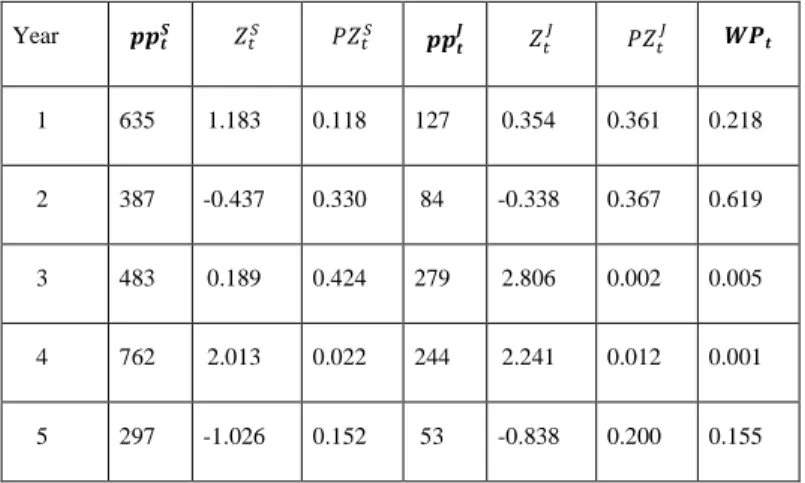
To explain this, the example in table 1 is provided. With z = 1990, 5 trials were
conducted (L = 5). The historic weather from 1979 to 2015 has a 𝜇
𝑃𝑝𝑡𝑆
= 454 , 𝜎
𝑃𝑝𝑡𝑆= 153,
𝜇
𝑃𝑝𝑡
𝐽
= 105 and 𝜎
𝑃𝑝𝑡𝐽
= 62. In this example, year 4 was an extremely wet year, both for the total
amount during the Season and during July. If we calculate the profits as a regular average of the
5 productions functions, we would assign year 4 a probability of 20%. With this methodology we
will assign it a probability of 0.1%. Year 3 had a
𝑃𝑝
𝑡𝑆very close to the mean and thus, highly probable. Nevertheless, 𝑃𝑝
𝑡𝐽
was extremely high,
with a very low probability. This last characteristic decreased the final probability of year 3 to
0.5%. The weather weighted profits function will be mainly a combination of year 2 (61.9%),
year 1 (21.8%) and year 5 (15.5%).
25
Table 1: Year fixed effects aggregation example, using the weather scenario starting in year 1990.
Year 𝒑𝒑𝒕𝑺 𝑍𝑡𝑆 𝑃𝑍𝑡𝑆 𝒑𝒑𝒕 𝑱 𝑍𝑡 𝐽 𝑃𝑍𝑡 𝐽 𝑾𝑷 𝒕 1 635 1.183 0.118 127 0.354 0.361 0.218 2 387 -0.437 0.330 84 -0.338 0.367 0.619 3 483 0.189 0.424 279 2.806 0.002 0.005 4 762 2.013 0.022 244 2.241 0.012 0.001 5 297 -1.026 0.152 53 -0.838 0.200 0.155