Virtual Machine on a Cluster of
Workstations
by
Carlos Daniel Cavanna
A thesis submitted in conformity with the requirements for the degree of Master of Applied Science
Edward S. Rogers Sr. Department of Electrical and Computer Engineering University of Toronto
2003
c
The Design and Implementation of a Java Virtual Machine on a Cluster of Workstations by
Carlos Daniel Cavanna Master of Applied Science
Edward S. Rogers Sr. Department of Electrical and Computer Engineering University of Toronto
2003
We present the design, implementation, and evaluation of a Java Virtual Machine
(JVM) on a cluster of workstations, which supports shared memory in software. More
specifically, we first extend the Jupiter JVM infrastructure to support multithreading on
Symmetric Multiprocessors (SMPs). We then extend this multithreaded Jupiter to deal
with memory consistency, private memory allocation, and the limitations on the use of
some resources on a 16-processor cluster of PCs interconnected by a Myrinet network;
which supports Shared Virtual Memory and a pthreads interface. Our experimental
evaluation is performed using standard benchmarks. On a 4-processor SMP, it indicates
that the performance of the multithreaded version of Jupiter is midway between a na¨ıve
and a state-of-the-art implementations of a Java interpreter. Our evaluation on the
cluster demonstrates that good speedup is obtained.
First, I would like to thank my supervisor, Professor Tarek Abdelrahman, for
his constant guidance and encouragement during the development of this work. His
high standards, attention to detail and confidence placed this work among the most
interesting and challenging experiences I have ever had.
I would also like to thank Patrick Doyle, for the long and productive discussions
about Jupiter, his support during the initial stages of this project and for providing such
a good system to work with. And Peter Jamieson, for the long hours we spent solving
development issues in the SVM system when enabling Jupiter to run on the cluster, and
debugging the newly released Linux version of CableS. I must extend my appreciation
to Professor Angelos Bilas for providing the resources to make this project advance, and
Rosalia Christodoulopoulou and Reza Azimi for continuously improving VMMC.
I am also thankful to all my friends, who were always present when I needed them.
In particular to Diego Novillo, who constantly provided accurate suggestions throughout
this work, and to Professors Gerardo Castillo and Andrea Lanaro, who I have always
considered very good friends, for motivating me so strongly to follow this path.
Last, but not least, I want to express my deepest gratitude to my wife for her
understanding, patience and love; and my family, without whose support, endless love,
and lifelong encouragement I would not have accomplished this achievement.
DEDICATION . . . . v
ACKNOWLEDGEMENTS . . . . vii
LIST OF TABLES . . . . xiii
LIST OF FIGURES . . . . xv
CHAPTERS 1. Introduction . . . 1
1.1 Objectives and Contribution . . . 2
1.2 Thesis Organization . . . 4
2. Background and Related Work . . . 5
2.1 The Java Model . . . 5
2.2 The Jupiter JVM . . . 6
2.3 Memory Consistency . . . 6
2.4 Clusters . . . 9
2.5 Shared Virtual Memory Clusters . . . 9
2.5.1 The Myrinet Cluster, VMMC, GeNIMA and CableS . . . 10
2.5.2 Programming using CableS . . . 12
2.6 Related Work . . . 14 2.6.1 JavaParty . . . 14 2.6.2 JESSICA/JESSICA2 . . . 15 2.6.3 Java/DSM . . . 16 2.6.4 cJVM . . . 17 2.6.5 Kaffemik . . . 17 2.6.6 Hyperion . . . 18 ix
3.1 Multithreading in JVMs . . . 19
3.1.1 Thread Handling . . . 19
3.1.2 Synchronization . . . 21
3.1.3 Wait-Sets and Notification . . . 21
3.2 Multithreading in Jupiter . . . 22
3.2.1 Threading Modules . . . 25
3.2.2 ThinThread . . . 27
3.2.3 Threadand MonitorModules . . . 29
3.2.4 Monitor Support for Recursive Calls . . . 31
3.2.5 Monitor and Spurious Wake-ups . . . 31
3.2.6 Thread Joining . . . 34
3.2.7 Waiting on Non-Daemon Threads . . . 34
3.3 Initialization Routines . . . 36
3.4 Mutable Data and Synchronization . . . 37
3.5 Multithreaded Quick Opcodes . . . 39
3.5.1 Quick Opcodes Overview . . . 39
3.5.2 Multithreaded Quick Opcode Replacement . . . 42
4. Shared Virtual Memory Extensions . . . 49
4.1 Design Issues . . . 49
4.2 Memory Consistency . . . 50
4.2.1 Locking on Java Class Creation . . . 51
4.2.2 Locking on Java Object Access . . . 52
4.2.3 Locking on Java Object Creation . . . 53
4.2.4 Volatile Fields . . . 53
4.2.5 Argument Passing at System Thread Creation . . . 54
4.2.6 Memory Consistency at Java Thread Creation . . . 57
4.2.7 Memory Consistency at Java Thread Termination . . . 60
4.3 Private Memory Allocation . . . 60
4.3.1 Private and Shared Memory Sources . . . 61
4.3.2 Thread Stack . . . 63
4.3.3 JNI (Java Native Interface) . . . 64
4.3.4 Thread Handling . . . 65 4.3.5 Opcode Interpretation . . . 66 4.3.6 Class Parsing . . . 66 4.4 Limitation of Resources . . . 66 4.5 Barrier Implementation . . . 68 4.6 Garbage Collection . . . 69
4.7 The Java Memory Model . . . 70
5.1 The Benchmarks . . . 71
5.2 The Experiment Platforms . . . 74
5.2.1 Measurement Methodology . . . 75
5.3 SMP Evaluation . . . 76
5.3.1 Single-Threaded Jupiter vs. Multithreaded Jupiter . . . 77
5.3.2 Multithreaded Jupiter vs. Reference JVMs . . . 78
5.3.3 Speedup . . . 79
5.4 Cluster Evaluation . . . 81
5.4.1 Evaluation Remarks . . . 83
5.4.2 One Processor per Node . . . 84
5.4.3 Two Processors per Node . . . 85
5.4.4 Performance Impact of the SVM System . . . 86
6. Conclusions . . . 99
6.1 Summary and Conclusions . . . 99
6.2 Future Work . . . 101
APPENDICES A. Benchmark Details . . . 107
A.1 SPECjvm98 . . . 107
A.2 Java Grande . . . 108
B. Stack Design . . . 113
B.1 Java Stack Overview . . . 113
B.2 Variable-Size Stack Segment . . . 114
B.3 Experimental Evaluation . . . 116
BIBLIOGRAPHY . . . . 119
Table
5.1 SPECjvm98 Benchmark Applications . . . 72
5.2 Java Grande Benchmark Applications . . . 72
5.3 SMP Experiment Platform . . . 74
5.4 Cluster Experiment Platform . . . 75
5.5 JVMs . . . 77
5.6 Execution Times for the Multithreaded Jupiter with Respect to the Single-Threaded Jupiter Using the SPECjvm98 Benchmarks . . . 77
5.7 Execution Times for the Multithreaded Jupiter with Respect to the Reference JVMs Using the SPECjvm98 Benchmarks . . . 79
5.8 Execution Times for the Multithreaded Jupiter with Respect to the Reference JVMs Using the Java Grande Benchmarks (Size A) . . . 80
5.9 Stress Tests for the Multithreaded Jupiter with Respect to the Reference JVMs Using the Java Grande Benchmarks . . . 81
5.10 Added Execution Times for the Multithreaded Jupiter and the Reference JVMs Using the Java Grande Benchmarks (Size A) . . . 82
5.11 Average Speedup for the Multithreaded Jupiter and the Reference JVMs Using the Java Grande Benchmarks (Size A) . . . 82
5.12 Execution and Benchmark Times for the Cluster-Enabled Jupiter on One Pro-cessor per Node Using the Java Grande Benchmarks (Size A) . . . 87
5.13 Execution and Benchmark Times for the Cluster-Enabled Jupiter on One Pro-cessor per Node Using the Java Grande Benchmarks (Size B) . . . 88
5.15 Average Speedup for the Cluster-Enabled Jupiter on One Processor per Node Using the Java Grande Benchmarks (Size B) . . . 89 5.16 Execution and Benchmark Times for the Cluster-Enabled Jupiter on Two
Pro-cessors per Node Using the Java Grande Benchmarks (Size A) . . . 92 5.17 Execution and Benchmark Times for the Cluster-Enabled Jupiter on Two
Pro-cessors per Node Using the Java Grande Benchmarks (Size B) . . . 93 5.18 Average Speedup for the Cluster-Enabled Jupiter on Two Processors per Node
Using the Java Grande Benchmarks (Size A) . . . 94 5.19 Average Speedup for the Cluster-Enabled Jupiter on Two Processors per Node
Using the Java Grande Benchmarks (Size B) . . . 94 5.20 Execution Time Overhead Introduced by the SVM System . . . 97 5.21 Benchmark Time Overhead Introduced by the SVM System . . . 98 B.1 Benchmark Times for the Multithreaded Jupiter with a Fixed-Size Stack with
Respect to a Variable-Size Stack (VSSJ) Using the SPECjvm98 Benchmarks . 116 B.2 Benchmark Times for the Multithreaded Jupiter with a Fixed-Size Stack with
Respect to a Variable-Size Stack (VSSJ) Using the Java Grande Benchmarks (Size A) . . . 117 B.3 Stress Tests for the Multithreaded Jupiter with a Fixed-Size Stack with
Re-spect to a Variable-Size Stack (VSSJ) Using the Java Grande Benchmarks . . 118
Figure
2.1 Lazy Release Memory Consistency Model . . . 8
2.2 Cluster Layers . . . 11
2.3 Use of Locks for Shared Values . . . 13
2.4 Use of Locks for Read-Only Arrays . . . 14
3.1 Single-Threaded Design . . . 22
3.2 Multithreading Design . . . 23
3.3 Multithreading Modules . . . 26
3.4 Monitor Support for Recursive Calls . . . 32
3.5 Wait-Sets and Notification that Handle Spurious Wake-ups . . . 33
3.6 Thread Joining . . . 34
3.7 Thread Spawn Relationship . . . 35
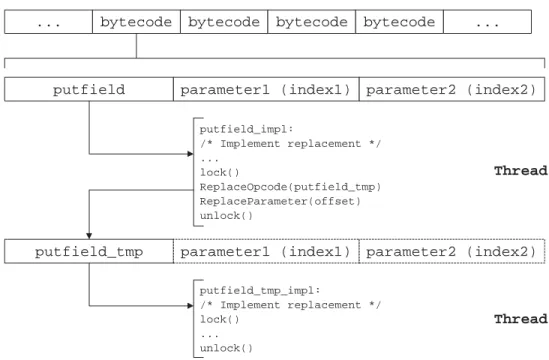
3.8 putfield Opcode Resolution . . . 41
3.9 qputfield Opcode Resolution . . . 42
3.10 Use of Locks for Multithreaded Opcode Replacement . . . 44
3.11 Multithreaded Opcode Replacement . . . 46
3.12 Multithreaded Quick Opcodes . . . 47
4.1 Implementation of Volatiles . . . 54
4.3 Need for Global Locks . . . 56 4.4 Memory Consistency at Java Thread Creation . . . 59 5.1 Average Speedup for the Multithreaded Jupiter and the Reference JVMs Using
the Java Grande Benchmarks (Size A) . . . 82 5.2 Speedup for the Cluster-Enabled Jupiter on One Processor per Node Using
the Java Grande Benchmarks (Size A) . . . 90 5.3 Speedup for the Cluster-Enabled Jupiter on One Processor per Node Using
the Java Grande Benchmarks (Size B) . . . 91 5.4 Speedup for the Cluster-Enabled Jupiter on Two Processors per Node Using
the Java Grande Benchmarks (Size A) . . . 95 5.5 Speedup for the Cluster-Enabled Jupiter on Two Processors per Node Using
the Java Grande Benchmarks (Size B) . . . 96 B.1 Variable-Size Stack Design . . . 114
Introduction
In recent years Java has steadily gained wide acceptance as a programming lan-guage of choice for application development. The main reason for this success is that Java provides a set of tools that give a platform-independent context for developing and deploying these applications. Furthermore, it includes a wide set of classes and libraries that simplify application development. In particular, these features benefit projects that target heterogenous platforms.
However, Java programs often lack performance compared to programs written in languages like C or C++. This is mainly due to the Java execution model, which consists of a software interpreter, called a Java Virtual Machine (JVM) that executes a Java program, compiled to an abstract set of instructions called Java bytecodes. This model can give rise to poor performance because the functionality required for the execution of individual bytecodes is delivered entirely in software.
Therefore, there has been considerable research into approaches for improving the performance of Java programs. The most significant of these approaches isjust-in-time (JIT) compilation [AAB+00, IKY+99], which dynamically translates Java bytecodes into native instructions that can be directly executed in the target hardware, thus reducing the performance penalty incurred by interpretation. Other approaches include improved array and complex number support [AGMM99, WMMG99], efficient garbage collection [DKL+00, BAL+01], and efficient support for threads and synchronization [AAB+00].
Parallel processing is another important and orthogonal approach for improving the performance of Java programs. The availability of multiple processors improves
the execution time of multithreaded applications. Since their introduction, JVMs have allowed for the execution of multiple threads in a Java program in shared memory on Symmetric Multiprocessors(SMPs). Unfortunately, SMPs are limited in their scalability, and can be very expensive at large scales.
A cost-effective alternative to SMPs isclusters of workstations, which offer large and potentially scalable environments; clusters can be expanded by easily incorporating additional off-the-shelve hardware and software components. For this reason, clusters provide an interesting platform for the execution of Java applications. However, clusters do not support the traditional shared memory programming model. This creates many challenges in enabling JVMs to run on clusters, including memory consistency and non-shared memory allocation issues. This thesis explores these challenges, and addresses the issues involved in the design and implementation of a JVM on a cluster of workstations.
1.1 Objectives and Contribution
The main goal of this work is to explore the design and implementation of a JVM that delivers good performance on a cluster of workstations. More specifically, the objective is to explore the issues involved in enabling a JVM to execute on a 16-processor cluster with Shared Virtual Memory (SVM). The cluster nodes are intercon-nected through Myrinet network interfaces [BCF+95, Myr03], which offer low latency and high bandwidth communications, and serve as support media for SVM.
For this purpose, it was necessary to utilize a JVM infrastructure that could be extended to work on the cluster. The Jupiter JVM [Doy02, DA02] is an extensible single-threaded JVM research framework. It was designed with strong emphasis on modularity, flexibility and portability, and thus it possesses the properties required for this work.
Our work focuses on the design and implementation of a multithreaded and cluster-enabled versions of the Jupiter JVM, while maintaining its extensibility and flexibility properties. The first part of this work presents the extension of the origi-nal Jupiter JVM to support multithreaded Java applications on SMPs. The second part shows the extension of the multithreaded Jupiter JVM to run on the SVM cluster. These two extensions of Jupiter are evaluated using standard benchmark suites (SPECjvm98
[SPE03] and Java Grande [EPC03, Jav03]). Our experimental results demonstrate that the multithreaded Jupiter speed is midway between Kaffe [Wil02], a na¨ıve implementa-tion of a Java interpreter, and Sun’s JDK [SUN03], a highly optimized state-of-the-art interpreter. The performance of the multithreaded Jupiter is also comparable to that of the single-threaded Jupiter [Doy02]. This indicates that our multithreading extensions do not introduce significant overhead. Furthermore, the cluster evaluation indicates that good speedup is achievable for the applications.
The main contribution of this work is the development of a cluster-enabled JVM, that delivers good performance and speedup. In this respect, the extensions to Jupiter deliver superior speedup to existing JVMs that run on clusters. More specifically, this work involves the addition of some needed functionality that would allow Jupiter to run multithreaded programs on an SMP, and ultimately on the cluster. This further involved:
• The creation of the required infrastructure to support all the operations involved with thread handling, which had to correspond to the interfaces of the JavaThread
class.
• The development of the necessary support for the thread behavior stated in the JVM Specification [LY99].
• The synchronization of those Jupiter structures and objects that become shared in a multithreading configuration.
• The extension of the Java opcode optimizations (quick opcodes) to work safely in the presence of threads.
• Dealing with a lazy release memory consistency model [KCZ92], provided by the SVM system, which adheres to the Java Memory Model.
• The exploitation of non-shared memory allocation, which led to an efficient imple-mentation of a distributed JVM on the current realization of the cluster.
In addition, this work constitutes a step towards providing a single system image (SSI) based on a JVM on a cluster, and provides an infrastructure for further investi-gation of issues related to the design of JVMs on SMPs and clusters. However, it does not currently address the issues of supporting a single-image I/O infrastructure for Java programs or distributed garbage collection on the cluster.
1.2 Thesis Organization
The remainder of this thesis is organized as follows. Chapter 2 introduces the background required for the understanding of this work and presents some related work. Chapter 3 describes the steps needed to extend the Jupiter JVM to support multithread-ing. Chapter 4 details the design issues and techniques involved in enabling Jupiter to work on the cluster. Chapter 5 shows the results of the experimental evaluation. Chap-ter 6 draws conclusions. Appendix A gives details on the benchmarks used for the experimental evaluation. The thesis concludes with Appendix B where an alternative implementation of the Java stack is explored and evaluated.
Background and Related Work
This chapter introduces necessary background required for understanding the implementation of the multithreaded and cluster-enabled versions of the Jupiter JVM, and provides a summary of related work that aims at running JVMs on clusters of workstations. Section 2.1 briefly describes the Java model. Section 2.2 gives a short overview of the Jupiter JVM. In Section 2.3, the concept of memory consistency and the consistency models relevant to this work are discussed. Clusters are introduced in Section 2.4 and Shared Virtual Memory clusters, including the platform used for this work, are addressed in Section 2.5. Finally, Section 2.6 provides a summary of the related work in this area.
2.1 The Java Model
A Java Virtual Machine [LY99] is an abstract specification for a computer imple-mented in software that interprets and executes a program, in a similar way in which a microprocessor executes machine code. This program is referred to as the Java pro-gram. Java programs are compiled to a standard set of codes, called Java bytecodes, which are an abstract, portable, machine-independent representation of the executable code [LY99]. The Java environment includes the JVM, Java compilers (to generate Java bytecodes from Java program source files) and Java system classes. The latter is a set of standard classes that perform common tasks, and act as a uniform and limited API to the underlying operating system.
Portability is one of the most important features of the JVM environment. For
that reason, Java has gained much popularity both in industry and academia. Today, there are several JVMs publicly available, including: Sun’s JDK [SUN03], Kaffe [Wil02], ORP [ORP02], Kissme [KIS03], SableVM [SAB03], OpenJIT [OPE01, MOS+98, Mar01] and JikesRVM (Jikes Research virtual machine, formerly known as Jalape˜no) [AAB+00, JAL01, JIK03]. Some of these JVMs were designed for special purposes or are not flexible or modular enough to be suitable for general research environments.
2.2 The Jupiter JVM
The Jupiter JVM [Doy02, DA02] was conceived as a modular and extensible JVM research framework. It was designed to be a JVM infrastructure that will support experimentation with a wide variety of techniques for improving JVM performance and scalability. Thus, it was developed with a set of carefully designed abstract interfaces. This allows the different Jupiter components to be fully isolated from one another, thus becoming interchangeable. Ultimately, these features made Jupiter portable and easy to modify [Doy02, Jog03].
Jupiter uses the ClassPath [GNU03] project as its core Java runtime library. ClassPath is distributed under a General Public Licence (GPL), and aims at creating a free software replacement for Sun’s proprietary Java core class libraries. It is intended to include all native methods and internal classes necessary to support a completely functional JVM. At the time of this writing, ClassPath is still under development.
Jupiter suited the needs of our project well, therefore it was elected as the base research platform. Its inherent modularity properties gave the necessary flexibility for the ultimate goal, enabling the project to run on top of a cluster. Furthermore, this was a good opportunity to fully test its extensibility in a real and challenging project.
2.3 Memory Consistency
A memory consistency model for a shared address space specifies constraints on the order in which memory operations must appear to be performed (i.e., to become visible to other processors) with respect to one another. This includes operations to the
same and different memory locations and by the same or different processes1 [CSG99]. There are many memory consistency models. An overview of the two models that are relevant to this work is presented in the remainder of this section.
A memory model is sequentially consistent if the result of any execution is the same as if operations of all the processors were executed in some sequential order, and the operations of each individual processor occur in this sequence in the order specified by its program [Lam79]. Every process in the system appears to issue and complete memory operations one at a time and atomically in program order [CSG99]. A memory operation does not appear to be issued until the previous one issued by the same process has completed. The shared memory appears to service these requests one at a time in an arbitrarily interleaved manner. Memory operations appear atomic in this interleaved order. Synchronization is still required to preserve atomicity (mutual exclusion) across multiple memory operations from a process or to enforce constraints on the interleaving across processes.
The lazy release consistency memory model [KCZ92] relaxes all program orders for memory operations that take place outside synchronization operations by default. It only guarantees that orderings will be made consistent at synchronization operations that can be identified by the system. When synchronization operations are infrequent, this model provides considerable reordering freedom to the hardware and compiler. This model is based on the observation that most parallel programs use synchronization operations to coordinate accesses to data when it is necessary. Between synchronization operations, they do not rely on the order of accesses being preserved. The intuitive semantics of these programs are not violated by any program reordering that happens between synchronization operations or accesses as long as synchronization operations are not reordered with respect to data accesses or one another. This memory model makes a distinction among types of synchronization operations, acquires and releases. An acquire operation is defined as a read (or read-modify-write) operation performed to gain access to a set of operations or variables; for example,lock(mutex)2. A release is
1In this sense, memory consistency subsumes coherence.
2A mutex is a variation of a binary semaphore or lock. The terms mutex and lock are used indistinctively
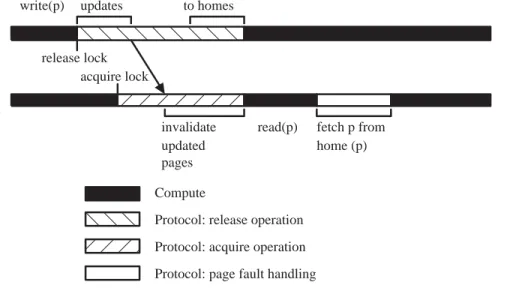
Node 1 / Thread 1 Node 2 / Thread 1 ;; ;; commit all local updates apply differences to homes invalidate updated pages write(p)
read(p) fetch p from home (p) release lock acquire lock ; ; Compute
Protocol: release operation Protocol: acquire operation Protocol: page fault handling
Figure 2.1: Lazy Release Memory Consistency Model
a write (or a read-modify-write) operation that grants permission to another processor to gain access to some operations or variables; for example, unlock(mutex).
In the lazy release model, each page is designated with a processor, or a node, which is called its home node. Processors cycle through acquire-compute-release cycles. As seen in Figure 2.1, when a thread requests a lock release, it ends the current time interval by committing all pages updated by any local thread during the past interval. Then, the thread releases the corresponding lock to the next requesting node, and com-putes and sends the differences of the updated pages to their home nodes. During an acquire operation, the processor fetches from each remote node the list of updates which are needed for this synchronization step and invalidates the corresponding pages. This is determined by comparison oftimestamp values. A subsequent access to an invalidated page triggers a page fault that results in remote fetching the latest version of the page from its home node.
In SMP systems, which are usually sequentially consistent, it is the hardware that guarantees the memory properties. In SVM systems (to be discussed in Section 2.5), which for the purpose of this work are assumed to adhere to the lazy release memory
consistency model, it is the application that is responsible for using the tools provided by the memory system and signal the appropriate execution points (synchronization points) where these should take place.
2.4 Clusters
Clustering is the use of multiple computers (typically workstations), multiple storage devices and (sometimes) redundant interconnections, to form what appears to users as a single (and sometimes highly available) system [CSG99].
A cluster can be used for load balancing, fault tolerance, high availability and high-performance computing. It is a relatively low-cost form of parallel processing for scientific and other applications that lend themselves to parallel operations. Other benefits include the ability to use commodity hardware. This allows clusters to expand at the sole expense of adding (and interconnecting) new off-the-shelf hardware.
SMPs provide a single address space programming model, where shared memory is equally accessible by all processors. Cluster systems lack a single address space, which is provided by additional support (either in hardware or software). Also, shared memory is distributed among the cluster nodes, and access time is not uniform to all CPUs. Since private memory resides in the local node, its access time is equivalent to that of an SMP. Thus, the use of private memory becomes an important issue to consider, as an efficient alternative to shared memory, whenever the semantics of the program being executed allow it.
2.5 Shared Virtual Memory Clusters
Software Distributed Shared Memory (SDSM) clusters provide users with a shared memory programming abstraction. The shared address space of these systems is usu-ally page-based3, and it is implemented either by run-time methods or by compile-time methods [LH89, ACD+96, SGT96]. SDSM systems can be cost-effective compared to hardware DSM systems [LC96]. However, there is a large coherence granularity imposed
by the page size of the underlying virtual memory system that tends to induce false sharing4 for most applications.
SVM [SHT98] clusters belong to the family of Software Distributed Shared Mem-ory (SDSM) clusters. SVM is an extension of the virtual memMem-ory manager of the under-lying operating system, where the paging system is modified to implement the mapping between local memory and shared memory on each node. The distinctive feature of SVM is that the operating system page fault exceptions are used to trap memory read and write operations. Shared memory is accessed in the same way as local memory, with remote page faults taking longer time than local ones. Thus, the running applica-tion memory reads and writes use the virtual protecapplica-tion mechanisms provided by the operating system.
2.5.1 The Myrinet Cluster, VMMC, GeNIMA and CableS
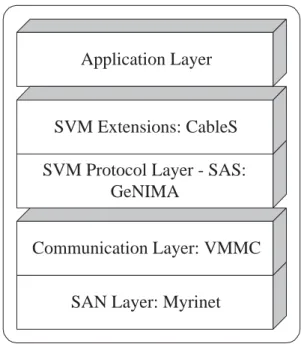
The cluster system used for this work is comprised of a number of software and hardware layers, as shown in Figure 2.2. These layers allow the cluster memory to be seen as a single address space. The current configuration consists of 8 interconnected dual-processor PC workstations, referred to as nodes, providing a total of 16 processors. For the remainder of this thesis, the above system will be referred to as “the cluster”.
The system area network (SAN) layer in this project is Myrinet [BCF+95, Myr03], a point-to-point interconnect, which provides a fast, high bandwidth physical commu-nication layer to the system. The cluster nodes are interconnected by PCI Myrinet network interface cards (NICs) through a Myrinet (Myricom) switch, and by Ethernet NICs to an Ethernet switch.
VMMC [BLS99, Azi02] is the communication layer, which supports internode communication. It consists of a custom NIC control program installed in the Myrinet card, an operating system driver and a user library. It allows access to the NIC in a protected manner, avoiding the need to trap (interrupt) in the kernel for data exchange. When user programs access any memory area, they can only make a reference to a 4False sharing occurs when two or more processors access different variables within a page, with at least one
of the accesses being a write. In the case of SVM clusters, this may cause coherence messages to be sent to other processors when shared pages are modified.
Application Layer
SVM Protocol Layer - SAS: GeNIMA
SVM Extensions: CableS
SAN Layer: Myrinet Communication Layer: VMMC
Figure 2.2: Cluster Layers
virtual memory address. VMMC translates those addresses into physical references, using a dynamic mapping scheme [CBD+98].
In addition to VMMC, which provides internode communication, GeNIMA [BJS01, JOY+99] implements the protocol that provides the shared address space abstraction.
CableS [Jam02b, JB02] is a set of libraries that provide thread and memory extensions to the SVM functionality in GeNIMA. It aims at supplying a single system image with respect to thread and memory management on top of the cluster. Its services are accessed through a standard POSIX [IEE90] pthread interface5. CableS provides a set of mechanisms that allow the application to use the system resources safely among the different cluster nodes. These mechanisms are:
• Shared Memory Allocation. CableS includes routines that allow the application program to allocate memory in a shared area. This memory will be visible to other cluster nodes, subject to the restrictions imposed by the lazy release consistency memory model [KCZ92].
5POSIX, which stands for Portable Operating System Interface, is a set of standard operating system
• Locks. Locks are usually employed as a mechanism for enforcing a policy for serial-izing access to shared data. However, on the cluster they are also used to guarantee memory consistency.
• Barriers. A barrier is a synchronization mechanism for coordinating threads oper-ating in parallel. It requires threads reaching a barrier at different times to wait until all threads reach the barrier.
The application layer in Figure 2.2 is the beneficiary of all the previously men-tioned layers. It is a shared memory application that uses POSIX pthreads. However, the application requires some modifications in order to work properly with CableS and the SVM system. These modification are further explored in Section 2.5.2. For the purpose of this work this layer is the Jupiter JVM.
2.5.2 Programming using CableS
CableS provides a standard POSIX interface. This may give the impression that CableS is a set of libraries that can make a POSIX-compliant application suitable to execute on the cluster. This is not the case, because CableS exposes the underlying lazy release memory consistency model of the SVM system to the application. Thus, all shared memory accesses must be protected with synchronization operations, even when synchronization is not necessary.
In the SVM system, locking has a double role. In addition to mutual exclusion, the SVM system locks invoke the routines that keep track of the changes made to the shared memory regions. Memory consistency operations are performed when the acquire and release lock primitives are invoked. This implies that every access to shared memory has to be protected with locks when that memory is read or written. At that point, the SVM system takes over and performs all the necessary memory update operations.
The locking operations guarantee that the latest values are always available to the other threads in the system. It must be noted that this does not immediately refresh values in the remote nodes. When the memory is written, it is marked as modified. When that memory is read after an acquire operation, perhaps from a remote node, the
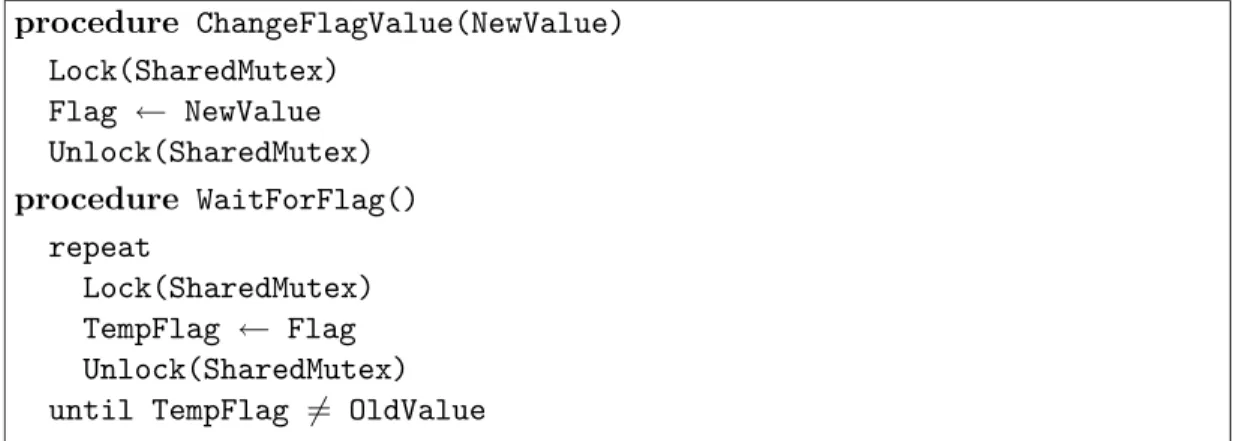
procedure ChangeFlagValue(NewValue) Lock(SharedMutex) Flag ← NewValue Unlock(SharedMutex) procedure WaitForFlag() repeat Lock(SharedMutex) TempFlag ← Flag Unlock(SharedMutex) until TempFlag = OldValue
Figure 2.3: Use of Locks for Shared Values
system checks for the latest value for the accessed addresses in the whole system, updates it in the local node (if necessary) and returns it to the application. For example, when
pthread mutex lock is called, the standard call for locking a mutex, the SVM system executes the memory consistency routines that search for the most up to date copy of the memory areas the program accesses. After the mutex is unlocked, the memory consistency routines are no longer invoked.
The following examples illustrate situations where the acquisition and release of a mutex signal the SVM system when the memory segments have to be updated from one node to another. Figure 2.3 shows a shared variable which is used as a flag. Its value can only be safely probed if the lock is acquired before reading and writing it. A call to
ChangeFlagValuemade from one thread will signal another thread, which is waiting on
WaitForFlag, that a certain event has occurred. If access to the flag is not protected inWaitForFlag, there is no guarantee that the new value set in ChangeFlagValuewill be visible if these calls occur in different cluster nodes. Analogously, ChangeFlagValue
must also protect its access to the flag. Notice thatChangeFlagValueandWaitForFlag
have to access the same lock,SharedMutex.
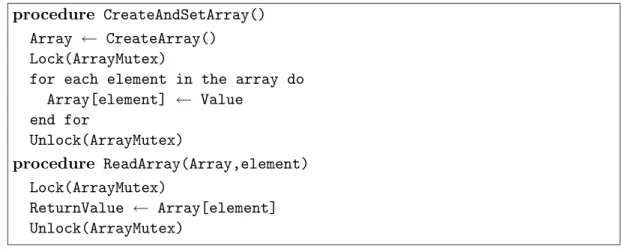
Figure 2.4 shows how a dynamically allocated array must be protected before each or all of its values are set. Then, when these values are accessed, perhaps by another thread, the reading operation also has to be protected with locks. This is true even if the array is defined as read-only, because the appropriate use of locks guarantees
procedure CreateAndSetArray() Array ← CreateArray() Lock(ArrayMutex)
for each element in the array do Array[element] ← Value end for Unlock(ArrayMutex) procedure ReadArray(Array,element) Lock(ArrayMutex) ReturnValue ← Array[element] Unlock(ArrayMutex)
Figure 2.4: Use of Locks for Read-Only Arrays
that the SVM system updates the memory values when or if it is required. Notice that the memory allocation routines, which are called fromCreateArray, are not protected. Section 4.2 provides further details on the usage of locks in the SVM system.
2.6 Related Work
This section presents various projects that aim at running a JVM on a cluster.
2.6.1 JavaParty
JavaParty [PZ97] is a cooperating set of JVMs that run on nodes of a distributed system. It is implemented as a preprocessor to the Java compiler and a runtime system. JavaParty extends the Java language with a new class modifier, called remote. This modifier is used to explicitly indicate to the preprocessor when classes can be spread among remote nodes. The precompiler and the runtime system ensure that access to remote class fields or methods are handled by Remote Method Invocations (RMI). Java-Party aims to hide the increased program size and complexity of explicitly using RMI or sockets for parallelization of Java programs on distributed systems. Object migration in JavaParty is supported through the use of proxies, with no replication, which slows down access to those objects that are shared between threads. The performance of JavaParty is reported to be comparable to that of RMI.
Unlike Jupiter, JavaParty requires that Java programs be modified. Jupiter sup-ports the standard Java thread model, while JavaParty requires that Java programs be expressed using the specialremoteclass modifier, which is not part of the Java standard. As a consequence, Java programs lose portability. Furthermore, the runtime component of JavaParty is implemented on top of RMI, which introduces considerable overhead. In contrast, Jupiter uses a shared address space memory model.
2.6.2 JESSICA/JESSICA2
JESSICA [MWL00] is a middleware system which creates a single system image of a JVM on a cluster. It is based on the Kaffe JVM [Wil02]. It uses Treadmarks [ACD+96] for DSM support, as well as the socket interfaces provided by Linux. JESSICA is similar to Jupiter in many respects. Both support the execution of Java programs on a cluster using DSM. However, JESSICA is not focused on obtaining a scalable JVM on the cluster. The main purpose of the system is abstraction from the cluster and appropriate load balancing. Thus, unlike Jupiter and other projects, JESSICA successfully implements I/O support, though it is centralized.
There are a number of other differences between JESSICA and Jupiter. In Tremarks, the memory pages allocated in different nodes may not reside at the same ad-dresses. This affects references to objects stored in the heap, which have to be translated when passed between nodes. Jupiter does not suffer from such translation problems. Also, JESSICA does not take full advantage of the relaxed properties of the Java Mem-ory Model. The implementation performs a DSM-lock acquire and release operation for every object access. JESSICA also uses a double locking mechanism for the update of shared objects. First, an object lock is requested, then, a DSM-lock, resulting in some extra traffic and delays. Another difference is that some system requests, such as thread signaling mechanisms (wait() and notify()) and mutex operations (lock()
and unlock()), are centralized in the main node. While this simplifies implementation, it is a potential bottleneck. Jupiter follows a decentralized schema, provided by the underlying SVM system.
Only three applications were used for the performance evaluation of JESSICA, for a cluster configuration of up to 8 processors. For RayTracer and SOR, the speedup obtained in Jupiter on the cluster is significantly better than that in JESSICA, which suffers from a significant slowdown introduced by the distributed object model and DSM systems. The slowdown ranges from 3% to 131% for a single worker thread.
JESSICA2 [ZWL02] is the extension of the JESSICA project. This prototype follows a different approach, using a JIT compiler, while maintaining much of the prop-erties of the previous architecture. JESSICA2 differs from JESSICA in three respects. JESSICA2 uses a JIT compiler; instead of a page-based DSM system, JESSICA2 uses object-based DSM (which adheres to the Java Memory Model); and the master and worker nodes communicate through TCP connections. The experimental evaluation on the cluster is based on three Java applications, with a configuration of up to 8 nodes. The performance of JESSICA2 is considerably better than that of JESSICA, because of the use of the JIT compiler. However, the speedup is worse.
2.6.3 Java/DSM
Java/DSM [YC97] is an implementation of a JVM based on Sun’s JDK 1.0.2 [SUN03] on top of the Treadmarks [ACD+96] distributed shared memory system. It runs on a cluster of heterogeneous computers, providing a single system image and hiding hardware differences. Java/DSM aims at integrating heterogeneous environments, using a translation mechanism to convert data of the same type between different hardware platforms. Java/DSM requires the threads in the Java program to be modified to specify the location to run. It is unclear if it was ever developed to completion.
Java/DSM bases its memory management on Treadmarks, and thus, it suffers from the same address translation drawbacks described earlier for JESSICA [MWL00]. Java/DSM differs from Jupiter in that its focus is to integrate heterogeneous systems. It also requires that threads specify the location where they run, thus making Java pro-grams not portable. The synchronization primitiveswaitand notify, which are impor-tant for developing multithreaded Java applications, are reported not to work between threads running on different nodes. Jupiter supports these primitives transparently.
The focus of the experimental evaluation of Java/DSM is to compare the difficulty of programming the application using Java/DSM and RMI. Thus, the experiments are based on a distributed spreadsheet that supports collaboration between users.
2.6.4 cJVM
cJVM [AFT99, CJV00, AFT+00] is a JVM based on Sun’s JDK 1.2 [SUN03] which provides a single system image of a cluster, where the nodes are interconnected with a Myrinet [Myr03] network. This project focuses mostly on exploiting optimization strategies based on Java semantic information obtainable at the JVM level, which is used to determine the most efficient way to handle remote object access. cJVM does not support all the core classes that have native methods.
In contrast to Jupiter, cJVM uses message passing (MPI) for communication, which requires extensive modifications to the JVM, and introduces efficiency and com-plexity problems. Jupiter follows a shared memory approach. The object model is also different from Jupiter’s. In Jupiter memory pages that store objects are shared between the nodes. However, cJVM supports distributed access to objects using a master-proxy model. This causes the thread stack to be distributed across multiple nodes, making the load distribution across the cluster dependent on the placement of the master objects.
The implementation was only tested to up to 4 cluster nodes, running one thread per node. Unfortunately, the applications used for the experimental evaluation are different from those used in Jupiter.
2.6.5 Kaffemik
Kaffemik [AWC+01] is a cluster-enabled JVM based on the Kaffe JVM [Wil02]. It provides a single machine abstraction of a cluster, with hardware support for DSM offered by a Scalable Coherent Interface (SCI) [IEE93]. Kaffemik is in its early stages of development.
Unlike our cluster-enabled Jupiter, the current implementation of Kaffemik does not support a release consistency memory model, object replication or caching; rather, it relies on cache coherence provided by SCI. Therefore, frequent access to remote objects
as well as array operations suffer from performance loss. This also creates some problems at thread creation, since part of the Java Thread object remains on the original node instead of being sent to the remote node. Jupiter fully supports the release memory consistency model, with data replication handled at the SVM level. The optimization of the execution is done at the Java application level, modifying it for enhancing memory locality. Jupiter is able to run unmodified Java applications efficiently.
The performance of Kaffemik is only reported for up to 3 nodes, running one thread per node. For this purpose, non-optimized and optimized versions of RayTracer were used. The speedup is comparable to that of Jupiter only for the optimized version.
2.6.6 Hyperion
Hyperion [ABH+01] provides a single system image of a JVM on a cluster of workstations. The cluster supports two interconnection networks: SCI [IEE93], which uses the SISCI protocol, and Myrinet [Myr03], which uses message passing (MPI). It executes on PM2, a distributed multithreaded run-time system that provides a generic DSM layer. Hyperion comprises a Java-bytecode-to-C translator and a run-time library for the distributed execution of Java threads.
A distinctive feature of Hyperion, which contrasts with Jupiter, is that it trans-forms Java bytecodes into C. The C code is then compiled and linked with Hyperion’s run-time library before it can be executed. Also, Hyperion uses an object-based DSM system. Hyperion keeps a single consistent master copy of an object. The nodes use their locally cached copy of objects, which are explicitly written back to the master copy at Java synchronization points using RPC. During the transfer, the thread blocks and performance is likely to suffer if objects are modified frequently. In contrast, Jupiter uses a page-based DSM system, and pages are flushed following a lazy release mem-ory consistency protocol. Hyperion lacks support for classes containing native methods, which must be manually converted in order to work.
The evaluation of Hyperion was performed to up to 8 processors using a single specially-developed application.
Multithreading Extensions
This chapter discusses the design and implementation of multithreading in Jupiter. Section 3.1 gives an overview of the functionality that a multithreaded JVM must pro-vide in order to correctly execute multithreaded Java programs in accordance with the JVM Specification [LY99]. Section 3.2 presents the approach taken in Jupiter to imple-ment these requireimple-ments. Section 3.3 explains the changes in the initialization routines of Jupiter, which involve the integration between Jupiter and the ClassPath libraries. Section 3.4 describes the use of synchronization operations to avoid race conditions in the various Jupiter shared data structures. Finally, Section 3.5 details the support for multithreaded quick opcodes.
3.1 Multithreading in JVMs
The JVM Specification [LY99] and theThread class interface require that a JVM provide three general types of functionality, relevant to multithreading: thread handling, synchronization, and wait-sets and notification.
3.1.1 Thread Handling
Thread handling refers to all the operations that can be performed on threads. A JVM provides threading functionality to Java programs through the interface of the
Thread class, which is the only mechanism available for this purpose. These operations fall into the following categories:
• Definition of thread creation properties. Java threads can be set to behave as non-daemon threads or as non-daemon threads. Non-non-daemon threads can be joined on termination, while daemon threads cannot.
• Definition of thread execution priorities. Priorities are attributes that determine the relative importance given to threads for CPU allocation, thus allowing some threads to have precedence over others. Java allows for this attribute to be modi-fied.
• Thread startup. This is the operation by which a thread begins its execution. In Java, threads are created in two steps. First, a Thread object (a subclass of
Thread or a class that implements the Runnable interface) must be instantiated and configured (priority and daemon properties). After that, the thread must be launched calling thestart method.
• Thread joining. A Java thread has the mechanisms to wait for another thread to complete its execution. This is called thread joining, and can only be performed on non-daemon threads. It accepts an optional time-out parameter.
• Thread execution state verification. This operation probes a thread to check if it has completed its execution or not.
• Thread sleep. The currently executing thread can be forced to temporarily cease execution for a period of time, which may make it also relinquish the CPU.
• Thread interruption. Some thread operations, such as thread sleep and join, can be interrupted. This allows the thread to resume execution.
• Processor yield. The currently executing thread can be forced to relinquish the CPU. In this case, other threads in the system will compete for the CPU, which allocation will be determined by the scheduler.
• Thread identification. A Thread object can be uniquely identified, thus providing the means to distinguish it from others. At this level, the interface only requires that aThread object have a name.
Notice that there are no operations for thread termination. The reason is that Java threads cannot be killed. Thestopmethod, initially intended for this purpose, has been deprecated [SUN03].
3.1.2 Synchronization
Synchronization is the process by which two or more threads coordinate their execution or the use of shared resources or common data structures. For this purpose, the Java language allows method definitions as well as blocks of code to be marked with a special synchronized clause. This functionality requires support for two opcodes, as specified in Chapter 6, Section 7.14 and Section 8.13 of the JVM Specification [LY99]. The monitorenter and montitorexit opcodes are invoked when asynchronized sec-tion is entered or exited respectively. They must guarantee mutual exclusion using the locks associated with Java object instances [LY99]. If thesynchronizedcode is marked as static, then the lock associated with the Class object that represents the class in which the method is defined is used instead of object instance locks.
3.1.3 Wait-Sets and Notification
Each Java Object must have an associated wait-set and notification mechanism [LY99]. This mechanism is used in the Object class for the implementation of the methods: wait, notify and notifyAll, for which a JVM must provide the following support:
• wait. This method causes the calling thread to enter a waiting-for-notification state and be placed in the wait-set of the corresponding object. The thread’s activity is suspended, and it remains so until it receives a notification. This inter-acts with the scheduling mechanism for threads. When a thread is in a waiting-for-notification state, it can be forced to relinquish the CPU and, therefore, is not scheduled for execution. The wait method has to be called from within
synchronized code. The lock held on the object, regardless of the level of re-cursion (i.e., successive calls to monitorenter), is released, but locks on other objects, if any, are retained [NBF96].
ExecutionEngine MemorySource Error ThreadSource FrameSource NativeSource ClassSource ObjectSource
Figure 3.1: Single-Threaded Design
• notify. This method sends a notification to one thread in the wait-set of the object on which the method containing notify is applied. This causes the thread to exit from the wait-set so that it can be rescheduled for execution. Since the thread had executed the wait from inside asynchronized method, it will be competing again to obtain the object lock, which it had previously released. When it finally reacquires the lock, it does so with the same recursion level it had before the execution of thewaitmethod. ThenotifyAllmethod is a special case, where the notification is sent to all the threads in the wait-set. The notify and notifyAll
methods have to be called from withinsynchronized code.
3.2 Multithreading in Jupiter
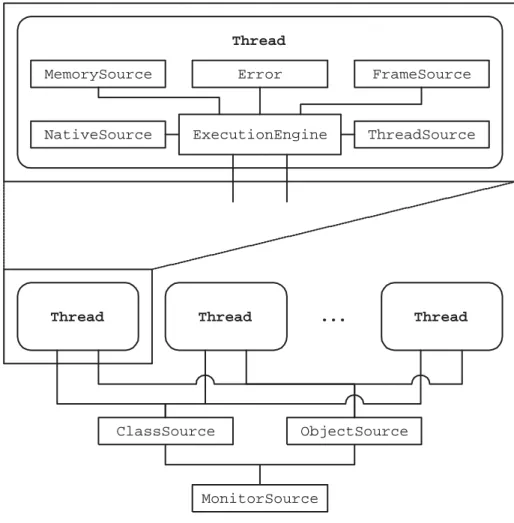
The overall structure of Jupiter is shown in Figure 3.1. TheExecutionEngineis the heart of the opcode interpreter. It integrates and coordinates the calls to the different components of the system. MemorySource provides the interface for memory allocation.
Error handles the error conditions that may appear. FrameSource allocates frames in the thread stack. NativeSource manages the calls to native methods. ThreadSource
is used for spawning child threads. ClassSource controls the creation of Java classes. Finally, ObjectSource is responsible for creating Java objects.
We elected to implement multithreading in Jupiter by having a completely func-tional JVM in every thread, where each thread shares some of its components with other threads, but has other components that remain private. In this case there is an
addi-Thread ObjectSource ClassSource MonitorSource Thread ... Thread ExecutionEngine MemorySource Error ThreadSource FrameSource NativeSource Thread
Figure 3.2: Multithreading Design
tional module, MonitorSource, which creates Monitor structures. This architecture is shown in Figure 3.2. As the figure shows, ExecutionEngine, MemorySource, Error,
FrameSource, NativeSource and ThreadSource remain private to the thread, while
ClassSource, ObjectSource and MonitorSource are shared. The rationale for these design decisions are listed below:
• ExecutionEngine. Having independent JVMs in each thread allows this module to remain private, since this comprises the opcode interpreter.
• MemorySource. Since memory allocation is performed through the standard POSIX call malloc, it can be independently invoked by all threads, thus making this
module private. In an SMP, this same call is used to allocate both memory that will be private to a thread or shared among threads. The allocated shared memory will be equally accessible by all threads. A similar situation occurs for the cluster case, which is described in Section 4.3.1.
• Error. This module is made private because each thread can manage its error conditions independently of the other threads.
• FrameSource. Since the stack always remains private to the thread, this module is not required to be shared.
• NativeSource. In Jupiter, the management routines for native calls can be called by more than one thread simultaneously. Each thread can safely construct its own references to native calls, since the internal Jupiter structures that are used do not require to be shared. Thus, this module is made private to each thread.
• ThreadSource. This module is used for thread creation and keeping track of non-daemon child threads, which must be joined before a JVM finishes its execution. These operations can be managed independently between threads, since each thread waits for its own child threads before finishing, thus allowing this module to remain private. The joining of threads is explained in further detail in Section 3.2.6.
• ClassSource. The JVM Specification [LY99] requires that loaded Java classes be accessible to all threads. Therefore, Jupiter creates classes in the global heap. The MonitorSourcemodule and the internal data structures that store references to such classes (which are used to access them) must be shared, thus making
ClassSourcea shared module.
• ObjectSource. Even though it is not required by the standard, Jupiter conserva-tively creates Java objects in the global heap. This allows them to be shared among threads. Similar to the case of ClassSource, the MonitorSource module, which is used for the creation of these objects, must be shared, making ObjectSource a shared module.
• MonitorSource. This module relies on the use of a single special instance of
ThreadSource, which is created in the main thread. Therefore, a single instance of MonitorSource is created for the system, which is shared among threads.
This high level design anticipates the need to enable the multithreaded Jupiter to run on the cluster of workstations, which will be described in Chapter 4. Having inde-pendent, decentralized components reduces the use of shared memory and the need for synchronization operations on the cluster, and thus, it is likely to improve performance. The remainder of this section discusses the development of the multithreading modules, the design decisions made in the process, the problems faced and how they were solved.
3.2.1 Threading Modules
The design of the threading modules was planned to accommodate the needs of two other modules, the Java class libraries and the native thread libraries. On the one hand, there are functionality requirements imposed by the JavaThreadclass, theObject
class (with support from the ClassPath class called VMObject) and the implementation of some opcodes. On the other hand, there is the functionality provided by the native thread libraries on the target system. Their requirements and services do not match one to one, although they aim at providing equivalent functionality.
Therefore, the main responsibility of the threading modules is to act as a simple interface between these modules, avoiding conflicts and constraints between the require-ments of the upper layer and the services provided by the lower layer.
Furthermore, it was necessary to provide an interface that would abstract away the details of the native thread libraries. This requires that the interface do not have complex functionality that some native libraries may not be able to supply, and it must only provide the smallest set of functions necessary to implement multithreading in Jupiter.
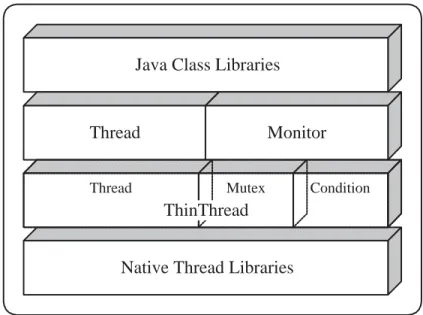
The threading modules implement two abstraction layers, Thread and Monitor, and ThinThread that link the Java class libraries and the native thread libraries, as shown in Figure 3.3.
Java Class Libraries
Native Thread Libraries
Thread Monitor
Thread Mutex Condition ThinThread
Figure 3.3: Multithreading Modules
Thread and Monitor provide services to the Java class libraries, whose interface was specified by ClassPath and adheres to the JVM Threading Specification, which was described in Section 3.1. Thread and Monitor rely on ThinThread, which in turn abstracts the native thread libraries.
The problem and solutions of over-constraint interfaces were introduced in the discussion ondesign for flexibility in the original work on Jupiter [Doy02]. In the design of the Thread, Monitor and ThinThread modules, it was attempted not to change the interfaces defined in the original Jupiter JVM. These interfaces were designed with the purpose of making Jupiter flexible and modular.
An important element in designing the interface was to isolate different func-tionality in several layers, gradually accommodating the abstract interface of the native thread libraries into the needs of Jupiter. While a single interface could have been used, a layered approach is a design technique that simplifies the implementation and improves maintainability. In this case, instead of having a single and complex module, the func-tionality is divided into smaller tasks and placed in separate modules. The funcfunc-tionality on each layer is supported on simple and well defined functions provided by the layer below.
ThreadandMonitorare designed to enhance portability. They provide function-ality that may not always be available in the lower layers or was restricted atThinThread, such as recursion, protection against spurious wake-ups, thread joining and priority set-ting. In those cases where it can rely on the lower layers, it supplies a uniform access interface.
3.2.2 ThinThread
ThinThread encompasses the minimal set of functionality that Jupiter requires for thread handling. It defines a standard and simple interface upon which Thread
and Monitor can be built. As its name indicates, this is a thin layer, thus it does not add functionality to the native thread libraries. Instead, it is intended to simplify the replacement of native libraries without the need of any major redesign in the upper layers of the threading modules, as was described above.
ThinThread’s interface was inspired in the POSIX thread libraries, because they are well known and standard, in particular for Unix systems. ThinThread is divided in three sections:
• Thread operations. These include thread startup, execution priority setting (lim-ited to priority values defined internally), processor yield, sleep, interrupt and self identification.
• Mutex operations. These comprise acquire, release and try. It is possible to imple-ment custom locks at this level using testandset.
• Condition Variable operations. These include wait and waitwithtimeout on condi-tions, and signal and broadcast of completed operations. It must be noted that this functionality does not necessarily have to rely on condition variables. It can be implemented using shared variables or signals.
This functionality, and the rationale for including such functionality in this layer are described below:
• Definition of thread creation properties. The option of setting the daemon prop-erty of a thread was not included in the ThinThread module. The reason for
this decision is to avoid relying on this feature provided by POSIX, which makes
ThinThreadas simple as possible. Therefore, only detached (daemon) threads can be created, and thread joining is controlled explicitly by Jupiter (see Section 3.2.6 for further details). Notice that this gives freedom of implementation because the interfaces do not rely on any specific property of the native thread libraries.
• Definition of thread execution priorities. The priority setting at the JVM level has to be isolated from the setting at the native library level. The reason is that both use different priority scales and ThinThread must remain as abstract as it is possible in this respect. Thus, ThinThread has an independent range of thread priorities that is converted to a valid range within the values that the native library can handle.
• Thread identification. The need for thread identification at a lower level extends the requirements of theThread class. At this point, it involves the internal identi-fication used, at system level, by the native thread libraries. This is necessary for operations such as priority setting, thread interruption and self thread identifica-tion. The latter is used to give support to the implementation of thread startup and Monitor.
• Thread execution state verification. The native thread libraries do not provide primitives for checking the execution state of threads. It is the operating system that keeps track of this information. In this case, an internal Java field that will store this state information is kept in the JavaThread class. When a thread starts and terminates, its value is updated using calls toThreadSource andThread that ultimately use the thread identification mechanisms in ThinThread.
It must be noted that some of the functionality required by the Thread class is programmed in the Java class libraries, and there is only specific functionality that Jupiter must provide this class through the JNI (Java Native Interface).
ThinThread limits locks to the fast (i.e., non-recursive) type [IEE90]. This de-sign decision avoids relying on the recursive feature supplied by POSIX, thus making
useful when enabling Jupiter to run on the cluster since CableS does not provide recur-sive locks.
ThinThreadalso allows condition variables to have spurious wake-ups1, which are also permitted by the underlying system libraries. The reason for the system libraries to experience such behavior is that a completely reliable once-and-only-once wake-up protocol at that level can be expensive. Furthermore, it is considered that spurious wake-ups promote good programming practices [HPO01]. This behavior is allowed at theThinThreadinterface because it simplifies the calls to the underlaying thread library.
3.2.3 Thread and Monitor Modules
Monitorprovides the synchronization and the wait-sets and notification function-ality required by the JVM Specification [LY99]. It is a structure associated with Java objects and classes, which is used for the implementation of synchronized code. The design allowed for both synchronization and wait-sets to be included in the same mod-ule because they base their mutual exclusion requirement on the same mutex. Monitor
provides the following interfaces: Enter, Exit, Try (monitor operations), Mine (monitor ownership), Wait/WaitWithTimeout and Notify/NotifyAll (wait-sets and notification). In Jupiter, Monitor is implemented using mutexes and condition variables. However, there are two aspects in Monitordesign that had to be considered:
• Recursion. The JVM Specification [LY99] allows for monitors to be called recur-sively. However, theThinThread interface does not allow mutexes to provide this property. Only fast (non-recursive) mutexes are provided. This restriction requires that Monitorbe responsible to handle this case. This will be described in Section 3.2.4.
• Spurious wake-ups. The native thread libraries, as well as the ThinThread layer, do not enforce that condition variables, used forMonitorwaiting, return only after a successful notification. This means that there is no guarantee that the return from a wait call is due to a signal or broadcast call [OPE97]. The spurious 1A spurious wake-up is a return from a waiting call on a condition variable predicate, even if the predicate
wake-up demands thatMonitorgive extra support to eliminate the problem. This will be explained in Section 3.2.5.
Thread presents the necessary interfaces for thread handling. These are as fol-lows: Start (thread startup), Set/Get Priority (priority setting), Interrupt (operation interruption), Self Identification (thread identification), Yield (processor yield), Sleep and Join/JoinWithTimeout (thread joining). This module also presents two distinct aspects that required further consideration and analysis:
• Thread startup. In contrast to the two-step thread creation in Java, once the thread libraries create a thread, it immediately begins its execution. This is done through the call to a generic function which receives the thread function as a parameter. Thread creation in ClassPath works differently. It calls a native function for cre-ating the system thread when the Thread object constructor is invoked. This is designed for the creation of the system thread without triggering its execution. Then, a different native function is called when the start method is invoked, which is intended to start the execution of the previously created system thread. This accommodates thread libraries that may work in two steps. This difference requires a careful design, which maintains Java semantics, when deciding where to execute the thread creation function2 from the thread library. One possibility was to create the thread during the creation of theThreadobject, and force the thread to spin until it is signaled to continue from within the start method. However, the alternative elected was to invoke the thread creation function in the start
method, which creates and starts the system thread in a single step.
• Thread joining. Since only daemon threads are supported by the ThinThread
layer, Jupiter must provide its own thread joining mechanisms. The solution to this problem is detailed in Section 3.2.6.
As the requirements of the Java class libraries are unlikely to change drastically in the future, the interfaces ofThread and Monitorwere designed to match them. This way, the lowest level of the Java class libraries remains simple.
3.2.4 Monitor Support for Recursive Calls
Monitors can be called recursively. This means that a thread that is already holding a monitor can request to use it again. This functionality can be implemented using recursive locks [LY99]. However, since the ThinThread interface restricts the use of locks to the fast (non-recursive) type, this had to be tackled in Monitor. This was achieved by direct control of recursion and ownership of the monitor, using functions for thread identification, provided by the Thread module.
An outline of the algorithm needed byMonitorto support recursive calls is shown in Figure 3.4. There are two important aspects to consider. In the method enter, if the current thread already holds Monitor (and, therefore, the lock), the only required action is to increment the locking countMonitorCount. Otherwise, the thread requiring exclusive access to Monitor must contend to acquire the lock. In the method try
similar steps are taken. It must be ensured that the internal countMonitorCountshows a complete unlock beforeMonitorcan be given to another thread. In the method exit, the count is decreased until it reaches 0. At that point, no thread owns the monitor, and therefore the lock can be released. Normally, the Java compiler guarantees that there are no more unlocking than locking operations [LY99].
3.2.5 Monitor and Spurious Wake-ups
The Monitor module implements the wait-set and notification mechanism for Java objects and classes. The synchronization structures used to support this mechanism are condition variables, because they best match the functionality requirements. A condition variable is a synchronization object which allows a thread to suspend execution until some associated predicate becomes true [OPE97].
Consequently, an interface for accessing condition variables was added at the
ThinThreadlayer. However, the native thread libraries as well as theThinThread mod-ule are allowed to produce spurious wake-ups on condition variables. This behavior should not occur in the implementation of wait-sets. As a result, it was not possible to use condition variables directly for the wait-sets. It was required that their behavior be adapted to the needs of Monitor. A solution was implemented at Monitor level,
procedure enter()
if MonitorOwner = CurrentThread then {If this thread is not the owner of the monitor, contend for its exclusive access}
Lock(MutexMonitor)
MonitorOwner ← CurrentThread {Keep monitor ownership information}
end if
MonitorCount ← MonitorCount + 1
procedure exit()
MonitorCount ← MonitorCount - 1
if MonitorCount = 0 then {The thread exited the monitor completely}
MonitorOwner ← NoThread {No thread owns the monitor} Unlock(MutexMonitor)
end if
function boolean try() MutexLocked ← FALSE
if MonitorOwner = CurrentThread then MutexLocked ← Try(MutexMonitor) if MutexLocked then MonitorOwner ← CurrentThread MonitorCount ← MonitorCount + 1 end if else MonitorCount ← MonitorCount + 1 end if return MutexLocked
Figure 3.4: Monitor Support for Recursive Calls
which has the added advantage of allowing a simple integration of the functionality of the wait-set with that of the lock associated with each Java Object and Class. Thus, all the Java synchronization structures could be centralized in one module.
An outline of the wait-sets and notification mechanism that handles spurious wake-ups is shown in Figure 3.5. The number of waiting threads and the notifications received are counted. The call toWaitOnConditionin the methodwaitis protected from spurious wake-ups by the count on the notifications. It must be noted that, since the