chapter
how do athletes
TRAIN FOR IMPROVED
performance?
In this chapter we explore the different types of training. Not every person responds in the same way to a particular training regimen. People respond differently, for both genetic and environmental reasons. Some athletes have an advantage due to inherited factors, such as gender, muscle-fibre type and body composition. Some athletes have to train harder than others to improve their performance by an equivalent degree.
Strength training
The main goal of strength training is to increase the maximum force that a particular muscle group can generate. In general, this increase will occur provided you work against some form of resistance and exercise the muscles regularly at a sufficiently high intensity.
As discussed in Core 2 (Factors Affecting Performance), strength training can take different forms: resistance training using hydraulic and elastic resistance
•
weight training using plates and dumb-bells •
isometric training applying a static force. •
20
Ap
plic
ation and Inquir
how do athletes
TRAIN FOR IMPROVED
performance?
Strength training can involve a variety of techniques. During strength training, elements of isotonic, isometric and isokinetic contractions can be used. Training sessions can incorporate elements of each, depending on the types of exercises, the equipment used and the type of strength development being sought.
There is much discussion about the nature of strength training and what form is best; for instance, whether free weights are preferable to machines or elastic resistance band training. In order to determine what method best suits an individual’s specific performance requirements a number of factors should be considered.
People choose to begin a strength training program for a variety of reasons. These include a desire to:
develop muscular strength or endurance •
develop power •
lose weight •
gain muscle definition. •
Some people want to commence strength training to build their upper-body strength, others seek lower-body strength, and some merely want a ‘six-pack of abs’.
Some require a specific type of muscle contraction for an activity: concentric, eccentric or isometric.
Strength training programs can be tailored to the specific needs of the individual. For this reason, it is helpful to know what exercises are available for specific body parts, and how those exercises are performed using machines, resistance
bands or free weights. Gyms will offer assistance in this matter, providing information, programs and supervision. Strength training books, videos, magazines and websites are also available.
Types of strength training
There are three main types of strength: maximum or absolute strength
• —the maximum weight
that can be lifted just once (one repetition maximum); for example, weightlifting
elastic strength (power)—
• the
ability to exert maximum force in a short time period; the product of strength and speed; common in explosive sports involving sprinting, jumping or throwing endurance strength
• —the capacity
to exert a force repeatedly over an extended time; required in swimming, rowing and cross-country skiing. The type of strength training undertaken is dependent on the demands of the sport.
The force exerted during strength training is proportional to the type and force of the muscular contractions. The three different types of muscular contractions are:
isotonic
• —a force against an external load that remains constant throughout the movement
isometric
• —a force performed at a constant angle against an immovable load
isokinetic
• —a force generated during movement at a pre-set, fixed speed throughout the range of motion of the joint.
These three different types of muscular contractions will occur during different types of strength training.
To maximise training and to increase strength, power, lean body mass and muscular endurance, most athletes use one or more of the following:
fixed resistance (free weights) •
variable resistance (such as •
Nautilus, Universal or elastic bands or tubing)
accommodating resistance (such •
as Cybex).
Figure 20.1 Gyms can tailor strength training programs to meet the specific needs of individual clients
#
The main types of strength are maximum or absolute strength, elastic strength and endurance strength.
#
A muscle will strengthen only if it has been forced to work beyond its customary intensity; that is, if it is overloaded.
A muscle will strengthen only if it has been forced to work beyond its customary intensity; that is, if it is overloaded. Muscles can be overloaded by progressively increasing the:
intensity (by decreasing the number and length of rest •
periods)
resistance (by lifting more weight) •
number of repetitions at a particular weight •
number of sets of an exercise •
speed of muscular action. •
In the interest of specificity, strength training must target the specific muscle groups involved in the sport. It must also take into account the types of movements that occur at specific joints.
Regardless of the strength training program to be followed, the athlete can ensure the program is effective and safe by:
undertaking a general strength program before •
specialising for specific movements
performing adequate warm-up and cool-down activities •
completing exercises for large muscle groups before •
those for smaller ones
using progressive overload as the body adapts to the •
amount of work performed
following an individual program shaped to the athlete’s •
level and requirements
focusing on the correct form, technique and breathing •
patterns for each exercise
allowing an appropriate recovery period between •
exercises during a session and between training sessions monitoring progress through the use of record cards or •
charts.
Resistance training
Resistance training occurs through the use of elastic resistance methods (bands or tubing) or through hydraulic resistance methods (specialised machines or exercises performed in water).
Elastic resistance training
Elastic resistance is achieved through the use of bands or tubes. An elastic resistance band is a flat piece of elastic material (band) that is cut from a roll to the desired length and is either held in the hands or tied to a stationary object. Elastic resistance tubing is bought as a kit, which contains lengths of tubing with handles attached. The handles provide a point of attachment that can be held in the hand, placed under the foot or attached to a stationary object.
The elastic resistance band or tube has become an effective and portable resistance training alternative to weight training in order to develop strength. Elastic resistance exercise has been used for both fitness training and rehabilitation for nearly a century. It works on the simple principle that as the elastic band is stretched, the resistance increases. A variety of elastic resistance exercises have been devised to target specific muscle groups; although many are the same as for weight training. Due to the nature of the equipment, exercises can be adapted to suit the needs of individual athletes and their sports. This versatility, along with its relatively low cost and portability, makes it an ideal form of strength training.
Ap
plic
ation and Inquir
Figure 20.2 Resistance bands can be used with plyometric exercises to assist in progressive overloading
Weight training using free weights or exercise machines relies on gravity as the force to provide resistance. This can limit the athlete to upward movements and often one particular exercise on each machine. Elastic resistance, however, does not rely on gravity for resistance; rather, resistance depends on how far the band is stretched. This allows for many more movements and for exercises to be completed in a number of planes; for instance, from side to side.
For athletes this type of training can allow for greater specificity as they can train against a resistance and better mimic the movement patterns required for their sport. For instance, performing exercise movements in the horizontal plane will better prepare athletes for competitive situations and may help to prevent sports injuries. This idea is used by throwers and swimmers and is readily adaptable to most sports. Particular applications are used to replicate movements, such as twisting from side to side while swinging a baseball bat or tennis racquet, throwing a punch in boxing or passing the ball in netball or basketball.
As elastic resistance training can work single or multiple joints it allows exercises to be more functional and efficient. A high level of neuromuscular control is required to stabilise the body in the appropriate positions in which the exercises are performed. This improves core strength while completing the exercises. Additionally, elastic bands can help to strengthen muscles that are not targeted by weights or machines, such as those in the rotator cuff of the shoulder.
Exercises performed with elastic resistance bands increase muscle strength and size. As they are able to be performed at speed they also improve the development of speed and power. When combined with specific plyometric exercises the added resistance can be beneficial in the progressive overloading of these exercises.
Training adaptations can be monitored as, generally, there is a colour-coded progression of resistance whereby different colours indicate an increasing amount of resistance. Quality band systems also allow for multiple bands to be attached to the handles to further increase resistance and progressively develop strength to higher levels. However, it can be difficult to accurately quantify the specific resistance applied the way we can with weights. A band cannot be equated to a specific weight and the force produced by a band depends on how much it is stretched; thus the height of the user varies the resistance.
Tension is present throughout the full range of motion. This means that, starting with the least resistance and ending with the highest, the muscle is exercised in a smooth manner. In particular, since momentum is not built up, as with weights, the smoother eccentric resistance during the return phase increases safety and reduces the chance of injury. Momentum does not play a role, which means it is much harder to ‘cheat’ using elastic bands.
It is important to regularly check the bands as their limited durability means that occasionally they can break. The attachment to either handles or stationary support should be secure in order to prevent ‘snap back’ and possible injury.
practical application
Elastic resistance training
1
a Practise using elastic resistance bands
with a range of general exercises, such as squats, bench presses, upright rows and bicep curls. Describe your experience in performing these exercises.b Having completed the above, design three
other exercises using elastic resistance bands (other than the exercises already performed) that mimic the specific movements for a sport in which you participate. Practise completing the exercises in the manner in which you think they would be performed. If you are unable to work out some of the exercises check with your teacher or contact a local gym for clarification.Hydraulic resistance training
Hydraulic resistance training utilises isokinetic contractions where the resistance varies to match the varying strength of contraction as the muscle changes in length and mechanical advantage. This usually involves exercising using equipment that provides a constant resistance and allows the muscle to contract and shorten at a constant speed. The theory is that this form of training can produce the greatest strength gains because isokinetic exercises allow strength to be developed through the full range of movement. The resistance is a function of speed: the faster the movement, the greater the resistance. These programs are also speed-specific in that they cause maximal gains in strength and endurance at speeds slower than or equal to those used in training (but not faster).
Hydraulic resistance training may also involve exercising in water, where each effort is opposed by the viscosity of the water. In this form of training, gravity neither helps nor hinders the work-out.
Programs using hydraulic resistance methods increase muscle strength and muscle size and decrease body fat in a
similar manner to other types of strength training programs, but are able to specifically build speed. They are also frequently used for rehabilitation purposes. As the machines do not allow many sport-specific movements and only allow for concentric contractions their effectiveness in training for these specific movements may be limited.
Hydraulic resistance typically makes it possible for a person to perform strength training as well as cardiovascular training at the same time. Gains in isokinetic strength and endurance have been seen with as little training as one minute per day on each exercise when completed four days per week for seven weeks. Interval circuit training using hydraulic machines allows this to be accomplished easily. The gains also appear to be longer lasting than those of isometric or isotonic exercises. Hydraulic resistance machines are very expensive, however, meaning access is limited as most gyms cannot afford them.
Hydraulic machines are designed to be safe, simple and effective and the resistance is
accommodating; that is, the resistance responds to the force exerted against it. Therefore, people of all levels of strength are able to benefit from them. To increase resistance, you simply push or pull harder, rather than adjust weights on barbells or machines. The result is an effective strength training method that reduces soreness, and eliminates the potential for injury.
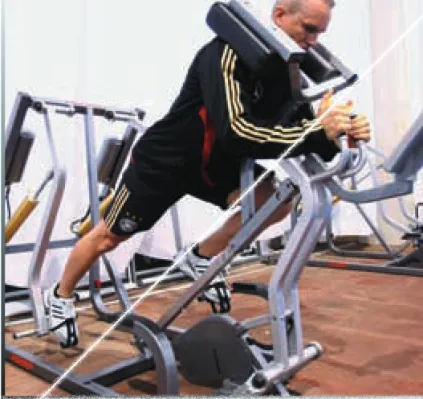
Figure 20.3 Hydraulic resistance training
practical application
Hydraulic resistance training
1 Visit a local fitness centre to find examples of hydraulic
resistance equipment.a Enquire as to how and why these machines are used
in strength training programs and what exercises are provided for the rehabilitation of patients with various sporting injuries.b Where possible, attempt a work-out on hydraulic resistance
equipment. Describe the feelings you experienced while completing this work-out.c
Compare and contrast the work-out completed above to one completed on weight training machines or using weights (plates or dumb-bells).d
Classify the exercises as isometric, isotonic or isokinetic. How and why are each used?Critical inquiry
1
Professional sporting teams, such as AFL and NRL teams, are often seen on television doing recovery sessions in pools. This would be classified as hydraulic resistance training. Explain the possible benefits of performing this type of session for these athletes.2
Identify particular movements in a variety of sports where the use of elastic resistance training may be of specific benefit to the athlete involved.Ap
plic
ation and Inquir
Figure 20.3 Hydraulic resistance training
Weight training
Weight training is the most common form of strength training for athletes and has been used for centuries. This type of training involves using force to resist the effect of gravity. Various objects (such as bricks or sandbags) could be used to achieve this effect. Typically, however, the athlete will use equipment specifically designed for this purpose.
Plates and dumb-bells
Nearly all the weight training people do is isotonic. In isotonic contractions, the muscle changes length under a constant load, which causes a variation in the tension produced in the muscle. Rather than using just the athlete’s body weight, the resistance can be provided in the form of free weights or weights stacked on a machine. Most body builders and people seeking pure strength prefer free weights. This is because they enable the participant to completely isolate muscles, and allow the joints and limbs to move along their natural planes. This may be done with plates loaded onto a machine or barbell. Some machines may be designed for single limb lifting; however, barbells require the use of both limbs. Individual dumb-bells are designed to be used with a single limb. Athletes may also use pulleys and cables attached to plates on a machine to perform a similar movement pattern to those in their sport.
Undertaking weight training using plates and dumb-bells involves performing isotonic contractions. The most common isotonic strength training (dynamic) program was developed by DeLorme and Watkins in 1948. They first coined the term ‘repetition maximum’ (RM) when they devised a strength training program based on a maximum load that could be lifted 10 times, but not 11 times (10 RM). The program requires the athlete to perform three sets of 10 repetitions as follows:
set 1—10 repetitions using a load that is half the load of 10 RM •
set 2—10 repetitions using a load that is three-quarters the load of 10 RM •
set 3—10 repetitions using a load of 10 RM. •
This type of training is known as progressive resistance exercise (PRE). When more than 10 RM can be lifted, the weight is increased. This program can be performed over three to four consecutive days, or with a rest day in between.
Some successful variations to PRE also exist. These variations include: exercising at 3–9 RM—best for strength gains
•
training at 1 RM for one set—significantly increases strength until about the sixth week •
varying the percentage of 10 RM in •
sets 1 and 2—as long as there is one 10 RM set
performing one or two sets rather •
than three—but three sets is more effective for strength gains varying the frequency of exercising— •
with the use of several different exercises, training may be best two to three times per week, rather than four to five times per week
using a faster rate of movement at a •
given resistance—results in greater strength gains.
Some of the possible free weight and weight machine exercises for working out the major muscle groups in the body are shown in Table 20.1 page 354. Notice that there are free-weight and machine exercises for each. This list is not exhaustive because new techniques and exercises are continually being
Weight training allows a muscle to be strengthened throughout the full range of motion (including both concentric and eccentric contractions) and exercises can be chosen to match the actions in a particular sport. It is also reasonably cheap and accessible. However, weight training can make muscles sore due to the stress applied while they lengthen (eccentric) and the muscle only gains its most strength at the weakest point of the action, rather than evenly throughout. Momentum built up during a movement can place stress on joints and cause injury so care should be taken, particularly in the eccentric phase. Working with one or more partners (spotters) is also advised as fatigue and heavy weights may lead to injury if unsupported.
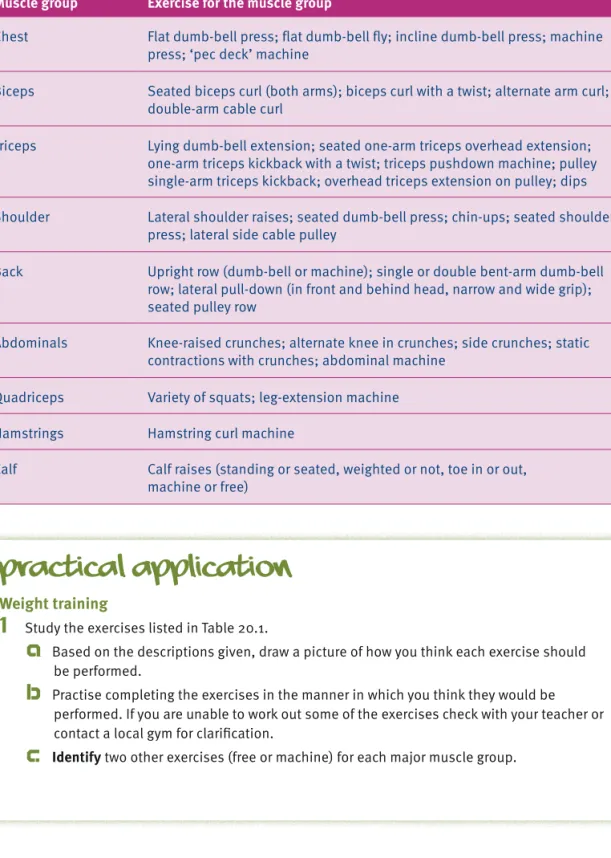
Table 20.1 Free weight and weight machine exercises for working out major muscle groups
Muscle group Exercise for the muscle group
Chest Flat dumb-bell press; flat dumb-bell fly; incline dumb-bell press; machine press; ‘pec deck’ machine
Biceps Seated biceps curl (both arms); biceps curl with a twist; alternate arm curl; double-arm cable curl
Triceps Lying dumb-bell extension; seated one-arm triceps overhead extension; one-arm triceps kickback with a twist; triceps pushdown machine; pulley single-arm triceps kickback; overhead triceps extension on pulley; dips Shoulder Lateral shoulder raises; seated dumb-bell press; chin-ups; seated shoulder
press; lateral side cable pulley
Back Upright row (dumb-bell or machine); single or double bent-arm dumb-bell row; lateral pull-down (in front and behind head, narrow and wide grip); seated pulley row
Abdominals Knee-raised crunches; alternate knee in crunches; side crunches; static contractions with crunches; abdominal machine
Quadriceps Variety of squats; leg-extension machine Hamstrings Hamstring curl machine
Calf Calf raises (standing or seated, weighted or not, toe in or out, machine or free)
practical application
Weight training
1 Study the exercises listed in Table 20.1.
a Based on the descriptions given, draw a picture of how you think each exercise should
be performed.b Practise completing the exercises in the manner in which you think they would be
performed. If you are unable to work out some of the exercises check with your teacher or contact a local gym for clarification.c
Identify two other exercises (free or machine) for each major muscle group.Ap
plic
ation and Inquir
Overload techniques
There are many techniques for achieving overload in weight training.
Blitzing is the practice of working a muscle or muscle group with different exercises from different angles on any one training day.
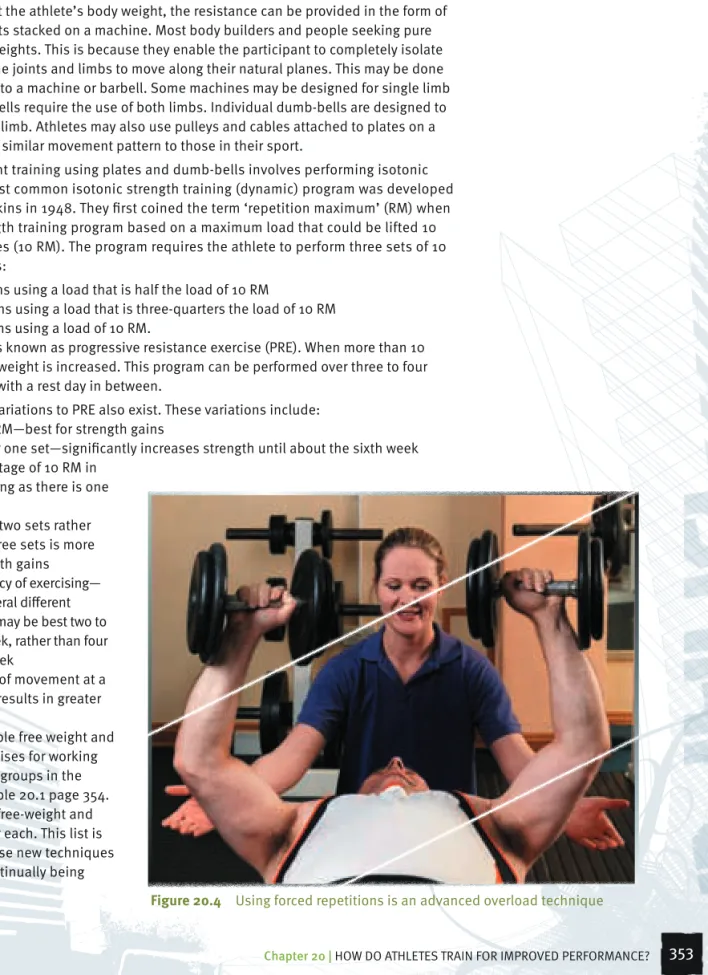
Forced repetitions are exercises in which a partner assists where the biomechanical advantage is least, and the muscle is thus weakest. The partner gently supports the weakest point.
Cheating is used by experienced trainers to overcome the weakest point of the muscle in order to overload the strongest part of the muscle. This is done by gently using other muscles to assist in lifting the weight over the weakest point. For example, in a very heavy arm curl, the trunk is bent slightly forward and the muscles of the small of the back are used to lift through the weakest point.
Negative repetitions are said to increase bulk and strength by using eccentric isotonic contractions after the muscle is fatigued. For example, after the biceps muscle is fatigued by performing biceps curls, a partner assists by lifting the weight and allowing further lowering (eccentric contractions) of the weight by the athlete. The extra work is said to be performed as a negative repetition.
Pre-exhaustion refers to exercising to isolate and fatigue a muscle, and then once more using the muscle (along with other muscles) in a more complex (compound) exercise so that it works further. For example, leg extension is used in pre-exhaustion followed by sets of squats.
Rest pause refers to fatiguing a muscle by overloading it to such a degree that only 1 RM can be performed, then pausing for 10 seconds before performing the exercise again and again. This technique is used by experienced lifters. Caution is required due to the high intensity of this technique.
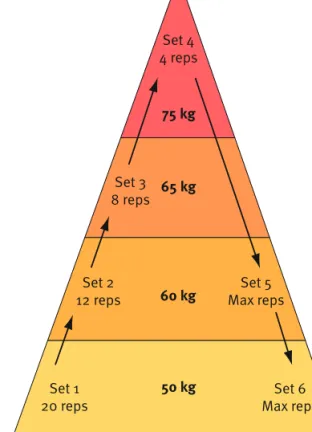
Pyramid training involves the practice of increasing resistance up to the optimal weight, and then decreasing the resistance.
Up and down the rack is similar to pyramid training. It uses light to heavy weights arranged on a weight rack. The athlete works up the rack (increasing weights) and then back down it (decreasing weights). See Figure 20.5 for an example of a pyramid squat workout.
Compound training involves combining exercises of the same muscle group and the antagonist muscle group with minimal rest between exercises. This can be done in:
super sets
• —exercise the agonist, then the antagonist (for example, a biceps curl, and then a triceps extension); alternatively, complete a different exercise with the same muscle group (for example, a bench press followed by a dumb-bell fly) tri sets
• —work the same muscle three times (for example, complete three different exercises for the deltoids)
giant sets
• —carry out super sets with more than two exercises, with no rest in between. Hybrid exercises (compound repetitions) involve moving through a greater range of motion because more than one joint is involved. Thus, instead of doing three or four different exercises, the athlete can complete just one.
Triple drop involves decreasing the weight during a set of repetitions so that more repetitions can be done. It is usually reduced three times, or until complete fatigue is reached.
Figure 20.5 Pyramid training
Set 4 4 reps 75 kg 65 kg 60 kg 50 kg Set 3 8 reps Set 2 12 reps Set 1 20 reps Set 5 Max reps Set 6 Max reps
#
An isolation exercise involves exercising one muscle group completely before moving onto the next exercise.
#
A compound exercise involves combining exercises of the same muscle group and the antagonist muscle group with minimal rest between exercises.
Guidelines for various types of weight training
A basic principle of weight training is to allow time for muscles to achieve optimum growth, repair and recovery. Allowing a rest period of about 48 hours will help to avoid over-training and muscle soreness. An exception to this general rule is to work the upper body one day and the lower body the next. Either way, there should be a rest of one day for each muscle group between sessions. The abdominal muscles can be worked every day, however, because of their size.
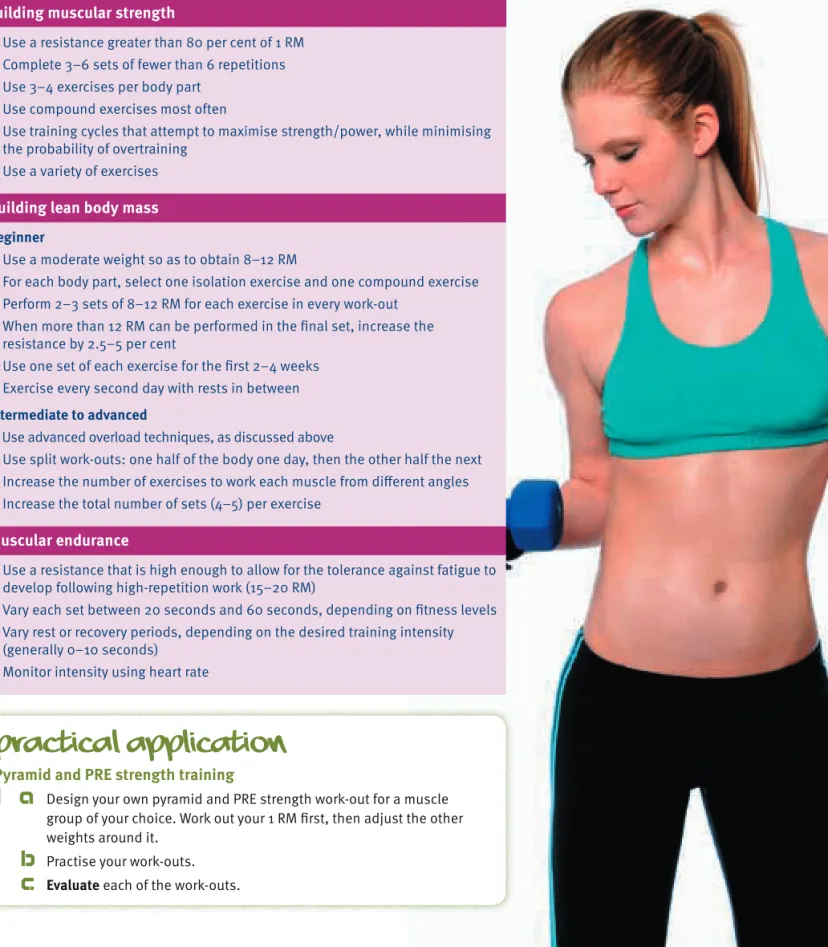
Table 20.2 Weight training guidelines for different goals
Building muscular strength
• Use a resistance greater than 80 per cent of 1 RM • Complete 3–6 sets of fewer than 6 repetitions • Use 3–4 exercises per body part
• Use compound exercises most often
• Use training cycles that attempt to maximise strength/power, while minimising
the probability of overtraining
• Use a variety of exercises
Building lean body mass
Beginner• Use a moderate weight so as to obtain 8–12 RM
• For each body part, select one isolation exercise and one compound exercise • Perform 2–3 sets of 8–12 RM for each exercise in every work-out
• When more than 12 RM can be performed in the final set, increase the
resistance by 2.5–5 per cent
• Use one set of each exercise for the first 2–4 weeks • Exercise every second day with rests in between
Intermediate to advanced
• Use advanced overload techniques, as discussed above
• Use split work-outs: one half of the body one day, then the other half the next • Increase the number of exercises to work each muscle from different angles • Increase the total number of sets (4–5) per exercise
Muscular endurance
• Use a resistance that is high enough to allow for the tolerance against fatigue to
develop following high-repetition work (15–20 RM)
• Vary each set between 20 seconds and 60 seconds, depending on fitness levels • Vary rest or recovery periods, depending on the desired training intensity
(generally 0–10 seconds)
• Monitor intensity using heart rate
practical application
Pyramid and PRE strength training
1
a Design your own pyramid and PRE strength work-out for a muscle
group of your choice. Work out your 1 RM first, then adjust the other weights around it.b Practise your work-outs.
c
Evaluate each of the work-outs.Ap
plic
ation and Inquir
Isometric training
A few years after DeLorme and Watkins revolutionised isotonic training, Hettinger and Müller revolutionised isometric strength training (static strength training). Their study in 1953 showed increases in maximum strength of 5 per cent per week by isometrically contracting a muscle group for six seconds once per day over five days per week. Repeating the contraction five to 10 times per day produced greater strength gains.
This study led to many further studies in which the amount of tension and the duration and number of contractions were varied to see what differences these changes made. The studies found considerable individual variations; however, they did, generally, confirm that isometric contractions can improve muscular strength and endurance.
Isometric exercises can be performed anywhere as equipment is not required. Isometric training is not ideal in the sports setting, however, because it requires static contractions, and this very rarely occurs in sporting events. This type of strength training is therefore unsuitable for sporting activities involving dynamic muscle action. However, it is a very useful rehabilitation tool. Care should be taken when performing isometric training if heart or blood pressure problems exist as during an exercise blood flow to the muscle can stop and blood pressure rises.
Aerobic training
Aerobic capacity will be improved by a training program that is designed to progressively overload the cardiovascular and respiratory systems, and to stress the oxidative
capacities of the muscles; that is, their ability to utilise oxygen. The program should be specific to the sport or event; that is, runners run and swimmers swim. The principal training methods used to develop aerobic capacity are continuous/uniform training, Fartlek training and long-interval training.
Continuous/uniform training
Continuous/uniform training is long, slow distance training (running, swimming or cycling). It involves working for longer than is the case in the performance or
competition, and at a uniform intensity of approximately 70 per cent of maximum heart rate (55–60 per cent max VO2). The form of training is effective in preparing for
long-distance events (for example, marathon), but does not substantially improve max VO2. Athletes and coaches
should be aware that, when training, more is not always better, and the volume of training undertaken should be an important consideration.
High-intensity, continuous training has been shown to improve max VO2 and lactate tolerance. The exercise
intensity required to produce these improvements varies from athlete to athlete, but should be around 80–90 per cent of max VO2; that is, greater than 90 per cent
of maximum heart rate. Work rates equal to or slightly above the lactate threshold produce the best results. An
Critical inquiry
1
Interview an employee of a local gym to determine which style of strength training is most popular for particular groups of people (such as adolescents, competitive athletes, females and the elderly) and for particular sports, and why.2
Contact a local physiotherapy centre and ask what exercises are provided for the rehabilitation of patients with various sporting injuries. Classifythe exercises as isometric, isotonic or isokinetic. How and why does the centre use each?
Research and Review
1
Describe the advantages and disadvantages of each type of strength training; that is, resistance, weight and isometric.2
Define delayed-onset muscle soreness. Explain how it relates to strength training.3
Explain why overload techniques are used in strength training.4
Describe the key features of resistance, weight and isometric training.5
Identify safety procedures that should be followed when conducting strength training.Internet support for aerobic training can be accessed via
www.oup.com.au/pdhpe12
WEB
#
When training, more is not always better.
Figure 20.6 Continuous/uniform training involves working for longer than is the case in the performance or competition, and at a uniform intensity
individual’s lactate threshold can be established by determining the person’s heart rate and ventilation, as opposed to performing invasive blood tests. The duration of the training session depends on the fitness of the athlete, but should be for approximately 25–50 minutes for best results.
Individual differences between athletes, and the nature of their sports, determine which method is most effective for improving max VO2 in particular activities. Intensity seems to be a more important factor
than duration. Another principle of training can be applied here—that of variety. Using a combination of the types of aerobic training listed above is helpful to keep athletes interested and motivated.
Training methods for improving aerobic capacity should aim to increase max VO2, improve tolerance to
lactate and improve economy of effort.
Fartlek training
Fartlek is a Swedish term meaning ‘speed play’ and is a variation of continuous training. In this type of training, athletes vary the pace at which they run and may also vary the terrain. Typically this would involve some uniform pace exercise interspersed with short sprints and returning to steady state to recover. Inclusion of uphill and downhill or stair work would assist in providing the variation required. This type of training is a more demanding form of aerobic training and aims to have athletes work both aerobically and anaerobically. By its nature it helps to improve max VO2 and is very beneficial for athletes requiring changes
of pace and for team games.
Long-interval training
In common with Fartlek training, in long-interval training there are periods of work interspersed with periods of recovery. To achieve a specific effect there are a number of variables that can be manipulated. These include the:
duration of each interval and rest period •
intensity of the interval •
duration of the recovery interval •
number of work/rest intervals per session. •
The key to effective and specific overload is the work:rest ratio. For aerobic training, long intervals are used with a work:rest ratio of 1:1. Each exercise interval would typically be 2–5 minutes in length and be done at a sub-maximal pace. The number of intervals to be completed would be four to eight repetitions.
Long-interval training allows work of a high quality to be performed as the recovery periods delay the onset of fatigue. Also the athlete can complete more work than in an equivalent continuous training session. Effective long-interval training depends on identifying the level of fitness of the athlete and setting the appropriate variables. A period of continuous training may be required to build aerobic fitness before introducing intervals.
As there are a number of variables available it can be easy to build progression into a long-interval training program. Measuring and monitoring training adaptations is achieved through the use of cards or charts to record each of the variables involved. It can be effective to use a heart rate monitor as the rest periods would allow the work intensity to be recorded.
practical application
Fartlek training
Plan a 30-minute Fartlek training session utilising the local environment around either your school or home. Attempt the course, ensuring that your heart rate is above the aerobic threshold during the steady-state sections and rises above the anaerobic threshold during the speed play sections.
Research and Review
1
a
Define max VO2.b
Outline the role it plays in sports performance.2
Suggest a suitable training program for a triathlete combining the necessary elements required for improved performance.3
Compare and contrast each of the types of aerobic training.4
Research a sub-maximal aerobic test and explain how it is performed and how the results from this can be used to estimate an athlete’s max VO2.Ap
plic
ation and Inquir
Anaerobic training (power and speed)
In developing the anaerobic system, consideration must be given to activities that tax the alactacid system (ATP–PC system) and the lactic acid system. Each of these systems operates without oxygen to replenish the body with a readily available energy in the form of ATP.
Table 20.3 Resistance training for power and speed events
• Resistance should be 30–70 per cent of 1 RM
• 2–3 sets with 6–8 repetitions performed with high velocity • 9–10 seconds rest between repetitions
• 4–6 minutes rest between sets • 8–10 minutes rest between sequences
Developing power through resistance/weight training
Power is the explosive aspect of strength, and can be developed by improving maximum strength and/or the speed of coordinated muscle contractions. Power is the product of strength and speed of movement. It can therefore be represented by the following formula:
Power = force (strength) x distance ÷ time taken
For example, if player A can bench press 200 kilograms in 8 seconds, and player B can do it in 4 seconds, player B has twice the power of player A because player B took half the time.
In most sporting activities, power is more important than maximum or absolute strength. For example, a player who can bench press 1 RM of 200 kilograms might have difficulty in tackling a player who can bench press 1 RM of 150 kilograms if this latter player can move his or her 1 RM at a faster speed. The first player is 50 kilograms stronger, but the second player’s good strength and faster speed gives this player more power and a performance edge in contact situations.
The greatest single contribution to increasing power is through ballistic and plyometric exercises (discussed later in this section), which focus on specific sport-related exercises. The main difficulties encountered in developing such exercises are:
determining which aspect of strength is optimally required; that is, strength or speed •
determining when (in the game or activity) this is required. •
For example, in a scrum, a front-row forward needs maximum strength but, in a tackle, this person requires strength and speed (power).
It appears that if heavy loads are lifted in training to develop strength, speed will increase automatically for that load. Problems arise when the load is less, because there will not be an accompanying increase in speed. In addition, if the load is light, speed will be developed only for that load, and other muscle groups can be fired to compensate if the load is outside the practised range. Therefore, to improve power, it is best, in each training cycle, to use a combination of increasing maximum strength and light, resisted sport-specific plyometrics. Power gains will be seen with sessions conducted at 75 per cent of maximum strength, with 4–6 sets of 6–10 repetitions, and 5 minutes of rest between sets. Power development requires longer periods of recovery than are required for orthodox maximum strength training. For this reason, power exercises should not be performed in the three or four days before a competition.
Internet support for anaerobic training can be
accessed via www.oup.com.au/pdhpe12
WEB
#
Power is the product of strength and speed of movement.
Figure 20.7 Anaerobic training
#
Power exercises should not be performed in the three or four days before a competition.
Developing speed
Speed is the greatest velocity at which the following occur:
Critical inquiry
Based on the information presented above, and on your own research, describe a series of exercises that will provide resistance to performers in the development of maximum speed in swimming or running. Include strength, endurance and game-like activities, which might or might not involve equipment.
practical application
Anaerobic training for speed
1 Devise two speed-training activities designed to
develop the speed of each of the following:a a tennis stroke
b the reaction of a slips fielder in cricket
c a swimmer off the blocks.
practical application
Anaerobic training for power
1 Over the next four weeks, an athlete is planning to do three sets of 15 RM, three times
per week on all exercises. Suggest how the athlete might be able to overload the muscles during the following four weeks to ensure an increase in:a maximum strength
b elastic strength
c strength endurance.
a limb or body part is moved •
a whole body is moved •
an implement is projected •
a reaction to a stimulus is made •
a number of repetitions of a task is made. •
Speed is the determining factor in power sports (for example, sprints, jumps and most team sports), and in sports involving speed of response (for example, combat sports, motor-driving, cricket and baseball). The relative contribution of speed to the sport depends on the athlete, the demands of the sport, and the specific techniques practised by the athlete.
Speed needs to be developed, modified and learned. Training has the capacity to enhance speed in the following areas:
achieving maximum speed •
maintaining maximum speed •
reacting to a signal •
accelerating •
adjusting rapidly and rebalancing •
choosing the correct option. •
The development of speed depends mainly on the characteristics of the athlete. These include muscle elasticity, muscle-fibre type, biochemical responses and use of energy, nervous system responses and willpower. Aspects of the environment (such as temperature, footwear, clothing and equipment) will also affect speed development.
Practices for the development of speed should be specific to the technical demands of the sport. Such demands will vary according to the requirements of maximum speed, strength, endurance and joint mobility of the particular sport.
Mastery of technical skills and technique should precede speed or strength development. This applies in all sports, including sprinting (both swimming or running).
Recovery is very important and should be quite lengthy when working at maximum intensity. This will ensure that every effort is made at 100 per cent. Different aspects of speed can be improved through different types of anaerobic training. A large number of sets with a small number of repetitions of very high intensity and over variable distances (dependent on the sport) is suitable for increasing absolute speed. Throwing speed can be increased by throwing lighter objects and using plyometric training. A variety of plyometric and sports-specific activities can be designed to improve jumping speed, and to improve a change in direction at speed.
Ap
plic
ation and Inquir
Plyometrics
Plyometrics is a training method used to enhance power and explosiveness. A plyometric exercise is one that produces stretching of a muscle group undergoing an eccentric contraction, followed by a rapid concentric contraction of the same muscle group. This is often called the stretch–shortening cycle, and the basic premise is that when a muscle is stretched much of the energy required to stretch is lost as heat, but some of the energy can be stored in the elastic components of the muscle. This stored energy is then available to the muscle only in an immediate subsequent contraction. The energy boost is lost if the eccentric contraction is not followed immediately by a concentric contraction in the shortest possible time.
The principle of specificity is very important in choosing appropriate plyometric exercises. For example, a line-out jumper in rugby union is concerned with increasing vertical height, whereas a javelin thrower is aiming for explosive upper-body power to launch the javelin.
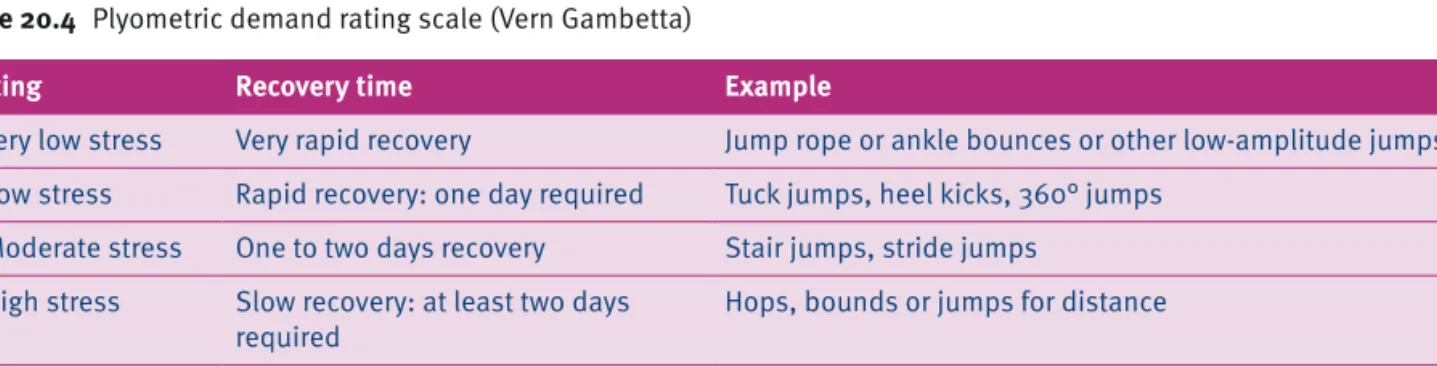
When designing a plyometric program the focus should be on quality of work, not quantity. Exercises should be completed with maximal effort and appropriate rest periods should be applied. Typically, there should be 1–3 minutes between sets and 3–5 minutes between each exercise. It is vital that the athlete has a good level of basic strength, begins with appropriate exercises, follows proper progression and performs the exercises correctly. An adequate warm-up routine is imperative. This should begin with general activity and proceed to specific exercises and dynamic stretches that mimic the exercises to be performed. A rating scale, such as the one in Table 20.4, should be used to determine the appropriate training load for the athlete and monitor his or her progress.
There are many other considerations to take into account in order to ensure the safety of the athlete. These include:
the weight and age of the athlete •
the plane of the exercise—horizontal is less stressful •
than vertical
limb involvement—single or double •
additional loading (weights) •
the skill and stability of the athlete. •
Appropriate progression is paramount, especially in the teaching phase of the exercises. Stabilisation tests, such as those in Table 20.5, can be used to determine the level an athlete is capable of.
Table 20.5 Plyometric stablisation tests (Vern Gambetta)
• Static stand (hip flexed) for 10 seconds • Single-leg squat
• Hop for distance—hold landing for 10 seconds • Hop down off 30 cm box—hold landing for 10 seconds • Repetitive jump test (maximum effort)—tuck jump for
30 seconds, checking for switch time, movement from starting position and jump count
Adapted from V Gambetta, ‘Plyometrics: myths and misconceptions’
Some examples of common upper-body and lower-body plyometric exercises are described below. These exercises should be given only to conditioned athletes, and should start out with low impact and then increase in intensity.
Upper-body plyometric exercises
The trunk, being the link between the legs and hips and the upper body, is extremely important for the efficient and powerful execution of many upper-body movements. Exercises for the trunk focus on swings and twists, while the arms and shoulders are engaged through thrusts, throws, passes and swings.Handstand jumps
While performing a handstand, the person goes down on both hands (in the same manner as doing a push-up), and then immediately springs back up and down on both hands.
Push-up claps
During a series of push-ups, a clap is added in between each push-up. The pre-stretch occurs when the hands arrive back on the ground after the clap and the chest sinks, followed quickly by an explosive upwards action. Keep ground contact to a minimum.
Table 20.4 Plyometric demand rating scale (Vern Gambetta)
Rating Recovery time Example
1 Very low stress Very rapid recovery Jump rope or ankle bounces or other low-amplitude jumps
2 Low stress Rapid recovery: one day required Tuck jumps, heel kicks, 360° jumps
3 Moderate stress One to two days recovery Stair jumps, stride jumps
4 High stress Slow recovery: at least two days
required Hops, bounds or jumps for distance
5 Very high stress Very slow recovery: three days
required Depth jumps or other shock jumps
Plyometric push-ups
The person kneels on the ground with a near vertical torso. The person uses gravity to fall towards the ground with arms extended as shown in Figure 20.8. The person contacts the ground, allowing the force to flex the elbows. The person drops down until the chest almost touches the ground. The person rapidly extends the arms to full length. The extension should be forceful enough to propel the upper body close to the starting position. This is not a continuous exercise as the person must always return to the starting position.
Figure 20.8 Plyometric push-up
Internet support for plyometrics can be accessed via
www.oup.com.au/pdhpe12
WEB
Table 20.6 Plyometric training advantages and disadvantages
Advantages Disadvantages
• Exercise is performed more explosively than with
traditional weights, leading to a more rapid development of force, which promotes more muscular power
• There is an increased risk of musculoskeletal injuries due
to high impact forces
• The continual acceleration throughout the exercise
produces high forces during the entire range of motion, which is more sport specific
• A limited range of exercises are able to be performed
• The exercises are able to be performed at higher
velocities than with traditional weight training; for example, they allow increased specificity to the competitive situation
• Research has concluded that power is minimised at an
approximate load of 30–40% of maximum; the use of one’s own body weight in plyometrics does not represent this
• The exercises enable the utilisation of elastic energy
and minimise the stretch reflex by training for a specific activity to increase power
• It is difficult to gain feedback from plyometrics; for
example, the amount of force, speed, weight and so on are variables and are difficult to standardise when compared with weights
• Higher velocities of contraction lead to lower forces and
therefore lower muscular strength
Starting position
Bottom of push-up position
Drop down Extend arms
1
3
2
4
Ap plication and Inquir
Medicine ball
The person lies on the ground face-up and has a partner drop a medicine ball towards the chest. The person catches the ball (the pre-stretch) and immediately throws it back. This is a good exercise for throwers.
Plyometric sit-ups
The person lies on the back with the legs slightly flexed and perpendicular to the floor. A partner stands with his or her feet on each side of the person’s head, facing the person’s feet. The partner grasps the person’s ankles and the
person grasps the partner’s ankles. The partner thrusts the person’s legs toward the ground by rapidly extending the arms. The person provides slight resistance to the partner’s push and allows the legs to slightly accelerate towards the floor. The person quickly lifts the legs to the perpendicular position before they touch the floor.
Lower-body plyometric exercises
The majority of plyometric exercises are specific to the hip and leg action as these are the centre of power for movement in most sports. Exercises for the lower body involve bounds, hops, jumps, leaps, skips and ricochets.Figure 20.10 Depth jump
Figure 20.9 Plyometric sit-up
1
2
3
Starting position Leg thrust Leg lift
1
2
3
4
Starting position Step off platform Land on both feet,
flex knees Jump upward or outward Extend body
Depth jumps
From a box 1 metre high, drop down (do not jump) to the ground (the pre-stretch), and then immediately jump up (concentric contraction). Minimise the length of time on the ground.
Bounds and hurdles
The person uses oversized strides to stay in the air longer and, on landing, springs off quickly. Two-legged or one-legged jumps can be used along the flat, up stairs or even over a series of obstacles.
Split squat jumps
The person assumes a stance with one leg extended forward and the other oriented behind the midline of the body as in a lunge position. The forward leg should be almost fully extended. The person starts with a
countermovement of approximately 15–25 centimetres. The person jumps explosively off the front leg, using the calves (plantar flexion) of the back leg.
Double-leg or single-leg zig-zag hops
Place about 10 cones 45–60 centimetres apart in a zig-zag pattern. The person begins with the feet shoulder-width apart, arms flexed at a 90° angle and at the sides of the body. The person jumps diagonally over the first cone. The person then propels the body in a forward diagonal direction, while keeping the shoulders perpendicular to an imaginary straight line through the centre of all cones. Immediately upon landing, the person changes direction and jumps diagonally over the second cone. The person continues, hopping over all cones. The person emphasises explosive hops and tries to attain maximum height.
Short-interval training
Short-duration interval training sessions of high-intensity activity (near maximal) are used to develop the anaerobic systems. Training to improve the ATP–PC system should be short (5–10 seconds), of high intensity and use the muscle groups involved in the sport. Rest periods should be of approximately 30–60 seconds duration with a work:rest ratio of 1:3. This is necessary because recovery is quite
Figure 20.11 Double-leg zig-zag hop
Jump over second cone, in opposite direction; repeat for all cones
Critical inquiry
1
a
Identify the other training methods that are used in sports to develop power.b
Compare and contrast each with plyometrics.2
Explain the value of plyometric training.practical application
Plyometrics
1 Design two other plyometric exercises that are
suitable for the upper body and the lower body.2 Try some of the plyometric exercises listed
earlier. Evaluate the difficulty of these.
3
Explain why is it important for plyometricexercises to be low-impact first and then harder.
4 Recommend sports that would most benefit
from plyometric training.
Starting position Jump over first cone
Ap
plic
ation and Inquir
rapid due to only a small amount of lactic acid being produced. The number of repetitions per set is largely dependent on the fitness of the athlete and environmental considerations, such as temperature. An example of a suitable session for a fit soccer player is shown in Table 20.7.
Training the lactic acid system involves using methods that are more than 10 seconds in duration. The system must be overloaded by intervals of medium to high intensity of 20–60 seconds. It is recommended that this type of training not be undertaken at every training session as it is very taxing, both physically and mentally. Allow for adequate rest and recovery of glycogen stores between training sessions. An example of a suitable interval-type training session to improve the lactic acid system is shown in Table 20.8. Table 20.7 Suitable short-interval training session for fit soccer player
Rest 30–60 seconds
Distance 10–30 metres (with direction changes) taking 5–10 seconds
Sets 3–5 Repetitions 6–10
Table 20.8 Suitable short-interval training session to improve lactic acid system
Rest Work: rest ratio of 1:3 (for example, work 1 minute; recovery 3 minutes); the recovery can be active as this assists with lactate removal
Distance Vary: 200–800 metres depending on the sport
Sets 3–4 Repetitions 2–4
Flexibility training
Static flexibility is the range of motion about a joint. It is relatively easy to measure using a flexometer. Dynamic flexibility is the opposition of resistance of a joint to motion. It is more concerned with the factors that limit movement than with the range of movement possible. It is quite difficult to measure.
Flexibility is limited by the structures in and around joints, such as the bones, muscles, ligaments, tendons and overlying skin. Most of these are elastic, to a greater or lesser degree, and therefore their ability to stretch can be improved with practice.
Bones, of course, are not elastic, and the flexibility of some joints (for example, the elbow) is limited by the shape of the bones involved, and cannot be improved past a certain point.
Regularly scheduled stretching programs over 2–5 days per week, for 15–30 minutes per day, will improve flexibility in a few weeks. Stretches can be held for 10–30 seconds, and are repeated twice. A stretching regimen can form part of a warm-up or warm-down, or might be a training session on its own.
Types of flexibility training
Stretching exercises can be performed statically, dynamically or ballistically.
Static flexibility training
Static flexibility training is achieved by the athlete moving slowly and steadily into a position beyond the point of resistance in order to stretch the muscle. The stretch position is then held for 10–30 seconds. Performed correctly, without any jerky movements, this is a safe method of gaining flexibility.
Proprioceptive neuromuscular facilitation (PNF) is a form of static stretch and is the most effective method of improving flexibility. In PNF stretching the muscle is stretched as in static stretching; however, it is then contracted isometrically for 6–10 seconds against a resistance, which is often provided by a partner. The muscle is then relaxed and stretched to its maximum. This allows a greater range of movement and improved flexibility.
Research and Review
1
Research other training methods that can be used to develop anaerobic capacity.2
Propose a speed-training session for a cyclist, and one for a centre in netball.3
a
Outline the sort of training a surfer requires.b
Recommend some ways for a surfer toimprove power and speed.
Internet support for flexibility training can be accessed via www.oup.
com.au/pdhpe12
WEB
Figure 20.13 Various stretches
Quadriceps stretch Static exercises
Dynamic exercises
Hamstring stretch Calf stretch
1
2
3
4
1
2
3
Ap
plic
ation and Inquir
Lower back lumbar stretch Triceps and shoulder stretch Biceps shoulder and chest stretch
Lower back arch and sway stretch
Figure 20.13 Various stretches (continued)
Neck stretches
1
2
3
1
2
4
5
6
Dynamic flexibility training
Dynamic or range of motion (ROM) stretching involves movement. While not generally used to improve flexibility it has a useful application in warm-up routines. The movements replicate those required in a sport or activity and stimulate elongation of tissues by increasing temperature. Examples are torso twists and arm circling, which can be performed before competing in team sports or swimming.
Ballistic flexibility training
Ballistic stretching involves using momentum to force muscles up to and past their normal range of motion. The exercises typically involve swinging or bouncing movements and great care is required as tearing of muscles can occur. This type of stretching is not recommended as a safe way to improve flexibility. If done, it should only be completed by already flexible athletes and after a comprehensive warm-up.
Assessing flexibility
Physiotherapists and sports trainers often use tools such as the flexibility screening test (Figure 20.14 (page 369) to predict possible sites of injury, weaknesses in the athlete and suitability to different sports.
Skill training
Most individual and team sports require the athlete to be able to perform skills competently. Training and participation are not always concerned with aerobic or anaerobic capacity, strength or flexibility. Long periods of time are spent by coaches and athletes on improving the performance of basic and complex skills involved in the sports. Even a marathon runner needs to develop skills to run; it is not merely a matter of developing max VO2.
practical application
Flexibility training and screening
1 For each exercise in Figure 20.13 (pages 366–7), determine how to make the exercise each
of the following types of stretch: static, dynamic, ballistic and PNF.2
a Study Figure 20.14. Conduct the flexibility screening test on a partner.
b
Identify possible sites where injury might occur as a result of over-flexibilityor under-flexibility.
c
Recommend sports that might be suitable for your partner.d
Propose a flexibility training program that focuses on developing your partner’s weaknesses and maintaining his or her strengths.Research and Review
1
Compare and contrast the different types of flexibility training.2
Design a sport-specific flexibility program for an athlete of your choice.3
Research different forms of yoga.a
Describe how they vary.b
Explain the purported benefits of each.4
Contraindicated exercises are exercises that are potentially dangerous. Identify specific flexibility exercises that are considered dangerous.Internet support for skill training can be accessed via
www.oup.com.au/pdhpe12
WEB
Ap
plic
ation and Inquir
Adapted from J Bloomfield, T Ackland & B Elliott,Applied Anatomy and Biomechanics in Sport, Blackwell Scientific Publications, Melbourne
Figure 20.14 Flexibility screening test
2022_BRO_PE2
Adapted from J. Bloomfield, T. Ackland and B. Elliott, Applied Anatomy and Biomechanics in Sport, Blackwell Scientific Publications, Melbourne
Movement 1 2 3 4 Rating Arm horizontal extension Forearm flexion Forearm hyperextension Arm abduction Hand flexion Hand extension Trunk flexion Trunk hyperextension Trunk lateral flexion Thigh flexion Thigh extension Leg flexion Leg hyperextension Foot dorsiflexion Foot plantarflexion
It is important for the coach to plan activities in a training session that challenge the athlete. The following questions should be considered by the coach:
What is the purpose of the drill; that is, is it for skill, team strategy or conditioning? •
Can participants perform the drill? •
How many people are involved? •
What equipment is necessary? •
How is it set up? •
How much time will be spent on it? •
What level of performance is expected? •
Before beginning a new skill activity the coach should explain it to the players.
A key point to remember in skill training is variety. Athletes are motivated to perform if training is kept interesting and challenging. A variety of drills for the practise of particular skills will aid this process. Modifying well-learned drills by adding defence, obstacles or other variables adds variety to the training session, and makes it more game-like. Variety can also be provided by employing a number of different practice methods (such as individual, team and pairs) under a range of conditions (such as minor games, small games, skill practice and full games). Demonstrations and explanations should be clear and concise, and feedback about practice and performance should be given frequently and appropriately.
Skill practices vary according to the: performer’s skill level
•
performer’s motivation •
practice methods used (for example, closed/open and massed/distributed) •
length of practice session •
use of mental and physical practice •
requirements of the sport. •
Drills practice
Skills are developed through repetition, observation and visualisation. Drills practice, either
individually or in groups, allows this to occur. Drills can be designed to practise a specific movement or technique; for example, kicking or throwing a ball or completing a forward roll. Drills practice forms an effective part of individual training when not practising with a team or partner. Examples of this include hitting a tennis ball against a wall or shooting a basketball. Drills practice is well suited for particular sports where individual skills need to be precise, such as gymnastics or athletics.
Figure 20.15 Drills practice allows a specific skill to be refined
Ap
plic
ation and Inquir
Modified and small-sided games
Modified and small-sided games provide variety and are an important and effective component of training. Well-designed games on small fields with fewer players can ensure each player experiences maximum involvement. Modified games enable time-efficient skill practice. They also provide a valuable forum to develop various important game-related skills, such as decision-making, reaction and vision skills. They can place a player in a game situation with a desired outcome by focusing on specific skills (such as passing and catching) or specific aspects (such as fitness or evasion skills). Varied levels of pressure can be applied by changing the format; for example, 2 versus 3.
Games for specific outcomes
Specific outcomes can be applied to modified or small-sided games and this can be used for practice in larger or actual game play situations. In this case the coach would identify a specific outcome to be achieved by the team or certain groups of players.
Decision making
By performing skills in a competitive environment the athletes would be placed in situations requiring quick decisions to be made. Games can be directed at allowing attackers to develop and practise deception skills and, in turn, allowing defenders to read the attempts at deception. Small-sided games assist here. Decision-making opportunities are created by varying field dimensions, varying the position on the field of a start and altering numbers in attack and defence.
Tactical awareness
To raise tactical awareness, the focus of modified and small-sided games could be on important tactical aspects, such as maintaining possession, delaying the opposition or pressuring or manoeuvring to regain possession. Moments of transition—where a ball changes possession—are important as they cause defenders to become attackers and provide opportunities to outnumber defenders. Games beginning with a turnover situation provide opportunities to practise simple tactics. They may also involve the use of specific set plays or team patterns in certain areas of the field. Tactics in this situation may be a more complex system based on exploiting a predictable response by a defender.
practical application
Training program
1
a
Analyse two of the training methods you have studied in this chapter. In your analysis, examine each method and how it best suits the specific program requirements of a particular athlete.b Design a training program based on each of the two chosen methods and include how
the coach can measure and monitor training adaptations. Include safety guidelines and identify potentially harmful training procedures.practical application
Skill training
1
a Allocate each of the following skills to pairs or individuals in your class:
•
serving in tennis•
putting in golf•
rucking in rugby•
kicking in Australian football•
goal-shooting in netball•
tackling in hockey•
hurdling•
throwing the javelin•
performing a handspring vault•
trapping and passing in soccer. You might need to make up some more skills.b Devise three drills that can be used to practise your allocated skill. Make the drills progressively more
difficult and/or taxing in nature.c Each pair or individual then teaches the drills to small groups in the class.
d
Evaluate the practice session and recommend changes that you would make.2
a In pairs or as individuals, devise a modified or small-sided game for a sport of your choice.
b Each pair or individual then teaches and controls the game to small groups in the class.
c
Discuss your experience with others in your class.Critical inquiry
1
In order to be effective, training methods need to be suited to the specific requirements of the athlete. Explain which methods would be best suited to the following athletes:a
a shot putterb
a hockey teamc
a 110-metre hurdlerd
a cross-country runnere
a springboard diver.2
Examine a number of case studies of elite athletes showing how training methods vary within the same sport. For example, consider two athletes in netball, rugby league, swimming or 1500-metre running. Analyse the training methods used by each individual.a
In what ways are the training methods different or similar?b
Why are the training methods different or similar?c
Describe the types of feedback that the coach might give to the athletes.d
How do the specific requirements of each sport influence training?Research and Review
1
Compare and contrast the different types of skill training available to a coach.2
Design a skill circuit for a sport of your choice in which each group or individual performs between five to eight drills of 3 minutes duration.3
Describe the benefits of using a variety of approaches in the training of a skill.Ap
plic
ation and Inquir