Article Designation: Scholarly JTATM Volume 2, Issue 3, Summer 2002
1
Volume 2, Issue 3, Summer 2002 Enterprise Resource Planning in Textiles
George L. Hodge
Department of Textile and Apparel, Technology and Management College of Textiles, North Carolina State University
ABSTRACT
A survey on the application of enterprise resource planning (ERP) systems in the textile and apparel industry was conducted. The survey identifies software packages that are used and linkages to applications such as e-commerce. The barriers to system implementation and factors considered in selection of software are described.
KEYWORDS: Enterprise Resource Planning, Textiles, Apparel, e-commerce
Introduction
An exploratory survey of ERP systems in textile manufacturing was in conducted November 2001. The survey investigated the following issues:
• What functions are included in textile ERP systems?
• Who are the vendors of ERP systems used in Textiles?
• What are the main factors in selecting an ERP system?
• What are the barriers to
implementing ERP systems?
• What functions are linked with textile ERP systems?
• Are companies using electronic commerce?
Enterprise resource planning is defined as
1) An accounting-oriented
information system for identifying and planning the enterprise wide
resources needed to take, make, ship, and account for customer orders. An ERP system differs from the typical MRPII system in technical requirements such as a graphical user interface, relational database, use of fourth-generation language, and computer assisted software engineering tools in development, client/server architecture, and open-system portability.
2) More generally, a method for the effective planning and control of all resources needed to take, make, ship, and account for customer orders in a manufacturing, distribution, or service company. [1]
Article Designation: Scholarly JTATM Volume 2, Issue 3, Summer 2002
2
Enterprise resource planning systems are the connection between the plant floor and the supply chain. A taxonomy of information
systems for textiles has been previously proposed and is shown in figure 1 [2].
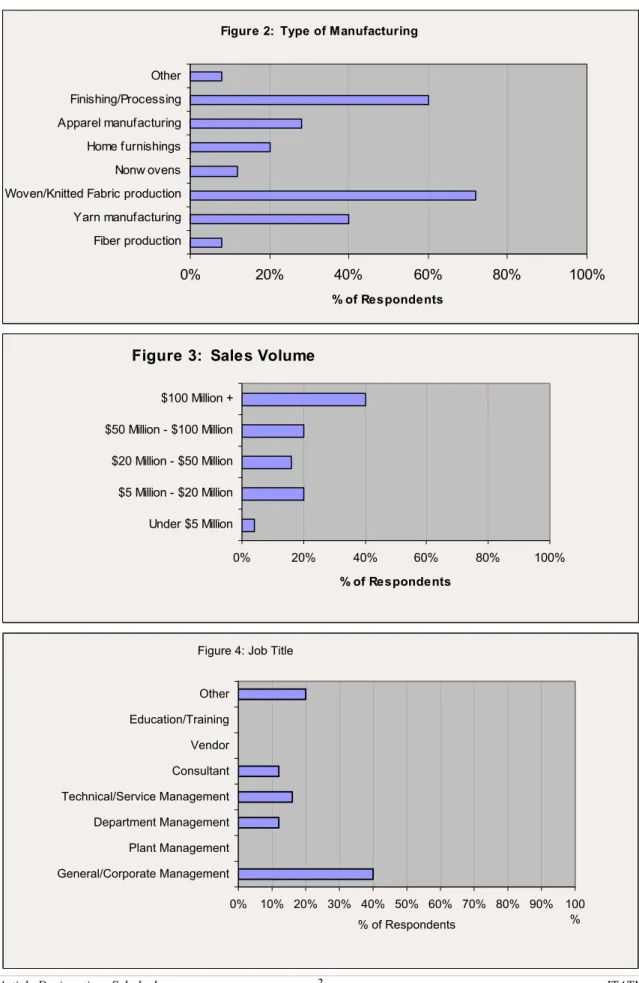
An Internet based survey instrument was developed and an invitation to participate was sent to the members of the electronic discussion list of APICS Textile and Apparel Specific Interest Group. This list mainly includes people interested in planning and logistics in the textile and allied industries. Twenty-five usable responses were received. Profiles of the
respondents are shown in figures 2, 3, and 4 summarizing the types of manufacturing, sales volume, job title, respectively. Because many respondents listed several types of manufacturing operations the percentages do not total to 100%. The respondents represented the many segments of the textile industry from fibers to end products.
Figure 1: Taxonomy of Textile Information Systems
M
anuf
act
uring
E
xecution
S
yst
em
s
Suppl
y Cha
in
Management
S
ystems
Advanced
Planning &
Scheduling
Product Data
Management
Customer
Relationship
Management
Human
Resource
Logistics
Business
Intelligence
Manufacturin
Purchasing
Engineering
Finance
Distribution
Marketing
Enterprise Resource
Planning Systems
EDI/Internet
Article Designation: Scholarly JTATM Volume 2, Issue 3, Summer 2002
3
Figure 2: Type of Manufacturing
0% 20% 40% 60% 80% 100%
Fiber production Yarn manufacturing Woven/Knitted Fabric production Nonw ovens Home furnishings Apparel manufacturing Finishing/Processing Other % of Respondents
Figure 3: Sales Volume
0% 20% 40% 60% 80% 100% Under $5 Million $5 Million - $20 Million $20 Million - $50 Million $50 Million - $100 Million $100 Million + % of Respondents
Figure 4: Job Title
0% 10% 20% 30% 40% 50% 60% 70% 80% 90% 100 % General/Corporate Management Plant Management Department Management Technical/Service Management Consultant Vendor Education/Training Other % of Respondents
Article Designation: Scholarly JTATM Volume 2, Issue 3, Summer 2002
4 ERP Systems
Figure 5 shows the functions that the respondents indicated were included in their ERP system. Three to fifteen different modules were reported as being included in each implementation. The most common functions are materials management, production control and sales. There was not sufficient data to conduct a statistical cluster analysis of functions by vendor, industry
segment, or company; however, the number of modules reported varied even among companies with the same software. This could be due to the perception of the respondent and differences in implementations. Also, there is no standard description for naming each function. None of the respondents identified themselves as vendors so these numbers more likely represent an user’s perspective.
Figure 5: ERP Functions
0% 10% 20% 30% 40% 50% 60% 70% 80% 90% 100% Materials Management Production Control Sales Financial Controlling Quality Management System Administration Product Engineering Executive Information Systems Project Management Plant Maintenance Human Resources Warehousing Purchasing Scheduling % of respondents
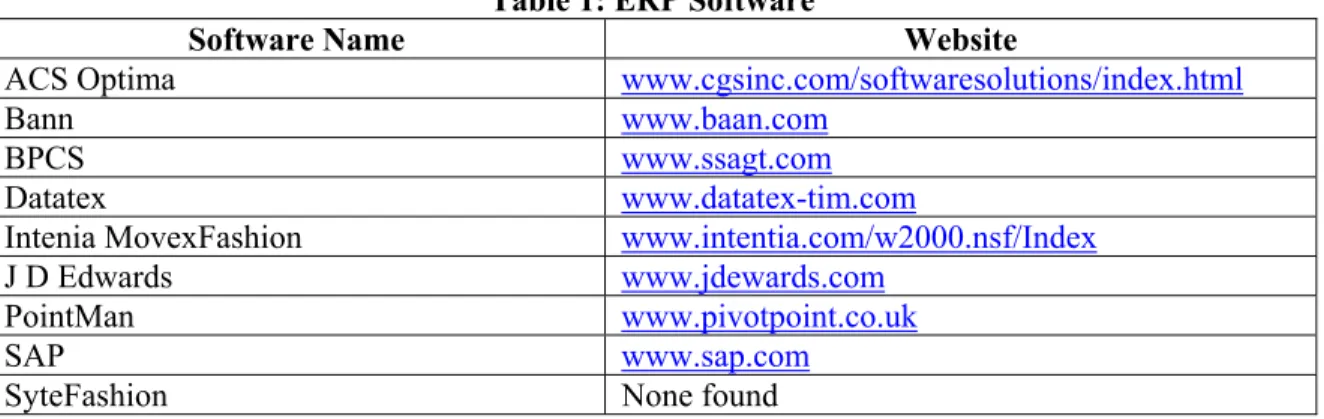
Table 1 lists the ERP software packages used by the respondents and provides links to company’s website. Datatex was the most frequently listed package. It is a software program designed for the textile industry
while many of the other packages serve multiple industry segments. Three of the respondents had systems developed in house or used a best-of-breed approach combining modules of several vendors. A
Article Designation: Scholarly JTATM Volume 2, Issue 3, Summer 2002
5
comprehensive listing of ERP systems for many industries is found in [3] and a
directory of ERP systems specific to textiles is available from APICS [4].
Table 1: ERP Software
Software Name Website
ACS Optima www.cgsinc.com/softwaresolutions/index.html
Bann www.baan.com
BPCS www.ssagt.com
Datatex www.datatex-tim.com
Intenia MovexFashion www.intentia.com/w2000.nsf/Index
J D Edwards www.jdewards.com
PointMan www.pivotpoint.co.uk
SAP www.sap.com
SyteFashion None found
Each respondent was able to list up to five factors they considered important in software selection. The most frequent responses could be summarized as: fit of the software to the textile and apparel industry, cost, support and maintenance, flexibility and functionality. Also, users want the software to integrate to specific systems, such as data collection, financials, and forecasting. Users also consider factor such as vendor stability, number of customers, and a proven record in textiles.
System Implementation
Respondents were asked what they thought were the main barriers to implementing an ERP system. The most frequently cite barriers were:
1. Resistance to change
2. Lack of top management support 3. User training & education
Some of the other issues that were mentioned included cost, having the right project team, lack of a clear view of the function of ERP, and that textiles does not follow and ERP business flow. Umble and Umble [5] describe 10 categories of ERP implementation failures which area as follows:
4. Poor leadership from top
management
5. Automating existing redundant or non-value-added processes
6. Unrealistic expectations, 7. Poor project management
8. In adequate education and training 9. Trying to maintain the status quo 10. Mismatch between the system
capabilities and the organizations processes and procedures
11. Inaccurate data
12. Implementation viewed as an IT project
13. Significant technical difficulties. Textile ERP projects appear to have the same difficulties as all other ERP implementations. As stated in Bobbin magazine [6] both Pillowtex and Crown Crafts inc. had problems implementing their ERP systems.
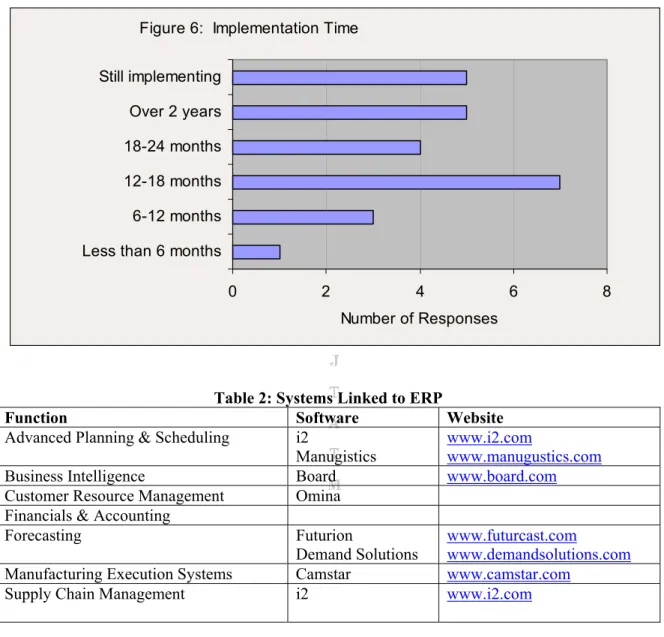
As summarized in Figure 6 the median time to implement an ERP system was 12-18 months. Several of the respondents were still implementing their ERP system. Fifty-six percent of the systems were identified as being fully integrated and another thirty-two percent were labeled as being integrated within a business unit.
Article Designation: Scholarly JTATM Volume 2, Issue 3, Summer 2002
6 Figure 6: Implementation Time
0 2 4 6 8
Less than 6 months 6-12 months 12-18 months 18-24 months Over 2 years Still implementing Number of Responses
Table 2: Systems Linked to ERP
Function Software Website
Advanced Planning & Scheduling i2
Manugistics
www.i2.com
www.manugustics.com
Business Intelligence Board www.board.com
Customer Resource Management Omina Financials & Accounting
Forecasting Futurion Demand Solutions
www.futurcast.com
www.demandsolutions.com Manufacturing Execution Systems Camstar www.camstar.com
Supply Chain Management i2 www.i2.com
Linkages
As shown in Table 2 companies are linking their ERP systems functions beyond ERP. Vendors and websites are also listed in Table 2 where the respondents identified a specific software package.
Electronic Commerce
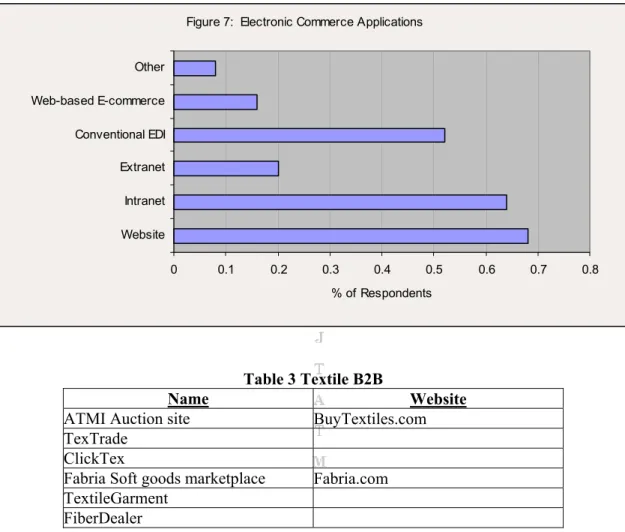
Companies were also asked about their use of electronic commerce applications. As
shown in figure 7 companies are using conventional EDI, have websites, and have an intranet. They do not have an extranet or web based e-commerce. Table 3 lists some of the business-to-business textile exchanges. Less than 20% of the respondents traded in any of these exchanges. Also, since this survey was conducted many of these exchanges no longer exist.
Article Designation: Scholarly JTATM Volume 2, Issue 3, Summer 2002
7
Figure 7: Electronic Commerce Applications
0 0.1 0.2 0.3 0.4 0.5 0.6 0.7 0.8 Website Intranet Extranet Conventional EDI Web-based E-commerce Other % of Respondents Table 3 Textile B2B Name Website
ATMI Auction site BuyTextiles.com
TexTrade ClickTex
Fabria Soft goods marketplace Fabria.com TextileGarment
FiberDealer
Conclusions
Textile companies are looking for ERP solutions to fit their specific needs. Both generic and textile specific packages have been utilized in the industry. The barriers to implementation in textiles seem similar to those in other industries. Electronic commerce in the form of traditional EDI, but not electronic marketplaces which have see lots of changes in the last year, is used by the textile industry.
Textile companies are looking to integrate their ERP systems with supply chain management and business intelligence systems. The Gartner group has now coined the phrase ERP II [7]. ERP II systems address the issues of sharing information across the supply chain with trading partners. It is expected that these systems
will not be deployed till 2005; however, companies will move towards this new model. Software vendors will provide solutions for specific industries. What will be the textile specific requirements for these new ERP II systems?
Acknowledgement
The author would like to thank Sanjana Vijayakumat who completed the Master of Textiles degree from North Carolina State University in December 2001 and collected the data for this paper.
References
[1] APICS Dictionary Ninth Edition (1998). APICS. Falls Church, VA, USA.
[2] Hodge, George (2000). "Taxonomy Of Information Systems For
Article Designation: Scholarly JTATM Volume 2, Issue 3, Summer 2002
8
Textiles". 80th World Conference of Textile Institute, Manchester, England, April 16-19, 2000.
[3] APICS (2002) “ERP Scorecard”
APICS Performance Advantage
June pp.59-65.
[4] Hodge, George (2000). Directory of Manufacturing Planning and Control Software for the Textile and Apparel Industry, Falls Church VA: APICS 2000, stock number 01176 [5] Umble, E.J. and M. M. Umble
(2002). “Avoiding ERP Implementation Failure”. Industrial Management. January/February pp.25-33.
[6] “Home Fashions leaders hone internal investment and global options” Bobbin June 2000 pp. 62-63
[7] “Taking the pulse of ERP” Modern Material Handling February 2001 pp. 44-51
AUTHOR’S INFORMATION:
George L. Hodge Associate Professor
Department of Textile and Apparel, Technology and Management
College of Textiles, North Carolina State University
Raleigh, NC 27609 [email protected]