REPORT ON BEST
PRACTICE MEETING IN
BRUSSELS
Using Energy Performance Certificate databases –
turning data into action
Deliverable D2.2: Report on key issues and recommendation resulting from the European Best Practice Meeting
Authors Austrian Energy Agency - Naghmeh Altmann-Mavaddat - Oskar Mair am Tinkhof - Günter Simader
2
This is a public report.
Disclaimers
The sole responsibility for the content of this publication lies with the authors. It does not necessarily reflect the opinion of the European Union. Neither the EASME nor the European Commission are responsible for any use that may be made of the information contained therein.
3
Content
Content... 3
CHAPTER I Introduction ... 4
CHAPTER II Stakeholder/Best Practice Meeting ... 5
CHAPTER III Best practice examples ... 6
1. Energy Performance Certificates across the EU ... 6
2. Status of EPC Databases in Partner Countries ... 7
3. Best practice example: Italy ... 8
4. Best practice example: Portugal ... 9
5. Best practice example: Scotland, UK ... 10
6. Best practice example: Ireland ... 11
7. Best practice example: The Netherlands ... 12
ANNEX I. Best practice meeting agenda, presentations, list of participants ... 14
ANNEX II. Overview Lists ... 15
4
CHAPTER I
Introduction
Request2Action is a programme across nine European countries, co-funded by the European Commission. Its focus is on how data from Energy Performance Certificates (EPCs), alongside other data, can be used to promote home energy efficiency.
The current state of the building stock is being monitored in many European countries and energy related information is collected more and more in regional or national EPC databases. In order to get insight into the development of the energy efficiency in buildings and the acceptance of the recommendations of EPCs, the analysis of the recorded data is necessary.
Investigations in the use of EPCs in refurbishment market show that in many countries there is little experience in monitoring the implementation of EPC recommendations. One of the tasks in work package two was to organise a best practice meeting and to invite representatives of the countries with EPC databases to share their experiences on monitoring activities with different stakeholders from the governmental, educational and private organisations.
The more comprehensive elaboration on the EPC databases is integrated in the deliverable 2.1 – Report on existing monitoring initiatives and databases.
5
CHAPTER II
Stakeholder/Best Practice Meeting
Since the certificates were first introduced in 2007, a number of European countries have stored data from EPCs in monitoring databases. Other countries are just starting to introduce such databases. Less attention has been paid to the potential of mass data gathered together from millions of EPCs.
The EPC data could be used for many purposes. In order to show how the information is being used in different countries, an expert workshop was organized in Belgium on November 4th 2014 (14:00-17:00) in the Auditorium of Vleva (Liaison Agency Flanders-Europe), Kortenberglaan 71 in Brussels.
Experts from the following sectors were invited to this Best Practice event:
EPC database administrators
Companies – particularly energy suppliers – who have the potential to use EPC data at scale
Academics working on energy policy and looking into big data use approaches.
Policy makers at national and European level.
48 participants from 11 countries, 14 energy agencies, 8 universities, 5 private enterprises and 3 governmental organizations including CA EPBD attended the Best Practice Meeting. The Meeting was organised by the Request2Action project team, to:
Discuss the first results of the internal survey on EPC database systems in the partner countries;
Give an overview about the features of existing EPC database systems across Europe and discuss the outcomes of the BPIE study (Title: “Energy Performance Certificates (EPC) across the EU: a mapping of national approaches”);
Show best practice examples from Italy, Portugal, UK, Ireland and the Netherlands.
This meeting offered the opportunity to validate existing information validated and to obtain new information (for example: information about the EPC database systems in Scotland and Ireland).
Looking at examples from across Europe presented at this meeting, the participants could see how EPC monitoring databases can be used to:
Track the progress of energy improvements – key data for governments in complying with the Energy Efficiency Directive;
Identify the buildings that most need energy upgrades – data that can be used not just by governments but also by legitimate other stakeholders;
Enable building owners and occupiers themselves and housing market actors to see the energy performance of entire communities;
6
CHAPTER III
Best practice examples
The participants were welcomed by Rui Fragoso from the Portuguese Energy Agency, ADENE. After a short introductory, explaining the context and aims of the meeting, energy experts presented the outcomes of surveys and how the EPC data is being used in exemplary countries.
The main points of the presentations are described in the following section. The presentations themselves are provided in the appendix.
1.
Energy Performance Certificates across the EU
A Mapping of National Approaches: a survey by BPIE By Aleksandra Arcipowska (BPIE)
Based on the latest BPIE study, Aleksandra Arcipowska (BPIE) gave an overview of the state of EPC activity and EPC databases across Europe. The BPIE study provides at evaluation of the EPC schemes’ implementation in Europe by focusing on the quality, availability and usability of EPC data. It builds on BPIE’s survey from 2014 on EPCs conducted in cooperation with national experts from 23 Member States and Norway. The study indicates how many EPC databases – central or regional – exist or are planned across Europe. It also shows the format of the collected data in different countries, how the information is uploaded into the database, and who has access to the data. Some examples (Denmark, the Netherlands, Hungary and Ireland) were shortly introduced to give a better picture of the databases.
The presentation concluded that a well-functioning EPC system accompanied by an EPC database can provide a ready-to-use source of information on the building stock. This makes the quality of EPC information crucial. The increasing number of best practices across Europe demonstrates the added value of EPC data for policy making and monitoring as well as for research and analysing. The further support of the Member States in developing and strengthening the central EPC registers, especially in relation to the privacy issues, is needed. The standardised methodologies and formats of data collecting and sharing should be promoted. The EPC schemes as a tool could be used for mapping and monitoring the national and European building stock and, if properly implemented, it could allow for the assessment of real market needs and the potential for energy efficiency improvements in the building sector.
7
2.
Status of EPC Databases in Partner Countries
A Survey of EPC Databases in the Partner Countries By Naghmeh Altmann-Mavaddat, AEA
In this workshop the early findings of the survey which is done in the work package 2 on the EPC databases in the 8 partner countries was presented by the work package leader.
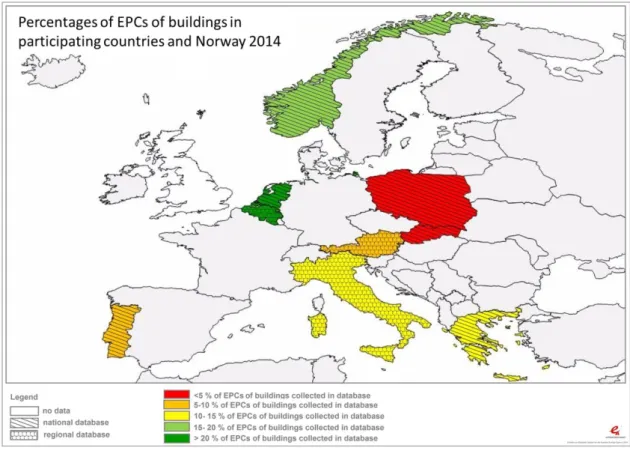
There are 7 existing EPC databases and one newly established among the Request2Action partner countries (see Figure 1).
Figure 1: The scope of EPC collection in the partner countries
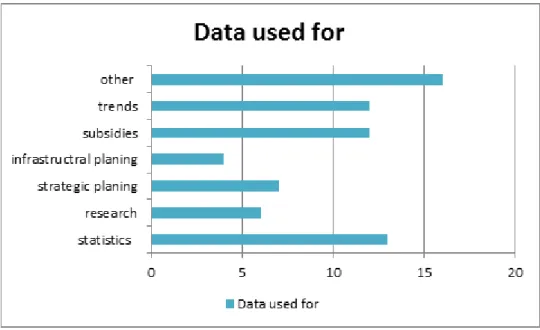
The data is mainly being used for statistics, research, strategies and infrastructural planning, subsidies and trend identifications in the building and real estate sector (see Figure 2).
8
Figure 2: The use of EPC data in the partner countries
In particular, the information was used to verify the effectiveness of some NEEAP (national energy efficiency action plans) measures and to evaluate the impact of energy saving measures. In some countries like Portugal the data was used in redesigning the building codes and defining the baseline of buildings’ energy performance.
The EPC databases have supported the designing and redesigning of funding schemes in many countries.
3.
Best practice example: Italy
Using Energy Performance Certificate databases: experience of Lombardy By Mauro Alberti – FINLOMBARDA
Lombardy is one of the first regions which established an EPC database after introducing EPC in Italy. The EPC database in Lombardy was established in 2007. Almost all the residential buildings in this region have an EPC all of which are collected in the EPC database.The EPC register is accessible from regional and municipal authorities and is rarely used for statistics and research. This region has its EPC database open to agencies for studies, to notary officials or on demand (also for trades).
The CENED register (the EPC register in Lombardy) is referred to building cadastre and is integrated, together with the regional Cadastre of Building Heating/Cooling systems (CURIT) and the Ground Source Heat Pumps cadastre, into a wider Information System for Energy and Environment (SIRENA20). This system feeds and updates the regional energy balance and the regional emission monitoring system. Thousands of building operators, experts, installers and maintainers, managers and authorities use and provide input data into this system, which facilitates dematerialisation and simplification of bureaucracy beyond time and cost savings.
Moreover, as a result, the statistical evaluation of these data helps the region in updating its climate goals. The elaboration of scenarios in new Regional Energy and Environmental Plan (PEAR) including the evaluation of the potential energy saving in the residential sector in Lombardy also builds on the inputs of the EPC database, crossed with other information within this regional system intelligence.
9
Many municipalities in Lombardy have been able to estimate potential impact of actions on buildings stock in their territories by relying also on EPC data, including public buildings. Access to CENED and use of SIRENA also helped them in drafting the sustainable energy action plans required from signatories of the Covenant of Mayors. Figure 3 shows a typical result based on this data
Figure 3: EPCs Open Data: a tool for informing property market in Lombardy
4.
Best practice example: Portugal
Using Energy Performance Certificate databases: experience of Portugal By Nuno Clímaco – ADENE
Since 2007 there is a national EPC database system in Portugal. The central EPC database is managed by ADENE. The EPC of almost 10% of the buildings in Portugal are collected in the database. There are monthly or annual targets of EPCs’ quality assessment numbers to reach, based on: typology (residential/non-residential), type of certificate (new, existing), energy experts covering and other criteria. The EPC is being used to verify the effectiveness of some of the national energy efficiency action plan (NEEAP) measures such as energy efficiency fund. EPC information was used to assist the redesign of the building codes, particularly the new energy performance of the buildings in the building regulations by providing real values of the building elements, technical systems or even adjustments of the scope. Based on about 1.2 million recommendations made by energy experts and stated in EPCs, costs and potential savings on energy efficiency measures could be identified and analysed (see Figure 4).
10
Figure 4: Evaluation of impact of energy saving measures
Credible information for the real estate market is one of the services made available through the EPC database. Thus the EPC database has become a powerful tool to evaluate buildings’ performance and to provide information for decision makers but its potential has not yet been depleted.
5.
Best practice example: Scotland, UK
Targeting domestic energy efficiency, renewable energy and fuel poverty with EPC data By Will Rivers (EST)
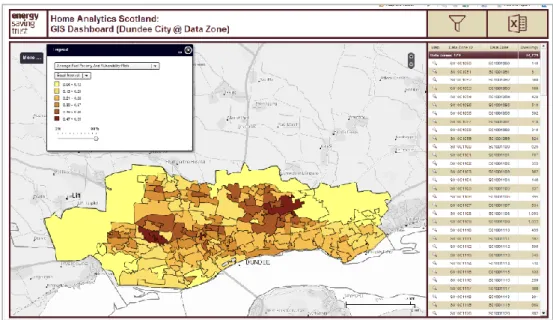
Using housing data is necessary in Scotland to reach the climate goals and abolish fuel poverty. The old housing stock is inefficient but with easy measures like loft and cavity wall insulation, the efficiency could be raised. The local authorities could benefit from data to plan deliverable area based schemes targeted effectively and develop effective plans and strategies. Approximately 28% of Scottish households have an EPC. EST and the Scottish government have started an EPC modelling project to provide either a real or a modelled EPC for every address in Scotland or make this data easily available for local authorities through an interactive mapping portal. Figure 5 shows a screenshot from this portal.
11
The British approach to the use of data in the EPC database is that the raw datasets by themselves are of limited value to deliver programmes and the data is needed on 100% of homes to be valuable. By combining datasets and using statistical modelling a powerful dataset can be created. The continual programme of updates and improvement keeps the data real to life and enables strategies and action plans to be based on accurate information. The statistical models can predict characteristics more accurately than homeowners and the data presentation is the key. The GIS portal engages more decision makers: currently it is used by 28 of 32 Scottish Local Authorities
.
6.
Best practice example: Ireland
Using Energy Performance Certificate databases: experience of Ireland By Chris Hughes (SEAI)
Extracts from the BER (Building Energy Rating = EPC) register, comprising BER (EPC) Certificates, provisional BER (EPC) Certificates and accompanying advisory reports of the Irish database are open to public inspection on a restricted basis. The BER (EPC) Certificate, Advisory Report and Xml data file are normally made available to:
The BER (EPC) assessor who carried out the relevant BER assessment
A BER (EPC) assessor undertaking subsequent BER assessment of the relevant building
The building owner or an agent acting on behalf of the owner, via a BER (EPC) assessor
The BER (EPC) database has supported the “Better Energy Homes” scheme which provides grants to homeowners for roof and wall insulation, boiler and heating control upgrades and solar panels. The “Better Energy Warmer Homes Scheme” aims at improvement of the energy efficiency and comfort conditions of homes occupied by vulnerable households in receipt of the “National Fuel Allowance Scheme” through the installation of draught proofing, attic insulation, lagging jackets, low energy light bulbs and cavity wall insulation.
According to the evaluation and research done (EPC database in combination with other databases) energy efficiency has a significant, positive relationship with list price of the buildings. A 50-point improvement (decline) in the Energy Performance Indicator is associated with a 1.5% higher list price.
12
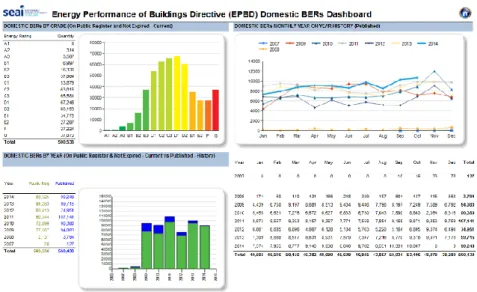
Figure 6: The daily Evaluation Energy Performance of the Buildings of Irish EPC database
7.
Best practice example: The Netherlands
The learning of the Dutch Database experience of the Netherlands By Kees Jan Hoogelander (RVO)
The Dutch EPC database is owned and operated by the government. It is mandatory to register the EPC. The information about the availability of an EPC is public and free. The data is used to verify if the goals are reached, does the policy needs adjusting and if a subsidy should be granted.
The database is being used for the programme “Energy Agreement for Sustainable Growth”, which includes forty organisations, central, regional and local governments and environmental organisations. The purpose of this programme was to achieve a sustainable energy supply system by 2020.
The database has been used for “National Revolving Fund for Energy Efficiency”, which provides loans to landlords and housing associations. This programme is based on the improvement of the energy label to A or A+.
Another programmes “EIA: Energy Investment Allowance”, which is also a funding programme (tax deduction), is also related to the information and improvement of the energy label of the EPCs.
There are also scientific research projects on labels and house-pricing. The information comes from database of transactions of the Dutch Association of Real Estate Brokers and National Energy Label Database. Figure 7 shows the effect of green energy label on the price of the Dutch buildings.
13
14
ANNEX I.
Best practice meeting agenda,
15
ANNEX II.
Overview Lists
List of figures
Figure 1: The scope of EPC collection in the partner countries ... 7
Figure 2: The use of EPC data in the partner countries ... 8
Figure 3: EPCs Open Data: a tool for informing property market in Lombardy ... 9
Figure 4: Evaluation of impact of energy saving measures ... 10
Figure 5: Example of elaboration of data: The average fuel poverty and vulnerability risk of Dandee city ... 10
Figure 6: The daily Evaluation Energy Performance of the Buildings of Irish EPC database ... 12
This is a public report.
Project Details
Duration
: April 2014 – April 2017
Coordinator
: Energy Saving Trust
Partners
Austrian Energy Agency, AEA, Austria Centre for Renewable Energy Sources and Saving, CRES, Greece
Energy Saving Trust, EST, UK
Flemish Institute of Technological Research, VITO, Belgium
Italian National Agency for New Technologies, Energy and Sustainable Economic Development ENEA, Italy
Netherlands Enterprise Agency, RVO.nl, Netherlands
Polish National Energy Conservation Agency, KAPE, Poland
Portuguese Energy Agency, ADENE, Portugal Slovak Innovation and Energy Agency, SIEA, Slovakia
AUDITORIUM OF VLEVA (LIAISON AGENCY FLANDERS-EUROPE), KORTENBERGLAAN 71, BRUSSELS.
4TH OF NOVEMBER 2014
Session 2 -
Using Energy Performance Certificate databases
– turning data into action
Europe has impressive ambitions for a nearly zero energy transformation of its housing stock. EPCs are key to realising those ambitions.
EPC databases/registers are now in place across most EU countries. These databases, coupled with advancements in ‘big data’ technology, statistical analysis and GIS mapping, have the power to transform our delivery of energy saving programmes. However, too often theses databases are left to gather dust and are not routinely used by policy makers and delivery bodies. A valuable opportunity is being missed.
At this workshop, you will hear about the organisations who are maximising the value of the EPC databases, by placing them at the heart of energy efficiency delivery and policy. Speakers will include:
- Ireland Sustainable Energy Authority – who have pioneered live, easy access to data
from EPCs for a wide range of stakeholders
- Energy Saving Trust Scotland – presenting their GIS software for the Scottish Government which turns EPC data targeting tools for use by local authorities
- ADENE – Portugal’s EPC administrator – who have one of Europe’s most powerful EPC registers and who are piloting a programme to use it to monitor on-the-ground retrofit activity
- RVO, Netherlands – A new project to use data from EPCs with financiers to make
the case for large scale investment in energy efficiency programmes We are inviting experts from the following sectors to this event:
- EPC database administrators: looking to understand new developments in the use of EPC data
- Companies – particularly energy suppliers – who have the potential to use EPC data at scale
- Academics working on energy policy and looking to use big data approaches to understand policy progress and challenges
- Policy makers at national and European level – who want to understand how they
can maximise investment in EPC registers to understand policy impact and progress towards EED targets
Please confirm your attendance by emailing Oskar Mair <[email protected]>
14:15 Introductory session on EPC databases: Rui Fragoso, ADENE 14:25 Best practice demonstration of using EPC databases across Europe 15:25 Austrian Energy Agency findings of survey on EPC monitoring 15:35 Break
15:50 Group session: How could EPC databases be used more effectively in your country?
16:50 Closing comments: Rui Fragoso, ADENE 17.00 END
Session 2 - Using Energy Performance Certificate
databases – turning data into action
Introductory session
AUDITORIUM OF VLEVA
KORTENBERGLAAN 71, BRUSSELS
4
thNovember 2014
Rui Fragoso
ADENE
1
Session 2 - Using Energy Performance Certificate (EPC) database
Session agenda
14:15
Introductory session on EPC databases:
Rui Fragoso
, ADENE
14:25
The picture of EPC monitoring activity
‐
BPIE research into overall EPC action across Europe
,
Aleksandra
Arcipowska
, BPIE
‐
Interim findings from R2A research specifically into monitoring
recommendations and giving market actors use of the data
,
Naghmeh
Altman, AEA
14:55
Best practice demonstrations
‐
Italy
,
Mauro Alberti
,
FinLombarda Italy
‐
Portugal
,
Nuno Clímaco, ADENE
‐
UK
,
Will Rivers, EST UK
‐
Discussion and questions
2
Session 2 - Using Energy Performance Certificate (EPC) database
Session agenda
16:15
Best practice demonstrations (continuation)
‐
Ireland,
Chris Hughes, Sustainable Energy Agency Ireland
‐
Netherlands
,
Kees-Jan Hoogelander, RVO
‐
Discussion and Questions
16:50
Closing comments:
Rui Fragoso
, ADENE
3
Session 2 - Using Energy Performance Certificate (EPC) database
Why a session on
“Using EPC databases”?
Directive 2002/91/EC and 2010/31/EU led to an
implementation of Energy
Performance Schemes all over EU member states
;
The EPC has a key role in achieving the goal of the EPBD, which is
to
support the transition of the real estate sector towards energy
efficiency;
In addition the EPC
includes recommendations for the cost-optimal or
cost-effective improvement
of the energy performance of a building;
Useful, detailed and high amount of data is now stored in central
registries
preparing the ground to unleash action;
Homeowners, real state market, policy makers, investors, etc…can now
benefit from that information… The secret now is
How to do it and Learn
from best practices.
4
Session 2 - Using Energy Performance Certificate (EPC) database
What to expect from this session?
Possible answers to:
How are
EPC databases currently being used
?
What is the
potential for using EPC data
?
Who
(companies, local government, policy makers etc)
have access to
databases?
Is the data accessible and useable
– what is
best practice in making
information practically useful
for policy makers and different market
actors?
How is the data linked to other sources of information
(eg data
collected from subsidy schemes)
and used by government
for market
monitoring and track retrofit activity?
What are
the issues around giving different actors
access to the data
(especially privacy concerns)?
5
Session 2 - Using Energy Performance Certificate (EPC) database
Relevant facts known about EPC
(based on Concerted Action EPBD book
“Implementing the EPBD - Featuring Country Reports 2012”
EPC are issued by
Qualified Experts
who undergoes specific
Training.
In
almost Member States
training is mandatory plus exams
;
In most cases
EPC are issued after a site visit
allowing to collect real data
and confirming implemented solutions;
EPC are the source for
cost-optimal or cost-effective improvements;
Nowadays technology allows to
easily store large amount of data in EPC
Central Databases
and
share it widely
;
The effective use of an
EPC in advertising and as a supporting tool for
financing
is very important to
increase the demand for energy efficiency
6
Session 2 - Using Energy Performance Certificate (EPC) database
But some challenges still exist..
(based on Concerted Action EPBD book
“Implementing the EPBD - Featuring Country Reports 2012”
Confidentiality issues/access to information
still prevent to take full
advantage of databases;
Monitoring of the implementation of recommendations
is crucial to
keep track of the actual improvements in building performance;
Some countries already experienced the
EPC as a supporting tool for
financing,
but its still not a common procedure;
EPC in advertising
: Consumers reaction and market uptake is still
unknown, but member states are making some market researches.
There is a need to promote the effective use of the EPC data.
Hopefully
Energy Performance
Certificates Databases
Current status of implementation
across Europe
Brussels, 4th November 2014
The Buildings Performance Institute Europe (BPIE)
Knowledge
Implementation
Policy
www.bpie.eu
www.buildingsdata.eu
@BPIE_eu
Report 2014: Energy Performance Certificates across the EU
Making EPCs an effective instrument for market transformation
and data mapping
Goal
: evaluate the implementation status of the EPC schemes in Europe by focusing
on the quality, availability and usability of EPC data.
Quality assurance schemes for EPCs
Centralised EPC databases
The results of this study are based on BPIE’s survey on EPCs conducted in
cooperation with national experts from 23 Member States and Norway.
Existence of EPC registers
Type of data collected - Format of EPC register
Examples
Database includes registration number of the EPC, the building type, the
calculation method, region where the building is located, certifier data.
Folder structure of the register; electronic copy of EPC (pdf, jpg).
Advance SQL database with 250 input parameters in the EPC database;
Data variables required in the calculation.
In 2005-2010: xls format.
Since 2010: MSQL database, all information from EPC.
Advanced system based on Excel with a user interface.
Upload of EPC in the register
Access to EPC registers
•
Public database of individual properties
providing the EPC and other public
information such as property and land value;
•
Limited (paid) access to a more extensive
database
and Property Data Report with
additional information (i.e. water supply and
soil contamination) is available;
•
For the recognized property owner:
sensitive information is available
(e.g.
overdue debt to the municipality);
•
Public access to aggregated statistics on
energy performance of Danish building
stock
.
Examples of EPC databases
Denmark
Access database at:
http://boligejer.dk/ejendomsdata/0/51
EPC Database is linked to other public databases
e.g. cadastral register, etc.
•
Possible to access information for individual
EPCs
searchable by number, postcode,
address;
•
Public access to aggregated statistics
(number of EPC per class, age band, building
type);
•
Possible to download aggregated statistics
;
•
Cooperation
with the
commercial sector
, i.e.
Meer Met Minder Energie.
Examples of EPC databases
The Netherlands
Examples of EPC databases
Hungary
•
Open access to EPC database
;
•
Statistics automatically generated
on
request and displayed online;
•
Not possible to download aggregated
data
in spreadsheet format.
Examples of EPC databases
Ireland
•
Dedicated open data portal
to access EPC data
: National BER Research
Tool;
•
Customised search and possible
download
of the aggregated statistics (raw
data format, not visual representation);
•
Access to individual EPCs only
via unique code of the building
.
•
A well-functioning EPC system accompanied by an EPC database provides a
ready-to-use source of information
on the building stock. The
quality
of EPC
information is crucial;
•
There is an
increasing number of best practices across Europe
that demonstrate
the added value of EPC data for policy making and monitoring, as well as market
and research analysis;
•
There is a
need to further support Member States in the development and
strengthening of central EPC registers
, especially in the context of private data,
and data analysis;
•
Standardised methodologies and formats of data gathering and sharing
(to
enable re-usability) should be
promoted
;
•
There is a need to
further promote the EPC schemes as a tool for mapping and
monitoring the national and European building stock
. Once properly
implemented, it will allow assessment of real market needs and the potential for
energy efficiency improvements in the building sector.
Thank you for your
attention!
Brussels, 4th November 2014
ENERGY PERFORMANCE CERTIFICATE DATABASES
FINDINGS OF SURVEY ON EPC MONITORING
Brussels, Belgium
04. November 2014
2
•
Article 11
–
Mandatory certification of new and existing buildings,
along with periodic certification of public buildings …
•
Article 18
–
Indepentent control system
•
Member States shall ensure that independent
control systems for energy performance
certificates and reports on the inspection of
heating and air-conditioning systems are
established …
3
•
24 Member States have central
EPC- database
•
The majority of countries
undertake statistical analysis
EU AND EPC-DATABASES
Including Norway!
4
MONITORING SYSTEMS AND EVALUATING DATA
Average U-value
Average space heating demand
Examples
5
MONITORING SYSTEMS AND EVALUATING DATA
Development of the energy ratings
Monthly development of EPCs
Examples
6
7
One-Stop Shop for different stakeholders
Monitoring systems
Energy Performance Certificate
Home Energy check Tool
Home visits
8
•
General information about the host and
provider
•
Basic information about the monitoring base
•
Information on the usage of the database
9
DATABASES IN EUROPE
10
EPCS IN THE DATABASES OF THE COUNTRIES
•
Austria: 6%
•
Belgium: 23%
•
Greece: 14%
•
Italy: 11%
•
The Netherlands: 28%
•
Poland: <1%
•
Portugal: 10%
•
Slovakia: 0%
•
United Kingdom: n.a.
11
•
Statistics
•
Research
–
verify the effectiveness of some NEEAP measures
–
Evaluate the impact of energy saving measures
•
Assist the redesign of the building codes
•
Define the baseline of building performance
•
Provide help for designing funding schemes
•
Trends
•
Strategic planning
•
Infrastructure planning
12
•
The documentation of recommendations and
implementation
Identification of renovation rate
•
Verifying the effectiveness of monitoring for
NEEAP
Reaching the goals
•
User friendliness of EPC-database
Improvement possibilities for market actors
Connection to other data sources?
DI MSc Naghmeh Altmann-Mavaddat
AUSTRIAN ENERGY AGENCY
—
Mariahilfer Straße 136 | 1150 Vienna | Austria
T. +43-1-586 15 24-128 | Fax +43-1-586 15 24-340
[email protected]
|
www.energyagency.at
Using Energy Performance Certificate databases –
turning data into action. The experience of Lombardy
Expert workshop organised as part of the Request2Action Project
November 4
th
, 2014 – Brussels
Expert workshop - November 4
th, 2014
Summary
•
The Regional energy system
•
Energy policies and planning
•
Key figures
•
The Regional information and knowledge
systems
•
The EPC database
•
Data
•
Promoting knowledge-based action
Expert workshop - November 4
th, 2014
T
HE NEW
E
NERGY
& E
NVIRONMENTAL
R
EGIONAL
P
LAN
BURDEN-SHARING
Expert workshop - November 4
th, 2014
T
HE NEW
E
NERGY
& E
NVIRONMENTAL
R
EGIONAL
P
LAN
OBJECTIVES and SHARING of RESPONSIBILITIES by SECTORS
Expert workshop - November 4
th, 2014
T
HE NEW
E
NERGY
& E
NVIRONMENTAL
R
EGIONAL
P
LAN
Expert workshop - November 4
th, 2014
T
HE
R
EGIONAL
E
NERGY
S
YSTEM
Regional energy balance – key figures
Buildings (residential + commercial and services), with a demand of about 11 million
toes in 2012, represent the most energy-consuming sector in Lombardy, corresponding
to 43% of the total demand. In the period 2000 - 2012, the final energy consumption in
the residential sector has decreased by 4%; on the other hand in the service sector
there has been an increase of 41%.
Expert workshop - November 4
th, 2014
K
NOWLEDGE
-
BASED
R
EGIONAL ENERGY PLANNING
Energy-environmental monitoring system (SIRENA)
Expert workshop - November 4
th, 2014
K
NOWLEDGE
-
BASED
R
EGIONAL ENERGY PLANNING
Energy databases and observatories
8
1 464 678 on October 23
rd
, 2014
*
Expert workshop - November 4
th, 2014
K
NOWLEDGE
-
BASED
R
EGIONAL ENERGY PLANNING
OPEN DATA
Expert workshop - November 4
th, 2014
EPC
REGULATION AND SYSTEMS IN ITALY
10
EPBD adopted by Regional Law
Regional regulation implementing National guide-lines
No EPBD adoption / no regional or provincial regulation
Adoption of a environmental-energy sustainability protocol
Expert workshop - November 4
th, 2014
EPC
REGULATION AND SYSTEMS IN ITALY
11
REGIONAL EPB CERTIFICATES
DATABASES
REGIONAL Heating systems
registries
Existing Not existing Under way Existing To be implementedExpert workshop - November 4
th, 2014
Summary
•
The Regional energy system
•
The new Energy & Environmental Regional
Plan (PEAR) and the initiatives for financing
energy sustainability at local level
•
Key figures
•
The EPC database
•
Data
•
Promoting knowledge-based action
Expert workshop - November 4
th, 2014
13
0 5000 10000 15000 20000 25000 30000 35000 40000 45000 09 -2 00 7 12 -2 00 7 03 -2 00 8 06 -2 00 8 09 -2 00 8 12 -2 00 8 03 -2 00 9 06 -2 00 9 09 -2 00 9 12 -2 00 9 03 -2 01 0 06 -2 01 0 09 -2 01 0 12 -2 01 0 03 -2 01 1 06 -2 01 1 09 -2 01 1 12 -2 01 1 03 -2 01 2 06 -2 01 2 09 -2 01 2 12 -2 01 2 03 -2 01 3 06 -2 01 3 09 -2 01 3 12 -2 01 3 03 -2 01 4 06 -2 01 4 Media annualeECs
2007
13.194
ECs
2008
60.949
ECs
2009
135.026
ECs
2010
214.811
ECs
2011
270.658
Total ECs
1 464 678 on October 23rd, 2014ECs
2012
325.171
ECs
2013
245.859
B
UILDING
E
NERGY
C
ERTIFICATES IN
L
OMBARDY
:
A CONSTANT GROWTH
Energy certification mandatory for buildings / apartments to be sold Energy certification mandatory for buildings / apartments to be rented Energy certification mandatory for property
advertisements
ECs
2014*
135.125
Expert workshop - November 4
th, 2014
14
B
UILDING
E
NERGY
C
ERTIFICATES IN
L
OMBARDY
:
DRIVERS
new constructionenergy service contract
replacement of heating generator > 100kW
voluntary certification
rental contract
other
demolition and reconstruction
volumetric expansion > 20%
building renovation> 25%
attic renovation
new installation heating system
restructuring heating system
retrofitting with tax incentives
sale
Expert workshop - November 4
th, 2014
15
0,1% 0,8% 5,6% 7,3% 9,6% 11,8% 13,2% 51,5% A+ A B C D E F G CLASS A+ A B C D E F G EPH 9,3 23,3 46,7 74,9 103,5 132,3 161,8 283,3 EPHin kWh/m2yC
ERTIFICATES PER ENERGY CLASS
–
RESIDENTIAL BUILDINGS
Expert workshop - November 4
th, 2014
16
EPHin kWh/m3y
C
ERTIFICATES PER ENERGY CLASS
–
NON
-
RESIDENTIAL BUILDINGS
0,1% 0,4% 1,8% 8,3% 14,5% 13,3% 14,3% 47,3% A+ A B C D E F G CLASS A+ A B C D E F G EPH 1,8 4,8 9,0 19,7 35,6 48,6 59,6 101,6
Expert workshop - November 4
th, 2014
17
P
RIMARY ENERGY DEMAND
(
CERTIFICATES
)
STATISTICS
–
RESIDENTIAL BUILDINGS
Expert workshop - November 4
th, 2014
18
P
RIMARY ENERGY DEMAND
(
CERTIFICATES
)
STATISTICS
–
NON-RESIDENTIAL BUILDINGS
Expert workshop - November 4
th, 2014
19
P
RIMARY ENERGY DEMAND
(
CERTIFICATES
)
STATISTICS
–
RESIDENTIAL BUILDINGS
Provinces’ data
Expert workshop - November 4
th, 2014
20
P
RIMARY ENERGY DEMAND
(
CERTIFICATES
)
STATISTICS
–
NON-RESIDENTIAL BUILDINGS
Provinces’ data
Expert workshop - November 4
th, 2014
21
C
ERTIFICATES PER USE DESTINATION
Expert workshop - November 4
th, 2014
22
A
VERAGE PRIMARY ENERGY
DEMAND
(EP
H
) –
RESIDENTIAL
BUILDINGS
M
UNICIPALITIES INL
OMBARDYA
VERAGEEP
H(
KW
H/
M2YEAR)
96 - 160
KW
H/
M2YEAR160 - 200
KW
H/
M2YEAR200 - 250
KW
H/
M2YEAR250 - 350
KW
H/
M2YEAR350 - 558
KW
H/
M2YEAR N.
A.
Expert workshop - November 4
th, 2014
23
C
OPERTURA
U
LIM
= 0,30 W/
M
2
K
U
AVG
= 0,96 W/
M
2
K
+ 220 %
F
ITTINGS
U
LIM
= 2,2 W/
M
2
K
U
AVG
= 3,19 W/
M
2
K
+ 45 %
W
ALLS
U
LIM
= 0,34 W/
M
2
K
U
AVG
= 1,04 W/
M
2
K
+ 206 %
F
LOOR
U
LIM
= 0.33 W/
M
2
K
U
AVG
= 1,03 W/
M
2
K
+ 213 %
R
OOF
E
NERGY
P
ERFORMANCE OF EXISTING BUILDING STOCK IN
L
OMBARDY
:
S
TATE OF THE ART
Expert workshop - November 4
th, 2014
* Threshold for a building with heating plant 15 kW or >84 kW powered
BUILDING
(ET
H)
138 [kWh/m
2
]
Building-Heating plants
System (EP
H)
182 [kWh/m
2
]*
THRESHOLD
64 [kWh/m
2]*
MEAN GLOBAL
SEASONAL EFFICIENCY
(h
G,YR)
78 [%]
threshold
78,5 [%]*- 84 [%]*
* Threshold for a building in Milan with surface/volume value equal to 0,5
+184%
E
NERGY
P
ERFORMANCE OF EXISTING BUILDING STOCK IN
L
OMBARDY
:
S
TATE OF THE ART
Expert workshop - November 4
th, 2014
0 50 100 150 200 250182
kWh/m
2/year
138
kWh/m
2/year
Energy demand for heating, E
PH
Thermal demand for heating, E
TH
E
PH
(mean)
64
kWh/m
2/year
PROVINCES