This PDF is a selection from an out-of-print volume from the National Bureau
of Economic Research
Volume Title: Mergers and Acquisitions
Volume Author/Editor: Alan J. Auerbach, ed.
Volume Publisher: University of Chicago Press
Volume ISBN: 0-226-03209-4
Volume URL: http://www.nber.org/books/auer87-1
Publication Date: 1987
Chapter Title: The Impact of Taxation on Mergers and Acquisitions
Chapter Author: Alan J. Auerbach, David Reishus
Chapter URL: http://www.nber.org/chapters/c5822
Chapter pages in book: (p. 69 - 86)
Mergers
and Acquisitions
Alan J. Auerbach and David Reishus4.1
IntroductionThroughout the recent wave of mergers, there has been no shortage of explanations for the increase in activity in the market for corporate control. Some explanations emphasize the positive role that mergers and takeovers play in the allo- cation of resources in society. For example, corporate acqui- sitions may lead to the replacement of a poor management team; they may facilitate the contraction of an industry in which no firm would voluntarily adopt a reduction in size; they may generate synergies through the combination of com- plementary resources.
Yet clearly there are also explanations that have negative implications for social welfare. The most obvious, of course, is a reduction in the level of competition in a market. The tax motive has also been mentioned frequently. To the extent that corporations and their shareholders reap windfall gains via tax reductions, the Treasury may be unintentionally subsidizing takeover activity that must be paid for by others in the fiscal system. It is noteworthy, however, that combining firms may also facilitate more efficient behavior on their own part by reducing their taxes. For example, wiping out tax losses may
Alan J . Auerbach is a professor of economics at the University of Pennsylvania
David Reishus is an economist with the U.S. Joint Committee o n Taxation. and a research associate of the National Bureau of Economic Research.
70 Alan J. AuerbacMDavid Reishus
increase the firm’s incentive to invest, particularly when new investment brings large, immediate depreciation deductions and investment tax credits that can only be used by the tax- paying firm.’ Moreover, the tax reductions that occur may not be appropriately described as windfalls. For example, if firms incurring tax losses are regularly targeted for takeovers, then many firms might be encouraged to take risks that result in such losses.
Whether tax incentives that encourage merger activity are desirable or not, it is important to know what their impact is. The U.S. income tax at the individual and corporate level imposes an extremely complicated set of provisions for merg- ers and acquisitions; the tax system is certainly not neutral in this area. But do taxes really play a significant role in the merger decision? Congress appears to have concluded that they do, having adopted provisions in the Tax Reform Act of 1986 that would limit the tax benefits from firm combinations. Yet there has been surprisingly little research on this question. This paper summarizes our own work to date on the topic. While we cannot offer definite conclusions, our preliminary results suggest that:
Many mergers and acquisitions provide an opportunity for corporations and their shareholders t o receive some tax benefits.
In a small minority of cases, these benefits are large in comparison to the value of the acquired company, suggesting that taxes provided motivation.
Even in cases where there are significant tax benefits, there is
no
strong evidence that they were the driving factors in the takeovers.Once again, we must stress the tentative nature of our con- clusions. We have not found that tax factors do not matter. But there is still a lack of convincing evidence that they are an important determinant of merger activity in the aggregate.
In the remainder of this paper, we will briefly discuss the potential tax benefits from mergers and acquisitions. Then we will describe our research on the importance of these tax benefits to U.S. mergers and acquisitions during the period from 1968 to 1983.
1.
2.
4.2 Taxes and Merger Activity
There are several different ways that companies may reduce taxes through a merger or acquisition, and tax benefits can accrue at both the corporate and the shareholder levels. How- ever, in some cases the tax benefits from a corporate combi- nation are also available by other means, and such benefits should not be attributed to the merger process alone.
4.2.1 Shareholder Taxation
Shareholders of an acquired corporation can receive many forms of payment when they sell their shares as part of a
merger or acquisition. Such receipts may be deemed taxable or nontaxable. If they are taxable, then the shareholders must pay capital gains taxes on their gain over basis. If they are not taxable, then shareholders need pay no taxes until they sell the shares in the acquiring company that they receive as payment. The latter treatment is clearly preferable to the for- mer from the perspective of the acquired firm’s shareholders. It may also represent a net gain to shareholders relative to the no-takeover situation; they may be less likely to sell their shares in the new company and incur capital gains taxes than they would have been had no acquisition occurred. For example, if a small company is bought out by a large, diversified one, ma- jor shareholders in the acquired firm would have less need to sell
some of their holdings to obtain portfolio diversification. In exchange for the benefits obtained through avoidance of capital gains taxes, there are costs. To avoid taxes at the in- dividual level, the corporate combination must qualify as a reorganization; that places certain restrictions on the trans- action. Among the most important are that the consideration paid to shareholders in the acquired company be voting stock, and that the acquired corporation’s tax attributes be taken over by the acquiring company. This severely restricts the ability of the acquiring company to use cash in the acquisition process, or to obtain the tax advantages associated with step- ping up asset bases of the acquired company’s assets. We discuss the latter problem further on.
Indeed, the use of cash might be attractive to the acquiring firm for several reasons. First, there is a nontax advantage to
72 Alan J. AuerbacWDavid Reishus
cash because it is relatively easy to use in a hostile tender offer. However, cash might also be attractive for tax purposes. An acquiring corporation with sufficient cash for a trans- action will have the funds available for distribution to its share- holders instead if it does not use the cash for the acquisition. These funds can be distributed in two ways: dividends and share repurchases. Dividends result in taxes which would be higher for shareholders of the parent firm than the capital gains taxes paid by the acquired firm’s shareholders in a taxable transaction. Thus, a taxable cash transaction would result in lower combined personal taxes on the two firms’ shareholders than a nontaxable stock transaction combined with an increase in dividends.
But firms can also repurchase their shares, and if they do
so, the tax advantage of using cash in the acquisition would disappear. For many years, economists have been puzzled by the unwillingness of most corporations to use the repurchase route to reduce the taxes paid by their shareholders. In recent years, repurchases have become quite substantial, but this was not true historically. Thus, the existence of a net shareholder tax advantage in a cash acquisition rests on the theory that corporations find it easier to purchase other firm’s shares for cash than their own.
In summary, nontaxable stock transactions may produce a tax benefit by allowing shareholders in the acquired company to attain a more diversified portfolio without realizing their shares and paying capital gains taxes. But such transactions may limit the size of corporate level tax benefits. Taxable cash transactions offer a tax advantage to shareholders only to the extent that they facilitate the transmission of cash out of the acquiring corporation at capital gains rates.
4.2.2 Corporate Taxation
At the corporate level, the tax treatment of a merger or acquisition depends on whether the acquiring firm elects to treat the acquired firm as being absorbed into the parent with its tax attributes intact, or first being liquidated and then re- ceived in the form of its component assets. As indicated ear- lier, a tax-free reorganization must follow the first path, while a taxable transaction can be of either type. Once again, each
form of transaction has potential tax benefits but it is important to determine what benefits might have been available even in the absence of a merger.
Acquiring a firm as a collection of assets allows a stepped- up basis for the assets, with assets that are depreciable or depletable then receiving higher allowances than would oth- erwise have been permitted. Prior to 1987 the liquidating target company (and therefore, its new parent) avoided capital gains taxes that would have been due on the simple sale of assets. This benefit occurred through the “General Utilities Doc- trine,” which allowed liquidating distributions of property to shareholders (in this case, corporate shareholders) to be made without the payment of capital gains taxes by the liquidating corporation (the acquired firm, in this case). For some as- sets, such as machinery and equipment, this was not a major benefit, since gains would still be subject to the recapture of ordinary income taxes previously deferred through the use of accelerated depreciation. For others, however, such as busi- ness structures and mineral property, the gain could be substantial.
When an acquiring firm takes over the tax attributes of the acquired company, it does not get the opportunity to step up asset bases. It does get the benefit of any unused tax credits or tax losses that the target firm has carried forward, plus any “built-in” tax losses that the target will incur in the future. Such built-in losses occur in a corporation whose assets have high basis and projected depreciation allowances but little pro- ductive value. The use of such tax benefits is limited by various sections of the Internal Revenue Code that require the ac- quisition to have economic substance and also require either the continuation of the target’s operations (in the case of a taxable transaction) or restrictions on the extent to which losses can be used (based on the relative sizes of acquired and acquiring companies).
Even with these restrictions and despite the existence of other channels such as leasing, the parent firm may be better able to use these tax benefits than the target firm would have on its own. This is confirmed in Auerbach and Poterba (1986), who suggest that firms with unused tax benefits in a given year are quite likely to still be in that position several years later.
74 Alan J. AuerbacWDavid Reishus
However the assets and tax attributes of the acquired com- pany are treated, an additional tax benefit may be obtained if the acquiring company has unused tax losses and credits: it may set these against the otherwise taxable income of the company it acquires. Restrictions on this practice are weaker than those on using the tax benefits of the acquired company. For example, the rule limiting the use of tax benefits in re- organizations would have no effect except in the very unlikely event that the acquiring company were much smaller than the taxable company it acquired.
A final tax incentive at the corporate level that may lead to mergers and acquisitions is the deductibility of interest on corporate borrowing. Since the interest deduction is always available to corporations, there must be some reason why an acquisition enhances its attractiveness. We can think of at least two reasonable explanations. First, target management might be overly cautious about borrowing, either because of its own interests or because of its fear of adverse shareholder reaction. The untapped tax gain available through additional use of debt capacity could motivate an acquiring company. Second, by integrating different operations, merging corporations could reduce business risk and make it possible for the combined entity to borrow more than the two companies could prudently borrow separately.
In summary, there are clear tax benefits available at the corporate level in the form of stepped-up asset bases and the increased utilization of tax losses and tax credits. There may also be gains from increased borrowing capacity, though here the benefits are more problematic.
4.3 Empirical Findings
To evaluate the magnitude of the tax benefits from mergers and acquisitions, we compiled a sample of large mergers and acquisitions that occurred between 1968 and 1983. Our col-
lection method and public data sources are described in our earlier study (Auerbach and Reishus 1986). Most of our ob- servations fell between the mid-1970s and 1982. Much of what we say below must be tempered by the fact that we have not
yet focused on the very recent wave of merger activity, for which data have only recently become available.
In our sample of 318 mergers and acquisitions, the average capitalized value of the acquiring company (before the ac- quisition) was just under $2 billion, with the acquired com- panies having an average capitalization of just over $200 mil- lion. There was relatively little difference in financial structure between the two groups, with the ratio of long-term debt to long-term debt plus equity (at market value) averaging 29.7 percent for acquiring firms and 27.4 percent for those acquired. A majority of the firms in the sample are in manufacturing: 65 percent of the targets and 74 percent of the parents. Of the remaining companies, 23 firms in energy and mining explo- rations were acquired, 10 of them by companies in the same industry. Only 1 company in energy and mining acquired a company outside the industry. Likewise in the transportation industry, where there were 19 parents and 21 targets, 13 of the mergers involved 2 firms in the industry. The same general pattern was observed in the financial industry, where, of the 16 acquired companies and 16 acquiring companies, 10 were matched.
4.3.1 Tax Losses and Credits
Under present law, a company which incurs a tax loss in the current year has two options. If it had sufficient taxable income in the three previous tax years to offset the current loss, it may carry the loss back to the earlier years and obtain an immediate refund. If it does not have enough recent income to do this for all of its current loss, it must carry the rest of the loss forward. Likewise with tax credits, the firm may have to carry unused credits forward if accrued credits exceed a certain fraction of the firm’s taxable income before credits. The disadvantage of carrying losses and credits forward is that they do not earn any interest and they may expire. In addition, firms with liquidity constraints lose the immediate cashflow that such benefits would deliver.
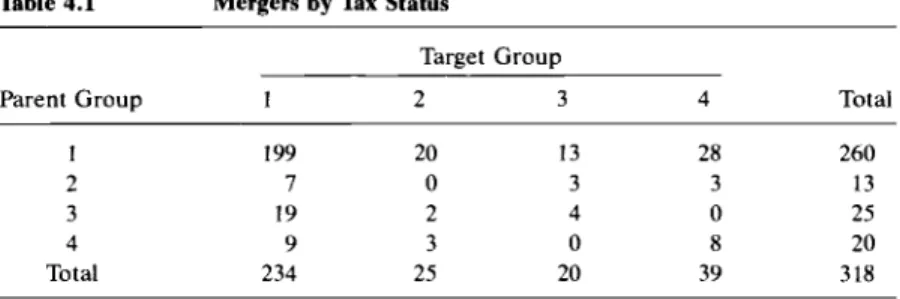
Table 4.1 presents a cross tabulation that is useful in con- sidering the potential importance of tax losses and credits in motivating mergers. In the table, we classify both acquired
76 Alan J. AuerbacWDavid Reishus
~~
Table 4.1 Mergers by Tax Status
Target Grout,
Parent Group 1 2 3 4 Total
I 199 20 13 28 260
2 7 0 3 3 13
3 19 2 4 0 25
4 9 3 0 8 20
Total 234 25 20 39 318
Notes: Group 1 firms have positive tax payments.
Group 2 firms have negative tax payments but n o carryforwards. Group 3 firms have tax credits but not losses carried forward. Group 4 firms have loss carryforwards.
Twelve firms have both positive tax payments and tax loss carryforwards, usually due to a subsidiary not consolidated for tax purposes (primarily life insurance sub- sidiaries). These firms have been classified on a case-by-case basis.
and acquiring companies into one of four categories according to their tax status in the last completed tax year before the merger or acquisition. These categories are:
Taxable; the firms paid federal income taxes and did not have any losses or tax credits carried forward. Such firms can use other firms’ tax benefits to shelter income.
Not taxable, but also without any losses or credits car- ried forward. This happens when businesses can carry all their current losses and credits back to an earlier, taxable year. Such firms offer no obvious tax shelter benefits to other firms, but neither are they likely to want to obtain such benefits to shelter their own income.
Tax credits, but not losses, carried forward. These firms are either currently taxable or are carrying all losses back, but they have tax credits they cannot use.
Tax credits and losses carried forward. These firms are currently not taxable and must carry losses as well as crediits forward.
For tax losses and credits to be of potential importance as incentives for merger activity, three conditions must be sat- isfied. First, these benefits must be present in a significant number of cases. Second, firms must have combined according to a pattern in which those with benefits (groups 3 and
4)
joined those who could make use of them (group 1). Finally, the benefits themselves must be of significant magnitude.1 .
2.
3.
As table 4.1 shows, the first of these conditions is satisfied. Out of a total of 636 firms involved in the 318 mergers (some of which appear more than once in the list), 104 were in group 3 or group 4. The second condition is also satisfied: there were 69 combinations of a group 1 firm with a firm from group 3 or 4. At the same time, the fact that 12 of the mergers and ac- quisitions occurred between tax-constrained firms (4 between firms in group 3 and 8 between firms in group 4) indicates the importance of nontax factors in the merger decision. Most of these combinations of tax-constrained companies were hori- zontal, within a single industry, where one would expect the fortunes of firms to be closely tied together.
To consider the third condition, that these benefits be eco- nomically significant, we can refer to table 4.2. In the cases where there were tax benefits available, we estimated their size as their value to the taxable firm in terms of the present value of taxes saved through the use of the existing tax losses and credits carried forward. As a fraction of the market value of the acquired company, the average gain was 13.7 percent, or 9.0 percent when weighted by the size of the acquired company. The (weighted) average gain was larger in the mi- nority of cases where the tax losses and credits came from the acquiring company than from the acquired company: 14.3 percent versus 5.5 percent of the value of the acquired com-
Table 4.2 Potential Gains from Tax Benefit Transfer (as a percentage of target firm’s market value)
Number of Mergers with
Potential Gain from: Target Parent Total
(by size of gain) No gain Below 5% 5-10% 10-25% Above 25% 277 293 252 20 8 28 7 5 12 11 6 17 3 6 9 Average Gain (of those with positive gain)
Unweighted Weighted
12.7 15.4 13.7
78 Alan J. AuerbacWDavid Reishus
pany. Although these were the average gains for the 20.7 per- cent of mergers in which some benefits were available, the gains exceed 10 percent of the market value of the target in 8.1 percent of all mergers, or 39 percent of those with some gains present.
Thus, we found that benefits from the increased use of tax losses and unused credits were present in about 20 percent of the mergers and acquisitions in our sample. In about 8 percent of the overall sample, the benefits were significant (at least 10 percent of the acquired company’s market value). We must now ask the most difficult question: how many of these com- binations occurred because of the available tax benefits? This is the subject of our continuing research, so we cannot offer clear answers yet. However, there are two pieces of evidence that shed light on the question.
First, the number of firms with tax losses involved in merg- ers and acquisitions in recent years has been large, but so has the incidence of tax losses among firms in general. In our sample, of 37 mergers and acquisitions that occurred in 1982 and 1983 (for which we use tax data a t the end of 1981 and 1982, respectively), 8 involved either a parent or a target with tax losses (that is, in group 4). In a comparable sample of large firms not limited to those involved in mergers, Auerbach and Poterba (1986) found that 7.6 percent had tax losses carried forward at the end of 1981 and 12.0 percent had losses carried forward at the end of 1982. The pure chance of a loss being present among either parent or target is thus roughly equal to that actually observed in the sample.*
Second, there is little evidence that among merging firms, the form of the combination depended on whether there were tax losses and credits available. If tax motivations were im- portant, one might expect to observe a greater number of nontaxable transactions among mergers with the potential for transferring tax benefits; these are cases in which the potential for stepping up asset bases, available only through taxable transactions, would be of little value. Yet our statistical anal- ysis (described in the appendix) has failed to detect any sig- nificant connection between the type of transaction (taxable or nontaxable) and the presence and size of these tax benefits.
We must conclude, on the basis of our evidence, that while the utilization of tax credits and tax losses could play an im- portant role in affecting merger activity, there is no strong evidence that it does.
4.3.2 Basis Step-up
There are a small number of celebrated cases in recent years where the step-up of asset bases supposedly played an im- portant role in the acquisition process. Our estimates-of the potential tax benefits from this channel (described in more detail in our earlier paper) are based on calculations of the total basis step-up that could be achieved on assets of the acquired firm not subject to recapture. The results suggested that this was not likely to be as important a benefit to merging firms as the utilization of unused tax losses and credits. In only seven cases could we identify gains in excess of 5 percent of the market value of the acquired firm.
Our statistical analysis also failed to support the notion that firms with sizeable potential gains from stepping up asset bases would be more likely to choose a taxable transaction in order to take advantage of these gains. However, we have less con- fidence in these conclusions than those reached above because we doubt our ability to accurately measure the gains from stepping up asset bases. The detailed asset information re- quired for such calculations is not normally available publicly. The little public information that does exist supports the conclusion that basis step-up is not typically important in larger mergers. One source says that of the 100 largest acquisitions since 1982 only 17 have elected to use the basis step-up, and the value of assets involved represents a smaller 13 percent of the total (Mergers and Acquisitions, 1986).
4.3.3 Leverage
As we indicated above, the tax deductibility of interest de- ductions in itself is not an incentive to merge. It is an incentive to borrow. Yet, there may be changes associated with merging that make borrowing less costly to the firm in some respect. One may certainly ask whether firms that merge borrow more.
80 Alan J. AuerbacWDsvid Reishus
Given the publicity that this topic has received, we were surprised to find that they do not. In our sample, we measured the debt-capital ratios (measured at market value) of firms before and after merger, comparing the combined ratio for the separate companies two years before the merger or acquisition to that of the single entity two years after the transaction. We chose to distance the dates of measurement from the merger date to avoid characterizing a very temporary increase in debt around the merger date as a change in underlying financial structure.
We found that the ratio of long-term debt to long-term debt plus equity increased in our sample from an average (weighted by size of firm) of 25.4 percent to one of 26.7 percent. This is not a very important increase given that it occurred during a period of generally rising debt-equity ratios. Where the ac- quired company’s market value was relatively large, between
25 and 50 percent of the size of the acquiring company, there was actually a decline in the debt-equity ratio. This is contrary to what one might expect for mergers with large capital re- quirements. It is important to stress that these mergers did involve increases in debt outstanding, but also in equity value. It has been well documented that, taken together, the market values of the two involved companies increase through merger (for example, Jensen and Ruback 1983). Our estimates merely suggest that borrowing did not outstrip growth in value. If the recent merger wave involved increases in leverage in the ag- gregate, then this represents a deviation from recent historical performance.
4.3.4 Individual Tax Factors
We indicated that a nontaxable transaction could lessen the capital gains tax burden for shareholders of acquired com- panies. It is difficult to know what this burden would be with- out a detailed list of shareholder tax rates and holding periods. As a rough measure of the potential benefit of avoiding a taxable transaction, we used the percentage increase in the acquired firm’s market value in the two years preceding the merger or acquisition. We found statistically that this measure had no impact on the decision between taxable and nontaxable transactions.
The potential tax benefits from using cash in a merger hinge on the acquiring corporation’s being in need of a way to get excess cash out of the corporation without subjecting it to dividend taxes. It is difficult to identify which firm, if any, had this motivation, but we can identify some that probably did not: those that had issued new equity in the two years im- mediately preceding the merger or acquisition. It is hard to imagine any reason why such a firm, having recently obtained an infusion of cash through the sale of shares, would then seek to reduce its internal cash position. Indeed, we found this to be one factor that did statistically influence the form of the transaction. Firms that had recently issued new equity were less likely to engage in a cash transaction; perhaps the method of payment in acquisitions does play a role in helping firms regulate their internal holdings of cash.3
4.4 Conclusions
Our results suggest that, for mergers and acquisitions in the 1970s and early 1980s between large public corporations in the United States, the potential transfer of unused tax credits and tax losses was the most significant potential tax-related factor. This was particularly so in cases where the benefits were used by an acquiring company to shelter the income of acquired taxable companies. The benefits from stepping up asset bases are less discernible. Likewise, purported gains from increasing leverage appear to be refuted by the stability of debt-equity ratios measured before and after mergers.
Even where potential tax benefits have been identified, we have not yet found any evidence that they have played an important role in the structure and frequency of mergers and acquisitions. However, further research on this matter is needed before more definite conclusions may be drawn.
Appendix
The value and type of tax benefits available to firms would be expected to affect not only the incentive to merge but also, once the decision to merge has been made, the legal form of
82 Alan J. AuerbacWDavid Reishus
the merger. The choice of stock or cash as the means of pay- ment, and the decision of whether to have a taxable combi- nation or a tax-free reorganization, should be influenced by various tax aspects.
These tax incentives were discussed more fully in the body of the paper, but can be summarized here by the following hypotheses.
High premiums paid, or low shareholder bases in the acquired stock, should lead to the use of stock as a form of payment. This defers the capital gains tax that would other- wise be payable by those selling their shares in the acquired company.
Low book value of depreciable or depletable assets rel- ative to market value should encourage a taxable transaction to take advantage of basis step-up. Since nontaxable trans- actions require the use of stock, we would expect to see cash used more often when book values are high relative to market value.
3. The presence of substantial tax loss and/or credit car- ryforwards on the targets’ books would encourage the use of these credits and thus make nontaxable stock transactions more likely.
The use of cash should be greater where acquiring firms have not needed to go to the market for new equity funds, and less where firms have an apparent desire to disburse cash from the corporate form.
In order to test these hypotheses, we performed a logit analysis where the choice of cash or stock as the means of payment was the dependent variable. For 241 of the 318 merg- ers in our sample we were unambiguously able to determine the means of payment. These included 128 stock (nontaxable), 106 cash (taxable), and 7 stock (taxable). The remaining trans- actions included mixtures of stock and cash. Since so few stock transactions were taxable, we focused on the choice between taxable cash and nontaxable stock transactions. Within this subsample, one would expect cash to occur more frequently with low locked-in capital gains of the acquired stock, high basis step-up potential, low tax loss and credit benefits from the target, and excess cash held by the parent. Our measure of the locked-in capital gains is crude and was
1.
2.
statistically insignificant. The remaining hypotheses may be evaluated using table 4.3, which presents results typical of the regressions we performed.
We tried three different measures of the available tax gains from the basis step-up at the corporate level. The first, de- scribed in the appendix of Auerbach and Reishus (1986), is based on an estimate of the difference between market and book values of business structure. The second is based on the difference between market value and book value of the firm, and the third is based on the accumulated deferred taxes, which to some extent reflects the excess depreciation taken on assets. None of these were statistically significant or im-
Table 4.3
Independent Variable
Form of Payment in Merger: Logit Analysis
Constant Tender offer Hostile tender offer
Missing tender offer (post-1980) Stock new issue
Stock repurchase Basis step-up Tax losses and credits Tax losses and credits x limit Basis step-up/Target assets Losses and credits x limit/ Losses and credits x limit/ Pseudo - R Target assets Target assets 0.573* (0.2 1 0) - 2.620* (0.662) -0.019 (1.14) - I . 180* (0.348) 0.777* (0.324) - 0.443 (0.612) 2.10 (30.30) -4.15 (9.19) 7.80 (20.5) 0.088 0.460* (0.229) - 2.690* (0.662) -0.028 (1.05) - 1.200* (0.345) 0.806* (0.329) (0.623) -0.402 2.07 (2.18) (4.09) 7.41 (7.00) 0.095 -3.86
Notes: Standard errors are in parentheses.
* = significant at .05 level.
84 Alan J. AuerbacWDavid Reishus
portant in explaining the form of payment. Only the results from the first version of this variable are shown in table 4.3.
Likewise, the results for the tax saving due to use of losses and credits are not significant in explaining the form of pay- ment. This is true whether we use the straight gains from the tax variables,
or
a version which attempts to account for the legal limitations that are due to the relative sizes of target and parent in a reorganization. In general, the standard errors of the estimated coefficients render them insignificant, often with a sign opposite from that predicted.The variables which are significant in explaining the changes are the stock issuing or purchasing behavior of the acquiring firm in the period two years before the merger. A firm which has previously issued new stock in this period is more likely to use stock in the merger, and one that has retired stock is more likely to use cash. Also, if a tender offer was used in the combination, cash is far more likely to be used as the means of payment. This is true even when we control for the hostility of the transaction using dummy variables for man- agement resistance and the presence of multiple
bidder^.^
We do not have data on tender offers past 1980, and the dummy variable representing this period has a significant effect on the probability of cash being used, reflecting the increased use of cash in our sample after 1980.In summary, there is little evidence from the logit regres- sions that the corporate tax effects we have identified are important in determining the form of the merger transaction. This does not imply that they are unimportant for the decision to merge. While the current results provide no strong support for taxes as an important motivation to merge, this can only be tested directly when merged firms are compared with firms that did not merge.
Notes
We are grateful to the National Bureau of Economic Research, the Na- tional Science Foundation, and the Institute for Law and Economics at the University of Pennsylvania for financial support.
1. Auerbach (1983) and Auerbach and Poterba (1987) find that taxpaying firms face a greater incentive to invest in machinery and equipment than firms not paying taxes because of net operating loss deductions.
Taking the two-year average loss frequency of about 10 percent as applying to all firms in the sample, one would expect 19 percent of the mergers to have at least one firm with a loss (10 percent targets plus 10
percent parents minus 1 percent to correct for double counting when both have losses). The observed incidence of 8 out of 37 is only slightly above this percentage.
We are also aware, however, that baser theories of management be- havior, such as “if you’ve got it, spend it, if you haven’t, issue stock” are also consistent with this finding. In general, it is difficult to distinguish the argument that internal funds are a cheaper source of capital for tax reasons from the argument that they are cheaper because managers need not subject themselves to the judgment of the market.
The data on tender offers was kindly supplied to us by Michael Jensen.
2.
3.
4.
References
Auerbach, Alan J. 1983. “Corporate Taxation in the U.S.” Brookings Papers on Economic Activity.
Auerbach, Alan J., and James M. Poterba. 1987. “Tax Loss Carryforwards and Corporate Tax Incentives.’’ In M. Feldstein, ed., The Effect of Tax- ation on Capital Accumulation, pp. 305-38. Chicago: University of Chi- cago Press.
Auerbach, Alan J., and David Reishus. 1986. “Taxes and the Merger De- cision.” NBER working paper #1855, March.
Jensen, Michael C., and Richard S. Ruback. 1983. “The Market for Cor- porate Control,” Journal of Financial Economics 11:5-50.
Mergers and Acquisitions. 1986. “The Threat of a Merger Tax.” Vol. 21,