Project 1: Implement a simple hosts framework using UNIX TCP Sockets to
demonstrate the concept of Mobile Agents
Due date: October 15 (Monday), 2007
Requirements
This exercise should be done individually. You will be asked to demonstrate your programs and to submit well commented codes and report via soft (CD) and hard copies.
Exercise 1: A server that echoes client input
You are required to produce client and server programs based on the procedures DoOperation, GetRequest and SendReply. These operations have been simplified so that client and server exchange messages consisting of strings.
The interaction between the client and server should be as described below:
Client: this takes the name of the server computer as an argument. It repeatedly requests a string to be entered by the user, and uses DoOperation to send the string to the server, awaiting a reply. Each reply should be printed out.
Server: repeatedly receives a string using GetRequest, prints it on the screen and replies with SendReply. The server exits when the string consists of the single character `q'.
Use the following (or equivalent C) definitions for Status and SocketAddress, which are in C++. enum Status
{ OK, // operation successful
BAD, // unrecoverable error
WRONGLENGTH // bad message length supplied };
typedef sockaddr_in SocketAddress;
Implement DoOperation, GetRequest and SendReply methods. The recommended prototypes are given in the definitions in the appendices. In the C++ definitions they are included in the classes Client and Server. The Status value returned reflects the values returned by TCPsend and TCPreceive (see below).
DoOperation
Sends a given request message to a given socket address and blocks until it returns with a reply message.GetRequest Receives a request message on a connected socket.
TCPsend and TCPreceive
The procedures DoOperation, GetRequest and SendReply must use two procedures TCPsend and TCPreceive to be written by you, which respectively send and receive a message over/from a socket. You are to implement these functions using the system calls sendto/send and recvfrom/recv respectively.
Each procedure returns a value of type Status which reports on the success of its execution. For example, if the sendto/send or recvfrom/recv system calls return negative values, your procedures should return a Status value of Bad.
TCPsend
Sends a given message through a connected socket.TCPreceive Receives a message on a connected socket.
Use the recommended definitions for SocketAddress and Message and the recommended prototypes for TCPsend and TCPreceive. In the C++ defintions, the latter are to be found in class Socket.
Choosing a server port
You will want to run server processes that can coexist with other people's processes in the same computer. You need to select an agreed port number for the server to receive messages from clients. Two servers on the same computer cannot use the same local port number. You will therefore want to choose a port number that is sure to be different from other people's port numbers. If everybody takes the first unreserved port number and adds their uid, there should be no such clashes - i.e.:
aPort = IPPORT_RESERVED + getuid() ; How to write a Concurrent Server?
As part of this exercise, you should implement the TCP echo server as a concurrent server and try to demonstrate the concept by using the same server to serve more than one client at the same time. Describe the experiment and discuss its results in a comment in your report.
Hint: Use pthreads API to implement a concurrent server.
Exercise 2: Implement a Mobile agent on a set of hosts connected through TCP/IP
sockets.
In this exercise you will need to extend the concepts from the Exercise 1, wherein you
have established a connection between the client and the server. Here, you need to
implement three hosts each of which is a client and server.
Mobile Agents:
An agent is an independent software program that runs on behalf of a network user. A
mobile agent is a program, once launched by a user, can travel from host to host
autonomously and can contribute to the functionality even if the user is disconnected
from the network. But, we would be implementing it for a set of four connected hosts.
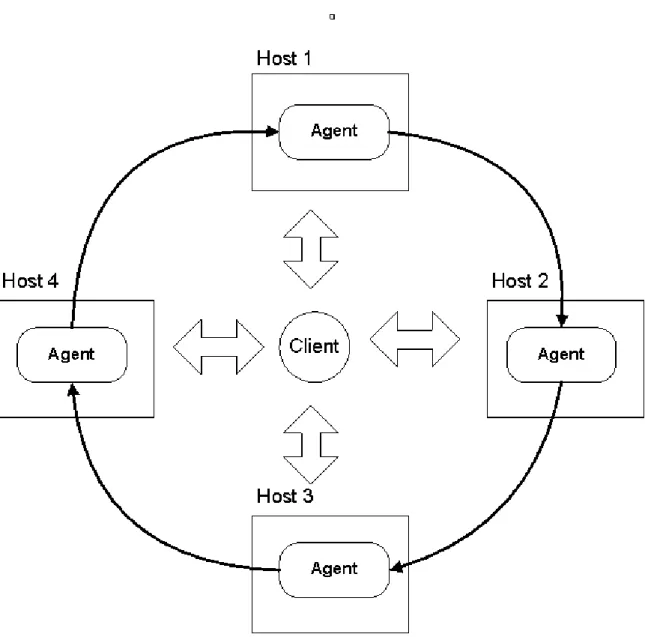
Figure 1: A mobile agent travels from host to host.
An agent carries following data items with it:
1. Identifier – information that allows an agent to be identified.
2. Itinerary – a list of addresses/names of the hosts that the agent is to visit. 3. Task data – data required by the agent to perform its tasks.
4. Process logic – logic(code) to perform its tasks on the task data.
In this exercise you will create an agent object which consists of all of the above described data. This agent object will be launched by a user, say client in the figure 1. The client acts as an initiator and should have connections to all 4 host servers to receive execution result from an agent (if the host is the last host on the list). The client can prompt at runtime to decide the
originating host (First host to which it should send the message/program to execute). The client should also ask the users about which hosts the program should be executed on. The list of hosts should then be set by setting the
m_host_list
variable as indicated in Appendix 1. This list
can also be used to identify the first host rather than prompting at runtime specifically for it. On reaching the first host it should execute its logic using the resources of the host server. At each host server, it needs to be examined, if there are any more hosts that need to be served by the agent before returning the result to the client. If so, then the current host server will update the next host index to be served by the agent and transport the agent to the next host server. Once the mobile agent exhausts all the hosts to be served it is assumed that it has finished execution and can then send the result of the execution to the client.Initiator: The client is responsible for launching the mobile agent. It marshals the data of the agent into a Message object and transports it using TCP sockets to the first host server in the itinerary of the agent.
Server Hosts: The First host receives the mobile agent in form of a Message object, unmarshal the data contained in the message object to reconstitute the agent, at which the process logic embedded in the agent is executed using the host’s resources. The host then looks up if there are any hosts remaining to be serviced by the agent and re-marshals the agent into a Message object to transport it the next host. If there are no more agents in the host list it simply sends the result of the operation back to the client which echoes it on the screen.
This exercise requires you to write marshalling and unmarshalling function members, which take network ordering into account, by using the functions htonl and ntohl. The recommended prototypes for marshal and unmarshal are given in the definitions. In C++ they are function members of the class MAgent (described below in Appendix 1).
Two other matters that should be addressed:
• The mobile agents need to have an identifier which is known only to the participating hosts and the agent. This is important from the security perspective.
• The hosts need to output the data modified by applying the process logic stored in the agents. The process logic can be unary or binary arithmetic operators, which are enumerated and have a predefined meaning so that the hosts can perform the corresponding operations on reading the enumerations. You can perform operations like addition, subtraction, multiplication, division, square root, square, etc.
Demonstrations Exercise 1
You must demonstrate that your programs work correctly by running two clients and a server on three different computers. Also, demonstrate the concept of concurrent servers by allowing more than one clients being served by a single server at the same time.
Exercise 2
A client should be an initiator which launches the mobile agent. You should demonstrate this by printing some text statements. On reaching the first host the mobile agent’s data should be operated on based on the logic stored in it and the corresponding result needs to be demonstrated on the server. Same holds for the second host the mobile agent visits. Once the mobile agent reaches the last host and its state is reconstituted, the resulting data is sent and printed out at the initiator client.
Print-outs to hand in
The client and server programs should have separate codes. Also, the mobile agent should have Exercise 1
Provide the main program for the client and the server. The code for the client should include a comment containing a short write-up describing the implementation of the concurrent TCP server.
Exercise 2
Please supply the print outs in the following order:
• Header files with definitions for SocketAddress, Status, Message. C++ programs will provide class interfaces, C programs will provide function prototypes;
• Implementation files for all the classes or functions;
• Separate header and implementations for the Arithmetic service; • A main for the client and the server (only one of each).
APPENDIX 1: Definitions for C++ Programs
In these exercises you are advised to define the following:
class Message { public:
Message(unsigned char *, unsigned int ); // message and length supplied Message(unsigned int ); // length supplied
private:
unsigned char * data; unsigned int length; };
The class
Message
is for holding the data and the length of a message. If you prefer you
can make data contained in the Message class a fixed length array of size 1000. The first
constructor is used to create a message with given contents. The second constructor is
used to create a message with a given length for putting the data into later. You may find
that you need other function members, e.g. to return the data or length.
class Socket { public:
Socket();
Socket(int); // port number passed as an argument status TCPsend(TCPMessage *m, SocketAddress * destination);
status TCPsend(TCPMessage *m, int sockfd); //sockfd is the connected socket status TCPreceive(TCPMessage **m, SocketAddress * origin);
status TCPreceive(TCPMessage **m, int sockfd); //sockfd is the connected socket private:
int s;
SocketAddress * socketAddress; };
The class Socket represents a stream socket. It has data members for the socket descriptor and for the socket address to which it is bound. There are two constructors i) no arguments: opens the socket and binds it to any local port, ii) one argument: opens a socket and binds it to the given port. The function members send and receive messages via the given port.
class Client: public Socket { public:
Client(); // calls constructor Socket()
status DoOperation (TCPMessage *callMessage, TCPMessage *replyMessage, SocketAddress * server);
};
class Server: public Socket { public:
Server(int); // calls constructor Socket(int); status GetRequest (TCPMessage *callMessage, SocketAddress * client);
status SendReply (TCPMessage *replyMessage, SocketAddress * client); status SendReply (TCPMessage *replyMessage, int connfd);
};
You can define another class or classes whose instances have the operations DoOperation, GetRequest and SendReply. One way to do this is to define two new classes called Client and Server, both of which are subclasses of the Socket class, as shown above.
C++ definitions for Exercise 2:
Declaration and description for an example Mobile agent class:
typedef enum { ADDITION,
SUBTRACTION, MULTIPLICATION, DIVISION,
SQUARE } OP_TYPE;
Note: You can add more operators to the above enumeration OP_TYPE. enum MessageType { Request, Reply};
class MAgent {
void MAgent (unsigned int, OP_TYPE , char **, int , double a1 = 0, double a2 = 0); void marshal( Message ** ); // marshal: encodes itself to a Message object void unmarshal(Message *); // unmarshal: decodes from a given Message
//object to itself
void execute (); // executes the operation on the task data protected:
unsigned int m_Identifier; // agent identifier int m_hostIndex; // which host to visit next char **m_host_list; // list of hosts
OP_TYPE m_operationID; // stores the enumerated operation type double m_arg1, m_arg2; // arguments for the operations (task data) };
The list of hosts to be visited by the agent in its itinerary as contained in the variable m_host_list, and m_ hostIndex holds the value of the next host to be visited. Both of these variables are looked up, and based on their current values and the next host to be visited is decided by the currently visited host/server. The variables m_arg1 and m_arg2 is the task data contained in the agent,
which are operated on, based on the enumerated type (OP_TYPE) stored in the variable m_operationID. MAgent class has a constructor which takes the agent identifier, enumerated operation type, list of hosts to be served, next host index, and the task data as the parameters. The two functions marshal and unmarshal flatten and reconstitute the execution state of the agent object respectively. Execute function is used to execute the process logic stored in the agent on the data stored in the agent. The process logic can be any of the operations defined in the type OP_TYPE; you can also add more operations to the enumerated type shown above.
APPENDIX 2: Definitions for C Programs
In these exercises you are to use the following type definitions: #define SIZE 1000
typedef struct { unsigned int length; unsigned char data[SIZE]; } Message;
typedef enum {OK, /* operation successful */ BAD, /* unrecoverable error */
WRONGLENGTH /* bad message length supplied */ } Status;
typedef struct sockaddr_in SocketAddress ; You may alternatively define data as a pointer.
The prototypes for DoOperation, GetRequest and SendReply (to which you must adhere) are as follows:
Status DoOperation (Message *message, Message *reply, int socket_descriptor, SocketAddress *serverSA);
Status GetRequest (Message *callMessage, int connfd, SocketAddress *clientSA=NULL); Status SendReply (Message *replyMessage, int connfd, SocketAddress clientSA=NULL);
The prototypes for TCPsend and TCPreceive are as follows:
Status TCPsend(int connfd, Message *m, SocketAddress destination=NULL); Status TCPreceive(int connfd, Message *m, SocketAddress *origin=NULL);
C definitions for Exercise 2
You should use the following definition of an agent:
typedef enum { ADDITION,
SUBTRACTION, MULTIPLICATION, DIVISION, SQUARE } OP_TYPE; typedef struct {
unsigned int m_Identifier; /* unique identifier */ int m_hostIndex; /* which host to visit next*/ char **m_host_list; /* list of hosts*/
OP_TYPE m_operationID; /* e.g.(0,1,2,3) for (+, -, *, /) */ int m_arg1; /* argument/ return parameter */ int m_arg2; /* argument/ return parameter */
}MAgent; /* each int (and unsigned int) is 32 bits = 4 bytes */ The fields arg1 and arg2 can be used for operation arguments or returned value and status. The prototypes of the marshalling and unmarshalling procedures should be as follows:
void marshal(MAgent *rm, Message *message); void unMarshal(MAgent *rm, Message *message);