
SIGGRAPH 99 Course Notes
Subdivision for Modeling and Animation
Organizers: Denis Zorin, New York University
Lecturers
Denis Zorin
Media Research Laboratory
719 Broadway,rm. 1201
New York University
New York, NY 10012
net:
[email protected]
Peter Schr¨oder
Caltech Multi-Res Modeling Group
Computer Science Department 256-80
California Institute of Technology
Pasadena, CA 91125
net:
[email protected]
Tony DeRose
Studio Tools Group
Pixar Animation Studios
1001 West Cutting Blvd.
Richmond, CA 94804
net:
[email protected]
Jos Stam
Member Technical Staff
Alias
jwavefront
1218 First Avenue, 8th Floor
Seattle, WA 98104
net:
[email protected]
Leif Kobbelt
Computer Graphics Group
Max-Planck-Institute for Computer Sciences
Im Stadtwald
66123 Saarbr¨ucken, Germany
net:
[email protected]
Joe Warren
Computer Graphics and Geometric Design Group
Computer Science Department
Rice University
Houston, Tx 77584
Schedule
Morning Session: Introductory Material
The morning section will focus on the foundations of
sub-division, starting with subdivision curves and moving on to surfaces. We will review and compare a
number of different schemes and discuss the relation between subdivision and splines. The emphasis
will be on properties of subdivsion most relevant for applications.
Foundations I: Basic Ideas
Peter Schr¨oder and Denis Zorin
Foundations II: Evaluation and survey of subdivision schemes
Denis Zorin and Jos Stam
Afternoon Session: Applications and Algorithms
The afternoon session will focus on applications
of subdivision and the algorithmic issues practitioners need to address to build efficient, well behaving
systems for modeling and animation with subdivision surfaces.
Implementing Subdivision and Multiresolution Meshes
Denis Zorin
A Variational Approach to Subdivision
Leif Kobbelt
Variational Subdivision Cookbook
Joe Warren
Subdivision Surfaces in the Making of Geri’s Game
Tony DeRose
Lecturers’ Biographies
Denis Zorin
is an assistant professor at the Courant Institute of Mathematical Sciences, New York
University. He received a BS degree from the Moscow Institute of Physics and Technology, a MS degree
in Mathematics from Ohio State University and a PhD in Computer Science from the California Institute
of Technology. In 1997-98, he was a research associate at the Computer Science Department of
Stan-ford University. His research interests include multiresolution modeling, the theory of subdivision, and
applications of subdivision surfaces in Computer Graphics. He is also interested in perceptually-based
computer graphics algorithms. He has published several papers in Siggraph proceedings.
Peter Schr¨oder
is an associate professor of computer science at the California Institute of Technology,
Pasadena, where he directs the Caltech Multi-Res Modeling Group. He received a Master’s degree from
the MIT Media Lab and a PhD from Princeton University. For the past 6 years his work has concentrated
on exploiting wavelets and multiresolution techniques to build efficient representations and algorithms
for many fundamental computer graphics problems. His current research focuses on subdivision as
a fundamental paradigm for geometric modeling and rapid manipulation of large, complex geometric
models. The results of his work have been published in venues ranging from Siggraph to special journal
issues on wavelets and WIRED magazine, and he is a frequent consultant to industry.
Tony DeRose
is currently a member of the Tools Group at Pixar Animation Studios. He received a BS
in Physics in 1981 from the University of California, Davis; in 1985 he received a Ph.D. in Computer
Science from the University of California, Berkeley. He received a Presidential Young Investigator award
from the National Science Foundation in 1989. In 1995 he was selected as a finalist in the software
category of the Discover Awards for Technical Innovation.
From September 1986 to December 1995 Dr. DeRose was a Professor of Computer Science and
Engi-neering at the University of Washington. From September 1991 to August 1992 he was on sabbatical
leave at the Xerox Palo Alto Research Center and at Apple Computer. He has served on various
techni-cal program committees including SIGGRAPH, and from 1988 through 1994 was an associate editor of
ACM Transactions on Graphics.
His research has focused on mathematical methods for surface modeling, data fitting, and more recently,
in the use of multiresolution techniques. Recent projects include object acquisition from laser range data
and multiresolution/wavelet methods for high-performance computer graphics.
Leif Kobbelt
is a senior researcher at the Max-Planck-Institute for computer sciences in Saarbr¨ucken,
Germany. His major research interests include multiresolution and free-form modeling as well as the
efficient handling of polygonal mesh data. He received his habilitation degree from the University of
Erlangen, Germany where he worked from 1996 to 1999. In 1995/96 he spent one post-doc year at the
University of Wisconsin, Madison. He received his master’s (1992) and Ph.D. (1994) degrees from the
University of Karlsruhe, Germany. During the last 7 years he did research in various fields of computer
graphics and CAGD.
Jos Stam
is currently a member of technical staff at Alias
jwavefront. He received BS degrees in
computer science and mathematics from the University of Geneva, Switzerland in 1988 and 1989, and
he received a MS and a PhD in computer science both from the University of Toronto in 1991 and
1995, respectively. His research interests cover most areas of computer graphics: natural phenomena,
rendering, animation and surface modeling. He has published papers at SIGGRAPH and elsewhere in
all of these areas.
Recently, his research has focused on the fundamentals of subdivision surfaces and their practical use in a
commercial product. Stam is a leading expert in both the theory and application of subdivision surfaces.
His work on evaluating subdivision surfaces presented at last years SIGGRAPH conference has been
widely acclaimed as being a landmark paper in the area.
Joe Warren
is currently an Associate Professor in the Department of Computer Science at Rice
Uni-versity. He received his master’s and Ph.D. degrees in 1986 from Cornell UniUni-versity. His research
interests focus on the relationship between computers, mathematics and geometry. During the course of
his research career, he has made fundamental contributions to topics such as algebraic surfaces, rational
surfaces, finite element mesh generation and subdivision. Currently, he is investigating the relationship
between subdivision and systems of partial differential equations.
Contents
1
Introduction
11
2
Foundations I: Basic Ideas
15
2.1
The Idea of Subdivision . . . .
16
2.2
Review of Splines . . . .
20
2.2.1
Piecewise Polynomial Curves . . . .
20
2.2.2
Definition of B-Splines . . . .
22
2.2.3
Refinability of B-splines . . . .
24
2.2.4
Refinement for Spline Curves . . . .
25
2.2.5
Subdivision for Spline Curves . . . .
27
2.3
Subdivision as Repeated Refinement . . . .
28
2.3.1
Discrete Convolution . . . .
28
2.3.2
Convergence of Subdivision . . . .
30
2.3.3
Summary . . . .
33
2.4
Analysis of Subdivision . . . .
34
2.4.1
Invariant Neighborhoods . . . .
34
2.4.2
Eigen Analysis . . . .
38
2.4.3
Convergence of Subdivision . . . .
40
2.4.4
Invariance under Affine Transformations
. . . .
40
2.4.5
Geometric Behavior of Repeated Subdivision . . . .
42
2.4.6
Size of the Invariant Neighborhood
. . . .
42
3
Subdivision Surfaces
45
3.1
Subdivision Surfaces: an Example . . . .
46
3.2
Natural Parameterization of Subdivision Surfaces . . . .
48
3.3
Subdivision Matrix . . . .
51
3.4
Smoothness of Surfaces . . . .
54
3.4.1
C
1-continuity and Tangent Plane Continuity . . . .
54
3.5
Analysis of Subdivision Surfaces . . . .
55
3.5.1
C
1-continuity of Subdivision away from Extraordinary Vertices
. . . .
57
3.5.2
Smoothness Near Extraordinary Vertices
. . . .
58
3.5.3
Characteristic Map . . . .
59
3.6
Piecewise-smooth surfaces and subdivision
. . . .
61
4
Subdivision Zoo
65
4.1
Overview of Subdivision Schemes . . . .
65
4.1.1
Notation and Terminology . . . .
68
4.2
Loop Scheme . . . .
70
4.3
Modified Butterfly Scheme . . . .
73
4.4
Catmull-Clark Scheme . . . .
73
4.5
Kobbelt Scheme . . . .
76
4.6
Doo-Sabin and Midedge Schemes . . . .
78
4.7
Limitations of Stationary Subdivision
. . . .
78
5
Evaluation of Subdivision Surfaces
6
Implementing Subdivision and Multiresolution Meshes
7
Interpolatory Subdivision for Quad Meshes
8
A Variational Approach to Subdivision
9
Subdivision Cookbook
Chapter 1
Introduction
Twenty years ago the publication of the papers by Catmull and Clark [3] and Doo and Sabin [4] marked
the beginning of subdivision for surface modeling. This year, another milestone occurred when
subdivi-sion hit the big screen in Pixar’s short “Geri’s Game,” for which Pixar received an Academy award for
“Best Animated Short Film.” The basic ideas behind subdivision are very old indeed and can be traced
as far back as the late 40s and early 50s when G. de Rham used “corner cutting” to describe smooth
curves. It was only recently though that subdivision surfaces have found their way into wide application
in computer graphics and computer assisted geometric design (CAGD). One reason for this
develop-ment is the importance of multiresolution techniques to address the challenges of ever larger and more
complex geometry: subdivision is intricately linked to multiresolution and traditional mathematical tools
such as wavelets.
Constructing surfaces through subdivision elegantly addresses many issues that computer graphics
practitioners are confronted with
Arbitrary Topology: Subdivision generalizes classical spline patch approaches to arbitrary
topol-ogy. This implies that there is no need for trim curves or awkward constraint management between
patches.
Scalability: Because of its recursive structure, subdivision naturally accommodates level-of-detail
rendering and adaptive approximation with error bounds. The result are algorithms which can
make the best of limited hardware resources, such as those found on low end PCs.
Uniformity of Representation: Much of traditional modeling uses either polygonal meshes or
as if they are made of patches, or they can be treated as if consisting of many small polygons.
Numerical Stability: The meshes produced by subdivision have many of the nice properties
fi-nite element solvers require. As a result subdivision representations are also highly suitable for
many numerical simulation tasks which are of importance in engineering and computer animation
settings.
Code Simplicity: Last but not least the basic ideas behind subdivision are simple to implement and
execute very efficiently. While some of the deeper mathematical analyses can get quite involved
this is of little concern for the final implementation and runtime performance.
In this course and its accompanying notes we hope to convince you, the reader, that in fact the above
claims are true!
The main focus or our notes will be on covering the basic principles behind subdivision; how
subdivi-sion rules are constructed; to indicate how their analysis is approached; and, most importantly, to address
some of the practical issues in turning these ideas and techniques into real applications.
The following 2 chapters will be devoted to understanding the basic principles. We begin with some
examples in the curve, i.e., 1D setting. This simplifies the exposition considerably, but still allows us to
introduce all the basic ideas which are equally applicable in the surface setting. Proceeding to the surface
setting we cover a variety of different subdivision schemes and their properties.
With these basics in place we proceed to the second, applications oriented part, covering algorithms
and implementations addressing
Interactive Multiresolution Mesh Editing: This section discusses many of the data structure
and algorithmic issues which need to be addressed to realize high performance. The result is a
system which allows for interactive, multiresolution editing of fairly complex geometry on PC
class machines with little hardware graphics support.
Subdivision Surfaces and Wavelets: This section shows how subdivision is the key element in
generalizing the traditional wavelet machinery to arbitrary topology surfaces. The result are a
class of algorithms which open up applications such as compression for subdivision surfaces, for
example.
A Variational Approach to Subdivision: Most subdivision methods are stationary, i.e., they use a
fixed set of rules. They are generally designed to exhibit some order of differentiability. In practice
it is often much more important to consider the fairness of the resulting surfaces. Variational
subdivision incorporates fairness measures into the subdivision process.
Exploiting Subdivision in Modeling and Animation: One reason subdivision is becoming very
popular is that it supports hierarchical editing and animation semantics. This was discovered
originally in the traditional spline setup and lead to the development of hierarchical splines. From
that technique it is only a small step to multiresolution modeling using subdivision. This section
discusses some of the issues in controlling animation hierarchically.
Subdivision Surfaces in the Making of Geri’s Game: This section discusses how subdivision
surfaces successfully address the needs of very high end production environments. in the process
new techniques had to be developed which are detailed in this part of the notes.
Beyond these Notes
One of the reasons that subdivision is enjoying so much interest right now is that it is very easy to
implement and very efficient. In fact it is used in many computer graphics courses at universities as a
homework exercise. The mathematical theory behind it is very beautiful, but also very subtle and at times
technical. We are not treating the mathematical details in these notes, which are primarily intended for
the computer graphics practitioners. However, for those interested in the theory there are many pointers
to the literature.
These notes as well as other materials such as presentation slides, applets and snippets of code are
available on the web at
http://www.multires.caltech.edu/teaching/courses/subdivision/
and all readers are encouraged to explore the online resources. A repository of additional information
beyond this course is maintained at
http://www.mrl.nyu.edu/dzorin/subdivision
.
Chapter 2
Foundations I: Basic Ideas
Peter Schr¨oder, Caltech
In this chapter we focus on the 1D case to introduce all the basic ideas and concepts before going
on to the 2D setting. Examples will be used throughout to motivate these ideas and concepts. We
begin initially with an example from interpolating subdivision, before talking about splines and their
subdivision generalizations.
Figure 2.1: Example of subdivision for curves in the plane. On the left 4 points connected with straight
line segments. To the right of it a refined version: 3 new points have been inserted “inbetween” the old
points and again a piecewise linear curve connecting them is drawn. After two more steps of subdivision
the curve starts to become rather smooth.
2.1
The Idea of Subdivision
We can summarize the basic idea of subdivision as follows:
Subdivision defines a smooth curve or surface as the limit of a sequence of successive
re-finements.
Of course this is a rather loose description with many details as yet undetermined, but it captures the
essence.
Figure 2.1 shows an example in the case of a curve connecting some number of initial points in the
plane. On the left we begin with 4 points connected through straight line segments. Next to it is a refined
version. This time we have the original 4 points and additionally 3 more points “inbetween” the old
points. Repeating the process we get a smoother looking piecewise linear curve. Repeating once more
the curve starts to look quite nice already. It is easy to see that after a few more steps of this procedure
the resulting curve would be as well resolved as one could hope when using finite resolution such as that
offered by a computer monitor or a laser printer.
Figure 2.2: Example of subdivision for a surface, showing 3 successive levels of refinement. On the left
an initial triangular mesh approximating the surface. Each triangle is split into 4 according to a particular
subdivision rule (middle). On the right the mesh is subdivided in this fashion once again.
An example of subdivision for surfaces is shown in Figure 2.2. In this case each triangle in the original
mesh on the left is split into 4 new triangles quadrupling the number of triangles in the mesh. Applying
the same subdivision rule once again gives the mesh on the right.
Both of these examples show what is known as interpolating subdivision. The original points remain
undisturbed while new points are inserted. We will see below that splines, which are generally not
interpolating, can also be generated through subdivision. Albeit in that case new points are inserted and
old points are moved in each step of subdivision.
How were the new points determined? One could imagine many ways to decide where the new points
should go. Clearly, the shape and smoothness of the resulting curve or surface depends on the chosen
rule. Here we list a number of properties that we might look for in such rules:
Efficiency: the location of new points should be computed with a small number of floating point
operations;
Compact support: the region over which a point influences the shape of the final curve or surface
should be small and finite;
Local definition: the rules used to determine where new points go should not depend on “far
away” places;
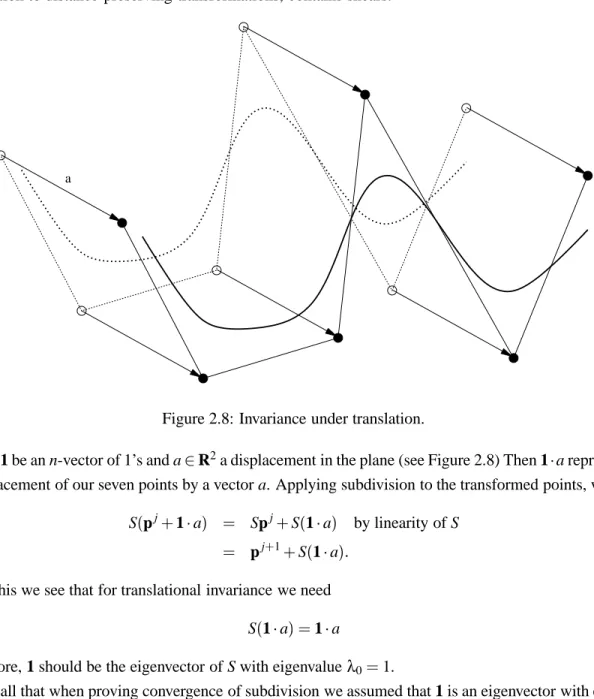
Affine invariance: if the original set of points is transformed, e.g., translated, scaled, or rotated,
the resulting shape should undergo the same transformation;
Simplicity: determining the rules themselves should preferably be an offline process and there
should only be a small number of rules;
Continuity: what kind of properties can we prove about the resulting curves and surfaces, for
example, are they differentiable?
For example, the rule used to construct the curve in Figure 2.1 computed new points by taking a weighted
average of nearby old points: two to the left and two to the right with weights 1
=16
(,1
;9
;9
;,1
)respec-tively (we are ignoring the boundaries for the moment). It is very efficient since it only involves 4
multiplies and 3 adds (per coordinate); has compact support since only 2 neighbors on either side are
involved; its definition is local since the weights do not depend on anything in the arrangement of the
points; the rule is affinely invariant since the weights used sum to 1; it is very simple since only 1 rule is
used (there is one more rule if one wants to account for the boundaries); finally the limit curves one gets
by repeating this process ad infinitum are C
1.
Before delving into the details of how these rules are derived we quickly compare subdivision to other
possible modeling approaches for smooth surfaces: traditional splines, implicit surfaces, and variational
surfaces.
1. Efficiency: Computational cost is an important aspect of a modeling method. Subdivision is
easy to implement and is computationally efficient. Only a small number of neighboring old
points are used in the computation of the new points. This is similar to knot insertion methods
found in spline modeling, and in fact many subdivision methods are simply generalization of knot
insertion. On the other hand implicit surfaces, for example, are much more costly. An algorithm
such as marching cubes is required to generate the polygonal approximation needed for rendering.
Variational surfaces can be even worse: a global optimization problem has to be solved each time
the surface is changed.
2. Arbitrary topology: It is desirable to build surfaces of arbitrary topology. This is a great strength
of implicit modeling methods. They can even deal with changing topology during a modeling
session. Classic spline approaches on the other hand have great difficulty with control meshes of
arbitrary topology. Here, “arbitrary topology” captures two properties. First, the topological genus
of the mesh and associated surface can be arbitrary. Second, the structure of the graph formed by
the edges and vertices of the mesh can be arbitrary; specifically, each vertex may be of arbitrary
degree.
These last two aspects are related: if we insist on all vertices having degree 4 (for quadrilateral)
control meshes, or having degree 6 (for triangular) control meshes, the Euler characteristic for a
planar graph tells us that such meshes can only be constructed if the overall topology of the shape
is that of the infinite plane, the infinite cylinder, or the torus. Any other shape, for example a
sphere, cannot be built from a quadrilateral (triangular) control mesh having vertices of degree 4
(6).
When rectangular spline patches are used in arbitrary control meshes, enforcing higher order
con-tinuity at extraordinary vertices becomes difficult and considerably increases the complexity of the
representation (see Figure 2.3 for an example of points not having valence 4). Implicit surfaces
can be of arbitrary topological genus, but the genus, precise location, and connectivity of a surface
are typically difficult to control. Variational surfaces can handle arbitrary topology better than
any other representation, but the computational cost can be high. Subdivision can handle arbitrary
topology quite well without losing efficiency; this is one of its key advantages. Historically
sub-division arose when researchers were looking for ways to address the arbitrary topology modeling
Figure 2.3: A mesh with two extraordinary vertices, one with valence 6 the other with valence 3. In
the case of quadrilateral patches the standard valence is 4. Special efforts are required to guarantee high
order of continuity between spline patches meeting at the extraordinary points; subdivision handles such
situations in a natural way.
challenge for splines.
3. Surface features: Often it is desirable to control the shape and size of features, such as creases,
grooves, or sharp edges. Variational surfaces provide the most flexibility and exact control for
cre-ating features. Implicit surfaces, on the other hand, are very difficult to control, since all modeling
is performed indirectly and there is much potential for undesirable interactions between different
parts of the surface. Spline surfaces allow very precise control, but it is computationally
expen-sive and awkward to incorporate features, in particular if one wants to do so in arbitrary locations.
Subdivision allows more flexible controls than is possible with splines. In addition to choosing
locations of control points, one can manipulate the coefficients of subdivision to achieve effects
such as sharp creases or control the behavior of the boundary curves.
4. Complex geometry: For interactive applications, efficiency is of paramount importance. Because
subdivision is based on repeated refinement it is very straightforward to incorporate ideas such
as level-of-detail rendering and compression for the internet. During interactive editing locally
adaptive subdivision can generate just enough refinement based on geometric criteria, for example.
For applications that only require the visualization of fixed geometry, other representations, such
as progressive meshes, are likely to be more suitable.
Since most subdivision techniques used today are based upon and generalize splines we begin with
a quick review of some basic facts of splines which we will need to understand the connection between
splines and subdivision.
2.2
Review of Splines
2.2.1
Piecewise Polynomial Curves
Splines are piecewise polynomial curves of some chosen degree. In the case of cubic splines, for
exam-ple, each polynomial segment of the curve can be written as
x
(t
) =a
i 3t
3+a
i 2t
2+a
i 1t
+a
i 0y
(t
) =b
i 3t
3+b
i 2t
2+b
i 1t
+b
i 0;where
(a
;b
)are constant coefficients which control the shape of the curve over the associated segment.
This representation uses monomials (t
3;t
2;
t
1;
t
0
), which are restricted to the given segment, as basis
functions.
-4 -3 -2 -1 0 1 2 3 4 -0.5 0.0 0.5 1.0Figure 2.4: Graph of the cubic B-spline. It is zero for the independent parameter outside the interval
[,
2
;2
].
Typically one wants the curve to have some order of continuity along its entire length. In the case of
cubic splines one would typically want C
2continuity. This places constraints on the coefficients
(a
;b
)while maintaining the constraints, is very awkward and difficult. Instead of using monomials as the basic
building blocks, we can write the spline curve as a linear combination of shifted B-splines, each with a
coefficient known as a control point
x
(t
) =∑
x
iB
(t
,i
)y
(t
) =∑
y
iB
(t
,i
):The new basis function B
(t
)is chosen in such a way that the resulting curves are always continuous and
that the influence of a control point is local. One way to ensure higher order continuity is to use basis
functions which are differentiable of the appropriate order. Since polynomials themselves are inifinitely
smooth, we only have to make sure that derivatives match at the points where two polynomial segments
meet. The higher the degree of the polynomial, the more derivatives we are able to match. We also
want the influence of a control point to be maximal over a region of the curve which is close to the
control point. Its influence should decrease as we move away along the curve and disappear entirely at
some distance. Finally, we want the basis functions to be piecewise polynomial so that we can represent
any piecewise polynomial curve of a given degree with the associated basis functions. B-splines are
constructed to exactly satisfy these requirements (for a cubic B-spline see Figure 2.4) and in a moment
we will show how they are constructed.
The advantage of using this representation rather than the earlier one of monomials, is that the
conti-nuity conditions at the segment boundaries are already “hardwired” into the basis functions. No matter
how we move the control points, the spline curve will always maintain its continuity, for example, C
2in
the case of cubic B-splines.
1Furthermore, moving a control point has the greatest effect on the part of
the curve near that control point, and no effect whatsoever beyond a certain range. These features make
B-splines a much more appropriate tool for modeling piecewise polynomial curves.
Note:
When we talk about curves, it is important to distinguish the curve itself and the graphs of the
coordinate functions of the curve, which can also be thought of as curves. For example, a curve can
be described by equations x
(t
)=sin
(t
), y
(t
)=cos
(t
). The curve itself is a circle, but the coordinate
functions are sinusoids. For the moment, we are going to concentrate on representing the coordinate
functions.
1The differentiability of the basis functions guarantees the differentiability of the coordinate functions of the curve.
How-ever, it does not guarantee the geometric smoothness of the curve. We will return to this distinction in our discussion of subdivision surfaces.
2.2.2
Definition of B-Splines
There are many ways to derive B-splines. Here we choose repeated convolution, since we can see from
it directly how splines can be generated through subdivision.
We start with the simplest case: piecewise constant coordinate functions. Any piecewise constant
function can be written as
x
(t
)=∑
x
iB
i0(
t
);where B
0(t
)is the box function defined as
B
0(t
) =1
if
0
t
<1
=0
otherwise
;and the functions B
i0(t
)=B
0(t
,i
)are translates of B
0(t
). Furthermore, let us represent the continuous
convolution of two functions f
(t
)and g
(t
)with
(f
g
)(t
)=Z
f
(s
)g
(t
,s
)ds
:A B-spline basis function of degree n can be obtained by convolving the basis function of degree n
,1
with the box B
0(t
).
2
For example, the B-spline of degree 1 is defined as the convolution of B
0(
t
)with
itself
B
1(t
)= ZB
0(s
)B
0(t
,s
)ds
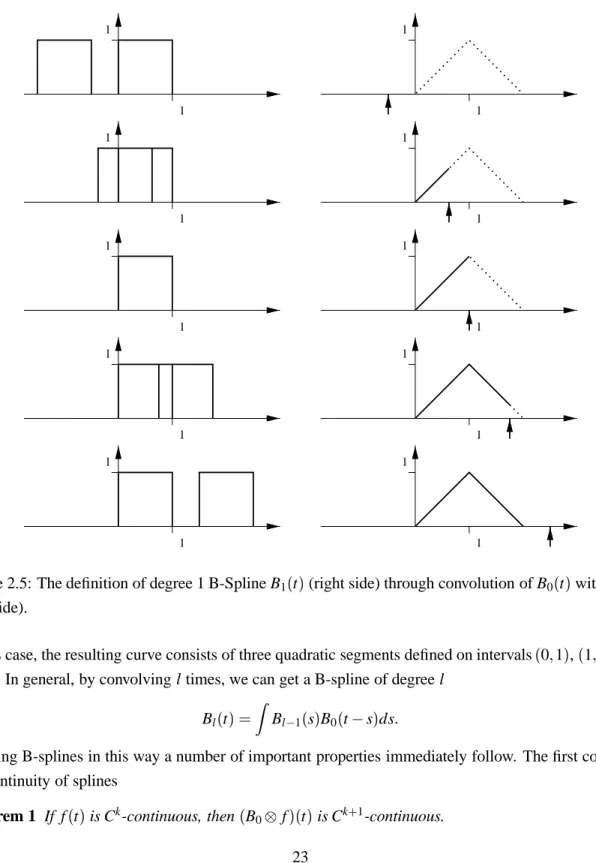
:Graphically (see Figure 2.5), this convolution can be evaluated by sliding one box function along the
coordinate axis from minus to plus infinity while keeping the second box fixed. The value of the
con-volution for a given position of the moving box is the area under the product of the boxes, which is just
the length of the interval where both boxes are non-zero. At first the two boxes do not have common
support. Once the moving box reaches 0, there is a growing overlap between the supports of the graphs.
The value of the convolution grows with t until t
=1. Then the overlap starts decreasing, and the value
of the convolution decreases down to zero at t
=2. The function B
1(t
)is the linear hat function as shown
in Figure 2.5.
We can compute the B-spline of degree 2 convolving B
1(t
)with the box B
0(t
)again
B
2(t
)=Z
B
1(s
)B
0(t
,s
)ds
:2The degree of a polynomial is the highest order exponent which occurs, while the order counts the number of coefficients
1 1 1 1 1 1 1 1 1 1 1 1 1 1 1 1 1 1 1 1
Figure 2.5: The definition of degree 1 B-Spline B
1(t
)(right side) through convolution of B
0(t
)with itself
(left side).
In this case, the resulting curve consists of three quadratic segments defined on intervals
(0
;1
),
(1
;2
)and
(2
;3
). In general, by convolving l times, we can get a B-spline of degree l
B
l(t
)= ZB
l,1(
s
)B
0(t
,s
)ds
:Defining B-splines in this way a number of important properties immediately follow. The first concerns
the continuity of splines
Theorem 1 If f
(t
)is C
k
-continuous, then
(
B
0f
)(t
)is C
k+1This is a direct consequence of convolution with a box function. From this it follows that the B-spline of
degree n is C
n,1continuous because the B-spline of degree 1 is C
0-continuous.
2.2.3
Refinability of B-splines
Another remarkable property of B-splines is that they obey a refinement equation. This is the key
observation to connect splines and subdivision. The refinement equation for B-splines of degree l is
given by
B
l(t
)=1
2
l l+1∑
k=0l
+1
k
B
l(2t
,k
):(2.1)
In other words, the B-spline of degree l can be written as a linear combination of translated (k) and
dilated (2t) copies of itself. For a function to be refineable in this way is a rather special property. As an
example of the above equation at work consider the hat function shown in Figure 2.5. It is easy to see that
it can be written as a linear combination of dilated hat functions with weights
(1
=2
;1
;1
=2
)respectively.
The property of refinability is the key to subdivision and so we will take a moment to prove it. We
start by observing that the box function, i.e., the B-spline of degree 0 can be written in terms of dilates
and translates of itself
B
0(t
)=B
0(2t
)+B
0(2t
,1
);(2.2)
which is easily checked by direct inspection. Recall that we defined the B-spline of degree l as
B
l(t
)= l O i=0B
0(t
)= l O i=0 (B
0(2t
)+B
0(2t
,1
))(2.3)
This expression can be “multiplied” out by using the following properties of convolution for functions
f
(t
), g
(t
), and h
(t
)f
(t
)(g
(t
)+h
(t
)) =f
(t
)g
(t
)+f
(t
)h
(t
)linearity
f
(t
,i
)g
(t
,k
) =m
(t
,i
,k
)time shift
f
(2t
)g
(2t
) = 1 2m
(2t
)time scaling
where m
(t
)=f
(t
)g
(t
). These properties are easy to check by substituting the definition of convolution
For example, in the case of B
1we get
B
1(t
) =B
0(t
)B
0(t
) = (B
0(2t
)+B
0(2t
,1
))(B
0(2t
)+B
0(2t
,1
)) =B
0(2t
)B
0(2t
)+B
0(2t
)B
0(2t
,1
)+B
0(2t
,1
)B
0(2t
)+B
0(2t
,1
)B
0(2t
,1
) =1
2
B
1(2t
)+1
2
B
1(2t
,1
)+1
2
B
1(2t
,1
)+1
2
B
1(2t
,1
,1
) =1
2
(B
1(2t
)+2B
1(2t
,1
)+B
1(2t
,2
)) =1
2
1 2∑
k=02
k
B
1(2t
,k
):The general statement for B-splines of degree l now follows from the binomial theorem
(
x
+y
) l+1 = l+1∑
k=0l
+1
k
x
l+1,ky
k;with B
0(2t
)in place of x and B
0(2t
,1
)in place of y.
2.2.4
Refinement for Spline Curves
With this machinery in hand let’s revisit spline curves. Let
γ
(t
)= "x
(t
)y
(t
) # =∑
ip
iB
il(t
)be such a spline curve of degree l with control points
(x
i;y
i) T=
p
i2R
2
. Since we don’t want to worry
about boundaries for now we leave the index set i unspecified. We will also drop the subscript l since the
degree, whatever it might be, is fixed for all our examples. Due to the definition of B
i(t
)=B
(t
,i
)each
control point exerts influence over a small part of the curve with parameter values t
2[i
;i
+l
].
Now consider p, the vector of control points of a given curve:
p
= 2 6 6 6 6 6 6 6 6 6 6 6 6 4..
.
p,
2p,
1p
0p
1p
2..
.
3 7 7 7 7 7 7 7 7 7 7 7 7 5and the vector B
(t
), which has as its elements the translates of the function B as defined above
B
(t
)= h :::B
(t
+2
)B
(t
+1
)B
(t
)B
(t
,1
)B
(t
,2
) ::: i :In this notation we can denote our curve as B
(t
)p.
Using the refinement relation derived earlier, we can rewrite each of the elements of B in terms of its
dilates
B
(2t
)= h :::B
(2t
+2
)B
(2t
+1
)B
(2t
)B
(2t
,1
)B
(2t
,2
) ::: i ;using a matrix S to encode the refinement equations
B
(t
)=B
(2t
)S
:The entries of S are given by Equation 2.1
S
2i+k;i =s
k=1
2
ll
+1
k
:The only non-zero entries in each column are the weights of the refinement equation, while successive
columns are copies of one another save for a shift down by two rows.
We can use this relation to rewrite
γ
(t
)γ
(t
)=B
(t
)p
=B
(2t
)Sp
:It is still the same curve, but desribed with respect to dilated B-splines, i.e., B-splines whose support is
half as wide and which are spaced twice as dense. We performed a change from the old basis B
(t
)to the
new basis B
(2t
)and concurrently changed the old control points p to the appropriate new control points
Sp. This process can be repeated
γ
(t
) =B
(t
)p
0 =B
(2t
)p
1 =B
(2t
)Sp
0..
.
=B
(2
jt
)p
j =B
(2
jt
)S
jp
0 ;from which we can define the relationship between control points at different levels of subdivision
p
j+1 =Sp
j ;
Looking more closely at one component, i, of our control points we see that
p
j+1 i =∑
lS
i;lp
j l:To find out exactly which s
kis affecting which term, we can divide the above into odd and even entries.
For the odd entries we have
p
j+1 2i+1 =∑
lS
2i+1;lp
j l =∑
ls
2(i,l)+1p
j land for the even entries we have
p
j+1 2i =∑
lS
2i;lp
j l =∑
ls
2(i,l)p
j l:From which we essentially get two different subdivision rules one for the new even control points of the
curve and one for the new odd control points. As examples of the above, let us consider two concrete
cases. For piecewise linear subdivision, the basis functions are hat functions. The odd coefficients are
12and
12, and a lone 1 for the even point. For cubic splines the odd coefficients turn out to be
12and
12, while
the even coefficients are
18,
68, and
18.
Another way to look at the distinction between even and odd is to notice that odd points at level j
+1
are newly inserted, while even points at level j
+1 correspond directly to the old points from level j.
In the case of linear splines the even points are in fact the same at level j
+1 as they were at level j.
Subdivision schemes that have this property will later be called interpolating, since points, once they
have been computed, will never move again. In contrast to this consider cubic splines. In that case even
points at level j
+1 are local averages of points at level j so that p
j+1 2i 6=
p
j
i
. Schemes of this type will
later be called approximating.
2.2.5
Subdivision for Spline Curves
In the previous section we saw that we can refine the control point sequence for a given spline by
multi-plying the control point vector p by the matrix S, which encodes the refinement equation for the B-spline
used in the definition of the curve. What happens if we keep repeating this process over and over,
gen-erating ever denser sets of control points? It turns out the control point sequence converges to the actual
spline curve. The speed of convergence is geometric, which is to say that the difference between the
curve and its control points decreases by a constant factor on every subdivision step. Loosely speaking
this means that the actual curve is hard to distinguish from the sequence of control points after only a
few subdivision steps.
We can turn this last observation into an algorithm and the core of the subdivision paradigm. Instead
of drawing the curve itself on the screen we draw the control polygon, i.e., the piecewise linear curve
through the control points. Applying the subdivision matrix to the control points defines a sequence of
piecewise linear curves which quickly converge to the spline curve itself.
In order to make these observations more precise we need to introduce a little more machinery in the
next section.
2.3
Subdivision as Repeated Refinement
2.3.1
Discrete Convolution
The coefficients s
kof the B-spline refinement equation can also be derived from another perspective,
namely discrete convolution. This approach mimics closely the definition of B-splines through
continu-ous convolution. Using this machinery we can derive and check many useful properties of subdivision
by looking at simple polynomials.
Recall that the generating function of a sequence a
kis defined as
A
(z
)=∑
k
a
kz
k;where A
(z
)is the z-transform of the sequence a
k. This representation is closely related to the discrete
Fourier transform of a sequence by restricting the argument z to the unit circle, z
=exp
(i
θ
). For the case
of two coefficient sequences a
kand b
ktheir convolution is defined as
c
k=(a
b
)k=∑
n
a
k,nb
n :In terms of generating functions this can be stated succinctly as
C
(z
)=A
(z
)B
(z
);which comes as no surprise since convolution in the time domain is multiplication in the Fourier domain.
The main advantage of generating functions, and the reason why we use them here, is that
manip-ulations of sequences can be turned into simple operations on the generating functions. A very useful
example of this is the next observation. Suppose we have two functions that each satisfy a refinement
equation
f
(t
) =∑
ka
kf
(2t
,k
)g
(t
) =∑
kb
kg
(2t
,k
):In that case the convolution h
=f
g of f and g also satisfies a refinement equation
h
(t
)=∑
k
c
kh
(2t
,k
);whose coefficients c
kare given by the convolution of the coefficients of the individual refinement
equa-tions
c
k=1
2
∑
ia
k,ib
i :With this little observation we can quickly find the refinement equation, and thus the coefficients of the
subdivision matrix S, by repeated multiplication of generating functions. Recall that the box function
B
0(t
)satisfies the refinement equation B
0(t
)=B
0(2t
)+B
0(2t
,1
). The generating function of this
refinement equation is A
(z
)=(1
+z
)since the only non-zero terms of the refinement equation are those
belonging to indices 0 and 1. Now recall the definition of B-splines of degree l
B
l(t
)= l O k=0B
0(t
);from which we immediately get the associated generating function
S
(z
)=1
2
l(1
+z
)l+1 :
The values s
kused for the definition of the subdivision matrix are simply the coefficients of the various
powers of z in the polynomial S
(z
)S
(z
)=1
2
l l+1∑
k=0l
+1
k
z
k;where we used the binomial theorem to expand S
(z
). Note how this matches the definition of s
kin
Equation 2.1.
Recall Theorem 1, which we used to argue that B-splines of degree n are C
n,1continuous. That same
theorem can now be expressed in terms of generating functions as follows
Theorem 2 If S
(z
)defines a convergent subdivision scheme yielding a C
k
-continuous limit function then
1
2(
1
+z
)S
(z
)defines a convergent subdivision scheme with C
k+1-continuous limit functions.
We will put this theorem to work in analyzing a given subdivision scheme by peeling off as many
fac-tors of
12(1
+z
)as possible, while still being able to prove that the remainder converges to a continuous
limit function. With this trick in hand all we have left to do is establish criteria for the convergence of
a subdivision scheme to a continuous function. Once we can verify such a condition for the
subdivi-sion scheme associated with B-spline control points we will be justified in drawing the piecewise linear
approximations of control polygons as approximations for the spline curve itself. We now turn to this
task.
2.3.2
Convergence of Subdivision
There are many ways to talk about the convergence of a sequence of functions to a limit. One can use
different norms and different notions of convergence. For our purposes the simplest form will suffice,
uniform convergence.
We say that a sequence of functions f
idefined on some interval
[a
;b
]R converges uniformly to a
limit function f if for all
ε
>0 there exists an n
0>0 such that for all n
>n
0max
t2[a;b]
j
f
(t
),f
n(t
)j<ε
:Or in words, as of a certain index (n
0) all functions in the sequence “live” within an
ε
sized tube around
the limit function f . This form of convergence is sufficient for our purposes and it has the nice
prop-erty that if a sequence of continuous functions converges uniformly to some limit function f , that limit
function is itself continuous.
For later use we introduce some norm symbols
k
f
(t
)k =sup
t jf
(t
)j kp
k =sup
i jp
ij kS
k =sup
i∑
k jS
ikj;which are compatible in the sense that, for example,
kSp
kkS
kkp
k.
The sequence of functions we want to analyze now are the control polygons as we refine them with
the subdivision rule S. Recall that the control polygon is the piecewise linear curve through the control
points p
jat level j. Independent of the subdivision rule S we can use the linear B-splines to define the
piecewise linear curve through the control points as P
j(t
)=B
1(2
j
t
)p
j
.
One way to show that a given subdivision scheme S converges to a continuous limit function is to
prove that (1) the limit
P
∞(t
)=lim
j!∞exists for all t and (2) that the sequence P
j(t
)converges uniformly. In order to show this property we
need to make the assumption that all rows of the matrix S sum to 1, i.e., the odd and even coefficients of
the refinement relation separately sum to 1. This is a reasonable requirement since it is needed to ensure
the affine invariance of the subdivision process, as we will later see. In matrix notation this means S1
=1,
or in other words, the vector of all 1’s is an eigenvector of the subdivision matrix with eigenvalue 1. In
terms of generating functions this means S
(,1
)=0, which is easily verified for the generating functions
we have seen so far.
Recall that the definition of continuity in the function setting is based on differences. We say f
(t
)is continuous at t
0if for any
ε
>0 there exists a
δ
>0 so that
jf
(t
0),f
(t
)j<ε
as long as
jt
0,t
j<δ
.
The corresponding tool in the subdivision setting is the difference between two adjacent control points
p
ij +1 ,p
j i =(∆
p
j)i
. We will show that if the differences between neighboring control points shrink fast
enough, the limit curve will exist and be continuous:
Lemma 3 If
k∆
p
jk<
c
γ
j
for some constant c
>
0 and a shrinkage factor 0
<γ
<1 for all j
>j
00
then P
j(t
)converges to a continuous limit function P
∞
(
t
).
Proof: Let S be the subdivision rule at hand, p
1=Sp
0
and S
1
be the subdivision rule for B-splines of
degree 1. Notice that the rows of S
,S
1sum to 0
(
S
,S
1)1
=S1
,S
11
=1
,1
=0
:This implies that there exists a matrix D such that S
,S
1=D
∆
, where
∆
computes the difference of
adjacent elements
(∆
)ii=,1,
(∆
)i ;i+1=
1, and zero otherwise. The entries of D are given as D
i j = ,∑
j k=i
(
S
,S
1)ik. Now consider the difference between two successive piecewise linear approximations
of the control points
k
P
j+1 (t
),P
j (t
)k = kB1
(2
j+1t
)p
j+1 ,B1
(2
jt
)p
j k = kB1
(2
j+1t
)Sp
j ,B1
(2
j+1t
)S
1p
j k = kB
1(2
j+1t
)(S
,S
1)p
j k kB
1(2
j+1t
)kkD
∆
p
j k kD
kk∆
p
j k kD
kc
γ
j :This implies that the telescoping sum P
0(t
)+∑
j k=0 (P
k+1 ,P
k)(
t
)converges to a well defined limit
func-tion since the norms of each summand are bounded by a constant times a geometric term
γ
j. Let P
∞ (t
)as j
!∞
, then
kP
∞ (t
),P
j (t
)k< kD
kc
1
,γ
γ
j ;since the latter is the tail of a geometric series. This implies uniform convergence and thus continuity of
P
∞(t
)as claimed.
How do we check such a condition for a given subdivision scheme? Suppose we had a derived
subdivision scheme D for the differences themselves
∆
p
j+1=
D
∆
p
j;
defined as the scheme that satisfies
∆
S
=D
∆
:Or in words, we are looking for a difference scheme D such that taking differences after subdivision is
the same as applying the difference scheme to the differences. Does D always exist? The answer is yes
if S is affinely invariant, i.e., S
(,1
)=0. This follows from the following argument. Multiplying S by
∆
computes a matrix whose rows are differences of adjacent rows in S. Since odd and even numbered rows
of S each sum to one, the rows of
∆
S must each sum to zero. Now the existence of a matrix D such that
∆
S
=D
∆
follows as in the argument above.
Given this difference scheme D all we would have to show is that some power m
>0 of D has norm
less than 1,
kD
m k=γ
<1. In that case
k∆
p
j k<c
(γ
1=m )j
. (We will see in a moment that the extra degree
of freedom provided by the parameter m is needed in some cases.)
As an example, let us check this condition for cubic B-splines. Recall that B
3(z
)= 1 8(1
+z
) 4, i.e.,
p
j+1 2i+1 =1
8
(4p
j i +4p
j i+1 )p
j+1 2i =1
8
(p
j i,1 +6p
j i+p
j i+1 ):Taking differences we have
(
∆
p
j+1 )2i =p
j+1 2i+1 ,p
j+1 2i =1
8
(,p
j i,1 ,2p
j i +3p
j i+1 ) =1
8
(3
(p
j i+1 ,p
j i)+1
(p
j i,p
j i,1 ))=1
8
(3
(∆
p
j )i+1
(∆
p
j )i ,1 );and similarly for the odd entries so that D
(z
)= 1 8(1
+z
)3
, from which we conclude that
kD
k=1
2
, and that
the subdivision scheme for cubic B-splines converges uniformly to a continuous limit function, namely
the B-spline itself.
Another example, which is not a spline, is the so called 4 point scheme [5]. It was used to create
the curve in Figure 2.1, which is interpolating rather than approximating as is the case with splines. The
generating function for the 4 point scheme is
S
(z
)=1
16
(,z
,3 +4z
,2 ,z
,1 )(1
+z
) 4Recall that each additional factor of
12(1
+z
)in the generating function increases the order of continuity of
the subdivision scheme. If we want to show that the limit function of the 4 point scheme is differentiable
we need to show that
18(,z
,3 +
4z
,2 ,z
,1 )(1
+z
)3
converges to a continuous limit function. This in
turn requires that D
(z
)= 1 8(,z
,3 +4z
,2 ,z
,1 )(1
+z
)2
satisfy a norm estimate as before. The rows of D
have non-zero entries of
( 1 4; 1 4), and
( ,1 8 ; 6 8; ,18 )
respectively. Thus
kD
k=1, which is not strong enough.
However, with a little bit more work one can show that
kD
2k= 3
4
, so that indeed the 4 point scheme is
C
1.
In general, the difficult part is to find a set of coefficients for which subdivision converges. There
is no general method to achieve this. Once a convergent subdivision scheme is found, one can always
obtain a desired order of continuity by convolving with the box function.
2.3.3
Summary
So far we have considered subdivision only in the context of splines where the subdivision rule, i.e., the
coefficients used to compute a refined set of control points, was fixed and everywhere the same. There
is no pressing reason for this to be so. We can create a variety of different curves by manipulating the
coefficients of the subdivision matrix. This could be done globally or locally. I.e., we could change the
coefficients within a subdivision level and/or between subdivision levels. In this regard, splines are just
a special case of the more general class of curves, subdivision curves. For example, at the beginning of
this chapter we briefly outlined an interpolating subdivision method, while spline based subdivision is
approximating rather than interpolating.
Why would one want to draw a spline curve by means of subdivision? In fact there is no sufficiently
strong reason for using subdivision in one dimension and none of the commercial line drawing packages
do so, but the argument becomes much more compelling in higher dimensions as we will see in later
chapters.
In the next section we use the subdivision matrix to study the behavior of the resulting curve at a point
or in the neighborhood of a point. We will see that it is quite easy, for example, to evaluate the curve
exactly at a point, or to compute a tangent vector, simply from a deeper understanding of the subdivision
matrix.
2.4
Analysis of Subdivision
In the previous section we have shown that uniform spline curves can be thought of as a special case of
subdivision curves. So far, we have seen only examples for which we use a fixed set of coefficients to
compute the control points everywhere. The coefficients define the appearance of the curve, for example,
whether it is differentiable or has sharp corners. Consequently it is possible to control the appearance of
the curve by modifying the subdivision coefficients locally. So far we have not seen a compelling reason
to do so in the 1D setting. However, in the surface setting it will be essential to change the subdivision
rule locally around extraordinary vertices to ensure maximal order of continuity. But before studying this
question we once again look at the curve setting first since the treatment is considerably easier to follow
in that setting.
To study properties such as differentiability of the curve (or surface) we need to understand which
of the control points influences the neighborhood of the point of interest. This notion is captured by the
concept of invariant neighborhoods to which we turn now.
2.4.1
Invariant Neighborhoods
Suppose we want to study the limit curve of a given subdivision scheme in the vicinity of a particular
control point.
3To determine local properties of a subdivision curve, we do not need the whole infinite
vector of control points or the infinite matrix describing subdivision of the entire curve. Differentiability,
for example, is a local property of a curve. To study it we need consider only an arbitrarily small piece
of the curve around the origin. This leads to the question of which control points influence the curve in
the neighborhood of the origin?
As a first example consider cubic B-spline subdivision. There is one cubic segment to the left of the
origin with parameter values t
2[,1
;0
]and one segment to the right with parameter range t
2[0
;1
].
Figure 2.6 illustrates that we need 5 control points at the coarsest level to reach any point of the limit
curve which is associated with a parameter value between
,1 and 1, no matter how close it is to the
origin. We say that the invariant neighborhood has size 5. This size depends on the number of non-zero
entries in each row of the subdivision matrix, which is 2 for odd points and 3 for even points. The latter
implies that we need one extra control point to the left of
,1 and one to the right of 1.
Another way to see this argument is to consider the basis functions associated with a given subdivision
scheme. Once those are found we can find all basis functions overlapping a region of interest and
3Here and in the following we assume that the point of interest is the origin. This can always be achieved through



![Figure 4.3: Loop subdivision: in the picture above, β can be chosen to be either 1 n ( 5 = 8 , ( 3 8 + 1 4 cos 2π n ) 2 ) (original choice of Loop [14]), or, for n > 3, β = 8n3 as proposed by Warren [25]](https://thumb-us.123doks.com/thumbv2/123dok_us/1558163.2708972/71.918.173.797.180.1027/figure-subdivision-picture-chosen-original-choice-proposed-warren.webp)
![Figure 4.6: Catmull-Clark subdivision. Catmull and Clark [3] suggest the following coefficients for rules at extraordinary vertices: β = 2k3 and γ = 4k1](https://thumb-us.123doks.com/thumbv2/123dok_us/1558163.2708972/75.918.128.825.152.1058/figure-catmull-subdivision-catmull-following-coefficients-extraordinary-vertices.webp)