Contract no 507953
Workpackage 6
Self organisation
Deliverable 6.3
How Software Development in
the DBE Differs From Normal
Business Software Development
Project funded by the European Community under the “Information Society Technology” Programme
Contract Number: 507953 Project Acronym: DBE
Title: Digital Business Ecosystem
Deliverable No: D6.3 Due date: 30/04/2005 Delivery date: 30/04/2005 Short Description:
This document is intended to provide a pamphlet-length non-technical summary, to the business partners, of software development within the Evolutionary Environment presented in deliverables D6.1 and D6.2, and how it differs to normal business software development.
Partners owning: ICL Partners contributing: ICL
Made available to: Consortium and EC Versioning
Version Date Author, organisation 1 30/04/05 Gerard Briscoe, ICL 1 30/04/05 Philippe De Wilde, ICL
Software Development in The
Evolutionary Environment
Digital Ecosystem
Gerard Briscoe
Philippe De Wilde
Intelligent Systems and Networks Group
Department of Electrical and Electronic Engineering
Imperial College London
April 2005
Acronyms
BML Business Modelling Language
EvE Evolutionary Environment
ICL Imperial College London
ISUFI Istituto Superiore Universitario di Formazione Interdisciplinare
LSE London School of Economics
SOA Service Oriented Architecture
SOLUTA SOLUTA.NET
STU Salzburg Technical University
SUN Sun Microsystems
Introduction
The state-of-the-art in business software development can be summarised as Service Oriented Architectures (SOAs). The SOA expresses a software architectural concept that incorporates modular reusable business services that have clearly defined and standardised interfaces.
In a SOA environment, nodes on a network make resources available to other participants in the network, as independent services that the participants access in a standardised way. Most definitions of SOAs identify the use of web services in their implementation. Unlike traditional object-oriented architectures, SOAs comprise loosely joined, highly interoperable application services, and because these services interoperate over different development technologies, the software components become very reusable.
SOAs promise to provide potentially huge numbers of services that programmers can combine, via the standardised interfaces, to create increasingly more sophisticated and distributed applications. TheEvolutionary Environment (EvE) Digital Ecosystem will extend this concept by the automatic combining of available and applicable services in a scalable architecture, to meet business user requests for applications.
Individuals within our Digital Ecosystem will be combinations of services (applications) created, using evolutionary optimisation, in response to business user requests for applications. These individuals will migrate through the Digital Ecosystem and adapt to find ’niches’ where they are useful in fulfilling other business user requests for applications. So the word ’ecosystem’ will be more than just a metaphor in the EvE Digital Ecosystem.
Evolutionary Environment Digital Ecosystem
Creating a Digital Ecosystem capable of the self-organising complex behaviour of a biological ecosystem is the ultimate aim of the EvE. Self-organisation is an emergent global ‘behaviour’ of a complex system, which consists of many autonomous components with local interaction rules. Over time a biological ecosystem becomes increasingly more complex, driven by the evolution of the populations within the ecosystem. In our Digital Ecosystem the components are the services which interact in evolving populations, forming applications, to provide optimal solutions to business user requests at the global level. The creation of the EvE Digital Ecosystem model, which started with the EvE Discussion Paper, has been achieved through the interactions of ICL, STU, UBHAM, SUN, SOLUTA, ISUFI and LSE. The final model for the EvE was presented in deliverable D6.2, and more technical information provided in the internal EvE Architecture Requirements document. The EvE Digital Ecosystem model is based on a Mobile Agent System with distributed evolutionary optimisation. Each business user will have a dedicated node, called a Habitat. At the business user’s Habitat an evolutionary optimisation process will find the optimal combination of services, from those registered at the Habitat, to meet requests from the business users. Alternative optimisation methods have been examined in deliverable D8.1, and it was concluded that evolutionary optimisation was the most effective in addressing
Business Ecosystem
FADA Network Execution Environment Evolutionary Environment
EvE service Service Manifest Software Service Real World Service pointer proxy (DNA) (Individual) EvE service pointer (Individual)
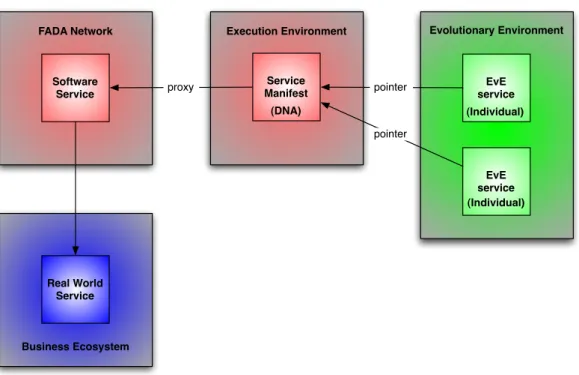
Figure 1: Relation of an EvE service to the DBE service it represents
A service in the real business world, such as selling books, is represented by a software service on a computer of the business user. The service is listed on the FADA network via a proxy reference. The Service Manifest describes the service in the Business Modelling Language (BML) and is stored in the distributed Semantic Registry of the Execution Environment. It also includes a reference to the proxy which activates the software service.
Habitat for Business A
Habitat Habitat Habitat Habitat Habitat for Biz D Habitat local collection of services
Evolutionary
Optimisation
(search for optimal combination of services) migrating service Evolutionary Optimisation (response to Biz A request for application) service application (group of services)
The individuals (EvE services) within the Digital Ecosystem are light-weight entities consisting of a description and an executable reference to the DBE service they represent. The description contained within each service acts as a guarantee of its functionality, and is the inheritable component from one generation to the next in the evolutionary optimisation.
Each Habitat is localised to the business user it was created for, and therefore the local collection of services within it will have properties which match those of the business user, and so be of potential use to the business user. The temporary evolving populations of applications (groups of services), will search the service combination space through evolutionary optimisation, to find the optimal solution(s) to meet business user requests for applications. These newly evolved applications are also stored within the Habitat’s local collection of services, as the combinations of services also have value.
The Habitat also provides a place for service migration to occur, as the Habitats are interconnected with one another. The migration of a service within the EvE is initially triggered by deployment to its Home Habitat for distribution, to business users who will potentially use the service. The successful use of the migrated service, in response to the business user requests for applications, will lead to further migration (distribution) and therefore availability of the service to other potential business users. The success of the migration, the migration feedback, leads to the reenforcing and creation of migration links between Habitats, just as the failure of migration leads to the weakening and negating of migration links between Habitats.
There will be at least hundreds of Habitats, as there is one for each business user, and potentially three or more times the number of populations at any one time. There will then be thousands of services and applications (groups of services) available to meet the application requests of the business users within the DBE. The union of the Habitats is the EvE Digital Ecosystem. The connectivity in the Habitats will be parallel to the ‘opportunity spaces’ (business sector and cross business sector interactions) that exist within the business user base.
H H H H H H H H H H H H H H
Figure 3: Habitat Network - Caveman Topology - Opportunity Spaces
The target topology for the EvE is a ‘caveman’ network in which there are ‘caves’ of high connectivity, equivalent to the strong interactions of opportunity spaces. This is based
Network-Based Economy
In an old market-based economy, made up of sellers and buyers, the parties exchange property. In a new network-based economy, made up of servers and clients, the parties share access to services and experiences. We view the EvE Digital Ecosystem as a platform to provide mechanisms for a network-based economy.
Strategic Business Partnerships
In terms of the DBE, specifically the EvE, a strategic business partnership is choosing to share the applications evolved in your Habitat with the Habitats of your business partners. The EvE will be set by default to share optimally solutions with potentially anyone, unless users turn off their application sharing. Users may not share generally, but will share more proactively, and specifically, with their business partners. This will benefit the business users who enter partnerships and the overall market efficiency, as investigated by ICL.
Evolving Futures Market
Each service consists of a remote executable component and a descriptive component. The descriptive component acting as a guarantee of behaviour. The evolutionary optimisation requires only the guarantees to work. The actual underlying code or service only comes into play once the whole application has been assembled. There is therefore, no strict requirement for the underlying code to exist until this stage. That is, evolution could happen entirely at the level of the specifications. Business users would only need to supply the service (code) once there is a demand for it. That is, when one of their specifications (or guarantees) has been used in the construction of an application which meets another business user’s request. The whole system then becomes more like an evolving futures market.
Targeting Potential Markets
The EvE could help mediate business propositions from the application consumer businesses to the service provider businesses. Consider a service provider business getting several dozen unfulfilled requests for the same service, a service that they are able to provide. They would easily be able to see the potential of offering the desired service(s). It would even be possible to have a virtual advertising board where all the requests for desired applications (unfulfilled requests) are listed so that business providers can see the potential markets (niches) to enter. So, market niches will be more easily identified and much easier to target, as the DBE will show the demand for specific services (applications) to fulfil the market niches.
Conclusion
The importance and challenge of creating the EvE should not be underestimated, as it is one of the project outputs to show ’integrated’ work from all the streams of the project. The interconnectivity will follow the business ’opportunity spaces’, it will use most of the computing ’DBE Core Architecture’, and will be designed around much of the scientific research.