Original Citation:
I/O-efficient similarity join
Springer Verlag Publisher: Published version: DOI: Terms of use: Open Access
This article is made available under terms and conditions applicable to Open Access Guidelines, as described at http://www.unipd.it/download/file/fid/55401 (Italian only)
Availability:
This version is available at: 11577/3228997 since: 2017-07-03T15:27:30Z
10.1007/978-3-662-48350-3_78
Università degli Studi di Padova
I/O-Efficient Similarity Join
?Rasmus Pagh, Ninh Pham, Francesco Silvestri??, and Morten St¨ockel? ? ? IT University of Copenhagen, Denmark
Abstract. We present an I/O-efficient algorithm for computing similarity joins based on locality-sensitive hashing (LSH). In contrast to the filtering methods commonly suggested our method has provable sub-quadratic dependency on the data size. Further, in contrast to straightforward implementations of known LSH-based algorithms on external memory, our approach is able to take significant advantage of the available internal memory: Whereas the time complexity of classical algorithms includes a factor ofNρ, whereρis a parameter of the LSH used, the I/O complexity
of our algorithm merely includes a factor (N/M)ρ, whereNis the data size andM is the size of internal memory. Our algorithm is randomized and outputs the correct result with high probability. It is a simple, recursive, cache-oblivious procedure, and we believe that it will be useful also in other computational settings such as parallel computation.
1
Introduction
The ability to handle noisy or imprecise data is becoming increasingly important in computing. In database settings this kind of capability is often achieved using similarity join primitives that replace equality predicates with a condition on similarity. To make this more precise consider a spaceUand a distance function
d:U×U→R. Thesimilarity join of sets R, S ⊆Uis the following: Given a radiusr, compute the setR ./≤rS ={(x, y)∈R×S|d(x, y)≤r}.This problem occurs in numerous applications, such as web deduplication [3, 14], document clustering [4], data cleaning [2, 6]. As such applications arise in large-scale datasets, the problem of scaling up similarity join for different metric distances is getting more important and more challenging.
Many known similarity join techniques (e.g., prefix filtering [2, 6], positional filtering [14], inverted index-based filtering [3]) are based onfiltering techniques that often, but not always, succeed in reducing computational costs. If we let
N =|R|+|S|these techniques generally require Ω(N2) comparisons for worst-case data. Another approach islocality-sensitive hashing (LSH) where candidate output pairs are generated using collisions of carefully chosen hash functions. The LSH definition is as follows.
?The research leading to these results has received funding from the European Research
Council under the EU 7th Framework Programme, ERC grant agreement no. 614331.
?? In part supported by University of Padova project CPDA121378 and by MIUR of
Italy project AMANDA while working at the University of Padova.
? ? ?
Supported by the Danish National Research Foundation / Sapere Aude program.
Definition 1. Fix a distance function d : U×U → R. For positive reals
r, c, p1, p2, and p1> p2, c >1, a family of functionsHis (r, cr, p1, p2)-sensitive
if for uniformly chosen h∈ H and allx, y∈U:
– Ifd(x, y)≤rthen Pr[h(x) =h(y)]≥p1;
– Ifd(x, y)> cr then Pr[h(x) =h(y)]≤p2.
We say thatHis monotonic if Pr[h(x) =h(y)]is a non-increasing function of the distance functiond(x, y). We also say thatHuses spacesif a functionh∈ H
can be stored and evaluated using space s.
LSH is able to break theN2barrier in cases where for some constantc >1
the number of pairs inR ./≤crS is not too large. In other words, there should not be too many pairs that have distance within a factorcof the threshold, the reason being that such pairs are likely to become candidates, yet considering them does not contribute to the output. For notational simplicity, we will talk aboutfar pairs at distance greater thancr (those that should not be reported), near pairs at distance at most r(those that should be reported), and c-near pairs at distance betweenrandcr(those that should not be reported but affect the I/O cost).
In this paper we study I/O-efficient similarity join methods based on LSH. That is, we are interested in minimizing the number of I/O operations where a block of B points from U is transferred between an external memory and an internal memory with capacity for M points from U. Our main result is
the first cache-oblivious algorithm for similarity join that has provably sub-quadratic dependency on the data sizeN and at the same time inverse polynomial dependency onM. In essence, where previous methods have an overhead factor of eitherN/M or (N/B)ρ we obtain an overhead of (N/M)ρ, where 0< ρ <1 is a parameter of the LSH employed, strictly improving both. We show:
Theorem 1. ConsiderR, S⊆U, letN=|R|+|S|, assume18 logN+3B≤M <
N and that there exists a monotonic(r, cr, p1, p2)-sensitive family of functions
with respect to distance measure d, using space B and with p2 < p1 < 1/2.
Letρ= logp1/logp2. Then there exists a cache-oblivious randomized algorithm
computing R ./≤rS (wrt.d) with probability1− O(1/N)using
˜ O N M ρ N B + |R ./ ≤rS| M B + |R ./ ≤crS| M B I/Os.1
Discussion. We now conjecture that the bound in Theorem 1 is close to the best
possible for the class of “signature based” algorithms that work by generating a set of LSH values (from a black-box and monotonic family) and checking all pairs that collide. For simple arguments, we split the I/O complexity of our algorithms
1
in two parts: T1= (N/M)ρ N/B+|R ./ ≤rS|/(M B) , T2=|R ./ ≤crS|/(M B).
We now argue that T1 I/Os is necessary. First, notice that we needO(N/B)
I/Os per hash function for transferring data between memories, computing and writing hash values to disk to find collisions. Second, since each I/O brings at mostB points in order to find collisions withM points residing in the internal memory, we needN/BI/Os to find collisions ofM N pairs. This means that when
p2≤M/N, the number of collisions of far pairs is at mostM N in expectation
and we needN/B I/Os to detect such far pairs.
Now consider the case where there are Ω N2 pairs at distance cr. Then the collision probability for each pair must be O(M/N) to ensure at most
M N collisions of far pairs due to the monotonicity of LSH family. In turn, this means that the collision probability for near pairs at distancermust be at most
O((M/N)ρ). So Ω((N/M)ρ) repetitions (different hash functions) are needed before we expect a near pair to collide at least once.
Then, a worst-case data set can be given so that we might need to examine, for each of theΩ((N/M)ρ) hash functions, a constant fraction the pairs inR ./
≤rS whose collision probability is constant. For example, this can happen ifRandS
include two clusters of close points. One could speculate that some pairs could be marked as “finished” during computation such that we do not have to compare their hash values again. However, it seems hard to make this idea work for an arbitrary distance measure where there may be very little structure to the output set, hence theO(|R ./≤rS|/(M B)) additional I/Os per repetition is needed.
To argue that the term T2 is needed, consider the case where all pairs in
R ./≤cr S have distancer+ε for a valueεsmall enough to make the collision probability of pair at distancer+εindistinguishable from the collision probability of pair at distance r. Then every pair in R ./≤cr S must be brought into the internal memory to ensure a correct result, which requiresT2 I/Os. This holds
forany algorithm enumerating or listing the near pairs. Therefore, there does not exist an algorithm that beats the quadratic dependency onN for such worst-case input sets, unless the distribution of the input is known beforehand. A possible approach to get subquadratic dependency onN in expectation when the number of reporting pairs is subquadratic is the one that can filter the pairs based on their distances — currently LSH-based methods are the only way to do this.
Note that whenM =N we haveT1=O(N/B) as we would expect, since just
reading the input is optimal. At the other extreme, when B=M = 1 our bound matches the time complexity of internal memory techniques. When|R ./≤crS| are bounded byM N then our algorithm achieves subquadratic dependency on
N/M. Such an assumption is realistic in some real-world datasets as shown in the experimental evaluation section.
It is worth noting that whereas most methods in the literature focus on a single (or a few) distance measure, our method works for an arbitrary space and
distance measure that allows LSH, e.g., Hamming, Manhattan (`1), Euclidean (`2),
Jaccard, and angular metric distances. A primary technical hurdle in the paper is that we cannot use any kind of strong concentration bounds on the number of points having a particular value, since hash values of an LSH family may be correlatedby definition. Another hurdle isduplicate elimination in the output stemming from pairs having multiple LSH collisions. However, in the context of I/O-efficient algorithms it is natural to not require thelisting of all near pairs (i.e., pairs with distance not greater than r), but rather we simply require that the algorithm enumerates all such near pairs. More precisely, the algorithm calls for each near pair (x, y) a functionemit(x, y). This is a natural assumption in external memory since it reduces the I/O complexity. In addition, it is desired in many applications where join results are intermediate results pipelined to a subsequent computation, and are not required to be stored on external memory. Our upper bound can be easily adapted to list all instances by increasing the I/O complexities of an unavoidable additive term ofΘ(|R ./≤rS|/B) I/Os.
The organization of the paper is as follows. In Section 2, we briefly review related work. Section 3 describes our algorithms including a warm-up cache-aware approach and the main results, a cache-oblivious solution, its analysis, and a randomized approach to remove duplicates. Section 4 shows some experimental results and Section 5 concludes the paper.
2
Related Work
Because Locality-sensitive hashing (LSH) is a building block of our I/O-efficient similarity join, we briefly review LSH, the computational I/O model, and some state-of-the-art similarity join techniques.
Locality-sensitive hashing (LSH).LSH was originally introduced by
In-dyk and Motwani [12] for similarity search problem in high dimensional data. This technique obtains a sublinear (i.e.,O(Nρ)) time complexity by increasing the gap of collision probability between near points and far points using the LSH family as defined in Definition 1. Such gap of collision probability is polynomial, with an exponent ofρ= logp1/logp2dependent onc.
It is worth noting that the standard LSHs for metric distances, including Hamming [12],`1[7],`2[1, 7], Jaccard [4] and angular distances [5] aremonotonic.
These common LSHs are space-efficient, and use space comparable to that required to store a point, except the LSH of [1] which requires spaceNo(1). We did not
explicitly require the hash values themselves to be particularly small. However, using universal hashing we can always map to small bit strings while introducing no new collisions with high probability. Thus we assume thatB hash values fit in one memory block.
Computational I/O model.We study algorithms for similarity join in the
external memory model, which has been widely adopted in the literature (see, e.g., the survey by Vitter [13]). The external memory model consists of an internal memory ofM words and an external memory of unbounded size. The processor can only access data stored in the internal memory and move data between the
two memories in blocks of sizeB. For simplicity we will here measure block and memory size in units of points fromU, such that a block can containB points. TheI/O complexity of an algorithm is defined as the number of input/output blocks moved between the two memories by the algorithm. The cache-aware approach makes use of the parameterM explicitly to achieve its I/O complexity whereas thecache-oblivious one [8] does not explicitly use any model parameters. The latter is a desirable property as it implies optimality on all levels of the memory hierarchy and does not require parameter tuning when executed on different physical machines. The cache-oblivious model assumes that the internal memory is ideal in the sense that it has optimal cache-replacement policy that can evict the block that is used the farthest in the future, and also that a block can be placed anywhere in the cache (full associativity).
Similarity join techniques.We review some state-of-the-art of similarity
join techniques most closely related to our work.
– Index-based similarity join.A popular approach is to make use of indexing
techniques to build a data structure for one relation, and then perform queries using the points of the other relation. The indexes typically perform some kind offiltering to reduce the number of points that a given query point is compared to (see, e.g., [6, 3]). Indexing can be space consuming, in particular for LSH, but in the context of similarity join this is not a big concern since we have many queries, and thus can afford to construct each hash table “on the fly”. On the other hand, it is clear that index-based similarity join techniques will not be able to take significant advantage of internal memory whenNM. Indeed, the query complexity stated in [9] isO((N/B)ρ) I/Os. Thus the I/O complexity of using indexing for similarity join will be high.
– Sorting-based. The indexing technique of [9] can be adapted to compute
similarity joins more efficiently by using the fact that many points are being looked up in the hash tables. This means that all lookups can be done in a batched fashion using sorting. This results in a dependency onN that is
˜
O (N/B)1+ρI/Os, whereρ∈(0; 1) is a parameter of the LSH family.
– Generic joins.WhenN is close toM the I/O-complexity can be improved
by using general join operators optimized for this case. It is easy to see that whenN/M is an integer, a nested loop join requiresN2/(M B) I/Os. Our oblivious algorithm will make use of the following result on cache-oblivious nested loop joins:
Theorem 2. (He and Luo [11]) For an arbitrary join condition, the join
of relationsR andS can be computed inO((|R|+|S|)/B+ (|R||S|)/(M B)) I/Os by a cache-oblivious algorithm. This number of I/Os suffices to generate the result in memory, but may not suffice to write it to disk.
3
Our Algorithms
In this section we describe our I/O efficient algorithms. We start in Section 3.1 with a warm-up cache-aware algorithm. It uses an LSH family where the value of the
Algorithm ASimJoin(R, S):R, S are the input sets.
1 Associate to each point inS a counter initially set to 0;
2 RepeatL= 1/p01times
3 Chooseh0i∈ H
0
uniformly at random;
4 Useh0ito partition (in-place)RandS in bucketsRv,Svof points with the
hash valuev;
5 Foreach hash valuevgenerated in the previous step
6 /* For simplicity we assume that|Rv| ≤ |Sv| */
7 SplitRvandSvinto chunksRi,v andSi,v of size at mostM/2;
8 Forevery chunkRi,vofRv
9 Load in memoryRi,v;
10 Forevery chunkSi,vofSvdo
11 Load in memorySi,v;
12 ComputeRi,v×Si,v and emit all near pairs. For each far pair,
increment the associated counters by 1;
13 Remove fromSi,v andRi,vall points with the associated counter
larger than 4LM, and writeSi,v back to external memory;
14 WriteRi,v back to external memory;
collision probability is set to be a function of the internal memory size. Section 3.2 presents our main result, a recursive and cache-oblivious algorithm which uses the LSH with a black-box approach and does not make any assumption on the value of collision probability. Section 3.3 describes the analysis and Section 3.4 shows how to reduce the expected number of times each near pair is emitted.
3.1 Cache-aware algorithm: ASimJoin
We will now describe a simple cache-aware algorithm calledASimJoin, which achieves the worst case I/O bounds as stated in Theorem 1.ASimJoin relies on an (r, cr, p01, p02)-sensitive family H0 of hash functions with the following
properties: p02≤M/N and p10 ≥(M/N)ρ, for a suitable value 0< ρ <1. Given an arbitrary monotonic (r, cr, p1, p2)-sensitive family H, the family H0 can be
built by concatenatingdlogp2(M/N)ehash functions fromH. For simplicity, we assume that logp2(M/N) is an integer and thus the probabilitiesp01, p02 can be exactly obtained. However, the algorithm and the analysis can be extended to the general case by increasing the I/O complexity by a factor at mostp−11in the worst case; in practical scenarios, this factor is a small constant [4, 7, 9].
ASimJoinassumes that each point in RandS is associated with a counter
initially set to 0. This counter can be thought as another dimension of the point which hash functions and comparisons do not take into account. The algorithm repeats L= 1/p01 times the following procedure. A hash function is randomly drawn from the (r, cr, p01, p02)-sensitive family, and it is used for partitioning the setsRandS into buckets of points with the same hash value. We letRv andSv denote the buckets respectively containing points ofRandS with the same hash valuev. Then, the algorithm iterates through every hash value and, for each hash
valuev, it uses a double nested loop for generating all pairs of points inRv×Sv. The double nested loop loads consecutive chunks ofRv andSv of size at most
M/2: the outer loop runs on the smaller set (sayRv), while the inner one runs on the larger one (saySv). For each pair (x, y), the algorithm emits near pairs
d(x, y)≤r, ignoresc-near pairsr < d(x, y)≤crand far pairsd(x, y)> cr, and increases counters associated withxandy of the far pairs by 1. Every time the counter of a point exceeds 4LM, the point is removed from the bucket. Chunks will be moved back in memory when they are no more needed. The following theorem shows the I/O bounds of the cache-aware approach.
Theorem 3. Consider R, S ⊆ U and let N = |R|+|S| be sufficiently large.
Assume there exists a monotonic(r, cr, p01, p02)-sensitive family of functions with respect to distance measure dwith p01= (M/N)ρ and p0
2=M/N, for a suitable
value0< ρ <1. With probability1−1/N, the ASimJoinalgorithm enumerates all near pairs using
˜ O N M ρ N B + |R ./ ≤rS| M B + |R ./ ≤crS| M B I/Os.
Proof. We first observe that the I/O cost of Steps 3-4, that is of partitioning sets
R andS according to a hash functionh0i, isL·sort(N) = ˜O((N/M)ρN/B)2 for
L≤(N/M)ρ repetitions.
Consider now the I/O cost of an iteration of the loop in Step 5 for a given hash value v and suppose that the size of the smaller bucket is smaller than
M/2. Then, the I/O cost is at most (|Rv|+|Sv|)/B. Therefore, the total I/O cost of theLiterations of Step 5 among all possible hash values where at least one bucket has size smaller thanM/2 is at most LN/B= (N/M)ρN/B I/Os.
Next, we consider the I/O cost of an iteration the loop in Step 5 for a given hash value v when both buckets Rv andSv are larger thanM/2. In this case the I/O cost is 2|Rv||Sv|/(BM), from which follows that the amortized cost of each pair inRv×Sv is 2/(BM). Therefore the I/O cost of all iterations of Step 5, when there are no bucket size less than M/2, can be upper bounded by multiplying the total number of generated pairs for the amortized I/O cost. It is clear that generated pairs can be partitioned into three groups: near pairs,c-near pairs and far pairs. We denote withCn,CcnandCf the respective size of each group.
1. Number of near pairs.By definition, LSH gives a lower bound on the proba-bility of collision of near pairs. It may happen that the collision probaproba-bility of near pairs is 1. Thus, two near points can be in the same hash value in each one of theLrepetitions of Step 2. This means thatCn≤L|R ./≤rS| (note that this is a deterministic worst case bound).
2
We let sort(N) =O(N/B) logM/B(N/B)
be shorthand for the I/O complexity [13] of sortingN points.
2. Number of c-near pairs. A pair from R ./≤cr S appears in a bucket with probability at most p01 due to monotonicity of our LSH family. Since we repeat for L = 1/p01 hash functions, the each c-near pair collide at most once in expectation. By using the Chernoff bound on 3 logN independentL
repetitions and applying the union bound, we getCcn≤3 logN|R ./≤crS| with probability 1−1/N.
3. Number of far pairs. For each pointx∈R∪S we throwxaway as described above if it exceeds 4LM collisions with points that are more than distance
craway. We have that the number of far away collisions examined per point is at most 4LM, and hence the total number of far pairs isCf ≤4N LM. Therefore by summing the number of near pairsCn, c-near pairs Ccn, and far pairs Cf and multiplying these quantities by the amortized I/O complexity 2/(BM), we get that the I/O cost of all iterations of Step 5, when there are no buckets of size less than M/2, is
N M ρ 8N B + 2|R ./≤rS| BM +6 logN|R ./≤crS| BM ,
with probability at least 1−1/N. By summing all the previous bounds, we get the claimed bound with high probability. ut
As already mentioned in the introduction, a near pair (x, y) can be emitted many times during the algorithm since points x andy can be hashed on the same value inp(x, y)Lrounds of Step 2, wherep(x, y)≥p01 denotes the actual collision probability. A simple approach for avoiding duplicates is the following: for each near pair found during thei-th iteration of Step 2, the pair is emitted only if the two points did not collide by all hash functions used in the previous
i−1 rounds. The check starts from the hash function used in the previous round and backtracks until a collision is found or there are no more hash functions. This approach increases the worst case complexity by a negligible constant factor (e.g, by setting M =B=O(1)). Section 3.4 shows a more efficient randomized algorithm that reduces the number of replica per near pair to a constant. It also applies to the cache-oblivious algorithm described in the next section.
3.2 Cache-oblivious algorithm: OSimJoin
The above cache-aware algorithm uses an (r, cr, p01, p02)-sensitive family of
func-tions, withp01∼(M/N)ρ andp02 ∼M/N, for partitioning the initial sets into
smaller buckets, which are then efficiently processed in the internal memory using the nested loop algorithm. As soon as the internal memory size M is known, this family of functions can be constructed by concatenating dlogp
2p
0
2e hash
functions from any given primitive (r, cr, p1, p2)-sensitive family. However, in the
cache-oblivious settings the value ofM is not known and such family cannot be built. Therefore, we propose in this section an algorithm, namedOSimJoin that efficiently computes the similarity join even without knowing the values of the internal memory size M and the block length B. OSimJoin uses as a
Algorithm OSimJoin(R, S, ψ): R, S are the input sets, and ψ is the recursion depth.
1 If |R|>|S|,thenswap (the references to) the sets such that|R| ≤ |S|;
2 If ψ=Ψ or|R| ≤1,thencomputeR ./≤r Susing the algorithm of Theorem 2
and return;
3 Pick a random sampleS0 of 18∆points fromS(or all points if|S|<18∆);
4 ComputeR0 containing all points ofRthat have distance smaller thancrto at least half points inS0;
5 ComputeR0./≤rS using the algorithm of Theorem 2;
6 RepeatL= 1/p1times
7 Chooseh∈ Huniformly at random;
8 Usehto partition (in-place)R\R0 andS in bucketsRv,Svof points with
hash valuev;
9 ForeachvwhereRvandSv are nonempty, recursively call OSimJoin(Rv, Sv, ψ+ 1);
black-box a given monotonic (r, cr, p1, p2)-sensitive family of functions3. The
value ofp1andp2can be considered constant in practical scenario. As common in
the cache-oblivious settings, we use a recursive approach for splitting the problem into smaller and smaller subproblems that at some point will fit the internal memory, although this point is not known in the algorithm. We first give a high level description of the cache-oblivious algorithm and an intuitive explanation. We then provide a more detailed description and analysis.
OSimJoinreceives in input the two sets R andS of similarity join, and a
parameterψdenoting the depth in the recursion tree (initially, ψ= 0) that is used for recognizing the base case. Let |R| ≤ |S|, N =|R|+|S|, and denote with∆= logN andΨ =dlog1/p2Netwo global values that are kept invariant in the recursive levels and computed using the initial input sizeN. For simplicity we assume that 1/p1 and 1/p2are integers, and further assume without loss of
generality that the initial size N is a power of two. Note that, if 1/p1 is not
integer, that the last iteration can be performed with probability 1/p1− b1/p1c,
such thatL∈ {b1/p1c,d1/p1e}andE[L] = 1/p1.
OSimJoin works as follows. If the problem is currently at recursive level
Ψ =dlog1/p2NeorRis empty, the recursion ends and the problem is solved using
the cache-oblivious nested loop described in Theorem 2. Otherwise the following operations are executed. By exploiting sampling, the algorithm identifies a subset
R0 of R containing (almost) all points that are near or c-near to a constant fraction of points inS. More specifically, the setR0 is computed by creating a random sampleS0ofSof size 18∆and then adding toR0all points inRthat have distance at most crto at least half points inS0. The join R0 ./≤rS is computed by using the cache-oblivious nested-loop of Theorem 2 and then points in R0 3 The monotonicity requirement can be relaxed to the following: Pr [h(x) =h(y)]≥
Pr [h(x0) =h(y0)] for every two pairs (x, y) and (x0, y0) where d(x, y) ≤ r and
are removed fromR. Subsequently, the algorithm repeatsL= 1/p1 times the
following operations: a hash function is extracted from the (r, cr, p1, p2)-sensitive
family and used for partitioning RandS into buckets, denoted withRv andSv with any hash valuev; then, the joinRv./≤rSv is computed recursively.
The explanation of our approach is the following. By recursively partitioning input points with hash functions from an (r, cr, p1, p2)-sensitive family, the
algo-rithm decreases the probability of collision between two far points. In particular, the collision probability of two far points ispi
2 at thei-th recursive level. On the
other hand, by repeating the partitioning 1/p1 times in each level, the algorithm
guarantees that a pair of near points is enumerated with constant probability since the probability that two near points collide is pi1 at thei-th recursive level.
It deserves to be noticed that the collision probability of far and near points at the recursive level log1/p2(N/M) is Θ(M/N) and Θ((M/N)
ρ), respectively, which are asymptotically equivalent to the values in the cache-aware algorithm. In other words, the partitioning of points at this level is equivalent to the one in the cache-aware algorithm, being the expected number of colliding far points is
M. Finally, we observe that, when a point inR becomes close to many points in
S, it is more efficient to detect and remove it, instead of propagating it down to the base cases. Indeed, it may happen that the collision probability of these points is large (close to 1) and the algorithm is not able to split them into subproblems that fit in memory.
3.3 I/O Complexity and Correctness of OSimJoin
Analysis of I/O Complexity. We will bound theexpected number of I/Os
of the algorithm rather than the worst case. This can be converted to a fixed time bound by a standard technique of restarting the computation when the expected number of I/Os is exceeded by a factor 2. To succeed with probability 1−1/Nit suffices to doO(logN) restarts to complete within twice the expected time bound, and the logarithmic factor is absorbed in the ˜O-notation. If the computation does not succeed within this bound we fail to produce an output, slightly increasing the error probability.
For notional simplicity, in this section we letRandS denote the initial input sets and let ˜Rand ˜S denote the subsets given in input to a particular recursive subproblem (note that ˜R can be a subset ofR but also ofS; similarly for ˜S). We also let ˜S0 denote the sampling of ˜S in Step 3, and with ˜R0 the subset of ˜R
computed in Step 4. Lemma 1 says that two properties of the choice of random sample in Step 3 are almost certain, and the proof relies on Chernoff bounds on the choice of ˜S0. In the remainder of the paper, we assume that Lemma 1 holds and refer to this event asAholding with probability 1− O(1/N).
Lemma 1. Consider a run of Steps 3 and 4 in a subproblem OSimJoin( ˜R,S, ψ˜ ),
for any level 0≤ψ ≤Ψ. Then with probability at least 1− O(1/N) over the choice of sampleS˜0 we have:
|R˜0 ./ ≤cr ˜ S|> |R˜ 0||S˜| 6 , (1)
|( ˜R\R˜0) ./ >cr ˜ S|> 5| ˜ R\R˜0||S˜| 6 . (2)
Proof. Both claims follow from Chernoff bounds. Letx∈R˜ be a point which is
c-near to at most one sixth of the points in ˜S, i.e.|x ./≤crS˜| ≤ |S˜|/6. The point
xenters ˜R0 if there are at least 9∆ c-near points in ˜S0 and this happens with probability at most 1/N4 since the entries in ˜S0 are randomly and independently
chosen from ˜S and there is probability 1/6 that an entry in ˜S is near tox. Each point of R ∪S appears in at most in 2Pii=0=Ψ−1Li < 2LΨ < 2N2
subproblems. Because there are at mostN points inR∪S, by an union bound we get that, in any subproblemOSimJoin( ˜R,S, ψ˜ ), with probability 1−2N3N−4=
1−2N−1 every point in ˜R0 has at least |S˜|/6c-near points in ˜S, and thus the bound in Equation 1 follows. Similarly, we have that all points in ˜R\R˜0 are far from at least 5/6 points of ˜S with probability at least 1−2N−1, getting
Equation 2. ut
To analyze the number of I/Os for subproblems of size more thanM we bound the cost in terms of different types ofcollisions, i.e., pairs inR×S that end up in the same subproblem of the recursion. We say that (x, y)is in a particular subproblem OSimJoin( ˜R,S, ψ˜ ) if (x, y)∈( ˜R×S˜)∪( ˜S×R˜). Observe that a pair (x, y) is in a subproblem if and only ifxandy have colliding hash values on every step of the call path from the initial invocation of OSimJoin.
Definition 2. GivenQ⊆R×S letCi(Q)be the number of times a pair inQ
is in a call to OSimJoinat thei-th level of recursion. We also let Ci,k(Q), with 0≤k≤logM denote the number of times a pair inQis in a call to OSimJoin at thei-th level of recursion where the smallest input set has size in[2k,2k+1)if
0≤k <logM, and in [M,+∞)if k= logM. The count is over all pairs and
with multiplicity, so if(x, y)is in several subproblems at thei-th level, all these are counted.
Next we bound the I/O complexity of OSimJoinin terms ofCi(R ./≤crS) andCi,k(R ./>crS), for any 0≤i < Ψ. We will later upper bound the expected size of these quantities in Lemma 3 and then get the claim of Theorem 1.
Lemma 2. Let ` = dlog1/p2(N/M)e and M ≥ 18 logN + 3B. Given that A
holds, the I/O complexity of OSimJoin(R, S,0) is
˜ O N L` B + ` X i=0 Ci R ./ ≤crS M B + Ψ−1 X i=` logM X k=0 Ci,k R ./ >crS L B2k
Proof. To ease the analysis we assume that no more than 1/3 of internal memory is used to store blocks containing elements ofR andS, respectively. Since the cache-oblivious model assumes an optimal cache replacement policy this cannot decrease the I/O complexity. Also, internal memory space used for other things
than data (input and output buffers, the recursion stack of size at mostΨ) is less thanM/3 by our assumption thatM ≥18∆+ 3B=Ω(logN). As a consequence, we have that the number of I/Os for solving a subproblemOSimJoin ( ˜R,S,˜ ·) where|R˜| ≤M/3 and|S˜| ≤M/3 isO(|R˜|+|S˜|)/B, including all recursive calls. This is because there is spaceM/3 dedicated to both input sets and only I/Os for reading the input are required. By charging the cost of such subproblems to the writing of the inputs in the parent problem, we can focus on subproblems where the largest set (i.e., ˜S) has size more thanM/3. We notice that the cost of Steps 3 and 4 is dominated by other costs by our assumption that the set ˜S0 fits in internal memory, which implies that it suffices to scan data once to implement these steps. This cost is clearly negligible with respect to the remaining steps and thus we ignore them.
We first provide an upper bound on the I/O complexity required by all subproblems at a recursive level above`. LetOSimJoin( ˜R,S, i˜ ) be a recursive call at thei-th recursive level, for 0≤i≤`. The I/O cost of the nested loop join in Step 5 in OSimJoin ( ˜R,S, i˜ ) is O|S˜|/B+|R˜0||S˜|/(M B) by Theorem 2. We can ignore the O|S˜|/B term since it is asymptotically negligible with respect to the cost of each iteration of Step 6, which is upper bounded later. By Equation 1, we have that ˜R0./≤crS˜contains more than|R˜0||S˜|/6 collisions, and thus the cost of Step 5 in OSimJoin( ˜R,S, i˜ ) is O|R˜0 ./≤crS˜|/(M B)
. This means that we can bound the total I/O cost of all executions of Step 5 at leveliof the recursion with O(Ci(R ./≤crS)/(M B)) since each near pair (x, y) appears in Ci((x, y)) subproblems at leveli.
The second major part of the I/O complexity is the cost of preparing recursive calls inOSimJoin( ˜R,S, i˜ ) (i.e., Steps 7-8). In fact, in each iteration of Step 6, the I/O cost is ˜O(|R˜|+|S˜|)/B, which includes the cost of hashing and of sorting to form buckets. Since each point of ˜Rand ˜S is replicated inLsubproblems in Step 6, we have that each point of the initial sets R andS is replicated Li+1
times at level i. Since the average cost per entry is ˜O(1/B), we have that the total cost for preparing recursive calls at leveliis ˜O N Li+1/B
. By summing the above terms, we have that the total I/O complexity of all subproblems in thei-th recursive level is upper bounded by:
˜ O Ci R ./ ≤crS M B + N Li+1 B . (3)
We now focus our analysis to bound the I/O complexity required by all subproblems at a recursive level below `. Let again OSimJoin( ˜R,S, i˜ ) be a recursive call at thei-th recursive level, for `≤i≤Ψ. We observe that (part of) the cost of a subproblem at leveli≥`can be upper bounded by a suitable function of collisions among far points inOSimJoin ( ˜R,S, i˜ ). More specifically, consider an iteration of Step 6 in a subproblem at level i. Then, the cost for
preparing the recursive calls and for performing Step 5 in each subproblem (at leveli+ 1) generated during the iteration, can be upper bounded as
˜
O(|R˜\R˜0|+|S˜|)/B+|( ˜R\R˜0)./≤cr S˜|/(BM)
,
since each near pair in ( ˜R\R˜0) ./≤cr S˜ is found in Step 5 in at most one subproblem at level i+ 1 generated during the iteration. Since we have that
|( ˜R\R˜0)./≤crS˜| ≤ |R˜\R˜0||S˜|, we easily get that the above bound can be rewritten as ˜O|R˜\R˜0||S˜|/(Bmin{M,|R˜\R˜0|}). We observe that this bound holds even wheni=Ψ−1: in this case the cost includes all I/Os required for solving the subproblems at levelΨ called in the iteration and which are solved using the nested loop in Theorem 2 (see Step 2). By Lemma 1, we have that the above quantity can be upper bounded with the number of far collisions between ˜Rand
˜
S, getting ˜O(|R˜\R˜0./>crS˜|)/(Bmin{M,|R˜\R˜0|})
.
Recall thatCi,k(Q) denotes the number of times a pair in Qis in a call to
OSimJoinat thei-th level of recursion where the smallest input set has size in
[2k,2k+1) if 0≤k <logM, and in [M,+∞) ifk= logM. Then, the total cost
for preparing the recursive calls in Step 7-8 in all subproblems at leveli and for performing Step 5 in all subproblems at level (i+ 1) is:4
˜ O logM X k=0 Ci,k(R ./>crS)L B2k ! . (4)
TheLfactor in the above bound follows since far collisions at leveliare used for amortizing the cost of Step 5 for each one of the Literations of Step 6.
To get the total I/O complexity of the algorithm we sum the I/O complexity required by each recursive level. We bound the cost of each level as follows: for a level i < `we use the bound in Equation 3; for a leveli > `we use the bound in Equation 4; for leveli=`, we use the bound given in Equation 4 to which we add the first term in Equation 3 since the cost of Step 5 at level`is not included in Equation 4 (note that the addition of Equations 3 and 4 gives a weak upper bound for level`). The lemma follows. ut
We will now analyze the expected sizes of the terms in Lemma 2. Clearly each pair fromR×S is in the top level call, so the number of collisions is|R||S|< N2.
But in lower levels we show that the expected number of times that a pair collides either decreases or increases geometrically, depending on whether the collision probability is smaller or larger thanp1 (or equivalently, depending on whether
the distance is greater or smaller than the radius r). The lemma follows by expressing the number of collisions of the pairs at thei-th recursive level as a Galton-Watson branching process [10].
4 We note that the true input size of a subproblem is|R˜|and not|R˜\R˜0|
. However, the expected value ofCi,k(R ./>crS) is computed assuming the worst case where
Lemma 3. Given thatAholds, for each 0≤i≤Ψ we have 1. E Ci R ./ >crS ≤ |R ./ >crS|(p2/p1) i; 2. E Ci R ./ >r,≤crS ≤ |R ./ >r,≤crS|; 3. E Ci R ./ ≤rS ≤ |R ./ ≤rS|L i; 4. E Ci,k R ./ >crS ≤N2k+1(p
2/p1)i, for any0≤k <logM.
Proof. Letx∈R andy∈S. We are interested in upper bounding the number of collisions of the pair at thei-th recursive level. We envision the problem as branching process (more specifically a GaltonWatson process, see e.g. [10]) where the expected number of children (i.e., recursive calls that preserve a particular collision) is Pr [h(x) =h(y)]/p1 for randomh∈ H. It is a standard fact from
this theory that the expected population size at generationi (i.e., number of times (x, y) is in a problem at recursive level i) is (Pr [h(x) =h(y)]/p1)i [10,
Theorem5.1]. Ifd(x, y)> cr, we have that Pr [h(x) =h(y)]≤p2and each far pair
appears (p2/p1)i times in expectation at leveli, from which follows Equation 1.
Moreover, since the probability of collisions is monotonic in the distance, we have that Pr [h(x) =h(y)] ≤ 1 if d(x, y) ≤ r, and Pr [h(x) =h(y)] ≤ 1/p1 if
r < d(x, y)≤cr, from which follow Equations 2 and 3.
In order to get the last bound we observe that each entry of R andS is replicated Li =p−i
1 times at level i. Thus, we have that N2k+1Li is the total
maximum number of far collisions in subproblems at leveliwhere the smallest input set has size in [2k,2k+1). Each one of these collisions survives up to
leveliwith probabilitypi
2, and thus the expected number of these collisions is
N2k+1(p
1/p2)i. ut
We are now ready to prove the I/O complexity of OSimJoin as claimed in Theorem 1. By the linearity of expectation and Lemma 2, we get that the expected I/O complexity of OSimJoinis
˜ O N L` B + ` X i=0 E Ci R ./ ≤crS M B + Ψ−1 X i=` logM X k=0 E Ci,k R ./ >crS L B2k ,
where`=dlog1/p2(N/M)e. By noticingCi,logM(R ./>cr S)≤Ci(R ./>crS) we
have|R ./>cr S| ≤N2andCi(R ./≤crS) =Ci(R ./≤rS) +Ci(R ./>r,≤crS), and by plugging in the bounds on the expected number of collisions given in Lemma 3, we get the claimed result.
Analysis of Correctness. We now argue that a pair (x, y) withd(x, y)≤ris
at levelicontaining (x, y). By applying Galton-Watson branching process, we get thatE[Xi] = (Pr [h(x) =h(y)]/p1)i. If Pr [h(x) =h(y)]/p1>1 then in fact
there is positive constant probability that (x, y) survives indefinitely, i.e., does not go extinct [10]. Since at every branch of the recursion we eventually compare points that collide under all hash functions on the path from the root call, this implies that (x, y) is reported with positive constant probability.
In thecritical case where Pr [h(x) =h(y)]/p1 = 1 we need to consider the
variance of Xi, which by [10, Theorem 5.1] is equal to iσ2, where σ2 is the variance of the number of children (hash collisions in recursive calls). If 1/p1
is integer the number of children in our branching process follows a binomial distribution with mean 1. This implies thatσ2<1. Also in the case where 1/p1
is not integer it is easy to see that the variance is bounded by 2. That is, we have Var (Xi)≤2i, which by Chebychev’s inequality means that for some integer
j∗= 2√i+O(1): ∞ X j=j∗ Pr [Xi≥j]≤ ∞ X j=j∗ Var (Xi)/j2≤1/2 . Since we have E[Xi] = P ∞ j=1Pr [Xi≥j] = 1 then Pj∗−1 j=1 Pr [Xi≥j] > 1/2, and since Pr [Xi≥j] is non-increasing with j this implies that Pr [Xi≥1]≥ 1/(2j∗) =Ω 1/√i
. Since recursion depth isO(logN) this implies the probabil-ity that a near pair is found isΩ 1/√logN
. Thus, by repeatingOlog3/2N
times we can make the error probability O 1/N3
for a particular pair and
O(1/N) for the entire output by applying the union bound.
3.4 Removing duplicates
The definition of LSH requires the probabilityp(x, y) = Pr [h(x) =h(y)] of two near pointsxandyof being hashed on the same value is at leastp1. Ifp(x, y)p1,
ourOSimJoin algorithm can emit (x, y) many times. As an example suppose
that the algorithm ends in one recursive call: then, the pair (x, y) is expected to be in the same bucket forp(x, y)Literations of Step 6 and thus it is emitted
p(x, y)L1 times in expectation. Moreover, if the pair is not emitted in the first recursive level, the expected number of emitted pairs increases as (p(x, y)L)isince the pair (x, y) is contained in (p(x, y)L)i subproblems at thei-th recursive level. A simple solution requires to store all emitted near pairs on the external memory, and then using a cache-oblivious sorting algorithm [8] for removing repetitions. However, this approach requires ˜Oκ|R./≤rS|
B
I/Os, whereκis the expected average replication of each emitted pair, which can dominate the complexity of
OSimJoin. A similar issue appears in the cache-aware algorithmASimJoinas
well: however, a near pair is emitted in this case at mostL0 = (N/M)ρ since there is no recursion and the partitioning of the two input sets is repeated only
L0 times.
If the collision probability Pr [h(x) =h(y)] can be explicitly computed in
pair once in expectation without storing near pairs on the external memory. We note that the collision probability can be computed for many metrics, including Hamming [12], `1 and `2 [7], Jaccard [4], and angular [5] distances. For the
cache-oblivious algorithm, the approach is the following: for each near pair (x, y) that is found at the i-th recursive level, with i ≥0, the pair is emitted with probability 1/(p(x, y)L)iand is ignored otherwise. For the cache-aware algorithm, the idea is the same but a near pair is emitted with probability 1/(p(x, y)L0) withL0= (N/M)ρ.
Theorem 4. The above approaches guarantee that each near pair is emitted with
constant probability in ASimJoinand in OSimJoin.
Proof. The claim easily follows for the cache-aware algorithm: indeed the two points of a near pair (x, y) have the same hash value inp(x, y)L(in expectation) of theL0 = (N/M)ρ repetitions of Step 2. Therefore, by emitting the pair with probability 1/(p(x, y)L) we get the claim.
We now focus on the cache-oblivious algorithm, where the claim requires a more articulated proof. Consider a near pair (x, y). LetGi andHi be random variables denoting respectively the number of subproblems at levelicontaining the pair (x, y), and the number of subproblems at leveliwhere (x, y) is not found by the cache-oblivious nested loop join algorithm in Theorem 2. Let alsoKi be a random variable denoting the actual number of times the pair (x, y) is emitted at leveli. We have: (1) E[Ki|Gi, Hi] = (Gi−Hi)/(p(x, y)L)i since a near pair is emitted with probability 1/(p(x, y)L)i only in those subproblems where the pair is found by the join algorithm; (2)E[Gi] = (p(x, y)L)i since a near pair is in the same bucket with probabilityp(x, y)i (it follows from the previous analysis based on standard branching); (3)G0= 1 since each pair exists at the beginning of the
algorithm; (4)HΨ = 0 since each pair surviving up to the last recursive level is found by the nested loop join algorithm.
We are interested in upper boundingEhPΨi=0Ki i . We prove by induction that E " l X i=0 Ki # = 1− E[Hl] (p(x, y)L)l,
for any 0≤l ≤Ψ. For l = 0 (i.e., the first call toOSimJoin) the equality is verified since
E[K0] =E[E[K0|G0, H0]] =E[G0−H0] = 1−E[H0],
sinceE[G0] =G0= 1. Consider now a generic levell >0. Since a pair propagates
in a lower recursive level with probabilityp(x, y), we have
Thus E[Kl] =E[E[Kl|Gl, Hl]] =E G l−Hl (p(x, y)L)l = E[H`−1] (p(x, y)L)l−1 − E[H`] (p(x, y)L)l By exploiting the inductive hypothesis, we get
E " l X i=0 Ki # =E[Kl] +E "l−1 X i=0 Ki # = 1− E[Hl] (p(x, y)L)l. SinceHΨ = 0, we haveE hPΨ i=0Ki i
= 1 and the claim follows. ut
We observe that the proposed approach is equivalent to use an LSH where
p(x, y) =p1 for each near pair. Finally, we remark that this approach does not
avoid replica of the same near pair when the algorithm is repeated for increasing the collision probability of near pairs. Thus, the probability of emitting a pair is at leastΩ1/√Ψas shown in the second part of Section 3.3 andOlog3/2N
repetitions of OSimJoinsuffices to find all pairs with high probability (however, the expected number of replica of a given near pair becomesOlog3/2N, even with the proposed approach).
4
Experiments
As discussed above, we informally argue that our upper bounds are close to the best possible for the class of “signature based” algorithms. We again split the I/O complexity of our algorithms in two parts:
T1= (N/M)ρ N/B+|R ./
≤rS|/(M B)
T2=|R ./
≤crS|/(M B)
and carry out experiments to demonstrate that the first termT1 often dominates
the second term T2 in real datasets. In particular, we depict the cumulative
distribution function (cdf) in log-log scale of all pairwise distances (i.e.,`1,`2)
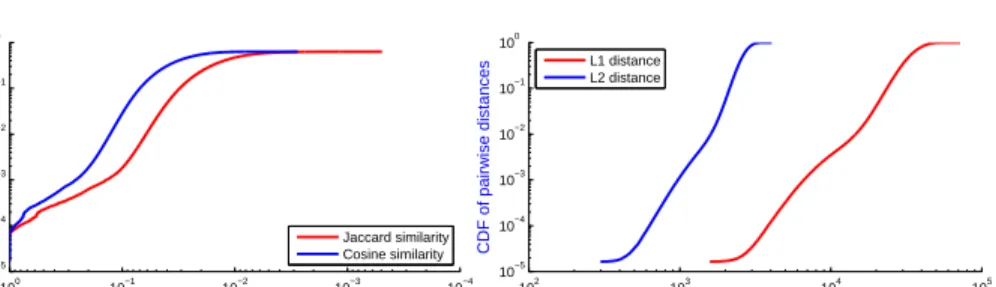
and all pairwise similarities (i.e., Jaccard and cosine) on two commonly used datasets: Enron Email5 and MNIST6, as shown in Figure 1. Since the Enron data set does not have a fixed data size per point our considerations consider a version of the data set where the dimension has been reduced such that each vector has a fixed size.
5
https://archive.ics.uci.edu/ml/datasets/Bag+of+Words
6
10−4 10−3 10−2 10−1 100 10−5 10−4 10−3 10−2 10−1 100
Jaccard and cosine similarity (a) Enron email dataset
CDF of pairwise similarities Jaccard similarity Cosine similarity 102 103 104 105 10−5 10−4 10−3 10−2 10−1 100 L1 and L2 distance (b) MNIST dataset CDF of pairwise distances L1 distance L2 distance
Fig. 1.The cumulative distributions of pairwise similarities and pairwise distances on samples of 10,000 points from Enron Email and MNIST datasets. We note that values decrease on the x-axis of Figure 1.a, while they increase in Figure 1.b.
Figure 1.a shows an inversepolynomial relationship with a small exponentm
between similarity thresholdsand the number of pairwise similarities greater thans. The degree of the polynomial is particularly low whens >0.5. This setting
s > 0.5 is commonly used in many applications for both Jaccard and cosine
similarities [2, 3, 14]. Similarly, Figure 1.b also shows a monomial relationship between the distance thresholdrand the number of pairwise distances smaller than r. In turn, this means that the number ofc-near pairs|R ./≤crS| is not much greater than cm|R ./
≤r S|. In other words, the second term T2 is often
much smaller than the first termT1.
Finally, for the same data sets and metrics, we used the cache-aware algorithm with explicit constants and examined the I/Os used compared to a standard nested loop method (Section 2) and a lower bound on the standard LSH method (Section 2). We used cache sizeM =N/1000, which is reasonable for judging number of cache misses since the size ratio between CPU caches and RAM is in that order of magnitude. In general this setting allows us to investigate what happens when the data size is much larger than fast memory. For simplicity we useB= 1 since all methods contain a multiplicative factor 1/Bon the I/O complexity. The used values ofρwere computed using good LSH families for the specific metric, givenrandc, which are picked according to Figure 1 such that the number ofc-near pairs are only an order of magnitude larger than the number of near pairs. The I/O complexity used for nested loop join is 2N+N2/M B
(here we assume both sets have sizeN) and the complexity for the standard LSH approach islower bounded by sort N1+ρ
. This complexity is a lower bound on the standard sorting based approaches as it lacks the additional cost that depends on how the LSH distributes the points. SinceM =N/1000 we can bound the log-factor of the sorting complexity and use sort (N)≤8N since 2N points read and written twice. The I/O complexity of our approach is stated in Theorem 3. The computed I/O-values in Figure 2 show that the complexity of our algorithm is lower on all instances examined. Nested loop suffers from quadratic dependency onN, while the standard LSH bounds lack the dependency onM. Overall the
Data set Metric r cr ρ |R ./ ≤rS| N |R ./ ≤crS|
N Standard LSH Nested loop ASimJoin Enron Jaccard 0.5 0.1 0.30 1.8·10316·103 >7.5·109I/Os 8·109I/Os 3.2·109I/Os Enron Cosine 0.7 0.2 0.51 1.6·10316·103>212·109I/Os 8·109I/Os 6.6·109I/Os
MNIST L1 3000 6000 0.50 1.8 42 >29·106I/Os 60·106I/Os 12·106I/Os
Fig. 2.Examples of similarity joins on our data sets. For each join a value of the approx-imation parameterchas been chosen based on estimates of the distance distribution to ensure that the number ofc-near neighbors was not too much higher than the output set. The numbers stated are extrapolated from the sample, similarly to Figure 1, and expressed in join results per point. Correspondingρ-values have been computed using standard optimal LSH families for the similarity measures. (We omit the L2 metric for this reason since there is no clear winner in choice of LSH for this measure. Since we want to explore the effect of data sets much larger than fast memory, the stated I/Os are under the assumption ofM=N/1000 andB= 1 due to a 1/B factor being present in all terms. Our new algorithm uses the least I/Os on the examined data.)
computed values points towards that our algorithm is practical on the examined data sets.
5
Conclusion
In this paper we examine the problem of computing the similarity join of two relations in an external memory setting. Our new cache-aware algorithm of Sec-tion 3.1 and cache-oblivious algorithm of SecSec-tion 3.2 improve upon current state of the art by around a factor of (M/B)ρ I/Os unless the number ofc-near pairs is huge (more thanN M). We believe this is the first cache-oblivious algorithm for similarity join, and more importantly the first subquadratic algorithm whose I/O performance improves significantly when the size of internal memory grows. It would be interesting to investigate if our cache-oblivious approach is also practical — this might require adjusting parameters such asL. Our I/O bound is probably not easy to improve significantly, but interesting open problems are to remove the error probability of the algorithm and to improve the implicit dependence on dimension inB andM: In this paper we assume for simplicity that the unit ofM andB is number of points, but in general we may get tighter bounds by taking into account the gap between the space required to store a point and the space for e.g. hash values. Also, the result in this paper is made with general spaces in mind and it is an interesting direction to examine if the dependence on dimension could be made explicit and improved in specific spaces.
References
1. Alexandr Andoni and Piotr Indyk. Near-optimal hashing algorithms for approximate nearest neighbor in high dimensions. InProceedings of FOCS’06, pages 459–468, 2006.
2. Arvind Arasu, Venkatesh Ganti, and Raghav Kaushik. Efficient exact set-similarity joins. InProceedings of VLDB’06, pages 918–929, 2006.
3. Roberto J. Bayardo, Yiming Ma, and Ramakrishnan Srikant. Scaling up all pairs similarity search. InProceedings of WWW’07, pages 131–140, 2007.
4. Andrei Z. Broder, Steven C. Glassman, Mark S. Manasse, and Geoffrey Zweig. Syntactic clustering of the web. Computer Networks, 29(8-13):1157–1166, 1997. 5. Moses S. Charikar. Similarity estimation techniques from rounding algorithms. In
Proceedings of STOC’02, pages 380–388, 2002.
6. Surajit Chaudhuri, Venkatesh Ganti, and Raghav Kaushik. A primitive operator for similarity joins in data cleaning. InProceedings of ICDE’06, page 5, 2006. 7. Mayur Datar, Nicole Immorlica, Piotr Indyk, and Vahab S. Mirrokni.
Locality-sensitive hashing scheme based on p-stable distributions. InProceedings of SOCG’04, pages 253–262, 2004.
8. Matteo Frigo, Charles E Leiserson, Harald Prokop, and Sridhar Ramachandran. Cache-oblivious algorithms. InProceedings of FOCS’99, pages 285–297, 1999. 9. Aristides Gionis, Piotr Indyk, and Rajeev Motwani. Similarity search in high
dimensions via hashing. InProceedings of VLDB’99, pages 518–529, 1999. 10. Theodore E Harris. The theory of branching processes. Courier Dover Publications,
2002.
11. Bingsheng He and Qiong Luo. Cache-oblivious nested-loop joins. InProceedings of CIKM’06, pages 718–727, 2006.
12. Piotr Indyk and Rajeev Motwani. Approximate nearest neighbors: Towards re-moving the curse of dimensionality. InProceedings of STOC’98, pages 604–613, 1998.
13. Jeffrey Scott Vitter. Algorithms and Data Structures for External Memory. Now Publishers Inc., 2008.
14. Chuan Xiao, Wei Wang, Xuemin Lin, and Jeffrey Xu Yu. Efficient similarity joins for near duplicate detection. InProceedings of WWW’08, pages 131–140, 2008.