On The Causation and Timing of
Mutations During Cancer Evolution
Daniel Peter Harry Temko
Doctoral Thesis submitted for the degree of PhD
University College London.
Department of Computer Science UCL
I, Daniel Peter Harry Temko, confirm that the work presented in this thesis is my own. Where information has been derived from other sources, I confirm that this has been indicated in the thesis.
Abstract
Mutations are the proximal causes of cancer and of drug resistance. Better under-standing the causation of mutations before and during cancer can open up avenues for improved cancer prevention and treatment. Early mutations may be of particular interest for therapeutic targeting and early detection.
In Chapter 2, I use a mathematical model of breast cancer development to assess the hypothesis that varying numbers of progenitor cells causes a slow-down in mutation accumulation. In Chapter 3, I present an adapted method to time the accumulation of copy number changes using sequencing data, and an application of this method in colorectal cancer. This application supports the hypothesis of a catastrophic process where multiple copy number alterations develop at the same time in colorectal cancer.
In Chapter 4, I present evidence that a mutational process linked to defects in
thePOLE gene causes key driver mutations in colorectal and endometrial cancer.
Based on this evidence and other analyses I argue that POLE mutations are very
early events in colorectal and endometrial cancer.
In Chapter 5, I build on the ideas presented in Chapter 4 to assess the causa-tion of driver mutacausa-tions by mutacausa-tional processes in a pan-cancer analysis. These results suggest causal explanations for key driver mutations in terms of mutational processes, and shed light on the important underlying biology of selection of driver mutations.
In whole my work expands our knowledge of the effects of mutational pro-cesses on cancer mutations and the timing of these mutations, indicates research strategies for novel approaches to cancer prevention and treatment, and informs our
Impact Statement
In this thesis I present several mathematical modelling-based analyses that investi-gate the causation and timing of mutations, and the cellular dynamics of tumours. The key findings of the research include:
(i) Evidence that copy number alterations (CNAs) often occur in a punctuated fashion, close in time to the last common ancestor of all tumour cells, in colorectal cancers.
(ii) Evidence that pathogenic mutations in the POLE gene are early events in the
colorectal and endometrial cancers in which these mutations occur.
(iii) Suggestive evidence of causal relationships between mutational processes and driver mutations.
(iv) Evidence for differences in selection between different mutations (amino acid changes) in the same driver gene and related driver genes.
There are several ways in which the work presented in this thesis could have a beneficial impact:
My findings on mutation timing have potential implications for tumour
surveil-lance. I argue thatPOLE mutations are early events in colorectal and endometrial
cancers in which they occur somatically. CNAs, by contrast, appear to often occur in a cluster of late events (close to the last common ancestor of cancer cells) in
colorectal cancer. The early occurrence ofPOLEmutations make them good
can-didates for surveillance programs, albeit the relatively small proportion of tumours in which these mutations are found must be taken into account. In terms of CNA
mutations, my results suggest that there may be limited scope to assess progres-sion towards colorectal cancer in terms of CNA accumulation, since the window of time before the last clonal expansion during which these changes are detectable is relatively narrow.
The results presented here also point to possible mechanisms of mutation cau-sation that could be of relevance for cancer prevention. The results in Chapters 4 and 5 identify a key role for potentially modifiable alterations to the mutation rate in accumulation of driver mutations. Whereas, the results of Chapter 3 support the hypothesis that WGD events play an important role in the aetiology of colorectal cancer, and motivate further research into the mechanisms of this type of change.
The differential selection results presented here are of interest for our wider understanding of cancer evolution. These results challenge the prevailing thinking on driver mutations and passenger mutations by demonstrating a spectrum of selec-tive effects between driver mutations. Many previous studies have assumed a fixed selective impact among drivers [Beerenwinkel et al., 2007, Waclaw et al., 2015, McFarland et al., 2014]. Some studies have allowed for a distribution of effects, but have relied on indirect estimates for parameter estimation [Foo et al., 2015]. My results argue in favour of incorporating such distributions in future studies, and also point to possible parameterisations. Thus, these findings have the potential to impact discourse and thinking in the cancer research field, to promote future dis-coveries.
In summary, the results presented in this thesis have the potential to impact tumour surveillance and prevention, and could also impact our wider understanding of cancer evolution. In total, the work provides a contribution to the growing body of work on the forces that govern the course of tumour evolution.
Publications
Work from the following manuscripts forms an important part of this thesis: * Equal contribution
1. Temko D.*, Cheng Y.K.*, Polyak K., and Michor F. (2017). Mathematical
modeling links pregnancy-associated changes and breast cancer risk. Cancer Res,
77(11):2800-2809
2. Temko D., Van Gool I.C., Rayner E., Glaire M., Makino S., Brown M., Chegwidden L., Palles C., Depreeuw J., Beggs A., Stathopoulou C., Mason M, Baker A., Williams M., Cerundolo V., Rei M., Taylor J.C., Schuh A., Ahmed A., Amant F., Lambrechts D., Smit V.T.H.B.M., Bosse T., Graham T.A., Church D.N.,
Tomlinson I. SomaticPOLEexonuclease domain mutations are early events in
spo-radic endometrial and colorectal carcinogenesis, determining driver mutation
land-scape, clonal neo-antigen burden and immune response. in press, The Journal of
Pathology, 2018
3. Temko D., Tomlinson I., Severini S., Schuster-Bckler B., Graham T.A. The effects of mutational processes and selection on driver mutations across cancer
types,in press,Nature Communications, 2018
4. Cross W., Kovac M., Mustonen V., Temko D., Davis H., Baker A., Biswas S., Arnold R., Chegwidden L., Gatenbee C., Anderson A.R., Koelzer V.H., Mar-tinez P., Jiang X., Domingo E., Woodcock D., Feng Y., Kovacova M., Jansen M., Rodriguez-Justo M., Ashraf S., Guy R., Cunningham C., East J.E., Wedge D., Wang L.M., Palles C., Heinimann K., Sottoriva A., Leedham S.J., Graham T.A. and
Tom-linson I. The evolutionary landscape of colorectal tumorigenesis, in preparation,
I have also contributed to the following manuscripts which do not feature prominently in the thesis:
1. Baker A.*, Cross W.*, Curtius K.*, Al-Bakir I.*, Choi C.R.*, Davis H., Temko D., Biswas S., Martinez P., Williams M., Lindsay J.O., Feakins R., Vega R., Hayes S., Tomlinson I., McDonald S.A.C., Moorghen M., Silver A., East J.E., Wright N.A., Wang L.M., Rodriguez-Justo M., Jansen M., Hart A.L., Leedham S.J. and Graham T.A. The evolutionary history of human colitis-associated colorectal
cancer,submitted, 2018
2. Werner B., Case J., Williams M., Chkhaidze K., Temko D., Cross W., Spiteri I., Huang W., Tomlinson I., Barnes C., Graham T. and Sottoriva A. Measuring single
cell divisions in human cancers from multi-region sequencing data,in preparation,
Acknowledgements
I would like to thank my supervisors Simone Severini, Trevor Graham and Ian Tom-linson. Through your expertise and insights you have helped me to turn vague ideas into research of relevance to the terrible disease that is the topic of this the-sis. Through your passion for your work and love of life, you have demonstrated to me that on top of the grit and grind, the best science involves an essential in-gredient of fun (and occasionally beer too). In your different leadership styles you have also each been role models to me, providing an example of fair, and effective leadership, which I hope one day to emulate. Finally, thank you for both the sup-port you have provided on a personal level, which has been a great help throughout the process, and for trusting me to make my own mistakes and come to my own conclusions, which undoubtedly has helped make me a better scientist. Also, thank you for teaching me statistics.
In addition, I would like to thank my collaborators: Benjamin Schuster-Boeckler, David Church, Franziska Michor, Nelly Polyak, Marc Williams, Anne-Marie Baker, William Cross, Laura Gay, Kit Curtius, Ibrahim Al-Bakir, Viola Walther, Jacob Househam, Pierre Martinez, Weini Huang, and Philipp Altrock form a necessarily incomplete list.
I must also thank my funders, the Engineering and Physical Sciences Research Council (EPSRC) and the Yule Bogue bequest, without the support of whom this work would not have have been possible.
Lastly, I wish to thank my family (current and future). To my parents Ned and Astra, thank you for your ever-willingness to lend an ear and provide me with good food throughout this journey. And to Gaby, my fianc´ee, thank you for your
endless patience and willingness to discuss cancer evolution, long after the novelty had presumably warn off.
Contents
1 Introduction 17
1.1 Pr´ecis . . . 17
1.2 Motivation . . . 18
1.3 Identification and timing of mutator processes: Theory . . . 21
1.4 Identification and timing of mutation processes: Data . . . 24
1.4.1 SNA mutation processes . . . 25
1.4.2 CNA mutation processes . . . 27
1.5 Selection . . . 34
1.6 Prognostic implications of mutation processes . . . 39
1.7 Aims and objectives . . . 41
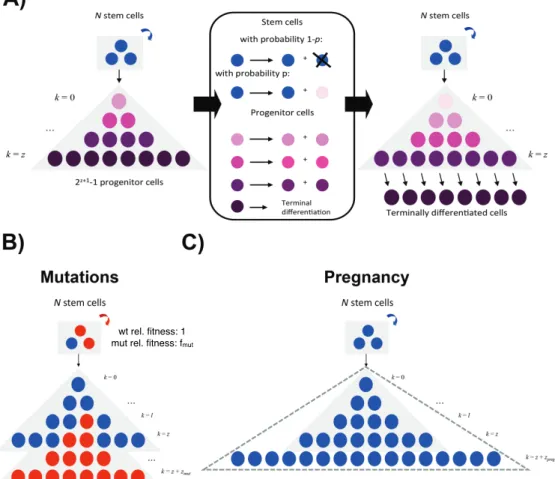
2 Mathematical modeling links pregnancy-associated changes and breast cancer risk 43 2.1 P´recis . . . 43 2.2 Contribution . . . 44 2.3 Introduction . . . 44 2.4 Mathematical Framework . . . 48 2.4.1 Mathematical model . . . 48 2.4.2 Model summary . . . 55 2.5 Model Exploration . . . 57
2.5.1 Model fitting procedure . . . 57
2.5.2 Analysis of model fit . . . 58
3 Evidence for punctuated accumulation of copy number alterations in colorectal cancer 69 3.1 Precis . . . 69 3.2 Contribution . . . 70 3.3 Introduction . . . 70 3.4 Mathematical Framework . . . 73 3.4.1 Growth model . . . 73
3.4.2 Joint estimation procedure . . . 74
3.4.3 Likelihood Maximisation . . . 75
3.4.4 Confidence intervals . . . 80
3.4.5 Testing for punctuated CNA evolution in exome data . . . . 81
3.5 Application to data . . . 81
3.5.1 Application of timing model to whole genome sequencing data in a study of colorectal cancer . . . 82
3.5.2 Exome test power analysis . . . 84
3.5.3 Application of timing model to whole exome sequencing data in a study of colorectal cancer . . . 86
3.5.4 Application of timing model to whole exome sequencing data in a study of IBD-associated-colorectal cancer . . . 89
3.6 Conclusion . . . 90
4 POLE mutations are early events in colorectal cancer and endometrial cancer 94 4.1 Pr´ecis . . . 94
4.2 Contribution . . . 95
4.3 Introduction . . . 95
4.4 Methods . . . 100
4.4.1 Mutational signature framework . . . 100
4.4.2 Tumour growth model . . . 101
4.4.3 Likelihood of a cancer mutation on the background of a mutational signature . . . 102
4.4.4 POLE heuristic mutational signature score . . . 103
4.4.5 Ethical approval . . . 105
4.4.6 Patients and tumour samples . . . 105
4.4.7 DNA extraction . . . 105
4.4.8 DNA sequencing . . . 105
4.4.9 Definition of driver genes . . . 106
4.4.10 Clonality of POLE mutations . . . 107
4.4.11 Classification of SNAs to a mutational processes . . . 107
4.4.12 POLE consensus mutational signature scores in driver genes 108 4.5 Results . . . 109
4.5.1 Whole genome sequencing . . . 109
4.5.2 POLEmutations often occur before the last common ances-tor of all tumour cells . . . 109
4.5.3 POLE signature scores of driver mutations . . . 111
4.6 Conclusion . . . 119
5 The effects of mutation and selection on driver mutations across cancer types 122 5.1 Pr´ecis . . . 122 5.2 Contribution . . . 123 5.3 Summary . . . 123 5.4 Introduction . . . 123 5.5 Methods . . . 125
5.5.1 Testing for evidence of differential selection between muta-tions in a cancer type . . . 125
5.5.2 Modelled relative risk . . . 126
5.5.3 Data collection . . . 127
5.5.4 Sample-specific mutation collection . . . 127
5.5.5 Definition of driver genes . . . 127
5.5.6 Sample-specific mutational signature estimation . . . 127
5.5.8 Power calculations . . . 129
5.5.9 Comparison of genomic and exonic mutation distributions . 130 5.5.10 Variation explained by mutation probability . . . 130
5.5.11 Multiple testing corrections . . . 131
5.6 Results . . . 131
5.6.1 Testing for mutational process and driver mutation associa-tions . . . 131
5.6.2 Mutational processes shape driver mutation landscape . . . 133
5.6.3 Detecting differential selection . . . 136
5.6.4 Differential selection between pathogenic amino acid changes within a driver gene . . . 138
5.6.5 Differential selection between mutationally-exclusive driver genes . . . 140
5.7 Conclusion . . . 145
6 Discussion 149 7 Methods 152 7.1 Standard Mutation Calling Pipeline . . . 152
7.1.1 Quality Control . . . 152
7.1.2 Alignment and Preprocessing . . . 152
7.1.3 Somatic Mutations . . . 153
7.1.4 Mutation context information used to identify mutation channel . . . 153
7.1.5 Copy Number Alterations . . . 153
Appendices 155
A Supplementary Figures 155
B Colophon 174
List of Tables
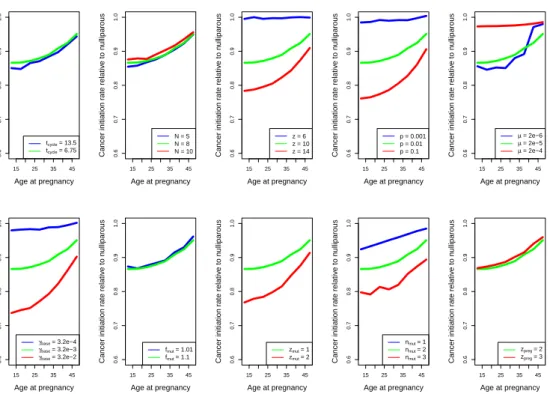
2.1 Fixed parameter values. Parameters that remained unchanged
throughout all simulations. ttotal: Simulation time (years), αpreg:
Proportional reduction of cell cycle time of stem cells during
preg-nancy,αmenopuase: Proportional increase of cell cycle time of stem
cells after menopause, ppost: Proportional reduction in number of
progenitor cells after initial pregnancy. . . 55
2.2 Range of parameter values investigated. For each parameter of
in-terest, we tested multiple values. Values defaulted to the numbers
in bold. tcycle: Cell cycle time of stem cells (hours), N: Stem cell
number,z: Progenitor cells divisions, p: Asymmetric division rate,
µ: Mutation rate (per cell division), γbase: Self-renewal event rate,
fmut: Mutant stem cell relative fitness,zmut: Mutant progenitor
ex-pansion,nmut: Mutations required,zpreg: Pregnancy progenitor
ex-pansion, ppost,subs: Proportional reduction in number of progenitor
cells after subsequent pregnancies. . . 55
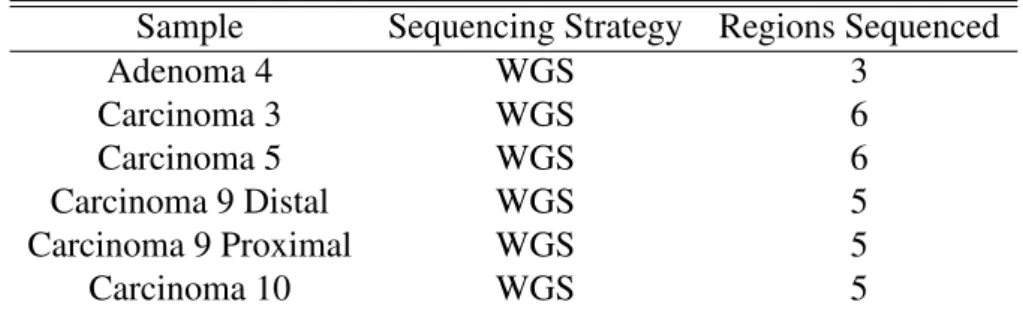
3.1 Colorectal cancer whole genome sequencing data considered for
timing analysis . . . 82
3.2 Colorectal cancer whole exome sequencing data considered for
CNA catastrophe test . . . 87
3.3 Application of test for punctuated CNA evolution to colorectal
can-cer exomes . . . 89
3.4 IBD-associated-colorectal cancer whole exome sequencing data
3.5 Application of test for punctuated CNA evolution to IBD-associated
colorectal cancer exomes . . . 90
4.1 POLE-mutant tumours . . . 105
4.2 Clonality ofPOLEmutations in endometrial cancer and colorectal
cancer samples. p-value’s shown are for one-sided binomial tests of the null hypothesis that the mutation was present in every tumour cell.114
5.1 Samples used for study . . . 132
5.2 Associations between mutational signatures and driver mutations
within cancer types. ‘Frequency’: Mutation frequency in the tu-mour type . . . 135
Introduction
1.1
Pr´ecis
Mutations play a causal role in cancer initiation and progression. Mutations arise due to mutation-causing processes (mutation processes or mutational processes) in somatic tissues and change in frequency in the population due to natural selection and drift. Improved understanding of these mutation processes is therefore of inter-est for prevention, early detection, and treatment of cancer. In addition, refined un-derstanding of mutation causation is important to define a null model against which it is possible to identify those mutations that are more frequent than expected in cancer genomes, and are subject to selection; a task of central importance to cancer research. The lack of data following the evolution of individual patients over time presents a major challenge for identification of mutation processes. Mathematical modelling can be a useful toolset to recover information on the causes of mutation in data that comes from a single point in time. Here, I present several analyses that aim to infer mutation-causing processes from molecular data that represents a snapshot in time. In the final chapter, I will present an application of a model of mutation-causing processes that aims to infer the strength of selection experienced by individual mutations. Overall, I aim to contribute to the expanding literature on the operation of mutation-causing processes in cancer and the selective impact of individual mutations.
1.2
Motivation
Genetic mutations are proximal causes of cancer inititiation [Lawrence et al., 2014, Vogelstein et al., 2013], and play an important role in resistance to targeted ther-apy [Chong and Janne, 2013, Weisberg et al., 2007]. In addition, somatic mutations can lead to the recognition of tumours by the immune system [Brown et al., 2014], and this recognition can be harnessed for therapy [McGranahan et al., 2016]. Al-beit, the identity of the mutations that play a causal role in disease is a mat-ter of long-standing research and the subject of ongoing debate [Cooper, 1982, Lawrence et al., 2014, Martincorena et al., 2017]. Mutations arise in human tissues at varying rates, their survival and expansion depends on natural selection and drift, both of which relate to population structure.
As a result, understanding the causation and timing of mutations during cancer evolution is important for several reasons. First, due to the causal role of mutation in disease progression, in a straightforward sense this understanding is important for cancer prevention and treatment. Indeed, many existing cancer prevention strate-gies are based on removal of mutation-causing processes that have already been identified, including strategies to reduce ultra-violet, and tobacco exposure. By the same token understanding of mutation-causing processes and how they impact the accumulation of mutations in the evolving tumour population could enable better prognostication. In many cases the mutation processes present in cancer genomes are measurable [Alexandrov et al., 2013a], so in theory it may be possible to predict evolutionary trajectories.
Secondly, there is a particular rationale for identifying early mutation-causing processes and mutations [Loeb, 2011]: In a straightforward sense early mutations have the most relevance for early detection. In addition, mutations that occur before the last common ancestor of all tumour cells (LCA) are expected to be present in every tumour cell (clonal) and can consequently be targeted in every tumour cell by a therapy. Finally, some researchers have argued that oncogene addiction is most likely for early mutations [Cristea et al., 2017]. Oncogene addiction is a phenomenon where tumour cells, but not healthy cells, become dependent on the
presence of a mutation for survival [Weinstein, 2002].
In addition, accurate understanding of muation-causing processes is key
to determining the selective impacts of individual mutations. Multiple
stud-ies (reviewed below) have aimed to identify genes under selection by finding genes that are mutated more (or less) frequently in tumours than would be ex-pected based on underlying mutation rates [Greenman et al., 2007, Kan et al., 2010, Martincorena et al., 2017]. The conclusions of these studies have been shown to be sensitive to the underlying model of mutation rate [Lawrence et al., 2013], and have generally developed in step with improved understanding of mutation-causing pro-cesses (see below). Further improvements in the understanding of mutation-causing processes could continue to drive these efforts forward.
Identifying the role played by individual mutations in disease can help to
design treatments. The EGFR gene is a case in point. Multiple lines of
evi-dence, including frequent mutations, supported a causal role for this gene in disease [Dowell and Minna, 2006]. This lead to the development of treatments targeting the protein encoded by this gene, including Erlotinib, which interferes with the capacity
of the EGFR-coded protein to propagate signalling cascades via phosphorylation
[Dowell and Minna, 2006, Schettino et al., 2008]. Although resistance remains a major problem, such therapies have improved survival time in non-small cell lung cancer [Dowell and Minna, 2006]. Treatments targeting a fusion mutation
involv-ing the genesBCRandABLprovide another example in chronic myeloid leukemia
[Mitelman et al., 2007, Quintas-Cardama et al., 2009]. Thus, mutations that play a causal role in disease can provide good treatment targets.
A major challenge for the identification of mutation processes, and indeed in cancer research more broadly, is that the process of cancer development in humans cannot usually be directly observed. By necessity, the molecular data that is avail-able to cancer researchers represents a single snapshot in time at the point when the tumour was removed. There are some exceptions in the case of blood cancers [da Silva-Coelho et al., 2017], and promising technological advances suggest that this may not always be the case for solid tumours; recent research has demonstrated
that tumour DNA is detectable in the blood from the earliest stages of tumorigenesis and tumour relapse [Abbosh et al., 2017, Cohen et al., 2018]. At present, though, single time-point data remains a major challenge for most tumour types.
At that single timepoint, there has recently been a rapid expansion in the amount of data available. Of note, since 2005 the Cancer Genome Atlas (TCGA) study generated publicly available whole exome sequencing (WXS) data for over 11,000 patients across 21 primary cancer sites (https://portal.gdc.cancer.gov). The PanCancer Analysis of Whole Genome (PCAWG) study that is currently in progress promises to generate a similarly rich public resource of tumour whole genome se-quencing (WGS) data.
There is a precedent for mathematical modelling approaches to these questions (which I discuss). However, there are two, informative, reasons why they are not more common. First, the complexity of the process of mutation accumulation and subsequent DNA sequencing means that mathematical models of mutation accumu-lation often have multiple free parameters. This has historically been the case for mathematical models of cancer development. A case in point is the seminal 1954 study by Armitage and Doll [Armitage and Doll, 1954] that provided key evidence that cancer initiation is a multi-step process. While the study is rightly regarded as one of the key contributions of mathematical modelling to cancer research, the con-clusions on the specific number of mutations required for cancer have been ques-tioned by later research – it has become clear that changes to the model to take into account the impact of clonal expansions can greatly effect the estimation of the number of steps required for cancer [Moolgavkar, 2004]. This exemplifies the fact that the findings from mathematical modelling studies are typically subject to caveats, and progress can be incremental.
Secondly, this approach is mutli-disciplinary. My approach requires applica-tions of mathematical techniques to biological content (including formalisation of biological concepts and synthesis of diverse areas of biological theory). This re-quires some appreciation of both the mathematics and the biology in the researcher, in addition to close collaboration between genuine subject area experts. As a result,
the pool of researchers and groups with appropriate interests and backgrounds is relatively limited.
Below, I review the literature on causes and timing of mutations in cancer. I first review the literature on mutation-causing processes. I then turn to the literature on the inference of selection, which often relies on modelling of mutation processes. Finally, I review the literature on the impact of varying mutation rates on outcomes in cancer.
1.3
Identification and timing of mutator processes:
Theory
The question of whether mutator phenotypes (defined as an increased cell-intrinsic mutation rates compared to non-cancerous cells) are common in cancer is a matter of longstanding debate. Two types of argument have been made in favour of preva-lent mutator phenotypes, by Lawrence Loeb and others. First, it has been argued that increased mutation rates are necessary to explain disordered genomes found in cancer cells, and the high incidence levels of cancer [Loeb, 2001] (necessity ar-guments). The second argument is based on two observations. First, that there are numerous genetically-encoded cellular processes involved in the faithful replication of DNA and the repair of insults to DNA [Loeb, 2011]. Secondly, that cancer initi-ation requires the accumuliniti-ation of multiple genetic mutiniti-ations that occur slowly in the absence of a mutator phenotype. The argument claims that, as a result, mutator mutations and likely to be common during the process of carcinogenesis, leading to mutator phenotypes in the resulting cancers [Christians et al., 1995, Loeb, 2011] (efficiency arguments).
Historically necessity arguments for a mutator phenotype by Loeb and col-leagues have relied on the need for more than two rate-limiting steps in carcinogen-esis [Loeb, 1991], and the possibility that even six or 12 mutations are required for carcinogenesis. [Loeb, 2001, Armitage and Doll, 1954].
Theoretical models [Moolgavkar and Knudson, 1981] and novel data-driven approaches [Tomasetti et al., 2015] have challenged traditional views that a large
number of mutations are required for cancer development – the latter study sug-gested that only three driver mutations are required for the development of lung cancer and colon cancer. In addition, studies that consider the effects of clonal ex-pansion have predicted faster rates of mutation accumulation under normal mutation rates, and concluded that mutator phenotypes are unlikely to be necessary to explain mutation and incidence rates [Beerenwinkel et al., 2007, Tomlinson et al., 1996].
However, none of these considerations are definitive. The Tomasetti study was restricted to colon cancer and lung cancer, and the length of routes to cancer across all cancer types is not known. Regarding the effects of clonal expansions -[Beerenwinkel et al., 2007] finds that cancers can develop within a human lifespan under a normal mutation rate assuming that drivers confer a selective advantage of 1%. However, the study assumes a well-mixed population in which the effects of selection could be overstated.
It is likely that the necessity or not of a mutator will depend on the balance between the length of routes to cancer (i.e. the number of causal mutations required and the probability of these mutations), and the efficacy of selection to accelerate mutagenesis, and there is still a long way to go to understand that balance.
There is a related body of literature evaluating efficiency arguments, describ-ing whether faithful DNA replication should be expected to fail en route to cancer, given its complexity, and in light of the number of mutations required for cancer, and at what time during carcinogenesis we should expect these failures to occur. An important paper in the field investigated the required effect size of a mutator pheno-type that would lead to the expectation of seeing mutator phenopheno-types in over half of cancers [Beckman and Loeb, 2006]. The study found that the required effect size varied over 1,000-fold depending on the number of mutations required for cancer, the number of mutator loci and the mutation rate. The same study found that if mutator phenotypes emerge, then they are more likely to be early events.
A model that took into account both clonal expansion and the effects of dele-terious mutations [Datta et al., 2013] also found a wide range of predictions regard-ing the likelihood of a mutator phenotype emergregard-ing, with the probability of mutator
phenotypes varying between zero and one depending on the probability of mutator mutations. Interestingly this study predicted that mutator phenotypes were more likely to occur under intermediate selection for drivers, than under strong or weak selection regimes.
Ian Tomlinson made the intriguing prediction, that although mutator pheno-types were predicted to be early events if they occurred, that they are more likely to occur in later onset cancers [Tomlinson et al., 1996], due to the extra steps re-quired for these cancers to develop. In a model that allows for back-mutation Ko-marova et al. recently predicted that when the selective effects of drivers muta-tions are in balance with the potential effects of deleterious mutamuta-tions, then mutator phenotypes can emerge early in cancer development and later revert to stability [Asatryan and Komarova, 2016]
The impact of ‘tumour suppressor genes’ (TSGs) which may require two hits before conferring a selective advantage has been studied in detail by Franziska Mi-chor and colleagues. These studies generally focus on chromosomal instability (CIN) as opposed to instability at the level of point mutations, since classical TSGs are thought to be inactivated by chromosomal mutations. A study by Franziska Michor found that the requirement to inactivate a tumour suppressor gene en route to cancer meant that CIN is likely to occur early even if only one or a few CIN-conferring mutations are possible, given a fixed cell population size [Michor, 2005]. The same study found that the requirement for two TSGs to be inactivated implies CIN is likely to occur early even if the mutations that lead to CIN come at a selec-tive cost. A later study, which included a growing population of cells found that the tendency of clones with CIN to accumulate deleterious mutations that could slow their growth had little effect on the prediction that these mutations would be early in the context of tumour suppressor genes [Nowak et al., 2006]. These results sug-gest that tumour suppressor genes increases the likelihood of early instability during the develop of cancer. However, it is unclear how these results are affected by the complicating factors of multiple possible mutational paths to cancer, some of which may not involve tumour suppressor genes.
These modelling results illustrate the complexity of the evolutionary setting in which cancer develops, often confounding firm predictions from theory. However, on a more optimistic note, they also illustrate the unexpected dynamics that can arise in this complex setting, motivating further research, and potential therapeutic targets.
1.4
Identification and timing of mutation processes:
Data
To discuss the literature on mutation-causing processes (mutation processes) it is useful to distinguish two major classes of mutation. Single nucleotide alterations (SNAs) describe substitution of one DNA base (A,C,G or T) for another in the linear DNA sequence, as well as insertions and deletions on the same length scale. Copy number alterations (CNAs) describe changes at the level of megabases. CNAs in-clude duplications (copies of a large section of DNA), and deletions; duplications that are re-inserted adjacent to the copied sequence are known as tandem duplica-tions. CNAs also include rearrangements of the continuous DNA sequence. Here, I have included rearrangements in the definition of CNAs, even though they do not alter copy number (in the sense of the number of genomic copies of a stretch of sequence), for ease of exposition; since my focus here is on mutation-causing pro-cesses and many propro-cesses that cause CNAs (more narrowly defined) also cause rearrangements. Thus, the term CNA used here, may be thought of as a short-hand for CNA and rearrangement as used elsewhere in the literature.
Although there is a broad literature on mutation processes in cancer, these studies generally share some commonalities in approach. In general, mutations with common genomic features are inferred to be caused by a similar mutation process, often backed up by evidence from experimental systems. It is possible to partially reconstruct the dynamics in several ways. First, temporal information can be accessed by harnessing the idea that different individuals represent different time-points of a common process. Thus types of mutation that correlate across in-dividuals can identify the influence of a common process realised across different
time-points. Similarly, evidence from putative pre-malignant lesions can be com-pared to frank carcinomas to approximate temporal data. Further evidence is pro-vided by studies of the clonal status of mutations attributed to different processes; mutations that are present in every cell probably occurred before the last common ancestor of all tumour cells. In addition, for copy number change in particular, the final state records some information on the order of events. This is the case for two reasons. First, since copy number changes effect large regions of the genome they often overlap and the order of events influences the final pattern. Secondly, the SNAs within CNA mutations can be used as a molecular clock to time their occurrence. This research has cast light on multiple mutation processes involving different types of mutation that are active in cancer (reviewed presently).
1.4.1
SNA mutation processes
There are a number of well-described mutation processes at the level of SNAs, two of these processes merit special mention given their relevance to the content of the thesis. The first is microsatellite instability (MSI). Microsatellites are seg-ments of DNA consisting of multiple repeats of the same short sequence of one to several bases. In microsatellite instability frequent indels increase or decrease the number of repeats in the segment. MSI was described in 1993 in colorectal cancer [Thibodeau et al., 1993]. It has since been shown to occur in around 15% of colorectal cancers [Vilar and Gruber, 2010]. In this setting it is most commonly
caused by methylation of the MLH1 gene, which is one of those genes involved
in the mismatch repair (MMR) process that repairs microsatellite indels, in addi-tion to other types of mutaaddi-tion [Vilar and Gruber, 2010]. While MSI is tradiaddi-tionally recognised as playing a role in colorectal, endometrial and gastric cancers, a re-cent support suggested that that MSI may occur at low levels in most tumour types [Hause et al., 2016].
The second is a mutation process linked with mutations in the POLE gene
(discussed in detail in Chapter 4). ThePOLEgene encodes a subunit of the DNA
replicase (Polε) [Rayner et al., 2016]. A subset of mutations in the gene cause a
trin-ucleotides due to disrupted DNA repair [Rayner et al., 2016]. These mutations are found in 7-12% of endometrial cancers and 1-2% of colorectal cancers, as well as a range of other tumour types [Rayner et al., 2016], referred to as ‘ultramutator’
can-cers. Endometrial cancers withPOLE mutations are associated with high immune
infiltration and improved prognosis [Hussein et al., 2015, Church et al., 2015]. In 2013 Ludmil Alexandrov and colleagues published a landmark paper in-troducing a mutational signature framework in cancer that provides a way of es-timating the SNA mutation-causing processes involved in the history of a tu-mour sample and ascribing mutations probabilistically to individual processes
[Alexandrov et al., 2013b, Alexandrov et al., 2013a]. The framework classifies
SNAs into 96 types defined by the base change (such as C>T), and the genomic
context including the two flanking bases of the mutated base (such as TCT). Under the assumption that each mutation process creates a characteristic distribution of mutations across the types (or a mutational signature), the study used the mutational catalogues from multiple tumours to identify 21 inferred processes and their asso-ciated mutational signatures. The signatures framework has since been extended to over 30 processes and associated signatures [Petljak and Alexandrov, 2016]. Many, but not all, of the signatures have a biological interpretation. Signatures 6, 15, 20
and 26 are linked to MMR defects, and signature 10 is linked toPOLE mutation.
Other signatures are linked to a range of processes including tobacco-induced dam-age (signature 4), mutation by APOBEC (apolipoprotein B mRNA editing enzyme, catalytic polypeptide-like) deaminases (signatures 2 and 13) and ultraviolet radia-tion (UV) (signature 7) (cancer.sanger.ac.uk/cosmic/signatures).
Studies have indicated diverse patterns with respect to SNA mutation process timing. A study that analysed mutation accumulation in individuals spanning a large age range suggests that some SNA mutation processes may occur gradually over the course of a lifetime, showing a clock-like relationship with age, in both tumour tissue [Alexandrov et al., 2015] and normal tissue [Blokzijl et al., 2016]. These in-clude a mutation process thought to be caused by deamination of methylated
the normal sequence (signature 1), and a process of unknown etiology which causes a broad spectrum of SNAs (signature 5) [Helleday et al., 2014].
Studies of the clonal status of SNA mutations can also reveal information on the timing of SNA mutational processes. One of the key discoveries of cancer research of recent years has been the widespread presence of intra-tumour het-erogeneity at the level of SNAs [Gerlinger et al., 2012, Andor et al., 2016]. This discovery tends to suggest that SNA processes are ongoing in tumours. However, variation in the rate of SNA processes over time has been identified. Mcgranahan et al. [McGranahan et al., 2015] analysed whether mutations associated with a range of SNA mutation processes were clonal (present in all cancer cells), or sublconal, in a range of cancer types. Notably, mutations likely to be caused by APOBEC were enriched for subconal mutations, consistent with a later onset in carcinogenesis of this mutation process. In a multi-region sequencing study of lung cancer, de Bruin et al. also found that mutations likely to be caused by APOBEC were enriched for subclonal mutations, whereas mutations likely to be caused by smoking were de-pleted among these later mutations [de Bruin et al., 2014]. As against this, a very recent report found heterogoneous timing with respect to the timing of APOBEC signatures, with heterogeneity between patients, including some where the signa-ture was predominantly early and clonal [Yates et al., 2017]. This suggests that APOBEC-linked mutations can also occur in the earlier stages of tumorigenesis.
1.4.2
CNA mutation processes
Copy number alterations were the first type of mutations to be recognised in
cancer. In 1914 Theodor Boveri theorised that cancer involves the disruption
of cellular chromosomes [Harris, 2008, Jeggo et al., 2016]. Around twenty years later the observation was made that human cancer cells are frequently found with abnormal chromosome numbers [Harris, 2008, Jeggo et al., 2016]. The ad-vent of next generation sequencing has confirmed that over half of breast can-cers, colorectal cancers and non-small cell lung cancers have non-diploid chro-mosome complement [Sansregret et al., 2018]. In 1997, Bert Vogelstein demon-strated ongoing chromosomal instability (CIN) in human colorectal cancer cell
lines [Lengauer et al., 1997]; this provided the first evidence that some cancers have genuinely unstable genomes, as opposed to a stably aneuploid genome. In the literature the presence of aneuploidy is often, confusingly, reported as CIN [Sansregret et al., 2018]. However, determining the extent of ongoing CIN across human cancers remains a major challenge due to the lack of temporally-resolved mutation data.
In 2011 a study identified a mutation process which was labelled
chromoth-ripsis, involving multiple localised CNAs [Stephens et al., 2011]. In this study, Stephens and colleagues identified complex genomic rearrangements in cancer samples rewiring the linear DNA sequence localised to one or a few
chromo-somes [Stephens et al., 2011]. They found this pattern in 2-3% of all cancers
and 25% of bone cancers. In the same year, Kloosterman et al. found evidence for widespread chromothripsis events in primary and metastatic colorectal cancer [Kloosterman et al., 2011]. In 2016 Notta et al. found evidence for at least one chro-mothripsis event in 65% (70/107) of pancreatic cancers subjected to whole genome sequencing [Notta et al., 2016].
In the original study that identified chromothripsis, the authors put forward several arguments to suggest that these changes are likely to occur in a single catas-trophic event, as opposed to gradually over many cell divisions. The main line of argument observes that the copy number states alternate between just one and sometimes two values. They argue that this is consistent with a single shattering event followed by stitching together of the fragments by DNA repair processes. By contrast, they use an intuitive argument, backed up with Monte Carlo simula-tions, to argue that this pattern is very unlikely based on a gradual model involving the successive accumulation of multiple types of CNA over multiple cell divisions. However, in my view, the assumed model of what gradual change would look like is rather artificially restricted, and there are plausible scenarios of gradual change that may explain the data, that are not considered in their model. In particular, the model seems to assume gradual change would consist of the random accumulation of CNAs of many types, including duplications, and deletions, and they do not seem
to consider the plausible scenario of multiple small-scale events of shattering and repair. In my view their secondary argument, that it is difficult to explain the highly clustered nature of the CNA breakpoints under a gradual scenario may be more convincing.
More recent experimental evidence has clarified some of these issues. In 2015 another group used a combination of live-cell imaging and DNA sequencing to show that the hallmarks of chromothripsis can indeed result from changes that take place in a single cell division [Zhang et al., 2015]. Specifically, they observed in-dividual cells with a structure called a micronucleus, which is presumed to contain a lagging chromosome that was incorrectly segregated during cell division (mi-cronucleated cells). Single-cell sequencing revealed an asymmetric pattern of copy number change in daughter cells of micronucleated cells, with DNA damage in some daughter cells that recapitulated the hallmarks of chromothripsis. The authors also showed that DNA in micro-nuclei is under-replicated. Therefore one explana-tion for the data is that under-replicated chromosome fragments in micro-nuclei are stitched together by the cells DNA repair machinery during cell division, leading to chromothripsis.
In 2013, Baca et al. identified complex chains of rearrangements in 88% (50/57) of prostate cancers sequenced by whole genome sequencing, which they
labelledchromoplexy[Baca et al., 2013]. 63% of tumours had two or more of these
chains. Some of these chains involved five or more chromosomes, in contrast to chromothripsis which typically occurs over a few chromosomes (but can involve more in some cases) [Stephens et al., 2011]. However, the authors note that some of the instances of chromoplexy resembled chromothripsis, and it seems plausible that the underlying mechanism may be related.
Another CNA mutation process involving multiple contemporaneous CNA events which may be widespread in cancer is whole genome doubling (WGD). In normal tissue WGD events (tetraploidisations) play a role in the development of a range of cell types [Sansregret et al., 2018]. Carter et al considered the number of copies of the two alleles of each chromosome across samples in a pan-cancer
anal-ysis [Carter et al., 2012]. They found that in high ploidy samples the allele with the higher copy number tended to have an even copy number. They show that this is consistent with a model where gains occur by whole-genome doublings (after which both alleles with have the same even copy number), followed by individ-ual copy losses (which leave two copy states for each allele, with the highest state being even). Based on their analysis they argue that WGD events occurred in the history of over 40% of oesophageal adenocarcinomas and in high proportions of lung adenocarcinomas and several other cancer types. However, arguably, there are other explanations for this pattern of copy number change that are plausible, such as common duplications of individual chromosomes, and this method may be prone to over or under-call WGD events in individual samples. A later pan-cancer study by the same group found a multimodal distribution of copy number states across can-cer types which is suggestive of frequent past WGD events [Zack et al., 2013]. One report argues that genome doubling events occurred in the majority of colorectal cancers [Dewhurst et al., 2014]. However, the parsimony-type method for identify-ing historic WGD used in this study cannot distidentify-inguish genuine WGD cases from those cases that have reached high ploidy through other routes. Together, the cu-mulative evidence supports an important role for WGD events in cancer, but other explanations for the data appear to be possible.
At the molecular level, a variety of mechanisms can lead to whole genome doubling and may underlie WGD events in cancer. Cells may undergo a
pro-cess calledendoreplicationwhere DNA duplication proceeds without cell division
[Sansregret et al., 2018]. Relatedly, defects in cellular processes including DNA replication and the functioning of the mitotic spindle can cause cells to abort cell division, producing a tetraploid cell [Storchova and Pellman, 2004]. Additionally,
entosis, engulfment by another cell, may lead to tetraploidisation by blocking cell division [Sansregret et al., 2018]. Cell fusions are known to play a role in de-velopment and disease, and could also play a role in tetraploidisation in cancer [Storchova and Pellman, 2004].
play a role in cancer, suggesting possible causal sequences of events among the observed CNAs in tumour samples. Merotelic chromosomal attachments are one well-described mechanism of CNA accumulation in cancer [Sansregret et al., 2018, Gordon et al., 2012]. This phenomenon arises when a single chromosomal kine-tochore becomes attached to mircotubules from both poles of the mitotic spindle [Gordon et al., 2012] and has been linked with lagging chromosomes during cell division [Sansregret et al., 2018]. Experimentally, a study using long-term live-cell imaging showed that the presence of extra copies of nuclear bodies called centro-somes leads to merotelic attachments and chromosome mis-segregation in cell lines [Ganem et al., 2009]. Thus, given the link between lagging chromosomes and chro-mothripsis, one possible sequence of events is that WGD due to failed division leads to supernumerary centrosomes and ongoing instability including chromothripsis via frequent merotely.
Another mechanism that is likely to play a role in CNA formation is a phe-nomenon known as ‘telomere crisis’, reviewed in [Maciejowski and de Lange, 2017]. Telomeres are composed of long tracts of repetitive double-stranded DNA. They function to protect the ends of chromosomes from recognition as sites of DNA damage by the cell. In most human somatic cells telomeres are depleted by around 50bps in each cell division. Loss of telomeres can trigger apoptosis or senescence. However, cells lacking the capacity for cell cycle arrest may undergo what is known as ‘telomere crisis’, a process involving multiple DNA aberrations, including fused dicentric chromosomes. Exit from telomere crisis may be acheived by activation of telomerase enzymes by the cell [Maciejowski and de Lange, 2017].
Two recent studies have demonstrated intriguing links between telomere short-ing and mutations observed in cancer. The first study showed that human cells in telomere crisis underwent tetraploidisation [Davoli and de Lange, 2012]. The sec-ond study used live-cell imaging to show that cells with dicentric chromosomes in-duce rupture of the nuclear envelope and that cell clones that have undergone telom-ere crisis show chromothripsis [Maciejowski et al., 2015]. Additionally, the break-age of dicentric chromosomes found in telomere crisis can lead to what is known
as breakage-fusion-bridge cycle (BFB cycle) [Maciejowski and de Lange, 2017]. BFB cycles can result in a range of CNAs, including gene amplification and rear-rangements. These results suggest another possible chain of events in some human cancers whereby cells undergo telomere crisis, resulting in WGD and chromothrip-sis, followed by ongoing stability as telomerase activity is restored.
Various other mechanisms of CNA accumulation in cancer have been de-scribed, with both cell-intrinsic and cell-extrinsic origins [Sansregret et al., 2018]. Defects in the spindle assembly checkpoint (SAC), and in chromosome cohe-sion are two cell-intrinsic mechanisms that are of uncertain significance in hu-man cancer [Gordon et al., 2012]. In normal functioning the SAC monitors the correct attachment of kinetochores to the mitotic spindle [Gordon et al., 2012]. SAC defects promote cancer in mice, and predispose to cancer in the rare condi-tion mosaic variegated aneuploidy, albeit the pathway is rarely mutated in humans [Gordon et al., 2012]. Chromosome cohesion is one of the processes involved in ensuring correct chromosome segregation. Mutations in genes related to chromo-some cohesion have been found in colorectal cancer, suggesting a potential role for disruption of cohesion in disease [Gordon et al., 2012]. External to the cell, aspects of the tumour micro-environment including hypoxia and glucose deprivation can induce CNAs [Sansregret et al., 2018], and cell migration may lead to karyotypic abnormalities due to nuclear envelope rupture [Sansregret et al., 2018].
There are also interesting links between CNA mutation processes and SNA mutation processes. Nuclear envelope rupture, which is implicated in chromoth-ripsis [Zhang et al., 2015, Maciejowski et al., 2015], exposes DNA to a nuclease present in the cytosol, which can create the single-stranded substrate for SNAs caused by APOBEC [Sansregret et al., 2018]. This may explain clusters of localised
mutations, termedkataegis, that have been found near chromothripsis breakpoints
[Maciejowski et al., 2015]. Thus, mechanisms that cause CIN may be responsible for SNAs caused by APOBEC found in cancer.
There is increasing evidence to suggest that WGD events frequently occur
(n=41) and malignant (n=79) Head and Neck Squamous Cell Carcinoma (HN-SCC) lesions using image cytomtery [Abou-Elhamd and Habib, 2007]. They found that 37% of premalignant lesions were tetraploid (appeared genome doubled) and
17% were aneuploid. By contrast, 90% of malignant lesions were aneuploid,
and none were tetraploid. This data is consistent with early WGD events giving way to ongoing instability in HNSCC. Supporting this, Jamal-Hanjani et al. re-ported a high level of clonal WGD events and a significant correlation between WGD and sub-clonal copy number diversity in a large multi-region sequencing study of lung cancer [Jamal-Hanjani et al., 2017]. Studies of pre-cancerous le-sions [Stachler et al., 2015, Li et al., 2014] support an early role for WGD events in esophageal adenocarcinoma and colorectal cancer. Finally, a study in pancre-atic cancer provides additional temporal resolution by using SNAs within the CNA regions as a molecular clock. This study made three observations. First, polyploidi-sation events were predominantly clonal. Secondly, most SNA mutations attributed to a mutational signature linked with ageing occurred before polyploidisation. Fi-nally, most CNAs occurred after polyploidisation. These observations support the impression that WGD events can occur early and give rise to ongoing instability, and the first two observations additionally suggest that early WGD events may oc-cur shortly before the last common ancestor of all tumour cells.
Adding to this picture, emerging data suggests heterogeneity in the rate of CNA accumulation across tumours. A recent single-cell sequencing study in triple neg-ative breast cancer by Gao et al. found high inter-tumour copy number profile het-erogeneity but high within-tumour copy-number homogeneity among single cells within each of 13 cancers [Gao et al., 2016]. They argue that, precluding a recent clonal expansion, these profiles suggest historic chromosomal instability that has given way to regained stability, representing a historic punctuated burst of evolution (Figure 1.1 A). These data are consistent with earlier longitudinal studies in breast cancer that found similar CNA profiles between (1/2) paired pre-cancerous ‘DCIS’ lesions invasive carcinomas [Kuukasjarvi et al., 1997b] and between some paired carcinomas and metastases [Kuukasjarvi et al., 1997a]. Very recently similar results
Figure 1.1:Cartoon illustrating punctuated evolution of the genome. The cartoon in A) shows a more punctuated pattern of mutation accumulation than that in B), which shows a more gradual pattern of evolution. Emerging evidence suggests that some (but not all) tumours follow a punctuated pattern of CNA accumula-tion
Time
A)
B)
have been found in a follow-up study in breast cancer [Casasent et al., 2018], and using single-cell sequencing in three patients with HBV-related hepatocellular car-cinoma [Duan et al., 2018]. Analyses of 21 breast cancer [Nik-Zainal et al., 2012a] and 5 ovarian cancer [Purdom et al., 2013] using SNAs within CNAs as molecular clocks, have found evidence that some tumours accrued CNAs in a punctuated man-ner, while others followed an approximately constant rate of accumulation (Figure 1.1 B). In summary, these data suggest that both punctuated and gradual patterns of CNA accumulation occur in cancer. Further studies in additional tumour types and with larger sample sizes will be important to assess how widespread these different modes of CNA accumulation are across cancers.
1.5
Selection
As alluded to above, the identification of mutations that are subject to selection dur-ing cancer evolution has been one of the most fervently pursued projects in cancer
research in the genomic era. While these studies (reviewed below) have become increasingly sophisticated as new knowledge has emerged on the mechanisms of mutation, they generally follow a common structure: They define a background mutation rate at which non-selected mutations are expected to occur in a cohort of cancer samples. They identify mutations that are found at a higher frequency than expected under neutrality, significantly recurrent mutations (SRMs). These mutations are then classified as driver mutations, typically defined as mutations that have been selected at some point during tumour growth, and the genes that contain them are deemed driver genes. Often these mutations are considered good targets for potential treatment. The implicit rationale for considering these mutations for targeting is that reverting the mutation to wild type could arrest tumour growth.
Before reviewing the findings, it is useful to highlight three points about this argument that are rarely spelled out explicitly. First, the claim that SRMs are driver mutations, in the sense of conferring a selective growth advantage at some point during tumour growth, is not straightforward. Consider a classical tumour sup-pressor gene, which requires a mutation, or ‘hit’, to both alleles before providing a growth advantage. Conceivably, a particular mutation that provided the first hit could be recurrent in a set of tumour samples but not have ever provided a selec-tive growth advantage (although the combined mutation consisting of the two hits would provide an advantage). Secondly, consider a mutator mutation, that is neu-tral or deleterious on whatever background it occurs but increases the rate of future positively selected mutations. Again, this mutation may be recurrent but never have provided a growth advantage. Finally, the argument that an SRM was selected also relies on the assumption that individual mutations occur independently. As a result of these considerations a more appropriate definition of driver gene (that deals with the first two considerations) would perhaps be a mutation that increases the likely number of future progeny of a cell.
Secondly, the rationale that reverting a driver mutation could arrest tumour growth may often be very weak as it depends on biological parameters that are dif-ficult to estimate. The effects of epistasis i.e. the way in which fitness of a mutation
at one genomic sites depends on fitness at others, influence the extent to which the effects of a mutation on one genetic background can predict the effects of reverting the mutation on a likely different genetic background at the time of treatment. Sim-ilarly, to the extent that the selective effects of mutations are context-dependent, the reversion of a mutation that was selected early in tumour growth could have unpre-dictable effects. Consider a hypothetical mutation that is highly immunogenic but is selected in early tumour growth due to an immune-privileged environment. Target-ing such a mutation in a later immune-exposed tumour could actually be deleterious. A 2010 study that found that restoration of p53 activity failed to shrink tumours in some mice due to context-specific effects of the gene, illustrates the relevance of
this point [Junttila et al., 2010] – Although, the effectiveness of targeting APC in
colorectal cancer models provides a counterpoint [Dow et al., 2015]. It is important to bear these considerations in mind when interpreting conclusions about SRMs, including those presented here.
The analysis of selection in cancer genomes has developed in step with im-proved understanding of background mutation rates. Early studies to identify se-lection from cancer genomes compared numbers of nonsynonymous mutations in genes to a simple cohort-level background mutation rate model inferred from non-synonymous mutations [Greenman et al., 2007, Kan et al., 2010]. The MutSigCV method represented a major step forward when it was introduced in 2013. This method takes into account patient-specific and gene-specific mutation rates to re-fine the background mutation model [Lawrence et al., 2013, Lawrence et al., 2014]. Gene-specific mutation rates are determined based on the replication timing and transcription level of the gene, which are known to covary with mutation rate across the genome [Makova and Hardison, 2015]. The method also took into account
dif-ferent rates for several difdif-ferent classes of SNA mutation (such as C>T). The
au-thors demonstrate that these changes can reduce the false positive rate for detecting driver genes. A recent study by the same group that developed MutSigCV identifies suspected indel driver mutations using a model of background indel mutation rates [Maruvka et al., 2017]. It is worth noting that these methods focus on
distinguish-ing genes that are subject to positive selection from those that are not, and do not attempt to quantify the selection experienced by individual genes beyond this binary distinction.
A very recent study by Martincorena and colleagues represented another
major advance [Martincorena et al., 2017]. The mutation rate model used
in this study takes into account all 96 SNA mutation classes considered by [Alexandrov et al., 2013b] as well as information on the transcribed versus the non-transcribed strand of genes, and other epigenetic mutation rate covariates. More importantly, this study models a distribution of per-gene mutation rates rather than assuming a point mutation rate per gene, and thereby takes into account remaining uncertainty surrounding per-gene mutation rates. This innovation is particularly important given the history of previous refinements to mutation rate models that may suggest further discoveries are likely. Both this study, and another very recent study [Weghorn and Sunyaev, 2017] quantify the effects of selection on individual genes by estimating the ratio of non-synonymous changes to synonymous changes in the gene (dN/dS). Albeit, this dN/dS measure is difficult to interpret.
Another strand of work has focused on identifying the effects of selection based on the frequencies of sub-clonal SNAs. The effects of selection are inter-twined with the pattern of cancer growth, and selection may be harder to detect that is usually assumed. A study by Sottoriva et al. indicated that sub-clonal diversity diversity that arose early in colorectal tumour development was main-tained during tumour growth, suggesting weak selection at the level of subclones [Sottoriva et al., 2015]. Previous work showed that in c. 30% of tumours the dis-tribution of sub-clonal mutations is consistent with the expectation under neutrality [Williams et al., 2016]. The authors have since gone on to develop techniques to di-rectly quantify the effects of selection, and measure individual fitness effects from
samples that deviate from this expected mutation distribution (Williams et al., in
press).
Inference of selection for CNAs is much less developed, probably due to chal-lenges in determining mutation rates in the absence of selection. A 2013 study by
Zach et al. using TCGA data reported recurrent CNA mutations with the caveat that the recurrence could represent increased mutation rates rather than selection. Of note, the single study that has developed a mutational signature framework for CNAs in breast cancer attempted to use these background mutation rates to infer selected changes, although they do not appear to have used the rearrangement sig-natures in their inference directly.
In addition to these studies there is a related body of literature on experimental measurement of somatic selection in model systems. These results are important because they circumvent some of the problems of interpretation mentioned above, and it is also generally possible to make more accurate quantitative measurements in these controlled experimental systems. One important study measured the coloni-sation of mouse colonic crypts by genetically induced mutations over time. The
authors observed colonisation by cells withKras G12Dmutations and single-allelic
Apcand bi-allelic Apcmutations, which are related to common mutations found in
human cancers. The results suggested that the probability of aKras G12D-mutant
cell replacing a neighbouring wild-type cell is greater than half (0.75 to 0.81).
Single-allelicApcmutations replaced wild-type cells with probability between 0.58
and 0.66, wherease bi-allelicApcmutants replaced wild-type cells with probabilities
between 0.75 and 0.82. In yeast, high-throughput experimentation combined with novel cell barcoding techniques have enabled the measurement of the distribution of fitness effects across all genomic mutations [Venkataram et al., 2016]. Important differences between both these model systems and human cancer place a limit on the relevance of these results to human cancer, both in terms of the differences in mutation effects compared to humans and in the micro-environment in which these mutations are selected. Illustrating this, an extensive study that applied the type of selection inference model described above to mutation data from mouse mod-els found marked differences in the genes that were selected compared to human cancers [Ben-David et al., 2017]. However, while results for individual genes and mutations may not be translatable across systems, it seems plausible that general properties in terms of the distribution of selective effects may be less variable.
1.6
Prognostic implications of mutation processes
Here I review the relationship between mutation processes and outcomes in cancer. These relationships provide further motivation for the thesis, by showing in more detail the importance of mutation rates in terms of clinical outcome.
There is a complex relationship between mutation rates and outcome in
can-cer. Genetically unstable colorectal cancer cells show multidrug resistance in
culture [Lee et al., 2011]. In mice, chromosomal instability confers tumours with the ability to survive the removal of an oncogene [Sansregret et al., 2018]. How-ever, in breast cancer, very high levels of chromosomal instability portend a bet-ter prognosis, compared to more genetically stable cancers [Birkbak et al., 2011,
Roylance et al., 2011]. As mentioned above, in some tissue types at least,
ultramutator cancers with POLE mutations, also have a better prognosis
[Church et al., 2015]. And colon cancers with MSI show high immune
cell infiltration and improved prognosis compared to other colon cancers [Vilar and Gruber, 2010].
There is a related complex relationship between mutation diversity and out-comes, which is also informative on the role of mutation processes influencing outcomes, given the close relationship between mutation diversity and the muta-tion rates that generate this diversity. In Barrett’s Oesophagus, higher copy number diversity predicts progression to cancer [Maley et al., 2006, Martinez et al., 2016]. In lung cancer, copy number diversity is an independent factor associated with in-creased risk of recurrence or death [Jamal-Hanjani et al., 2017]. However, in a pan-cancer analysis tumours in the highest (or lowest) quartile of copy number diversity had reduced mortality risk [Andor et al., 2016]. And in the lung cancer study above, SNA diversity does not predict worse outcome, despite a large sample size (n=100) [Jamal-Hanjani et al., 2017].
One possible explanation for these observations is that raised mutation rates, as well as increasing the likelihood of mutations leading to disease progres-sion, cause mutations that form novel cell-surface proteins, which are
colon cancers upregulate the ligand PD-1, which suppresses anti-tumour immune response [Llosa et al., 2015], suggesting possible coevolution of cancer and im-mune cells in the MSI context, with a higher imim-mune response creating a se-lection pressure for immunosuppressive mutations in the cancer - a phenomenon called immunoediting. More generally, there is a pan-cancer association between the predicted number of neo-antigens, inferred tumour cytotoxic T cell content and prognosis [Brown et al., 2014]. In addition, novel checkpoint inhibitor im-munotherapies that inhibit the effects of PD-1, are more effective in lung cancers with more neoantigens, and, in particular, cancers with more clonal neoantigens [McGranahan et al., 2016]. A recent report showed that the clonal status and likeli-hood of immune recognition of neoantigens predicted response to immunotherapy in cohorts of lung cancer and melanoma patients [Luksza et al., 2017].
A fascinating strand of theory work accompanies these findings. A study by McFarland predicts that mutator cancers will accumulate deleterious mutations,
which could include neo-antigens. In particular the authors predict that many
moderately deleterious mutations accumulate in mutator tumours, whereas strongly deleterious mutations are filtered out by selection [McFarland et al., 2013]. A fol-lowup study shows that these predictions explain certain features of incidence data [McFarland et al., 2014]. Relating these findings to prognosis, a study in HIV viruses has found evidence for a mutational meltdown, caused by a mutation rate beyond which the viruses cannot adapt [Loeb and Mullins, 2000]. There is an in-dication that a limit of around 20,000 somatic SNAs exists in some cancers with
POLE mutations [Shlien et al., 2015], which could support the existence of
muta-tional meltdown in tumours. Albeit issues related to the detection limit of sequenc-ing confound the latter observation.
In conclusion, although difficulties in accurately measuring mutation rates in human tumours have limited the amount of data available, there is data to suggest a paradoxical relationship between mutation rates and outcomes in cancer, with high-est mutation rates portending a better prognosis. Build-up of deleterious mutations, especially at higher mutation rates, may underlie this data. Improved
understand-ing of the dynamics that relate underlyunderstand-ing mutation rates to the accumulation of mutations in the tumour population as a whole, are needed to fully understand the influence of mutation processes on tumour evolution.
1.7
Aims and objectives
In this chapter I have provided a motivation for attempting to better understand the mutation processes that are operative in cancer. I surveyed the literature on mutation processes active in human cancer, the inference of selection in cancer and the prognostic impliations of mutation processes.
Although major progress has been made in the understanding of mutation pro-cesses operative in cancer, important questions remain. In particular, questions re-main around the timing of SNAs and CNAs during cancer evolution, as well as around identifying the links between mutation causing processes and individual mu-tations. While improvements in the identification of selection from tumour genomes have been made in step with improvements in understanding mutation rate, there is a need for research that can quantify the effects of selection in a meaningful manner. At the start of the thesis, in Chapter 2, I present a study of the factors influ-encing mutation accumulation in breast cancer. I aim to shed light on the influence of population size variation on mutation accumulation during early cancer develop-ment, as well as to give a more detailed motivation of the mathematical modelling approach to cancer research.
In the following Chapters (Chapters 3 and 4) I aim to address specific questions about the timing of SNA and CNA mutations during cancer evolution. In chapter 3, I aim to assess the timing of CNA accumulation during colorectal cancer
evolu-tion. In chapter 4, I aim to shed light on the timing ofPOLE mutations during the
evolution of colorectal and endometrial cancers.
I then turn to analyse the the causal relationships between mutation-causing processes and individual SNA driver mutations in chapter 5.
Finally, also in chapter 5, I aim to infer the selective differences between driver mutations through application of a recent model of mutation causation.
My broader aim in the thesis, in addition to answering the specific points men-tioned above, is to make progress towards understanding the complex web of inter-actions that link the causation of mutations (via population dynamics and selection) to the occurrence and timing of these mutations in patient tumours.
Mathematical modeling links
pregnancy-associated changes and
breast cancer risk
The work in this chapter is now published in Cancer Research [Temko et al., 2017].
2.1
P´recis
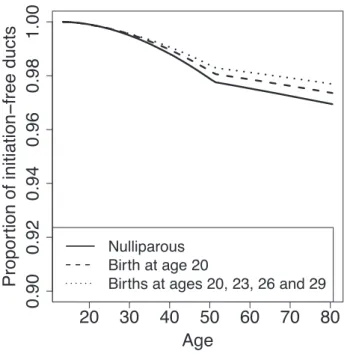
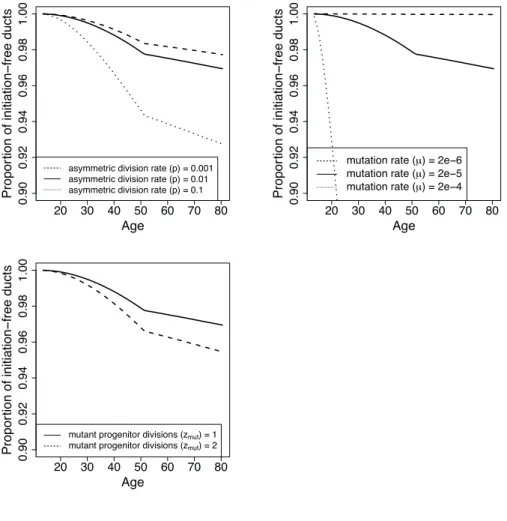
Recent debate has concentrated on the contribution of unavoidable mutations, that may occur on cell division, to cancer development. The tight correlation between the number of tissue-specific stem cell divisions and cancer risk of the same tissue suggests that bad luck has an important role to play in tumor development, but the full extent of this contribution remains an open question. Improved understand-ing of the interplay between extrinsic (external to the population of cells at risk of cancer) and intrinsic (internal to the population of cells at risk of cancer) factors at molecular scales is one promising route to identifying the limits on extrinsic control of tumor initiation, which is highly relevant to cancer prevention. Here we use a simple mathematical model to show that recent data on the variation in numbers of breast epithelial cells with progenitor features due to pregnancy are sufficient to explain the known protective effect of full-term pregnancy in early adulthood for estrogen receptor positive (ER+) breast cancer later in life. Our work provides a mechanism for this previously ill-understood effect and illuminates the complex