THE BOOSTED DIFFERENCE OF CONVEX FUNCTIONS
ALGORITHM FOR NONSMOOTH FUNCTIONS
∗FRANCISCO J. ARAG ´ON ARTACHO† AND PHAN T. VUONG‡
Abstract. The boosted difference of convex functions algorithm (BDCA) was recently proposed for minimizing smooth difference of convex (DC) functions. BDCA accelerates the convergence of the classical difference of convex functions algorithm (DCA) thanks to an additional line search step. The purpose of this paper is twofold. First, we show that this scheme can be generalized and successfully applied to certain types of nonsmooth DC functions, namely, those that can be expressed as the difference of a smooth function and a possibly nonsmooth one. Second, we show that there is complete freedom in the choice of the trial step size for the line search, which is something that can further improve its performance. We prove that any limit point of the BDCA iterative sequence is a critical point of the problem under consideration and that the corresponding objective value is monotonically decreasing and convergent. The global convergence and convergence rate of the iterations are obtained under the Kurdyka– Lojasiewicz property. Applications and numerical experiments for two problems in data science are presented, demonstrating that BDCA outperforms DCA. Specifically, for the minimum sum-of-squares clustering problem, BDCA was on average 16 times faster than DCA, and for the multidimensional scaling problem, BDCA was 3 times faster than DCA.
Key words. difference of convex functions, boosted difference of convex functions algorithm, Kurdyka– Lojasiewicz property, clustering problem, multidimensional scaling problem
AMS subject classifications. 65K05, 65K10, 90C26, 47N10 DOI. 10.1137/18M123339X
1. Introduction.
In this paper, we are interested in the following difference of
convex (DC) optimization problem
(
P
) minimize
x∈Rm
g(x)
−
h(x) =:
φ(x),
(1.1)
where
g
:
R
m→
R
∪ {
+
∞}
and
h
:
R
m→
R
∪ {
+
∞}
are proper convex functions,
with the conventions
(+
∞
)
−
(+
∞
) = +
∞
,
(+
∞
)
−
λ
= +
∞
and
λ
−
(+
∞
) =
−∞
∀
λ
∈
]
− ∞
,
+
∞
[
.
For solving (
P
), one usually applies the well-known DC algorithm (DCA) [21,
22, 34] (see section 3). DC programming and the DCA have been investigated and
developed for more than 30 years [20]. The DCA has been successfully applied in many
fields, such as machine learning, financial optimization, supply chain management,
and telecommunication [19, 22, 20]. If both functions
g
and
h
are differentiable, then
∗Received by the editors December 17, 2018; accepted for publication (in revised form) January24, 2020; published electronically March 23, 2020. https://doi.org/10.1137/18M123339X
Funding:The first author was supported by MICINN of Spain and ERDF of EU, as part of the Ram´on y Cajal program (RYC-2013-13327), and the grants MTM2014-59179-C2-1-P and PGC2018-097960-B-C22. The second author was supported by the FWF (Austrian Science Fund), project M 2499-N32, and by the Vietnam National Foundation for Science and Technology Development (NAFOSTED), project 101.01-2019.320.
†Department of Mathematics, University of Alicante, Alicante, Spain ([email protected]). ‡School of Mathematical Sciences, University of Southampton, University Road, SO17 1 BJ,
Southampton, UK ([email protected]). 980
the boosted DC algorithm (BDCA) developed in [2] can be applied to accelerate the
convergence of DCA. Numerical experiments with various biological data sets in [2]
showed that BDCA outperforms DCA, being on average more than four times faster
in both computational time and the number of iterations. This advantage has been
also confirmed when applying BDCA to the indefinite kernel support vector machine
problem [36].
The purpose of the present paper is to develop a version of BDCA when the
func-tion
φ
is not differentiable. Unfortunatelly, when
g
is not differentiable, the direction
used by BDCA may no longer be a descent direction (see Example 3.4). For this
reason, we shall restrict ourselves to the case where
g
is assumed to be differentiable
but
h
is not. The motivation for this study comes from many applications of DC
pro-gramming where the objective function is the difference of a smooth convex function
and a nonsmooth convex function. We mention here the minimum sum-of-squares
clustering problem [13], the bilevel hierarchical clustering problem [27], the multicast
network design problem [15], and the multidimensional scaling (MDS) problem [18],
among others.
The paper is organized as follows. In section 2, we recall some basic concepts
and properties of convex analysis. As we are working with nonconvex and nonsmooth
functions, we need some tools from variational analysis for generalized differentiability.
Our main contributions are in section 3, where we propose a nonsmooth version
of the BDCA introduced in [2]. More precisely, we prove that the point generated by
the DCA provides a descent direction for the objective function at this point, even
at points where the function
h
is not differentiable. This is the key property allowing
us to employ a simple line search along the descent direction, which permits us to
achieve a larger decrease in the value of the objective function.
In section 4, we investigate the global convergence and convergence rate of the
BDCA. The convergence analysis relies on the Kurdyka– Lojasiewicz inequality. These
concepts of real algebraic geometry were introduced by Lojasiewicz [23] and Kurdyka
[16] and later developed in the nonsmooth setting by Bolte et al. [9] and Attouch
et al. [3], among many others [1, 4, 6, 8, 11, 28].
In section 5, we begin by introducing a self-adaptive strategy for choosing the trial
step size for the line search step. We show that this strategy permits us to further
improve the numerical results obtained in [2] for the above-mentioned problem arising
in biochemistry, BDCA being almost 7 times faster than DCA on average. Next,
we present an application of BDCA to two important classes of DC programming
problems in engineering: the minimum sum-of-squares clustering problem and the
MDS problem. We present some numerical experiments on large data sets, with both
real and randomly generated data, which clearly show that BDCA outperforms DCA.
Namely, on average, BDCA was 16 times faster than DCA for the minimum
sum-of-squares clustering and 3 times faster for the MDS problems. We conclude the paper
with some remarks and future research directions in the last section.
2. Preliminaries.
Throughout this paper, the inner product of two vectors
x, y
∈
R
mis denoted by
h
x, y
i
, while
k · k
denotes the induced norm, defined by
k
x
k
=
p
h
x, x
i
. The closed ball of center
x
and radius
r >
0 is denoted by
B
(x, r).
2.1. Tools of convex and variational analysis.
In this subsection, we recall
some basic concepts and results of convex analysis and generalized differentiation for
nonsmooth functions, which will be used in what follows.
For an extended real-valued function
f
:
R
m→
R
∪ {
+
∞}
, the domain of
f
is
the set
dom
f
=
{
x
∈
R
m:
f
(x)
<
+
∞}
.
The function
f
is said to be proper if its domain is nonempty. It is said to be
convex
if
f
(
λx
+ (1
−
λ
)
y
)
≤
λf
(
x
) + (1
−
λ
)
f
(
y
)
∀
x, y
∈
R
mand
λ
∈
]0
,
1[
,
and
f
is said to be
concave
if
−
f
is convex. Further,
f
is called
strongly convex
with
modulus
ρ >
0 if for all
x, y
∈
R
mand
λ
∈
]0,
1[,
f
(λx
+ (1
−
λ)y)
≤
λf
(x) + (1
−
λ)f
(y)
−
1
2
ρλ(1
−
λ)
k
x
−
y
k
2,
or, equivalently, when
f
−
ρ2k · k
2is convex. The function
f
is said to be
coercive
if
f
(x)
→
+
∞
whenever
k
x
k →
+
∞
.
The gradient of a function
f
:
R
m→
R
∪ {
+
∞}
which is differentiable at some point
x
in the interior of dom
f
is denoted by
∇
f
(
x
).
We denote by
f
0(
x, d
) the one-sided directional derivative of
f
at
x
∈
dom
f
for the
direction
d
∈
R
m, defined as
f
0(
x
;
d
) := lim
t↓0
f
(
x
+
td
)
−
f
(
x
)
t
.
A function
F
:
R
m→
R
mis said to be
monotone
when
h
F
(x)
−
F
(y), x
−
y
i ≥
0
∀
x, y
∈
R
m.
Further,
F
is called
strongly monotone
with modulus
ρ >
0 when
h
F
(x)
−
F
(y), x
−
y
i ≥
ρ
k
x
−
y
k
2∀
x, y
∈
R
m.
The function
F
is called
Lipschitz continuous
if there is some constant
L
≥
0 such
that
k
F
(x)
−
F
(y)
k ≤
L
k
x
−
y
k
∀
x, y
∈
R
m,
and
F
is said to be locally Lipschitz continuous if, for every
x
in
R
m, there exists a
neighborhood
U
of
x
such that
F
restricted to
U
is Lipschitz continuous.
We have the following well-known result (see, e.g., [33, Exercise 12.59]).
Fact
2.1.
A function
f
:
R
m→
R
∪ {
+
∞}
is strongly convex with modulus
ρ
if
and only if
∂f
is strongly monotone with modulus
ρ
.
The
convex subdifferential
∂f
(¯
x
) of a function
f
at ¯
x
∈
R
mis defined at any point
¯
x
∈
dom
f
by
∂f(¯
x) =
{
u
∈
R
m|
f
(x)
−
f(¯
x)
≥ h
u, x
−
x
¯
i ∀
x
∈
R
m}
and is empty otherwise.
When dealing with nonconvex and nonsmooth functions, we have to consider
subdifferentials more general than the convex one. One of the most widely used
constructions is the Clarke subdifferential, which can be defined in several (equivalent)
ways (see, e.g., [12]). For a given locally Lipschitz continuous function
f
:
R
m→
R
∪ {
+
∞}
, the
Clarke subdifferential
of
f
at ¯
x
is given by
∂
Cf
(¯
x) = co
lim
x→¯x, x6∈Ωf∇
f
(x)
,
where co stands for the convex hull and Ω
fdenotes the set of Lebesgue measure zero
(by Rademacher’s theorem) where
f
fails to be differentiable. When
f
is also convex
on a neighborhood of ¯
x, then
∂
Cf
(¯
x) =
∂f(¯
x) (see [12, Proposition 2.2.7]).
Clarke subgradients are generalizations of the usual gradient of smooth functions.
Indeed, if
f
is strictly differentiable at
x, we have
∂
Cf
(x) =
{∇
f
(x)
}
;
see [12, Proposition 2.2.4]. However, it should be noted that if
f
is only Fr´echet
differentiable at
x, then
∂
Cf
(x) can contain points other than
∇
f
(x) (see, e.g., [12,
Example 2.2.3]).
The next basic formulas facilitate the calculation of the Clarke subdifferential.
Fact
2.2 (basic calculus).
The following assertions hold:
(i)
For any scalar
s
, one has
∂
C(sf
)(x) =
s∂
Cf
(x).
(ii)
∂
C(f
+g)(x)
⊂
∂
Cf
(x) +
∂
Cg(x)
, and equality holds if either
f
or
g
is strictly
differentiable.
Proof.
See [12, Propositions 2.3.1 and 2.3.3]. For the last assertion, see [12,
Corollary 1, p. 39].
2.2. Assumptions.
Throughout this paper, the following two assumptions are
made.
Assumption
1. Both functions
g
and
h
are strongly convex with modulus
ρ >
0.
Assumption
2. The function
h
is subdifferentiable at every point in dom
h, i.e.,
∂h(x)
6
=
∅
for all
x
∈
dom
h. The function
g
is continuously differentiable on an open
set containing dom
h
and
inf
x∈Rm
φ(x)
>
−∞
.
(2.1)
Under these assumptions, the next necessary optimality condition holds.
Fact
2.3 (first-order necessary optimality condition).
If
x
∗∈
dom
φ
is an optimal
solution of problem
(
P
)
in
(1.1)
, then
∂h(x
∗) =
{∇
g(x
∗)
}
.
(2.2)
Proof.
See [35, Theorem 3
0].
Any point satisfying condition (2.2) is called a
stationary point
of (
P
). One says
that ¯
x
is a
critical point
of (
P
) if
∇
g(¯
x)
∈
∂h(¯
x).
It is obvious that every stationary point
x
∗is a critical point, but the converse is not
true in general.
Example
2.4. Consider the DC function
φ
:
R
m→
R
defined for
x
∈
R
mby
φ
(
x
) :=
k
x
k
2+
mX
i=1x
i−
mX
i=1|
x
i|.
It is not difficult to check that
φ
has 2
mcritical points, namely, any
x
∈ {−
1,
0
}
m,
and only one stationary point
x
∗:= (
−
1,
−
1, . . . ,
−
1), which is the global minimum
of
φ.
3. DCA and BDCA.
The key idea of the DCA to solve problem (
P
) in (1.1)
is to approximate the concave part
−
h
of the objective function
φ
by its affine
ma-jorization, and then minimize the resulting convex function. The algorithm proceeds
as follows.
DCA
[22]
1. Let
x
0be any initial point and set
k
:= 0.
2. Select
u
k∈
∂h(x
k) and solve the strongly convex optimization problem
(
Pk
) minimize
x∈Rm
g(x)
− h
u
k, x
i
to obtain its unique solution
y
k.
3. If
y
k=
x
kthen STOP and RETURN
x
k, otherwise set
x
k+1:=
y
k, set
k
:=
k
+ 1, and go to step 2.
Let us introduce the algorithm we propose for solving problem (
P
), BDCA. The
algorithm is a nonsmooth version of the one proposed in [2], except for a small but
relevant modification in step 4, where now we give total freedom to the initial value
for the backtracking line search used for finding an appropriate value of the step size
λ
k. In section 5, we demonstrate that this seemingly minor change permits
smarter
choices
of the initial value than simply using a constant value
λ. We have also replaced
λ
kin the right-hand side of the line search inequality by
λ
2k, which allows us to remove
the inconvenient assumption
ρ > α
(see [2, Remark 3] for more details).
BDCA
1. Fix
α >
0 and 0
< β <
1. Let
x
0be any initial point and set
k
:= 0.
2. Select
u
k∈
∂h
(
x
k) and solve the strongly convex optimization problem
(
P
k) minimize
x∈Rmg(x)
− h
u
k, x
i
to obtain its unique solution
y
k.
3. Set
d
k:=
y
k−
x
k. If
d
k= 0, STOP and RETURN
x
k. Otherwise, go to
step 4.
4. Choose any
λ
k≥
0. Set
λ
k:=
λ
k.
WHILE
φ(y
k+
λ
kd
k)
> φ(y
k)
−
αλ
2kk
d
kk2
DO
λ
k
:=
βλ
k.
5. Set
x
k+1:=
y
k+λ
kd
k. If
x
k+1=
x
kthen STOP and RETURN
x
k, otherwise
set
k
:=
k
+ 1, and go to step 2.
Observe that if one sets
λ
k= 0, the iterations of the BDCA and the DCA coincide.
Hence, our convergence results for the BDCA apply in particular to the DCA. In the
following proposition we show that
d
k:=
y
k−
x
kis a descent direction for
φ
at
y
k.
Since the value of
φ
is always reduced at
y
kwith respect to that at
x
k, one can achieve
a larger decrease by moving along the direction
d
k. This simple fact, which is the key
idea of the BDCA, improves the performance of the DCA in many applications (see
section 5).
Proposition
3.1.
For all
k
∈
N
, the following holds:
(i)
φ(y
k)
≤
φ(x
k)
−
ρ
k
d
kk2;
(ii)
φ
0(y
k;
d
k)
≤ −
ρ
k
d
kk2;
(iii)
there is some
δ
k>
0
such that
φ
(y
k+
λd
k)
≤
φ(y
k)
−
αλ
2k
d
kk
2∀
λ
∈
[0, δ
k],
so the backtracking step
4
of BDCA terminates finitely.
Proof.
The proof of (i) is similar to the one of [2, Proposition 3] and is therefore
omitted. To prove (ii), pick any
v
∈
∂h
(
y
k). Note that the one-sided directional
derivative
φ
0(
y
k;
d
k) is given by
φ
0(y
k;
d
k) = lim
t↓0φ(y
k+
td
k)
−
φ(y
k)
t
= lim
t↓0g(y
k+
td
k)
−
g(y
k)
t
−
lim
t↓0h(y
k+
td
k)
−
h(y
k)
t
≤ h∇
g(y
k), d
ki − h
v, d
ki
(3.1)
by convexity of
h. Since
y
kis the unique solution of the strongly convex problem
(
Pk
), we have
∇
g(y
k) =
u
k∈
∂h(x
k).
The function
h
is strongly convex with constant
ρ. This implies, by Fact 2.1, that
∂h
is strongly monotone with constant
ρ
. Therefore, since
v
∈
∂h
(
y
k), it holds that
h
u
k−
v, x
k−
y
ki ≥
ρ
k
x
k−
y
kk
2.
Hence
h∇
g(y
k)
−
v, d
ki
=
h
u
k−
v, y
k−
x
ki ≤ −
ρ
k
d
kk
2,
and the proof follows by combining the last inequality with (3.1).
Finally, to prove (iii), if
d
k= 0 there is nothing to prove. Otherwise, we have
lim
λ↓0φ(y
k+
λd
k)
−
φ(y
k)
λ
=
φ
0(y
k;
d
k)
≤ −
ρ
k
d
kk2<
−
ρ
2
k
d
kk 2<
0.
Hence, there is some
e
λ
k>
0 such that
φ(y
k+
λd
k)
−
φ(y
k)
λ
≤ −
ρ
2
k
d
kk 2∀
λ
∈
i
0,
e
λ
ki
,
that is,
φ(y
k+
λd
k)
≤
φ(y
k)
−
ρλ
2
k
d
kk
2∀
λ
∈
i
0,
e
λ
ki
.
Setting
δ
k:= min
n
e
λ
k,
2ραo
, we obtain
φ
(
y
k+
λd
k)
≤
φ
(
y
k)
−
αλ
2k
d
kk2∀
λ
∈
]0
, δ
k]
,
which completes the proof.
Remark
3.2.
(i) When the function
h
is differentiable, BDCA uses the same direction as the
Mine–Fukushima algorithm [24], since
y
k+
λd
k=
x
k+ (1 +
λ)d
k. The
algo-rithm they propose is computationally undesirable in the sense that it uses an
exact line search. This was later fixed in the Fukushima–Mine algorithm [14]
by considering an Armijo type rule for choosing the step size
x
k+1=
x
k+
β
ld
k=
β
ly
k+ 1
−
β
lx
kfor some 0
< β <
1 and some nonnegative integer
l. Since 0
< β <
1, the
step size
λ
=
β
l−
1 chosen by the Fukushima–Mine algorithm [14] is always
less than or equal to zero, while in BDCA, only step sizes
λ
∈
0, λ
kare
explored. Also, the Armijo rule differs, as BDCA searches for some
λ
ksuch
that
φ(y
k+
λ
kd
k)
≤
φ(y
k)
−
αλ
2kk
d
kk
2, while the Fukushima–Mine algorithm
requires
φ(x
k+
β
ld
k)
≤
φ(x
k)
−
αβ
lk
d
kk
2.
(ii) We know from Proposition 3.1 that
φ
(y
k+
λd
k)
≤
φ(y
k)
−
αλ
2k
d
kk
2≤
φ(x
k)
−
ρ
+
αλ
2k
d
kk2;
thus, BDCA results in a larger decrease in the value of
φ
at each iteration
than DCA. As a result, we can expect BDCA to converge faster than DCA.
Example
3.3 (Example 2.4 revisited). Consider again the function defined in
Example 2.4 for
m
= 2. The function
φ
can be expressed as a DC function of
type (1.1) with strongly convex terms by taking, for instance,
g(x, y) =
3
2
x
2+
y
2+
x
+
y
and
h(x, y) =
|
x
|
+
|
y
|
+
1
2
x
2+
y
2.
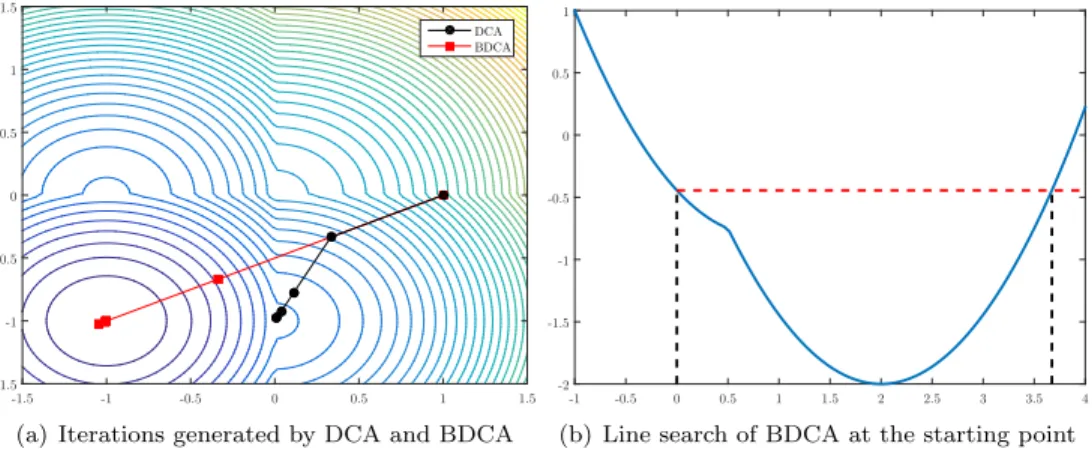
In Figure 1(a) we show the iterations generated by DCA and BDCA from the same
starting point (x
0, y
0) = (1,
0), with
α
= 0.1,
β
= 0.6, and
λ
k= 1 for all
k. Not only
does BDCA obtain a larger decrease than DCA in the value of
φ
at each iteration,
but also the line search helps the sequence generated escape from the stationary point
(0,
−
1), which is not even a local minimum. As the function
h
is not differentiable
at (x
0, y
0), there is freedom in the choice of the point in
∂h(x
0, y
0) =
{
2
} ×
[
−
1,
1]
(we took the point (2,
0)). In Figure 1(b) we plot the value of the function in the
line search procedure of BDCA at the first iteration. The value
λ
= 0 corresponds to
the next iteration chosen by DCA, while BDCA choses
λ >
0, which permits us to
achieve an additional decrease in the value of
φ
.
-1.5 -1 -0.5 0 0.5 1 1.5 -1.5 -1 -0.5 0 0.5 1 1.5 DCA BDCA
(a) Iterations generated by DCA and BDCA
-1 -0.5 0 0.5 1 1.5 2 2.5 3 3.5 4 -2 -1.5 -1 -0.5 0 0.5 1
(b) Line search of BDCA at the starting point
Fig. 1.Illustration of Example 3.3.
Table 1
For1million random starting points in[−1.5,1.5]2, we count the sequences generated by DCA, BDCA, the Oliveira–Tcheou algorithm (OTA)[29], and the Banert–Bot¸ algorithm (BBA)[6], con-verging to each of the four stationary points.
(−1,−1) (−1,0) (0,−1) (0,0) DCA 249,763 249,841 250,204 250,192
BDCA 1,000,000 0 0 0
OTA 1,000,000 0 0 0
BBA 250,980 249,377 249,831 249,812
Fig. 2. Comparison of the objective function value (using logarithmic scale) of DCA, BDCA,
the Oliveira–Tcheou algorithm (OTA)[29], and the Banert–Bot¸ algorithm (BBA)[6]for a particular random instance where the four algorithms converge to the global minimumx∗= (−1,−1).
To demonstrate that, indeed, the line search procedure of BDCA helps the
iter-ations escape from stationary points that are not critical points, we show in Table 1
the results of running both algorithms for 1 million random starting points. For only
25% of the starting points, DCA finds the optimal solution, while BDCA finds it in
100% of the instances.
In [29], Oliveira and Tcheou have recently introduced a modification of DCA by
adding the inertial term
γ(x
k−
x
k−1) to
u
kin the subproblem (
Pk
), where
γ
∈
[0,
ρ2[.
Although the sequence of objective values of the resulting algorithm is no longer
monotone, as can be observed in Figure 2, the numerical experiments in [29] show
that this term can be beneficial for escaping from stationary points that are not
critical. This is also the case here: although the scheme is slower than BDCA, the
algorithm finds the optimal solution in 100% of the instances.
Last, we test the performance of a double-proximal gradient algorithm which
was recently introduced by Banert and Bot¸ in [6]. This algorithm generates both a
primal and a dual sequence by using two proximal steps at each iteration. In our
setting, where the function
g
is smooth and its gradient is Lipschitz continuous with
constant
1β
= 3, only one proximal step is needed, and the scheme reads as follows:
Let (x
0, z
0)
∈
R
2×
R
2be a pair of starting points, and set for
k
≥
0
x
k+1=
x
k+
γ
kz
k−
γ
k∇
g(x
k),
(3.2)
z
k+1=
z
k+
µ
kx
k+1−
µ
kprox
µ−1 k hµ
−1kz
k+
x
k+1(3.3)
=
z
k+
µ
kx
k+1−
µ
kargmin
u∈R21
µ
kh(u) +
1
2
µ
−1kz
k+
x
k+1−
u
2,
where
µ
kand
γ
kare some positive step sizes. To ensure that the hypotheses of the
convergence results from [6] are satisfied, we take
µ
k=
γ
k= 0.3
< β. We observe
in Table 1 that this algorithm also often gets stuck in stationary points. Although
the proximal step can be explicitly computed for this example, which is not always
the case and can be time-consuming, the Banert–Bot¸ algorithm turns out to be the
slowest among the three; see a particular random instance in Figure 2.
The next example complements the one given in [2, Remark 1]. It shows that the
direction used by BDCA can be an ascent direction at
y
keven when this point is not
the global minimum of
φ. Thus, Proposition 3.1 does not remain valid when
g
is not
differentiable, and the scheme cannot be further extended.
Example
3.4 (failure of BDCA when
g
is not differentiable). Consider now the
modification of the previous example
g
(
x, y
) =
−
5
2
x
+
x
2+
y
2+
|
x
|
+
|
y
|
and
h
(
x, y
) =
1
2
x
2+
y
2,
so that now
h
is differentiable but
g
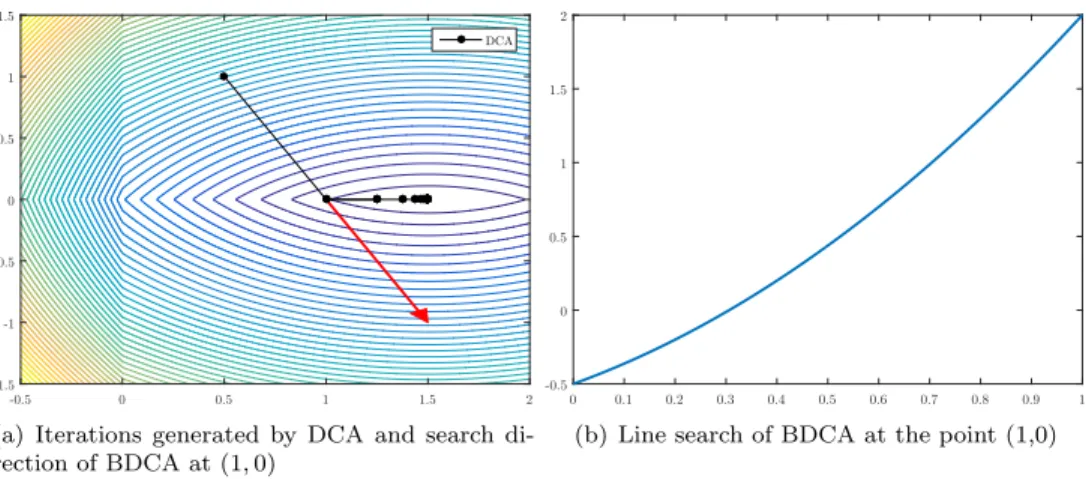
is not. Let (x
0, y
0) = (
12,
1). Then, the next point
generated by DCA is (x
1, y
1) = (1,
0) and
d
0:= (x
1, y
1)
−
(x
0, y
0) = (
12,
−
1) is not a
descent direction for
φ
at (x
1, y
1). Indeed, one can easily check that
φ
0((x
1, y
1);
d
0) = lim
t↓0φ
(1,
0) +
t
12,
−
1
−
φ(1,
0)
t
=
3
4
;
see Figure 3. Actually, it holds that
φ
((x
1, y
1) +
td
0)
−
φ(x
1, y
1) =
5t
28
+
3t
4
,
so
φ
((
x
1, y
1) +
td
0)
> φ
(
x
1, y
1) for all
t >
0.
In contrast with the example in [2, Remark 1], observe that here (
x
1, y
1) is not
the global minimum of
φ
. In fact, the iterates generated by DCA converge to the
global minimum of
φ, as shown in Figure 3(a).
As proved next, the failure of BDCA shown in Example 3.4 can occur only
for
n
≥
2.
Proposition
3.5.
Let
φ
=
g
−
h
, where
g
:
R
→
R
and
h
:
R
→
R
are convex
and
h
is differentiable. If
h
0(x)
∈
∂g(y)
and
0
6∈
∂
Cφ(y)
, then
φ
0(y;
y
−
x)
<
0
.
Proof.
First, observe that
φ
0(y;
y
−
x) = (y
−
x) sup
z∈∂g(y)
{
z
−
h
0(y)
}
.
Since
h
is convex, one has
(h
0(x)
−
h
0(y)) (x
−
y)
≥
0.
Suppose that
x
−
y >
0. Then,
h
0(x)
≥
h
0(y). Since
h
0(y)
6∈
∂g(y) and
∂g(y) is convex,
we deduce that
h
0(y)
< z
for all
z
∈
∂g(y), which implies
φ
0(y;
y
−
x)
<
0. A similar
argument shows that
φ
0(y;
y
−
x)
<
0 when
x
−
y <
0. This concludes the proof.
-0.5 0 0.5 1 1.5 2 -1.5 -1 -0.5 0 0.5 1 1.5 DCA
(a) Iterations generated by DCA and search di-rection of BDCA at (1,0) 0 0.1 0.2 0.3 0.4 0.5 0.6 0.7 0.8 0.9 1 -0.5 0 0.5 1 1.5 2
(b) Line search of BDCA at the point (1,0)
Fig. 3.Illustration of Example 3.4.
We are now in a position to state our first convergence result of the iterative
sequence generated by BDCA, whose statement coincides with [2, Proposition 5].
The first part of its proof requires some small adjustments due to the nonsmoothness
of
h.
Theorem
3.6.
For any
x
0∈
R
m, either BDCA returns a critical point of
(
P
)
or
it generates an infinite sequence such that the following holds:
(i)
φ(x
k)
is monotonically decreasing and convergent to some
φ
∗.
(ii)
Any limit point of
{
x
k}is a critical point of
(
P
)
. If in addition
φ
is coercive,
then there exists a subsequence of
{
x
k}
which converges to a critical point
of
(
P
)
.
(iii)
P
+∞k=0
k
d
kk
2<
+
∞
.
Further, if there is some
λ
such that
λ
k≤
λ
for all
k
,
then
P
+∞k=0
k
x
k+1−
x
kk
2<
+
∞
.
Proof.
If BDCA stops at step 3 and returns
x
k, then
x
k=
y
k. Because
y
kis the
unique solution of the strongly convex problem (
Pk
), we have
∇
g(x
k) =
u
k∈
∂h(x
k),
i.e.,
x
kis a critical point of (
P
). Otherwise, by Proposition 3.1 and step 4 of BDCA,
we have
φ
(
x
k+1)
≤
φ
(
y
k)
−
αλ
2kk
d
kk
2≤
φ
(
x
k)
−
αλ
2k+
ρ
k
d
kk
2.
(3.4)
Therefore, the sequence
{
φ(x
k)
}
converges to some
φ
∗, since is monotonically
de-creasing and bounded from below by (2.1). This proves (i). As a consequence, we
obtain
φ(x
k+1)
−
φ(x
k)
→
0,
which implies
k
d
kk
2=
k
y
k−
x
kk
2→
0, by (3.4).
If ¯
x
is a limit point of
{
x
k}
, there exists a subsequence
{
x
ki}
converging to ¯
x.
Then, as
k
y
ki−
x
kik →
0, we have
y
ki→
x. Since
¯
∇
g
is continuous, we get
u
ki=
∇
g(y
ki)
→ ∇
g(¯
x).
Hence, we deduce
∇
g
(¯
x
)
∈
∂h
(¯
x
), thanks to the closedness of the graph of
∂h
(see [32,
Theorem 24.4]). When
φ
is coercive, by (i), the sequence
{
x
k}
must be bounded, which
implies the rest of the claim in (ii).
The proof of (iii) is similar to that of [2, Proposition 5(iii)] and is thus
omitted.
Remark
3.7. In our approach, both functions
g
and
h
are assumed to be strongly
convex with constant
ρ >
0. It is well known that the performance of DCA heavily
depends on the decomposition of the objective function [22, 31]. There is an infinite
number of ways of doing this and it is challenging to find a “good” one [31]. To get
rid of this assumption, one could add a proximal term
ρk2
k
x
−
x
kk
2
to the objective
of the convex optimization subproblem (
Pk
) in step 2, as done in the proximal point
algorithm (see [14]). This technique is employed in the proximal DCA; see [1, 6, 20, 26].
With some minor adjustments in the proofs, it is easy to show that the resulting
algorithm satisfies both Proposition 3.1 and Theorem 3.6.
4. Convergence under the Kurdyka– Lojasiewicz property.
In this
sec-tion, we prove the convergence of the sequence generated by BDCA as long as the
sequence has a cluster point at which
φ
satisfies the strong Kurdyka– Lojasiewicz
in-equality [23, 16, 9] and
∇
g
is locally Lipschitz. As we shall see, under some additional
assumptions, linear convergence can also be guaranteed.
Definition
4.1.
Let
f
:
R
m→
R
be a locally Lipschitz function. We say that
f
satisfies the
strong Kurdyka– Lojasiewicz inequality
at
x
∗∈
R
mif there exist
η
∈
]0,
+
∞
[
, a neighborhood
U
of
x
∗, and a concave function
ϕ
: [0, η]
→
[0,
+
∞
[
such
that
(i)
ϕ(0) = 0
;
(ii)
ϕ
is of class
C
1on
]0, η[
;
(iii)
ϕ
0>
0
on
]0
, η
[
;
(iv)
for all
x
∈
U
with
f
(
x
∗)
< f
(
x
)
< f
(
x
∗) +
η
we have
ϕ
0(f
(x)
−
f
(x
∗)) dist (0, ∂
Cf(x))
≥
1.
(4.1)
For strictly differentiable functions the latter reduces to the standard definition of
the Kurdyka– Lojasiewicz inequality. Bolte et al. [9, Theorem 14] show that
definable
functions
satisfy the strong Kurdyka– Lojasiewicz inequality at each point in dom
∂
Cf
,
which covers a large variety of practical cases.
Remark
4.2. Although the concavity of the function
ϕ
does not explicitly appear
in the statement of [9, Theorem 14], the function
ϕ
can be chosen to be concave
(since
ϕ
is o-minimal by construction, its second derivative exists and maintains the
sign on an interval ]0, δ[, and this sign is necessarily negative). If the function
f
is
not o-minimal but is convex and satisfies the Kurdyka– Lojasiewicz inequality with
a function
ϕ
which is not concave, then
f
also satisfies the Kurdyka– Lojasiewicz
inequality with another function Ψ which is concave (see [10, Theorem 29]).
Theorem
4.3.
For any
x
0∈
R
m, consider the sequence
{
x
k}
generated by the
BDCA. Suppose that
{
x
k}
has a cluster point
x
∗, that
∇
g
is locally Lipschitz
contin-uous around
x
∗, and that
φ
satisfies the strong Kurdyka– Lojasiewicz inequality at
x
∗.
Then
{
x
k}converges to
x
∗,
which is a critical point of
(
P
)
.
Proof.
By Theorem 3.6, we have lim
k→+∞φ(x
k) =
φ
∗.
Let
x
∗be a cluster point
of the sequence
{
x
k}
. Then, there exists a subsequence
{
x
ki}
of
{
x
k}
such that
lim
i→+∞x
ki=
x
∗
. Thanks to the continuity of
φ, we deduce
φ(x
∗) = lim
i→+∞
φ(x
ki) = lim
k→∞φ(x
k) =
φ
∗
.
Hence, the function
φ
is finite and has the same value
φ
∗at every cluster point of
{
x
k}.
If
φ(x
k) =
φ
∗for some
k >
1, then
φ(x
k) =
φ(x
k+1), because the sequence
{
φ(x
k)
}
is decreasing. From (3.4), we deduce that
d
k= 0, so BDCA terminates after
a finite number of steps. Thus, from now on, we assume that
φ(x
k)
> φ
∗for all
k.
Since
∇
g
is locally Lipschitz around
x
∗, there exist some constants
L
≥
0 and
δ
1>
0 such that
k∇
g
(
x
)
− ∇
g
(
y
)
k ≤
L
k
x
−
y
k
∀
x, y
∈
B
(
x
∗, δ
1)
.
(4.2)
Further, since
φ
satisfies the strong Kurdyka– Lojasiewicz inequality at
x
∗, there
exist
η
∈
]0,
+
∞
[, a neighborhood
U
of
x
∗, and a continuous and concave function
ϕ
: [0, η]
→
[0,
+
∞
[ such that for every
x
∈
U
with
φ(x
∗)
< φ(x)
< φ(x
∗) +
η, we
have
ϕ
0(
φ
(
x
)
−
φ
(
x
∗)) dist (0
, ∂
Cφ
(
x
))
≥
1
.
(4.3)
Take
δ
2small enough that
B
(x
∗, δ
2)
⊂
U
and set
δ
:=
12min
{
δ
1, δ
2}
. Let
K
:= max
λ≥0L(1 +
λ)
αλ
2+
ρ
,
(4.4)
which is attained at ˆ
λ
=
−
1 +
p
1 +
ρ/α. Since lim
i→+∞x
ki=
x
∗, lim
i→+∞φ(x
ki) =
φ
∗,
φ(x
k)
> φ
∗for all
k, and
ϕ
is continuous, we can find an index
N
large enough
such that
x
N∈
B
(x
∗, δ),
φ
∗< φ(x
N)
< φ
∗+
η
(4.5)
and
k
x
N−
x
∗k
+
Kϕ
(φ(x
N)
−
φ
∗)
< δ.
(4.6)
By Theorem 3.6(iii), we know that
d
k=
y
k−
x
k→
0. Then, taking a larger
N
if
needed, we can ensure that
k
y
k−
x
kk ≤
δ
∀
k
≥
N.
For all
k
≥
N
such that
x
k∈
B
(x
∗, δ), we have
k
y
k−
x
∗k ≤ k
y
k−
x
kk+
k
x
k−
x
∗k ≤
2δ
≤
δ
1;
then, using (4.2), we obtain
k∇
g(y
k)
− ∇
g(x
k)
k ≤
L
k
y
k−
x
kk=
L
1 +
λ
kk
x
k+1−
x
kk.
On the other hand, we have from the optimality condition of (
Pk
) that
∇
g(y
k) =
u
k∈
∂h(x
k),
which implies, by Fact 2.2,
∇
g
(
y
k)
− ∇
g
(
x
k)
∈
∂h
(
x
k)
− ∇
g
(
x
k) =
∂
C(
−
φ
(
x
k)) =
−
∂
Cφ
(
x
k)
.
(4.7)
Therefore,
dist (0, ∂
Cφ(x
k))
≤ k∇
g(y
k)
− ∇
g(x
k)
k ≤
L
1 +
λ
kk
x
k+1−
x
kk.
(4.8)
For all
k
≥
N
such that
x
k∈
B
(x
∗, δ) and
φ
∗< φ(x
k)
< φ
∗+
η, it follows from
(4.8), the concavity of
ϕ
, (4.3), and (3.4) that
L
1 +
λ
kk
x
k−
x
k+1k
(ϕ
(φ(x
k)
−
φ
∗)
−
ϕ
(φ(x
k+1)
−
φ
∗))
≥
dist (0, ∂
Cφ(x
k)) (ϕ
(φ(x
k)
−
φ
∗)
−
ϕ
(φ(x
k+1)
−
φ
∗))
≥
dist (0, ∂
Cφ(x
k))
ϕ
0(φ(x
k)
−
φ
∗) (φ(x
k)
−
φ(x
k+1))
≥
φ(x
k)
−
φ(x
k+1)
≥
αλ
2k+
ρ
k
y
k−
x
kk
2=
αλ
2k+
ρ
(1 +
λ
k)
2k
x
k−
x
k+1k
2,
which implies, by (4.4), that
k
x
k−
x
k+1k ≤
L(1 +
λ
k)
αλ
2 k+
ρ
(
ϕ
(
φ
(
x
k)
−
φ
∗)
−
ϕ
(
φ
(
x
k+1)
−
φ
∗))
≤
K
(ϕ
(φ(x
k)
−
φ
∗)
−
ϕ
(φ(x
k+1)
−
φ
∗))
.
(4.9)
We prove by induction that
x
k∈
B
(x
∗, δ) for all
k
≥
N. Indeed, from (4.5) the
claim holds for
k
=
N
. We suppose that it also holds for
k
=
N, N
+ 1, . . . , N
+
p
−
1,
with
p
≥
1. Since
{
φ(x
k)
}
is a decreasing sequence converging to
φ
∗, our choice
of
N
implies that
φ
∗< φ(x
k)
< φ
∗+
η
for all
k
≥
N
. Then (4.9) is valid for
k
=
N, N
+ 1, . . . , N
+
p
−
1. Hence,
k
x
N+p−
x
∗k ≤ k
x
N−
x
∗k
+
pX
i=1k
x
N+i−
x
N+i−1k
≤ k
x
N−
x
∗k
+
K
pX
i=1[ϕ
(φ(x
N+i−1)
−
φ
∗)
−
ϕ
(φ(x
N+i)
−
φ
∗)]
≤ k
x
N−
x
∗k
+
Kϕ
(φ(x
N)
−
φ
∗)
< δ,
where the last inequality follows from (4.6).
Thus, adding (4.9) from
k
=
N
to
P
, we get
P
X
k=N
k
x
k+1−
x
kk ≤Kϕ
(φ(x
N)
−
φ
∗)
,
and taking the limit as
P
→
+
∞
, we conclude that
+∞X
k=1
k
x
k+1−
x
kk<
+
∞
.
(4.10)
Therefore,
{
x
k}is a Cauchy sequence, and since
x
∗is a cluster point of
{
x
k}
, the
whole sequence converges to
x
∗. By Theorem 3.6,
x
∗must be a critical point
of (
P
).
Remark
4.4. In the proof of Theorem 4.3, we assume the
strong Kurdyka–
Lojasiewicz inequality
in order to have Fact 2.2(i), which allows us to deduce the
last equality in (4.7). Therefore, Theorem 4.3 remains valid if, instead of
requir-ing that
φ
satisfies the strong Kurdyka– Lojasiewicz inequality, we assume that
−
φ
satisfies the
Kurdyka– Lojasiewicz inequality
(which is defined in the same way but
replacing in (4.1) the Clarke subdifferential by the limiting subdifferential). Another
possibility would be to assume that
φ
satisfies the
symmetric Kurdyka– Lojasiewicz
inequality
, which can be defined as in Definition 4.1 with (4.1) replaced by
ϕ
0(f
(x)
−
f
(x
∗)) dist (0, ∂
0f
(x))
≥
1,
(4.11)
where
∂
0f
(x) is the
symmetric subdifferential
of
f
at
x
(see, e.g., [25, p. 171]), defined
by
∂
0f
(x) :=
∂
Lf
(x)
∪
[
−
∂
L(
−
f
(x))]
,
(4.12)
with
∂
Lf
(
x
) denoting the
limiting subdifferential
of
f
at
x
. It is clear that
∂
Lf
(
x
)
⊂
∂
0f
(x)
⊂
∂
Cf
(x) for locally Lipschitz functions. Moreover
∂
0(
−
f
(x)) =
−
∂
0f
(x) (see
[25, Exercise 1.75]), which is exactly what we need to deduce the last equality in (4.7).
For more information on this, we recommend the discussion in [25, pp. 61–62].
Remark
4.5. Our convergence analysis in Theorem 4.3 shares a similar flavor with
the general framework developed by Attouch, Bolte, and Svaiter in [5]. Indeed, in
that paper, the authors provided a convergence analysis for any generic algorithm for
solving nonsmooth nonconvex optimization problems satisfying two key properties:
(i) for each
k
∈
N
:
φ(x
k+1) +
a
k
x
k+1−
x
kk2≤
φ(x
k);
(ii) for each
k
∈
N
there exists
w
k+1∈
∂
Lφ(x
k+1) such that
k
w
k+1k ≤
b
k
x
k+1−
x
kk,
(4.13)
where
a
and
b
are some positive constants. In our convergence analysis, while we also
have the descent property (i) for BDCA (see (3.4)), it is not clear if (ii) holds. Instead
of (ii), from (4.8) we can deduce a similar property: for each
k
large enough there
exists
w
k∈
∂
Cφ(x
k) such that
k
w
kk ≤b
k
x
k+1−
x
kk.
(4.14)
This also opens the question of whether the general framework from Attouch, Bolte,
and Svaiter [5] still holds when we replace (4.13) by (4.14). The answer seems to be
positive, at least for DC programming.
Remark
4.6. In [28], Noll proposed an alternative algorithm for nonsmooth
non-convex optimization problems without requiring (4.13) or (4.14), where the
conver-gence analysis also heavily depends on the strong Kurdyka– Lojasiewicz inequality.
In addition, he provided an example where both (4.13) and (4.14) could fail.
An-other algorithm for DC programming whose convergence was analyzed under the
Kurdyka– Lojasiewicz inequality is the double-proximal gradient algorithm by Banert
and Bot¸ [6], which was briefly discussed in Example 3.3. This algorithm can be applied
to more general DC problems of the type
min
x∈Rm
{
g(x) +
φ(x)
−
h(Kx)
}
,
where
g
and
h
are proper, convex, and lower semicontinuous functions,
φ
is convex
and differentiable with
1β
-Lipschitz continuous gradient, for some
β >
0, and
K
is
a linear mapping. Although neither strong convexity of
g
and
h, nor smoothness of
g
+φ
is required, this comes at the cost of needing to compute an additional proximal
step. Further, when
g
+
φ
is smooth, the global Lipschitz continuity of the gradient
of
φ
with a known constant is needed to guarantee the convergence of the algorithm,
because the step size is bounded above by that constant (see [6, Theorem 1]). In
contrast, only local Lipschitz continuity of
∇
g
is assumed in Theorem 4.3.
Remark
4.7. As mentioned before, if one sets
λ
k= 0 for all
k, then BDCA
be-comes DCA. In this case, Theorem 4.3 is akin to [17, Theorem 3.4], where the
func-tion
φ
is assumed to be subanalytic. We also note that in this setting only one of
the functions
g
or
h
needs to be strongly convex, since one can easily check that [2,
Proposition 3] still holds, and Proposition 3.1(ii) is not needed anymore.
Next, we establish the convergence rate on the iterative sequence
{
x
k}
when
φ
satisfies the strong Kurdyka– Lojasiewicz inequality with
ϕ(t) =
M t
1−θfor some
M >
0 and 0
≤
θ <
1. Observe that this property holds for all globally subanalytic
functions [9, Corollary 16], which covers many classes of functions in applications.
We will employ the following useful lemma, whose proof appears within that of [4,
Theorem 2] for specific values of
α
and
β.
Lemma
4.8 (see [2, Lemma 1]).
Let
{
s
k}be a nonnegative sequence in
R
and
let
α, β
be some positive constants. Suppose that
s
k→
0
and that the sequence satisfies
s
αk≤
β
(s
k−
s
k+1)
∀
k
sufficiently large.
Then,
(i)
if
α
= 0
, the sequence
{
s
k}
converges to
0
in a finite number of steps;
(ii)
if
α
∈
]0,
1]
, the sequence
{
s
k}
converges linearly to
0
with rate
1
−
β1;
(iii)
if
α >
1
, there exists
η >
0
such that
s
k≤
ηk
− 1α−1
∀
k
sufficiently large.
Theorem
4.9.
Suppose that the sequence
{
x
k}generated by the BDCA has the
limit point
x
∗.
Assume that
∇
g
is locally Lipschitz continuous around
x
∗and
φ
satisfies the strong Kurdyka– Lojasiewicz inequality at
x
∗with
ϕ(t) =
M t
1−θfor some
M >
0
and
0
≤
θ <
1
. Then, the following convergence rates are guaranteed:
(i)
if
θ
= 0
, then the sequence
{
x
k}converges in a finite number of steps to
x
∗;
(ii)
if
θ
∈
0
,
1 2, then the sequence
{
x
k}converges linearly to
x
∗;
(iii)
if
θ
∈
1 2,
1
, then there exists a positive constant
η
such that
k
x
k−
x
∗k ≤
ηk
− 1−θ2θ−1
for all large
k
.
Proof.
By (4.10), we know that
s
i:=
P
+∞k=ik
x
k+1−
x
kkis finite. Since
k
x
i−
x
∗k ≤
s
iby the triangle inequality, the rate of convergence of
x
ito
x
∗can be deduced from
the convergence rate of
s
ito 0.
Adding (4.9) from
i
to
P
with
N
≤
i
≤
P, we have
P
X
k=i
k
x
k+1−
x
kk ≤
Kϕ
(φ(x
i)
−
φ
∗) =
KM
(φ(x
i)
−
φ
∗)
1−θ,
which implies that
s
i= lim
P→+∞ PX
k=ik
x
k+1−
x
kk ≤
KM
(φ(x
i)
−
φ
∗)
1−θ.
(4.15)
Since
φ
satisfies the strong Kurdyka– Lojasiewicz inequality at
x
∗with
ϕ(t) =
M t
1−θ,
we have
M
(1
−
θ
) (
φ
(
x
i)
−
φ
∗)
−θ
dist (0
, ∂
Cφ
(
x
i))
≥
1
.
This and (4.8) imply
(φ(x
i)
−
φ
∗)
θ≤
M
(1
−
θ) dist (0, ∂
Cφ(x
i))
≤
M L
(1
−
θ
)
1 +
λ
ik
x
i+1−
x
ik≤
M L(1
−
θ)
k
x
i+1−
x
ik.
(4.16)
Combining (4.15) and (4.16), we obtain
s
θ 1−θ i≤
(KM
)
θ 1−θ(φ(x
i)
−
φ
∗)
θ≤
M L(1
−
θ) (KM
)
θ 1−θ(s
i−
s
i+1).
Applying Lemma 4.8, with
α
:=
θ1−θ
and
β
:=
M L(1
−
θ) (KM
)
θ1−θ
, we deduce the
convergence rates in (i)–(iii).
5. Applications and numerical experiments.
The purpose of this section is
to numerically compare the performance of DCA and BDCA. The lack of an explicit
form of the proximal step of the Banert–Bot¸ algorithm (3.2)–(3.3), together with the
relatively large size of our test problems, precludes the inclusion of this algorithm
in our numerical experiments. We also tested the inertial DC algorithm of Oliveira
and Tcheou [29] mentioned in Example 3.3, but we do not include any of the results
because we did not observe any difference with respect to DCA. This is due to the
small value of the inertial parameter, as it has to be set smaller than
ρ2
to guarantee
the convergence of the algorithm, which is small in our test problems. All our codes
were written in Python 2.7 and the tests were run on an Intel Core i7-4770 CPU
3.40GHz with 32GB RAM, under Windows 10 (64-bit).
In all the experiments in this section we use the following strategy for choosing
the trial step size in step 4 of BDCA, which makes use of the previous step sizes. We
emphasize that the convergence results in the previous sections apply to any possible
choice of the trial step sizes
λ
k. This is in contrast with [2], where
λ
khad to be chosen
constantly equal to some fixed parameter
λ >
0.
Self-adaptive trial step size
Fix
γ >
1. Set
λ
0= 0. Choose some
λ
1>
0 and obtain
λ
1by step 4 of BDCA.
For any
k
≥
2:
1. IF
λ
k−2=
λ
k−2AND
λ
k−1=
λ
k−1THEN set
λ
k:=
γλ
k−1; ELSE set
λ
k:=
λ
k−1.
2. Obtain
λ
kfrom
λ
kby step 4 of BDCA.
The latter
self-adaptive strategy
uses the step size that was chosen in the previous
iteration as a new trial step size for the next iteration, except in the case where two
consecutive trial step sizes were successful. In that case, the trial step size is increased
by multiplying the previously accepted step size by
γ >
1. Thus, we used a somewhat
conservative strategy in our experiments, where two successful iterations are needed
before increasing the trial step size. Other strategies could be easily considered. Since
we set
λ
0= 0, the first iteration is computed with DCA. In all our experiments we
took
γ
:= 2.
The self-adaptive strategy for the trial step size has two key advantages with
respect to the
constant strategy
λ
k=
λ >
0, which was used in [2]. The most
important one is that we observed in our numerical tests almost a two times speed up
in the running time of BDCA. The second advantage is that it is more adaptive and
less sensitive to a wrong choice of the parameters. Indeed, in the constant strategy,
a very large value of
λ
could make BDCA slow, due to the internal iterations needed
in the backtracking step. On the other hand, a small value of
λ
would provide a trial
step size that will be readily accepted but will result in a small advantage of BDCA
against DCA.
In the next two subsections, we compare the performance of DCA and BDCA in
two important nonsmooth problems in data analysis: the minimum sum-of-squares
clustering problem and the MDS problem. Before doing that, let us begin by
numeri-cally demonstrating that the self-adaptive strategy permits us to further improve the
results of BDCA in the smooth problem arising from the study of systems of
biochem-ical reactions tested in [2], where BDCA was shown to be more than four times faster
than DCA. To this aim, we used the same setting as in [2, section 5]. For each of
five randomly selected starting points, we obtained the 1000th iterate of BDCA with
constant trial step size strategy
λ
= 50. Next, both BDCA with self-adaptive strategy
(with
β
= 0.1) and DCA were run from the same starting point until they reached the
same objective value as the one obtained by BDCA with constant strategy. Instead
of presenting a table with the results, we show in Figure 4 the ratios of the running
times between the three algorithms, which permits us to readily compare the three
algorithms. On average, BDCA with self-adaptive strategy was 6.7 times faster than
DCA and was 1.7 times faster than BDCA with constant strategy, which in turn was
4.2 times faster than DCA.
Fig. 4. Ratios of the running times of DCA, BDCA with constant trial step size and BDCA
with self-adaptive trial step size for finding a steady state of various biochemical reaction network models [2]. For each of the models, the algorithms were run using the same five random starting points. The average is represented with a dashed line.
In the next two subsections we present various experiments with problems in data
analysis. We consider two types of data: real and random. As real data, we use the
geographic coordinates of the Spanish cities with more than 500 habitants.
1The
advantage of this relatively large data in
R
2is that it permits us to visually illustrate
some of the experiments.
5.1. The minimum sum-of-squares clustering problem.
Clustering is an
unsupervised technique for data analysis whose objective is to group a collection of
objects into clusters based on similarity. This is among the most popular techniques
in data mining and can be mathematically described as follows. Let
A
=
{
a
1, . . . , a
n}
be a finite set of points in
R
m, which represent the data points to be grouped. The
goal is to partition
A
into
k
disjoint subsets
A
1, . . . , A
k, called clusters, such that a
clustering criterion is optimized.
There are many different criteria for the clustering problem. One of the most used
is the
minimum sum-of-squares clustering
criterion, where one tries to minimize the
Euclidean distance of each data point to the centroid of its cluster [7, 13, 30]. Thus,
each cluster
A
jis identified by its center (or centroid)
x
j∈
R
m, j
= 1, . . . , k. Letting
X
:=
x
1, . . . , x
k∈
R
m×k, this gives rise to the following optimization problem:
minimize
ϕ(X, ω) :=
1
n
nX
i=1 kX
j=1ω
ijk
x
j−
a
ik
2,
where the binary variables
ω
ijexpress the assignment of the point
a
ito the cluster
j,
i.e.,
ω
ij= 1 if
a
i∈
A
j, and
ω
ij= 0 otherwise. This problem can be equivalently
refor-mulated as the following nonsmooth nonconvex unconstrained optimization problem
(see [13, 30]):
minimize
X∈Rm×kφ(X) :=
1
n
nX
i=1min
j=1,...,kk
x
j−
a
ik
2.
(5.1)
As explained in [13, 30], we can write this problem as a DC problem of type (1.1) by
taking
g
(
X
) :=
1
n
nX
i=1 kX
j=1x
j−
a
i 2+
ρ
2
k
X
k
2,
h(X) :=
1
n
nX
i=1max
j=1,...,k kX
t=1,t6=jx
t−
a
i 2+
ρ
2
k
X
k
2,
for some
ρ
≥
0, where
k
X
k
is the Frobenius norm of
X
. Observe that both functions
g
and
h
are convex, and strongly convex if
ρ >
0. Moreover,
g
is differentiable,
and the subdifferential of
h
can be explicitly computed (see [30, p. 346] or [13,
equation (3.21)]).
Experiment
5.1 (clustering the Spanish cities in the peninsula).
Consider the
problem of finding a partition into five clusters of the
4001
Spanish cities in the
penin-sula with more than
500
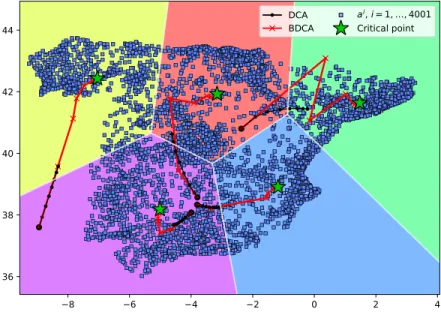
residents. For illustrating the difference between the iterations
of DCA and BDCA, we present in Figure
5
the result of applying
7
iterations of DCA
1The data can be retrieved from the Spanish National Center of Geographic Information at http://centrodedescargas.cnig.es.
Fig. 5. Seven iterations of DCA and BDCA are computed from the same starting point for grouping the Spanish cities in the peninsula into five clusters.
and BDCA to the clustering problem
(5.1)
from a random starting point (composed by
a quintet of points in
R
2), with the parameters
ρ
=
101,
α
= 0.1
,
β
= 0.5
, and
λ
1= 5
.
Both algorithms converge to the same critical point, but it is apparent that the line
search of BDCA makes it faster.
Let us demonstrate that the behavior shown in Figure
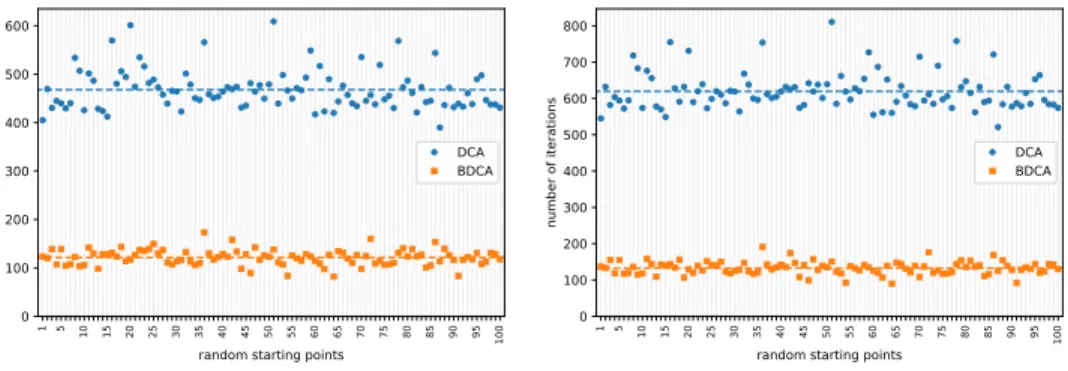
5
is not atypical. To do
so, let us consider the same problem of the Spanish cities for a different number of
clusters
k
∈ {
5,
10,
15,
20,
25,
50,
75,
100
}
. For each of these values, we run BDCA
for
100
random starting points with coordinates in
]
−
9.26,
3.27[
×
]36.02,
43.74[
(the
range of the geographical coordinates of the cities). The algorithm was stopped when
the relative error of the objective function
φ
was smaller than
10
−3. Then, DCA was
run from the same starting point until the same value of the objective function was
reached, which did not happen in
31
instances because DCA
failed
(by which we mean
that it converged to a worse critical point). In Figure
6
we have plotted the ratios
between the running time and the number of iterations, except for those instances
where DCA failed. On average, BDCA was
16
times faster than DCA, and DCA
needed
18
times more iterations to reach the same objective value as BDCA.
Experiment
5.2 (clustering random points in an
m
-dimensional box).
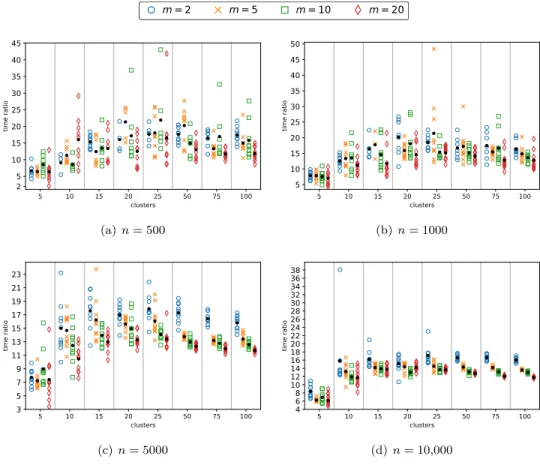
In this
numerical experiment, we generated
n
random points in
R
mwhose coordinates were
drawn from a normal distribution having a mean of
0
and a standard deviation of
10
, with
n
∈ {
500,
1000,
5000,
10,000
}
and
m
∈ {
2,
5,
10,
20
}
. For each pair of values
of
n
and
m
,
10
random starting points were chosen and BDCA was run to solve the
k
-clustering problem until the relative error of the objective function was smaller than
10
−3, with
k
∈ {
5,
10,
15,
20,
25,
50,
75,
100
}
. As in Experiment
5.1
, we run DCA from
the same starting point as BDCA until the same value of the objective function was
reached. The DCA failed to do so in
123
instances. The ratios between the respective
running times are shown in Figure
7
. On average, BDCA was
13.7
times faster than
DCA.
Fig. 6.Comparison between DCA and BDCA for solving the clustering problem of the cities in the Spanish peninsula described in Experiment 5.1. We represent the ratios of running time (left) and number of iterations (right) between DCA and BDCA for100random instances for different values of the number of clustersk∈ {5,10,15,20,25,50,75,100}. The dashed line shows the overall average ratio, and the red dots represent the average ratio for each value ofk.
(a)n= 500 (b)n= 1000
(c)n= 5000 (d)n= 10,000
Fig. 7. Comparison between DCA and BDCA for solving the clustering problems with
ran-dom data described in Experiment 5.2. For each value of n ∈ {500,1000,5000,10,000} and
m ∈ {2,5,10,20} we represent the ratios of running time between DCA and BDCA for 10 ran-dom starting points for
![Fig. 4. Ratios of the running times of DCA, BDCA with constant trial step size and BDCA with self-adaptive trial step size for finding a steady state of various biochemical reaction network models [2]](https://thumb-us.123doks.com/thumbv2/123dok_us/339839.2537294/17.918.157.615.616.963/ratios-running-constant-adaptive-finding-various-biochemical-reaction.webp)