November 2008, Volume 28, Issue 5. http://www.jstatsoft.org/
Building Predictive Models in
R
Using the
caret
Package
Max KuhnPfizer Global R&D
Abstract
Thecaretpackage, short for classification and regression training, contains numerous tools for developing predictive models using the rich set of models available in R. The package focuses on simplifying model training and tuning across a wide variety of modeling techniques. It also includes methods for pre-processing training data, calculating variable importance, and model visualizations. An example from computational chemistry is used to illustrate the functionality on a real data set and to benchmark the benefits of parallel processing with several types of models.
Keywords: model building, tuning parameters, parallel processing,R,NetWorkSpaces.
1. Introduction
The use of complex classification and regression models is becoming more and more com-monplace in science, finance and a myriad of other domains (Ayres 2007). The Rlanguage (RDevelopment Core Team 2008) has a rich set of modeling functions for both classification and regression, so many in fact, that it is becoming increasingly more difficult to keep track of the syntactical nuances of each function. The caret package, short for classification and regression training, was built with several goals in mind:
to eliminate syntactical differences between many of the functions for building and predicting models,
to develop a set of semi-automated, reasonable approaches for optimizing the values of the tuning parameters for many of these models and
The package contains functionality useful in the beginning stages of a project (e.g., data splitting and pre-processing), as well as unsupervised feature selection routines and methods to tune models using resampling that helps diagnose over-fitting.
The package is available at the ComprehensiveRArchive Network athttp://CRAN.R-project.
org/package=caret. caret depends on over 25 other packages, although many of these are listed as “suggested” packages which are not automatically loaded whencaretis started. Pack-ages are loaded individually when a model is trained or predicted. After the package is in-stalled and loaded, help pages can be found usinghelp(package = "caret"). There are three package vignettes that can be found using thevignettefunction (e.g.,vignette(package = "caret")).
For the remainder of this paper, the capabilities of the package are discussed for: data splitting and pre-processing; tuning and building models; characterizing performance and variable importance; and parallel processing tools for decreasing the model build time. Rather than discussing the capabilities of the package in a vacuum, an analysis of an illustrative example is used to demonstrate the functionality of the package. It is assumed that the readers are familiar with the various tools that are mentioned. Hastie et al. (2001) is a good technical introduction to these tools.
2. An illustrative example
In computational chemistry, chemists often attempt to build predictive relationships between the structure of a chemical and some observed endpoint, such as activity against a biological target. Using the structural formula of a compound, chemical descriptors can be generated that attempt to capture specific characteristics of the chemical, such as its size, complexity, “greasiness” etc. Models can be built that use these descriptors to predict the outcome of
interest. SeeLeach and Gillet(2003) for examples of descriptors and how they are used.
Kazius et al. (2005) investigated using chemical structure to predict mutagenicity (the in-crease of mutations due to the damage to genetic material). An Ames test (Ameset al.1972) was used to evaluate the mutagenicity potential of various chemicals. There were 4,337 com-pounds included in the data set with a mutagenicity rate of 55.3%. Using these comcom-pounds, thedragonXsoftware (Talete SRL 2007) was used to generate a baseline set of 1,579 predic-tors, including constitutional, topological and connectivity descrippredic-tors, among others. These variables consist of basic numeric variables (such as molecular weight) and counts variables (e.g., number of halogen atoms).
The descriptor data are contained in anRdata frame names descrand the outcome data are in a factor vector calledmutagen with levels"mutagen" and "nonmutagen". These data are
available from the package website http://caret.R-Forge.R-project.org/.
3. Data preparation
Since there is a finite amount of data to use for model training, tuning and evaluation, one of the first tasks is to determine how the samples should be utilized. There are a few schools of thought. Statistically, the most efficient use of the data is to train the model using all of the samples and use resampling (e.g., cross-validation, the bootstrap etc.) to evaluate the efficacy of the model. Although it is possible to use resampling incorrectly (Ambroise and
McLachlan 2002), this is generally true. However, there are some non-technical reasons why resampling alone may be insufficient. Depending on how the model will be used, an external test/validation sample set may be needed so that the model performance can be characterized on data that were not used in the model training. As an example, if the model predictions are to be used in a highly regulated environment (e.g., clinical diagnostics), the user may be constrained to “hold-back” samples in a validation set.
For illustrative purposes, we will do an initial split of the data into training and test sets. The test set will be used only to evaluate performance (such as to compare models) and the training set will be used for all other activities.
The functioncreateDataPartition can be used to create stratified random splits of a data set. In this case, 75% of the data will be used for model training and the remainder will be used for evaluating model performance. The function creates the random splits within each class so that the overall class distribution is preserved as well as possible.
R> library("caret") R> set.seed(1)
R> inTrain <- createDataPartition(mutagen, p = 3/4, list = FALSE) R> R> trainDescr <- descr[inTrain,] R> testDescr <- descr[-inTrain,] R> trainClass <- mutagen[inTrain] R> testClass <- mutagen[-inTrain] R> R> prop.table(table(mutagen)) mutagen mutagen nonmutagen 0.5536332 0.4463668 R> prop.table(table(trainClass)) trainClass mutagen nonmutagen 0.5535055 0.4464945
In cases where the outcome is numeric, the samples are split into quartiles and the sampling is done within each quartile. Although not discussed in this paper, the package also contains method for selecting samples using maximum dissimilarity sampling (Willett 1999). This approach to sampling can be used to partition the samples into training and test sets on the basis of their predictor values.
There are many models where predictors with a single unique value (also known as “zero-variance predictors”) will cause the model to fail. Since we will be tuning models using resampling methods, a random sample of the training set may result in some predictors with more than one unique value to become a zero-variance predictor (in our data, the simple split of the data into a test and training set caused three descriptors to have a single unique value in the training set). These so-called “near zero-variance predictors” can cause numerical problems during resampling for some models, such as linear regression.
As an example of such a predictor, the variablenR04is the number of number of 4-membered rings in a compound. For the training set, almost all of the samples (n = 3,233) have no
4-member rings while 18 compounds have one and a single compound has 2 such rings. If these data are resampled, this predictor might become a problem for some models.
To identify this kind of predictors, two properties can be examined:
First, the percentage of unique values in the training set can be calculated for each predictor. Variables with low percentages have a higher probability of becoming a zero variance predictor during resampling. For nR04, the percentage of unique values in the training set is low (9.2%). However, this in itself is not a problem. Binary predictors, such as dummy variables, are likely to have low percentages and should not be discarded for this simple reason.
The other important criterion to examine is the skewness of the frequency distribution of the variable. If the ratio of most frequent value of a predictor to the second most frequent value is large, the distribution of the predictor may be highly skewed. For
nR04, the frequency ratio is large (179 = 3233/18), indicating a significant imbalance in the frequency of values.
If both these criteria are flagged, the predictor may be a near zero-variance predictor. It is suggested that if:
1. the percentage of unique values is less than 20%and
2. the ratio of the most frequent to the second most frequent value is greater than 20, the predictor may cause problem for some models. The function nearZeroVarcan be used to identify near zero-variance predictors in a dataset. It returns an index of the column numbers that violate the two conditions above.
Also, some models are susceptible to multicollinearity (i.e., high correlations between pre-dictors). Linear models, neural networks and other models can have poor performance in these situations or may generate unstable solutions. Other models, such as classification or regression trees, might be resistant to highly correlated predictors, but multicollinearity may negatively affect interpretability of the model. For example, a classification tree may have good performance with highly correlated predictors, but the determination of which predictors are in the model is random.
If there is a need to minimize the effect of multicollinearity, there are a few options. First, models that are resistant to large between-predictor correlations, such as partial least squares, can be used. Also, principal component analysis can be used to reduce the number of dimen-sions in a way that removes correlations (see below). Alternatively, we can identify and remove predictors that contribute the most to the correlations.
In linear models, the traditional method for reducing multicollinearity is to identify the of-fending predictors using the variable inflation factor (VIF). For each variable, this statistic measures the increase in the variation of the model parameter estimate in comparison to the optimal situation (i.e., an orthogonal design). This is an acceptable technique when linear models are used and there are more samples than predictors. In other cases, it may not be as appropriate.
As an alternative, we can compute the correlation matrix of the predictors and use an al-gorithm to remove the a subset of the problematic predictors such that all of the pairwise
correlations are below a threshold:
repeat
Find the pair of predictors with the largest absolute correlation;
For both predictors, compute the average correlation between each predictor and all of the other variables;
Flag the variable with the largest mean correlation for removal; Remove this row and column from the correlation matrix;
untilno correlations are above a threshold ;
This algorithm can be used to find the minimal set of predictors that can be removed so that the pairwise correlations are below a specific threshold. Note that, if two variables have a high correlation, the algorithm determines which one is involved with the most pairwise correlations and is removed.
For illustration, predictors that result in absolute pairwise correlations greater than 0.90 can
be removed using thefindCorrelationfunction. This function returns an index of column
numbers for removal.
R> ncol(trainDescr) [1] 1576
R> descrCorr <- cor(trainDescr)
R> highCorr <- findCorrelation(descrCorr, 0.90) R> trainDescr <- trainDescr[, -highCorr]
R> testDescr <- testDescr[, -highCorr] R> ncol(trainDescr)
[1] 650
For chemical descriptors, it is not uncommon to have many very large correlations between the predictors. In this case, using a threshold of 0.90, we eliminated 926 descriptors from the data.
Once the final set of predictors is determined, the values may require transformations be-fore being used in a model. Some models, such as partial least squares, neural networks and support vector machines, need the predictor variables to be centered and/or scaled. ThepreProcess function can be used to determine values for predictor transformations
us-ing the trainus-ing set and can be applied to the test set or future samples. The function
has an argument, method, that can have possible values of "center", "scale", "pca" and
"spatialSign". The first two options provide simple location and scale transformations of each predictor (and are the default values ofmethod). The predictmethod for this class is then used to apply the processing to new samples
R> xTrans <- preProcess(trainDescr)
R> trainDescr <- predict(xTrans, trainDescr) R> testDescr <- predict(xTrans, testDescr)
The "pca" option computes loadings for principal component analysis that can be applied to any other data set. In order to determine how many components should be retained, the
preProcessfunction has an argument called thresh that is a threshold for the cumulative percentage of variance captured by the principal components. The function will add compo-nents until the cumulative percentage of variance is above the threshold. Note that the data
are automatically scaled when method = "pca", even if the method value did not indicate that scaling was needed. For PCA transformations, the predict method generates values with column names"PC1","PC2", etc.
Specifyingmethod = "spatialSign" applies the spatial sign transformation (Serneels et al.
2006) where the predictor values for each sample are projected onto a unit circle using x∗ =
x/||x||. This transformation may help when there are outliers in thex space of the training set.
4. Building and tuning models
Thetrain function can be used to select values of model tuning parameters (if any) and/or estimate model performance using resampling. As an example, a radial basis function support vector machine (SVM) can be used to classify the samples in our computational chemistry data. This model has two tuning parameters. The first is the scale function σ in the radial basis function
K(a, b) = exp(−σ||a−b||2)
and the other is the cost value C used to control the complexity of the decision boundary. We can create a grid of candidate tuning values to evaluate. Using resampling methods, such as the bootstrap or cross-validation, a set of modified data sets are created from the training samples. Each data set has a corresponding set of hold-out samples. For each candidate tuning parameter combination, a model is fit to each resampled data set and is used to predict the corresponding held out samples. The resampling performance is estimated by aggregating the results of each hold-out sample set. These performance estimates are used to evaluate which combination(s) of the tuning parameters are appropriate. Once the final tuning values are assigned, the final model is refit using the entire training set.
For the train function, the possible resampling methods are: bootstrapping, k-fold cross-validation, leave-one-out cross-cross-validation, and leave-group-out cross-validation (i.e., repeated splits without replacement). By default, 25 iterations of the bootstrap are used as the resam-pling scheme. In this case, the number of iterations was increased to 200 due to the large number of samples in the training set.
For this particular model, it turns out that there is an analytical method for directly estimating a suitable value of σ from the training data (Caputo et al. 2002). By default, the train
function uses thesigestfunction in thekernlabpackage (Karatzoglouet al.2004) to initialize this parameter. In doing this, the value of the cost parameterCis the only tuning parameter. Thetrainfunction has the following arguments:
x: a matrix or data frame of predictors. Currently, the function only accepts numeric values (i.e., no factors or character variables). In some cases, themodel.matrixfunction may be needed to generate a data frame or matrix of purely numeric data
y: a numeric or factor vector of outcomes. The function determines the type of problem (classification or regression) from the type of the response given in this argument.
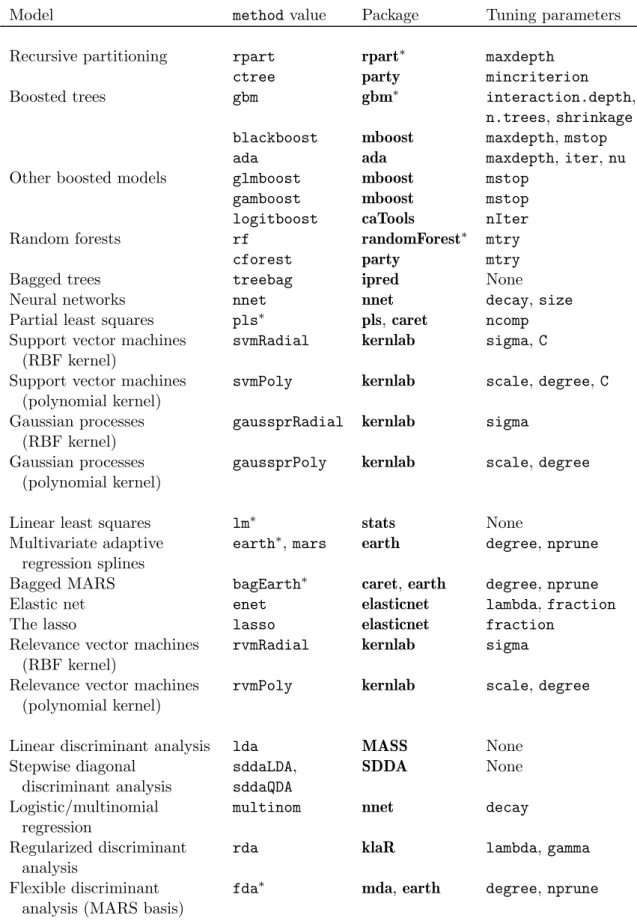
method: a character string specifying the type of model to be used. See Table1 for the possible values.
metric: a character string with values of"Accuracy","Kappa","RMSE"or"Rsquared". This value determines the objective function used to select the final model. For example, selecting"Kappa"makes the function select the tuning parameters with the largest value of the mean Kappa statistic computed from the held-out samples.
trControl: takes a list of control parameters for the function. The type of resampling as well as the number of resampling iterations can be set using this list. The function
trainControl can be used to compute default parameters. The default number of resampling iterations is 25, which may be too small to obtain accurate performance estimates in some cases.
tuneLength: controls the size of the default grid of tuning parameters. For each model,
train will select a grid of complexity parameters as candidate values. For the SVM model, the function will tune over C = 10−1,1,10. To expand the size of the default list, the tuneLengthargument can be used. By selectingtuneLength = 5, values ofC
ranging from 0.1 to 1,000 are evaluated.
tuneGrid: can be used to define a specific grid of tuning parameters. See the example below.
... : the three dots can be used to pass additional arguments to the functions listed in Table 1. For example, we have already centered and scaled the predictors, so the
argument scaled = FALSE can be passed to the ksvm function to avoid duplication of
the pre-processing.
We can tune and build the SVM model using the code below.
R> bootControl <- trainControl(number = 200) R> set.seed(2)
R> svmFit <- train(trainDescr, trainClass, + method = "svmRadial", tuneLength = 5, + trControl = bootControl, scaled = FALSE) Model 1: sigma=0.0004329517, C=1e-01
Model 2: sigma=0.0004329517, C=1e+00 Model 3: sigma=0.0004329517, C=1e+01 Model 4: sigma=0.0004329517, C=1e+02 Model 5: sigma=0.0004329517, C=1e+03 R> svmFit
Call:
train.default(x = trainDescr, y = trainClass, method = "svmRadial", scaled = FALSE, trControl = bootControl, tuneLength = 5)
3252 samples 650 predictors
summary of bootstrap (200 reps) sample sizes: 3252, 3252, 3252, 3252, 3252, 3252, ...
boot resampled training results across tuning parameters:
sigma C Accuracy Kappa Accuracy SD Kappa SD Selected
0.000433 0.1 0.705 0.395 0.0122 0.0252
0.000433 1 0.806 0.606 0.0109 0.0218
0.000433 10 0.818 0.631 0.0104 0.0211 *
0.000433 100 0.8 0.595 0.0112 0.0227
0.000433 1000 0.782 0.558 0.0111 0.0223
Accuracy was used to select the optimal model
In this output, each row in the table corresponds to a specific combination of tuning param-eters. The “Accuracy” column is the average accuracy of the 200 held-out samples and the column labeled as “Accuracy SD” is the standard deviation of the 200 accuracies.
The Kappa statistic is a measure of concordance for categorical data that measures agreement relative to what would be expected by chance. Values of 1 indicate perfect agreement, while a value of zero would indicate a lack of agreement. Negative Kappa values can also occur, but are less common since it would indicate a negative association between the observed and predicted data. Kappa is an excellent performance measure when the classes are highly unbalanced. For example, if the mutagenicity rate in the data had been very small, say 5%, most models could achieve high accuracy by predicting all compounds to be nonmutagenic. In this case, the Kappa statistic would result in a value near zero. The Kappa statistic given here
is the unweighted version computed by the classAgreement function in the e1071 package
(Dimitriadou et al. 2008). The Kappa columns in the output above are also summarized across the 200 resampled Kappa estimates.
As previously mentioned, the “optimal” model is selected to be the candidate model with the largest accuracy. If more than one tuning parameter is “optimal” then the function will try to choose the combination that corresponds to the least complex model. For these data, σ was estimated to be 0.000433 andC = 10 appears to be optimal. Based on these values, the model was refit to the original set of 3,252 samples and this object is stored in svmFit$finalModel.
R> svmFit$finalModel
Support Vector Machine object of class "ksvm" SV type: C-svc (classification)
parameter : cost C = 10
Gaussian Radial Basis kernel function.
Hyperparameter : sigma = 0.000432951668058316 Number of Support Vectors : 1616
Objective Function Value : -9516.185 Training error : 0.082411
Model method value Package Tuning parameters
Recursive partitioning rpart rpart∗ maxdepth
ctree party mincriterion
Boosted trees gbm gbm∗ interaction.depth,
n.trees,shrinkage
blackboost mboost maxdepth,mstop
ada ada maxdepth,iter,nu
Other boosted models glmboost mboost mstop
gamboost mboost mstop
logitboost caTools nIter
Random forests rf randomForest∗ mtry
cforest party mtry
Bagged trees treebag ipred None
Neural networks nnet nnet decay,size
Partial least squares pls∗ pls,caret ncomp
Support vector machines svmRadial kernlab sigma,C
(RBF kernel)
Support vector machines svmPoly kernlab scale,degree,C
(polynomial kernel)
Gaussian processes gaussprRadial kernlab sigma
(RBF kernel)
Gaussian processes gaussprPoly kernlab scale,degree
(polynomial kernel)
Linear least squares lm∗ stats None
Multivariate adaptive earth∗,mars earth degree,nprune
regression splines
Bagged MARS bagEarth∗ caret,earth degree,nprune
Elastic net enet elasticnet lambda,fraction
The lasso lasso elasticnet fraction
Relevance vector machines rvmRadial kernlab sigma
(RBF kernel)
Relevance vector machines rvmPoly kernlab scale,degree
(polynomial kernel)
Linear discriminant analysis lda MASS None
Stepwise diagonal sddaLDA, SDDA None
discriminant analysis sddaQDA
Logistic/multinomial multinom nnet decay
regression
Regularized discriminant rda klaR lambda,gamma
analysis
Flexible discriminant fda∗ mda,earth degree,nprune
analysis (MARS basis)
Table 1: Models used intrain(∗ indicates that a model-specific variable importance method is available, see Section 9.). (continued on next page)
Model method value Package Tuning parameters
Bagged FDA bagFDA∗ caret,earth degree,nprune
Least squares support vector lssvmRadial kernlab sigma
machines (RBF kernel)
k nearest neighbors knn3 caret k
Nearest shrunken centroids pam∗ pamr threshold
Naive Bayes nb klaR usekernel
Generalized partial gpls gpls K.prov
least squares
Learned vector quantization lvq class k
Table 1: Models used intrain(∗ indicates that a model-specific variable importance method is available, see Section 9.).
In many cases, more control over the grid of tuning parameters is needed. For example, for boosted trees using the gbm function in the gbm package (Ridgeway 2007), we can tune over the number of trees (i.e., boosting iterations), the complexity of the tree (indexed by
interaction.depth) and the learning rate (also known as shrinkage). As an example, a user could specify a grid of values to tune over using a data frame where the rows correspond to tuning parameter combinations and the columns are the names of the tuning variables (preceded by a dot). For our data, we will generate a grid of 50 combinations and use the
tuneGridargument to thetrainfunction to use these values.
R> gbmGrid <- expand.grid(.interaction.depth = (1:5) * 2, + .n.trees = (1:10)*25, .shrinkage = .1)
R> set.seed(2)
R> gbmFit <- train(trainDescr, trainClass,
+ method = "gbm", trControl = bootControl, verbose = FALSE, + bag.fraction = 0.5, tuneGrid = gbmGrid)
Model 1: interaction.depth= 2, shrinkage=0.1, n.trees=250 collapsing over other values of n.trees
Model 2: interaction.depth= 4, shrinkage=0.1, n.trees=250 collapsing over other values of n.trees
Model 3: interaction.depth= 6, shrinkage=0.1, n.trees=250 collapsing over other values of n.trees
Model 4: interaction.depth= 8, shrinkage=0.1, n.trees=250 collapsing over other values of n.trees
Model 5: interaction.depth=10, shrinkage=0.1, n.trees=250 collapsing over other values of n.trees
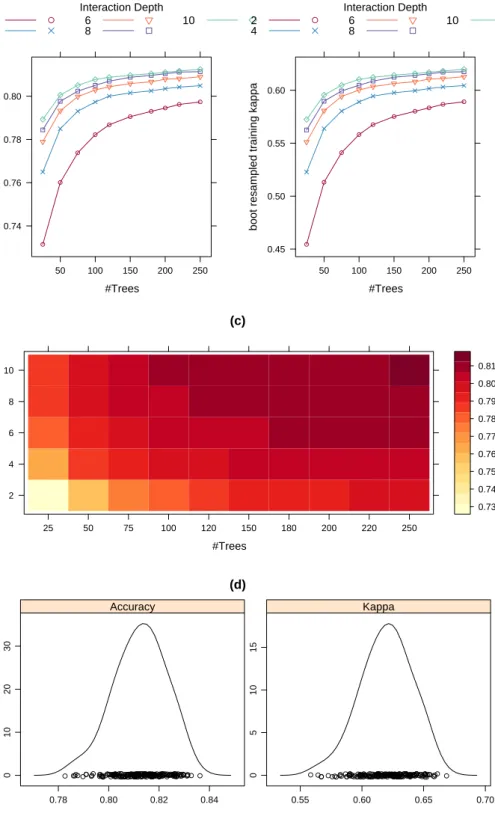
In this model, we generated 200 bootstrap replications for each of the 50 candidate models, computed performance and selected the model with the largest accuracy. In this case the model automatically selected an interaction depth of 8 and used 250 boosting iterations (although other values may very well be appropriate; see Figure 1). There are a variety
(a)
#Trees
boot resampled training accuracy 0.74
0.76 0.78 0.80 50 100 150 200 250 ● ● ● ● ● ● ● ● ● ● Interaction Depth 2 4 68 10 ● (b) #Trees
boot resampled training kappa
0.45 0.50 0.55 0.60 50 100 150 200 250 ● ● ● ● ● ● ● ● ● ● Interaction Depth 2 4 68 10 ● (c) #Trees Interaction Depth 2 4 6 8 10 25 50 75 100 120 150 180 200 220 250 0.73 0.74 0.75 0.76 0.77 0.78 0.79 0.80 0.81 (d) Density 0 10 20 30 0.78 0.80 0.82 0.84 ● ● ● ● ● ●● ● ● ● ● ●● ●●●●●●●●●●●●●●●●●●● ●●●●●●●●●●●●●●●●●●● ●●●●●●●●●●●●●●●●●●● ●●●●●●●●●●●●● ●●●●●●●●●●●●●●● ● ●●●●●●●●●●●●●●●●●●●●●●●●●●●●●●●●● ●●●●● ● ●●●●●●●● ●●●●●●● ●●●●●●●●●●●●●● ●●●●●●●●●●●●●●●●●●●●●●●●●●●●●●●●● Accuracy 0 5 10 15 0.55 0.60 0.65 0.70 ● ● ●● ● ●● ● ● ● ● ●● ● ●●●●●●●●●●●●●●●●●●●●●●●●●●●●●●●●●●●●● ●● ●●●●●●●●●●●●●●●●●●●●●●●●●●●●●●●●● ●●●●●●●●●●●● ● ● ●●●●● ●●●●●●●●●●●● ●●●●●● ●●●●●●●●●●●●●●●●●●●●●●● ●● ●● ●●● ● ●● ● ●●●●●●●●●●●●●● ● ● ●● ●●●●●●●●●●●●●●●●● ● ● ●● ● ● ● ● Kappa
Figure 1: Examples of plot functions for train objects. (a) A plot of the classification accuracy versus the tuning factors (usingplot(gbmFit)). (b) Similarly, a plot of the Kappa statistic profiles (plot(gbmFit, metric = "Kappa")). (c) A level plot of the accuracy values (plot(gbmFit, plotType = "level")). (d) Density plots of the 200 bootstrap estimates of accuracy and Kappa for the final model (resampleHist(gbmFit)).
of different visualizations for train objects. Figure 1 shows several examples plots created
usingplot.trainand resampleHist.
Note that the output states that the procedure was “collapsing over other values of n.trees”. For some models (method values of pls, plsda, earth, rpart, gbm, gamboost, glmboost,
blackboost, ctree, pam, enet and lasso), the train function will fit a model that can be used to derive predictions for some sub-models. For example, since boosting models save the model results for each iteration of boosting, train can fit the model with the largest number of iterations and derive the other models where the other tuning parameters are the same but fewer number of boosting iterations are requested. In the example above, for a
model with interaction.depth = 2 and shrinkage = .1, we only need to fit the model
with the largest number of iterations (250 in this example). Holding the interaction depth and shrinkage constant, the computational time to get predictions for models with less than 250 iterations is relatively cheap. For the example above, we fit a total of 200×5 = 1,000 models instead of 25×5×10 = 10,000. The trainfunction tries to exploit this idea for as many models as possible.
For recursive partitioning models, an initial model is fit to all of the training data to obtain the possible values of the maximum depth of any node (maxdepth). The tuning grid is created based on these values. IftuneLength is larger than the number of possible maxdepthvalues determined by the initial model, the grid will be truncated to themaxdepthlist. The same is also true for nearest shrunken centroid models, where an initial model is fit to find the range of possible threshold values, and MARS models (see Section 7).
Also, for the glmboost and gamboost functions from the mboost package (Hothorn and
B¨uhlmann 2007), an additional tuning parameter,prune, is used by train. Ifprune = "yes", the number of trees is reduced based on the AIC statistic. If "no", the number of trees is kept at the value specified by the mstop parameter. See B¨uhlmann and Hothorn (2007) for more details about AIC pruning.
In general, the functions in the caret package assume that there are no missing values in the data or that these values have been handled via imputation or other means. For the train
function, there are some models (such as rpart) that can handle missing values. In these cases, the data passed to the xargument can contain missing values.
5. Prediction of new samples
As previously noted, an object of class traincontains an element called finalModel, which is the fitted model with the tuning parameter values selected by resampling. This object can be used in the traditional way to generate predictions for new samples, using that model’s
predictfunction. For the most part, the prediction functions inRfollow a consistent syntax,
but there are exceptions. For example, boosted tree models produced by the gbm function
also require the number of trees to be specified. Also, predict.mvr from the pls package (Mevik and Wehrens 2007) will produce predictions for every candidate value of ncomp that was tested. To avoid having to remember these nuances,caret offers several functions to deal with these issues.
The functionpredict.trainis an interface to the model’spredictmethod that handles any extra parameter specifications (such as previously mentioned for gbm and PLS models). For example:
R> predict(svmFit$finalModel, newdata = testDescr)[1:5] [1] mutagen nonmutagen nonmutagen nonmutagen mutagen Levels: mutagen nonmutagen
R> predict(svmFit, newdata = testDescr)[1:5]
[1] mutagen nonmutagen nonmutagen nonmutagen mutagen Levels: mutagen nonmutagen
In cases where predictions are needed for multiple models based on the same data set,
predict.listcan be used implicitly:
R> models <- list(svm = svmFit, gbm = gbmFit)
R> testPred <- predict(models, newdata = testDescr) R> lapply(testPred, function(x) x[1:5])
$svm
[1] mutagen nonmutagen nonmutagen nonmutagen mutagen Levels: mutagen nonmutagen
$gbm
[1] mutagen mutagen mutagen nonmutagen mutagen
Levels: mutagen nonmutagen
predict.trainproduces a vector of predictions for each model. The functionextractPrediction
can be used to obtain predictions for training, test and/or unknown samples at once and will return the data in a data frame. For example:
R> predValues <- extractPrediction(models, + testX = testDescr, testY = testClass)
R> testValues <- subset(predValues, dataType == "Test") R> head(testValues)
obs pred model dataType
3253 mutagen mutagen svmRadial Test
3254 nonmutagen nonmutagen svmRadial Test
3255 mutagen nonmutagen svmRadial Test
3256 nonmutagen nonmutagen svmRadial Test
3257 mutagen mutagen svmRadial Test
3258 mutagen mutagen svmRadial Test
R> table(testValues$model) gbm svmRadial
1083 1083
R> nrow(testDescr) [1] 1083
The output has columns for the observed outcome, the model prediction, the model type and the data type (i.e., training, test or unknown).
Many classification models listed in Table 1 can produce class probabilities. The values can be accessed using predict.train using the argument type = "prob". In this case, the
Probability of mutagen Percent of Total 0 10 20 30 40 0.0 0.2 0.4 0.6 0.8 1.0 Data: mutagen gbm Data: nonmutagen gbm Data: mutagen svmradial 0.0 0.2 0.4 0.6 0.8 1.0 0 10 20 30 40 Data: nonmutagen svmradial
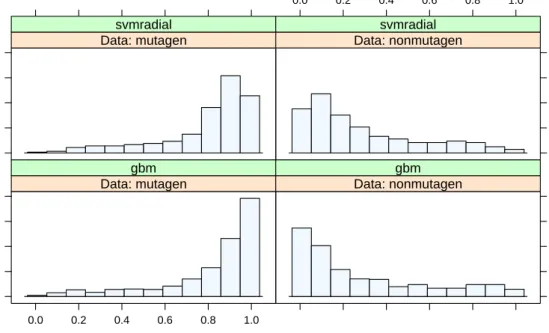
Figure 2: Histograms of the “mutagen” class probability for two models (produced using
plotClassProbs(testProbs)). The panels correspond to the model used and the observed class (labeled asData in the panels).
function will return a data frame with probability columns for each class. Also, the function
extractProb is similar to extractPrediction, but will produce the class probabilities for each class in the data. An additional column of probabilities is supplied for each level of the factor variable supplied to train.
R> probValues <- extractProb(models,
+ testX = testDescr, testY = testClass)
R> testProbs <- subset(probValues, dataType == "Test") R> str(testProbs)
'data.frame': 2166 obs. of 6 variables:
$ mutagen : num 0.6274 0.2970 0.1691 0.0177 0.9388 ... $ nonmutagen: num 0.3726 0.7030 0.8309 0.9823 0.0612 ...
$ obs : Factor w/ 2 levels "mutagen","nonmutagen": 1 2 1 2 1 1 2 2 2 2 ... $ pred : Factor w/ 2 levels "mutagen","nonmutagen": 1 2 2 2 1 1 2 2 2 2 ... $ model : chr "svmRadial" "svmRadial" "svmRadial" "svmRadial" ...
$ dataType : chr "Test" "Test" "Test" "Test" ...
For classification models, the function plotClassProbs function can create a lattice plot of histograms (Sarkar 2008) to visualize the distributions of class probabilities using the
output from plotClassProbs. Figure 2 was generated using plotClassProbs(testProbs)
and shows histograms of the probability of the mutagen prediction across different models and the true classes.
6. Characterizing performance
caretalso contains several functions that can be used to describe the performance of
classifica-tion models. For classification models, the functions sensitivity, specificity,
posPredValue and negPredValue can be used to characterize performance where there are two classes. By default, the first level of the outcome factor is used to define the “positive” result, although this can be changed.
The functionconfusionMatrix can be used to compute various summaries for classification models. For example, we can assess the support vector machine’s performance on the test set.
R> svmPred <- subset(testValues, model == "svmRadial") R> confusionMatrix(svmPred$pred, svmPred$obs)
Loading required package: class Confusion Matrix and Statistics
Reference
Prediction mutagen nonmutagen
mutagen 528 102
nonmutagen 72 381
Accuracy : 0.8393
95% CI : (0.8161, 0.8607) No Information Rate : 0.554
P-Value [Acc > NIR] : 6.196e-89 Kappa : 0.6729 Sensitivity : 0.88 Specificity : 0.7888 Pos Pred Value : 0.8381 Neg Pred Value : 0.8411
In addition to the cross-tabulation of the observed and predicted values, various statistics are calculated. The confidence interval for the accuracy rate uses the default binomial confidence interval method used inbinom.test.
The “no-information rate” shown on the output is the largest proportion of the observed classes (there were more mutagens than nonmutagens in this test set). A one-sided hypothesis test is also computed to evaluate whether the overall accuracy rate is greater than the rate of the largest class. Like Kappa, this is helpful for data sets where there is a large imbalance between the classes.
When there are three or more classes,confusionMatrixwill show the confusion matrix and a set of “one-versus-all” results. For example, in a three class problem, the sensitivity of the first class is calculated against all the samples in the second and third classes (and so on). Receiver operating characteristic (ROC) curves can also be computed using thecaretpackage. Therocfunction takes as input a numeric score and a factor variable with the true class labels.
Larger values of the numeric data should indicate that the sample is more likely to have come from the first level of the factor. For example, the class probability associated with the “mutagen” class and the observed classes can be used to compute an ROC curve for these data (“mutagen” is the first factor level in svmProb$obs). For example, in the code below,
svmProb$mutagencontains the mutagen class probabilities.
R> svmProb <- subset(testProbs, model == "svmRadial") R> svmROC <- roc(svmProb$mutagen, svmProb$obs)
R> str(svmROC)
num [1:1083, 1:3] NA 0.00352 0.00401 0.00460 0.00589 ... - attr(*, "dimnames")=List of 2
..$ : NULL
..$ : chr [1:3] "cutoff" "sensitivity" "specificity"
The result is a matrix with columns for the cutoff, the sensitivity and specificity. These can be used to create an ROC curve for the test set. The functionaucRoccan be used to compute the simple area under the curve statistic (via the trapezoidal rule).
7. Regression models
Usingtrainto build regression models is almost exactly the same process as the one shown in the previous sections. For regression models, performance is calculated using the root mean squared error andR2 instead of accuracy and the Kappa statistic. However, there are
many models where there is no notion of model degrees of freedom (such as random forests)
or where there are more parameters than training set samples. Given this, train ignores
degrees of freedom when computing performance values. For example, to compute R2, the
correlation coefficient is computed between the observed and predicted values and squared. When comparing models, the performance metrics will be on the same scale, but these metrics do not penalize model complexity (as adjustedR2 does) and will tend to favor more complex fits over simpler models.
For multivariate adaptive regression spline (MARS) models, the earth package (Milborrow 2007) is used when a model type ofmars orearthis requested. The tuning parameters used by train aredegree and nprune. The parameter nk is not automatically specified and the default in theearthfunction is used. For example, suppose a training set with 40 predictors
is used with a MARS model using degree = 1and nprune = 20. An initial model with nk
= 41 is fit and is pruned down to 20 terms. This number includes the intercept and may
include “singleton” terms instead of pairs. Alternate model training schemes can be used by passingnk and/orpmethod to theearthfunction.
caretalso includes a function,plotObsVsPred, that can produce alatticeplot of the observed responses versus the predicted values for various models and data sets.
8. Other modeling functions
The package also includes other model functions. The knn3 function is a clone of knn from theMASS package (Venables and Ripley 2002) whosepredict function can return the vote
proportions for each of the classes (instead of just the winning class). Also, there are functions that produce bagged versions of MARS and flexible discriminant analysis (FDA) models.
These two functions, bagEarth and bagFDA, can be used to produce smoother prediction
functions/decision boundaries while including integrated feature selection. Another function,
plsda, builds partial least squares discriminant analysis models (Barker and Rayens 2003). In this case, a matrix of dummy variables is created with a column for each class. This response matrix is used as an input to the plsrfunction of the plspackage. The predict function can be used to produce either the raw model predictions, the class probabilities (computed using the softmax equation) or the class prediction.
9. Predictor importance
The generic function varImp can be used to characterize the general effect of predictors on the model. The varImp function works with the following object classes: lm, mars, earth,
randomForest,gbm,mvr(in theplspackage),rpart,RandomForest(from thepartypackage),
pamrtrained, bagEarth, bagFDA, classbagg and regbagg. varImp also works with objects produced bytrain, but this is a simple wrapper for the specific models previously listed. Each model characterizes predictor importance differently:
Linear models: The absolute value of thetstatistic for each model parameter is used.
Random forest from Liaw and Wiener (2002): “For each tree, the prediction accu-racy on the out-of-bag portion of the data is recorded. Then the same is done after permuting each predictor variable. The difference between the two accuracies are then averaged over all trees, and normalized by the standard error. For regression, the MSE is computed on the out-of-bag data for each tree, and then the same computed after permuting a variable. The differences are averaged and normalized by the standard error. If the standard error is equal to 0 for a variable, the division is not done.”
varImp.randomForest is a simple wrapper around theimportancefunction from that
package. Similarly, for RandomForest objects, varImp is a wrapper around varimp in
the partypackage.
Partial least squares: The variable importance measure here is based on weighted sums of the absolute regression coefficients. The weights are a function of the reduction of the sums of squares across the number of PLS components and are computed sep-arately for each outcome. Therefore, the contribution of the coefficients are weighted proportionally to the reduction in the sums of squares.
Recursive partitioning: The reduction in the loss function (e.g., mean squared error) attributed to each variable at each split is tabulated and the sum is returned. Also, since there may be candidate variables that are important but are not used in a split, the top competing variables are also tabulated at each split. This can be turned off
using the maxcompete argument in rpart.control. This method does not currently
provide class-specific measures of importance when the response is a factor.
Bagged trees: The same methodology as a single tree is applied to all bootstrapped trees and the total importance is returned
Boosted trees: This method uses the same approach as a single tree, but sums the importances over each boosting iteration (see Ridgeway 2007).
Multivariate adaptive regression splines: MARS models include a backwards elimination feature selection routine that looks at reductions in the generalized cross-validation (GCV) estimate of error. The varImp function tracks the changes in model statistics, such as the GCV, for each predictor and accumulates the reduction in the statistic when each predictor’s feature is added to the model. This total reduction is used as the variable importance measure. If a predictor was never used in any MARS basis function, it has an importance value of zero. There are three statistics that can be
used to estimate variable importance in MARS models. Using varImp(object, value
= "gcv")tracks the reduction in the generalized cross-validation statistic as terms are added. Also, the optionvarImp(object, value = "grsq")compares the GCV statis-tic for each model to the intercept only model. However, there are some cases when terms are retained in the model that result in an increase in GCV. Negative variable importance values for MARS are set to a small, non-zero number. Alternatively, using
varImp(object, value = "rss")monitors the change in the residual sums of squares (RSS) as terms are added, which will never be negative.
Bagged MARS and FDA: For these objects, importance is calculated using the method for MARS/earth models (as previously described) for each bagged model. The overall importance is aggregated across the bagged results.
Nearest shrunken centroid models: The difference between the class centroids and the overall centroid is used to measure the variable influence (see pamr.predict). The larger the difference between the class centroid and the overall center of the data, the larger the separation between the classes. The training set predictions must be supplied when an object of class pamrtrained is given tovarImp.
For the mutagenicity example, we can assess which predictors had the largest impact on the model.
R> gbmImp <- varImp(gbmFit, scale = FALSE) R> gbmImp
gbm variable importance
only 20 most important variables shown (out of 650 ) Overall piPC09 115.80 PCR 102.16 MATS1p 58.24 N.078 49.45 AMW 48.51 nR03 45.54 nN. 40.85 Mor12m 38.89 O.057 37.93
MAXDN 35.07 R2u. 29.03 R3e 28.06 ClogP 27.53 N.069 26.30 Ms 26.14 D.Dr03 25.96 BELm1 25.32 Mor24m 24.38 RDF040m 22.36 T.N..N. 22.34
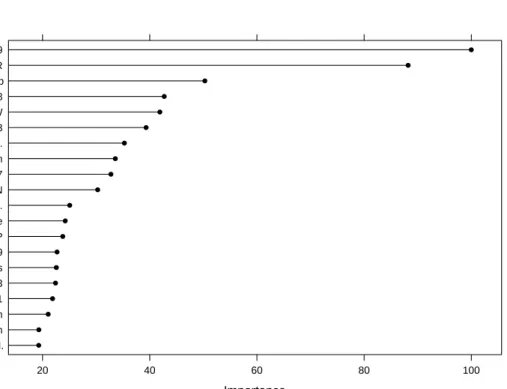
The top two descriptors, the molecular multiple path count of order 09 and the ratio of multiple path count over path count, have large contributions relative to the other descriptors. These two descriptors have a correlation of 0.76, indicating that they might be measuring similar underlying mechanisms (both descriptors are measures of molecular complexity). For this example, there were 218 predictors with importance values equal to zero, meaning that these were not used in any splits in any of the trees.
A plot method forvarImpis included that produces a “needle plot” of the importance values where the predictors are sorted from most-important to least. Figure3 provides an example for the boosted tree model.
The advantages of using a model-based approach are that it is more closely tied to the model performance and that the importance may be able to incorporate the correlation structure between the predictors into the importance calculation. Regardless of how the importance is calculated:
For most classification models, each predictor will have a separate variable importance for each class (the exceptions are FDA, classification trees, trees and boosted trees).
All measures of importance are scaled to have a maximum value of 100, unless thescale
argument of varImp.train is set toFALSE (as in the example above).
If there is no model-specific way to estimate importance, the importance of each predictor can be evaluated individually using a “filter” approach. This approach is most accessible using
varImp.traineither for models that are not included in the list above or by usinguseModel = FALSE invarImp.train.
For classification models, ROC curve analysis is conducted on each predictor. For two class problems, a series of cutoffs is applied to the predictor data to predict the class. The sensitivity and specificity are computed for each cutoff and the ROC curve is computed. The trapezoidal rule is used to compute the area under the ROC curve. This area is used as the measure of variable importance. For multi-class outcomes, the problem is decomposed into all pairwise problems and the area under the curve is calculated for each class pair (i.e., class 1 vs. class 2, class 2 vs. class 3 etc.). For a specific class, the maximum area under the curve across the relevant pairwise AUC’s is used as the variable importance measure.
Figure 4 shows a hypothetical example of this approach for three classes. For this predictor, three ROC curves are computed, along with the area under the ROC curve. To determine the importance of this predictor to class 1, the maximum of the two AUCs related to this class
Importance T.N..N. RDF040m Mor24m BELm1 D.Dr03 Ms N.069 ClogP R3e R2u. MAXDN O.057 Mor12m nN. nR03 AMW N.078 MATS1p PCR piPC09 20 40 60 80 100 ● ● ● ● ● ● ● ● ● ● ● ● ● ● ● ● ● ● ● ●
Figure 3: A needle plot of the boosted tree variable importance values (produced using
plot(varImp(gbmFit), top = 20)). 0 20 40 60 80 100 0.00 0.04 0.08 0.12 Variable Density Class1 Class2 Class3 1vs2: 0.69 1vs3: 0.98 2vs3: 0.92
Figure 4: An example of the model-free technique for characterizing predictor importance in classification models using ROC curves. Each pairwise ROC curve is calculated and the maximum AUC for each class is computed.
is computed (0.98 = max(0.98,0.69)). In other words, this predictor is important to at least one class. The importances of this predictor to classes 2 and 3 are 0.92 and 0.98, respectively. For regression, the relationship between each predictor and the outcome is evaluated. An argument, nonpara, is used to pick the model fitting technique. When nonpara = FALSE, a linear model is fit and the absolute value of thetvalue for the slope of the predictor is used. Otherwise, a loess smoother is fit between the outcome and the predictor. TheR2 statistic is calculated for this model against the intercept only null model. This number is returned as a relative measure of variable importance.
10. Parallel processing
If a model is tuned using resampling, the number of model fits can become large as the number of tuning combinations increases. To reduce the training time, parallel processing
can be used. For example, to train the support vector machine model in Section 4, each
of the 5 candidate models was fit to 200 separate bootstrap samples. Since each bootstrap sample is independent of the other, these 1,000 models could be computed in parallel (this is also true for the different flavors of cross-validation).
NetWorkSpaces(Scientific Computing Associates, Inc. 2007) is a software system that facili-tates parallel processing when multiple processors are available. A sister Rpackage to caret,
called caretNWS, uses NetWorkSpaces to build multiple models simultaneously. When a
candidate model is resampled during parameter tuning, the resampled datasets are sent in roughly equal sized batches to different “workers,” which could be processors within a single machine or across computers. Once their models are built, the results are returned to the originalR session. NetWorkSpaces is available in Rusing the nws package and can be used across many platforms.
There is a large degree of syntactical similarity between the caret and caretNWS packages. The former uses thetrainfunction to build the model and the latter usestrainNWS. Almost all of the other syntax is the same. For example, to fit the SVM model from Section4, we could use:
R> set.seed(2)
R> svmFit <- trainNWS(trainDescr, trainClass,
+ method = "svmRadial", tuneLength = 5, scaled = FALSE)
Recall that thetuneLengthparameter sets the size of the search grid. Due to time constraints, the default number of bootstrap samples (25) was used for model training. Each of the 25 sets of bootstrap samples was split across 5 processors.
To characterize the benefit of using parallel processing in this manner, the previous support vector machine and boosted tree models were refit using multiple processors. Additionally, a partial least squares classification model was also fit usingcaret’s plsda function, where up to 40 components were evaluated. For each of these three models, the execution times were recorded when utilizingP = 1, 2, 3, 4, 5, 10, 15 and 20 processors on a single AMD Opteron system containing eight quad-core chips using Red Hat Linux (version 2.6.9).
One common metric used to assess the efficacy of parallelization is speedup = Tseq/Tpar, where Tseq and Tpar denote the execution times to train the model serially and in parallel,
Training Time
#Processors
Training Time (min)
0 20 40 60 80 100 5 10 15 20 ● ● ● ● ● ● ● ● gbm ● pls svm Speedup #Processors Speedup 2 4 6 5 10 15 20 ● ● ● ● ● ● ● ● gbm ● pls svm
Figure 5: Training time profiles using parallel processing viatrainNWS. The left panel shows the elapsed time to train various types of models using single or multiple processors. The panel on the right shows the “speedup,” defined to be the time for serial execution divided by the parallel execution time. The reference line shows the maximum theortical speedup.
respectively. Excluding systems with sophisticated shared memory capabilities, the maximum possible speedup attained by parallelization withP processors is equal to P (Amdahl 1967). Factors affecting the speedup include the overhead of starting the parallel workers, data transfer, the percentage of the algorithm’s computations that can be done in parallel, etc. Figure 5 shows the results of the benchmarking study. In the left panel, the actual training time for each of the models is shown. Irrespective of the number of processors used, the PLS model is much more efficient than the other models. This is most likely due to PLS solving straight-forward, well optimized linear equations. Unfortunately, partial least squares produces linear boundaries which may not be flexible enough for some problems. For the support vector machine and boosted tree models, the rate of decrease in training time appears to slow after 15 processors.
On the right-hand panel, the speedup is plotted. For each model, there is a decrease in the training time as more nodes are added, although there was little benefit of adding more than 15 workers. The support vector machine comes the closest to the theoretical speedup boundary when five or less workers are used. Between 5 and 15 workers, there is an additional speedup, but at a loss of efficiency. After 15 workers, there is a negligible speedup effect. For boosted trees, the efficiency of adding parallel workers was low, but there was more than a four-fold speedup obtained by using more than 10 workers. Although PLS benefits from parallel processing, it does not show significant gains in training time and efficiency. Recall from Section4 that boosted trees and partial least squares exploit the use of sub-models to efficiently derive predictions for some of the combinations of tuning parameters. Support vector machines are not able to take advantage of sub-models, which is probably one factor
related to why it benefits more from parallel processing than the other models.
One downside to parallel processing in this manner is that the dataset is held in memory for every node used to train the model. For example, iftrainNWSis used to compute the results
from 50 bootstrap samples using P processors, P data sets are held in memory. For large
datasets, this can become a problem if the additional processors are on the same machines where they are competing for the same physical memory. In the future, this might be resolved using specialized software that exploits systems with a shared memory architecture.
More research is needed to determine when it is advantageous to parallel process, given the type of model and the dimensions of the training set.
11. Summary
An R package has been described that can be used to facilitate the predictive modeling
process. A wide variety of functions have been described, ranging from data splitting and pre-processing methods to tools for estimating performance and tuning models. Providing a unified interface to different models is a a major theme of the package. Currently, caret
works with a large number of existing modeling functions and will continue to add new models as they are developed.
Computational details
All computations and graphics in this paper have been obtained using Rversion 2.6.1 (R De-velopment Core Team 2008) using the packages: ada2.0-1 (Culpet al.2007),caret3.45, caret-NWS 0.23, class 7.2-42 (Venables and Ripley 1999), e1071 1.5-18 (Dimitriadou et al.2008),
earth 2.0-2 (Milborrow 2007), elasticnet 1.02 (Zou and Hastie 2005), gbm 1.6-3 (Ridgeway 2003),gpls1.3.1 (Ding 2004),ipred0.8-5 (Peterset al.2002),kernlab0.9-5 (Karatzoglouet al.
2004),klaR0.5-6 (Weihset al.2005),MASS7.2-42 (Venables and Ripley 1999),mboost1.0-2 (Hothorn and B¨uhlmann 2007), mda 0.3-2 (Hastie and Tibshirani 1998), nnet 7.2-42 ( Ven-ables and Ripley 1999), nws1.7.1.0 (Scientific Computing Associates, Inc. 2007),pamr 1.31 (Hastieet al.2003),party0.9-96 (Hothornet al.2006),pls2.1-0 (Mevik and Wehrens 2007),
randomForest 4.5-25 (Liaw and Wiener 2002), rpart 3.1-39 (Therneau and Atkinson 1997) and SDDA 1.0-3 (Stone 2008).
Acknowledgments
The author would like to thank Kjell Johnson and David Potter for feedback. Steve Weston
and Martin Schultz were very helpful in extending caret using NetWorkSpaces. Also, two
referees provided helpful comments that improved the manuscript.
References
Ambroise C, McLachlan G (2002). “Selection Bias in Gene Extraction on the Basis of Mi-croarray Gene–Expression Data.” Proceedings of the National Academy of Sciences, 99,
Amdahl GM (1967). “Validity of the Single-Processor Approach To Achieving Large Scale Computing Capabilities.” In “American Federation of Information Processing Societies Conference Proceedings,” volume 30, pp. 483–485.
Ames BN, Gurney EG, Miller JA, Bartsch H (1972). “Carcinogens as Frameshift Muta-gens: Metabolites and Derivatives of 2–acetylaminofluorene and other Aromatic Amine
Carcinogens.” Proceedings of the National Academy of Sciences, 69(11), 3128–3132.
doi:10.1073/pnas.69.11.3128.
Ayres I (2007). Super Crunchers. Bantam. URL http://www.randomhouse.com/
bantamdell/supercrunchers/.
Barker M, Rayens W (2003). “Partial Least Squares for Discrimination.”Journal of Chemo-metrics,17(3), 166–173.
B¨uhlmann P, Hothorn T (2007). “Boosting Algorithms: Regularization, Prediction and Model Fitting.”Statistical Science,22(4), 477–505. doi:10.1214/07-STS242.
Caputo B, Sim K, Furesjo F, Smola A (2002). “Appearance-Based Object Recognition Using SVMs: Which Kernel Should I Use?”Proceedings of Neural Information Processing Systems Workshop on Statistical methods for Computational Experiments In Visual Processing and Computer Vision.
Culp M, Johnson K, Michailides G (2007). “ada: An R Package for Stochastic Boosting.”
Journal of Statistical Software,17(2), 1–27. URL http://www.jstatsoft.org/v17/i02/.
Dimitriadou E, Hornik K, Leisch F, Meyer D, Weingessel A (2008). e1071: Misc Functions
of the Department of Statistics (e1071), TU Wien. Rpackage version 1.5-18, URL http: //CRAN.R-project.org/package=e1071.
Ding B (2004). gpls: Classification Using Generalized Partial Least Squares. R package
version 1.3.1, URLhttp://CRAN.R-project.org/package=gpls.
Hastie T, Tibshirani R (1998).mda: Mixture and Flexible Discriminant Analysis. Rpackage
version 0.3-2, URLhttp://CRAN.R-project.org/package=mda.
Hastie T, Tibshirani R, Friedman JH (2001). The Elements of Statistical Learning.
Springer-Verlag, New York. URLhttp://www-stat.stanford.edu/~tibs/ElemStatLearn/.
Hastie T, Tibshirani R, Narasimhan B, Chu G (2003). pamr: Pam – Prediction Analysis for Microarrays. R package version 1.31, URL http://CRAN.R-project.org/package=pamr. Hothorn T, B¨uhlmann P (2007). mboost: Model-Based Boosting. R package version 1.0-2,
URLhttp://CRAN.R-project.org/package=mboost.
Hothorn T, Hornik K, Zeileis A (2006). “Unbiased Recursive Partitioning: A Conditional Inference Framework.”Journal of Computational and Graphical Statistics,15(3), 651–674. Karatzoglou A, Smola A, Hornik K, Zeileis A (2004). “kernlab – An S4 Package for Kernel Methods inR.”Journal of Statistical Software,11(9). URL http://www.jstatsoft.org/ v11/i09/.
Kazius J, McGuire R, Bursi R (2005). “Derivation and Validation of Toxicophores
for Mutagenicity Prediction.” Journal of Medicinal Chemistry, 48(1), 312–320.
doi:10.1021/jm040835a.
Leach A, Gillet V (2003).An Introduction to Chemoinformatics. Kluwer Academic Publishers. Liaw A, Wiener M (2002). “Classification and Regression by randomForest.” RNews,2(3),
18–22. URL http://CRAN.R-project.org/doc/Rnews/.
Mevik BH, Wehrens R (2007). “The pls Package: Principal Component and Partial Least
Squares Regression in R.” Journal of Statistical Software, 18(2). URL http://www.
jstatsoft.org/v18/i02/.
Milborrow S (2007). earth: Multivariate Adaptive Regression Spline Models. R package
version 2.0-2, URLhttp://CRAN.R-project.org/package=earth.
Peters A, Hothorn T, Lausen B (2002). “ipred: Improved Predictors.” R News,2(2), 33–36. URLhttp://CRAN.R-project.org/doc/Rnews/.
RDevelopment Core Team (2008).R: A Language and Environment for Statistical Computing.
RFoundation for Statistical Computing, Vienna, Austria. ISBN 3-900051-07-0, URLhttp: //www.R-project.org/.
Ridgeway G (2003). gbm: Generalized Boosted Regression Models. Rpackage version 1.6-3, URLhttp://CRAN.R-project.org/package=gbm.
Ridgeway G (2007). “Generalized Boosted Models: A Guide to the gbmPackage.”Rpackage
vignette, URLhttp://CRAN.R-project.org/package=gbm.
Sarkar D (2008). lattice: Multivariate Data Visualization withR. Springer-Verlag, New York.
Scientific Computing Associates, Inc (2007). NetWorkSpacs for R User Guide. R package
version 1.7.1.0, URL http://CRAN.R-project.org/package=nws.
Serneels S, DeNolf E, VanEspen P (2006). “Spatial Sign Preprocessing: A Simple Way To Impart Moderate Robustness to Multivariate Estimators.”Journal of Chemical Information and Modeling,46(3), 1402–1409. doi:10.1021/ci050498u.
Stone G (2008). SDDA: Stepwise Diagonal Discriminant Analysis. Rpackage version 1.0-3, URLhttp://CRAN.R-project.org/package=SDDA.
Talete SRL (2007). DRAGON for Windows and Linux. URLhttp://www.talete.mi.it/.
Therneau TM, Atkinson EJ (1997). “An Introduction to Recursive Partitioning Using the
rpart Routine.” URLhttp://www.mayo.edu/hsr/techrpt/61.pdf.
Venables B, Ripley B (1999). VR: Bundle of MASS, class, nnet, spatial. R package
version 7.2-42, URLhttp://CRAN.R-project.org/package=VR.
Venables WN, Ripley BD (2002). Modern Applied Statistics with S. 4th edition. Springer-Verlag, New York.
Weihs C, Ligges U, Luebke K, Raabe N (2005). “klaR: Analyzing German Business Cycles.” In D Baier, R Decker, L Schmidt-Thieme (eds.), “Data Analysis and Decision Support,” pp. 335–343. Springer-Verlag, Berlin.
Willett P (1999). “Dissimilarity-Based Algorithms for Selecting Structurally
Di-verse Sets of Compounds.” Journal of Computational Biology, 6(3-4), 447–457.
doi:10.1089/106652799318382.
Zou H, Hastie T (2005). elasticnet: Elastic-Net for Sparse Estimation and Sparse PCA.
Rpackage version 1.02, URLhttp://CRAN.R-project.org/package=elasticnet.
Affiliation:
Max Kuhn
Nonclinical Statistics Pfizer Global R&D
Groton, CT, United States of America
E-mail: [email protected]
Journal of Statistical Software
http://www.jstatsoft.org/published by the American Statistical Association http://www.amstat.org/
Volume 28, Issue 5 Submitted: 2008-04-22