Uni
t
e
d
Ki
ng
do
m
o
f
Gr
e
at
Br
i
t
ai
n
and
No
r
t
he
r
n
I
r
e
l
and
I
n
or
de
r
t
o
pr
omot
e
publ
i
c
e
duc
a
t
i
on
a
nd
publ
i
c
s
a
f
e
t
y,
e
qua
l
j
us
t
i
c
e
f
or
a
l
l
,
a
be
t
t
e
r
i
nf
or
me
d
c
i
t
i
ze
nr
y,
t
he
r
ul
e
of
l
a
w,
wor
l
d
t
r
a
de
a
nd
wor
l
d
pe
a
c
e
,
t
hi
s
l
e
ga
l
doc
ume
nt
i
s
he
r
e
by
ma
de
a
va
i
l
a
bl
e
on
a
nonc
omme
r
c
i
a
l
ba
s
i
s
,
a
s
i
t
i
s
t
he
r
i
ght
of
a
l
l
huma
ns
t
o
know
a
nd
s
pe
a
k
t
he
l
a
ws
t
ha
t
gove
r
n
t
he
m.
Nul
l
i
ve
nde
mus
,
nul
l
i
ne
g
ab
i
mus
aut
di
f
f
e
r
e
mus
Re
c
t
um
aut
Jus
t
i
c
i
am.
We
wi
l
l
s
e
l
l
t
o
no
man,
we
wi
l
l
no
t
de
ny
o
r
de
f
e
r
t
o
any
man
e
i
t
he
r
Jus
t
i
c
e
o
r
Ri
g
ht
.
MAGNA
CARTA
(
1
297)
≠
EDI
CT
OF
GOVERNMENT
±
BS NA EN 1997-2 (2007) (English): UK National
Annex to Eurocode 7. Geotechnical design. Ground
investigation and testing
UK
National Annex to
Eurocode
7:
Geotechnical
design - Part 2: Ground
investigation and testing
NO COPYING WITHOUT BSI PERMISSION EXCEPT AS PERMITIED BY COPYRIGHT LAW
raising standards worldwide™
= ...
1
"'"
i S i
NA
to
BS EN 1997-2:2007
IJ
FSC
100%
From well-managed forests Cert no. sW-COC-004238
www.fsc.org © 1996 Forest Stewardship Council
NATIONAL ANNEX
Publishing and copyright information
The BSI copyright notice displayed in this document indicates when the document was last issued.
© BSI2009
ISBN 978058069457 8 ICS 91.010.30, 93.020
The following BSI references relate to the work on this standard: Committee reference B/526/3
Draft for comment 09/30128274 DC
Publication history
First published December 2009
Amendments issued since publication
Date Text affected
Summary of pages
This document comprises a front cover, an inside front cover, pages 1 to 12, an inside back cover and a back cover.
Introduction
This National Annex has been prepared by Subcommittee B/526/3,
Site investigation and ground testing.
In the UK, it is to be used in conjunction with BS EN 1997-2:2007,Eurocode
7 -Geotechnical
design - Part
2:Ground investigation and testing.
NA.1 Scope
There are no Nationally Determined Parameters in BS EN 1997-2:2007. This National Annex contains all the information concerning the application of BS EN 1997-2:2007 in the UK.
This National Annex gives:
a) the UK decisions on the status of BS EN 1997-2:2007 informative annexes; and
b) references to non-contradictory complementary information.
NA.2 Nationally Determined Parameters
There are no Nationally Determined Parameters.
BS EN 1997-2:2007 covers the planning, carrying out and reporting of site investigations. It should be read together with complementary documents such as BS 5930:1999+A 1 and BS 1377 (Parts 1 to 9) throughout.
(EN ISOITS are Technical Specification documents and are not formal standards.
The methods described in DD (EN ISOITS 22475-2 and
DD (EN ISOITS 22475-3 should be followed in UK practice (see BS EN 1997-2:2007, Note to 1.2).
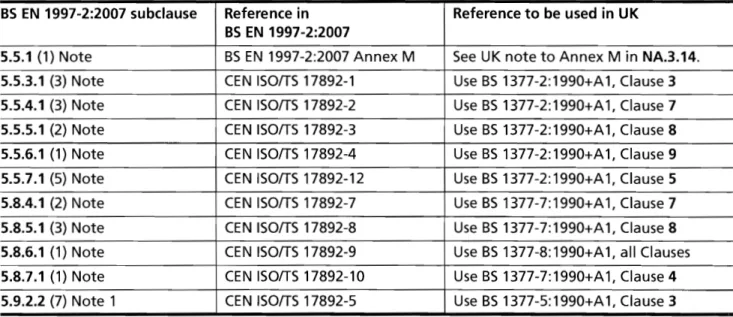
In the UK, laboratory tests should continue to be carried out using parts of BS 1377. DD (EN ISOITS 17892-6 is the only laboratory test TS to be used in the UK; the other (EN ISOITS 17892 parts are not implemented in the UK. See Table NA.1 for the part of BS 1377 to be used where (EN ISOITS 17892 is informatively referenced in BS EN 1997-2:2007.
This National Annex does not include a comprehensive cross-referencing or comparison with the national standards. Before designing the investigation programme, the available information and documents should be evaluated in a desk study which should also use experience in the same or similar geology from elsewhere. A desk study is required in the planning of every investigation, but the size and extent of the desk study will vary according to the project and the anticipated ground conditions. The minimum number of laboratory tests to be carried out on a project is suggested in the BS EN 1997-2:2007 annexes. The number of tests should only be reduced on the basis of precedent experience; this experience should be included in the ground investigation report (GIR).
NA
to
BS EN 1997-2:2007
NATIONAL ANNEX
Table NA.1 BS EN 1997-2:2007 Section 5 cross-references to Parts of (EN ISO/TS 17892 BS EN 1997-2:2007 subclause Reference in Reference to be used in UK
5.5.1 (1) Note 5.5.3.1 (3) Note 5.5.4.1 (3) Note 5.5.5.1 (2) Note 5.5.6.1 (1) Note 5.5.7.1 (5) Note 5.8.4.1 (2) Note 5.8.5.1 (3) Note 5.8.6.1 (1) Note 5.8.7.1 (1) Note 5.9.2.2 (7) Note 1
2 •
© BSI 2009 BS EN 1997-2:2007BS EN 1997-2:2007 Annex M See UK note to Annex M in NA.3.14. CEN ISOITS 17892-1 Use BS 1377-2:1990+A 1, Clause 3 CEN ISOITS 17892-2 Use BS 1377-2:1990+A1, Clause 7 CEN ISOITS 17892-3 Use BS 1377-2:1990+A 1, Clause 8 CEN ISOITS 17892-4 Use BS 1377-2:1990+A1, Clause 9 CEN ISOITS 17892-12 Use BS 1377-2:1990+A1, Clause 5 CEN ISOITS 17892-7 Use BS 1377-7:1990+A1, Clause 7 CEN ISOITS 17892-8 Use BS 1377-7:1990+A1, Clause 8 CEN ISOITS 17892-9 Use BS 1377-8:1990+A1, all Clauses CEN ISOITS 17892-10 Use BS 1377-7:1990+A1, Clause 4 CEN ISOITS 17892-5 Use BS 1377-5: 1990+A 1, Clause 3
NA.3 Decisions on the status of informative
annexes
NA.3.1
General comments
Examples of the application of test results to design are given in the annexes in BS EN 1997-2:2007. These correlations and design proposals are of interest as background and may be used. Alternative correlations and design procedures may also be used. The results from a range of tests can be used in deriving parameters and for input to design as appropriate to the site, the ground conditions and the engineering problem. The derivation of parameters from test results should be explained in the GIR. Justification of how the test results and derived values are used in design should be provided in the geotechnical design report (GDR).
Notes within the main text of BS EN 1997-2:2007 referring to annexes should be read in conjunction with the decisions in NA.3.2 to NA.3.25.
NA.3.2
List of test results of geotechnical test standards,
BS EN 1997-2:2007, Annex A
Annex A may be used.
NA.3.3
Planning of geotechnical investigations,
BS EN 1997-2:2007, Annex B
Annex B may be used in conjunction with the following paragraph. The recommendations of Annex B are not exhaustive and should be treated as a minimum. Relaxation of this guidance is only possible where there is sufficient previous knowledge of the ground conditions at the site or in the geological formation. The previous knowledge used in making this decision should be reported in the GIR.
NA.3.4
Example of groundwater pressure derivations
based on a model and long term measurements,
BS EN 1997-2:2007, Annex C
Annex C should not be used. Investigations of groundwater conditions should be carried out in accordance with BS EN ISO 22475-1.
NA.3.S
Cone and piezocone penetration tests,
BS EN 1997-2:2007, Annex D
Annex D may be used subject to the general comments of NA.3.1. As the new European and international standards for cone
penetration test (CPT) and piezocone penetration test (CPTU) are yet to be published, testing should be carried out in accordance with BS 1377-9:1990+A2 and BS 5930:1999+A1, 26.3.3 and international test procedures (ISSMGE) [1].
A more detailed review of the use of CPT/CPTU can be found in Lunne et al [2].
NA.3.6
Pressuremeter test, BS EN 1997-2:2007, Annex E
Annex E may be used, but is only applicable to the Menard pressuremeter and subject to the general comments of NA.3.1. As the new European and international standards for the various pressuremeter types are yet to be published, the guidance in BS 5930: 1999+A 1, 25.7 may be used.More details on the use of pressuremeters are given in Clark [3] and Baguelin et al [4].
NA.3.7
Standard penetration test, BS EN 1997-2:2007, Annex F
Annex F may be used subject to the general comments of NA.3.1. The results of standard penetration tests (SPTs) should be included in borehole records without the application of corrections.Relative density descriptions on borehole records should also be based on uncorrected SPT N values, unless significantly disturbed, using the density classification in BS 5930:1999+A1, Table 13.
More details on the testing technique are given in BS 5930:1999+A 1 and Hepton and Gosling [5] and on the use of test results in Clayton [6].
NOTE It is recognized that it is difficult to measure the straightness of the rods to the tolerance needed. Rolling the rods on a flat surface will highlight any deflection that is likely to affect their acceptability. It is necessary to use the best available method to measure the straightness and record which method has been used.
NA.3.8
Dynamic probing test, BS EN 1997-2:2007, Annex G
Annex G may be used subject to the general comments of NA.3.1. The correlations given have not been proven in UK conditions.NA.3.9
Weight sounding test, BS EN 1997-2:2007, Annex H
Annex H should not be used.I'JA
to
BS EN 1997-2:2007
NATIONAL ANNEX
4 •
© B512009NA.3.10
Field vane test, BS EN 1997-2:2007, Annex I
Annex I may be used subject to the general comments of NA.3.1. As EN ISO 22476-9 is in preparation and is yet to be published, the guidance in BS 1377-9:1990+A2, 4.4 should be used.
Where field vane test results are included on exploratory borehole records, the values of uncorrected shear strength measured during the field vane test should be reported. Any corrections applied should be described in the GIR.
Further information on the use of field vane test results can be found in Menzies and Simons [7], and Clayton et al [8].
NA.3.11
Flat dilatometer (DMT) test, example of
correlations between
Eoedand DMT results,
BS EN 1997-2:2007, Annex
J
Annex J may be used subject to the general comments of NA.3.1. The flat dilatometer (DMT) has seen limited exposure in the UK, but has been widely used worldwide. DD CEN ISOITS 22476-11 gives a basic guide for the DMT, but Marchetti et al [9] gives much fuller guidance.
NA.3.12
Plate loading test, BS EN 1997-2:2007, Annex K
Annex K may be used subject to the general comments of NA.3.1. As no standard is yet available, testing should be carried out in accordance with BS 1377-9: 1990+A2. General guidance on testing and limitations together with use in boreholes is included in BS 5930:1999+A1, 25.6. Guidance on the selection of plate sizes is provided in BS 1377-9:1990+A2, 4.1.2d).NA.3.13
Detailed information on preparation of soil
specimens for testing, BS EN 1997-2:2007, Annex
l
Annex Lshould not be used, BS 1377-1:1990+A1 should be used instead.
NA.3.14
Detailed information on tests for classification,
identification and description of soil,
BS EN 1997-2:2007, Annex M
Annex M should not be used.
Testing should be in accordance with BS 1377-1:1990+A1 and
BS 1377-2: 1990+A 1. Head [10] and Head and Keeton [1'j] (or previous editions) provide further information. Modern methods of particle size analysis that incorporate detection systems using X-rays, laser beams, density measurements and particle counters may also be applied, in which case they should be calibrated against the standard methods. Frost susceptibility determination should follow the method in BS 812-124.
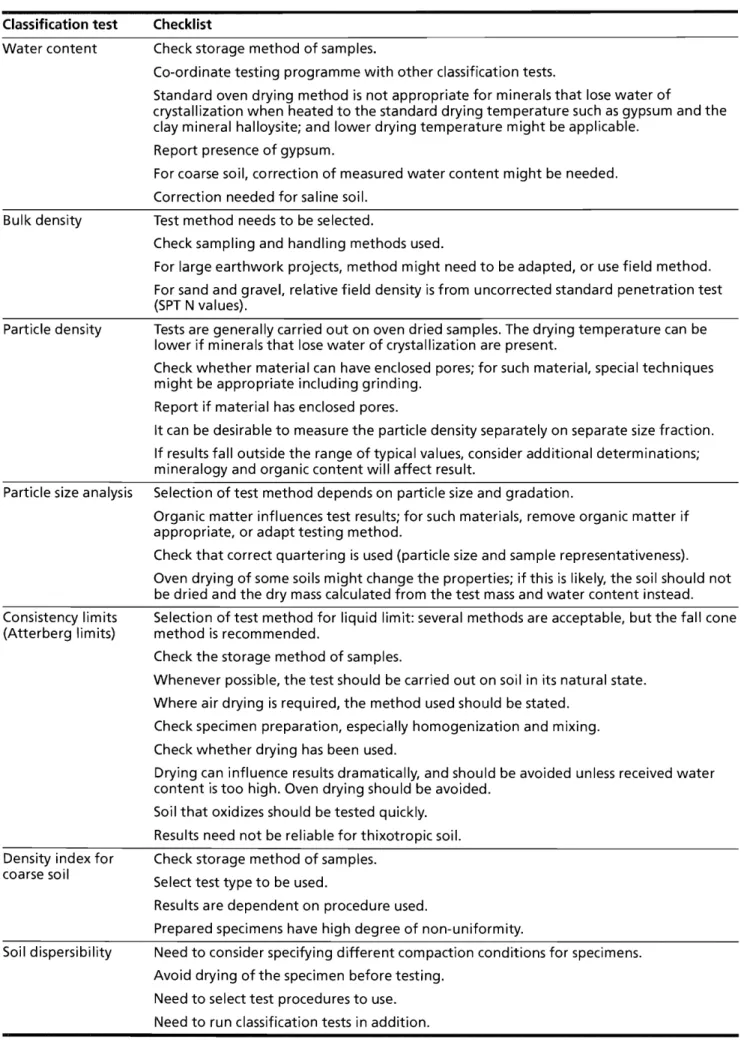
A checklist for the soil classification tests in BS EN 1997-2:2007 is given in Table NA.2.
Table NA.2 Checklist for soil classification tests Classification test Water content Bulk density Particle density Checklist
Check storage method of samples.
Co-ordinate testing programme with other classification tests.
Standard oven drying method is not appropriate for minerals that lose water of
crystallization when heated to the standard drying temperature such as gypsum and the clay mineral halloysite; and lower drying temperature might be applicable.
Report presence of gypsum.
For coarse soil, correction of measured water content might be needed. Correction needed for saline soil.
Test method needs to be selected.
Check sampling and handling methods used.
For large earthwork projects, method might need to be adapted, or use field method. For sand and gravel, relative field density is from uncorrected standard penetration test (SPT N values).
Tests are generally carried out on oven dried samples. The drying temperature can be lower if minerals that lose water of crystallization are present.
Check whether material can have enclosed pores; for such material, special techniques might be appropriate including grinding.
Report if material has enclosed pores.
It can be desirable to measure the particle density separately on separate size -Fraction. If results fall outside the range of typical values, consider additional determinations; mineralogy and organic content will affect result.
Particle size analysis Selection of test method depends on particle size and gradation.
Consistency limits (Atterberg limits)
Density index for coarse soil
Soil dispersibility
Organic matter influences test results; for such materials, remove organic matter if appropriate, or adapt testing method.
Check that correct quartering is used (particle size and sample representativeness). Oven drying of some soils might change the properties; if this is likely, the soil should not be dried and the dry mass calculated from the test mass and water content instead. Selection of test method for liquid limit: several methods are acceptable, but the fall cone method is recommended.
Check the storage method of samples.
Whenever possible, the test should be carried out on soil in its natural state. Where air drying is required, the method used should be stated.
Check specimen preparation, especially homogenization and mixing. Check whether drying has been used.
Drying can influence results dramatically, and should be avoided unless received water content is too high. Oven drying should be avoided.
Soil that oxidizes should be tested quickly. Results need not be reliable for thixotropic soil. Check storage method of samples.
Select test type to be used.
Results are dependent on procedure used.
Prepared specimens have high degree of non-uniformity.
Need to consider specifying different compaction conditions for specimens. Avoid drying of the specimen before testing.
Need to select test procedures to use. l\Jeed to run classification tests in addition.
NA
to
BS EN 1997-2:2007
NATIONAL ANNEX
6 •
© 8512009NA.3.1S
Detailed information on chemical testing of soil,
BS EN 1997-2:2007, Annex N
NA.3.1S.1
General
Annex N may not be used, with the exception of N.S, pH value determination (acidity and alkalinity). Use the appropriate method in
BS 1377-3 with the information in NA.3.1S.2 to NA.3.1S.6.
Storage temperature before testing can influence the biological degradation of organic matter or oxidation of sulfide minerals. Whenever possible, the sample material for chemical tests should be kept at a temperature of 5 O( to 10 0c. The time between sampling and
testing should be limited to reduce the likelihood of chemical change.
NA.3.1S.2
Organic content determination
Sample preparation should follow the method described in BS 1377-3.
Analysis of the extract should follow BS 1377-3. Modern methods of organic content analysis, such as total organic analyser, may also be used; they should be calibrated against the standard's methods. The result should be reported as the percentage of organic content in the soil sample in accordance with BS 1377-3.
NA.3.1S.3
Carbonate content determination
Sample preparation should follow the method described in BS 1377-3.
Analysis of the extract should follow BS 1377-3. Modern methods of carbonate content analysis such as thermogravimetric and X-ray diffraction (XRD) may also be applied, in which case they should be calibrated against the standard's methods. The result should be reported as (percentage of (02 in the soil sample) expressed in BS 1377-3.
NA.3.1S.4
Sulfate content determination
Use BRE [12] to choose the tests to be used where the sulfate content is used to select the appropriate cement type or to investigate the likely effect on concrete. The extracts should be prepared using methods described in BS 1377-3. The analysis of the extract may be measured using methods described in BS 1377-3 (gravimetry or ion exchange). Modern methods of analysis that incorporate detection systems using chromatographic or spectroscopic methods may also be used; they should be validated against the methods in B5 1377-3. The results should be expressed as described by BS 1377-3:
• total soil sulfate (acid extract): S04 to the nearest 0.01 %;
• 2: 1 water extract sulfate: 504 to the nearest 0.01 giL; and
• groundwater: 504 to the nearest 0.01 giL.
NA.3.1S.S
pH value determination
NA.3.1S.6
Chloride content
Sample preparation of acid and water soluble chloride of soil should follow the method described in B5 1377-3. The extract may be measured using methods described in BS 1377-3. Modern methods of analysis that incorporate detection systems using chromatographic or spectroscopic methods may also be applied; they should be validated against the method in BS 1377-3. The results should be expressed as described by BS 1377-3, as the percentage of chloride to the nearest 0.01 %.
NA.3.16
Detailed information on strength index testing of
soil, BS EN 1997-2:2007, Annex
0
Annex 0 may be used.
NA.3.17
Detailed information on strength testing of soil,
BS EN 1997-2:2007, Annex P
Annex P may be used. The test procedures used should be in accordance with BS 1377-7:1990+A 1.
NA.3.18
Detailed information on compressibility testing of
soil, BS EN 1997-2:2007, Annex
Q
Annex Q may be used. The test procedures used should be in accordance with BS 1377-5:1990+A 1. The coefficient of volume compressibility, mv' should be taken as the inverse of the oedometer modulus, Eoed'
NA.3.19
Detailed information on compaction testing of soil,
BS EN 1997-2:2007, Annex R
Annex R may be used. The test procedures used should be in accordance with BS 1377-4:1990+A2.
NA.3.20
Detailed information on permeability testing of soil,
BS EN 1997-2:2007, Annex S
Annex S may be used. The test procedures used should be in accordance with BS 1377-5:1990+A1 and BS 1377-6:1990+A1.
NA.3.21
Preparation of specimen for testing on rock material,
BS EN 1997-2:2007, Annex T
Annex T may be used. The test procedures used should be in accordance with ISRM [13] or ASTM D 4543-08 [14] as required.
NA.3.22
Classification testing of rock material,
BS EN 1997-2:2007, Annex U
Annex U may be used. The test procedures used should be in accordance with ISRM [13].
NA
to
BS EN 1997-2:2007
NATIONAL ANNEX
8 •
© B512009NA.3.23
Swelling testing of rock material,
BS EN 1997-2:2007, Annex V
Annex V may be used. The test methods are described in ISRM [13]. These tests are also applicable to 'firm or stiffer fine-grained soils, as described in BS 1377-5: 1990+A 1.
NA.3.24
Strength testing of rock material,
BS EN 1997-2:2007, Annex W
Annex W may be used, with the exception of W.1.1.
The tests listed in W.1.1 should be carried out in accordance with ISRM [15] or ASTM D 7012-07 [16], or ASTM D 5731-07 [17].
NA.3.2S
Bibliography, BS EN 1997-2:2007, Annex X
Annex X should be used.NA.4
References to non-contradictory
complementary information
BS 5930: 1999+A 1 :2007, Code of practice for site investigations. 1)
NA.S
Bibliography
Standards publications
For dated references, only the edition cited applies. For undated references, the latest edition of the referenced document (including any amendments) applies.
BS 812-124, Testing aggregates - Part 124: Method for determination of frost-heave
BS 1377-1, Methods of test for Soils for civil engineering purposes -Part 1: General requirements and sample preparation
BS 1377-2: 1990+A 1: 1996, Methods of test for Soils for civil engineering purposes - Part 2: Classification tests
BS 1377-3, Methods of test for Soils for civil engineering purposes-Part 3: Chemical and electro-chemical tests
BS 1377-4, Methods of test for Soils for civil engineering purposes-Part 4: Compaction related tests
BS 1377-5:1990+A 1 :1994, Methods of test for Soils for civil engineering purposes - Part 5: Compressibility, permeability and durability tests
BS 1377-6, Methods of test for Soils for civil engineering purposes -Part 6: Consolidation and permeability tests in hydraulic cells and with pore pressure measurement
BS 1377-7: 1990+A 1: 1994, Methods of test for Soils for civil engineering purposes - Part 7: Shear strength tests (total stress)
1) Under revision to remove superseded information and any text conflicting with B5 EN 1997-2.
BS 1377-8: 1990+A 1: 1994, Methods of test for Soils for civil
engineering purposes - Part 8: Shear strength tests (effective stress) BS 1377-9: 1990+A2:2007, Methods for test for Soils for civil
engineering purposes - Part 9: In-situ tests
BS 5930:1999+A 1 :2007, Code of practice for site investigations
BS EN 1997-2:2007, Eurocode 7 - Geotechnical design - Part 2: Ground investigation and testing
BS EN ISO 22475-1, Geotechnical investigation and testing Sampling methods and groundwater measurements - Part 1: Technical principles for execution
DD (EN ISOITS 17892-6, Geotechnical investigation and testing -Laboratory testing of soil - Part 6: Fall cone test
DD (EN ISOITS 22475-1, Geotechnical investigation and testing-Sampling methods and groundwater measurements Part 1: Technical principles for execution
DD (EN ISOITS 22475-2, Geotechnical investigation and testing -Sampling methods and groundwater measurements - Part 2: Qualification criteria for enterprises and personnel
DD (EN ISOITS 22475-3, Geotechnical investigation and testing-Sampling methods and groundwater measurements - Part 3: Conformity assessment of enterprises and personnel by third party DD (EN ISOITS 22476-11, Geotechnical investigation and testing -Field testing - Part 11: Flat dilatometer test
(EN ISOITS 17892-1, Geotechnical investigation and
testing-Laboratory testing of soil Part 1: Determination of water content2)
(EN ISOITS 17892-2, Geotechnical investigation and testing -Laboratory testing of soil Part 2: Determination of density of fine-grained soil 2)
(EN ISOITS 17892-3, Geotechnical investigation and testing
-Laboratory testing of soil- Part 3: Determination of particle density Pycnometer method 2)
(EN ISOITS 17892-4, Geotechnical investigation and testing-Laboratory testing of soil - Part 4: Determination of particle size distribution 2)
(EN ISOITS 17892-5, Geotechnical investigation and testing-Laboratory testing of soil Part 5: Incremental loading oedometer test 2)
(EN ISOITS 17892-7, Geotechnical investigation and testing Laboratory testing of soil - Part 7: Unconfined compression test on fine-grained soil 2)
(EN ISOITS 17892-8, Geotechnical investigation and
testing-Laboratory testing of soil- Part 8: Unconsolidated undrained triaxial test2)
(EN ISOITS 17892-9, Geotechnical investigation and
testing-Laboratory testing of soil- Part 9: Consolidated triaxial compression tests on water saturated soi/2)
(EN ISOITS 17892-10, Geotechnical investigation and testing Laboratory testing of soil- Part 10: Direct shear tests 2)
2) Not adopted in the UK.
NA
to
BS EN 1997-2:2007
10 •
© 8512009NATIONAL ANNEX
CEN Isorrs 17892-12, Geotechnical investigation and
testing-Laboratory testing of soil- Part 12: Determination of A tterb erg limits 3)
prEN ISO 22476-9, Geotechnical investigation and testing - Field
testing - Part
9:
Field vane test4)Other publications
[1] International Society for Soil Mechanics and Geotechnical
Engineering (lSSMGE). International reference test procedure for the cone penetration test (CPT) and the cone penetration test with pore pressure (CPTU). Report of ISSMGE Technical Committee on ground property characterisation from in-situ testing. Proc.
Xflth ECSMGE, pp 2195-2222. Rotterdam: Balkema, 1999. [2] Lunne, T., Robertson, P.K. and Powell, J.J.M. Cone penetration
testing in geotechnical practice. Abingdon, Routledge, 1997. [3] Clarke, B.G. Pressuremeters in geotechnical design. London:
Blackie Academic and Professional, 1994.
[4] Baguelin, F., Jezequel, J.F. and Shields, D.H. The Pressuremeter
and Foundation Engineering. Clausthal-Zellerfeld, Germany: Trans Tech Publication, 1978.
[5] Hepton, P. and Gosling, D. The Standard penetration Test in the UK after Eurocode 7: Amendment to BS 1377: Part 9: 1990,
Ground Engineering, 2008. Volume 41; Number 11, pp 16-21. [6] Clayton, CR.!. The standard penetration test (SPT): methods and
use. Report 143. London: ClRIA, 1995.
[7] Menzies, B.K. and Simons, N.E. Stability of embankments on 50ft
ground. Developments in Soil Mechanics 1. London: Applied Science Publishers Ltd., 1978.
[8] Clayton, CR.I., Simons, N.E. and Matthews, M.C Site
Investigation. London: Granada, 1982.
[9] International Society for Soil Mechanics and Geotechnical Engineering (lSSMGE). Marchetti 5., Monaco, P., Totani, G.
& Calabrese, M. The Flat Dilatometer Test (DMT) in soil investigations. A Report by the ISSMGE Committee TC16.
Proc. IN SITU 2001, Int. Conf. On In-situ Measurement of Soil Properties, Bali, Indonesia: 2001.
[10] Head, K. H. Manual Of Soil Laboratory Testing I Soil Classification
And Compaction Tests Pt. 1. Third Edition. Dunbeath: Whittles Publishing, 2008.
[11] Head, K.H. and Keeton, P. Manual of Soil Laboratory Testing:
Permeability, Shear Strength and Compressibility Tests Pt. 2.
Dunbeath: Whittles Publishing, 2009.
[12J Building Research Establishment (BRE). Special Digest 1: Third Edition. Concrete in aggressive ground, Watford: BRE, 2005. [13] International Society for Rock Mechanics (lSRM). Suggested
Methods for Rock Characterization, Testing and Monitoring. Ed. E.T. Brown. Oxford: Pergamon Press, 1981.
3} Not adopted in the UK.
[14] ASTM D 4543-08. Preparing Rock Core Specimens and
Determining Dimensional and Shape Tolerances. ASTM Volume 04.08 Soils and Rock. Philadelphia, USA: American Society for
Testing and Materials, 2008.
[15] International Society for Rock Mechanics (lSRM), Suggested Methods for Determining Point Load Strength. International
Society for Rock Mechanics, Mining Sciences and Geomechanical Abstracts, 1985, Vo1.22, 2, pp52-60.
[16] ASTM D 7012-07. Standard Test Method for Compressive Strength
and Elastic Moduli of intact Rock Core Specimens under Varying States of Stress and Temperature. ASTM Volume 4.09 Soil and Rock II. Philadelphia, USA, American Society for Testing and
Materials, 2009.
[17] ASTM D 5731-07. Standard Test Method for Determination of
the Point Load Strength Index of Rock and Application to Rock Strength Classification. ASTM Volume 04.08 Soils and Rock.
Philadelphia, USA, American Society for Testing and Materials, 2008.
Further reading
Site Investigation Steering Group. Site Investigation in Construction,
Part 2, Planning, procurement and quality management. London:
Thomas Telford, 1993.5)
Head, K. H. Manual of soil laboratory testing. Vol. 2. Permeability, shear strength and compressibility tests. Second edition. London:
Pentech Press, 1994.
5) Being revised in 2010.
NA
to
BS EN 1997-2:2007
NATIONAL ANNEX
Revisions
British Standards and PASs are norl('vlir::dlll updated by amendment or
revision. Users of British and should make sure that they possess the latest amendments or editions.
It is the constant aim of BSI to improve the services, We would be grateful if anyone
while using British Standards would inform the of technical committee responsible, the identity of which can be found on the inside front cover. Similary for PASs, please notify BSI Customer Services.
Tel: +44 (0)20 8996 9001 Fax: +44 (0)20 8996 7001
BSI offers BSI Subscribing Members an individual updating service called PLUS which ensures that subscribers automatically receive the latest editions of British Standards and PASs,
Tel: +44 (0)20 8996 7669 Fax: +44 (0)20 8996 7001 Email: [email protected]
Buying standards
You may buy PDF and hard copy versions of standards directly using a credit card from the BSI Shop on the website www.bsigroup.com/shop. In addition all orders for BSI, international and foreign standards publications can be addressed to BSI Customer Services.
Tel: +44 (0}20 89969001 Fax: +44 (0)2089967001 Email: [email protected]
In response to orders for international standards, BSI will Standard implementation of the relevant international otherwise requested.
BSI
389 Chiswick High Road London W4 4AL UK Tel +44 (0)20 8996 9001
Fax +44 (0)2089967001 www.bsigroup.com/standards
raising standards worldwide™
the British unless
Information on standards
BSI provides a wide range of information on national, European and international standards its Knowledge Centre.
Tel: +44 (0)20 8996 7004 Fax: +44 (0)20 8996 7005 Email: [email protected]
BSI Subscribing Members are kept up to date with standards developments and receive substantial discounts on the purchase price of standards. For details of these and other benefits contact Membership Administration,
Tel: +44 (0)20 8996 7002 Fax: +44 (0)20 8996 7001 Email: [email protected]
Information regarding online access to British Standards and PASs via British Standards Online can be found at
www.bsigroup.com/BSOL
Further information about British Standards is available on the BSI website at www.bsi-group.com/standards
Copyright
All the data, software and documentation set out in all British Standards and other BSI publications are the property of and copyrighted by BSI, or some person or entity that own copyright in the information used (such as the international standardisation bodies) has formally licensed such information to BSI for commerical publication and use. Except as permitted under the Copyright, Designs and Patents Act 1988 no extract may be reproduced, stored in a retrieval system or transmitted in any form or by any means electronic, photocopying, recording or otherwise without prior written permission from BSI. This does not preclude the free use, in the course of implementing the standard, of necessary details such as symbols, and size, type or grade designations. If these details are to be used for any other than implementation then the written permission of BSI must obtained. Details and advice can be obtained from the Copyright & Licensing Department.