Stolle and Rick: Improved method for determination of creatine kinase activity 239
J. Clin. Chem. Clin. Biochem. Vol. 14, 1976, pp. 239-244
An Improved Method for the Determination of Creatine Kinase Activity in Serum
By D. Stolle and W. Rick
Institut für Klinische Chemie und Laboratoriumsdiagnostik der Universität Düsseldorf (Received January 7/March 10,1976)
Summary: An improved method for the determination of creatine kinase activity (EC 2.7.3.2) is described. For the reactivation of creatine kinase, serum is first preincubated in the test solution in the presence of dithioerythritol. Then the enzymatic reaction is started by adding creatine phosphate. By optimizing the concentrations in the test solution and by altering the measurement procedure using dithioerythritol as reactivator, the assay is made more sensitive, and a far higher enzyme activity in serum is measured in comparison with other recommended tests. The reaction rate is linear for ten minutes up to 700 U/l. An increase in activity by enzyme dilution was not observed. In this study a sensitivity of detection of 0.9 U/l was achieved. This would be especially advantageous in the detection of the isoenzymes of creatine kinase after chromatpgraphy. Within-run precision was 1.2%(CV), day-to-day precision was 2.0% (CV). The test solution is stable for at least 24 hours.
Eine verbesserte Methode zur Bestimmung der Creatinkinase-Aktivität im Serum
Zusammenfassung: Es wird eine verbesserte Methode für die Aktivitätsmessung der Creatinkinase (EC 2.7.3.2) im Serum beschrieben. Zur Reaktivierung der Creatinkinase wird Serum zunächst im Testansatz mit Dithioerythrit vorinkubiert. Dann erfolgt der Start der enzymatischen Reaktion durch Zugabe von Creatinphosphat. Durch Opti-mierung der Konzentrationen im Testansatz, durch Änderung der Meßanordnung und mit Dithioerythrit als Reaktivator wird der Test empfindlicher. Im Vergleich mit anderen empfohlenen Tests wird eine weit höhere Enzymaktivität im Serum gemessen- Die Zeit-Umsatz-Kurve ist bis 700 U/l für 10 Minuten linear. Ein Aktivitäts-anstieg durch Enzymverdünnung wurde nicht beobachtet. Mit der beschriebenen Meßanordnung wurde eine Nach-weisgrenze von 0,9 U/l erreicht. Dies ist von besonderem Vorteil für den Nachweis der Creatinkinase-Isoenzyme nach chromatographischer Trennung. Der Variationskoeffizient der Präzision in der Serie lag bei 1,2%. Die Präzi-sion von Tag zu Tag hatte einen Variationskoeffizienten von 2,0%. Die Testlösung ist für mindestens 24 Stunden haltbar.
Introduction times faster than the phosphorylation of creatine (6).
The reaction rate is measured optically by reduction of The determination of creatine kinase activity in serum is NADF*". During the enzymatic reaction creatine kinase of great significance in the diagnosis of my ocardial in- is simultaneously reactivated by reduced glutathione farction and muscle disease. Striving for a high precision (GSH). Results were calculated from the change in ab-of the method and for reproducibility ab-of the results the sorbance per minute after five minutes preincubation German Society for Clinical Chemistry 1970 and 1972 in the presence of the substrates. In spite of the metho-suggested the use of standard test conditions (1, 2). dological improvement some problems still remained: According to Offver (3) and Rosalki (4) the reverse ^ reactivator is unsuitable for the following reason: reaction (5) was chosen: Glutathione may be partially present in the oxidized
creatine kinase - form (GSSG) which is a substrate for glutathione ADP + creatine phosphate · - - > ATP + creatine reductase (EC .6.4.2):
. Glutathione reductase ,.,.-.„». At the optimal pH value the formation of ATP and NADPH + H" + GSSG > NADP
creatine from ADP and creatine phosphate is about six + 2 GSH
240 Steile and Rick: Improved method for determination of creatine kinase activity
2. The change in absorbance during ten minutes was found to be linear only up to 200 U/l corresponding to four times the upper limit of the normal range. 3. Sera with higher activities have to be diluted. On the
other hand there is no linear relationship between the amount of serum in the test and the measured reac-tion rate. Even activities of 100 U/l are found to be 10% too low compared with the assay result of a diluted specimen. Up to now this phenomenon has been interpreted by postulating the presence of serum inhibitors (8). Therefore Szasz et al. suggested dilu-tion with inactivated serum (9).
4. In sera from patients with myocardial infarction myo-kinase (EC 2.7.4.3) is inhibited by AMP in the test solution (3). Unfortunately AMP also inhibits crea-tine kinase. An optimal balance between inhibition of myokinase and the unavoidable inhibition of crea-tine kinase was not achieved in the methods
published.
drift was monitored and corrected by comparative absorbance measurements of diluted picric acid solution.
Attenuator range: Absorbance 0-Ö.25Ö ^ 20 cm
Chart speed: 1 cm/min; in case of high activities with reaction rate lines steeper than tga = 60° speed was increased to 2 cm/min or 5 cm/min.
Evaluation of results was done graphically by measuring the change of absorbance over a range of 10 cm on the chart. The corresponding time is then defined by the chosen chart speed.
Results and Discussion
Buffer system and optimal pH
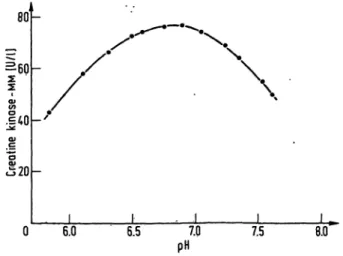
Triethänolämine-HCl is not suitable as a buffer system at a pH value of about 7.0 because if its high pKa value of 7.9. Imidazole/acetic acid was chosen as the buffer system according to Warren (11) and Forster et al. (6). A pH-optimum of 6.8 was found for the creatine kinase activity (Pig, 1). The same range was verified with pooled human serum.
Materials and Methods
Specimens
Following the proposal of the Expert Panel on Enzymes of the IFCC (10) we established the reproducibility of the method "with a clearly characterized human enzyme of the type found in serum ...". Therefore purified human iso-enzyme creatine kinase-MM was used (product of Biochemical Research, E. Merck). Stock solution: Suspension of creatine kinase-MM in 650 g/1 ammonium sulfate stabilized with 10 g/1 globulin; activity: ca. 100 kU/1. Before use the stock solution was diluted with 50 g/1 human serum albumin to an activity of about 100 U/l. Trie sera used were taken from normal persons and patients with increased creatine kinase activities ranging from 50 to 1400 U/L
Inhibition of myokinase
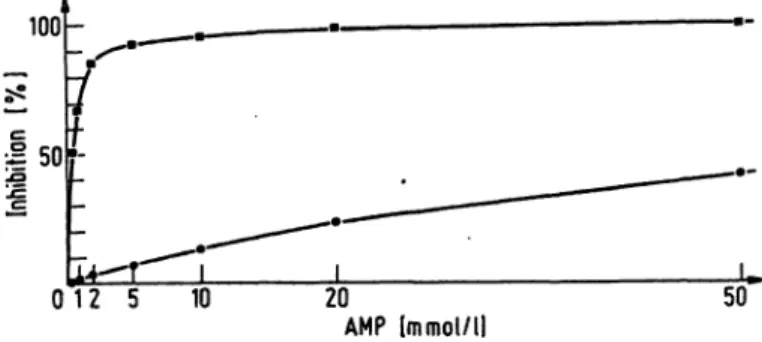
The influence of AMP concentration in the test was checked with regard to the inhibition of myokinase activity as well as to the inhibition of creatine kinase activity (Fig. 2). The test solution was identical for both the creatine kinase and myokinase measurements, except that in the latter case creatine phosphate was omitted. In the presence of 1 fnmol/1 ADP the optl· mal concentration of AMP is about 5 mmol/1: inhi-bition of myokinase exceeds 90 % whereas inhiinhi-bition of creatine kinase is in the range of 5 %.
Reagents
For the preparation of the modified assay solutions all reagents were weighed out daily. Creatine phosphate, disodium salt; ADP, free acid; NADP, disodium salt; AMP, disodium salt; N-acetyl cysteine; myokinase, porcine; hexokinase (EC 2.7.1.1.), from yeast; and glucose 6-phosphate dehydrogenase (EC 1.1.1.49), from yeast, were obtained from Boehringer Mann-heim GmbH. Glucose; dithioerythritol; mercaptoethanol; magnesium acetate, and imidazole were obtained from E. Merck. Dithiothreitol was obtained from Calbiochem. A com-mercial kit was used only to check the recommended test (2): CPK activated 124176 from Boehringer Mannheim.
Instrumentation and equipment
Photometer Eppendorf 1100 M with logarithmic converter Eppendorf 1853; Chart recorder Eppendorf 4412. The temperature in the cuvette holder is regulated by a Colora Ültrathermostat NB 5.
Measurement procedure Temperature: 25.0°C ± 0.05°C Wavelength: Hg line 334 nm
All measurements were made in duplicate. Each reaction rate was recorded individually for five minutes. Any instrumental
80-20
6.0 6.5 7.0 7.5 8.0 pH
Fig. 1. Effect of the pH value in the assay solution on the activity of purified human creatine kinase-MM. Final concentra-tions in the assay solution: creatine phosphate 35 mmol/1; glucose 20 mmol/1; ADP 1 mmol/1; NADP 0.6 mmoi/1; hexokinase 1.2 k U/l; glucose 6-phosphate dehydrogenase 1.2 kU/1; Mercaptoethanol 10 mmol/1; magnesium acetate 10 mmol/1; AMP 10 mmol/1; imidazole/acetic acid buffer 100 mmol/1.
Stolle and Rick: Improved method for determination of creatine kinase activity 241
£ 50
012 5 10 20 50
AMP [mmol/l|
Fig. 2. Inhibition of creatine kinase-MM (· ·) and myokinase (a ·) depending on the AMP concentration. The other test conditions were the same as in Fig. 1.
Blank reaction
A blank reaction was found to be due to contaminants in the auxiliary enzymes. This blank reaction rate varied with the batch of the enzyme preparations, and had to be determined for each batch.
Reactivation of creatine kinase
The most suitable thiol compound for the reactiva-tion of creatine kinase was evaluated by varying the reactivators in the test solution, and observing the reactivation potency for the different types of SH-reagent (Tab. 1). Dithioerythritol and dithiothreitol proved to be the most effective.
In contrast to Warren (11) no significant difference between these two substances could be seen. The extent of reactivation was defined as per cent increase of activity due to the reactivator in relation to the activity without addition of a thiol compound. Neces-sarily the rate of reactivation is a function of the actual state of inactivation of the specimen. In spite of the augmented acitivity due to reactivation the true activity is not known precisely.
For further investigations dithioerythritol was chosen. Its isomer dithiothreitol is far less convenient, owing to
Tab. 1. Percentage increase of activity of purified human creatine kinase-MM by different SH-reagents (final con-centration in the assay solution 10 mmol/1). Other test conditions see Fig. i.
SH-reagent no activator Dithioerythritol Dithiothreitol Mercaptpethanol N-acetyi cysteine U/l 152 235 233 228 ' 219 increase (U/l) 83 81 76 67 increase (%) 54 53 50 44
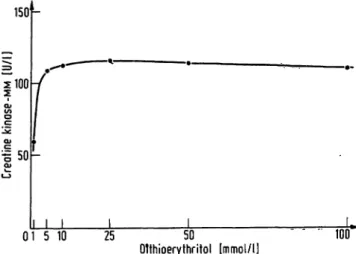
its low melting point (41°C) and its high hygroscopi-city. Mercaptoethanol has such an unpleasant odor that it was not taken into consideration. N-acetyl cysteine which is proposed by Forster et al. (6) is un-doubtedly of advantage because of low price but shows far less efficiency in regard to reactivation. In additional experiments the difference between dithioerythritol and N-acetyl cysteine could be demon-strated even more impressively (Fig. 3): Serum was incubated with equimolar amounts of thiol reagent. The pH of the mixture was corrected to 6.8. After various preincubation intervals the mixture was assayed without additional thiol reagent. The results show that reactivation in serum is slower than in the assay solu-tion. After about one hour serum reactivation with dithioerythritol exceeds reactivation in the assay. With N-acetyl cysteine only 75% of the reactivation in the assay is obtained after 41/2 hours of serum incubation. The decrease in activity after 15 minutes cannot be explained. The optimum concentration for dithioery-thritol proved to be 25 mmol/1 (Fig. 4). As the reac-tivation of the enzyme may be influenced by the enzymatic reaction itself a preincubation period with-out substrate was used for reactivation. Moreover in this preincubation period no NADP"1" is consumed,
so that in the same reaction time after starting higher activities could be measured without loss of linearity. A preincubation time of 10 minutes is sufficient. A longer time would be of little practical effect (Fig. 5). 150
5100
Jsol
30 60 120 t (min] 180 240Fig. 3. Reactivation of serum. Serum was incubated with the thiol compound (final concentration 10 mmol/1, pH 6.8) for various periods. After the incubation the activity was assayed without further addition of SH-compound. AMP 5 mmol/liter; for other test conditions see Fig. 1. ·- - · serum with dithioerythritol, no additional
dithio-erythritol in the assay solution,
• - · serum with N-acetyl cysteine, no additional N-acetyl cysteine in the assay solution,
« ο dithioerythritol in the assay solution, no preincuba-tion of serum,
« ο N-acetyl cysteine in the assay solution, no prein-cubation of serum.
242 Stolle and Rick: improved method for determination of creatine kinase activity
150'
•100
01 5 10 25 50
Dlthioerythritol [mmol/l] 100
Fig. 4. Determination of the optimal dithioerythritol concentra-tion. The other test conditions were the same as in Fig. 3.
Tab. 2. Analytical System. Pipette
1 Buffer-Reagent Mixture 2 Auxiliary Enzyme Solution 3 Serum (Sample)
Incubate at 25.00°C for 10 min 4 Creatine Phosphate Solution
Volume 2500 μΐ 50 μΐ 100 μΐ
100 μ\ Mix well and record the changing absorbance at 334 nm Hg for 5 min. Calculate the average change in absprbance/min after blank correction.
Calculations
Catalytic concentration = 4450 ΔΑ/min [U/l] where
eNADPH334 n?n, 25°C is-6.18 [cm2/MmolJ and the pathlength of the cuvette is 1 cm. 150 i 100
I
J 50 I I I I 0 510 2030 60 t [min] 120 180 Fig. 5. Determination of the optimal preincubation time ofcreatine kinase in the assay solution. The enzyme reaction was started subsequently by adding creatine phosphate. Test conditions as in Fig. 3; dithioerythritol 25 mmol/l.
Tab. 3. Final concentrations in the test solution. Buffer (pH 6.8)
Substrates Coenzymes
Imidazole-Acetic Acid 100 mmol/l Creatine Phosphate
Glucose ADP NAPP+ Auxiliary Enzymes Hexokinase
Glucose 6-phosphate dehydrogenase Creatine Kinase Reactivator Dithioerythritol 35 mmol/l 20 mmol/l 1 mmol/l 2 mmol/l 3 kU/1 3kU/l 25 mmol/l Activator Myokinase Inhibitor Magnesium Acetate AMP 10 mmol/l 5 mmol/l
Suggested test procedure
The measurement procedure is shown in Table 2. Final concentrations of the test solution are listed in Table 3. The concentration of NADP"1" was increased to diminish the competitive inhibition of the glucose 6-phosphate dehydrogenase by NADPH (12) when high creatine kinase activities were assayed. By separating the reactivation time from the enzyme reaction itself a low concentra-tion of NADPH at the beginning of the reacconcentra-tion is achieved. In the method described here only about 12% of NADpt are reduced to NADPH when 700 U/l creatine kinase are assayed over a period of 10 min. In the same case 64 % of NADP* are consumed with the method mentioned at the beginning (1, 2). The activity of the auxiliary enzymes in combined optical tests has to be at least 100-fold the activity of the enzyme to be assayed, otherwise the indicator system will be rate limiting (13). We therefore increased the activity of the auxiliary enzymes as shown in Table 3. Thus a linear
proportionality up to 1400 U/l was found between the amount of enzyme in the test and the reaction rate (Fig. 6). The significance of a blank correction is also seen. The same range of linearity was found for sera with highly increased activities. Both graphs are nearly identical demonstrating good correspondence of creatine kinase-MM and sera.
The test solution is stable for at least one day at room temperature. From the analysis of regression between apparent loss of activity using a once prepared buffer-reagent mixture and storage time (up to 10 days) of this mixture at room temperature the average decrease per day of activity due to aging of the test solution was 1.0% (y = - 1.2 χ + 114.6, r = 0.945).
Quality control
Quality control was performed with creatine kinase-MM in 50 g/1 human serum albumin and Precinorm-E. The within-run precision was 1.2% CV with n = 30,
Stolle and Rick: Improved method for determination of cxeatine kinase activity 243 1000 I 100 10
-J_
128 64 32 16 θ Dilution factorFig. 6. Relationship between dilution of the specimen and measured activity. A double logarithmic scale was chosen for demonstrating clearly the linearity over the whole range from 10-1400 U/l. For test conditions see Table 3.
• · creatine kinase-MM, blank corrected, 1460 U/l • · creatine kinase-MM, blank not corrected X—X pool of 10 sera, blank corrected, 1400 U/l.
χ = 97.3 U/l and s = 1.2 U/l. The day-to-day precision was 2.0% CV with n = 20 (the first of the duplicate values was taken), χ = 118.7 U/l and s = 2.4 U/l. The sensitivity of detection was 0.9 U/l (x + 3 s of "no enzyme" in 50 g/1 human serum albumin, n = 20, blank corrected).
Comparison with established procedures
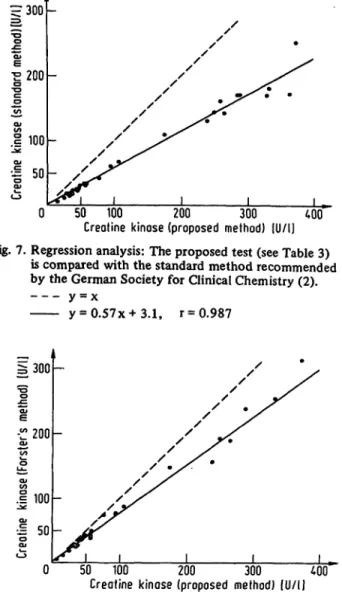
The results were obtained by employing purified human creatine kinase-MM isoenzyme according to the published recommendations of the IFCC (10). The low activity of creatine kinase-MB which may be present in some sera does not impair the predominant role of creatine , kinase-MM. Serum was considered not to be suitable as a model specimen due to its individual composition arid the possibility of interfering substances, e.g. drugs and their metabolites, the presence of which cannot be excluded. The validity of the test under optimized con*· ditions was proved by a comparison with the method recommended by the German Society for Clinical Chemistry. Analysis of regression was carried out using 30 different sera with normal and elevated enzyme activities. Notwithstanding the objection to GSH as a reactivator and triethanolamine-HCl as a buffer system, the new assay clearly demonstrates increased sensitivity by detection of 75 % higher activity in the same sera (Fig. 7), the coefficient of correlation being 0.987. A revised version of the recommended test (2) was suggested by Forster et al. in 1974 (6). N-acetyl cysteine is used as the reactivator and imidazole/acetic
50 100 200 300 400^ Creatine kinase (proposed method) (U/l) Fig. 7. Regression analysis: The proposed test (see Table 3)
is compared with the standard method recommended by the German Society for Clinical Chemistry (2).
0.57x+3.1, r = 0.987 H300 t £200 Οι to ο u_ 01
j 100
01 = 50 0 50 100 200 300 400 Creatine kinase (proposed method) [U/l] Fig. 8. Regression analysis: The proposed test (see Table 3) iscompared with the method according to Forster et al. (6) y = x
y = 0.75x + 3.6, r = 0.991
acid is chosen as the buffer system. Analysis of regres-sion with this test is shown in Figure 8. The coefficient of correlation here is 0.991. Though the revised version is a clear improvement, the present method still deter-mines 33 % higher activities in the same samples. Two essential reasons account for this:
1. Dithioerythritol is more effective than N-acetyl cysteine.
2. The preceding reactivation of creatine kinase before starting the enzyme reaction itself permits a higher reactivation rate of the enzyme before it is measured. Thus sensitivity is increased.
This is especially advantageous in the analysis of creatine kinase isoenzymes by chromatography when only low activities of creatine kinase-MB after myocardial infarc-tion are present in serum. Hitherto, it was necessary for samples for the analysis of isoenzymes to have a signi-ficantly elevated activity, or they had to be concentrated (14).
244 Stolle and Rick: Improved method for determination of creatine kinase activity
References
1. German Society for Clinical Chemistry (1970), this J. 8, 659-660.
2. German Society for Clinical Chemistry (1972), this J. 10, 281-291.
3. Oliver, I. T. (1955), Biochem. J. 61, 116-122. 4. Rosalki, S. B. (1967), J. Lab. din. Med. 69, 696-705. 5. Commission on Biochemical Nomenclature (1972),
En-zyme Nomenclature, p. 15, Elsevier, Amsterdam. 6. Forster, G., Bernt, E., & Bergmeyer, H. U. (1974), in
Methods of Enzymatic Analysis (Bergmeyer, H. U., Ed.) 2nd ed. p. 784, Academic Press, New York and London. 7. Weidemann, G. (1973), this J. 11, 134-135.
8. Graig, F. A., Smith, L C, & Foldes, F. F. (1967), din. Chim. Acta75, 107-111.
9. Szasz, G-, Busch, E.-W., & Farohs, H.-B. (1970), Deut. Med. Wochenschr. 95, 829-835.
10. Bpwers, G. N. Jr>, Beigmeyer, H. Ü., & Moss, D. W. (1975), Clin. Chim. Acta 61, F 11-F 24. - This J. 13, 523-531.
11. Warren, W. A. (1972), Oin. Chem. 18, 473-475. 12. Barman, T. E. (1969), Enzyme Handbook, Vol. l,
p. 73-74, Springer-Verlag, Berlin, Heidelberg, New York. 13. Richterich, R. (1971), Klinische Chemie, 3rd. ed., p. 168,
Verlag S. Karger, Basel.
14. Nealon, D. A., & Henderson, A. R. (1975), Clin. Chem.
21, 392-397.
Prof. Dr. W. Rick
Institut .für Klinische Chemie und Laboratoriumsdiagnostik Moorenstr. 5
D4000 Düsseldorf