This PDF is a selection from an out-of-print volume from the National Bureau of Economic Research
Volume Title: History and Policies of the Home Owners' Loan Corporation Volume Author/Editor: C. Lowell Harriss
Volume Publisher: NBER Volume ISBN: 0-870-14142-2
Volume URL: http://www.nber.org/books/harr51-1 Publication Date: 1951
Chapter Title: Financial Liquidation of the Home Owners' Loan Corporation Chapter Author: C. Lowell Harriss
Chapter URL: http://www.nber.org/chapters/c3216 Chapter pages in book: (p. 159 - 181)
CHAPTER 11
Financial Liquidation of the
Home Owners' Loan Corporation
T the time of the Home Owners' Loan Corporation's organization no one knew specifically how much money might be lost from operations, though some loss was expected, even by the sponsors of the originating bill, and some expected the deficit to be large.' While
a purely financial accounting of losses for an activity such as that
engaged in by the HOLC is obviously too narrow to be fully satisfac-tory as a basis for appraising the organization, it is interesting, never-theless. Accordingly, the following sections summarize this financial record to the final liquidation in the spring of 1951 and the principal factors that affected it.
FINANCIAL RESULTS ACCORDING
TO HOLC ACCOUNTING
By its own accounting, the HOLC, through March 31, 1951, had
re-ceived a total gross income of $1,417 million, of which 84 percent
($1,192 million) came from interest paid by its borrowers,. about 5 percent ($73 million) from sources not being studied in this volume (dividends from savings and loan associations and the Federal Sav-ings and Loan Insurance Corporation), nearly 10 percent ($139
mil-lion) from income from property (gross rentals), and the small
balance—$ 13 million—from miscellaneous sources, including pay-ment for services to other governpay-ment agencies and for the handling of insurance accounts (Table 42).
Total expenses for the same period were $1,065 million,
on million for
adminis-1Itwas estimated in January 1937 by the Chairman of the House Subcommittee on Appropriations that losses would amount to from 15 to 20 percent of the amount loaned. Later, he mentioned 10 to 15 percent as the expectable loss. Other legislators privately anticipated a much larger loss rate. U. S. Congress, House, Hearings before the Subcommittee of the Committee on Appropriations on the Independent Offices
dppropriation Bill for 1938, 75th Congress, 1st Session (1937) p. 644.
160 HISTORY AND POLICIES OF THE HOLC
TABLE 42 — OPERATING RESULTS OF THE HOLC, AS OF JUNE 30, 1940
AND MARCH 31, 1951 (in millions) . Income and pense Items . . June 30, 1910 March 31,1951 income Interest on accounts b Dividendsreceived C Propertyincome Other income ' $828.3 727.2 26.3 72.9 1.9 $1,417.1 1,192.0 73.0 138.6 13.5 . Expenses Interest on bonds Administrative and general expenses Property expense 717.5 446.0 208.9 62.6 1,064.9 660.7 291.4 . 112.8 Net Income 110.8 352.2 - TotalLosses 139.1 338.0
Net Profit orLoss —28.3 +14.2
a Datamade available by the HOLC.
bIncludes interest converted to principal ($6.7 million as of March 31, 1951) and
interest capitalized in property accounts ($53.4 million as of March 31, 1951).
cIncludesdividends from savings and loan associations ($44.7 million as of March 31,
1951) and from the Federal Savings and Loan Insurance Corporation ($28.2 million as of
March 31, 1951).
ciIncludes losses on mortgage loans and vendee accounts, property accounts,
insur-atice accounts, and other miscellaneous losses.
trative and general expenses, and $113 million for property expenses. Against the difference between gross income and expenses of $352 million, HOLC offset losses of $338 million (chiefly, on properties which it had foreclosed and later sold), leaving a net profit to March 31, 1951 of $14 million. Over a decade earlier (June 30, 1940), the corresponding figure was a loss of $28 million (Table 42). With only a few small items remaining—administrative expenses and salaries for a skeleton staff for a few weeks, terminal leave pay for some em-ployees, and proceeds from the sale of remaining office equipment—
these figures represent the final financial results of the HOLC's existence.
One relevant fact omitted in the above financial summary is that the HOLC, quite properly for its own purposes, has not tharged itself with the costs of the $200 million capital advance which it received from the United States Treasury. On the assumption that the cost of
these funds would average 1 percent annually, the total cost through
June 30, 1950 would be $34 million, without compounding. The appropriate rate, however, may not be 1 percent but the average of
the annual interest rates paid by the Treasury over the relevant
period—about 2.37 percent—which would raise the total cost through June 30, 1950 to $81 million. On the other hand, it might be argued
that the rate to be used is that on short-term Treasury borrowing—
probably the "marginal" element. in its borrowing—in which case the 1 percent figure used above is not far In any case, the over-all
cost of the HOLC to the date of its liquidation is higher than that
shown by its accounting records by at least $35 million, and possibly by nearly double that amount.
Another factor affecting HOLC costs is •that as a government agency it obtained free some services which would have been business costs to any private enterprise.2 It is estimated that free use of the
mails until 1946 saved the I-IOLC about $6 million, at a cost to the government of possibly $3 million. As for taxes, a comparable private
agency would have paid state and local business taxes (the HOLC paid property taxes on the properties it acquired) but until 1949 no
federal income tax because of its deficit.
Somewhat more important was the fact that the HOLC was not subject to social security taxes. Had it been required from 1938 to pay old age and survivors insurance at a rate of 1 percent and an
unemployment insurance tax at an average rate of 2 percent (in each •case, on payments up to $3,000 a year per employee), its total costs would have been somewhat more than $5 million higher than those recorded through March 31, 1951).3 The HOLC may have obtained
2 Of quite a different nature was the unusual power of the HOLC, as a government agency, to obtain huge amounts of uncompensated overtime from its employees, at least until World War II. Beginning in 1938, federal law required payment, at rates, for time worked beyond fortyfour hours a week (beyond forty hours, beginning in
1940) by private employers generally. A comparison of HOLC's costs with those of a
private organization should not ignore this item, but there is no basis for a reliable
estimate of its magnitude.
3 Under government accounting, costs for employee retirement allowances are not allocated to the separate agencies. The over-all average cost for the government has been about 5 percent of the salaries of covered employees; an increase in retirement allow-ances voted in 1948 raised the cost estimate to 61/2 percent. The HOLC, however, was
not brought within the retirement system until 1942, and many of its employees left
federal government employment entirely without retirement claims. A few millions of
dollars of liability for civil service retirement benefits was accumulated (and will accumulate) on account of employment for the HOLC, above amounts covered by
162 HISTORY AND POLICIES OF THE HOLC
some other cost-reducing advantages as a government agency, but
these were not of great importance.4 On the other hand, its staff mem-bers had to prepare many reports for review and audit that would not have been required of an independent private agency, and much time was taken in dealing with members of Congress.
FACTORS AFFECTING HOLC
FINANCIAL RESULTS FALLING INTEREST RATES
Possibly the most important single factor affecting the HOLC's
finan-cial experience was the fall in the rate of interest which it paid on
borrowings. Original plans called for the HOLC to pay 4 percent on its bonds. This rate was paid for a few months on a relatively small volume of bonds but was replaced by a 3 percent rate in 1934 when
the government's guarantee was extended to principal.5 Over the
next few years, the HOLC was able to obtain a substantial part of its funds for 11/2 percent or less, though higher rates were paid on some parts of the total because noncallable bonds had been issued.6 This
cost reduction was offset in part at least when HOLC's charge to
borrowers was reduced in October 1939 from 5 to percent.7Yet
the HOLC benefited greatly from the fact that its major item of
money costs fell in relation to mortgage interest rates.8 The spreadbetween the average rates of interest received and paid by the HOLC 4 The HOLC reimbursed the Treasury for the latter's costs in handling itsbonds,
checks, and coupons. Although the HOLC had the advantage of the Treasury's free
advice on financing, it was compelled to deposit surplus cash with the Treasury, at no
interest, and probably enjoyed no net advantage, on balance. Only a small fraction of
its office space was obtained free of charge in government buildings; by far the largest portion was obtained by rental on a regular commercial basis.
5 Mr. Fahey has told the author that he and some other members of the Federal
Home Loan Bank Board were opposed to the 3 percent bonds. Had their judgment been accepted, the HOLC would have been able to take full advantage of low interest rates. The Treasury recommended the 3 percent rate. Second Annual Report, Federal Home Loan Bank Board (December 31, 1934) p. 81.
6 See Chapter 10.
7 This reduction was made, somewhat against the wishes of the HOLC, partly because
of pressure from borrowers and partly because of a general policy of the Roosevelt Administration to lower interest rates to stimulate the housing market.
8 From purely dollar-and-cents considerations it was unfortunate that the original
plan provided for exchange of bonds for mortgages. The Treasury was then obtaining
funds for less than the interest on the HOLC bonds. If it had borrowed the money needed and given cash to those who were transferring mortgages to the HOLC, the net intcrest cost to the Treasury would have been lower. Completion of loans would
FINANCIAL LIQUIDATION OF THE HOLC
was about 2½ percentage points. As conditions have worked out, this
spread has covered costs with little, if any, margin. The spread of 1 percentage point planned originally would, of course, have been very inadequate. The 2 percent and larger spreads made effective after the HOLC bonds were fully guaranteed in 1934 would have been almost sufficient, but the HOLC would not have been able to reduce its charge to borrowers by one-tenth (from 5 percent to
percent) in 1939.
WAR PROSPERITY
An answer to the question of. whether war-generated prosperity re-duced the HOLC's losses is difficult to give. Since the HOLC's
prin-cipal costs, other than interest, resulted from foreclosures, any
condition reducing the foreclosure rate, or increasing the HOLC'sability to sell its properties at higher prices, would benefit its financial record.° However, 90 percent of all foreclosures had been completed before the summer of 1940, when armament expenditures began to be felt in the economy. And though the easing of credit terms granted under the Mead-Barry Act might conceivably have produced another surge of foreclosures had it not been for the income inflation caused
by war expenditures, that possibility cannot be objectively
demon-strated.
Nonetheless, it is clear that the HOLC's risks were reduced as in-creased incomes facilitated collections and inin-creased repayments of
principal. Also, operating costs fell as the need for loan servicing
declined. In these respects, the HOLC benefited from war prosperity, but no one can say by how much.
The HOLC benefited somewhat, but not tremendously, from the
improvement in the real estate market and the opportunity for
dis-position of foreclosed properties on more favorable terms. Properties were sold, on the average, about two years after their acquisition— generally in the late thirties; nearly two-thirds of the sales were made
by the end of 1940, long before the great boom in residential real estate. The great increases in consumers' disposable income in the United States did not come until after 1941, by which time three-fourths of all, the HOLC properties had been sold. The remaining 0 Through March 81, 1951, losses on the sale of foreclosed properties were 15 percent
greater than all outlays for administration and general expense and more than half as
164 HISTORY AND POLICIES OF THE IIOLC fourth doubtless brought higher prices than if disposable income had not risen, though it cannot be stated how much higher. Yet the total
revenue from property sales was probably not much greater than
that which would have been received even without the effect of the
war on incomes. If, for example, the dollar volume of sales made
after June 1940 had averaged one-fifth higher than prewar prices, the
net realization by the HOLC would have been only $75 million
greater. The postwar surge in real estate prices came many years after the HOLC had disposed of its holdings.
On the other hand, war and postwar prosperity adversely affected
the HOLC's earnings by reducing loan balances more rapidly than
had been expected, and by encouraging private financial institutions to make it possible for to shift their unpaid loan balances from the HOLC. Servicing and administration costs were reduced as balances fell, but not proportionately. Consequently, the HOLC suf-fered a loss of net income as a result of the high rates of debt repay-ment in recent years. Again, it is difficult to estimate the amount of
the loss to the date of liquidation, but, as a crude estimate, it seems likely that the loss of net income will probably exceed the benefits
resulting from the sale of properties at war-inflated prices.
Finally, the war had the effect of increasing dperating costs—espe-cially salaries. By the time war-induced increases in cost became large,
however, the HOLC's operating budgets were much below their peak and declining. Nonetheless, an estimated increase of only one-third in general and administrative expenses for the years 1943-51—about $8 million—gives an amount that is large in relation to. the net finan-cial result of the Corporation's total activities.
Another interesting question is whether different operating
poli-cies might have produced substantially better results. For instance,
would earlier foreclosure have reduced losses in individual cases? If the HOLC had foreclosed on the average a year earlier, and for this
period had rented at an average of $25 a month per property, its gross earnings would have been nearly $60 million higher; 10 and
most of this gross revenue would have been net earnings,, since HOLC
eventually paid most of the costs of taxes, insurance, and depreciation
for this period. On the other hand, if it had consistently foreclosed
10If all family units in the properties (averaging 1.3) had been rented at $25 a
FINANCIAL LIQUIDATION OF THE HOLC
after shorter periods of delinquency, it would have taken over many
more properties and stood the chance of correspondingly heavier
foreclosure losses. It is not unreasonable to assume, however, that on
those properties that would have been acquired under less liberal
policies the HOLC would have lost less on the average than it did on those properties actually acquired. If it had foreclosed in one-fourth
more cases and had lost only half as much per case as it did on those it
acquired, the additional loss would have been $42 million. The bal-ance of these arguments is far from clear, in dollar terms, but in terms
of the broader, nonmonetary objectives of the HOLC the smaller
the number of foreclosures the better.
A closely related question is whether large amount of personal servicing which the HOLC gave its loans was financially justified. In
some cases, loan servicing, while it might have seemed expensive,
prevented foreclosure and considerable dollar loss. How to balance
these cases against those in which servicing costs were: unavailing, no
one can say.' Yet in terms of the broader, nonmonetary objectives of the HOLC, the servicing expenseswere doubtless well worth while in enabling families to keep their homes.
TIMING OF LIQUIDATION
The progress of liquidation of the HOLC accounts can be traced
from several different tabulations prepared by the Corporation. The
first of these, given in Chart 3, shows collections of principal and
interest to December 1949. Other data refer to the status of outstand-ing balances, whether delinquent or not (and, if delinquent, by how many months), and to the experience with sales of property.
Referring first to the record of collections, it will be noted that
repayments of principal were small in the. early years, which may be
explained by the fact that contracts called for little amortization in
any case, and for some loans none at all during the first three years.
Although large numbers of loans were recast in regard to length of
contract in late 1939 and early 1940 and the interest charge was cut, reducing the monthly payment, monthly collections not only did not
fall but soon began to rise. This may be explained by the fact that sales of properties resulted in loans to purchasers and thereby
in-creased the number of accounts outstanding and also by the fact that
Millions 30
CHART 3 —
PRINCIPAL
AND INTEREST COLLECTIONS ON ORIGINAL AND VENDEE ACCOUNTS OF THE HOLC, MONTHLY,
JANUARY 1936-DECEMBER 1949 a of Dollars 25 20 Millions of Dollars 30 C) IS l0 5 0 1936 25 20 15 10 5 0 1937 1938 a Data in .Appendix Table B7. 1939 1940 1941 1942 1943 1944 1945 1946 1947 1948 1949
loans more rapidly than required by contract.11 Another measure of the progress of liquidation, the average quarterly ratio of payments actually received to accruals, is given for the period since June 1936 in Chart 4. It will be noted that until the end of 1940 payments were not more than 10 percentage points less than accruals, but that since early 1941 they have generally run above accruals. In June 1936, the
end of the period of original lending, amounts due and delinquent
represented about 25 percent of the total amount due (Chart 5).
CHART 4 — RATIO OF INSTALMENT PAYMENTS TO ACCRUALS ON TOTAL
DEBTOR ACCOUNTS OF THE HOLC, MONTHLY AVERAGES PER QUARTER, JUNE 1936-JUNE 1950 a
Percent Percent 115 115 II 110 105 (05 100 100 95 95 90 85 0
- Abetter understanding of the problem of loan delinquency may
be obtained from Chart 5, which gives quarterly data, from June 1936, on the total number of accounts paid on schedule .(that is, within one month of the due date), those delinquent (that is, with arrearages up to three months), and those in default (that is, with
arrearages of three months or more). At the end of its original
lend-11Amortization periods on vendee loans were shorter than on original loans with
full Mead-Barry extensions. Also, since vendees were somewhat better credit risks than
original b9rrowers, the shift of accounts from the former to the latter tended to increase monthly collections.
90
85
168 HISTORY AND POLICIES OF THE HOLC
CHART 5 — NUMBER OF HOLC ACCOUNTS PAID ON SCHEDULE,
DELIN-QUENT AND IN DEFAULT, END OF QUARTER, JUNE 30,
1936-JUNE 30, 1948 Thousands Thousands 1,250 Deb+or Accounts 1,000 •.• .- 1,000
...
750r - 750 Paid on Schedule 500 .. .• .. .. .. ,'• .. ..• .• .• •. -250 —ing period, the I-IOLC had about 1,000,000 accounts, of which.
roughly 400,000 were in default and about 230,000 in a delinquent status. The number in default dropped fairly steadily through the
late thirties but mainly because of foreclosures, which transferred the asset from the loan to the property account.'2 Partially offsetting this transfer was the fact that of the vendee accounts established by June 1939 on the sale of about 47,000 foreclosed properties, 40,000 were paid on schedule and slightly over 1,000 were in default.
The sharp decline in defaulted loans early in 1940 may be
attrib-uted mainly to the Mead-Barry extensions—amounts unpaid were
added to principal, thus eliminating the basis of default. The rise in the number and percent of total accounts that were delinquent in the last half of 1940 may also be attributed to the shift of accounts from a defaulted to a current status via extensions, and not long thereafter to
12 The cessatIon in late 1939 of the decrease (and slight rise) in the number of
accounts in default is explained largely by the decrease in foreclosures as accounts were
recast and extended. During this time, the ratio of instalment payments to accruals
was as low as a year earlier when foreclosures were much higher.
500
250
• FINANCIAL LIQUIDATION 0F THE HOLC
a delinquent status; to the fact that some new vendee accounts
be-came delinquent, and others went into a delinquent status while the borrowers were trying to get an extension; and, finally, to
uncertain-ties growing out of the war.'3
The Corporation's experience with vendee accounts has been
gen-erally better than that with original loan accounts, a result to be
expected in view of the fact that properties were sold only to persons
who showed good prospects of paying, while original loans were made only to persons in economic distress. In the late summer of 1940,
about 5 percent of all vendee accounts and 10 percent of all original loan accounts were in default. Thereafter, the percentages of the two
types of loans in default decreased and became more alike. On the other hand, delinquency rates on vendee accounts were generally
about one-fourth below those on original loan accounts, and the per-centage of vendee accounts paid on schedule was generally higher.
Defining total liquidation of the HOLC accounts as the sum of
principal repayments, the cash proceeds of property sales, other
prop-erty credits, and losses charged to reserve, the HOLC has reported that 100 percent of the amount of its original loans and subsequent
advances had been liquidated by March 31, 1951. This was done in just three months less than the fifteen years originally contemplated
by Congress. The financial results by this accounting showed a loss of
over one-tenth of the amount of the original loans.
A liquidation figure taking full account of income and exp.ense, however, is perhaps more significant. For the country as a whole, by
the same methods of accounting as were discussed earlier in this
chapter, this amounted through March 31, 1951, to a net profit
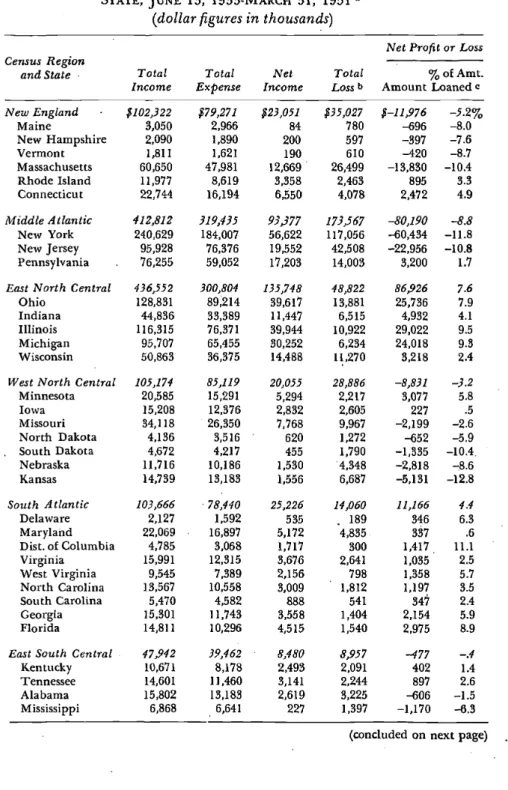
slightly over 0.4 percent o,f the amount of original loans plus ad-vances. As shown in Table 44, thirty-one states'and the District ofColumbia showed a the rest losses. 1flinois recorded the largest
net profit, $29 million, or 10 percent of the total advanced, while in Ohio the net prOfit was $26 million (8 percent). The largest net loss was $60 million (12 percent) in New York; the New Jersey net loss
13 There was a striking stability in the number of delinquent accounts, which
fluc-tuated close 'to 200,000 from June 1936 to June 1942. The percentage of outstanding
accounts that were delinquent increased, however, from 23 percent in June 1936 to 25 percent six years later. Even as late as December 1947, when economic conditions were highly prosperous, the percentage of accounts delinquent was about the same as in June 1936. The number of accounts in default did not fall below 50,000 from June 1936 until the summer of 1941, and in December 1947 totaled 10,562 accounts—3.3 percent of the total.
170 HISTORY AND POLICIES OF THE HOLC TABLE 43 — CAPITALIZATION AND LIQUIDATION OF
ERTY ACCOUNTS OF THE HOLC, JUNE 1951 a
(inthousands)
DEBTOR AND
PROP-13, 1933-MARCH 31,
ORIGINAL LOAN AMOUNT
Additions Advances Interest b Property charges Charges to reserve TOTAL CAPITALIZATION Realization Repayment of principal
Cash proceeds of property sales d Property credits $3,093,451 105,449 192,667 60,092 152,099 591 3,498,900 3,161,748 3,058,126 94,481 9,141 Losses Charged to Reserve
• Losses on property sales
Commissions and sales expense Principal and interest losses Property losses charged off. Discount on sale of loans
337,152 288,136 48,410 372 214 20 TOTAL LIQUIDATION 3,498,900
a Datamade available by the HOLC.
b Represents interest converted to principal ($6,731,000) and interest transferred to
property accounts ($53,361,000).
cIncludesmortgage loans and vendee accounts. d Net of commissions and sales expense of $48,410,000.
was $23 million (11 percent) and in neighboring Pennsylvania a
slight profit had been realized. The loss rate in New Hampshire and
Vermont was relatively high, about 8 percent, but the absolute
amount was not large, approximately $400,000 in each state; Kansas recorded a net loss of 13 percent.
SALE OF LOANS
By early 1943, the pressure to have the HOLC sell some or all of its mortgages to private lenders had become very strong.14 Many HOLC
loans were then of excellent quality. Roughly 462,500 of the loan
balances had been reduced to 70 percent or less of the original loan
14 The pressure appears to have come mainly from some savings and loan groups.
Little or no evidence has been found to suggest that insurance companies or banks
TABLE 44 —OPERATINGRESULTS OF THE HOLC, BY CENSUS REGION AND STATE, JUNE 13, 1933-MARcH 31, 1951 a
(dollar figures in thousands)
Census Region
and State Total
income ExpenseTotal incomeNet Loss bTotal
Net Profit or Loss
. %of Amt. Amount Loaned C New England p102,322 p79,271 p35,027 —5.2% Maine 3,050 2,966 84 780 —696 —8.0 New Hampshire 2,090 1,890 200 597 —897 —7.6 Vermont 1,811 1,621 190 610 —420 —8.7 Massachusetts 60,650 47,981 12,669 26,499 —13,830 —10.4 Rhode Island 11,977 8,619 3,358 2,463 895 3.3 Connecticut 22,744 16,194 6,550 4,078 2,472 4.9 Middle Atlantic 412,812 319,435 93,377 173,567 —80,190 —8.8 New York 240,629 184,007 56,622 117,056 —60,434 —11.8 New Jersey 95,928 76,376 19,552 42,508 —22,956 —10.8 Pennsylvania . 76,255 59,052 17,203 14,003 3,200 1.7
East North Central 436,552 300,804 135,748 48,822 86,926 7.6
Ohio 128,831 89214 39,617 13,881 25,736 7.9
Indiana 44,836 33,389 11,447 6,515 4,932 4.1
Illinois 116,315 76,371 39,944 10,922 29,022 9.5
Michigan 95,707 65,455 30,252 6,234 24,018 9.3
Wisconsin 50,863 36,375 14,488 11,270 3,218 2.4
West North Central 105,174 85,119 20,055 28,886 —8,831 —3.2
Minnesota 20,585 15,291 5,294 2,217 3,077 5.8 Iowa 15,208 12,376 2,832 2,605 227 .5 Missouri 34,118 26,350 7,768 9,967 —2,199 —2.6 North Dakota 4,136 3,516 620 1,272 —652 —5.9 South Dakota •4,672 4,217 455 1,790 —1,335 —10.4. Nebraska 11,716 10,186 1,530 4,348 —2,818 —8.6 Kansas 14,739 13,183 1,556 6,687 —5,131 —12.8 South Atlantic 103,666 78,440 25,226 14,060 11,166 4.4 Delaware 2,127 1,592 585 189 346 6.3 Maryland 22,069 16,897 5,172 4,835 337 .6 Dist. of Columbia 4,785 3,068 1,717 300 1,417 11.1 Virginia 15,991 12,315 3,676 2,641 1,035 2.5 West Virginia 9,545 7,389 2,156 798 1,358 5.7 North Carolina 13,567 10,558 3,009 1,812 1,197 3.5 South Carolina 5,470 4,582 888 541 347 2.4 Georgia 15,301 11,743 3,558 1,404 2,154 5.9 Florida 14,811 10,296 4,515 1,540 2,975 8.9
East South Central 17,912 39,462 8,480 8,957 —477 —.4
Kentucky 10,671 8,178 2,493 2,091 402 1.4
Tennessee 14,601 11,460 3,141 2,244 897 2.6
Alabama 15,802 13,183 2,619 3,225 —606 —1.5
Mississippi 6,868 6,641 227 1,397 —1,170 —6.3
172 HISTORY AND POLICIES OF THE HOLC TABLE 44 —(concluded)
Census Region
and State Total Total Net Total
IVet Pro
.
fit or Loss
% of Amt.
Income Expense Income Loss b Amount Loaned West South Central $90,898 $72,778 $18,120 $16,297 $1,823 .8%
Arkansas 7,881 7,108 773 1,320 —547 —2.6 Louisiana 17,560 13,379 4,181 2,377 1,804 4.1 Oklahoma 22,410 19,095 3,315 6,446 —3,131 —5.1 Texas 43,047 33,196 9,851 6,154 3,697 3.3 Mountain 37,691 30,107 7,584 4,775 2,809 2.8 Montana 2,749 2,505 244 329 - —85 —1.1 Idaho 3,355 2,713 642 354 288 3.2 Wyoming 2,139 1,643 496 95 401 7.0 Colorado 9,695 7,352 2,343 900 1,443 5.8 New Mexico 1,949 1,867 82 133 —51 —.9 Arizona 6,378 4,954 1,424 1,317 107 .6 Utah 10,254 8,092 2,162 1,580 582 2.1 Nevada 1,172 981 191 67 124 3.6 Pacific 78,964 58,453 20,511 7,599 .12,912 6.1 Washington 15,656 12,570 3,086 1,606 1,480 3.5 Oregon 7,446 5,642 1,804 753 1,051 5.2 Cali€ornia 55,862 40,241 15,621 5,240 10,381 7.0 United States d $1,417,098 $1,064,918 $352,180 $338,015 $14,165 .4%
a Data made available by the HOLC.
bIncludes losses on mortgage loans and vendee accounts, property accounts,
insur-ance accounts and other miscellaneous losses.
c Total amount loaned includes subsequent additions to original loan amounts and represents the total capitalized value of terminated accounts.
d Includes Hawaii and Puerto Rico.
amount, while another 132,900 had been paid down to between 70
and 80 percent of thçir original amount.15 Over 100,000 of the loans
were of the vendee type and were being paid on schedule. On the vendee loans, and probably also on most other properties securing
HOLC loans, the value of the security was greater at that time than the amounts due on the loans. Moreover, property values were rising in many areas, borrower incomes were generally high, default rates were low, and principal was being repaid steadily, and in some cases rapidly. Servicing costs had been markedly reduced; an interest rate of 41/2 percent was being obtained on loans of good quality, most of
15 U. S. Congress, Hearings before the Joint Committee on Reduction ot Nonessential
Federal Expenditures on the Reduction of Nonessential Federal Expenditures, 78th Congress, 1st Session (1943) Part 6, pp. 2214, 2221-23.
which had ten years or more, to run, and on its entire portfolio the
HOLC was earning a profit of about $1 million a month.
While private agencies were understandably attracted to the
HOLC's assets, the Corporation opposed the principle of transferring
its mortgages to private For one thing, its officers
nat-urally wanted to take advantage of the evident opportunity to liqui-date with a financial profit. Furthermore, there was a feeling that the transfer would prevent the taxpayer's recouping the losses accrued in earlier years, that mortgages would not be sold at a sufficiently high
price, and the possibility that the transfer might leave the HOLC
with only the least attractive assets, on which the eventual liquidation
experience might be very poor.17
The crucial question, in a sense, was the price private lenders were prepared to pay, but there were other and larger matters involved. Not the least was the question of the proper relationship between public and private institutions in the financial system, and whether an agency set up to aid private finance in time of economic depression
was justified in holding on to the assets so acquired until their final
liquidation in an improved economic climate. This question was raised directly or implicitly throughout the discussions. There was generally an acceptance of the principle that, other things being
equa'l, private facilities should be used in preference to government..
The fact that the government through the HOLC had materially
assisted the nation's financial institutions was pointed out, presum-ably with the inference that these institutions would be inconsistent
(and ungrateful) if they forced the HOLC to terminate its activities.
Institutions .that had accepted HOLC aid could not then cite basic
principle as an argument against the propriety of the HOLC's exist-ence. Or if they did, they should show why they had shifted position on principle.
16 Representative Dirksen of Illinois, a leading Congressional advocate of quick liquidation, reacted to Mr. Fahey's statement that no concrete plans for purchase of
HOLC assets had been proposed by circularizing financial institutions. The latter were
asked whether they were interested in taking over HOLC loans, paying par (that is,
the outstanding balance) and agreeing to maintain the 41/2 percent interest charge and other provisions of the HOLC contract. The response showed that there was an apparent
demand, extending even to all the loans in an area, good and bad. However, nothing
seems to have been said about possible solutions to many practical problems.
17 U. S. Congress, House, Hearings (Supplemental) before the Subcommittee of the Committee on Appropriations on the Independent Offices Appropriation Bill for 1915. 78th Congress, 2nd Session (1944) pp. 34-43.
1.74 HISTORY AND POLICIES OF THE HOLC The HOLC continually emphasized that it was liquidating, that its actions showed that it had no intention of perpetuating itself.
Moreover, it was not making new loans except in the case of sales of properties and only after private institutions had refused them, Loans had been made to borrowers as a matter of aid rather than as a purely financial transaction—creating a two-way commitment. The HOLC argued that the terms of the loan would probably become less favor-able to the borrower if the HOLC were forced to sell. Taxpayer aid to needy borrowers and assistance to financial institutions in distress
was one thing; taxpayer contribution to the profits of .such institu-tions was quite another matter.18 Savings and Loans, the monthly
publication of the United States Savings and Loan League, expressed the view that it was proper and acceptable for the government to take losses to help business in hard times, while turning the activity back to private ownership when operations became profitable; the
govern-ment should not try to minimize its losses by retaining profitable
accounts to help carry the costs of those that were unprofitable.'9 The
argument was also made that, if the HOLC were permitted to hold
on to its functions, a bad precedent would be set for the disposition of war plants financed by the government.
The controversy over the HOLC did little if anything to help re-solve the fundamental problem of the relative spheres of private and government activity. The great issues of principle were seldom exam-ined seriously and never exhaustively. For the economist one of the
main issues would be the prospects of effecting real economies by
the shift. The lOans held by the HOLC had to be serviced until their maturity—1961 at the latest. Could the servicing be performed with a
snIaller total of real resources by private financial institutions than
by the HOLC? An affirmative answer would provide an impressive
argument for shifting the loans from the HOLC to private
institu-tions. No evidence has been found to indicate that private institutions
18Thearguments as expressed in these two paragraphs are the author's expression of what he believes the spokesmen for the HOLC had in mind. Their statements were
less direct and explicit.
19See,for example, Ralph H. Cake, "The Future of Real Estate," Savings and Loans,
Vol. 18, No. 3 (March 1943) pp. 17-19; U. V. Wilcox, "Opportunity Knocks on Fahey's Door," idem, pp. 7 if.; A. L. M. Wiggins, "The Crossroads for Financial Institutions," Vol. 19, No. 1 (January 1944) pp. 4 if. (a more moderate position); U. V. Wilcox, "Washington in War Time," a monthly article, with several statements to this general
FINANCIAL LIQUIDATION OF THE HOLC
would have done the work more cheaply in terms of real resources.2°
On the other hand, there was an important real cost involved— that of transferring the loans. In many states institutions acquiring
the HOLC mortgages would have to have up-to-date appraisals; the
HOLC would have to prepare lists of its loans, provide data about loans, transfer the mortgage and the legal records, and familiarize
new persons with the HOLC cases. Borrowers would be troubled by
the uncertainty and occasionally embarrassed by the disclosure of
payment record.
The HOLC emphasized other practical problems. It had many
loans for which the value of the underlying collateral property was
too small to permit private institutions under state law to lend as
much as was still due the HOLC. This was especially true of loans on
properties which the HOLC had sold. A very large number of its
loans were too small to be attractive to private institutions (especially if an appraisal fee had to be paid in acquiring them). As a practical matter, it would be difficult to get competitive bidding for loans; the mechanics of providing the necessary information on loans and solic-iting bids would at best be clumsy. In many communities there might
be no bidders or only one; if the HOLC were forced to liquidate, it
might have to accept some absurdly low prices. The HOLC had loans
in towns where there were no local lenders, and in many more the
HOLC had so few loans that sale on a "package" basis would not be practicable. In such cases effective competition of lenders could not be expected, especially where the loans in small communities were themselves small. The purchase of foreclosed properties still owned
by the HOLC was not proposed; presumably, they were to be left
with the FIOLC for whatever might be salvaged. If the HOLC were
left with properties, or with loans private lenders did not want, it would have to maintain an organization and thus incur overhead
costs that would be high per loan or property. The circularization of data on the HOLC loans to potential buyers would enable the latter to get information to solicit refinancing of the good loans without any
20 By 1948 the HOLC had so routinized and mechanized its operations that its costs to the economy were probably more often lower than higher than they would have been in private institutions. One exception may be noted—institutions with unused capacity might have been able to add the servicing of some additional accounts with little or no
real cost; this possibility was not discussed, however, and the author has no way of judging its significance. Some borrowers might have found it more convenient and cheaper to make payment locally in cash rather than by mail to the HOLC. It was by
176 HISTORY AND POLICIES OF THE HOLC
obligation to take bad loans. Sale of its poorer loans at a discount would insure loss to the HOLC without giving any opportunity for recovery; if the loan were to be written down, the borrower should
get the benefit, not private lending institutions. Finally, Congress in
passing the Mead-Barry Act had deliberately forced the HOLC to
slow down the rate and extend the period of its own liquidation.
In any event, in 1943, the House of Representatives passed an amendment to the HOLC appropriation bill directing speedy
liqui-dation. The Senate substituted a provision, which the House eventu-ally accepted, directing the HOLC to prepare and present to Congress by February 1944 a plan for its liquidation.
The plan presented by the HOLC consisted of a recommendation that the liquidation policies already in practice be continued, and the
controversy was renewed. In reply to representations that private
financial agencies were prepared to buy loans at par, the HOLC re-plied that a higher price was justified and that borrowers should be protected.
After considerable discussion, Congress decided against directing prompt liquidation, apparently convinced of the Corporation's deter-mination to liquidate on what it regarded as an orderly basis. By the spring of 1944, the HOLC held only 10,000 properties, slightly less than one-third of the number held a year earlier,2' and sales were be-ing pressed. Furthermore, the Corporation was encouragbe-ing borrow-ers to speed up loan repayments, and balances were declining even
more rapidly than scheduled. Finally, the Corporation was at that time earning an operating profit.22 For several years the issue was
dormant.
The HOLC continued to urge borrowers to repay their loans as rapidly as possible. It permitted repayment without penalty, even when funds were obtained through refinancing with other
institu-tions. Up to the end of 1947, the Corporation opposed the direct sale
of active loans to financial institutions. About that time, and following the retirement of Mr. Fahey, who had opposed the sale of loans, the Home Loan Bank Board decided to expedite the HOLC's liquidation both through more intensive urging of borrowers to
pre-pay their loans and through the sale of active balances to private
21TheHOLC had increased its efforts to sell quickly the properties still on hand, a
large fraction of which were in the New York City area.
22Oneblock of loans—those in Hawaii—was sold in 1944 to local savings and loan
financing agencies. There was no Congressional directive to hasten liquidation, but members of the key committees encouraged the ac-tion informally, and appropriaac-tions made specific provision of funds for liquidation operations.
The program of selling loans was changed somewhat after its initiation in the spring of 1948, but not in its main features. Sales operations have been largely on a state-by-state basis. The initial
efforts were concentrated on the sale of loans in states in which only a few loans were outstanding, but there was some geographical
selec-tion also, an effort being made to sell loans in the West and in the
upper New England areas, presumably to effect economies of
opera-tion. Next, the sales effort was concentrated on loans in the New York
region, which had the largest total loan balances, followed rapidly-by efforts in other large states.
After a state in which loans were to be sold had been selected, all borrowers were so notified by mail and told that they might repay the balance still, due or, if they wished, arrange new private financing.23 They were also informed that the interest rate on the loan would not be raised by anyone to whom the HOLC sold it, nor would other
fea-tures, such as the amortization period or prepayment without
pen-alty, be changed. Financial institutions were informed of the number
and amount of loans involved, by counties, and asked if they were
interested in buying loans. Later, this procedure was replaced by one merely involving public notice calling for bids. The general terms of
sale set by the HOLC as of August 1949 were: (1) that assignment was made without recourse to the HOLC, (2) that assignment was
subject to the right to discharge the indebtedness of the mortgagors
with bonds of the HOLC at their face value (the amounts involved are very small), and (3) that the assignee should not demand, or be
entitled to collect, interest on the assigned amount at an annual rate
in excess of 41/2 percent.
A few weeks were allowed for borrowers to arrange refinancing
and for institutions to discuss the problem with the HOLC,24 and
23Someborrowers objected to the sale of the loan by the HOLC, but they had no legal recourse.
24During this period, some private institutions took the initiative in trying to get
the HOLC borrowers to refinance with them. In this way, the lender got only the best
loans, could loan larger amounts than were owed to the HOLC, and avoided "red tape"
involved in the purchase of loans from the HOLC. The HOLC did not furnish a list
of its borrowers when circularizing institutions, but public records showed properties on
178 HISTORY AND POLICIES OF THE HOLC
then detailed negotiations were undertaken with those institutions
that indicated a desire to buy loans.25 A high proportion of sales were made to savings and loan associations and banks; life insurance com-panies, though often expressing an interest in buying loans, bought
very few (Table 45). Typically, where more than one institution indicated a desire to purchase loans, those available were divided equally or to the limits desired by particular institutions.
As was expected, many institutions were reluctant to purchase loans on properties outside of their immediate communities,
espe-cially when the loan balances were small. The HOLC insisted,
however, that all the loans in a general area, ordinarily consisting of the entire state, be taken as a single unit, or as parts of a single unit, regardless of the size of the loan balances. At one time, field teams were sent to try to sell accounts locally where there was no buyer for an entire state portfolio. The expense of this kind of sale seemed un-justifiably high, and it was discontinued.
In a few states the purchasing institution or group sold the ac-counts in areas where they did not want to try to provide servicing facilities; where the request was made of it, the HOLC arranged to
make separate physical delivery of accounts. Purchasers were not
al-ways institutions, in the same state. One large Pennsylvania bank bought the Connecticut and Michigan loans and contracted with
others to service the accounts; the servicjng companies in both cases had some former HOLC employees in key positions, makIng
conti-nuity of servicing policy easier to obtain.
Except for states with very few loans, the actual process of trans-ferring a batch of loans took several weeks or months. The entire file
except the HOLC ledger card was sent to the purchaser of the
ac-count. As it gained experience, the HOLC found that transfers could be completed more quickly than it had originally estimated. The last account was transferred in March 1951.
The loss to the government on this sale of assets is difficult to
estimate. The two most important variables—future operating costs, 25 Accounts were sold for par or more everywhere but in Maine and Puerto Rico.
There were only about 45 accounts left in Maine and these were small, widely scattered, and costly to service. In Puerto Rico, the 41/2percentinterest rate was not attractive to
local lenders, and continental lenders wanted compensation for anticipated disadvan-tages of offshore lending. The attractiveness of accounts varied from state to state; in
some states instalment (vendee) accounts were less attractive than in others because of
the local custom of providing the buyer of the property with an abstract or title
FINANCIAL LIQUIDATION OF THE HOLC 179
TABLE 45 —NUMBERAND PRINCIPAL BALANCE OF MORTGAGES ASSIGNED
IN HOLC LIQUIDATION PROGRAM, BY TYPE OF ASSIGNEE AND STATE, AS OF MARCH 31, 1951 a
(dollarfigures in thousands) Census
and RegionState
Insurance Cog. Savings and LoanAssociations Banks No. of
Loans PrincipalBalance No. ofLoans PrincipalBalance No. ofLoans PrincipalBalance
New England 45 $45 .. .. 11,010 $22,726 Maine 45 45 .. NewHampshire .. .. .. Vermont .. .. .. Massachusetts .. .. . .. .. 7,323 15,073 Rhode Island .. .. .. .. 1,331 2,517 Connecticut .. ,. .. .. 2,356 5,136 Middle Atlantic .. .. 10,709 $13,366 48,712 118,007 New York .. .. .. .. 36,617 92,140 New Jersey .. .. .. .. 12,095 25,867 Pennsylvania .. .. 10,709 13,366
East North Central 3,519 3,073 23,200 37,043 8,477 11,917
Ohio .. .. 9,099 11,648
Indiana 8,519 8,078 ..
Illinois .. .. 9,634 18,351
Michigan .. .. .. .. 8,477 11,917
Wisconsin .. .. 4,467 7,044
West North Central 1,932 2,038 5,794 5,072 3,628 4,403
Minnesota 1,932 2,038 .. Iowa .. .. 1,722 1,488 Missouri .. .. .. .. 3,628 4,403 North Dakota .. .. .. South Dakota .. .. 81 72 Nebraska .. 1,773 1,614 Kansas .. .. 2,218 1,898 South Atlantic 1,835 2,080 2,966 3591 3,699 4,695 Delaware .. .. .. Maryland .. .. .. .. 2,087 2,872 Dist. of Columbia .. .. .. Virginia .. — .. 1,386 1,573 West Virginia .. .. .. North Carolina .. .. 1,630 2,018 South Carolina .. .. Georgia 1,835 2,080 .. Florida .. .. .. .. 1,612 1,823
East South Central 3,187 3,379 2,714 3,046
Kentucky .. .. 1,028 1,384
Tennessee .. .. 1,686 1,712
Alabama 2,528 2,732
Mississippi 659 647
180 HISTORY AND POLICIES OF THE HOLC TABLE 45 — (concluded)
Census Region and State
.
Insurance Cos. Savings and LoanAssociations Banks No. of Loans -. . Principal Balance . No. of Principal
Loans Balance No. ofLoans
.
Principal
Balance
West South Central
Arkansas 5,521688 $5,136624 .1,900.. $1,685.. .. . .. .. .. Louisiana Oklahoma Texas 1,357 .. 3,476 1,688. .. 2,824 .. .. 1,900 1,685 .. .. .. .. .. .. .. .. Mountain 422 460 .. .. . .. .. Montana .. .. .. .. .. .. Idaho .. .. .. .. .. . .. Wyoming Colorado New Mexico .. 422 .. .. 460 .. .. .. .. . .. .. .. .. .. .. .. .. .. Arizona .. .. .. .. .. .. Utah .. .. .. .. .. .. Nevada .. .. .. . .. .. .. Pacific Washington Oregon California .. .. .. S .. .. . .. .. 3,316 .. .. .. .. 2,489 3,316 .. .. .. .. . .. .. .. United Statesb 16,571 $16,362 49,772 $67,119 75,526 $161,748
a Datamade available by the HOLC.
bIncludes principal balance of $151,000 on 110 loans outstanding in Puerto Rico
assigned to insurance companies.
including the rate of interest paid. on borrowed funds, and the
amount by which.,loans would be reduced if they were not sold
out-right—are both unknown. Ignoring the costs of the transfer,26 an average annual loss of profit of about $5 million for at least a few
years was estimated, by the HOLC. In terms of total lifetime FIOLC
profit or loss, the total loss from the sale of loans may be very large.
In some cases, buyers appraised the properties, but the speed with which they generally took over the, accounts suggests that in many
cases no appraisals were made or, at best, very hurried appraisals.
The HOLC estimated that at the time of sale the average loan balance was from 20 to 25 percent of the current market price.
26Someof these costs had to be met eventually when the loan was paid off. A large
part of the $5 average cost of transferring a loan, therefore, was an anticipation of an
SETTLEMENT OF NONMORTGAGE
LENDING ACTIVITIES
Supplementary activities of the HOLC need brief comment even
though they do not bear directly upon mortgage lending experience. To help savings and loan institutions,.under the terms of the original statute as amended, the HOLC purchased a total of $223.9 million of shares in insured federal and state savings and loan institutions. On this operation the HOLC received $45 million in dividends, almost
exactly what the funds cost. No appreciable addition to operating costs was involved. Therefore, the net result as far as the financial
out-come of the Corporation's activities is concerned was nearly zero. The HOLC also advanced $100 million of its 3 percent bonds to the Federal Savings and Loan Insurance Corporation. A final settle-ment of this account was made late in 1948. The HOLC received $25 million from the FSLIC. The actual cost of bonds to the HOLC was roughly $34 million. By an act of Congress it was decided, however,
that the FSLIC should pay the HOLC the amount that represented
the average cost of borrowed funds to the HOLC, not the cost of the funds specifically advanced to the FSLIC; moreover, interest was not compounded, although, of course, the HOLC had paid for its funds