SPECIAL COURSE FOR
DEVELOPMENT POLICY
(MASTER’S COURSE)
Enrollment for the academic year
beginning in October 2016
Graduate School of
International Cooperation Studies
(GSICS)
1
1. Overview and Number of Students Admitted
Our master’s program has a dual structure; the Japanese program starts in April and the English program (i.e., Special Course for Development Policy) starts in October. Accordingly, we have two enrollment periods: April and October. For a single academic year (from April to March), a total of 70 students are admitted. Generally the October admissions account for one-third to one-half of incoming students.
2. Study Requirements and Degrees Granted
Most students require two years to meet the degree requirements, but exceptional students may only need one year. The following requirements must be met: earn at least 30 credits (those who understand Japanese can take up to 12 credits from the subjects offered in the GSICS Program in Japanese), complete a master's thesis in English, and pass a final
interview
. Students who successfully complete these requirements are granted one of the following degrees: Master of International Studies, Master of Economics, Master of Laws, or Master of Political Science.3. Eligibility for General Admission
Only applicants who are not of Japanese nationality and can obtain a student visa for enrollment may apply to the Special Course for Development Policy. There are three categories of eligible applicants:
(a) Those who have or will have completed an undergraduate program in Japan by September 30, 2016.
(b) Those who have or will have complete 16 years of education outside Japan by September 30, 2016.
(c) Those who are at least 22 years of age by October 1, 2016 and are recognized as possessing an academically ability suitable for graduate studies by GSICS.
N.B.
Applicants in the eligibility category 3(c) above must contact the GSICS Academic Affairs Office about their eligibility by January 14, 2016. All inquiries must be accompanied with the following documents: curriculum vitae, official transcript from the last university attended (if any), and an explanation of the reasons for applying, including additional supporting evidence of eligibility.
4. Eligibility for Special Admission
Applicants must satisfy the requirements for general admission. However, those who apply in accordance with the double degree programs established by GSICS or those who have been
2
granted a scholarship from the following programs are eligible for special admission. (See section 6 (6).)
Japanese Grant Aid for Human Resource Development Scholarship (JDS)
Indonesia Professional Human Resources Development Program IV (PHRDP-4, Linkage Program)
ADB-Japan Scholarship Program (ADB-JSP)
5. Other Requirements
Applicants must satisfy the following requirements:
(1) Health: Applicants must be physically and mentally fit.
(2) English proficiency: Applicants must possess a sufficient command of English for graduate studies. Applicants from undergraduate programs not conducted in English are strongly encouraged to submit their official TOEFL or IELTS scores.
(3) Accepted applicants must appear at the GSICS Academic Affairs Office no later than October 4, 2016 (i.e., before classes begin in the fall semester).
N.B.
Admission may be revoked:
(1) If accepted applicants are not in Japan by the date specified above in 5(3) (2) If accepted applicants fail to graduate from a university by September 30, 2016.
6. Application Documents
The following documents must be submitted: (1) Application form (form enclosed)
A recent (within the last three months) photograph (4.5 cm×3.5 cm) must be glued to the completed application form.
(2) Official or certified copy a bachelor’s degree diploma
Applicants who have not yet graduated must provide an official letter from the university in which they are currently enrolled affirming the applicant's expected graduation and degree conferment by September 30, 2016.
(3) Official or certified copy of transcript/certificate of undergraduate studies. (4) Research proposal (form enclosed)
(5) Letter of recommendation (form enclosed)
An original letter must be submitted; copies, in any form, are unacceptable. The letter should be from a person familiar with the applicant’s academic work and English ability. (6) Letter of consent (form enclosed)
A letter of consent must be obtained from a prospective academic advisor.
* Refer to Table A for a complete list of the GSICS teaching staff along with the type of degrees students can apply for under their supervision.
3
* This document is not required for those applying for special admission under the eligibility specified in Section 4.
(7) Application fee: 30,000 yen (fee subject to change)
* After obtaining a letter of consent, please inquire about payment methods at the GSICS Academic Affairs Office.
* After completing the monetary transfer, attach a photocopy of the bank transfer receipt or transfer slip to the application form. Payment of bank transfer fees (if any) is the responsibility of the applicant.
(8) Photocopy of the passport biographical information page
* Applicants residing in Japan must also submit a photocopy of their residence card.. * Applicants without a passport at the time of application may submit a photocopy of a
citizenship certificate instead.
(9) Official TOEFL or IELTS score report (if available). TOEFL
Submit a copy of the “Examinee’s Score Record” Request that ETS forward an “Official Score Report” to GSICS to be received by April 8, 2016. (DI Code:3341 Department Code: 80)
IELTS
Submit a photocopy of the “Test Report Form” . Request that the testing center forward an original “Test Report Form” to GSICS to be received by April 8, 2016.
(10) Applicants who wish to apply for the Joint Japan World Bank Graduate Scholarship must to contact the Academic Affairs Office for its application procedure.
N.B.
The application and all enclosed materials, including those that arrive at GSICS after the deadline, become the property of GSICS and will not be returned. For applicants who have or will have graduated from a university in China, application documents (2) and (3) must be submitted through the verification service provided by the China Academic Degrees and Graduate Education Development Center (CDGDC). Chinese applicants must apply online at http://www.cdgdc.edu.cn. Application documents (2) and (3) must be verified by CDGDC and sent directly from CDGDC to Kobe University, Graduate School of International Cooperation Studies (CDGDC Registration Code: W600506).
7. Application Deadline
All application documents must be submitted as a single packet to the GSICS Academic Affairs Office by registered mail. (Write “application forms enclosed” in red on the front of the envelope.) Application documents must be received by GSICS between April 1, 2016 and April 8, 2016.
8. Admission Process and Results
4
official letter of the application results will be sent by post and posted on the official GSICS website. No telephone inquiries will be accepted.
9. Registration
(1) All necessary documents for registration and the enrollment procedures will be mailed to successful applicants along with the notification of the application result.
(2) The fall semester begins on October 1, 2016. All entering students must obtain a student visa and register in person at the GSICS Academic Affairs Office between October 3, 2016 and October 4, 2016.
(3) Fees (fee subject to change): Entrance fee: 282,000 yen.
Tuition fee: 535,800 yen/year (267,900 yen/semester).
10. Additional Information
(1) Application documents cannot be altered after submission. (2) The application fee is non-refundable.
(3) To obtain a letter of consent, applicants for general admission are advised to contact a prospective academic advisor well in advance.
(4) Financial support, including scholarships and accommodations for international students, is not guaranteed. Applicants should make separate arrangements.
For further inquiries, please contact the GSICS Academic Affairs Office.
Graduate School of International Cooperation Studies Kobe University
2-1 Rokkodai-cho, Nada-ku, Kobe 657-8501 JAPAN Phone: +81-78-803-7267
Fax: +81-78-803-7297
URL: http://www.gsics.kobe-u.ac.jp/
11. Preventative Measures Against Infectious Diseases Such As Measles and Rubella
To prevent a possible outbreak of Measles and Rubella on campus, Kobe University requires all applicants to submit one of the following three certificates
① Vaccination Certificate for measles and rubella vaccines (or combined vaccine including measles and rubella vaccines, for example, MR vaccine) that proves you were
immunized twice in your life. The Certificate must be issued by an accredited medical institution and state the type of vaccine and the date of inoculation.
② Vaccination Certificate for measles and rubella vaccines (or combined vaccine including measles and rubella vaccines, for example, MR vaccine) that proves you were
5
medical institution and state the type of vaccine and the date of inoculation.
③ Antibody Certificate verifying that you have sufficient antibody titer in your blood to prevent development of measles and rubella, based on the results of an antibody test performed within the last five years. The Certificate must be issued by an accredited medical institution and state the measuring method and the measured values.
Students entering in October must submit one of the above at the routine medical check-up scheduled in mid-October.
The Measuring Methods and Judging Standards of Protective Antibody Value
Measuring Method Judging Standard Remarks
Measles
IgG-EIA method 8.0≦
*(16.0≦)
Positive result by one of these three methods:
* School of Medicine (Faculty of Medicine and Faculty of Health Sciences) and Graduate Schools of Medicine and Health Sciences require values that are higher than bracketed values.
PA method 128≦
*(256≦) NT method *(84≦≦)
Rubella HI method 32≦
The protective antibody value differs according to the measuring method used. Please note that the judging standards are higher than the usual standards considered to be positive.
If your antibody titer level is below these values, please take the required vaccination and submit the Vaccination Certificate. If the antibody titer level is below the requirement yet you cannot be inoculated with one of the vaccines listed above for any reason, please present the document (for example, a certificate issued by the doctor) to explain why.
Please ask the doctor to issue you a necessary certificate by showing him/her this notice.
※When going to a medical institution in Japan, please ask the doctor to issue you a necessary
certificate by showing him/her the Japanese version of this notice.
※Please bring the original certificate and an A4-size copy with you when submitting.
Inquiries:
Medical Center for Student Health Phone:+81-78-803-5245 Student Welfare Division, Student Welfare Department Phone:+81-78-803-5219
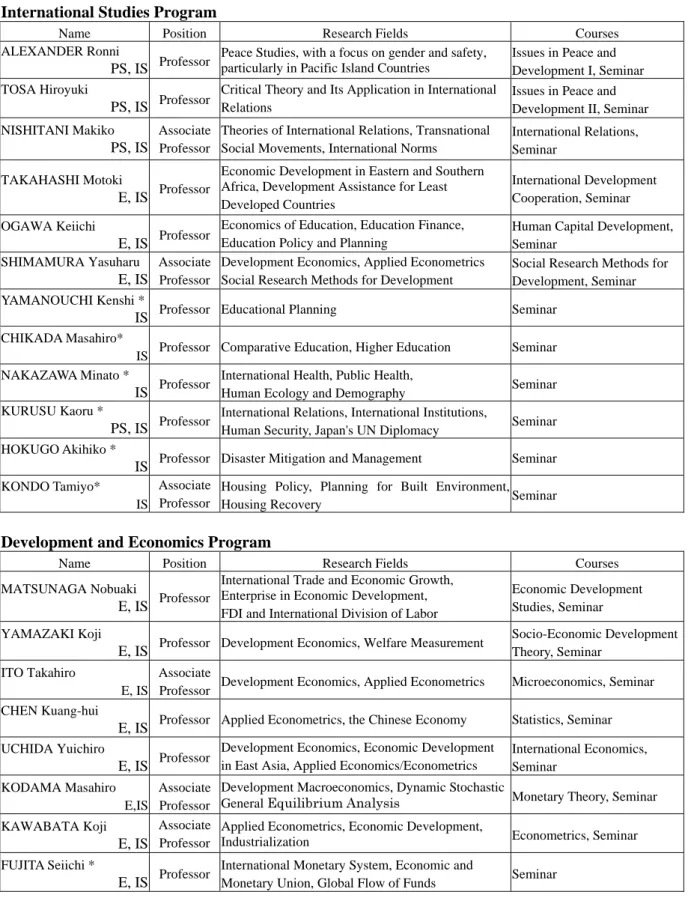
Table A: List of Teaching Staff
Abbreviations under each name are the degrees students can apply for under the supervision of that person.
E: Master of Economics, Doctor of Philosophy in Economics
IS: Master of International Studies, Doctor of Philosophy
L: Master of Laws, Doctor of Laws
PS: Master of Political Science, Doctor of Philosophy in Political Science
Faculty members whose names are followed by an asterisk (*) have their primary appointment in other faculties of Kobe University, and may only accept a limited number of students.
International Studies Program
Name Position Research Fields Courses
ALEXANDER Ronni
PS, IS Professor
Peace Studies, with a focus on gender and safety, particularly in Pacific Island Countries
Issues in Peace and Development I, Seminar TOSA Hiroyuki
PS, IS Professor
Critical Theory and Its Application in International Relations
Issues in Peace and Development II, Seminar NISHITANI Makiko
PS, IS
Associate Professor
Theories of International Relations, Transnational Social Movements, International Norms
International Relations, Seminar
TAKAHASHI Motoki
E, IS Professor
Economic Development in Eastern and Southern Africa, Development Assistance for Least Developed Countries
International Development Cooperation, Seminar OGAWA Keiichi
E, IS Professor
Economics of Education, Education Finance, Education Policy and Planning
Human Capital Development, Seminar
SHIMAMURA Yasuharu
E, IS
Associate Professor
Development Economics, Applied Econometrics Social Research Methods for Development
Social Research Methods for Development, Seminar YAMANOUCHI Kenshi *
IS Professor Educational Planning Seminar
CHIKADA Masahiro*
IS Professor Comparative Education, Higher Education Seminar NAKAZAWA Minato *
IS Professor
International Health, Public Health,
Human Ecology and Demography Seminar
KURUSU Kaoru *
PS, IS Professor
International Relations, International Institutions, Human Security, Japan's UN Diplomacy Seminar HOKUGO Akihiko *
IS Professor Disaster Mitigation and Management Seminar
KONDO Tamiyo* IS
Associate Professor
Housing Policy, Planning for Built Environment,
Housing Recovery Seminar
Development and Economics Program
Name Position Research Fields Courses
MATSUNAGA Nobuaki
E, IS Professor
International Trade and Economic Growth, Enterprise in Economic Development, FDI and International Division of Labor
Economic Development Studies, Seminar YAMAZAKI Koji
E, IS Professor Development Economics, Welfare Measurement
Socio-Economic Development Theory, Seminar
ITO Takahiro
E, IS
Associate
Professor Development Economics, Applied Econometrics Microeconomics, Seminar CHEN Kuang-hui
E, IS Professor Applied Econometrics, the Chinese Economy Statistics, Seminar
UCHIDA Yuichiro
E, IS Professor
Development Economics, Economic Development in East Asia, Applied Economics/Econometrics
International Economics, Seminar KODAMA Masahiro E,IS Associate Professor
Development Macroeconomics, Dynamic Stochastic
General Equilibrium Analysis Monetary Theory, Seminar
KAWABATA Koji
E, IS
Associate Professor
Applied Econometrics, Economic Development,
Industrialization Econometrics, Seminar
FUJITA Seiichi *
E, IS Professor
International Monetary System, Economic and
ZHAO Laixun *
E, IS Professor
International Trade, Foreign Investment, Multinational Labor-Management Relations, Cross-Border Pollution, International Merger
Seminar KATO Hiroyuki *
E, IS Professor Chinese Economy, Comparative Economic Systems Seminar
YOSHII Masahiko *
E, IS Professor
Comparative Economics, Russian and Central and
Eastern European Economies Seminar
HAMAGUCHI Nobuaki *
E, IS Professor Latin American Economy Seminar
SATO Takahiro*
E, IS Professor Indian Economy Seminar
YANAGAWA Takashi *
E, IS Professor Industrial Organization, Competition Policy Seminar
International Law /Law and Development Program
Name Position Research Fields Courses
SHIBATA Akiho
L, IS Professor International Law
International Environmental Law, Seminar
HAYASHI Mika
L, IS Professor International Law
International Cooperation Law, Seminar
OKADA Yohei
L, IS
Associate
Professor International Law
Law of International Organizations, Seminar YOTSUMOTO Kenji
L, IS Professor Asian Constitutional Law
Law and State Building, Seminar
KANEKO Yuka
L, IS Professor
Law and Development, Comparative Law in Asia, Economic Law
Law and Economic Development, Seminar SAITO Yoshihisa
L, IS
Associate
Professor Social Law in Asia and Transition Economies
Law and Social Development, Seminar
Political Science and Area Studies Program
Name Position Research Fields Courses
MATSUNAMI Jun
PS, IS Professor
Comparative Study of Deregulation, Privatization and Local Governments
Japanese Politics,
Local Government, Seminar KIMURA Kan
PS, IS Professor
Korean Nationalism and Historical Disputes in
Northeast Asia Comparative Politics, Seminar
TAKAHASHI Yuriko PS, IS
Associate
Professor Comparative Politics (Latin America)
Political Development, Seminar
MINOHARA Toshihiro *
PS, IS Professor
US-Japan Relations, Diplomacy, International