Advancing Studio Knowledge through Virtual
Interdisciplinary and Transdisciplinary
Collaborations
David GOLDBERG1 and Barry KEW1 1Pennsylvania State University, Pennsylvania/United States · [email protected]
Abstract
The practical knowledge for landscape architects, architects, engineers, and planners today is increasingly broadening. Designers are being challenged to better understand ecology, geotechnics, hydrology, economics, politics, traffic, building systems, structure, geography, and other areas of expertise before developing their design solutions. Henceforth, all complex design projects require some level of collaboration with experts. As educators our challenge is to provide this expert knowledge in our design studios, not from our own reflective practice, but from outside collaborators. With many expert collaborators located distantly from the university, virtual collaboration technologies are essential in bringing this knowledge into the studio. This paper discusses the strategy of two landscape architecture design studio courses that utilize web conferencing technology to advance studio know-ledge through virtual interdisciplinary and transdisciplinary collaborations with expert scientists, allied students, and experienced practitioners.
1 Introduction
1.1 Studio Knowledge
Design studios are essential experiences in the education of students in architecture and landscape architecture (SALAMA 1995). Such courses allow students to develop and refine
their design abilities in large part by doing, with course instructors correcting them at key points along the way as students seek to develop imaginative, beneficial, and well functioning end products (LAWSON 2005). The approach used in design studios generally is to present students with problems encountered in the real world – often wicked problems whose complexity and multiple possible solutions present considerable challenges (BELASSIANO 2012). This allows students to explore solutions, encounter failures, and propose resolutions. This approach is formally recognized as problem-based learning (PBL) in the fields of medicine, engineering, education, science, and mathematics. The essence of PBL is allowing students to develop their own learning by seeking the necessary knowledge from a variety of resources to solve a particular problem. Students need to engage in a search for solutions, learning not only the facts of the situation and the solutions but also the process (KVAN 2003). Studio instructors do not teach students a fixed body of know-ledge; instead, they help students to master techniques of problem solving and habits of learning (HURLEY-KURTZ 2003). To obtain this knowledge, students query literature at the
Wissen Hayek, U., Fricker, P. & Buhmann, E. (Eds.) (2014): Peer Reviewed Proceedings of Digital Landscape Architecture 2014 at ETH Zurich. © Herbert Wichmann Verlag, VDE VERLAG GMBH, Berlin/Offenbach. ISBN 978-3-87907-530-0.
University’s interdisciplinary libraries, query the Internet (i.e., “Google it”), seek guidance from instructors, refer to classmates, or consult with outside experts in the field.
Many upper level design studios also follow a peer-reviewed process in addition to having a PBL structure. This entails the students’ design solutions being openly reviewed by outside clients, practitioners, and/or other experts who are engaged in the real-world project. Such courses have many benefits. They provide opportunities, to varying degrees, to engage individuals associated with a particular locality; essentially, experience in dealing with clients who can provide initial guidance on design efforts and feedback throughout the design process where they have both an interest in, and a knowledge of, a particular location slated for a design exercise (BALASSIANO & WEST 2013).
1.2 Studio Collaborations
Collaboration occurs at multiple levels, dimensions, and scales in landscape architectural studios. These collaborations include monodisciplinary, interdisciplinary, and transdiscipl-inary teaming. Most studio teaming is monodiscipltransdiscipl-inary where students are teamed with peers within the landscape architecture discipline. In this collaboration students internalize the problems and seek knowledge to shape their designs through individual research. In an interdisciplinary collaboration, students are teamed with students of different disciplines where the methods and assumptions for a project are collectively shared, but the knowledge and skills of distinct individual disciplines shape the final designs. In transdisciplinary collaborations, students of different academic disciplines work jointly with practitioners to solve real-world problems (KLEIN 2001). In this collaboration the disciplinary boundaries for the participants are dissolved as they work within the same framework or method. In selecting projects for studio collaborations instructors carefully select projects that are rigorous in scope and are situated in a locale with particular characteristics and challenges. Unfortunately, they often identify projects that are located at some distance from where a studio is taught, introducing logistical problems that potentially undercut many of the benefits studios can have and the access to expert knowledge. To mitigate the distance from the academic institution to where the project is located, studios are leveraging online conferencing tools to virtualize many of these important collaborations.
1.3 Virtual Studios
Virtualizing the studio is not a novel approach to design education. Academicians and practitioners have studied and applied the capabilities of online telecommunication tools to host a variety of studio collaborations (KVAN et. al. 2001; BUHMANN & HEINS 2004; FETZER & KAISER 2011). These collaborations occur in a number of formats including campus-to-campus, university-to-university, firm-to-firm, firm-to-community, or univer-sity-to-community. They also reach across countries, continents, and time zones to col-laborate on a single or multiple projects. Furthermore, the tools are becoming more per-vasive and less specialized or proprietary, allowing anyone with a computer and Internet access to utilize them.
2
Studio Case Studies
This paper describes two landscape architecture design studios at Penn State University where virtual collaboration tools were utilized to mitigate dispersed project locations and to foster collaborations with clients, practitioners, and scientists in order to advance the knowledge sharing amongst teams. The two studios are the Baltimore Ecosystem Study Studio (BESS) and the Interdisciplinary Collaborative Design Studio (ICDS). The BESS seeks design solutions from transdisciplinary collaborations. The ICDS develops new building and landscape designs through an interdisciplinary collaboration of allied students and transdisciplinary collaborations with practitioners working on the real project.
2.1 The Baltimore Urban Design Studio
2.1.1 Studio Overview
Two years ago, the Department of Landscape Architecture at Penn State University identified Baltimore, Maryland, as a location for an advanced studio on urban design. In contrast to the small town in rural central Pennsylvania where Penn State is located, Baltimore is a city that provides fundamental challenges in urban design. Moreover, Baltimore is a shrinking city, an urban locale that is losing population, primarily through emigration to more distant locations on the outskirts of the city and beyond. One of the main attractions to Baltimore is that it is particularly well known thanks to the Baltimore Ecosystem Study (BES), a multidisciplinary investigation of urban ecology that has been underway for more than a decade. As a result of BES research, Baltimore is ecologically one of the best-known urban places on Earth. Combining this remarkably well-developed ecological understanding with continued loss of population yields an urban setting that shares important developmental characteristics with other shrinking cities, amid a remarkably rich database and refined understanding of ecological conditions.
2.1.2 Collaborations
The BESS faced two challenges: the development of a realistic experience, in which students engaged clients and actual design settings; and the integration of scientific understanding on the urban ecology of Baltimore with the design process. The BES is one of two projects in the Long-Term Ecological Research network located in an urban setting, providing an opportunity to integrate urban ecological research, outreach, and education in a diachronic perspective (PICKETT et al. 2010). An accomplishment has been continued outreach to the public, including Baltimore City government, in an attempt both to educate others about the ecology of Baltimore (and why it is important) and to encourage the appli-cation of BES results to help guide human actions and, ultimately, improve the human condition in the city.
The BESS Studio provided an opportunity to expose students to urban design problems for two main reasons. One is that in focusing on Baltimore it dealt with a shrinking city. Shrinking cities occur in several locations in the United States, primarily in the former manufacturing belt in the Northeast and Midwest (HOLLANDER et al. 2009), as well as in parts of Europe. In contrast to cities that are maintaining their populations or growing, where nearly all structures are occupied and all lots committed to a use, shrinking cities present opportunities to introduce a broad range of solutions that address a range of human
problems, a range of natural environmental problems, or both (HAASE 2008). The second reason that Baltimore is a good choice for an urban design studio is that more than a decade of research by the BES team has generated a considerable amount of data on the city. The two collaborators for the studio are the Baltimore Office of Sustainability (BOS) and the BES team. The BES team consists of nearly 50 principal investigators and dozens more collaborators, with a broad range of expertise. Their considerable expertise on the urban ecology of Baltimore, including issues associated with the biological, physical, and social components of the city, places them in an excellent position to comment on aspects of student designs related to ecology.
In order to take full advantage of the design setting, students need personal exposure to the site and experts, a requirement complicated by their distance from Penn State. Strategically scheduled web conferences enabling the transmission of interim designs, student presen-tations of selected design components, receipt of comments from reviewers, and two-way discussions, provided frequent access to experts from the BOS and the BES team.
Within this studio design initiative, input exchange included first-hand exposure to the inner-city community and was intensely supplemented with the research scientists and city planners by web conferencing. Regularly scheduled web conferences for design updates were conducted and resulted in constructive dialogue between collaborators.
2.1.3 Enabling Technologies
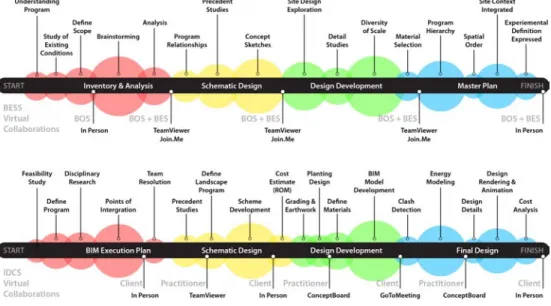
The BESS utilized two virtual conferencing applications to mitigate their distance from the project site and expert knowledge. These applications were “Join.Me” and “TeamViewer.” Join.Me (https://join.me/) is an online meeting software application that allows screen sharing, instant messaging, and VoiceIP services. While the interface is highly intuitive, which is perfect for community participation, Join.Me can only host up to ten participants in a meeting. TeamViewer (https://teamviewer.com) is a more robust online meeting software application that includes everything Join.Me offers, plus the capability for white boarding, and remote access to studio computers (Figure 1).
Synchronic collaborations were managed using either Join.me or TeamViewer on laptops with built-in web cameras. These virtual collaboration tools enabled student presentations as well as partner commentary ‒ in essence, two-way communication that replicated as much as possible the experience of meeting clients face-to-face while benefiting from the combination of self learning and group-learning, some of the strongest features of distance learning (MOORE & KEARSLEY 1996).
2.1.4 Results
In the BESS, the availability of large ecological datasets coupled with advanced understanding of Baltimore’s urban ecology placed much greater demands on students to integrate technical information. This is consistent with observations that virtual technologies can help bridge disciplinary boundaries (DE FREITAS & VELETSIANOS 2010). Through establishing communication between students and collaborators, this studio not only addressed challenges of distance learning but actually enhanced the student experience through structured information exchange (LAWSON 2005) – video and audio components of
web conferences enabled BOS staff and BES team members to evaluate selected aspects of the design and ecological content of projects being prepared by student designers.
Design students can respond to newly formed scientific understanding by transferring this information from their left side of the brain (analytical side) to their right side of the brain (creative side). Scientists are able to conceptualize newly formed perspective of landscape generated by these design students, which allows these scientists to re-think relationships of urban ecology.
2.2 The Interdisciplinary Collaborative Studio
2.2.1 Studio Overview
As a response to accreditation boards’ call for collaborative design in education and the profession’s desire for graduating students be prepared for a Building Information Modelling (BIM)-enabled Integrated Project Delivery (IPD) practice world, Penn State School of Architecture and Landscape Architecture and the Department of Architectural Engineering created the ICDS. This course mixed architecture, landscape architecture and engineering students (construction, structural, mechanical, and lighting / electrical engineering) in six-person interdisciplinary teams to design a project based on a real site and program.
The project selected for this studio was the design of a new 25,000 S.F. building as part of the Energy-Efficient Building HUB (EEB Hub) and adjoining 3-acre park serving both the HUB and the planned mixed-use neighbourhood in the Historic Core area at the Philadelphia, Pennsylvania Navy Yard. The EEB Hub was established in Philadelphia by the United State’s Department of Energy as an Energy-Regional Innovation Cluster in 2011 with a unique dual mission of improving energy efficiency in buildings – literally re-energizing them for the future – and promoting regional economic growth and job creation. (“About EEB HUB – EEB Hub”)
2.2.2 Collaborations
ICDS supported an interdisciplinary collaboration of upper-level undergraduate students in architecture, landscape architecture, and architectural engineering (AE) undergraduate students to form six-person teams. The teams followed an Integrated Project Delivery (IPD) method. IPD is a method of collaboration that aligns the business interests of all parties for a construction project including the owner, stakeholders, constructor, and design pro-fessionnals. While each design professional may represent separate disciplines or firms, in an IPD collaboration all design professionals and constructors work as one firm to satisfy the project goals and share financial risks. In the studio the instructors asked each inter-disciplinary team to act as individual firms – breaking down discipline silos within the teams. Additionally, the ICDS utilized Building Information Modelling (BIM) software to facilitate the IPD workflow. The use of BIM tools was critical when benchmarking energy analysis and cost estimates with the actual project.
A significant challenge to the studio was providing the expert knowledge in order for the teams to produce well-informed designs. While the students were knowledgeable from past coursework in preparation of this advanced studio, they are not prepared for many of the issues that arise in this type of interdisciplinary collaboration. Additionally, the studio
instructors were unable to address all of the complex issues that arose from each of the six disciplines of the project. To advance the practical knowledge in the studio, the students entered into transdisciplinary collaborations with practitioners who were working on the actual project. Practitioners contributed to student projects at different stages during the semester.
2.2.3 Enabling Technologies
The ICDS utilized both synchronous and asynchronous virtual collaborations. The syn-chronous collaborations included live webinars from industry experts, whiteboarding consultations with practitioners, and simulcast design reviews with owner / stakeholders. The software applications used for those collaboration were “GoToMeeting,” and “ConceptBoard.”
GoToMeeting (https://gotomeeting.com) is a well-established web conferencing application that enables teams to synchronously present live video, audio, and whiteboarding with collaborators. ConceptBoard (https://conceptboard.com) is an intuitive whiteboarding application where teams can upload sketches and images to a shared canvas to receive annotations and comments from practitioners. Although ConceptBoard is well suited for asynchronous collaborations, the ICDS held synchronous consulting sessions, as they were more time efficient in rapidly sharing ideas. Teams asynchronously collaborated using Autodesk’s BIM 360 Glue (https://autodesk.com/products/bim-360/) for detecting building clashes and coordinating solutions using commenting tools (Figure 1).
2.2.4 Results
Virtual collaborations to enable practitioner input were extremely valuable for the landscape architecture students. As is typical in many professional building projects, the landscape design program is not as developed as it is with the architecture or engineering components. In a studio where there are analytical comparisons of the student projects versus the real project, having ambiguity of the landscape component is a bit troublesome. Additionally, the project had an undefined user group who would occupy the park, exacerbating the uncertainty of the landscape architecture program.
Through virtual collaborations, landscape architecture students were able to validate their design approaches from practitioner comments. Without this knowledge input the studio would not be successful. Students also wished for dedicated spaces so that each team can more fully function as a firm. This includes having dedicated space to pin-up work, meet, and to host virtual collaborations as a team.
3 Conclusions
This paper describes two studios that utilized virtual collaborations to advance studio knowledge at one university. The challenge for these collaborations is to move beyond only facilitating communication but rather to foster a new paradigm in the method of collaboration. Adding cultural diversity when using international collaborators is one method, but this is only a form of telepresence.
What is not being described is how virtual collaboration was better than being face-to-face. All would agree that face-to-face collaborations are preferable to virtual ones. The most significant advantage in these virtual collaborations was saving time and money. The virtual collaboration allowed collaborators to join sessions from their own locations for short periods of time (up to two hours per session) – without the need to travel. Without this convenience, many contributors would not have been able to contribute to the studios and therefore not advance the studio’s knowledge.
These virtual collaborations are also an effective educational tool for instruction (KNAP et
al. 2005), and when combined with multimedia learning (pictures and words) this method has enabled deeper learning (MAYER 2003). Virtual collaboration as part of a structured process to engage students in their learning and education can prove to be a positive technology for these students to communicate with peers (CORNELIUS 2013). Knowing that
the greatest success in such studios requires collaboration between analytical and creative individuals – the idea of virtual collaboration provides a better opportunity to share a broad range of information. These collaborations also enabled students to make correlations between different fields of their studies, as they had to integrate this knowledge into their problem solving strategies in a complex context. (NOTHHELFERIN 2009)
The BESS and ICDS will continue to be offered as advanced studios for landscape architecture students into the foreseeable future. Development will continue on how virtual collaborations are utilized to advance their studio knowledge. In 2014, the IDCS will provide collaboration pods for each team to more fully function as individual design firms and to further immerse themselves in the simulation of real-world practice.
References
“ABOUT EEB HUB – EEB HUB.” Accessed December 20, 2013. http://www.eebhub.org/ about-eebhub.
ADAMS, R. S., TURNS, J. & ATMAN, C. J. (2003), Educating effective engineering designers: the role of reflective practice. Design Studies, 24 (3), 275-294.
ARMSTRONG, H. (1999), Design studios as research: an emerging paradigm for landscape architecture. Landscape Review, 5 (2), 5-25.
BUHMANN, E. & HEINS, M. (2004), How “Online” Can Landscape Architecture Education Be? Online-Assisted Teaching, Introductory and Conversion Courses of the Graduate Program at Anhalt University In: Buhmann, Haaren & Miller (Eds.), Peer Reviewed Proceedings Digital Landscape Architecture 2004: “Trends in Online Landscape Architecture,” Anhalt University of Applied Sciences.
CORNELIUS, S. (2013), Convenience and Community? An Exploratory Investigation into Learners’ Experiences of Web Conferencing. Journal of Interactive Learning Research, 24, 267-283.
DEFREITAS, S. & VELETSIANOS, G. (2010), Editorial: Crossing Boundaries: Learning and Teaching in Virtual Worlds. British Journal of Educational Technology, 41, 3-9.
FETZER, E. & KAISER, H. (2011), Computer-Supported Collaborative Learning with Wikis and Virtual Classrooms across Institutional Boundaries: Potentials for Landscape Architecture Education. In: Buhmann, Ervin, Palmer, Tomlin & Pietsch (Eds.), Peer Reviewed Proceedings Digital Landscape Architecture 2011: Teaching & Learning with Digital Methods & Tools, Anhalt University of Applied Sciences.
GODSCHALK, D. & LACEY, L. (2001), Learning at a Distance: Technology Impacts on
Planning Education. Journal of Planning Education and Research, 20, 476-489.
HAASE, D. (2008), Urban Ecology of Shrinking Cities: An Unrecognized Opportunity? Nature and Culture, 3, 1-8.
HOLLANDER, J. B., PALLAGST, K., SCHWARZ, T. & POPPER, F. (2009), Planning Shrinking
Cities. Progress in Planning, 72, 223-232.
HOYT, D. P. & LEE, E.-J. (2002), Teaching “Styles” and Learning Objectives. IDEA Research Report #4. Manhattan, KS.
HURLEY-KURTZ, P. (2003), Research, Writing and Community Outreach: A Critical
Framework for the Refereed Urban Design Studio. Landscape Review, 8 (1), 29-37. “INTEGRATED PROJECT DELIVERY – A WORKING DEFINITION.” American Institute of
Architects California Council May 15, 2007. Retrieved 2013-11-13.
KLEIN, J. T. (Ed.) (2001), Transdisciplinarity challenges: joint problem solving among
science, technology, and society: an effective way for managing complexity. Birkhauser, Basel.
KVAN, T., MAHER, M., CHENG, N. & SCHMITT, G. (2000), Teaching Architectural Design in Virtual Studios. Computing in Civil and Building Engineering, 162-169.
LAWSON, B. (2005), How Designers Think: The Process Demystified. Fourth edition. Elsevier, New York.
MAYER, R. E. (2003), The promise of multimedia learning: using the same instructional design methods across different media. Learning and Instruction, 13, 125-139.
MOORE, M. G. & KEARSLEY, G. (1996), Distance Education: A Systems View. Wadsworth, Belmont, CA.
NOTHHELFERIN, U. (2009), Interactive Learning Beyond Knowledge-based Education. In: Buhmann, Kieferle, Pietsch, Paar & Kretzler (Eds.), Peer Reviewed Proceedings Digital Design in Landscape Architecture 2009, Anhalt University of Applied Sciences.
PICKETT, S. T. A., CADENASSO, M. L., GROVE, J. M., GROFFMAN, P. M., BAND, L. E., BOONE, C. G., BURCH, W. R., GRIMMOND, C. S. B., HOM, J., JENKINS, J. C., LAW, N. L., NILON, C. H., POUYAT, R. W., SZLAVECZ, K., WARREN, P. S. & WILSON, M. A. (2008), Beyond Urban Legends: An Emerging Framework of Urban Ecology, as Illustrated by the Baltimore Ecosystem Study. BioScience, 58, 139-150.
SALAMA, A. (2005), Chp. 5 Expanding the knowledge base in the architectural design Studio in New Trends in Architecture Education. 3rd Ed. Tailored Text and Unlimited Potential Publishing, Raleigh, NC.
WATERMAN, T. (2009), The Fundamentals of Landscape Architecture. AVA Publishing, LaVergne, TN.