2004
A hybrid intrusion detection system
Yanxin Wang
Iowa State University
Follow this and additional works at:
https://lib.dr.iastate.edu/rtd
Part of the
Computer Sciences Commons
This Dissertation is brought to you for free and open access by the Iowa State University Capstones, Theses and Dissertations at Iowa State University Digital Repository. It has been accepted for inclusion in Retrospective Theses and Dissertations by an authorized administrator of Iowa State University Digital Repository. For more information, please [email protected].
Recommended Citation
Wang, Yanxin, "A hybrid intrusion detection system " (2004).Retrospective Theses and Dissertations. 1129.
by
Yanxin Wang
A dissertation submitted to the graduate faculty in partial fulfillment of the requirements for the degree of
DOCTOR OF PHILOSOPHY
Major: Computer Science
Program of Study Committee: Johnny S. Wong, Major Professor
Andrew S. Miner Doug W. Jacobson
James A. Davis Pete J. Boysen
Iowa State University Ames, Iowa
2004
INFORMATION TO USERS
The quality of this reproduction is dependent upon the quality of the copy submitted. Broken or indistinct print, colored or poor quality illustrations and photographs, print bleed-through, substandard margins, and improper alignment can adversely affect reproduction.
In the unlikely event that the author did not send a complete manuscript and there are missing pages, these will be noted. Also, if unauthorized copyright material had to be removed, a note will indicate the deletion.
UMI
UMI Microform 3145689
Copyright 2004 by ProQuest Information and Learning Company. All rights reserved. This microform edition is protected against
unauthorized copying under Title 17, United States Code.
ProQuest Information and Learning Company 300 North Zeeb Road
P.O. Box 1346 Ann Arbor, Ml 48106-1346
Graduate College Iowa State University
This is to certify that the doctoral dissertation of Yanxin Wang
has met the dissertation requirements of Iowa State University
For the Major Program
Signature was redacted for privacy.
DEDICATION
ACKNOWLEDGEMENT
I would like to thank my advisor, Dr. Johnny Wong, for his constant guidance and encouragement. During my four years' study at Iowa State University, I get tremendous advice and support from him. Without his support, I would have never finished this research. I would also like to thank Dr. Andrew Miner for his extensive help and comments on my research and papers.
I also owe a great magnitude of thanks to Dr. Doug Jacobson for many useful suggestions on my academic growth, Dr. Pete Boysen for helping me overcome many difficulties and Dr. James Davis for serving on both my MS and PhD committee and offered valuable suggestions. Finally, I would like to thank my family - my parents and my brother - for their love and constant support, and all the friends who helped me during my four years' study in Iowa State University.
TABLE OF CONTENTS
ACKNOWLEDGEMENT iv
LIST OF TABLES x
LIST OF FIGURES xii
ABSTRACT xiii
CHAPTER 1. Introduction 1
1.1 Intrusion and intrusion detection 3
1.2 Thesis statement 5
1.3 Contributions 6
1.4 Roadmap of this dissertation 7
CHAPTER 2. Related work 9
2.1 Misuse intrusion detection system 9
2.1.1 Rule based expert system 9
2.1.2 High level representation of intrusion detection 11
2.2 Anomaly intrusion detection system 13
2.2.1 Statistical model 15
2.2.2 Computer immunology based anomaly detection 20
2.2.3 Machine learning and data mining methods for anomaly intrusion de
tection 22
2.3 Specification based intrusion detection system 29
2.3.1 FSM based intrusion detection 30
2.3.2 Uppuluri's specification based intrusion detection/response system ... 31
2.3.4 Discussion of specification based intrusion detection 33
2.4 Hybrid intrusion detection system 35
2.4.1 Integration of misuse and anomaly intrusion detection 35
2.4.2 Integration of specification and misuse detection 36
2.5 Intrusion detection system infrastructure 37
2.5.1 CIDF 37 2.5.2 DIDS 38 2.5.3 EMERALD 38 2.5.4 AAFID / AAFID 2 39 2.5.5 JAM 39 2.5.6 DSRIDA 39 2.6 Summary 40
CHAPTER 3. Related technology 41
3.1 Technology related to machine learning methods 41
3.1.1 Support Vector Machine 41
3.1.2 Kernel function 43
3.2 Technology related to specification based methods 44
3.3 Technology related to formal methods 47
3.3.1 Software Fault Tree (SFT) for modeling intrusion 47
3.3.2 Colored Petri Net (CPN) for modeling intrusion detection 49
3.3.3 Conversion between SFT and CPN 50
3.3.4 Summary 50
CHAPTER 4. Kernels for anomaly intrusion detection 51
4.1 Analysis of the false alarm problem in anomaly detection 51
4.1.1 Generalization capability of a machine learning algorithm 54
4.1.2 Feature selection 54
4.1.3 Similarity measure 54
4.2.1 STIDE anomaly detector 55
4.2.2 STIDE kernel 56
4.2.3 Efficient computation of STIDE kernel 57
4.3 Design and computation of Markov Chain kernel 58
4.3.1 Markov Chain anomaly detector 58
4.3.2 Markov Chain kernel 59
4.3.3 Efficient computation of Markov Chain kernel 60
4.4 Experiments on STIDE and Markov Chain kernel based Support Vector Ma
chine (SVM) anomaly detectors 61
4.4.1 Experiments on the UNM data 61
4.4.2 Experiments on the DARPA Lincoln Lab data 63
4.5 Impact of window size on the coverage of system call sequence based intrusion
detection 64
4.5.1 Coverage of STIDE anomaly detector 65
4.5.2 Coverage of Markov Chain anomaly detector 65
4.5.3 Impact of window size on SVM anomaly detector 69
4.6 Summary 71
CHAPTER 5. One class SVM for anomaly detection 72
5.1 Introduction 72
5.1.1 Clustering 73
5.1.2 One class SVM 74
5.2 Experiments on one class SVM based anomaly detectors 74
5.2.1 Experiments on the UNM data 74
5.2.2 Experiments on the DARPA Lincoln Lab data 76
5.3 Discussion of the experiment results . 76
5.4 Summary . 77
CHAPTER 6. Specification assisted anomaly detection . 78
6.2 Experiment with FSM filter based SVM anomaly detector 80
6.2.1 Design 82
6.2.2 Experiment and result 85
6.3 EFSA with SVM 85
6.3.1 Feature selection approach 86
6.3.2 Filter approach 87
6.3.3 Combined approach 87
6.3.4 Experiment and result 89
6.4 Summary 91
CHAPTER 7. Intrusion detection software agents 92
7.1 Automatic generation of misuse intrusion detection agents 92
7.1.1 Introduction 92
7.1.2 Conversion from extended SFT to CPN 94
7.1.3 Translation algorithm implementation 95
7.1.4 Conversion from CPN design template to misuse intrusion detection
agents 97
7.2 Automatic generation of anomaly intrusion detection agents 97
7.2.1 Design 98
7.2.2 Implementation 100
7.2.3 Experiment and result 104
7.3 Summary 104
CHAPTER 8. Conclusions and future work 107
8.1 Conclusions 107
8.2 Future work 108
8.2.1 More kernels for intrusion detection 108
8.2.2 Automatic tuning of the parameter for one class SVM 108
APPENDIX A. Formal definition of an extended Software Fault Tree for
APPENDIX B. Examples of SFT modeling intrusions and CPN modeling
intrusion detection design template 112
B.l FTP bounce attack 112
B.2 Trinoo Distributed Denial of Service attack (DDoS) 115
LIST OF TABLES
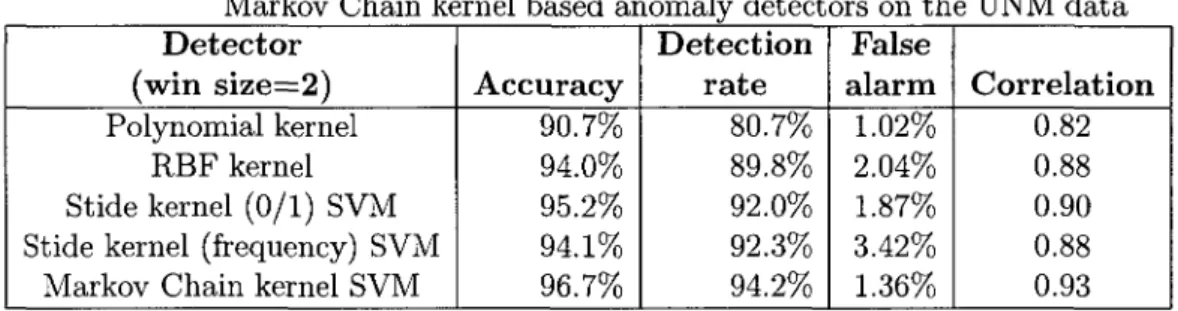
4.1 Comparison of STIDE, Markov Chain, STIDE kernel based, Markov
Chain kernel based anomaly detectors on the UNM data 62
4.2 Comparison of polynomial kernel, RBF kernel, STIDE kernel and Markov
Chain kernel based anomaly detectors on the UNM data 63
4.3 Comparison of STIDE, Markov Chain, STIDE kernel based and Markov
Chain kernel based two class SVM anomaly detectors on the FTP pro
cesses in the DARPA Lincoln Lab data 64
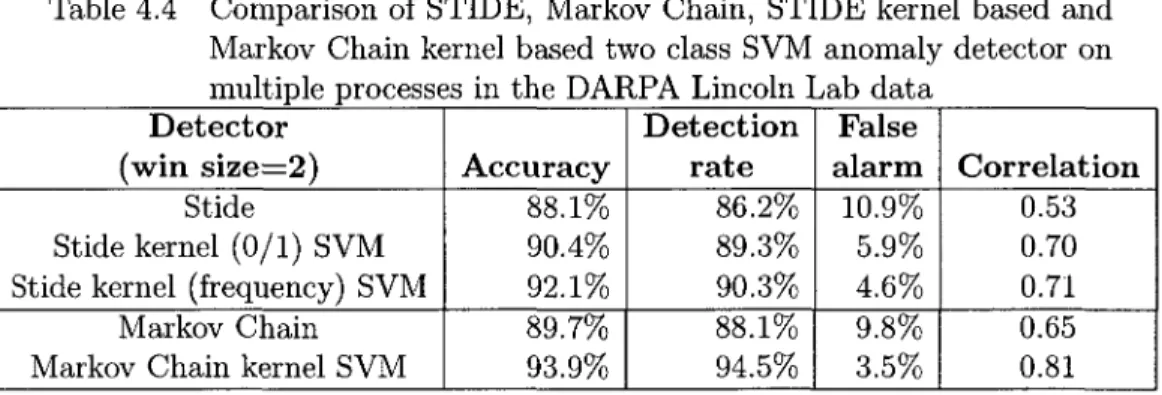
4.4 Comparison of STIDE, Markov Chain, STIDE kernel based and Markov
Chain kernel based two class SVM anomaly detector on multiple pro
cesses in the DARPA Lincoln Lab data 64
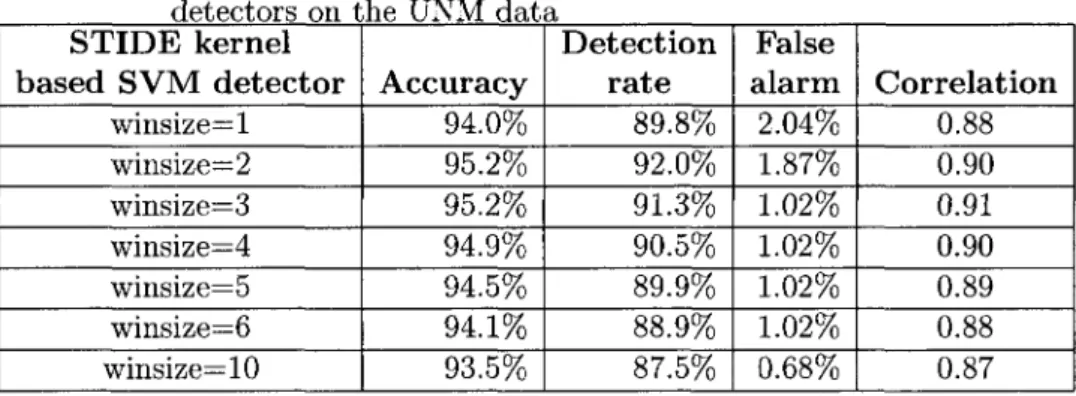
4.5 Window size impact on the STIDE kernel based SVM anomaly detec
tors on the UNM data 69
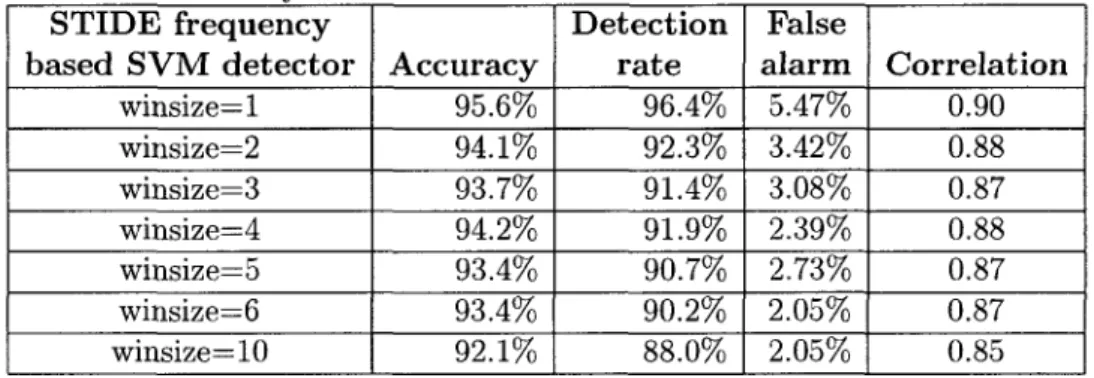
4.6 Window size impact on the STIDE frequency kernel based SVM anomaly
detectors on the UNM data 70
4.7 Window size impact on the Markov Chain kernel based SVM anomaly
detectors on the UNM data 70
5.1 Comparison of STIDE, Markov Chain, STIDE kernel based and Markov
kernel based SVM anomaly detectors on the UNM data 75
5.2 Comparison of polynomial kernel, RBF kernel, STIDE kernel and Markov
Chain kernel based SVM anomaly detectors (ratio threshold = 0.1) on
5.3 Comparison of STIDE, Markov Chain, STIDE kernel based one class SVM, Markov Chain kernel based SVM anomaly detectors on the
DARPA data 77
6.1 Comparison of FSM, SVM and SVM with FSM filter and feature selection 86
6.2 Comparison of EFSA, SVM and ES FA guided SVM on the FTP pro
cesses in the DARPA Lincoln Lab data 90
6.3 Comparison of EFSA, SVM and ESFA guided SVM on multiple pro
cesses in the DARPA Lincoln Lab data 91
LIST OF FIGURES
3.1 A sample of generic specification [68] 46
3.2 A simplified specification for FTP process [68] 47
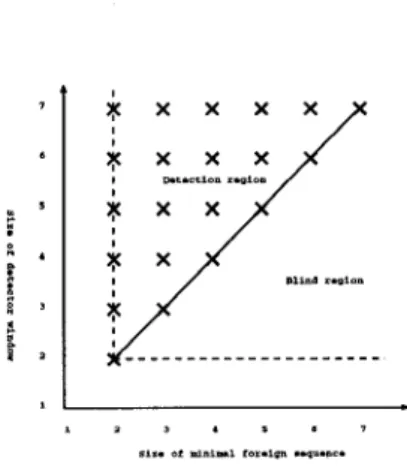
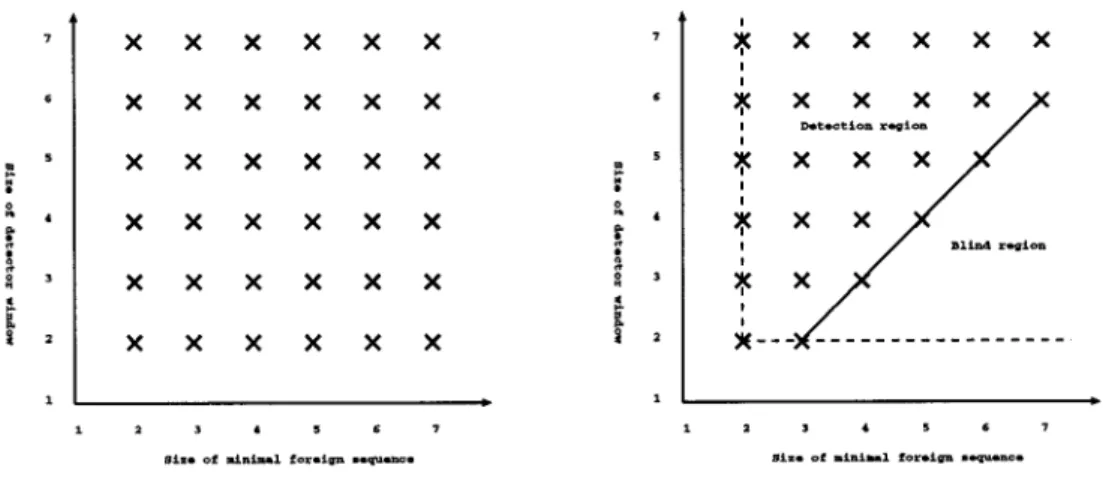
4.1 Detection and blind area of STIDE detector 65
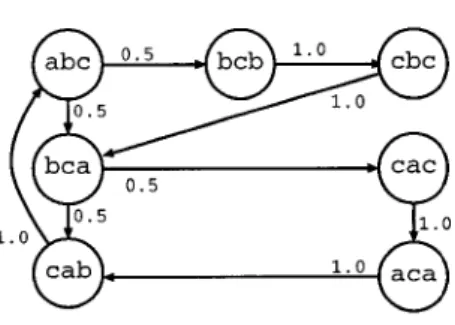
4.2 Markov chain constructed from training data "abcabcbcacabc" using
window size 3 67
4.3 Claimed coverage 68
4.4 Actual coverage of Markov detector 68
6.1 Source code of a piece of program 83
6.2 FSM translated from the code 83
6.3 Training phase of the hybrid anomaly detector 88
6.4 Testing phase of the hybrid anomaly detector 88
7.1 Generation of anomaly intrusion detection profiles 102
7.2 The interface of the agent based anomaly detector 105
A.l SFT for FTP bounce attack Ill
B.l Diagram for FTP bounce attack 113
B.2 Generated CPN for FTP bounce attack 114
B.3 Diagram for TRINOO DDOS attack 116
B.4 SFT for TRINOO DDOS attack 117
ABSTRACT
Anomaly intrusion detection normally has high false alarm rates, and a high volume of false alarms will prevent system administrators identifying the real attacks. Machine learning methods provide an effective way to decrease the false alarm rate and improve the detection rate of anomaly intrusion detection. In this research, we propose a novel approach using kernel methods and Support Vector Machine (SVM) for improving anomaly intrusion detectors' accuracy. Two kernels, STIDE kernel and Markov Chain kernel, are developed specially for intrusion detection applications. The experiments show the STIDE and Markov Chain kernel based two class SVM anomaly detectors have better accuracy rate than the original STIDE and Markov Chain anomaly detectors.
Generally, anomaly intrusion detection approaches build normal profiles from labeled train ing data. However, labeled training data for intrusion detection is expensive and not easy to obtain. We propose an anomaly detection approach, using STIDE kernel and Markov Chain kernel based one class SVM, that does not need labeled training data.
To further increase the detection rate and lower the false alarm rate, an approach of integrating specification based intrusion detection with anomaly intrusion detection is also proposed. Anomaly intrusion detectors tend to classify the behavior patterns that do not exist in training data as anomalies. When the training data does not cover all the normal behaviors, there will be a high false alarm rate using anomaly detection. Using specification based method as a filter and feature selection tool, the accuracy rate of anomaly detection intrusion can be further improved.
This research also establish a platform which generates automatically both misuse and anomaly intrusion detection software agents. In our method, a SFT representing an intrusion is automatically converted to a Colored Petri Net (CPNs) representing an intrusion detection
template, subsequently, the CPN is compiled into code for misuse intrusion detection software agents using a compiler and dynamically loaded and launched for misuse intrusion detection. On the other hand, a model representing a normal profile is automatically generated from training data, subsequently, an anomaly intrusion detection agent which carries this model is generated and launched for anomaly intrusion detection. By engaging both misuse and anomaly intrusion detection agents, our system can detect known attacks as well as novel unknown attacks.
CHAPTER 1.
Introduction
In the early days of computing, security problems were not a concern for system and software design and implementation. The computer security problem appeared in the 1970s are mainly attackers broke into users' accounts, and private and important information were stolen. From then on, with more and more sharing of information and the thriving of the Internet, computer security problems became a vital concern.
An informal definition of computer security is given by Garfinkel and Spafford in 1996 -A computer is secure if you can depend on it and its software to behave as you expect [19]. This definition is broad and includes hardware damage as well as software bugs. Currently, a more formal definition narrows down the goal of computer security to three categories: confidentiality, integrity and availability [50]. Confidentiality means data are not disclosed to unauthorized users. Integrity means there is no unauthorized modification. Availability means computer resources, information and services are not withheld to authorized users when they are needed. A computer system is secure if the three goals are achieved.
Security policy is a set of rules and principles to guarantee integrity, availability and con fidentiality in a computing system. Intrusion prevention includes defining a security policy and implementing the system according to the security policy. A security policy is specified first by system administrators, then it is implemented through appropriate installation and configuration of systems and also enforced using many security measures, such as authentica tion, encryption, access control, firewall, etc. Computer security measures and controls help an information system to achieve the goals of confidentiality, integrity and availability, and protect against unauthorized information disclosure (information leakage), modification and destruction of information systems and data (information corruption) and denial of service attack (information denial).
The ideal approach for computer security is to establish and implement a security policy that prevents any intrusions using these security measures. However, the preventive measures are not always sufficient because of the following reasons [64] :
• Bug free software is almost impossible. It is an extremely difficult task to design such software, and no one wants to make such a huge effort to design totally bug free software, except maybe in the military organization.
• It is difficult to change users and organizations' behaviors. For example, we can require users and organizations to follow some security measures, such as setting passwords that are not easy to guess, however, there is no guarantee that such policy will be followed by all users.
• Human errors in operations and maintenances are unavoidable. These errors can cause serious security loopholes.
• There are a lot of insecure systems installed all over the world. It is impossible to patch all of them to make them secure.
• The security measures and controls themselves can be compromised. For instance, the cryptographic algorithms can be cracked with sufficient time and computing power. • It is almost impossible to prevent insider attacks. Insiders have more access to the
system than outside attackers. It is very difficult to prevent them from abusing their rights.
• Even though it is possible to set up a totally secure system, the cost of these security measures and efficiency degradation because of these security measures will discourage people from doing this.
Because of these reasons, intrusion detection is prompted as a second line of defense to ensure security of a computer system. Intrusion detection includes monitoring the events happening in the monitored system, and detecting intrusions when they happen. In the following sections, an overview of intrusions and intrusion detection system is given first.
Then, the problems in the field of intrusion detection are identified and the contribution of our research is summarized.
1.1 Intrusion and intrusion detection
An intrusion is a violation of a security policy. For example, if one of the security policies for a system defines that the users' accounts on this system can only be accessed by authorized users, then the action of sneaking into these users' accounts and transfering these users' files is an intrusion. If a security policy of a system defines that some web pages in the system should be available to Internet users, then the action that impedes Internet users from getting these web pages is considered as an intrusion, namely, a denial of service attack.
System and user behaviors need to be monitored and analyzed to detect intrusions. The monitoring is often done through audit data that is generated by operating systems and ap plications. Operating systems and many applications regularly log an incredibly large volume of data in their log files. In the UNIX operating system, syslogd is used by kernels, daemons and applications to log useful messages at various levels of details. The wtmp and utmp files on UNIX system provide records about users' log-ins, log-outs and sessions information. Some additional audit tools are also provided to record system activities. For example, strace and Basic Security Module (BSM) in UNIX system can record system call traces. The tcpdump program can be used to record all network traffics at the TCP level, while uptime, df and netstat can be used to provide system usages, disk usages and network connections.
Intrusion behaviors can be discovered by analyzing these audit files. However, the large volume of audit files and the complicated nature of intrusions make it impossible to analyze these audit data to find out attacks manually, calling for an automatic approach to analyze audit files and detect intrusions, namely an intrusion detection system.
For intrusion detection, the basic assumption is that intrusion behaviors are different from normal behaviors and are detectable. Followings are six main types of intrusions, and how they can be detected [61]:
detected by atypical behavior profiles or violations of security constraints.
2. Masquerade attacks, i.e., attackers masquerade as normal users, are detected by atypical behavior profiles or violations of security constraints.
3. Penetration of the security control system, i.e., attackers break into security adminis tration or control system such as Intrusion Detection System and Access Control table, is detected by monitoring specific patterns of activities.
4. Leakage, i.e., system resources such as CPU time and hard disk space are stolen, is detected by atypical use of system resources.
5. Denial of service, i.e., services provided are stopped, interrupted or slowed down by attacker, which is detected by atypical use of system resources.
6. Malicious use, i.e., inside attackers abuse their privileges, is detected by atypical behavior profiles, violations of security constraints, or use of special privileges.
Computer attacks are becoming more and more complicated. Temporal and spatial fea tures of an attack must be considered to detect it accurately. One successful attack behavior may have a long time span, which means an intrusion detection system needs to examine a series of behaviors for a long time to detect such attack. One attack also may involve coop eration from several different sites, which means correlation of behaviors from several sites is needed to detect such attack.
Generally speaking, intrusion detection approaches can be categorized into misuse de tection, anomaly detection, and specification based detection. Misuse detection works by comparing network traffic, system call sequences, or other measurable quantities to known attack patterns called attack signatures. Although misuse detectors can be quite successful in detecting attacks using known signatures, they cannot detect novel attacks and often fail to detect slight modifications to existing attacks. When a new attack surfaces, an attack signa ture must be constructed (usually by an expert), and the misuse detector must be reconfigured to include the new signature.
Anomaly detection systems "learn" what constitutes normal behaviors from systems' or users' past behaviors, developing sets of normal profiles that are continually updated. An anomaly detector looks for deviations from the known normal behavior; when the deviation exceeds certain predefined threshold, an alarm is raised. Unlike misuse detectors, anomaly detectors are able to detect previously unseen attacks. However, anomaly detectors can suffer from a high false alarm rate; this can occur due to rare but legitimate behaviors (e.g., actions taken to respond for events of dropped packets or failed servers) that are not covered by the definition of normal system behaviors.
Specification based detection uses specifications, which are derived from system designs and configurations. The system activities are compared to the specifications of the software system. Any activities that do not comply to the specifications are identified as intrusions. For instance, if the specifications define that in FTP daemon, files should be downloaded from the /public directory, then any downloading from other directories are classified as intrusions. Specification based intrusion detection approach can find out novel attacks and does not need a training procedure to build a normal profile. However, the specification of a system can be complicated and needs tremendous human effort to build it.
1.2 Thesis statement
This dissertation addresses the detection accuracy problems involved in intrusion detection and systematic methods for intrusion detection system design. Specifically, it answers these questions:
• How can we improve the detection rate and reduce the false alarm rate of anomaly intrusion detection?
• Is it possible to take advantages of the strengths of various intrusion detection approaches without degrading the overall performance? How can we integrate these intrusion de tection approaches?
sys-tern to detect known and novel attacks?
1.3 Contributions
The first contribution of this research is a novel approach using kernel methods and Sup port Vector Machine (SVM) for improving anomaly intrusion detectors' accuracy [77]. In previous work, machine learning techniques have been used in the intrusion detection field for learning intrusion signatures, building normal profiles, selecting important features and so on. SVM is a newly emerging method in machine learning research; kernel method has a longer history, but it is recently found to be very effective and efficient when combined with the SVM method. This research develops two kernels specially suitable for intrusion detection applications, namely STIDE and Markov Chain kernels. They are combined with two class SVM for intrusion detection. This approach improves the detection rate and lowers the false alarm rate for anomaly intrusion detection.
The second contribution of this research is an anomaly detection approach, using STIDE kernel and Markov Chain kernel based one class SVM, that does not need labeled training data. Generally, anomaly intrusion detection approaches build normal profiles from labeled training data [76]. However, labeled training data for intrusion detection is expensive and not easy to obtain. One class SVM approach provides a reliable, accurate and efficient way for anomaly detection.
The third contribution of this research is the integration of specification based intrusion detection with anomaly intrusion detection to increase detection rates and lower false alarm rates. Anomaly intrusion detection can detect novel intrusions. However, the main problem of anomaly intrusion detection is its high false alarm rate. Anomaly intrusion detectors tend to classify the behavior patterns that do not exist in training data as anomalies. When the training data does not cover all the normal behaviors, there will be a high false alarm rate using anomaly detection. Specification based intrusion detection system aims to capture all the legitimate behaviors of a system. Thus, a fully developed specification based intrusion detection system does not have false alarms. The main problem of specification based approach
is the design of specifications needs tremendous human effort and is very time consuming. This dissertation proposes an intrusion detection approach that combines the strengths of specification based intrusion detection and anomaly intrusion detection and alleviates their weaknesses.
The fourth contribution of this research is the design and implementation of an intrusion detection system, which generates automatically both misuse and anomaly intrusion detection software agents. In our method, a SFT representing an intrusion is automatically converted to a Colored Petri Net (CPNs) representing an intrusion detection template, subsequently, the CPN is compiled into code for misuse intrusion detection software agents using a compiler and dynamically loaded and launched for misuse intrusion detection [74, 75]. On the other hand, a model representing a normal profile is automatically generated from training data, subsequently, an anomaly intrusion detection agent which carries this model is generated and launched for anomaly intrusion detection. By engaging both misuse and anomaly intrusion detection agents, our system can detect known attacks as well as novel unknown attacks.
1.4 Roadmap of this dissertation
The remainder of the dissertation is organized as follows. Chapter 2 reviews the related work on intrusion detection systems. An overview of the three main methods for intrusion detection, namely, misuse intrusion detection, anomaly intrusion detection and specification based intrusion detection, is given. The arguments of the issues and problems related to these three kinds of intrusion detection methods are presented. The effort of combining various intrusion detection methods, namely, hybrid intrusion detection systems, are also introduced. We also review infrastructure for intrusion detection systems and agent based intrusion detection systems in this chapter.
Chapter 3 introduces the related technology used in this dissertation, such as Support Vec tor Machine (SVM), Kernel Method, Software Fault Tree, Colored Petri Net and specification based method. These technologies have been developed in research and development in our project.
Chapter 4 presents our kernel approach, combined with two class SVM, for classification of system call sequences. Two kernels, STIDE kernel and Markov Chain kernel are presented. An evaluation is also presented for the two conventional anomaly detectors, the Markov Chain anomaly detector and the STIDE anomaly detector, with comparison to our new two class SVM based anomaly detectors.
Chapter 5 shows how to use one class SVM and kernel methods for unsupervised learning for anomaly intrusion detection. The results are compared with two conventional anomaly detectors, STIDE and Markov Chain anomaly detectors, and two class SVM based anomaly detectors.
Chapter 6 introduces specification guided anomaly detection. An approach to integrate the specification based intrusion detection and anomaly intrusion detection is presented. A technique of using specifications to reduce features for anomaly detection is also introduced.
Chapter 7 presents the automatic generation of misuse and anomaly intrusion detection agents. Design and implementation of an intrusion detection system prototypes will be pre sented, which automatically generates misuse intrusion detection software agents from the SFT specification of intrusion, using the CPN as design templates for intrusion detection, and automatically generates anomaly intrusion detection software agents from training data.
CHAPTER 2.
Related work
This chapter describes related work about approaches for intrusion detection, including anomaly intrusion detection, misuse intrusion detection, specification based intrusion detec tion, and hybrid intrusion detection which integrates some or all of these approaches, as well as infrastructures for intrusion detection systems.
2.1 Misuse intrusion detection system
Misuse intrusion detection systems use well defined intrusion patterns (intrusion signa tures) to represent attacks and match intrusion patterns with audit trails to detect attacks. The representation of intrusion signatures has evolved from the simple forms such as fixed strings, regular expressions and rules, to scenario models and state transitions modeling com plicated attacks.
The first generation of misuse intrusion detection systems uses rule based misuse intrusion detection, by which audit records are matched to expert rules. The second generation of misuse intrusion detection systems either use model based intrusion detection, by which scenario models are constructed to represent the features of intrusion behaviors, or state transition analysis, by which states and state transitions in a system leading from an initial state to a compromise state are modeled.
2.1.1 Rule based expert system
For very simple misuse intrusion patterns, only fixed strings and regular expressions are used to match audit trails and identify intrusions. However, most intrusion patterns are complicated, thus, expert systems are usually integrated with rule based intrusion detection
systems since expert systems provide powerful reasoning ability to reason from facts and rules [58].
2.1.1.1 P-BEST
P-BEST, a general purpose forward chaining expert system, is first used by MIDAS to define rule sets and facts for misuse intrusion detection [59]. By analyzing audit trails, facts related to the misuse intrusion are extracted and asserted in the P-BEST fact base and an inference engine in P-BEST is triggered to derive new facts.
P-BEST rule sets and fact base are precompiled to C modules, and C functions can be called from P-BEST. This feature provides convenience to the system development as C lan guage is very powerful and supported in almost all systems.
2.1.1.2 RUSSEL
RUSSEL is a language designed for searching arbitrary patterns of records in a file when misuse detection system AS AX is developed [48]. A RUSSEL program consists of rule sets and global variables. Records are analyzed sequentially in such a way that when a record is read in, some rules are triggered to alter global variables, raise alarms, write reports, and activate new rules. When all triggered rules are finished, the next records are read in. AS AX also supports C routines, either system defined or user defined, which makes it more flexible. Unlike MIDAS [59], which needs to rewrite the P-BEST program for different operating systems, ASAX is independent of operating systems by using a format adaptor to translate native file into a NADF (Normalized Audit Data Format) format. This feature means ASAX can analyze data streams of any format. ASAX uses this feature to implement a distributed misuse intrusion detection system to do online analysis and correlation of multiple distributed data streams.
MIDAS and ASAX use rules to represent detection of an attack in the system. These rules are very system dependent. To design and update these rules, security experts are needed, and also extensive knowledge about the system is needed. Furthermore, current rule designs uses
an ad hoc method, which is inefficient. Thus, a high level abstraction of intrusion detection and a more efficient method of designing rule bases are called for.
2.1.2 High level representation of intrusion detection
Compared to misuse intrusion detection rules, high level representation of intrusion de tection is more system independent, efficient and easier to design. Model based intrusion detection approaches use high level representation of intrusions, such as State Transition Analysis and Colored Petri Nets.
2.1.2.1 Model based intrusion detection
Garvey et al. proposed model based intrusion detection which verifies attack scenarios from observed activities [20]. Attack scenarios, composed of a sequence of activities making up the attack, are stored in a scenario database. Model based intrusion detection systems use anticipators which predict the next step in the scenario, use planners which translate the prediction to what would occur in the audit trail and use interpreters to actually search for the data in the audit trail. When activities are found leading to an intrusion depicted by the attack scenario, it signals an alarm.
This approach is very efficient because it always searches for activities that are expected from the last scenario and large amounts of noises can be neglected. Also it is possible to take preventive measures when a compromise is predicted.
2.1.2.2 State Transition Analysis
Porras et al. proposed to use State Transition Analysis approach to model penetration stages in a computer system [51]. State Transition Analysis views an intrusion as a sequence of actions that leads from an initial state, through a series of intermediate states, to a final compromised state of a computer system. A State Transition Diagram is used to model the penetration as a sequence of state transitions.
In State Transition Analysis, only the key events which will prevent the intrusions from happening if absent will be modeled. So, the minimum requirements for an intrusion are
identified. By recognizing only the minimum number of key events for a penetration, intrusion detection is more efficient and also, some variants of the analyzed attack can be modeled.
A State Transition Analysis Tool is developed to look for known penetrations in the audit trail. It consists of an Audit Record Processor, a Knowledge Base, an Inference Engine and a Decision Engine. The Inference Engine maintains a state table to keep track of all possible penetrations. Audit trails are analyzed by the Audit Record Processor and relevant informa tion is sent to the Inference Engine to trigger a state transition. The Decision Engine informs a compromise or a danger of compromise, and take actions to prevent it from happening.
By State Transition Analysis, some level of abstraction is achieved over the rule based methods. For the same type of intrusion, the state transition model is always the same in State Transition Analysis for different operating systems, whereas the rules representing the same intrusions can be very different.
The State Transition Analysis method has several advantages:
First, the rules are easily created and updated. Transition rules are intuitive and concise. Thus, unlike rule based intrusion detection, State Transition Analysis methods do not need experts of the rule system and the operating systems for designing and updating rules.
Second, this method focuses on events that cause state transitions instead of low level audit records. So it achieves high level abstraction and is independent of audit records, making it easy to port to other systems.
Third, the next steps in penetration can be predicted, thus, measures can be taken to prevent a compromise from happening.
2.1.2.3 Colored Petri Nets
Kumar and Spafford proposed to use Colored Petri Nets (CPNs) for misuse intrusion detection in their Intrusion Detection in Our Time (IDIOT) project [33]. They considered the misuse intrusion detection as a pattern matching procedure. The transitions through CPN places lead from initial state to final intruded state. CPN is a Turing Machine language which has the features of generality, conceptual simplicity and graphical representability, and it is more powerful than regular expressions.
Used in pattern matching for misuse intrusion detection, CPN is not only expressive but also attains better abstract level. A CPN is more like a virtual machine for matching input events with intrusion signatures, and it does not depend on operating systems. In other words, it represents signatures in an operating system independent format and works on abstract audit trails. Thus, the CPN approach has good portability.
2.2 Anomaly intrusion detection system
An anomaly is a user or system behavior or a system status that deviates from the normal state. Anomaly detection can be described as finding anomalies in a system. In other words, an anomaly detector looks for deviations from the normal; when a deviation exceeds some pre-defined threshold, an alarm is raised. Unlike misuse detectors, anomaly detectors are able to detect previously unseen attacks.
A normal profile that describes the normality of the monitored system is always required for an anomaly detection system. For different kinds of subjects in a system, such as sessions, users, groups, programs and network traffics, different measures are used to describe the normality. For example, log-in time, log-out time, log-in attempts and user commands are used for profiling sessions; user commands, their arguments and key strike speeds are used for profiling users' behaviors; network outbound and inbound flow byte counts, source and destination IP addresses and connection start and end times are the parameters used in profiling network traffics. An anomaly detection system requires a normal profile because it detects anomalies based on the deviation from the normal profile, i.e. all system states varying from the normal profile by statistically significant amounts are flagged as intrusive attempts. Dorothy Denning first describes building an activity profile of normal usage by employing a statistical model [14]. After that, many researchers have studied how to establish normal profiles for a monitored system, some of the efforts are as following:
IDES/NIDES The anomaly detector in IDES/NIDES followed Denning's statistical model [27]. The profiles of individual subjects, such as individual users and user groups, are generated by observing the subjects in a working environment for a period of time.
Then the system is monitored and the observed data are compared to the profile to assess whether the deviation is significant enough to signal an anomaly.
HAYSTACK The anomaly detector HAYSTACK, developed at the University of California, Davis, compares a session vector describing session properties, such as files opened for reading, number of connections in one minute and number of log-in attempts, to a stan dard vector to indicate whether an anomaly occurs [61]. The standard vector functions as a normal profile of sessions, and it describes the normal characteristics of a session.
Computer immunology (STIDE) STIDE, developed at the University of New Mexico (UNM), is inspired by an immunology "sense of self" concept, where living organisms distinguish themselves from any foreign particles [17]. This approach was developed for UNIX system programs. The "self sense" of a UNIX program is established by analyz ing the system call sequences generated from normal executions of the UNIX system program. Thereafter, the system call sequences generated in a working environment are collected and compared to the normal database of system call sequences. The "self sense" here is essentially another expression for "profile".
IBL Lane and Brodley use Instance Based Learning (IBL) to learn "characteristic sequences" of actions generated by users by forming a user profile [34]. Actions of users are taken to be UNIX shell commands with arguments; and characteristic sequences are used to represent user actions. For each user, a dictionary is formed from characteristic sequences collected from a presumably users' intruder-free history. For each new sequence, a similarity value is calculated by comparing it to the dictionary and a threshold is used to determine whether it is anomalous.
JAM The JAM project in Columbia University utilizes data mining techniques to compute features that are significant to detect intrusions, and uses a decision tree learning soft ware, RIPPER, to learn rules from training data to detect intrusions [36].
Neural network Ghosh et al. introduce a back propagation neural network to build profiles of software behaviors [21]. Program inputs and program states are used as the inputs
to the back propagation network, which is first trained using normal and intrusive data. This approach predicts subsequent behaviors from previously known behaviors, and flags all system states having significant deviations from predicted or expected behaviors as intrusive attempts.
Support Vector Machine Mukkamala et al. in New Mexico Technology University per formed research on anomaly intrusion detection using Support Vector Machine (SVM) [66]. They constructed network based and host based features for intrusion detection, represented the audit data in the form of feature vectors, and fed these feature vectors to SVM for training and classification.
As described above, many researchers have made tremendous efforts to explore various approaches for anomaly detection. These approaches for building anomaly detectors can be categorized into two types. First, the statistical model based method, which employs a statis tical model to construct a profile for users, groups, programs and systems. The representative methods are IDES/NIDES and HAYSTACK. Second is the machine learning or data mining method. In this method, profiles (in the form of rules) are built from training data. The rep resentative methods are JAM, Neural network, IBL, computer immunology method (STIDE) and Markov Chain method. In the following sections, these approaches are discussed in more detail.
2.2.1 Statistical model
2.2.1.1 Denning' s statistical model
Dorothy Denning first described building an "activity profile" of normal usage and flagging all behaviors deviated significantly from the normal profile as anomalies. She also proposed to employ a statistical model to construct a normal profile [14]. The concept about using a normal profile for detecting anomalies in a system is essential for anomaly intrusion detection.
There are six main components in Denning' s model:
Objects Resources managed by system, such as files, programs, printers and databases. Audit records Generated by the system when subjects attempt or perform some actions on
objects, such as user log-in, command execution, file access, etc.
Profiles Created from observed activities in system, profiles describe the behavior of subjects with respect to objects in terms of statistical metrics and models. Normal profiles are models generated when the system is in normal operation.
Anomaly records Records of detected abnormal behaviors.
Activity rules Rules of conditions triggering actions, such as updating profiles, detecting abnormal behavior, and producing reports.
This subject-object model is analogous to an access control matrix which describes what access permission a subject has over an object. The dissimilarity between this model and an access control matrix is that:
The information (access permission) in an access control matrix is defined by system administrators, so it is a prior knowledge; while the information in the usage matrix (usage statistics) is generated from observed activities, so it is learned knowledge. For instance, an access control matrix can set a permission whether a user X can access a file A or not, while usage matrix describes statistics from past behaviors that the user X has never accessed file A in the past (thus the user X accessing file A will be considered as an anomaly).
Three kinds of statistical metrics used in this model are:
Event counter: number of audit records corresponding to a specified event, such as the number of log-ins during a period, number of password failures during a minute, and the number of commands used during one session.
Interval time: length of time between two audit records which represents two related events. For example, the time period between log-in time and log-out time of one user.
Resource measure: resource usage of certain activities. For example, CPU time consumed by a program and number of files opened during one session.
2.2.1.2 Main issues for statistical model
The essence of the statistical models is to monitor variables changing over time, such as log-in and log-out time, resource usage (CPU, memory, disk, etc.), user commands, command parameters, network inbound and outbound flow byte counts, and report the deviation from the average.
To establish a statistical model based anomaly detector, the main issues to consider are what measures to use in profiling and what statistical model to use for assessing anomaly. For different subjects described in a profile, such as sessions, users, groups, programs and network traffic, different measures are used. For example, log-in time, log-out time, number of log-in attempts, and user commands are normally employed to describe normality of a session. Also, the statistical models for assessing anomaly is different for various measures.
In statistical models, the measures used in profiling can be categorized into four classes: categorical, continuous, intensity, and event distribution [14].
Categorical measures use discrete values from a categorical set, such as command name, source and destination host identity and port number.
Continuous measures use numeric values or ordinal numbers, such as session time, number of files opened and CPU time used by an application.
Intensity measures track intensity of activities. These measures reflect the intensity of the event stream (number of events per unit time) over time intervals. For example, web page access times during one minute and number of bytes transferred in one second.
Event distributions are the "meta-distribution" of the measures affected by recent events. For example, an Is command in an FTP session affects the directory measure, but does not affect measures related to file transfer.
In Denning's method [14], deviations are calculated and anomalies are decided using five statistical models: Operational Model, Mean and Standard Deviation Model, Multivariate Model, Markov Process Model and Time Series Model.
Operational Model assumes the new observation of a statistical measure x is defined to be an abnormality if it is out of a fixed limit. For example, the number of failed log-in failures
during a specified time interval greater than 10 indicates abnormality.
Mean and Standard Deviation Model assumes a new observation of a statistical measure x is defined to be abnormal if it falls outside of mean ± d * stdev , where mean and stdev is the mean value and standard deviation of past events and d is the confidence parameter decided by an administrator (the probability of a value falling outside of the above range is 1/d? according to Chebyshev' s inequality [31]). For example, suppose we observed the average session time for a user is 80 minutes and the standard deviation of past log-in times is 10 minutes. Assuming d — 4, if the session time is less than 40 minutes or more than 120 minutes, it indicates abnormality.
Multivariate Model assumes two or more measures xi,x2, • • •, xn, need to be correlated
to detect abnormality. This model is based on other models. For example, log-in frequency x\ and session time x2 may be correlated to indicate abnormality since frequent log-ins with
short session time is a strong indication of an attack. When log-in frequency and session time are both out of normal range according to operational model or mean and standard deviation model, it suggests abnormality.
Markov Process Model assumes a new observation x is abnormal if its probability as de termined by the previous state and the transition probability matrix is lower than a fixed threshold. For example, suppose the monitored subject is a program, if the current observed system call from this program is s and the previous system calls from this program are SiS2 ... sn, assuming the anomaly threshold to be 0.2, then abnormality needs to be reported if the probability of generating a system call sequence sis2 ... sns from the program is below
0.2.
Time Series Model assumes a new observation x is abnormal if its probability of occurrence at the time is low. Interval timers are used to measure the intervals between events. When the probability of the specific order and interval times of the observation of event series X\,X2, • • • ,xn are below some pre-defined threshold, abnormality should be reported. This
model, which combines event counter with interval time, is actually a variation of multivariate model.
2.2.1.3 Intrusion detection systems using statistical model
Intrusion Detection Expert System (IDES), developed in SRI around 1984, uses the anomaly detection models described above [27]. IDES is a real time anomaly intrusion detection sys tem that monitors computer behaviors and learns normal profiles for users and group of users. The learned profiles are updated daily giving more weight to most recent behaviors. For each newly generated audit records, an overall statistical score is calculated. The score summarizes all relevant measures and reflects the similarity with the normal profile. An alarm is reported when the score exceeds a certain pre-defined threshold.
IDES profiles the behaviors of individual users or group of users. To extend the profiling to application, SRI International also conducted Safeguard project to research on application based profiling. Under safeguard model, a statistical score is computed for the operation of applications and represents the degree to which current behavior of the application corresponds to its established patterns of operation.
HAYSTACK, developed for Air Force computing platform at Lawrence Livermore Labo ratory and University of California Davis in 1988, is one of the earliest intrusion detection systems [61]. It includes an anomaly detector that monitors and analyzes user activities for anomalies. In HAYSTACK anomaly detector, a vector is used to describe the statistical mea sures, such as session duration, number of files opened for reading; a threshold vector is used to represent the threshold for each statistical measure; a weight vector is used to give different measure of importance to each attribute for some particular attacks and a Bernouli vector is used to represent the attributes that are out of range compared to the threshold vector.
2.2.1.4 Advantages and disadvantages of statistical model
Using a statistical model for anomaly detection, no prior knowledge about intrusions or systems is needed for establishing an intrusion detection system, which is better than misuse anomaly detection as domain experts for specifying attack signatures and designing rules are needed. Furthermore, using the statistical model, novel intrusions can be detected.
model based anomaly intrusion detection and causes many false alarms. In a system, new users are added, some services are removed and new machines are hooked up frequently. All these changes impact activities observed in a system. With the environmental changes, false alarm rates raise significantly since anomaly detection systems flag all behaviors with significant deviations from the profile as abnormal. The true alarms are sometimes buried with false alarms and the IDSs become useless. Statistical model based anomaly detection must update the profiles to reflect the environmental changes.
Currently, two approaches are widely used for updating normal profiles. One method is to generate and use a new profile regularly; another method is to merge new observed activities into the old profile, giving more weight to recently observed activities. However, these two methods of updating profiles are not faultless: attackers can slowly insert their intrusive behaviors and train the normal profiles to accept their behaviors as normal. This problem is still an open problem for user based anomaly detection. It is easy for an attacker to disguise as a normal user and slowly insert their intrusive behaviors to misguide an anomaly detection system. However, it is less a problem for system call based anomaly detection since the system call sequences of programs are not easy to be manipulated, i.e., being changed slowly.
2.2.2 Computer immunology based anomaly detection
Natural immune systems can detect foreign objects from self and attack foreign objects when encountered. Forrest et al. from the University of New Mexico proposed to incorpo rate the mechanisms and algorithms used by natural immune systems in computer intrusion detection [17].
2.2.2.1 Sense of self for Unix process
The first thing to do for any immunology system is to establish a "sense of self". In UNIX system, a process with root privilege is likely to cause serious damages. Thus, to establish "sense of self" definition of UNIX privileged process is essential for detecting anomalies in UNIX system. Forrest et al proposed to use local ordering of system calls (fixed size system call sequences) observed in execution of processes to define a UNIX process's "self". A fixed
size normal system call sequences database needs to be established from the process execution. To test if a process is normal, the process's system call sequences are compared with the normal system call sequence database. If the percentage of abnormal system call sequences is above some predetermined threshold, an abnormality alarm is generated.
Thus, system call sequences from program execution is used as a definition of "self". Usu ally, a definition too narrow will result in many false positives (false alarms), a definition too broad will result in many false negatives (undetected intrusions). Forrest et al. demonstrated that this notion of behavior identity - using system call sequence to define UNIX process's self - is suitable because of following two reasons:
First, the sequence of system calls executed by a program is locally consistent during nor mal operation. Conditions and function calls will change the relative orderings of the invoked system calls but not necessarily add variation to short term correlation. The experiment showed that new system call sequences only emerge in the early part, say first 3000 system calls, during the execution of a sendmail process (experimented using window size of 6). The experiment also showed that although the normal system call sequence database formed in this way only covers 5 x 10~5% of the total possible system call sequences ( from analyzing source code of sendmail program), the normal database is very stable for a particular architecture, software configuration, local administrative policies, and usage patterns.
Second, some unusual short sequences of system calls will be executed when a security hole in a program is exploited. Most of the attacks to UNIX privileged process will change some system calls in execution. For example, the syslog attack uses the syslog interface to overflow a buffer in sendmail process, and cause sendmail process to execute a piece of an attacker's code. The attack will vary sendmail' s system call sequences by inserting system call sequences from the attacker's code.
Some attacks to UNIX process might not be detected by only examining their system call sequences. One example is race conditions attack, which steals system resources from a privileged program by taking advantage of the time lag between checking the availability of a resource and actually using the resource of a privileged program. As long as the privileged program does not find an error, the system call sequences of the privileged program will not
reflect any abnormality. Those intrusions might be detectable by examining other aspects of a process's behavior, and need a revised definition of self [21].
2.2.2.2 Computer immunology and intrusion detection
Forrest et al. pointed out some computer immunology concepts and methods can be used for intrusion detection [17]:
First one is to use sequence to represent characteristics of "self" and to build a normal sequences database(used for anomaly intrusion detection for UNIX privileged processes). Sec ond one is the similarity value of a characteristic sequence to the normal sequence database, which is used to decide whether a test sequence is abnormal. In the immunology field, exact match, approximation and partial match are all used to calculate the similarity value. In UNIX intrusion detection, only exact match are systematically studied. Another one is that memorial cells in immunology are used to memorize some knowledge about foreign objects to improve the accuracy of the judgement and accelerate the reaction, and intrusion detection system can borrow this idea and use learned rules to memorize some knowledge about attacks, and thus integrating misuse and anomaly detection together.
2.2.3 Machine learning and data mining methods for anomaly intrusion detection Anomaly detection can be formulated as a learn-by-example machine learning task. A learn-by-example learning procedure generally begins with a set of examples with labels, and generates a model (i.e., classification rules) to classify future examples. In anomaly detection learning, the audit data from previously observed activities serve as examples. Several ma chine learning approaches are proposed to profile user and program behaviors and recognize previously unseen behaviors.
2.2.3.1 IBL
Lane and Brodley applied Instance Based Learning (IBL) technique to learn a profile for each user from users' input streams [34]. In Denning's statistical based intrusion detection model, a user's behavior can be characterized using resources consumed by the user, user's
typing rate, command issue rate and counts of particular commands employed in one session, whereas Lane and Brodley's approach emphasizes on one interesting assumption - "a user responds in a similar manner to similar situations, leading to repeated sequences of actions". This hypothesis holds in general, while there are times when users respond to abruptive events, and cause the input stream injected with unusual user inputs, which may cause false alarms. Lane and Brodley used sequences to characterize a user's input stream - including com mands and their arguments. File names in the user input are neglected because they can change significantly. Furthermore, these character sequences are segmented into fixed size overlapping characteristic sequences of tokens. Their experiments showed the size of the characteristic sequences had positive correlation with detection rate [34].
The motivation of using segmented sequences for user input profiling is similar to that of using a sliding window on system call sequences for program profiling used in computer immunology approach [17]. The segmented fixed length sequences feature temporal relation ships between single events. Furthermore, abnormality is usually temporally localized, which means in an abnormal sequence there always exist some relatively small length sequences that are very dissimilar with normal sequences. Also, by using fixed size sequences, it is possible to reduce false alarm rate since small noises are filtered out because the dissimilarity of system calls in a segmented fixed size sequence needs to exceed some threshold to be classified as an anomaly.
The similarity comparison between sequences is basically a string matching problem. Lane and Brodley defined similarity measures that yield a higher score for more similar sequences and biased toward adjacent identical tokens rather than identical tokens separated by some non-matching intermediate tokens.
A set of instances are used to exemplify the user profile. However, instances library get
extremely large, so it needs to be trimmed. A least recently used pruning strategy is employed
to keep the instance library to a manageable size; also only representative instances are stored in instances library. However, the least recently used pruning strategy causes this anomaly detection approach to be prone to a slow training attack (attackers slowly insert their behaviors into the normal profile to cause the intrusion detection system to identify their behaviors as
normal).
Lane and Brodley's IBL algorithm is different with computer immunology approach in that it defines a similarity measure instead of doing the exact matching. Lane and Brodley also proposed: in addition to exact matching and similarity measure, any off-the-shelf machine learning algorithm can be applied to anomaly detection based characteristic sequences. Fol lowed Lane and Brodley, Lee et al. experimented on using a detection tree software RIPPER to classify system call sequences [35]; Ghosh proposed to use Neural Network to classify pro gram BSM event stream [21]; Mukkamala used SVM to classify network and host events [66]. In this dissertation, we proposed to use Support Vector Machine (SVM) to classify system call sequences, which has shown to perform very well.
2.2.3.2 JAM
Lee et al. applied a decision tree learning approach RIPPER to learn normal and abnor mal patterns of program behaviors in JAM project [35]. Similar to computer immunology approach, Lee' s method is also based on system call sequences. However, instead of rote learning by maintaining a normal system call sequence database like computer immunology method, Lee's approach employed concise rules to generalize the system call sequence infor mation, and is able to identify unseen intrusions and unseen normal traces.
This generalization ability is what differs machine learning method from other anomaly detection methods. Other methods such as computer immunology method can memorize past behaviors but is unable to generalize from past behaviors. Thus, if the observed normal behaviors are not adequate and can not cover all users' or programs' behaviors, future unseen normal behaviors will be classified as anomalous and false alarm rates will be high. By applying a machine learning approach like RIPPER, knowledge about abnormal and normal patterns of program behaviors are generalized and a concise set of rules for normal and abnormal behaviors are produced.
Compared to computer immunology method, this decision tree based approach also has the advantage of being less sensitive to noise, thus less false alarm rates. A post processing procedure is used after prediction using RIPPER on the input system call sequences. In a
region of length 21 + 1, if more than I predictions are anomalous, the region is anomalous. The instinct behind this idea is: "When an intrusion actually occurs, the majority of adjacent system call sequences are abnormal; whereas the prediction errors tend to be isolated and sparse" [35]. Thereafter, this procedure filters out some spurious prediction errors.
Different from the user based method, such as IBL, this method is program based, so it is insusceptible to slow training by the attackers. However, this method still has not overcome the shortcoming of common anomaly detectors - being impacted by training data. RIPPER outputs rules for the minority class and the default class for unmatched instances is the majority class. Thus, if abnormal data is the major instances in the training data, the default class will be abnormal, which means this approach can not classify most unseen normal behaviors correctly; otherwise, the default class in the RIPPER rules will then be normal, which means this approach can not classify most unseen intrusive behaviors correctly.
2.2.3.3 Neural network
Ghosh et al. proposed to use neural network for detecting anomalies [21]. They compared two kinds of neural networks, feed-forward backpropagation neural network and recurrent neural network (Elman network), with simple equality matching algorithm, which is similar to computer immunology method. Their experiments showed neural networks had a better accuracy rate than equality matching algorithm.
Their goal of using neural network was to detect novel attacks, while at the same time, reduce false alarms. Ordinary anomaly detection methods based on exact matching or simi larity measures have a high false alarm rate when the observed audit data is incomplete and the future data set includes much previously unseen normal data. Besides learning the associ ations between inputs and outputs, neural network can generalize from previously seen inputs to predict future unseen inputs. Neural network is a good fit to generalize these incomplete observed data and give a good prediction to future seen and unseen data.
Like decision tree method, which is more sensitive to temporal co-located events and less sensitive to noises, Ghosh et al. uses a leaky bucket on the result of the neural network. The leaky bucket memorizes recent events and clears out the old events, so it is sensitive to a
series of anomalies and neglects occasional anomalies. Since it is well recognized that program anomalies are always located in temporal clusters and isolated anomalies tend to be prediction errors, the leaky bucket approach helps to reduce prediction errors.
The feed-forward backpropagation neural network method uses weights of the network to store generalized mapping from inputs to outputs. The inputs to the neural network are sequences of BSM events. A set of randomly generated input data are first used as abnormal data to train the network. So by default, the neural network classifies data as anomalies, which complies with the anomaly detection concept - unknown data are classified as anomalies. Then observed sequences, which are sequences of BSM events captured during a program's execution, are used to train the neural network. To put into operation, the trained neural network classifies BSM sequences in order and uses a leaky bucket to make the final prediction. The above feed-forward backpropagation neural network method can not catch "large scale structure" of programs. Elman networks overcome this disadvantage since it maintains some state information using context nodes which only take input from hidden nodes [21]. When training, the sequences of BSM events are input into an Elman network in order; suppose the nth output from the nth input In is On, the difference between nth output On and (n+l)th
input In+1 is used as the anomaly measure of the sequence 7n+i and fed into a leaky bucket. The Elman networks achieve better accuracy rate than the feed-forward backpropagation neural network method since it is also trained to recognize large scale structure of program behaviors [21].
The exact matching method classify all unseen inputs as anomaly, which often causes a high false alarm rate; while neural network method can classify novel inputs from the generalization of seen input thus give a re
![Figure 3.1 A sample of generic specification [68]](https://thumb-us.123doks.com/thumbv2/123dok_us/350027.2538516/62.915.221.747.124.286/figure-sample-generic-specification.webp)
![Figure 3.2 A simplified specification for FTP process [68]](https://thumb-us.123doks.com/thumbv2/123dok_us/350027.2538516/63.915.216.739.120.436/figure-simplified-specification-ftp-process.webp)