Interpreting and Answering Keyword
Queries using Web Knowledge Bases
by
Jeffrey Pound
A thesis
presented to the University of Waterloo in fulfillment of the
thesis requirement for the degree of Doctor of Philosophy
in
Computer Science
Waterloo, Ontario, Canada, 2013
c
I hereby declare that I am the sole author of this thesis. This is a true copy of the thesis, including any required final revisions, as accepted by my examiners.
Abstract
Many keyword queries issued to Web search engines target information about real world entities, and interpreting these queries over Web knowledge bases can allow a search system to provide exact answers to keyword queries. Such an ability provides a useful service to end users, as their information need can be directly addressed and they need not scour textual results for the desired information. However, not all keyword queries can be addressed by even the most comprehensive knowledge base, and therefore equally important is the problem of recognizing when a reference knowledge base is not capable of modelling the keyword query’s intention. This may be due to lack of coverage of the knowledge base or lack of expressiveness in the underlying query representation formalism.
This thesis presents an approach to computing structured representations of keyword queries over a reference knowledge base. Keyword queries are annotated with occurrences of semantic constructs by learning a sequential labelling model from an annotated Web query log. Frequent query structures are then mined from the query log and are used along with the annotations to map keyword queries into a structured representation over the vocabulary of a reference knowledge base. The proposed approach exploits coarse linguistic structure in keyword queries, and combines it with rich structured query representations of information needs.
As an intermediate representation formalism, a novel query language is proposed that blends keyword search with structured query processing over large Web knowledge bases. The formalism for structured keyword queries combines the flexibility of keyword search with the expressiveness of structures queries. A solution to the resulting disambiguation problem caused by introducing keywords as primitives in a structured query language is presented. Expressions in our proposed language are rewritten using the vocabulary of the knowledge base, and different possible rewritings are ranked based on their syntactic rela-tionship to the keywords in the query as well as their semantic coherence in the underlying knowledge base.
The problem of ranking knowledge base entities returned as a query result is also explored from the perspective of personalized result ranking. User interest models based on entity types are learned from a Web search session by cross referencing clicks on URLs with known entity homepages. The user interest model is then used to effectively rerank answer lists for a given user. A methodology for evaluating entity-based search engines is also proposed and empirically evaluated.
Acknowledgements
I would like to thank my supervisors Grant Weddell and Ihab Ilyas for their support and guidance, and for allowing me the independence to explore my research interests. I would like to thank the many collaborators I have worked with over the years: David Toman, Jiewen Wu, Alexander Hudek, Peter Mika, Roi Blanco, Hugo Zaragoza, Stelios Paparizos, Panayiotis Tsaparas, and others. I would also like to thank my committee members: Tamer ¨Ozsu, Ming Li, Lukasz Golab, and Nick Koudas for taking the time to read and critique my thesis.
I would also like to thank the many friends I’ve met during my studies. It’s the (more than occasional) beer and coffee with friends that keep a person sane throughout a PhD.
Most of all I want to thank my family from the bottom of my heart. My parents Linda and Steve, my brother Brad; mi suegra Monica, suegro Horacia, hermano Alejandro y hermanita Macarena; my wife Sol and beautiful baby daughter Sofia. You have all always stood by me and believed in me, I would not be where I am today if it wasn’t for your support. Muchas gracias.
Dedication
Table of Contents
List of Figures xv
1 Introduction 1
1.1 Search in Information Systems . . . 1
1.2 Representing Knowledge . . . 4
1.3 Representing Query Intentions . . . 15
1.4 Thesis Overview. . . 17
2 The Query Understanding Problem 19 2.1 Formalizing The Query Understanding Problem . . . 22
2.2 Solution Overview . . . 24
2.3 Baseline Approaches . . . 28
3 Semantic and Structural Annotation of Keyword Queries 33 3.1 Query Segmentation & Semantic Annotation . . . 33
3.2 Structuring Annotated Queries . . . 37
3.3 Analysis of a Web Query Log . . . 39
3.4 Evaluation of Keyword Query Understanding. . . 41
4 Graph Queries with Keyword Predicates 57
4.1 Motivation . . . 58
4.2 Structured Keyword Queries . . . 60
4.3 Matching Subgraphs with Keyword Predicates . . . 61
4.4 Concept Search Queries as Keyword Query Interpretations . . . 72
4.5 Computing All-Pairs Similarity over Knowledge Base Items . . . 75
4.6 Knowledge Graph Management . . . 76
4.7 Evaluation of Graph Queries with Keyword Predicates . . . 81
4.8 Related Work . . . 88
5 Personalized User Interest Models for Entity Ranking 93 5.1 Data & Problem Definitions . . . 94
5.2 Personalized Ranking of Entity Queries . . . 100
5.3 Evaluation of Personalized Entity Ranking . . . 105
5.4 Related Work . . . 112
6 A Methodology for Evaluating Entity Retrieval 115 6.1 The Ad-hoc Entity Retrieval Task . . . 115
6.2 An Empirical Study of Entity-based Queries . . . 121
6.3 Related Work . . . 129
7 Conclusions and Future Work 133 References 135 Appendices 149 A Evaluation Workloads 149 A.1 Query Understanding Workload . . . 149
A.2 TREC-QA Structured Keyword Query Encoded Workload . . . 156
A.3 Synthetic Efficiency Workload . . . 161 xii
B Proofs 165 B.1 Proof of Lemma 1 . . . 165 B.2 Proof of Theorem 1 . . . 166
List of Figures
1.1 An example knowledge graph. . . 9
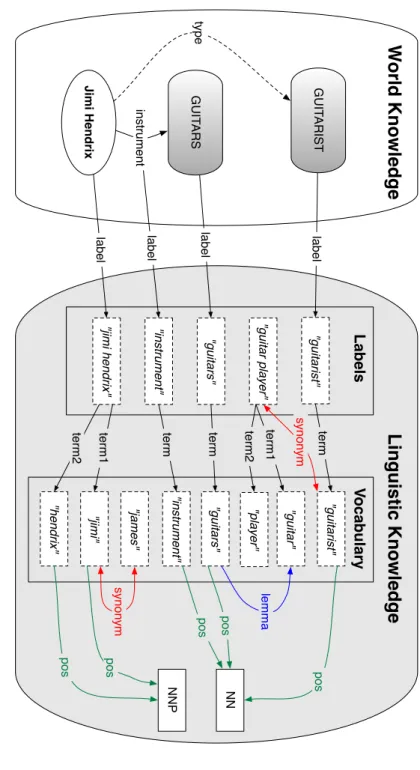
1.2 Part of an example knowledge graph extended with linguistic knowledge. . 14
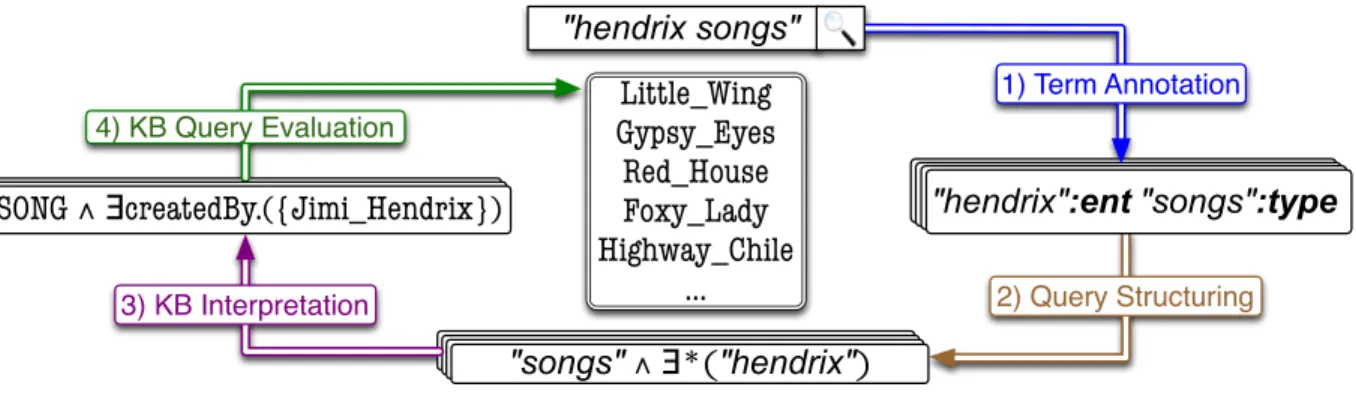
2.1 Overview of the query understanding process. . . 24
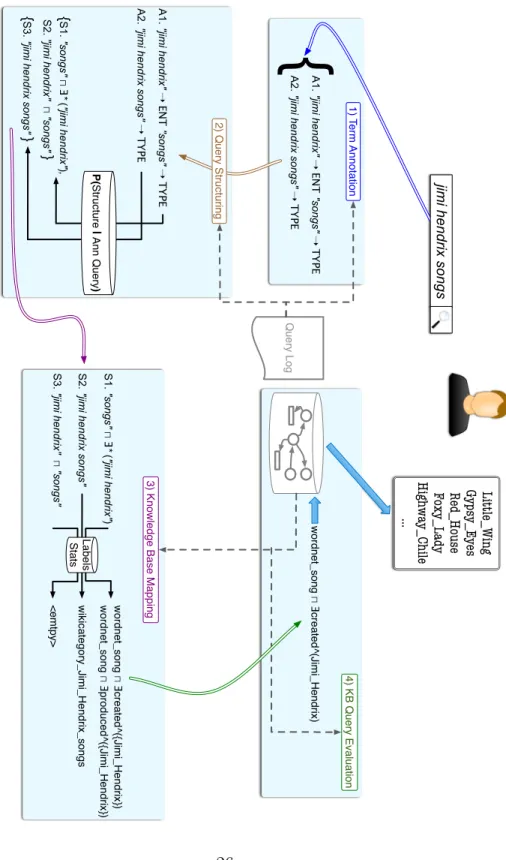
2.2 Detailed overview of the query understanding process. . . 26
2.3 Examples of the query understanding process. . . 27
2.4 Example query result subgraph for the query “john lennon birth city”.. . . 29
2.5 Example query result subgraph for the query “jimi hendrix birthplace”. . . 31
3.1 Example segmentation and annotation process for the CRF-based semantic annotator. . . 37
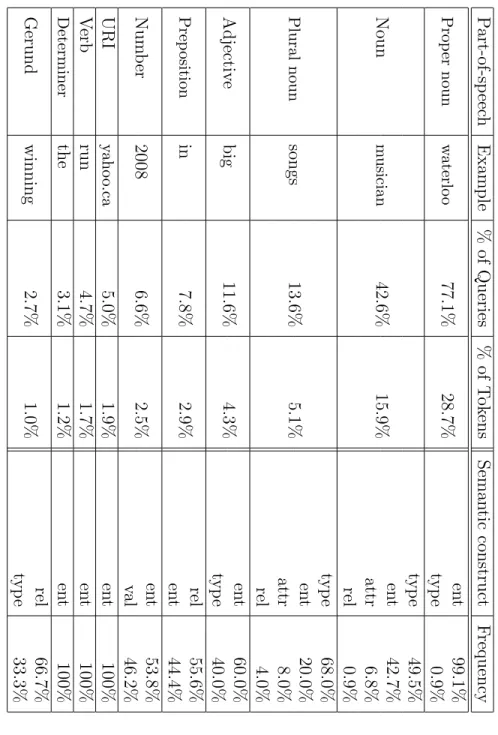
3.2 Distribution of most frequent part-of-speech tags among entity-based queries. 40 3.3 Most frequently occurring templates among entity-based queries. . . 42
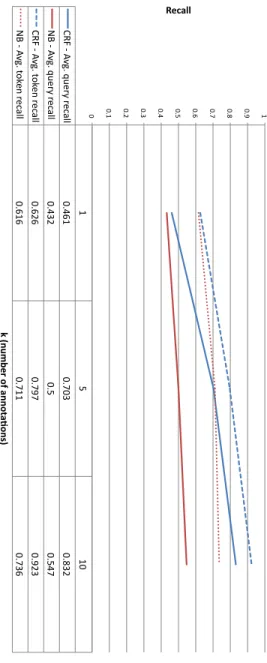
3.4 Effectiveness of keyword query annotation. . . 46
3.5 Effectiveness of query interpretation. . . 47
3.6 Effectiveness of query interpretation. . . 48
3.7 Average Precision, MRR, and Recall for the query answering task. . . 49
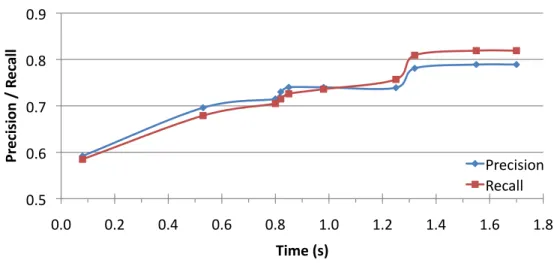
3.8 Average precision and recall vs. average run time for varying number of candidate query structures.. . . 50
3.9 Average run-times for each phase of the keyword query answering process. 51 4.1 An ambiguous concept search query and the possible mappings of each key-word to a knowledge base item. . . 60
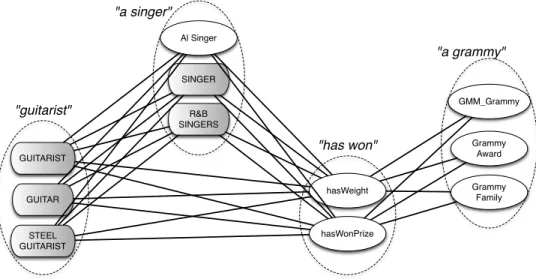
4.2 An example structured keyword query disambiguation graph. . . 63
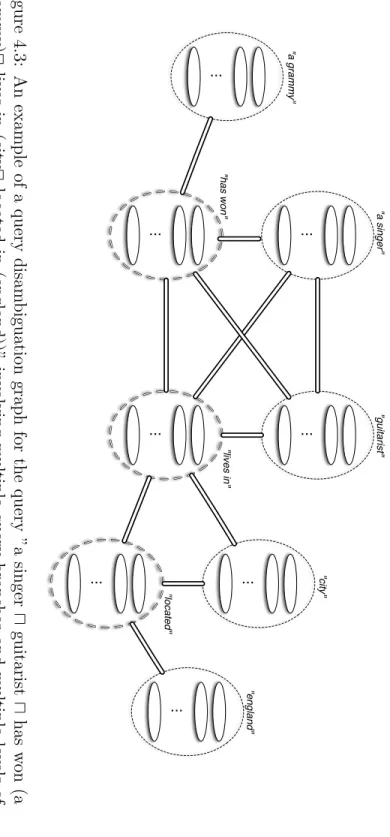
4.3 A complex structured keyword query disambiguation graph. . . 66
4.4 The example query disambiguation graph with zero-weight edges pruned and the correct disambiguation highlighted. . . 71
4.5 Encoding structured keyword query disambiguation as a rank-join.. . . 73
4.6 A knowledge graph index for the example knowledge graph. . . 78
4.7 The knowledge graph concept search query evaluation procedure. . . 79
4.8 An example encoding of a TREC QA task item to a structured keyword query. 83 4.9 Effectiveness of mapping structured keyword queries to concept search queries. 85 4.10 Entity retrieval effectiveness vs. number of knowledge base mappings . . . 87
4.11 Entity retrieval task effectiveness for all systems.. . . 89
4.12 Performance of structured keyword query disambiguation and evaluation. . 90
5.1 Example result ranking with and without a user’s search context. . . 94
5.2 An example entity database and query click log. . . 97
5.3 Distribution of click frequency of entity types clicked in the query log. . . . 99
5.4 Distribution of entity count for entity types occurring in the entity database.100 5.5 MRR and p@1 for the baseline ranking functions. . . 106
5.6 MRR values of each ranking method vs. generality filtering threshold value. 107 5.7 Precision at rank 1 for each reranking method vs. generality filtering thresh-old value. . . 108
5.8 Best reranking approaches for each baseline. . . 110
5.9 Increase in MRR and p@1 for best reranking approach for each baseline. . 111
6.1 A sample of queries with their entities, types, query intent, and query type. 118 6.2 A screen capture of the evaluation tool for judging results. . . 126
6.3 Inter-judge agreement on relevance scores. . . 127
6.4 Frequencies of valuations over all result judgements. . . 128
6.5 Stability of evaluation metrics for resource ranking. . . 129 xvi
6.6 Distinguishing among the baseline, random, and ideal rankings for various evaluation metrics. . . 129 A.1 Query understanding workload: semantic summaries and structured query
templates. . . 150 A.2 Query understanding workload: structured keyword query encodings. . . . 152 A.3 Query understanding workload: concept search query encodings. . . 154
Chapter 1
Introduction
If Edison had a needle to find in a haystack, he would proceed at once with the diligence of the bee to examine straw after straw until he found the object of his search... I was a sorry witness of such doings, knowing that a little theory and calculation would have saved him ninety per cent of his labor.
Nikola Tesla (1857 - 1943), New York Times, October 19, 1931
1.1
Search in Information Systems
Consider a person who searches an information system using the keywords“toronto restau-rants”. The person types their query and clicks the search button, anxiously awaiting their results. But what information should a search system return in order to satisfy this user’s information need? Certainly a Web search engine, such as Google or Bing, has many choices. There are millions of documents on the Web that mention the terms “toronto” and “restaurant”1. There are also structured databases encoding information about vari-ous restaurants, some of which are likely located in the city of Toronto. Whether a search engine returns documents relevant to the query terms or structured results showing restau-rants in Toronto, we cannot say that the search engine has done something right or wrong. Since the intent of the query is underspecified – that is to say, we cannot know exactly what it is the user is looking for due to the inherent ambiguity of keyword queries – there
1According to http://www.google.com, there are 156,000,000 documents matching the query “toronto
is no definition of a “correct” query answer. However, it seems clear that some answers may be better than others. Results providing information about restaurants in Toronto would be considered morerelevant than results that coincidently mention those two terms together, but do not provide information explicitly about restaurants that are located in Toronto.
1.1.1
Query Interpretation in Search Systems
The nature of search in information systems – be it the traditional information retrieval that searches document collections given keyword queries, or more recent adaptations of search that integrate large structured data repositories – is one of uncertainty and ambiguity. Results are judged by their quality, not by a formal definition of correctness. At the time of writing, a Bing2 search for our example query “toronto restaurants” returns a list of documents relevant to the query terms. Among them are various Web pages describing restaurants in Toronto. A Google3 search for the same query terms however, produces a
fundamentally different search result: a list of structured data items, each item describing a particularentity that is a type of RESTAURANTwith alocation of Toronto. The difference in the two results is not about access to data, indeed a search initiated from Bing’s local page4 returns a similar structured result as Google. The difference is in the understanding and representation of the query. While Bing views this query as a collection of terms describing textual documents of interest, Google views the query as having a more explicit structure: a search for particular restaurant entities that are located in Toronto.
Special handling of queries for vertical domains is a common way of integrating domain knowledge into search engines. Examples include the local business search provided by major search engines, which aims to interpret queries over locations and business types; the book search facility provided by Amazon, which aims to interpret queries over author names, book titles, and ISBN numbers; or the job search from Monster.com, which aims to interpret queries over locations, companies, and job types. While building domain specific vertical search engines achieves the goal of integrating domain knowledge into the search process, it comes at the expense of engineering a specific solution for each target domain.
2www.bing.com
3www.google.com
4www.bing.com/local
1.1.2
Semantic Search
A general search architecture that can integrate arbitrary external knowledge sources, interpret keyword queries over these knowledge sources, and provide exact answers to keyword queries is a highly desirable goal, and the focus of this thesis. This process is often referred to as the semantic search problem – the problem of integrating reference semantic information in the search process. A semantic search system allows the integration of domain knowledge into the search process in a generic way. For example, a product catalogue could be used as a reference knowledge base, allowing queries to be interpreted in terms of products (attributes of products, brands, product types, etc. . . ) enabling a powerful vertical product search with an underlying understanding of the concepts and entities in the reference knowledge. A query for “10mp canon digital cameras” could be modelled as a query for entities with amegapixelvalue of 10, the brandCanon, and an entity typeDIGITAL CAMERA. This semantic, or structural, understanding of the query allows the retrieval of specific entities and information about those entities.
The semantic search approach also allows one to incorporate general knowledge, orfact collections, into an open domain search engine as well. Similar to recent advances in the Google search engine5 which aims to answer simple factual queries like birthdays of famous
people or authors of popular books, a semantic search engine allows the integration of large amounts of reference knowledge in the search process. The potential for semantic search however is much greater than answering simple factual queries, as formal representations of knowledge and queries can enable more complex query interpretations. For example, a query for“grammy award winning guitarists” requires not only a structural understanding of the query (i.e., entities of typeGUITARISTthat have hasWonPrize relation to entities of typeGRAMMY AWARD), but also complex reasoning over the knowledge base to determine if an entity can be inferred to be aGUITARISTthat has won some entity that can be inferred to be a type of GRAMMY AWARD.
Modelling possible query interpretations also poses a difficult problem. Following our previous example query “grammy award winning guitarists”, how does a search sys-tem identify that “winning” denotes the relation hasWonPrize? Similarly, for the query “toronto restaurants” having an interpretation of RESTAURANTSthat are locatedIn the city ofToronto, a search system must infer the relationshiplocatedIn which is not explicitly rep-resented in the query. Furthermore, even if a query understanding algorithm can compute probable mappings of query terms to knowledge base items, how can a system determine that a query is looking for entities of type RESTAURANT that are locatedIn Toronto, as
5See for example, the Google result of the query“moby dick author” which provides the exact answer
opposed to the query looking for information about the entity Torontowhich is the loca-tion of variousRESTAURANTs? As queries become more complex, the problem of modelling their interpretations becomes more complex as well. We discuss the problem of search in information systems, from the point of view of query understanding and knowledge incorporation in Chapters2 and 3.
1.2
Representing Knowledge
In this section we describe the data model used for representing factual world knowledge about real-world entities, as well as linguistic knowledge that describes how the terms used to encode a knowledge base are related to each other. The world knowledge acts as a repository of searchable information, while the linguistic knowledge determines how query terms can match against knowledge base items. We adopt of formal model of knowledge representation based on an existing dialect of description logics, allowing us to give explicit semantics to the often vaguely used terms knowledge base,knowledge graph, and concept.
1.2.1
Representing World Knowledge
We represent factual world knowledge as a collection of assertions about real-world entities. Such assertions encode relationships between entities, such as
hJimi Hendrix, hasWonPrize, Grammy Lifetime Achievement Awardi,
as well as relationships between entities and the types they have, for example
hJimi Hendrix, type, GUITARISTi,
and sub-class relationships between types
hGUITARIST, subClassOf, MUSICIANi.
Knowledge bases are often represented as collection of subject, predicate, object triples following the RDF model. However RDF alone is not sufficient to describe the underlying semantics of the data. Missing are constructs that allow one to express semantics such as class hierarchies. There are a variety of proposals to extend triple-based models with richer schema-level semantics such as RDFS [15] and the family of OWL languages [120]. We adopt a formal model of knowledge representation as a collection of assertions based on
the OWL2 EL Profile 6 extended with unary entity sets (allowing an entity to represent a
class containing only itself), with attributes that map to values in a concrete domain such as strings or dates, and with inverse relations. This model of knowledge representation allows us the expressiveness to encode a wide variety of knowledge sources (including many publicly available knowledge bases), formalize constraints in the data as inclusion dependencies, and issue expressive concept-based search queries against the knowledge base. At the same time, the OWL2 EL Profile is simple enough to allow efficient concept-based search query processing over very large data sets with query-time inference.
The syntax and semantics of concept expressions are given as follows.
Definition 1 (Concept) Let {A, A1, . . .}, {R, R1, . . .}, {f, f1, . . .}, and {e, e1, . . .} be
countably infinite and disjoint sets of entity type names (a.k.a, entity class or primitive concept), relation names, attribute names, and entity names respectively. Let R− denote the inverse of relation R, and f− denote the inverse of attribute f. A concept is given by the following. C ::= A | ∃R(C) | ∃R−(C) | f(k) | f−(C) | C1 u C2 | {e}
Instances of concepts are specified using aknowledge representation interpretation func-tion(KR-interpretation) which maps concept expressions to sets of items in given domains. An KR-interpretation I is a 2-tuple (4 ] S,·I) in which 4 is an abstract domain of
entities and S is a disjoint concrete domain, and ·I a KR-interpretation function. The
KR-interpretation function·I maps
• each concept name A to a set (A)I ⊆ 4;
• each relation name R to a relation (R)I ⊆(4 × 4);
• each attribute f to a relation (f)I ⊆(4 ×S);
• each nominal entity set {e} to itself ({e})I ={e} ⊆ 4;
• a finite string k to itself (k)I =k ∈S;
The KR-interpretation function is extended to all concepts as follows.
• (CuD)I = (C)I∩(D)I • (∃R.C)I ={x∈ 4 | ∃y∈(C)I : (x, y)∈(R)I} • (∃R−.C)I ={x∈ 4 | ∃y∈(C)I : (y, x)∈(R)I} • (f(k))I ={x∈ 4 |(x, k)∈(f)I} • (f−(C))I ={k ∈S| ∃x∈(C)I : (x, k)∈(f)I} 2
An example of an entity type is GUITARIST, which denotes the set of all entities that are a type of guitarist. An example of a relation is bornIn, which maps entities to the places in which they were born. The inverse bornIn− maps places of birth to entities (which intuitively would represent a “birthplace of” relation). An example entity isJimi Hendrix, with an attributedateOfBirth that mapsJimi Hendrixto the constant“1942-11-27”. The inverse attribute dateOfBirth− would map the concrete value “1942-11-27” to the set of all entities known to be born on that day.
We allow all constructs to be used when defining concepts for queries (see Section1.3), and omit use of inverses and nominals when defining knowledge bases to ensure tractability of reasoning.
Definition 2 (Knowledge Base Constraint) LetC1 and C2 be concepts free of
nom-inals and inverses, A be an entity type, R a relation, f an attribute, e an entity and k is an element of a concrete domain. An inclusion dependency is expressed as follows.
C1 vC2
Anassertion has one of the following forms.
A(e) | R(e1, e2) | f(e, k)
A KR-interpretation I satisfies a knowledge base constraint of type: 6
• inclusion dependency C1 vC2 if (C1)I ⊆(C2)I; • entity type assertion A(e) ife ∈(A)I;
• relation assertion R(e1, e2) if (e1, e2)∈(R)I; and • attribute assertion f(e, k) if (e, k)∈(f)I.
2
An inclusion dependency describes a subset relationship between all of the entities in the KR-interpretation of the left hand side, and all of the entities in the KR-interpretation of the right hand side. This construct can be used to encode subclass hierarchies, for example
GUITARISTvMUSICIAN
expresses the fact that all guitarists are also musicians. Inclusion dependencies can also describe more complex dependencies, for example the inclusion dependency
ARTISTvPERSON u ∃created(CREATIVE WORK)
defines the concept of an artist as any person that has created some thing considered to be a creative work.
Facts about entities are represented as assertion constraints. The first assertion con-straint asserts that an entity e has type A, e.g., GUITARIST(Jimi Hendrix). The second assertion constraint asserts that a relation R holds between two entities, for example:
created(Jimi Hendrix,Little Wing). This also implies that the inverse relation holds:
created−(Little Wing,Jimi Hendrix). The last constraint asserts that an entity has a
particular value for a given attribute. This can be thought of as a special case of a relation assertion, where the entity relates to a concrete value. For example, the attribute encoding a date of birth: dateOf Birth(Jimi Hendrix,“1942-11-27”).
Definition 3 (Knowledge Base) An ontology O is a set of inclusion dependencies. We use the symbol A to refer to a set of assertions. Given an ontology O, and a set of assertions A, aknowledge base Kis defined as a two-tuple:
K:=hO, Ai.
A knowledge base K entails that a ∈ (4 ] S) is an instance of concept C, written
knowledge baseKentails that a conceptC2 subsumes a conceptC1, writtenK |=C1 vC2,
if (C1)I ⊆(C2)I for all KR-interpretations I that satisfy all constraints in K.
A knowledge baseK:=hO, Aiis aknowledge graph when all of the inclusion dependencies inO are of the form A1 vA2.
2
An ontology (also known as aTBox) defines schema-level constraints over the knowledge base, while the set of assertions (also known as anABox) define concrete information about entities and their relationships to entity types and constants.
A knowledge graph restricts inclusion dependencies to have primitive left and right hand sides. The phrase knowledge graph comes from the fact that the knowledge base can be represented visually as a graph where nodes represent entities, types, and constants; and edges represent relations, attributes, and inclusion dependencies between entity types. While most of the work in this thesis applies to general knowledge bases, our implementa-tion of back-end knowledge base query processing exploits the knowledge graph nature of the test data sets for efficiency. An example knowledge graph is shown in Figure 1.1. We represent entity type assertions using the edge labeltype and inclusion dependencies using the edge label subClassOf. Entities are represented as ovals, entity types as shaded boxes, concrete domain values as rectangles, and relations as solid lined arrows.
Throughout this thesis, we adopt the following notational conventions.
• Entities are written in a typed font with leading capitals (e.g.,John Lennon,Canada).
• Entity types are written in a typed font in all capitals (e.g.,COUNTRY, GUITARIST).
• Relations and attributes are written in italic camel caps (e.g.,hasWonPrize, dateOf-Birth).
• Keyword queries andconcrete values (or constants) are written in quoted italic lower case (e.g., “guitarists”, “toronto restaurants”, “1940-10-09”).
We now present a lemma concerning the constraints that must occur in a knowledge graph in order to determine if a knowledge base entails that an entity has a given type. We use the syntactic abbreviation {A1 v A2. . . An v A} to denote the set of inclusion
dependencies{A1 vA2, A2 vA3, . . . , An−1 vAn, AnvA}.
John Lennon cre a te d G U IT AR IST MU SI C IAN typ e su b C la ssO f G ra mmy L if e ti me Ach ie ve me n t A w a rd h a sW o n Pri ze G R AMMY A W AR D typ e A W AR D su b C la ssO f Jimi Hendrix typ e h a sW o n Pri ze N O N VI O L EN C E AD VO C A T E typ e PER SO N su b C la ssO f su b C la ssO f cre a te d cre a te d H a p p y Xma s (W a r is O ve r) AN IT -W AR SO N G typ e SO N G su b C la ssO f Little Wing C a st le s Ma d e o f Sa n d typ e typ e At h e n s C O AST AL C IT IES CITY LOCA TION typ e su b C la ssO f su b C la ssO f b irt h p la ce L ive rp o o l typ e C R EA T IVE WORK su b C la ssO f d a te O fBi rt h "1 9 4 0 -1 0 -0 9 " Figure 1.1: An example kno wledge graph.
Lemma 1 (Entity Type Inference) Given a knowledge graph K =hO,Ai, an entity typeA, and an entity e, K |=A(e) if and only if either of the following sets of constraints exist in the knowledge graph K:
1. {A(e)} or,
2. {A1(e)} ∪ {A1 vA2. . . An vA}.
(1.1) Proof: See Appendix B.1.
2
1.2.2
Sources of Web Knowledge Bases
Knowledge bases on the Web are created both manually and in automated ways. In-terestingly, both methods tend to produce very large and heterogeneous data sets. For example, DBpedia is automatically extracted from various structured parts of Wikipedia, and produces a KB of over 500 million assertions for∼3.64 million entities (as of DBpedia
3.7). Freebase on the other hand is built from user contributions (in the same style as Wikipedia), and it also yields a large heterogeneous KB consisting of hundreds of millions of assertions ∼20 million entities.
Automatically extracted knowledge bases come from various sources. Some are built by directly extracting facts from natural language text with predefined target schemas (e.g., [23, 53]). Others extract arbitrary facts from text without a fixed target schema by a method known asopen information extraction [5, 17, 19, 37]. Knowledge bases extracted from text can be very large due to the vast amounts of text available for extraction, however achieving high extraction accuracy can be difficult. Textual extraction frameworks are also left with a very difficult resolution problem – the problem of determining when two different strings reference the same entity, entity type, attribute, or relation. For example, such knowledge bases may contain redundancies encoding “Einstein’s birthday”, “Albert Einstein’s date of birth”, and “Dr. Einstein’s birth date.”
To exploit existing structure on the Web, some projects have aimed to extract high precision knowledge bases from semi-structured sources. Two prominent examples are DBpedia [11] and YAGO [96]. The DBpedia knowledge base uses custom scripts to ex-tract structured facts from Wikipedia infoboxes and categories. Measures are taken to resolve common rewording of relations to represent facts of the same type using a com-mon schema (e.g., “dateOfBirth” to represent the many ways of expressing the birthday relation). This produces a very large and high quality collection of facts over real world
entities, with categorical types for entities. The extraction of the YAGO knowledge base uses a similar methodology as DBpedia, but exploits Wikipedia categories to a greater extent. In YAGO, Wikipedia categories are cross-referenced with WordNet concepts to produce a rich taxonomy over entities. For example, using the YAGO knowledge base one can deduce that Jimi Hendrix is aMusician, because the entity Jimi Hendrix is known to be a Lead Guitarist, which is known to be a type of Guitarist, which in turn is a type of Musician. Google’s WebTables project [18] is another example of a large KB extracted from partially structured Web data. HTML tables on Web pages, which can often encode structured data, are processed to build a collection of structured facts with schema information extracted from table headers.
Manually constructing large scale knowledge bases is another possible method for cre-ating Web KBs. While such a goal may seem infeasibly ambitious, several projects have produced large scale high quality knowledge bases from manual labour. In particular, the Cyc project [63] pioneered work in the manual construction of a general domain knowledge base. However the limited number of contributors resulted in a rather small output. The Freebase project [113] on the other hand took a community approach, similar in nature to how Wikipedia was built. Freebase now consists of a large collection of general knowl-edge facts over 20 million real world entities. Another interesting manually constructed knowledge base is WordNet [76]. WordNet is a linguistic ontology, encoding linguistic rela-tionships between words and grouping words into conceptual units called “synsets.” While WordNet is a valuable resource, it should be noted that the type of information it contains is substantially different than the Web knowledge bases we consider in this thesis, which primarily encode factual assertions about real world entities.
There are also a number of smaller scale knowledge bases manually constructed for particular vertical domains. These include, for example, SNOMED CT [125] for medical informatics, the GENE Ontology [114] for genetics, the MusicBrainz ontology [119] for musical works and artists, and many others.
With all of the individual efforts to construct knowledge bases, the question of how an information system can use multiple KBs becomes an issue. The LinkedData [116] effort aims to address this issue bylinking (defining equivalences over) common resources described in different data sets. The LinkedData Web consists of over 30 billion assertions as of September 20117, and has been growing so quickly statistics about its current size are difficult to estimate. Additionally, there are efforts to manually create small ontologies to serve as high level classification or typing systems from which specific knowledge bases can provide finer granularity types as well as data level instances of types. By using common
high level ontologies, integrating multiple knowledge bases into an information system is easier. Such efforts include UMBEL [127] as well asschema.org[121], an effort jointly put forward by industry search leaders Yahoo, Microsoft, and Google.
Independent of how a Web KB is created, they generally share a few common charac-teristics. They are very large in terms of the number of assertions they contain, and they are heterogenous in the types of information they encode. This makes search using a KB a challenging task, as one cannot assume the user will have familiarity with the contents of an underlying knowledge base.
We have found the formalism presented in Section 1.2 is sufficient to capture many of these real world Web knowledge sources, such as the knowledge graphs DBpedia [11], Freebase [113], and YAGO [96]; as well as the medical knowledge base SNOMED CT [125].
1.2.3
Representing Linguistic Knowledge
Web knowledge bases encode information about real-world entities. This information ul-timately makes use of English labels to represent the entities, types, relations, attributes and attribute values. Linguistic knowledge not only connects the knowledge base items to their textual representations, but also encodes information about the linguistic relation-ships between words in a vocabulary (e.g., synonymy between words, or one word being the lemmatized form of another). Linguistic knowledge can also capture the roles words play in expressing information (i.e., their parts-of-speech). For example,“city” is the lemmatized form of “cities”, is a synonym of “metropolis”, and is a noun.
We encode linguistic knowledge by extending the formalism used to encode world knowl-edge. We link constructs in a knowledge base to their textual labels by stating an assertion over a label relation. For example,
label(GUITARIST, “guitarist”)
encodes the label for the type GUITARIST. Labels with multiple terms (e.g., “grammy award”) can have a mapping to each term in the vocabulary (note that we need to retain the order of the terms, we do this by using aterm relation that maintains a countterm1,term2, etc. . . ). We can then encode various linguistic relationships between the term “guitarist” and related terms by extending the knowledge base constraints defined in Definition 2 to allow relations between constants,
RL(k1, k2),
whereRLis a linguistic relation andk1andk2 are constants. An example of such assertions
are given below.
synonym(“guitarist”, “guitar player”) lemma(“guitarists”, “guitarist”) term1(“guitar player”, “guitar”) term2(“guitar player”, “player”)
We can additionally encode part-of-speech relations by allowing assertions from constants to a fixed set of part-of-speech tags.
part-of-speech(k, pos-tag)
where k is a constant and pos-tag is a part-of-speech tag from a reserved set of symbols (disjoint from the abstract domain4). For example:
part-of-speech(“guitarist”, noun) part-of-speech(“guitar”, noun) part-of-speech(“hendrix”, proper noun).
This model provides us with a formal way of describing how query terms map to knowledge base items. It is ultimately the text representation of knowledge base items that we will use to map keyword query terms into the knowledge base. Figure 1.2 shows a sample of our example knowledge graph with the associated connections to an example linguistic knowledge base. We abbreviate “part-of-speech” as “pos” in the example.
1.2.4
Sources of Linguistic Knowledge Bases
Linguistic knowledge bases can be created manually or automatically extracted from text collections or query logs. WordNet is a manually constructed and expert curated collection of linguistic knowledge [76]. It encodes a high precision collection of English linguistic knowledge including a large English vocabulary,synsets which are relations among groups of semantically synonymous terms, and part-of-speech annotations of terms. Vocabularies can also be built automatically by analyzing text collections of interest, such as document collections or query logs, and enumerating a set of terms. Synonyms can be discovered automatically as well using statistical methods (see for example, [28]). Also, Web page hypertext links can also be used to extract synonyms for entities on the Web [77]. For example, if the text“The Great One”is often used to link to theWayne GretzkyWikipedia page (and not often used to link to other pages), then it is likely that this label is a synonym for the entity Wayne Gretzky.
Jimi Hendrix te rm1 "j imi " G U IT AR IST typ e te rm2 "h e n d ri x" te rm "g u ita ri st " "g u ita rs" in st ru me n t te rm le mma NN NNP pos pos pos pos G U IT AR S L in g u is ti c K n o w le d g e Wo rld K n o w le d g e te rm "i n st ru me n t" Vo c a b u la ry "j imi h e n d ri x" "g u ita ri st " "g u ita rs" "i n st ru me n t" Labels "g u ita r p la ye r" syn o n ym te rm1 "g u ita r" "j a me s" syn o n ym pos
label label label label
"p la ye r" te rm2 Figure 1.2: P art of an example kno wledge grap h extended with linguistic kno wledge. T he relation “p os” represen ts part-of-sp eec h, NN denotes noun and NNP denotes prop er noun. The “lab el” relation connects kno wledge graph items to their syn tactic represen tations. 14
1.2.5
A Knowledge Graph with Textual and Linguistic
Annota-tions
We compile a number of publicly available resources to construct a knowledge graph con-taining tens of millions of facts over millions of real-world entities. Our knowledge graph is centred around the fact collection and type hierarchy compiled by the YAGO [96] project. We make use of the entity labels extracted from the anchor text of cross-page links in Wikipedia that are included in YAGO. We then integrate WordNet relations to model synonymy among terms in the labels of the graph nodes and edges. We use a mapping of terms to part-of-speech tags obtained from the well known Brown and Wall Street Journal corpora (which have been manually annotated) by taking the most frequent tag for each term as its part-of-speech. We compute the lemmatized form relations on-the-fly during query processing using the Stanford natural language processing toolkit [126]. We also cross-reference YAGO entities with DBpedia [11] (using existing Linked Data mappings) in order to integrate integrate Wikipedia abstracts for each entity as a textual description the entity.
Overall, the knowledge graph is built entirely from publicly available sources and con-sists of∼3.3 million entities,∼300,000 entity types,∼11 million constants (strings, numbers,
dates, etc. . . ), and∼38 million assertions (edges) over these KB items.
Experiments conducted as part of this thesis make use of various subsets of this knowl-edge graph depending on the nature of the experiment. In particular, some experiments make use of only the core YAGO data set with linguistic annotations (Chapters 3 and 4). Other experiments make use of an entity database subset, consisting of the entity sets of YAGO and DBpedia, along with the extracted entity labels, synonyms, abstracts, and linguistic annotations (Chapter 5).
1.3
Representing Query Intentions
We will ultimately use concepts in the given KB formalism to represent the explicit inten-tion or informainten-tion need of an ambiguously specified user keyword query. We adopt the following definition of a concept-based search query over a knowledge base, analogous to instance queries over description logic knowledge bases.
Definition 4 (Concept Search Query) A concept search query is given by a concept
search queryC, the answer to the queryCoverKis the set of entities or constants inferred to be instances ofC byK,
answer(C,K) ={a | K |=C(a)}.
2
As an example, the concept
MUSICIAN u ∃hasWonPrize(GRAMMY AWARD)
is interpreted as a query for all entities that are of type MUSICIAN and that have a hasWonPrize relationship to some entity that has type GRAMMY AWARD. Inferring which entities are answers to a concept search query may require inference over the knowledge base, as can be seen by considering the example query over the knowledge base illustrated in Figure1.1. A query processor must exploit the knowledge that a GUITARIST is a type of MUSICIANto infer that the entities Jimi Hendrix and John Lennon qualify.
This class of queries has a natural mapping to conjunctive queries (e.g., SPARQL queries [87]). Concept search queries correspond to conjunctive queries with a single head variable (hence the “search” or “retrieval” nature of the queries), with query bodies that are directed acyclic graphs. (Note however, that the reverse is not necessarily true, i.e., not any directed acyclic graph query can be expressed as a concept search query.) The example query above could be written in SPARQL the following way (assuming knowledge base inference has been accounted for).
SELECT ?x
WHERE {
?x type GUITARIST . ?x hasWonPrize ?y . ?y type GRAMMY AWARD .
}
Concept search queries essentially define selection conditions over knowledge base enti-ties. Such functionality could also serve as a component of a larger knowledge base algebra, as explored in [85].
1.4
Thesis Overview
1.4.1
Contributions
This thesis makes the following contributions.
• At the core of this thesis is a novel method for interpreting keyword queries over Web knowledge bases that computes mappings of keyword queries to formal concept search queries over the vocabulary of a given knowledge base. The mappings form probable interpretations of the user’s information need based on statistical models learned from real user query logs (Chapter 3). The result of this process is a set of the top-k
structured concept search queries representing possible interpretations of a keyword query, which can be evaluated over the knowledge base to produce precise answers to the keyword query (Chapter 4). The latter process is able to exploit semantics encoded in the knowledge base by performing reasoning during query evaluation. We formalize the problem of mapping keyword queries to concept search queries over a knowledge base in Chapter 2.
• We present the results of an analysis of a real Web search log, giving insight into the types of entity-based queries asked by real users. Our analysis shows the importance of addressing entity-based queries due to the large number of these queries issued by users. The analysis also establishes relationships between linguistic structure and semantic structure, and gives insight into the types of latent semantic structures that repeatedly occur in keyword queries (Chapter 3).
• We propose a keyword-based structured query formalism that allows users to create expressive descriptions of their information need without having detailed knowledge of an underlying knowledge base vocabulary. The query formalism also acts as an intermediate language for representing possible structure in users’ keyword queries. We propose a model for efficient and effective mapping of these structured keyword expressions into a large knowledge base (Chapter 4).
• We propose a model for re-ranking entity results produce by a baseline ranking algorithm to increase the effectiveness of results based on learned user profiles. We show that the re-ranking is effective for a number of popular baseline entity ranking methods (Chapter 5).
• We propose a methodology for ad-hoc entity retrieval evaluation. We design a frame-work for evaluating entity retrieval systems that builds upon existing evaluation ap-proaches in document retrieval and maximizes the reusability of expensive human
relevance judgments on query results. We deploy our proposed evaluation method-ology on a real world data set and query workload. We show experimentally that our proposal is stable for some popular evaluation metrics, and that it can reliably distinguish among the effectiveness of systems with these metrics (Chapter 6).
1.4.2
Outline
The remainder of this thesis is organized as follows. Chapter 2 formalizes the keyword query understanding problem and gives an overview of our approach to semantic query un-derstanding. The details of our approach to structuring keyword queries are presented in Chapter3. Chapter4explores the problem of mapping structured graph queries with key-word predicates into a knowledge base. Such queries form an intermediate representation of keyword query interpretations in our system. Keyword queries interpreted and evaluated over Web knowledge bases ultimately produce a list of entity results. Chapter5address the entity ranking problem, with a focus on learning personalized user interest models from a query log, and ranking entity results based on a user’s interests. Throughout the thesis, we conduct a number of evaluations involving entity retrieval. The theory and validation of the methodology used to evaluate entity retrieval is presented in Chapter 6. We conclude in Chapter7 and discuss directions for future work.
Chapter 2
The Query Understanding Problem
As the amount of structured data on the Web continues to grow, the ability to exploit this data for keyword search becomes increasingly important. Efforts such as DBpedia [11], Freebase [113], and Linked Data [116] have produced large heterogeneous knowledge bases that encode great amounts of information about many real world entities. Web search queries seeking information about these entities could be better served by interpreting the query over a knowledge base in order to provide an exact answer to the query, or to enhance document retrieval by understanding the entities described by the query.For example, consider a user searching for“songs by jimi hendrix.” While a text search may retrieve relevant documents to the query terms, it leaves the user with the task of scouring textual results in search of the information they are seeking. This user’s query could be better served by returning a list of particular songs by the musician Jimi Hendrix (precise answers to the query), possibly along with information about each song (e.g., structured facts from a knowledge base or documents resulting from a text search for the particular song). Similarly, the keyword query “author of moby dick” could be better answered if a search system understood that “moby dick” describes a particular book, “author of” describes a relationship, and thequery intent is to find the unspecified entity that has an “author of” relationship to “moby dick.”
We refer to the process of interpreting keyword queries over a knowledge base as seman-tic query understanding. This problem has the following characterisseman-tics that pose difficult technical challenges.
• Ambiguity Keyword queries tend to be short, ambiguous, and underspecified. For a given keyword query there may be multiple possible ways to interpret the underlying
query intent. Semantic query understanding systems need to accurately interpret entity-based keyword queries when the underlying reference knowledge base contains the relevant information.
• Representation & Coverage Not all keyword queries have an entity focus (so called, entity-based keyword queries). A query such as “corporate tax laws buyout” may intentionally be seeking documents that mention the given query terms, and an attempt to represent the query in terms of knowledge base entities may produce an incorrect interpretation and harm the quality of results. Similarly, some entity-based queries may seek information that does not exist in a given reference knowledge base. A high accuracy semantic query understanding system will answer queries only when the query intent can be represented and evaluated over the reference knowledge base, and recognize when queries cannot be answered due to representation or KB coverage.
• Scale Web knowledge bases tend to be very large and heterogenous, meaning ap-proaches cannot be engineered to exploit domain specific regularities or depend on small fixed schemas with complete data. Semantic query understanding techniques must scale to large heterogeneous Web knowledge bases.
Query understanding is a broad phrase used to describe many techniques applied to keyword queries in order to represent the underlying information need in a way that a search system can exploit. Some popular approaches include topic classification, in which the topic of a query is determined using a statistical classifier. Topic classification aids a search system by giving it context, or by allowing the system to select the appropriate data source to search. For example, the query
“songs by jimi hendrix” (2.1)
may be classified as a music query. However query classification does not give any insight into precisely what the query is looking for within the domain of music.
Another query understanding approach that has received recent attention from re-searchers is term annotation. Term annotation labels individual query terms with anno-tations that describe the role these terms play with respect to an underlying information system. Following our example query, the terms “jimi hendrix” may be annotated as a name, and the term“songs” annotated as an entitytype. While query annotations can aid a search system in understanding the meaning of individual terms, the annotations do not describe the underlying structure of the query as a single coherent query interpretation. Continuing the example, we want to model the latent query structure that expresses the
query intention as finding entities of typesong that are created by an entity named “jimi hendrix” (as opposed to finding, for example, information about the person named “jimi hendrix” who is known to have written songs, or a song named “jimi hendrix”).
The goal of semantic query understanding is to compute a formal interpretation of an ambiguous information need. The interpretation is represented using some underly-ing structured query language. The information need is expressed as a keyword query, a short and often underspecified string of natural language words. The query understand-ing process is inherently uncertain, and approaches for semantic query understandunderstand-ing are generally based on inexact matching and ranking using probabilistic models. Figure 2.1 shows our proposed semantic query understanding process for a variation of our running example information need.
A formal modelling of semantics can aid in returning more relevant results, and can also allow the search system to decide on the type of results and the format for returning an answer. For example, a query for digital cameras can return structured shopping results, rather than (or in addition to) text documents. A query for a particular fact such as a celebrity’s birthday can be better served by returning the exact date value, rather than a list of documents. Thus the more a search system understands about a query’s intent, the more possibilities there are for addressing the user’s information need.
Our example keyword query can be structurally understood as finding all entities of a type described as “songs,” that have a “by” relationship to an entity described as “jimi hendrix”. This is given as the following conjunctive query.
q(x):-∃y.SONG(x)∧createdBy(x, y)∧y=Jimi Hendrix (2.2) Where the predicatesSONG andcreatedBy, and the entityJimi Hendrix are part of a Web knowledge base. The difficulty in mapping a keyword query to a formal interpretation lies in the inherent ambiguity in keyword queries, and the many possible mappings query terms can have over very large reference data collections. For example, the term“hendrix” matches 68 data items in our data set (see Section1.2.5), the term “songs” matches 4,219 items, and the term “by” matches 7,179 items. This yields a space of over two billion possible conjunctive queries constructed by mapping each query term to a syntactically similar predicate. This does not count the possibility of additional predicates existing in the underlying conjunctive query that are not explicitly represented by a term in the keyword query. For example, the query “hendrix songs” shown in Figure 2.1 shares the same logical structure as example query 2.2, even though the createdBy relation is not explicitly represented by any query terms. It is the job of the query understanding system to infer the existence of such latent relations.
Another key challenge of the semantic query understanding problem is to determine when a querycannot be modelled using a given collection of reference knowledge. Indeed, no matter how large a data set is, it will always be possible to formulate a query that describes information outside of the scope of the reference knowledge. Identifying when a query’s semantics cannot be modelled using the available knowledge is equally important to the problem of correctly modelling the query interpretation when the reference knowledge captures the required information. We consider the importance of this component of a query understanding system in the design of our approach and emphasize it in our evaluation.
In this thesis we propose a method for interpreting keyword queries over Web knowledge bases. We use an annotated Web search query log as training data to learn a mapping between keyword queries and their underlying semantic structures. Because of the very high cost in creating training data, we design an approach that maps high level representations of keyword queries to schema-level representations of structured queries, greatly reducing the amount of training data needed to accurately learn these mappings. Our approach integrates state-of-the-art techniques in natural language processing with top-ksearch over structured data and knowledge base query processing, bridging the gap between statistical representations of keyword queries and database formalisms for structured representations of information needs.
2.1
Formalizing The Query Understanding Problem
A surface keyword query is given by a user as a string. We define a keyword query as the ordered set of individual terms from a concrete domain S occurring in the input string. The only structure specified in a keyword query is the order of the terms.
Definition 5 (Keyword Query) A keyword query Q is a non-empty ordered set of n
strings
Q=hq1q2. . . qni
such thatqi ∈S for all 1≤i≤n. 2
We can think of a concept search queryC as being composed of a number of items from the vocabulary of a knowledge base, where each knowledge base item is either an entity, entity type, relation, attribute, or constant. In order to express query interpretations as concepts, we define a notion of admissibility of a concept search query for a keyword
query in terms of the knowledge base items used and the coverage of keywords the concept provides.
Definition 6 (Admissible Keyword Query Interpretation) Given a keyword query
Q overS, a knowledge base K, and a concept search query C, let item(K) denote the set of knowledge base items occurring in a knowledge base K, let item(C) denote the set of knowledge base items occurring in a concept search queryC, and let L(i)⊆S denote the set of textual labels inS that can be used to describe a knowledge base itemi. A concept search query C is an admissible keyword query interpretation for keyword query Q iff
∀i∈item(C), i∈item(K); (2.3)
∀q ∈Q,∃i∈item(C), q∈ L(i); and (2.4)
|answer(C,K)|>0. (2.5)
2
Equation 2.3 constrains all predicates to be part of the given knowledge base, ensuring the query is safe. Equation2.4 ensures coverage of all keyword query terms. Equation 2.5 ensures that the query is consistent with the knowledge base and that the knowledge base has sufficient data coverage to answer the query by only allowing concept search queries with non-empty answer sets (refer to Section 1.3 for a definition of concept search query semantics). In theory we expect that L(i) contains all possible representations of
i, including all possible synonyms and variations. In practice, we approximate this by relaxing the constraint q ∈ L(i) to allow fuzzy and partial string matching. We also consider segmenting keyword queries into sequences of keyword phrases, and allow partial or fuzzy matching at the phrase level in Chapter 3 (e.g., match “President Obama” to “Barack Obama”).
Definition 7 (Keyword Query Understanding Problem) Given a keyword query Q
and a knowledge base K, the query understanding problem is to find the most probable concept search queryC given the keyword query Q:
C = argmaxC0 Pr(C0|Q) (2.6)
such thatCis an admissible interpretation of the intention ofQwith respect to a knowledge
SONG ∧ ∃createdBy.({Jimi_Hendrix})
"songs" "songs" ∧∧∃∃*.("jimi hendrix")*.("jimi hendrix") Little_Wing Gypsy_Eyes Red_House Foxy_Lady Highway_Chile ... "hendrix songs" 1) Term Annotation 2) Query Structuring 3) KB Interpretation 4) KB Query Evaluation
"hendrix":ent"songs":type
SONG SONG ∧ ∃createdBy.({Jimi_Hendrix})∧∃createdBy.({Jimi_Hendrix})
"songs" "songs" ∧∃∧*.("jimi hendrix")∃*("hendrix")
Figure 2.1: Overview of the query understanding process.
2.2
Solution Overview
Estimating the distribution in Equation 2.6 directly would require a large amount of la-belled training examples. One would need to see each possible keyword in a vocabulary enough times to model the different possible semantic mappings that word can take in var-ious contexts. The space of possible keyword queries mapping to possible concept search queries is very large, and estimating such a mapping directly is not feasible when train-ing data is limited. Because of the manual effort required in creattrain-ing labelled traintrain-ing data, we need to design an approach that can maximize the utility of a small collection of training examples. We propose to compute high level summaries of queries based on annotating query terms with semantic annotations, and learn a conditional distribution over structured query templates given these summaries.
Our semantic query understanding approach is summarized as a sequence of four steps, as illustrated in Figure2.1.
1. Keyword Query Annotation Queries are first annotated with the semantic con-structs from the knowledge representation language defined in Definition 1(i.e., en-tity, type, relation, attribute, attribute value). We use part-of-speech tags as features that suggest probable semantic constructs for each query term. The mapping from part-of-speech tags to semantic constructs is learned from an annotated query log (Chapter 3).
2. Keyword Query Structuring Annotated queries are structured by computing the most probable structured query templates given the annotations as a semantic
summary of the query contents. This relationship between annotations and query structures is learned from an annotated query log. Learning a mapping directly from keywords to structured queries would require large amounts of training examples. By learning the mapping from semantic summaries to query templates, we take advantage of the redundancy in the training data caused by many queries sharing the same summaries and templates. For example, queries containing two entities tend to be structured in particular ways, while queries containing a type followed by an entity may exhibit different structures with regularity (Chapter 3).
3. Knowledge Base Mapping Semantically annotated keyword queries can be com-bined with a structured query template to form a structured representation of the keyword query known as astructured keyword query. This structured keyword query is essentially a structured graph query (in the form of a concept search query) with keyword predicates. We map structured keyword queries into concept search queries over the vocabulary of the knowledge base. Our method computes mappings that maximize syntactic similarity of query terms to KB items as well as semantic coher-ence of the concept search query given the knowledge base (Chapter 4).
4. Knowledge Base Query Evaluation Concept search queries are then executed over the knowledge base to find entities and values described by the query. This pro-cess performs query-time inference, exploiting the semantics encoded in the knowl-edge base to compute query answers using a custom knowlknowl-edge base engine. Our knowledge management approach also does closure path caching, taking advantage of sets of queries that share query terms generated from the same keyword query by the query understanding process (Chapter 4).
We also address the entity ranking problem in Chapter 5 from the view of personalized entity ranking. In Chapter 6 we provide an in-depth analysis of evaluation of the entity retrieval task.
Figure 2.2 gives a detailed visualization of the query understanding and evaluation process for our example query “jimi hendrix songs”. The figure also illustrates the steps in which query log and knowledge base data are used.
Note that at steps 1 and 2 of the process, we are not yet concerned with how query terms map to particular knowledge base items as would be done in traditional keyword search over graphs. Inferring probable structures of the query terms first will allow us to constrain the possible mappings into the knowledge base. This can improve performance by fixing the structure of possible mappings into the knowledge base, and improve effectiveness by only allowing structures that have a high probability of being representative of query
w o rd n e t_ so n g ⨅ Ǝ cre a te d ^(Ji mi _ H e n d ri x)
{
1 ) T e rm An n o ta tio n A1 . "j imi h en dri x" ➝ EN T "so ng s" ➝ T YP E A2 . "j imi h en dri x so ng s" ➝ T YP E 2 ) Q u e ry St ru ct u ri n g w iki ca te g o ry_ Ji mi _ H e n d ri x_ so n g s w o rd n e t_ so n g ⨅ Ǝ cre a te d ^({Ji mi _ H e n d ri x}) w o rd n e t_ so n g ⨅ Ǝ p ro d u ce d ^({Ji mi _ H e n d ri x}) <e mt p y> { S1 . "so ng s" ⨅ Ǝ * ( "j imi h en dri x" ) , S2 . "j imi h en dri x" ⨅ "so ng s" } { S3 . "j imi h en dri x so ng s" } S1 . "so ng s" ⨅ Ǝ * ( "j imi h en dri x" ) S2 . "j imi h en dri x so ng s" S3 . "j imi h en dri x" ⨅ "so ng s" 3 ) Kn o w le d g e Ba se Ma p p in g 4 ) KB Q u e ry Eva lu a tio n Little_Wing Gypsy_Ey es Red_House Foxy_Lady Highway_Chile ... ji mi h en dri x so ng s Q u e ry L o g Labels St a ts A1 . "j imi h en dri x" ➝ EN T "so ng s" ➝ T YP E A2 . "j imi h en dri x so ng s" ➝ T YP E P( St ru ct u re | An n Q u e ry ) Figure 2.2: Detailed o v erview of the query understanding pr o cess. 26“jimi hendrix songs” User keyword query
,→“jimi hendrix”:ent “songs”:type 1) Term annotation
,→“songs” u * (“jimi hendrix”) 2) Query Structuring
,→ SONG u ∃created− (Jimi Hendrix) 3) Knowledge base mapping
,→ {Little Wing, Castles Made of Sand} 4) Knowledge base evaluation
“jimi hendrix birthplace” User keyword query
,→ “jimi hendrix”:ent“birthplace”:relation 1) Term annotation
,→ “birthplace”(“jimi hendrix”) 2) Query Structuring
,→ ∅ 3) Knowledge base mapping
,→ ∅ 4) Knowledge base evaluation
“john lennon birth city” User keyword query
,→“john lennon”:ent “birth”:relation “city”:type 1) Term annotation
,→“city” u “birth” (“john lennon”) 2) Query Structuring
,→ CITY u ∃birthplace− (John Lennon) 3) Knowledge base mapping
,→ {Liverpool} 4) Knowledge base evaluation
Figure 2.3: Examples of the query understanding process.
intentions. Inferring query structures also gives us the ability to know precisely what piece of information is being requested, much like a projection in structured query languages.
At each stage of the query understanding process, we generate the top-kmost probable outputs as input to the next step. The expectation is that poor annotations will not produce good structurings, which will then not find mappings into the knowledge base. On the other hand, correct annotations (even if not ranked as the most probable), will produce structured keyword queries that do map to coherent knowledge base queries. Similarly, queries searching for information that cannot be modelled by the knowledge base (for example, due to lack of coverage) will not resolve into concept search queries because generated candidates will not have mappings that satisfy both the candidate structure and keyword constraints.
Some examples of keyword queries, their semantically annotated forms, structures, and proper knowledge base interpretations, along with the final results after KB evaluation are illustrated in Figure 2.3.
2.3
Baseline Approaches
In this section we give an overview of the most relevant techniques used for answering keyword queries over knowledge graphs, and contrast it with our proposed approach for interpreting and answering keyword queries. A detailed discussion of specific related work is presented in Sections3.5 and4.8 and a detailed experimental comparison in Sections3.4 and 4.7.
Existing methods that can be applied to the problem of answering keyword queries over knowledge bases are all based on some form of keyword search over graphs. The problem of keyword search over graphs is to find nodes in the knowledge graph who’s labels match query terms, then find connections among these seed nodes. A connected subgraph of the knowledge graph that contains nodes matching all of the keyword query’s terms is considered a result. Often these result graphs are restricted in order to improve performance. Some approaches restrict the result subgraphs to be trees, others also impose maximum size conditions to constrain the search space.
Once a subgraph is found that contains all query terms, it may be directly returned to the user as a result. Other approaches consider generalizing the returned graph, by replacing nodes not containing query terms (i.e., nodes included only to connect other nodes that do match query terms) with variables and then issuing the resulting graph as a query against the knowledge base.
There are a number of drawbacks to using approaches for keyword search over graphs for answering keyword queries over knowledge graphs. The first is that the result of the keyword search over graphs techniques is a subgraph, not a specific answer to the query. While the subgraphs will often contain the desired answer, this leaves the difficult problem of how to communicate a graph answer to an end user in such a way that the user can easily identify the answer to their query. An example is illustrated in Figure 2.4. The query terms “john lennon birth city” produce an answer graph consisting of three edge connections represented as three triples as follows.
hJohn Lennon, birthplace, Liverpooli hLiverpool, type, COASTAL CITIESi
hCOASTAL CITY,subClassOf, CITYi
Encoded in this answer graph is the query answer – Liverpool – and the task of locating the answer is left to the user. The difficulty of such a task will largely depend on how the search system manages to convey a graph as a result. An approach that can directly
John Lennon cre a te d G U IT AR IST MU SI C IAN typ e su b C la ssO f G ra mmy L ife ti me Ach ie ve me n t A w a rd h a sW o n Pri ze G R AMMY A W AR D typ e A W AR D su b C la ssO f Ji mi H e n d ri x typ e h a sW o n Pri ze N O N VI O L EN C E AD VO C A T E typ e PER SO N su b C la ssO f su b C la ssO f cre a te d cre a te d H a p p y Xma s (W a r is O ve r) AN IT -W AR SO N G typ e SO N G su b C la ssO f Little Wing C a st le s Ma d e o f Sa n d typ e typ e At h e n s C O AST AL C IT IES CITY LOCA TION typ e su b C la ssO f su b C la ssO f b ir th place L ive rp o o l typ e C R EA T IVE WORK su b C la ssO f d a te O fBi rt h "1 9 4 0 -1 0 -0 9 " Figure 2.4: Exam ple query result subg raph for the query “john lennon birth city” . No des included in the result are rendere d with double-strok e b oarders, no des matc hing query terms ha v e un derlined text.
provide the answer to the user is likely preferable to an approach that produces potentially large and complex answer graphs.
The second drawback to keyword search over graph techniques is that there are no constraints on the shape of the answer graph, which can lead to meaningless interpretations that coincidentally match query terms. Figure 2.5 illustrates an example of this problem. The query seeks to find the birthplace of Jimi Hendrix. While our example knowledge base contains information about the entity Jimi Hendrix, as well as information encoded with the birthplace relation, it does not contain the birthplace of Jimi Hendrix. This type of sparsity is very common among automatically extracted knowledge graphs. Despite the query answer not existing in the graph, an answer graph can quite easily be found by linking the entity Jimi Hendrix to the entity Liverpool which is the birthplace of John Lennon. The graph is connected via an award both entities have won (or alternatively by both entities having the same typeGUITARIST).
The third potential drawback is the efficiency of keyword search over graph techniques, particularly in the case when the top-k answers are being queried and k answers do not exist in the graph. The only way to confirm thatkanswers don not exists is to exhaust the entire search space. There have however, been efforts to greatly improve the performance of search over graphs, such as [98] by use of indexing graph summarizations.
The final issue with keyword search over graphs is the difficult problem of ranking answer graphs. The answer graphs contain very little text making existing ranking meth-ods from the information retrieval literature difficult to apply. Most approaches rely on heuristics based on the similarity of query terms to node labels and the size of the an-swer graph. Our proposed method for interpreting keyword queries over knowledge bases also requires ranking graph structured query interpretations, however our formalization leads to a natural probabilistic interpretation of candidate scoring. We are able to esti-mate the probability of keyword query annotations and structuring directly from annotated query logs, and while part of our ranking depends on heuristic scoring (mapping annotated queries into the knowledge base), we are able to empirically validate the e