Abstract—The proposed Multimedia Pronunciation Learning Management System (MPLMS) in this study is a technology with profound potential for inducing improvement in pronunciation learning. The MPLMS optimizes the digitised phonetic symbols with the integration of text, sound and mouth movement video. The components are designed and developed in an online management system which turns the web to a dynamic user-centric collection of consistent and timely information for quality sustainable learning. The aim of this study is to design and develop the MPLMS which serves as an innovative tool to improve English pronunciation. This paper discusses the iterative methodology and the three-phase Alessi and Trollip model in the development of MPLMS. To align with the flexibility of the development of educational software, the iterative approach comprises plan, design, develop, evaluate and implement is followed. To ensure the instructional appropriateness of MPLMS, the instructional system design (ISD) model of Alessi and Trollip serves as a platform to guide the important instructional factors and process. It is expected that the results of future empirical research will support the efficacy of MPLMS and its place as the premier pronunciation learning system.
Keywords—Design, development, multimedia, pronunciation, learning management system
I. INTRODUCTION
HE use of internet as a ubiquitous tool has become prevalent in daily life. The statistics of Internet World Stats [1] demonstrate a tremendous growth of 480.4% of internet users between 2000 and 2011. With this overwhelming acceleration in technology usage, educational communities are constantly aware of integrating the new technologies in teaching and learning to support and enhance the level of education. For instance, classrooms and whole schools are networked; school announcements are posted on the website or emailed to parents; educational software and online resources are replacing traditional textbooks [2].
Online learning is increasingly becoming an essential part in education to bridge the literacy divide between urban and rural areas. It is used to reach a large number of students studying at a distance or those who are unable to attend mainstream classes. Nunan [3] added that flexible delivery through online methods fosters a culture of self-learning and problem solving.
Fei Ping Por is with the School of Educational Studies at Universiti Sains Malaysia, Penang, Malaysia (phone: +6-012-423-3805; e-mail: christinepor@ gmail.com).
Soon Fook Fong is with School of Educational Studies at Universiti Sains Malaysia, Penang, Malaysia (phone: +6-012-525-4955; e-mail: sffong@ usm.my).
This type of flexible learning enables students to assume greater responsibility for their own learning [4], [5]. It also enables greater access to synchronous or asynchronous collaborative learning [6]. Changes in teaching and learning methods are parallel to changes in technology. The diffusion of internet adoption in the education world suggests that online learning has the potential to proliferate in a larger population that is increasingly proficient with technology.
This paper aims to optimise the online technology by exploring an alternative method in learning English pronunciation by training the learners to be independent, active and critical in their learning process. The proposed design of Multimedia Pronunciation Learning Management System (MPLMS) in this study introduces digitised phonetic symbols with the integration of mouth movement video. In addition, the components are designed and developed in an online learning management system which allows accessibility throughout the whole world for quality sustainable learning. The online resources and databases can be maintained, customized and upgraded easily according to the current needs. Users will always have the latest information. The MPLMS (Multimedia Pronunciation Learning Management System) turns the web to a dynamic user-centric collection of consistent and timely information in the learning of
pronunciation. It is also able to manage and keep users’
progress, activity and performance. This is a breakthrough compared to the existing pronunciation learning software in the market where the learning contents and interactive practices are presented in CD format in which information is hardly revised and the progress of individual user is difficult to be tracked in detail. For further enhancement, the MPLMS allows instructors and/or parents to review the learning records and analyse the record data to determine the strengths and areas needed for improvement.
The MPLMS emerges as a timely and useful tool for non-native English speakers to achieve pronunciation competence substantially. Being able to communicate in English is
relatively indispensable in today’s world in the light of the increased people’s mobility, joint study programmes,
commercial networks, information technology, medicine, diplomacy, and many more. Pronunciation is a salient element of effective communication. To be able to speak English fluently and comprehensibly, the speakers need to learn and master the sound system. However, the conventional method of solely emphasised hearing, imitating and reproducing restricts the capacity of the learners to be competent in mastering the precise sounds of pronunciation. This prominent aural-oral method used in the existing teaching and learning
Fei Ping Por, and Soon Fook Fong
The Design and Development of Multimedia
Pronunciation Learning Management System
T
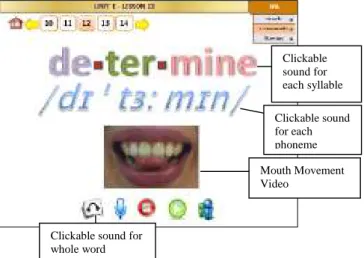
Mouth Movement Video Clickable sound for each syllable Clickable sound for each phoneme
Clickable sound for whole word
programmes shapes the pronunciation learners to be passive and dependent by mere duplicating the pronunciation without any explicit understanding to critically discern the sounds. If the learners listen to the incorrect pronunciation, they will inevitably repeat the incorrect sounds. Furthermore, the hearing of the learners is not adequately reliable as they are strongly influenced by the “phonological matrix of their native languages”[7, p.116].
This proposed MPLMS is technologically a new concept in digitising the phonetic symbols with clickable sounds for each phoneme, syllable and word together with the mouth movement video. In order to facilitate competent English pronunciation, it is essential that learners are given the sounds of English in addition to the visual coding system, phonetic symbols. The universally agreed system of notation for sounds, the IPA (International Phonetic Alphabet) symbols provide one unique symbol for one discrete sound [8]. This is meant to be easier for the pronunciation learners of non-native English speaking background to understand by reducing the ambiguities of overlapping sounds. By clicking the sound panel, learners can choose to hear the sounds of individual phoneme, syllable, or word, accompanied by video showing the mouth movements. Visual information of the mouth is an integral part of pronunciation learning. The MPLMS employs the feature of front view mouth movements because lips, jaws, tongue and teeth are always visible compared to other speech organs which can only be viewed to a limited degree. Learners can easily and clearly see the movements of the mouth in the production of the particular sounds. With the help of video camera or even mirror, they can self-correct their mispronunciation in their oral drills. By moving the mouth as displayed in the video, learners learn to discern whether they have produced the desired sounds.
Fig. 1 Interface of the MPLMS
Though technology has opened new doors to a variety of delivery options, the instructional design development process must align with pedagogy. In the MPLMS, the four basic
elements as shown in Figure 2 form the architecture of the system. The course content with the multimedia components (text, audio, video, graphic) is to meet the learning objectives. The organisation and delivery of the content are governed by pedagogy for the strategy to achieve the expected learning outcomes.
Fig. 2 Architecture of the MPLMS
It is convincingly expected that the proposed MPLMS will contribute to the design of instructional technology to supplement the learning of pronunciation in the English Curriculum Specifications. This paper shares the work in progress specifically the general methodology in designing and developing the MPLMS.
II.METHODOLOGY
The development of educational software is related both to general software engineering and to the instructional design of educational interventions [10]. Educational software methodologies tend to have evaluation and feedback done at each stage whereby a continual iterative approach is employed until all functionalities have been achieved. The methodology of developing educational software is flexible with each step depends on the result of the previous step [11]. To align with the flexibility, Figure 3 below illustrates the overall methodology in developing the MPLMS.
Fig. 3 Iterative Methodology
There are five main phases in the development lifecycle of the MPLMS:
Plan - establishing learning prerequisites and learning objectives to clearly identify the requirements
Design - the conceptual work of the MPLMS, which is an iteration to meet the requirements
Develop - the actual creation of the multimedia product, MPLMS, which is the iteration to deliver the design
Evaluate - a constant process to ensure all standards are met, which often inspires revision and makes the design process iterative
The cycle of design, develop and evaluate is repeating until the MPLMS is completed.
Implement - deliver the final product of MPLMS to the end-users
The emphasis in this methodology is on fast iterations through the cycle. Prototypes are designed, developed and evaluated by experts and with users, involving them in the process [12]. The methodology that encourages continual feedback and evaluation is particularly suited to the pedagogical perspective of the MPLMS to adapt to different situations.
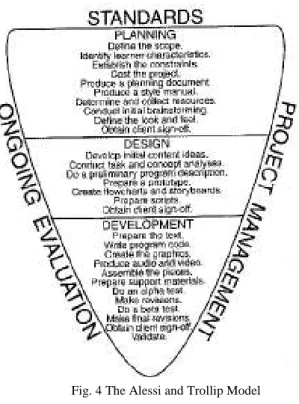
The detailed development scheme for the phases of planning, design and development is adopted from the three-phase Alessi and Trollip model as depicted in Figure 4.
Fig. 4 The Alessi and Trollip Model
In the Alessi and Trollip model of developing the interactive MPLMS, there are three attributes which are always present– Standards, Ongoing Evaluation, and Project
Management. They are the principles that applied to the whole process of design and development, and they form the good foundation.
A. Plan
The first phase in developing the MPLMS is planning. In this phase, a proper groundwork is laid to ensure all aspects of the system flow smoothly. It begins with defining the scope. The learning content of the MPLMS covers the sounds of phonetic symbols, including vowels, consonants, stresses, and frequently mispronounced words. Interactive enhancement exercises are also included. After the scope is defined, learner characteristics are assessed. The target learners of the MPLMS are young non-native English speakers aged between 10 and 12. These young learners should be exposed to their second language or foreign language as early to allow them optimise their learning potential and help shape the brain at its flexible stage. Children at this range of age acquire basic computer literacy which enables them to navigate the MPLMS meaningfully.
Constraints of the system development are to be established to ensure issues that will impact the design and development are studied, such as the compatibility of hardware, the potential software, available budget, deadlines and relevant permissions to be obtained.
A style manual will be prepared within 2 months of the commencement of the project. The style manual contains the structure of the system and the specifications which should be adhered to. This is to ensure that the standards are mutually agreed on to avoid misunderstanding. Good planning contributes to the efficiency of the design and development process and to the quality of the finished product.
B. Design
The design phase is the most creative as it deals with the activities of assembling the content and deciding on how it is to be treated from both an instructional and interactive perspective that will help the target learners achieve the intended learning outcomes.
After analysing the tasks and concepts, all the ideas are to be integrated for the system to work as a whole. Prototype is a mock-up of the MPLMS that portrays the design, the methodology and the metaphor to be used. It functions as a visual representation of the overall ideas to illustrate a concrete example for others to react to it and provide feedback. The aim of prototyping is to enable inputs from the experts and end users at an early stage by giving them the look and feel of the application. Flowchart reveals the structure and sequence of the instruction. A good flowchart reduces the risk of poor programming. Storyboards present a visual representation of the design by including the primary text and secondary text [13].
C.Develop
The third phase is taking the design of the MPLMS and turning it into a robust system. The development is a collaborative process. It includes all the computer programming expertise to make the whole system functions, encompassing the writing of programming code, the production of graphics, audio, and video materials, and the development of support materials. It is a demanding part of the
overall process and requires a variety of skills. During the development phase, the costs and time spent need to be monitored closely to ensure the MPLMS is done on time and within the allotted budget [14].
After assembling all the components, the MPLMS is to be tested. Alpha testing involves a thorough review of all aspects of the system and supplemental materials by the design and development team. The purpose is to identify and eliminate as many problems as possible. Following the completion of the alpha test and revision cycles, the final product of MPLMS is to be undergone beta testing.
D.Evaluation
Ongoing evaluation and revision are essential elements throughout the whole development process. The process of determining how robust and effective an instructional product helps its users attain the desired learning outcome is called validation [14]. The validity of the MPLMS will be evaluated through a series of formative tests, and usability testing will also be conducted to evaluate the ease of use, aesthetics as well as the educational efficiency of the system.
Formative evaluation is used with the intention of improving the quality of the MPLMS throughout its design and development by examining the delivery of the system, the quality of its implementation and the organisational context, structures and procedures [15]. One important aspect of formative evaluation is that the audience for the observations and recommendations is the project team itself, used to immediately improve the design of the product and refine the development specifications [16].
The usability testing is essential for the overall quality of learning and the user will gauge the system on the basis of interface. Usability ensures the ease of learnability of the learning environment, user-friendliness and visually attractive which increases the effectiveness [17]. Responses will be elicited through subject matter experts and learners [18]. The trial learners are selected from the target population to ensure the intended context is similar as the actual implementation phase. Methods which might be used include interviews/observations, focus groups, formal usability test, and questionnaires [19].
E. Implement
In this phase, it involves making sure all system functions are in place to support and maintain the instruction. The MPLMS must be integrated into the identified delivery (host) environment. Then it must be tested to ensure all components function as expected and end-users are able to access all instructional elements easily and without additional assistance [20].
The initial user training is to be completed, user documentation is to be delivered, and the post implementation review meeting is to be held. When this phase is completed, the application should be in steady-state production. This signifies that the goals of the research project are met for a satisfactory result [21].
III. CONCLUSIONANDFURTHERWORK
In this paper, the innovative Multimedia Pronunciation Learning Management (MPLMS) for improving pronunciation is proposed. The purpose of this project is to explore an
alternative method in learning pronunciation by training the users of MPLMS to be independent, active and critical in their learning process. It is convincingly expected that the proposed MPLMS will contribute to the design of instructional technology to supplement the learning of pronunciation in the English Curriculum Specifications.
With the methodology presented here, it is anticipated that the MPLMS will be developed in a systematic process within
the context that help reduce both the product’s development
time and costs without neglecting the quality. However, to profoundly enhance the MPLMS, research limited to the functionalities of the system will not be sufficient. The
learning contents and structure along with the learners’
psychological profiles are also key areas for extensive research.
REFERENCES
[1] Internet World Stats. World Internet users and population stats. 2011 [cited 2011 June 17]; Available from: http://www.internetworldstats.com/stats.htm.
[2] Ross D, editor. Learning English simulation learning for non-native English speakers incorporating edutainment methodology. Global Learn Asia Pacific 2010, AACE; 2010; Penang, Malaysia.
[3] Nunan E, editor. Flexible delivery: What is it and why is it a part of current educational debate? Higher Education Research and Development Society of Australasia: Different Approaches: Theory and Practice in Higher Education; 1996; Perth, Western Australia.
[4] Schwier RA, Misanchuk ER. Interactive multimedia instruction. New Jersey: Educational Technology Publications; 1993.
[5] Winn W, editor. Learning in hyperspace. Online Conference: The Potential of the Web; 1997; Adelphi, MD: International University Consortium and Institute for Distance Education.
[6] Mayadas F. Asynchronous learning networks: A Sloan Foundation perspective. Journal of Asynchronous Learning Networks. 1997;1(1). [7] Schütz R. The importance of pronunciation. 2008 [cited 2011 April 15];
Available from: http://www.sk.com.br/pronunciation.ppt.
[8] The International Phonetic Association. Handbook of the International Phonetic Association: A guide to the use of the International Phonetic Alphabet. UK: Cambridge University Press; 2003.
[9] Hossain SA, Rahman ML. Framework for component-based multimedia courseware development. Dhaka, Bangladesh: Center for Research and Training, East West University; 2007.
[10] Bostock S. Courseware Engineering - an overview of the courseware development process. 2003 [cited 2011 June 15]; Available from: http://www.keele.org.uk/docs/atceng.htm.
[11] Hunter A, Ellis A, editors. The development process for courseware material: A computing methodology approach. The ASCILITE 2000: Learning to Choose, Choosing to Learn; 2000; Southern Cross University, Coffs Harbour NSW Australia.
[12] Jenkins N. How to make software: An introduction to software development 2005 [cited 2011 June 15]; Available from: http://www.nickjenkins.net/prose/makingSoftware.pdf.
[13] Alessi SM, Trollip SR. Multimedia for learning: Methods and development (3rd ed.). Boston: Allyn & Bacon; 2001.
[14] Miller M. Chapter summaries of multimemedia for learning: Methods and development, 3rd edition. 2003 [cited 2011 June 15]; Available from: http://mlmiller.myweb.uga.edu/6200project/alessi.htm.
[15] European Commission. Formative evaluation. 2007 [cited 2011 June
17]; Available from:
http://ec.europa.eu/regional_policy/sources/docgener/evaluation/evalsed/ sourcebooks/method_techniques/planning_structuring/formative/main_s teps_en.htm.
[16] Bevan N, Singhal N, Werner B, Degler D, Wilson C. Formative evaluation. 2009 [cited 2011 June 17]; Available from: http://www.usabilitybok.org/methods/formative-evaluation.
[17] Durdu PO, Yalabik N, Cagiltay K. A Distributed online curriculum and courseware development model. Educational Technology & Society. 2009;12(1):230–48.
[18] Retalis S, editor. A courseware development methodology for open and distance learning. CAISE’ 97;1997; Barcelona, Spain.
[19] Preston A. Types of usability methods. Usability Interface. 2004;10(3):15.
[20] National Training and Education Division Responder Training Development Center. Implementation phase. 2011 [cited 2011 June 23];
Available from:
https://www.firstrespondertraining.gov/rtdc/state/review.htm.
[21] Princeton University. Princeton development methodology -Implementation phase. 2011 [cited 2011 June 23]; Available from: http://web.princeton.edu/dms/public/methodology/dev/instbase.html.