1 2nd CARPE Conference
November 4 - 6, 2013; Manchester, UK
IT
-
enabled Quality Management
implementations in Small Healthcare
Institutions
:
Method
and
Case Study
Koen Smit
HU University of Applied Sciences, Nijenoord 1, 3552 AS Netherlands [email protected]
Joris Mens
Utrecht University Graduate School of Natural Sciences, Princetonplein 5, 3584 CC Netherlands [email protected]
Johan Versendaal
HU University of Applied Sciences, Nijenoord 1, 3552 AS Netherlands [email protected]
Navin Sewberath Misser
HU University of Applied Sciences, Nijenoord 1, 3552 AS Netherlands [email protected]
Pascal Ravesteijn
HU University of Applied Sciences, Nijenoord 1, 3552 AS Netherlands [email protected]
2
Conference theme: the future of healthcare
Abstract
In the dynamic environment of increasing regulations, increasing patient demand, decentralization of budgets and enforcement of efficiency, small sized healthcare institutions in the Netherlands are having a difficult time. Although these service providers are usually capable of flexibly delivering healthcare, the investment and overhead for implementing and executing on required quality management standards like ISO 9001 is difficult. In this paper we construct a method for the implementation of an IT-enabled quality management system for small sized healthcare institutions, which is applied through case study. The case organisation provides intra- and extramural care for mentally handicapped persons and young adults with a psychiatric disorder. The quality management system implementation is based on 1) a lightweight IT infrastructure (based at a secure data centre and accessible through remote login) implying secure storage of patients' medical and personal information. Furthermore, the Deming (Deming, 1982) cycle enabled processes and protocols are 2) described in an e-handbook and prototyped via an open source process management system which supports the quality regulation demanded for providing care to patients. The case study supports the validity of our method and the fact that small sized healthcare institutions are able to execute their care while adhering to ISO 9001-like standards, with limited initial costs and relatively low cost of ownership.
3
1
Introduction
Healthcare organisations in the Netherlands are facing increasing demands from the
government (both on country and municipal level) and partners in the chain such as insurers. Healthcare institutions are no longer merely required to deliver qualitative health care. Policy makers also demand transparent quality management systems and internal procedures. In the Netherlands, by the end of the previous century, several initiatives have harmonised and standardised quality management in the healthcare, resulting in quality labels like ISO 9001 (NEN, 2013) and HKZ (Stichting HKZ, 2013). These quality labels have in common that they require the description of processes, procedures and protocols, taking advantage of the Deming cycle (Plan, Do, Check Act; Deming, 1982). Although it is not yet a firm legal requirement for all healthcare institutions to have a quality system certification, it is advised to standardise internal processes and to adhere to some quality labelling. Insurers play a significant role in the healthcare chain. For example, they can reimburse invoices from healthcare providers based on a complex system of indication codes for patients. More and more insurers are also asking a quality label from healthcare providers. With proposed budget cuts for healthcare also the Dutch government increases the pressure on healthcare
institutions to be transparant on their procedures and protocols.
These insights illustrate the need for efficient and effective internal processes for healthcare service providers, with implementation of quality management systems. These service providers have been standardising and certifying their internal processes by implementing quality management systems according to for example HKZ-standards. For small healthcare providers these implementations and day to day management of the processes require effort and dedication from all staff members. On top of that, software suites for quality management are often geared towards larger organisations and priced accordingly. Based on common principles of implementation of information technology (IT) this research aims to identify a suitable software solution and implementation method for small sized healthcare institutions to support quality. This is done by constructing an implementation framework and
performing a case study applying the framework in a small healthcare institution. The
framework consists of a method for implementing IT-enabled quality management systems in small sized healthcare institutions.
4 We need to limit our research focus as the healthcare is a very broad sector. The trend of empowering persons in need of healthcare makes our focus on long-lasting care for for example mentally disabled people and persons with a psychiatric disorder a justifiable one. Healthcare institutions should configure their processes, procedures and protocols (and hence their quality management system) such that optimal care is continuously provided for a longer time. In summary our focus is on small healthcare organisations that provide long-lasting care for patients.
2
Theoretical framework
Prior to focussing on the case study design science research has been conducted in order to address the primary research question:
How can small sized health care service providers, focussing on providing long-lasting care, implement a quality management system against low costs.
Design science research is a research meta-method that is applicable in the context of
information systems (IS), and explicitly takes into account practical relevance and rigor. Prior to focussing on IS-research, it is necessary to determine the relevance of research by defining the business needs based on a detailed overview of the organisations environment focussing on people, organisations and technology. Based on the body of knowledge of existing theories, frameworks and methods IS-research can be conducted by developing or building theories and artifacts that need to be evaluated or justified (Hevner, March, Park & Ram 2004).
The artifact or framework we are looking for in our research is a method for implementation of a quality management system in the context of small healthcare institutions that provide long-lasting care to for example mentally disabled persons.
To position our research and our framework we take advantage of the large body of
knowledge on business/IT alignment (see among others Venkatraman, Henderson & Oldach, 1993; Versendaal, Akker, Xing & Bevere, 2013). As with other information systems, the implementation of a quality management system should be aligned with, and should support, business strategy, processes and organisational infrastructure. We define the following
5 dimensions for the context of our artifact, staying close to Venkatraman, Henderson &
Oldach's (1993) original operationalisation of business/IT alignment: 1. Business strategy context
2. Business processes 3. Technology
ad 1) As for business strategy the base-line for the small sized healthcare providers of our focus is the short-term survival in the dynamic and fast moving market, in which the strength of such organisations are to be leveraged (flexible and quick provision of healthcare) against low overhead costs, with a well functioning quality management system.
ad 2) As for the processes we adhere to Hammer & Champy's (1993) argument for re-engineer business processes before automating them. In addition, provided the context of quality management systems, we include principles of continuous improvement of business processes through the Deming cycle (Deming, 1982), as well as the norms for
standardisation.
ad 3) Much has been written about the successes and failures of IT implementations in organisations (e.g. Ehie & Madsen, 2005; Ravesteyn & Versendaal, 2007). From these, within our context of small organisations in healthcare, we can adopt (Ehie & Madsen, 2005: p. 553): proper project management, support and drive from the CEO, involvement of users and employees, application of process re-engineering (see also the second dimension), low IT costs, and to relieve small healthcare organisations from in house IT infrastructure: e.g. by leveraging cloud computing (Hand, 2007).
From this we now construct our artifact, being an implementation method for quality management systems:
6 A) Assess existing quality management situation in the small healthcare organisation,
describe bottlenecks in terms of deviation from a quality label like HKZ (Stichting HKZ, 2013).
B) Determine possible enabling and innovating IT, for low-cost, with its infrastructure as much as possible out the door.
C) Process reengineering, leveraging principles as described by Hammer & Champy (1993), and including employees for improvement generation and testing. Ensure low costs in this step by strict project management and low labour costs.
D) Prototype and implement the solution.
3
Case study at Breder
Breder Foundation (Stichting Breder, www.stichtingbreder.nl) started in 2008 as a
one-woman business. Currently it is a Dutch-based small non-profit healthcare service provider of 35 employees that delivers individual coaching, group coaching and practical pedagogical family coaching. Breder also provides services to facilitate temporary stay and they provide care for persons in a supervised living community by renting houses. Breder is a regional health care provider in the centre of the Netherlands; patients of Breder are merely young adults with a psychiatric disorder or persons with a mental disability. As such they fit our scope of small healthcare organisation providing long-lasting care.
The case study was executed over a period of 14 months. Triggered in December 2011 by an explicitly formulated need from the CEO to gain a quality label certificate. By February 2013 the quality label was assigned, and the quality management system was implemented and highly automated against relative low costs. Also the forecast for the upcoming IT costs looks well manageable. As for the project team two Bachelor-students were involved performing their final thesis under the guidance of a professor from HU University of Applied Sciences. The project team executed the proposed previously defined method for Breder. We now go over each step of the method and discuss the application and the results of each step at Breder.
7 The quick growth of Breder caused for inefficiencies. Communication mostly went via the CEO, who also was (and still is) involved in the daily care business operations: this appeared to become a bottleneck. Also there was little time for defining policy and also to improve existing procedures. Through interviews with the CEO and two employees at Breder the situation in December 2011 was assessed in detail and projected unto the norms of the HKZ quality label. From this the following major areas for improvement were suggested:
• Yearly write a policy plan for the organisation
• Describe and execute on the existing processes of the care business operations and ensure that improvements are regularly investigated
• Ensure that patient files are easy accessible, centrally and securely stored and updated regularly
• Describe and execute on an employee contracting and development process
B) Determine enabling IT
In order to ensure easy access and securely stored electronic patient files, secure cloud computing was identified as an important enabler for Breder. And instead of a paper
handbook for the description of processes, procedures and protocols (as requested by HKZ), a web-site with an electronic version of the handbook in HTML-format, including hyperlinks and easy changeability was suggested: this should provide easy access to the latest
information, procedures etc. Finally the support of the processes and procedures through an open source (low-cost) workflow/process management system was proposed. Such a system provides employees with automatic task lists: next steps in a process to be undertaken by an employee.
C) Process re-engineering
The previous two steps provided triggers for really re-engineering the processes at Breder, and further detailing suggested IT. For example, the availability of patient files at a central location in the cloud, with controlled access for only those employees providing care to the patient, is made possible through cloud computing technology; it is also in sync with one of the major principles of Hammer & Champy (1993): store files and data once, centrally. Store once, centrally, prevents that employees need to come to the Breder office for looking into a patient's file, or that they have a copy that may be out of sync with a just updated original file. A secure cloud computing IT provider was contracted in order to execute on the proposed
8 cloud computing infrastructure; the services provided by this IT provider were kept very simple in order to limit the costs. Only the hardware and server based operating system were bought, and helpdesk support was contracted; as for file editing the free-of-cost OpenOffice open source software was downloaded and installed on the IT infrastructure. Secure access to the hard- and software was ensured by allowing employees to set up a Virtual Private
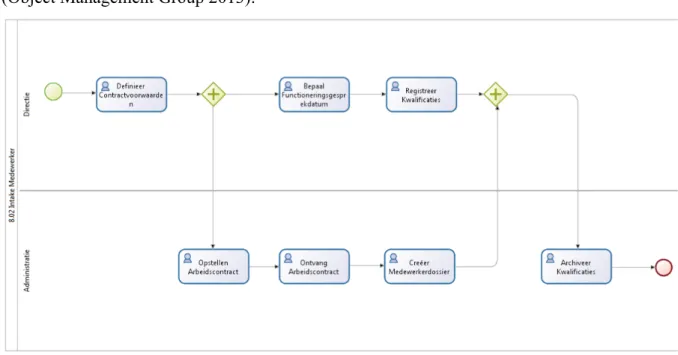
Network (VPN) connection (using free-of-cost open source downloaded VPN software) and by subsequently allowing employees to log in via Microsoft's Remote Desktop Protocol. As for for example the process of contracting employees, based on input from the CEO, a new process was re-engineered of which Figure 1 provides a picture in BPMN-format (Object Management Group 2013):
Figure 1: Employee contracting process in BPMN format (in Dutch)
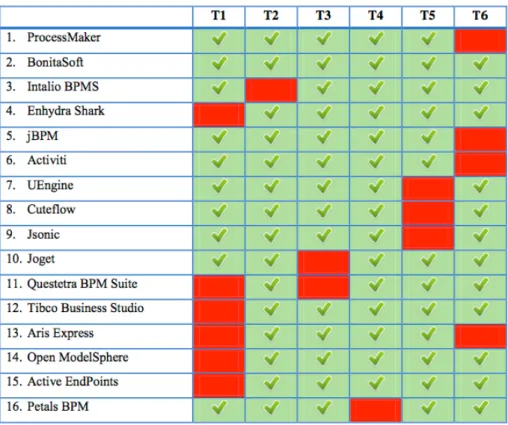
Each square in Figure 1 represents an activity to be performed by an employee. The arrows identify next steps to be taken, while the '+'-squares relate to parallel activities. As for the workflow/process management system supporting these BPMN-type of diagrams a selection process was proposed in which open source software was judged according to six criteria that adhere to the criteria as defined in our method framework:
T1: no costs, in principle, for downloading the software
T2: scalable, i.e. prepared for fitting on a small but growing organisation
T3: regulation compliant, i.e. the solution is not in conflict with healthcare regulations from
9
T4: stable, i.e. the software should not contain bugs that endanger the stability of the software
solution
T5: containing roadmap, there is a vision and strategy for future functionalities of the software
T6: easy to maintain, it should be easy for the healthcare organisation to maintain the software (future installs, configuration, etc.)
With these criteria the following available open source software packages were judged, resulting in the choice for BonitaSoft (see Figure 2).
Figure 2: Overview of judging 16 available process management software packages against six criteria
D) Prototype and implement the solution
In April 2012 an IT infrastructure in the cloud with secure storage of patients' medical and personal information was implemented and 'went live' after an instruction meeting for all employees. The actual implementation was preceded by conversion of all (mostly in existing paper format available) patient information: the digitization (scanning and saving) of patient files. Also the electronic version of the handbook in HTML-format was put in the cloud. This handbook contained further instructions on how processes at Breder were meant to be
10 by an independent accreditor who judged the completeness and applicability of the handbook. The accreditor confirmed that the description of the processes in the handbook, the
availability of centrally available secure electronic patient files, and the execution on the processes was satisfactory and he consequently provided Breder with the HKZ quality label. As for the process management system, from the period of September 2012 to January 2013, the two bachelor students worked on the technical installation of the BonitSoft software on the available IT infrastructure of Breder in the cloud. Also they configured BonitaSoft according to the processes as described in the handbook, and in cooperation with input from two employees and the CEO of Breder. By January 2013 they were able to prototype the support of all processes as described in the electronic handbook. Currently the prototype is being adapted to prepare for a full roll-out of BonitaSoft, so that all employees will start working in the BonitaSoft environment.
4
Conclusions
Following Hevner, March, Park & Ram's (2013) design science research meta-model this paper describes the construction and validation of an artifact (in casu an implementation method for a quality management system). The constructed method is built from an existing scientific body of knowledge on implementations of IT in organisations, and is considered relevant for small sized healthcare organisations embarking on a quality management program. As for the theoretical basis, principles of business/IT alignment (Venkatraman, Henderson & Oldach, 1993) and principles from business process re-engineering (Hammer & Champy, 1993) have been applied, thus contributing to the rigor of our research.
With the application of the five steps of the method in the case study at Breder, the validity of the constructed method is confirmed:
A) we were well able to assess the existing quality management system and to identify gaps and deviations from desired quality labelling;
B) we were well able to find low-cost software solutions for supporting and enabling an improved quality management system;
C) we were well able to leverage principles of process re-engineering at low costs, though one may argue that putting a senior consultant on this step may be much more expensive than two students under guidance of a professor.
11 D) we were well able to prototype and implement the quality management system against low costs: part of it was fully rolled-out (IT infrastructure, handbook and electronic patient files), and the other part (process management system) is currently being prepared for roll-out. Because our research focuses on small organisations, well-prepared implementations of information systems is more easy and costs less than implementing such systems in larger organisations.
Moreover the accreditor's approval on the quality management system, and the subsequently receipt of the HKZ certificate also support the validity of our approach.
We further argue that the method and its application at Breder follows business/IT alignment principles as described in section 2:
1) With relatively low costs for the implementation of a quality management system, and with relatively low costs of ownership for the quality management system, Breder continuous to be a flexible organisation, yet more professionalised as for quality management;
2) Principles of process re-engineering and norms for quality management are well applicable in the context of small healthcare organisations;
3) Either explicit or implicit the success factors for implementation of information systems were also taken care of for our implementation at Breder.
Of course more cases can and should be performed to investigate in more detail the validity of the constructed method for small healthcare organisations providing long-lasting care.
5
References
DEMING, W.E. (1982) Out of the Crisis. The Massachusetts Institute of Technology, Cambridge, Massachusetts: MIT Press.
EHIE, I.C. & MADSEN, M. (2005) Identifying critical issues in enterprise resource planning (ERP) implementation. Computers in Industry. 26. p. 545-557.
HAMMER, M. & CHAMPY, J. (1993). Reengineering the corporation. A manifesto for
business evolution. London: Nicholas Brealy Publishing Ltd.
12 HEVNER, A.R., MARCH, S.T., PARK, J. & RAM, S (2004). Design science in information systems research. MIS Quarterly. 28(1). p. 75-105
NEN. (2012). ISO 9001 voor de zorg. [Online] Available from:
http://www.nen.nl/Normontwikkeling/normcommissie/ISO-9001-voor-de-zorg.htm [Accessed: 12 september 2013]
OBJECT MANAGEMENT GROUP (2013) Business Process Model and Notation. [Online] Available from: http://www.bpmn.org [Accessed: 10 October 2013]
RAVESTEYN, P. & VERSENDAAL, J. (2007) Success Factors of Business Process Management Systems Implementation. in ACIS2007 Proceedings of the 18th Australasian
Conference on Information Systems. Toowoomba, Australia, 5-7 December 2007.
STICHTING HKZ. (2013) HKZ-normen. [Online] Available from:
http://www.hkz.nl/content/view/1515/1352/ [Accessed: 12 september 2013]
VENKATRAMAN, N., HENDERSON, J.C. & OLDACH, S. (1993) Continuous strategic alignment: Exploiting information technology capabilities for competitive success. European
Management Journal, 11(2), pp.139–149.
VERSENDAAL, J.M., AKKER, J.M. VAN DEN, XING, X.C. & BEVERE, B. (2013). Procurement maturity and IT-alignment models: overview and a case study. Electronic Markets: (2013, April 14).