February 2004
On the Hidden Links Between Financing Costs and International Trade Patterns
Yothin Jinjarak
Department of Economics, University of California at Santa Cruz
Abstract
This paper investigates whether there is a link between financing costs and international trade patterns, and if so, whether this link is determined by the strength of trade and financial ties between trading partners. The potential importance of these considerations stems from the fact that
approximately half of world trade is conducted on credit; a supplier gives to its foreign buyer a trade-financing loan financed by commercial banks on both sides of the transaction. For buyers, especially in developing countries, trade-financing loans from foreign suppliers are an essential source of external finance for international trade. We find that, first, with respect to price, the industry-level evidence indicates that financing costs determine international trade patterns, whereby for each industry the pass-through rates of exchange-rate changes into import prices are positively correlated with the industry's dependence on external-finance and trade-credit use. Second, with respect to volume, the country-level evidence suggests that between trading partners, the volume of trade-financing loans depends positively on the stronger trade and financial ties, including the higher value of total imports, the higher degree of product differentiation in imports, and the higher value of banking claims. Interestingly, investigation on trade-financing loans during periods of systematic banking crises suggests that the links between financing costs and international trade patterns also depend on characteristics of the loan arrangements (i.e. maturity), the size of the commercial banks (i.e. money-center, large, or small), and type of creditors (i.e. commercial bank or official).
Keywords: Trade financing, pass-through, trade and financial linkages, international debt JEL classification: F15, F23, F34
Acknowledgements: I am grateful to Joshua Aizenman for his invaluable guidance, and to Yin-Wong Cheung, Michael Dooley, David Kaun, and Kenneth Kletzer for comments and suggestions. I would like to thank Raghuram Rajan and Luigi Zingales for data on measures of industry external-finance use, Raymond Fisman and Inessa Love for data on measures of industry trade-credit use, and Andrew Rose for data on distance and indicator of regional trade agreement. Financial support from the University of California President Dissertation-Year Fellowship is gratefully acknowledged. All remaining errors are my own.
Contact: Yothin Jinjarak, 514 South Gramercy Pl.#20, Los Angeles, CA 90020. E-mail: [email protected]. Tel: +1 213 268 0750.
2
Is there a link between financing costs and international trade patterns? For example,
considering a firm's purchasing of an imported good: one firm could pre-buy for future delivery, while another spot-buy for immediate delivery. Intuitively, if both use the same mode of transportation, the former would have higher financing costs since the firm has to pay in advance, but it should be better for hedging against the variability of import prices. So, does a firm in an industry which faces high financing costs because it requires extensive external finance have less control over the variability of prices of its imported goods when faced with exogenous shocks such as movements in exchange rates or changes in tariff and non-tariff measures, than a firm in an industry which requires little external finance?
Approximately half of world trade is conducted on credit; a supplier gives to its foreign buyer a trade-financing loan financed by commercial banks on both sides of the transaction. For buyers, especially in developing countries, trade-financing loans from foreign suppliers are an essential source of external finance. How then does a disruption in a country’s financial system affect this source of external finance? For example, should a country with stronger trade and financial ties with its trading partners be less affected by disruptions in its financial system because it might be better in securing trade-financing loans?1
In short, how important is the link between financing costs and international trade, and what are the implications for the conduct of monetary and international trade policy? Is there a link between financing costs and international trade patterns? And if so, is it determined by the strength of trade and financial ties between trading partners?
1 This interest essentially comes after observing that following a turbulent period in financial sector such as debt- and financial crisis, a debtor country tends to have difficulty in continuing normal operation of its international trade. For example, Anne O. Krueger (2002) emphasizes the necessity of a debt restructuring mechanism that would facilitate the provision of trade-financing need of a debtor country in order to limit the degree of economic dislocation. Empirical work seems consistent with the concern that disruption in a country’s financial sector adversely affects its international trade. For example, on the basis of data from 217 countries between 1948 and 1997, Andrew K. Rose (2003) concludes that: “international default has negative consequences for trade.” Nevertheless, his study simply suggests correlation, but not a channel through which financing costs of a country affect its international trade. As Rose puts it: “It seems clear that there are reasons to believe that sovereign default may lead to a decline in international trade, either as a punishment for and deterrent to further default, or simply because of more costly trade finance and/or insurance.” This paper advances his findings by investigating a channel through which a country’s financing costs affect its international trade patterns.
3
This paper seeks to answer these questions by considering two sets of evidence. First, We use the U.S. industry data disaggregated at four-digit level on a firm’s external-finance use and import prices to test whether the pass-through rates of exchange-rate changes are determined by an industry’s financing costs. With respect to price, the industry-level evidence indicates that financing costs determine international trade patterns, whereby for each industry the pass-through rates of exchange-rate changes into import prices are positively correlated with the industry's dependence on external-finance and trade-credit use. Essentially, this implies that financing costs may also influence the response of international trade patterns to changes in international trade policy (i.e. import tariffs, anti-dumping duties) and monetary policy (i.e. dollarization, interest rate).
Second, We use data on trade-financing loans from the U.S. commercial banks, and from the G7-creditors, to examine whether the strength of trade and financial ties could explain the amount of trade-financing loans between trading partners. We find that the volume of trade-financing loans depends positively on the value of total imports, the degree of product differentiation in imports, and the value of banking claims. Interestingly, our investigation on trade-financing loans during periods of systematic banking crises suggests that the links between financing costs and international trade patterns also depend on characteristics of the loan arrangements (i.e. maturity), size of the commercial banks (i.e. money-center, large, or small), and type of creditors (i.e. commercial bank or official).
This paper follows a literature that emphasizes the association between real and financial linkages (Andrew K. Rose and Mark M. Spiegel (2002), Kristin J. Forbes and Menzie D. Chinn (2003)). The main conclusion of this paper is that there are economically important links between financing costs and international trade patterns, and that these links are determined by trade and financial ties between trading partners.
This paper starts with a theoretical underpinning which is used to organize data for basic tests in section 2. In section 3, I set up the econometric tests and discuss the results. Section 4 concludes.
4
1. Theoretical underpinnings: trade and financial ties hypothesis
In a simple arrangement of international-trade transactions, after a supplier contracts to supply goods to a foreign buyer, there is a parallel trade-financing loan agreement in which a bank lends on behalf of the supplier to the foreign buyer’s bank2. Normally, the loan is guaranteed by an export-credit agency of the supplier’s country and/or a lead bank, if the loan is syndicated.
We argue that under the buyer’s limited commitment to repay, the total amount of trade-financing loans is determined by strength of trade and financial ties between the supplier/creditor country and the buyer/borrower country. Specifically, the amount of trade-financing loans depends on the following:
positively on the value of total imports by the buyer country,
positively on the value of banking claims with the buyer country, and
on the degree of product differentiation in total imports, with the direction of the association determined by characteristics of the loan arrangements (i.e. maturity), size of the commercial banks (i.e. money-center, large, or small), and type of creditors (i.e. commercial bank or official).
We label this the “trade and financial ties hypothesis.” The basic intuition behind this hypothesis, and the formal model focusing on international exchange characterized by separation between the quid and the quo such as trade-financing loan, contracts for future delivery, collateral, and insurance, is found in Appendix B.
2. The basic tests
The trade and financial ties hypothesis in the previous section sets the framework to examine empirically the links between financing costs and international trade patterns. Our next step is to investigate whether there is a link between financing costs and international trade patterns, and if so,
2 Stylized facts of trade financing are found in Appendix A. Figure A illustrates details and time-line of standard trade-financing arrangement.
5
whether this link is determined by trade and financial ties between trading partners. I proceed by setting up basic tests on two sets of data.
2.1 The First Test: Financing Costs and Pass-Through into Import Prices
The objective is to test whether the pass-through rates of exchange-rate changes into import prices are determined by each industry’s financing costs. If so, there is a link between financing costs and international trade patterns. More importantly, such a link implies that financing costs could also determine the response of international trade patterns to changes in international trade- and monetary policy.
The most disaggregated and comprehensive data on each industry’s use of external-finance that can be linked with import prices is available only for the U.S.’s manufacturing industries3. I use the basic econometric specification that is closely related to standard exchange-rate pass-through estimation, with a modification, to address what we are looking for: for each industry, the correlation between the pass-through rates of exchange-rate changes into import prices and the industry’s financing costs.
Theoretically, financing costs use should be positively correlated with the pass-through rates. In purchasing an imported good, the firm could pre-buy for future delivery or spot-buy for immediate delivery. The former would imply higher financing costs since the firm has to pay in advance, but would be a better hedge against the variability of import prices4. Thus, the disconnection between changes in import prices and exchange rates should be more likely for an industry that faces low financing costs with little need for external-finance use. Hence, if we can measure the industry’s
3 Using only the U.S. data raises a question on whether the evidence from the U.S. industries is a good representative for industries in other countries. The response to this question is, given that the U.S.’s capital market is more developed than most countries, the U.S. firms are less financially constrained, implying that the findings, if any, of the correlation between industry’s external-finance use and the rates of exchange-rate pass-through into import prices can be ‘a lead evidence’ of the link between international trade and financing costs in other countries. In other words, using the U.S.-industry evidence simply biases against any finding of the link between financing costs and international trade patterns.
4 See Joshua Aizenman (2003) where it is shown in a formal model that higher financing costs can increase the cost of pre-buying imports, reducing thereby the frequency of pricing to market and the expected deviation from relative purchasing power parity. It should be noted that this study investigates only import pricing behavior. For many developing countries that are highly dependent on exports of one primary commodity, there is also cost associated with export price fluctuations. See, for example, Kenneth M. Kletzer et al. (1992), for a study on the role of conventional instruments for smoothing primary exporters’ price risks, including loans and futures contracts, in the presence of sovereign risk and capital shortages.
6
financing costs, we should expect a positive interaction between the industry’s financing costs and exchange rate changes.
In order to focus on the interaction between exchange-rate changes and the industry’s financing costs, I modify the standard exchange-rate pass-through estimation by including the interaction effects of exchange rates with a measure of external-finance use, and controlling variables thought to influence pass-through rates across industries. The dependent variable is the industry-disaggregated import price index, pooled across industries and time periods. Let j denotes industry and t denotes time period, the estimating equation, with all variables transformed to natural logs, is given by:
(1) Import Pricesj,t
=
β
1⋅
Lagged Import Pricesj,t +β
2⋅
Exchange Ratest +β
3⋅
(Exchange Ratest×
Volatility of Exchange Ratest) +β
4⋅
(Exchange Ratest×
Industry j’s Concentration) +β
5⋅
(Exchange Ratest×
Industry j’s Financing Costs) +β
6⋅
Industry j’s Inventory to Shipmentst +ε
j,tIt should be noted that this approach of estimating exchange-rate pass-through has one advantage over other specifications of pass-through estimation. By focusing on differences across industries based on interactions between exchange rates and variables thought to influence the pass-through rates, this approach can estimate the correlation between the rates of pass-pass-through and controlling variables without using two-stage estimation. Thus, unlike previous studies, it is less subject to an econometric issue of weighted least squares5.
5 Previous studies on exchange rate pass-through use the two-stage regression technique whereby, (1) pass-through elasticities are estimated for each series of import prices (industries, countries), and (2) weighted least squares method is implemented by using the inverse of the standard error of pass-through elasticity estimates from the first stage as weights to allow for heteroskedasticity for the first stage pass-through elasticities. See, for example, Jaiwen Yang (1997) on a link between and exchange rate pass-through and degree of product differentiation, and Jose Manuel Campa and Linda S. Goldberg (2003), on
7
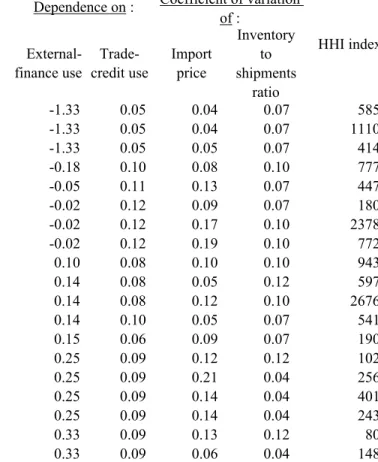
Variables and their source of data are reported in Appendix D. Two simple correlations (not reported) are noteworthy. First, the simple correlation shows that an industry that is highly dependent on external-finance use is also highly dependent on trade-credit use: the correlation between the two variables for all U.S. companies in the 1980’s is 0.38 and statistically significant at 5-percent level. Second, an industry with high level of industry inventory to shipments tends to be highly dependent on external-finance use.
2.2 The Second Test: Trade and Financial Ties and Volume of Trade-Financing Loans
The objective here is to examine whether between trading partners the amount of trade financing loan depends on trade and financial ties. For buyers, especially in developing countries, trade-financing loans from foreign suppliers are an essential source of external finance for international trade. In particular, it is important to investigate how a disruption in a country’s financial system such affects this source of external finance. Results from this test should suggest whether a link between financing costs and international trade patterns depends on trade and financial ties between trading partners.
The simple econometric specification is as follows: The dependent variable is the amount of trade-financing loans a borrower (importer) country receives from a creditor (foreign supplier) country. The key explanatory variables include measures of trade and financial ties between trading partners. In order to investigate the response of trade-financing loans to trade and financial ties during periods of disruption in a borrower country’s financial system, I include the interaction effects between the indicator of a financial disruption and measures of trade and financial ties. Let i denotes borrower countries and, as before, t denotes time periods. Let
[ ]
•
′
be a row vector of explanatory variables, andk
Θ
be a column vector of coefficients. The estimating equation is given by:how exchange rate pass-through across OECD countries are determined by microeconomic factors (e.g. industry composition of a country’s import bundle) and macroeconomic factors (e.g. inflation and volatility of exchange rates).
8 (2) Trade-Financing Loansi,t
=
θ
0⋅
Financial-Disruption Indicatori,t +[
Trade and Financial Ties]
′
i,t⋅
Θ
1+
[
Trade and Financial Ties× Financial-Disruption Indicator
]
′
i,t⋅
Θ
2 +[
Controlling Variables]
′
i,t⋅
Θ
3To deal with the non-zero nature6 of the observations on the amount of trade-financing loans, I estimate the above equation with the pooled Tobit regression7, with all variables in natural logs, including controlling variables thought to determine trade-financing loans between trading partners. Of course, we need appropriate measures of trade and financial ties and the indicator of
financial-disruption periods. This is what we will examine shortly8.
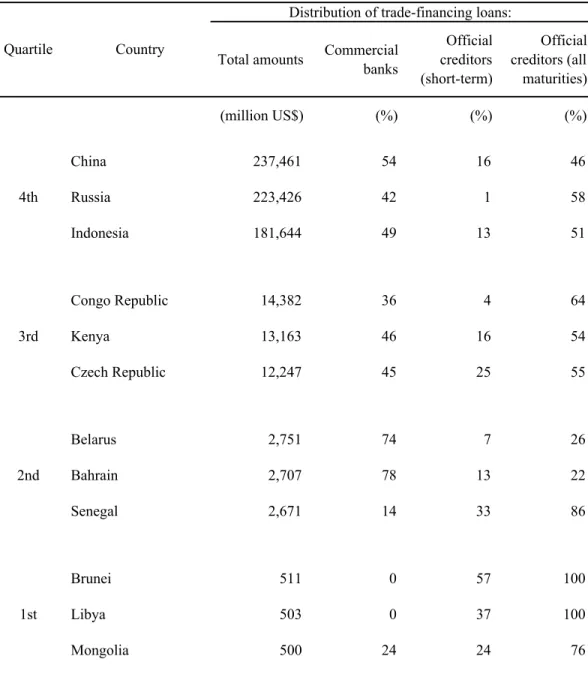
Variables and their source of data are reported in Appendix D. Tables 4 and 5 report statistics of the trade-financing loans data. Several points are noteworthy. First, from 1997 to 2002, Korea and Brazil not only proportionally received large trade credits from the U.S. commercial banks, but they also received trade credits in excess of total imports from the United States. Second, most of trade credits from G7 to low-income countries were from the official creditor (i.e., Senegal:85%,
Mongolia:76%). We also find that the correlation (not reported) between the value of banking claims
6 When an observation on trade-financing loan is equal to zero, it might not be the issue of data observability as in the general data-censoring problem. Suppose that the volume of trade-financing loans is an observable outcome: a trade-financing loan takes on the value zero with positive probability, but is a continuous random variable over strictly positive values. One can think of a borrower/importer and a creditor/foreign supplier solving an optimization problem, in which for some periods the optimal choice will be zero trade-financing loan (a corner solution).
7 Computationally, this estimation technique applies standard Tobit regression to a data set as if it was a one long cross section of size equals to number of panels
×
periods of time.8 Andrew K. Rose and Mark M. Spiegel (2002) investigate causality between a country’s bilateral borrowing and bilateral trade with its creditors. They show that a volume of bilateral borrowing is higher between countries with stronger trade ties. However, the skeptic could still offer a number of arguments against causality. First, although Rose and Spiegel solve a possibility that international borrowing and trade could be driven by a common factors by using instrumental variables, in the absence of a well-accepted theory of a link between a country’s financing costs and its international trade, the set of their instruments thought to be important to international trade but not international borrowing patterns may not include a large number of potential omitted variables. Second, from their claim, though intuitive and suggestive, it is difficult to draw on an example and policy implication between a country’s financing costs and its international trade pattern. Empirical work that links directly a channel through which financing costs of a country influences its international trade is essential in order to advance a discussion on real and financial linkages, and, in particular, the immediate concern on the links between international trade and financial system (e.g. whether a country services its debt obligation because it wants to avoid losing trade financing (Jeremy I. Bulow and Kenneth Rogoff (1989)), or to preserve its good reputation (Jonathan Eaton and Mark Gersovitz (1981), Kenneth M. Kletzer and Brian D. Wright (2000), or to avoid from collusive punishment from international banks (Mark J. Wright (2002))). This paper makes progress on causality between trade and finance by focusing on the mechanics of trade-financing, a channel through which a country’s financing costs may potentially influence its international trade patterns.
9
and imports are high and statistically significant (0.5 and 0.8 in the case of the U.S.’s banks and the G-7 creditors, respectively), consistent with the findings of Andrew K. Rose and Mark M. Spiegel (2002) to the effect that a volume of bilateral borrowing is higher between countries with stronger trade ties.
3. The hidden links
3.1 Pass-Through Rates Are Positively Correlated with Financing Costs 3.1.1 Results from Dependence on External-Finance Use
I start by using Dependence on External-Finance Use as a measure of an industry’s financing costs. As can be seen from Table 2, the coefficient estimates on the interactions between Dependence on External-Finance Use and Exchange Rates are all statistically significant. However, their signs vary for different categories of the U.S. companies. This can be the case when old firms in a low pass-through industry have lower external-finance use (face lower financing costs) than old firms in a high pass-through industry, but a pattern of external-finance use of young firms is reversed. If anything, this result suggests interesting linkages between international trade, monetary policy and credit markets. Mitchell A. Petersen and Raghuram G. Rajan (1995) show that creditors in concentrated credit markets have an assurance of obtaining future surplus from the firm, and consequently accept lower returns up front, so that in credit markets young firms who get institutional loans (bank loans) are more indebted in concentrated credit markets than in competitive credit markets, but this pattern reverses for older firms since the older firms, having few investment opportunities and being faced high interest rates, tend to use less external finance9.
One way to get a sense of magnitude of the coefficient estimates is as follows: The industry at the 4th quartile (highest dependent) of Dependence on External-Finance Use is Special Industry Machinery. The industry at the 1st quartile (lowest dependent) is Instruments for Testing of Electrical
9 See also Raghuram G. Rajan and Luigi Zingales (2001) for a survey on how relationship-based (bank-dominated) and arm’s length (market-based) financial system can have different effects on industrial structure and growth.
10
Signals. Using the Dependence on External-Finance Use of old firms in the 1980’s, the coefficient estimate then predicts that pass-through of 1 percent exchange rate changes into import prices of the Special Industrial Machinery should be 0.577 percent higher than the Instruments for Testing of Electrical Signals industry.
3.1.2 Results from Dependence on Trade-Credit Use
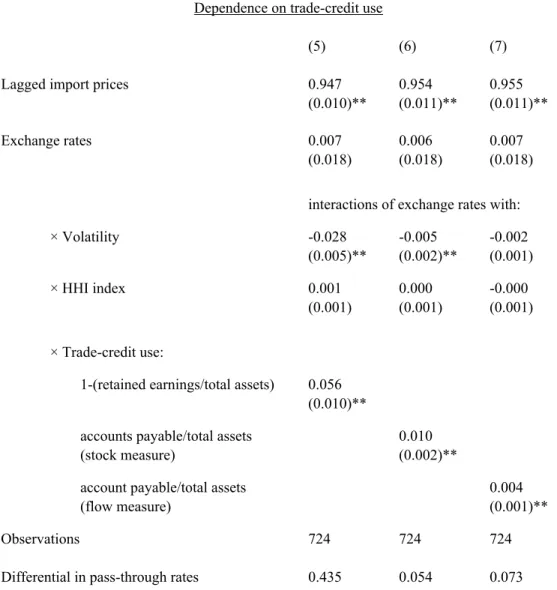
As can be seen from Table 3, the coefficient estimates of the interactions between Exchange Rates and Dependence on Trade-Credit Use are all positive and statistically significant at the 1-percent level10.
A sense of magnitude of the coefficient estimates is given as follows. The industry at the 4th quartile (highest dependent) of Dependence on Trade-Credit Use is Electrical Machinery, Equipment, and Supplies. The industry at the 1st quartile (lowest dependent) is Construction Machinery and Equipment. Using the stock measure of Dependence on Trade-Credit Use of firms in the 1980’s, the coefficient estimate then predicts that pass-through of 1 percent exchange rate changes into import prices of the Electrical Machinery, Equipment, and Supplies industry should be 0.054 percent higher than the Construction Machinery and Equipment industry.
These results are interesting for both practical and intellectual reasons. The immediate practical concern is that while the literature on open-economy macroeconomics focuses on how firm pricing behavior (in particular, pricing to market behavior, market power, and product differentiation) affects the conduct of monetary policy, the results presented here suggest that dependence on external-finance use and industry financing costs are also important. The intellectual interest of these results is that they offer evidence on the role of financing costs in international trade. In recent years, researchers have been concerned with how firms’ dynamics such as pricing and productivity influence patterns of
10 Although the estimation does not use measures of Dependence on Trade-Credit Use from different categories of firms (i.e. young firms and old firms), it is unlikely to observe opposite patterns of the correlation between pass-through rates and trade-credit use across firm age as we did when we use measures of Dependence on External-Finance Use. Using firm-level data, Mitchell A. Petersen and Raghuram G. Rajan (1995) find that although the decision to offer trade credits depends upon the firm’s quality, the decision by trade creditors to offer early payment discount does not vary with firm size or firm age.
11
international trade. The evidence in this paper suggests a possible channel through which finance and capital markets might have influential impact on international trade patterns.
3.2 Trade and Financial Ties Determine Volume of Trade-Financing Loans 3.2.1 Varying the U.S.-Commercial Bank Size
With the data on trade-financing loans from the U.S. commercial banks, we are able to investigate whether the correlations between trade-financing loans and trade and financial ties vary across bank size. Using the data on trade-financing loans from the U.S. money-center banks, Table 6 reports the coefficient estimates on the measures of Trade and Financial Ties with and without interactions with Financial-Disruption Indicator.
As can be seen in the first and second column of Table 6, the coefficient estimates on Value of Total Imports, Value of Banking Claims, and Degree of Product Differentiation in Imports, are positive and statistically significant.11,12 The coefficient on Financial-Disruption Indicator is negative, but not significant. The coefficient estimate of the interaction between Financial-Disruption Indicator and Degree of Product Differentiation in Imports is negative and statistically significant at the 1-percent level.
For panel data, where both cross-section and time-period are large, there could be the problem of cointegration in the panel estimation (see for example M. Hashem Pesaran and Ron Smith (1995) and Peter C. B. Phillips and Hyungsik R. Moon (1999)). In the context of trade-financing loans in this study, the existence of cointegration would probably mean that trade-financing loans across borrower countries are highly correlated over time. In other words, if one has a prior that trade-financing markets are highly integrated, it might be useful to control for cointegration in the estimation.
11 Throughout the paper, the reported standard errors are robust to heteroskedasticity.
12 To get a sense of magnitude of coefficient estimate from the Tobit estimation is not straightforward. This is because partial effects on mean responses, averaged across the distribution of unobservables, cannot be identified. Jeffrey M. Wooldridge (2002) suggests an approach to get around this, but given a large number of explanatory variables under consideration in this paper, his approach is not practically applicable to our estimation.
12
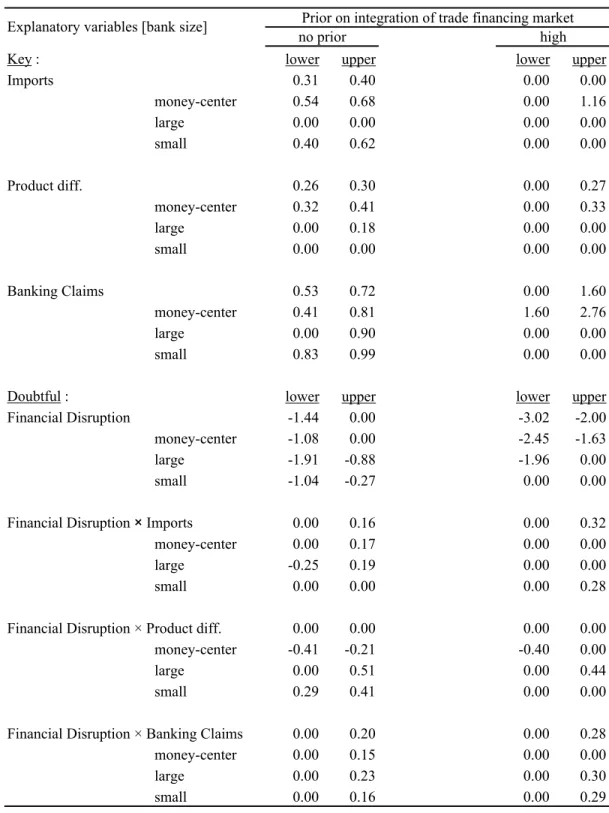
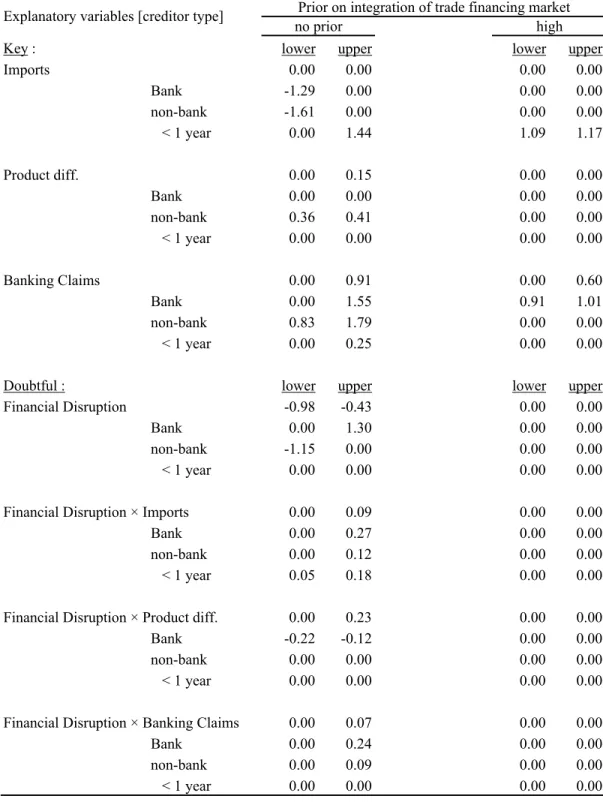
The robustness of the results with different specifications, and the extent of panel cointegration are considered in Table 7, which show the lower- and upper bound of coefficient estimates of a series of models nested between the specification (8) and (9). The columns with ‘no prior’ are coefficient estimates without controlling for the possibility of panel cointegration in the estimation,13 whereas the columns with ‘high’ are estimates with a prior that trade-financing market is highly integrated. As can be seen from Table 7, the coefficient estimates on the interactions between Financial-Disruption Indicator with Value of Total Imports and with Value of Banking Claims are positive with varying degree of statistical significance for all U.S. banks.14 Interestingly, the effects of the interaction between Financial-Disruption Indicator and Degree of Product Differentiation in Imports vary across the bank size: for the trade-financing loans from money-center banks, the effect is negative, whereas it is positive for large and small banks. This suggests that during a period of systematic banking crises, the links between financing costs and international trade patterns depend on the size of the commercial bank of the loan arrangement.15
3.2.2 Varying the G7-Creditor Type
Data on trade-financing loans from the G-7 countries allow us to investigate the correlation between trade and financing ties and the provision of trade-financing loans by creditor type
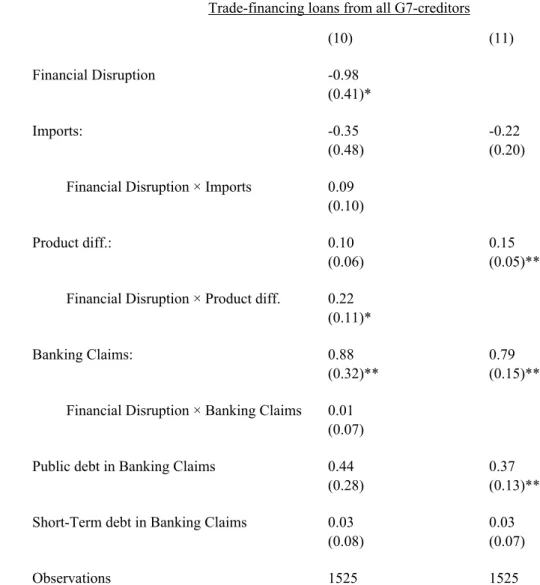
(commercial banks, all- and short-term official creditors). Table 8 reports the coefficient estimates of the basic specification using the data on trade-financing loans of all types of the G7 creditors.
13 I follow M. Hashem Pesaran and Ron Smith (1995), that by averaging the data over time and estimating cross-section regression on group means, the estimation should provide efficient and consistent estimates of the long-run effects of the explanatory variables if there is panel cointegration in the data.
14 All coefficients reported in lower- and upper-bound are at least at 5-percent level, otherwise zero value reported.
15 This might be a result of bargaining position of a borrower country and its creditors. Using data on secondary-market prices of loans to developing countries from U.S. commercial banks, Fernandez and Ozler (1999) find that countries with higher debt concentration (the proportion of a country’s debt held by large banks relative to small banks) have higher secondary-market prices of loans. They argue that because the banks’ bargaining power increases with the degree of debt concentration, repayment and secondary-market prices will increase with a country’s level of debt concentration. In addition, our result shows that disruption in a country’s financial system affects international trade, a finding that is closely related to the study on the link between financial development and international trade. Thorsten Beck (2003, (2002)) finds that countries with better-developed financial systems have higher export shares and trade balances in industries that use more external finance, suggesting that financial development may translate into a comparative advantage in industries that use more external finance. Delving deeper into the components (i.e. by industries) of international trade, it is possible that the negative impact of financial disruption on international trade is larger for industries that face higher financing costs and depend more on external finance.
13
Table 9 reports lower- and upper-bound of coefficient estimates from the data of the G7 creditors. The coefficient estimates on the interactions of Financial-Disruption Indicator with Value of Total Imports and with Value of Banking Claims are positive and statistically significant.
Interestingly, the effects of Financial-Disruption Indicator and its interaction with Degree of Product Differentiation in Imports on the amount of trade-financing loans differ across creditor types. The effect of Financial-Disruption Indicator is positive for commercial-bank creditor, whereas it is negative for official creditor. This seems to suggest that during periods of systematic banking crises, there is a substitution away of trade-financing lending from official to commercial-bank creditor16. The interaction between Financial-Disruption Indicator and Degree of Product Differentiation in Imports has a negative effect on trade-financing loans in the case of commercial-bank creditor, but none for official creditors. That Trade and Financial Ties are less important to the official creditors with respect to the commercial-bank creditors seems reasonable since, in recent years, official creditors such as export-credit agencies have changed their role from lender to guarantor of trade-financing loans.
4. Conclusion
Approximately half of world trade is conducted on credit; a supplier gives to its foreign buyer a loan financed by commercial banks on both sides of the transaction. For importers, especially in developing countries, trade-financing loans from foreign suppliers are an essential source of external finance. This paper argues that there are links between financing costs and international trade patterns, links that are determined by the strength of trade and financial ties between trading partners. The paper presents two sets of evidence, which, apart from the main findings, may bear on other areas of current research.
16 Dalia Marin and Monika Schnitzer (2002) show that since the international debt crisis in the 1980’s, international barter has also emerged as an international trade technique, and increases substantially after recent financial crises in Russia and South East Asia.
14
First, with respect to price, the industry-level evidence indicates that financing costs influences international trade patterns, whereby for each industry the pass-through rates of exchange-rate changes into import prices are positively correlated with the industry's dependence on external-finance and trade-credit use. Essentially, this means financing costs determines international pricing behavior. In the context of the exchange-rate pass-through literature, the findings in this paper provides fresh evidence that an industry’s external-finance use and its financing costs have an influence on pass-through rates. This knowledge is useful in the implementation of optimal monetary policy in open-economy framework. In the context of international trade literature, this paper suggests that there are links between a country’s financing costs and source of external finance, and trade patterns with its trading partners. Essentially, these imply that financing costs can potentially be an important factor in determining the effect of a shift in international trade policy (such as anti-dumping- and import tariffs policy) as well as a change in monetary policy (i.e. exchange rate and interest rate policy)17. For example, together with a recent finding of Carmen M. Reinhart et al. (2003a) that dollarization does appear to increase exchange rate pass-through, the findings in this paper suggest that variation across industries of pass-through rates and linkages between inflation and exchange rate changes, might depend on level of an industry’s external-finance use, dollar debts, and financing costs. Further, the results are relevant in explaining how industries with differing levels of dependence on external finance and trade credit respond to financial disruption in their country’s financial sector. As an example, the recent credit crunch in Argentina had only limited negative effects on firms in the agricultural industry (producer of grains), which generally do not have access to bank financing, but instead, have suppliers’ credits on barter basis.
Second, with respect to volume, the country-level evidence suggests that between trading partners the higher volume of trade-financing loans depends positively on the strength of trade and financial ties,
17 For closely related research on these, see for example, Robert C. Feenstra (1989) on how import tariffs and exchange rate symmetrically affect import prices; Bruce A. Blonigen and Stephen E. Haynes (2002) on how imposition of an anti-dumping duty may influence firm’s pricing decisions which lead to structural breaks in exchange rate pass-through; Won Chang and L. Alan Winters (2002) on how the setup of regional trade agreement may influence import-and export-prices; Paul R. Bergin and Robert C. Feenstra (2001) on how a firm’s price-setting behavior plays an important role in an open-economy macroeconomic model; Michael W. Klein et al. (2002) on how financial difficulties at banks were economically important in reducing the number of foreign direct investment projects by Japanese firms into the United States.
15
including the higher value of total imports, the higher degree of product differentiation in imports, and the higher value of banking claims. Interestingly, a study of trade-financing loans during periods of systematic banking crises suggests that the links between financing costs and international trade patterns also depend on characteristics of the loan arrangements (i.e. maturity), size of the commercial banks (i.e. money-center, large, or small), and type of creditors (i.e. commercial bank or official). Besides the implications regarding the bargaining positions between a borrower country and its creditors, the analyses also emphasize the notion that in order to resolve international debt problem, financial policy cannot be separated from a country’s international trade. During a debt crisis and other financial disruption in a country’s financial system, external finance for investment in highly trade-dependent sectors may be warranted. As Joshua Aizenman (1991) suggests, this would reduce economic dislocation of the debtor country and increase future repayments to its creditors. As Jeremy I. Bulow (2002) puts it, the ultimate goal of any debt policy should be to foster trade and enhance efficient investment, but not to maximize capital flows. To achieve these goals, this paper affirms that we must not only recognize that financing costs and level of debt intolerance differ among countries (Carmen M. Reinhart et al. (2003b)), but we must also try to understand linkages between trade and finance in different parts of the economy.
Appendix A: Stylized Facts of Financing Costs and Trade Financing
There is a large literature indicating that development of a country’s financial sector positively influences the level and the rate of growth of per capita income. Interestingly, the positive influence of financial sector development is found to vary with financial dependence across industries and across countries, suggesting a link between financing costs and international trade pattern18.
Historically, trade-financing loans were subsidized by governments of industrial countries, usually through the so-called ‘export credit agency’19, and were widely used for imports of capital goods as a part of large industrial projects in developing countries. Pressured by criticisms of its cost
18 Raghuram G. Rajan and Luigi Zingales (1998) find that during 1980’s the industrial sectors in a large number of countries that are relatively more dependent on external finance develop disproportionately faster in countries with more developed financial sectors. Raymond Fisman and Inessa Love (2003) find that industries with higher dependence on trade credit financing have disproportionately higher growth rates in countries with weaker financial sectors. If international trade patterns are determined by comparative advantage of a country, these findings of the link between financial dependence and industry growth across countries would imply that a disruption in the financial sector that affects a country’s source of external finance could also negatively influence an industry comparative advantage.
19 Major export credit agencies are the US Export-Import Bank, the Kreditanstalt fur Wiederaufbau (KfW) of Germany the Export Credits Guarantee Department (ECGD) of the United Kingdom, the Japan Bank for International Cooperation (JBIC), and the Canadian Export Development Corporation (EDC).
16
ineffective and subsidized trade-financing activities, export credit agencies of the OECD countries agreed in 1992 to maintain some floor level of trade-financing interest rates, and to focus their role as guarantors of trade-financing loans. As a result, trade financing has gradually been done less by government agencies, and more by capital markets.
In order to get a better picture of trade financing for international trade, let us look at basic features of trade financing loans. For a simple arrangement of trade-financing loans, after a foreign supplier contracts to supply goods to an importer, there is a parallel loan agreement in which a “negotiating” bank in the supplier country lends to an “issuing” bank in the importer country.20
An example of trade-financing loans21
Loan: Citigroup puts together a trade-financing loan to fund the purchase of 1,072 Volvo buses by Mexico's IAMSA group. The overall finance amounts to US$223 million consisting of commercial facility of US$125.7 million and the Swedish Export Guarantee Board or Export Kredit Namnden (EKN) supported term loan facilities of US$97.2 million.
Lender, Borrower, Guarantor: Lender of record is the Swedish Export Credit Corporation (SEK). Borrower of record is Promotora de Proyectos Terrestres. The commercial contract is between IAMSA and its subsidiaries and Volvo Buses de Mexico. The IAMSA group, consisting of IAMSA and subsidiaries and the entities forming part of OMnibus de Mexico, Grupo Flecha Amarilla and Grupo Toluca, represents the leading group of bus operators in Mexico encompasses 22% of the Mexican industry fleet and transports 20% of the 2.1 billion passengers transported annually in the country. The deal has 100% political and 90% commercial risk cover from the Swedish agencies.
Repayment: The financing of the acquisition of these 1,702 buses represents the majority of the IAMSA group's fleet renewal program for the years 2002-2005. There is an eight-year tenor overall -- with final maturity mid-2010. Deliveries of the buses is over three years, and this is accommodated by tranching both facilities into four tranches with five years repayment per tranche.
Because a foreign supplier and/or its export credit agency has to accept delayed payment and, thus, bears all risks of non-repaying (i.e., commercial- and political-risks), it will normally try to transfer most of the risk to capital markets through a specialized financing technique called forfaiting22. Another feature of trade financing is that since trade-financing loans are tied with the purchase of imported goods, and are a source of inexpensive financing, it has often been argued in the business community that servicing of trade-financing obligations commands a priority over other types of international debts23.
Appendix B: A formal model of trade and financial ties.
Trade and Financing: Basic Setup
20 In recent years there has been an increasing volume of trade financing through syndicated loans of large international banks. Typically, a lead bank (also called mandated arranger) acts as a negotiating bank to syndicate loans from other banks. A lead bank may also be a guarantor. Normally, an export credit agency of the supplier country will be a guarantor of trade-financing loans.
21 This example is drawn from Trade Finance Magazine (December, 2002).
22 According to a recent estimate, activities in the market that is devoted to international trade financing are worth around US$700 billion a year (the Economist (January 4th, 2002)). A mechanic of forfaiting is non-recourse sale by the foreign supplier of bank-guaranteed promissory notes, bills of exchange, or similar documents received from an importer. The foreign supplier receives cash at the time of the transaction by selling the notes or bills at a discount from their face value to a specialized finance firm called a forfaiter. Although the foreign supplier is responsible for the quality of her goods, she receives a clear and unconditional cash payment at the time of the transaction.
23 For example, from the Global Investing Section of the Financial Times: “Government can reschedule their bonds and it affects their sovereign rating but if you don’t pay your trade obligations your imports dry up.” (Alison Beard (August 30th, 2001)). In addition, the moral hazard problem seems to be less likely as compared to other types of international borrowing such as bonds and other types of loans. The foreign supplier can threaten to cut off future supplies in the event of the importer’s actions that reduce the chances of repayment. Of course, the importer has a recourse option to import from alternative foreign suppliers. This is a part of what we examine shortly in the theoretical model.
17
This appendix presents a conceptual framework modeling international exchange
characterized by separation between the quid and the quo, such as trade-financing loan, contracts for future delivery, collateral, and insurance24. Consider trade and financial ties in an international economy populated by entrepreneurs (buyers) and potential foreign suppliers. Let us refer to each of the former and of the latter by he and she, respectively. Each entrepreneur has a project, which requires an imported good from foreign suppliers. The economy and the project lasts for two periods and three-date: date-0 to date-2.
The value of the imported good is $1, and is made in two deliveries: an amount α on date-0 and another
1
−
α
on date-1, where0
≤
α
≤
1
. The imported good requires one period forinstallation, after which it can be used in the project until date-2.
Let
1
+
y
, where0
≤
y
≤
1
, be a riskless cash flow from using each $1 worth of the imported good. On each date, if the entrepreneur works on his project, he can earn this cash flow proportional to amount of the imported good available on that date. That is, his project will generate a cash flow of 0 on date-0,α
(
1
+
y
)
on date-1, and1
+
y
on date-2. Note that the investment of the entrepreneur in his project is observable and contractible to the foreign supplier: the trade-financing loan is tied with delivery of the imported good, and the entrepreneur cannot divert trade-financing loan to other uses.The entrepreneurs need a trade-financing loan from foreign suppliers. A trade contract between an entrepreneur and a foreign supplier not only specifies a schedule of deliveries of the good, but also includes terms of a required trade-financing loan repayment. The required repayment is denoted by
1
+
p
, where0
≤
p
≤
1
, and it is to be made after date-0 delivery (α) is arrived, but before date-1 delivery (1
−
α
).Suppose that the foreign supplier’s cost of producing $1 worth of imported good equals 1, and the entrepreneur’s willingness to pay for this imported good is
1
+
v
, where0
≤
v
≤
1
. Then, the required trade-financing loan repayment,1
+
p
, can be found such that (i)1
+
p
≥
1
: cost of production is covered by repayment, (ii)1
+
p
≤
1
+
v
: entrepreneurs are willing to repay, and (iii)(
y
)
p
≤
+
+
1
1
α
: date-1 cash flow from the project is sufficient to repay the trade-financing loan. Limited Commitment with Trade and Financial TiesA date-0 foreign supplier to the project has been in trade and financial relationship with the entrepreneur since a beginning of the project, and thus develops specific skills in supplying the entrepreneur. Let us call this date-0 foreign supplier the relationship supplier.
There is a limitation on willingness of any potential relationship supplier to provide trade-financing loans. After date-0 imported good (α) is delivered, the entrepreneur cannot commit to make his required repayment (
1
+
p
) to the relationship supplier. By not repaying, the entrepreneur can still generate a date-1 cash flow ofα
(
1
+
y
)
, by using 0 delivery in his project, and then use the date-1 cash flow to finance recourse to import the good equals to date-date-1 delivery from other foreign suppliers.Other potential foreign suppliers who come after date-0 to replace the relationship supplier, know less than the relationship supplier on how to supply to the ongoing project of the entrepreneur.
24 Avner Greif (2002) offers an historical account of such a separation between the quid and the quo for trade during the late Medieval period. The structure of a model of trade and financial ties in this section borrows partly from a model of liquidity and banking of Douglas W. Diamond and Raghuram G. Rajan (2001) and a model of international barter of Dalia Marin and Monika Schnitzer (2003). In order to focus on stylized fact of trade-financing arrangement and to organize data for empirical test, I model (1) exporter and its bank together as foreign supplier and (2) the importer and its bank as domestic entrepreneur. See Vicente Cunat (2002) for a model where the supplier competes in lending with the bank, and Mikhail M. Klimenko (2002) for a model where the level of openness, variety of product differentiation, and market power in international trade with the rest of the world of a debtor country may influence its bargaining position with its privates creditors and international financial institutions. Mitchell A. Petersen and Raghuram G. Rajan (1997) provide a comprehensive study on corporate’ use of trade credits.
18
Let us call any of these potential foreign suppliers the unskilled supplier. Suppose that for each $1 worth of date-2 cash flow to be earned by the entrepreneur, if the date-1 delivery was supplied by the relationship supplier, he can earn only
1
−
s
E, where0
≤
s
E≤
1
, if he imports the date-1 delivery from the unskilled supplier.For the entrepreneur, a difference in date-2 cash flow generated by using the imported good in the project, between (a) repaying trade-financing loan and getting the date-1 delivery from the
relationship supplier, and (b) not repaying the loan and getting the date-1 delivery from the unskilled supplier is:
(3) Date-2 cash flow =
(
)(
)
−
+
+
Es
y
y
1
1
1
; relationship supplier ; unskilled supplierAs for the relationship supplier, in the event of non-repayment she can cancel date-1 delivery
(
1
−
α
)
, and sell to other entrepreneurs in the world market. Since her good is specifically made for the entrepreneur’s ongoing project, it would not be as productive if it were used in other projects. As a result, the most that she can expect to get in return from supplying the date-1 delivery to the world market instead will be(
1
−
s
S)(
1
+
p
)(
1
−
α
)
, where0
≤
s
S≤
1
, which is less than the amount that she can get,(
1
+
p
)(
1
−
α
)
, if the entrepreneur services his repayment obligation.Recall from the stylized facts on trade financing that a trade-financing loan is an obligation that an issuing bank of the entrepreneur has to repay to a negotiating bank of the relationship supplier. In the event of non-repayment, the negotiating bank can seize as collateral the banking assets of the issuing bank accessible to the negotiating bank. Essentially, this means that the larger the financial ties (i.e. cross-border banking claims) between the negotiating bank and the issuing bank, the more banking assets that can be seized to repay the relationship supplier if the entrepreneur fails to service his repayment obligation25.
Let
β
be the value of such assets that can be seized in the event of non-repayment, where1
0
≤
β
≤
. Under limited commitment to repay, the relationship supplier is willing to provide a trade-financing loan only if in the event that the entrepreneur fails to repay, a total value that she can get from selling date-1 delivery to the world market and seizing the banking assets of the issuing bank, is sufficient to cover her total cost of production:(4)
(
1
−
s
)(
1
+
p
)(
1
−
α
)
+
β
≥
1
SFrom the above condition, three implications follow. First, in the event of non-repayment by the entrepreneur, the relationship supplier’s loss in the value of her good ( a fraction,
1
−
s
S) cannot be too large. This means that the more differentiated the imported good (because of its specificity to the project), the larger the loss to the relationship supplier.Second, it is risky for the relationship supplier to engage in a one-time sale
(
α
=
1
)
and provide a trade-financing loan to the entrepreneur. This implies that the larger the volume of continuing trade, which can be measured by the value of total imports, the less risky for therelationship supplier to provide the loan. Third, if a value of the banking assets that can be seized as collateral is sufficiently large relative to the total cost of production (i.e.
β
=
1
), an incentive condition of the relationship supplier to provide the loan is easily satisfied.
25 Such assets could also represent insurance covered by the government’s export credit agency. Malcolm Stephens (1998) notes that, unfortunately, exporters, banks, and investors seem not to have been sufficiently concerned about risks in South East Asia as to seek export credit agency cover before a recent East-Asian financial crisis.
19 Time line of events thus far is:
Date-0 Date-1 Date-2 1. Supplier agrees to sell to
entrepreneur an imported good. The good is to be delivered at Date-0 and Date-1.
2. Banks on both sides agree on trade-financing loan contract. 3. Supplier delivers Date-0 fraction of the imported good and acquires specific skills in making and supplying the good to entrepreneur through relationship.
1. Relationship supplier delivers Date-1 fraction of the imported good if entrepreneur repays trade-financing loan; otherwise she sells the good to world market with loss due to specificity of the good. 2. Entrepreneur makes a repayment and receives the Date-1 delivery, or he defaults and uses cash-flow generated by Date-0 delivery of imported good to recourse to other suppliers.
1. Entrepreneur generates Date-2 cash-flow by either (1) (if he repaid ) using all imported good from the relationship supplier or (2) (if he defaulted) using a mixed of imported good from two suppliers (relationship supplier and unskilled supplier) and suffering a loss due to specificity of the imported good.
2. If entrepreneur defaulted on Date-1, negotiating bank of relationship supplier seizes as collateral banking assets of issuing bank of entrepreneur. Proposition 1: Under limited commitment to repay, the amount of trade-financing loans that the relationship supplier is willing to provide to the entrepreneur is:
- Positively correlated with value of total imports by the entrepreneur
- Positively correlated with value of banking claims that the entrepreneur’s issuing bank owes to the supplier’s negotiating bank (increasing with
β
)- Negatively correlated with degree of product differentiation in imports (increasing with S
s
)The present value of cash flows of the entrepreneur if the entrepreneur fails to service repayment obligation is:
(5)
(
)
3
2
1
01
−+
datev
α
(
) (
)(
)
4
4
4
4
4
3
4
4
4
4
4
2
1
11
1
1
−+
−
+
+
+
−
datev
y
α
α
β
(
)(
) (
)(
)
4
4
4
4
4
3
4
4
4
4
4
2
1
21
1
1
1
−+
−
+
+
−
−
date Ey
s
p
α
If the entrepreneur repays his trade-financing loan, a present value of cash flows that will be generated is: (6)
(
)
3
2
1
01
−+
datev
α
(
) (
) (
)(
)
4
4
4
4
4
4
3
4
4
4
4
4
4
2
1
11
1
1
1
−+
−
+
+
+
+
−
datev
y
p
α
α
(
)
4
3
42
1
21
−+
+
datey
From the two conditions above, the entrepreneur has incentive to repay to the relationship supplier when: (7)
(
)
(
1
)
1
1
≥
+
+
+
p
y
s
Eα
β
Two implications follow. First, similar to the incentive condition to provide trade-financing, the above condition suggests that repayment incentive is easier to satisfy when value of total imports
20
by the entrepreneur and value of the entrepreneur’s issuing bank assets in reach of the supplier’s negotiating bank (as represented by
β
) are large.Second, the degree of product differentiation in imports (as represented by
s
E) influences the repayment incentive. Interestingly, the more differentiated the good, the greater the repayment incentive; it is more difficult for the entrepreneur to find other foreign suppliers to replace the relationship supplier, and thus his present value of cash flows suffers more whens
E is large.Proposition 2: Under limited commitment to repay, the entrepreneur’s incentive to repay is: - Positively correlated with value of total imports
- Positively correlated with value of banking claims that the entrepreneur’s issuing bank owes to the supplier’s negotiating bank (increasing with
β
)- Positively correlated with degree of product differentiation in imports (increasing with E
s
) To summarize: Observable quantities ofinterest Parameters Effects on trade-financing loans Ties
Value of total imports
1
−
α
+ TradeValue of banking claims
β
+ FinancialDegree of product
differentiation in imports
s
i;
i
=
{ }
S
,
E
±
Trade/FinancialAppendix C: List of countries in the sample
Emerging markets:
Afghanistan, Albania, Algeria*, Angola, Argentina*, Armenia, Aruba, Azerbaijan, Bahrain*, Bangladesh, Barbados, Belarus, Belize, Benin, Bermuda*, Bhutan, Bolivia*, Bosnia and Herzegovina, Botswana, Brazil*, Brunei, Bulgaria*, Burkina Faso, Burundi, Cambodia, Cameroon*, Cape Verde, Central African Republic, Chad, Chile*, China*, Colombia*, Comoros, Congo Democratic Republic, Congo Republic, Costa Rica*, Croatia, Cuba, Cyprus, Czech Republic*, Djibouti, Dominica,
Dominican Republic*, Ecuador*, Egypt*, El Salvador*, Equatorial Guinea, Estonia, Ethiopia*, Falkland Islands, Fiji, Gabon*, Gambia, Georgia, Ghana*, Gibraltar, Grenada, Guatemala*, Guinea, Guinea Bissau, Guyana, Haiti, Honduras, Hong Kong*, Hungary*, India*, Indonesia*, Iran*, Iraq*, Israel*, Jamaica*, Jordan*, Kazakhstan, Kenya*, Korea*, Kuwait*, Kyrgyz Republic, Laos, Latvia, Lebanon*, Lesotho, Liberia*, Libya, Lithuania, Macao*, Macedonia*, Madagascar, Malawi*, Malaysia*, Maldives, Mali, Malta, Mauritania, Mauritius, Mexico*, Moldova, Mongolia, Morocco*, Mozambique, Myanmar, Namibia, Nepal, Netherlands Antilles, New Caledonia, Nicaragua*, Niger, Nigeria*, Oman*, Pakistan*, Panama*, Papua New Guinea, Paraguay*, Peru*, Philippines, Poland*, Qatar*, Romania*, Russia*, Rwanda, Samoa, Sao Tome and Principe, Saudi Arabia*, Senegal*, Seychelles, Sierra Leone, Singapore*, Slovakia*, Slovenia, Solomon Islands, Somalia, South Africa*, Sri Lanka*, St. Lucia, St. Vincent and Grens, Sudan*, Suriname, Swaziland, Syria*, Tajikistan, Tanzania, Thailand*, Togo, Tonga, Trinidad and Tobago*, Tunisia*, Turkey*, Uganda, Ukraine, United Arab Emirates, Uruguay*, Vanuatu, Venezuela*, Vietnam, Yemen, Zambia*, Zimbabwe Industrial countries:
Australia, Austria, Belgium, Canada, Denmark, Finland, France, Germany, Greece, Iceland, Ireland, Italy, Japan, New Zealand, Norway, Portugal, Spain, Sweden, Switzerland, United Kingdom Note: Data for the U.S. banks’ trade financing are available only for countries with * and
21
Appendix D: Variables and Data Source
Variables Description Industry-Level Data
Financing-Cost Measures
Dependence on Trade-Credit Use [(capital expenditures - cash flow from operations) / capital expenditures] for four firms in the 1980’s, old firms in the 1980’s, young firms in the 1980’s, and all firm constructed from the data of the U.S. companies over the 1980’s in Standard and P Source: Raghuram G. Rajan and Luigi Zingales (1998)
Dependence on External-Finance Use (i) a stock measure of dependence on trade credits: [accounts payable / total assets dependence on trade credits: [change in accounts payable / change in total assets], of dependence on external finance: [(total assets - retained earnings) - total assets] data of the U.S. companies over the 1980’s in Standard and Poor’s COMPUSTAT. Source: Raymond Fisman and Inessa Love (2003)
Import Prices Quarterly indexes disaggregated into the four-digit SIC.
Source: U.S. Bureau of Labor Statistics (BLS) on-line databases. http://www.bls.g accessed on August 30, 2003
Exchange Rates Inverse of the U.S. nominal effective exchange rates (i.e. an increase is dollar depr nominal effective exchange rates are averages of the monthly exchange rate series Source: International Financial Statistics (IFS) series [neu] by the International M Volatility of Exchange Rates Three-month rolling standard deviations of the monthly nominal effective exchang Source: International Financial Statistics (IFS) series [neu] by the International M Industry Concentration Two-digit SIC industries’ Herfindahl-Herschmann Index (HHI) from the 1992 sur
SIC industry, the HHI index is calculated by summing the squares of the individua for the 50 largest companies or the universe, whichever is lower, in the industry. Source: U.S. Bureau of Census. On-line databases: http://www.census.gov/epcd/w accessed on August 30, 2003.
Industry Inventory to Shipments Quarterly inventory to shipments for each two-digit SIC industry, averaged from t Source: U.S. Bureau of Census. On-line databases:
http://www.census.gov/indicator/www/m3/hist/m3bendoc.htm, accessed on Augu Country-Level Data
Trade-Financing Loans
U.S. Commercial Banks Quarterly stock of commercial-bank trade credits from the U.S. to industrial and d available for all commercial banks (money-center, large, and small) from Septemb 2002. Money-center banks include Bank of America Corp., Bank One Corp., Taun Chase & Co., and Citigroup. Large banks include Bank of New York Co., Wachov Financial Corp., HSBC Holdings PLC, and State Street Corp..
Source: Federal Financial Institutions Examination Council (FFIEC)-Country Exp and Country Exposure Information Report (E.16)
G7 Creditors Bi-annual stock of trade credits from G7 to developing countries, available for com official creditors from 1991 to 2002. The data is the aggregate of trade credits from that since most of trade-financing loans are provided by large industrial countries, credit agencies or by international banks and their subsidiaries, it is reasonable, giv data, to match trade-financing loans with international trade data of G7 countries. Source: Bank of International Settlements (BIS)
Trade and Financial Ties
Value of Imports Value of total imports from the creditor/exporter country (US, G7) by the borrowe Source: Organisation for Economic Cooperation and Development (OECD)-Mont Statistics. http://sourceoecd.org
Value of Banking Claims Value of cross-border banking claims the borrower/importer country owes to the c Source: FFIEC-E16 for the U.S. commercial banks and from BIS for the G7-credi Degree of Product Differentiation in Imports [total value of the imports of differentiated products / (total value of imports of org
+ total value of imports of reference-priced goods)] averaged over the sample peri U.S. commercial-bank case, and 1991-2002 for the G7-creditors case), using good
22
E. Rauch (1999).
Financial Disruption Dummy variable equal to one for periods of a systematic banking crisis, construct episodes of systematic banking crises since 1975.
Source: Gerard Caprio and Daniela Klingebiel (2003)
Public Debts in Banking Claims Percentage of public debts in banking claims by each bank size (U.S. data) and cre Source: Same as data for Trade-Financing Loans
Short-Term Debts in Banking Claims Percentage of short-term debts in banking claims by each bank size (U.S. data) an Source: Same as data for Trade-Financing Loans
Number of Previous Participation in Paris Club
Negotiation Number of previous participation in Paris Club negotiation, constructed from dateNegotiation Source: http://www.clubdeparis.org
Regional Free Trade Agreement Participation Dummy variable equal to one if a debtor country participates in a regional free tra trade agreement dummies include EEC/EC/EU, US-Israel FTA, NAFTA, CARICO ANZCERTA, MERCOSUR.
Source: http://faculty.haas.berkeley.edu/arose/, accessed on May 28, 2003. Distance from Trading Partners distance between the borrower/importer country and the creditor/exporter country
23
References
"Citigroup Arranges Major Mexican Bus Financing," Trade Finance Magazine. December, 2002. "A New Game of Forfaits," Economist. January 4th, 2002.
Aizenman, Joshua. "Endogenous Pricing to Market and Financing Costs." Journal of Monetary Economics, 2003, forthcoming.
____. "Trade Dependency, Bargaining and External Debt." Journal of International Economics, 1991, 31, pp. 101-20.
Beard, Alison. "Obscure Asset Class Emerges from the Shadows: A Little-Known Trade Financing Technique Know as Forfaiting Is Poised to Reach a Much Wider Market," Financial Times. August 30th, 2001. Beck, Thorsten. "Financial Dependence and International Trade." Review of International Economics, 2003, 11(2),
pp. 296-316.
____. "Financial Development and International Trade: Is There a Link?" Journal of International Economics, 2002, 57, pp. 107-31.
Bergin, Paul R. and Feenstra, Robert C. "Pricing-to-Market, Staggered Contracts, and Real Exchange Rate Persistence." Journal of International Economics, 2001, 54, pp. 333-59.
Blonigen, Bruce A. and Haynes, Stephen E. "Antidumpting Investigations and the Pass-through of Antidumping Duties and Exchange Rates." American Economic Review, 2002, 92(4), pp. 1044-61.
Bulow, Jeremy I. "First World Government and Third World Debt." Brookings Papers on Economic Activity, 2002, 2002(1), pp. 229-55.
Bulow, Jeremy I. and Rogoff, Kenneth. "A Constant Recontracting Model of Sovereign Debt." Journal of Political Economy, 1989, 97, pp. 155-78.
Campa, Jose Manuel and Goldberg, Linda S. "Exchange Rate Pass-through into Import Prices: A Macro or Micro Phenomenon?" NBER Working Papers, 2003.
Caprio, Gerard and Klingebiel, Daniela. "Episodes of Systematic and Borderline Financial Crises," World Bank. 2003.
Chang, Won and Winters, L. Alan. "How Regional Blocs Affect Excluded Countries: The Price Effects of Mercosur"." American Economic Review, 2002, 92(4), pp. 889-904.
Cunat, Vicente. "Trade Credit: Suppliers as Debt Collectors and Insurance Providers," Universiat Pompeu Fabra, June, 2002.
Diamond, Douglas W. and Rajan, Raghuram G. "Liquidity Risk, Liquidity Creation, and Financial Fragility: A Theory of Banking." Journal of Political Economy, 2001, 109(2), pp. 287-327.
Eaton, Jonathan and Gersovitz, Mark. "Debt with Potential Repudiation: Theoretical and Empirical Analysis." Review of Economic Studies, 1981, 48(2), pp. 289-309.
Feenstra, Robert C. "Symmetric Pass-through of Tariffs and Exchange Rages under Imperfect Competition: An Empirical Test." Journal of International Economics, 1989, 27(1), pp. 25-45.
Fisman, Raymond and Love, Inessa. "Trade Credit, Financial Intermediary Development, and Industry Growth." Journal of Finance, 2003, 58(1).
Forbes, Kristin J. and Chinn, Menzie D. "A Decomposition of Global Linkages in Financial Markets over Time," MIT. 2003.
Greif, Avner. "Institutions and Impersonal Exchange: From Communal to Individual Responsibility." Journal of Institutional and Theoretical Economics, 2002.
Klein, Michael W.; Peek, Joe and Rosengren, Eric S. "Troubled Banks, Impaired Foreign Direct Investment: The Role of Relative Access to Credit." American Economic Review, 2002, 92(3), pp. 664-82.
24
Kletzer, Kenneth M.; Newbery, David M. and Wright, Brian D. "Smoothing Primary Exporters's Price Risks: Bonds, Futures, Options and Insurance." Oxford Economic Paper, 1992, 44, pp. 641-71.
Kletzer, Kenneth M. and Wright, Brian D. "Sovereign Debt as Intertemporal Barter." American Economic Review, 2000, 90(3), pp. 621-39.
Klimenko, Mikhail M. "Trade Interdependence, the International Financial Institutions, and the Recent Evolution of Sovereign-Debt Renegotiations." Journal of International Economics, 2002, 58, pp. 177-209.
Krueger, Anne O. "A New Approach to Sovereign Debt Restructuring," Washington, D.C.: International Monetary Fund, 2002.
Marin, Dalia and Schnitzer, Monika. "Creating Creditworthiness through Reciprocal Trade." Review of International Economics, 2003, 11(1), pp. 159-74.
____. "The Economic Institution of International Barter." Economic Journal, 2002, 112, pp. 293-316.
Pesaran, M. Hashem and Smith, Ron. "Estimating Long-Run Relationship from Dynamic Heterogeneous Panels." Journal of Econometrics, 1995, 68, pp. 79-113.
Petersen, Mitchell A. and Rajan, Raghuram G. "The Effect of Credit Market Competition on Lending Relationships." Quarterly Journal of Economics, 1995, 110(2), pp. 407-43.
____. "Trade Credit: Theories and Evidence." Review of Financial Studies, 1997, 10(3), pp. 661-91.
Phillips, Peter C. B. and Moon, Hyungsik R. "Linear Regression Limit Theory for Nonstationary Panel Data." Econometrica, 1999, 67(5), pp. 1057-111.
Rajan, Raghuram G. and Zingales, Luigi. "Financial Dependence and Growth." American Economic Review, 1998,