ORIGINAL ARTICLE
Investigating the effect of wave parameters on
wave runup
A.I. Diwedar
Researcher, Hydraulics Research Institute, National Water Research Center, Egypt Received 18 March 2015; revised 16 November 2015; accepted 9 December 2015 Available online 4 January 2016
KEYWORDS
Rubble mound breakwater; Rough slope;
Wave runup; Wave steepness; Surf similarity parameter
Abstract The research presents the results and findings of an experimental work to investigate the influence of wave condition on the wave runup and rundown of rough armoured rubble mound breakwater. This work has been supported by the Hydraulics Research Institute (HRI). An exper-imental program was designed including more than 70 tests. A physical model with a scale of 1:20 was constructed in the coastal laboratory of HRI. Measuring devices were arranged, and measure-ments were undertaken and analyzed from which the impact of wave height, wave period so as the steepness on the resulting wave run-up so as the rundown, on rough armoured rubble mound break-water, was recognized. The experiments were executed in the domain of dimensionless wave steep-ness that ranged between 0.01 and 0.07 while the measured dimensionless run-up varied between 1.26 and 2.24. The results were used to validate selected existing equations. Based on the results, it was clear that the wave steepness has a great effect on the run-up.
Ó2015 Faculty of Engineering, Alexandria University. Production and hosting by Elsevier B.V. This is an open access article under the CC BY-NC-ND license (http://creativecommons.org/licenses/by-nc-nd/4.0/).
1. Introduction
Wave runup is defined as the distance between the mean sea level and the highest point of wave crest that touches the struc-ture. Wave rundown is the vertical lower level reached by backwash of a wave on a coastal structure. The wave runup level is one of the most important factors affecting the design of coastal structures such as dikes, revetments, and breakwa-ters ([1–3]). Wave runup is one of the main physical processes which are taken into account in the design of the crest level of sloping coastal structures.
Information about runup is used to predict the damage that can happen to the inner structure slope. Wave runup is affected by the geometrical and structural characteristics as
structure side slope, the surface roughness, the permeability and porosity of the slope. Hydraulic parameters also affect the runup value, as wave steepness, wave height and the angle of wave attack, oblique waves produce less runup rather than perpendicular waves. The relative wave runup decreases with increasing wave steepness especially in smooth and rough impermeable models according to Shankar and Jayaratne[4]. The most widely used method to predict the wave runup is the regression method (RM) developed by Van der Meer et al. [3], used to predict runup on rock armoured breakwater. This empirical model is also recommended by different manuals and guidelines in coastal engineering such as USACE[2].
Wave runup phenomenon was studied extensively in the past by Allsop et al.[5], Saville [6]. Recent summary works include Dentale et al. [7], De Walle [8], EurOtop [9], Juhl and Sloth[10], Kobayashi[11], Koraim et al.[12], Rasmeemas-muang et al.[13], Stockdon et al.[14], and De Waal et al.[15]. Peer review under responsibility of Faculty of Engineering, Alexandria
University. H O S T E D BY
Alexandria University
Alexandria Engineering Journal
www.elsevier.com/locate/aej www.sciencedirect.com
http://dx.doi.org/10.1016/j.aej.2015.12.012
1110-0168Ó2015 Faculty of Engineering, Alexandria University. Production and hosting by Elsevier B.V. This is an open access article under the CC BY-NC-ND license (http://creativecommons.org/licenses/by-nc-nd/4.0/).
Most of these studies were focusing on wave runup on smooth and impermeable and less work was focusing on rough and permeable structures.
De Rouck et al.[16]stated that preliminary prototype mea-suring campaigns (1993–1996) indicated clearly higher wave runup values than the values found by laboratory testing and reported in the literature. The uncertainties in empirical formulas inevitably increase the factor of safety and the con-struction costs ([17]). Therefore, recently, more studies have been carried out to develop more accurate models for wave runup calculation. Erdik et al. [18] proposed a new runup model using TAKAGI–SUGENO Fuzzy approach for predicting the wave runup. An improvement of the prediction accuracy of wave runup on rubble-mound using Artificial Neural Network (ANN) method was proposed by Erdik et al.[19].
Predictions of wave action on slopes, and various wave and water depth induced processes in the surf zone rely on two principal parameters: wave steepness and surf parameter ([20]). Wave steepness has great effects on the wave runup; SubbaRao et al.[21] argued that wave steepness is inversely proportional to wave runup. Shankar and Jayaratne[4]argued that wave steepness proves to be a good parameter for describ-ing the combined effect of wave height and period on wave runup.
According to Battjes[22], surf similarity parameter is also an important parameter in determining the runup and it is cal-culated using the following equation:
n0tanffiffiffiffih Hi L0 q ð1Þ where: n0: surf similarity (–)
h: angle of structure front slope to the horizontal (breakwater slope) (degrees)
Hi: incident wave height at the structure (m) L0: wavelength in the deep water (m)
The runup level could be reduced by using berm structure, permeable and rough structure slope. Steep structure slope produces high runup level due to the surging waves. Van der Meer et al.[3]evaluated the effects of various structural and
hydraulic parameters on wave runup using a large number of laboratory tests. They analyzed the effect of the permeability, the slope angle, the spectral shape, significant wave height and mean wave period separately. They concluded that the most significant factors influencing runup phenomenon on rock armoured slopes, are the permeability of the structure and the surf similarity parameter.
2. Objectives
Different parameters affect the wave runup and rundown, some are related to structure characteristics and others are due to wave conditions. Therefore this research was initiated with the following objectives:
Determining the effect of wave run-up on the rough armoured rubble mound breakwater.
Analyzing the relation of run-up to the wave conditions in terms of steepness, surf similarity and the wave heights. Using the experimental results to develop a design
method-ology to give more accurate forms.
3. Methods
In order to achieve the above objectives, a methodology was designed. A physical model tool was used in this study as the physical model is a helpful tool to get in-depth understanding of the phenomena and the interaction between the structure and the waves and to investigate the influence of wave condi-tion on the wave run-up and rundown on rough armoured rubble mound breakwater. The experimental program was designed that included more than 70 tests. A physical model with a scale of 1:20 was constructed, measuring devices were arranged, and measurements were undertaken and analyzed from which the impact of wave height, wave period so as the steepness on the resulting wave run-up, was recognized. 3.1. Model scale
Geometrical scale of 1:20 is selected for the present investiga-tion, where Froude scaling technique is adopted for physical
Nomenclature
Notations
Tp peak period (s)
Hs significant wave height (m) Fr Froude number (–)
V mean velocity of the flow (m/s) g gravity acceleration (m/s2) h local water depth (m)
n0m surf similarity parameter based on mean wave period (–)
Hi incident wave height (at toe of structure) (m) Hm0 spectral significant wave height at the toe of
struc-ture based on the mean irregular wave period Tm
(m)
L0 deep water wavelength (m)
Lm0 deep water wavelength based on the mean irregu-lar wave periodTm(m)
Hm0/Lm0 wave steepness (–) Ru wave runup (m) Rd wave rundown (m)
Ru2% runup level exceeded by 2% of the incident waves (m)
Ru/Hm0 dimensionless wave runup (–) Rd/Hm0 dimensionless wave rundown (–) h breakwater slope (degrees)
modeling, which allows for the correct reproduction of gravi-tational and fluid inertial forces and due to the fact that both inertia and gravitational forces are dominant. It means that the Froude number in both physical model and prototype must be identical based on the following equation:
Fr¼ v
ffiffiffiffiffi gh
p ð2Þ
whereFris the Froude number,vis the average flow velocity (m/s),hrepresents local characteristic water depth (m) andg is the gravity acceleration (m/s2).
3.2. Model detail
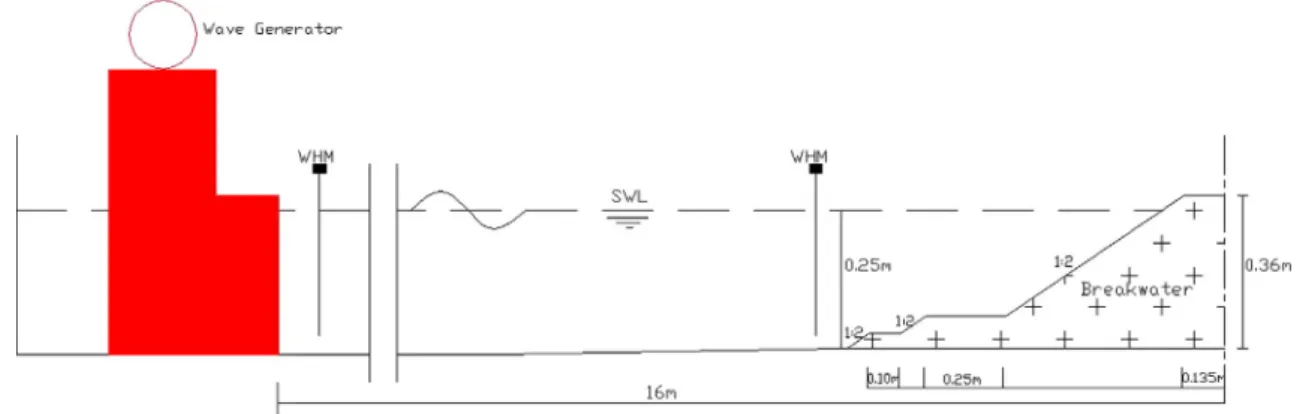
The wave basin has an area of 34 m31 m, maximum water depth of 0.45 m and a length of 25 m long. The wave generator consists of 96 paddles each is 26.5 cm wide and 40 cm high. The wave board is capable of generating regular/monochro-matic and irregular/random waves. The wave generator is con-nected to computer system for the steering, wave generation and data acquisition. Wave data were measured using wave height meters (WHM),Fig. 1.
Fig. 2 presents the setup of the 3D breakwater model, where a permeable rough breakwater with rubble stones (riprap) armor layer was simulated with breakwater length of 6 m. The breakwater was constructed in 0.25 m water depth and the slope of the seabed, in front of breakwater was 1:50. A spending beach was placed around the basin boundaries to dissipate the transmitted waves. The breakwater is designed under significant wave height (Hs) of 0.10 m, and peak period (Tp) equals 1.5 s.
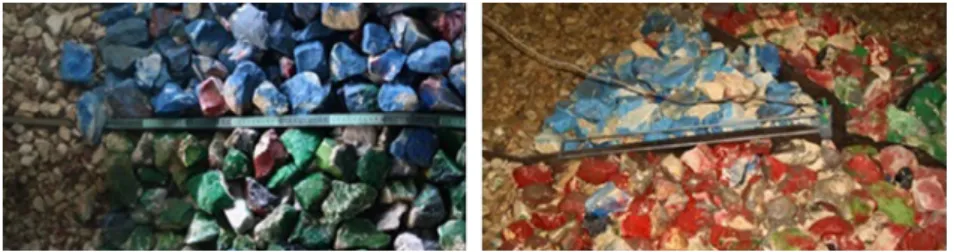
The wave direction was set perpendicular as the critical case for the wave run-up. The tested breakwater is designed based on the wave conditions and the water depth, where it consists of one stone armour layer with weight of 178–356 gm, and stone under layer with weight of 15–37 gm, and more details are listed inTable 1. The constructed breakwater is presented inFig. 3.
3.3. Test program
A test program was designed to inspect the different wave con-ditions that influence the wave run-up and rundown. It included more than 70 tests. The amount of energy available for runup depends on structure slope, roughness, permeability of the structure and also on the wave angle and wave steepness, and some of these parameters are included in the surf similar-ity. Broad range of wave characteristics was investigated, Table 2. The main parameters are the significant wave height
(Hs) and the peak period (Tp). The selected wave heights sim-ulate the Suze Gulf of Egypt wave conditions.
3.4. Arranging devices and measurements
Measuring devices were arranged and measurements were undertaken. Wave data were measured using wave height meters (WHM), which are designed for dynamic fluid level measurements as wave-height measurements in hydraulic mod-els. Two WHM were installed in front of the wave generator, two just before the breakwater and two in the lee side of the structure. WHM were also used to measure the run-up and rundown in addition to the visual monitoring using video cam-era and fixed ruler on the breakwater cross section.
3.5. Model runs
Tests with standard irregular waves of JONSWAP spectra with specified wave height and peak period were executed to have at least 1000 measured waves. Tests were carried out under different wave conditions with wave height (Hs) of 0.05, 0.75, 0.10 and 0.125 m.
For each wave height, different wave periods were tested to simulate both short and long waves. The generated waves and the measured waves in front of the structure were measured and the measured wave run-up and rundown are presented inTable 3.
4. Results and discussion
The model was operated according to the abovementioned test program to examine the effect of different parameters on the wave run-up. The influential wave parameters were measured and analyzed for all tests. Thus, relationships between dimen-sionless wave run-up and the wave steepness, surf similarity and wave height were determined. Model results are presented and discussed in the following sections.
4.1. Effect of surf similarity on wave runup
The relative wave run-up height is plotted against surf similar-ity parameter.Figs. 4 and 5present two different wave condi-tions. They indicate that as the surf similarity parameter increased (from 1.90 to 2.65), the relative run-up increased, where the plunging and transitional wave breaking case took place. The results correlate well with the formulas of delft [23], Van der Meer [24]and ACES [25], which are the most used equations for the rock armoured permeable and
impermeable slopes based on theRu, having the same trend with recognizing underprediction of the existing equation. This is possibly due to the considered parameters and data limitation of each equation.
This was also recognized by Shankar and Jayaratne [4], where he found that about 15% of his data underestimated the computed wave run-up using Losada and Gimenez-Curto [26]formula, while he found they possessed an underprediction of Chue[27]by 70%. He argued that this might be due to the highly empirical nature of the proposed equation.
4.2. Effect of wave steepness on wave runup
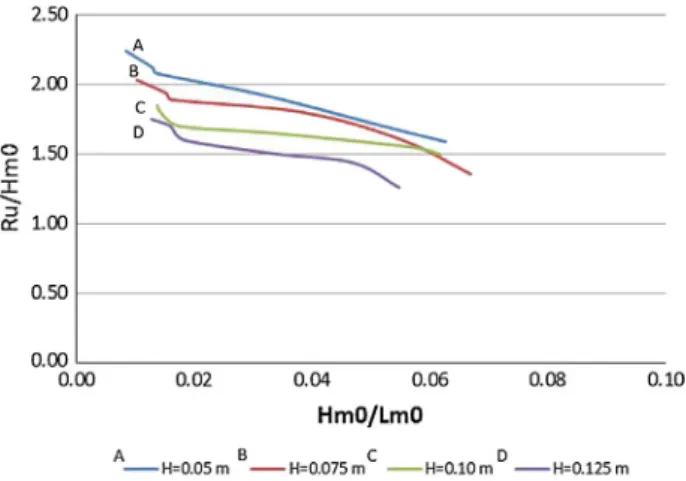
The wave run-up was measured for different wave heights and wave period, and also it was visually monitored. From the analysis of the measured data, it was found that for the differ-ent wave heights, the dimensionless wave run-up (Ru/Hm0) decreased with the increase of relative wave height (H/L),
Fig. 6. The tests results showed that the wave run-up decreased by 20% when the wave height increased from 0.05 to 0.125 m. 4.3. Effect of wave height on wave runup
Fig. 7presents the relation between the measured wave run-up to the surf similarity parameter under different wave condi-tions. It was observed that when the wave height was increased, the dimensionless run-up (Ru/Hm0) decreased. The relative wave run-up under the storm conditions was less com-pared to mild condition, as during storm condition overtop-ping is dominant.
4.4. Effect of surf similarity on wave rundown
In the design of the breakwater wave run-up is dominant than rundown. From the executed measurements and obser-vation, it was found that wave rundown increases with increasing surf similarity, Fig. 8. The rundown for higher wave heights was found to be less compered to low wave heights.
5. Statistical analysis
Applying regression analysis usingData Fit Software, the mea-surements results were found to produce Eq.(3). The equation could predict the wave run-up based on the correlation Figure 2 Schematic diagram for the model setup including breakwater, wave generator, and instruments.
Table 1 Breakwater Characteristics.
Layer Type Weight (gm) Density t/m3
Armour Stones 108–216 2.4
Under Stones 11–27 2.4
Toe Stones 11–27 2.4
Core & bedding Stones 0.5–2.16 2.4
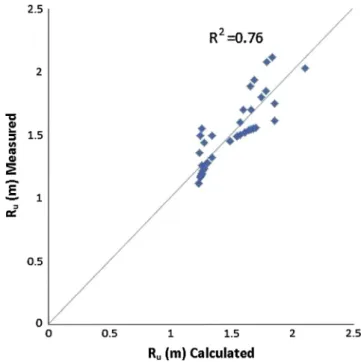
between relative wave run-up (Ru/Hm0) and wave steepness (n0m). Ru=Hm0¼aþb ðn0mÞ 3 ð3Þ where a= 1.19 b= 0.00772
with coefficient of Multi determinationR2= 0.76.
The abovementioned equation was validated using the mea-sured data in the physical model,Fig. 9where it is limited to the examined data range.
Table 2 Tests condition.
Parameter Test range
Wave height (H) m 0.05–0.125
Wave period (T) s 0.82–2.86
Wave steepness (Hi/L0) 0.01–0.07
Surf similarity 1.93–5.43
Table 3 Measured data for the different wave period conditions. Tests conditions (m) Measurements Hs(m) in front of wave generator Hm0(m) in front of breakwater Ru (m) Rd(m) Hs= 0.05 0.041–0.057 0.048–0.08 0.08– 0.17 (0.06) to (0.14) Hs= 0.075 0.070–0.080 0.084–0.13 0.12– 0.25 (0.10) to (0.19) Hs= 0.10 0.096–0.104 0.110–0.15 0.15– 0.30 (0.12) to (0.24) Hs= 0.125 0.12–013 0.137–0.18 0.17– 0.29 (0.17) to (0.22)
Figure 4 Comparative relative wave runup with surf parameter (H= 0.10 m).
Figure 5 Comparative relative wave runup with surf parameter (H = 0.125 m).
Figure 6 Relative wave runup with wave steepness for various wave heights (0.05, 0.075, 0.1, 0.125 m).
Figure 7 Relative wave runup with surf parameter for various wave heights (0.05, 0.075, 0.1, 0.125 m).
6. Conclusions and recommendations
This research study focused on checking the hydrodynamic behavior of the rubble mound breakwater under different wave conditions focusing on runup and rundown to protect the lee side area. This was achieved experimentally by employ-ing physical model technique.
In general, it was clear that the wave steepness has a great impact on the wave run-up. Also the surf similarity was found to be a good parameter describes the inspiration of wave steep-ness and the structure parameters on the wave run-up. The study results indicated that the run-up decreases with increas-ing of wave steepness, while it increases with the increasincreas-ing of surf similarity parameter. Results of the experimental work showed that the wave run-up is higher for longer waves in comparison with the shorter wave. The results trends were found to match with previous studies trends. The research also
showed that common existing formulas describing wave run-up under estimate the values of wave run-run-up in comparison with test results.
Based on the obtained results, the following conclusions are deduced from this study:
The wave run-up for long waves is higher than that for the short waves.
As deep water wave steepness increases, relative wave run-up (Ru/Hm0) decreases for all tested wave heights in the pre-sent study where (Ru/Hm0) ranged between 1.26 and 2.24. The wave rundown (Rd/Hm0) decreased as deep water wave
steepness increased. It is recommended to:
Investigate the effect of different water depths in front of the breakwater and different structure slope for this wave conditions
Formulate a clear idea about the relation between the dif-ferent parameters affecting the wave run-up in this case.
Acknowledgments
This work was done as a basic research work carried out as part of the research plan of the Hydraulics Research Institute. The author wishes to express his appreciation to HRI staff who worked and contributed for the success of this research work.
References
[1]S.A. Hughes, Estimation of wave run-up on smooth, impermeable slopes using the wave momentum flux parameter, Coast. Eng. 51 (11) (2004) 1085–1104.
[2] USACE, 2003. Coastal Engineering Manual. Washington, DC, United States: US Army Corps of Engineers, Technical Report No. EM 1110-2-1100, 330p [Part VI-Chapter 5].
[3]J.W. Van der Meer, C.M. Stam, Wave runup on smooth and rock slopes of coastal structures, J. Waterway, Port, Coast. Ocean Eng. 118 (5) (1992) 534–550.
[4]N.J. Shankar, P.R.M. Jayaratne, Wave runup and overtopping on smooth and rough slopes of coastal structures, Ocean Eng. J. 30 (2) (2003) 221–238.
[5] N.W.H. Allsop, P.J. Hawkes, F.A. Jackson, L. Franco, Wave runup on steep slopes model tests under random waves, Oxfordshire, UK: Hydraulic Research Wallingford, Technical Report SR2, 1985, 985p.
[6] T. Saville, Jr., Wave runup on composite slopes, in: Proceedings of 6th Conference on Coastal Engineering (Council on Wave Research, ASCE), 1958, pp. 691–699.
[7]F. Dentale, G. Donnarumma, E.P. Carratelli, Wave run up and reflection on tridimensional virtual breakwater, Hydrogeol. Hydrol. Eng. 1 (1) (2012) 102–110.
[8] V.B. De Walle, Wave runup on rubble mound breakwaters, Ghent, the Netherlands: University of Ghent, Ph.D. dissertation, 2003, 463p.
[9] EurOtop, Wave overtopping of sea defenses and related structures: assessment manual, United Kingdom: Environmental Agency, ISSN 0452-7739, 2007, 193p.
[10] J. Juhl, P. Sloth, Wave overtopping of breakwaters under oblique waves, in: Proceeding of 24th International Conference on Coastal Engineering (Kobe, Japan, ASCE 1), 1994, pp. 1182– 1196.
Figure 8 Relative wave rundown with surf parameter for various wave heights (0.05, 0.075, 0.1, 0.125 m).
[11] N. Kobayashi, Wave runup and overtopping on beaches and coastal structures, Adv. Coast. Ocean Eng. 5 (7) (1999) 95–154,
http://dx.doi.org/10.1142/9789812797544_0002.
[12]A.S. Koraim, E.M. Heikal, A.A. Abo Zaid, Hydrodynamic characteristics of porous seawall protected by submerged breakwater, Appl. Ocean Res. J. 46 (6) (2014) 1–14.
[13]T. Rasmeemasmuang, W. Chuenjai, W. Rattanapitikon, Wave runup on sandbag slopes, Maejo Int. J. Sci. Technol. 8 (1) (2014) 48–57.
[14]H.F. Stockdon, A.R. Holman, A.P. Howd, A.H. Sallenger, Empirical parameterization of setup, swash, and runup, Coast. Eng. J. 53 (7) (2006) 573–588.
[15] J.P. De Waal, J.W. Van der Meer, Wave runup and overtopping on coastal structures, in: Proceeding of 23rd, International Conference on Coastal Engineering (Venice, Italy II, ASCE), 1992, pp. 1759–1771.
[16] J. De Rouck, B. Van de Walle, P. Troch, L. Van Damme, M. Willems, F.P. Jens, P. Frigaard, R.J. Medina, Wave runup on a rubble mound breakwater, In: E. Ozhan (Eds.), Proceedings of the 5th International Conference on the Mediterranean Coastal Environment (MEDCOAST01, Hammamet, Tunisia), 2001, pp. 1153–1164.
[17]D.H. Kim, W.S. Park, Neural network for design and reliability analysis of rubble mound breakwaters, Ocean Eng. J. 32 (11) (2005) 1332–1349.
[18]T. Erdik, M.E. Savci, TAKAGI-SUGENO fuzzy approach in rock armored slopes for 2% wave runup estimation, Coast. Eng. J. 50 (2) (2008) 161–177.
[19]T. Erdik, M.E. Savci, Z. Sen, Artificial neural networks for predicting maximum wave runup on rubble, Exp. Syst. Appl. J. 36 (3) (2009) 6403–6408.
[20]M.A. Tayfun, Distributions of wave steepness and surf parameter, J. Waterway, Port, Coastal, Ocean Eng. 132 (1) (2006) 1–9.
[21]S.K. SubbaRao, K. BalakrishnaRao, V.R. Chandramohan, Stability aspects of non-reshaped berm breakwaters with reduced armor weight, J. Waterway, Port, Coastal Ocean Eng. 134 (2) (2008) 81–87.
[22] J.A. Battjes, Surf similarity, in: Proceedings of the 14th International Coastal Engineering Conference (ASCE), vol. 1, 1974, pp. 466–479.
[23] Delft Hydraulics, Slopes of loose materials: wave runup on statistically stable rock slopes under wave attack. The Netherlands, Delft Hydraulics Laboratory, Report M 1983, 1989.
[24] Van der Meer, wave runup and wave overtopping at dikes. Delft, The Netherlands: Technical Advisory Committee on Flood Defense, Technical Report, 2002, 50p.
[25] J. Ahrens, B.L. McCartney, Wave period effect on the stability of riprap, in: Proceeding Civil Engineering in the Oceans III (Reston, VA, USA), 1975, pp. 1019–1034.
[26]M.A. Losada, L.A. Gimenez-Curto, Flow characteristics on rough permeable slopes under wave action, Coast. Eng. J. 4 (1981) (1981) 187–206.
[27] S.H. Chue, Wave run-up formula of universal applicability, in: Proceeding ICE Part 2, 69(4), 1980, pp. 1035–1041.