RUMOR SOURCE IDENTIFICATION IN
COMPLEX NETWORKS
By
Jiaojiao Jiang
Submitted in fulfilment of the requirements for the degree of
Doctor of Philosophy
Deakin University
January 2017
DEAKIN UNIVERSITY SCHOOL OF
INFORMATION TECHNOLOGY
The undersigned hereby certify that they have read and
recommend to the Faculty of Science, Engineering and Built
Environment for acceptance a thesis entitled “RUMOR SOURCE
IDENTIFICATION IN COMPLEX NETWORKS” by
Jiaojiao Jiangin partial fulfillment of the requirements for the degree of
Doctor of Philosophy. Dated: January 2017 External Examiner: Research Supervisor: Shui Yu Examing Committee:
Table of Contents
Table of Contents v
List of Tables ix
List of Figures x
Acknowledgements xvi
List of Publications xvii
Abstract xx
1 Introduction 1
1.1 Motivation . . . 1
1.2 Research Questions . . . 5
1.2.1 Rumor Diffusion in Time-varying Networks . . . 5
1.2.2 Rumor Diffusion with Multiple Sources . . . 6
1.2.3 Rumor Diffusion in Large-scale Networks . . . 8
1.3 Thesis Outline . . . 9
2 Preliminaries 12 2.1 Complex Networks . . . 12
2.1.1 Node Centralities . . . 12
2.1.2 Network Generating Models . . . 14
2.1.3 Community Detection . . . 18
2.2 Information Diffusion Models . . . 20
2.2.1 Susceptible-Infected model . . . 21
2.2.2 Susceptible-Infected-Recovered model . . . 21
2.3 Maximum-Likelihood Estimation . . . 21
3 Rumor Source Identification 23 3.1 Categories of Observations . . . 23
3.1.1 Complete Observation . . . 24
3.1.2 Snapshot Observation . . . 24
3.1.3 Sensor Observation . . . 25
3.2 Rumor Source Identification Based on Complete Observations . . . . 26
3.2.1 Single Rumor Center . . . 26
3.2.2 Local Rumor Center . . . 28
3.2.3 Multiple Rumor Centers . . . 29
3.2.4 Minimum Description Length . . . 30
3.2.5 Dynamic Age . . . 32
3.3 Rumor Source Identification based on Snapshots . . . 33
3.3.1 Jordan Center . . . 33
3.3.2 Dynamic Message Passing . . . 34
3.3.3 Effective Distance Based Method . . . 35
3.4 Rumor Source Identification based on Sensor Observations . . . 36
3.4.1 Gaussian Estimator . . . 37
3.4.2 Monte Carlo Method . . . 38
3.4.3 Bayesian Estimator . . . 39
3.4.4 Moon-walk Method . . . 40
3.4.5 Four-metric Method . . . 41
3.5 Comparative Study . . . 42
3.5.1 Comparison on Synthetic Networks . . . 43
3.5.2 Comparison on Real-world Networks . . . 51
3.5.3 Summary . . . 53
4 Rumor Source Identification in Time-varying Networks 57 4.1 Introduction . . . 57
4.2 Time-varying Social Networks . . . 60
4.2.1 Time-varying Topology . . . 60
4.2.2 Security States of Individuals . . . 62
4.2.3 Observations on Time-varying Social Netowrks . . . 63
4.3 Narrowing Down the Suspects . . . 65
4.3.1 Reverse Dissemination Method . . . 65
4.3.2 Performance Evaluation . . . 70
4.4.2 Propagation Model . . . 75
4.5 Evaluation . . . 78
4.5.1 Accuracy of Rumor Source Identification . . . 78
4.5.2 Effectiveness Justification . . . 81
4.6 Conclusion and Discussion . . . 86
5 Identifying Multiple Rumor Sources 89 5.1 Introduction . . . 89
5.2 Preliminaries . . . 92
5.2.1 The Epidemic Model . . . 92
5.2.2 The Effective Distance . . . 93
5.3 Problem Formulation . . . 95
5.4 The K-center Method . . . 97
5.4.1 Network Partitioning with Multiple Sources . . . 97
5.4.2 Identifying Diffusion Sources and Regions . . . 98
5.4.3 Predicting Spreading Time . . . 102
5.4.4 Unknown Number of Diffusion Sources . . . 103
5.5 Evaluation . . . 104
5.5.1 Accuracy of Identifying Rumor Sources . . . 106
5.5.2 Estimation of Source Number and Spreading Time . . . 109
5.5.3 Effectiveness Justification . . . 110
5.6 Conclusion and Discussion . . . 113
6 Identifying Rumor Sources in Large-scale Networks 115 6.1 Introduction . . . 115
6.2 Community Structure . . . 118
6.3 Community-based Method . . . 120
6.3.1 Assigning Sensors . . . 120
6.3.2 Community Structure Based Approach . . . 122
6.3.3 Computational Complexity . . . 124
6.4 Evaluation . . . 126
6.4.1 Identifying Diffusion Sources in Large Networks . . . 128
6.4.2 Influence of the Average Community Size . . . 130
6.4.3 Effectiveness Justification . . . 133
6.4.4 Comparison with Current Methods . . . 136
7 Summary and Future Work 147
7.1 Summary of Contributions . . . 147
7.2 Future Work . . . 149
7.2.1 Continuous Time-varying Networks . . . 149
7.2.2 Multiple Rumors on the Same Topic . . . 150
7.2.3 Interconnected Networks . . . 151
List of Tables
3.1 Summary of Current Source Identification Methods. . . 56
4.1 Comparison of Data Collected in the Experiments. . . 71
4.2 Accuracy of Estimating Rumor Spreading Time. . . 85
5.1 Statistics of the Datasets Collected in Experiments. . . 104
5.2 Accuracy of Multi-source Identification. . . 107
5.3 Accuracy of Spreading Time Estimation. . . 108
6.1 Statistics of Two Large Networks in Experiments. . . 126
6.2 Statistics of Network Communities and Accuracy of Our Method. . . 132
List of Figures
1.1 Illustration of time-varying mobile-phone call (MPC) network [44]. Panels (a), and (b) show calls within 3 hours between people in the same town in two different time windows. Panel (c) presents the total weighted social network structure, which was recorded by aggregating interactions during 6 months. Node size and colors describe the activity of users, while link width and color represent weight. . . 5 1.2 Illustration of the diffusion with two rumor sources. The blue group of nodes
hear the rumor from one source, and the red group hear the rumor from the other source. The yellow nodes are those who receive rumors from both sources. . . 7 1.3 Left: The community construct of a network. Right: The observed network. 9 2.1 Illustration of different centrality measures. (A) Degree; (B) Betweenness;
(C) Closeness; (D) Jordan centrality; (E) Eigenvector centrality. . . 13 2.2 The plot of the mean component size excluding the giant component if there
is one (black solid line), and the giant component size (red dashed line), for the ER random network [69]. The mean degreez=p(n−1). . . 15 2.3 The Watts-Strogatz model reproduces the small-world phenomenon by rewiring
edges in a regular network according to the randomness parameter p[108]. 16 2.4 The connectivities of various large real-world networks have scale-free
dis-tributions, (a) actor collaboration graph, (b) the World Wide Web, and (c) the power grid network [9]. . . 17
2.5 Illustration of three classic epidemic spreading models. (A) SI model; (B)
SIR model; (C) SIS model. . . 20
3.1 Illustration of three categories of observation in networks. (A) Complete observation; (B) Snapshot; (C) Sensor observation. . . 24
3.2 Taxonomy of current source identification methods. . . 26
3.3 Illustration of wavefronts in the shortest path tree v. Readers can refer to the work “The Hidden Geometry of Complex, Network-driven Contagion Phenomena” [12] for the details of the wavefronts. . . 35
3.4 Sample topologies of two synthetic networks. (A) 3-regular tree; (B) small-world network. . . 43
3.5 Crosswise comparison of existing methods on two synthetic networks. 44 3.6 The impact of network topologies. . . 46
3.7 Illustration of different propagation schemes. The black node stands for the source. The numbers indicate the hierarchical sequence of nodes getting infected. . . 47
3.8 The impact of propagation schemes: random-walk scheme. . . 48
3.9 The impact of propagation schemes: contact-process scheme. . . 49
3.10 The impact of propagation schemes: snowball scheme. . . 50
3.11 The impact of infection probability. . . 51
3.12 Sample topologies of two real-world networks. . . 52
3.13 Source identification methods applied on real networks. . . 53
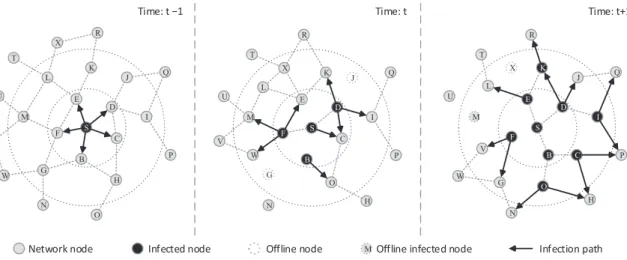
4.1 Example of a rumor spreading in a time-varying network. The random spread is located on the black node, and can travel on the links depicted as line arrows in the time windows. Dashed lines represent links that are present in the system in each time window. . . 61
4.2 State transition of a node in rumor spreading model. . . 62
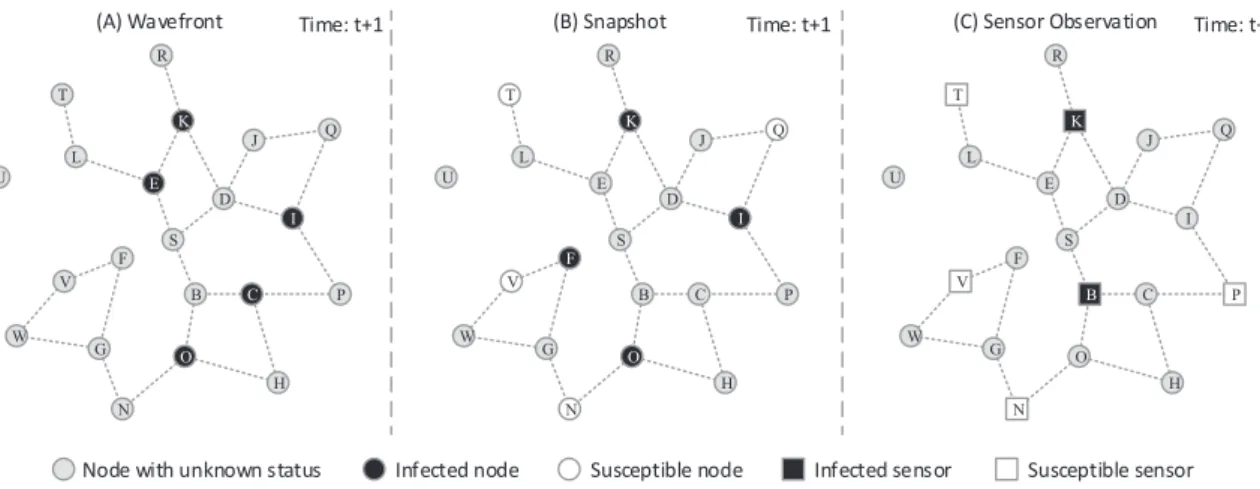
4.3 Three types of observations in regards to the rumor spreading in Fig. 4.1. (A) Wavefront; (B) Snapshot; (C) Sensor. . . 63
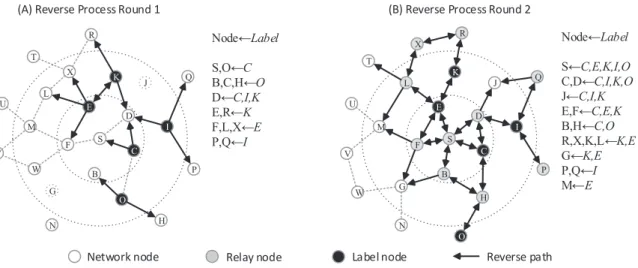
4.4 Illustration of the reverse dissemination process in regards to the wavefront observation in Fig. 4.3 (A). (A) The observed nodes broadcast labeled copies of rumors to their neighbors in time window t; (B) The neighbors who received labeled copies will relay them to their own neighbors in time windowt−1. . . 66 4.5 Accuracy of the reverse dissemination method in networks. (A) MIT; (B)
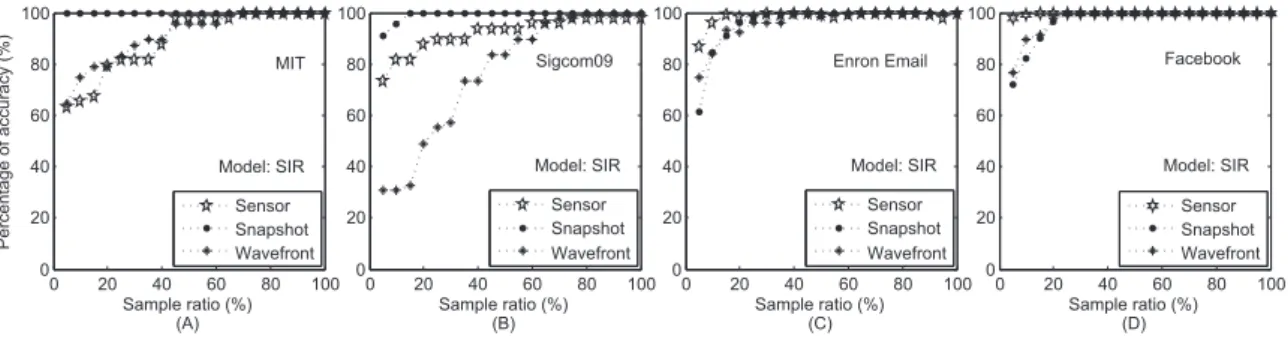
Sigcom09; (C) Enron Email; (D) Facebook. . . 72 4.6 The distribution of error distance (δ) in the MIT Reality dataset. (A)
Sensor; (B) Snapshot; (C) Wavefront. . . 77 4.7 The distribution of error distance (δ) in the Sigcom09 dataset. (A) Sensor;
(B) Snapshot; (C) Wavefront. . . 78 4.8 The distribution of error distance (δ) in the Enron Email dataset. (A)
Sensor; (B) Snapshot; (C) Wavefront. . . 79 4.9 The distribution of error distance (δ) in the Facebook dataset. (A) Sensor;
(B) Snapshot; (C) Wavefront. . . 80 4.10 The correlation between the maximum likelihood of the real sources and that
of the estimated sources in the MIT reality dataset. (A) Sensor observation; (B) Snapshot observation; (C) Wavefront observation. . . 81 4.11 The correlation between the maximum likelihood of the real sources and that
of the estimated sources in the Sigcom09 dataset. (A) Sensor observation; (B) Snapshot observation; (C) Wavefront observation. . . 82 4.12 The correlation between the maximum likelihood of the real sources and that
of the estimated sources in the Enron Email dataset. (A) Sensor observation; (B) Snapshot observation; (C) Wavefront observation. . . 83 4.13 The correlation between the maximum likelihood of the real sources and that
of the estimated sources in the Facebook dataset. (A) Sensor observation; (B) Snapshot observation; (C) Wavefront observation. . . 84 4.14 The accuracy of estimating infection scale in real networks. (A) MIT; (B)
5.1 The state transition graph of a node in the SI model. . . 92 5.2 An example of altering an infection graph using effective distance. (A) An
example infection graph with source S. The weight on each edge is the propagation probability. The two dot circles represent the first-order and second-order neighbors of sourceS. The colors indicate the infection order of nodes, e.g., nodes A, C, D and F are infected after the first time tick. Notice that the diffusion process is spatiotemporally complex. (B) The altered infection graph. The weight on each edge is the effective distance between the corresponding end nodes. Notice that the effective distances from source S to the infected nodes can accurately reflect their infection orders. . . 94 5.3 Degree distribution. (A) Power Grid; (B) Yeast; (C) Facebook . . . 104 5.4 The monotonically decreasing of the objective functions. . . 105 5.5 Histogram of the average error distances (∆) in various networks whenS∗
= 2. (A) Power Grid; (B) Yeast; (C) Facebook. . . 106 5.6 Histogram of the average error distances (∆) in various networks whenS∗
= 3. (A) Power Grid; (B) Yeast; (C) Facebook. . . 107 5.7 Estimate of the number of sources. (A) Yeast; (B) Power Grid; (C) Facebook.109 5.8 The correlation between the objective function of the estimated sources and
that of the real sources when S∗ = 2. (A) Power Grid; (B) Yeast; (C) Facebook.. . . 110 5.9 The correlation between the objective function of the estimated sources and
that of the real sources when S∗ = 3. (A) Power Grid; (B) Yeast; (C) Facebook.. . . 111 5.10 The effective distances between the nodes infected at each time tick and
their corresponding sources when S∗ = 2. (A) Power Grid; (B) Yeast; (C) Facebook.. . . 112
5.11 The effective distances between the nodes infected at each time tick and their corresponding sources when S∗ = 3. (A) Power Grid; (B) Yeast; (C) Facebook.. . . 113 6.1 Illustration of network communities and community bridges. (A) Separated
communities. Community bridges are the nodes associated with between-community edges,e.g., nodes Aand Dconnecting the blue community and the green community. (B) Overlapping communities. Community bridges are not only the nodes associated with between-community edges but also the nodes shared by different communities, e.g., nodes H, I and J shared by the green community and the yellow community. . . 119 6.2 Degree distribution of the two large networks. (A) The Mention network;
(B) The Retweet network. . . 127 6.3 The accuracy of the proposed method in identifying diffusion sources in two
real large networks. (A) and (C) show the accuracy of our method in the Mention network and the Retweet network having overlapping-community structure with parameterα∈ {0.10,0.15,0.20}. (B) and (D) show the accu-racy of our method in these networks having separated-community structure with parameterβ ∈ {2,3,4}. . . 128 6.4 Community size distribution under different parameter setting. (A) and
(B) show the community size distribution in the Mention network and the Retweet network having separated community structure withβ ∈ {2,3,4}; (C) and (D) show the community size distribution in the Mention network and the Retweet network having separated community structure with α ∈
{0.10,0.15,0.20}. . . 131 6.5 The influence of the ratio of infected sensors in the accuracy of our method
6.6 Justification of our method on the Mention network. (A) Linear correlation between the relative infection time of sensors and their average effective distance from the diffusion source. Specifically, we let the diffusion start from sources with different degrees: small degree, moderate degree and large degree. (B), (C) and (D) show the correlation coefficient value for each suspect. . . 134 6.7 Justification of our method on the Retweet network. (A) Linear correlation
between the relative infection time of sensors and their average effective distance from the diffusion source. (B), (C) and (D) show the correlation coefficient value for each suspect.. . . 135 6.8 Degree distribution of the four networks. (A) Political Mention; (B) Political
Retweet; (C) Power Grid; (D) Yeast PPI network. . . 138 6.9 Betweenness distribution of the four networks. (A) Political Mention; (B)
Political Retweet; (C) Power Grid; (D) Yeast PPI network. . . 139 6.10 Comparison of the proposed method with other methods in the accuracy
of identifying diffusion sources when setting sensors at high-degree nodes in four moderate-scale networks. (A) Political Mention; (B) Political Retweet; (C) Power Grid; (D) Yeast.. . . 140 6.11 Comparison of the proposed method with other methods in the accuracy
of identifying diffusion sources when setting sensors at high-betweenness nodes in four moderate-scale networks. (A) Political Mention; (B) Political Retweet; (C) Power Grid; (D) Yeast. . . 141 6.12 The relationship between degree and the average betweenness at each degree
of the four networks. (A) Political Mention; (B) Political Retweet; (C) Power Grid; (D) Yeast PPI network. . . 142 6.13 Linear correlation between relative infection time and average effective
Acknowledgements
Firstly, I would like to express my deepest gratitude and appreciation to my super-visors Dr. Shui Yu, Prof. Wanlei Zhou, and Dr. Simon James. They have given me so much advise, encouragement, and endless support during the three-year journey of my PhD study at Deakin University. I appreciate all the time they have spent on editing my papers, discussing my research ideas, listening to my problems, and taking away all my doubts and worries. I will always be very grateful for their guidance, support and encouragement.
Secondly, I would like to give my sincere thanks to my research collaborators, Prof. Yang Xiang, and Dr. Sheng Wen. I have acquired a rich set of skills and experiences from their research experiences, knowledge, and meticulous attitude to research during my PhD expedition. Every piece of helpful suggestion makes me better and makes me enjoy research more.
I would also like to thank the academic and general research staff of the School of Information Technology, Deakin University. I would like to give my thanks and appreciation to Ms. Alison Carr and Ms. Lauren Browne for their great secretarial work. Thanks to everyone working in the Research Center for Cyber Security Re-search, I was able to easily access a large collection of Research data to facilitate my research. I also owe a great deal of thanks to my friends who helped me in my study and daily life during my PhD study: Xiao Chen, Dr. Jun Zhang, Prof. Xinyi Huang, and so many others.
I also would like to thank my family for their support and love. Without their everlasting encouragement and understanding, this thesis wouldn’t exist.
Melbourne, Australia Jiaojiao Jiang
List of Publications
Refereed Journal Articles
1. Jiaojiao Jiang, Sheng Wen, Shui Yu, Yang Xiang, and Wanlei Zhou,
“Iden-tifying Propagation Sources in Networks: State-of-the-Art and Comparative
Studies,” IEEE Communications Surveys and Tutorials, accepted on
Septem-ber 17, 2014.
2. Jiaojiao Jiang, Sheng Wen, Shui Yu, Yang Xiang, and Wanlei Zhou,
“K-center: An Approach on the Multi-source Identification of Information
Diffu-sion,” IEEE Transactions on Information Forensics and Security, vol. 10, no.
12, 2015, pp. 2616-2626.
3. Jiaojiao Jiang, Sheng Wen, Shui Yu, Yang Xiang, and Wanlei Zhou, “Rumor
Source Identification in Social Networks with Time-varying Topology,” IEEE
Transactions on Dependable and Secure Computing, accepted on December 30, 2015.
4. Jiaojiao Jiang, Sheng Wen, Shui Yu, Yang Xiang, and Wanlei Zhou, “The
Structure of Communities in Scale-free Networks,”Concurrency and
Computa-tion: Practice and Experience, accepted on January 1, 2016.
5. Sheng Wen, Jiaojiao Jiang, Yang Xiang, Shui Yu, Wanlei Zhou, and Weijia
Jia, “To Shut Them Up or To Clarify: Restraining the Spread of Rumors in
vol. 25, issue 12, 2014, pp. 3306-3316.
6. Sheng Wen, Jiaojiao Jiang, Bo Liu, and Wanlei Zhou, “Are the Popular
Users Always Important for the Information Dissemination in Online Social Networks?” IEEE Network, vol. 28, issue 5, 2014, pp. 64-67.
7. Sheng Wen, Jiaojiao Jiang, Yang Xiang, Shui Yu, and Wanlei Zhou, “Using
Epidemic Betweenness to Measure the Influence of Users in Complex Networks,” Journal of Network and Computer Applications, accepted on November 2, 2016.
8. Haibin Zhang,Jiaojiao Jiang, and Zhi-Quan Luo, “On the Linear Convergence
of a Proximal Gradient Method for a Class of Nonsmooth Convex Minimization
Problems,” Journal of the Operations Research Society of China, vol. 1, issue
2, 2013, pp. 163-186.
Refereed Conference Papers
1. Jiaojiao Jiang, Andi Zhou, Kasra Majbouri Yazdi, Sheng Wen, Shui Yu, and
Yang Xiang, “Identifying Diffusion Sources in Large Networks: A Community
Structure Based Approach,” IEEE Trustcom2015, vol. 1, pp. 302-309, 2015.
2. Jiaojiao Jiang, Sheng Wen, Shui Yu, Wanlei Zhou, and Yi Qian, “Analysis
of the Spreading Influence Variations for Online Social Users under Attacks,”
IEEE GlobeCom2016, Washington, DC USA, December 4-8, 2016.
3. Jiaojiao Jiang, Sheng Wen, Shui Yu, and Wanlei Zhou, “Studying the Global
Spreading Influence and Local Connections of Users in Online Social Networks,”
IEEE SocialSec2016, Yanuca Island, Fiji, December 7-10, 2016.
4. Sheng Wen, Jiaojiao Jiang, Kasra Majbouri Yazdi, Yang Xiang, and
Wan-lei Zhou, “The Relation between Local and Global Influence of Individuals in
5. BoHao Feng, Huachuan Zhou, Hongke Zhang,Jiaojiao Jiang, and Shui Yu, “A Popularity-based Cache Consistency Mechanism for Information-Centric
Net-working,” IEEE GlobeCom2016, Washington, DC USA, December 4-8, 2016.
6. Bo Liu, Wanlei Zhou, Jiaojiao Jiang, and Kun Wang, “K-source: Multiple
Source Selection for Traffic Offloading in Mobile Social Networks,” IEEE
Abstract
In the modern world, the ubiquity of networks has made us vulnerable to various
network risks. For instance, computer viruses propagate throughout the Internet and infect millions of computers. Misinformation spreads incredibly fast in online social networks, such as Facebook and Twitter. Infectious diseases, such as SARS, H1N1 or Ebola, have spread geographically and killed hundreds of thousands people. In
essence, all of these situations can be modeled as a rumor spreading through a
network, where the goal is to find the source of the rumor in order to control and prevent these network risks. So far, extensive work has been done to develop new approaches to effectively identify rumor sources. However, current approaches still suffer from critical weaknesses. The most difficult one is the complex
spatiotempo-ral diffusion process of rumors in time-varying networks, which is the bottleneck of
current approaches. The second problem lies in the expensively computational
com-plexity of identifying multiple rumor sources. The third important issue is the huge
scale of the underlying networks, which makes it difficult to develop efficient strategies to quickly and accurately identify rumor sources. These weaknesses prevent rumor source identification from being applied in a broader range of real-world applications. This thesis aims to address these issues to make rumor source identification more effective and applicable.
The first issue is overcome by proposing an analytical model for modeling rumor
spreading in dynamic networks. Traditional approaches assume firm connections
between individuals (i.e., static networks) so that people can trace back along the
physical mobility and online/offline status of individuals in modeling rumor spreading. Furthermore, we propose a novel reverse dissemination strategy to narrow down the scale of suspicious sources, which dramatically promotes the efficiency of our method. We then develop a Maximum-likelihood estimator, which can pinpoint the true source from the suspects with a high accuracy. Experiment results justify the effectiveness of the proposed method in real-world time-varying networks.
We address the second issue through developing an optimization framework for
multi-source identification issue. We adapt K-means from data mining and effective
distance to structure diffusion pattern of multi-source rumor spreading. After this,
we formulate an optimization problem for multi-source identification, and develop a fast method to solve the problem. Theoretical analysis proves the efficiency of the proposed method, and the experiment results demonstrate the effectiveness of the proposed method in various real-world networks.
For the scalability issue in rumor source identification, we explore sensor
tech-niques and develop a community structure based method. Instead of assigning
sen-sors on high-centrality nodes in traditional methods, we propose placing sensen-sors on community bridges. Thus, we can efficiently record the rumor diffusion between com-munities rather than between individuals. Then, we take the advantage of the linear correlation between rumor spreading time and rumor infection distance to develop a fast method which can locate the rumor source with high accuracy. Theoretical analysis proves the efficiency of the proposed method, and the experiment results verify the significant advantages of the proposed method in large-scale networks.
In summary, this thesis makes three major contributions: 1) propose a novel
ap-proach to identify rumor sources intime-varying networks; 2) develop a fast approach
to identify multiple rumor sources; 3) propose a community-based method to
over-come the scalability issue in this research area. These contributions enable rumor
source identification to be applied effectively in real-world networks, and eventually diminish rumor damages.
Chapter 1
Introduction
1.1
Motivation
With rapid urbanization and advancements in transportation technologies, the world
has become more interconnected. Acontagious disease, like SARS [63], H1N1 [29] and
Ebola [103], can spread quickly through a population and lead to an epidemic [56]. It is crucial to quickly identify the set of epidemic sources, so that potential containment policies can be formulated to prevent further spreading of the disease [92]. In a similar
vein, computer viruses, like Cryptolocker and Alureon [62], on a few servers of a
computer network can quickly spread to other servers or computers in the network and cause a good share of cyber-security incidents [106]. Identifying the servers in the network that are first infected allows us to detect the latent points of weaknesses in the computer network, so that preventive measures can be taken to enhance the protection at these points. The source identification problem also arises in the study of
misinformation spreading in a social network. A piece of misinformation like Barack Obama was born in Kenya started by a few individuals can spread quickly through the underlying social network [21,78]. In many cases, we are interested to find the sources
of the misinformation. For example, law enforcement agencies may be interested in identifying the perpetrators who fabricate misinformation to manipulate the market prices of certain stocks.
In essence, all of the above examples can be modeled as a rumor spreading in a
network of nodes. In a population network, the rumor is the disease that is transmitted between individuals. In the example of a computer virus spreading in a network, the rumor is the computer virus, while for the case of a misinformation spreading in a social network, the rumor is the misinformation. In this thesis, we focus on the problem of identifying rumor diffusion sources: given a complex network and a partial observation of rumor diffusion, determine the rumor diffusion source(s).
From both practical and technical aspects, it is of great significance to identify
rumor sources. Practically, it is important to accurately identify the ‘culprit’ of the rumor propagation for forensic purposes. Moreover, seeking the rumor sources as quickly as possible can find the causation of rumors, and therefore, mitigate the damages. Technically, the work in this field aims at identifying the sources of rumors based on limited knowledge of network structures and the states of a small portion of nodes. In academia, traditional identification techniques, such as IP trace back [91] and stepping-stone detection [93], are not sufficient to seek the sources of rumors,
as they only determine the true source of packets received by a destination. In
the propagation of rumors, the source of packets is almost never the source of the rumor propagation but just one of the many propagation participants [114]. Methods are needed to find propagation sources higher up in the application level and logic structures of networks, rather than in the IP level and packets.
rumor diffusion sources. The initial methods were designed to work on particular
networks (e.g., regular tree and regular graphs) and with the diffusion following the
traditional susceptible-infected (SI) model [22, 42, 95, 96]. Later, some other works were proposed to deal with particular networks but with different epidemic models, such as the recovered (SIR) model and the susceptible-infected-susceptible (SIS) model [55,59,120,121]. The constraints on particular networks were then relaxed to generic network topologies but still assume that rumors spread along the breadth-first search (BFS) trees of networks [12, 25, 53, 84]. Recently, researchers proposed methods to identify propagation sources by using sensor techniques [1, 82, 94], but they are still restricted in the BFS trees of networks. In the real world, rumor diffusion is a complex process and it does not always follow the ideal BFS-tree spreading scheme. It can be affected by the impacts from the dynamic of individuals, the impacts from the structure of the underlying network, the impacts from other related rumors, etc. Therefore, previous methods of rumor sources identification are far from applying effectively and efficiently in real-world networks.
In many ways, current approaches of rumor source identification are facing the following three critical challenges.
• The underlying networks are often of time-varying topology. For example, in
human contact networks, the neighborhood of individuals moving over a geo-graphic space evolves over time, and the interaction between the individuals appears/disappears in online social network websites (such as Facebook and Twitter) [87]. Indeed, the spreading of rumors is affected by duration, sequence, and concurrency of contacts among nodes [13, 104]. Then, can we model the
way that rumor spreads in time-varying networks? Can we estimate the prob-ability of an arbitrary node being infected by a rumor? How do we detect rumor source in time-varying networks? Can we estimate the infection scale and infection time of the rumor?
• Rumors often emerge frommultiple sources. However, current methods mainly
focus on the identification of a single rumor source in networks. A few approach-es are proposed for identifying multiple rumor sourcapproach-es but they all suffer from extremely high computational complexity, which is not practical to be adopted in real-world networks. In this thesis, we will answer the following question-s correquestion-sponding to multi-question-source identification. How many question-sourcequestion-s are there? Where did the diffusion emerge? When did the diffusion start?
• Another critical challenge in this research area is the scalability issue. Curren-t meCurren-thods generally require scanning Curren-the whole underlying neCurren-twork of rumor spreading to locate rumor sources. However, real-world networks of rumor d-iffusion are often of a huge scale and extremely complex structure. Thus, it is impractical to scan the whole network to locate the rumor sources. We develop efficient approaches to identify rumor sources by taking the structural features of networks and the diffusion patterns of rumors into account, and therefore address the scalability issue.
To address the above challenges, this thesis aims to achieve a breakthrough in rumor source identification to enable its effective applicability in real world applications. The approaches involve the complex network theory, information diffusion theory, probability theory, and applied statistics.
www.nature.com/
SCIENTIFIC
Figure 1.1: Illustration of time-varying mobile-phone call (MPC) network [44]. Panels
(a), and (b) show calls within 3 hours between people in the same town in two different time windows. Panel (c) presents the total weighted social network structure, which was recorded by aggregating interactions during 6 months. Node size and colors describe the activity of users, while link width and color represent weight.
1.2
Research Questions
As presented in the previous section, current studies on rumor source identification
encounter three critical challenges: time-varying networks, multiple rumor sources
andscalability issue. In this section, we will introduce the research questions examined in each chapter in detail.
1.2.1
Rumor Diffusion in Time-varying Networks
In the real world, it takes different periods of time for nodes to transmit information to their neighbors. The temporal dynamic is an important factor, particularly when the propagation concerns human involvements [110]. Let us take the mobile phone call (MPC) network [44] as a example. Fig. 1.1(A) and 1.1(B) show two snapshots of the MPC network at different times covering a few hours of calls in a town. The
two plots capture dynamical interaction patterns not visible from the aggregated net-work representation (Fig. 1.1(C)). Traditional methods of rumor source identification
assume the firm connection between individuals (i.e., the network in Fig. 1.1(C)).
However, this will dramatically overfit the actual time-varying network structure. This is also the reason that traditional methods present a low accuracy in identifying rumor sources in real-world networks.
Technically, the temporal dynamic of networks is complex. It involves the impact
of the time zone and the population distribution [18]. Individual habits also strongly affect the temporal dynamic of rumor diffusion. Currently, litter literature considers temporal dynamics of the underlying network where rumors diffuse. We consider these factors in modeling rumor propagation. In other words, we model rumor propagation by considering the realistic temporal dynamics of individuals and their interactions. Based on the innovative model, we can trace back the rumor diffusion source and also predict its future trend. This will make a fundamental contribution to rumor source identification, and open up a new direction of modeling rumor propagation. Therefore, identifying rumor sources in time-varying networks is the first research question to address in this thesis.
1.2.2
Rumor Diffusion with Multiple Sources
In the real world, the propagation of rumors often initiates from multiple sources. For example, a contagious disease emerging from a small population can spread geo-graphically and infect hundreds of thousands of people [56]. Culprits employ a botnet to spread computer viruses and finally infect millions of computers and servers [8,28]. Fig. 1.2 shows an example to illustrate the rumor diffusion starting from two sources.
Figure 1.2: Illustration of the diffusion with two rumor sources. The blue group of nodes hear the rumor from one source, and the red group hear the rumor from the other source. The yellow nodes are those who receive rumors from both sources.
One source mainly infects the blue nodes, the other source mainly contaminates the red nodes, the yellow nodes are infected by both sources. Few of current methods are developed for multi-source identification. Some single-source identification methods can be adapted to identify multiple rumor sources. However, they all suffer from the
expensive computational complexity (generallyO(Nk), whereN is number of infected
nodes andk is the number of sources). Therefore, they are not practical to be applied
in real-world networks.
Technically, the methods of single source identification cannot be directly used for multiple source cases. This is because the spread initiated from multiple sources can-not be thought of as the superposition of multiple single-source propagation processes. Meanwhile, current multi-source identification methods are too computationally
pattern of multi-source rumor diffusion. This is the crucial factor that we consid-er in developing new methods for multi-source identification. Using the pattconsid-ern of multi-source rumor diffusion, we substantially simplify the multi-source identification problem and develop a fast method to solve this problem. Therefore, the identifi-cation of multiple rumor sources is the second research question to address in this thesis.
1.2.3
Rumor Diffusion in Large-scale Networks
In the real world, rumor diffusion often occurs in large-scale networks, such as human contact networks, online social networks, computer networks or the World Wide Web. Let us take a real event on Twitter for an example. On April 15th of 2013, two explosions at the Boston Marathon finish line shocked the entire United States [101]. There were millions of tweets about it, and many of the tweets contained rumors and misinformation. Within a couple of days, multiple pieces of misinformation went viral on various social media. The huge scale of the Twitter network severely challenges traditional rumor source detection methods. Therefore quickly identifying rumor sources in large-scale networks is of great significance in practice.
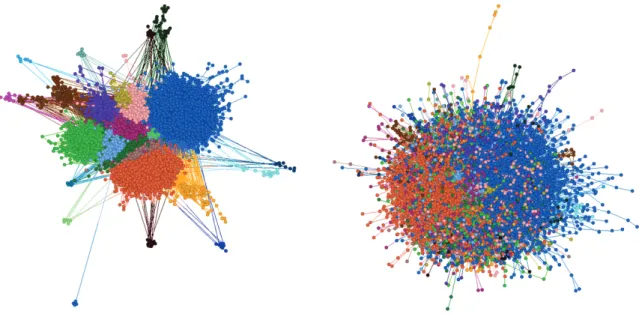
Technically, current methods are too computationally expensive to quickly and accurately detect rumor sources in large-scale networks. This is because most of cur-rent methods require scanning the entire network to locate the rumor sources. More-over, current methods ignore an important fact that rumor diffusion often presents a network-driven phenomenon. We show an example in Fig. 1.3 to illustrate one of
the important structures of complex networks − community structure. The left plot
Figure 1.3: Left: The community construct of a network. Right: The observed network.
in our observation. Appropriately utilizing the structure of networks can facilitate our rumor source detection work in large-scale networks. This is the crucial factor we will consider in developing new methods for identifying rumor sources in large-scale networks. Accordingly, based on the structure of the underlying network, we dramatically decrease the scanning of the entire network to scanning a small commu-nity of the network. Therefore, we propose developing efficient and scalable source identification methods as the final research question in this thesis.
1.3
Thesis Outline
This section aims to establish the structural organization of the thesis. According to
three research issues addressed in this thesis: time-varying networks, multiple rumor
sources and scalability issue, the chapters are organized as follows.
some basic concepts and network generating models in graph theory, informa-tion propagainforma-tion models and the Maximum-Likelihood Estimainforma-tion method.
• Chapter 3 presents acomprehensive survey on the development of rumor source
identification, including relevant concepts, assumptions, and emerging tech-niques in this area. Efforts have been given to identify various research di-rections and emerging research issues.
• Chapter 4 focuses on thetime-varying networks issue in the context of
network-driven rumor propagation. This chapter specifically investigates how to model rumor diffusion in a dynamic network by reducing the network into a series of static network windows. This chapter also proposes an effective two-stage method to detect rumor sources in time-varying networks. The first stage nar-rows down the suspicious rumor sources. The second stage pinpoints the true source from the suspects. The method involves developing a reverse dissemina-tion method to trace back rumor in time-varying networks, and a maximum-likelihood method is explored to compute the probability of the status of arbi-trary individuals.
• Chapter 5 proposes a novel K-center method to address the multiple rumor
sources issue. This chapter focuses on how to efficiently and effectively detec-t muldetec-tiple rumor sources by exploring muldetec-ti-source rumor diffusion padetec-tdetec-terns. Through combining the diffusion patterns and network partition techniques, this chapter formulates the multi-source identification problem as an optimiza-tion problem and proposes a fast method to solve the problem. This chapter
of rumors sources, (ii)locating the topological places where the rumor emerges,
and (iii) estimating the time when the rumor breaks out.
• Chapter 6 aims at addressing the scalability issue in identifying rumor sources
in large-scale networks. This chapter specifically explores how to utilize the structural patterns of networks for rumor propagation. With the considera-tion of community structure and sensor techniques in complex networks, this chapter proposed a community-structure based method. Compared with the traditional methods, the proposed community-structure based method dramat-ically decreases the searching scale of rumor sources from the entire network to a small community.
• Chapter 7 summarizes the contributions of this thesis, and presents some
pos-sible suggestions and extensions for further research.
To maintain the readability, each chapter is organized in a self-contained format, and some essential contents, e.g. definition, are briefly recounted in related chapters.
Chapter 2
Preliminaries
This chapter provides some preliminary work about rumor source identification. We first introduce some concepts related to complex networks, including node central-ities, network generating models, and community detection methods. Secondly, we introduce three classic information diffusion models adopted in this thesis. Finally, we explain the maximum-likelihood estimation method adopted in this thesis.
2.1
Complex Networks
2.1.1
Node Centralities
Degree Given a node i, the degree of node i is the number of edges connected to
nodei. In general, the larger degree of a node, the more influential of the node
(see the black nodes in Fig. 2.1(A)).
Betweenness The betweenness of a node stands for the number of shortest paths
from all nodes to all others that pass through the node [31]. Researchers have found some nodes which do not have large degrees also play a vital role in the
!"##$%&'%% ( ! ) $ * +',-.#/ +',-.#0 )"##)%12%%33%44 ! ) * *"##*5,4%3%44 67&8#9%31':571;#3,<%4 ='<73:';#3,<%4 $"##>,'<:3#*%31':571; ! ) * ?/ ?@ ("##(7&%3A%91,'#*%31':571; @ 0 @ @ / ?0 ?B ? C D E D F @
Figure 2.1: Illustration of different centrality measures. (A) Degree; (B) Betweenness; (C) Closeness; (D) Jordan centrality; (E) Eigenvector centrality.
is smaller than nodes A, B, C and D. However, node E is noticeably more
important to information spread as it is the connector of two large groups. To locate this kind of nodes, researchers introduced the measure of betweenness.
Closeness The closeness of a node is defined as the average length of the shortest
path between the node and all other reachable nodes [31, 74]. As shown in
Fig. 2.1(C), this measure discloses the nodes that can rapidly disseminate
information to all the other nodes. This measure concentrates more on the information propagation speed rather than the connectivity of a network [74].
Jordan centrality The Jordan centrality of a node measures the maximum geodesic
distance (shortest-path distance) from the node to a given set of infected nodes
minimum Jordan centrality. Suppose all the nodes are infected in the graph
in Fig. 2.1(D), then nodes A, B, C are the Jordan centers of the graph with
Jordan centrality 3. Equivalently, Jordan center is equal to the radius of a network [102].
Eigenvector centrality It is defined as the eigenvector of the adjacency matrix
associated to the largest eigenvalue [11, 71]. Equivalently, the eigenvector cen-trality of a node is proportional to the sum of the eigenvector cencen-trality of all its neighboring nodes. In the real world, an important node is characterized by its connectivity to other important nodes. Thus, a node with a high eigen-vector centrality is a well-connected node and has a dominant influence on the
surrounding network. As shown in Fig. 2.1(E), node V1 and V3 have the
high-est eigenvector centrality in the graph. Readers could refer to [11] for further computation methods.
2.1.2
Network Generating Models
Various models devoted to reproducing the growth and evolution of network topology have been developed to capture different characteristics of complex networks. In the following subsections, we will introduce three classic network generating models.
Random Networks
The first network generating model proposed in 1959 by Erdos and Renyi [1960]
described the process of growing a random network: n nodes connected by m edges
randomly selected from all n(n−1)/2 possible edges with equal probability p. The
0 5 Mean degree z 0 2 4 6 8 10
Mean component size
<
S>
0 0.5 1
Giant component size
S
4
1 2 3
Figure 2.2: The plot of the mean component size excluding the giant component if there is one (black solid line), and the giant component size (red dashed line), for the ER random network [69]. The mean degree z=p(n−1).
other key feature is a sudden change of the network connectivity with the increase of
p: when p is small, many clusters are small and isolated, but once p increases to be
larger than a critical value, the network suddenly becomes very dense where almost all the nodes are linked to each other in a giant connected component (see Fig. 2.2).
Small-World Networks
The small-world network originated from the experiment of Milgram [65], in which selected persons were asked to deliver a letter to a target receiver by only passing the letter to their acquaintances. Among all the successful instances, the average length of these communication chains was short, around six steps. The phenomenon is well known as “small-world effect” or “six degrees of separation”. A small-world network has acquaintanceship-based edges and the distance between a random pair of people is smaller than expected. In the real world setting, the small-world effect implies that most of the friends of an individual are people living around, but he may also
Regular Small-world Random
Increasing randomness Large avg shortest path
High clustering coefficient
Small avg shortest path High clustering coefficient
Small avg shortest path Low clustering coefficient
Figure 2.3: The Watts-Strogatz model reproduces the small-world phenomenon by rewiring
edges in a regular network according to the randomness parameter p[108].
have a few friends far away. People are moving around, but the geographic distance
limits the strength of social relationships. The Watts-Strogatz model was designed
to reproduce the small-world phenomenon by rewiring each link in a regular network
with a probability p [108]. As shown in Fig. 2.3, when p = 0, the network is fully
ordered; when p = 1, every edge is rewired so as to create a random network; when
0 < p < 1, we obtain a small-world network with small average shortest path and high clustering coefficient [108].
Scale-Free Networks
A scale-free network has a power-law degree distribution, commonly seen in many real-world networks, such as the Internet, the film actor network, the scientific col-laboration network, the citation network, and many others (see Fig. 2.4) [4, 9, 69]. Highly unbalanced degree distribution in a social network indicates that, in a large group of people, only a few are extremely popular and most others do not have too
P(k ) k 100 101 102 103 104 100 10-2 10-4 10-6 10-8 100 101 100 10-1 10-2 10-3 10-4 (a) Actor 100 101 102 103 10-6 10-5 10-4 10-3 10-2 10-1 (b) WWW (c) Powergrid
Figure 2.4: The connectivities of various large real-world networks have scale-free distri-butions, (a) actor collaboration graph, (b) the World Wide Web, and (c) the power grid network [9].
many contacts. It has been suggested to be the most critical feature of social net-works [73].
Among many models that can capture the heterogeneous distribution in connec-tivity [23, 27, 47–49, 73], Barabasi-Albert model was the first to generate a scale-free network with two simple mechanisms: continuously adding new nodes into the system (“growth”) and connecting with other nodes with preference to the high-degree ones (“preferential attachment”) [9]. Motivated by the structure of the Web graph, the copying model added a new node into the network and linked it to a random existing node or its neighbors [47, 49]. Another model proposed by Newman et al. [73] aimed to build up a random graph with the arbitrary degree setting. The ranking model grew the network according to a rank of the nodes by any given prestige measure; the probability of linking a target node could be any power law function of its rank, resulting in a power-law degree distribution [27].
2.1.3
Community Detection
A community is a group of densely connected nodes in a graph. The community structure is claimed to be one key property of various complex networks, suggesting that a network can be partitioned into several (potentially overlapped) clusters so that nodes in one cluster are densely connected internally but not externally; such clustering might derive from common interests of people, geographical divisions of power grids, or functional similarity of proteins [32, 72]. How to detect communities has been widely studied [26], popular methods including modularity optimization [70], Louvain method [10], infomap [89], clique percolation [76], and link clustering [2].
The two methods, Infomap and link clustering, applied in the thesis are introduced
as follows.
Infomap The infomap community detection method is built on the assumption that
a random walker is more likely to be trapped in communities than to trav-el between communities. The path of a random walker can be encoded, and then compressed given a hierarchical network partition so that the encoded description is minimum. The duality between finding community structure in a network and the coding problem is: to find an efficient code, it looks for a
module partitionM ofn nodes intom modules so as to minimize the expected
description length of a random walk. By using the module partition M, the
average description length of a single step is given by
L(M) =qyH(L) +
m
∑
i=1
piH(Pi), (2.1.1)
intra-module movements;qy gives the probability that the random walk
switch-es modulswitch-es on a given step; pi
is the sum of the probability of intra-module
movements inside the module i and the probability of exiting i. The first part
of the formula describes the entropy of the movement between communities, and the second part sums up the entropy within each community. Eventually infomap applies computational search algorithm to find the best partition as the outcome [89].
Link clustering Different from the Infomap method, the link clustering algorithm
aims at discovering overlapped communities in which a node is allowed to be-long to multiple groups. The link clustering algorithm reinvents communities
as groups of links rather than nodes. The set of neighbors of a nodeiis denoted
asNi. Given a pair of links with one shared node,eij andejk, the similarity
be-tween these two links is the Jaccard similarity bebe-tween neighbor sets of distinct nodes:
S(eij, ejk) =
|Ni∩Nk|
|Ni∪Nk|
. (2.1.2)
Then a dendrogram is built up according to these similarities using single-linkage hierarchical clustering and cutting the dendrogram at some level produces the overlapped community structure. Given a partition P = {P1, P2, ..., PC}, a
partition density Dcan be computed by the average partition density weighted
by the fraction of present links in each partition:
D=∑ c mc MDc = 2 M ∑ c mc mc−(nc−1) (nc−2)(nc−1) , (2.1.3)
wheremcandncare the numbers of edges and nodes in the partitionPc,
S
I
S
I
R
S
I
S
(A)
(B)
(C)
Figure 2.5: Illustration of three classic epidemic spreading models. (A) SI model; (B) SIR model; (C) SIS model.
a maximum partition density.
2.2
Information Diffusion Models
Early models concerning communication dynamics were inspired by studies of epi-demic spreading [6, 7, 19, 33, 85]. Similar to how an infectious disease is transmitted among the population, a piece of information can pass from one individual to an-other through social connections and “infected” individuals can, in turn, propagate
the information to others, possibly generating a full-scale contagion. The
susceptible-infected (SI) [45, 46], susceptible-infected-recovered (SIR) [6], and susceptible-infected-susceptible (SIS) [7] models are three classical models in epidemiology, in which the infected population grows exponentially until the rate of infection is balanced by the rate of recovery, or the contagion finally dies off when the recovery rate prevails. As another foundation for this field, different models refer to different scenarios in seek-ing propagation origins. Currently, researchers mainly employ these three epidemic models in rumor source identification:
2.2.1
Susceptible-Infected model
In this model, nodes are initially susceptible and can be infected along with the propagation of rumor (Fig. 2.5(A)). Once a node is infected, it remains infected
forever. This model focuses on the infection processS →I, regardless of the recovery
process.
2.2.2
Susceptible-Infected-Recovered model
Recovery processes are considered in this model (Fig. 2.5(B)). Similarly, nodes are initially susceptible and can be infected along with the propagation. Infected nodes can then be recovered, and never become susceptible again. This model deals with
the infection and curing process S →I →R.
2.2.3
Susceptible-Infected-Susceptible model
In this model, infected nodes can become susceptible again after they are cured (Fig.
2.5(C)). This model stands for the infection and recovery process S →I →S.
There are also other epidemic models, such as SIRS [99], SEIR [116], MSIR [37], SEIRS [17]. Readers could refer to the work of [113] and [106] for more epidemic models. Future work may consider these models in rumor source identification.
2.3
Maximum-Likelihood Estimation
Maximum-likelihood estimation (MLE) [Cowan, 1998] is a method of estimating the
parameters θ of a statistical model M, given the independent observed data X =
parameters θ is f(xi|θ). Then the likelihood of having parameters θ equals to the
probability of observingX given θ:
L(θ|X) = f(X|θ) =f(x1|θ)f(x2|θ)...f(xn|θ) = Πi= 1nf(xi|θ). (2.3.1) logL(θ|X) = n ∑ i=1 logf(xi|θ). (2.3.2) ˆ
θ= arg maxθ log L(θ|X) = arg max
n
∑
i=1
log f(xi|θ). (2.3.3)
To find the optimal parameter ˆθ which best describes the observed data given the
model and thus provides the largest log-likelihood value, we can solve the Eq. (2.3.3) or computationally search for the best solution in the parameter space. This thesis mainly adopts MLE to estimate the probability of a node being a candidate rumor source.
Chapter 3
Rumor Source Identification
This chapter provides an extensive literature review on rumor source identification
by tracing research trends and hierarchically reviewing the contributions along each
research line regarding rumor source identification.
This chapter consists of four parts. First, we introduce different types of obser-vations on rumor diffusion. Second, for each type of obserobser-vations, we review the existing approaches and analyze their pros and cons. Third, comparative studies are provided according to various experiment settings and diffusion scenarios. Finally, we summarize the analysis and comparative studies, and conclude the perspective research issues in this area.
3.1
Categories of Observations
One of the major premises in rumor source identification is the observation of node states during the propagation process. Diverse observations lead to a great variety of methods. According to the literature, there are three main categories of observations:
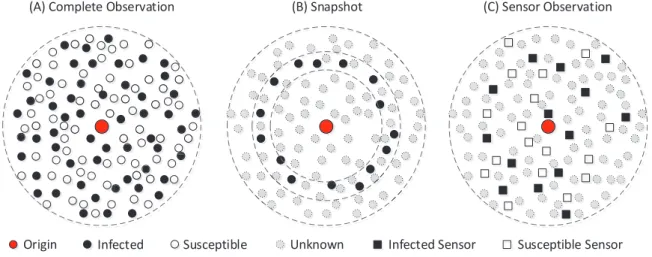
!"#$%&'()*+*$,-.*/01+2&3 !4#$531(.6&+ !%#$5*3.&/$,-.*/01+2&3
,/2723 839*:+*; 5<.:*(+2-)* =3>3&?3 839*:+*;$5*3.&/ 5<.:*(+2-)*$5*3.&/
Figure 3.1: Illustration of three categories of observation in networks. (A) Complete
observation; (B) Snapshot; (C) Sensor observation.
sensor observation provide much less information for identifying propagation sources compared with the complete observation.
3.1.1
Complete Observation
Given a timet during the propagation, complete observation presents the exact state
for each node in the network at timet. The state of a node stands for the node having
been infected, recovered, or remaining susceptible. This type of observation provides comprehensive knowledge of a transient status of the network. Through this type of observation, source identification techniques are advised with sufficient knowledge. An example of the complete observation is shown in Fig. 3.1(A).
3.1.2
Snapshot Observation
A snapshot provides partial knowledge of network status at a given time t. Partial knowledge is presented in four forms: (i) nodes reveal their infection status with
probability µ; (ii) we recognize all infected nodes, but cannot distinguish susceptible
or recovered nodes; (iii) only a set of nodes were observed at timetwhen the snapshot
was taken; (iv) only the nodes who were infected exactly at timetwere observed. An
example of the 4-th type of snapshots is shown in Fig. 3.1(B).
3.1.3
Sensor Observation
Sensors are firstly injected into networks, and then the propagation dynamics over these sensor nodes are collected, including their states, state transition time and infection directions. In fact, sensors also stand for users or computers in networks. The difference between sensors and other nodes in networks is that they are usually monitored by network administrators in practice. Therefore, the sensors can record all details of the rumor propagation over them, and their life can be theoretically assumed to be everlasting during the propagation dynamics. This is different from the mobile sensor devices which may be out of work when their batteries run out. As an example, we show the sensor observation in Fig. 3.1(C).
In the following three sections, we analyze different techniques for source identifi-cation and discuss their pros and cons. We classify the source identifiidentifi-cation methods into three categories in accordance with the three different types of observations in Section 3.1. The taxonomy of current methods is shown in Fig. 3.2.
!"#$%&'(%)( *%+,-"(.&"/#0)0-1#0%/ *"/'%,( 23'",41#0%/ 5%678"#"( 23'",41#0%/ */17'$%# 9%,&1/(5"/#", !"''1:"( ;1''0/: 5%/-"/#,0-0#< =+6%,(5"/#", >%-18(,+6%,( -"/#", !+8#078"( ,+6%,(-"/#",' *#1#0'#0-' ?0:"/4"-#%,( 5"/#", @</160-18(A:" !@> B1<"' C1+''01/ !%%/(D18E !"#$%&'()*+#, -$./+)01$#, 2$(/*3#, *0/:8"(,+6%,( -"/#", 9%,&1/(-"/#",( F(*.=(6%&"8 9%,&1/(-"/#",( F(*.(6%&"8 9%,&1/(-"/#",( F(*.*(6%&"8 @</160-( 6"''1:"G71''0/: ?))"-#04"( &0'#1/-" !%/#"(51,8% H%+,G6"#,0-C,""&<(=+8"'
Figure 3.2: Taxonomy of current source identification methods.
3.2
Rumor Source Identification Based on
Com-plete Observations
In this section, we summarize the methods of source identification developed under complete observations. There are two main techniques in this category: rumor center and eigenvector center based methods (see Fig. 3.2).
3.2.1
Single Rumor Center
Shah and Zaman [95], [96] introduced rumor centrality for source identification. They assume that information spreads in tree-like networks and the information propaga-tion follows the SI model. They also assume each node receives informapropaga-tion from only one of its neighbors. Since we consider the complete observations of networks, the source node must be one of the infected nodes. This method is proposed for the propagation of rumors originating from a single source.
as the number of distinct propagation paths originating from the source. The node with the maximum rumor centrality is called the rumor center. For regular trees, the rumor center is considered as the propagation origin. For generic networks, researchers employ BFS trees to represent the original networks. Each BFS tree corresponds to
a probability ρ of a rumor that chooses this tree as the propagation path. In this
case, the source node is revised as the one that holds the maximum product of rumor centrality and ρ.
Analysis In essence, the method is to seek a node from which the propagation matches the complete observation the best. As proven in [95, 96], the rumor center is equivalent to the closeness center for a tree-like network. However, for a generic network, the closeness center may not equal the rumor center. The effectiveness of the method is further examined by the work in [97]. The authors proved that the rumor center method can still provide guaranteed accuracy when relaxing two assumption-s: the exponential spreading time and the regular trees. This method was further explored in the snapshot scenario that nodes reveal whether they have been infected
with probability µ [42]. When µ was large enough, the authors proved the accuracy
of the rumor center method can still be guaranteed. Z. Wang et al. [107] extended the discussion of the single rumor center into a more complex scenario with multiple snapshots. Although snapshot only provided partial knowledge of rumor spreading, the authors proved that multiple independent snapshots could dramatically improve temporally sequential snapshots. The analysis in [107] suggested that the complete observation of rumor propagation could be approximated by multiple independent snapshots.
considered on a very special class of networks: infinite trees. Generic networks have to be reconstructed into BFS trees before seeking propagation origins. Second, rumors
are implicitly assumed to spread in a unicast way (i.e., an infectious node can only
infect one of its neighbors at one time step). Third, the infection probability between neighboring nodes is equal to 1. In the real world, however, networks are far more
complex than trees, with rumors often spreading inmulticast orbroadcast ways, and
the infection probability between neighboring nodes differing from each other.
3.2.2
Local Rumor Center
Following the assumptions of the single rumor center method, Dong et al. [22]
pro-posed alocal rumor center method to identify rumor sources. This method designates
a set of nodes as suspicious sources. Therefore, it reduces the scale of seeking origins. Method Dong et al. [22] extended the approaches and results in [95] and [96] to identify the source of propagation in networks. Following the definition of the
rumor center, they defined thelocal rumor center as the node with the highest rumor
centrality compared to other suspicious infected nodes. The local rumor center is considered as the rumor source.
Analysis For regular trees with every node having degreed, the authors analyze the accuracy γ of the local rumor center method. To construct a regular tree, the
degreed of each node should be at least 2. For regular trees, Dong et al. [22] derived
the following conclusions. (i) When d = 2, the accuracy of the local rumor center
method followsO(1/√n), wherenis the number of infected nodes. Therefore, whenn
is sufficiently large, the accuracy is close to 0. (ii) When the suspicious set degenerates
to +∞. This means that the minimum accuracyγ is 25% and the maximum accuracy is 30.7%. (iii) When the suspicious nodes form a connected subgraph of the network,
the accuracy γ significantly exceeds 1/k when d = 3, where k is the the number of
suspicious nodes. (iv) When there are only two suspect nodes, the accuracy γ is at
least 0.75 if d = 3, and γ increases with the distance between the two suspects. (v)
When multiple suspicious nodes form a connected subgraph, the accuracy γ is lower
than when these nodes form several disconnected subgraphs.
Discussion The local rumor center is actually the node with the highest rumor centrality in the priori set of suspects. The advantage of the local rumor center method is that it dramatically reduces the source-searching scale. However, it has the same drawbacks as the single rumor center method.
3.2.3
Multiple Rumor Centers
Luo et al. [58] extended the single rumor center method to identifymultiple sources.
In addition to the basic assumptions, they further assumed the number of sources was known for the method of identifying multiple rumor centers.
Method Based on the definition of rumor centrality for a single node, Luo et al. [58] extended rumor centrality to a set of nodes, which is defined as the number of distinct propagation paths originating from the set. They proposed a two-source estimator to compute the rumor centrality when there were only two sources. For multiple sources, they proposed a two-step method. In the first step, they assumed a set of infected nodes as sources. All infected nodes were divided into different partitions by using the Voronoi partition algorithm [36] on these sources. The single rumor center method was then employed to identify the source in each partition.
In the second step, estimated sources were calibrated by the two-source estimator between any two neighboring partitions. These two steps were iterated until the estimated sources become steady.
Analysis Luo et al. [58] are the first to employ the rumor center method to identify multiple rumor sources. They further investigate the performance of the two-source estimator on geometric trees [96]. The accuracy approximates to 1 when the infection graph becomes large. This method has also been extended to identify
multiple sources with snapshot observations. Because snapshots only provide partial
knowledge about the spreading dynamics of rumors in networks, W. Zang et al. [118] introduce a score-based method to assess the states of other nodes in networks, which indirectly form a complete observation on networks.
Discussion According to the definition of rumor centrality of a set of nodes, we need to calculate the number of distinct propagation paths originating from the node set. It is too computationally expensive to obtain the result. Even though Luo et al. have proposed a two-step method to reduce the complexity, the two-step method still
needs O(Nk) computations, where k is the number of rumor sources. This method
can hardly be used in the real world, especially for large-scale networks.
3.2.4
Minimum Description Length
Prakash et al. [83, 84] proposed a minimum description length (MDL) method for
source identification. This method is considered for generic networks. They assumed rumor propagation following the SI model.
Method Given an arbitrary infected node as the source node, minimum descrip-tion length corresponds to the probability of obtaining the infecdescrip-tion graph. For gener-ic networks, it is too computationally expensive to obtain the probability. Instead,
Prakash et al. [84] introduced an upper bound of the probability and detected the
origin by maximizing the upper bound. They claimed that to maximize the upper
bound is to find the smallest eigenvalueλmin and the corresponding eigenvector umin
of the Laplacian matrix of the infection graph. The Laplacian matrix is widely used
in spectral graph theory and has many applications in various fields. This matrix is
mathematically defined as L=D−A, where Dis the diagonal degree matrix and A
is the adjacency matrix. According to Prakash et al.’s work in [83, 84], the node with
the largest score in the eigenvector umin refers to the propagation source.
Analysis This method can also be used to seek multiple sources. The authors adopted the minimum description length (MDL) cost function [34]. This was used to evaluate the ‘goodness’ of a node being in the source set. To search the next source node, they first removed the previous source nodes from the infected set. Then, they replayed the process of searching the single source in the remaining infection graph. These two steps were iterated until the MDL cost function stopped decreasing.
Discussion Due to the high complexity in computing matrix eigenvalues,
gen-erally O(N3), the DML method is not suitable for identifying sources
![Figure 2.4: The connectivities of various large real-world networks have scale-free distri- distri-butions, (a) actor collaboration graph, (b) the World Wide Web, and (c) the power grid network [9].](https://thumb-us.123doks.com/thumbv2/123dok_us/854278.2608821/39.892.171.810.183.427/figure-connectivities-various-networks-distri-butions-collaboration-network.webp)