Empowerment of Women through Self-help Groups
and Credit Linkage: A Case Study of Six Self-help
Groups under Ramsai Hills, Assam
Ouseph Varghese*Abstract
A harmonious progress of a nation is possible only when women are considered as equal partners in the development process. Since early 1970s the emergence of Self Help Groups (SHGs) as a vehicle of transformation in poverty alleviation and women empowerment became worldwide phenomenon. Self Help Groups are considered as one of the means to empower women as it enables them to pool resources through thrift and opens them to easy access to credits. A SHG is generally a village-based financial intermediary. It is homogenous and has commonality of interest. Typically it is a group of “micro-entrepreneurs” with similar social and economic backgrounds, coming together to save regular small sums of money, jointly agreeing to contribute to a common fund and to meet their emergency needs. They pool their resources to become financially stable.
Introduction
Assam is predominantly a rural based state, almost 86 per cent of its population still living in rural areas. The socio-economic position among the people in rural areas is very pathetic compared to urban area & all India figures. Rural poverty is more than twice that of urban poverty. The population growth in Assam also implied that there has hardly been any reduction in the absolute number of the poor over the years. Gender Empowerment measure (GEM) and Gender Development Index (GDI) are indices for measuring gender inequality. Gender Development Index (GDI) scores are measured to account for inequalities between men and women. GEM proposed to assess women’s and men’s ability to
participate actively in economic and political life and their command over economic resources. The GDI score for India was 0.590 and that for Assam was 0.585 in 2006. State Assam was placed 26th in GDI score. The aggregate score for GEM for India was 0.497 in 2006 and for Assam it was 0.417 ranking 28th in GEM score. It reflects the existence of sharp disparities in gender empowerment in Assam (Soma, 2014).
The economic development extend of a country depends largely on its human resources. It can be said that the contribution of women in the socio-economic development of a country is vital. An all round development and harmonious growth of a nation is possible only when women are considered as equal partners in progress with men. It is ironical to see that a vast majority of them still remain ignored and not seriously considered although women constitute an integral part of India’s socio-economic force. It is because they have scanty access to capital resources, technology and credit. Ideologically as well as in practice male supremacy over women override in every sphere of the society, notwithstanding the fact that equality between men and women by and large is seen on paper but not otherwise, a trend setter for feminization of poverty.
Concept of Empowerment
The word empowerment is loaded with many nuances and it is redundant to give an exhaustive description of the concept. A general understanding of it would help to understand the process of empowerment of women. The neo-liberal policies uphold the freedom of individuals to make their own decisions and reject the culture of dependency. It glorifies the culture of self-management, self-reliance and discipline (Harvey, 2005). But the irony is that in the process of liberalization, a large section of the society is left out especially in developing countries. In this context, the libertarian concept propounded by John Rawls is noteworthy. His theory has great significance in the perspective of empowerment for establishing social justice by empowering the powerless through remedial interventions. Rawls’ theory calls for social responsibility in distributing goods according to merit and needs (Rawls, 1971). His distributive theory bases itself on two principles of societal equality and inequality and the principle inequality drives in the need of gender equality.
Concept of Self Help Groups (SHGs)
A Self Help Group (SHG) is a group of about 10 to 20 people from a homogeneous class, who come together for addressing their common problems. They are encouraged to make voluntary thrift on a regular basis. They use this pooled resources to make small interest bearing loans to their members. The process helps them imbibe the essentials of financial intermediation, including prioritization of needs, setting terms and conditions and accounts keeping. This gradually builds financial discipline in all of them. They also learn to handle resources of a size that is much beyond their individual capacities. The SHG members begin to appreciate that resources are limited and have a cost. Once the groups show this mature financial behavior, banks are encouraged to make loans to the SHG in certain multiples of the accumulated savings of the SHG. The bank loans are given without any collateral and at market interest rates. Banks find it easier to lend money to the groups as the members have developed a credit history. The groups continue to decide the terms of loans to their own members. Since the groups’ own accumulated savings as part of the aggregate loans made by the group to its members, peer pressure ensure timely repayment and replaces the ‘collateral’ for the bank loans. Apart from financial help in the time of need the group provides social security to its members (cited in Tanka, 2012).
A self-help group (SHG) is generally a village-based financial intermediary. SHGs are small informal association of individuals in a locality created for the purpose of reaping economic advantages resulting out of mutual help, solidarity, and joint responsibility (Anand, 2002). It is homogenous and has commonality of interest. The members here come together to share common experiences and eventually create an opportunity to mobilize resources in the pursuit of needs and interests (Kurtz, 1981). Typically it is a group of “micro-entrepreneurs” with similar social and economic backgrounds, coming together to save regular small sums of money, jointly agreeing to contribute to a common fund and to meet their emergency needs. They pool their resources to become financially stable. Members use SHG loans to pay off moneylenders, and for education and health needs.
SHGs and Empowerment of women
Self Help Groups (SHGs) provide an opportunity for social action and empowerment through women’s involvement in considering, addressing and participating in issues that affect their members and their communities, including issues that affect women in particular (Naidu, 2013). In the mid-1970s, Muhammad Yunus began to establish the Grameen Bank in Bangladesh and the SHG movement is attributed to him as his brain child. However, SHGs are not to be confused with Nobel Peace Prize–winning Grameen Bank model. Grameen Bank is a Bangladeshi concept which requires potential borrowers/customers to organize into groups of five, which in turn are clubbed in groups of five to seven into centres that save and/or borrow from a micro-finance organization (MFO). SHGs, an Indian construct, are groups of up to twenty individuals who come together or are brought together by an NGO and then tap a bank or MFO to fund their schemes. The SHG’s individual members and the lending institution have no direct link.
The SHG movement in India took shape in the 1980s as several NGOs experimented with social mobilization and organization of the rural poor into groups for ‘self-help. The SHG-bank Linkage Programme (SBLP) under the leadership of the National Bank for Agriculture and Rural Development (NABARD) completed two decades of existence in February 2012. The SHG movement has come to mean more than merely the provision of financial services to their group membership, which is composed mainly of poor women. However, it is the role of SHGs in financial intermediation that hold great promise as a means of financial inclusion and mainstreaming of the poor families as well as a development model with wider application.
Studies of Tankha (2012), Manga (2011), Sooryamoorthy (2013) etc. have revealed that SHGs play important role in socio-economic empowerment of people. Singh and Singh (2009) opine that SHGs have been social innovation and their saving and credit function have a great appeal to the rural financial institutions. It is also revealed that SHGs build up women’s confidence level and dignity, generate self-employment and improves their accessibility to credit. Mayoux (2000) points out that the use of savings and credit for economic activities generates income and assets. This leads to increase in consumption standards and, more importantly, reduces vulnerability of poor
households by reducing smoothening seasonal fluctuations in household income and consumption levels. The additional income may also act as a safety net by helping the family tide over emergencies.
Participation in SHG movements and access to credit also leads to a change in the status of members within their households. It has been observed that the economic contribution of women may increase their role in household decision-making (Hashemi et al., 1996, Mayoux, 2000, Pitt and Khandker, 1995). This may lead to improved household-level outcomes with respect to health, education (particularly education of the girl child, nutrition and family planning (Kabeer, 2001 and 2005). Other positive outcomes of joining SHGS have been observed – greater respect within household (Mayoux, 2000), increase in mobility, ability to articulate, self-confidence and esteem (Moyle et al., 2006; Chavan and Kumar, 2002), growth of a collective identity and political awareness (Hashemi et al., 1996). The incidence of violence against women has also been found to have decreased (Hashemi et al., 1996).
Swain and Wallentin (2009), examining the link between SHG/microfinance and women‘s empowerment in India, argue that women‘s empowerment takes place when women challenge the existing norms and culture of society to improve their well-being effectively. They also emphasize that the nature and types of activities and the kind of programme that the women are exposed to, critically determines how empowering the impact of SHG is on women. Overall, there is mixed evidence of empowerment in Indian context (Kabeer, 2005; Swain and Wallentin, 2009; Lindberg et al. 2011; Sivachithappa, 2013). If women’s empowerment is to be pursued as a serious objective by SHG programme in particular and the larger microfinance community in general, greater emphasis needs to be placed in training, education of women and creating awareness, with increased investment in social intermediation. Without these, channeling microfinance through women’s group alone might result in several other positive outcomes but will not translate into women’s empowerment (Swain, 2006).
Empowerment of women is essential for the development of a country. In recent years the Government of India has assigned a special role to SHGs in the implementation of its poverty alleviation programmes, recognizing it as a viable organized setup to disburse micro-credit to the rural women for the purpose of making them
enterprising and encouraging to enter into entrepreneurial activities (Singh & Singh, 2009). Besides SHGs are seen as a means to promote and enhance people’s participation in development programmes. In using SHGs as a strategy for implementing poverty alleviation programmes, the focus is also on economic development and there is no attempt to strike at the roots of poverty and to bring about changes in the system.
In Northeast India, the SHG concept is a late comer by almost a decade and we see the emergence of it in Assam and Tripura late 90s and spreading into other parts of Northeast India Gradually.
SHGs and Poverty Eradication for Women
Down the line of post independent decades the planners and policy makers of the country adopted a state centered approach in poverty eradication programmes which achieved very little. Thus the focus then shifted to development activities of locally rooted, participatory micro-development organizations and thus recognizing the role of voluntary and non-governmental organizations, in asserting the positive values of participation of the poor in development and bringing about social changes within a democratic political framework (Prasad, 2003).
It has been observed in many parts of the world that an effective way to tackle poverty and enable communities to improve the quality of life is through social mobilization of disadvantaged people, especially into Self Help groups (SHGs). Self-Help groups have become a familiar presence in the countryside and have also been successfully promoted in urban areas. The concept of SHGs is based on the idea of community participation of the entire community. ‘Popular Participation’ ensures that the benefits of development are equitably shared. Thus SHGs have been promoted as an effective channel and means for the delivery of microfinance, which for some time held out the promise globally as a “magic bullet” for poverty reduction.
In third world countries as well as in fast developing countries a large section of women have substandard existence as they are vulnerable and marginalized due to lack of education, access to resources and employment opportunity. An all-encompassing and harmonious progress of a nation is possible only when women are considered as equal partners in the development process. Since early 1970s the emergence of SHGs as a vehicle of transformation in poverty alleviation
and women empowerment became worldwide phenomenon. Self Help Groups (SHGs) are considered as one of the means to empower women as it enables them to pool resources through thrift and opens them to easy access to credits. It is a general belief that easy access to credit would enable women to participate in income generating activities, develop their entrepreneurial skills, improve their social status and augment well-being in households. The ability to generate own income gives more power to women in decision making in world of choices related to house hold matters, education , health and opportunities to take part in other socio-economic activities.
Savings and Credit (Microfinance) and Women Empowerment According to Sooryamoorthy (2013) there is a direct relationship between access to credit and the status of women in families and communities. NGOs in development activities adopt microcredit to empower women economically and support them for leadership skill, health, literacy, and vocational training for livelihood. Women are trustworthy borrowers and credit users with repayment habit.
From the 1990s, microfinance came to be seen as a window of hope by development agencies who largely trail economic development. Such zeal originates from the idea that microfinance can provide for ‘killing two birds with one stone’. It can facilitate poverty reduction through improved quality of life on the one hand, and women’s empowerment on the other. This means that through microfinance, women can be engaged in the market both for market efficiency gains and for their own gains in challenging hegemonic gender relations (Lakwo, 2006).
Microfinance services are provided through three types of sources (i) formal institutions like through Banks (ii) semiformal institutions like NGOs and (iii) informal sources like money lenders. Now-a-days, Micro Finance Institutions (MFIs) are playing vital role in the economy by extending Micro-Credit facilities in order to develop rural folk by changing their life style pattern. Similarly, these institutions are making an attempt to bring rural women and farmers into the formal banking grid. As a result, most of the under developed or rural areas are getting modern formal banking facilities at their door steps. Micro-Finance services have diversified over time into areas such as micro savings, micro insurance and several non-financial services (Kaur, 2015).
In order not to equate micro-finance with credit for micro enterprises but also include savings, consumption loans, housing loans and insurance services, the task force on micro-finance set up by NABARD came up with a definition which has become the definitive one. “Micro-finance is provision of thrift, credit, and other financial services and products of very small amounts to the poor in rural, semi-urban or urban areas, for enabling them to raise their income levels and improve living standards” (Murthy, n.d).
The success of micro credit initiatives has often been attributed to their particular focus on empowering women and encouraging their self-reliance through developing their own means of income. Various case studies show that there is a positive correlation between credit availability and women's empowerment (Balakrishnan, n.d). Many evaluations of MFIs have shown that microfinance services have a positive impact on women (Hashemi et al., 1996; Khandker, 2005; Lakwo, 2006; Mahmud, 2003; MkNelly & Dunford, 1998, MkNelly & Dunford, 1999; Morduch, 1998; Osmani, 2007; Pitt & Khandker, 1998; Pitt et al., 2006; Pitt et al., 2003; Rai & Ravi, 2011; Schuler & Hashemi, 1994; Schuler et al., 1996). Hashemi et al. (1996) found that credit programmes had significant effects on eight different dimensions of women’s empowerment.
They found that women’s access to credit was significant determinant of the magnitude of economic contributions reported by women; of the likelihood of an increase in asset holdings in their own names; of an increase in their exercise of purchasing power; of their political and legal awareness as well as of the value of the composite empowerment index (Kabeer, 2001). Mahmud (2003) found that microcredit programme participation has only a limited effect in increasing women’s access to choice-enhancing resources, but has a much stronger effect in increasing women’s ability to exercise agency in intra-household processes. Consequently, programme participation is able to increase women’s welfare and possibility to reduce male bias in welfare outcomes, particularly in poor households. Furthermore, MkNelly and Watetip (1993) found that credit enhanced women empowerment in Thailand, such as increased self-confidence and better cooperation with neighbours. Rai and Ravi (2011) in their paper female empowerment and microfinance found that clients spouses use more health insurance in
terms of filling claims than those of non-clients, and that women who are clients make significantly more use of health insurance than non-clients women who have obtained the insurance through their husband. Their findings provide evidence that women who are members of MFIs are more empowered than nonmembers. Becchetti and Castriota (2011) analys the effectiveness of MFIs as a recovery tool after a natural disaster. In their paper they examine the contribution of MFIs loans in helping people who were hit by tsunami in Sri Lanka in 2004. They found that loans obtained from the MFI after the catastrophic event have a positive and significant effect on the change in real income and in weekly worked hours, and that the impact on performance variables is significantly stronger for damaged than non-damaged borrowers. Their study provides a strong evidence for effectiveness of MFIs as recovery tool (Hermes & Lensink, 2011). Kabeer (2005) opined that finance services make a vital contributions to the economic productivity and social well-being of the marginalized women, and therefore automatically empowers them.
Despite remarkable achievement, the assumption that microfinance empowers women remains controversial (Haile, Bock, & Folmer, 2012). Linda Mayoux (1999) stated that, the evidence indicates that for some women in some context, even very poor women, microfinance programmes can indeed contribute to empowerment. However, for many women, impact on both economic and social empowerment appears to be marginal and some women may be disempowered. Critics of credit programmes argue that credit in itself is not a solution for women empowerment (Wrigley-Asante, 2011). Targeting women without adequate support networks and empowerment strategies can merely shift all the burden of household debt and household subsistence onto women (Cheston & Kuhn, 2002; Kay, 2002; Mahmud, 2003; Mayoux, 2000; Mayoux, 2002; Wrigley-Asante, 2011). Some studies point out that credit programmes pay insufficient attention to their impact from a gender perspective and, as consequence, may weaken rather than strengthen women’s position in the family (Goetz & Gupta, 1996). Since credit by itself cannot overcome patriarchal systems of control at the household and community levels, empowerment is not always realized (Ahmed, Chowdhury, & Bhuiya, 2001). Rahman (1999) also show that
some men compel their wives to hand over loans to them, which tends to increase marital conflict.
Role of the Microfinance Institutions
The aim of the MFIs are to provide financial and other support services to the underprivileged households in the Northeast to economically empower and to improve their quality of life especially women by providing access to need based financial services in a cost effective manner on a sustainable basis. MFI mobilize client groups and give those trainings on how to sustain without outside credit or support and arrange credit facilities to income generating activities through Micro Finance Schemes. The types of loan available for the SHGs are through Internal saving loan, SHG group loan, and Entrepreneurship loan for individuals, Housing loan, Livelihood loan and Income generation. As mentioned by the three MFIs, loan is used more by the SHGs for entrepreneurship Livelihood and Income Generation activities to reduce poverty and to create opportunities for self-employment for the underprivileged.
They prefer joint liability groups because it lowers transaction costs, professional, based on board’s decision and easier to repay when loan is given to joint liability groups than to individuals because group pressure compels the defaulting client to repay the loan amount on time or else it is likely that the entire group will earn itself a bad reputation. Prachesta practice individual lending to the members of SHGs where as RGVN and Nightingale do not do individual lending to the members of SHG. In order to make sure of repayment capacity of the client, home visit- door to door is made.
The MFIs practice different mechanisms for repayment of loan through group guarantee or peer pressure, only for income generation activity so loan amount can be repaid from the profit earned and assessment by a 5 member group to confirm whether the client group is capable for repayment or not. In order to make sure loan are used for the intended purpose, loan utilization format, field visit and verification.
The interest rates of loans to the SHGs are 24%, 12% and 25% P/A respectively. The prime reasons for high interest rates charged by MFI were attributed to high operations costs. The interviewee from Prachesta explained that interest rates covers the operating expenses besides
refinancing expenditure and consider provisions for potential portfolio risk and inflation. Furthermore higher interest rates for microloans are justified by the complex and labor-intensive structuring, documentation and provision of the credit, the often remote location of the clients and the frequent meetings with MFI’s staff during approval and repayment process. According to Nightingale, there are three kinds of costs the MFI has to cover when it makes microloans; The first two, the cost of the money that it lends and the cost of loan defaults, are proportional to the amount lent. For instance, if the cost paid by the MFI for the money it lends is 10%, and it experiences defaults of 1% of the amount lent, then the interest rate will be 11% of the loan amount which will cover both these costs. The third type of cost is transaction cost. The transaction cost of Rs.5000 loan is not much different from the transaction cost of Rs. 30000 loan. Both loans require roughly the same amount of staff time for meeting with the borrower to appraise the loan, processing the loan disbursement and repayments, and follow-up monitoring.
The frequency of collection of repayments from clients was monthly for all the three organisations. In case of late payment, Prachesta staff made home visit (In case the clients fails to repay the money the staff goes to the clients house to inquire about the missed payment and warn of the consequences of late payment, including legal action), group or peer pressure (In this case the default client are usually pressurized by his or her peer group members to return the money) or recourse to legal action (If in case the client after warning still continue as a defaulter). For RGVN, notice is served upon the defaulting member still if they fail to repay then their loan is excused. And for Nightingale, usually the clients repay but in exceptional cases of client’s inability to repay immediately then they are given additional time.
The terms and conditions involved in getting the funds is that the MFIs commits itself for implementing and adopting fair practices in all its activities and transactions with the stakeholders. It adopts a code of conduct to promote good and fair practices by setting minimum standards in dealing with the clients and increasing transparency so that the clients have a better understanding of the services provided. The Guidelines on Fair Practices Code for all Non-Banking Financial Companies (NBFCs) issued by RBI vide circular dated 18th February, 2013 are adopted and followed by MFIs.
There are 4000 clients at Prachesta, 150 at RGVN and 25000 at Nightingale and the maximum amount of loan given to clients under Prachesta is a minimum of Rs. 1000.00 and Maximum of Rs. 50,000.00, under RGVN, the minimum is Rs. 30,000.00 and maximum of Rs. 3, 000, 00.00 and under Nightingale at minimum of Rs. 5000.00 and maximum of Rs. 30,000.00. The default rate of repayment by clients in % is 2% for all the three MFIs. For availing loans, SHG requires minimum saving of Rs 10.00 in the bank account of the person as mentioned by Prachesta while RGVN and Nightingale have no fixed amount.
By supporting women's economic participation, microfinance helps to empower women, thus promoting gender-equity and improving household well-being. Rise in the economic status of the women have helped in their empowerment. They can now dream, plan and hope for a better future for themselves and for their family thereby making their work visible.
As per their opinion the impacts created through MFI in the lives of women are:
Prachesta RGVN Nightingale
- Economic empowerment- it has enhanced in the women’s contribution to the household income as a result of credit access; helped in employment generation; helped in understanding bank transactions and improved women’s access and control over resources.
- Social empowerment: it has helped women to gain confidence; to gain respect in the family; increased the role of women in household decision making; improved the ability of women to freely interact with the members of the group and with outsiders and increased mobility of women within their locality and outside.
- Education, skill and training empowerment and
- Political empowerment: it has led to
Women are empowered to come out of their homes and engage in income generation activities. They have become more enterprising. Access to financial services has improved the status of women within the family and the community. Women have become more assertive and confident. In regions where women's mobility is strictly regulated, women have become more visible and are better able to negotiate the public sphere.
Women own
the participation of women in local bodies as well as increased the number of women in decision making power of local governments.
land and housing, and play a stronger role in decision making.
Besides the points mentioned above, women’s capacity for livelihood is boosted through MFI said the interviewee of Prachesta at 60%, RGVN said 75% and Nightingale also expressed 70%. Women are now getting chance to go out of their houses and take part in income generating process which is also making the women empowered and self-independent. 50% of women are involved in decision making after helping them said Prachesta, RGVN said 60% women and Nightingale 70%. MFI provide loans for women to generate livelihood income. These women are trained how to take leadership roles and encouraged to participate in public speaking in the group meetings or workshops. Hence women are getting empowered with knowledge, attitude and skill.
Facilitating Organisation: Women Development Centre, Guwahati Women Development Centre (WDC) Guwahati is a registered non- government organization established in the year 1999 for the development of women. The centre was started, by the Congregation of the Sisters of the Cross of Chavanod. Its aim is to empower the women in North East India for the integral development of individuals, families and communities in order to establish peace and stability and to build up love centered Human Communities in the Region.
WDC has created awareness on SHG management, credit facilities, legal rights and schemes available for the empowerment of women. The centre started Self Help Groups among women in Arunachal Pradesh, Assam and Meghalaya in East Siang, West Siang, Kamrup, Lakhimpur, Morigaon, Nagaon and West Garo Hills districts. At present, a total of 750 SHG’s are functioning under it out of which six were selected for the present study.
Methodology
The study was aimed at a comparative study of the situations existing among six SHG groups under Ramsa Hills, Ward No 12 Guwahati Circle, Kamrup Metro, Assam before the interventions of Women Development Centre and the present status in 2015. During this gap of
five years what happened to the women in their journey towards empowerment and the strategies adopted was the specific question studied. The place of study was the six villages. The population of the study was the women groups and women members of the six SHGs.
In order to conduct the research, the methods used were Case Study Method with the help of Interviews, Questionnaires and Observation Method.
The plan of action for the strategy and structure of the design was of a sociological research. Through this the study intended to gain more knowledge of a specific problem or a specific aspect of the society. In order to achieve the specific objectives, the study used exploratory and descriptive research design.
Data Collection, Analysis and Interpretation
Using the above mentioned research design, data was collected from the study group. The main respondents were the members of six SHG. The selections were made based on the principles of sampling methods. Sixty nine persons of the populations were selected as samples, 10 members and one office bearer from each SHG was randomly selected to find out the impact of the programme on the women. The heads of three MFIs were interviewed namely Prachesta, RGVN and Nightingale to elicit the role of microfinance in the empowerment of SHG members. The data was interpreted and the learning was consolidated to arrive at conclusions and the expected results. To summarize and tabulate the data, SPSS Computer package was used and the accuracy of the data was ensured. Tables and figures were prepared accordingly. The data have been interpreted and the learning consolidated to arrive at conclusions and results to understand the effect and impact of SHGs for development and the changes brought in the communities. Simple statistical method of frequency and percentages were used to analyse the extent of empowerment and role of microfinance behind of this empowerment.
Findings and Analysis Profile of the SHGs
Cent percent of the group members are female. The Assamese community consist 66.6 percent while 33.3 percent consist of people from other communities like Bengali, Nepali and Bodo. The SHG leaders affirmed that the SHG was formed by NGO.
Table: 1
The SHGs have Agree Disagree
Trade license 3 (50%) 3 (50%)
Bank Account 6 (100%) 0 (0%)
Table 1 shows that 50 percent of the SHGs have got trade license and the other half percent i.e. 50 percent do not have. It is found that all of them have their Bank Accounts.
Four of the SHGs are affiliated to NGO/NBFC (Non-Banking Financial Institute) and the other 2 groups are with No registration Number/Affiliated. The size of the group with more than 10 members is 83 percent and less than 10 member’s amounts to 17 percent.
SHGs Grading
Fig. 1
Fig. 1 reveals, 67 percent of the SHGs has been graded by the Bank with “A” grade as they showed their skill of returning the loan as per the Rules and Regulations of the bank on time obtained in the year 2010, 2012, 2013 and 2015, whereas 33 percent of the SHGs (formed less than 3 years) have not yet received any grade from the bank as they have not yet begun taking loan from the bank.
Financial Information of SHGs
Table: 2
Financial Information of SHGs Monthly Quarterly
Regularity of savings 5 (83.3%) 1 (16.7%) Monthly Contribution 0 – 50 (33.4%) 51 – 100 (66.7%)
Yes No
Extra saving 6 (100%) 0
Inter-loaning 5 (83.3%) 1 (16.7%)
As per table 2, a majority, 83.3 percent of the group members have regular savings on monthly basis, and a meager 16.7 percent have saving on quarterly basis. 33.4 percent of the group members saves Rs.5000/- and above, and majority 67 percent saves less than Rs.5000/- 67 percent which is more than half of the number of groups contributes Rs. 50/- to Rs.100/- monthly. Another 33 percent contributes less than Rs. 50/-. Majority i.e. 83 percent of the groups has the practice of inter-loaning.
Loan and Credit Repayment in SHG Table: 3
Loan and Credit Repayment in SHG Agree Disagree
Regular in repayment of loan 6 (100%) 0 The installment period to repay loan Monthly (100%) 0 Reason for Defaulting
Loans not received in time 0 6 (100%)
Not getting the required sum of money always
1 (16.7%) 5 (83.3%)
High Interest Rates 0 6 (100%)
Formalities and Procedures 0 6 (100%)
If fail to repay, would the group pay it back
4 (66.7%) 2 (33.3%) If fail to repay, any motivational steps
taken
5 (83.3%) 1 (16.7%) If fail to repay, any action taken 5 (83.3%) 1 (16.7%)
Table 3, shows that 100 percent of the group agrees with the monthly repayment principles. 16.7 percent do not get the required sum of money always as per the requirement, whereas 83.3 percent are happy with the sum of money they get. 66.7 percent expressed that if the members fail to repay, the group pays it back, while 33.3percent do not practice. A majority 83.3 percent reveals that if the members fail to repay, they advise them, how to improve their repayment ability and if not, expelling the members on such ground from the group is the practice. Furthermore, there are 16.7 percent who despite of the advice in improving the repayment do not take any action as per table 3.
Book Keeping and Documentation Table: 4
Book Keeping and Documentation Agree Disagree
Admission Book 4 (66.7%) 2 (33.3%) Minute Book 6 (100%) 0 Attendance register 6 (100%) 0 Cash Book 6 (100%) 0 General ledger 3 (50%) 3 (50%) Bank Passbook 4 (66.7%) 2 (33.3%) Loan Ledger 5 (83.3%) 1 (16.7%) Bank Passbook 6 (100%) 0 Individual Passbook 6 (100%) 0 Receipt Voucher 3 (50%) 3 (50%) Stock Book 6 (100%) 0
Audit of the SHG been done: Internal auditing
6 (100%) 0
Cent percent of the SHG members maintain and update the minute books, attendance register, cash book, Bank Pass books, individual pass book and internal auditing. On the other hand 66.7 percent out of the total maintain admission books as per the table. 50 percent maintain General ledger, 66.7 percent maintain bank pass book and 83.3 percent Loan ledger, and 50 percent maintain receipt Voucher. It is learnt that 100 percent maintain Stock Book and internal auditing.
Trainings Attended
Table: 5
Trainings Attended Agree Disagree
Weaving 4 (66.7%) 2 (33.3%)
Pickle Making 2 (33.3%) 4 (66.7%)
Health Care 1 (16.7%) 5 (83.3%)
Disaster Management 1 (16.7%) 5 (83.3%)
Cane and Bamboo 2 (33.3%) 4 (66.7%)
Soap Making 2 (33.3%) 4 (66.7%)
Mushroom 2 (33.3%) 4 (66.7%)
Cutting and Tailoring 4 (66.7%) 2 (33.3%)
Candle Making 3 (50%) 3 (50%)
Awareness Programme any 3 (50%) 3 (50%)
Leadership training 3 (50%) 3 (50%)
Table 5, describes that 50 percent i.e. half of the groups have attended 11 times and the remaining half 50 percent attended less than four trainings. These disparities were noticed due to the differences in the year of their SHG formation. Some of the groups were formed just three years ago. It is found that 67 percent attended in Cutting, tailoring and Weaving. 50 percent have attended in Leadership training, Awareness Program, Candle making, pickle making, Mushroom cultivation and Soap making. 33 percent on Cane and Bamboo and 17 percent attended on street play, Health care and Disaster management.
One of the reasons for the gap noticed in percentage is due to the groups being formed in different years. Over and above the disparities were created due to the type of trainings given in different years.
Social Involvement
Table: 6
Activities Performed Agree Disagree
Health 3 (50%) 3 (50%)
Immunization 0 6 (100%)
Non Formal Education(NFE) 2 (33.3%) 4 (66.7%)
ICDS nutrition Anganwadi 0 6 (100%)
Adolescent Programme 0 6 (100%)
Water and Sanitation Programme 2 (33.3%) 4 (66.7%)
Alcoholism 1 (16.7%) 5 (83.3%)
Domestic Violence 2 (33.3%) 4 (66.7%)
Abortions/ Infanticide 1 (16.7%) 5 (83.3%) Violation of Human Rights 1 (16.7%) 5 (83.3%) Conflict between two village/ tribes 3 (50%) 3 (50%) Environmental degradation 1 (16.7%) 5 (83.3%)
Human Trafficking 0 6 (100%)
Pollution 0 6 (100%)
Table No 6, shows that 50 percent on Health and Conflict between two village and tribes of intervention/social action programme/ activities/ awareness taken up by SHGs. 33.3 percent types of intervention/social action programme/ activities/ awareness taken up by SHGs are Non formal education, water and sanitation programme and domestic violence. No intervention/social action programme/ activities/ awareness has been taken up by SHGs on Immunization, ICDS nutrition anganwadi, Adolescent Programme, Human Trafficking and Pollution. 16.7 percent has intervened on Alcoholism, Abortion/infanticide,
Environmental degradation type of intervention/social action programme/activities/awareness taken up by SHGs. 33.3 percent of the SHGs have met and interacted with Official of the state/district/block level and political leaders while 83.3 percent with bank official and NGOs. So far, none of the SHGs have met SHPI/Federation.
Group Dynamic, Capacity, Communication and Interaction Table. 7A
Agree Disagree
Official of the State/ District/block level 2 (33.3%) 4 (66.7%)
Political Leader 2 (33.3%) 4 (66.7%)
NGO 5 (83.3%) 1 (16.7%)
SHPI/ Federation 0 6 (100%)
Bank 5 (83.3%) 1 (16.7%)
Table 7A, reveals that only 33.3 percent SHGs frequently approached Official of State/ District/ block level and political leaders whereas 83 percent of the respondents approached NGOs and Bank to communicate, collect information from linkages department.
Group Dynamic, Capacity, Communication and Interaction Table: 7B
Agree Disagree
SHG approached by Community for help 4 (66.7%) 2 (33.3%) Activities organized in the community 2 (33.3%) 4 (66.7%) SHG members made available with new
employment activities
2 (33.3%) 4 (66.7%)
Linkage with the following Institutions/Monetary Institutions
Banks 5 (83.3%) 1 (16.7%)
Non-Banking Financial Institutions 1 (16.7%) 5 (83.3%)
Chit funds 1 (16.7%) 5 (83.3%)
International funding agencies 0 6 (100%) Line Department/Sectoral Department
Health department 1 (16.7%) 5 (83.3%)
Agriculture department 1 (16.7%) 5 (83.3%)
Animal husbandry department 0 6 (100%)
Education department 0 6 (100%)
Social welfare department 4 (66.7%) 2 (33.3%)
Soil & water conservation 0 6 (100%)
Cooperation department 0 6 (100%)
Community and rural development department 0 6 (100%)
NGO 4 (66.7%) 2 (33.3%)
SHG taken initiative to have a federation of SHG 0 6 (100%) Table 7B reveals that 67 percent of the SHGs are approached by community members for help and support. While 33- 33.3 percent of the SHGs have organized employment activities in the villages; have given new employment activity to the SHG members respectively. Eighty three percent SHGs have established linkages to bank especially Gramin Bank and almost nil to other monetary institutions such as; non-banking financial institutions, chit funds and International funds. Sixty seven percent SHGs have established linkages with Social Welfare Department, on the other hand; they have not created any link with other line Departments due to their ignorance of benefits which can be availed. The SHG representatives expressed that any beneficiary information is available only if the group can pay a portion of their benefit drawn from the line Department. As a result, they did not make any extra effort to create link. They did not form Federation, as they did not have clear knowledge on it as well as they could not get proper guidance from any one. Every decision in all the groups is made collectively. The SHGs have not taken up any project so far.
Suggestions for Improvement
Table: 8
Future Requirements of the SHG: Agree Disagree
Income generating activities(IGA) 3 (50%) 3 (50%)
Training 4 (66.7%) 2 (33.3%)
Skill up-gradation 2 (33.3%) 4 (66.7%)
Supply of raw materials 0 6 (100%)
Marketing 5 (83.3) 1 (16.7%) Credit 0 6 (100%) Extension services 0 6 (100%) Housing 0 6 (100%) Health services 1 (16.7%) 5 (83.3%) Education 1 (16.7%) 5 (83.3%) Food processing 2 (33.3%) 4 (66.7%) Food security 2 (33.3%) 4 (66.7%) Environmental concerns 0 6 (100%)
Child welfare services i.e., day care centers 0 6 (100%) Others, specify - Want to form as
Federation
Suggestions for Improvement of Microfinance Situation in the State
Less coercion 0 6 (100%)
More coercion 0 6 (100%)
Reduction of interest 4 (66.7%) 2 (33.3%) Flexibility in repayment 1 (16.7%) 5 (83.3%)
Table 8 reveals that 83 percent of the SHG groups expressed that marketing is important to make them economically self-sufficient. Sixty Seven percent felt trainings were essential while 33 percent feel food security is of great concern as mothers and 50 percent of SHG considered Income Generation will enhance their life as table 10 illustrates. Moreover, in a lower percent i.e.17 percent they also felt the importance of Health services and education. Sixty Seven percent suggested that reduction of interest rate will enhance quality service to the SHGs by Microfinance Institutions. And another 17 percent felt Flexibility in repayment will reduce the tension of taking another loan to repay.
Functioning and Savings
Table 9 shows 100 percent SHG members confirmed that decisions regarding the functioning of the group were unanimously taken. All the members were satisfied with the functioning of the SHGs. Most of the SHGs members usually save below Rs.1000/ per month. Most of the SHG members save their amount at Micro Finance Institute (50 percent of the respondent reveals), followed by Bank with 36 percent post Office with 3.3 percent, personal 3.3 percent and Life Insurance with 1.7 percent. 78.3 percent do take loan at Micro Finance Institute followed by 5 percent in Bank and 13.3 percent reveal that they did not take loan yet 91.7 percent reveal that their members do not have any conflict.
Table: 9
Functioning and savings of the Group Responses Percentage
Making decision on day to day functioning of group
Whole Group 100% Members satisfied with the group functioning Yes 100% Saving per month in bank a/c 100 - 1000 55%
1001 - 3000 25% 3001 - 5000 15% 5001 - 10000 3.3% 10000 and above 1.7% SHG members keep these savings Bank 36.7%
Post Office 3.3% Life Insurance 1.7% Personal 3.3% Micro- finance Institute 50% Others 5%
SHG members taken loan No 13.3%
Bank 5%
Micro-Finance Institution
78.3%
Others 3.3%
Conflict among group members Yes 8.3%
No 91.7%
Economic Empowerment
Fig. 3
Table: 10
Amount Before Joining SHG After Joining SHG
Below 1000 44 (73.3%) 2 (3.3%)
1001 – 3000 9 (15%) 22 (36.7%)
3001 – 5000 4 (6. 7%) 24 (40%)
5001 – 10000 1 (1.7% ) 9 (15%)
10000 and Above 2 (3.3%) 3 (5%)
Expenditures Increased Decreased
Monthly food expenditure 59 (98.3%) 1(1.7%) Monthly non-food expenditure 59 (98.3%) 1 (1.7%)
Table 10, indicates that their credit facilities are improved after joining SHGs. 73.3 percent of the SHG members reveals that their monthly income was below Rs. 1000 before joining SHG, on the other hand, there was a double to triple increase after joining the SHGs from Rs.1000-3000 with 36.7 percent, and from 3001- 5000, and 5000-10000, and 10000 & above, with 40 percent, 15 percent & 5 percent respectively. Savings have been made in their own name as revealed by 93.3 percent.
Furthermore, food and other expenditures were high with 98.3 percent before they joined the SHGs, and the remaining scanty percent 1.7 does not have much significance.
Information on Institution and Loan Repayment Table: 11
Information on Institution SHG Bank Micro- Finance
Institution
Others Institutions where money
borrowed
31.7% 8.3% 48.3% 11.7%
Institutions members prefer to take loan from
41.7% 10% 40% 8.3%
Loan Repayment Own
Income
SHGs Bank/ Cooperative The sources of finance avail
in order to repay loans on time
80% 3.3% 16.7%
Loan Repayment Yes No Others
Repayment Started 91.7% 3.3% 5% Follow repayment-schedule 91.7% 8.3%
Table 11 reveals SHG members usually borrow money from Micro Finance Institute and among group as the above percentage shows 48.3 percent & 31.7 percent respectively. Whereas, 8.3 percent member fairly a few of them take loan from the bank as well. But SHG members mostly prefer to take loan from Micro Finance Institute and within group with 40 percent & 41.7 percent respectively due to the reason that loan procedure in this institution and within the group are easier with fewer formalities.
80 percent of their own incomes were used for the sources of finance in order to repay loans on time. 91.7 percent reveals that they have started repayment of loan taken from the lender and follow the repayment schedule.
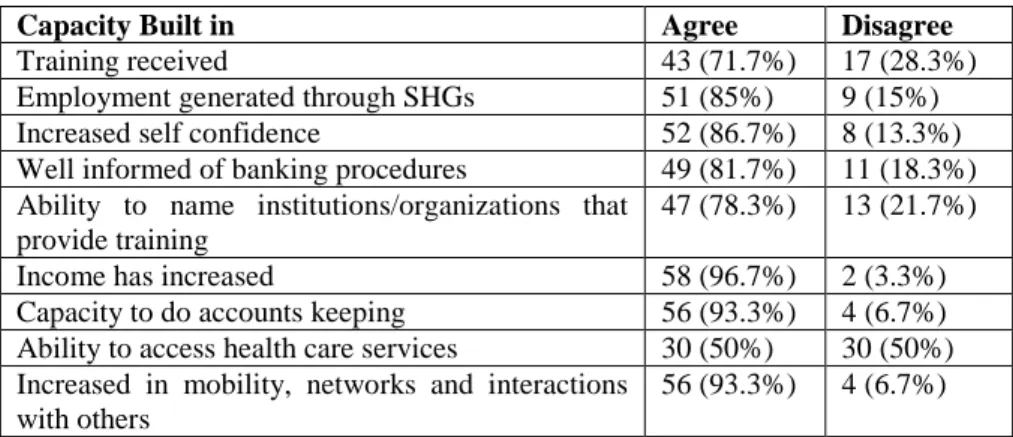
Capacity Building of Individuals Table: 12
Capacity Built in Agree Disagree
Training received 43 (71.7%) 17 (28.3%)
Employment generated through SHGs 51 (85%) 9 (15%) Increased self confidence 52 (86.7%) 8 (13.3%) Well informed of banking procedures 49 (81.7%) 11 (18.3%) Ability to name institutions/organizations that
provide training
47 (78.3%) 13 (21.7%)
Income has increased 58 (96.7%) 2 (3.3%)
Capacity to do accounts keeping 56 (93.3%) 4 (6.7%) Ability to access health care services 30 (50%) 30 (50%) Increased in mobility, networks and interactions
with others
56 (93.3%) 4 (6.7%)
Table 12 shows that, 71.7 percent members affirmed they got training after joining SHGs. 85 percent of them revealed that there is employment generation through SHG. 81.7 percent expressed they were well informed on banking procedures after joining SHG. 78.3 percent are able to name Institutions or an organization that provides training on financial administration. Majority 93.3 percent of the members are able to do accounts keeping and increased mobility, network and interactions with others as revealed by SHG members.
Decision Making
Table: 13
Decisions on Husband Wife Jointly Others
Loan taken 1(1.7%) 7
(11.7%)
51 (85%) 1 (1.7%) Controls the use of loan 2 (3.3%) 16
(26.7%) 41 (68.3%) 1 (1.7%) Enterprise Management 0 21 (35%) 38 (63%) 1 (1.7%) Purchase of household equipment, farm equipment, livestock or non-moveable goods 1(1.7%) 9 (15%) 50 (83.3%) 0 Children’s education 0 2 (3.3%) 58 (96.7%) 0 Family planning methods 0 1 (1.7%) 58 (96.7%) 1(1.7%)
As per table 13, 85.5 percent of the respondents reveal the decisions for the purpose of loan were taken jointly. 68.3 percent said that loan was controlled by both (husband and wife jointly). 98.3 percent reveals that the attitude of their husband was positive while functioning with the
group. 96.7 percent of the respondent said that jointly they plan for their children’s education and family planning methods as well were jointly planned.
Social Empowerment
Table: 14
Measures of Empowerment Improved Deteriorated Same Status in household 50 (83%) 7 (11.7%) 3 (5%) Status in the community 48 (80%) 2 (3.3%) 10 (16.7%)
Agree Disagree Involvement in the
organizations
53.3% 46.7%
More Less Same
Level of involvement 70% 23.3% 6.7%
As per table 14, 83.3 percent improved their status in their household after joining the SHG where as 11.7 percent deteriorated and 5 percent remained the same. 80 percent of the SHG members improved their status in the community after joining the SHG where as 16.7 percent remained the same while 3.3 percent deteriorated. 53.3 percent are currently involved with the organization. 70 percent reveals that their level of involvement increased in the organization where as 23.3 percent said less and 6.7 percent remained the same.
Conclusion
The study tried to explore the perception of women regarding their empowerment in various key domains. Definite improvement was marked in all the domains after the women joined the group than they were before. It is known that SHG utilizes savings as a base to extend credit to the unreached poor women. Microfinance and SHG intervention have brought tremendous change in their lives at the grassroots level. It could be explained as follows; after joining SHG women had better access to credit facilities and increased income which helped them to contribute to the household expenses.
A study done in Ghana (MkNelly and McCord, 2001) also reported that the husbands appreciated their wives’ increased economic contribution to families and respected and listened to them after they joined the credit with education program more than they did before. The same is noted in this study. The members felt that all these were because they contributed to family income. Thus, it could be said that earning potential gave women a life of respect and dignity among their family
members which was lacking previously because they were unable to earn and thus had to be subjugated and suppressed in their own families.
Women’s ability to influence others or make decisions regarding their lives is considered to be one of the principal components of empowerment, yet the type of decision and the degree of influence to be considered as their empowerment should be clarified in different contexts. Though in the present study, the women had better decision-making in their families, yet the crucial decisions were taken with the consent of both spouses. The responses from the study represent incomplete progress towards empowerment in this area.
Studies from several microfinance and microenterprise support programs had observed significant improvements in women’s status in their family and communities after joining those. Women’s increased economic capability had improved their position in society by their financial contribution to their families which conferred greater value to their views and gave them more entitlements in the family and in the community (Cheston et al, 2002). Similarly, the perception of women of their position in the society in our study was very positive. All of them felt to have received more respect in family and community after joining SHG. However, it is required to know the actual respect that they get from the community than their perceptions alone because their perceptions could have been affected by their esteem and self-reliance.
Self-confidence is one of the most crucial areas of change for empowerment, yet it is also one of the most difficult domains to assess. It is a complex concept relating to women’s perception of their capabilities and their actual level of skills and capabilities. Self-esteem and self-confidence are closely linked with knowledge (Cheston et al, 2002). Capacity building and regular saving increased their earnings, improved their purchasing ability and decision making in the family. All these in turn had improved confidence of SHG members.
Though the widespread political empowerment is a fairly rare outcome of most microfinance programmes, the candidacy for public office can be a good indicator of women’s self-confidence and efficacy and the community’s respect for women as well as political empowerment. By contributing to women’s knowledge and self- confidence and by widening their social networks, many microfinance programmes give women the tools and skills they need to participate more effectively and successfully in formal politics (Cheston et al, 2002). In present study too, women’s participation in groups had participated in political processes but none of them had been actively involved in politics or holding any posts which could be an indication of meager political empowerment of women of this area. It was in contrast
to the findings of MkNelly and McCord (2001) from Bolivia where the clients were significantly involved as a candidate for public office or as a member of the community.
References
Ahmed, M. S., Chowdhury, M., & Bhuiya, A. (2001). Micro-Credit and Emotional Well-Being: Experience of Poor Rural Women from Matlab, Bangladesh. World Development, 29(11). (pp. 1957– 1966).
Anand, J.S. (2002). Self-help Groups in Empowering Women: Case study of selected SHGs and NHGs. Kerala Research Programme on Local Development studies; Discussion Paper, N0.38
Balakrishnan, L. (n.d). Rural Energy Dept. http://www.vigyanprasar.gov.in/Radioserials/7women_self_help _groups_radio1509.pdf. Accessed on 20th December, 2015.
Becchetti, L., & Castriota, S. (2011). Does Microfinance Work as a Recovery Tool After Disasters? Evidence from the 2004 Tsunami. World Development, 39(6). (pp. 898–912).
Chavan, P. and Kumar, R. R. (2002). Microcredit and Rural Poverty - An Analysis of Empirical Evidence. Economic and Political Weekly, 37(10). (pp. 955–65).
Cheston, S., & Kuhn, L. (2002). Empowering Women through Microfinance. In S. Daley-Harris (Ed.), Pathways out of Poverty: Innovation in Microfinance for the Poorest Familiars. Bloomfield, Connecticut: Kumarian Press. (pp. 167–228).
Goetz, A.M., & Gupta, R.S. (1996). Who Takes the Credit? Gender, Power, and Control over l Loan use in Rural Credit Programs in Bangladesh. World Development, 24(1). (pp. 45–63).
Haile, H.B., Bock, B., & Folmer, H. (2012). Microfinance and Female Empowerment: Do Institutions Matter? Women's Studies International Forum, 35(4). (pp. 256–265).
Harvey, D. (2005). A Brief History of Neo Liberalism. New York: Oxford University Press.
Hashemi, S.M., Schuler, S.R., & Riley, A.P. (1996). Rural Credit Programs and Women's Empowerment in Bangladesh. World Development, 24(4). (pp. 635–653).
Hermes, N., & Lensink, R. (2011). Microfinance: Its Impact, Outreach, and Sustainability. World Development, 39(6). (pp. 875–881).
Kabeer, N. (2001). Conflicts over Credit: Re-evaluating the Empowerment Potential of Loans to Women in Rural Bangladesh. World Development, 29(1). (pp. 63-84).
Kabeer, N. (2005). Is Microfinance a 'Magic Bullet' for Women's Empowerment? Analysis of Findings from South Asia. Economic and Political Weekly, 40(44/45). (pp. 4709-4718).
Kaur, S. (February, 2015). Women Empowerment Through Micro Finance: An Empirical Study Of Women Self Help Groups In Patiala District, Punjab. International Journal in Commerce, IT & Social Sciences. 2 (2). http://www.ijmr.net.in. Accessed on 8th December, 2015.
Kay, T. (2002). Empowering Women through Self-Help Microcredit Programmes. In United Nations (Ed.), Bulletin on Asia-Pacific Perspectives. Asia-Pacific Economies: Sustaining Growth amidst Uncertainties. New York: United Nations. (pp. 69–78).
Khandker, S.R. (2005). Microfinance and Poverty: Evidence Using Panel Data from Bangladesh. The World Bank Economic Review, 19(2). (pp. 263–286).
Kurtz, H.A. (1981). Self Help and Mutual Aid: An Emerging Social Movement? Annual Review of Sociology, Vol. 7. (pp. 129-155).
Lakwo, A. (2006). Microfinance, Rural Livelihoods, and Women’s Empowerment in Uganda. (Doctoral Dissertation). Radboud University, Nijmegen, Leiden, the Netherlands.
Lindberg, S., Athreya, V.B., Vidyasagar, R., Djurfeldt, G. and Rajagopal, A. (2011). A Silent Revolution‘? Women‘s Empowerment in Rural Tamil Nadu. Economic and Political Weekly, XLVI(13). (pp. 111-120).
Mahmud, S. (2003). Actually How Empowering is Microcredit? Development and Change. 34(4) (pp. 577– 605).
Manga, B.V.L.A. (2011). Empowering Rural Women through Self Help Groups. New Delhi: Akansha Publishing House.
Mayoux, L. (1999). Questioning Virtuous Spirals: Micro-finance and Women's Empowerment in Africa. Journal of International Development. 11. (pp. 957–984).
Mayoux, L. (2000). Poverty Elimination and the Empowerment of Women. London: DFID.
Mayoux, L. (2002). Microfinance and Women’s Empowerment: Rethinking ‘Best Practice’. Development Bulletin, 57. (pp. 76– 81).
MkNelly, B., McCord, M. (2001). Credit with Education on Women’s Empowerment and Freedom from Hunger. Impact Review No. 1. http://www.freedomfromhunger.org/pdfs/impact_re view _ women’s_ empowerment.pdf. Accessed on 20th March, 2015. MkNelly, B., and Watetip, C. (1993). Impact Evaluation of Freedom
from Hunger’s Credit with Education Program in Thailand. MkNelly, B., & Dunford, C. (1998). Impact of Credit with Education on
Mothers and Their Young Children’s Nutrition: Lower Pra Rural Bank Credit with Education Program in Ghana. Davis, CA: Freedom from Hunger.
MkNelly, B., & Dunford, C. (1999). Impact of Credit with Education on Mothers and Their Young Children’s Nutrition: CRECER Credit with Education Program in Bolivia. Davis, CA: Freedom from Hunger.
Morduch, J. (1998). Does Microfinance Really Help the Poor? New Evidence from Flagship Programs in Bangladesh. New York: New York University.
Murthy, L. (n.d). Micro-Credit: Background & Perspective. http://infochangeindia.org/liveliho ods/microfinance/micro-credit-background-a-perspective.html. Accessed on 15th December, 2015.
Naidu, S.G. (2013). Women Empowerment through Self Help Groups. International Journal of Arts Commerce and Literature. 1(3), March 2013. (pp. 155-167).
Osmani, L.N.K. (2007). A Breakthrough in Women's Bargaining Power: The Impact of Microcredit. Journal of International Development, 19(5). (pp. 695–716).
Pitt, M.M., & Khandker, S.R. (1998). The Impact of Group-Based Credit Programs on Poor Households in Bangladesh: Does the Gender of Participants Matter? Journal of Political Economy, 106(5). (pp. 958-996).
Pitt, M.M., Khandker, S.R., & Cartwright, J. (2006). Empowering Women with Micro Finance: Evidence from Bangladesh. Economic Development and Cultural Change, 54(4). (pp. 791– 831).
Pitt, M.M., Khandker, S.R., Chowdhury, O.H., & Millimet, D.L. (2003). Credit Program for the Poor and the Health Status of Children in Rural Bangladesh. International Economic Review, 44(1). (pp. 958–996).
Pitt, M.M. and Khandker, S.R. (1995). Household and Intrahousehold Impact of the Grameen Bank and Similar Targeted Credit Programs in Bangladesh. World Bank Discussion Paper No. 320. Washington D.C: World Bank.
Prasad, R.R. (June, 2003). Social Mobilization: Concept, Meaning and Approach. Kurukshektra. (pp. 4-11).
Rahman, A. (1999). Micro-Credit Initiatives for Equitable and Sustainable Development: Who Pays? World Development. 27(1). (pp. 67-82).
Rai, A., & Ravi, S. (2011). Do Spouses Make Claims? Empowerment and Microfinance in India. World Development, 39(6). (pp. 913– 921).
Rawls, J. (1971). A Theory of Justice. Cambridge: Harvard University Press, Revise Edition.
Schuler, S.R., & Hashemi, S.M. (1994). Credit Programs, Women's Empowerment, and Contraceptive use in Rural Bangladesh. Studies in Family Planning, 25(2). (pp. 65-76).
Schuler, S.R., Hashemi, S. M., Riley, A.P., & Akhter, S. (1996). Credit Programs, Patriarchy and Men's Violence against Women in Rural Bangladesh. Social Science & Medicine, 43(12). (pp. 1729-1742).
Singh, N.T and Singh, T.J, (2009). Microfinance and Self Help Group: A Boon for Socio-economic Development; A Case study of Manipur. Journal of North-East India Council for Social Science Research. Vol 33(1). (pp. 29-39).
Sivachithappa, K. (2013). Impact of Microfinance on Income Generation and Livelihood of Members of Self-Help Groups: A Case Study of Mandya District, Procedia: India. Social and Behavioral Sciences. Vol 91. (pp. 228-240).
Sooryamoorthy, R. (2013). Microcredit, Self-Help Groups and NGOs in the Alleviation of Poverty: An Overview. Social Action. 63(2). (pp. 165-179).
Swain, R. B. (September, 2006). Microfinance and Women’s Empowerment; Evidence from the Self Help Group Bank Linkage Programme in India. Division for Market Development. ART NO: SIDA30632en. http://www.sida.se/contentassets/ 8b66929d5c994d119331 c119559e14ed/microfinance-and-womensempowerment_1055.pdf. Accessed on 28th September, 2015.
Swain, R.B. and Wallentin, F. Y. (2009). Does Microfinance Empower Women? Evidence from self -help Groups in India. International Review of Applied Economics, 23 (5). (pp. 541-556).
Tankha, A. (2012) Banking on Self-Help Groups Twenty Years on. New Delhi: SAGE Publications India Pvt Ltd.
Wrigley-Asante, C. (2011). Out of the Dark but not out of the Cage: Women's Empowerment and Gender Relations in the Dangme West District of Ghana. Gender, Place & Culture. (pp. 1-20).
*Ouseph Varghese is a Ph.D. research scholar of Assam Don Bosco University, Guwahati.