
Development and application of
RNA-seq bioinformatic tools to explore
non-model organisms in ageing research
DISSERTATION
zur Erlangung des akademischen Grades
„doctor rerum naturalium“ (Dr. rer. nat.)
vorgelegt
dem Rat der Biologisch-Pharmazeutischen Fakultät
der Friedrich-Schiller-Universität Jena
von
Diplom-Bioinformatiker Martin Bens
ii
Die vorliegende Arbeit wurde in der Zeit von August 2012 bis Juni 2017 am Leibniz-Institut für Alternsforschung – Fritz-Lipmann-Institut in Jena angefertigt und am 03.11.2017 verteidigt. Gutachter:
1. PD Dr. Matthias Platzer, Jena, Germany Platzer Research Group,
Leibniz Institute on Aging – Fritz Lipmann Institute, Jena, Germany 2. Prof. Dr. Dr. Steve Hoffmann,
Hoffmann Research Group,
Leibniz Institute on Aging – Fritz Lipmann Institute, Jena, Germany 3. Prof. Dr. Ingo Ebersberger,
Department for Applied Bioinformatics,
iii
„Essentially, all models are wrong, but some are useful.“ George Edward Pelham Box
Empirical Model-Building and Response Surfaces, John Wiley & Son, 1987
iv
Abstract
Advances in sequencing technologies enabled data generation from both genomes and transcriptomes at an unprecedented depth and accuracy. This progress changed the way researchers can approach biological questions, as hypotheses can be generated and verified using virtually any species apart from traditional laboratory organisms. However, genome-wide investigations in such non-model organisms are still hampered by the complexity and costs associated with sequencing and reconstruction of large genomes. Second-generation transcriptome sequencing (RNA-seq) and computational reconstruction of transcripts provides an alternative and cost-effective approach to gain insights into the protein-coding portion of genomes. Yet, lack of publicly available software that performs necessary steps to get from RNA-seq data obtained from non-model organisms to reasonable mRNA catalogues for downstream analyses limited its application to experts.
My thesis comprises the development of FRAMA, a software pipeline that delivers mRNA catalogues in the absence of a genomic reference, based on so-called de novo transcriptome assembly. Besides efficiently connecting publicly available software, FRAMA
incorporates custom-build tools to attenuate frequent de novo assembly issues. FRAMA’s
competitiveness with genome-based transcript reconstruction approaches was demonstrated by application to RNA-seq data obtained from the naked mole-rat (NMR). This non-model organism gains increasing popularity in ageing research due to its extreme lifespan of >30 years in captivity accompanied by lifelong fertility and an extreme resistance to ageing-related deterioration. Its lifelong fertility is exceptional, considering that NMRs are socially organized in colonies and one breeding female carries the metabolic load of reproduction and still lives at least as long as its non-breeding siblings. As part of my thesis, I investigated this trait by analysing gene expression profiles between reproductively active and inactive NMRs based on an mRNA catalogue delivered by FRAMA. I further applied FRAMA to non-model organisms at the other end of the vertebrate lifespan continuum – annual fishes (Nothobranchius). This fish genus, comprising one of the shortest-lived vertebrates, naturally evolved short lifespans presumably in adaptation to the transient availablility of water in their habitat. Based on positive selection analyses, we investigated when and how evolution shaped protein-coding genes that are potentially involved in such short lifespans.
Both types of analyses, gene expression in NMRs and positive selection in annual fishes, revealed interesting candidate genes in respect to ageing. Moreover, it shed light on sexual maturation in NMRs and on the evolution of short lifespans in annual fishes.
v
Zusammenfassung
Technologische Fortschritte haben es ermöglicht, ohne jegliches Vorwissen und in noch nie zuvor dagewesener Tiefe und Genauigkeit, Informationen über Genome und Transkriptome zu gewinnen. Diese Entwicklung hat die Herangehensweise an biologische Fragestellungen verändert, denn nun können Forscher Hypothesen in nahezu jeder Spezies entwickeln und überprüfen, ohne sich auf traditionelle Labororganismen beschränken zu müssen. Allerdings sind genomweite Untersuchungen in solchen Nicht-Modellorganismen immer noch eingeschränkt, denn die Sequenzierung und rechnergestütze Rekonstruktion von großen Genomen ist ein aufwendiges und kostspieliges Unterfangen. Die Sequenzierung und Rekonstruktion von Transkriptomen bietet hingegen eine kostengünstige Alternative und Einblicke in den proteinkodierenden Teil des Genoms. Der Mangel an Programmen, welche ausgehend von Sequenzierungsdaten passende Transkriptkataloge für weitere Analysen anfertigen, begrenzte allerdings auch diese Anwendung auf Experten.
In meiner Dissertation habe ich eine Software (FRAMA) entwickelt, die alle notwendigen Schritte vollzieht um von Sequenzierungsdaten zu Transkriptkatalogen zu gelangen. Dazu werden sowohl öffentlich verfügbare als auch selbst angefertigte Programme effizient miteinander verbunden, um die Transkriptomassemblierung und -annotation vorzunehmen, sowie Schwachstellen der Assemblierung auszubessern. Die Wettbewerbsfähigkeit von FRAMA
im Vergleich zu genombasierten Verfahren wurde durch Anwendung auf Sequenzierungsdaten des Nacktmulls demonstriert. Der Nacktmull rückt immer stärker in den Fokus der Alternsforschung, durch seine außergewöhnlich Lebensspanne von >30 Jahren in Gefangenschaft, die von einer extremen Widerstandskraft gegen altersbedingten Zerfall und einer lebenslangen Fruchtbarkeit begleitet wird. In Anbetracht seiner eusozialen Lebensweise, ist eine lebenslange Fruchtbarkeit bemerkenswert, denn in einer Kolonie trägt ein einzelnes Weibchen die metabolische Last der Fortpflanzung und wird dabei mindestens genauso alt wie ihre fortpflanzungsinaktiven Geschwister. Als Teil meiner Doktorarbeit habe ich mit Hilfe von Genexpressionsanalysen und basierend auf dem zuvor angefertigten Transkriptkatalog, fortpflanzungaktive und -inaktive Nacktmulle verglichen. Weiterhin habe ich FRAMA auf Sequenzierungsdaten von Saisonfischen der Gattung Nothobranchius angewandt. Diese Gattung zeigt, vermutlich in Anpassung an die kurze Verfügbarkeit von Wasser in ihrem Habitat, eine sehr kurze Lebensspanne und umfasst eines der kurzlebigstes bekannten Wirbeltiere. Die Transkriptkataloge dienten als Grundlage zur Analyse positiver Selektion um genetische Determinanten kurzer Lebensspannen zu identifizieren.
Beide Analysen haben interessante Genkandidaten in Bezug zur Alterung aufgedeckt und sowohl Einblicke in die sexuelle Reifung von Nacktmullen als auch der Evolution kurzer Lebenspannen in Saisonfischen gegeben.
vi
Table of Contents
ABSTRACT ... IV ZUSAMMENFASSUNG ... V TABLE OF CONTENTS ... VI 1 INTRODUCTION ... 11.1 Transcriptome Bioinformatic Analysis ... 2
1.1.1 RNA-seq principle ... 3
1.1.2 De novo transcriptome assembly from RNA-seq data... 4
1.1.3 Studying gene expression profiles using RNA-seq data ... 5
1.1.4 Studying genome-wide genetic selection by positive selection ... 5
1.2 Animal models in research on ageing ... 6
1.2.1 What is a model organism in biology? ... 7
1.2.2 Non-model organisms in ageing research ... 8
1.2.3 Rational for the naked mole-rat as a potential model for ageing research ... 9
1.2.4 Rational for annual fishes as potential models for ageing research ... 10
1.3 Connections between Manuscripts ... 11
2 OVERVIEW OF MANUSCRIPTS ... 13
2.1 Contribution to each work ... 13
2.2 Manuscript 1 (M1) ... 14 2.3 Manuscript 2 (M2) ... 15 2.4 Manuscript 3 (M3) ... 16 2.5 Manuscript 4 (M4) ... 17 3 MANUSCRIPTS ... 19 3.1 Manuscript 1 (M1) ... 19 3.2 Manuscript 2 (M2) ... 33 3.3 Manuscript 3 (M3) ... 57 3.4 Manuscript 4 (M4) ... 71 4 DISCUSSION ... 81
4.1 Coping with de novo transcriptome assembly issues from RNA-seq data ... 81
4.2 Gene expression profiling in naked mole-rats ... 84
4.3 Investigating positively selected genes in annual fishes ... 86
4.4 Alternative technologies and future applications for transcriptome investigations ... 89
4.5 Conclusion and Outlook ... 91
vii 6 ABBREVIATION ... 103 7 APPENDIX ... 105 7.1 Manuscript 1 (M1) ... 105 7.1.1 M1_MainDocument.pdf ... 105 7.1.2 M1_SupplementTables.xlsx... 105 7.1.3 M1_SupplementNotes.docx ... 106 7.2 Manuscript 2 (M2) ... 107 7.2.1 M2_MainDocument.pdf ... 107 7.2.2 M2_Supplementary_Tables_S1-28.xlsx ... 107 7.2.3 M2_Supplementary_Figures_S1-14.pdf ... 108 7.2.4 M2_Supplementary_Text_S1.pdf ... 110 7.2.5 M2_Supplementary_Data_S1.zip ... 110 7.2.6 M2_Supplementary_Data_S3.zip ... 110 7.2.7 M2_Supplementary_Data_S3.zip ... 110 7.3 Manuscript 3 (M3) ... 110 7.3.1 M3_MainDocument.pdf ... 110 7.3.2 M3_Supplement_Document_S1.pdf ... 110 7.3.3 M3_Supplement_Data_S2.xlsx ... 110 7.3.4 M3_Supplement_Data_S2.xlsx ... 111 7.3.5 M3_Supplement_Data_S3.xlsx ... 111 7.3.6 M3_Supplement_Data_S4.xlsx ... 111 7.4 Manuscript 4 (M4) ... 112 7.4.1 M4_MainDocument.pdf ... 112 7.4.2 M4_Supplement.xlsx ... 113 8 ACKNOWLEDGEMENTS ... 115 9 STATEMENT OF AUTHORSHIP ... 117
1
1
Introduction
A primary ingredient of life for a wide variety of species is the ageing process [1]. The biological phenomenon that we call ageing is defined as the progressive and irreversible decline in physiological function over time that inevitably ends in death [2]. This process of deterioration usually leads to impairments of health and reproduction, and an increased mortality risk, even if external sources of mortality, such as predators, are absent. Life expectancy, defined as the mean age a population of a certain age will reach, for humans has steadily increased in developed countries [3–5]. This increase is mainly the result of postponed mortality driven by advances in standard of living, education and health-care, including medicine, public health and nutrient supply [5,6]. However, the pace of deterioration with ageing is not slowing down and advanced age is a major risk factor for multiple diseases, including heart disease, cancer, diabetes and Alzheimer’s disease. As a consequence of this development, more people reach advanced age, but suffer from these age-associated diseases [5,7]. Thus, despite investigating the molecular causes and effects of ageing to satisfy the human need to understand it [6], ageing research has become crucial to potentially identify strategies that minimize the lifetime spend with age-associated diseases [8].
Understanding ageing is challenging, because it is a complex trait that arises from interactions between multiple biological layers, as well as environmental (e.g. radiation) and behavioural factors (e.g. physical activity, diet) [9,10]. Recently, a conserved set of biological processes, so-called hallmarks, involved in ageing across different mammalian species have been grouped into three categories: (i) primary (genomic instability, telomere attrition, epigenetic changes, loss of proteostasis), (ii) antagonistic (mitochondrial dysfunction, cellular senescence, deregulated nutrient sensing) and (iii) integrative hallmarks (stem cell exhaustion, altered intracellular communication) [9]. Despite their interactions, the primary cause of ageing is the accumulation of cellular damages (primary hallmarks). Antagonistic hallmarks protect from or compensate these damages initially, but eventually contribute to ageing. Finally, integrative hallmarks arise from the previous two categories and cause the actual deterioration of physiological function [9]. Although understanding the exact molecular mechanisms behind the scenes is an ongoing quest, it is already clear that genes play a major role in these processes. This is shown by hundreds of gene manipulations in laboratory organisms capable of altering these hallmarks and thereby altering (e.g. accelerating or delaying) the ageing process [9,11].
Advances in technologies facilitate studying such complex traits by enabling data generation from multiple layers of biological systems, such as genomes, epigenetic patterns, transcriptomes and proteomes. These data can be obtained from biological samples, including tissue samples, whole-blood samples and even single cells. Over the last decade, in particular the development of high-throughput DNA sequencing methods (commonly referred to as
2
next-generation sequencing but more specifically 2nd-generation sequencing (2GS)) enabled in-depth analyses of biological systems. Among others, 2GS allows inference of sequence composition (sequencing) of whole genomes or targeted features of genomes, such as exons, DNA damage or DNA methylation [12–14]. Nevertheless, whole genome sequencing of large genomes is still costly and their full-length representation require computational reconstruction, which in turn requires sufficient computational resources, time and expertise. Also, additional efforts are needed to reach chromosome-scale resolution (e.g. optical mapping, linkage maps) and to annotate genomic features (e.g. repeats, genes) [15–19]. Targeted approaches selectively capture a subset of genomic regions and are usually cheaper, but require knowledge of the genomic reference sequence. In contrast, transcriptome sequencing (RNA-seq ) is a less complex and, in all above mentioned practical aspects, more effective approach. RNA-seq operates without prior knowledge and provides expression level as well as sequence of transcripts [20]. Quantifying transcript levels helps to investigate which genes are expressed, e.g. in a specific organ, tissue or cell of any species under particular conditions and/or at defined time points. In respect to ageing, the comparison of expression levels between different phenotypes can reveal gene candidates that can serve as predictors for the pace of deterioration [21] or as targets to delay ageing [22]. Knowledge of transcript sequence allows to perform genome-wide computational analyses, e.g. to reveal sequence adaptations involved in biological traits and the evolutionary forces involved in shaping them [23,24]. In contrast to genome sequencing, RNA-seq can be applied by a broad range of researchers, as it requires lower financial budgets and computational resources, enabling the investigation of a wide range of phenotypes. As an additional benefit, even non-specialists in bioinformatics can analyse previously uncharacterized transcriptomes if user-friendly assembly pipelines are available.
In this thesis, I focused on the development and application of RNA-seq bioinformatic tools to study gene expression and protein-coding sequences (CDSs). Both factors are known to influence lifespan and ageing. In the following two sections, I will provide a general introduction to the transcriptome, the principles of RNA-seq and bioinformatics steps involved in analysing RNA-seq data as well as the organisms that are relevant for ageing research.
1.1
Transcriptome Bioinformatic Analysis
The transcriptome represents the complete set and abundance of transcripts (ribonucleic acids; RNAs) that are expressed in a biological sample at a certain time [20]. RNAs are transcribed from genomic templates and are generally categorized in (i) protein-coding messenger RNAs (mRNAs), (ii) non-protein-coding RNAs (ncRNAs) and (iii) spurious transcripts [25]. This work focuses on mRNAs, which are an important transmitter of biological information between the genome, providing the templates, and proteins, carrying out cellular functions. Nevertheless, all RNA categories are vital to understand the connections between
3 genotype and phenotype, and especially ncRNAs are increasingly recognized as key regulators of gene expression and are involved in ageing [9,26–28].
In the past, different approaches were developed to infer sequence composition (e.g. Sanger sequencing) and expression level (e.g. real-time polymerase chain reaction) of mRNAs, but only a small number of mRNAs could be studied simultaneously this way. The first technology that enabled measuring several thousand mRNAs in parallel were DNA microarrays introduced in 1995 [29]. Yet, DNA microarrays are only able to measure the relative expression of mRNAs and, based on hybridisation, require prior knowledge of mRNA sequences that are supposed to be analysed. Since 2005, the introduction of 2GS technologies (454 Life Sciences/Roche) allows to identify both sequence and relative expression at an unprecedented depth and accuracy [30,31]. These methods offer the possibility to study near-complete snapshots of transcriptomes in any species and without prior knowledge. In the following sections, I will describe the basic principle of RNA-seq technology and RNA-seq data analysis.
1.1.1 RNA-seq principle
RNA-seq, or whole-transcriptome shotgun sequencing, is the application of 2GS to transcriptomes. 2GS is characterized by massive parallelization of sequencing reactions, amplification of DNA fragments on a solid surface and “sequencing by synthesis“ [31]. In principle, total RNA is isolated from biological samples, optionally filtered for target RNA species, and subsequently converted into libraries of complementary DNA fragments. These libraries are then partially sequenced from one end (single-end) or both ends (paired-end). The resulting short nucleotide sequences are called “reads” and have, depending on the sequencing platform, lengths ranging typically from 30-400 bp [12]. During this process, orientation of the original RNAs is lost, but can be preserved by using respective protocols [32]. However, if full-length mRNA sequences are required, these must be computationally reconstructed from reads.
Following this procedure (and sequencing errors and biases apart), an RNA-seq data set consists of reads obtained by random sampling of small sections from RNA molecules that are present in a biological sample. The sampling process is influenced by the abundance and length of RNAs – the higher the expression of an RNA and the longer the molecule, the more reads will be obtained [33]. This allows the quantification of gene/transcript expression levels relative to each other. However, a robust and direct relationship between the number of reads and the actual number of RNA molecules in the biological sample is not possible, unless control RNAs in known amounts are used to calibrate measurements [34]. The detection of low expressed RNAs is limited by the sample size, which is reflected by the number of reads. To investigate low expressed RNAs, the sequencing depth (i.e. sample size) needs to be adjusted accordingly and in dependency of the size of the transcriptome being assayed as well as the biological question (e.g. RNA discovery, RNA quantification) [35–38].
4
Within the framework of my thesis, I investigated RNA-seq data by two different routes of downstream analyses: (i) the quantitative route - studying mRNA expression changes between phenotypes - and (ii) the qualitative route - studying positive selection in CDSs. Both routes rely on knowledge of mRNA sequences that can be obtained from the RNA-seq data itself.
1.1.2 De novo transcriptome assembly from RNA-seq data
The ultimate goal of transcriptome assemblies is the full-length reconstruction of all transcript species of a transcriptome. Therefore, assembly algorithms were developed that computationally reconstruct full-length sequences de novo, i.e. without any reference sequence, from the collection of short sequencing reads [37,39–41]. Unfortunately, the number of reads is usually not sufficient to reconstruct all transcripts completely. Thus, assemblers are only able to reconstruct contiguous sequences (contigs) and many contigs represent only a small continuous section of a full-length transcript [37]. Even if a transcript is sufficiently covered by reads, complex loci with multiple exons and extensive alternative splicing events can present too many possible solutions to assembly algorithms and assemblers at best deliver most likely solutions [37].
The reduction of raw assemblies to an evolutionary reasonable set of transcript contigs relies on the identification of homologous transcript counterparts in another species (orthologs). Homology is the relationship between two genes that have descended from a common ancestral gene [42]. Homologs in different species with a last common ancestor before speciation are referred to as orthologs. Because descendants usually rely on the function of the ancestral gene, orthologs are expected to have retained a certain degree of sequence similarity and their function. Thereby, orthologs usually allow the transfer of functional information between species. Paralogs are another group of homologs with the last common ancestor before a gene duplication and are thought to be a major source of functional innovation (neofunctionalization, subfunctionalization) [43]. Homology by this definition is an evolutionary term, but in practice is inferred using sequence similarity [44]. Proper ortholog assignment would require evolutionary analysis, including alignment of transcripts from multiple species and phylogenetic tree reconstruction. However, genome-wide application of such methods is too computationally intensive given tens of thousands of genes (21,243 protein-coding genes in the human genome) [45], represented usually by an order of magnitude more transcript contigs. Therefore, heuristic approaches are commonly used to identify two genes that are mutually most similar between gene sets from two different species (best bidirectional hit) [44]. Besides reducing the assembly to an evolutionary meaningful subset of RNAs, orthologs can be used to determine structural information, such as CDS of mRNAs, and optimize assemblies. This optimization includes the correction of misassembled contigs that arise from falsely connected transcripts originating from adjacent genes, or fragmentation of contigs corresponding to single transcripts [37].
5 After such a functional and structural annotation of raw assemblies, the subset of evolutionary reasonable contigs, representing ideally full-length RNA sequences, provide the basis for further downstream analysis.
1.1.3 Studying gene expression profiles using RNA-seq data
Gene expression profiling investigates the expression of thousands of genes simultaneously. One of the main goals is to identify statistically significant quantitative changes in gene expression profiles between experimental groups (e.g. different conditions, age cohorts). This procedure aims to understand the molecular response, e.g. to different stimuli or changes during ageing [46].
To determine expression profiles, reads are usually aligned to a reference genome sequence. If the species’ genome sequence is unknown, the genome of a closely-related species can be used or RNA sequences need to be computationally reconstructed and used for alignment. The number of aligned reads (referred to as read count) to a certain region (e.g. gene, exon or splice-junction) normalized by the number of sequenced reads can then be used to compare expression levels of genes across samples. To compare expression levels between genes within an RNA-seq sample, read counts need to be additionally normalized by the length of the region [33,46,47]. Different methods utilize read count information to identify a subset of genes showing statistically significant changes across experimental groups (differentially expressed genes; DEGs) [48,49]. Once orthologs are determined, DEGs can also be identified between different species. In order to avoid artefacts in such an analysis, e.g. arising from different ortholog lengths, commonly transcribed regions should be determined first [50].
Insights into biological processes are often challenging, even at the level of DEGs. Several tools have been developed to investigate biological processes more broadly, based on predefined gene sets [51–53]. These gene sets categorize genes by common functions or otherwise meaningful criteria (e.g. common regulation or location). The Gene Ontology is usually the catalogue of choice for such an analysis [54], but other databases also provide useful gene sets, including “Kyoto Encyclopedia of Genes and Genomes” (KEGG) [55] and Reactome [56] for metabolic pathways, and Digital Ageing Atlas [57] and GenAge [58] for ageing-associated genes. Different methods enable the identification of significantly enriched (over-represented) gene sets, e.g. based on DEGs using Fisher’s Exact Test or at the level of gene expression (e.g. read count, fold change) using GAGE to identify gene sets showing altered expression, e.g. a common up- or down-regulation [51,59,60].
1.1.4 Studying genome-wide genetic selection by positive selection
One approach to investigate lineage-, species-, or population-specific adaptations via comparative studies is the sequence-based identification of positively selected genes (PSGs). Positive selection describes the selective force that promotes the fixation of advantageous genetic mutations by natural selection [61]. While the concept of positive selection is based on
6
the simple principle that mutations increasing the chance of survival and reproduction of an organism have a higher chance of being transmitted to the next generation, its detection is complex and requires several steps. In a single gene, detection of positive selection includes (i) identification of orthologs, (ii) accurate multiple sequence alignment (iii) phylogenetic tree reconstruction and (iv) identification of signals of positive selection. A genome-wide application additionally requires robust filtering to remove false positives arising from incomplete sequences, alignment errors or poor conservation [62].
One concept to identify signals of positive selection in two orthologous CDSs relies on the ratio of non-synonymous (amino acid-changing, dN) and synonymous (silent, dS) nucleotide exchanges. Because positive selection promotes changes, non-synonymous exchanges are assumed to be fixed at a higher rate than synonymous exchanges. In consequence, PSGs should show dN/dS ratios significantly greater than 1 [61]. Several statistical methods were developed to test for positive selection in individual phylogenetic branches and in a set of branches [61,63]. Although these methods became increasingly successful in PSG identification, they can be hampered by other selective forces or sequence divergence [63,64]. Nevertheless, comparative studies using this concept proved useful to investigate the links between molecular adaptations and ageing [24,65–67].
1.2
Animal models in research on ageing
As introduced in the beginning, almost all multicellular organisms underlie ageing, a complex time-dependent process that negatively affects the function of multiple organs and increases disease susceptibility. Interestingly, looking at lifespans across different animal species, the maximum lifespan correlates with body mass [68]. However, humans deviate from this relation and are exceptionally long-lived when normalized by their body mass [69]. Nevertheless, the elderly human population becomes increasingly unhealthy with advanced age and suffers from age-associated diseases [5,8]. Fortunately, ageing research has led to remarkable breakthroughs towards the understanding of molecular mechanisms involved in ageing [7,9,70]. Conserved effects of interventions and roles of signalling pathways across different organisms revealed that the pace of ageing is rather flexible and shapeable than fixed [6,8,9]. Among these conserved mechanisms having lifespan modulating effects are: calorie restriction, mitochondrial function, protein turnover, insulin/IGF-signalling, target of rapamycin signalling and sirtuin function [9,70].
Comparative biology has been an essential tool in ageing research for more than a century, starting with the comparison of metabolic rates and their relationship to lifespan in different species (rate-of-living hypothesis) [65–68,71–73]. Yet, most insights into ageing relied on short-lived laboratory organisms to investigate environmental and molecular factors of ageing [9,70,74]. Nowadays, supported by advances in sequencing technologies (2GS, mass spectrometry [75]) and molecular techniques (RNA interference [76], CRISPR/Cas9 [77], induced pluripotent stem cells [78]), research becomes increasingly independent from
7 traditional laboratory organisms. This progress allows to generate and verify hypotheses about the mechanisms of ageing in a broad range of species. Further, it enables studying particular species having interesting traits for ageing research, such as resistance to age-associated diseases or exceptionally long or short lifespans [79].
The following sections present a selection of organisms that are becoming increasingly popular in ageing research and describe particularly those that I investigated in the course of my thesis. Maximum lifespans are presented according to the “The Animal Ageing and Longevity Database” (AnAge, genomics.senescence.info/species).
1.2.1 What is a model organism in biology?
Molecular researchers need experiments to gain insights into complex interactions in biological systems, e.g. by investigating the molecular response to external stimuli. However, experiments in the species of interest can be unethical or otherwise unfeasible to perform, e.g. because of costly housing or long lifespans. Therefore, model systems that ideally replicate the biological system of interest are used as proxies. Mathematical modelling of multicellular organisms [80] or single organs [81], which would allow computational simulation of experiments, is still in its early stages and living organisms are primarily used as models in biology. The possibility to exploit one particular species to understand molecular mechanisms in another is based on evolutionary ancestries and the conservation of molecular pathways across species. Yet, even slight lineage- or species-specific adaptations can cause altered or novel functions that are only shared between closely related species or limited to a single species [74]. Further, adaptation through the process of natural selection can yield multiple, independent solutions to the same problem [82]. Thus, it is important to choose model organisms wisely to address the research question of interest and transfer gained knowledge to the target species [74,83].
Ideal models are closely related to the target species and share similar traits, e.g. in reproduction, diseases and ageing. Still, experiments in animals also require practical and economic factors, including known genes and regulatory regions (ideally a well annotated genome), good health in captivity, inexpensive housing, easy breeding and manipulable genetics and environment [74]. In ageing research, longitudinal and lifespan studies also require comparably short lifespans. Yet, assuming that resistance to ageing must be maintained throughout life, studying young adults of long-lived species should also be rewarding [84]. Traditional model organisms in ageing research are yeasts (Saccharomyces cerevisiae, 2 weeks), nematodes (Caenorhabditis elegans, 2 months), flies (Drosophila melanogaster, 3.5 months) and rodents, in particular mice (Mus musculus, 4 years) and rats (Rattus norvegicus, 4 years) [9,70,74]. These models fulfil most practical and economic factors mentioned above and are therefore perfectly suitable as experimental systems. Yet, they are only distantly related to humans and on the opposite end of the lifespan continuum (short-lived). Even the closest relatives to humans among these models (mouse/rat) show substantially distinct biological traits, including
8
differences in reproductive biology (e.g. oestrus vs. menstrual cycle; number of pregnancies and offspring) and absence of human age-related diseases (e.g. atherosclerosis, Alzheimer’s) [74]. This suggests that evolution shaped ageing significantly different in these species [74] and the potential lack of mechanisms to delay ageing might limit research on health- or lifespan extension [79].
1.2.2 Non-model organisms in ageing research
Nowadays, mentioned technological advances allow to investigate and manipulate organisms apart from currently established laboratory models, commonly called “non-model” organisms, at the molecular level at similar depth and with a similar efficiency. In respect to ageing, this allows to extend the list of traditional models to more appropriate models for human ageing. Several non-model organisms have been suggested to understand ageing in general, such as biologically immortal hydras and extremely long-lived quahogs (Arctica islandica, 507 years), and human ageing in particular, such as nonhuman primates and domesticated species (dogs, cats) that mimic human ageing (particularly brain ageing) [1,74,79,85,86]. Non-model rodent and fish species are of particular interest in my thesis as proxies for human ageing in different aspects.
Rodents are particularly suitable to understand ageing in mammals using comparative biology [85]. Besides well-described laboratory models, this order comprises 2,227 species [87] showing substantially different lifespans even among equally sized animals (Heterocephalus glaber, 31 years; Mus musculus, 4 years; >7-fold difference). Longevity has presumably evolved independently in different families of rodents, such as mole-rats (Bathyergidae; Heterocephalus glaber, 31 years), porcupines (Hystricidae; Hystrix brachyura, 27 years), beavers (Castoridae; Castor canadensis, 23 years) and squirrels (Sciuridae; Sciurus carolinensis, 23 years) [85]. This offers the possibility to discover multiple different mechanisms leading to longevity. In this respect, my work focuses on an extremely long-lived member of the mole-rat clade – the naked mole-rat (detailed in 1.2.3).
Between the comparably closely-related vertebrate models (mouse/rat) and distantly-related invertebrate models (nematode, fly) is another attractive group of animals - fish. Similar to rodents, these vertebrates show a wide variety of different species and lifespans [88]. Ageing studies in guppies (Poecilia reticulate, 5 years) demonstrated the potential of fishes as model systems and the zebrafish (Danio rerio, 5 years) already emerged as a valuable model particularly in developmental biology (e.g. transparent embryos, rapid development, low maintenance cost) [88]. Yet, although its regenerative capabilities are of particular interest, its relatively long lifespan hampers lifelong experimental studies. Due to their short lifespans and rapid life cycles, annual fishes of the genus Nothobranchius (detailed in 1.2.4) are particularly interesting for ageing research.
9 1.2.3 Rational for the naked mole-rat as a potential model for ageing research
The naked mole-rat (NMR, Heterocephalus glaber; family: Bathyergidae) is a mouse-sized rodent (~35 g) native to hot dry regions of northeast Africa (Somalia, Kenya, Ethiopia) [89]. Although not immune to ageing, these rodents have a remarkable lifespan of >30 years in captivity and, similar to humans, live five times longer than expected by their body mass [69]. Yet, unlike humans (and mice/rats), NMRs are extremely resistant to cancer [90] and show negligible signs of ageing, including no age-related decline in fertility and no increase in mortality rate until sudden death [89]. Still, few signs of ageing can be observed, such as osteoarthritis and skin ageing [69,91]. However, these signs manifest very late in life (~24-27 years), which makes it a perfect model in respect to health span extension in humans [69,89].
Despite showing a healthy and long life, the NMR has another exceptional trait – its eusociality. NMRs form social colonies of up to 300 non-breeding subordinates and one breeding pair of animals [92]. Non-breeders are capable of ascending into breeders even as adults and breeders stay fertile throughout their lifespan. Although currently subject to controversy [93], this eusocial colony structure was thought to be accompanied by different lifespans in NMR breeders and non-breeders, as observed in Fukomys mechowii [94], a close relative of the NMR, and in eusocial insects [72]. In F. mechowii female and male breeders live 2.2 and 1.5-times, respectively, longer than non-breeders of the same sex [94]. This enables studying different ageing rates within the same genotype. Even if NMR non-breeders and breeders age at equal pace, insights into adaptations that prevent the decline in activity and fertility regardless of the high metabolic demands of pregnancies and lactation are valuable as this contradicts the “disposable soma theory” of ageing [95]. This theory suggests that, due to the organism’s limited energy budget, ageing results from a compromise between investment of energy in somatic maintenance and reproduction [95].
In the case of the NMR, two independent draft genome assemblies from 2GS of genomes are available (hetgla1 [96]; hetgla2 [97]) and a third unpublished meta assembly, which combines the previous assemblies, has been performed [67]. However, genome assemblies from 2GS data are often fragmented, have a high gap percentage and homologous genes might have been collapsed, limiting downstream analyses [15]. In addition, finishing a genome, e.g. closing assembly gaps, fixing misassembled regions and annotating genes, is still time consuming and expensive [18,19]. As a consequence, the genomic references for the NMR are far from contiguous and complete. So far, transcript sequences have mainly been derived by genome-based gene predictions in hetgla1 and hetgla2. Consequently, their quality largely depends on the quality of the underlying genome assembly. Another important drawback is the inference of untranslated regions (UTR), which cannot be predicted from the genome yet [98]. However, UTRs provide valuable information regarding mRNA stability and mRNA localization [99]. Moreover, UTRs are the landing platform for microRNAs, which gain
10
increasing attention in ageing research [26,99]. A steadily increasing number of publications on NMR cancer resistance and ageing over the last 8 years [90,100–103] emphasize the efforts that have already been made to establish the NMR as a model organism.
1.2.4 Rational for annual fishes as potential models for ageing research
In contrast to NMRs, annual fishes (genus Nothobranchius) offer the possibility to investigate the other end of the lifespan continuum as they show short lifespans. Most of the 43 described species in this genus inhabit ephemeral pools across Africa formed by seasonal rainfalls [104]. Therefore, their life expectancy is dictated by the cessation of their transient habitat and differences in maximum lifespan across different species correlates with the availability of water in their habitat [104]. Among annual fishes, N. furzeri shows the most extreme short lifespan of 3-7 months [105], accompanied by a rapid life cycle and early sexual maturation [104]. Such short lifespans enable longitudinal studies and quick, monitorable experiments [21]. The short lifespan of N. furzeri in particular is associated with rapid ageing and typical signs of ageing (e.g. cancerous lesions, decline in fertility and cognitive function).
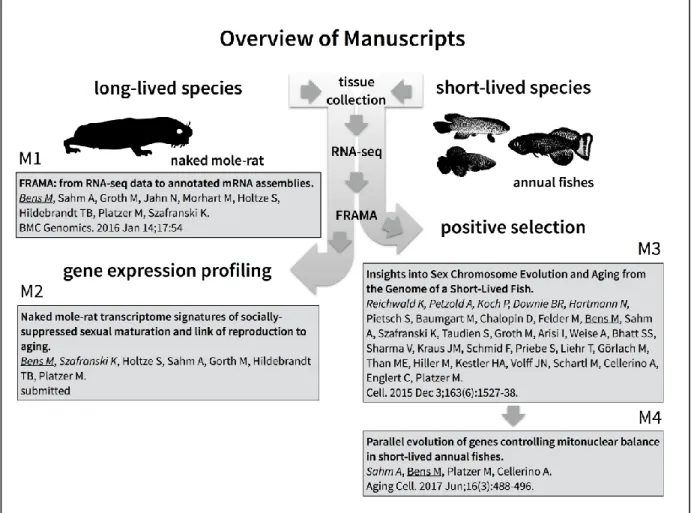
Figure 1: Overview of manuscripts. FRAMA (M1) was developed to automate the process from de novo transcriptome assembly to a non-redundant set of mRNA sequences suitable for downstream analyses. mRNA catalogues delivered by FRAMA provided the basis for two different routes of downstream analyses in two groups of non-model organisms. In long-lived naked mole-rats gene expression was studied (M2), while in short-lived annual fishes positively selected genes were analysed (M3, M4).
11 Importantly, the involved mechanisms overlap with mammalian hallmarks of ageing [106] and their onset can be modulated, e.g. by water temperature, calorie restriction or resveratrol treatment [107,108]. These characteristics, including practical features, such as comparably low requirements in water quality and eggs storable at room temperature for several months [104], make Nothobranchii attractive animal models for ageing research.
Since suggested in 2003 [105], N. furzeri is rapidly developing as a new model organism in ageing research. Similar to the NMR, two genome assemblies have been performed [109,110], but with greater efforts to reach chromosome-scale resolution [106]. Although this allows thorough investigation of N. furzeri, studies on how such short lifespans evolved across different annual fishes are limited. Potential efforts to investigate additional annual fishes could involve genome sequencing as the N. furzeri genome should provide a good reference to improve 2GS-based genome assemblies. However, this is still costly even for one species and RNA-seq provides a cost-effective approach to gain insights into protein-coding genes of multiple different species.
1.3
Connections between Manuscripts
Molecular studies in any species greatly benefit from the availability of genetic information. Researchers prefer well-annotated reference genomes. These references provide a plethora of information, from comprehensive templates for mRNAs and ncRNAs, to regulatory motifs and repeat families, and can be studied using comparative genomic approaches that allow to investigate the history of unique and common biological traits across species. Nevertheless, current strategies to assemble reference genomes to chromosome-scale resolution are costly and time intensive. An alternative approach that allows investigating the protein-coding portion of genomes is provided by RNA-seq. Within the scope of my thesis, four scientific papers were published in or submitted to peer-reviewed journals, exemplifying how qualitative and quantitative investigation of transcriptomes can provide insights into molecular mechanisms and adaptation in ageing (Figure 1). Therefore, I developed the software framework FRAMA (From RNA-seq to annotated mRNA assemblies) that automates the assembly, annotation and optimization of protein-coding transcripts from RNA-seq data (M1).
FRAMA was applied to transcriptomes of non-model species on both ends of the vertebrate lifespan continuum, including the extremely long-lived NMR and a selection of extremely short-lived annual fishes. The delivered mRNA catalogues provided insights into (i) NMR transcriptome signatures of socially-suppressed sexual maturation and links of reproduction to ageing (M2), and (ii) PSGs related to short lifespan in annual fishes (M3, M4).
13
2
Overview of Manuscripts
2.1
Contribution to each work
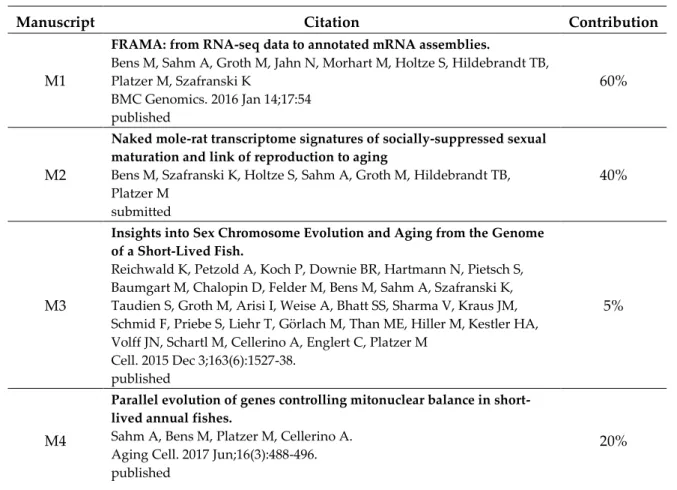
Table 1: Overview of manuscripts and proportion of my contribution to each work.
Manuscript Citation Contribution
M1
FRAMA: from RNA-seq data to annotated mRNA assemblies.
Bens M, Sahm A, Groth M, Jahn N, Morhart M, Holtze S, Hildebrandt TB, Platzer M, Szafranski K
BMC Genomics. 2016 Jan 14;17:54 published
60%
M2
Naked mole-rat transcriptome signatures of socially-suppressed sexual maturation and link of reproduction to aging
Bens M, Szafranski K, Holtze S, Sahm A, Groth M, Hildebrandt TB, Platzer M
submitted
40%
M3
Insights into Sex Chromosome Evolution and Aging from the Genome of a Short-Lived Fish.
Reichwald K, Petzold A, Koch P, Downie BR, Hartmann N, Pietsch S, Baumgart M, Chalopin D, Felder M, Bens M, Sahm A, Szafranski K, Taudien S, Groth M, Arisi I, Weise A, Bhatt SS, Sharma V, Kraus JM, Schmid F, Priebe S, Liehr T, Görlach M, Than ME, Hiller M, Kestler HA, Volff JN, Schartl M, Cellerino A, Englert C, Platzer M
Cell. 2015 Dec 3;163(6):1527-38. published
5%
M4
Parallel evolution of genes controlling mitonuclear balance in short-lived annual fishes.
Sahm A, Bens M, Platzer M, Cellerino A. Aging Cell. 2017 Jun;16(3):488-496. published
14
2.2
Manuscript 1 (M1)
Title: FRAMA: from RNA-seq data to annotated mRNA assemblies
Status: published in BMC Genomics. 2016 Jan 14;17:54
Authors: Martin Bens (MB), Arne Sahm (AS), Marco Groth (MG), Niels Jahn (NJ), Michaela Morhart (MM), Susanne Holtze (SH), Thomas B. Hildebrandt (TBH), Matthias Platzer (MP) and Karol Szafranski (KS)
Summary: I developed the software framework FRAMA, which assembles, annotates and optimizes transcripts from RNA-seq data. This work describes and assesses every step in
FRAMA, with special focus on post-assembly tasks, including reduction of redundant transcript contigs, correction of misassembled transcripts, scaffolding of fragmented transcripts and coding sequence identification. FRAMA was applied to RNA-seq data obtained from deep sequencing the transcriptome of the naked mole-rat, a promising non-model organism in ageing research.
Authors‘ contribution: MP, TBH and KS conceived the project. MM, SH, TBH, MB, MG and KS performed the tissue sampling and sequencing experiments. MB, AS, NJ, MP and KS designed and implemented the software. MB, AS, MP and KS performed the validation analysis and discussed the results. MB, MP and KS wrote the paper.
15
2.3
Manuscript 2 (M2)
Title: Naked mole-rat transcriptome signatures of socially-suppressed sexual maturation and links of reproduction to ageing
Status: submitted to Genome Research (June 2017)
Status: Authors: Martin Bens (MB)*, Karol Szafranski (KS)*, Susanne Holtze (SH), Arne Sahm (AS), Marco Groth (MG), Thomas B. Hildebrandt (TBH), Matthias Platzer (MP). * shared first authorship
Summary: This work comprises a comparative gene expression study of breeding and non-breeding eusocial, long-lived naked mole-rats and polygynous, not long-lived guinea pigs. Therefore, we accumulated and analysed an extensive set of transcriptome data from ten different tissues of both species. We revealed minor differences between sexes of non-breeding naked mole-rats in contrast to guinea pigs, providing additional evidence for socially suppressed sexual maturation in naked mole-rats. Expression differences between non-breeding and non-breeding NMRs suggest links to ageing hallmarks by influencing mitochondrial activity and lipid metabolism.
Authors‘ contribution: TBH, MP and KS conceived the project. SH, TBH, MB, MG and KS performed the animal study, sampling and sequencing experiments. Data analysis and interpretation were performed by MB, KS, SH, MP and TBH. The manuscript was written by MB and KS. TBH and MP are joint senior authors.
16
2.4
Manuscript 3 (M3)
Title: Insights into Sex Chromosome Evolution and Aging from the Genome of a Short-Lived Fish
Status: published in Cell. 2015 Dec 3;163(6):1527-38.
Authors: Kathrin Reichwald (KR)*, Andreas Petzold (AP)*, Philipp Koch (PK)*, Bryan R. Downie (BRD)*, Nils Hartmann (NH)*, Stefan Pietsch (SPe), Mario Baumgart (MBa), Domitille Chalopin (DC, Marius Felder (MF), Martin Bens (MBe), Arne Sahm (AS), Karol Szafranski (KS), Stefan Taudien (ST), Marco Groth (MG), Ivan Arisi (IA), Anja Weise (AW), Samarth S. Bhatt (SSB), Virag Sharma (VS), Johann M. Kraus (JMK), Florian Schmid (FS), Steffen Priebe (SPr), Thomas Liehr (TL), Matthias Görlach (MGo), Manuel E. Than (MET), Michael Hiller (MH), Hans A. Kestler (HAK), Jean-Nicolas Volff (JNV), Manfred Schartl (MS), Alessandro Cellerino (AC), Christoph Englert (CE), Matthias Platzer (MP). * shared first authorship
Summary: Providing a chromosome-scale draft genome sequence, including annotation of protein-coding genes and several classes of non-coding RNAs, for the N. furzeri, this publication presents a milestone in establishing this fish as a model organism in molecular research. Despite investigating sex chromosome evolution and reporting gdf6 gene expression as a marker for sex determination, the age-related analyses included gene expression comparisons between young and old animals in multiple tissues. Positional enrichment revealed non-random organization of temporally regulated DEGs in the genome, suggesting co-regulation of functionally associated genes. I was primarily involved in analysing positive selection in the N. furzeri, which indicated also functional adaptation in temporally regulated DEGs.
Authors‘ contribution: CE, KR, and MP initiated, managed, and drove the genome project. KR, NH, MBa, ST, and MGr prepared the samples. KR, ST, and MGr performed the sequencing AP, PK, BRD, VS, and MH performed the genome assembly and annotation. PK, BRD, DC, and JNV performed the repeat analysis MBa, MGr, AC, and MP performed the mRNA analysis. IA, MBa, AP, and AC performed the miRNA analysis. KR, AW, SSB, and TL performed the chromosome FISH. KR, AP, PK, MF, KS, NH, MS, CE, and MP performed the sex chromosome evolution analysis. MGo and MET performed protein structure modelling. JMK, FS, SPr, PK, HAK, AC, and MP performed the positional gene enrichment analysis. AS, MBe, AP, BRD, AC, and MP performed the positive selection analysis. NH, SPi, and CE performed the diapause analysis. All authors contributed to data interpretation. KR, AP, PK, NH, MS, AC, CE, and MP wrote the manuscript.
17
2.5
Manuscript 4 (M4)
Title: Parallel evolution of genes controlling mitonuclear balance in short-lived annual fishes
Status: published in Aging Cell. 2017 Jun;16(3):488-496.
Authors: Arne Sahm (AS), Martin Bens (MB), Matthias Platzer (MP), Alessandro Cellerino (AC)
Summary: In this work, we present a follow-up study of the positive selection analysis in M3 to investigate the evolution of annual life history in more detail. Again, we performed positive selection analysis, but using a broader range of non-annual outgroup species and by analysing deeper branches of the N. furzeri phylogenetic tree. In annual fishes, we identified positively selected genes involved in all steps of mitochondrial biogenesis, a conserved longevity mechanism in model organisms, suggesting a causal link between positively selected genes and annual life history. Further, we identified signs of parallel evolution in two different lineages of annual fishes in a subset of these genes and overlaps with positively selected genes in long-lived mammals.
Authors‘ contribution: AS and MB performed the analysis; MP and AC supervised the work; and AS, MP, and AC wrote the manuscript.
19
3
Manuscripts
33
3.2
Manuscript 2 (M2)
34
Manuscript Title
Naked mole-rat transcriptome signatures of socially-suppressed sexual maturation and links of reproduction to ageing
Authors
Martin Bens 1*, Karol Szafranski 1*, Susanne Holtze 2, Arne Sahm 1, Marco Groth 1, Hans A. Kestler 1,3, Thomas B. Hildebrandt 2**, Matthias Platzer 1**
Affiliations:
1 Leibniz Institute on Aging - Fritz Lipmann Institute, Germany 2 Leibniz Institute for Zoo and Wildlife Research, Germany
3 Institute of Medical Systems Biology, Ulm University, Ulm, Germany
* authors contributed equally to this work ** shared senior authors
Corresponding author: Martin Bens, [email protected]
Email addresses: Martin Bens, [email protected]; Karol Szafranski, [email protected]; Susanne Holtze, [email protected]; Arne Sahm, [email protected]; Marco Groth, [email protected]; Thomas B. Hildebrandt, [email protected]; Matthias Platzer, [email protected]
Keywords
reproduction, sexual maturation, ageing, RNA-seq, naked-mole rat, eusociality
Abbreviations
GO Gene Ontology NMR naked mole-rat GP guinea pig
DEG differentially expressed gene FET Fisher's exact test
FDR false discovery rate
NMR-BvN comparison of NMR breeders vs. non-breaders (both sexes) NMR-N-FvM comparison of NMR Non-breeder Females vs. Males
NMR-B-FvM comparison of NMR Breeder Females vs. Males NMR-M-BvN comparison of NMR Male Breeders vs. Non-breeders NMR-F-BvN comparison of NMR Female Breeders vs. Non-breeders GP-N-FvM comparison of GP Non-breeder Females vs. Males GP-B-FvM comparison of GP Breeder Females vs. Males GP-M-BvN comparison of GP Male Breeders vs. Non-breeders GP-F-BvN comparison of GP Female Breeders vs. Non-breeders
35
Abstract
Naked mole-rats (NMRs) are eusocially organized in colonies with an extreme reproductive skew towards one pair of breeding animals. Although breeders carry the additional metabolic load of reproduction, laboratory animals remain fertile and healthy throughout their extremely long lifespan of >30 years. Here, we present a comparative transcriptome analysis of breeders versus non-breeders of the eusocial, long-lived NMR versus the polygynous and shorter-lived guinea pig (GP). It gives insights into interspecies differences in sexual maturation and a naturally evolved case of positive correlation between reproduction and longevity. We found low levels of transcriptional differentiation between sexes in adult NMR non-breeders, providing molecular evidence that sexual maturation in NMRs is socially suppressed. After transition into breeders, both NMR sexes show pronounced feedback signalling via gonadal steroids and expression changes similar to socially-regulated reproductive phenotypes in fish. Remarkably, genes which are higher or lower expressed in NMR compared to GP are also preferentially up- or downregulated in NMR breeders, suggesting a gradual expression strategy related to fitness maintenance in reproductive NMRs. Moreover, status-related expression differences show significant enrichment for ageing-associated genes only in NMRs, indicating differences in the genetic impact on lifespan between species. This is further supported by opposing expression changes in status-related genes between species, such as fibroblast growth factor receptor 2. In addition, tissue-specific changes of mitochondrial activity in skin of male NMR breeder indicate delayed organ ageing.
36
Introduction
The naked mole-rat (NMR, Heterocephalus glaber) has become increasingly popular as an animal model in a variety of research fields due to its unique biology. This includes an exceptionally long lifespan and resistance to cancer (Kim et al. 2011; Tian et al. 2013). According to The Animal Ageing and Longevity Database (AnAge, genomics.senescence.info/species) the maximum recorded lifespan is 31 years, i.e. 368% of the prediction based on body mass. NMRs stay fertile throughout their long and healthy life, i.e. show an extraordinary long life- and healthspan (Buffenstein and Jarvis 2002). This lifelong fertility becomes even more astonishing, considering the extreme reproductive skew in NMR colonies. Like eusocial insects, NMRs are socially organized in colonies consisting of a pair of reproducing animals (breeders, queen and pasha(s)) and up to 300 subordinates (non-breeders, female and male workers) (Jarvis 1981). However, although workers are in principle capable of reproduction (Faulkes et al. 1990a, 1991), sexual maturation is suppressed through the behavior of the dominating queen (Smith et al. 1997). Non-breeding animals of both sexes are the backbone of the social organisation of the colony and take care of foraging, brood care, colony defence and digging (Burda et al. 2000).
Naturally, new NMR colonies originate from fissioning of existing colonies or formation by dispersers. Dispersers are animals that leave their natal colony and migrate into other colonies or form new colonies (Braude 2000; O’Riain et al. 1996).
When under laboratory conditions non-breeders are removed from the colony and paired with the opposite sex, they have the capability to ascend into breeders. This process is accompanied with physiological and behavioural changes, and results in the formation of a new colony (Jarvis 1981; Faulkes et al. 1990a). Remarkably, despite the
queen’s enormous metabolic load of producing a large litter every three months and
being exclusively in charge of lactation (Orr et al. 2016), preliminary data from the wild NMR colonies indicate that breeders live longer than their non-breeding counterparts (Hochberg et al. 2016). Under laboratory conditions it seems there is no evidence of a significant difference in the life expectancy between breeders and workers (Buffenstein 2005). In closely related eusocial Fukomys mole-rats the breeding animals show extended longevity in captivity (Dammann and Burda 2006; Dammann et al. 2011). This contrasts the disposable soma theory of ageing, which hypothesizes that energy is either allocated to body maintenance or reproduction (Kirkwood 1977).
In NMR, the reproductive suppression in female non-breeders is mediated through inhibition of gonadotropin-releasing hormone (GnRH) secretion from the hypothalamus (Faulkes et al. 1990a). This in turn leads to an inhibition of follicle stimulating hormone (FSH) and luteinizing hormone (LH) released by the pituitary gland and causes a block of ovulation. Also for male non-breeders, reproductive suppression is caused by inhibition of GnRH secretion, which results in lower levels of urinary testosterone and plasma LH (Faulkes et al. 1991). The impact, however, is less profound compared to females as spermatogenesis is attenuated, but not entirely suppressed (van der Horst et al. 2011). Nevertheless, weight of testis and number of active spermatozoa is higher in breeders (Faulkes et al. 1994, 1991). The role of GnRH in mediating environmental cues to allow or block reproduction is well described in a variety of species (Abbott et al. 1988; White et al. 2002).
37
The NMR can be regarded as a neotenic species and the prolonged retention of juvenile features has been linked to its longevity (Skulachev et al. 2017). In comparison to mice, e.g. postnatal NMR brain maturation occurs at slower rate (Orr et al. 2016) and puberty is delayed. Female and male NMRs may reach sexual maturity at 7.5 to 12 months of age (Sherman et al. 1991b). In the colony, however, the queen suppresses sexual maturation in both non-breeding males and females by aggressive social behaviour (Smith et al. 1997) and can delay – independently of neoteny - the puberty of female workers for life (Dengler-Crish and Catania 2007). Thus, sexual dimorphism is almost absent among non-breeding NMRs. Both sexes show almost no difference in morphology, including body mass, body size and even external genitalia, as well as no behavioural differences, in the sense that non-breeders participate and behave equally in all colony labours (Sherman et al. 1991a). Nevertheless, these features are correlated with colony rank. Most profound differences can be observed comparing NMR queens vs. non-breeders, reflected in morphological differences, such as an elongated spine and higher body mass of queens, as well as behavioural differences, such as increased aggressiveness, copulation and genital nuzzling (Sherman et al. 1991a).
In this work, we characterize the molecular signature of reproductive status (breeder vs. non-breeder) in tissue samples of ten organs or their substructures (hereinafter
called for simplicity “tissues”) from both sexes using RNA-seq. We contrast the NMR results with the transcript profiles of corresponding samples of guinea pig (GP, Cavia
porcellus), a closely related, polygynous, not long-lived rodent species (AnAge:
12 years maximal longevity, 89% of the prediction based on body mass). We specifically focused our analyses on transcriptome signatures of the socially-suppressed sexual maturation in NMR as well as on differentially expressed genes (DEGs) that may contribute to the exceptional long and healthy lifespan of NMR breeders.
Results
To gain molecular insights into the fascinating combination of NMR phenotypes, in particular their eusocial reproduction, lifelong fertility, extraordinary healthspan and longevity, we aimed to collect a comprehensive set of tissue samples for male and female breeders and non-breeders of NMR and GP - six biological replicates each. Towards this, NMR non-breeders were removed from their natal colony, paired with an unrelated animal of the opposite sex from a second colony and thereby turned into breeders. Respective male and female litter siblings remained in the two colonies as non-breeder controls. Time to first litters averaged in 6.5±4.9 (s.d.) months and duration of pregnancies was approximately 70 days. GP breeders and non-breeders were housed as pairs of opposite or same sex, respectively. For this species, the time to first litters was 4.1±0.8 month and the pregnancies lasted about 68 days.
Female breeders gave birth to two litters each, with two exceptions. One NMR female was pregnant at least twice (ultrasonographically verified), but never gave birth to live offspring, and another gave birth to three litters, due to a pregnancy fathered by one of her sons. At time of sampling, NMRs and GPs reached an age of 3.4±0.5 and 0.9±0.1 years, respectively (for more details see Supplementary Table S1).
38
Tissue and species are the major determinants of transcriptomes
To compare gene expression between reproductive statuses (breeder vs. non-breeder) in NMR and GP, we performed RNA-seq of ten different tissue samples (heart - Hrt, skin - Skn, liver - Lvr, kidney - Kid, cerebellum - Cer, hypothalamus - Hyp, pituitary - Pit, thyroid - Thy, adrenal - Adr, and gonads – Gon, represented by either ovary – Ova or testis – Tes) from 24 animals for each species (six males, six females per status; Supplement Figure S1). Seven of the 480 samples (1.5%) had to be excluded for different reasons (Supplement Table S2, S3). On average (±s.d.), we obtained per sample 27.6±3.6 million high-quality reads with 84.1±16.1% unique mapping rate (Supplement Tables S4). The grand mean of pairwise Pearson correlation within the 40 replicate groups (2 statuses x 2 sexes x 10 tissues per sex) was 0.981±0.013 and 0.984±0.01 for NMR and GP, respectively, indicating high consistency between replicate samples (Supplement Table S5).
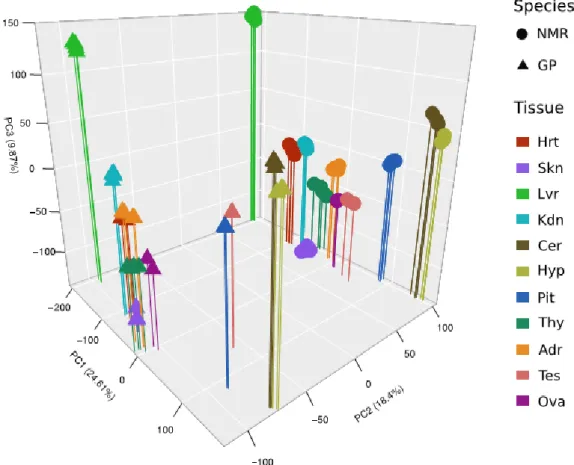
Based on these data, unsupervised hierarchical clustering gave a similar cluster hierarchy of tissues for both species (Supplement Figure 2). Brain tissues are grouped (Pit as a sister group to Cer and Hyp); Kid and Thy are sister groups to the cluster of Adr and Ova. The results are confirmed by principle component analysis, separating tissues by the first and species by the second component (Figure 1). At this level of
Figure 1: Principle component (PC) analysis based on logarithm of mean
expression level between replicates (four datasets per tissue and species: 2 sexes x 2 statuses, except gonads). Tissues are separated by PC1 and PC3, species by PC2.
39
analysis, ovary was the only tissue, which showed a separation of samples with respect to breeding status. Together, this indicates that: (i) tissue source is dominant over other biological variables such as species, sex and status and (ii) the impact of sex and status on transcriptome profiles is subtle.
Cross-species DEGs are enriched in ageing-related genes
To further characterize the species differences between the long-lived NMR and the shorter-lived GP, we next determined gene expression differences based on orthologous transcribed regions that show high sequence similarity. This filtering method avoided potentially misleading signals that may arise from assembly artefacts or the comparison of different transcript isoforms and identified 9,593 genes suitable for further analyses.
Across all tissues, we identified 16,692 significant expression differences (EDs; 8,920/7,772 higher/lower expressed in NMR) in 5,601 genes (FDR<0.01, |log2FC|>2;
Supplement Table S6, Supplement Data 1). To assess the association of cross-species DEGs with ageing, we examined their overlap with ageing-related genes of human and mouse obtained from the Digital Ageing Atlas (DAA) (Craig et al. 2014). This test revealed a significant overlap with DAA containing 999 genes (17.8% of DEGs; p=0.008, Fisher's exact test (FET); Supplement Table S7). The enrichment analysis of shared ageing-related genes reveals 212 significant GO terms (FDR<0.05, Supplement Table S8). Further summarization in 80 non-redundant GO term sets by REVIGO reveals that the top 15 ranked sets are associated with lipid biosynthetic process (GO:0008610), growth (neuron projects development, GO:0031175; chemotaxis, GO:0006935; system development, GO:0048731; blood vessel development, GO:0001568, wound healing, GO:0042060; hippocampus development, GO:0021766) and response to glucocorticoids (GO:0051384) (Supplement Figure S3).
Figure 2: Euler diagrams of analyzed gene sets. (A) DEGs of females vs. males within breeders and breeders for each species. (B) DEGs of breeders vs. non-breeders within the same sex for each species. (C) NMR gonad DEGs of non-breeders vs. non-breeders and ageing-related genes from the Digital Aging Atlas (DAA).
40
Sexual differentiation and maturation in NMR are delayed until transition from worker to breeder
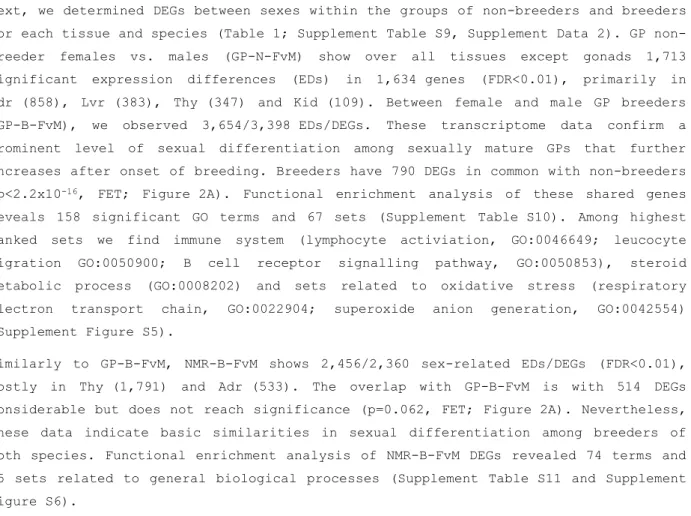
Next, we determined DEGs between sexes within the groups of non-breeders and breeders for each tissue and species (Table 1; Supplement Table S9, Supplement Data 2). GP non-breeder females vs. males (GP-N-FvM) show over all tissues except gonads 1,713 significant expression differences (EDs) in 1,634 genes (FDR<0.01), primarily in Adr (858), Lvr (383), Thy (347) and Kid (109). Between female and male GP breeders (GP-B-FvM), we observed 3,654/3,398 EDs/DEGs. These transcriptome data confirm a prominent level of sexual differentiation among sexually mature GPs that further increases after onset of breeding. Breeders have 790 DEGs in common with non-breeders (p<2.2x10⁻¹⁶, FET; Figure 2A). Functional enrichment analysis of these shared genes
reveals 158 significant GO terms and 67 sets (Supplement Table S10). Among highest ranked sets we find immune system (lymphocyte activiation, GO:0046649; leucocyte migration GO:0050900; B cell receptor signalling pathway, GO:0050853), steroid metabolic process (GO:0008202) and sets related to oxidative stress (respiratory electron transport chain, GO:0022904; superoxide anion generation, GO:0042554) (Supplement Figure S5).
Similarly to GP-B-FvM, NMR-B-FvM shows 2,456/2,360 sex-related EDs/DEGs (FDR<0.01), mostly in Thy (1,791) and Adr (533). The overlap with GP-B-FvM is with 514 DEGs considerable but does not reach significance (p=0.062, FET; Figure 2A). Nevertheless, these data indicate basic similarities in sexual differentiation among breeders of both species. Functional enrichment analysis of NMR-B-FvM DEGs revealed 74 terms and 35 sets related to general biological processes (Supplement Table S11 and Supplement Figure S6).
Table 1: Numbers of DEGS identified in the different comparisons (FDR<0.01).
Organ GP NMR GP NMR GP NMR GP NMR Hrt 4 10 89 13 2 3 0 0 Skn 6 6 3 5 5 1 0 223 Lvr 383 4 235 10 71 0 9 1 Kid 109 6 106 21 1 4 0 0 Cer 1 5 2 25 0 15 0 0 Hyp 2 8 1 11 0 5 2 0 Pit 347 9 307 47 114 114 2 1 Thy 3 0 2,087 1,791 675 285 1 0 Adr 858 4 824 533 0 201 1 4 Gon - - - - 18 502 3 381 ED* 1,713 52 3,654 2,456 886 1,130 18 610 NR** 1,634 22 3,398 2,360 883 1,078 14 598
female vs. male breeder vs. non-breeder non-breeder breeder females males
* significant expression differences across tissues
Figure

Related documents