Optimization of Mechanical Properties in Natural Hybrid Polymer Composite using Polypropylene (PP), Banana Stem Fiber (BS) and Pineapple Leaf Fiber (PALF)
by
Siti Norakma Bt Sarifuddin 16932
Dissertation submitted in partial fulfilment of the requirements for the
Degree of Engineering (Hons) (Mechanical)
MAY 2015
Universiti Teknologi PETRONAS, Bandar Seri Iskandar,
31750 Tronoh,
i
CERTIFICATION OF APPROVAL
Of Research Project
Study on the Optimization of Mechanical Properties in Natural Hybrid Polymer Composite using Polypropylene (PP), Banana Stem Fiber (BS) and Pineapple Leaf Fiber
(PALF) By
Siti Norakma Bt Sarifuddin 16932
A project dissertation submitted to the Mechanical Engineering Program Universiti Teknologi PETRONAS in partial fulfilment of the requirement for the
BACHELOR OF ENGONEERING (Hons) (MECHANICAL)
Approved by,
(Mr. Kamal Arif bin Zainal Abidin)
Universiti Teknologi PETRONAS TRONOH, PERAK
ii
CERTIFICATION OF ORIGINALITY
This is to certify that I am responsible for the work submitted in this project, that the original work is my own except as specified in the reference and acknowledgements, and the original work herein has not been undertaken or done by unspecified sources or persons.
(SITI NORAKMA BT SARIFUDDIN) Mechanical Engineering Department, Universiti Teknologi PETRONAS.
iii
ABSTRACT
A study was carried out to investigate the optimization of the natural hybrid polymer composite which was made using polypropylene (PP) as matrix and banana stem fiber (BSF) and pineapple leaf fiber (PLF) as a reinforcement. The coupling agent which was Maleic anhydride grafted polypropylene (MAPP) was added in the composite to improve the bonds between polymer and natural fiber. This study is was aimed to investigate how two reinforcement in a single matrix will enhance the mechanical properties of the composites. The banana stem fiber was hybridized with pineapple leaf fiber to improve the mechanical properties of the banana stem fiber. Hybrid composites were prepared using banana/pineapple fiber of 100:0, 70:30, 50:50, 30:70, 0:100 ratios while overall weight percentage of the fiber was fixed as 30 wt%. The composite will be tested according to the standard for tensile strength (ASTM D638), flexural strength (ASTM D790) and the morphology of the composite will be studied under the scanning electron microscopy (SEM) machine.
iv
ACKNOWLEDGEMENT
In completing my Final Year Project, it is enough to say that I experienced valuable insight from the challenges and difficulties I have face thoroughly. With that, I would like to express my greatest gratitude to all of related personnel who have direct and indirectly assisted me in this work.
First and foremost, I would like to express my sincere appreciation and gratitude to my supervisor Mr Kamal Ariff Bin Zainal Abidin for his patience, guidance, support, and construction comment throughout these entire period of project completion. Besides that, I would like to convey my gratitude to my examiner, Dr. Hamdan Bin Ya and Dr Jabaraj for their critical comments and evaluation given during the project completion. Thanks were forwarded to all lecturers who have indirectly assisted me in this work.
I would also like to address my appreciation to all UTP lab technologist especially Mr Danial Mohd Rani and Mr Paris Said for their continuous help and assistance throughout the research period. And special thanks goes towards all the personnel in SIRIM Berhad, Shah Alam, Selangor for warm hospitality and assistance in completing my task.
Last but not least, I owe special gratitude to my family especially my parents and friends for continuous and unconditional support, encouragement during this project. All of the contribution, knowledge and experience will not be forgotten.
v
TABLE OF CONTENTS
CERTIFICATION OF APPROVAL ... i CERTIFICATION OF ORIGINALITY ... ii ABSTRACT ... iii ACKNOWLEDGEMENT ... ivLIST OF TABLE ... vii
LIST OF FIGURES ... viii
CHAPTER 1: INTRODUCTION ... 1
1.1 Background of Study ... 1
1.2 Problem Statement ... 2
1.3 Objectives ... 2
1.4 Scope of Study ... 3
CHAPTER 2: LITERATURE REVIEW ... 4
2.1 Overview ... 4
2.2 Application of the composites ... 5
2.3 Natural Fiber ... 7
2.4 Hybridization ... 8
2.5 Matrix: Polypropylene (PP) ... 9
2.6 Reinforcement ... 10
2.6.1 Banana Stem Fiber (BSF) ... 10
2.6.2 Pineapple Leaf Fiber (PLF) ... 11
2.7 Coupling Agent: MAPP ... 13
2.8 Finding from Researchers ... 14
CHAPTER 3: METHODOLOGY ... 18
3.1 Tools and Equipment ... 18
vi
3.2.1 Polypropylene (PP) ... 19
3.2.2 Banana Stem Fiber (BSF) ... 20
3.2.3 Pineapple Leaf Fiber (PLF) ... 21
3.2.4 Maleic Anhydride Grafted Polypropylene (MAPP) ... 21
3.3 Sample preparation ... 22
3.3.1 Mixing PP with MAPP ... 22
3.3.2 Composite Fabrication ... 24
3.3.3 Mechanical Testing Preparation ... 28
3.4 Project Workflow ... 32
3.5 Gantt Chart ... 33
CHAPTER 4: RESULT AND DISCUSSION ... 34
4.1 Theoretical Result ... 34
4.2 Fiber Analysis ... 36
4.3 Tensile Strength ... 38
4.4 Flexural Strength ... 40
4.5 Comparison of Theoretical, Experimental and Previous Research Value .... 42
4.6 Morphology Study ... 46
CHAPTER 5: CONCLUSION AND RECOMMENDATION ... 49
REFERENCE ... 50
vii
LIST OF TABLE
Table 1: The applications of natural fiber in various automotive applications [14]. ... 6
Table 2: Mechanical Properties of Polypropylene [19] ... 9
Table 3: Physical and mechanical properties of banana stem fiber [2] ... 11
Table 4: Physical and Mechanical properties of pineapple leaf fiber [26] ... 12
Table 5: Chemical Composition of Pineapple Leaf Fiber and Napier Grass fiber ... 12
Table 6: Standard properties for car dashboard [35]. ... 17
Table 7: List of Equipment and its function ... 18
Table 8: Properties of MAPP ... 21
Table 9: Material Composition for compounding PP and MAPP ... 23
Table 10: Temperature profile in twin screw extruder ... 23
Table 11: The composition of matrix fiber ... 24
Table 12: Volume for tensile and flexural mold ... 24
Table 13: Density of the material ... 25
Table 14: Calculated weight for each material in tensile mold ... 26
Table 15: Calculated weight for each material in flexural mold ... 27
Table 16: Specimen dimension for tensile specimen [24]. ... 28
Table 17: FYP 1 project Gantt chart and Key Milestone ... 33
Table 18: FYP 2 project Gantt chart and Key Milestone ... 33
Table 19: Formula of ROHM ... 34
Table 20: Mechanical properties for Calculation ... 35
Table 21: Theoretical result for natural fiber composites ... 35
Table 22: Aspect ratio for each fiber in hybrid composite ... 37
Table 23: Tensile strength of the composites ... 39
Table 24: Flexural Strength of the composites ... 41
Table 25: Experimental result for tensile and flexural properties of hybrid composites 42 Table 26: Previous research value for tensile and flexural properties of hybrid composites [37] ... 43
viii
LIST OF FIGURES
Figure 1: Current trend of bio based composite by application in United State of
America 2000-2005 ... 5
Figure 2: List of automotive applications and natural fiber ... 8
Figure 3: The SEM micrograph of Epolene 43 Kenaf treated sample [29] ... 14
Figure 4: Polypropylene in granule ... 20
Figure 5: Raw and yarn Banana Stem Fiber ... 20
Figure 6: Raw and yarn Pineapple Leaf Fiber ... 21
Figure 7: MAPP Fusabond P 613 in granule ... 22
Figure 8: Summary of the process compounding PP and MAPP ... 23
Figure 9: Type I shaped ... 28
Figure 10: A specimen undergo tensile test ... 29
Figure 11: A specimen undergo flexural test ... 30
Figure 12: SEM micrographs of untreated a) raw banana fiber b) raw banana fiber with diameter measurement c) raw pineapple fiber d) raw pineapple fiber with diameter measurement ... 37
Figure 13: Broken Specimen after tensile test ... 38
Figure 14: Bar chart of the tensile strength with different type of composites ... 39
Figure 15: Fractured specimen after flexural test ... 40
Figure 16: Bar chart of flexural strength of PP/BSF/PLF composites ... 41
Figure 17: Bar chart of theoretical, experimental and previous research value of tensile strength ... 43
Figure 18: Comparison of Theoretical, experimental and previous research value of tensile modulus ... 44
Figure 19: Comparison of experimental and previous research value for flexural strength ... 44
Figure 20: Comparison of experimental and previous research value for flexural modulus ... 45
Figure 21: SEM micrograph of tensile fracture of 50/50 hybrid composite using PP/BSF/PLF ... 46
ix
Figure 22: SEM micrograph of tensile fracture of 50/50 hybrid composites with weak bonding ... 47 Figure 23: SEM micrograph of tensile fracture of 50/50 hybrid composite for
1
CHAPTER 1: INTRODUCTION
1.1 Background of Study
Natural fiber is getting an attractive attention for the past few years to be used as a reinforcement in the polymer composite. Natural fiber is produced from animals and plants for example jute, hemp, sisal, bamboo, pineapple, banana, kenaf, wool and cotton. Natural fiber has been introduced to replace the synthetic fiber due to increasing costs of plastic, environmental concerns and movement towards greening technology. The use of green material is now very important and widely practiced due to the concern for global warming and oil depletion [1]. Unique intrinsic properties such as light weight can satisfy the requirement of global market especially for those industries who concern in weight reduction for example automotive and aerospace industries [2].
Other than light weight, it is proved by the researchers that natural fibers have many advantages like low density, low cost, recyclable, biodegradable, non-abrasive nature, have relatively high strength, high degree of flexibility during processing and high stiffness [2], [3], [4], [5]. However, some arguments have been raised that biodegradable polymer would not be sufficient enough as replacement material for fossil-based polymer. Therefore, the hybrid composites is being introduced. Hybrid composite is a composite that contains two or more types of reinforcement in a single matrix. It has been said that hybridization of two types of short fibers having different length and diameter offers some advantages over the use of one fiber in a single matrix [3]. Most study on hybridization of the polymer shows positive improvement on their properties [3], [5] , [6]. Many studies of hybridization had been performed using banana and kenaf, kenaf and sisal, sisal and banana, and also kenaf and corn husk [3], [5], [6].
This research was carried out to determine the optimization of mechanical properties of polypropylene (PP) composites, using banana stem fiber as the reinforcement to be used and had been highlighted as the objective for this research. In
2
order to improve the mechanical properties, pineapple leaf fiber was added into the composition to form a hybrid composite. Composition of the fiber were varied and mechanical test such as tensile, flexural and impact test will be carried out to select the best composition of the fibers. The composites will be fabricated by using the compression molding machine.
1.2 Problem Statement
The use of natural fiber as a reinforcement in polymer composites is gaining a wide interest especially from aerospace and automotive industries as the demand for light weight material are increasing. Other concerns included cost and environmental aspects, green technology and oil depletion. There are also concerns said that single reinforced natural fiber would not be enough to replace synthetic fiber [6], [3].
1.3 Objectives
1) To investigate how two reinforcement in a single matrix polymer would affect the mechanical properties of the composites.
2) To compare the tensile strength, flexural strength and impact of the two reinforcement with different fiber loading in the composites.
3) To compare the result of rule of hybrid mixture (RoHM) and experimental value.
4) To investigate how coupling agent will help in improving tensile strength of the hybrid composites.
3 1.4 Scope of Study
The research focused on hybridization of the banana fiber and pineapple leaf fiber as reinforcement in a single matrix which is polypropylene. The main scopes of the activities are:
1) Mixing the coupling agent MAPP with PP using twin screw extruder.
2) Calculate the tensile strength and modulus of elasticity using rule of hybrid mixture (RoHM)
3) Establish the mechanical testing; tensile strength and flexural strength for natural fiber hybrid composites which have different composition of matrix-fiber.
4) Compare the experimental result with the theoretical result.
4
CHAPTER 2: LITERATURE REVIEW
2.1 Overview
Composites genuinely are the combination of two or more materials which have different physical and chemical properties in order to obtain specific characteristics and properties. Composites may consist of matrix and the reinforcement. The matrix can be either metallic, ceramic or polymer. Despite from its origin, the purpose of having the matrix is to give the composites the shape, appearance, environmental tolerance and durability [7]. While, the reinforcement is believed to improve the mechanical properties of the composite since it is stronger and stiffer than the matrix. The reinforcement can consist of fibrous, powdered, spherical, crystalline or whiskered and it also can be either organic, inorganic, metallic, ceramic or polymeric material [7].
The properties of composites actually depend on the behavior and characteristic of the interface between matrix and reinforcement. A better interfacial bonding will hence enhance the improvement of the mechanical properties for the composites. So, the research open a new sight for engineering field to develop composites that have superior mechanical properties. Some of the researches work on the hybridization. Hybridization is a promising strategy to improve and toughen the composites material [8].
The awareness of the environmental issues and oil depletion is gaining a huge engrossment to the nation nowadays. Hence many researchers stimulated the search for sustainable material which is using natural fiber (plant fiber) composite instead of the synthetic fiber composite [9]. Natural fiber reinforced composite gives a better mechanical properties and it is also ecofriendly. Besides, it is a lignocellulosic fiber which is able to impact certain benefits to the composites for example having low density, high stiffness, low cost, renewability, biodegradability, and high degree of flexibility compared to synthetic fiber [2], [4].
5
In addition, natural fiber offers more advantages to the composite where it has non-abrasive nature and high specific mechanical properties [9]. The use of natural fiber-polypropylene composites is growing in a global market especially for automobile and aerospace industries as they are demanding in the weight reduction material [2], [10].
2.2 Application of the composites
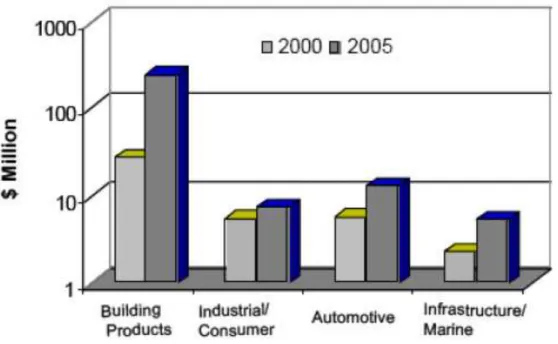
Natural fibers composite become an interesting alternative for the most widely applied fiber in the industry nowadays because it offers the opportunity for eco-friendly products, reduces the energy consumption, light weight, insulation and absorption properties, reduction in the dependence on petroleum based and forest product based material and reduces carbon emission [11]. The work reported by Drzal et al. in figure 1 shows the trend of application of bio based composites in United States of America in year 2000 and 2005 [12]. The trend of using bio based composites keeps increasing and it is soon predicted that this trend will change the whole global market of composite.
Figure 1: Current trend of bio based composite by application in United State of America 2000-2005
6
The use of bio composites provides large opportunities in the construction industries as it gives a sustainable approaches towards an ecological balance. Besides, the natural fiber can be used as reinforcement in cement matrix so that it can make low cost building material and occupy large carbon footprint in the ecosystem [13]. The example of building material that used natural fibers are panels, claddings, roofing sheets and tiles, slabs, and beams. However, researches on these bio composites are still ongoing because of the problems encountered with the natural fiber such as product performance due to poor fiber matrix interface and fiber variability [13].
The trends towards the use of natural fibers started in the years of 1990 in Europe and become the leading market of plastic composites in construction and also automotive industries [14]. In order to remain in this competitive market, the automotive industries started to optimize the price versus the quality. Natural fiber is believed to have the potential to substitute glass fiber as a reinforcement in the composites. Furthermore, the main driver for utilization of natural fiber composites are the demands for light weight parts where it leads to a lowering in fuel consumption and it is biodegradability, hence reducing the waste disposal problem [14].
Natural fibers can be processed into various automotive applications for example door cladding, seatbacks lining and packages shelves, dashboard, door panel, package tray and etc. [14]. Shuda et al. in their research said that all the major vehicle manufacturers around the world are using natural fiber in their automotive applications for example listed in the Table 1.
Table 1: The applications of natural fiber in various automotive applications [14].
Model Manufacturer Applications
Rover 2000 and others
Rover Rear Storage shelf/panel, insulation
Passat Variant, Golf A4, Bora
Volkswagen Seatback, door panel, boot – lid finish panel, boot- liner
7 A2, A3, A4, A4
Avant, A6, A8
Audi Hat rack, boot lining, spare tire-lining, side and back door panel, seat back
3, 5, 7 series BMW Seatback, headliner panel, boot-lining, door panel
Pilot Honda Cargo area
406 Peugeot Front and rear door panel
Alfa Romeo 159 Fiat Door Panel
C, S, E and A class Mercedes Benz
Door panel, glove box, instrument panel support, insulation, seat backrest panel, trunk panel and seat surface
Raum Toyota Floor mats, spare tire cover
2.3 Natural Fiber
Natural fiber can be either plant based fiber or animal based fiber and as for the plant fiber, it can be categorized as wood fibers and non-wood fibers. Wood fibers consist of soft and hard woods. The example of wood fibers are cedar, pine, cherry and walnut. While non-wood natural fiber consists of kenaf, banana, pineapple, cotton, wheat, jute, flex, sisal, bamboo, grass and etc. However, this natural fiber can be classified in term of utilization whether it is primary or secondary fiber. The primary fiber is the fiber extract from the primary plant in which it is grown for their fiber content whereas the secondary fiber is the fiber from the waste. For example; banana stem fiber, pineapple leaf fiber, cereal stalks and coir fiber [15].
This natural fiber is used in various applications as mentioned earlier in this report. It can be either used in automotive, construction, packaging and others industrial appliances. It becomes interesting because it has a light weight feature, low cost and biodegradability. As for the automotive application, Shuda et al. in their research mentioned that coconut coir fiber is used to make seat bottom, back cushion and head restraint and abaca is being used in making underfloor body panel [14]. Figure 2 shows the list of fiber which is used in automotive applications.
8
Figure 2: List of automotive applications and natural fiber
The reported work by Shuda et al. mentioned that flax, hemp, sisal, wool and other natural fiber were used to make 50 Mercedes-Benz E-class components [14]. The Mercedes-Benz company are working in a large range of natural fiber in order to replace glass fiber. BMW group also make use of the natural fiber for example flax and sisal in the interior door lining, cotton for sound proofing and kenaf for package trays and door panel.
2.4 Hybridization
In the recent years the development of the hybridization of the polymer with two or more reinforcement in a single matrix boost the mechanical properties of the composites. Hybrid composites are the material made up with two or more reinforcement in a single matrix [3]. Venkateshwaran et al. [3] said hybridization of two types of short fiber offer some advantages compared to those composites that have fiber alone in a single polymer matrix.
The hybridization gives many advantages over the single fiber such as having a better overall property combinations and also the failure of hybrid composites is not as
9
catastrophic as with single fiber composites [6]. The matrix is soft and ductile and it serves as the purposes to bind the reinforcement together, protect the fiber, and transfer the load to the fiber and also to separate the fiber and inhibit crack propagation [15]. While, reinforcement is strong and stiffer which will improve the mechanical properties of the composites [16].
2.5 Matrix: Polypropylene (PP)
Polypropylene (PP) is widely used as a matrix in composites fabrication for the past few decades. Polypropylene is a polymer under thermoplastic group which will soften or melted when exposed to heat and consist of linear or branched chain molecules having strong intramolecular bonds but weak intermolecular bonds [7]. Thermoplastic has re-softening ability where the scrap thermoplastic is able to put back in the process, in other term it is easier to recycle [17]. It possess various advantages compared to polyethylene as it can withstand higher working temperature and also has a greater tensile strength [16].
Besides, Polypropylene has a good resistances to chemical attack and excellent fatigue resistance [18]. PP product is light in weight, has low moisture absorption rate, resistant to strain, though and resistant to heat [16]. Polypropylene also has some useful properties like dimensional stability heat distortion temperature, flame resistance and transparency [16]. The properties of polypropylene is as in table 2 [19].
Table 2: Mechanical Properties of Polypropylene [19]
Matrix Processing Temperatures (ºC) Specific Gravity Water Absorption (% 24h) Tensile Strength (MPa) Elongation at break (%) Tensile Modulus (GPa) Flexural Strength (MPa) Low High Low High Low High Low High Low High Low High Low High PP 191 288 0.90 0.91 0.01 0.03 31.0 41.9 100 600 1.15 1.57 42 56
10
Due to its excellent properties in corrosion and chemical leaching resistant, polypropylene is used in the manufacturing piping system. It is able to withstand any forms of physical damage including impact and freezing. Polypropylene also can be used in manufacturing medical and laboratory items as it can withstand heat an autoclave. Due to the same reason, kettles and plastic tubs for dairy product are being made from this type of plastic. There are many applications out there that use polypropylene as a main polymer because of its excellent properties.
The most common type of manufacturing technique for polypropylene is injection molding which usually used by cutlery parts and automotive part such as batteries. The method of manufacturing is basically possess melt processing technique. It can be achieved via extrusion and molding [20]. Instead of that, there are many other techniques used for processing polypropylene for example thermoforming sheet for processing apparels and diapers and also cast film for adhesive tape.
2.6 Reinforcement
2.6.1 Banana Stem Fiber (BSF)
Banana stem fiber is a type of bast fibers which is in Musaceae family where the fiber is produced from the inner bark of banana tree or pseudo stem and provides structural strength and rigidity to the stem [21], [22]. Banana fiber is easy to get without any cost included since it is a waste product of banana cultivation and banana tree is one of the trees that are most planted in Malaysia [23]. The physical and mechanical properties of banana fiber is as follow:
11
Table 3: Physical and mechanical properties of banana stem fiber [2]
Fiber Density (g/cm³) Tensile
Strength (MPa) Tensile Modulus (GPa) Elongation at break (%) Banana Stem fiber (BS) 1.3 600-750 29-32 2-4
The extraction of banana stem fiber can be done using three methods which are chemical, mechanical and manual extraction. From these three methods, mechanical extraction is the best way to obtain the good quality and good condition fiber. Besides, mechanical extraction is an eco-friendly method of extraction [24]. Banana stem fibers can be used in many applications for example to make bond papers, replacement of glass fibers in composites material, manufactured of mattresses, pillows and cushions in the furniture industry, making bags, purse, mobile phone cover and also being used in manufacture of textiles [24].
According to a study on mechanical properties of natural fiber polymer composites [25], the polymer reinforced with banana fiber is the best composites among the various composites. The flexural test for banana reinforced composites showed higher stiffness compared to coir and sisal and the density test result showed that banana has low density which is 1101 Kg/m³. It is an attractive parameter in designing light weight material.
2.6.2 Pineapple Leaf Fiber (PLF)
Pineapple leaf is one of the natural wastes in Malaysia. It can be obtained at lower cost since its full potential does not being developed by the Malaysian. Pineapple is a tropical plant which names as Ananas comosus and it is herbaceous monocots [23]. The fiber from the leaves is long fiber bundle which is stiff and hard [22]. Table 4 shows the properties of pineapple leaf fiber.
12
Table 4: Physical and Mechanical properties of pineapple leaf fiber [26]
Fiber Density (g/cm³) Tensile
Strength (MPa) Tensile Modulus (GPa) Elongation at break (%) Pineapple leaf Fiber (PALF) 1.44 413-16277 34.5-82.5 1.6
Long time ago before any machines have been discovered, pineapple leaf fibers is extracted using retting method. Retting is a process of removing fibers from plants using enzymes from microorganism. The plants will be placed in a pond for a few weeks and it will undergo natural decay process in removing unnecessary cellulose [22]. On the other hand, the fiber can be extracted by using scrapping machine in which the leaves are fed through the feed roller and being scratched by the other roller to remove the waxy layer on top of the pineapple leaf fiber [27].
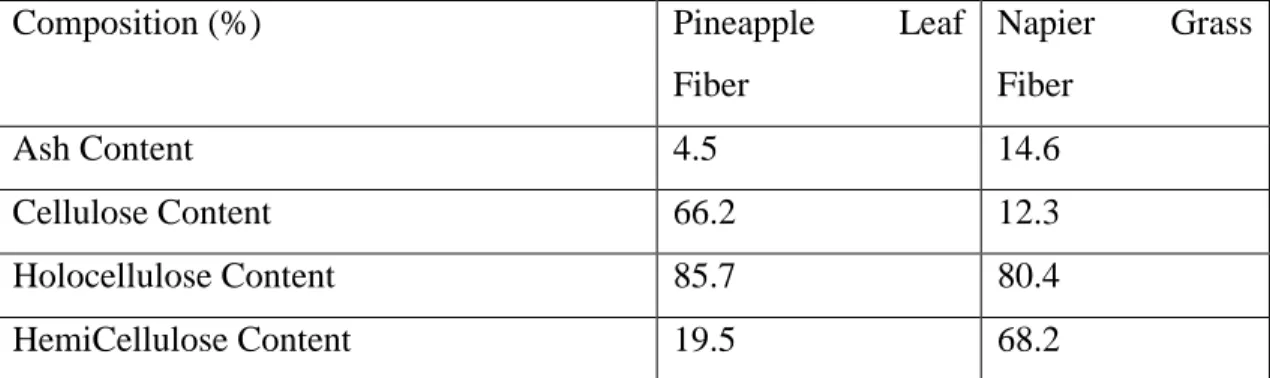
From the reported work, a study on the suitability of Pineapple Leaf and Napier Grass as a finer substitution for paper making industries were establish [28]. The chemical composition and a study on morphology of the both fibers were analyzed. Table 5 shows the result of chemical composition of both fibers from the research. Pineapple fiber has a lower ash, lignin and hemicellulose content while exhibits higher cellulose, holocellulose and moisture content compared to Napier grass. SEM analysis depicted that arrangement of the fiber in pineapple leaf formed a strong fiber structure.
Table 5: Chemical Composition of Pineapple Leaf Fiber and Napier Grass fiber
Composition (%) Pineapple Leaf
Fiber Napier Grass Fiber Ash Content 4.5 14.6 Cellulose Content 66.2 12.3 Holocellulose Content 85.7 80.4 HemiCellulose Content 19.5 68.2
13
Lignin Content 4.2 10.7
Moisture Content 81.6 11.7
Munirah Mokhtar et al [11] comparatively studied on the characterization and treatments of pineapple leaf fiber (PALF) thermoplastic composite for the construction application. Before being reinforced with polypropylene (PP), PALF is chemically treated to hinder the water content. The results shown that the flexural strength and modulus of treated PALF reinforced with PP composites increased linearly with the increment of fiber loading. While, for the tensile strength, the result is decreasing as the fiber loading increased. This phenomenon may appeared due to the poor interfacial bonding between fiber and PP matrix.
2.7 Coupling Agent: MAPP
Works by Mohamad Jani [29] emphasized on the effect of Maleated Polypropylene (MAPP) on the tensile strength, impact and thickness swelling properties of the kenaf fiber reinforced with polypropylene composites. Coupling agent is known as an additive in improving the adhesion, dispersion and compatibility between the hydrophilic cellulose which is fiber itself and hydrophobic matrix. Epolene 43 has been loaded in the compounding process with the different concentrations (1%, 3% and 5% wt.). This study proved that composites with coupling agent depicted a better adhesion between filler and matrix. The finding of SEM in figure 3 proved the good bonding between interfacial regions and resulting an outstanding nature of mechanical and physical properties of the composites.
14
Figure 3: The SEM micrograph of Epolene 43 Kenaf treated sample [29]
A study on engineering the fibre-matrix interface in natural composites [30] highlighted that treatment with MAPP improves wetting of the fibers as it reduces the polarity and promote wetting by the viscous polymer matrix. However, the major disadvantage of this treatment is that it increased the cost of the composites.
2.8 Finding from Researchers
Natural fiber may possess low thermal stability, inhomogeneous quality and supply cycles, poor water resistance and susceptibility to rot [3], [5]. Jayamani et al. [5] described that natural fiber is dominated highly hydrophilic because of unsettled polarity from cellulose and lignin to the hydroxyl free groups. Gandini et al. [31] agreed that two major limitations of using natural fiber as a reinforcing element which are: 1) the composites are subject to loss of mechanical properties because of the fiber strong sensitivity to the water and moisture, and 2) the hydrophilic has a poor compatibility with hydrophobic matrix hence causes a weak interfacial adhesion. The poor interfacial bonding may produce undesirable mechanical and physical properties of the composites [5] as a weak interface do not transfer enough stress from the matrix to the fiber [32].
15
Thus, in this recent years, many researchers believe that by modifying the fiber surface or modifying the matrix or use of coupling agent will enhance a better interfacial adhesion and provide a better mechanical properties [4], [32]. Several of surface treatments have been promoted by the literature for instance treatment by alkali, silane, benzoylation, electric discharge, acetylation and peroxide. Paul et al. [2] had performed a study of the effect of fiber loading and chemical treatment on the thermophysical properties. The fiber surface was performed using different concentration and different method of treatment which are alkalization, benzoyl chloride treatment, KMnO4 treatment and silane treatment. The model result showed that all the chemical treatment enhance thermophysical properties but only the fiber that was treated with benzoylated and 10% NaOH showed a major increasing in the thermophysical properties.
Olodele et al. [33] carried out the experiment on the effect of the chemical treatment on the mechanical properties of sisal fiber reinforced polyester composites. They performed the treatment on the sisal fiber using the same concentration and different method of treatment which are NaOH, KOH,𝐻2𝑂2, and ethanol. The outcome of the experiment showed that KOH treatment enhance the tensile and hardness properties of the polyester composites than other treatment. From the past research, it is absolutely proved that chemical treatment increases the mechanical and physical properties of the fiber since it reduces the polarity of the cellulose fiber surface [2].
The use of coupling agent in the composites also helps in improving the mechanical properties of the composites. Khalid et al [34] studied the effect of MAPP as coupling agent on mechanical properties of natural fiber composites. The research was done by varying the percentage of weight concentration of MAPP which are 2%, 3%, 5% and 7% wt. It was found that 2% of MAPP gave the best result compared to other concentrations. MAPP did enhance the composites matrix adhesion that led to improvement of bio composite performance. However, the study highlighted with the increased in the concentration of MAPP in the PP matrix above 2%, there was a substantial decrease in mechanical strength [34].
16
Venkateshwaran et al. [21] investigated on the mechanical behavior of banana/sisal reinforced hybrid composites by varying the fiber length and weight percentage. They concluded that the tensile, flexural and impact strength depended on the weight percentage and fiber length. There were some increments in the mechanical properties of the composites but still the hybridization of the natural fiber with the natural fiber did not show a huge mechanical properties as compared to the hybridization of the synthetic fiber.
Elammaran et al. [5] stated that hybrid composite’s properties may depend on the fiber orientation ore configuration, fiber content, length of the individual fiber, extend of intermingling of fiber and also bonding between matrix and fiber. They said that the mechanical properties may be increased significantly if there is a careful selection of reinforcing fiber used. Despite of having a good mechanical properties, hybrid composite seem to have a balancing between the cost and the performance comparable to the single fiber as a reinforcement.
Literature shown that tensile strength can be predicted using the equation instead of having the experiment in the lab. Venkateshwaran et al. [3] predicted the tensile properties of banana/sisal hybrid composites by using the RoHM (role of hybrid mixtures) equation and properties of the pure composites. The author compared the result of RoHM equation and experimental and the result is closer but a little bit higher than the experimental value. Anyhow, most of the researchers have an argument in the values that were produced from the calculation since it did not include the internal or external factor which is the chance of formation of void between fiber and matrix during the preparation of composites.
17
Till this day, there are only few numbers of the research papers on hybridization of two natural fiber as reinforcement and using biodegradable polymer. And there are a lot of predictions that lead to the advantages of mechanical properties when dealing with different volume or configuration. Therefore, this research was aimed for optimization of the mechanical properties of natural hybrid composites using different configuration, different weight ratio the effect of chemical treatment for the use of car dashboard. Borealis and Borouge [35] the providers for innovative chemical and plastic solution for the infrastructure emphasized the standard properties car dashboard as in table 6.
Table 6: Standard properties for car dashboard [35]. Filler Content (%) Density (kg/m³) Flexural Modulus (MPa) Tensile Stress at yield (MPa) Impact, Charpy notched 23˚C (kj/m³) Impact, Charpy notched -20˚C (kj/m³) 9-20 950-1040 1700-2050 17-23 16-45 3.5-6
18
CHAPTER 3: METHODOLOGY
3.1 Tools and Equipment
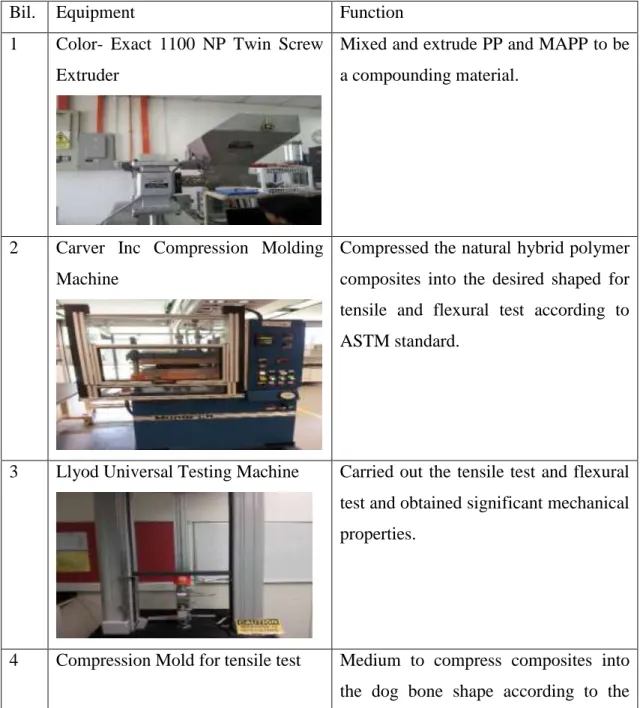
The experiment used the tool and equipment as in table 7 below:
Table 7: List of Equipment and its function
Bil. Equipment Function
1 Color- Exact 1100 NP Twin Screw Extruder
Mixed and extrude PP and MAPP to be a compounding material.
2 Carver Inc Compression Molding Machine
Compressed the natural hybrid polymer composites into the desired shaped for tensile and flexural test according to ASTM standard.
3 Llyod Universal Testing Machine Carried out the tensile test and flexural test and obtained significant mechanical properties.
4 Compression Mold for tensile test Medium to compress composites into the dog bone shape according to the
19
standards.
5 Compression mold for flexural test Medium to compress composites into the flexural shape according to the standards.
5 Scanning Electron Microscopy Analyzed the morphology of natural hybrid polymer composites.
3.2 Material
The material used for this research is as follow:
3.2.1 Polypropylene (PP)
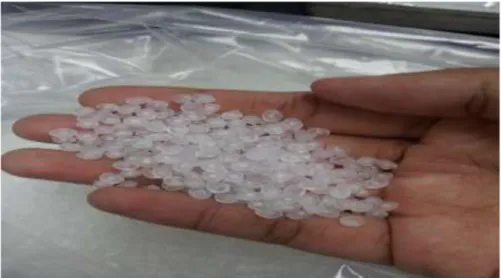
Polypropylene in figure 4 acts as a matrix that binds the fiber together. The function of matrix is to transfer the load to fiber without fracturing, to support and protect the fiber and as a principal load-carrying agent [7]. It was obtained from Lotte Chemical TITAN Holding Sdn. Bhd. It has a density of 0.9 g/cm³, melting flow index of 42 g/10 min and melting point with a maximum processing temperature of 300°C.
20
Figure 4: Polypropylene in granule
3.2.2 Banana Stem Fiber (BSF)
Banana stem fiber (BSF) in figure 5 is obtained from Conifer Handmade Mumbai, India. It is in the form of raw fiber and yarn fiber which is about 1 kg each. It has a density of 1.3 g/cm³ and can withstand temperature up until 200˚C.
21 3.2.3 Pineapple Leaf Fiber (PLF)
Pineapple Leaf Fiber (PLF) in figure 6 is purchased from the Conifer Handmade Mumbai, India. It is in the form of raw fiber and yarn fiber for about 1 kg each. The properties of PLF are, it has a density of 1.44 g/cm³ and can bear with higher temperature.
Figure 6: Raw and yarn Pineapple Leaf Fiber 3.2.4 Maleic Anhydride Grafted Polypropylene (MAPP)
MAPP is known as a coupling agent which gives a flexible layer to the matrix and fiber interfacial which will improve their bonding and reduces the number of void traps [7]. MAPP in figure 7 is also known as Fusabond P 613, obtained from Dupont Packaging & Industrial Polymer Malaysia. The properties of the MAPP as in table 8:
Table 8: Properties of MAPP Density (g/cm³) Melting point (ºC) Maximum processing temperature Melting flow index (g/min) MAPP 0.903 162 300 4 g/10 min
22
Figure 7: MAPP Fusabond P 613 in granule
3.3 Sample preparation
The preparation of the material as follows:
3.3.1 Mixing PP with MAPP
The process of mixing PP with MAPP is done by using twin screw extruder machine according to the weight ratio shown on the table 9. While, table 10 depicted the temperature profile at the extruder zone. The compounded PP and MAPP is melted and processed in the machine and extruded with 3.00 mm thickness. Then it will be quenched in water bath and palletized using palletizer. The compounding process takes places at the temperature of 170˚C with the screw speed of 50 rpm. This speed is ideal for the melt process for twin extruder machine. The process of compounding and palletizing is depicted in figure 8.
23
Table 9: Material Composition for compounding PP and MAPP
Bil Material Weight (%)
1 Polypropylene (PP) 95
2 Maleic Anhydride Grafted Polypropylene (MAPP) 5
Total 100
Table 10: Temperature profile in twin screw extruder Barrel Temperature Settings (°C)
Zone 1 2 3 4 5 6
Temperature(°C) 148 133 137 162 165 191
Fusabond P613 (5%) PP (95%) Mix in extruder
Palletize the strip Compound become granule
Figure 8: Summary of the process compounding PP and MAPP
Long strip is extruded
24 3.3.2 Composite Fabrication
The experiment will be conducted using the same configuration but with a different volume fraction of fiber. The matrix of the composites will be fixed at 70 wt% since the previous research said that the composite will give an optimum result when it is at 70-30 wt%. The fiber used is a long fiber. The composition of the matrix fiber is shown in table 11.
Table 11: The composition of matrix fiber Composite Matrix (PP with
MAPP) (wt. %) Fiber (BSF) (wt. %) Fiber (PLF) (wt. %) Total (wt. %) PP/BSF/PLF 1 70 30 - 100 PP/BSF/PLF 2 70 20 10 100 PP/BSF/PLF 3 70 15 15 100 PP/BSF/PLF 4 70 10 20 100 PP/BSF/PLF 5 70 - 30 100 PP/BSF/PLF 6 100 - - 100
The weight of matrix and fiber will be calculated according to its weight percentage in the composite composition. The weight is determined using the volume of mold used and the density of the each material. Table 12 below stated the calculated volume of tensile and flexural mold based on the standard and table 13 shows the density of the each material.
Table 12: Volume for tensile and flexural mold
Mold Volume (m³)
Tensile 1.32 × 10⁻⁵
25 Table 13: Density of the material
Material Density (kg/m³)
Polypropylene 900
Banana Stem Fiber (BSF) 1300
Pineapple Leaf Fiber (PLF) 1440
A sample calculation of compounding PP and fiber weight for tensile and flexural mold is shown below. The calculated weight for tensile mold and flexural mold are depicted in table 14 and 15. 1) Tensile mold Compounded Polypropylene (70%) = 0.7 × 1.32 × 10−5= 9.24 × 10⁻⁶ 𝑚3 𝜌 =𝑚𝑣 𝑚 = 𝜌 × 𝑣 𝑚 = 900𝑘𝑔 𝑚3× 9.24 × 10−6𝑚3 𝑚 = 8.316 × 10⁻³𝑘𝑔
Banana Stem Fiber (15%) = 0.15 × 1.32 × 10−5𝑚−3= 1.98 × 10⁻⁶ 𝑚3
𝑚 = 1300𝑘𝑔
𝑚3× 1.98 × 10−6𝑚3
𝑚 = 2.57 × 10⁻³𝑘𝑔
Pineapple Leaf Fiber (15%) = 0.15 × 1.32 × 10−5𝑚−3= 1.98 × 10⁻⁶ 𝑚3
𝑚 = 1440𝑘𝑔 𝑚3× 1.98 × 10−6𝑚3 𝑚 = 2.85 × 10⁻³𝑘𝑔 2) Flexural Mold Compounded Polypropylene (70%) =0.7 × 6.35 × 10−6 = 4.45 × 10⁻⁶ 𝑚3 𝜌 =𝑚𝑣 𝑚 = 𝜌 × 𝑣
26
𝑚 = 900𝑘𝑔
𝑚3× 4.45 × 10−6𝑚3
𝑚 = 4.005 × 10⁻³𝑘𝑔
Banana Stem Fiber (15%) = 0.15 × 6.35 × 10−6𝑚3 = 9.53 × 10⁻⁷ 𝑚3
𝑚 = 1300𝑘𝑔
𝑚3× 9.53 × 10−7𝑚3
𝑚 = 1.24 × 10⁻³𝑘𝑔
Pineapple Leaf Fiber (15%) = 0.15 × 6.35 × 10−6𝑚3 = 9.53 × 10⁻⁷ 𝑚3
𝑚 = 1440𝑘𝑔
𝑚3× 9.53 × 10−7𝑚3
𝑚 = 1.37 × 10⁻³𝑘𝑔 Table 14: Calculated weight for each material in tensile mold
Composite Matrix (PP with MAPP) (wt. %) Weight (g) Fiber (BSF) (wt. %) Weight (g) Fiber (PLF) (wt. %) Weight (g) PP/BSF/PLF 1 70 8.316 30 5.148 - - PP/BSF/PLF 2 70 8.316 20 3.432 10 1.901 PP/BSF/PLF 3 70 8.316 15 2.570 15 2.850 PP/BSF/PLF 4 70 8.316 10 1.716 20 3.802 PP/BSF/PLF 5 70 8.316 - - 30 5.702 PP/BSF/PLF 6 100 11.88 - - - -
27
Table 15: Calculated weight for each material in flexural mold Composite Matrix (PP with MAPP) (wt. %) Weight (g) Fiber (BSF) (wt. %) Weight (g) Fiber (PLF) (wt. %) Weight (g) PP/BSF/PLF 1 70 4.005 30 2.477 - - PP/BSF/PLF 2 70 4.005 20 1.651 10 0.914 PP/BSF/PLF 3 70 4.005 15 1.240 15 1.370 PP/BSF/PLF 4 70 4.005 10 0.826 20 1.829 PP/BSF/PLF 5 70 4.005 - - 30 2.743 PP/BSF/PLF 6 100 5.715 - - - -
After the sample is weighed according to the composition, it will be put inside the mold cavity. However, before that, a thin layer of wax is applied on the surface of mold to ensure the composite will be easily removed. While waiting for the sample to be prepared, the machine is preheated at 170˚C for 15 minutes. The hybrid composite is prepared using sandwich method where the matrix and fibers are being put layer by layer. For the first layer, PP layer is put in the mold followed by the banana stem fiber, a layer of PP is again being put on top of banana stem fiber, and followed by pineapple leaf fiber and last but not least, a layer of PP is put on the top side to cover the fiber.
Then, composites will be prepared by compression molding machine at 170 ± 3ºC and at a pressure of 10 ton force pressure for about 40 minutes [8]. The mold is subjected to compressive load until the mold cover fully closed. After that, it is allowed to cold down at 80 ˚C in 40 minutes. The composite is then removed from the mold.
28 3.3.3 Mechanical Testing Preparation
3.3.3.1 Tensile test
For the tensile strength testing, specimen is made according to the ASTM D638 Type 1 for reinforced composite shown in figure 9 and the test will follow the detail procedures in ASTM D638 [24]. The specimen dimension is presented in the table 16 below.
Figure 9: Type I shaped
Table 16: Specimen dimension for tensile specimen [24].
Dimension Length (mm)
W- width of narrow section 13 ± 0.5 L- Length of narrow section 57 ± 0.5
WO- Width overall 19 ± 6.4
LO- Length overall 165
G- Gage length 50 ± 0.25
D- Distance between grips 115 ± 5
R- radius of fillet 76 ± 1
29 The procedure of the testing are as follows:
1. The width and thickness of the specimen are measured to the nearest 0.025 mm using the applicable method.
2. The specimen is then placed in the grips of the testing machine. The alignment of the long axis of the specimen and the grip with and imaginary line joining the points of the attachment of the grip to the machine need to be taken care.
3. Attached the extension indicator. It is required a class B-2 or better extensometer when the modulus is being determined.
4. The speed of testing is being set at 5 ± 25% mm/min. And the machined is started.
5. The load-extension curve of the specimen is recorded.
6. Last but not least, the load and extension at the yield point and at the moment of rupture is recorded.
Figure 10: A specimen undergo tensile test 3.3.3.2 Flexural test
Three point bends testing will be conducted based on ASTM D790 M test method 1, procedure A to measure flexural strength [4]. Procedure A is basically designed for materials break at comparatively small deflection and it shall be used for measurement of flexural properties and modulus. It employs a strain rate of 0.01 mm/mm/min. The recommended test specimen for molding materials is 127 by 12.7 by 3.2 mm tested flatwise on a support span. The procedures of the testing are as follows:
30
1. Used an untested specimen for each measurement. The width and depth of the specimen should be measured to the nearest 0.03mm at the center of the test support.
2. The support span used is determined as 16:1 support span-to-depth ratios. 3. Calculate the rate of crosshead motion using the following equation,
𝑅 =𝑍𝐿2 6𝑑 =
0.01(16 × 4)2
6 × 4 = 1.707 𝑚𝑚/𝑚𝑖𝑛
Where,
R = rate of crosshead motion, mm/min L = support span, mm
d = depth of beam, mm and
Z = rate of straining of the outer fiber, 0.01 mm/mm/min
4. The loading nose and support need to be aligned so that the axes of the cylindrical surface are parallel and it is in the midway between the supports. 5. The load is applied on the specimen at calculated crosshead rate and the load
deflection data is recorded.
6. When the maximum strain of outer surface of the specimen reached 0.05 mm/min, the test is terminated.
31 3.3.3.3 Morphology Study
Morphology study will be observed under Scanning Electron Microscopy machine model 7353 LEO 1430VP. The fractured surfaced of the specimen is used to illustrate the microstructure of the composite with the different composition of the fiber. It is conducted to study the bonding between the fiber and matrix.
32 3.4 Project Workflow
A proposed project workflow is as below: Start
Perform preliminary research/introduction to the project
Identify the problem
State the objectives of the project
Conduct literature review
Develop sample calculation
Perform sample preparation
Preparation of BS and PLF mixed with PP/MAPP using compression molding machine
Perform tensile test, and flexural test and SEM analysis
Data analysis, discussion, conclusion and final report
End
FYP I
33 3.5 Gantt Chart
Table 17: FYP 1 project Gantt chart and Key Milestone
34
CHAPTER 4: RESULT AND DISCUSSION
4.1 Theoretical Result
A rule of hybrid mixture (ROHM) is used to calculate tensile strength and tensile modulus of the composites. The formula used for hybrid composite having all fiber aligned are shown in table 19.
Table 19: Formula of ROHM
Mechanical Properties Formula
Tensile Strength 𝜎𝐶 = 𝜎𝑚𝑉𝑚+ 𝜎𝑓1𝑉𝑓1+ 𝜎𝑓2𝑉𝑓2 Elastic Modulus 𝐸𝐶 = 𝐸𝑚𝑉𝑚+ 𝐸𝑓1𝑉𝑓1+ 𝐸𝑓2𝑉𝑓2
Where;
𝜎𝐶 = tensile strength for the composite
𝑉𝑚= volume fraction of matrix
𝐸𝑚= tensile modulus for matrix
𝜎𝑚= tensile strength for the matrix
𝑉𝑓1 = volume fraction of BSF
𝐸𝑓1= tensile modulus for BSF
𝜎𝑓1= tensile strength for the BSF
𝑉𝑓2 = volume fraction of PLF
𝐸𝑓2 = tensile modulus for PLF
𝜎𝑓2= tensile strength for PLF 𝐸𝐶 = tensile modulus of composite
The design parameter for the calculation acquired the mechanical properties of each fiber and the matrix itself. The parameter is shown in the table 20.
35 Table 20: Mechanical properties for Calculation
Material Density, 𝜌 (g/cm³) Tensile Strength, 𝜎 (MPa)
Tensile Modulus, E (GPa)
Polypropylene 0.9 31.0 1.15
Banana Stem Fiber (BSF)
1.3 600-750 29-32
Pineapple Leaf Fiber (PLF)
1.44 413-16277 34.5-82.5
Based on the formula and the given parameters, the expected result for tensile strength and tensile modulus for hybrid composites are calculated as example below;
Tensile strength, 𝜎𝐶 𝜎𝐶 = 𝜎𝑚𝑉𝑚+ 𝜎𝑓1𝑉𝑓1+ 𝜎𝑓2𝑉𝑓2 𝜎𝐶 = 31 (0.7) + 600 (0.15) + 413 (0.15) 𝜎𝐶 = 173.65 𝑀𝑃𝑎 Elastic of Modulus, 𝐸𝐶 𝐸𝐶 = 𝐸𝑚𝑉𝑚+ 𝐸𝑓1𝑉𝑓1+ 𝐸𝑓2𝑉𝑓2 𝐸𝐶 = 1.15 (0.7) + 29 (0.15) + 34.5 (0.15) 𝐸𝐶 = 10. 25 𝐺𝑃𝑎
Table 21: Theoretical result for natural fiber composites
Composite Matrix (PP with MAPP) (wt. %) Fiber (BSF) (wt. %) Fiber (PLF) (wt. %) Tensile Modulus, 𝜎𝐶 (𝑀𝑃𝑎) Elastic Modulus, 𝐸𝐶 (𝐺𝑃𝑎) PP/BSF/PLF 1 70 30 - 201.7 9.51 PP/BSF/PLF 2 70 20 10 183.0 10.06 PP/BSF/PLF 3 70 15 15 173.7 10.25 PP/BSF/PLF 4 70 10 20 164.3 10.61
36
PP/BSF/PLF 5 70 - 30 145.6 11.61
PP/BSF/PLF 6 100 - - 31.0 1.15
From table 21, it is shown that PP/BSF/PLF 1 has higher tensile strength compare to others and PP/BSF/PLF 5 has higher elastic modulus compared to others.
4.2 Fiber Analysis
The fiber has been analyzed using scanning electron microscopy (SEM) in order to study the surface morphology and to measure the diameter of untreated banana stem fiber (BSF) and pineapple leaf fiber (PLF). The study on the diameter and the length of the fiber influence the mechanical properties of the composites. Kwon et al. reported that the role of aspect ratio in natural fiber will predict the mechanical properties of the hybrid composites [6].
a) b)
37
Figure 12: SEM micrographs of untreated a) raw banana fiber b) raw banana fiber with diameter measurement c) raw pineapple fiber d) raw pineapple fiber with diameter measurement
Based on the SEM micrograph in figure 12, it is shown that raw banana stem fiber (BSF) is smoother than raw pineapple leaf fiber (PLF). PLF obviously has a lot of fibrils on the surface and contains more lignin. It also shows PLF has a bigger diameter compare to BSF. As mentioned earlier, the diameter of the fiber for sure affects the role of aspect ratio in predicting the mechanical properties of the hybrid composites. Table 22 shows the role of aspect ratio for each fiber.
Table 22: Aspect ratio for each fiber in hybrid composite Length (mm) Average Diameter
(µm)
Aspect ratio (L/D)
Banana Stem Fiber (BSF)
140 33.03 4238.57
Pineapple Leaf Fiber (PLF)
120 200.67 598.00
Kwon at el. in his work reported that aspect ratio affected the mechanical properties of hybrid composites as has a high aspect ratio compared to PLF. Practically, the mechanical properties of composites will increase if the amount of BSF is larger than PLF in the composites. The research done by Kwon et al. indicated the one that has a higher aspect ratio played a role as primary reinforcement in the hybrid composite.
38
Therefore, having a higher composition of BSF in the composite will enhance the optimization of mechanical properties of hybrid composites.
4.3 Tensile Strength
Tensile test has been performed using universal tensile machine (UTM) according to ASTM D638 standards and the broken samples are shown in figure 13. The dog bone specimen is in type 1 which the average size of length is 165.00 mm, width 12.79 mm and thickness 4.33 mm is used for tensile testing. The testing is done over the five different types of banana and pineapple fibers composites. The test is performed at a speed rate about 5 mm/min and at average load of 1.185 kN.
Figure 13: Broken Specimen after tensile test
Based on figure 13, it is clearly seen that the specimens were fractured in irregular forms. The best specimen supposed to break in the middle of the length which can be seen at sample 1 while the other specimens were fractured near to the grip. It is due to void that can be clearly seen by naked eyes which appeared in the sample.
39 Table 23: Tensile strength of the composites
Sample Tensile Strength (MPa)
Unreinforced PP + MAPP PP + MAPP + BSF+PLF PP + BSF + PLF PP + BSF + PLF 1 4.264 5.919 5.373 4.426 2 4.031 7.001 0.819 3.232 3 5.241 5.217 5.331 5.357 4 3.890 6.200 5.524 2.378 5 3.086 7.764 7.777 3.866
Figure 14: Bar chart of the tensile strength with different type of composites From the bar chart depicted in figure 14, the composite that contained PP, MAPP and natural fiber shows higher tensile compared to the composite that contain PP and natural fiber only. This shows that the composites with MAPP (coupling agent) possesses better mechanical properties compare to the composites without the MAPP. The mechanical properties of the composite with MAPP shows 50% increment in tensile strength compare to the composite without MAPP. Zafeiropoulos in his study
0 1 2 3 4 5 6 7 8 9 PP + MAPP + BSF + PLF PP + BSF + PLF Ten si le S tr e n gth (M Pa ) Type of Composite
Tensile Strength of Natural fiber hybrid composite
Sample 1 Sample 2 Sample 3 Sample 4 Sample 5
40
[30] highlighted that the addition of MAPP in the composites will increase the tensile strength of the composites. It is because MAPP improves wetting of the fibers. The presence of the coupling agent chain in the composites reduces the polarity of the fibers and indirectly improves wetting of the fiber [30].
Each sample shown in figure 14 represents a different fiber loading in each composite. The fiber loading in each composites are described as in table 21. Sample 5 that contains 100% PLF has a higher tensile strength which is 7.764 MPa compared to sample 3 where it contains 50/50% BSF and PLF. The data values of the tensile strength for each composite are summarized in table 23.
4.4 Flexural Strength
Flexural test or three points bending test has been done according to ASTM D790 standard using universal testing machine (UTM) and the fractured specimens were depicted in figure 15. The result shows a smooth bending of specimen which proved that it had been done accordingly to the standards. Table 24 below summarized the value of flexural strength of all composites.
41 Table 24: Flexural Strength of the composites
Sample Flexural Strength (MPa) of PP + BSF + PLF
Batch 1 Batch 2 Batch 3 Batch 4 Average
1 45.175 44.705 44.007 32.921 41.702 2 44.777 34.312 45.354 31.787 39.058 3 44.101 40.006 48.007 42.270 43.598 4 40.996 25.872 37.491 32.371 34.183 5 48.985 44.705 43.268 27. 848 41.202 6 24.864 34.394 33.386 32.623 34.394
Figure 16: Bar chart of flexural strength of PP/BSF/PLF composites
The chart shows in figure 16 is the average value of flexural strength for the composites which are varied in its fiber length. The sample 3 where it consists of 50/50% BSF and PLF content yield the highest value of flexural strength compared to the other hybrid composites which is 43.598 MPa. This shows a good interfacial bonding between fiber and matrix as it possesses higher mechanical properties as compared to other hybrid composites.
0 5 10 15 20 25 30 35 40 45 50
Sample 1 Sample 2 Sample 3 Sample 4 Sample 5 Sample 6
Fl e xu ral S tr e n gth (M Pa)
Type of Composite with different fiber loading
Average value of flexural strength of PP/BSF/PLF
composites
42
From the chart in figure 16, it can be seen that the composite has higher flexural strength compared to unreinforced PP which is picturized by sample 6. Sample 1 until 5 is a composite that varied its fiber loading while sample 6 is unreinforced PP. It is proven that composites with reinforced natural fiber possess higher mechanical properties compared to single PP. Also figure 16 shows, the addition of pineapple leaf fiber into banana stem fiber will increase the strength up to 50 wt% and then it started to decrease. It is explained on the theory of the aspect ratio in which the higher content of fiber with larger aspect ratio in a composites will possess higher mechanical properties of the comosites.
4.5 Comparison of Theoretical, Experimental and Previous Research Value
Table 25: Experimental result for tensile and flexural properties of hybrid composites Fiber content BSF/PLF Tensile Strength (MPa) Tensile Modulus (MPa) Flexural Strength (MPa) Flexural Modulus (MPa) 100/0 4.90 4770 41.70 1390 70/30 2.03 0.03 39.06 1330 50/50 5.34 5378 43.60 1350 30/70 3.95 12380 34.18 1790 0/100 5.82 0 41.20 1480
43
Table 26: Previous research value for tensile and flexural properties of hybrid composites [37]
Fiber content BSF/PLF Tensile Strength (MPa) Tensile Modulus (MPa) Flexural Strength (MPa) Flexural Modulus (MPa) 100/0 16.12 642.00 57.33 8920 70/30 17.39 662.25 58.51 9025 50/55 18.66 682.50 59.69 9130 30/70 19.93 702.75 60.87 9235 0/100 21.20 723.00 62.04 9340
Figure 17: Bar chart of theoretical, experimental and previous research value of tensile strength 0 50 100 150 200 250
Theoretical Experimental Research
Ten si le S tr e n gth (M Pa)
Hybrid composites with varied BSF/PLF composition
Comparison of theoretical, experimental and research
value for tensile strength
100/0 70/30 50/50 30/70 0/100
44
Figure 18: Comparison of Theoretical, experimental and previous research value of tensile modulus
Figure 19: Comparison of experimental and previous research value for flexural strength 0 2000 4000 6000 8000 10000 12000 14000
Theoretical Experimental Research
Ten si le M o d u lu s (M Pa)
Hybrid composite with varied BSF/PLF composition
Comparison of theoretical, experimental and research
value for tensile modulus
100/0 70/30 50/50 30/70 0/100 0 10 20 30 40 50 60 70 Experimental Research Fle xu ra l Strengt h (MPa )
Hybrid composites with varied fiber loading
Comparison of experimental and previous reseacrh for
flexural strength
100/0 70/30 50/50 30/70 0/10045
Figure 20: Comparison of experimental and previous research value for flexural modulus
Figure 18 and 19 show the comparison value of tensile strength and tensile modulus for theoretical, experimental and previous research and it is showed that the theoretical tensile strength and tensile modulus exhibit higher value compared to others. It is because, the chance of formation of micro voids during the preparation of samples influenced the tensile properties and also tensile modulus. It is observed that the tensile strength for experimental result is quite a low value compared to previous research done by Venkateshwaran [37].
Venkateshwaran et al [37] in their research used sisal in addition to banana/epoxy composite to bring the hybrid effect. Sisal is known to have a higher tensile strength compared to banana and pineapple fiber. Thus, that is the reason why the previous research possesses higher strength compare to this experimental value. However, there are some other reasons that contribute to the low value of tensile strength. It is due to void that trap inside the composites during the preparation of composite. The formation of void can be clearly seen by naked eyes. The voids gives higher tendency for the material to fail.
0 1000 2000 3000 4000 5000 6000 7000 8000 9000 10000 Experimental Research Fle xu ra l m o d u lu s (MPa )
Hybrid composites with varied fiber loading
Comparison of experimental and previous reseacrh value
for flexural modulus
100/0 70/30 50/50 30/70 0/100
46
Figure 19 and 20 show the comparison result of experimental and previous research for flexural strength and flexural modulus. The differences between these two results are not too obvious. It is might be due to the material used and method of composites preparation. However, there is also a tendency in which the result is low because of voids trap inside the composite and it might be due to the low operating temperature of the compression moulding machine so that the material will not be fully melted. This process will cause the air bubble trapped inside the mould.
4.6 Morphology Study
The structure of the fractured surface from tensile test is observed through Scanning Electron Microscopy (SEM) analysis. All SEM micrograph shows the phenomenon of pull out fiber and observe the internal cracks, fractured surface and internal structure of the composites. It can been seen from figure below, the composites failed in the brittle manner. It is proven by researcher material that failed in a brittle mode is very rigid and have higher modulus of tensile. As observed in tensile strength test, the crack propagates at a small loads and it occurs almost instantly. It is because the composites in figure show the lack of plastic deformation on the fracture surface.
Figure 21: SEM micrograph of tensile fracture of 50/50 hybrid composite using PP/BSF/PLF Weak interfacial bonding between matrix and fiber Voids
47
From figure 21 of SEM micrograph of tensile fracture of 50/50 hybrid composite using PP/BSF and PLF, it was observed that there are a lot of voids appeared in the composites. These voids appeared from the air bubbles that entrapped in the composites during the preparation of the composites. And, it is the strong reason to the sudden drop in its stress and strain curve provided by UTM machine. Poor interfacial bonding between fiber and matrix is clearly evident from figure 22 that resulting to the low of mechanical properties compared to the previous research.
Figure 22: SEM micrograph of tensile fracture of 50/50 hybrid composites with weak bonding
Based on figure 22, the SEM analysis show the close micrograph of the tensile fracture, it is observed that there is no matrix appeared in between the fiber. The matrix does not penetrate in between the fibers to create homogenous form resulting to the weak adhesion between fibers and matrix. These is why the mechanical properties of the composites is low. Due to absence of fiber matrix interaction, the fibers tend to agglomerate into bundles and become unevenly distributed throughout the matrix.
Brittle fracture
No matrix in between fiber
48
Figure 23: SEM micrograph of tensile fracture of 50/50 hybrid composite for PP/MAPP/BSF/PLF
Figure 23 show the tensile fracture microstructure of the composite that have mixed with the coupling agent. The smooth surface in the figure shows that PP and MAPP blend well, thus enhance the mechanical properties of the hybrid composites. Coupling agent is believed can improved the bonding between fiber and matrix as it treated the polar and non-polar region in the composites. Figure 23 also shows the irregularities or unwanted substance in the composites which produce low mechanical properties of the composites.
Good bonding of fiber and matrix
![Table 1: The applications of natural fiber in various automotive applications [14].](https://thumb-us.123doks.com/thumbv2/123dok_us/842938.2607201/16.918.163.802.920.1079/table-applications-natural-fiber-various-automotive-applications.webp)

![Table 2: Mechanical Properties of Polypropylene [19]](https://thumb-us.123doks.com/thumbv2/123dok_us/842938.2607201/19.918.93.881.858.1021/table-mechanical-properties-of-polypropylene.webp)
![Table 3: Physical and mechanical properties of banana stem fiber [2]](https://thumb-us.123doks.com/thumbv2/123dok_us/842938.2607201/21.918.165.816.139.304/table-physical-mechanical-properties-banana-stem-fiber.webp)
![Figure 3: The SEM micrograph of Epolene 43 Kenaf treated sample [29]](https://thumb-us.123doks.com/thumbv2/123dok_us/842938.2607201/24.918.232.679.107.406/figure-sem-micrograph-epolene-kenaf-treated-sample.webp)
![Table 6: Standard properties for car dashboard [35].](https://thumb-us.123doks.com/thumbv2/123dok_us/842938.2607201/27.918.163.808.451.614/table-standard-properties-car-dashboard.webp)