1. Arranging and Establishing a
Struc-ture of Educational Administration
1-1 The Structure and Conception of Educational Administration in the Context of the Education Ordinance In the Edo era, there was no nationwide school system, so consequently there was no educational administration organization. Public schools existed
for youngsters of the samurai class, but they were few in number, with only 1 or 2 schools in each fief, and administering them was an easy task. In the case of “private academies” or that of “terakoya,” which catered for commoners, there was no public administration or control over them. It was in the latter part of the 19th century, following the Meiji Restoration, when a nationwide school system was introduced on the basis of models taken over from Issues in developing countries
Issues frequently mentioned as being of concern to developing countries in the area of educational administration include the inadequacy of educational laws and regulations, excessive centralization of administrative powers, the weak organization of local educational administration, frequent changes on the part of ranking officials in the administration and lack of policy continuity as a result of the system of making political appointments, a lack of professional ability on the part of those holding posts in educational administration, bargaining or compromises with teacher unions, and lack of participation in education by parents or local communities.
Points
This chapter presents an overview of the development of educational administration in Japan since the introduction of a modern education system, showing how the system was put in place and how it has changed over time, dividing the account into prewar and postwar periods with World War II as the dividing line. Major perspectives are: ①legalism and over-attachment to Imperial orders in educational administration; ② changes in the authority and responsibilities of the Ministry of Education as an organ of central government; ③ changes in the organization and authority of local educational administration; ④ the struggle between democratization and the drive for increased efficiency in educational administration; ⑤ the separation and unification of general administration and educational administration; ⑥recruitment of educational administration staff and career opportunities. In terms of specialist fields, particular points on which attention is focused include: curriculum administration; textbook administration; the system of educational inspectors and supervisory staff; matters concerned with teachers and teacher unions; and private-sector educational administration Japan is said to have a centrally controlled educational administrative system, but in fact Japan had a local educational administration structure in place before World War II, with the division of responsibility arranged essentially on the basis that the compulsory education stage was a municipal responsibility, secondary education was a prefectural responsibility, and higher education was a national responsibility. Finally, the chapter touches on the current structure of educational administration and on reform issues.
56
The History of Japan’s Educational Development
Western countries, that for the first time, an educational administration structure was also established. In the Education Ordinance of 1872, the first educational law in the modern period, France was taken as the model for the organization of educational administration. In terms of central government structures, the Ministry of Education was established in 1871 as the central government body in charge of educational administration. It is also worthy of note that in the early stages after the Ministry was established, an American, David Murray, was invited to Japan from 1873 and served first as adviser, then as Superintendent, giving directions and guidance on education policy until 1878. In terms of nationwide administration, the whole country was divided up into school districts (university districts, middle school districts, and elementary school districts); each school district was the basic area for the establishment of schools and was expected to become the standard unit of educational administration. Each elementary school district aimed to cover a population of around 600 people. In addition, in each university district, Inspectors’ Offices were established, with the respective Inspectors appointed by the Secretary of Education. In each middle school district, 12 to 13 people of stature and influence in the area were appointed as school district supervisors, and the aim was to make each of them responsible for educational administrative matters relating to between 20 and 30 elementary schools. Each elementary school district, under the guidance of the school district supervisor, was responsible, with the city mayor or village mayor at the head, for raising funds for the establishment of schools, enforcing school attendance, and similar matters. To assist the mayor with the administration and management of schools, a number of what amounted to school administrators were appointed from among local residents.
However, the Education Ordinance was not in fact exactly implemented in the way it was conceived. In the end, only one university was established, and the Inspector for the university district was absorbed into the Ministry of Education. In addition, although this was not specified in the Education Ordinance,
prefectures became in practice the highest unit of local educational administration. Within the prefectural office was housed a section dealing with school administrative affairs, and specialist full-time staff were assigned to this office. A school district was not conterminous with general administrative districts at prefectural, town or village level, but was a unit specially designated for the purpose of educational administration. However, because of difficulties experienced by school districts in establishing schools independently from their own financial resources, in some cases 2 or 3 school districts would combine their resources to establish a school. The result of this situation was that in reality, in many cases, elementary school and middle school districts were formed using the old land divisions of county (“gun”), town and village as the basic unit. Also in many cases, because this was the most convenient arrangement, the mayor would concurrently hold the post of school district supervisor, with the result that the division between those responsible for educational administration and those responsible for general administration was ambiguous.
1-2 Putting a Local Government System in Place and Unifying Educational and General Administration
In 1878, the government introduced new laws and regulations concerning land divisions and set down local taxation regulations, thereby clarifying the authority and functions of the prefecture, the county (gun), and the municipality (ward, town and village). In 1879, the Education Ordinance was abolished, and in its place, the Education Order was promulgated. Through this Order, a new conception of a system of educational administration was realized. The system of school districts was abolished, and the units of educational administration were unified with the units of general local administration. In principle, the management of primary education was made the responsibility of municipalities (wards, towns and villages), and that of secondary education the responsibility of prefectures.
had been too uniform, the direction now proposed was that education should be left to local discretion. In place of the school district supervisor, local educational administration would be the responsibility of “educational committeemen” directly elected by town or village inhabitants. This system of “educational committeemen” is said to have been modeled on the American system of boards of education. However, criticisms were made to the effect that the Education Order gave too much freedom of action to local community officials and cause the reduction of the enrollment rate. As a result, it was revised only one year after it was issued.
The “Revised Education Order” of 1880 once again expanded the authority of the Ministry of Education in local educational administration, and set out clearly the authority of the prefectural governor with regard to educational administration. In addition, the formula whereby “educational committeemen” were directly elected by local residents was changed into one whereby they were appointed by the prefectural governor, with the town or village mayor included as one of the committeemen. The intention of devolving and democratizing educational administration dropped back after a trial of just one year, and in 1885, the system of “educational committeemen” was itself abolished. From this date on, educational affairs at town and village level were placed under the authority of the mayor.
With regard to the authority of the Ministry of Education, it was made clear that this extended to issuing Guidelines for the Course of Study (curriculum criteria) for Elementary Schools, also to approval of various regulations established by the prefectural governor (regulations for enforcing school attendance, for establishing and closing schools, for the salaries of teachers in elementary schools, and for the election of educational committeemen), as well as to approval of the establishment and closure of prefectural schools. With regard to authority vested in the prefectural governor, this extended to the regulations mentioned above, to the editing and implementation of the Guidelines for the Course of Study for Elementary
Schools, to the establishment of middle schools, specialized schools, agricultural, commercial and industrial schools, and to the appointment and dismissal of teachers in town and village schools (on the basis of applications from the educational committeemen). On the basis of the Revised Education Order of 1881, the Ministry of Education established Guidelines for the Course of Study for Elementary Schools. Also in 1881, with a view to curbing participation by teachers in a political movement that emerged at this time, the Freedom and Popular Rights Movement, the Ministry of Education issued an Ethical Guide for Elementary School Teachers and Regulations for Examining the Conduct of Schoolteachers. In 1886, 5 people were appointed to the position of inspectors within the Ministry of Education.
1-3 The Introduction of a Cabinet System and the Establishment of an Educational Administrative System by Imperial Decree
With the advent of the 1880s, great changes came about in the government of Japan, taking such forms as the establishment of the Meiji Constitution, the opening of the National Diet, and the introduction of the cabinet system. It was in 1885 that the cabinet system was introduced to replace the Grand Council that had existed up to that time. The former Depart-ment of Education was renamed as the Ministry of Education, and at its head, in place of the former Sec-retary of Education, was the Minister of Education.
The first Minister of Education to be appointed was MORI Arinori, and it was under his direction that the basic framework of the Japanese education system was put in place. There was no specific article relating to education in the Meiji Constitution of 1889, the assumption being that education was under the direct authority of the Emperor. There was great debate, in the context of the new political system, about whether the form of regulations pertaining to education was such that they should be classified as laws forming part of the legislature, or such that they should be treated as Imperial decrees. In the end, with the exception of one part of the laws, which
58
The History of Japan’s Educational Development
dealt with educational finance, the prevailing opinion in prewar Japan was that as far as educational administration was concerned, education regulations should be thought of as Imperial decrees. The Imperial Rescript on Education, issued in 1890, was in practice the supreme education law in prewar Japan.
1-4 Establishing the Basic Framework of Educational Administration in Prewar Japan
Around the same time as the promulgation of the Meiji Constitution, a number of laws were enacted, namely the City System and Town and Village System Law of 1888, the Prefecture System Law of 1890, and the County System Law, also of 1890; through these laws, the framework of the local administration system was put in place. In accordance with this system, the 1890 Elementary School Order and the Law concerning General School Regulations for Local School Matters were both promulgated in 1890, and in this way, issues of structure and authority relating to local educational administration were clarified, and the basic framework for prewar local educational administration in Japan was established.
Through the above measures, the principle was clearly established that education was not an exclusively local concern, but essentially a national concern, and the responsibility of local bodies (city, town, village) was to carry out the matters with which they had been entrusted by the nation. In accordance with this principle, the respective powers of the Minister of Education, the prefectural governors, and the mayors of counties (gun), cities, towns and villages were clarified. In the case of primary and secondary education, authority with regard to matters of educational content such as educational objectives, the curriculum, textbooks, and service regulations for teachers was vested in the Minister of Education. On the other hand, local government bodies, in particular, the city, town and village, were expected to take responsibility for educational expenses concerned with the establishment and maintenance of schools,
equipment, teachers’ salaries, as well as costs of educational committeemen and inspectors. With regard to educational administration at prefectural level, the prefectural governor carried out his duties within the framework of direction and supervision from the Minister of Education, and to assist him with his duties, an Educational Affairs Section was established within each prefectural office. Below the level of the prefecture, the county governor received direction and supervision from the prefectural governor, and in turn was responsible for directing and supervising the mayors of towns and villages within his jurisdiction in respect of matters concerned with educational administration. Assistance was provided by the appointment of one county school supervisor within each county (gun). In addition, in 1897, the office of local supervisor was created in each prefecture, followed in 1899 by the creation of the office of chief supervisor; at this time, the designation of “local supervisor” was changed to that of “school supervisor.” The persons appointed to the offices of chief supervisor and school supervisor respectively were in practice the persons who exercised real authority over personnel matters to do with teaching personnel, and they played a very significant role in terms of directing and supervising local educational administration. The mayors of cities, towns and villages were responsible for implementing educational matters in accordance with the duties entrusted to them by the central government. From 1890 onwards, assistance was provided by “educational committeemen,” who served in cities, towns and villages throughout Japan. The usual practice was that elementary school principals or eminent persons from the local community served in this capacity. In 1926, as a result of reform of the local government system, the counties (gun) were abolished as administrative units, and responsibility for the educational duties carried out by the county governor and the country school supervisor were transferred to the prefecture. With the abolition of county school supervisors, 350 additional persons became prefectural school supervisors.
1-5 Curriculum Administration and Text-book Administration
In 1881, the Ministry of Education issued Guidelines for the Course of Study for Elementary Schools, setting out unified, basic criteria for the curriculum, which until this time had varied widely according to the conditions of prefectures and local areas. The Guidelines specified for each level of elementary school the subjects to be taught, the educational content of each subject, the number of teaching days and the number of teaching hours. In 1886, the government issued “Subjects and their Standards for Elementary School,” followed in 1900 by the promulgation of the “ (Third) Elementary School Order,” and it is fair to say that as a result of this Order and the detailed Regulations for Enforcement, a system of national criteria for the formation of the curriculum was virtually completed for the prewar period in Japan.
In 1941, during World War II, elementary schools were renamed “National Schools,” and the military atmosphere in the schools was strengthened still further. On the basis of the idea that children should be trained as subjects of the Emperor, various subjects were grouped together into 4 subject areas, namely national studies (morals, Japanese language, Japanese history, geography), science and mathematics (arithmetic, science), physical training (gymnastics, martial arts), and arts (music, calligraphy, drawing, craft, dressmaking, housekeeping). For higher classes only, a further subject area in the form of vocational training (agriculture, industry, commerce, fisheries) was added, making 5 subject areas in all. However, before this subject grouping could actually be implemented, the war came to an end.
With regard to textbooks, in the early stages of its formation, the Ministry of Education set about translating and editing foreign textbooks, and at the same time, selected from among privately produced textbooks those that were deemed suitable for use, and energetically supported their dissemination. However, from around 1880, along with the rise in a reactionary ideology, changes in textbook administration also became discernible. Within the
Ministry of Education, an Editing Office was established, and it immediately set to work producing standard textbooks. The “Elementary Moral Training Primer” that was produced here subsequently became a model for the moral education subject area. In addition, an examiner was attached to the Local School Affairs Section with the task of examining the elementary school textbooks in use in each prefecture and forbidding use of any that were deemed unsuitable. According to the Guidelines for the Course of Study for Elementary Schools referred to above, each prefecture would decide on the textbooks to be used. And from around 1882, the choice of elementary school textbooks was unified within a prefecture. For its part, the Ministry of Education imposed an obligation on all prefectures to submit a report on the textbooks they planned to use. And in 1883, a system was introduced whereby the Ministry of Education “approved” textbooks for use. A further development came in 1886 with the Elementary Schools Order of that year, which stipulated that “elementary school textbooks shall be limited to those which the Ministry of Education has authorized.” In this way, the textbook authorization system came into being, and state supervision and control of textbooks was further strengthened.
In 1902, a large-scale bribery scandal concerned with the adoption of textbooks erupted, resulting in over 100 arrests, including the prefectural governor, inspectors, school principals and members of staff of the textbook publishing company involved. Triggered directly by this scandal, a system of state editing of textbooks was introduced from 1903. From that time on, the government undertook the production and editing of textbooks, and entrusted the publishing and supply of the books to a private company.
1-6 The Improvement of a Bureaucracy and the Introduction of an Examination System for Appointment to the Bureaucracy
The establishment of an appointment system to the bureaucracy occurred in parallel with the introduc-tion of a Cabinet system and the promulgaintroduc-tion of the
60
The History of Japan’s Educational Development
Meiji Constitution. Until this time, there were no set criteria for appointment to the central or to the local bureaucracy. Posts in the bureaucracy were filled by the appointment of those who had personal or private connections with powerful politicians within a system based on the old feudal affiliations, which had survived the Meiji Restoration. The result was that the bureaucracy was actually a system of political appointments, and when there was a change of political power or when powerful politicians lost their positions, the bureaucrats lost their positions as well. From the 1880s, however, the modernization and establishment of a bureaucratic structure became a matter of urgency for the government. In 1887, a system of examination for appointment to the bureaucracy was introduced. Under this new system, in place of the previous system of appointment as a result of personal ties and influence, a system of appointment on the basis of a competitive examination was introduced. However, the examination was not equally open to everyone, and entry to the examination was limited to those who had achieved a set academic standard, the level of which varied according to the bureaucratic rank to which the applicant hoped to be appointed. Graduates from an Imperial university were given special exemption from sitting the examination. Political appointments as a result of personal connections became few in number, and bureaucratic positions, in particular, those in the highest level of the bureaucracy in central government, were filled by persons whose level of specialist ability had been confirmed by their high academic record and their success in a national examination. Successful appointees were therefore able to acquire high status and a stable position.
From that time on, the dominant procedure in the Japanese bureaucracy became one whereby a person was appointed to a specific government ministry or agency, and rotated through a number of different sections and posts, carrying out the work of a specialized administrative officer. In the case of a post like “inspector” or “local school supervisor,”
however, persons appointed were required to have held a prescribed educational position such as that of principal of a middle school or higher level institution. However, in terms of the overall bureaucratic structure of the Ministry of Education, there was a tendency to put stress on general administrative ability, taking such forms as the ability to formulate and interpret laws, or the ability to secure and distribute budgets, rather than on specialist educational knowledge.
2. Postwar Educational Administrative
Reforms
2-1 The Basic Direction of Postwar Educational Administrative Reform At the end of the war in 1945, with Japan under the control of the Allied Forces, demilitarization, democratization, and the rebuilding of the nation were all taken forward. With the aim of examining the overall concept of educational reform in postwar Japan, the General Headquarters of the Allied Forces (GHQ) requested the U.S. to dispatch an investigation group of education specialists in the form of the “United States Education Mission to Japan.” After the Mission arrived in Japan in 1946, they carried out a range of investigative activities in a very positive fashion, and produced a report containing a series of recommendations concerned with Japanese education reform. Urging reforms, the report criticized educational administration in the following terms.1
“The Ministry of Education has been the seat of power for those who controlled the minds of Japan. In order to prevent the misuse of the power of this office as heretofore constituted, we propose that its administrative controls be reduced. This means that many present controls affecting curricula, methods, materials of instruction, and personnel shall be transferred to prefectural and local administrative units. In the past, regimentation has been compelled by a system of inspectors. This system should be abolished. In its place, there should be established a
system of consultants and competent technical advisers who will provide inspiratiion and guidance, without policing or administrative powers.”
With regard to “powers at the prefectural level,” the report continued:
“We recommend that in each prefecture there shall be established an educational committee or agency, which shall be politically independent and composed of representative citizens elected by popular vote.”
And with regard to “powers at the local level.” the report said:
“If the schools are to become effective instruments of a strong democracy, they must be kept close to the people. It is essential that teachers, school principals, and local heads of school systems be free from domination and control by higher ranking school officials.”
Through proposals and recommendations such as these, the democratization and decentralization of education was identified as a core issue of educational reform. The central pillars of this process were the reduction of the authority of the Ministry of Education and the introduction of a local educational administration structure which took the U.S. system of boards of education as its model. In parallel with the introduction of what was termed the 6-3-3-4 system of school education, the reform of educational administration was carried out in line with the direction of the recommendations in the report.
2-2 Improvement of the Fundamental Legal Structure of Education
In the new Constitution of Japan promulgated in 1946, the right to receive education was stipulated as one of the fundamental rights of the people. It was also stipulated that compulsory education should be free of charge. There was also considerable reflection on the prewar system, in which the bureaucracy decided on the fundamental direction of education, which was then promulgated in the name of the Emperor, and in which the Imperial wish constituted education law. In place of this prewar system, a legalist system was adopted, whereby the laws and regulations that formed the basis of educational administration were decided and enacted in the
National Diet. In line with this thinking, a number of educational laws determining the structure and management of the new education system were enacted in succession between 1947 and 1949, including the “Fundamental Law of Education,” the “School Education Law,” the “Board of Education Law,” the “Social Education Law” and the “Private School Law.” And in 1948, a decision was taken in the Diet eliminating and confirming the invalidation of the Imperial Rescript on Education.
2-3 The Ministry of Education Establishment Law and the Board of Education Law In 1949, by virtue of the enactment of the Ministry of Education Establishment Law, the organization and duties of the Ministry were established afresh. Under the new law, the character of the Ministry was greatly changed from what it was in prewar days. A year previously, in 1948, the Board of Education system had been introduced, and the Ministry’s job was to put in order those items that required permission or approval and as far as possible delegate authority to local boards of education, while it concentrated on its main functions of providing specialist and technical guidance and advice as well as financial assistance. But that said, because of the need to maintain educational standards throughout the country as a whole, the Ministry retained the authority to implement financial policies aimed at establishing and maintaining educational standards.
In March 1947, with the aim of determining the standards for the curriculum and educational content under the new school system, the Ministry issued new Courses of Study. These “aimed to show important items that schools should use as points of reference when preparing and developing teaching plans. Accordingly, the Courses of Study do not show teaching plans in their entirety, and it is not required that they should be implemented in exact detail.” It was with these provisions in mind that the term “draft” was appended to the Courses of Study as a subtitle. Local educational administrators and teachers were able to use the Courses of Study as reference criteria, and prepare curricula on their own initiative in accordance with local conditions and the
62
The History of Japan’s Educational Development
needs of students. At the same time, the system of state editing of textbooks was abolished, and for the second time, an authorization system was introduced. In July 1948, the Board of Education Law was enacted, identifying democratization of educational administration, decentralization, and the preservation of local autonomy as central ideas. The main points of the new board of education system are as listed below:
①A board of education is an administrative organ of a local public entity, and is an independent organ operating under a representative system.
②Boards of education shall be established in prefectures as well as in cities, towns and villages. However, it is possible for towns and villages to combine together and form an association, and for that association to establish a board of education.
③A prefectural board of education shall have 7 members, and that of a city, town or village 5 members. One member shall be a member of the local assembly, elected by mutual vote from among its members, and the other 6 (or 4) members shall be elected by local residents.
④The board of education will administer and implement matters concerned with education, science and culture that were formerly the responsibility of the prefectural governor or the mayor of a city, town or village. Personnel matters in respect of elementary and lower secondary school teachers shall come under the jurisdiction of the board of education.
⑤A superintendent of education shall be located in the board of education; the superintendent shall be appointed by the board of education from among people possessing agreed qualifications. The board of education shall establish an office to deal with clerical matters. Every prefectural board of education should have a section concerned with research and statistics, and a section concerned with educational guidance.
⑥With regard to the educational budget, the board of education shall prepare their own budget of necessary costs, and shall receive a budget from the head of the local public entity, and where there is a difference of opinion, the estimate prepared by the board of education shall be attached to the estimate
of the head of the local public entity, and the estimates shall be submitted to the local assembly, which will make a decision.
The independence of the board of education from general administration, the election of board of education members directly by residents, the execution of policies by the superintendent of education who should be a professional educationist, and the independent preparation of an education budget by the board of education, were all matters representing a radical reform in the previously accepted way of doing things in local education administration. Boards of education were established in each prefecture and in the 5 largest cities by 1948, and in all cities, towns and villages by 1952.
2-4 The Enactment of the Private School Law Another area where administration was greatly changed is that of private schools. Before the war, matters relating to private schools in respect of such matters as teachers’ qualifications, facilities and equipment, and the curriculum, were in principle subject to application of the same laws and regulations that applied to public schools, and various kinds of regulations created by central government were applied to their establishment and management. Religious education was forbidden in private schools as it was in the public sector. The Fundamental Law of Education clearly stipulated that private schools have a public character, and at the same time, confirmed that the right of establishment of private schools should be limited to a special legal entity called a school juridical person. Freedom of religious education was also approved for private schools. In 1949, the Private School Law was enacted, with the “objective, in the light of the special characteristics of private schools, of developing a healthy private school sector, by means of enhancing their public character while laying stress on their autonomy.” Adopting the standpoint of respecting the autonomy of private schools, the new law greatly reduced the supervisory authority of government, and created the legal entity of a “school juridical person” as the body responsible for establishing private schools in place of the
“non-profit corporation” that had previously carried out this role. A further effect of the law was that subsidization of private schools from public funds became possible.
3. Revising the Educational
Administra-tion System
In 1951, the Allied occupation of Japan came to an end, and Japan regained its sovereignty. In the previous year, 1950, the Korean War had broken out, and with the deepening of East-West confrontation in the form of the Cold War structures, the situation in the region surrounding Japan also showed signs of change. Against this background, very shortly after regaining independence, the Japanese government began the task of reviewing the policies carried out during the Occupation. In the educational field, the basic skeleton of postwar education reforms was kept, but the system was adjusted to suit Japanese conditions. More specifically, slight adjustments were made to the processes of democratization, liberalization and devolution that had formed the central pillars of reforms in educational administration.
3-1 Re-examining the Board of Education System
With regard to the system of boards of education, no sooner had the system been established than various problems arose with regard to the implementation, for example, over such matters as the unit of establishment, the methods of electing and nominating members of the boards, the relationship between general administration and educational administration, and so on. In 1956, the government began to tackle the task of re-examining the system of boards of education, and submitted a new law to the Diet aimed at reforming local government administration. The main thrust of the new law was aimed at maintaining the system of boards of education as such, but at the same time curtailing their independence and authority. The superior-subordinate relationship linking central government (Ministry of Education), prefectural boards of
education and municipal boards of education (in cities, towns and villages) was also strengthened. Moreover, under the rubric of achieving comprehensive and efficient management of local administration, the new measures aimed to weaken the independence of the educational administration. In the face of the proposed reforms, strong opposition was voiced by the Japan Teachers Union, by university presidents and others, who labeled the reforms as a “reverse course,” counter to the democratization of education. Fierce debate also erupted in the Diet, and the bill was finally approved through a forced passage with exceptional police presence at the Diet. The result was that the Board of Education Law was annulled, and in its place, the “Law concerning the Organization and Functions of Local Educational Administration” was promulgated. By virtue of the new law, the system of boards of education was revised in terms of the following provisions:
①The system of direct public election of board members is cancelled, and instead members will be appointed by the head of each local public body with the consent of the assembly.
②Board members shall number 5 persons, but may be 3 persons in the case of town and village boards.
③The superintendents of the prefectural boards of education shall be appointed by the prefectural boards, subject to the approval of the Minister of Education, and the superintendents of the city, town, and village boards of education shall be appointed by the city, town, and village boards from among the members of these boards with the consent of the prefectural boards of education.
④The power of boards of education to prepare budgets and submit drafts shall be cancelled, and jurisdiction over the acquisition and disposal of educational property, and over contracts concerned with educational business matters shall be vested in the head of the local public body.
⑤Authority to appoint teaching personnel shall be vested in the prefectural boards of education, based on recommendations forwarded by the city, town, and village boards of education.
64
The History of Japan’s Educational Development
necessary guidance, advice, and assistance to enable prefectural, and city, town, and village educational administrators to handle educational matters properly; prefectural boards are expected to provide a similar service to cities, towns, and villages. The Minister of Education is able to demand necessary corrective measures in cases where a local board of education has acted illegally or in a clearly inappropriate manner.
3-2 Introduction of a System of Regular Job Rotation for Teachers
Under the old Board of Education Law, authority over personnel matters affecting teachers was vested in the local (city, town, village) board of education, but under the new law, authority concerning the appointment of teachers in local, public-sector elementary and lower secondary schools was transferred to prefectural boards of education. As a result, whereas previously the transfer of teachers over an area that exceeded the local boundaries of the city, town or village was difficult, this now became possible. From this time on, the personnel administration of teachers was handled by prefectural boards of education in line with a procedure whereby the principal of each school could express an opinion regarding his wish to have a particular teacher transferred to his school, and the local board of education would forward all opinions received to the prefectural board of education. In this way, the systematic practice developed, in a way very characteristic of Japan, of transferring teachers employed in public sector schools, at intervals of a number of years, on the basis of the following criteria: ①interchange between urban and rural areas; ②interchange between isolated and populous areas (mountainous and flat areas); ③maintaining an appropriate balance in terms of the age structure of teachers in a school; and ④avoidance of a long term of service in one particular school.
3-3 Curriculum Administration and Text-book Administration
In 1949, in accordance with a request from the Minister of Education, the Curriculum Council was established as an advisory body to investigate and discuss important matters concerned with the curriculum. It was on the basis of a report by the Curriculum Council that a wide-ranging reform of the Courses of Study was carried out in 1958. The reform was implemented against the background of criticism to the effect that the child-centered, activity-based curriculum that became popular as a result of postwar American influence had brought about a decline in children’s academic ability. Consequently, the revision changed the curriculum in such a way as to stress the systematic nature of teaching that aimed to strengthen children’s basic abilities. At the same time, for the first time since the end of the war, “Moral Education” was included in the timetable. Moreover, in the course of the revision, the Courses of Study, which until this time had been issued as “drafts,” were given the character of “directives,” thus strengthening their legally binding force. From this time on, it became customary for the Courses of Study to be revised approximately every 10 years in accordance with the changing current of the times and educational demands.
Under the Board of Education Law, the power to authorize textbooks was vested in prefectural boards of education. However, there was considerable opposition to the proposed procedure based on fears of the difficulties that would be encountered in implementing authorization while using prefectures as units, so with the revision of the law in 1953, the power of authorization was unified by the minister of Education. Thereafter, amidst allegations of political bias in the content of authorized textbooks, the Ministry of Education strengthened the authorization system. In 1965, the author of a Japanese history textbook who was dissatisfied with the modifications to his text proposed by the Ministry in the course of the authorization process, brought a lawsuit against the Ministry claiming that the textbook authorization system was illegal and unconstitutional. With this lawsuit as a focal point, controversy over the
textbook authorization system raged both in and outside the courts. The final result of the lawsuit, which continued for a very long time, was that the allegation of unconstitutionality was rejected. However, as a result of criticisms voiced while the lawsuit was in progress, partial revisions were made to the system, including systematization of the authorization procedures and the provision of relief measures concerning textbooks that were unsuccessful in the authorization process.
Furthermore, in accordance with the principle of free compulsory education as stipulated in the Constitution of Japan, a system of free distribution of textbooks at compulsory education level was introduced in 1963. The scope of the free distribution system gradually expanded year by year, and by 1969, free distribution was implemented over the whole country.
In the case of “national” and private schools, authority to select textbooks for use from among those that had been authorized was vested in the school principal, while in the case of “public” schools, it was vested in the board of education with authority over the school concerned. In practice, the way the choice of textbooks for adoption worked was that the prefectural board of education grouped a number of cities and “counties” (“gun”) together into “textbook adoption districts,” and the textbooks adopted were the same for all public schools within a particular textbook adoption district. About 500 such districts were established covering the whole of Japan.
3-4 The Formation of the Japan Teachers’ Union and its Opposition to the Government’s Education Policies
Within the framework of the postwar education reform, trade union activity by teachers was legalized and encouraged. In 1947, the Japan Teachers Union (JTU) was formed, and within a very short time, had become a giant organization with over 500,000 members. In the atmosphere of postwar confusion following Japan’s defeat in war, the JTU launched activities aimed at the improvement of teachers’ living conditions, advances in the democratization of
education, and support for the wholesale implementation of reforms, including in particular what was called the 6-3 school system. Following the end of the occupation, the JTU developed a movement in opposition to the government’s proposed re-evaluation of education policies implemented under the occupation, giving the re-evaluation the label of “reverse course,” indicating a return to conservatism. For a long period after this, the slogan, “Never send our students to the battlefield again,” became a central feature of JTU activities. Maintaining close links with left-wing bodies such as the Socialist Party and the Communist Party, the JTU began to develop anti-war activities. For its part, the Ministry of Education strengthened its confrontational posture, using the slogan “Safeguarding political neutrality in education.” In the latter part of the 1950s and the former part of the 1960s, confrontation between the JTU and the Ministry reached its peak over the government’s attempted implementation of work performance rating for teachers and over the rights and wrongs of the implementation of nationwide achievement tests. The JTU organized nationwide strike protests, while for its part, the government invoked the criminal law against many teacher union leaders.
From the latter part of the 1970s into the 1980s, trade union activities by teachers began to show signs of stagnation. This was due to a number of factors, including the general acceptance of legal precedents supporting the prohibition of labor dispute activities by public servants, the raising of union fees to provide support for those subject to criminal law procedures, and a decrease of interest in labor movements. A further contributory factor was the large-scale improvement in teachers’ salaries as a result of a law designed to secure capable educational personnel. When membership of the JTU was at its peak, it included nearly 90% of all teachers, but by 1985, the proportion had sunk to below 50%. Subsequently, the decline continued, and particularly among newly appointed teachers, there was a strong drift away from union membership. Aggressive teacher union activities that developed over a long period in the form of opposition to and criticism of
66
The History of Japan’s Educational Development
the government’s postwar education policies, had by the end of the 1980s virtually disappeared from the Japanese educational world.
4. The Debate Over Reform of
Educational Administration in the
National Council on Educational
Reform
In the mid-1980s, the National Council on Educational Reform made a wide-ranging survey of the overall picture of education reform in Japan. Their basic thinking regarding reform of educational administration is set out in the following three points:
①In the past, a tendency toward excessive uniformity, an over-preoccupation with trivial matters, and a closed, exclusive atmosphere in education has become apparent. With a view to breaking with these tendencies and realizing a form of education that puts stress on vitality and individuality through creativity and ingenuity in the classroom, where education is actually carried out, there is a need to take forward a bold and meticulous process of deregulation, including a re-evaluation of the forms of permission and approval, criteria, aid, direction and advice.
②There is a need to put stress on strengthening systems of autonomy, self-reliance and responsibility in schools, prefectural and local boards of education, and local government bodies, and a need to confirm the principles of freedom, autonomy and acceptance of responsibility in education.
③There is a need to expand the variety of choices and opportunities in such ways as diversifying the school system, creating a network of links joining the educational functions of schools, families and society, relaxing age and qualification restrictions, and admitting exceptional cases.
On the basis of the thinking expressed in the above points, the National Council on Educational Reform proposed the following specific reforms:
①Re-evaluation of national criteria such as the criteria for establishing universities, the official Courses of Study, and so on;
②Encouragement to establish private elementary
and lower secondary schools;
③Re-evaluation of the division of national and local responsibilities;
④Revitalization and accomplishment of the mission imposed on boards of education;
⑤Improvement of the administration and management of schools (establishment of a system specifying the responsibility held by individual schools and confirmation of the leadership ability of school principals).
In 1998, the Central Council for Education issued a report dealing with the future pattern of local educational administration. In the report, the Council suggested a re-examination of the system of administration from 4 perspectives:
① the division of roles regarding educational administration among the national government, prefectures, and municipalities (cities, towns and villages);
②the board of education system;
③the autonomy and independence of schools;
④the role that boards of education should play in raising local educational functions and in developing as well as revitalizing local communities.
In particular, the report indicated 7 specific problems with regard to the board of education system, namely:
① On many occasions, board of education meetings were entirely taken up with formalistic discussion on agenda items that required a practical resolution, so that there was insufficient time for discussion or examination of such matters as how to respond to a wide variety of educational problems.
②There is a need for policies and devices that will enable the will of the people to be more clearly reflected in the appointment of board of education members.
③ From the point of view of promoting the devolution of authority, the system requiring the approval of the superintendent of education for appointments presents a problem.
④ Because the appointment of the superintendent of education is carried out as one part of the framework of personnel movements in local public bodies, there are cases of people being appointed
without sufficient experience of education or educational administration.
⑤The secretariat structure is weak and there is a lack of specialist personnel.
⑥There is a dearth of distinctive policies designed to match the realities and specific characteristics of different regions.
⑦ Within the process of planning and imple-menting policies, there is insufficient effort made in terms of presenting information to local residents and in terms of grasping and reflecting their hopes and wishes.
In response to the above problems, the report suggested a number of specific reform policies, including public release of the criteria and reasons for the appointment of board of education members; flexibility regarding the number of board of education members; provision of sufficient information to board of education members; abolition of the system requiring the approval of the superintendent of education for the appointment of members; measures to ensure that suitable personnel are recruited and trained for the office of superintendent of education; strengthening of the office support system for boards of education; positive efforts to establish public hearings at which views and opinions could be exchanged with local residents; establishment of an independent access point for dealing with complaints; positive measures to supply information to residents; positive efforts to open board of education meetings to the public; and encouragement of participation by volunteers in educational activities.
5. Conclusion
Ever since the introduction of a modern education system, the arrangements for a national educational administration system have constituted a very important issue for Japan. In 1871, the central government established the Ministry of Education, which played a leading role in the modernization of the education system. However, the construction of a local education system was no easy task, and in the early stages, the systems of a number of different
countries were taken as models, and various kinds of trial and error experiments were tried out. With the advent of the 1880s, the Cabinet system was introduced as the central political controlling structure, and on the other hand, accompanying the reorganization of local government in the form of the system of cities, towns and villages, the skeleton of the educational administration system was also set up in the form of a pyramid-like structure, with central government at the top, and then, at progressively lower levels of the pyramid, the prefectures, the counties (gun), and the towns and villages. The national government reserved for itself the power to deal with items directly concerned with the objectives and methods of education, including the enactment of laws and regulations, criteria for the national curriculum, the preparation of textbooks, and matters to do with teacher training and teacher service. In addition, the national government directly administered and managed the institutions that trained the future elite of Japan, including the imperial universities and the high schools, which acted as preparatory schools to the Imperial universities.
On the other hand, the administration and management of elementary schools and the former section of middle schools was entrusted to local areas. Matters over which local areas were given authority included the establishment and maintenance of school buildings and facilities, payment of teachers’ salaries, encouragement of school attendance, and the allocation of educational administration staff. In the context of prewar nationalism, matters concerned with education were not the exclusive preserve of prefectures or of cities, towns and villages, but simply national matters which had been delegated to a lower level, and there was no conception of local autonomy in education. There were limits to the decentralization of educational administration, but that said, in practice, the role that local areas played in the administration and management of schools was very large indeed. From the point of view of efficiency, Japan before the war had already created a very efficient network of educational administration.
68
The History of Japan’s Educational Development
In the postwar reform of educational administration, the decentralization and democratization of education was identified as the most significant issue. The system of American-style local boards of education, which constituted one of the major pillars of postwar reforms, was adjusted to suit Japanese conditions, but has now become a completely settled feature in Japan, with about half a century of history since the system was first introduced. However, as can be seen from the recent
debate concerned with educational administration, it cannot be denied that in the Japanese education world, there is still a deep-rooted conservative tradition that wants to stick to old precedents. The core issue in the current debate is about the revitalization of boards of education and the need to re-evaluate the division of roles and responsibility as between central government and local governments.
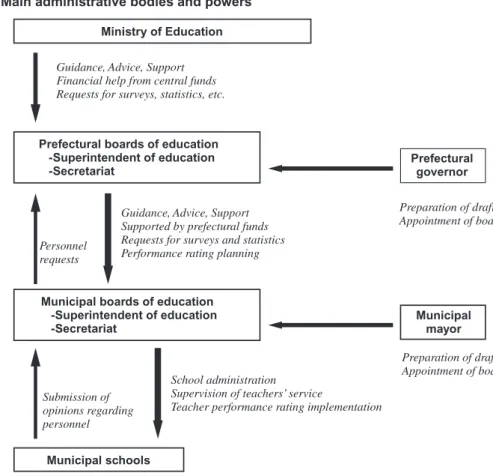
Diagram 2-1 The current system of educational administration
1. Main administrative bodies and powers
Guidance, Advice, Support Financial help from central funds Requests for surveys, statistics, etc.
Personnel requests
Guidance, Advice, Support Supported by prefectural funds Requests for surveys and statistics Performance rating planning
Preparation of draft budget
Appointment of board of education members
Submission of opinions regarding personnel
School administration Supervision of teachers’ service
Teacher performance rating implementation
Preparation of draft budget
Appointment of board of education members
Ministry of Education
Prefectural boards of education -Superintendent of education -Secretariat
Municipal boards of education -Superintendent of education -Secretariat Prefectural governor Municipal mayor Municipal schools
2. List of educational administration bodies and powers
Educational administration bodies Authorities
- School establishment criteria - Textbook authorization - Curriculum criteria - School enrollment criteria - Supervision of teacher licensing - Ordinances, instructions, circulars, notices - Jurisdiction over national universities and schools - Financial help to private universities
- Jurisdiction over private and public universities and granting of permission to establish them - Exhibiting of authorized textbooks
- Granting permission for exemption from compulsory school attendance
- Issuing of teachers’ licenses
- School administration rules and regulations - Selection of textbooks
- Setting, notifying and getting approval of educational planning criteria
- Educational planning formulation
- School enrollment enforcement and exemption - School administration regulations
- Lesson planning formulation
- Notification to boards of education of non-attendance or delinquency among children - Guidance, Advice, Support
- Requests for surveys, statistics, etc. - Financial help from central funds
- Guidance, Advice, Support
- Appointment of teaching staff supported by prefectural funds
- Requests for surveys and statistics - Performance evaluation planning - School administration
- Supervision of teachers’ service - Performance rating implementation Ministry of Education/
Minister of Education
Prefectural boards of education
Municipal boards of education
Municipal schools
1. Educational Financing in the Prewar
Period
1-1 Large-scale Dependence on Community Residents and Parents
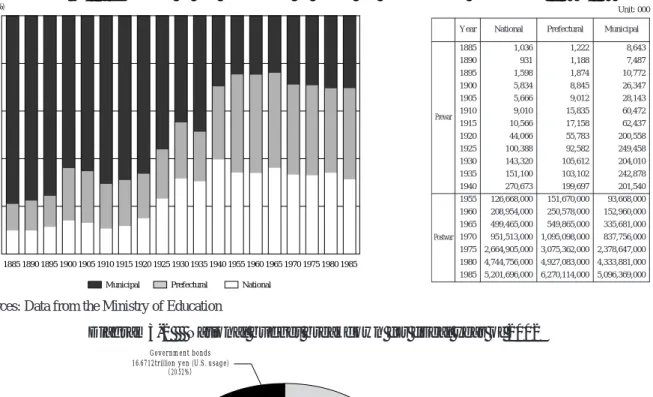
The “Education Ordinance,” constituting the first modern educational law to be enacted in Japan, used the concept of a school district as the unit for educational administration; the school district was also adopted as the unit for educational financing. Putting this in more specific terms, each school district was expected to raise the necessary funds for
establishing and running the school that served that district, so that an elementary school district would find the funds for the elementary school in that district, and a middle school district would do the same for the middle school serving that district. The priority for the national government at this time was to establish a system of higher education so that Japan could speedily incorporate the skills and knowledge from Western countries. With this aim in mind, the government used the larger part of its educational budget to employ many foreign teachers at very high salaries, and to send Japanese students to Issues in developing countries
Developing countries have worked hard to secure sources of finance in order to expand and strengthen their educational provisions. However, in recent years, with the reduction in public educational budgets as a result of “structural adjustment policies” required to cope with economic crises, they have had to attempt a variety of educational financing policies, including still more effective use of funds, prioritized distribution of funds to the educationally disadvantaged, diversification of sources of funding provision, funding distribution formulae incorporating the principle of competition, and the introduction of private funding.
Points
This chapter aims to provide an overview of the history and current state of educational financing in Japan. It will examine how responsibility for the provision of funding for Japanese education came to be divided among national government, prefectural governments, cities, towns and villages, parents, and community residents. One particular characteristic of Japan is that whereas in the area of educational administration, Japan has displayed very strong centralizing tendencies, in contrast to this, in the area of educational finance, right from the early stages of the introduction of a modern education system, the process of providing and distributing educational funding has been carried out within a significantly decentralized system. The latter part of this chapter explains the current system of educational financing. In addition, the paper also looks at movements to expand government subsidies to specif ic educational areas, including the correction of disparities in educational conditions, children’s welfare, the promotion of science education and industrial education, and the encouragement of private schools. Particular emphasis deserves to be placed on the results of the “Law to Secure Capable Educational Personnel,” which aimed to realize wide-ranging improvements in teachers’ salaries during the 1970s.
72
The History of Japan’s Educational Development
study overseas in advanced Western countries. The result of this situation was that the construction and running of elementary schools inevitably depended on local government funds, taxes levied on local residents, and income from tuition fees. Specifically, each school district was required to put together the necessary funding by means of a combination of taxation, donations and tuition fees. Regulations regarding the payment of subsidies from central government to prefectures did exist at this time, but the amount involved was very small, and the distribution formula was unclear. And in 1880, the system of national subsidization was itself abolished. As the country moved toward a new age, the government emphasized the necessity of self-enlightenment, the provision of opportunities for advancement through education, and the practical value to be gained from education; in this way, it justified the formula used in educational financing, whereby “those who benefited should bear the burden of the cost.”
In this situation, it was entirely natural that there should be outbreaks of resistance by residents and parents against the considerable financial burden imposed on them by the use of this formula. An expression of this resistance can also be seen in the low enrollment in the early days of the introduction of a modern school system. Moreover, in some cases, resistance even went as far as burning down schools. But that said, and despite the use of the formula as set out here, within a few years after the implementation of the modern school system, over 20,000 elementary schools were in fact established throughout Japan. Looking at these figures, it seems fair to say that among residents and parents in Japan at this time, there were those who anticipated great things from the new schools and who were ready to submit to the financial burden and to make efforts to raise the necessary funds. This is why, in contrast to the centralized pattern of educational administration, if we look at schools from the point of view of funding, it is entirely legitimate to say that the starting point of elementary schools in Japan was very clearly community based.
1-2 Unification of the Educational Financing Burden Levied on Municipalities, and Movements to Begin (restart) the System of Central Government Subsidies
The 1880s, when local government bodies initially took shape, gave way to the 1890s, when as a result of the Second Elementary School Law of 1890, the total costs of elementary schools became the responsibility of municipalities (cities, towns and villages). In principle, the system of tuition fees was maintained, but the income was in fact treated by municipalities as a minor handling charge, and in 1893, those municipalities that were able to do so, were permitted to abolish tuition fees completely. In 1900, as a result of the Third Elementary School Law, tuition fees were abolished in principle for all elementary schools. On the other hand, along with the spread of compulsory education, the burden of educational financing borne by municipalities steadily increased. It is against this background that increasingly strong demands were made for a restoration of the system of national subsidization, which had been in abeyance since 1880. In 1896, a national subsidy toward primary education costs was restored in the form of assistance in improving teachers’ salaries (special allowance for long service). Moreover, in 1900, through the enactment of the “Law concerning the National Treasury’s Share of Municipal Elementary School Education Expenses,” the government broadened the scope of the national subsidy for primary education costs. The amount of the national subsidy was set at 1 million yen a year, and was distributed to prefectures in accordance with the number of children of school age and the number of children attending school. In addition, in 1907, the duration of compulsory schooling was extended from 4 to 6 years, and accompanying a substantial rise in elementary school teachers’ salaries, provision was made for each prefecture to pay from 1908 a subsidy equal to that received from the national treasury; the sums received in this way were used to supplement the salary of elementary school teachers and to make a payment toward the cost of their housing.
system of subsidy from the national treasury, the percentage of the total running costs of municipal schools met by this subsidy throughout this period did not rise above the very small figure of 1%. In contrast to this, teachers’ salaries paid by towns and villages in the 1900s exceeded 40% of their total disbursements. Consequently, the demands for higher national subsidies toward education costs became increasingly strong.
1-3 A Legal Base for the National Treasury’s Share of Compulsory Education Expenses
In 1918, the “Law concerning the National Treasury’s Share of Municipal Compulsory Education Expenses” was passed. Under this law, the national treasury would disburse the sum of 10 million yen or more a year as a payment to partially defray the cost of salaries of teachers employed in municipal (city, town, village) elementary schools. In contrast to the previously existing law, which had focused on “assistance” from the state as its main objective, a noticeable characteristic of the new law was that the concept of sharing or apportioning responsibility for compulsory education expenses between the national government and the municipalities was firmly established. The basis for the distribution of the national government’s share was the number of teachers and the number of children, but a formula was adopted whereby those municipalities that were particularly weak in terms of financial resources could receive an extra amount. The sum disbursed by the national government as its share amounted to 40 million yen in 1925, 70 million yen in 1926, 75 million yen in 1927, and 85 million yen in 1930.
In 1940, the financial relationship between central and local government was changed, and a financial adjustment system took shape, whereby the central government returned money acquired from tax revenue to local governments. At the same time, the “Law concerning the National Treasury’s Share of Municipal Compulsory Education Expenses” was revised, and a new law, namely the “Law Concerning the National Treasury’s Share of Compulsory
Education Expenses” as well as an Imperial edict, “Concerning the Salary and Travel Expenses of Municipal Elementary School Teaching Personnel,” were promulgated. Under the new laws, the formulae employed were that responsibility for the payment of teachers’ salaries and their traveling expenses on the occasion of transfer to a different school was transferred from the municipality to the prefecture, and that half the sums involved would be paid by the national treasury. In other words, instead of a fixed sum being paid by the national treasury, a fixed percentage amounting to half of the actual sum disbursed by the prefecture would be paid. The transfer of responsibility for the salaries of elementary school teachers from the municipality to the prefecture, removed the burden on municipal funds, and at the same time, opened the way to the possibility of strengthening educational conditions relating to school facilities and structures, and adjusting the criteria governing teachers’ salaries to an appropriate level over the country as a whole.
2. Postwar Educational Financing
2-1 Postwar Reconstruction and Educational Financing
Postwar Japan faced problems of securing finance to deal with such problems as restoring school buildings and facilities destroyed by war and constructing new buildings to cope with the effects of the decision to make secondary education compulsory. For its part, the national government agreed to pay half of the cost of constructing school buildings and one-third of the cost of equipment. However, in practice, confusion continued with, for example, education budgets being cut by 10% or funds for the construction of lower secondary schools being completely wiped out as a result of budget shrinkage caused by postwar inflationary pressures. One case followed another of the heads of local government bodies resigning or committing suicide in their desperation at their inability to find funds to construct lower secondary schools. Furthermore, on the basis of recommendations made by a mission of tax system specialists sent from the U.S., the “Law
74
The History of Japan’s Educational Development
Concerning the National Treasury’s Share of Compulsory Education Expenses” was annulled, generating confusion in efforts to secure teachers’ salaries. The inadequacy of education budgets and the accompanying confusion lasted until about 1950, but in 1952, the above law was resuscitated and a system of support newly established. From this time on, the formula whereby half the personnel costs of teaching staff in compulsory education schools were borne by the national treasury became the basic formula for educational finance. And by the enactment in 1953 of the “Law concerning the National Treasury’s Share of Local Public School Construction” and the “Law concerning Special Measures to Promote the Reconstruction of Dangerous Schools Buildings,” a legal foundation was laid down for national government assistance in the construction or reconstruction of school buildings and facilities. In 1958, these laws were reformulated and unified into the “Law concerning the National Treasury’s Share of Expenses for Various Compulsory Education School Facilities.” Through these various laws, it was decided that the national treasury would bear half the cost of necessary expenses for the construction or enlargement of buildings for public elementary and lower secondary schools, half the cost of the expenses for the construction of indoor gymnasia, and one-third of the cost of expenses for reconstructing buildings which were in a structurally dangerous condition.
2-2 Aid for Private Schools
A combination of war damage and postwar confusion also inflicted heavy blows on private schools. For this reason, the government decided in 1946 to create a special fund for the reconstruction of war-damaged private schools and to introduce a system of lending public funds to private schools. In addition, in response to demands calling for the strengthening of the system of long-term, low-interest loans of public funds targeted at private education, the government enacted in 1951 the “Private School Promotion Law,” and established the totally government-funded “Private School Promotion Association” as a special juridical entity
with the purpose of creating a channel for the ongoing loan of public funds aimed primarily at the expansion and strengthening of private school facilities. Since its establishment, the Association has continued to function in this way.
2-3 The Enactment of the Laws to Promote Various Priority Measures and the Establishment of Financial Support for Specific Target Areas
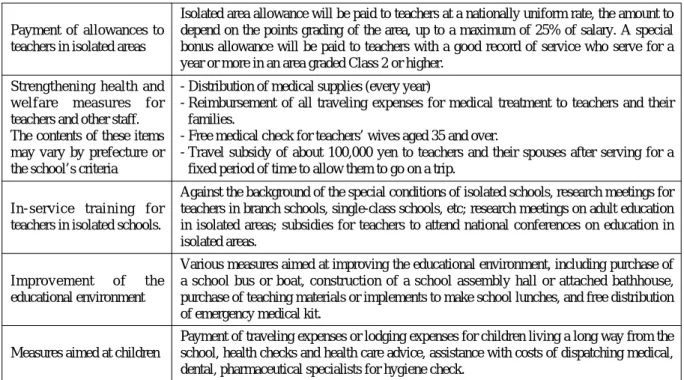
Through measures of the kind outlined above, the government had by about 1952 put a basic framework for postwar educational financing firmly in place. In parallel with this kind of framework-building, from the beginning of the 1950s, the government identified areas within education which were lagging behind in their development, or in which there was a particularly urgent need for action in terms of policy-level priorities, and adopted measures to give such areas favorable treatment in terms of educational financing. The succession of laws enacted with these aims in mind includes the “Industrial Education Promotion Law” (1951), the “Science Education Promotion Law” (1953), the “Law for the Promotion of Education in Isolated Areas” (1954), the “School Lunch Law” (1954), the “Law concerning the National Treasury’s Share for the Encouragement of School Attendance of Pupils having Financial Difficulties” (1956), and the “School Health Law” (1958). Through these various laws, the government set out specific criteria aimed at strengthening the facilities and infrastructure in the areas targeted by the respective laws, and decided that in cases where local government bodies or schools made determined efforts to meet the criteria, national funds could be used to meet one part or the majority of the costs involved.
With regard to running costs in local education other than the examples given above of special assistance from the national treasury, the government undertook to meet these by establishing a source of finance whereby a fixed percentage of the revenue from different kinds of taxation (income tax, corporation tax, liquor tax, consumption tax, and tobacco tax) would be granted to local bodies
(prefectures and municipalities) through a local grant tax allocation system.
2-4 Securing Capable Personnel and Improving Teachers’ Salaries
In 1974, the “Law to Secure Capable Education Personnel1” was enacted. This law was based on a recommendation in the report issued in 1971 by the Central Council for Education on the need “to change and renew the system of teachers’ salaries so as to ensure that the salary a teacher receives is sufficient to encourage outstandingly capable personnel to wish to enter the teaching profession of their own accord and to be ready to respond to the responsibility of a post that demands a high level of professional specialization and administrative skill.” In the context of the lively activity that the labor market had displayed during the continuing period of high economic growth, there had been a tendency for people of outstanding talent to concentrate in private companies, and the intention of the 1974 law was to recruit such capable people into the teaching profession in opposition to this tendency. Following the enactment of the law, during the period 1974-78, the salary of teachers in compulsory education schools was revised three times, so that at the end of this process it had risen by 30% and was higher than the salary paid to general civil servants. There is no doubt that after these reform measures were implemented, the traditional image of a teacher’s job as being equal to a low salary was completely dispelled. Following the measures, the competition in the examination organized by prefectural boards of education for appointment as a teacher rose sharply, and in economic terms too, the teaching profession became a very popular option among young people. Moreover, from this point on, it was possible to observe a lowering of the organizational power and influence of the Japan Teachers Union, which had been maintained for a long period after the end of the war, and its aggressive posture also became weaker.
3. The Educational Financing Reform
Debate in the National Council on
Educational Reform
The National Council on Educational Reform, which deliberated and iss