High school students seeking to complete a postsec-ondary degree must properly prepare themselves aca-demically and financially in order to qualify and pay for college. With the use of data, school counselors can target high-achieving students from diverse back-grounds to provide equitable opportunities for all stu-dents. In this article, a school counselor along with partners from the school district and local university discuss how school counselors at a high school were able to increase academic and funding opportunities for college-bound students from low-income households. Interventions included enrolling target students in academically challenging courses and advising stu-dents in applying for financial aid and scholarships.
A
s we near the end of the first decade of the 21stcentury, the demographics of our population are shifting with an increase in the numbers of school-age children, as well as increases in racial and ethnic diversity, to include increased numbers of children who speak a language other than English at home. The achievement gap between Caucasian and minority students, specifically African-American and Hispanic students, as well as students of lower socio-economic backgrounds, continues to be an impor-tant and controversial educational issue (Education Trust, 2008). Recent educational statistics show a gen-der gap with girls as a group achieving at a higher level than boys than boys, and fewer males than females enrolling in and completing college (Clark, Lee, Goodman, & Yacco, 2008; National Center for Education Statistics, 2006).
The school counseling profession has gone through a major transformation in the past decade as reflected in the American School Counselor Associa-tion (ASCA) NaAssocia-tional Standards (Campbell & Dahir, 1997), the ASCA National Model®(2005), and the
National Center for Transforming School Coun-seling (Education Trust, 2008), all of which empha-size the essential principle of working to help all stu-dents be successful in school. Additionally, legisla-tion such as the No Child Left Behind Act (U.S. Department of Education, 2001), a reauthorization
of the Elementary and Secondary Education Act, and the Individuals with Disabilities Education Act (U.S. Department of Education, 2004) provide the legal foundation for schools to improve educational outcomes for all students (Felton, 2005; Yell, Katsiyannas, & Shiner, 2006).
Comprehensive school counseling programs (Gysbers & Henderson, 2001, 2006; Myrick, 2003b) and the ASCA National Model (2005) have provided the impetus for school counselor account-ability for student achievement and educational attainment as well as an evolving vision of the role of school counselors to include leadership, advocacy, and systemic change efforts. A primary focus of the ASCA National Model is to bridge school counsel-ing and student academic achievement through col-laboration among important stakeholders such as school counselors, teachers, administrators, parents, and students (Holcomb-McCoy, 2007).
It is vital that preservice and professional school counselors be prepared to collect, analyze, and dis-aggregate data to demonstrate where significant ed-ucational needs exist in order to develop a program rationale and accompanying interventions that target specific individuals and groups of students to max-imize their potential in school and for the future (Education Trust, 2008; Stone & Dahir, 2004). This article discusses two interventions using data in which high school counselors and their interns collaborat-ed to highlight and create opportunities for students to further their educational achievements and aspira-tions. Specifically, the researchers identified low-income students who were deemed by test scores and grades to be potentially successful in college for the purpose of increasing the rigor of their academic curriculum, as well as low-income seniors to assist in accessing financial aid information and opportunities. Further, the partnership between a university counselor edu-cation program and a school district is described to share the collaborative activities that strengthen both the school counselor training program and the efficacy of practicing school counselors in imple-menting data-driven counseling programs.
Erin Camizzi, Ed.S.,is a
high school counselor in Alachua County, FL.
E-mail: [email protected]
Mary Ann Clark, Ph.D.,
is an associate professor
and Summer Yacco,
Ed.S.,is a doctoral candidate in the Department of Counselor Education, University of Florida, Gainesville. William Goodman,
Ed.S.,is the coordinator
of guidance services for the School Board of Alachua County.
Becoming “Difference Makers”:
School-University Collaboration to
Create, Implement, and Evaluate
Data-Driven Counseling
LITERATURE REVIEW
National, state and local data can provide valuable information to address the growing need to increase the numbers of students who are college and work ready. It is vital that preservice and in-service school counselors are aware of trends in student education-al achievement and attainment at education-all levels, and can identify and address student needs at the school level. Accessing and using such data is essential to plan, implement, and evaluate school counseling interventions that address achievement and oppor-tunity gaps in relation to race/ethnicity, socioeco-nomic status and gender.
Advocating for Postsecondary Access and Opportunity
The Bureau of Labor Statistics projects that many of the fastest growing jobs in the United States will require some type of postsecondary education, while the actual number of young people entering post-secondary education is much lower than expected needs (Progress of Education Reform, 2008). State and national organizations such as Go Higher, the Florida Task Force (Florida Department of Educa-tion, 2007), the Education Trust (2008), and the College Board’s (2008) National Office for School Counselor Advocacy have identified and made rec-ommendations to address challenges relating to col-lege readiness, access, and financial support for stu-dents. These organizations, among others, recog-nize the significance of school counseling programs, and college counseling specifically, in providing the impetus and essential information needed by stu-dents and their families in order to access and shape higher educational opportunities (MacAllum, Glov-er, Queen, & Riggs, 2007; Perna, Rowan-Kenyon, Bell, Thomas, & Chunyan, 2008; Progress of Edu-cation Reform).
The decision to attend, apply, and enroll in college is a long-term planning process that involves gather-ing information, enrollgather-ing in appropriate programs of study in high school, and accessing information about application processes and financial aid oppor-tunities. Much of this type of information and knowledge of the planning process is less accessible or less understood by low-income, potential first-generation students as compared to middle-income students. Thus, lower-income students whose par-ents have less formal education tend to rely more on advice from school counselors, marketing materials from colleges, or college fair attendance (MacAllum et al., 2007). Students and parents of all income lev-els often do not have knowledge of college costs or the financial aid process, which can change rapidly.
Accountability and Use of Data
In the 1970s, the concept of comprehensive school counseling programs (CSCPs) emerged (Aluede, Imonikhe, & Afen-Akpaida, 2007; Gysbers & Henderson, 2001). Based on theories of human development, a CSCP is aimed at helping students acquire developmentally appropriate competencies in the academic, career, and personal/social do-mains. Comprehensive programs are systemic and involve the active collaboration and communication between stakeholders (Aluede et al.; White, 2007). Instead of focusing on processes carried out by staff, the approach prioritizes student outcomes. Ac-countability for school counselors once meant quan-tifying the time spent on tasks and the number of students served, but now accountability refers to using data to make informed decisions about stu-dent needs and selecting responsive interventions (Isaacs, 2003; Stone & Dahir, 2004). Counselors take responsibility for their actions and demonstrate their contributions by documenting their goals, pro-cedures, and results (Myrick, 2003b; Stone & Dahir). With the help of advanced technology, in-cluding computers and the Internet, counselors are able to access and share student information with ease (White).
The ASCA National Model (2005) identifies accountability as a cornerstone of school counseling programs. Specifically, the use of student outcome data demonstrating direct benefits of school coun-seling interventions on academic achievement and attainment indicators is a powerful tool in program planning and evaluation (Daniels & Goodman, 2007; Loesch & Ritchie, 2005; Stone & Dahir, 2004). Disaggregation is the separation of data by group characteristics, such as race, gender, age, or test scores (Isaacs, 2003). Because data can be dis-aggregated, underrepresented populations of stu-dents can be identified and actions undertaken to address inequities in service delivery (Daniels & Goodman). The school district in this study has access to current and historical student information that can be downloaded to identify students for a variety of services that can include prevention and early intervention, academic and career advisement, and financial aid counseling.
School counselors can also use data to advocate for educational equity for all students, especially those who are disadvantaged (House & Martin, 1998). The achievement gap is a term that refers to differences in achievement between majority and minority groups and socioeconomic status (SES) that are seen in graduation rates and performance in reading and math (Isaacs, 2003). An achievement gap can be created by systematically conveying lower expectations for low-income and minority students (House & Martin). Students from low-SES
house-IItt iiss vviitta
all tth
ha
att
p
prreesseerrvviiccee a
an
nd
d iin
n--sseerrvviiccee sscch
ho
oo
oll
cco
ou
un
nsseello
orrss a
arree
a
aw
wa
arree o
off ttrreen
nd
dss iin
n
ssttu
ud
deen
ntt
eed
du
ucca
attiio
on
na
all
a
acch
hiieevveem
meen
ntt a
an
nd
d
a
atttta
aiin
nm
meen
ntt a
att a
allll
lleevveellss,, a
an
nd
d cca
an
n
iid
deen
nttiiffyy a
an
nd
d
a
ad
dd
drreessss ssttu
ud
deen
ntt
n
neeeed
dss a
att tth
hee sscch
ho
oo
oll
lleevveell..
holds are at higher risk for drug use, poverty, and violence, and are less likely to obtain a higher edu-cation (Lee, Daniels, Puig, Newgent, & Nam, 2008). By understanding the factors associated with academic success as well as barriers to success, school counselors can help at-risk students achieve to their fullest potential by selecting appropriate interven-tions (Dimmitt, 2003; Lee et al.). Academic achieve-ment, behavior, gender, and student expectations are factors that affect educational attainment. Counselors can gather concrete evidence and an ac-curate outlook on these factors by collecting data. Strategic interventions, which are selected, based on student needs and expected outcomes, enable school counselors to demonstrate efficacy (Brown & Trusty, 2005). Rather than trying to fit all students with one approach, school counselors need to use student data to inform their work.
Importance of Collaboration and School-University Partnerships
Resistance is a normal reaction to change, and coun-selors may give reasons for not being accountable, such as having a large caseload, lacking clerical sup-port, or doubting their knowledge or ability (Isaacs, 2003; Myrick, 2003a; White, 2007). Partnering with another professional from the same school, at the district level, or at a university can help school counselors overcome anxiety or uncertainty about accountability (Isaacs). A partner or mentor who has experience with implementing a CSCP can provide continuing consultation and guidance throughout the change process (Poynton, Schumacher, & Wilczenski, 2008).
Partnerships with universities can be particularly useful for learning data collection methods as well as research skills and knowledge (Dimmitt, 2003). In the present study, the partnership between the uni-versity counselor preparation program and the school district has focused on the collaborative con-tributions that are made to forward common pur-poses. The supervisor of guidance services and counselor educators assisted each other with in-serv-ice training and served as guest speakers in school counseling courses on the use of and disaggregation of data, provided guidance and supervision on action research projects in the schools conducted by graduate student interns and school counselors, worked collaboratively on community-based inter-ventions such as career and college events, and engaged in professional conferences and publication of results. Graduate students, school counselors, counselor educators, and the district supervisor used a team approach to implement interventions that can assist in promoting increased rates of school suc-cess indicators such as graduation rates, enrollment in rigorous curricula, college applications, and
accessing financial aid information. A recent study on the role of college counseling in shaping college opportunity recommended that schools and post-secondary institutions should identify collaboration opportunities and that a local district-level commit-ment particularly with support and accompanying resources is highly important (Perna, Rowan-Kenyon, Thomas, et al., 2008).
The current study examines how collaborative efforts made by counselor educators, district super-visor, school counselors, and graduate interns increased rigorous course enrollment, financial aid applications, and scholarship applications among high school students. Data were used to identify stu-dents of financial need who also had an academic record of success to provide with additional support and interventions.
METHOD
Data were collected and interventions implemented at a large high school in a north central Florida school district in 2007. The county with a popula-tion of 220,000 is home to a large public university as well as a community college. In addition to edu-cation, health, and social services jobs, employment includes retail trade, arts, recreation, food services, manufacturing, construction, finance, agriculture, and public administration. Part of the county is rural with regard to housing and livelihood. The demo-graphic population of this high school is diverse, consisting of 48% Caucasian, 37% African-American, 7% Latino, 4% Asian, and 4% multiracial students. In addition, 35% of the students are enrolled in the free and reduced-price lunch program. Out of the three main high schools in the area, this institution resides between the higher- and lower-SES schools, and it includes the English for Speakers of Other Languages program, which renders the school pop-ulation with a diverse array of ethnicities and a wide range of socioeconomic status.
Participants
The participants in the initial part of this study aimed at increasing academic rigor were 9th-, 10th-, and 11th-grade students who were enrolled in the free or reduced-price meal program, maintained at or above a 2.75 grade point average (GPA), and attained a passing score of a level 3 or higher on the Florida Comprehensive Achievement Test (FCAT) math and reading section, which indicated that the student was potentially college ready according to this state-mandated test required for graduation. Using these data, a list was generated of 31 students. The ethnic backgrounds included 13 African-American, 11 Caucasian, 4 Hispanic, 1 Asian, and 2 multiracial students. Twenty-four of these students
B
Beecca
au
ussee d
da
atta
a cca
an
n b
bee
d
diissa
ag
gg
grreeg
ga
atteed
d,,
u
un
nd
deerrrreep
prreesseen
ntteed
d
p
po
op
pu
ulla
attiio
on
nss o
off
ssttu
ud
deen
nttss cca
an
n b
bee
iid
deen
nttiiffiieed
d a
an
nd
d
a
accttiio
on
nss u
un
nd
deerrtta
akkeen
n
tto
o a
ad
dd
drreessss
iin
neeq
qu
uiittiieess iin
n sseerrvviiccee
d
were female and 7 were male.
The second intervention included three steps to assist seniors with the financial aid and scholarship application process. The first step included inform-ing the entire senior class of scholarship application procedures. The second step was to increase scholar-ship applications among 299 seniors who had a GPA of 2.75 or higher. The third step was to support a group of 83 seniors in the financial aid application process who were identified through disaggregating data as having a GPA of 2.5 or higher and being enrolled in the free or reduced price meal program. The students targeted in the third step consisted of 43 African-American, 15 Caucasian, 14 Hispanic, 6 Asian, and 5 multiracial participants. Fifty of these students were female and 35 were male.
Procedures
For the first intervention, the 31 student names identified as having potential to be successful in a more rigorous academic program were distributed to all seven counselors, who then informed these students during registration for the following year of how their GPAs and test scores indicated potential for success in advanced classes. The counselors also advised students on the effects of incorporating the weight of course rigor with high GPAs and test scores on college application acceptance rates and post-secondary academic success.
The first step of the second intervention was to inform the senior class about scholarship opportuni-ties. Notices were sent to all seniors with defined steps on how to apply for these state scholarships, along with regular audits on students who were eli-gible but had not yet applied. It should be noted that this group of seniors was generated without the consideration of family income level. The purpose of the second step was to increase applications for State funded merit scholarships. A list of 299 seniors with a 2.75+ GPA was generated of those who could potentially meet the scholarship requirements. Participants were advised of their options if they raised their weighted GPA to a 3.0 in their core aca-demic classes. A solution-focused approach to allow students to create a plan for achieving their academ-ic goals was used.
The last step was to generate a list of 83 econom-ically disadvantaged students to assist with the appli-cation process for local scholarships and federal stu-dent aid. Each stustu-dent was given a questionnaire by the school counselor intern from the counselor edu-cation graduate program at the local university. The students were asked to list their plans after gradua-tion, to state whether or not they planned on attending the local community college, to report if they needed assistance with filling out the Free Application for Federal Student Aid (FAFSA), to
indicate if they would be interested in help with applying for local scholarships, and to include a cell phone number where they could be reached. After review, only 75% of the students listed a cell phone number so those students received information through direct communication with the intern.
After students returned the questionnaire, they were counseled individually by the intern, two or more times as needed, with suggestions on how to complete the financial aid application, write a per-suasive essay, and generate an impressive resume. Solution-focused counseling conversations concern-ing expectations, plans and procedures for college, financial aid and scholarship opportunities and appli-cation procedures were held. The importance of attending an upcoming FAFSA seminar was stressed and on-site Internet assistance was offered. The ses-sions were held in a small computer lab, in which the counselor set up each computer with the local and state scholarship application Web sites so applica-tions could be completed online during the session. The participants were also told they could come back to the counselor if they needed further assis-tance with the process. Many of them returned for individual support as needed with FAFSA correspon-dence, college applications, state scholarships, and federal grants. In addition, notices via telephone text messages and first-period teachers’ mailboxes were distributed repeatedly to remind the participants and their parents of upcoming dates and deadlines. The researchers recognized the importance of text mes-sages in reaching students, but offered alternative means of communication as 25% of the targeted stu-dents did not have access to text messaging.
The FAFSA seminar was set up by the school counseling department chair, orchestrated by the school counseling intern, and administered by the district supervisor of guidance services. During this seminar, the district supervisor of guidance explained the application procedures for filling out the FAFSA, while the school counselor and intern assisted families with the application process. This was a collaborative effort among the district guid-ance department, and was followed up by offering a second chance to complete the FAFSA online through College Goal Sunday, a program incorpo-rating the financial aid office at the local communi-ty college, the district supervisor of guidance, and graduate students from the counselor education department at the sister university.
Data Analysis
To move toward closing the achievement gap, the researchers identified high school students, grades 9 through 11, based on their GPAs, test scores, and socioeconomic status to target as candidates for higher-level courses, and low-income seniors to
SSu
up
pp
po
orrtt b
beettw
weeeen
n
tth
hee u
un
niivveerrssiittyy a
an
nd
d
tth
hee sscch
ho
oo
oll ssyysstteem
m
w
wa
ass eevviid
deen
ntt
tth
hrro
ou
ug
gh
ho
ou
utt tth
hee
p
prro
occeessss,, a
an
nd
d tth
hee
een
nd
d rreessu
ulltt w
wa
ass
ssu
ucccceessssffu
ull
cco
om
mp
plleettiio
on
n o
off a
a
ssh
ha
arreed
d g
go
oa
all..
inform and counsel about financial aid opportuni-ties. A group of seniors who were eligible or close to being eligible for local scholarship opportunities was also identified.
The data for the first intervention were used to encourage participants to pursue a more rigorous schedule for preparation in college-level courses. After course registration in the spring semester for fall enrollment, the outcome of this intervention was analyzed by reviewing academic records of the par-ticipants’ advancement to upper-level classes and av-eraging of the first 9 weeks’ grades.
In a second intervention, data such as GPAs, test scores, and free or reduced-price meal status of all seniors to target for specific encouragement to apply for college financial aid were used. Accountability measures were generated based on attendance at the high school’s annual seminar to assist low-income families with the FAFSA and the number of students who completed one or more scholarship applications.
RESULTS
By targeting low-income students who demonstrat-ed potential college readiness, school counselors were able to provide specific counseling interven-tions to improve the target students’ chances of pur-suing a postsecondary degree. Of the 31 students, 29% registered for one or more honors, advanced placement, or dual enrollment courses, 65% were already enrolled in a rigorous schedule and remained
so, and 6% did not register for an accelerated cur-riculum. After the intervention, 9 students moved into a higher-level class schedule, which led to a 45% increase of advanced course enrollment from the previous year (see Figure 1). Of the 31 students in grades 9 through 11 who were targeted to increase rigor in their academic curricula, there were over three times as many females as males who met the criteria: 7 males and 24 females. Likewise, overall in this school, females outnumbered males enrolled in advanced placement courses. For example, the en-rollment in Advanced Placement courses was 61% female and 39% male.
The school counselors also targeted qualifying 8th-grade students for enrollment in honors courses as incoming freshmen. The counselors used the same intervention with the 8th graders as they did with 9th-, 10th-, and 11th-grade students, in which they disaggregated data on GPAs, FCAT scores, and free and reduced-price meal status. In addition, rec-ommendations from the students’ middle school counselors were considered. These early interven-tions may explain why a large percentage of identi-fied students were already enrolled in academically challenging courses.
When comparing the students’ cumulative GPAs from the previous year with the first-quarter GPAs of the current year, the mean difference in GPA was negligible, at –.03. However, more than half of the students who switched to a more rigorous course schedule improved their GPA after making the
Figure 1. Target students’ course enrollment by year.
2007 2008
20 – Rigorous Course Enrollment 29 – Rigorous Course Enrollment 11 – Regular Course Enrollment 2 – Regular Course Enrollment
4
change. Of the 9 students who enrolled in more rig-orous courses, 5 (56%) increased their GPAs, 3 (33%) lowered their GPAs, and 1 (11%) kept the same GPA.
The results of the second intervention regarding financial aid access and application procedures were computed by counting the number of patrons who attended the FAFSA seminar held at the school and also the number of students who submitted a com-pleted financial aid application. After speaking with the participants, the counselor garnered information indicating that 80% of these students were first-gen-eration potential college attendees and resided in a single parent household. Significantly more females (n= 50) than males (n= 33) were identified in the target group.
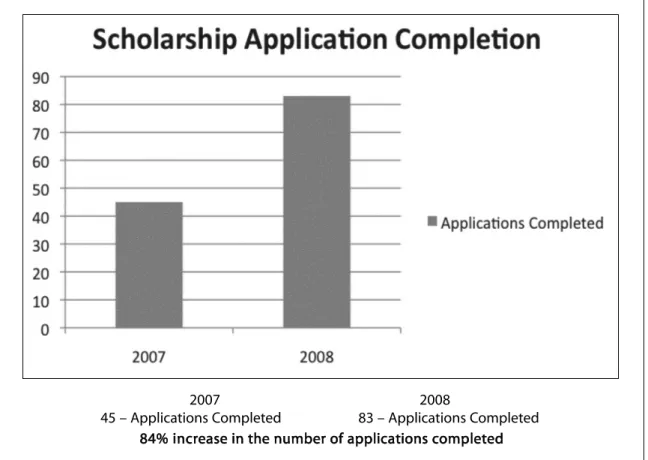
School counselor efforts to increase financial aid and scholarship applications led to a high level of completion and scholarship money for students. More than 100 students and parents attended the FAFSA seminar, where they completed the online application for financial aid. The number of atten-dees at this seminar rose by 81 percent compared to the average attendance rate of previous years (see Figure 2). Overall, approximately 100 FAFSA appli-cations were completed by low-income families. In addition, 83 students applied for a school board foundation scholarship; with 35 students receiving a scholarship, a success rate of 42 percent was
achieved. The number of completed school board foundation scholarship applications from this school increased 84 percent from the previous year (see Figure 3). Other scholarships received by students include six local community college endowment scholarships and 181 state supported merit scholar-ships. The 181 state scholarships included 64 awards that pay 100 percent of tuition toward a baccalaure-ate degree at a public institution, 115 awards that pay 75%, and two vocational awards that pay 75% of college tuition.
As a result of the collaborative efforts of the school counseling team, there was an increase in rig-orous course enrollment among the target group, increased attendance at the high school financial aid seminar, and an increase in the number of financial aid and scholarship applications completed and awards made.
DISCUSSION AND IMPLICATIONS
This study addressed barriers contributing to the achievement gap such as lack of access to higher ed-ucational opportunities, postsecondary knowledge, and economic support sometimes found in the low-er socioeconomic population. Many of the students who enroll in the free or reduced-price meal program are potential first-generation college candidates, and parents may not be knowledgeable of procedures,
Figure 2. Parent and student attendance at financial aid seminar by year. 2007 2008
57 – Number of Attendees 103 – Number of Attendees 8
guidelines, recommendations. and resources neces-sary to encourage and support their child to become a more competitive applicant for postsecondary edu-cation. Eighty percent of the seniors targeted for spe-cial assistance with finanspe-cial aid access and awareness were first-generation potential college attendees and resided in a single-parent household. By enabling and encouraging families to apply for government financial aid as well as locally funded scholarships through community outreach, school counselors are helping low-income students access the necessary funding for higher education, thus making it a real-ity for first-generation college students.
In examining our data, the authors noted that males were underrepresented in the group of low income students with qualifying test scores and GPAs who were targeted to enroll in a more rigor-ous academic program of studies as well as the tar-geted group of seniors who were deemed to be from low income families and potentially eligible for financial aid and scholarships. The findings reflect an international trend of males falling behind females in grades and postsecondary degree attainment (Clark et al., 2008). Lindsay and Muijs (2006) identified two approaches that are commonly used in schools to decrease the gender gap in achievement: (a) hav-ing high standards for everyone; and (b) targethav-ing specific groups, and these were supported in the
cur-rent findings. Educators interested in replicating these strategies could use diverse strategies for instruction and also use data to identify, monitor, and support underachievers. Counselors and parents need to be aware of these trends and develop strate-gies to encourage achievement and aspirations for enrollment in more rigorous curricula as well as for postsecondary education for capable but under-achieving male students.
A strong recommendation would be to work with eighth-grade students, parents, and counselors before students reach high school. In the current study, the school counselors were able to appropri-ately enroll students in rigorous courses as incoming freshmen, although they did identify additional upperclassmen who were also deemed eligible to take more challenging coursework. Because students are able to take high school level courses while they are in middle school, middle school counselors are also critical in encouraging students to take course-work that will prepare them for college. Partnerships between high school and middle school counselors strengthen the ability of counselors to identify and prepare high achieving students for postsecondary education. Early and ongoing outreach to parents regarding information on program offerings and educational and career opportunities for their chil-dren is essential.
Figure 3. School board foundation scholarship application completion by year. 2007 2008
45 – Applications Completed 83 – Applications Completed 8
The collaboration between the school and univer-sity in this study proved to be a strong support to the success of the data-driven interventions. For example, the district supervisor of guidance assisted counselors in examining and disaggregating student data through the use of available databases. Addi-tionally, the district supervisor, in guest presenta-tions in the university’s counselor education de-partment, demonstrated to counselor education stu-dents the disaggregation of student data and its use to identify student needs. Thus, graduate student interns enter local schools with the mindset and knowledge to assist school counselors in identifying needs and implementing appropriate interventions.
Counselor education professors offered group pre-sentations to school counselors on action research, accountability, culturally responsive counseling, and family school collaboration activities and worked with school counselors and interns to design their own action research projects and accountability sys-tems. Support between the university and the school system was evident throughout the process, and the end result was successful completion of a shared goal that provided opportunities for students to over-come barriers and enhance their academic, social, and career development. The results indicated that the interventions increased the numbers of targeted students enrolling in advanced coursework, creased GPAs for the majority of them, and in-creased the number of low-income students applying for and receiving financial aid for higher education.
CONCLUSION
The collaboration between the school system and the university helped the researchers become more focused and specific about using data, developing goals and corresponding interventions, and measur-ing results. Furthermore, bemeasur-ing able to talk to grad-uate students in counselor education as well as pro-fessional school counselors about how to carry out action research, has helped stimulate interest and understanding of the use of data and how it can directly impact student success and access to higher education. The positive results of this study have demonstrated to the researchers as well as the school-level and district administrators the value of the interventions used, and have provided a ration-ale for continuing and expanding these collaborative counseling initiatives in an effort to help all students be the best they can be. ■
References
Aluede, O., Imonikhe, J., & Afen-Akpaida, J. (2007). Towards a conceptual basis for understanding developmental guidance and counselling model.Education, 128,
189–201.
American School Counselor Association. (2005).The ASCA national model: A framework for school counseling programs (2nd ed.). Alexandria, VA: Author
Brown, D., & Trusty, J. (2005). School counselors, comprehensive school counseling programs, and academic
achievement: Are school counselors promising more than they can deliver? Professional School Counseling, 9,
1–8.
Campbell, C. A., & Dahir, C. A. (1997).Sharing the vision: The national standards for school counseling programs.
Alexandria, VA: American School Counselor Association. Clark, M. A., Lee, S., Goodman, W., & Yacco, S. (2008). Examining
male underachievement in public education: Action research at a district level.NASSP Bulletin, 92,111–132. College Board. (2008).Connecting counselors with the tools to
help students enroll and succeed in college.Washington, DC: National Office for School Counselor Advocacy. Retrieved December 5, 2008, from http://professionals. collegeboard.com/policy-advocacy/educators/nosca Daniels, H. D., & Goodman, W. (2007). Documenting counseling
services: Changing to evidence-based practices. In J. Wittmer & M. A. Clark (Eds.),Managing your school counseling program: K-12 developmental strategies(3rd ed., pp. 320–327). Minneapolis, MN: Educational Media Corporation.
Dimmitt, C. (2003). Transforming school counseling practice through collaboration and the use of data: A study of academic failure in high school.Professional School Counseling, 6, 340–350.
Education Trust. (2008).National Center for Transforming School Counseling.Retrieved December 5, 2008, from http:// www2.edtrust.org/EdTrust/Transforming+School+ Counseling/main
Felton, R. (2005). A new IDEA.Principal Leadership (Middle School Edition),5(7), 57–61.
Florida Department of Education. (2007).Florida counseling for future education handbook.Tallahassee, FL: Author. Gysbers, N. C., & Henderson, P. (2001). Comprehensive
guidance and counseling programs: A rich history and a bright future.Professional School Counseling, 4, 246–257. Gysbers, N. C., & Henderson, P. (2006).Developing and
managing your school guidance program(4th ed.). Alexandra, VA: American School Counselor Association. Holcomb-McCoy, C. (2007).School counseling to close the
achievement gap.Thousand Oaks, CA: Corwin Press. House, R. M., & Martin, P. J. (1998). Advocating for better futures
for all students: A new vision for school counselors.
Education, 119, 284–292.
Isaacs, M. L. (2003). Data-driven decision making: The engine of accountability.Professional School Counseling, 6,288–296. Lee, S. M., Daniels, M. H., Puig, A., Newgent, R. A., & Nam, S. K.
(2008). A data-based model to predict postsecondary educational attainment of low-socioeconomic-status students.Professional School Counseling, 11,306–316. Lindsay, G., & Muijs, D. (2006). Challenging underachievement
in boys.Educational Research, 48,313–332.
Loesch, L. C., & Ritchie, M. H. (2005).The accountable school counselor.Austin, TX: ProEd.
MacAllum, K., Glover, D. M., Queen, B., & Riggs, A. (2007, December).Deciding on postsecondary education: Final report.Retrieved December 5, 2008, from
http://nces.ed.gov/pubs2008/2008850.pdf Myrick, R. D. (2003a). Accountability: Counselors count.
Professional School Counseling, 6,174–180.
Myrick, R. D. (2003b).Developmental guidance and counseling: A practical approach (3rd ed.). Minneapolis, MN:
National Center for Educational Statistics. (2006).The condition of education.Retrieved December 5, 2008, from http://nces.ed.gov/pubsearch/pubsinfo.asp?pubid= 2006071
Perna, L. W., Rowan-Kenyon, H., Bell, A., Thomas, S. L., & Chunyan, L. (2008). A typology of federal and state programs designed to promote college enrollment.
Journal of Higher Education, 79, 243–267.
Perna, L., Rowan-Kenyon, H., Thomas, S., Bell, A., Anderson, R., & Li, C. (2008). The role of college counseling in shaping college opportunity: Variations across high schools.
Review of Higher Education, 31,131–159.
Poynton, T. A., Schumacher, R. A., & Wilczenski, F. L. (2008). School counselors’ attitudes regarding statewide comprehensive developmental guidance model implementation.Professional School Counseling, 11,
417–422.
Progress of Education Reform. (2008).Counseling high school students for postsecondary and workplace success.
Retrieved June 12, 2009, from http://www.ecs.org/html/ educationIssues/ProgressofReform.asp
Stone, C. B., & Dahir, C. A. (2004). School counselor accountability: A MEASURE of student success.Upper Saddle River, NJ: Pearson Education.
U.S. Department of Education. (2001).No Child Left Behind Act
(H.R. 1). Retrieved December 5, 2008, from http://www. ed.gov/policy/elsec/guid/secletter/070423.html U.S. Department of Education. (2004).Individuals with
Disabilities Act,20 U.S.C. § 1400 et seq. Retrieved April 21, 2009, from http://idea.ed.gov
White, F. A. (2007). The professional school counselor’s challenge: Accountability.Journal of Professional Counseling: Practice, Theory & Research, 35, 62–70. Yell, M. L., Katsiyannas, A., & Shiner, J. G. (2006). The No Child
Left Behind Act, adequate yearly progress, and students with disabilities.Teaching Exceptional Children, 38(4), 32–39.