Fighting Parasite Hosting: Identifying and Mitigating
Unauthorized Ads on Your Webserver
Shuang Hao, Adam Arrowood, Xinyu Xing, Nick Feamster
Georgia Institute of TechnologyABSTRACT
Parasite hosting is an emerging search poisoning attack that compromises Web servers and inserts links that redirects users to scam Web pages that sell products or attempt to victim-ize users. One of the most significant challenges for Web site operators is that compromised sites are extremely diffi-cult to detect: Attackers adapt techniques such as code ob-fuscation and cloaking that make it difficult to detect com-promise. Of course, because the scam content must even-tually be displayed to users to enable attackers to mount their attacks, it is detectable in theory, but devising the ap-propriate mechanisms to reveal these activities is difficult in practice. We present a system that automatically detects when Web pages have been compromised for the purposes of parasite hosting; the system relies on periodic crawling of groups of Web pages that correspond to various keyword searches in search engines. In this paper, we describe the de-tection system, explain how it can automatically locate the compromised Web servers being used for parasite hosting, and present our findings regarding the prevalence of parasite hosting on the Internet today. We find that around1,000 URLs newly indexed by search engines per day are under parasite hosting attack. The query terms explored by our system would have similar detection power compared with manually picked queries. We also identify that the major tar-get of the compromise lies in the blog and wiki applications on the Web servers.
1.
Introduction
Internet users fundamentally rely on search engines to dis-cover content on the Web; accordingly, Web site authors and administrators go to great lengths to improve the rankings of their pages by modifying the page structure and content, through a process called search engine optimization (SEO). While many aspects of SEO are considered good Web de-sign, miscreants are now exploiting the ranking functions of search engines as a vehicle for new families of attacks. One such family of attacks is calledsearch poisoning, whereby an attacker modifies a Web site to falsely increase the rank for another site.
A new type of search poisoning involves attaching spam to sites hosted on reputable domains. A typical attack scenario works as shown in Figure 1: the attackers first identify high-visibility Web sites that have vulnerabilities and compromise the servers to gain access to create or change pages. The
Regular user visit
Search engine crawler
Click on search results
Hacked page (benign display)
Illicit site
Figure 1: Attack scenario of parasite hosting.
hacked page iscloakedto display different contents to dif-ferent visitors. The normal content is showed to the regular visitors (as the solid line). The spam-advertised terms (like “viagra”) andredirectare triggered to search engine crawlers and clicks from search results (following dashed lines). The spam content is only visible to the people who search for the illicit products, which makes it difficult for administra-tors to notice that their site is compromised. The search intention of the buyers also results in a higher conversion rate [6]. More strawman attacks include posting spam links in blogs, or redirecting to spam sites regardless of the visitor types. We define these attacks asparasite hosting: Attack-ers compromise benign Web site or abuse the Web services to host spam-advertised pages. The attack allows spammers to use a site’s established search rankings for the domain name and incoming links to promote malicious sites. Para-site hosting increases search engine traffic; people searching for illicit products would follow the poisoned results to make purchases. The affected sites suffer from risks of being re-ducing their ranking by search engines or giving the public a bad impression due to the spam content. The exploited vul-nerability could be further used to launch other attacks, e.g. theft of private information.
In this paper, we present a detection system to capture spam-related search terms, crawl the suspect URLs, and iden-tify parasite hosting on the concerned sites. We present the following contributions beyond previous related work:
We build a service to inspect the integrity of each indi-vidual sites or domains. The parasite hosting adopts vari-ous ways to keep undetected from the server administrators. For example, attackers use code obfuscation to avoid disk scan [2]. Cloaking and redirection are prevalent methods to escape from the notice of the Web master [6, 10]. But
spam-mers seek to get high visibility in the search results to sell their products, therefore the tampered spam content is not disguised to the search engines and the users looking for the illicit products. Search engines (e.g., Google, Bing, Yahoo!) become a vantage point to detect tainted Web pages. We set up a Google search on concerned domains to find new search results, which makes the newly created suspect pages get in-spected nearly in real time after being indexed by search en-gines. The focus is not to find arbitrary malicious pages on the Internet, but to protect specified domains from parasite hosting attacks.
The spam-advertised terms are dynamically updated. The key challenge is to know the appropriate terms to query for the suspicious URLs. Not only querying could reduce the number of target pages for crawling, but also sophisticated parasite hosting pages only respond spam content to requests with certain search engine redirect, i.e., the value in param-eter “q=” is set to match the spammers’ term list. Most pre-vious research uses either random hot keywords (e.g., words listed in Google trends) [7] or a fixed set of pharmaceutical terms [6]. Instead, we find and track what Web spammers are actively advertising right now. The products that they hope to sell on the spam pages constitute “target term”. The assumption is that the benign Web sites would rarely have the spam words, and searching for “target term” returns the list of suspicious URLs on the concerned domain. In addi-tion, we define a set of “coexistentn-gram”: the auxiliary phrases to help advertise the products or draw users’ atten-tion, e.g., “satisfaction guaranteed”, “per pill”, “low price” etc. Querying “coexistentn-gram” assists to discover new “target term”. After crawling the URLs and verifying the spam pages, we prune the candidate term pool to eliminate the bogus terms.
We investigate the vulnerability to cause the site to be tainted. The URL crawler we built identifies what service softwares and their versions are installed on the Web servers. That would give people insight what vulnerability the attack-ers are going after. To the best of our knowledge, we are the first to do large-scale investigation about site platform re-lated with parasite hosting attacks.
It is already found that.edudomains are the major tar-gets of Web spammers [6]. We use the sites in.edu do-mains to evaluate the effectiveness of our prototype system.
During our study, we find that:
• The querying terms explored from the known scam pages allow to detect more parasite hosting attacks. The terms with wider conception, e.g., “buy” and “price” yield more scam pages, but our method could also iden-tify specific products, like “levitra”, “samsung” and “louisvuitton” etc.
• Our system detect around1,000parasite hosting URLs distributed over 100 domains on average every day. The fact indicates the attack becomes a more severe problem, and our system is effective to make detection in near real-time.
• We observe that the compromise is correlated with the
applications installed on the Web servers rather than the underlying operating systems or upper libraries. The major target of the attackers is blog or wiki ap-plications.
The rest of this paper is organized as follows. Section 2 surveys the related work. Section 3 describes the system architecture that we design for crawling suspect URLs. Sec-tion 4 studies the characteristics of the poisoned sites and spam pages. Section 5 shows detection performance and analysis, and Section 6 concludes.
2.
Related Work
Many approaches have been proposed to detect search poi-soning attacks. They are mainly based on lexical analysis on the page content [8, 9], or the hyper-link structure from sites to sites [3, 13]. It is common that attackers use tech-niques of cloaking and redirection to keep the spam pages hard to detect [1,12]. Luet al.recently proposed to combine the redirection characteristics to detect clicking on poisoned search results. Those methods are effective to detect indi-vidual search poisoning case, but they could not be directly applied to monitor and find all Web spam for a domain or or-ganization. On the other hand, our system dedicates to pro-tect the sites’ integrity under individual domains, and adopt the previously proposed features.
There is recent research studying the search poisoning at-tacks, especially focusing on the cases with compromised servers. deSEO [5] tried to use similar format in URLs to identify sites infected by the same search poisoning cam-paign. The difference is that we crawl and investigate the suspect pages from the end users’ perspective, rather than grouping the URLs from the search engines’ perspective. The practical scan could obtain more accurate evidence for spam detection. Leontiadiset al. did a measurement on the search poisoning particularly on the online pharmacies [6], with similar crawling methods we used in this paper. But our intention is to design a service that operators could subscribe to check whether their sites have been exploited for search poisoning. Moreover, we propose a framework to automat-ically extract current spam-related terms, instead of using a fixed set of search terms or random popular key words.
In a concurrent and independent work, Invernizzi et al. presented EVILSEED [4]. EVILSEED starts from an initial set of known, malicious web pages, and generates search en-gines queries to identify other similar pages. If the quality of the extracted words is not carefully evaluated and updated in time, it still ends up crawling many pages to get the ma-licious ones. In comparison, our approach keeps different categories of querying terms to generate, and eliminate the bogus terms, which would keep the term pool smaller and more efficient to find malicious pages In addition, we devote to build a near real-time service to protect concerned sites, and present the design of the crawlers to retrieve richer in-formation and stay unnoticed by the attackers.
The general idea is to make use the search engines to find out whether there are suspicious pages on the sites for adver-tising illicit product. At first it sounds straightforward to sub-mit the search query and crawl the URL for detection. But it becomes a challenging task with consideration of choosing the appropriate key words, retrieving URLs from the search results in time, and making the crawl scalable and anony-mous. In this section, we illustrate system design of different components and address the challenges.
3.1
Overview of System Design
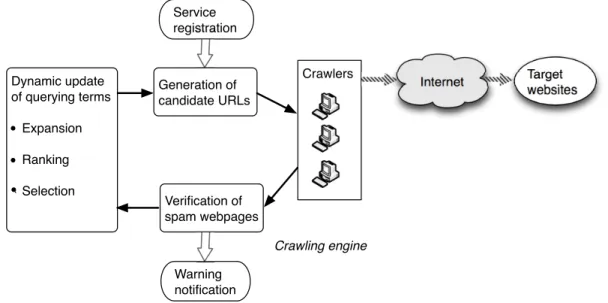
Figure 2 shows the architecture of the detection system. The arrows indicate the work flow.
• Service registration & warning notification: To provide a detection service, the system allows Web masters to sign up and get notification if parasite hosting is de-tected on their sites.
• Dynamic update of the search terms: We choose what words to query on the search engines in order to locate the suspect URLs. The purpose is to find out the illicit products that the spammers are advertising. The new terms are explored after more parasite hosting pages are detected. The dynamic update on the queries leads to pages more likely getting involved in parasite host-ing. (Section 3.2)
• Generation of candidate URLs: The selected terms are queried on search engines to obtain suspect URLs. The queries are performed periodically and specified to get the latest indexed pages, which allows the system to detect the attacks nearly in real time. (Section 3.3)
• Crawling for the URLs: The crawler is set to probe the URLs as various roles, including regular user, the search engine crawler and click from search results. We further retrieve the search engine cache of the URL, and collect the system platform information on the servers. (Section 3.4)
• Verification of site compromise and spam pages: Based on the gathered information, we examine whether the URL leads to parasite hosting, e.g., cloaking, redirec-tion.(Section 4)
In the rest of the section, we present the design details of each component respectively.
3.2
Dynamic Update of Search Terms
The quality of the search terms greatly affects the detec-tion performance of the system. Our goal is to identify the terms that return parasite hosting URLs with higher proba-bility from the search results, and eliminate those pointing to many benign pages. We define two categories of terms: “target term” are single words that indicate what illicit prod-ucts the attackers are advertising through parasite hosting, such as “viagra”, “rolex” etc; “coexistentn-gram” are multi-words that occurring frequently on the spam pages, e.g. “low
price”, “free shipping” to draw visitors’ attention or for de-scriptive purpose. The candidate terms are updated at the end of each epoch (we set as one-day period) after a batch of new parasite hosting pages are collected and identified. The term update goes through three steps,expansionfor new terms,rankingof existing terms, andselectionof terms for next epoch.
Expansion for new terms: The purpose is to find out new terms that are highly related with parasite hosting pages, and use them as queries to search engines to discover new at-tack campaigns. We modify information techniques, called Query by Document[14], to extract key phrases from the identified spam pages. Given a piece of spam content, (1) we extract a set of terms for consideration; (2) we evaluate the importance of the candidate terms to represent the spam content.
With the help of apart-of-speech tagger(POST), we first determine the word part-of-speech (e.g., noun, verb, adjec-tive, etc) in the sentences. For example, given a sentence “Buying viagra at extra low prices”, term “Buying” is clas-sified as a verb, “viagra” as a noun and so on. We extract all single noun words as candidates of “target term”. If we use “N”, “V”, “P” and “J” to present noun, verb, preposition and adjective respectively. The example sentence would have POST tags “VNPJJN”. Among them, the noun phrases is a sequence of part-of-speech tags match a noun phrase pat-tern (NPP). Example noun phrase patpat-tern we use are “JN”, “NN”, “NNN”, “JJN” etc. “viagra” and “extra low prices” would be noun phrases in the example sentence. We con-sider all noun phrases as candidates of “coexistentn-gram”, and limit the number of words less than four.
To score how likely a “target term” is representative for the given parasite hosting page, We usetf /idf based function, wheretf is term frequency in the spam page andidf is in-verse document frequency in a background corpus. We take the past6-day collected pages as the background corpusD
to calculateidf. For a termwshowing in a spam document
d,tf(w, d)is the occurrence ofwinddivided by total word number ind, and thetf /idfscoref(w, d)is calculated as:
idf(w) = log |D|
|{u∈D:w∈u}|
f(w, d) = tf(w, d)×idf(w)
where|D|is total number of pages in the corpus and|{u∈
D :w∈u}|is the number of pages wherewappears. The scoref(w)is the maximum value over all spam pagesd de-tected in the epoch.
The extraction of “coexistentn-gram” is based on the point-wise mutual information (PMI) to discover multi-words that appear together not due to coincidence. Suppose a phrasec
consisting ofw1, w2, . . . , w|c|, the higher the mutual
infor-mation among the terms, the higher are the chances of the terms appearing frequently together to form a phrase. Since PMI calculation requires probability ofc andwi (prob(c),
prob(wi)) over the background corpus which is extremely
Internet Crawlers Dynamic update of querying terms Expansion Ranking Selection Generation of candidate URLs Verification of spam webpages Target websites Warning notification Crawling engine Service registration
Figure 2: Framework of the detection system.
only. prob(c) = tf(c, d) tf(P OSc, d) ,andprob(wi) = tf(wi, d) tf(P OSwi, d)
wheretf(P OS, d)is the frequency of the part-of-speech tagger in the document content.
TheP M Iscore for a phrasecis
f(c, d) = P M I(c) = Q|cprob| (c) i=1prob(wi) = tf(c,d) tf(P OSc,d) Q|c| i=1 tf(wi,d) tf(P OSwi,d)
Similar to “target term”, the “coexistent n-gram” score
f(c)is the maximum value over all spam pagesddetected in the epoch. The higher the score, the more likely the candi-date term are considered to appear in parasite hosting pages and correlated with illicit products.
Ranking of existing terms: After crawling and analyzing the URLs returned by querying a term, we evaluate the term capability of exposing Web spam. If searching a term gives many URLs leading to parasite hosting, we keep querying the term and crawl the retrieved URLs. On the other hand, if a term returns very low percentage of spam pages, we think the term has bad quality for detecting spam pages and drop it in the selection phase. The ranking criteria is the por-tion of spam URLs in a time window (multiple past epochs) adjusted with Dirichlet smoothing, which favors more for terms getting many URLs. The smoothing factorαT is
cal-culated as the5-percentile of the URL numbers returned by the terms in the time windowT (we set T as a 6-day pe-riod). Suppose a termm is active for querying during the periodD ⊂T , and it gets URL setQm,tshowed in search
engines in epocht ∈ D, among which URL set Pm,t are
involved in parasite hosting. The ranking score¯r(m)is ¯ r(m) = P t∈Dr(m, t) |D| ,wherer(m, t) = |Pm,t| |Qm,t|+αT
Another concern is to avoid querying terms yielding to the same attack campaign, e.g. querying“viagra” and “silde-nafil” would give back similar set of URLs. We use a greedy algorithm to prioritize terms getting different spam URLs from others. The ranking is a iterative process. At each step, the term with the largestr¯(m)score is picked to output and removed from the pool. In the next iteration, the rest of the terms will get ranked again, but their spam URL sets do not count the URLs that have been shown in the search results from the output terms. The output sequence forms the rank of the queried terms to evaluate their performance to find parasite hosting attacks.
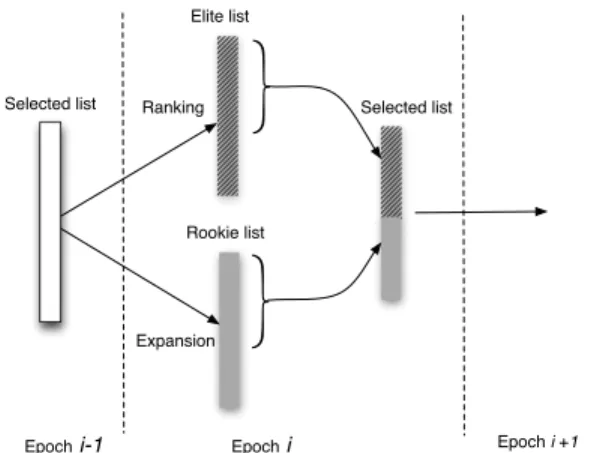
Selection of terms for the new epoch: Therankingphase evaluates the efficiency of terms which have been queried and their returned URLs are crawled. Theexpansionphase provides the list of potential terms which are expected to find parasite poisoning pages with high probability. The purpose of theselection phase is to combine the two lists and de-termine the query terms for the new epoch, as in Figure 3. According to from which list the term is selected, the term has two states. If the term comes from the list of ranking phase, we call itelite, which means the term has been tested with good performance. If the term is picked from the list of expansionphase, the state isrookie, which means the term needs exploration. If a term shows inrookiestate repeatedly, that indicates although the term is estimated to work well, it does not indeed. We then do not select it for queryig in the next epoch. We keep arookie-timer and arookie-counter to track the term’s status. The timer records the passed epochs from the last time it is selected, and the counter keeps the occurances of staterookiefrom the lastelitestate. We force a rookie-state term to wait at least exponetial of
rookie-Epochi-1 Epoch i +1 Expansion Ranking Elite list Rookie list Selected list Selected list Epochi
Figure 3: Diagram of term selection process.
counter epochs before gettig picked again. The selection process is shown in Algorithm 1. LE,LRandLS are the
term lists fromexpansion,rankingandselectionphases re-spectively.KEandKRindidate at most how many terms we
set foreliteandrookiestates.Nis the counter to record how many time the term has been selected as inrookiestates. It is reset to0once the term gets inelitestate. M is the timer to track how many epochs the term has not been selected for querying. The timer is set to0after the term is selected in an epoch. Lines 2-8 demonstrate the process of selecting elite-state terms; Lines 9-17 show the alogorithm to pick rookie-state terms. Especially, line 10 indicates that arookie-state termtneeds to wait2N(t)−1epochs to get selected inrookie
state again. Since the purpose and effect of “target term” and “coexistentn-gram” are different, we perform the selection for the two types of terms seperately.
Algorithm 1Algorithm for term selection Input: elite listLE, rookie listLR;KEandKR
1: InitializeLS to empty. Set counterCE= 0,CR= 0 2: foreacht∈LEdo
3: AddttoLS andCE =CE+ 1
4: N(t) = 0
5: ifCE≥KEthen
6: break the for loop
7: end if 8: end for 9: foreacht∈LRdo 10: if2N(t)−1> M(t)then 11: AddttoLS 12: N(t) =N(t) + 1 13: end if 14: ifCR≥KRthen
15: break the for loop
16: end if 17: end for
18: UpdateM(x):
19: ∀x∈LS, M(x) = 0
20: ∀x /∈LS, M(x) =M(x) + 1
Output: selection listLS
3.3
Collection of Suspect URLs
The queries to collect the candidate URLs are composed by the selected terms and the concerned sites. The selected terms are dynamically updated at each epoch as we demon-strat above. The concerned sites are specified in the ser-vice registration process, during which Web masters need to prove that they own the websites. For example, if do-mainxyz.eduis under monitoring, and the termviagra is considered as suspect, the query submitted to Google is “viagra site:xyz.edu”. We evaluate the performance of our detection system on.edu domains, since previous studies have shown that sites in educational institutes are ma-jor victim of parasite hosting attacks [6]. In each epoch, we search for URLs multiple times and request the results sorted in dates. Therefore, once a page gets indexed by the search engine, we would collect the URL in a real-time mode. In the experiment, we set up to search the term list twice each day, specify the search time range as24hours and limit the result number as100.
3.4
Dispatch of URL Crawling
Our scanning of candidate URLs consisted of six types of automated Web requests, proxied via Tor or VPN: Regu-lar crawl, Google cache crawl, Googlebot User Agent based crawl, Google Referer (curl-based) crawl, and Google Ref-erer (browser-based) crawl, application fingerprint.
Regular crawl(Type 1): Each URL is crawled using the curl command line and the contents returned by the crawl, including the HTTP headers returned by the server, were stored for later analysis. A random HTTP User Agent was used for each request, taken from a pool of over2,000HTTP User Agents acquired from the Web logs of a large campus. This crawl served as a base-line to compare with the other types of requests and it is assumed that the content retrieved is the content displayed to all ”normal” Web browsers visit-ing the URL.
Google cache crawl(Type 2) : The contents of the URL as cached by Google is requested and stored. The fetched cache page allows us to understand what page content Google search engine gets from the URL. Since we are retrieving candidate URLs from Google daily, the ages of the cached pages aver-aged from a day to only a few days old; thus are very likely to represent the content that the Web server would return to Google (and possibly other Web crawlers) and could be compared with other scans of the same URL with little risk of page being changed in the actual document. There are a small percentage of pages for which there is no Google cache or that we were unable to retrieve successfully from Google.
Googlebot User Agent based crawl(Type 3): Each URL was crawled using curl with an HTTP User Agent matching that of Google webcrawlers:
Mozilla/5.0 (compatible; Googlebot/2.1; +http://www.google.com/bot.html)
If the website we crawl does not perform IP-based filter-ing, the request would be accounted for scans from Google
bot, and the page will serve the content designed for search engine. Given that not all candidate URLs were available from Google’s cache, this scan was done to try and trigger cloaks that activate based on HTTP User Agent.
Google Referrer (curl-based) crawl(Type 4): Each URL was crawled with the HTTP User Agent of that of Mac Sa-fari and an HTTP Referrer matching that of a Web search conducted via a Google search for a specific term. For ex-ample, for the candidate term ”viagra” a curl request with HTTP Referrer of
http://www.google.com/search? client=safari&rls=en&q=viagra
was used. This referrer matches the basic syntax of the HTTP Referrer sent when a browser visits a URL via a Google search result. This request was used to try and trigger an HTTP redirect to spam target website. Such redirects are only returned to Web clients who come to a URL from a Web search for a specific term or terms.
Google Referrer (browser-based) crawl(Type 5) : Each URL was crawled using a popular Web browser, scripted in such a way as appearing to come from a Google search for a specific term. The requests were relayed through a Web proxy and the logs resulting from each request were stored for later analysis. This type of scan was necessary to catch HTTP referrer-based redirection conducted via JavaScript (or other rich-media browser technologies, such as Flash). Due to the prevalence of code obfuscation, redirection code that requires client-side execution is very difficult to detect via command-line (curl) scanning of candidate URLs. But the downside of browser-based crawl is that the page content is not stored for analysis.
Application fingerprint(Type 6) : Except for the page content of the URL, we hope to collect the information about the server hosting the page. We use a scanner, WhatWeb [11], to examine what system, Web servers, libraries installed on the server side. For example, using WhatWeb on our de-partment website shows that the we server is Apache 2.2.21 and PHP 5.3.10 is installed.
The summary of different crawls is shown in Table 1. It lists whether the crawl type has been used in previous re-search, and what is the purpose of each crawl. Every suspect URL goes through the six scans to get a collection of snap-shots, which provides the page content presented to different visitors: regular user such as typing the URL directly into a browser, requests from search engine crawlers (Googlebot), and clicks on the search result pages. We discuss how to use the different crawls to in Section 4.
4.
Verification of Spam Pages
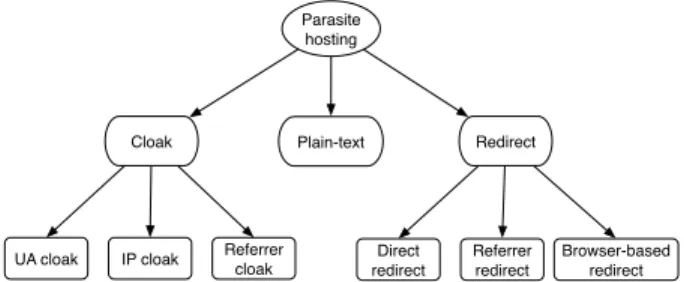
The types of parasite hosting attacks could be categorized as three groups: cloak, redirect and plain-text (as in Fig-ure 4). We will show the details of each type and address the methods to detect them.
4.1
Cloak
Cloak is the technique to display different page content
Parasite hosting
Redirect Cloak Plain-text
UA cloak IP cloak Referrer cloak Direct redirect Referrer redirect Browser-based redirect
Figure 4: Different attacks in parasite hosting.
based on the visitor types. It allows the parasite hosting stay undetected for a longer period, and promote the rank of spam pages in the search engines. The heuristic for identifying cloak is to compare the pages returned from different crawls. If the titles are different, and the pages have different links which lead to out of current domains or contain the search term in it, the URL is considered as a cloaked page. Given that the crawls for a URL happens almost simultaneously and the candidate URL gets indexed by search engines after a short period (less than24hours), the detection method is accurate to identify live cloak pages.
UA cloakuses the User Agent field from the HTTP re-quest headers to distinguish HTTP clients as user browser or search engine crawlers. The UA cloak intend to hide the malicious content to users who directly type URL in the browsers to visit the site, but make the spam-advertised terms crawled and indexed by Google. We compare the re-turned pages fromType 1andType 3to detect UA cloak.
IP cloak is to use the IP address of the request to de-cide what content is shown to the visitors. The scammers maintain a list of IP addresses from the search engines, and the cloak is only triggered by the requests from the IP lists. The purpose is to restrict the cloaked content just visible to the search engines. A request from a non-Google IP (even with User Agent set as search engine crawlers) would not be served with the same content as Google crawler received. In order to observe what the page content Google accesses to, we performType 2crawl to retrieve Google cache, and take the difference fromType 1crawl.
Referrer cloakchecks the “Referrer” field in the HTTP headers to determine which URL the request clicks through to visit the current page. The scammer could know whether a visitor comes from clicking the search results from the search engines, and what query the visitor is submitted. It allows the scammer to control which group of end users to see the cloak content. For example, a compromised page for drug selling could show pharmacy links to the visitors click-ing through Google results on searchclick-ing for “viagra”, but serve normal content to visitors search for non-drug terms (which is related to the benign content). The page differ-ence betweenType 1andType 4crawl results help to identify whether there is referrer cloak on a URL.
The different types of cloaks could happen together. For example, an URL has both UA cloak and referrer cloak to show illicit product selling, which indicates the scammer hopes the search engines to get the page indexed on the
Crawl type Has been used in previous research?
Visit effect
1 Regular Yes From normal end users
2 Google cache No From Googlebot IPs
3 Googlebot User Agent Yes From Googlebot (but different IPs than Google)
4 Google Referrer (curl-based) Yes From clicking Google search results
5 Google Referrer (browser-based) No From clicking Google search results (allowing in-browser script execution)
6 Application fingerprint No To identify OS and application information on the server
Table 1: Summary of crawls in our system.
spam-advertised terms, and only serve the scam content to the users searching for them. We also observer parasite-hosting case with UA or IP cloak but not referrer cloak. The scammers trick search engines to promote the sites linked from the scam page, but do not want the visitors from click-ing the search results to see the spam content. The strategy does not directly give attackers benefits, but it will promote the spam site in the search results, and keep the compromise unnoticed unless the Web masters crawl their own pages with the User Agent set as Google crawlers as mentioned above.
4.2
Redirect
URL redirection makes a browser to open a different URL usually without the users’ notice. The benign usages include moving a site to a different place, or short aliases for long URLs. In parasite hosting attacks, redirect is abused to send users to the illicit websites from the original page. In order to check redirect, we examine whether there are multiple hops during the connection, and whether the HTTP is redirected a website different from the original domain.
Direct redirectintends to redirect the request to a different URL regardless of the visitor type. Upon receiving a connec-tion attempt, the server sends an HTTP redirect with status code30x. The browser could follow the “Location” field in the response to open the new URL. OurType 1crawl cap-tures the HTTP30xstatus code. If the second-level domain in the new URL is not the same as in the original request, we mark it as direct redirect.
Referrer redirectmeans the redirect only happens if the “Referrer” field in the HTTP headers matches the attacker’s expectation. As mentioned before, the “Referrer” field in-dicates from clicking which page the request comes from. Attacker use referrer direct mostly to get users clicking on search engine results to the illicit pages. Comparison on Type 1andType 4crawls provides an effective way to iden-tify referrer redirect. IfType 1just has one hop with HTTP 200status code, andType 4get30xcodes to external web-sites, the URL is labelled as referrer redirect.
Browser-based redirecta type of HTTP Referrer redirec-tor having the additional requirement: a Web client under-standing and interpreting JavaScript or HTML Frames is used to retrieve the target website or content. The redirection is done via script execution in the client Web browser and not via a301or302HTTP redirect. Command-line Web clients, such as wget or curl, will not retrieve the content,
since they will get a200status code and could not interpret the codes to execute. Type 5crawl launches a real browser (Safari in our system) to visit the URL. Later we could re-trieve the request information from the proxy logs. If the HTTP response is code200and there exist requests leading to out-of-domain URLs, we consider a browser-based redi-rect happening.
4.3
Plain-text spam
We define plain-text spam as the pages stuffed with links pointing to illicit sites, but there is no cloak or redirect iden-tified. Most of plain-text spam occur due to blog or wiki which accepts anonymous comments or posts. The basic idea of checking plain-text spam is to examine whether the querying terms show in the title, links or body in Type 1 crawl. Our system does not focus on detecting plain-text Web spam, since that is straightforward to find abnormal content on the page by the Web master. We exclude the analysis, but our system retains the potential to find plain-text Web spam.
5.
Evaluation and Analysis
We implement a prototype of our detection system, and evaluate its performance over the.edudomains. Suppose the term “viagra” is a candidate term, the query we submit Google search to collect the URLs is in the format “viagra site:edu. We started the system with58terms manually identified from known spam pages. The system ran with dy-namic term update from April 8th 2012 to April 14th 2012. The term list gets updated once a day. We use150“target term” and150“coexistentn-gram”. The numbers ofeliteto rookieterms for “target term” are100to50; while the num-bers for “coexistentn-gram” are50to100. The heuristic is that we hope to keep the “target term” more stable, and ex-plore more on “coexistentn-gram”. In total, we query up to 300terms each day.
The system detected6,489parasite hosting URLs across 480domains. We define taint rate as the number of URLs found in parasite hosting divided by the number of URLs we need to crawl. Table 2(a) shows the taint rates for different attack types obtained from the detection system. Table 2(b) shows the number and the percentage of the pages discov-ered by the new terms (i.e. not the58terms we used to boost the system). We could see even only considering the auto-matically added terms, the system still achieve high taint rate for finding parasite hosting attacks.
(a) URLs from all terms (38,837in total)
Attack type Malicious URLs Taint rate
UA cloak 3,249 8.36% IP cloak 2,899 7.46% Referrer cloak 1,391 3.58% All cloak 5,004 12.88% Direct redirect 1,951 5.02% Referrer redirect 2,496 6.42% All redirect 3,660 9.42%
All parasite hosting 7,121 18.33% (b) URLs from new terms (34,243in total)
Attack type Malicious URLs Taint rate
UA cloak 1,449 4.23% IP cloak 669 1.95% Referrer cloak 1,369 4.00% All cloak 2,481 7.24% Direct redirect 606 1.77% Referrer redirect 566 1.65% All redirect 1,107 3.23%
All parasite hosting 3,502 10.22%
Table 2: Taint rate of crawled URLs.
Rank Target term Taint # Coexistentn-gram Taint #
1 buy 349 mac os 58
2 levitra 321 online store 46
3 generic 281 best buy 39
4 uk 210 full version 31
5 und 202 buy online 30
6 true 167 free online 27
7 der 161 past recipients 26
8 download 128 best online 17
9 pwcs 122 price canada 17
10 price 111 pharmacy online 13
Table 3: Top10new terms getting most scam pages .
Table 3 demonstrates the top10“target term” and “coexis-tentn-gram” found by the system with respect to the number of total parasite hosting identified. Some terms might not look obvious to human, but they are effective to find spam webpages. For example, “und” and “der” are Germany, and they would lead to spam pages in German. It is observed that words containing wider conception would provide more pages related to parasite hosting as shown in Table 3. Our system also identify more concrete terms, like “sunglasses” and “cigarettes”, to specific products, e.g., “levitra”, “sam-sung”, “louisvuitton”.
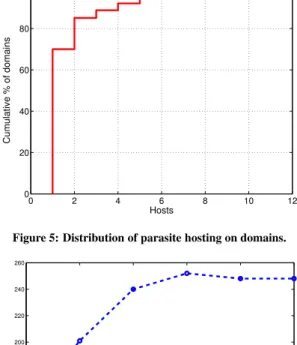
Next we measure the rate parasite hosting attacks across servers and domains. Figure 5 shows the distribution of hosts involved in parasite hosting per domain. The x-axis is the number of taint servers, and y-axis indicates what per-centage of domains have less than or equal to that number of servers involved in parasite hosting. We observe that most the victim domains have one or two web servers suffered from the attacks, and the largest compromise instances are around10(with one exception of78taint servers on a single domain). But given that we detect the compromise or spam-ming activity at current, it is still surprising to observe many domains get at least one hosts exploited within a week.
0 2 4 6 8 10 12 0 20 40 60 80 100 Hosts Cumulative % of domains
Figure 5: Distribution of parasite hosting on domains.
1 2 3 4 5 6 100 120 140 160 180 200 220 240 260 Day Count taint domains taint hosts
Figure 6: Daily counts of parasite hosting on domains & hosts.
Figure 6 demonstrate how many domains and servers hav-ing been identified with parasite hosthav-ing every day. The x-axis is the day count, and y-x-axis shows the numbers of the taint domains and hosts identified on that day. On average, 233Web servers in155domains with new pages indexed by search engines are under parasite hosting attacks. The huge number is mainly because attackers use cloak and redirect techniques to keep the compromise and the scam pages un-noticed from the Web masters and the regular visitors. Our system provides an automatic tool to quickly and automat-ically detect the new scam pages created by attackers. The plot also shows our system increased the detection instances during the expansion period, and reach steady detection rate over time.
At last we investigate what kind of Web servers are more likely to get parasite hosting attack. From bottom to the top, the Web server infrastructure include, operating system (e.g., Linux, Windows), Web server (e.g., Apache, IIS, Nginx, Lighttpd), Web programming language (e.g., PHP, Python, Perl), Web application (e.g., WordPress, Drupal, Joomla) and modules or libraries (JQuery, Prototyp, MooTools). Based on the system information collected fromType 6crawl, the lower layer has very small diversity. The Web server is dominated by Apache, followed by Microsoft IIS; while the upper level, modules or libraries, has big variation across
0 2 4 6 8 10 12 14 16 18 20 Apache versions 2.0.472.0.502.0.522.0.632.2.02.2.22.2.32.2.62.2.82.2.92.2.102.2.112.2.122.2.142.2.152.2.162.2.172.2.202.2.212.2.22
Percentage of taint servers (%)
Figure 7: Apache versions on tainted servers. Application Taint # Percentage in tainted hosts
1 WordPress 87 28.25% 2 Joomla 35 11.36% 3 phpBB 23 7.47% 4 MediaWiki 14 4.55% 5 Drupal 13 4.22% 6 Plone 9 2.92% 7 vBulletin 7 2.27%
Table 4: Top applications installed on tainted servers.
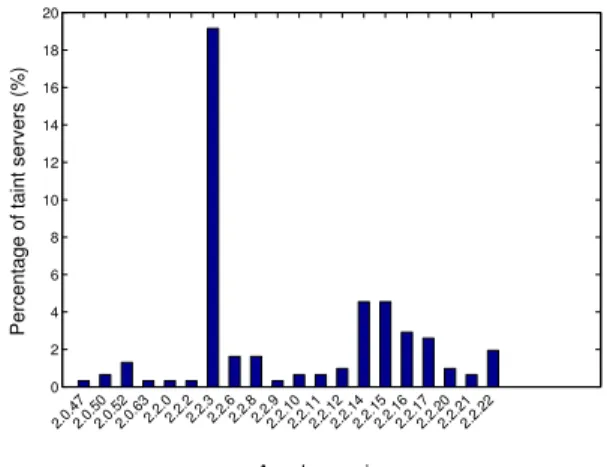
servers. Recarding to the HTTP servers, we investigate the versions of Apache servers. Figure 7 shows the percent-ages of the versions in the tainted servers. The x-axis is the sorted version numbers, and y-axis indicates the percentage accounting to all the tainted servers. It is noticed that version 2.2.3is prevalent under attack, and Web masters are encour-aged to upgrade Apache to higher versions.
Given that applications are quite diverse, we focus on analysing the different applications rather than the versions. Table 4 shows the top applications we identified on servers related with parasite hosting. The second column displays the ap-plication names. The third column is the percentage of the tainted servers with that application installed. Blog and Wiki packages are the major target to compromise the servers.
6.
Conclusion
Traditional search poisoning attacks have switched to a new form: the attackers compromise benign Web servers and implant their scam pages to get high rank in search engines, which we define as parasite hosting. Since the attack usually adapts cloaking or redirection techniques to keep unnoticed from the Web masters and the normal visitors. Parasite host-ing could last over a long period and give attackers higher conversion rate to sell illicit products. In this paper we de-sign and evaluate a dynamic system to detect parasite hosting attacks. The system automatically retrieve important terms from the known scam pages, submit queries to search en-gines to collect sets of suspect URLs, and deploy multiple crawlers to examine the page content. Our system detects around1,000 parasite hosting URLs distributed over 100 domains every day on average. The fact indicates that the
attack becomes a more severe problem, and our system is ef-fective to make detection in near real-time. The mechanism we proposed is capable of achieve similar performance com-pared with finding malicious pages based on a list of man-ually picked spam-advertised terms. It is observed that the terms with wider conception, e.g., “buy” and “price” yields more scam pages, but our method could also identify spe-cific products, like “levitra”, “samsung” and “louisvuitton” etc. We also find that the compromise is correlated with the applications installed on the Web servers rather than the un-derlying operating systems, or upper libraries. The major target of the attackers is blog of wiki application.
REFERENCES
[1] CHELLAPILLA, K.,ANDMAYKOV, A. A Taxonomy of JavaScript Redirection Spam. InProc. 3rd International Workshop on Adversarial Information Retrieval on the Web (AIRWeb)(Banff, Canada, May 2007).
[2] Code Obfuscation.
http://isc.sans.edu/diary.html?storyid=3219/.
[3] GYONGYI, Z., GARCIA-MOLINA, H.,ANDPEDERSEN, J. Combating Web Spam with TrustRank. InProc. 30th International Conference on Very Large Data Bases (VLDB)(Toronto, Canada, Sept. 2004).
[4] INVERNIZZI, L., BENVENUTI, S., MILANI, P., COVA, M., KRUEGEL, C.,ANDVIGNA, G. EvilSeed: A Guided Approach to Finding Malicious Web Pages . InProc. IEEE Symposium on Security and Privacy 2012 (Oakland)(Chicago, IL, May 2012). [5] JOHN, J. P., YU, F., XIE, Y., KRISHNAMURTHY, A.,ANDABADI,
M. deSEO: Combating Search-Result Poisoning. InProc. 20th USENIX Security Symposium(San Francisco, CA, Aug. 2011). [6] LEONTIADIS, N., MOORE, T.,ANDCHRISTIN, N. Measuring and
Analyzing Search-Redirection Attacks in the Illicit Online Prescription Drug Trade. InProc. 20th USENIX Security Symposium (San Francisco, CA, Aug. 2011).
[7] MOORE, T., LEONTIADIS, N.,ANDCHRISTIN, N. Fashion Crimes: Trending-Term Exploitation on the Web. InProc. 18th Conference on Computer and Communications Security (CCS)(Chicago, IL, Oct. 2011).
[8] NTOULAS, A., NAJORK, M., MANASSE, M.,ANDFETTERLY, D. Detecting Spam Web Pages through Content Analysis. InProc. 15th International Wordl Wide Web Conference (WWW)(Edinburgh, Scotland, May 2006).
[9] URVOY, T., CHAUVEAU, E., FILOCHE, P.,ANDLAVERGNE, T. Tracking Web Spam with HTML Style Similarities.ACM Transactions on the Web 2, 1 (2008).
[10] WANG, D. Y., SAVAGE, S.,ANDVOELKER, G. M. Cloak and Dagger: Dynamics of Web Search Cloaking. InProc. 18th Conference on Computer and Communications Security (CCS) (Chicago, IL, Oct. 2011).
[11] WhatWeb.http://www.morningstarsecurity.com/
research/whatweb.
[12] WU, B.,ANDDAVISON, B. D. Cloaking and Redirection: A Preliminary Study. InProc. 1st International Workshop on Adversarial Information Retrieval on the Web (AIRWeb)(Chiba, Japan, May 2005).
[13] WU, B.,ANDDAVISON, B. D. Identifying Link Farm Spam Pages. InProc. 14th International Wordl Wide Web Conference (WWW) (Chiba, Japan, May 2005).
[14] YANG, Y., BANSAL, N., DAKKA, W., IPEIROTIS, P., KOUDAS, N.,
ANDPAPADIAS. Query by document. InProc. of 2nd ACM International Conference on Web Search and Data Mining(2009), pp. 34–43.