RESIDENTIAL AIR CONDITIONER DIRECT LOAD CONTROL "ENERGY PARTNERS PROGRAMn
John D. Cook Supervisor Houston
ABSTRACT
Demand side management programs like Energy Partners can provide an effective peak reducing capability which within a carefully designed
integrated resource plan can help to ensure that the
system's load requirements are met in the most cost effective manner.
A pilot program which will be discussed in detail was conducted during the
summer of 1991. Following this successful pilot the Energy Partners program began implementation in September of 1992.
Our marketing goals are aggressive, but we are
currently on target with over 20,000 new installations in 1993 and project over 100,000 installations in place by the year 2000. Our peak load reduction goals approach 35MW by the end of this year, and grow to nearly 150MW by the year 2000.
An outside contractor handles customer inquiries, amlications, switch
.ations, and tracking of .pants. Cycling
lies, load control, .ng and other
itrative duties are L by HL&P staff. A FM, tdio transmission system ~g used t o transmit the
to our customers homes. iveral thousand
!rs being cycled off at !nt intervals, the
Lighting & Power Houston, TX
system will provide a I
continuous load reduction. I
INTRODUCTION
Resource planning dictates that an electric utility company consider all potential options for meeting peak demand requirements. Additionally, HL&P is
committed t o an integrated resource planning (IRP)
approach in which both demand- side and supply side resources are evaluated. HL&P also
recognizes the contribution demand-side programs make to the company's long-term
ability to provide reliable and reasonably priced electric service for its customers.
Through its planning process,
,
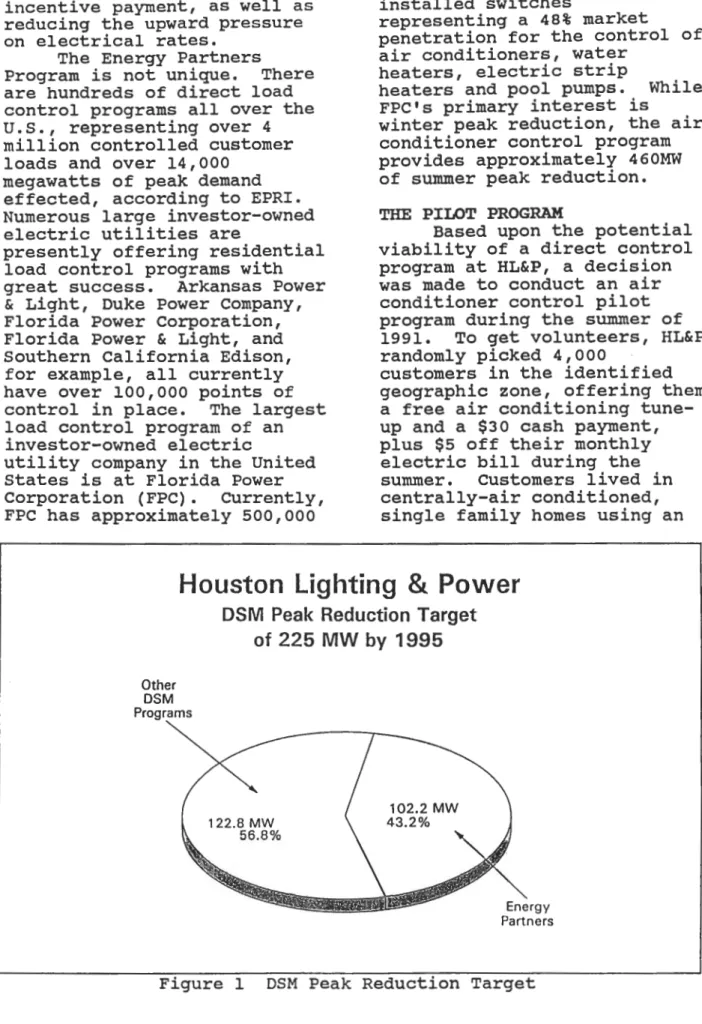
HL&P has identified a peak reduction target of 225MW by 1995 to be met by selected DSM programs. The Energy Partners Program is committed tocontributing over 40% of this
,
goal, or 102.2MW (See Figure 1)H L & P 1 s Energy Partners Program is a prime example of a cost effective resource alternative to building additional generating
capability. Energy Partners truly is a partnership between
/
HLfP and its residentialcustomers. In this
partnership the customer
allows HLfP t o install a I
switch on his/her air
conditioner or heat pump and
i
periodically cycle the unit off during the hottest summer1
days. In return the customer benefits by receiving anincentive payment, as well as reducing the upward pressure on electrical rates.
The Energy Partners
Program is not unique. There are hundreds of direct load control programs all over the U.S., representing over 4 million controlled customer loads and over 14,000
megawatts of peak demand effected, according to EPRI. Numerous large investor-owned electric utilities are
presently offering residential load control programs with great success. Arkansas Power & Light, Duke Power Company, Florida Power Corporation, Florida Power t Light, and Southern California Edison, for example, all currently have over 100,000 points of control in place. The largest load control program of an investor-owned electric
utility company in the United States is at Florida Power Corporation (FPC)
.
Currently, FPC has approximately 500,000installed switches
representing a 48% market
penetration for the control of air conditioners, water
heaters, electric strip
heaters and pool pumps. While FPC's primary interest is
winter peak reduction, the air conditioner control program provides approximately 460MW of summer peak reduction. THE PIIDT PROGRAW
Based upon the potential viability of a direct control program at HLtP, a decision was made to conduct an air
conditioner control pilot program during the summer of 1991. To get volunteers, HLtP randomly picked 4,000
customers in the identified geographic zone, offering them a free air conditioning tune- up and a $30 cash payment, plus $5 off their monthly electric bill during the summer. Customers lived in centrally-air conditioned, single family homes using an
Houston Lighting
& Power
DSM
Peak
Reduction Targetof
225
MW
by
1995Other DSM Progrfms
Partners
a v e r a g e 1 , 0 0 0 k i l o w a t t h o u r s p e r month.
A s u r p r i s i n g 550
customers responded, more t h a n double t h e number needed f o r t h e p i l o t . U l t i m a t e l y , 185 customers p a r t i c i p a t e d i n t h e p i l o t program. Sub-metering t o d e t e r m i n e a c t u a l l o a d i m p a c t s was performed a t 1 0 0 of t h e homes. The sub-metering a n a l y s i s r e v e a l e d t h a t on peak t e m p e r a t u r e days, t h a t is, where t h e o u t s i d e ambient t e m p e r a t u r e i s i n e x c e s s o f 95 d e g r e e s , HLtP could e x p e c t t o r e c e i v e on a v e r a g e a 1 . 4 6 K W l o a d r e d u c t i o n from each p a r t i c i p a n t a t a 50% c y c l i n g s t r a t e g y . The 50% c y c l i n g s t r a t e g y refers t o t h e f a c t t h a t f o r a 30 minute p e r i o d t h e a i r c o n d i t i o n e r would be r e m o t e l y I1shut-of f u f o r 15 m i n u t e s and t h e n allowed t o r u n f o r t h e remadning 15 m i n u t e s . I n t h e c a s e of a r a r e
system emergency, where t h e
1
i n t e g r i t y o f t h e e n t i r e e l e c t r i c a l system may b e i n jeopardy, t h e r e s u l t s i n d i c a t e t h a t HLCP c o u l d a c h i e v e an approximate 3.85KW l o a d r e d u c t i o n , on a peak t e m p e r a t u r e day, f o r a c o n t i n u o u s l o a d shed. A c o n t i n u o u s l o a d shed i s d e f i n e d a s c y c l e d l l o f f n r e m o t e l y f o r 30 m i n u t e s o u t of a 30 minute p e r i o d . The a n a l y s i s f o r t h e sub- metered d a t a a l s o i n d i c a t e d t h a t t h e o v e r a l l effect on energy consumption, f o r a p a r t i c i p a t i n g customer, on a c o n t r o l day is e s s e n t i a l l y n e g l i g i b l e . T h e r e d u c t i o n i n energy consumption t h a t o c c u r s d u r i n g a c o n t r o l p e r i o d i s s h i f t e d t o t h e p o s t - c o n t r o l p e r i o d a s t h e A/C u n i t a t t e m p t s t o a l l e v i a t e t h e h e a t b u i l d l u p i n t h e house (See F i g u r e 2 ).
Cycled Air Conditioner Load Profile
Weekdays Over
94
Degrees
With respect to customer acceptance of the program, pilot participants told HL&P through monthly surveys that generally they were very satisfied with the pilot program. The responses
indicate that approximately 93% of the participants were satisfied with the temperature and humidity in their home during the four month period. Additionally, 89% of the
participants indicated that they would participate in an ongoing direct load control program if offered by HL&P. This high customer
satisfaction has continued during full implementation as verified by several
participant surveys. IMPLEMENTATION
Based upon the results of the 1991 pilot program, a
thorough benefit-cost analysis was conducted for a proposed
formal program. As a result of the success of the 1991 pilot program and the
favorable results of the benefit-cost analysis, HL&P elected to pursue the formal implementation of residential direct control of air
conditioners in the HL&P service area. The Energy Partners Program went into full implementation in the Fall of 1992. ist of HL&P nd people have Energy Partners ementing the this will
the entire life m. Energy
nique in that no gram at RL&P has
involvement by number of areas
y . Some of the
departments that continue to support Energy Partners, and their basic focus follows:
Information Systems.
Monitor automated billing procedures, resolve
exceptions, and implement enhancements.
~elecommunications. Coordinate the
installation of future
transmitter sites and perform periodic testing of signal reception.
Enerw Control.
Maintain EMACS interface with the master control unit.
~ransmission & Distribution. Assist Tele-
communications with the
installation and maintenance of transmitter sites.
Public Affairs. Provide media and creative advertising revisions, and serve as
liaison with the advertising agency and area printers and promotional materials
suppliers.
Through a competitive bid process, the Demand Management Company (DMC) was chosen to be responsible for the
installation of all control switches and for all
scheduling and ongoing maintenance of customer
installations. DMC1s Houston staff of nearly 30 works
exclusively on the Energy Partners Program and
interfaces daily with Energy Partners staff. Many issues, such as customer satisfaction, switch inventory, program
management, are addressed routinely. Regular meetings with DMC are held to
facilitate this process. MARKF,TING
The marketing goals for the program are aggressive. Currently the program is on target to achieve over 20,000 new installations each year from 1993 through 1995. Additionally, the program projects over 100,000
installations in place by the year 2000. The peak load reduction goals approach 70MW by the end of this year, and grow t o over lOOMW by 1995, and then to nearly 150MW by the year 2000 (See Figure 3).
It is HL&P1s goal to sign up approximately 10% of single- family residential homeowners and renters who have central air conditioners or heat pumps in the HL&P service territory in order to achieve these goals.
The basic marketing I technique is direct mail. 1 However, total response rate
is greatly improved with the use of Iflayered" marketing. Layering is the use of several media resources and/or
messages at one time. HL&P has been successful using direct mail, radio, newspaper, and special promotions all at the same time. Throughout the year the following marketing promotions are implemented to target as many potential
customers as possible:
*
Direct mail*
Radio*
Newspaper (City-wide & neighborhood)*
Special promotions (discount coupons)*
Trade showsHouston Lighting
&
Power
*
Participant newsletters*
A/C contractor organization participation*
Presentations to community organizations*
Internal HLtP presentations CURRENT OPERATIONSThe basic requirements for program participation are a single family home with a central air conditioner or heat pump in good working
order, and, if the customer is renting, a landlord permission form must be signed.
Participating customers will be cycled only during the four summer months of June through September. Cycling will occur on weekdays only, excluding holidays, between 12 noon and
8 PM. Initially, HLtP cycled
at a maximum 50% cycling rate, I1off1l for 15 minutes and I1onl1 for 15 minutes. Other
administrative constraints placed on the program in 1993 were a four hour per day
maximum cycling time, and a limit of sixty hours total cycling within the four summer month period. These
constraints will be modified for 1994 based on customer satisfaction survey results and system load
considerations. Additionally, HLtP has retained the right to conduct a total load shed in the event of system emergency.
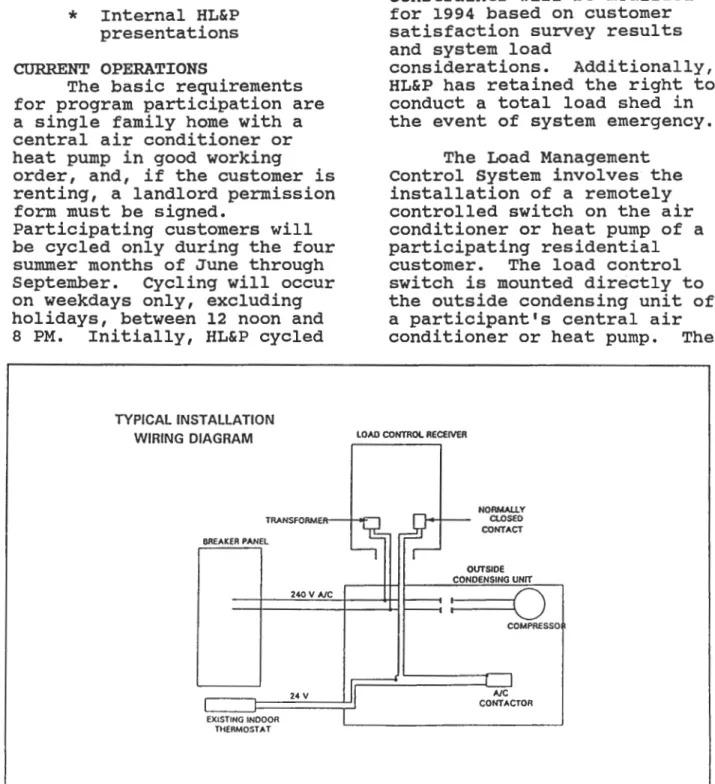
The Load Management Control System involves- the installation of a remotely controlled switch on the air conditioner or heat pump of a participating residential customer. The load control switch is mounted directly to the outside condensing unit of a participant's central air conditioner or heat pump. The
TYPICAL INSTALLATION WIRING DIAGRAM T R A N S F O R M E R BREAKER PANEL
1
EXISTING INOOOR THERMOSTATT
240vAICFigure 4 Typical Installation Wiring Diagram
OVTSJOE CONDENSING UNrr I 24 V
:-
COMPRESSOI AIC COWACTORcontrol switch is not utilized
on window units or gas air
conditioning units. The
installation requires the
insertion of a normally-closed
relay contact, located inside
the switch, into the existing
24
volt thermostat circuit.
An additional connection is
made to the
2 4 0volt
compressor circuit to power
the control switch (See Figure
4).
The regulating
jurisdictions in the Houston
area all agreed that this work
can be performed under a state
issued HVAC license, thus
eliminating the need for
individual site permits.
A radio signal, operating
on an FCC allocated frequency,
is transmitted via HL&Pts
existing pager system to
initiate load control. The
switch, upon receiving the
radio signal will typically
cycle the unit "offu for up to
15
minutes out of a
3 0minute
period. With several thousand
customers being cycled "offM
at different intervals, the
system will provide a
continuous load reduction.
The participant, as
compensation for any
inconvenience or reduction in
comfort level, receives a
monthly bill credit of
8dollars for each of the four
summer months that the program
is utilized to provide load
r software
to transmit
s can be pre-
ed load in
nts and at
ntervals. The
so be
itiate control
ty of control
s time,
temperature, demand level, or
by remote supervisory control.
The equipment provides the
flexibility of changing Ifon-
linew the cycle I1off1l
time to
different levels or of
conducting a continuous load
shed (I1offlt
for
3 0minutes out
of
3 0minutes) in the event of
a system emergency. The Load
!Management System equipment is
integrated into HL&Pts
Energy
Control operations.
When load control is
initiated, a FM one-way radio
signal is transmitted to the
control switch. The radio
signal uses a frequency that
is licensed exclusively to
HL&P. The radio signal will
not interfere with the
operation of TV1s,
radios, or
,
other home appliances such as
Iautomatic garage door openers.
The switch responds by opening
the normally-closed contact,
installed in the thermostat
1
circuit, for anywhere from
7.5 (minutes to
15minutes out of a
3 0
minute period.
Additionally, a red LED
located on the face of the
Iswitch energizes to indicate
i
that the system is being
!
controlled remotely by HL&P.
During the remainder of
1the
3 0minute control period
the air conditioner is allowed
/
to run as normally required by
(the thermostat setting. The
1
switch only controls the
outside compressor circuit,
the inside air handler is
allowed to run if the
thermostat is calling for
cooling. Thus the fan on the
system will continue to
operate, blowing already
1
cooled air throughout the
home. The customer may not
even be aware that the
cycled.
LOOKING AHEAD
Energy Partners has become an important and significant part of HL&P1s Integrated Resource Plan and Demand Side Management
process. Additionally, it is currently enjoying a high level of customer
satisfaction, as well as successful program
implementation and ongoing operations. However,
continuous improvement has
become a way of life at HL&P1s Energy Partners program.
Projects are currently
underway to improve customer acceptance, database
management, and equipment performance. We know that no matter how successful or large the program becomes, we will never complete the improvement process now underway.