Hybridization of Self Adaptive Differential Evolution Algorithm
with Biogeography-Based Algorithm for Solving Reactive Power
Problem
Mr.K. Lenin1, Dr.B.Ravindhranath Reddy2 , Dr.M.Suryakalavathi3 1Research Scholar,2Execuitive Engineer,3Professor , Department of Electrical and Electronics Engineering,
Jawaharlal Nehru Technological University, Kukatpally, Hyderabad 500 085, India
Abstract
In this paper, Self-adaptive Differential Evolution Algorithm (SaDE) Hybridized with Biogeography-Based Algorithm (BBO) to solve reactive power problem. In this proposed algorithm Iteration-level hybridization is done, in which Self-adaptive Differential Evolution Algorithm and Biogeography-Based Algorithm (DEBA) is executed in sequence. Self-adaptive Differential Evolution Algorithm acts independently and then exchanges information from Biogeography-Based algorithm. The proposed DEBA has been tested in IEEE 30,118 bus test systems and simulation results show clearly the better performance of the proposed algorithm in reducing the real power loss.
Keywords: Evolutionary computation, Self-Adaptive Differential Evolution Algorithm, Biogeography-Based optimization, optimal reactive power, Transmission loss.
1. Introduction
Optimal reactive power problem is to minimize the real power loss and bus voltage deviation by satisfying a set of physical and operational constraints enacted by apparatus limitations and security requirements. Numerous mathematical techniques like the gradient method [1-2], Newton method [3] and linear programming [4-7] have been adopted to solve the optimal reactive power dispatch problem. Both the gradient and Newton methods has the complication in handling inequality constraints. The problem of voltage stability and collapse play a key role in power system planning and operation [8]. Evolutionary algorithms such as genetic algorithm have been already proposed to solve the reactive power flow problem [9, 10].In [11], Genetic algorithm has been used to solve optimal reactive power flow problem. In [12], Hybrid differential evolution algorithm is suggested to improve the voltage stability index. In [13] Biogeography Based algorithm is proposed to solve the reactive power dispatch problem. In [14], a fuzzy based method is used to solve the optimal reactive power scheduling method .In [15], an improved evolutionary programming is used to solve the optimal reactive power dispatch problem. In [16], the optimal reactive power flow problem is solved by integrating a genetic algorithm with a nonlinear interior point method. In [17], a pattern algorithm is used to solve ac-dc optimal reactive power flow model with the generator capability limits. In [18], proposes a two-step approach to evaluate Reactive power reserves with respect to operating constraints and voltage stability. In [19], a programming based proposed approach used to solve the optimal reactive power dispatch problem. In [20], presents a probabilistic algorithm for optimal reactive power provision in hybrid electricity markets with uncertain loads. This paper proposes Hybridization of Self-adaptive Differential evolution algorithm (SaDE) with Biogeography-Based Algorithm to solve reactive power problem. Biogeography-Based Optimization (BBO) [21, 22], is a new global optimization algorithm based on the biogeography theory, which is the study of distribution of species. The proposed DEBA algorithm has been evaluated in standard IEEE 30,118 bus test systems. The simulation results show that our proposed approach outperforms all the entitled reported algorithms in minimization of real power loss.
2. Objective Function 2.1. Active power loss
The objective of the reactive power dispatch is to minimize the active power loss in the transmission network, which can be described as follows:
F = PL = ∑ ∈ g V + V − 2V V cosθ (1) or
F = PL = ∑∈ P − P = P + ∑ P − P (2)
Where gk : is the conductance of branch between nodes i and j, Nbr: is the total number of transmission lines in power systems. Pd: is the total active power demand, Pgi: is the generator active power of unit i, and Pgsalck: is the generator active power of slack bus.
2.2. Voltage profile improvement
F = PL + ω! × VD (3)
Where ωv: is a weighting factor of voltage deviation. VD is the voltage deviation given by:
VD = ∑ |V − 1|)*'( (4) 2.3. Equality Constraint
The equality constraint of the problem is represented by the power balance equation, where the total power generation must cover the total power demand and the power losses:
P+= P,+ P- (5)
This equation is solved by running Newton Raphson load flow method, by calculating the active power of slack bus to determine active power loss.
2.4. Inequality Constraints
The inequality constraints reflect the limits on components in the power system as well as the limits created to ensure system security. Upper and lower bounds on the active power of slack bus, and reactive power of generators:
P. / ≤ P ≤ P. 1 (6)
Q. /≤ Q ≤ Q. 1 , i ∈ N (7)
Upper and lower bounds on the bus voltage magnitudes:
V. /≤ V ≤ V. 1 , i ∈ N (8)
Upper and lower bounds on the transformers tap ratios:
T. /≤ T ≤ T. 1 , i ∈ N
7 (9)
Upper and lower bounds on the compensators reactive powers:
Q. /≤ Q ≤ Q 8
. 1 , i ∈ N
8 (10)
Where N is the total number of buses, NT is the total number of Transformers; Nc is the total number of shunt
reactive compensators.
3. Self-adaptive differential evolution (SaDE)
DE is a simple evolutionary algorithm that creates new candidate solutions by combining the parent solution and several other candidate solutions. A candidate solution replaces the parent solution if it has better fitness. This is a greedy selection scheme that often outperforms traditional evolutionary algorithms. SaDE is one of the best DE variants [23]. It uses a self-adaptive mechanism on control parameters F and CR. Each candidate solution in the population is extended with control parameters F and CR that are adjusted during evolution. Better values of these control parameters lead to better candidate solutions, which in turn are more likely to survive the selection process to produce the next solution and propagate the good parameter values. SaDE is highly independent of the optimization problem's characteristics and complexity, and it involves self-adaptation and learning by experience. SaDE demonstrates consistently good performance on a variety of problems, including both unimodal and multimodal problems.
4. Biogeography-based optimization (BBO)
BBO is a new population-based optimization algorithm inspired by the natural biogeography distribution of different species. In BBO,[21,22] each individual is considered as a “habitat” with a habitat suitability index (HIS). A good solution is analogous to an island with a high HSI, and a poor solution indicates an island with a low HSI. High HSI solutions tend to share their features with low HSI solutions. Low HSI solutions accept a lot of new features from high HSI solutions. In BBO, each individual has its own immigration rate λ and emigration rate μ. A good solution has higher μ and lower λ and vice versa. The immigrant ion rate and the emigration rate are functions of the number of species in the habitat. They can be calculated as follows,
λ = I ;1 −/< (11) μ = E ;/< (12)
Where I is the maximum possible immigration rate; E is the maximum possible emigration rate; k is the number of species of the k-th individual; and n is the maximum number of species. In BBO, there are two main
operators, the migration and the mutation. 4.1. Migration
Consider a population of candidate which is represented by design variable. Each design variable for particular population member is considered as SIV for that population member. Each population member is considered as individual habitat/Island. The objective function value indicates the HSI for the particular population member. S value represented by the solution depends on its HSI. S1 and S2 represent two solutions with different HSI. The emigration and immigration rates of each solution are used to probabilistically share information between habitats. If a given solution is selected to be modified, then its immigration rate λ is used to probabilistically modify each suitability index variable (SIV) in that solution. If a given SIV in a given solution Si is selected to be modified, then its emigration rates μ of the other solutions is used to probabilistically decide which of the solutions should migrate randomly for selected SIV to solution Si. The above phenomenon is known as migration in BBO. Because of this migration phenomenon BBO is well suited for the discrete optimization problems as it deals with the interchanging of design variables between the population members.
4.2. Mutation
In nature a habitat’s HSI can change suddenly due to apparently random events (unusually large flotsam arriving from a neighboring habitat, disease, natural catastrophes, etc.). This phenomenon is termed as SIV mutation, and probabilities of species count are used to determine mutation rates. This probability mutates low HSI as well as high HSI solutions. Mutation of high HSI solutions gives them the chance to further improve. Mutation rate is obtained using following equation.
M(s) = m. 1;1 −@@A
BCD< (13)
Where, mmax is a user-defined parameter called mutation coefficient. 5. Common Methodology
Steps of iteration-level hybridization combining SaDE with BBO Step 1. Generate the initial population P
Step 2. Maximum number of function evaluations reached? If Yes output result. If No go to step 3. Step 3. Create offspring O from P using SaDE.
Step 4. Improve offspring O using BBO. Step 5. Replace parent P with O. Step 6. Output.
Where P is the parent population and O is the offspring population.
We implement iteration-level hybridization for optimal reactive power problem by combining recently developed SaDE with BBO.The goal of this hybridization approach is to balance the exploration and exploitation ability.
Steps of DEBA algorithm
1: Arbitrarily initialize the parent population P 2: Calculate the fitness of all candidate solutions in P 3: Whereas the halting criterion is not satisfied do
4: Perform a recently developed SaDE to create offspring population O 5: Calculate the fitness of each solution in offspring population O 6: Compute the immigration rate λ and emigration rate μ of each solution
7: Accomplish one generation of BBO to improve the solutions in offspring population O 8: Swap the parent population P with the offspring population O
9: End while
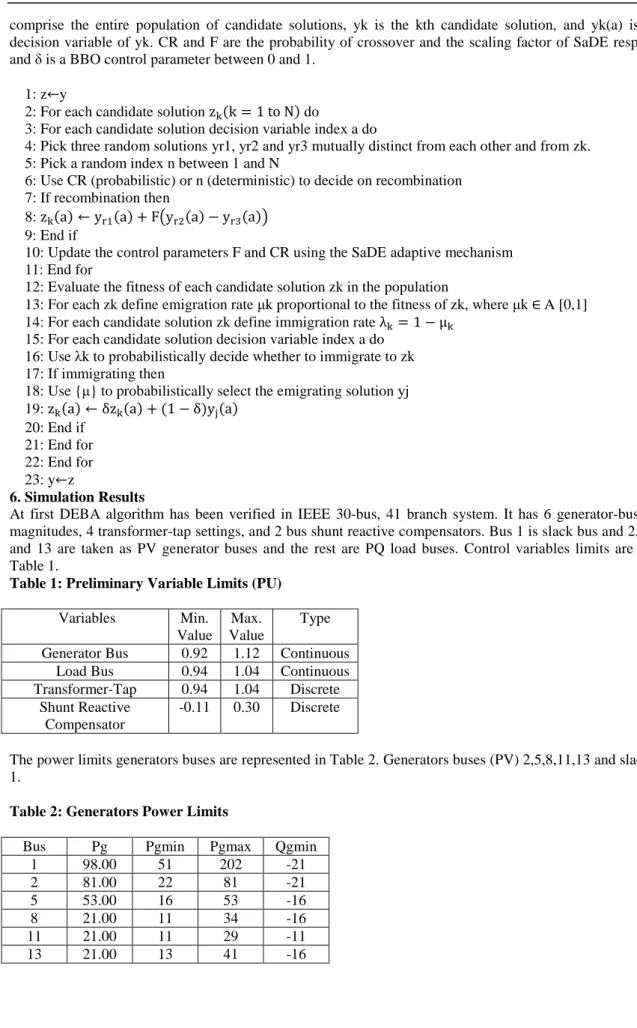
comprise the entire population of candidate solutions, yk is the kth candidate solution, and yk(a) is the ath decision variable of yk. CR and F are the probability of crossover and the scaling factor of SaDE respectively, and δ is a BBO control parameter between 0 and 1.
1: z←y
2: For each candidate solution z Gk = 1 to NJ do
3: For each candidate solution decision variable index a do
4: Pick three random solutions yr1, yr2 and yr3 mutually distinct from each other and from zk. 5: Pick a random index n between 1 and N
6: Use CR (probabilistic) or n (deterministic) to decide on recombination 7: If recombination then
8: z GaJ ← y*GaJ + F y GaJ − yMGaJ 9: End if
10: Update the control parameters F and CR using the SaDE adaptive mechanism 11: End for
12: Evaluate the fitness of each candidate solution zk in the population
13: For each zk define emigration rate μk proportional to the fitness of zk, where μk ∈ A [0,1] 14: For each candidate solution zk define immigration rate λ = 1 − μ
15: For each candidate solution decision variable index a do 16: Use λk to probabilistically decide whether to immigrate to zk 17: If immigrating then
18: Use {μ} to probabilistically select the emigrating solution yj 19: z GaJ ← δz GaJ + G1 − δJy GaJ
20: End if 21: End for 22: End for 23: y←z
6. Simulation Results
At first DEBA algorithm has been verified in IEEE 30-bus, 41 branch system. It has 6 generator-bus voltage magnitudes, 4 transformer-tap settings, and 2 bus shunt reactive compensators. Bus 1 is slack bus and 2, 5, 8, 11 and 13 are taken as PV generator buses and the rest are PQ load buses. Control variables limits are listed in Table 1.
Table 1: Preliminary Variable Limits (PU) Variables Min.
Value Max. Value
Type
Generator Bus 0.92 1.12 Continuous Load Bus 0.94 1.04 Continuous Transformer-Tap 0.94 1.04 Discrete
Shunt Reactive Compensator
-0.11 0.30 Discrete
The power limits generators buses are represented in Table 2. Generators buses (PV) 2,5,8,11,13 and slack bus is 1.
Table 2: Generators Power Limits
Bus Pg Pgmin Pgmax Qgmin
1 98.00 51 202 -21 2 81.00 22 81 -21 5 53.00 16 53 -16 8 21.00 11 34 -16 11 21.00 11 29 -11 13 21.00 13 41 -16
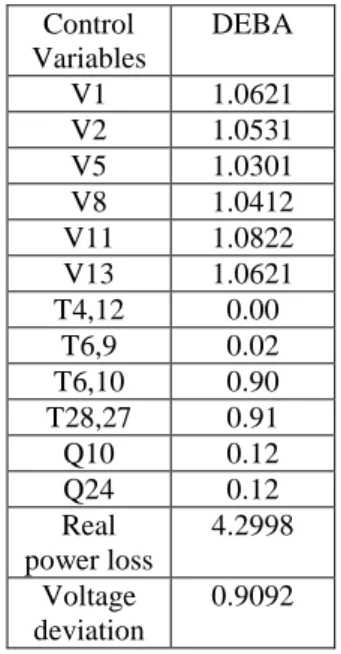
Table 3: Values of Control Variables after Optimization Control Variables DEBA V1 1.0621 V2 1.0531 V5 1.0301 V8 1.0412 V11 1.0822 V13 1.0621 T4,12 0.00 T6,9 0.02 T6,10 0.90 T28,27 0.91 Q10 0.12 Q24 0.12 Real power loss 4.2998 Voltage deviation 0.9092
Table 3 shows the proposed approach succeeds in keeping the control variables within limits. Table 4 summarizes the results of the optimal solution obtained by various methods.
Table 4: Comparison Results Methods Real power
loss (MW) SGA (24) 4.98 PSO (25) 4.9262 LP (26) 5.988 EP (26) 4.963 CGA (26) 4.980 AGA (26) 4.926 CLPSO (26) 4.7208 HSA (27) 4.7624 BB-BC (28) 4.690 DEBA 4.2998
Then DEBA has been tested in standard IEEE 118-bus test system [29] .The system has 54 generator buses, 64 load buses, 186 branches and 9 of them are with the tap setting transformers. The limits of voltage on generator buses are 0.95, -1.1 per-unit., and on load buses are 0.95, -1.05 per-unit. The limit of transformer rate is 0.9, -1.1, with the changes step of 0.025. The limitations of reactive power source are listed in Table 5, with the change in step of 0.01.
Table 5: Limitation of reactive power sources BUS 5 34 37 44 45 46 48 QCMAX 0 14 0 10 10 10 15 QCMIN -40 0 -25 0 0 0 0 BUS 74 79 82 83 105 107 110 QCMAX 12 20 20 10 20 6 6 QCMIN 0 0 0 0 0 0 0
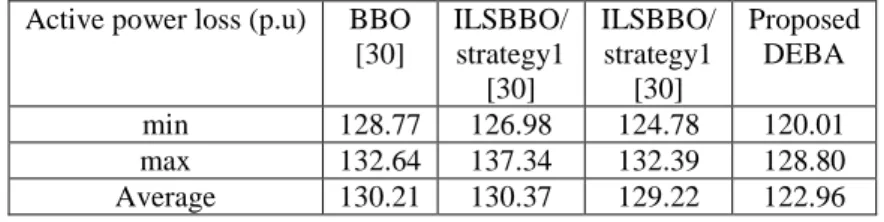
In this case, the number of population is increased to 120 to explore the larger solution space. The total number of generation times is set to 200. The statistical comparison results of 50 trial runs have been list in Table 6 and the results clearly show the better performance of proposed algorithm.
Table 6: Comparison results Active power loss (p.u) BBO
[30] ILSBBO/ strategy1 [30] ILSBBO/ strategy1 [30] Proposed DEBA min 128.77 126.98 124.78 120.01 max 132.64 137.34 132.39 128.80 Average 130.21 130.37 129.22 122.96 7. Conclusion
In this paper, Hybridized Self-adaptive Differential evolution algorithm with Biogeography-Based Algorithm has been successfully implemented to solve reactive power problem. The proposed algorithm has been tested on the IEEE 30,118 -bus systems. The results are compared with the other heuristic techniques and the proposed algorithm established its efficiency and strength in minimization of real power loss. And control variables are well within specified limits.
References
[1] O.Alsac,and B. Scott, “Optimal load flow with steady state security”,IEEE Transaction. PAS -1973, pp. 745-751.
[2] Lee K Y ,Paru Y M , Oritz J L –A united approach to optimal real and reactive power dispatch , IEEE Transactions on power Apparatus and systems 1985: PAS-104 : 1147-1153
[3] A.Monticelli , M .V.F Pereira ,and S. Granville , “Security constrained optimal power flow with post contingency corrective rescheduling” , IEEE Transactions on Power Systems :PWRS-2, No. 1, pp.175-182.,1987.
[4] Deeb N ,Shahidehpur S.M ,Linear reactive power optimization in a large power network using the decomposition approach. IEEE Transactions on power system 1990: 5(2) : 428-435
[5] E. Hobson ,’Network consrained reactive power control using linear programming, ‘ IEEE Transactions on power systems PAS -99 (4) ,pp 868=877, 1980
[6] K.Y Lee ,Y.M Park , and J.L Oritz, “Fuel –cost optimization for both real and reactive power
dispatches” , IEE Proc; 131C,(3), pp.85-93.
[7] M.K. Mangoli, and K.Y. Lee, “Optimal real and reactive power control using linear programming” , Electr.Power Syst.Res, Vol.26, pp.1-10,1993.
[8] C.A. Canizares , A.C.Z.de Souza and V.H. Quintana , “ Comparison of performance indices for detection of proximity to voltage collapse ,’’ vol. 11. no.3 , pp.1441-1450, Aug 1996 .
[9] S.R.Paranjothi ,and K.Anburaja, “Optimal power flow using refined genetic algorithm”, Electr.Power Compon.Syst , Vol. 30, 1055-1063,2002.
[10]D. Devaraj, and B. Yeganarayana, “Genetic algorithm based optimal power flow for security enhancement”, IEE proc-Generation.Transmission and. Distribution; 152, 6 November 2005.
[11]Berizzi, C. Bovo, M. Merlo, and M. Delfanti, “A ga approach to compare orpf objective functions including secondary voltage regulation,” Electric Power Systems Research, vol. 84, no. 1, pp. 187 – 194, 2012.
[12]C.-F. Yang, G. G. Lai, C.-H. Lee, C.-T. Su, and G. W. Chang, “Optimal setting of reactive compensation devices with an improved voltage stability index for voltage stability enhancement,” International Journal of Electrical Power and Energy Systems, vol. 37, no. 1, pp. 50 – 57, 2012.
[13]P. Roy, S. Ghoshal, and S. Thakur, “Optimal var control for improvements in voltage profiles and for real power loss minimization using biogeography based optimization,” International Journal of Electrical Power and Energy Systems, vol. 43, no. 1, pp. 830 – 838, 2012.
[14]B. Venkatesh, G. Sadasivam, and M. Khan, “A new optimal reactive power scheduling method for loss minimization and voltage stability margin maximization using successive multi-objective fuzzy lp technique,” IEEE Transactions on Power Systems, vol. 15, no. 2, pp. 844 – 851, may 2000.
[15]W. Yan, S. Lu, and D. Yu, “A novel optimal reactive power dispatch method based on an improved hybrid evolutionary programming technique,” IEEE Transactions on Power Systems, vol. 19, no. 2, pp. 913 – 918, may 2004.
[16]W. Yan, F. Liu, C. Chung, and K. Wong, “A hybrid genetic algorithm interior point method for optimal reactive power flow,” IEEE Transactions on Power Systems, vol. 21, no. 3, pp. 1163 –1169, aug. 2006. [17]J. Yu, W. Yan, W. Li, C. Chung, and K. Wong, “An unfixed piecewise optimal reactive power-flow
170 –176, feb. 2008.
[18]F. Capitanescu, “Assessing reactive power reserves with respect to operating constraints and voltage stability,” IEEE Transactions on Power Systems, vol. 26, no. 4, pp. 2224–2234, nov. 2011.
[19]Z. Hu, X. Wang, and G. Taylor, “Stochastic optimal reactive power dispatch: Formulation and solution method,” International Journal of Electrical Power and Energy Systems, vol. 32, no. 6, pp. 615 – 621, 2010.
[20]Kargarian, M. Raoofat, and M. Mohammadi, “Probabilistic reactive power procurement in hybrid electricity markets with uncertain loads,” Electric Power Systems Research, vol. 82, no. 1, pp. 68 – 80, 2012.
[21]Simon, Dec.2008.“Biogeography- Based Optimization”,IEEE transactions on Evolutionary computation, vol. 12, No.6, pp. 702-713.
[22]Haiping Ma,Dan Simon,Minrui Fei,Xinzhan ShuZixiang Chen, “Hybrid biogeography-based evolutionary algorithms”, Engineering Applications of Artificial Intelligence Volume 30, April 2014, Pages 213–224.
[23]Zhenyu Yang, Ke Tang and Xin Yao, “Self-adaptive Differential Evolution with Neighborhood Search”,pp 1110-1119, 2008 IEEE Congress on Evolutionary Computation (CEC 2008).
[24]Q.H. Wu, Y.J.Cao, and J.Y. Wen. Optimal reactive power dispatch using an adaptive genetic algorithm. Int. J. Elect. Power Energy Syst. Vol 20. Pp. 563-569; Aug 1998.
[25]B. Zhao, C. X. Guo, and Y.J. CAO. Multiagent-based particle swarm optimization approach for optimal reactive power dispatch. IEEE Trans. Power Syst. Vol. 20, no. 2, pp. 1070-1078, May 2005.
[26]Mahadevan. K, Kannan P. S. “Comprehensive Learning Particle Swarm Optimization for Reactive Power Dispatch”, Applied Soft Computing, Vol. 10, No. 2, pp. 641–52, March 2010.
[27]A.H. Khazali, M. Kalantar, “Optimal Reactive Power Dispatch based on Harmony Search Algorithm”, Electrical Power and Energy Systems, Vol. 33, No. 3, pp. 684–692, March 2011.
[28]S. Sakthivel, M. Gayathri, V. Manimozhi, “A Nature Inspired Optimization Algorithm for Reactive Power Control in a Power System”, International Journal of Recent Technology and Engineering (IJRTE) ,pp29-33 Volume-2, Issue-1, March 2013.
[29]IEEE, “The IEEE 30-bus test system and the IEEE 118-test system”, (1993), http://www.ee.washington.edu/trsearch/pstca/.
[30]Jiangtao Cao, Fuli Wang and Ping Li, “An Improved Biogeography-based Optimization Algorithm for Optimal Reactive Power Flow” International Journal of Control and Automation Vol.7, No.3 (2014), pp.161-176.