The application of additive and multiplicative Generale Linear Interactive Models (GLIM) in Health Insurance.
Paper for the XXI ASTIN Colloquium New York, 1989
subject: Empirical Investigations.
Bob J.J. Alting von Geusau June 1989.
1. Introduction and Summary.
For the private health insurance industry in the Netherlands a model is developped which can describe accurately the interaction between the various influencing factors which determine the size of health claims.
Most of these factors such as sex of the insured, age of the insured, or type of coverage,
can be considered as working multiplicatively on the base claim size,
For other factors this seems less true: it might be that far them an additive model will be more appropriate.
This paper provides a description of an example of a model which originally uses the multiplicative specifications but which is generalised easily to the use of additive factors.
Only the basic technique is given, which means that some major points are still open: for instance when to use the purely multiplicative model and when the mixed one.
2. The General Linear Interactive Model (GLIM): the multiplicative Gamma-case.
If the claimcost per insured k are symbolized by the variable and the claimcost are supposed to be Gamma distributed, we can define as the density of :
(1)
The parameters µ and in (1) are also visible of course in
(2) the expectation
the variance
In principle both sets of parameters can be of a very complicated structure, but in multiplicative GLIM we restrict ourself to the
according to
(3)
In formula (3) Xk is a vector with zeros and ones in such a way
that the correct linear combination of elements from the rating
vector is obtained.
The second restriction affects :
(4) = for all k,
where is the scale factor in the Gamma distribution: since
at the moment we are only interested in the average value (3) we
donot have to estimate the value of thin parameter .
In order to estimate the values of the elements of we use the
sample z1,.., zk,..., zn
and the log-likelihood function
(5) log = constant +
since (3) and (4) hoids
= constant + function( ,zk) + k=1
As a function of (6) has its maximum when
(6)
for m=1,..,M, where xkm is element number m in the vector .
The consequence of this definition is that for each claim we
Formula (6) is a system of M equations with H unknowns
but since this system is not linear we need a little bit more
than some basic knowledge of matrix algebra.
Van Eeghen, Greup and Nijssen in "Ratemaking" (1983) describe the elegant method of scoring as a way to solve (6) as follows:
Define the information matrix by:
(7)
(8)
(9)
This matrix is negative definite for the values
where is the nth approximation
of the solution of (6).
The method of scoring finally solves (6) by the
iterative procedure
Formula (9) converges quite easily when the chosen initial value
(10)
It makes the situation easier that in this specific case (7) boils down to
(11)
for each which means that it is necessary to compute the inverse matrix of (11) only once.
3. GLIM generalised to the mixed additive-multiplicative case.
In health insurance it nay be necessary to generalise (3) to
(12)
(say)
for the observations Zk with k=l,..,n where:
the specific vector for observation k with zeros and ones for the additive factors, and
the vector with the A additive factors.
As an example of such an additive factor the deductible per insured can be considered.
For the log-likelihood function this means:
Therefore (6) becomes a system of (M+A) equations with (M+A) unknowns:
(14) for
which
again cannot
be solved
directly.With scoring it takes some tedious calculations but finally we find for the information matrix the composition of the submatrices:
for a=1 ,..,A and b=l,..,A and for m=l,..,M and p=l,..,M of the matrices given by:
(15)*
(15)**
- Expectation
- Expectation
- Expectation
(15)***
and for a = 1 , . . , A m = 1 , . . , M .which totalises into the information matrix by the recipe:
(16)
and leads finally to the scoring formula:
(17)
The convergence of (17) is much less convincing but in the cases I have analysed the solution came up after some time: the number of necessary iterations appeared to be about three times as high as in the purely multiplicative case.
This is the price we have to pay for the fact that (16) is not strictly negative definite in all cases.
4. Some results on real data.
The methods mentioned in the previous paragraphs have been applied to the 1987 and the 1988 data from private health insurance companies in the Netherlands.
This data has been collected by the Foundation KISG from 3.5 million insureds with regards to the following activities:
- the cost of hospitalisation
- the cost of a specialist in a clinic
- the cost of a specialist without hospitalisation - the cost of paramedical aid
- the coat of other medical care, such as medical transportation, artificial legs and arms, dentures, obstetrical aid, home care, etcetera. Of these activities the gross and the net amounts per insured per year have been collected plus the information related to the the individual situation of the insured with regards to:
- hospitalisation 3rd class or better - sex of the insured
- area Where the insured is living: the highly populated Western part of the Netherlands is much more expensive than the North and the South
- the age of the insured
- the level of the deductible
- the type of health insurance contract: in the Netherlands one can buy private health insurance through an individual contract or in some cases collectively via the employer in a group contract - the fact whether the cost of the family doctor is
insured yes or no: it seems that this factor indicates a totally different type of risk.
On this information I have applied the general GLIM-models in a score of variants of which I give three examples.
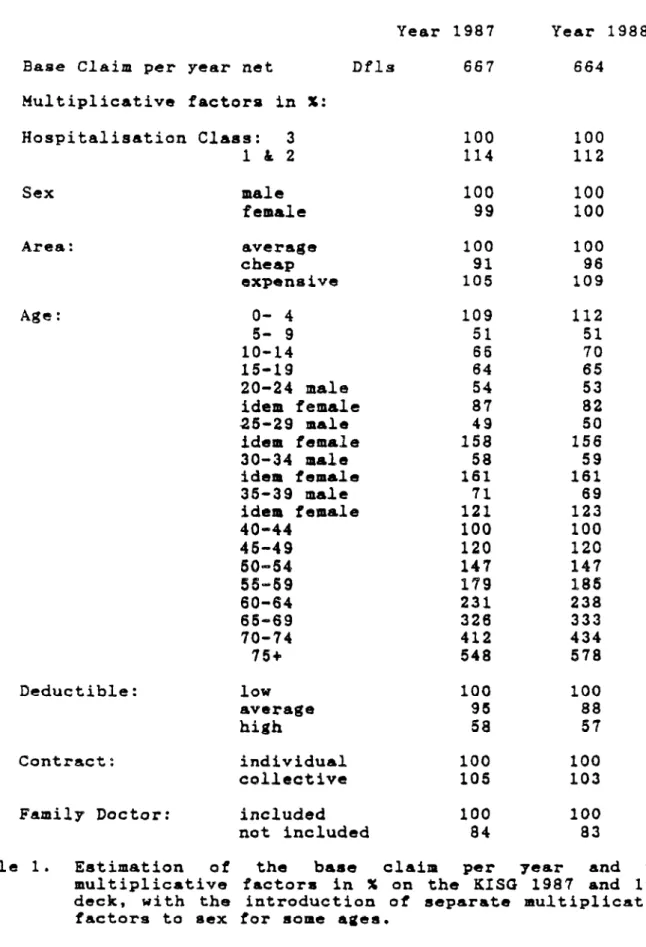
The first one is a purely multiplicative one with compound age factors:
Base Claim per year net Dfls 667 664 Multiplicative factors in X: Hospitalisation Class: 3 100 100 l&2 114 112 Sex male female 100 99 100 100 Area: average 100 100 cheap 91 96 expensive 105 109 Age: 0- 4 109 5- 9 51 10-14 66 15-19 64 54 87 158 58 161 71 121 100 120 147 179 231 326 412 548 20-24 male idem female 25-29 male idem female 30-34 male idem female 35-39 male idem female 40-44 46-49 50-54 55-59 60-64 65-69 70-74 75+ 49 112 51 70 65 53 82 50 156 59 161 69 123 100 120 147 186 238 333 434 578 Deductible: low average high Contract: individual collective Family Doctor: included
not included Year 1987 Year 1988 100 95 58 100 105 100 84 100 88 57 100 103 100 83
Table 1. Estimation of the base claim per year and the multiplicative factors in X on the KISG 1987 and 1988 deck, with the introduction of separate multiplicative factors to sex for some ages.
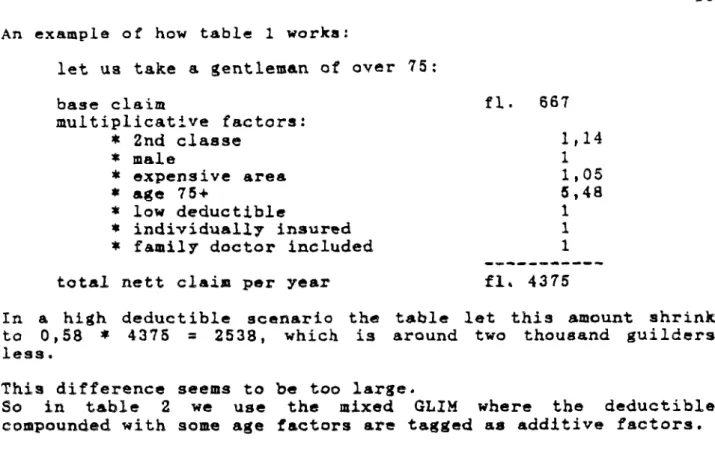
An example of how table 1 works:
let us take a gentleman of over 75: base claim multiplicative factors: * 2nd classe * male * expensive area * ago 75+ * low deductible * individually insured * family doctor included total nett claim per year
fl. 667 1,14 1 1,05 5,48 1 1 1 fl. 4375
In a high deductible scenario the table let this amount shrink to 0,58 * 4375 = 2538, which is around two thousand guilders less.
This difference seems to be too large.
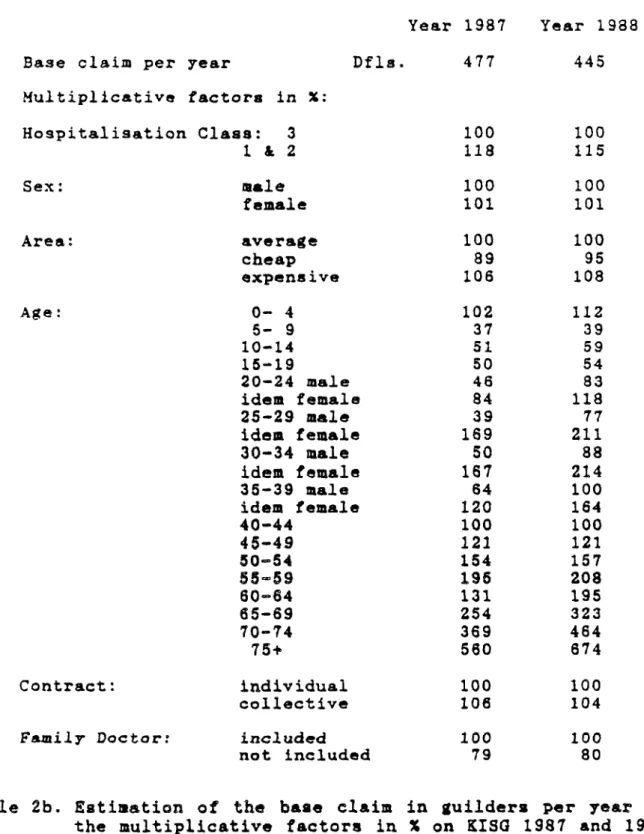
So in table 2 we use the mixed GLIM where the deductibles compounded with some age factors are tagged as additive factors.
Deductible Age for male and female:
0-19 20-39 40-59 60+
low: under fl. 250 per year
1987: 180 173 205 836
1988: 189 22 249 729
average: fl. 250 - 750 per year
1987: 178 81 178 1068
1998: 150 73- 155 547
high: over fl. 750 per year
1987: 0 22- 116- 324
1988: 0 178- 91- 10
Table 2a. Additive constants in the mixed GLIM-model for the claimfactor 'Deductible' on KISG 1987 and 1988: these constants can only be used in connection with table 2b.
Base claim per year Dfls. 477 Year 1988 445 Multiplicative factors in X: Hospitalisation Class: 3 1&2 100 118 100 115 Sex : male female 100 101 100 101 Area: average 100 100 cheap 89 95 expensive 106 108 Age: 0- 4 5- 9 10-14 16-19 102 37 51 50 118 39 169 50 167 64 120 100 121 154 195 131 254 369 560 112 39 59 54 83 118 77 211 88 214 100 164 100 121 157 208 195 323 464 674 20-24 male idem female 25-29 male idea female 30-34 male idem female 35-39 male idem female 40-44 45-49 50-64 55-59 60-64 65-69 70-74 75+ Year 1987 Contract: individual 100 collective 106
Family Doctor: included 100
not included 79
Table 2b. Estimation of the base claim in guilders per year and the multiplicative factors in X on KISG 1987 and 1988: this table can only be used in connection with table 2a.
100 104 100 80
Back to our example to demonstrate how both tables are used together: base claim 1987 fl. 477 multiplicative factors: * 2e class * male * expensive area * age 75+ * individual cover
* family doctor included sub result 1,18 1 1,06 5,60 1 1 fl. 3341 additive factor:
+ low deductible, age 75+ total net claim in 1987
836 fl. 4177
With a high deductible the amount would have been fl. 3665 - that is 512 guilders lower - and that seems more plausible. This better fit is also indicated by the Power mean squared error: in table 2a/2b this reads 685, while in table 1 it is 734.
Finally I have listed table 3, where the multiplicative GLIM is demonstrated on a separate insurance activity: the cost of hospitalisation in 1987.
The introduction of separate age/sex factors leads to interesting results:
Base claim in 1987 Multiplicative factors in X: 283 Hospitalisation class: Sex : Area: 0 - 4 Age: 5- 9 10 - 14 15 - 19 20 - 24 25 - 29 30 - 34 35 - 39 40 - 44 46 - 49 50 - 54 55 - 59 60 - 64 65 - 69 70 - 74 759 Deductible: Contract: Family doctor:
Standaard deviation MSE:
3 100 l & 2 1 1 3 male 100 female 90 average 100 cheap 91 expensive 103 male female 189 60 56 82 91 61 66 81 100 131 164 253 358 570 739 1007 low 100 average 98 high 65 individual 100 group 102 included 100 not included 82 605 184 191 153 164 196 221 257 347 488 668 1024
the multiplicative factors in X for the cost of hospitalisation in 1987 with the introduction of separate multiplicative factors to sex for some ages. Table 3. Estimation of the base claim per year in guilders and
5. Resume.
Pour la description d'un portefeuille Couts Medicaux la methode GLIM (General Linear Interactive Model) peut donner des
instruments utilisables. I1 parait possible de generaliser cette méthode avec des variantes mixtes du genre additif-multiplicatif. Finallement le papier donne quelques exemples.
Bob J.J. Alting von Geusau, Juin 1989 - June 1989,