Sound & Communications 46
Audio networking over Ethernet in 2012.
ARE WE THERE YET?
Tim Shuttleworth is editor of the Emerging Trends Report for the Audio Engineering Society’s Technical Committee on
Networked Audio Systems. He is engineering manager with Renkus Heinz Inc., and is a technical papers reviewer and papers session moderator for the recent AES 44th Conference on Audio Networking. He holds patents for techniques across the spectrum of audio electronics, and is a co-author of the Harman HiQNet Protocol. He can be reached at t.shuttleworth@ sbcglobal.net.
The area of audio networking sys-tems has seen some rapid development recently with new technologies being announced and discussed, promoted and critiqued. Systems integrators, design consultants and engineers are left struggling to comprehend all this technology and gain a perspective on what it all means for the short term and longer term future of audio sys-tems.
Here, I will be addressing a couple of specific questions that I hear a lot from the systems integration commu-nity, and in doing so, will cover some basics of current network schemes for audio applications. Here are the two questions: Is Ethernet AVB the future? And, to plagiarize Bob Pease:
What’s all this layer 2 versus layer 3 stuff anyhow? These two questions are very much interrelated, and both must be addressed in order to provide a better understanding of where the various elements, protocols, methods and commercial solutions fit in a fully operational networked audio system.
Ethernet Suite Push
The push toward the suite of IEEE standards generally referred to as Ethernet AVB has received a lot of at-tention and created a deal of momen-tum in discussion forums from online blogs to conference workshops. De-spite all this dissemination, it remains poorly understood in relation to how it fits the overall landscape of audio
devices, controllers, computer software and GUIs that make up a networked audio system. So, let me state right up front that Ethernet AVB will standard-ize the way media (that’s audio signals and video signals) are routed over Eth-ernet. AVB concerns itself with packag-ing these digital media signals, and en-suring that a connection route delivers this media content such that it can be reconstructed accurately, reliably and quickly at the receiving device.
What it does not do is provide a means to control any aspect of the sending or receiving device beyond the routing of media content out of and into devices via the network. As with so many things, there is a caveat to that statement: In the future, under
Figure 1. Audio Network Devices and Protocols
the auspices of IEEE1722.1, a means of limited control of device function-ing, such as volume and mute may be defined.
First generation proprietary audio-over-Ethernet protocols such as Co-braNet not only provided a means of routing digitized audio signals between devices on a network, but they also included some methods of controlling functions within those devices such as gain, equalization, limiter/compres-sor settings, and also means to return signal information from devices to a monitoring controller such as a soft-ware GUI—as level meters. CobraNet, to continue that example, also included a means to encode other command and control functionality into network data packets to allow manufacturer-specific (custom) non-audio command and con-trol data such as remote power/sleep and temperature or fault reporting back and forth between control devices and operational devices.
Proprietary Methods
Many adopters of CobraNet utilized (and still do) only the digital audio transport aspect of CobraNet and used their own proprietary methods for con-trol of signal processing objects and reporting of status information using separate Ethernet interfaces (NICs) on their products to handle control and command data. Some even use non-Ethernet networks for these com-mand and control data, such as RS422 and RS485. This allowed manufactur-ers to develop control protocols that addressed their specific feature set efficiently, but required end users to use separate software to control prod-ucts from different brands on the same network, even with all of them utilizing
CobraNet as the audio signal distribu-tion method.
This practice was railed against by serious industry systems users such as the late Albert Leccese of Audio Analysts, who pointed out that what the end user community wants is a common control platform allowing a single software program (GUI) to find, identify and fully configure and control every audio device on a network.
Ethernet AVB provides a license-free standard schema for media transport over Ethernet. What it does not do is move our industry any closer to the goal of a common control scheme across branded products. The connec-tion and routing management software for CobraNet, CobraNet Discovery, provided the same utility as now of-fered by Ethernet AVB more than 10 years ago, albeit in a closed proprie-tary protocol requiring license fees and per-channel royalties, and with some Ethernet compatibility challenges.
Recently, efforts have focused on the need for an open standard protocol for device command and control allowing discovery and control of processing ob-jects embedded within network node devices. It is these command and con-trol protocol open standards, coupled with standards for media transport such as Ethernet AVB and AES X-192, that actually move us toward the ulti-mate objective of a cross-brand com-mon control platform for an entire networked audio system.
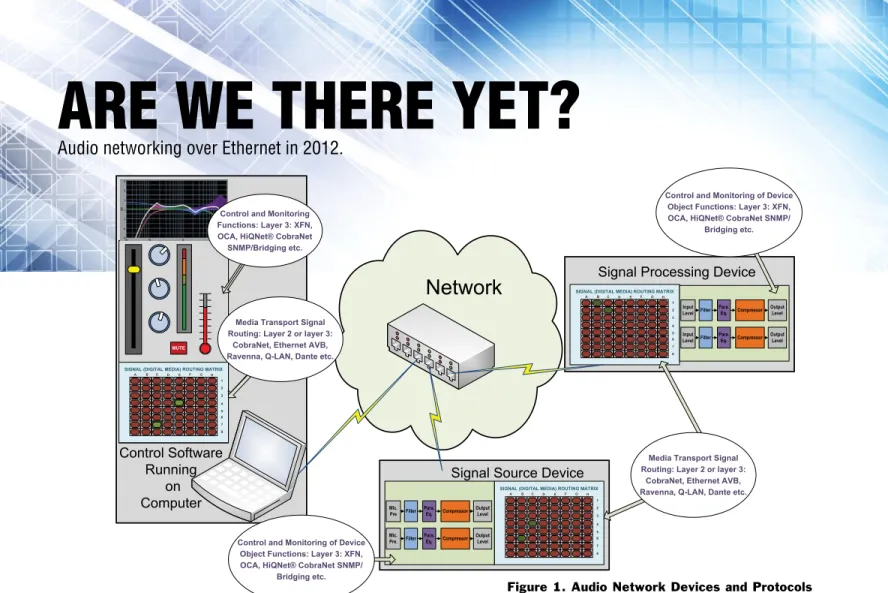
Table 1 diagrams where the dif-ferent media transport and device control schemes map against the full implementation reference example of CobraNet, complete with control and monitoring of audio signal processing objects and non-audio parameters.
Fig-Sound & Communications 48
800.500.8142 / 818.500.8142 / [email protected] / www.bittree.com Highest-density Micro-Video format features 48 jacks per row
2 x 48 configuration, in 1 and 1.5 RU sizes SMPTE 292M and SMPTE 424M compliant DIN 1.0 / 2.3 rear termination
High-bandwidth performance for SD/SDI, HD/SDI, 3-D and other 3 Gb/s applications Front panel’s optional 1” recess keeps patchcords from protruding beyond the rack, saving space and ensuring tight connections
True 75ohm impedance with low return loss Rear lacing bar keeps rack wiring organized
Bittree 2 x 48 Micro-Video Patchbays
Highest Bandwidth. Highest Density. Highest Value.
ure 1 diagrams how these protocols interact with network devices; con-trollers, computer software GUIs and signal processors, and the processing objects and parameters within them.
How Do Ethernet
Layers Relate?
Armed with a better understanding of how the available protocols relate to operations across the network (such as transport of media over the network), and within devices on the network (control of signal processing and re-porting of faults and so forth), let’s now look at how the concept of Eth-ernet Layers relates to all this. A com-mon game played at children’s parties in Britain is called “Pass the Parcel.” In
this game, the host wraps something of value to the participants (in this case, a toy or chocolate bar, for instance) in multiple layers of wrapping paper. The parcel is passed around the attendees until a signal to stop when the current possessor of the parcel removes one layer of wrapping.
The process continues until a lucky participant removes the final wrapper and gains possession of the prize. Eth-ernet Layering is a lot like this game, except that the outer layers have to be added according to strict rules gov-erned by the authority in charge of the Ethernet game, the IEEE. The first lay-ers of wrapping can be applied by the “host” according to rules they dictate as long as the intended recipient is in possession of an understanding of the
same rules. We’ll call these Layer 3. As long as the layers of wrapping can be interpreted by both the sending and re-ceiving application, the prize—the data payload at the core of the packet—will reach its intended destination and be usable and valuable.
But the outer layers must be fully compliant with the standardized rules of Ethernet protocols so the entire network infrastructure understands the wrappers. We’ll call this Layer 2. The wrapping layers for Layer 2 have to be understood by the entire network infrastructure because these are the layers of data that determine how and where the data packet is to go.
Started As OSI
This whole concept started out as the OSI (Open Systems Interconnec-tion) model that defined layers of wrapping for network data packets. As developers of Ethernet systems be-came more familiar with implementing these layers, they became aggregated, at least in discussion vocabulary, into the three layer model most commonly referred to in the Ethernet community. It is this contemporary 3 Layer model being described in the wrapping of the parcel analogy. Layer 1 is where the actual connection to the physical net-work is made. Above Layer 3 sits the software application that’s being used to do some work, such as browse the internet, transfer files from computer A to computer B, or communicate in-structions to a remote device and, of course, for streaming media.
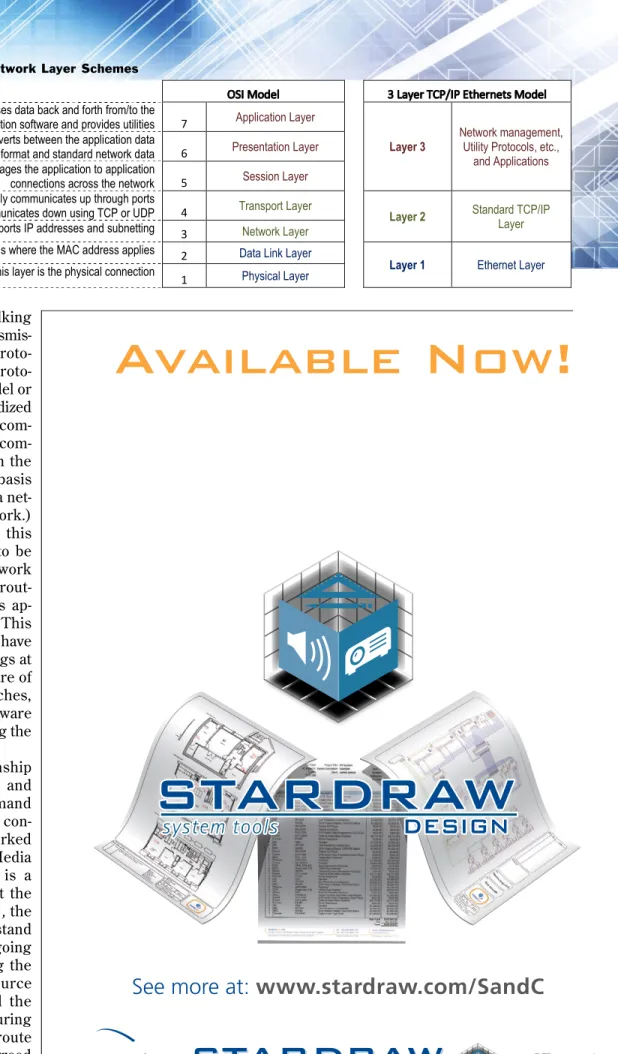
Table 2 diagrams the relationship be-tween the OSI model’s layers and the more commonly used 3 Layer TCP/IP
CobraNet Ethernet AVB
AES X-170 Draft Standard OCA Alliance Proposed Protocol Harman Proprietary Protocol
Non-Audio Control Data
(temperature, fault, remote power) encoded/decoded/managed by CobraNet Passbridge or Packet Bridging X-170 (XFN) Command and Control Protocol OCA (Open Control Architecture) Command and Control Protocol HiQNet Command and Control Protocol Audio DSP Object Control and
Monitoring using “CobraNet SNMP Library” commands Ethernet AVB IEEE802.1Qav, IEEE802.1AS, IEEE7122.1, IEEE1733, etc. Packetized audio routing and
connection management. CobraNet Discovery Audio stream
digitization/packetization and timing control. CobraNet packets, CobraNet Conductor and beat packet protocol
Ethernet model we’re actually talking about. (TCP/IP refers to the Transmis-sion Control Protocol/Internet Proto-col suite of computer network proto-cols, often called the Internet Model or IP Model, which defines a standardized method to enable computers to com-municate over a network and encom-passes the functions described in the left column of Table 2. It’s the basis on which both Ethernet local area net-works (LANs) and the internet work.) The important point about all this is that Layer 2 wrappings have to be handled and managed by the network infrastructure to ensure correct rout-ing and prioritization, as well as ap-propriate bandwidth allocation. This means that the Ethernet switches have to be able to manage the wrappings at Layer 2. The Layer 3 wrappings are of no concern to the Ethernet switches, and conversely, the Layer 3 software need not concern itself with getting the data packet across the network.
Table 3 describes the relationship between these Ethernet layers and the media streaming and command and control protocols we’ve been con-cerned with for getting our networked audio system up and running. Media transport using Ethernet AVB is a Layer 2 activity. This means that the infrastructure of the network, i.e., the Ethernet switches, must understand the protocols because they are going to take responsibility for routing the streaming media data from source to destination together with all the necessary timing data, and ensuring reserved bandwidth along this route guarantees delivery within the agreed delay time (latency).
OSI Model 3 Layer TCP/IP Ethernets Model
This layer passes data back and forth from/to the
application software and provides utilities 7 Application Layer
Layer 3 Network management, Utility Protocols, etc., and Applications
This layer converts between the application data
format and standard network data 6 Presentation Layer
This layer manages the application to application
connections across the network 5 Session Layer
This layer typically communicates up through ports
and communicates down using TCP or UDP 4 Transport Layer Layer 2 Standard TCP/IP
Layer This layer supports IP addresses and subnetting 3 Network Layer
This layer is where the MAC address applies 2 Data Link Layer
Layer 1 Ethernet Layer This layer is the physical connection
1 Physical Layer Table 2: The Network Layer Schemes
Copyright © 2011 Stardraw.com Ltd. All Rights Reserved.
Stardraw Design 7
The new generation of the industry's
leading design/documentation software
See more at:
www.stardraw.com/SandC
DESIGN
system toolsSound & Communications 50
Proprietary Schemes
Note that, in Table 3, there are some proprietary media transport schemes that operate at Layer 3 (Dante, Raven-na, etc.). These schemes use the pre-existing Layer 2 protocols to manage routing and timing without reliance on the new and imminent IEEE standards for Ethernet AVB. This provides the advantage that AVB-compliant Ether-net switches are not required to build a network using these schemes. As at this writing, AVB-compliant Ethernet switches are not shipping extensively; you can’t go to your local computer store and buy one.
There’s some advantage for the Layer 3-based methods in the short term. The trade-off, however, is that some quite serious care and attention is required to correctly select, set up and configure the network switches and infrastructure. I’m not going to attempt to explain how these schemes achieve reliable connections and time-ly transfer of media content across the network. That is something for their promoters to explain. However, being equipped with an understand-ing of how Ethernet layers work and how they relate to media transport schemes and command and control protocols will enable a better under-standing of those explanations.
Implementation Details
Another important point in relation to the proprietary schemes being of-fered to device manufacturers is that a
lot of the implementation details have been figured out by the scheme’s ven-dor. Manufacturers must pay for the privilege of using the protocol and its prepackaged implementation; usually a license fee accompanied by a per-unit royalty, and in exchange, they receive a lot of support incorporating the scheme into their products: soft-ware and firmsoft-ware that’s ready to go, reference designs for hardware and even hardware modules for purchase. To adopt a standard such as Ether-net AVB or OCA (should this become a standard as its promoters intend), a manufacturer must invest in its own implementation of the standard and commit to maintaining compliance with the standard as it evolves in the future. Of course, there are non-brand third-party developers work-ing on implementation of the stan-dards approach, and manufacturers can partner with these design houses rather than invest in in-house design resources.
Hybrid Business Model
An interesting hybrid business model is being provided in relation to the X-170 command and control protocol. In this case, a product de-veloper can choose to implement the standard itself or can buy a prepack-aged implementation being offered as the commercialized version known as XFN. A similar business model may, I suppose, emerge from the OCA Al-liance group. Software and firmware
for these protocols can be created in a portable non-platform-specific form such as the C programming language and compiled by a manufacturer to suit its particular hardware processors.
So are we there yet? If “there” is at a point where all manufacturers can pro-vide networked devices that are fully interoperable and can be configured and controlled by a common protocol and hence be managed by a single user interface software, the answer is no. What’s even more concerning is that we are seeing the emergence of competing standards to add to the abundance of existing competing pro-prietary protocols.
It’s hard to be optimistic that the convergence required for this much desired interoperability is even in pros-pect. Ethernet AVB and wide availabil-ity of AVB-compliant Ethernet switches certainly will make configuring and setting up networks much simpler and more reliable. That’s no small achieve-ment, and definitely something to look forward to.
But it looks like end users will be stuck with competing protocols and their user interface control and moni-toring software applications for the foreseeable future. A thorough under-standing of what part each of the vari-ous commercialized audio networking offerings plays in creating a complete audio system and how to select the best combinations for each system configuration will continue to be nec-essary.
TCP/IP Ethernets
Model
Audio Related Protocols
Layer
3
Network
management,
Utility
Protocols,
etc., and
Applications
Control
Protocols:
OCA,
X-170,
HiQNet
Layer 2
Media
Transport:
AVB,
CobraNet
Layer 3
Media
Transport:
Ravenna,
Dante,
X-192
Layer
2
TCP/IP Layer
Standard
Layer
1
Ethernet Layer
Table 3: Audio Related Protocols and their Ethernet Layers