Decision to accept binding
commitments to modify a data
exchange tool used by Motor
Insurers
December 2011
© Crown copyright 2011
You may reuse this information (not including logos) free of charge in any format or medium, under the terms of the Open Government Licence. To view this licence, visit www.nationalarchives.gov.uk/doc/open-government-licence/ or write to the Information Policy Team, The National Archives, Kew, London TW9 4DU, or email: [email protected]
Any enquiries regarding this publication should be sent to us at: Marketing, Office of Fair Trading, Fleetbank House, 2-6 Salisbury Square, London EC4Y 8JX, or email: [email protected]
CONTENTS
Chapter Page
1 Introduction 7
2 The OFT's investigation 8
3 Background - the private motor insurance market 17
4 The OFT'S competition concerns 25
5 The Commitments 32
6 The OFT's Decision 57
Annexe
Annex 1 Commitments text Annex 2 Aggregation analysis
Annex 3 Additional issues regarding modification of the WhatIf? Private Motor product
Annex 4 Analysis of data sample
EXECUTIVE SUMMARY
This Decision is addressed to seven insurers and two IT software providers.1 It
relates to an information exchange product sold by Experian and known as WhatIf? Private Motor. WhatIf? Private Motor is an information product
consisting of an information exchange which enables insurers to access other insurers' pricing information for any risk profile. In particular, WhatIf? Private Motor allows insurers to know in detail what their rivals' future prices will be, provides them with the opportunity to adjust their own quotation prices in advance of such prices going 'live' in the market, and through batch analysis2
enables them to determine the detailed structure of their rivals' pricing strategies/models.
The Office of Fair Trading (‘the OFT’) was concerned that the information
exchange might constitute an infringement of the Chapter I prohibition under the Competition Act 1998 (‘the Act’) and/or of Article 101(1) of the Treaty of the Functioning of the European Union (TFEU) and has had particular regard to the fact that the information exchange can be properly characterised as an
exchange of future information (in the sense that competitors can adjust their prices in response to their competitors' stated intentions). In articulating its concern the OFT has also had particular regard to features of the information exchange3 which could be facilitative of co-ordination. This includes the highly
individualised, commercially sensitive, non public, highly disaggregated nature of pricing information exchanged and the fact that the information is exchanged through WhatIf? Private Motor on a frequent and consistent basis and that the companies involved account for a large part of the private motor insurance market.
1 The seven insurers are Ageas Insurance Ltd (formerly Fortis UK Ltd), Aviva Insurance UK Ltd;
AXA Insurance UK plc, Liverpool Victoria Insurance Company, RBS Insurance Group Ltd, Royal & Sun Alliance plc and Zurich Insurance plc – UK Branch. The IT software providers are Experian Ltd and SSP Ltd. The insurers, Experian and SSP are referred to in Chapters 1-4 of the Decision as ‘Parties’.
2 Batch analysis involves accessing the pricing information in the product by inputting a very large number of risk profiles at one time. For a fuller description of batch analysis see paragraph 3.13 below.
In order to address the competition concerns of the OFT in relation to the WhatIf? Private Motor product, the parties subject to the OFT's investigation offered commitments (the 'Commitments') to the OFT that they would only exchange (or facilitate the exchange) of information through the WhatIf? Private Motor (or successor) product(s) if this product complies with certain Principles.4
The OFT, pursuant to s31A Competition Act 1998, conducted a consultation exercise (the 'Consultation') to seek views on the Commitments offered by the parties. This took the form of publication of a Notice to accept binding
Commitments issued on 13 January 2011 (OFT1301).
In the light of evidence submitted to the OFT pursuant to the Consultation and the OFT's subsequent further analysis of this market, the OFT requested from the Insurers,5 and received, amended Commitments (the 'Amended
Commitments'). Specifically, in light of evidence presented to the OFT during the Consultation, including evidence as to potential value of exchange of certain information to market entrants in some circumstances, the definition of
'Relevant Data' contained in the Commitments was amended to refer to data which is six months old, rather than 36 months old (the 'Amendment'). The OFT was of the view that this revised duration contained in the Amendment
addressed its competition concerns. At the same time, it ensures that the
commitments are not unnecessarily restrictive, which the OFT recognises can be helpful for third parties, notably small insurers and new entrants, and hence encourages healthy competition in this market.
The OFT conducted a second consultation exercise (the 'Second Consultation') to seek views on its intention to accept the Amended Commitments offered by the Parties. This took the form of publication of a Notice of intention to modify proposed binding commitments issued on 30 September (OFT1377).
The OFT, having taken account of representations made during the Second Consultation, considers that the Amended Commitments6 offered by the Parties
4 Principles means the principles as set in Annex 1 to this document.
5 Six of the seven original insurer parties have offered the Amended Commitments to the OFT.
fully address the OFT's competition concerns and it has, therefore, decided to accept the Amended Commitments. A decision by the OFT accepting binding commitments does not amount to or imply any finding as to the legality or otherwise of the conduct by the Parties under investigation either prior to acceptance of the commitments or once the commitments are in place. It is proposed that these commitments will remain in force for five years. It should also be noted, where the OFT has accepted binding commitments it may for the purpose of addressing its current competition concerns, accept a
1
INTRODUCTION
1.1 In this document, the OFT accepts the Amended Commitments offered by the companies7 under investigation in case CE/9388/10 and set out
at Annex 1. Formal acceptance of the commitments by the OFT results in the termination of our investigation, without the need for any decision on whether or not the Competition Act 1998 and/or Article 101(1) TFEU has been infringed by any of the companies under investigation.
1.2 The remainder of this document describes the OFT’s investigation, the market context in which the investigation has been carried out, the parties involved and the nature of the information exchange and of the information exchanged. The OFT’s competition concerns are
summarised, together with details of the commitments offered by the parties and why the OFT considers that these address its competition concerns. This document also includes an overview of the
representations made in response to the OFT’s Notice of intention to accept binding commitments and the Notice of intention to modify proposed binding commitments and a description of how we have taken account of the significant issues raised.
2
THE OFT'S INVESTIGATION
2.1 In June 2009, the OFT received information suggesting that certain arrangements between a large number of insurance companies operating in the broker insurance market might be in breach of the Chapter I
prohibition of the Competition Act 1998 (the 'Act') and/or Article 101 of the Treaty of the Functioning of the European Union ('TFEU').
2.2 In January 2010, the OFT launched a formal investigation under section 25 of the Act through the issue of section 26 notices, on the basis that it had reasonable grounds to suspect that Chapter I of the Act was being infringed. In particular, the OFT suspected that insurers were indirectly exchanging commercially sensitive price information through certain third party IT software providers, facilitated by third party service providers, and that such arrangements might have the object or effect of
preventing, restricting or distorting competition.
OFT’s prioritisation
OFT’s general approach to prioritisation
2.3 The OFT's objective is to make markets work well for consumers. Markets work well for consumers when businesses compete vigorously and fairly to win customers’ business. The OFT will only intervene in markets when they do not work well and, by doing so, will seek to promote open competition, and to encourage unrestricted availability of products and services.
2.4 In order to make the best use of its resources in terms of real outcomes for UK consumers, the OFT needs to ensure that we make appropriate decisions about which projects and programmes of work we undertake across all areas of our responsibility.
2.5 In seeking to target both the OFT’s resources and enforcement strategy, the OFT generally prioritises its work according to the impact on
consumers and the work’s strategic significance, amongst other
and resources involved. Further information on the OFT’s prioritisation strategy can be found at: OFT Prioritisation Principles, October 2008 (OFT953).8
Application of OFT’s prioritisation principles in this case
2.6 The OFT considered that the features of this case were such that it was appropriate to take the case forward as meeting its prioritisation criteria. The following factors were of particular relevance in this regard:
Impact:
• the insurance sector is significant, both in terms of size (i.e. value) and reach (the sector is one that touches most consumers, motor insurance being one example), such that any finding of harm and/or change in market behaviour resulting from an investigation could have a correspondingly large impact.
Strategic significance:
• the case presented novel facts in relation to information exchange, and therefore any finding (infringement or non-infringement) by the OFT would not only deter anticompetitive exchange of information between competitors but also provide business with some indication as to types of information exchange that may raise competition concerns.
Scope of the OFT’s investigation
2.7 In deciding on the most appropriate scope for its investigations, the OFT aims to strike the optimal balance between achieving the greatest
possible impact and using its resources as efficiently and effectively as possible.
2.8 In this case, it was suggested to the OFT that the alleged information exchange could be occurring indirectly between a large number of insurers operating in the broker insurance market through the use of several data analysis products, and in relation to several insurance lines. 2.9 Mindful of the widespread use of information exchange tools in the
insurance sector and the likely resource and timing implications of a wide-ranging investigation, the OFT was careful to adopt an
appropriately scoped investigation from the outset. It therefore decided to focus on one insurance line, one data analysis product and a subset of insurers that subscribed to that data analysis product during the relevant period of investigation.
2.10 The following paragraphs describe how the OFT went about narrowing the scope of its investigation (so as to strike the optimal balance
between impact and efficient use of OFT resources).
• Narrowing by insurance line: the evidence available to the OFT indicated that the alleged behaviour it would be investigating was likely to be similar for private motor insurance, household insurance, motorcycle insurance and commercial vehicle insurance sold via brokers. Given the larger size of the private motor insurance line (and therefore the corresponding larger direct impact of its investigation), the OFT focused its investigation on private motor insurance.9 • Narrowing by data analysis provider: the OFT focused on Experian
Ltd's ('Experian') WhatIf? Broker data analysis product for private motor insurance (WhatIf? Private Motor). The rationale for this was that: (a) the OFT understood the WhatIf? Private Motor to be the leading available data analysis product for the broker channel, (b) there was good evidence relating to WhatIf? Private Motor, and (c)
9 Datamonitor reports estimate the respective market sizes to be £9.2 billion for private motor insurance(UK Private Motor Insurance 2010), £7.5 billion for household insurance (UK Household Insurance 2010), £176 million for motorcycle insurance (UK Motorcycle Insurance 2010), and £3.3 billion for commercial vehicle insurance (UK Commercial Vehicle Insurance 2010).
the OFT understood that most insurers active in the UK subscribe (or have subscribed in the past) to WhatIf? Private Motor.
• Narrowing by number of insurers: Given the number of insurers involved, the OFT focused its investigation on the top nine insurers by revenue in private motor in 2009, the year before the start of the OFT’s investigation. The OFT identified these insurers using revenue information for the overall market for private motor insurance (that is including sales through the direct, affinity and broker channels).10
The reason for selecting the top nine insurers was that there was a clear gap between the turnover of the ninth and tenth insurance companies in 2009.11 In addition, the OFT noted that these nine
insurance companies comprised a number of different profiles namely, UK-based insurers, international insurance companies, a mutual insurance company and considerable variation in terms of size and resource. Since the top nine insurers based on turnover already captured a range of profiles no further widening of the group for deterrence or other purposes was warranted.
Following this approach, the insurance companies12 that were within
the initial scope of the OFT's investigation were Ageas Insurance Ltd ('Ageas'), formerly known as Fortis Insurance Ltd, Aviva Insurance UK Ltd ('Aviva'), general insurance subsidiaries of AXA Insurance UK plc ('AXA Insurance'), Liverpool Victoria Insurance Company Ltd ('Liverpool Victoria'), RBS Insurance Group Ltd ('RBS Insurance'), Royal & Sun Alliance Insurance plc ('RSA') and Zurich Insurance plc – UK Branch ('Zurich').13
10 In the absence of available revenue information for the broker channel, the OFT considered that information on total private motor insurance was a reasonable proxy subject to excluding any insurer that did not operate in the broker segment.
11 The turnover of the ninth company was 50 per cent higher than that of thetenth company and this was the biggest 'break' between consecutively ranked companies.
12 Referred to collectively as 'Insurer Parties'.
13 Two further insurers that were within the initial scope of the investigation were subsequently excluded from the investigation scope following confirmation by them that they had not received
2.11 In summary, the OFT’s investigation covered the alleged anticompetitive exchange of private motor broker pricing information between certain insurers through Experian and, as explained further below, SSP Ltd (‘SSP’). 14
2.12 By adopting this narrow scope, the OFT was able to conduct its
investigation in an efficient and effective manner, and within a shortened time-frame.
Process
2.13 On 29 January 2010, the OFT issued Notices under section 26 of the Act ('Section 26 Notices') to the insurers identified in paragraph 2.10 above, as well as to IT software providers SSP and Experian. The Section 26 Notices requested information on, in particular, the indirect exchange of information between insurers through WhatIf? Private Motor.
2.14 Having considered the evidence gathered in response to the Section 26 Notices, the OFT sent the parties that remained within the scope of its investigation (collectively referred to as the 'Parties') a state of play letter on 17 June 2010, updating the Parties on the OFT's ongoing investigation and briefly outlining the OFT's competition concerns. 2.15 Following a series of separate meetings and discussions between the
OFT and each of the Parties, each Party indicated its willingness to offer commitments as a way of addressing the OFT’s competition concerns. Accordingly, the OFT, in accordance with paragraph 4.18 of OFT407 (Enforcement) (the 'OFT Guidance') proceeded to discuss with each Party the scope of any commitments which would be necessary to address the concerns it had identified.
the WhatIf? Private Motor product and/or had not provided private motor insurance in the relevant period.
14 SSP is a software provider through which Experian obtains data for its WhatIf? Private Motor product.
2.16 By way of background, the OFT notes that it has the power to accept commitments offered to it pursuant to section 31A of the Act where it is satisfied that the commitments offered meet its competition concerns. The OFT Guidance describes the circumstances in which it may be appropriate to accept binding commitments, and the process by which parties to an investigation may offer commitments to the OFT.
2.17 The Parties having indicated their willingness to offer commitments, the OFT (in accordance with paragraph 4.17 of the OFT Guidance) sent a Statement of Competition Concerns (SOCC) to the Parties on 6
September 2010 as a precursor to a possible commitments outcome. 2.18 Following the receipt of the Parties' responses to the SOCC, the OFT
(pursuant to the OFT Guidance) further discussed with the Parties the form and content of the commitments that would be necessary to address the competition concerns it had identified.
2.19 The Parties offered formal commitments in final form to the OFT on a range of dates in December 2010 and January 2011.
2.20 On 13 January 2011, the OFT issued a Notice of an intention to accept binding commitments to modify a data exchange tool used by Motor Insurers15 ('Commitments Notice') in which it invited interested third
parties to make representations on the proposed commitments. The consultation process officially concluded on 14 February 2011.
2.21 Having considered the Parties' proposed commitments, the responses to the Commitments Notice16 and the OFT's subsequent further analysis of
this market, the OFT requested from the insurers, and received, amended commitments. Specifically, in light of evidence presented to the OFT during the Consultation, including evidence as to potential value of exchange of certain information to market entrants in some
15 OFT 1301: Notice of an intention to accept binding commitments to modify a data exchange tool used by Motor Insurers, 13 January 2011
16 A summary of the responses and of the account taken by the OFT of issues raised is set out
circumstances, the definition of 'Relevant Data' contained in the Commitments was amended to refer to data which is six months old, rather than 36 months old. The OFT was of the view that this revised duration contained in the amendment would address its competition concerns, whilst remaining helpful to third parties, notably small insurers and new entrants, and hence encourages healthy competition in this market.
2.22 The OFT conducted a Second Consultation17 exercise to seek views on
its intention to accept the Amended Commitments offered by the Parties. This took the form of publication of a Notice of intention to modify proposed binding commitments issued on 30 September. 2.23 The OFT, having taken account of representations made during the
Second Consultation, considers that the amended commitments offered by the parties are sufficient to address the OFT's competition concerns. As a result, the OFT hereby accepts the amended commitments as offered by the parties in the form set out in Annex 1 and has closed its file in respect of this investigation.
The Parties
2.24 Ageas (formerly Fortis Insurance Ltd) is part of the international insurance company Ageas SA/NV. In the UK, Ageas provides general insurance through subsidiaries of Ageas (UK) Ltd, which include Ageas Insurance Ltd, and life insurance through Ageas Protect Ltd.
2.25 Aviva is part of Aviva plc, the UK’s largest insurer and the world’s sixth-largest insurance company based on gross worldwide premiums in 2009. For the UK insurance market, Aviva offer motor, property, health and related insurance services to individuals and small to medium sized enterprises.
2.26 AXA Insurance is wholly owned by AXA SA, one of the world’s largest insurers. AXA Insurance underwrites a range of products such as motor,
home and travel insurance. AXA Insurance also underwrites a number of products for some of the UK’s best known brands.
2.27 Experian is a global information services company, providing market data and analysis products. In the UK, Experian supports a range of vertical markets, including financial services, retail, home shopping,
telecommunications, utilities, media, property, automotive, leisure, charity and insurance. On 9 August 2004, Experian acquired ISL Ltd (ISL). ISL provided a number of data analysis products aimed at the insurance market, including the WhatIf? Private Motor product. 2.28 Liverpool Victoria is part of the Liverpool Victoria Friendly Society, a
mutual society providing life insurance, general insurance, investment products, savings, lending and advisory services to its members. It primarily operates in the UK under Liverpool Victoria Insurance Company Ltd and Highway Insurance Company Ltd.
2.29 RBS Insurance is a subsidiary of the Royal Bank of Scotland Group PLC. Within this subsidiary there are four main UK general insurance
companies, such that, collectively, RBS Insurance is the UK's second-largest provider of general insurance selling car, home, pet, travel and commercial insurance through a number of brands including Direct Line and Churchill. RBS Insurance's broker based insurer is the National Insurance and Guarantee Corporation Ltd (NIG), which is a commercial and personal lines insurer providing products through a network of
independent brokers. In August 2010, NIG announced its decision to exit the personal lines business (which includes private motor) and to focus solely on its commercial lines of business.
2.30 RSA is the largest commercial insurer in the UK, and the third-largest personal lines insurer. RSA’s commercial business focuses on property, motor, liability and marine insurance. RSA’s personal lines insurance is distributed through brokers, direct channels and affinity organisations. 2.31 SSP is a provider of IT systems and services to the UK insurance
industry. Relevant to this case, SSP offers quote engines to brokers in order to access quotes from their panel of insurers for the purposes of
calculating premiums and providing policy details to customers, relevant to each customer's specific demands and needs. SSP also provides the same data to Experian for incorporating into its WhatIf? Private Motor product.
2.32 Zurich is part of Zurich Financial Services Ltd, a multinational insurance group with insurance operations throughout the world. In the UK, Zurich Insurance provides private motor insurance business, together with other general insurance, both directly and through intermediaries.
3
BACKGROUND - THE PRIVATE MOTOR INSURANCE MARKET
Routes to market
3.1 Private motor insurance is a subcategory of general retail insurance. Total gross written premiums in private motor insurance in the UK in 2010 amounted to £9.5 billion (£9.2 billion in 2009).18 In 2010 the
largest ten companies accounted for approximately 77 per cent of total sales.19
3.2 As with other general insurance categories, private motor insurance is sold in the following ways:
a. directly to the final customer, for example through an insurer’s website, through price comparison websites or by telephone, b. through affinity relationships with, for example, other financial
firms, such as high street banks or major retailers, such as
supermarkets or department stores. These firms are not involved in the provision of insurance themselves but they have existing
relationships with customers and wish to offer those customers a portfolio of financial products including insurance. Some affinity partners use only one supplier whilst others use a panel of different suppliers. The underlying insurance contract is between the insurer and the customer (not the affinity partner). However, the policy documentation is likely to have the affinity partner’s branding, and c. through brokers who are able to purchase services for their clients from a range of different insurers. As with the affinity channel, the broker does not enter into the contract with the customer, but acts as an intermediary, placing the customer with the insurer.
18 Datamonitor: UK Private Motor Insurance 2011 19 See footnote 18.
3.3 The difference between the broker and affinity channels resides primarily in the type of company marketing the insurance – the affinity firms are more likely to be financial institutions or major retailers. In addition, affinity relationships are more likely to have sole suppliers.
3.4 In addition, the broker channel can be split into two broad categories: a. Large brokers, who tend to market insurance policies under their
own brand (although these are underwritten by insurers), and b. Small and regional brokers, who make up the large majority of
independent brokers operating throughout the UK.
Sales through all brokers made up approximately 30 per cent of private motor insurance sales in 2010 (31 per cent in 2009).20 The OFT
understands that the information in WhatIf? Private Motor is more useful for the small and regional broker channel since larger brokers have
greater flexibility in their pricing strategies. In addition, it notes that insurers may write different proportions of policies for each channel: while some write most of their business through large brokers, others may operate a more balanced portfolio or sell more policies through small and regional brokers.
How insurance premiums are calculated
3.5 Insurers selling high volume products need to be able to quickly and easily calculate an insurance premium for any potential customer. Insurance premiums are typically calculated on the basis of three broad categories: the cost of the underlying risk (sometimes referred to as 'expected claims costs'), a need to recover expenses (which may include fixed expenses and commissions), and a wider commercial strategy (including adjustments made to premiums and rates to increase or decrease the volume of business that an insurer writes for any given sector).
3.6 The first of these categories (expected claims costs) will be based on a significant number of variables (known as risk or rating factors), which affect the risk to an insurer. For example, the age of a driver would be a risk factor for private motor insurance.21 There are a number of risk
factors which contribute towards a private motor insurance price. This, in addition to the fact that some risk factors (for example, postcodes) can themselves comprise a large number of variables (for example, there are over 10,500 postcode sectors in the UK), results in a very large number of possible premium permutations.
3.7 Expected claims costs will also take account of demand conditions and, in particular, consumer price sensitivity at the individual insurer level, which is influenced by insurers' price competitiveness with their key rivals. Account is also taken of technical risk factors, which reflect an insurer’s expertise and experience of the degree to which any given risk factor has led to claims arising in the past, and the expectation that any particular factor will increase the likelihood and/or scale of claims in the future.
3.8 These costs, coupled with expense recuperation and commercial considerations, which will include allowance for consumer price sensitivity, as influenced by insurer's price competitiveness with their key rivals, are combined together in each insurer's rating model which calculates premiums – in other words, an insurer’s rating model
constitutes the insurer’s underlying pricing model or strategy for any given risk profile. For the broker market, where the broker will be acting as an intermediary for a number of different insurers, this is the premium a broker should charge a customer based on the values of the different risk factors for that customer, as set by each insurer on the panel.
Provision of information by insurance companies to brokers
3.9 In order for brokers to be able to quote insurance prices to theircustomers, brokers need to have access to insurers' up-to-date rating
information and be able to provide policy details to their customers. It is the OFT's understanding that, in particular for small and regional brokers to have access to insurer information, insurers independently submit their underwriting rules and rating models ('pricing information') to IT software providers, such as SSP, for incorporation in insurance quote engines for onward provision to brokers. These quote engines are
purchased by such brokers in order for them to access prices from their panel. The SSP software, therefore, enables each panel insurer to trade through its respective brokers, in particular its small and regional brokers who tend to have less flexibility than larger brokers as regards their pricing strategies.
3.10 Insurers update their pricing information on a monthly basis and this is usually provided to IT software providers approximately six weeks prior to the rates going 'live' with brokers as regards the start date of the policies they sell to consumers. The 'live' date is defined as the inception date of policies which brokers sell to consumers. Thus prices for policies incepting on 1 March are provided to IT software providers six weeks earlier in January. The OFT considers the insurer pricing information is provided to brokers by IT software providers, such as SSP, for a specific and legitimate reason, that is, to enable brokers, in particular small and regional brokers, to provide accurate information on the insurance products they offer to customers.
WhatIf? Private Motor
3.11 In addition to providing insurers' pricing information to insurance brokers, at a similar time, SSP also provides the same pricing information to
Experian. Experian then incorporates the insurer pricing information it receives from SSP into its market data analysis product for the broker channel, WhatIf? Private Motor. WhatIf? Private Motor was purchased by, or was made available for purchase to, most insurers operating in the broker channel (the OFT understands that this amounted to
approximately 55 subscribing insurers in 2007-8).
3.12 The OFT understands that it is possible for insurers to adjust the rates they provide to SSP before they go live. For example, the OFT
understands that this happens where insurers realise that there are some errors in the rates contained in WhatIf? Private Motor or through SSP. 3.13 By obtaining the WhatIf? Private Motor product insurers:
• are not only able to access their own pricing information (that is, the data that brokers use to quote for their own products), they are also able to access other insurers' pricing information (for the broker market) in respect of almost all combinations of risks that each insurer would price for before they make their final pricing decision,22
and
• by inputting very large numbers of risk profiles (sometimes referred to as ‘batch processing’ or ‘batch analysis’), insurers are able to reverse engineer their rivals’ rating models (and therefore their pricing model or strategy for any given risk profile). For example, by holding constant all the risk factors but one, it is possible to test the effect on price resulting from varying the value for that single risk factor, thereby identifying the underlying pricing model/strategy for that particular risk factor.
3.14 Diagram 1 provides a summary of the information flows described above:
22 The OFT understands that it is possible that some risk factors relevant for insurers' pricing models will not appear in WhatIf? Private Motor.
Diagram 1
The exchanged information
3.15 This section describes the characteristics of the information that is made available to insurers through purchasing WhatIf? Private Motor. As
stated above, the OFT notes that through WhatIf? Private Motor, insurers have access to other insurers' pricing information for any risk profile. Furthermore, WhatIf? Private Motor not only allows insurers to know in detail what their rivals' future prices will be, it can also allow them, through batch analysis, to determine the detailed structure of their rivals' pricing strategies/models.
3.16 In summary, for the reasons described below, the information exchanged may be characterised as: future, commercially sensitive, non public, individualised and highly disaggregated. The information is exchanged on a regular and frequent basis.
3.17 Future information: insurers receive the upcoming month’s pricing information through the WhatIf? Private Motor product some two to three weeks before the rates become 'live' (that is, before cover commences for those policies using these rates (that is, before cover commences for those policies using these rates). The OFT understands that during the month it is possible for insurers to adjust the rates they
IT service providers e.g. SSP IT service providers e.g. SSP Broker A Broker B Insurance company B
Premium calculation software Rating algorithms Rating algorithms
Quotation Exchanges IT service providers e.g. Experian Premium calculation software Premium calculation software
broker information flow (not subject to OFT investigation) information exchange that is
subject to OFT investigation Insurance
company A
Insurance company C
provide to SSP. For example, the OFT understands that this happens where insurers realise that there are some errors in the rates contained in WhatIf? Private Motor or through SSP. This indicates that insurers can (and do) adjust their prices during this period, implying that the prices exchanged are future pricing intentions rather than firm commitments.23
In addition, because the WhatIf? product provides them with the ability to interrogate24 the database of competitors’ prices, insurers may be able
to extrapolate from the current data to obtain a view about their competitors’ future pricing strategy and thereby also allow them to signal their future pricing strategies. There is also some indication that insurers can use the WhatIf? Private Motor information to inform their pricing strategy in the direct channel where prices can be changed immediately.
3.18 Commercially sensitive information: The information exchanged is commercially sensitive. The information is not in the public domain and enables a user to access each individual insurer's confidential rating model. The data that can be generated through WhatIf? Private Motor is pricing information and reflects extremely detailed data in relation to most types of risk factors.
3.19 Non-public data: the information exchanged is not genuinely publicly available, nor is it exchanged publicly – that is, it is not available to all at no cost. While insurers could, in theory, replicate the contents of the WhatIf? Private Motor product themselves by asking for prices from all insurers, in practice it would be almost impossible as it would
necessarily entail requesting huge numbers (thousands if not millions) of quotes. In addition, while the WhatIf? Private Motor product has been publicly marketed and its contents and use are known throughout the insurance industry, given the costs involved in obtaining and using the
23 Correcting errors in the prices for the month sent to SSP following reconsideration of the insurers own data is unlikely to give rise to concern. Concern arises where prices may be amended following consideration of data relating to other insurers’ prices.
24 By using ‘batch processing’ or ‘batch analysis’ to reverse engineer rivals’ rating models. See paragraph 3.13.
product, the OFT does not consider that the information is exchanged within the public domain.
3.20 Individualised data: the WhatIf? Private Motor product gives access to highly disaggregated data enabling access to actual prices for any combination of risk factors. Furthermore these prices are provided at an individual firm level for almost all insurers that provide quotes to the broker channel through SSP. For example, WhatIf? Private Motor permits insurers to analyse many hundreds of thousands of different risk profiles by insurer product and to assess price changes. Large batches of these data can be analysed, which, in turn, enables the reverse engineering of highly granular data as to individual rating models within the market. 3.21 Frequency of the information exchange: insurers receive the WhatIf?
Private Motor product on a monthly basis. The frequency and
consistency of an exchange is relevant to the degree of reliance which can be placed on the information, and therefore to the extent to which information exchanged may be used to reach clarity on competitors’ existing and intended pricing strategies.
3.22 Market coverage: the companies involved in the data exchange together account for a very large part of the private motor insurance market in the UK. WhatIf? Private Motor was purchased by, or contained data relating to, all of the largest 10 insurers and most other insurers operating in the broker channel for motor insurance at some point during the relevant period.
4
THE OFT'S COMPETITION CONCERNS IN RELATION TO THE
INFORMATION EXCHANGE
Existence of a concerted practice
4.1 Agreements or concerted practices25 between undertakings that have as
their object or effect the prevention, restriction or distortion of
competition are contrary to Article 101 TFEU and Chapter I of the Act.26
4.2 It is clear from the European Courts' case law, that a concerted practice between undertakings does not require undertakings to have established a plan of coordination.27 In Suiker-Unie, the ECJ defined the concept of a
'concerted practice' as ‘a form of coordination between undertakings, which, without having been taken to the stage where an agreement properly so-called has been concluded, knowingly substitutes for the risks of competition, practical cooperation between them which leads to conditions of competition which do not correspond to the normal
conditions of the market, having regard to the nature of the products, the importance and number of the undertakings as well as the size and nature of the said market.’
4.3 The concept of a concerted practice must, therefore, be understood in light of the principle that an economic operator cannot coordinate on the
25 The ECJ has confirmed that it is not necessary, for the purposes of finding an infringement, to characterise conduct exclusively as an agreement or as a concerted practice (see for example Case T-7/89 Hercules Chemicals v European Commission [1991] ECR II-1711, at paragraph 264. The concepts of agreement and concerted practice are not mutually exclusive and there is no rigid dividing line between the two. They are intended “to catch forms of collusion having the same nature and are only distinguishable from one another by their intensity and the forms in which they manifest themselves” (see Case C-49/92P Commission v Anic Particepazioni SpA [1999] ECR I-4125, at paragraph 131 (‘Anic’). In this case, the OFT has, in articulating its concerns, analysed the information exchange as a concerted practice.
26 Chapter I and Article 101(1) TFEU will only apply to an agreement or concerted practice which has an appreciable effect on competition; in the case of Article 101(1) the agreement or concerted practice must also have an appreciable effect on trade between Member States. 27 Cases 40/73 etc. Suiker Unie v Commission [1975] ECR 1663, at paragraph 173 (‘Suiker Unie’).
policy and conduct it intends to adopt on the market. In particular, as the ECJ also held in Suiker Unie: ‘Although it is correct to say that this requirement of independence does not deprive economic operators of the right to adapt themselves intelligently to the existing and anticipated conduct of their competitors, it does however strictly preclude any direct or indirect contact between such operators, the object or effect whereof is either to influence the conduct on the market of an actual or potential competitor or to disclose to such a competitor the course of conduct which they themselves have decided to adopt or contemplate adopting on the market.’
4.4 The OFT considers that the information exchange may amount to a concerted practice raising competition concerns given that:
a. each of the Insurers was acquiescing to the provision of its
information to SSP in the knowledge that its information would be passed on to their competitors and has so been provided on a regular basis
b. the Insurers received confidential competitor information on future pricing intentions via Experian/SSP, and
c. the nature of the information exchanged is such that it discloses to competitors the course of conduct that each of the Insurers intends to pursue.
The Information Exchange as a restriction of competition
4.5 Certain types of information exchange may enable competitors tobehave in a coordinated manner. This is why the European Court has confirmed, on numerous occasions, that exchanges of certain types of information between competitors can constitute infringements under Article 101(1) TFEU.28
28 See for example Anic, and , Case T-25/95 Cimenteries CBR SA v Commission [2000] ECR II-491.
4.6 The European Commission has summarised the legal position in relation to information exchanges as articulated by the European Courts in its Guidelines on the applicability of Article 101 of the Treaty on the Functioning of the European Union to horizontal co-operation
agreements29 (the 'EC Guidelines'). The OFT has, therefore, used the EC
Guidelines as a framework when articulating its competition concerns and assessing the proposed commitments in this case.
4.7 The EC Guidelines state that exchanges of information on companies’ individualised intentions concerning future conduct regarding prices should be considered to constitute restrictions of competition by
'object'. This is on the basis that these exchanges are particularly likely to lead to a collusive outcome, and therefore negatively impact
competition.
4.8 The EC Guidelines also describe certain market conditions that may have a restrictive 'effect' on competition. For example, the exchange of
commercially sensitive, non-public, individualised, highly disaggregated information on a frequent and consistent basis, can also facilitate firms in reaching a coordinated outcome, especially if those firms account for a sufficiently large part of the relevant market.
4.9 The OFT is, therefore, concerned that the information exchange may constitute an infringement under Chapter I of the Act and/or Article 101(1) TFEU. In articulating this concern, the OFT has had regard to the following features of the information exchange:30
• it is the view of the OFT, as explained above (see paragraph 3.17) that the information exchange can be properly characterised as an exchange of future information (in the sense that a competitor can adjust its prices in response to its competitors' stated intentions). It is clear that the information exchanged does give detailed indications as to competitors' future pricing and strategic intentions. This is because insurers have the ability, through
29 OJ C 11/1 14/01/2011 30 See footnote 3 above
interrogating WhatIf? Private Motor, to obtain detailed information about their competitors’ pricing structures. While pricing
structures may change over time, competing insurers obtain an understanding of their competitors' intended pricing structures, and have the opportunity to respond or take action on the basis of such information before insurers are fully committed to offering those prices. This facilitates coordination; and the OFT has concerns that the nature of the information exchanged through the WhatIf? Private Motor product, in the context of the private motor insurance market, is also facilitative of coordination. In particular, the exchange concerns commercially sensitive, non-public, individualised, highly disaggregated information available on a frequent and consistent basis, with the companies involved accounting for a large part of the private motor insurance market. 4.10 Given that the commitments offered in this case address the OFT’s
competition concerns, it was not necessary to conduct a detailed assessment of the economic effect of the information exchange. The OFT did, however, provide an overview of its concerns in its Notice to accept binding Commitments (OFT1301) in order to allow potential respondents to understand the OFT’s concerns.
Application of Article 101(3) TFEU or section 9 of the Act
314.11 Article 101(3) TFEU and section 9 of the Act provide for an exemption to Article 101 TFEU or section 2 of the Act if the practice in question: a. contributes to improving the production or distribution of goods or
to promoting technical or economic progress, i.e. leads to efficiency gains
b. allows consumers a fair share of the efficiency gains stipulated in (a)
31 The practice under consideration does not fall within any of the exclusions set out in section 3 of the Act.
c. does not impose restrictions that go beyond what is necessary to achieve the efficiency gains stipulated in (a), and
d. does not afford the parties the possibility of eliminating competition in respect of a substantial part of the goods in question.
4.12 The OFT recognises that there may be some pro competitive benefits stemming from the information exchange, for example in helping to facilitate entry or expansion.
4.13 Indeed, the European Commission recognised some of the potential benefits of information exchange in its renewal of the Insurance Block Exemption Regulation in March 2010.32 For example, the Commission
recognises that the sharing of certain information ‘makes it possible to improve the knowledge of risks and facilitates the rating of risks for individual companies. This can in turn facilitate market entry and thus benefit consumers.’
4.14 Specifically, in relation to writing risks, market analysis products such as WhatIf? Private Motor may result in lower barriers to entry and
expansion by providing information where the insurer has little or no underwriting experience and is therefore unable accurately to rate the risk. This may, therefore, enable insurers to expand or enter into the writing of policies where otherwise they may have been reticent, for example due to the potential cost of future claims. In this respect, having taken account of information submitted to the OFT during the consultation process, including evidence as to potential benefits of this exchange to market entrants in some circumstances, the OFT is of the view that the sharing of Relevant Data no less than six months old, rather than no less than 36 months old, would satisfy its competition concerns.
32 Commission Regulation (EU) No 267/2010 of 24 March 2010 on the application of Article 101(3) of the Treaty on the Functioning of the European Union to certain categories of agreement, decisions and concerted practices in the insurance sector.
4.15 In relation to whether the criteria for the fulfilment of Article 101(3)/section 9 of the Act are met, however, the OFT notes the following:
a. the Parties have not adduced sufficient evidence to discharge the evidential burden of any efficiency gains, and
b. the OFT is of the current view that not all of the information exchanged appears indispensable for any pro-competitive purpose and considers that it is unlikely, therefore, that the current
arrangements could benefit from an exemption.
4.16 In order to fulfil the condition of indispensability, the Parties would need to prove that the type of data exchanged (for example, as to the level of its aggregation, its age, its commercial sensitivity and its frequency) is necessary for creating any efficiency gains. In the OFT's view the frequent sharing of highly disaggregated, individualised and future data in this case is unlikely to be indispensable, especially if they are related to prices. The OFT considers that in this case, the sharing of future individualised data can facilitate a common understanding of the market and punishment strategies, by providing the coordinating companies with the ability to signal focal points and single out deviation or new entry. 4.17 Therefore, the OFT is of the view that it is unlikely that the Information
Exchange would fulfil the criteria set out in section 9 of the Act or Article 101(3) TFEU.
Non-application of the insurance block exemption regulation
4.18 The Information Exchange falls outside the Insurance Block Exemption Regulation. This permits the exchange of certain information on,
amongst other things, the number of claims during a certain period; the number of individual risks insured in each risk year of the chosen
observation; and the total amounts paid or payable in respect of claims during the relevant period. However, the Insurance Block Exemption Regulation explicitly excludes the exchange of compilations, tables or study results which contain any indication of the level of commercial
premiums.33 As a result, the OFT's current view is that the information
exchange in question would not be exempted under the Insurance Block Exemption Regulation.34
Potential infringements of the Act
4.19 The OFT's investigation has sought to establish whether the Information Exchange raises competition concerns. On the basis of the above
analysis, the OFT has concerns that the WhatIf? Private Motor product may be expected to prevent, restrict or distort competition.
4.20 However, following consultation with the Parties,35 the OFT has decided
that its competition concerns would be addressed by the Amended Commitments proposed by the Parties. It is important to note that the purpose of commitments is to remove the OFT's concerns that the information exchange could constitute an infringement under Chapter I of the Act or Article 101 TFEU. Formal acceptance of commitments has resulted in the OFT terminating its investigation, so that it is not
necessary for the OFT to decide whether or not the Act has been infringed by any of the companies under investigation.
33 Article 3(2)(c) of the Insurance Block Exemption Regulation.
34 The OFT considers that this analysis would also apply under the previous Insurance Block Exemption Regulation (Commission Regulation (EC) No 358/2003 of 27 February 2003 on the application of Article 81(3) of the Treaty to certain categories of agreements, decisions and concerted practices in the insurance sector).
5
THE COMMITMENTS
5.1 In order to address the OFT’s concerns that the information exchange could constitute an infringement under Chapter I of the Act and/or Article 101 TFEU, the Parties36 have offered Amended Commitments to
the OFT (in the form set out in Annex 1) that they will only exchange (or facilitate the exchange) of information through the WhatIf? Private Motor (or successor) product(s) if such product complies with certain
principles. The Amended Commitments offered are addressed in detail below.
5.2 As stated, the purpose of the Amended Commitments offered by the Parties is to remove the OFT's concerns that the information exchange could constitute an infringement under Chapter I of the Act and/or Article 101 TFEU. For the avoidance of doubt, even though the OFT considers that the Amended Commitments fully address its competition concerns, it does not consider the Principles37 in this Annex 1 to be an
exhaustive set of solutions to the competition concerns it has identified. Furthermore:
• a decision by the OFT to accept the binding commitments in this case does not amount to or imply that the OFT has reached any conclusion as to the legality or otherwise of the conduct by the Parties under investigation either prior to acceptance of the commitments or once the commitments are in place
• this investigation has demonstrated that the nature of
commitments needed to satisfy concerns are likely to be highly specific to the facts and circumstances of this case.
36 For an explanation of capitalised terms used in section 5 see Annex 1, Definitions. For example, from this point forward 'the Parties' will mean the six insurers and two IT software providers that have formally offered the Amended Commitments.
Appropriate case for commitments
The OFT Guidance
5.3 The OFT Guidance (OFT 407) states that the OFT is likely to consider it appropriate to accept binding commitments only in cases where (a) the competition concerns are readily identifiable, (b) the competition
concerns are fully addressed by the commitments offered, and (c) the proposed commitments are capable of being implemented effectively and, if necessary, within a short period of time.38 In this case, as stated
above, the purpose of the commitments offered is to address the OFT’s concerns that the information exchange potentially infringes Chapter I of the Act and/or Article 101 TFEU.
5.4 In addition, the OFT will not accept, other than in very exceptional circumstances, binding commitments in cases involving secret cartels between competitors which include price-fixing, bid-rigging (collusive tendering), establishing output restrictions or quotes, sharing markets and/or dividing markets. Nor will the OFT accept binding commitments in cases involving serious abuse of a dominant position.39
5.5 Moreover, the OFT will not accept commitments where compliance with such commitments and their effectiveness would be difficult to discern, and/or where the OFT considers that not to complete its investigation and make a decision would undermine deterrence.40
Appropriateness of this case for commitments
5.6 The OFT considers that this is an appropriate case for commitments for the following reasons:
38 Paragraph 4.3 39 Paragraph 4.4 40 Paragraph 4.5
• Identifiable competition concerns: the OFT is concerned that the information exchange may allow Insurers to reach a coordinated outcome.
• Competition concerns are fully addressed by the commitments offered: the commitments would prevent the Parties from
exchanging information unless the exchange complies with certain conditions. An explanation of why these conditions are likely to remove the exchange from the scope of Chapter I of the Act and/or Article 101 TFEU, and thereforemeet the OFT’s concerns is set out below in paragraphs 5.11 to 5.22.
• The commitments offered are capable of being implemented effectively and, if necessary, within a short period of time: the
Parties can cease exchanging the data immediately (i.e. by ceasing to use the current version of the WhatIf? Private Motor product), and the OFT understands that the WhatIf? Private Motor product can be modified relatively easily in order to comply with the commitments in future.
5.7 In addition, and as noted above, the conduct investigated in this case does not constitute a secret cartel between competitors.41 It is notable in
this regard that the WhatIf? Private Motor product is publicly marketed. 5.8 Finally, the OFT does not consider that a commitments decision would
undermine deterrence in this case. Whilst the OFT is terminating its investigation into the concerns addressed by the commitments, this would not preclude it from investigating the agreement or concerted practice in respect of which the commitments have been accepted in the future in certain circumstances. For example, this might be appropriate where the OFT has reasonable grounds for believing that there has been a material change of circumstances since the commitments were
accepted, if it has reasonable grounds for suspecting that a person has
failed to adhere to one or more or the terms of the binding
commitments, or reasonable grounds for suspecting that information which led it to accept the binding commitments was incomplete, false or misleading in a material particular.42
5.9 As far as general deterrence is concerned, the OFT considers that the proposed decision will assist in promoting compliance with competition law by indicating the sorts of considerations to which those engaged in comparable information exchanges should have regard when assessing whether such exchanges constitute infringements under Chapter 1 of the Act and/or Article 101 TFEU.43
5.10 In light of the above, therefore, the OFT's conclusion is that this is an appropriate case for it to accept binding commitments from the Parties.
The OFT's assessment of the commitments
5.11 The OFT has carefully considered the proposals for commitments set out in Annex 1, the arguments for and against these commitments fully addressing the OFT's competition concerns and why the arrangements between the Parties, as modified by the commitments, would fall outside Chapter 1 of the Act and/or Article 101 TFEU. These are set out below in relation to each Principle.
Experian and SSP commitments
5.12 The commitments by Experian and SSP are designed to ensure that neither will facilitate any information exchange between insurers through the use of the WhatIf? Private Motor product or any successor product, save in certain specified ways.
42 Paragraph 4.9
43 It is proposed that the commitments will remain in force for five years. Where the OFT has
accepted binding commitments it may for the purpose of addressing its current competition concerns, accept a variation of or substitution for the commitments.
Insurer commitments
5.13 The Insurers have each proposed to commit that (a) no insurer will allow SSP to provide its data to Experian where it is aware (or ought
reasonably to be aware) that the insurer’s data is transmitted (either directly or indirectly) to other UK insurers unless the information is exchanged in a form compliant with the Principles; and (b) they will not directly or indirectly acquire other UK insurers' data from WhatIf? (or successor products) unless the information is exchanged in a form compliant with the Principles.
5.14 The Principles in question are the following:
• users of WhatIf? Private Motor must not be able to access individualised Future Data through WhatIf? Private Motor,
• users of WhatIf? Private Motor must not be able to access Relevant Data through WhatIf? Private Motor unless this is:
i.Anonymous Data, and
ii.averaged across at least five UK Insurers.
5.15 The OFT's views on each of these requirements is as follows:
• No access to individualised Future Data: as discussed above, the EC Horizontal Guidelines state that exchanges of information on
companies’ individualised intentions concerning future conduct regarding prices should be considered to constitute restrictions of competition by 'object'. This is on the basis that these exchanges are particularly likely to lead to a collusive outcome, and therefore negatively impact competition. The commitment not to exchange individualised data relating to future conduct therefore allays the OFT's concerns in this respect, although it is not of itself sufficient to remove the information exchange from the scope of Chapter I of the Act and/or Article 101 TFEU altogether, so as to address all of the OFT’s competition concerns regarding the potential of WhatIf? Private Motor to facilitate coordination.
• No access to Relevant Data unless anonymous and averaged across five insurers: the Parties agreed that preventing the exchange of Relevant Data would help ensure in the circumstances of this case that the information exchange falls outside the scope of Chapter I of the Act and/or Article 101 TFEU. The Parties have therefore offered to modify the data exchange in certain additional respects, so that the data is anonymised and that it is averaged across five insurers. The OFT believes that averaging prices across five insurers44 on an
anonymous basis should be sufficient to remove competition concerns because insurers will not be able to reach a coordinated outcome. This is for the following reasons:
– A Product45 complying with the Principles would significantly
reduce the prospects of Insurers reaching a common coordinated understanding: Aggregating the prices of the five cheapest
Insurers for each quote would not enable Insurers to signal pricing intentions and hence reach a common understanding on the terms of co-ordination. This is because no Insurer will know precisely what each of its rivals will charge for any possible combination of risks but will only have an average of the prices offered by a group of five insurers. In addition, average prices will ensure no insurer will be able to reverse engineer an individual competitor's rating model and view the underlying pricing model. The proposed commitments will therefore mean that Insurers will not be able to discern individual competitors' pricing strategies and hence will not be able to identify and signal profitable price increases.
44 See Annex 2 for a discussion of the analysis conducted by the OFT in assessing the Parties’ commitments offers and which, in the view of the OFT, provides support for the proposition that aggregating quotes over not fewer than five insurers is highly unlikely to have the effect of restricting competition. The OFT expects Insurers will average across the five cheapest quotes. However, the commitments do not prescribe this so, for example, it would be possible to see the average of the sixth to eleventh cheapest quotes.
45 In this section, the term Product refers to WhatIf? Private Motor product as currently supplied by Experian and any successor products which relate to the Data quoted in the broker market for private motor insurance.
– A Product complying with the Principles would also make co-ordination highly unlikely: Averaging prices across five insurers will not allow the Insurers to monitor whether rivals are deviating from the terms of a coordinated understanding. This is because, in this industry, an average of five would not allow insurers to identify whether there has been any deviation so that such a deviation could be disciplined. The OFT's analysis of a dataset from WhatIf?,46 indicates that there is sufficient variation
between the quotes of the five cheapest insurers such that the identification of a price deviation would not be possible.
Aggregating quotes to a minimum of five insurers ensures that a price cut by any one party of 20 per cent47 could not be
statistically distinguished from normal variations in price for over 95 per cent of the analysed risks. This is in contrast to using the cheapest insurer alone, where a price cut of even 10 per cent would be detected more than 50 per cent of the time. The OFT is therefore of the view that averaging to five insurers (and at the same time anonymising their identities) will be sufficient to prevent identification either of the fact that a firm has deviated, or the identity of the deviator.
- A Product complying with the Principles would not allow external sustainability of the co-ordination: a Product complying with the Principles will not allow insurers to monitor and target new
entrants. This is because price cuts associated with new entrants will not be easily identifiable as discussed above. In addition, because the group of insurers whose prices will make up the average will be anonymous and potentially different every month, it is not possible to target or even identify new entry.
46 See Annex 2
47 A 5-10 per cent price cut is usually considered sufficient to constrain a hypothetical monopolist active in the same relevant market. The OFT has, however, looked to be more conservative by ensuring that a 20 per cent price cut will remain undetectable.
The definition of Relevant Data
5.16 In the light of evidence submitted to the OFT pursuant to the first Consultation and the OFT’s subsequent further analysis of this market, the OFT requested from the Insurers, and received, Amended
Commitments. Specifically, an amendment was made to the period which would need to expire before the exchange of Relevant Data should be permitted through the WhatIf? Private Motor product.
5.17 The original definition of Relevant Data, which restricted the availability of data less than 36 months old, was based on concerns that prices for many risk factors would remain constant, and would therefore provide an indication of future pricing strategies, until such information was at least 36 months old. There was, however, a divergence of views from the insurer parties as to when the information would become less commercially sensitive.48
5.18 In proposing modification to the definition of Relevant Data, the OFT took account of the views expressed by respondents to the first consultation, particularly in relation to the potential benefits of the information exchange to market entry, in particular to market entry by new competitors and to entry by smaller competitors to new product areas. The OFT has, therefore, taken the view that restricting the
availability of data less than six months old, rather than 36 months old, would sufficiently address its competition concerns.49
5.19 The OFT is of the view that this less restrictive, revised duration would be sufficient to avoid constraints on market entrants, and hence
encourage healthy competition in this market.
48 In this regard, while some insurer parties were of the view that information would lose its
relevance within a matter of a few months, other Insurer Parties expressed the view that prices for many risk factors would remain constant, and therefore provide an indication of future pricing strategies, until the information was at least 36 months old.
The evidential basis for the Amendment
5.20 The OFT, having evaluated the data provided to it, came to the
conclusion that restricting the availability of data which was up to six months old was likely to satisfy the OFT’s competition concerns. In reaching this conclusion, the OFT was concerned to ensure that the sharing of data more than six months old would not enable insurers to reach a coordinated outcome and, accordingly, to ensure the data
exchanged via WhatIf? Private Motor could not facilitate an infringement of the Act and/or the TFEU.
5.21 Specifically, for coordination between undertakings to be sustainable, the undertakings generally need to be able to signal focal points, and identify and punish any deviations from the coordination within a timely fashion, thereby reducing the gains from deviation, and hence increasing the stability of a coordinated outcome. Our analysis suggested that, despite the concern that prices for some risk factors would remain constant for up to 36 months, most insurers tended to alter their prices on a two to three month basis.50
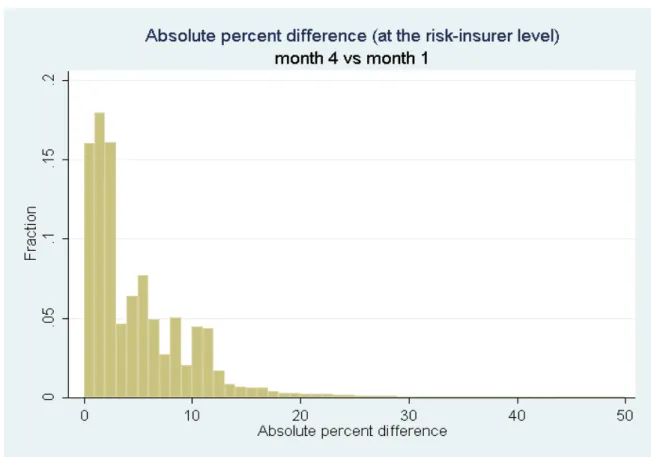
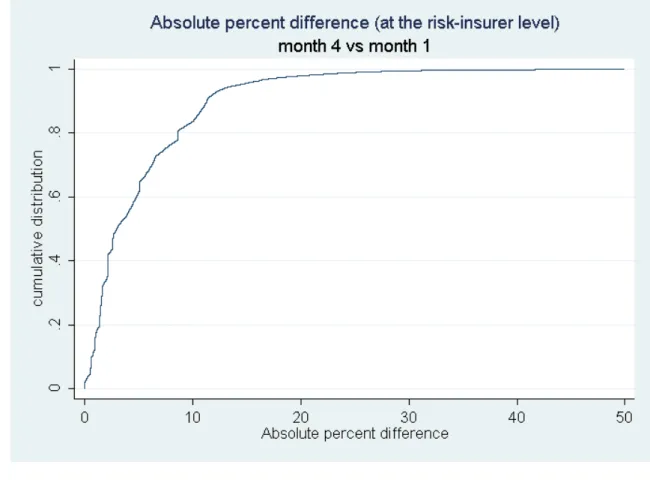
5.22 When the majority of insurers can and do change their prices on a two to three month basis and, in addition, have the ability to change their prices on a more regular basis than this, the sharing of data which is more than six months old is highly unlikely to facilitate a collusive outcome. This is because a firm’s ability to signal, monitor and react to deviation or market entry is significantly reduced.51 In these
circumstances, the fact that some insurers only make major changes in their pricing strategies once or twice a year does not, in itself,
significantly raise the likelihood of a collusive outcome.
Additional issues
5.23 In making their commitments offers, the Parties raised a number of additional issues regarding the modification of the WhatIf? Private Motor
50 See Annex 4. 51 See Annex 4.