The World Is Round
531268_250_The_World_is_Round.indd 1
Pelckmans Pro
© 2020, Jo Caudron and Pelckmans Pro
Pelckmans Pro is part of Pelckmans Uitgevers nv www.pelckmansuitgevers.be
Brasschaatsteenweg 308, 2920 Kalmthout, Belgium
Original publication: De wereld is rond. (Pelckmans Pro, 2019)
All rights reserved. No part of this book may be reproduced, stored or made public by any means whatsoever, whether electronic or mechanical, without prior permission in writing from the publisher, except in cases where the legally foreseen exceptions apply. More information about copying rights and the legis-lation relating to reproduction can be found on www.reprobel.be
During the compilation of The World is Round, use has been made of texts and illustrations for which it was not always possible to find the source. Those who feel they may have rights over these texts and illustrations are requested to contact the publisher.
Cover design: Tinxz Layout: Crius Group
Translation: Lisa de Haan (Eloquentia Ltd) D/2020/13955/7 ISBN 978 94 6337 250 3 NUR 801 pelckmanspro.be pelckmanspro.nl pelckmanspro
Jo Caudron has been working as a digital entrepreneur for years and has been involved in a number of digital businesses. For the past ten years he has worked as a transformation strategist. With his strategy and innovation agency, he helps organisations in Europe and the Middle East. Jo has written several books that all provide a source of inspiration for individuals, companies and policy-makers in these times of transformation. He is also a popular public speaker. Jo lives in the Flemish Ardennes, is happily married and has two children. They form his ideal laboratory for observing change, but also serve as the major driving force in his search for an optimistic outlook for tomorrow.
531268_250_The_World_is_Round.indd 2
THE WORLD
IS ROUND
JO CAUDRON
An optimistic master plan
for the transformation
of business and society
531268_250_The_World_is_Round.indd 3
531268_250_The_World_is_Round.indd 4
Table of Contents / 5
Table of Contents
Acknowledgements
... 11Introduction
... 151. The Metastorm
18
The Domains Of The Metastorm: Work, Housing And Mobility ... 21Let’s Ditch The Silo Mentality ... 22
What Preceded The Metastorm? ... 25
2. The Awakening
28
…the world is round ... 29My Wake-Up Call ... 32
We Have Forgotten Our Past ... 33
Nostalgia Is A Lie ... 33
A Focus On Our Achievements ... 34
3. The World Is Angry
36
The West Is Angry ... 37What Makes Us Insecure? ... 38
Who Is Insecure And Angry? ... 39
What Do You Mean Everyone Is Angry? ... 43
The Polarisation Is Not That Pervasive ... 44
People’s Insecurities ... 46
Employment-Related Insecurity ... 47
Insecurity Related To Income And Pension ... 47
Insecurity Related To Care And Ageing ... 48
Mobility-Related Insecurity ... 49
Insecurity Related To Population Growth ... 49
Insecurity Related To Housing And Living Together ... 49
Insecurity Related To New Power Structures ... 50
Insecurity Related To Artificial Intelligence ... 50
First The Rest And Then The West? ... 51
Insecurity Related To The Climate ... 52
531268_250_The_World_is_Round.indd 5
6/ The World Is Round
We Are Intrinsically Pessimistic ... 52
The Need For A Positive Story ... 53
4. Progress Pessimism Explained
54
We Have Reached An Important Crossroads ... 55Change Can Be Terrifying ... 56
The Forgotten Power Of Progress ... 57
The Wrong Kind Of Humanism In The Driving Seat ... 60
The State Of The World Is Better Than We Think ... 62
The Past Was Worse Than We Think ... 64
‘It’s All The Fault of the Media!’ ... 65
Polarisation In Society ... 68
5. Prosperity And Happiness
74
What Is Happiness? ... 75The Progress Ceiling ... 76
Progress And Happiness ... 79
The Path of Emancipation ... 80
The Classical Approach ... 81
The Emancipation Approach ... 82
The Community Approach ... 84
6. An Optimistic Perspective
88
About Change, Acceleration And Predicting The Future ... 89In Search Of A New Perspective ... 90
The Importance Of Growth ... 92
The Economic Growth Engine: Should It Continue Or Grind To A Halt? ... 95
Globalisation And The European Project ... 99
Progress, Poverty And Inequality ... 101
Is Poverty Immoral? ... 102
Is Inequality Immoral? ... 104
Inequality In Innovation ... 107
In Search Of A New Model For Sustainable Growth ... 108
7. The Peak Stuff Economy Revolution
110
The Stuff Economy ... 112Peak Stuff ... 115
The Peak Stuff Economy ... 116
531268_250_The_World_is_Round.indd 6
Table of Contents / 7
The Solution Economy ... 119
Towards Optimistic Progress ... 122
8. The Perfect Storm Impacting Work
124
The Driving Forces Behind The Perfect Storm Impacting Work ... 125Automation And Robotisation ... 126
Artificial Intelligence ... 126
Flexibility ... 127
Age And Work ... 127
Income ... 128
New Jobs... 129
Education ... 129
The Fragile Balance Between Man And Machine ... 131
Man Machine Collaboration ... 131
Digital Transformation Causes The Acceleration Of AI ... 131
The Digital Transformation Paradox ... 132
The Impact On People And Work ... 134
Man Machine Collaboration (MMC) Explained ... 135
Necessary Trusted Service Level ... 136
Levels Of Automation ... 137
The Synergy Between Man And Machine ... 139
Human Intervention As A Differentiator ... 141
The Income Debate ... 144
Man And Machine Side By Side: Utopia Or Dystopia? ... 144
Education In Preparation Of The Future Of Work ... 149
Education Today ... 149
Education Tomorrow ... 152
9. The Perfect Storm Impacting Housing
156
Linear Versus Circular Living ... 157The Evolution To Linear Living ... 159
Different Forms Of Linear Living ... 159
The Significance Of Linear Living ... 160
The History Of Linear Living ... 161
The Consequences Of Linear Living ... 162
The Cost Of Linear Living Is Higher Than It Seems ... 162
Linear Living Is Unhealthy And Bad For The Climate ... 164
Linear Living Isolates Us From Others ... 166
531268_250_The_World_is_Round.indd 7
8/ The World Is Round
10. The Perfect Storm Impacting Mobility
168
The Car As A Source Of Freedom ... 169
How Man Has Made The Car Unsafe ... 170
Impact On Our Health And The Climate ... 171
The Car Has Become Inefficient ... 172
A Car Is Expensive ... 172
Technology Will Save Us, Won’t It? ... 173
The World Is Dematerialising, What Should We Do With The Car? ... 175
Cities In (R)Evolution ... 175
New Generations, New Expectations, New Behaviour ... 176
11. The Future In 2030
180
Work In 2030: Man And Machine Working Side By Side ... 183New Jobs In High Tech ... 185
The Return Of The Manufacturing Industry ... 186
The Return Of Farming ... 188
Less Work, More Work, Different Work ... 191
Job Mobility And The Return To Circular Living ... 193
Boring Workplaces Are Now Trendy ... 194
The New Way Of Studying ... 196
Healthcare In The Community ... 197
The Development Of Urban Villages ... 198
Care Is Work Too ... 202
Urban Villages As Accelerators Of The Solution & Peak Stuff Economy .... 203
How Housing And Working Really Change Mobility ... 203
The New Mobility Models ... 205
Mobility As A Service ... 207
Life In 2030 ... 208
Meanwhile, In The Rest Of The World… ... 211
The Future’s So Bright, I Gotta Wear Shades ... 213
Urban Villages Restore A Sense Of Community ... 214
Urban Villages Improve Health, Nature And The Climate ... 215
Urban Villages And The Return Of Jobs Reduce The Hinterland ... 216
The New Economy Is Inherently Circular ... 217
531268_250_The_World_is_Round.indd 8
Table of Contents / 9
12. What Is Needed?
218
The Need For A New Deal ... 219
The Need For A Shared Vision And Support ... 220
The Need For Depolarisation ... 223
The Need For New Collaboration ... 225
The Need For Political Will And A Mandate... 227
National Policy ... 228
Local Policy ... 229
The Need For An Alternative View Of Energy ... 232
The Need For An Alternative Economic Model... 233
The Need For A Realistic Time Frame ... 233
13. Managing The Metastorm Using The SUPERchange
model
236
The Transformation Box ... 239Digitisation ... 240
Digital Transformation ... 241
From Digital To Social Transformation ... 243
The SUPERchange Model ... 248
See The Changes ... 249
Understand The Impact... 252
Predicting The Future Of The World ... 253
Plan For The Future ... 257
Our Particular Place In The Future ... 257
A Strategy For The Metastorm ... 258
A Road Map For The Metastorm ... 263
Time To Act ... 267
An Example: The Retailer In 2030 ... 268
An Example: The Bank In 2030 ... 270
All The Others ... 272
14. The World Is Round
274
Circular Living ... 276531268_250_The_World_is_Round.indd 9
531268_250_The_World_is_Round.indd 10
Acknowledgements
The journey culminating in this book was longer than I remember from my four previous endeavours. I reread the acknowledgements in my last book in which I promised my friends and family that I would never be unavailable to them for so long again. Unfortunately, this proved to be an empty promise. So, without further ado: thank you Florence for giving me the space I needed to write this book; thanks to Marilou and César for not making too much noise while you were busy respectively on Instagram or Fortnite ;-) A special thank you to Florence Pérès, to Dado Van Peteghem and Nils van Dam for being the first to struggle through the very rough versions of the manuscript.I would like to thank Annick Beyers and Philip Arickx for all the help in writing, translating and structuring the book. Thanks also to Emily De Baets for her youthful enthusiasm and rebellious fervour with which she questioned almost every statement I initially made. It all worked out in the end.
Thanks to the whole team at Duval Union Consulting, for the years of research that crept into the book one way or another. A special thanks to Emily De Baets, Aitor Somers and Francesco Cilurzo for the in-depth research in sustainability, mobility and housing. Thanks to all our clients: without their challenges I would never have made the important connections. Thanks in particular to the CEOs and their teams from
531268_250_The_World_is_Round.indd 11
the twenty or so companies I approached with a test scenario while writing the book. The lively debates and critical comments helped me fine-tune the story. Thanks to my publisher, Pelckmans Pro, for giving me the chance to write this book, and especially to Elisabeth Torfs, who immediately understood the story I wanted to tell, and who supported me with both the content and structure from the start. Thanks for quickly reworking the whole structure a week after the deadline, the book is far better as a result (on the other hand, the lack of sleep…)!
Last of all I would like to thank Devin Townsend, the Canadian musician whose music I discovered by chance while writing this book. I believe it is the perfect soundtrack for the Metastorm: confusing, loud, threatening, beautiful, hard, genius, chaotic, metal, classical, raw, complex, layered, eclectic, opera, muddled, emotional and above all, optimistic. Higher! Higher! For the adventurous among you: http://tiny.cc/ b7mnaz.
Thanks!
531268_250_The_World_is_Round.indd 12
THE
PRESENT
DIFFERS TOO
MUCH FROM
THE
PAST
TO BE
ABLE TO MAKE
STATEMENTS
ABOUT THE
FUTURE
!
531268_250_The_World_is_Round.indd 13 531268_250_The_World_is_Round.indd 13 11/02/2020 11:18:2611/02/2020 11:18:26531268_250_The_World_is_Round.indd 14
Introduction / 15
Introduction
You write an introduction once a book is finished, when you know what it is about. This book was quite an undertaking. Not only because I had more to say than in my previous books, but also mainly because this time I dared to stray far from my comfort zone. All my life I have been a self-made entrepreneur ex-ploring unfamiliar topics. That was the case 25 years ago with my first Internet company, and is still the case today in my reflections on the transformation of society. It’s not something I studied for, and even if I had wanted to, there are no study programmes to prepare you for this job.
I believe this represents the strength and the weakness of this book. Over the years I have learned to identify patterns across different domains, which reveal how everything looks similar and is mutually dependent. Not only do you ob-serve how a problem on this side creates a problem elsewhere, you also see that a solution only works if different domains are connected. This insight was al-ready relevant when producing a simple website, and is even more so in the case of digital transformation. For social transformation it appears crucial. Once you obtain this insight you notice the underlying patterns, a bit like Keanu Reeves in the film The Matrix.
The consequence of this approach is that you should read this book as a per-sonal vision. While I use verifiable figures and facts as the basis, where they lead me is entirely speculative. Therefore, this book is not scientific. It is not based on in-depth research, methodological, accurately performed studies or any other academic or formal legitimacy. It is my personal vision of change in the world as it currently unfolds. It is also an attempt to seek possible solutions.
This book starts with the Metastorm, an impending phenomenon that I afford almost mythical proportions. It is the metaphor for the many changes as a cause of the transformation facing our society today. This transformation will demand
531268_250_The_World_is_Round.indd 15
16/ The World Is Round
resilience and energy from all of us. Therefore, it is important to be aware of our current state of readiness in which we can invest. In the first part of this book I take a look at the world to establish that there is a trend of growing pessimism. The systems that have been developed are being questioned and there is in-creasing polarisation. Not only do I attempt to identify it, but also to explain it, which makes it possible to respond to this trend.
In the second part I go in search of an optimistic perspective. I reflect on tricky themes such as economic growth, inequality, prosperity and happiness, and of-fer an alternative economic model, to reconcile growth with the major challeng-es of tomorrow.
The third part examines in detail the perfect storms on the horizon in the dif-ferent domains of work, housing and mobility. I dissect the challenges we face today and how the three perfect storms catch up with each other to converge and form the Metastorm. I use these insights to seek an optimistic, speculative vision of the world that I set in the year 2030. I describe the different dimensions of our society based on the assumption that we could use the Metastorm as a positive force to create a better world.
The final part describes an approach for taking action tomorrow. After discussing the main critical factors for success, I go on to provide the reader with a method for compiling an optimistic transformation plan using the SUPERchange model. I realise this is a rather lengthy book. I thoroughly enjoyed writing it and hope you will derive the same pleasure from reading it.
Jo
(Contact me at jocaudron.com)
531268_250_The_World_is_Round.indd 16
531268_250_The_World_is_Round.indd 17
01
The Metastorm
531268_250_The_World_is_Round.indd 1801 The Metastorm / 19
The Metastorm
The times in which we live are interesting but alarming. When I embarked on my digital career 25 years ago, I could never have imagined I would have a front row seat on so much change. I have actively worked on the emergence of the digital society. Every month a new opportunity, a new concept, or a new hype sprung up. I was at the forefront of the emergence of the first websites, e-commerce, intranets, online video, online advertising, mobile sites, apps, and social media, as well as the first fatal disruptions, which resulted in bankruptcies…
My mother was a nurse, and on Sunday she made a habit of nonchalantly talk-ing about bedsores, stomas, amputations and other fascinattalk-ing medical facts while we ate our chicken, salad and fries. On one of these unique occasions – I must have been around twelve years old – the topic of conversation was the grief module, the five stages terminally ill patients go through: denial, anger, bargaining, depression and acceptance. How often have I seen this happen to businesses and their CEOs in the past 25 years? Blockbuster, Kodak, Nokia and others were the first to go through these stages and succumb. This is what lies in store for a large number of companies and sectors under pressure from the digital mastodons of today, such as Uber, Amazon and Netflix. I have seen the general vision of the digital world evolve from a hype that would soon blow over, to the force it harnesses today: ruthless in terms of its speed and impact, sparing nothing and nobody, yet totally captivating. In the past ten years my calling has involved helping traditional organisations cope with it: preventing them becoming terminally ill and ensuring that, once they emerge from a phase of denial, they focus their energy on something other than anger and resistance. My aim is to heal them and get them in shape for the digital world.
531268_250_The_World_is_Round.indd 19
20/ The World Is Round
Two years ago I was struck by doubt. What if my approach is lacking? What if there’s a lot more to it than ‘simply’ formulating a response to the digital challengers? What if being aware of, and surviving digital disruptions proves in-sufficient because something much bigger is happening: a social transformation that is all-pervading?
I gave it a name, because I wanted to make this feeling tangible, and because it produces an effective, dramatic reaction during a presentation: I call it the Meta-storm. It is a concept I devised to illustrate the scope of the challenges we face. In order to explain the Metastorm, I start with something with which we are all familiar: the perfect storm. It is a climatic phenomenon in which a rare combi-nation of conditions increases the impact of the storm to such an extent that the consequences are far worse than we would typically expect. Most people know the term from the Hollywood blockbuster with the same name, featuring George Clooney from 2000, but unfortunately also from the harsh reality of Hur-ricane Katrina in 2005, the most devastating meteorological disaster to ever hit the US. With the arrival of the digital transformation we began using the term in a business context, to demonstrate that an entire industry could be annihilated if a number of factors were to converge. By analogy with what happened in, for example, the video store market, the music industry or the photographic sector, many business leaders are holding their breath in anticipation of the moment when a perfect storm strikes their particular industry.
I believe that perfect storms are currently gathering force in a number of fields. Sectors are under pressure from technological innovation and economic change. The expected upheavals will not be limited to the industries themselves; we appear to be gradually reaching a tipping point with regard to social issues too, which could give rise to major changes. We are approaching a point at which several perfect storms are simultaneously building, and exerting a major impact on each other: a perfect storm made up of several perfect storms, or a Meta-storm, which has the ability to precipitate social upheaval the like of which has so far been unthinkable.
531268_250_The_World_is_Round.indd 20
01 The Metastorm / 21
The Domains Of The Metastorm: Work, Housing
And Mobility
Which domains will be ravaged by these perfect storms? With regard to the digital transformation, we now see that there are no sectors that can evade the effects of digital disruption. After the first waves of change in media, entertain-ment and photography, we currently find ourselves in the midst of the transfor-mation of the retail and banking sectors, and we are heading for even greater upheaval in healthcare, education, production, food and so on. In short, each sector has the potential to survive a perfect storm, although the outcome is in-herently unpredictable. What’s more, there are social themes that run through all industries and systems: climate change, globalisation, changes in manufacturing, an ageing population, migration, etc. They involve some of our most problematic challenges.
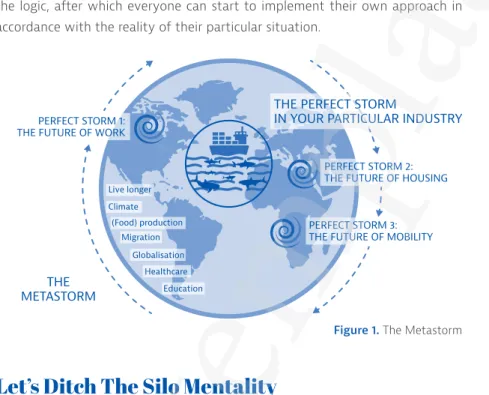
I have selected three major perfect storms that are strongly interrelated, and therefore will almost certainly result in a Metastorm: the future of work, the future of housing and the future of mobility. I deliberately selected these three domains because I am convinced that these three perfect storms collectively form a fabric of society. They constitute the basis on which many of the other domains of industry are built, and are consequently an important part of the fabric, of the substructure of the society to which we all belong. Another reason for this choice is that the three are relatively easy to change. It is not utopian to reflect on other forms of work, a different way of organising how we live, or new mobility solutions. On the contrary: when we take a closer look, we see that these changes are already under way.
What is lacking is a holistic approach to the perfect storms, a more effective identification of the connections and an attempt to allow the effect of one positive to act on the other. Thinking about these three perfect storms again in the right way could transform the Metastorm’s energy into a positive force: a force for change that will also have a positive impact on other important social domains, and a force for change that will help businesses and sectors write a new and optimistic plan for their future.
Therefore, the three perfect storms form the basis of our Metastorm model, but depending on your type of organisation, you will naturally attach more
impor-531268_250_The_World_is_Round.indd 21
22/ The World Is Round
tance to one force or the other. Like everything in life, there is no one-size-fits-all solution to complex problems. By simplifying the issue, I also hope I can convey the logic, after which everyone can start to implement their own approach in accordance with the reality of their particular situation.
PERFECT STORM 1: THE FUTURE OF WORK
THE METASTORM
THE PERFECT STORM
IN YOUR PARTICULAR INDUSTRY
PERFECT STORM 2: THE FUTURE OF HOUSING PERFECT STORM 3:
THE FUTURE OF MOBILITY
Live longer Climate (Food) production Migration Globalisation Healthcare Education
Figure 1. The Metastorm
Let’s Ditch The Silo Mentality
Silos have been a constant throughout my career. It was around 25 years ago when I started building websites. A site was ordered either by IT, Marketing, HR or Sales.
By definition these were all bad websites: they were built from the reality of a single department, a company silo, which was not linked in any way to the other entities. In those rare cases in which multiple departments sat around the table together, it was surreal to witness how everyone seemingly spoke the same lan-guage but nobody appeared to want to understand anyone else. IT considered marketeers to be systematic dreamers that apparently tripped on too many mind-expanding substances and asked for impossible applications. Marketing viewed IT as an autistic bunch that had a single standard response: ‘Computer says no’. Nobody saw the holistic whole outside the company from their own silo: the customer and the rest of the world. Fortunately these times are behind us and we realise that collaborating is the only way to build digital solutions that genuinely serve the interests of the business as well as the customer.
531268_250_The_World_is_Round.indd 22
01 The Metastorm / 23
Initially we also observed a similar silo mentality in relation to the digital trans-formation: CMOs (Chief Marketing Officer) and CIOs (Chief Information Officer) jostling to take the lead in this new discipline. Fortunately, many CEOs and boards of directors soon grasped the fact that transformation extends to all parts of a business.
Yet a silo mentality is the reason why we don’t see a Metastorm coming. In the best-case scenario we are aware of our own perfect storm, or we see one social transformation occurring, but we do not have a view of the bigger picture. Now that we are on the verge of major revolutions, once again we lack a holistic, transversal framework that offers a panoramic view of the different silos and plans. This is effectively reflected in how cities and municipalities are organised nowadays: with strictly delineated competences for aldermen from different policy areas: mobility, urban development, economy, civil society, urban plan-ning, and so on, all in separate portfolios, often of services that refuse to work together.
If we want to have an idea of what the future holds for us, it is important that we adopt a holistic view of all the individual perfect storms currently build-ing. The various upheavals in society are convergbuild-ing. If we are unable to form an all-encompassing picture of them, it is highly likely that we will be over-whelmed by the seemingly chaotic changes, which will paralyse us, and we will be doomed to experience the challenges fatalistically. In order to cope, we must look for patterns that transcend the silo mentality, in disruptions as well as solu-tions. This will enable us to start thinking about an overall plan. It might seem utopian to believe that we could produce a master plan to manage our diverse challenges. I can already hear people say: how can we draft a master plan if we still have no idea of the sub-aspects? Nonetheless, in my opinion this is the only way. Metastorm thinking can help us break through the silos and see the bigger picture. If we continue to fixate on the destructive forces of all these seemingly isolated perfect storms, we will no longer be able to see the forest for the trees. If we make an effort to identify patterns in the chaos of the perfect storms, we will discover the connections necessary to work towards an optimistic plan for the future.
531268_250_The_World_is_Round.indd 23
IF WE MAKE
AN
EFFORT
TO IDENTIFY
PATTERNS IN
THE
CHAOS
OF
THE PERFECT
STORMS, WE WILL
DISCOVER THE
CONNECTIONS
NECESSARY TO
WORK
TOWARDS
AN OPTIMISTIC
PLAN FOR THE
FUTURE
.
531268_250_The_World_is_Round.indd 24
01 The Metastorm / 25
What Preceded The Metastorm?
Until the digital revolution, most companies were large, stable battleships. They were not particularly manoeuvrable and sailed in calm waters. They knew their customers, partners and competitors through and through. The game and the rules of play were clear and subject to very little change. Evolution and inno-vation progressed at a steady pace without any major shock waves. Of course, some did sink, but this took a very long time and the cause was more often to be found in bad management than in the failure to correctly assess abrupt changes. The first generation of digital developments was simply a tool that served the objectives of these companies. Digitisation was an ‘enabler’ of further optimisa-tion, with cost-reductions as the underlying objective. Communicaoptimisa-tion, market-ing, transactions and the entire underlying process flow of businesses became digitised. Banks, for example, first made their marketing, communication, ac-count management and payments available on online platforms, followed by product purchases such as loans. For 25 years, companies have been digitising their entire business operations, layer by layer, including the potential errors that had historically crept into them. Operational processes were faster, more customer-friendly and more efficient. Digital technology had no direct impact on the essential value proposition. In essence, a company remained unchanged and primarily created a digital version of itself, with the main goal being to save costs.
Around ten years ago, digitisation acquired another dimension. New players introduced disruptive forces in the market, which use the possibilities of dig-itisation to cast doubt on the essence of traditional business models and val-ue propositions. Suddenly, the music industry no longer operated by pressing and selling records. New players such as Spotify stream music and offer a new business model based on access to music instead of ownership of a physical product. The status quo of the business model, which revolved around selling records, was disrupted. Digital disruption that results in digital transformation is a phenomenon that we now observe in all sectors: from media and enter-tainment to retail, the banking sector and even mobility. New challengers have a much better understanding of how they can use digital technology to find better solutions to an old problem.
531268_250_The_World_is_Round.indd 25
26/ The World Is Round
It is clear that the impact of the second digital wave is disruptive. Most or-ganisations in diverse sectors still don’t have a convincing plan to address the digital transformation and reinvent their particular business model. New players have opportunities because traditional companies, which have operated in their sector for years, do not change, for fear of putting their existing model at risk. Fortunately, we see that an increasing number of traditional companies do un-derstand they have to make the transition. They detect the perfect storm in their industry and compile a plan for their transformation, which often consists of finding a new balance between the traditional business (the mother ship) and radical innovation (the speedboat). Banks get answers to market-disruptive innovation from small fintech players as well as major initiatives by big tech like Google, Apple, Amazon and Facebook. Retailers develop plans to arm themselves against Amazon or Alibaba. Of course, there is still a fundamental difference between producing a digital transformation plan and effectively implementing it. I am convinced that at the time I am writing this book there is a growing number of organisations with a sound transformation plan, but hardly any that are actually implementing it.
But, what if even the successful implementation of the digital transformation plan proves insufficient? What if this is just the first step? What if managing our specific perfect storm is just a small piece of the puzzle? Is your company ready to handle the social perfect storms that are building? Do you have a strategic plan for the Metastorm, of which your sectoral perfect storm is just a single component? We are arriving at a point at which not only traditional business models are faltering as a result of digital disruption, but social transformations will also have a fundamental impact on business strategy. The way in which we will work, live and move in the future, the way in which we strive for sus-tainability and tackle other major challenges, will have at least as significant an impact on our long-term strategy as the pressure Amazon and co. exert on our businesses.
The good news is that we can examine and address all these challenges in one and the same Metastorm plan. Each company must ask what stage of digiti-sation and transformation it is in. Does it predominantly concern the classic digitisation of processes and customer relations, or is there already a plan of action in case the business models are at risk of changing? Or does the company
531268_250_The_World_is_Round.indd 26
01 The Metastorm / 27
actually look further ahead into how the world is evolving in terms of sustaina-bility, climate, working, living and mobility? In the run-up to, and preparation of this book I spoke to hundreds of people from dozens of organisations, including companies and authorities. Although this is not a scientifically recognised sam-ple, there is an obvious trend. Most have to admit that they are still predomi-nantly stuck in pure digitisation: the process-based translation of services and business relations. Just a handful of companies believe they have a plan for digital transformation and changing business models, although the implementa-tion is still in its infancy. In all these months, I never came across anyone that is entirely confident they have a plan for the Metastorm.
I encounter many people that are very concerned about the future and sense where the challenges lie, but do not have a real master plan. This provided me with additional motivation to write this book, in which I aim to explain the forces at play and how they are interrelated. I want to demonstrate that it is possible to formulate an answer to the question of how you can understand them and integrate them in a timetable for the future. I want to prove that the forces of the Metastorm do not necessarily need to be viewed as negative, be-cause they can help us create an optimistic vision of the future for the next 75 years. However, I also want to point out the risks of the social climate in which we currently find ourselves, how we are gradually creating a world in which a pessimism is growing that will deprive us of the strength to cope with major challenges in a constructive manner.
Later on in the book I explore the three major perfect storms as the basis of the Metastorm in more detail, but before that I first want to zoom in on the state of our world today, the stage on which all transformations play out.
531268_250_The_World_is_Round.indd 27