Casey and James are fifth-grade special education students receiving math instruction in a special education classroom. They have been working on mastery of basic multiplication facts for 3 years with limited success. They are mainstreamed into general education class-rooms for science and, in one particular unit, are using memo-ry-enhancing strategies to learn chemical compound formulas. When the teacher holds up a box of table salt, Casey remem-bers that potato chips are salty and that “No one can eat just one!” She then says to herself, “Not a Chip left!” and writes down NaCl. When the teacher holds up a bag of sugar, James remembers that if he frequently eats food and drinks beverages with large amounts of sugar, he will develop painful cavities. Then he thinks to himself, “12
Cavities Have 22 Ouches at 11 at night,” and writes down C12H22O11.
In this classroom scenario, two students with learning disabilities have learned how to use associative learning strate-gies to recall information that many other students memorize with little dif-ficulty. Could students like Casey and James also learn associative learning strategies to remember basic multiplica-tion facts? Yes, according to a recently
published study (Wood, Frank, & Wacker, 1998). These researchers found that after receiving instruction on one strategy, each student’s accuracy was often 100%, and this was maintained throughout the study even as they learned additional strategies. This arti-cle describes methods you can use to successfully teach students how to remember the basic multiplication facts. Families of Basic Facts
In this strategy, all 100 basic multiplica-tion facts involving the numerals 0-9 are grouped into families: the zeros, ones, twos, fives, nines, and pegwords. For a fact to be included in a family, it must contain at least one numeral that corre-sponds to the name of that family. For example, the fact, 0 x 4, belongs in the zeros family because it contains at least one 0; the fact, 2 x 7, belongs in the “doubles” family because it contains at least one 2; the fact, 1 x 5, can be
included in either the ones or fives fam-ily. Fifteen facts make up the last group of facts, called the “pegword family.”
Strategies for Remembering Multiplication Facts
Teach students a specific strategy for remembering the facts within each fam-ily. The facts involving 0 and 1 are the easiest to learn, so teach the strategies for remembering these facts first. The facts involving 2, 5, and 9 are more dif-ficult to learn, so introduce the strate-gies for remembering these facts after the students have mastered the zeros and ones families. The remaining 15 facts (pegwords) should be taught last because the strategy takes more time to learn (Greene, 1992).
The 0, 1, 2, 5, and 9 Families
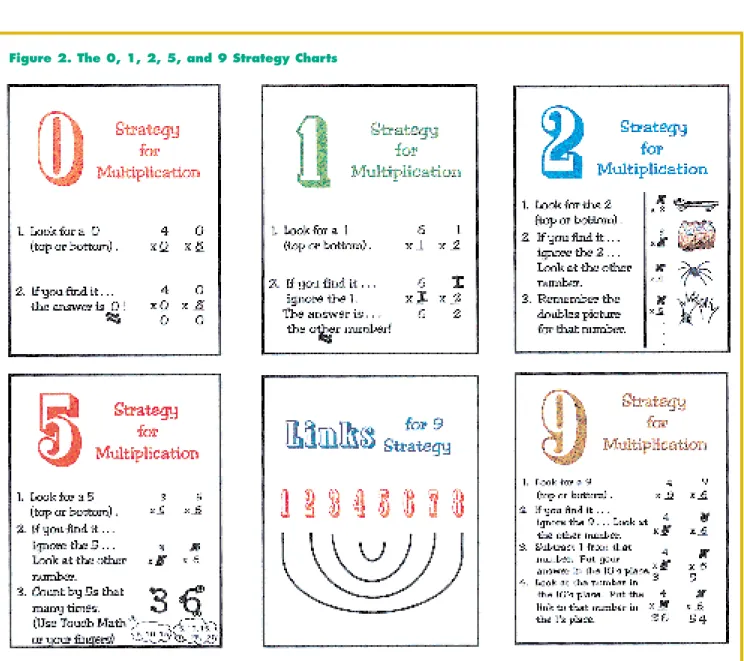
Introduce your students to the memory-enhancing strategies, beginning with the “0 Strategy,” using the lesson plan in Figure 1 and the corresponding strat-egy chart (Figure 2). Continue practic-ing a specific strategy in subsequent les-sons until your students accurately answer the related multiplication facts.
TEA CHING Exceptional Childr en , Vol. 32, No. 5, pp. 78-82. Cop yright 2000 CEC.
Using Memory-Enhancing Strategies
to Learn
Multiplication Facts
Donna K. Wood
Alan R. Frank
Students will be motivated to
learn each strategy if you teach
them to graph the percentage of
correct responses on each practice
worksheet.
“The students developed a
positive and enthusiastic attitude
Figure 1. Plan for Teaching the Strategies
Preskills
Students must be able to correctly name and write the numerals from 0-9 and count by 5s.
Steps
1. If one or more strategies already have been taught, review them at the beginning of the lesson.
2. Give each student a worksheet on which has been written a few multiplication facts from each of the families. 3. Demonstrate how to find the problems in the family being taught by running your finger under the problems. Stop at
each and think out loud. “Is there a _____ (e.g., 0) in this problem?” Then answer your own question.
4. Hold up the strategy chart. Read it to the students. Go through the examples on the chart. Have the students practice saying the rules.
5. Draw the students’ attention to the first problem on their worksheet. Ask the question. “Is there a ____ (e.g., 0) in this problem?” If yes, lead the students in saying the rule, then direct them to write the answer under the first problem. If no ____ (e.g., 0) is present, tell students to skip the problem, and go on to the next one.
6. Continue this procedure until all problems in the family have been identified and answered.
Students will be motivated to learn each strategy if you teach them to graph the percentage of correct responses on each practice worksheet. Encourage your stu-dents to attribute their success to their use of the strategies.
Before introducing the “2 Strategy,” teach your students to associate a visu-al image with each fact in the family. The following visual images on flash cards are easy for students to remem-ber: 2 x 2—a skateboard with two sets of wheels, 3 x 2—a six pack of pop, 4 x 2—a spider with two sets of four legs, 5 x 2—two hands with all fingers held up, 6 x 2—a dozen eggs in a carton, 7 x 2— a calendar with 2 weeks circled (7 days
and 7 days), 8 x 2—two octupi, each with eight tentacles, 9 x 2—an “18-wheeler” truck (9 wheels on each side). Students will need to be fluent in counting by 5s before you introduce the “5 Strategy.” This may be accomplished by providing students with practice over a period of several days. Tell your stu-dents this practice will help them to learn some of their multiplication facts.
Figure 3. Numbers with Associated Pegwords and Symbols
Note: “Twin-T” symbol refers to a popular TV character called “Mr. T,” who had his hair shaved except for a strip on the top of his head.
Quotes from a special education teacher who used this instruc-tional method:
The students developed a positive and enthusiastic attitude toward math instruction. This was in contrast to the attitude previously displayed by these students. They not only reported enjoying math more, but attributed their learning successes
directly to the mnemonic methods and materials being taught.
One of my students received daily medication for an ADHD diagnosis made when he was a first grader. Despite daily med-ication for ADHD, he exhibited attentional diffi-culties in all academic areas. However, a change in task completion occurred during mnemon-ic instruction. He learned to scan the multiplication facts on a worksheet, identify the correct strate-gy for solving each prob-lem, write the answers, often completing the task
before the other students
in his math group!
An important part of this
instructional package is
continuous data collection to
determine each student’s progress
in learning the multiplication
facts.
Keep the practice sessions short and brisk to maintain student attention.
The “9 Strategy” involves two charts (Figure 2). Use the “Linking for 9” strat-egy chart to teach your students to asso-ciate pairs of numbers. For example, show students that the number 1 is associated with the number 8, and the number 2 is associated with the number 7 (Schroeder & Washington, 1989). Once your students have learned these number associations, use the lesson plan to introduce the “9 Strategy” chart.
The Pegword Family
The pegword strategy (Mastropieri & Scruggs, 1991; Willot, 1982) is more complicated and thus will take more time for your students to learn. A few weeks before you introduce the peg-word strategy, begin teaching students to associate each number word used in this family with what is called a
rhyming pegword(see Figure 3). 1. Prepare flashcards, on one side of which are number words and the other side of which are the corresponding pegwords and symbols (e.g., the num-ber word “one” on one side and the pegword “sun” on the other accompa-nied by a picture of a sun).
2. Begin each practice session by intro-ducing about three new associations, then review previously learned associa-tions.
3. Alternate using each side of a flash-card as the stimulus during these ses-sions, requiring a number word response when you hold up the peg-word and symbol side and requiring a pegword response when you hold up the number word side.
4. Prepare flashcards that show combi-nations of pegwords. For example, the number 21 is illustrated by combining “twin-T” with “sun” (see Figure 4, the 3 x 7 fact), and the number 32 is illustrat-ed by combining “dirty” with “shoe” (see Figure 4, 4 x 8 fact). Add these cards to your practice sessions.
Once your students are firm in their responses to all the pegword flashcards, begin instruction on the pegword strate-gy.
1. For this phase of instruction, prepare pegword fact flashcards using the
Figure 4. Pegword Family of Facts, Associations, and Elaborations
where a fact appears on one side of a flashcard along with the correspon-ding pegword and visual associa-tions.
2. Introduce the pegword strategy using the chart shown in Figure 5, along with the first three pegword fact flashcards.
3. As you show each pegword fact flash-card, lead students through the corre-sponding elaboration provided in Figure 4. Require students to repeat the elaborations because this will assist them in remembering the facts. 4. Omit the worksheet portion of the
lesson plan until you have introduced all 15 flashcards and the students have practiced them.
Student Self-Assessment and Self-Monitoring
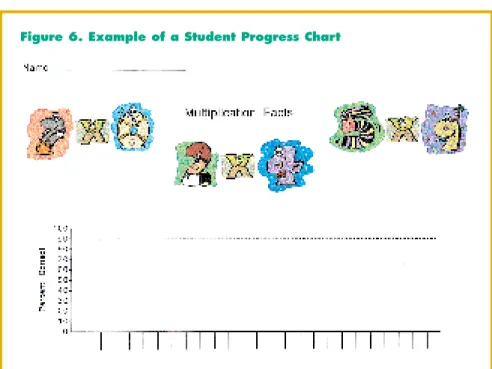
An important part of this instructional package is continuous data collection to determine each student’s progress in learning the multiplication facts. You can accomplish this by asking students to complete a multiplication facts work-sheet two or three times per week as part of instruction. After the worksheets are scored (and analyzed if errors have been made), each student should plot the results on a graph similar to the one shown in Figure 6. Most students are highly motivated when they observe the
progress they are making and strive to reach the goal shown on their graph. Students as Active Learners This instructional method will teach your students how to approach multipli-cation facts. Rather than relying on rote memorization, students will be able to approach multiplication facts with a set of strategies that will enable them to solve the problems. These strategies will allow students to become active learn-ers, analyzing each problem and not only determining the correct strategy, but also applying each step in the strat-egy.
References
Greene, G. (1992). Multiplication facts: Memorization made easy. Intervention in School and Clinic, 27,150-154.
Mastropieri, M. A., & Scruggs, T. E. (1991). Teaching students ways to remember: Strategies for learning mnemonically. Cambridge, MA: Brookline Books.* Schroeder, M. A., & Washington, M. (1989).
Math in bloom. East Moline, IL: LinguiSystems, Inc.*
Willot, P. C. (1982). The use of imagery as a mnemonic to teach basic multiplication facts to students with learning disabilities. Unpublished doctoral dissertation, West Virginia University, Morgantown. Wood, D. K., Frank, A. R., & Wacker, D. P.
(1998). Teaching multiplication facts to students with learning disabilities. Journal of Applied Behavior Analysis, 31,323-338.
*To order the book marked by an asterisk (*), please call 24 hrs/365 days: 1-800-BOOKS-NOW (266-5766) or (732) 728-1040; or visit them on the Web at http://www.BooksNow. com/TeachingExceptional.htm. Use VISA, M/C, AMEX, or Discover or send check or money order + $4.95 S&H ($2.50 each add’l item) to: Clicksmart, 400 Morris Avenue, Long Branch, NJ 07740; (732) 728-1040 or FAX (732) 728-7080.
Donna K. Wood, Special Education Teacher, West Middle School, Sioux City Community School District, Sioux City, Iowa; and Alan R. Frank, Professor Emeritus, Curriculum and Instruction, The University of Iowa, Iowa City, Iowa.
Address correspondence to Alan R. Frank, 2612 Bluffwood Circle, Iowa City, IA 52245 (e-mail: [email protected]). Note: The visual images referred to in this article are available in “ready-to-use” format on the Internet (http://www.uiowa.edu/~xfacts TEACHING Exceptional Children, Vol. 32, No. 5, pp. 78-82.
Copyright 2000 CEC. Figure 5. The Pegword
Strategy Chart
Figure 6. Example of a Student Progress Chart