Public Health Programme
(PHP) 2003-2008
Final report
March 2011
DG SANCO
Ex-post evaluation of the
Public Health Programme
(PHP) 2003-2008
Final report
March 2011 Parallelvej 2 DK-2800 Kongens Lyngby Denmark Tel +45 45 97 22 11 Fax +45 45 97 22 12 www.cowi.comTable of Contents
1 Key points of the evaluation 1
2 Executive summary 4
2.1 Introduction 4
2.2 Methods 4
2.3 Main results and conclusions 5
2.4 Recommendations 11
3 Introduction 14
3.1 Purpose of the evaluation 14
3.2 Outline of the report 15
4 Context of the evaluation 17
4.1 Complexity of European public health 17
4.2 Public Health Programme 2003-2008 (PHP) 18
5 Evaluation methodology and data collection 24
5.1 Methodology 24
5.2 Data collection 25
5.3 Caveats 40
6 European public health needs - relevance and
European added value of the PHP 42
6.1 Background and focus 42
6.2 Summary - relevance 42
6.3 Evaluation results 44
7 Contribution to European public health -
effectiveness of the PHP 57
8 The EU level public health initiative -
consistency/complementarity of the PHP 81
8.1 Background and focus 81
8.2 Summary - consistency/complementarity 81
8.3 Evaluation results 82
9 The EU level public health initiative -
support/involvement of the PHP 92
9.1 Background and focus 92
9.2 Summary - support/involvement 93
9.3 Evaluation results 94
10 Monitoring of the PHP 109
10.1 Background and focus 109
10.2 Summary - monitoring 109
10.3 Evaluation results 110
11 A sustainable EU public health effort -
sustainability of the PHP 112
11.1 Background and focus 112
11.2 Summary - sustainability of the PHP 112
11.3 Evaluation results 113
12 Conclusions and recommendations 123
12.1 Relevance and European added value 126
12.2 Effectiveness 129
12.3 Consistency/complementarity 132
12.4 Support/involvement 134
12.5 Monitoring 136
12.6 Sustainability 138
12.7 Evaluation conclusions from case studies 139
13 Literature 142
Appendix
Task specifications1
Key points of the evaluation
Achievement of programme objectives• The case studies illustrate a clear linkage between the objectives of the PHP and the projects funded on one hand and how these projects may con-tribute to the achievements of the objectives of the PHP on the other hand. However, the assessment of achievement of objectives is hampered by lack of clear performance indicators.
• The e-survey reveals that even though many stakeholders find that the ob-jectives are unclear, there is a general belief that PHP obob-jectives have been achieved to some extent. Beneficiaries are more optimistic compared with other stakeholders.
• The case studies document that the projects funded by the PHP have deli-vered a number of concrete results in the form of reports, articles, websites and training etc.
• Most of the projects selected for the case studies have a strong potential to contribute to the preparation, development and implementation of EU pub-lic health initiatives. However, only limited evidence was found of such contributions at both national and EU level.
• There are projects where dissemination of knowledge generated has been considerable. However, for other projects, the dissemination effort has not been targeted to all relevant stakeholders.
• According to the case studies, sustainability was mainly achieved by mak-ing projects results available on websites after the project period and through follow-up projects funded by DG SANCO. There seems to be a need for a clearer focus on dissemination of project results to policy-makers in order to promote sustainability through implementation of policy initiatives.
• According to the case studies, a three-year funding period is not always long enough to cover the whole project cycle. Furthermore, the present
funding model where projects compete to obtain funding may promote good start-ups but entail less focus on dissemination and implementation of the results.
Implementation of the programme
• All projects selected for in-depth case studies are perceived to be relevant to the PHP and have provided clear European added value - in this way, the projects selected may be regarded as success stories. The Commission staff stated in the interview that the focus on European added value should have higher priority
• The portfolio analysis conducted by COWI shows a good coverage of PHP objectives and work plan priorities.
• However, many stakeholders involved in the implementation of the PHP hold the view that there are too many priority areas in the annual work plans.
• According to the e-survey, most beneficiaries are familiar with the EU public health policy in general. They are also familiar with the general programme objectives and annual priorities of the PHP but to a somewhat lesser extent.
• Other stakeholders employed by international organisations are in general very familiar with the EU public health policy and the way the programme supports this policy.
• It may be somewhat surprising that other stakeholders employed in the public administration of the Member States are not more familiar with the EU public health policy, general programme objectives and annual priori-ties of the PHP than the e-survey results indicated.
• Small organisations might not have the resources necessary to participate in the programme, especially organisations/research institutions from East-ern Europe.
• According to the e-survey, most beneficiaries have met barriers to receiv-ing fundreceiv-ing (language, procedures, cultural differences, new/old EU mem-bership). From the viewpoint of most other stakeholders, there are indeed barriers to receiving funding.
The five highest ranked recommendations
1 DG SANCO should reduce the number of priority areas in the annual work plans by allowing a maximum of five priority areas in each of the three
strands to increase the impact within the priority areas, bringing them to not more than 15 per yearly call.
2 DG SANCO should in collaboration with EAHC define clear performance indicators (success criteria) at programme level in order to facilitate fol-low-up and evaluation of the achievements. These success criteria should be based on a thorough elaboration of the intervention logic underpinning the different areas and priorities of the programme.
3 EAHC should compile brief descriptions of project results, compatible with the existing database, including considerations about use potential and policy recommendations if relevant, and disseminate these to Commission staff and national stakeholders at the political level, under the caveat that such procedures do not increase the administrative burden for the end user and grant holders unnecessarily.
4 DG SANCO should ensure that the priority areas in the annual work plans are focused and based on a thorough analysis of needs and European added value. This analysis should be carried out by public health experts versed in these issues.
5 EAHC and DG SANCO should pursue inclusion of Member States which appear inactive in the programme. These are typically countries with a rel-atively low GDP/capita. Inclusion could be pursued by providing technical assistance to write proposals (EAHC) or by increasing the EC financial contribution (DG SANCO), possibly on the basis of an alternative cost model.
2
Executive summary
2.1
Introduction
The overall purpose of this evaluation is to assess the effectiveness, efficiency and utility of the Public Health Programme (PHP). Thus, it is assessed whether the achievements of the programme:
• correspond with its objectives
• are achieved at reasonable resource use/costs
• correspond with needs, problems and issues (of relevance to stakeholders). Furthermore, the impact of the programmes, projects, and activities on the im-provement of public health policies in the Member States and at EU level is assessed. This is done by evaluating the extent to which the programme has achieved the intended outcomes/impacts, delivered inputs to policy, ensured consistent and complementary implementation with respect to the Member States' expected achievements in the field of public health, and been imple-mented in accordance with the international public health aims. All this will be undertaken with a view to examining European added value.
2.2
Methods
The results of the evaluation are found by combining four types of information sources, namely desk study, e-survey, interviews and case studies - acknowl-edging the strengths and the weaknesses of the different methods. The different sources contribute in different ways. While e.g. the e-survey has a widespread coverage of beneficiaries and other stakeholders compared with the interviews and case studies, the issues are, in turn, covered in less detail.
In addition to these weaknesses, there are a number of caveats to be aware when analysing the results of applying the evaluation methodology. Purpose
Combination of four types of information sources
The evaluation of the effectiveness of the PHP in contributing to European pub-lic health suffers from a lack of an exppub-licit intervention logic that could facili-tate the setting of clear and logically linked objectives and corresponding per-formance indicators. A consequence of intended results and impacts not being clearly set out is that it is difficult to assess whether they have been achieved. Hence, in practice - as done in the present evaluation - the evaluator attempts to establish the invention logic for the programme, and while doing this, seeks to describe how to measure objective achievement. The caveat is thus that the use of the assessment of objective achievement is associated with the additional uncertainty of target specification.
Even without well-specified targets, an evaluation will analyse results and im-pacts envisaged to have been caused by the PHP interventions. This is, how-ever, also not straightforward - for at least two reasons.
Firstly, changes to, for example, health policies and ultimately improvements to the health of groups of European citizens are typically the result of complex interactions. Since it is difficult to attribute the change in a given health out-come to a specific PHP intervention, the evaluation merely assesses whether the intervention has contributed to a change in the health outcome.
Secondly, the counterfactual situation of what would have happened to the relevant health output, result, or impact indicators anyway - i.e. without the PHP intervention - is unobservable, and furthermore it is in the given context considered difficult to estimate.
Furthermore, the fact that health improvements take time means that many of the results and impacts of the PHP interventions will not have materialised at the time of the evaluation - but may do so in the medium to longer term. Hence, a caveat is that the evaluation to some extent is limited to assessing the actual project deliverables. Another caveat is here that such speculations, in particular by project participants, are likely to be too optimistic - a caveat that in practice is relevant to all evaluation methodologies where assessments are based on sub-jective opinions.
2.3
Main results and conclusions
2.3.1 European public health needs - relevance and European added value
The extent to which the PHP has addressed the perceived and real needs con-cerns three issues. Firstly, the extent to which the needs have been addressed in the annual work plans (AWPs) and listed as a priority area is central. This is a precondition to funding of activities in the field. Secondly, it is important whether activities have actually been funded in the priority area. Finally, it con-cerns whether the needs have been addressed during the implementation of the Unclear formulations of intended results and impacts Attribution vs. con-tribution of PHP in-terventions
Many results and impacts appear in the medium to long term
When looking at relevance and Euro-pean added value of the PHP …
activities funded, if any, to the extent that some room for manoeuvre remains within the scope of the project defined in the application and contract docu-ments.
In our view, the activities financed under the PHP have in general been relevant to the overall aim of the PHP, the general objectives and the priority areas listed in the annual work plans.
This is in part a consequence of the far-reaching aim, objectives and priorities of the PHP - making it difficult to identify public health issues that may be con-sidered as not relevant. The aim, objectives and priorities of the PHP are very broad and thus may encompass a wide range of issues in the field of public health.
Furthermore, the activities funded show a good coverage of the work plan pri-orities. Only few possible gaps have been identified.
However, during the PHP period projects have been funded under many differ-ent priority areas as defined in the annual work plans (AWPs). Taking into ac-count the limited available financial resources of the PHP, this may have di-luted the potential effects of the individual projects compared with a more tar-geted effort in selected areas. The point of view that there may have been too many priority areas was also put forward by the Court of Auditors in 2008 and Commission staff during this evaluation. However, since the PHP was the first programme in the field of public health at EU level, it can be argued that it was wise andnecessary to fund a broad spectrum of activities; but today a more tar-geted effort in selected areas seems to be of crucial importance.
In general, the projects selected for the in-depth case studies are found to have provided clear European added value. In this way, the projects selected may be regarded as success stories.
There is no clear cut definition of European added value. According to the EAHC homepage, "European added value refers to the European dimension of the problem and of the project. Projects funded within the EU Health Pro-gramme are expected to contribute to solving problems at the European level, and the expected impact of co-ordinating the work at European level should be greater than the sum of the impacts of national activities". Thus, our judgment is based on whether the projects are likely to have gained value by being ad-dressed/implemented at the European level rather than at regional/national lev-els.
It is the view of the evaluator that there could be even more focus on ensuring European added value of the funded activities - both through the compilation of annual work plans, including choice of priority areas, and through decisions on which applications to accept. This point of view was also put forward by Commission staff interviewed during the evaluation.
… we conclude that the PHP activities have been relevant …
… only few possible gaps have been iden-tified …
… and the projects selected for case study analysis showed clear Euro-pean added value
2.3.2 Effectiveness
The Court of Auditors (CoA) concluded in an audit of the PHP in 2008 that the programme lacks an explicit intervention logic that could facilitate the setting of clear and logically linked objectives and corresponding performance indica-tors.
While such lack of intervention logic can hinder the effectiveness of pro-gramme implementation, it also has implications for an evaluation - if intended results and impacts are not clearly formulated, it is difficult to assess whether they have been achieved. However, a programme without well-specified targets in the programme documents is not the same as saying that the programme does not have objectives and a plan for reaching these objectives. The case studies illustrate that there is a clear logic between the objectives of the PHP and the projects funded, on the one hand, and the potential contribution of the projects to the achievement of the objectives of the PHP, on the other hand.
The evaluation has found that the projects funded by the PHP have delivered a number of concrete results in the form of reports, articles, websites, training etc. The case studies also demonstrated that the programme has supported the establishment and maintenance of networks and sharing of experiences across Europe. The case studies indicate that the projects in general have strong poten-tials to contributing to the preparation, development and implementation of public health policy initiatives. The evidence of such contributions was, how-ever, limited. This was confirmed by interviews with Commission staff. It seems that the dissemination of project results is not always targeted to policy makers. In addition, the results of the projects are not always reported in a sys-tematic and transparent way in the final reports, and not all final reports are available on-line.
Based on the case studies, we believe that most of the projects funded by the PHP have produced evidence, data or methodologies with significant value. This view was confirmed by the beneficiaries taking part in the e-survey. How-ever, only few good examples were provided by Commission staff during in-terviews. The case studies indicate that it may be more difficult in general to justify recurrent projects in terms of new results. However, continued funding may be justified on other grounds, e.g. to ensure sustainability.
The projects funded by the PHP have also helped transmit experience/best prac-tices to and from health stakeholders. This conclusion is based mainly on the case studies, but confirmed by interviews with Commission staff. Networks and conferences may be accentuated as good examples in this regard. However, the extent to which such transmission has actually taken place is not well docu-mented.
The dissemination of project output and results is central to reach users and to achieve the PHP objectives. Both the Commission and the beneficiaries have a responsibility in this regard. The Commission makes available information on When looking at the
effectiveness of the PHP … … we conclude that the PHP projects have delivered a number of concrete results …
… but not enough focus has been on dissemination of re-sults to a wider audi-ence and the political level …
the output and results of projects to the public on the EAHC website, including in the project database, and by organising conferences. According to Commis-sion staff interviewed as part of the evaluation, the CommisCommis-sion could do more in this field but is restrained by lack of resources. The case studies revealed that in some cases beneficiaries have done a considerable effort to disseminate pro-ject results, e.g. through publication of articles, website, training seminars and conferences. In other cases, the dissemination efforts have not been targeted to all relevant stakeholders.
Most of the budget is allocated to calls for proposals. In recent years, the use of calls for tenders has become more common to achieve more focused outcomes. Furthermore, direct grant agreements are considered important to ensure coop-eration with international organisations at the strategic level and the pooling of resources. Challenges posed the existing financial instruments include ensuring sustainability. Networks may need continued funding to maintain activities. Furthermore, a three-year funding period may not always be sufficient to cover the whole project cycle.
The Commission has already responded to some of the limitations of the finan-cial instruments by introducing new instruments in the second Health Pro-gramme 2008-2013, most notably operating grants and joint actions. Time will show whether introduction of these new instruments are sufficient to overcome the challenges encountered during the implementation of the PHP 2003-2008. Another problem encountered in this evaluation is that small organisations do not always have the resources necessary to participate in the programme. This is especially true for organisations from Eastern Europe. Both the interviews with Commission staff and the case studies pointed to this problem.
The case studies also revealed that the present funding model by which projects compete to obtain funding may promote good project start but may also entail less focus on dissemination and implementation of the results.
Another important lesson from the case studies is that some traditional public health researchers applying for PHP funds seem to place less emphasis on as-pects such as the link to EU public health policies, implications in terms of na-tional policies and the dissemination of project results beyond the narrow circle of experts directly dealing with each topic. In such cases, it must be considered whether the PHP is ultimately meant to support evidence-based developments at the EU level or to subsidise ongoing research activities of the public health community.
… but new financial instruments have been introduced with the second Health Programme 2008-2013
2.3.3 Consistency/complementarity
According to the PHP programme decision, consistency and complementary should be ensured between activities implemented under the PHP and those envisaged or implemented under other policies and activities, in particular in the light of the requirement to ensure a high level of human health protection in the definition and implementation of all Community policies and activities. The Commission, the Member States and the beneficiaries all have a responsi-bility in this regard. At both Commission and project levels, coordination takes place to some degree, and this evaluation observed a high degree of comple-mentarity with other Commission policies and actions as well as activities in international organisations. However this was not done in a systematic way. The case studies selected for in-depth study generally show activity either re-garding policy at national or EU level or other national/international activities ensuring consistency/complementarity in the field. Some projects have several activities at national and international policy level whereas others have national or international activities at programme and/or project level.
2.3.4 Support/involvement
The e-survey revealed that most of the stakeholders are familiar with the EU public health policy in general. This also holds for the general programme ob-jectives and annual priorities of the PHP but to a somewhat lesser extent. In general, beneficiaries feel more familiar in this area than other stakeholders. However, other stakeholders employed by international organisations are also very familiar with the EU public health policy and the way the programme sup-ports this policy. Stakeholders employed in the public administration of the Member States feel less familiar with this area. This is an important observation as familiarity is considered closely associated with involvement.
Most beneficiaries have met barriers to receiving funding. Possible barriers in-clude language problems, procedures and cultural differences. As an example, requirements to management might be difficult to fulfil by some PHP appli-cants as pointed out by Commission staff interviewed as part of the evaluation. Furthermore, some stakeholders might have problems finding the supplemen-tary funding necessary to participate in the programme.
The needs of the different Member States may be translated in terms of priori-ties in the annual work plans (AWPs), activipriori-ties selected for funding and in terms of involvement in the implementation of the funded activities. The Commission, the Member States and the beneficiaries all have important roles to play in this regard.
The implementation of the programme should promote national involvement at all levels, including actual involvement of Member States in the choice of pri-ority areas for the annual work plans (AWPs). This is important to increase the When looking at the
consistency/comple-mentarity of the PHP …
… we did only find limited evidence of a systematic approach …
... but evidence from the case study and EU programmes show many activities
When looking at support/involvement, we conclude that most stakeholders are familiar with EU public health policy and the PHP …
… most beneficiaries have met barriers to receiving funding …
… and the degree to which the needs of Member States are met depends on their participation in the PHP
potential use of project output and results at national level. Furthermore, it is important that the Commission raises awareness among national stakeholders that complementary funding is highly supportive. The introduction of joint ac-tions as a new financial instrument with the second Health Programme 2008-2013 is a step in this direction.
Through participation in the Programme Committee, the Member States have the opportunity to influence the implementation of the programme. According to Commission staff interviewed during the evaluation, the actual participa-tion/involvement of Programme Committee members differs across countries depending on importance attached to the programme by national systems and individual factors. In general, Programme Committee members do not seem to consult operating stakeholders at national level to a sufficient degree. Further-more, the frequent turnover of Programme Committee members tends to reduce participation/involvement by the country in question.
The case studies point to good examples of projects that ensure participation at national level, e.g. by appointing national coordinators with special knowledge of the needs and terrain of decision-making in their own countries. However, no evidence has been found as to whether and to what extent the project output is actually used at national level. Neither is evidence found as to what extent national interests are taken into account in the implementation of the projects.
2.3.5 Monitoring
Monitoring is a continuous and systematic process carried out during an vention, which generates quantitative data on the implementation of the inter-vention but usually not its effect. The intention is to correct any deviation from the operational objectives and thus improve the performance of the programme as well as facilitate the subsequent evaluation.
Progress has been made since the launch of the PHP to ensure that the monitor-ing system delivers the information needed to support sound implementation of the programme. In our view, there is still room for improvement. During inter-views conducted as part of the evaluation, Commission staff expressed that more resources should be allocated to the monitoring of the programme. A vast amount of information is collected through the online applications for funds under the second Health Programme. Furthermore, the beneficiaries are re-quired to compile a final technical implementation report describing the process and deliverables produced. Relevant information on the activities funded should be registered in a database in order to ease the monitoring of the imple-mentation of the programme, including the coverage and results of activities funded. Based on this register, regular reports on the implementation may be produced and distributed to relevant stakeholders.
When looking at the monitoring of the PHP …
… we conclude that progress has been made, but there is still room for im-provement
2.3.6 Sustainability
By sustainability we understand the continuation of activities after the funding period has ended. Sustainability concerns both cooperation between project participants and the dissemination and use of project results. As regards the dis-semination and use of project results, the most wide-ranging sustainability is achieved when activities are continued by other players and/or integrated into existing structures, e.g. through policy initiatives.
This evaluation indicates that project results were sustained by still being avail-able on websites after the end of the project period and through follow-up pro-jects funded by DG SANCO. However, little evidence has been found of the sustainability of project results though policy initiatives, neither at EU nor at national level.
No evidence was found of compilation of systematic legacy plans to ensure sustainability of the projects.
In addition to pursuing sustainability of outputs and results actually achieved, the sustainability of the established collaborations - that might deliver outputs and results also after the EC funding has ended - has been assessed. We believe that the EC funding has helped create critical mass of expertise from a more fragmented expert structure through the establishment of networks and confer-ence events, info days etc.
2.4
Recommendations
The table below provides an overview of our recommendations in order of pri-ority in each evaluation dimension. The five highest ranked recommendations are marked in bold.
Figure 2-1 Overview of recommendations in order for each evaluation dimension in order of priority 1.R el evance an d E u ro p ean a d d e d va lu e
1 DG SANCO should reduce the number of priority areas in the annual work plans by allowing a maximum of five priority areas in each of the three strands to increase the impact within the priority areas, bringing them to not more than 15 per yearly call. (1st priority)
2 DG SANCO should ensure that the priority areas in the annual work plans are focused and based on a thorough analysis of needs and European added value. This analysis should be carried out by public health experts versed in these issues. (4th priority)
3 EAHC should reveal gaps in the coverage of a priority area by the sup-ported projects to ensure better coverage in future project funding deci-sions.
4 DG SANCO should earmark a part of the budget of each annual work plan to funding of activities in areas with the aim to tackle unexpected
When looking at the sustainability of the PHP results, we find little evidence of sus-tainability through policy initiatives …
… but the PHP has helped create critical mass of expertise by establishment of networks
public health problems that may arise after the drawing up of the annual work plan. 2. E ff ec ti ve n es s
5 DG SANCO should in collaboration with EAHC define clear performance indicators (success criteria) at programme level in order to facilitate follow-up and evaluation of the achievements. These success criteria should be based on a thorough elaboration of the intervention logic underpinning the different areas and priorities of the programme. (2nd priority)
6 DG SANCO should earmark a part of the budget in the annual work plans as easy accessible funds towards additional dissemination efforts. These should be distributed based on a separate 'fast track' and simple applica-tion procedure. However, this might require a change in the financial regulation.
7 EAHC should develop a final report template on outputs/results/impacts to be used by all beneficiaries as a supplement to the technical imple-mentation report. 3. Co n si s-te n cy/c o mp le me n tar ity
8 Member States (e.g. Programme Committee members) should at a regu-lar basis collect information about relevant activities at national level, e.g. through public consultations every two or three years, and pass on this information to the Commission.
9 EAHC should in cooperation with DG SANCO and other DGs carry out regular mapping of activities under the framework programmes for re-search and development and thereby increase the motivation of other DGs to engage more actively in inter-service consultations.
4. S u p p o rt / in vo lve me n t
10 EAHC and DG SANCO should pursue inclusion of Member States which appear inactive in the programme. These are typically countries with a relatively low GDP/capita. Inclusion could be pursued by providing tech-nical assistance to write proposals (EAHC) or by increasing the EC finan-cial contribution (DG SANCO), possibly on the basis of an alternative cost model. (5th priority)
11 EAHC should distribute an information package with relevant targeted information about the programme to each Programme Committee and National Focal Point members.
12 EAHC should encourage that annual information days are still held at both EU and national levels to increase familiarity with the programme and annual priorities.
13 Each Member State should establish a help desk to provide support to potential applicants to overcome barriers relating to funding procedures and reporting. 5. Mo n i to r-in
g 14 EAHC should compile monitoring reports on a yearly basis based on common management performance indicators.
15 EAHC should predefine keywords for the categories of interventions, health issues and the target groups. The project applicants must choose the keywords which best describe their projects. This improved informa-tion about coverage of health objectives will enhance both funding deci-sions and evaluation exercises.
6. S u stai n ab ili ty
16 EAHC should compile brief descriptions of project results, compatible with the existing database, including considerations about use potential and policy recommendations if relevant, and disseminate these to Commission staff and national stakeholders at the political level, under the caveat that such procedures do not increase the administrative bur-den for the end user and grant holders unnecessarily. (3rd priority)
17 Project applicants should e requested by EAHC to include considerations about involvement of potential users during project implementation and sustainability in their project applications.
3
Introduction
3.1
Purpose of the evaluation
In line with the Commission's guidelines for evaluating EU activities1 the pur-pose of the evaluation is to assess the effectiveness, efficiency and utility of the Public Health Programme (PHP). Thus, it is assessed whether the achievements of the programme:
• correspond with its objectives
• are achieved at reasonable resource use/costs
• correspond with needs, problems and issues (of relevance to stakeholders). Furthermore, the programmes, projects, and activities' impact on the improve-ment of public health policies in the Member States and at EU level is eluci-dated. This is done by evaluating the extent to which the programme has achieved the intended outcomes/impacts, delivered inputs to policy, ensured consistent and complimentary implementation with respect to the Member States' expected achievements in the field of public health, and been imple-mented in accordance with the international public health aims. All this will be undertaken with a view to examining European Added Value.
The focus of the evaluation is on the implementation and achievements of the programme. In terms of implementation, this will involve establishing and evaluating the correspondence between the needs and the expectations at all levels of the specific and the operational objectives of the programme decision as well as of the annual work plans, and the actions financed under the pro-gramme. This will be accompanied by an indication of the amounts invested in each of the objectives. Furthermore, the implementing procedures of the pro-gramme will be evaluated to allow for recommendations on their improvement.
1 Evaluating EU activities - a practical guide for the Commission services, European
Com-mission, July 2004.
Overall purpose of the evaluation
The evaluation results are envisaged to be used by the Commission in the fol-lowing ways:
• reporting on the programme implementation to the European Parliament and the Council
• better defining the needs of any future programme with more focused and more explicit objectives and success indicators
• reporting on improvements in relation to current monitoring systems • reconsidering the scope for EU public health activities and the approach to
EU funding
• designing a legacy plan to contribute to the sustainability of outcomes • validating empirical definitions of networks, and information systems, etc.
3.2
Outline of the report
The report comprises 13 chapters:
• The previous chapters (chapter 1 and 2) present the key points of the evaluation and the executive summary
• The present chapter (chapter 3) describes the purpose of the evaluation. • Chapter 4 briefly outlines the context of the evaluation
• Chapter 5 describes the evaluation methodology and data collection proc-ess
• Chapter 6 elaborates on the European public health needs - i.e. the rele-vance and European added value of the PHP.
• Chapter 7 elaborates on the contribution to European public health - i.e. the effectiveness of the PHP
• Chapter 8 elaborates on EU level public health initiatives with respect to the consistency and complementarity of the PHP
• Chapter 9 elaborates on EU level public health initiatives with respect to support and involvement of the PHP
• Chapter 10 elaborates on the monitoring of the PHP Use of evaluation
results
• Chapter 11 describes the sustainability of EU public health efforts - here-under the sustainability of the PHP
• Chapter 12 presents the conclusions and recommendations • Chapter 13 includes a list of references.
4
Context of the evaluation
4.1
Complexity of European public health
Challenges In order to appreciate the complexity of this evaluation, it is considered valuable to highlight the complexity of European public health. The European public health field faces numerous problems in these years. One problem is the change in lifestyle habits, another is the rise in lifestyle diseases, such as type 2 diabetes or coronary heart diseases. Problems are scaled up by the demographic changes reflecting a rapid increase in the percentage of elderly citizens result-ing from low birth rates and increasresult-ing longevity. By 2050, the number of peo-ple in the EU aged 65+ will have grown by 70 per cent, and the 80+ age group will have grown by 170 per cent2. Simultaneously, life expectancy varies from 65.3 years in Lithuania to 79.5 years in Iceland partly due to inequality in health. With increasing age, a rise in diseases (lifestyle diseases and chronic diseases) and dependency are observed. Furthermore, infectious diseases - e.g. bird flu, the re-emergence of tuberculosis, or the appearance of variant
Creutzfeldt Jacob Disease - illustrate the diversity of health threats, which may appear without notice, and the importance of rapid action.
A fascinating aspect of the public health field relates to the dynamic complexity between the systems that link social determinants of population health and the institutional organisations that determine the collective response to threats to community health. It is necessary to obtain deep insight into the significance of a number of factors for the health status of the population in order to relate health and financial consequences to risk factors. The causes of many diseases and disabilities are thus complex and multi-factorial.
Furthermore, there may be direct causality between risk factors and morbidity or mortality; or risk factors may relate to a chain of causalities reflecting areas such as social relations, living conditions, working conditions, socioeconomic conditions, and cultural conditions. Hence, there may be obvious health ine-qualities across Europe. Even though most countries offer universal healthcare systems, large population groups face significant barriers to equal access to healthcare. Among those who have the poorest access to healthcare are
2 Eurostat population projections published on the International Day of Older Persons, 29 September 2006.
Dynamic complexity
Risk factors - a chain of causalities
vantaged communities and vulnerable population groups, such as low-income groups, migrants and children.
Hence, it is obvious that the inherent complexity of the health field claims vari-ous ways of working with public health as well as the development and imple-mentation of public health policies. In some cases, prevention is plausible e.g. in implementing preventive strategies to reduce decreases in functional ability of elderly people; or implementing preventive strategies aiming at changing the lifestyle of people with lifestyle diseases. Other strategies are needed to address chronic diseases where treatment and/or how to live with chronic diseases are important factors. Regarding communicable diseases, epidemiological surveil-lance contributes to the reduction of morbidity and/or mortality whereas rapid and co-ordinated responses to these threats are necessary in emergencies, such as in the case of bird flu.
4.2
Public Health Programme 2003-2008 (PHP)
Complexity of PHP The complexity of the public health field is naturally reflected in the Public Health Programme 2003-2008 (PHP). The different health problems need to be treated in various ways and with respect to the complexity of each issue. However, to reduce the complexity - or at least make it transparent - the PHP has a hierarchy of objectives/levels. Four levels of the PHP are distinguished: • The strategic level represents the high-level aim of the programme and is defined in general terms. This level is inherently linked to the Treaty or other overall policies of the EU.
• The general level presents the ways in which the strategic objectives can be achieved. This level is directly linked to the structure of the programme. • The specific level sets the specific priorities and areas of actions of the
programme, and contains thus the annual action plan part of the pro-gramme.
• The operational level is the lowest level of the programme structure, and is closely linked to the funded projects.
More precisely, the strategic level addresses the article of the Treaty that refers to public health and the Community's Health Strategy. This thus influences the formulation of the overall aim of the PHP.
The three general objectives correspond to the programme's three strands3. This is illustrated in Table 4-1.
3 Ibid.
Various ways are needed to respond to the different health challenges
PHP intervention logic
Table 4-1 General level of PHP 2003-2008
General level: General objectives of the PHP 2003-2008:
6To improve information and knowledge for the development of public health
7To enhance the capability of responding rapidly and in a coordinated fashion to threats to health
8To promote health and prevent disease through addressing health determinants across all policies and activi-ties
Strands:
1. Health information - actions and supporting measures
2. Health threats - actions and sup-porting measures
3. Health determinants - actions and supporting measures
1.1: Health monitoring system 1.2: Early warning system
1.3: System for transfer and sharing 1.4: Mechanisms for analysis, ad-vice, reporting, information and consultation
1.5: Impact of health policy devel-opments
1.6: Reviewing, analysing, and sup-porting the exchange of experi-ences
1.7: Exchange of information and experiences on good practice 1.8: Availability to the general pub-lic on the Internet of information
2.1: Communicable diseases - net-work on epidemiological surveillance 2.2: Communicable diseases - net-work operations
2.3: Non-communicable disease 2.4: Exchanging information - emer-gencies
2.5: Exchanging information - vacci-nation and immunisation
2.6: Substances of human origin - safety
2.7: Vigilance networks for human products
2.8: Protection of human health - environmental threats
2.9: Reducing antibiotic resistance
3.1. Public awareness - lifestyle 3.2. Social and economic health determinants
3.3. Health determinants related to the environment
3.4. Exchange information on ge-netic determinants
3.5. Evaluation of health promo-tion strategies
3.6. Encouraging training activities related to the above
The specific level of the PHP is also divided into two levels. The first repre-sents the priority areas of the programme, and the second characterises the top-ics under each priority area4. The priority areas and topics are both defined in the Annual Work Plans (AWPs) attached to the programme. This means that the priority areas and topics are annual and can be subject to annual changes. Internally, the Commission adopts the AWPs under the supervision and advice of the Programming Committee. The Committee has one representative from each Member State.
The operational level includes the funding level of the programme. Funded pro-jects/activities are networks, conferences, research schemes, etc. corresponding to the annual priorities (priority areas/topics). The PHP financial envelope is distributed on calls for proposal/ tender and international grant agreements.
4 In this study, we have chosen to name the two levels of the AWPs "priority area" and
Box 4-1 describes the evolution of the AWPs over the programme period 2003-2008.
Box 4-1 Evolution of the annual work plans (AWPs) 2003-2008
Each year during the programme period 2003-2008, the Commission has prepared and adopted an Annual Work Plan (AWP) following approval by the Member States represented in the Programme Committee. The AWPs set out priority areas and criteria for funding activities. Funding decisions are subject to competitive selection procedures through calls for proposals (projects) and calls for tender (service contracts).
Budget
The budget available varies from AWP to AWP, with the largest budget for the 2005 AWP, esti-mated at EUR 58,900,000, and the lowest budget for the 2007 AWP, estiesti-mated at EUR 40,000,000.
Allocation of resources across strands
In the 2003 AWP, the allocation is 33/32/35 per cent for the health information, health threats and health determinants strand respectively. In the 2004 AWP, it is mentioned that the health informa-tion strand will receive slightly more (36 per cent) than the other two strands (32 per cent). In the 2005 and 2006 AWPs, an equal division of resources is emphasised (no specific percentages are mentioned). In the 2007 AWP, it is mentioned that the quality and quantity of proposals received will be taken into account when allocating the resources (no specific percentages are mentioned). Furthermore, in the 2006 and 2007 AWPs, it is mentioned that if a public health emergency arises, the allocation of resources will be reconsidered.
Priority areas
In the 2003 AWP, a number of crosscutting themes are mentioned as independent priority areas. In later AWPs, all priority areas mentioned are assigned to one of the three strands. The majority of priority areas are listed in all (or almost all) AWPs - the text in the work plans/wording of priority areas may have changed slightly, but the overall contents remain the same. Other priority areas have only been listed in later AWPs, e.g. "Developing strategies and mechanisms for preventing, exchanging information and responding to non-communicable disease threats, including gender specific threats and rare diseases (HI)" and "Capacity to deal with an influenza pandemic and tackle particular health threats (HT)". "Actions to improve health information and knowledge for the de-velopment of public health (HI)" and "Information on then environment and health (HI)" were men-tioned for the first time as independent priority areas in the AWP for 2007. On the other hand, "Ageing and health", "Health in applicant countries" and "Rare diseases (HT)" were only listed as independent priority areas in the 2003 AWP (the first two as crosscutting themes), and "Genetic determinants of health (HD)" was only listed as an independent priority area in the AWP for 2005.
Financial contribution of maximum 60 or 80 per cent
sources than the PHP. In the later AWPs, this is increased to 40 per cent meaning that the amount of the financial contribution cannot be more than 60 per cent of the project costs. However, a maximum co-financing of 80 per cent of the eligible cost could be financed if the project has a sig-nificant European added value. No more than 10 per cent of the funded projects can receive a co-financing over 60 per cent.
Funding period of maximum three years
For the projects to be co-funded, they are not allowed to exceed a running period of three years. This is mentioned in all AWPs. In the 2007 AWP, it is further mentioned that the projects should be innovative in nature and contain information on gender aspects and how they will be taken into account.
Cooperation with international organisations
In all AWPs, it is mentioned that ensuring synergy and complementarity of programme activities with the work of international organisations (e.g. WHO, OECD and the Council of Europe) is of great importance and that cooperation will be further strengthened. In the AWP for 2005, cooperation with international organisations is further specified, joint priorities are defined, and direct grant agreements are concluded to improve the synergies and responsiveness of the European Commis-sion to international organisations where actions are jointly covered. The same is the case for the 2006 and 2007 AWP, with the addition that cooperation is to be further strengthened and to be extended to additional areas set out in the AWP.
The focus areas of the evaluation, namely relevance, effectiveness, consistency and complementarity, sustainability, and support and involvement, are all linked to the above PHP intervention logic.
Relevance concerns the assessment of the extent to which the expected impacts of the different programme levels proficiently address the real needs of Euro-pean public health.
Effectiveness assesses whether the achievements made actually match the ex-pected impacts of the programme. In this context, there is a focus on which in-terventions - i.e. addressing specific health issues and/or specific target groups - seem to be the most effective.
Consistency and complementarity concerns the extent to which the impacts of the PHP results also support other EU programmes, national policies and activi-ties, and international initiatives within public health.
Sustainability concerns the extent to which positive effects are likely to last af-ter the end of the PHP funding period, see definition used in Box 4-2. This as-sessment concerns primarily the longer-term impacts of the PHP and thus the higher levels of the intervention logic, but issues such as the sustainability of Focus areas of
evaluation linked to intervention logic
collaborations between different health stakeholders might also be relevant to address.
Box 4-2 Sustainability - definition used in this evaluation
Sustainability concerns the continuation of activities after the funding period has ended either through:
• Continued cooperation between project participants • Continued dissemination of project results, e.g. on websites
• Use of project results by other players or by integration into existing structures
Monitoring, support and involvement finally looks into the operational level - i.e. the implementation and monitoring of the PHP - e.g. by assessing national barriers to stakeholder involvement or the influence of different national needs on priorities and project involvement.
In addition - but not least - an assessment of the European added value of the PHP is made, to be able to draw conclusions on the value of EU interventions at European level. There is no clear cut definition of European added value. Our assessment is based on whether or the projects are likely to have gained value by being addressed/ implemented at European level rather than at re-gional/national levels, see definition in Box 4-3. An example of European added value of the PHP is the response to cross-border issues such as terror, epidemic diseases, etc. Other examples of European added value are the oppor-tunity to compare health issues and health policies across countries, the estab-lishment of professional networks, and knowledge dissemination across the EU to fight rare diseases and health inequalities in Europe. Such issues are in par-ticular addressed as a part of the conclusions of the evaluation.
Box 4-3 European added value - definition used in this evaluation
"European added value refers to the European dimension of the problem and of the project. Pro-jects funded within the EU Health Programme are expected to contribute to solving problems at the European level, and the expected impact of co-ordinating the work at European level should be greater than the sum of the impacts of national activities." (EAHC homepage)
Finally, a central aspect of the evaluation is the understanding of the features of the different PHP financial instruments. Overall, the EU funding possibilities are divided into grants and public contracts. Grants provide funds to co-finance specific projects or objectives usually through calls for proposals. Public con-tracts (public procurement) are funds to buy services. This is usually done through calls for tenders (public procurement). Thus, there are various options for receiving funds from the PHP. The AWPs (annual work plans) establish in European added
value of the PHP
PHP financial in-struments
detail the annual priorities within which the Commission can distribute PHP funds. General rules for EU funding are defined by the EU Financial Regula-tion and its implementing rules. The specific PHP funding statute is included in the programme decision.
5
Evaluation methodology and data
collection
5.1
Methodology
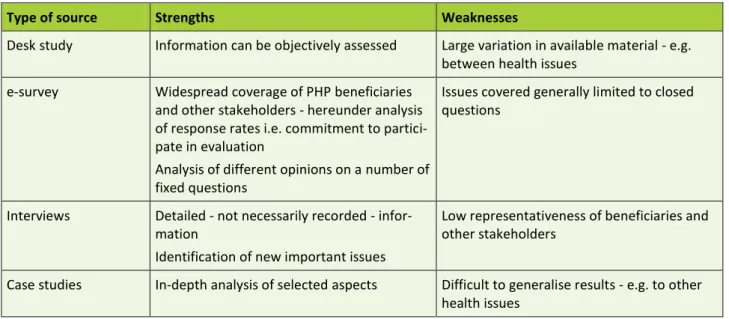
The results of the evaluation are found by combining four types of information sources - acknowledging the strengths and the weaknesses of the different methods (see Table 5-1). The different sources contribute in different ways. While e.g. the e-survey has a widespread coverage of beneficiaries and other stakeholders compared with the interviews and case studies, the issues are, in turn, covered in less detail. In addition to these weaknesses, there are a number of caveats to be aware of when analysing the results of applying the evaluation methodology. These are discussed in section 5.3.
Table 5-1 Strengths and weaknesses of information sources
Type of source Strengths Weaknesses
Desk study Information can be objectively assessed Large variation in available material - e.g. between health issues
e-survey Widespread coverage of PHP beneficiaries and other stakeholders - hereunder analysis of response rates i.e. commitment to partici-pate in evaluation
Analysis of different opinions on a number of fixed questions
Issues covered generally limited to closed questions
Interviews Detailed - not necessarily recorded - infor-mation
Identification of new important issues
Low representativeness of beneficiaries and other stakeholders
Case studies In-depth analysis of selected aspects Difficult to generalise results - e.g. to other health issues
The portfolio analysis carried out by COWI provides a major input to this evaluation in terms of elucidation of the coverage of the funded activities. Fur-thermore, it identifies the groupings of the types of interventions, types of health issues, and types of target groups that also are addressed when evaluat-Combination of four
types of information sources …
… complemented with results from portfolio analysis
ing the impacts, results, and outputs of the PHP. Hence, while the mapping in the portfolio analysis concentrates on the coverage of the projects in relation to the objectives and priorities of the PHP - hereunder the identification of possi-ble gaps and overlaps, the PHP evaluation examines whether the objectives were achieved. In other words, the evaluation will attempt to assess the types of interventions that are most effective for different health issues and target groups.
An important part of the method is a careful selection of stakeholders to be ap-proached for information gathering. To this end, PHP stakeholders were mapped. This included categorisation of the individual PHP stakeholders, the groups' stakes and roles in the programme, individual members of the group, and preparation of evaluation questions and study tool for each stakeholder group.
The result of the mapping exercise is presented in Table 5-2, and it includes an overall grouping of external and internal stakeholders in relation to the pro-gramme and categorisation of six and three subgroups of stakeholders in these overall groups respectively. Please consult appendix 2 for more details on each group.
Table 5-2 PHP stakeholders
External PHP stakeholders
Stakeholder group 1 International organisations (WHO, OECD, Coun-cil of Europe)
Stakeholder group 2 Public Administrations (Programme Committee, representatives of national authorities)
Stakeholder group 3 Interest groups (NGOs)
Stakeholder group 4 Economic operators/ private bodies (private companies/institutions, etc.)
Stakeholder group 5 Experts (PH experts involved in the programme, researcher, PH institutions)
Stakeholder group 6 Independent experts (PH experts not participat-ing directly in the PHP)
Internal PHP stakeholders
Stakeholder group 7 DG SANCO + agencies Stakeholder group 8 Other DGs + agencies Stakeholder group 9 Other EU institutions
5.2
Data collection
The means of data collection are described in more detail in the following. Identification of
5.2.1 Desk study
The desk study is based on available programme documents, including e.g. programme decision5, the White Paper "Together for Health"6, annual work plans7, the interim evaluation8 and report from the Court of Auditors9. Project documents, including project abstracts, final reports and documentation from project websites, are included in the desk study performed as a part of the case studies.
Furthermore, the evaluation draws on the results of a portfolio analysis con-ducted by COWI10 concerning the coverage of PHP objectives and priorities by activities funded.
5.2.2 E-survey
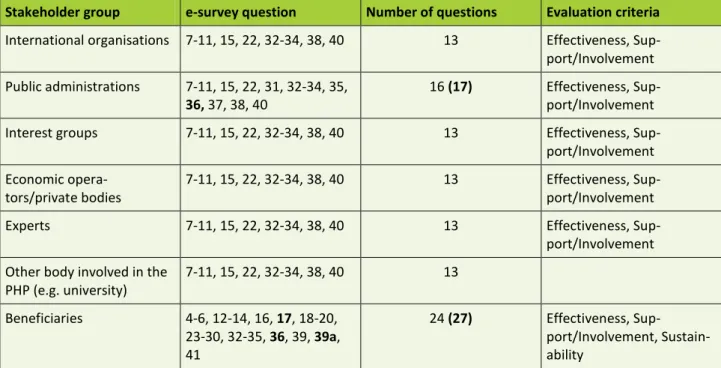
In all, 1,242 respondents were invited to participate in the e-survey. Only exter-nal stakeholders and beneficiaries received an invitation to participate in the e-survey. The recipients of the e-survey are further grouped according to their role, and the different groups received targeted questions (see Table 5-3). The initial sample of respondents of the survey thus comprises all beneficiaries of the PHP (proposals and direct grants) and the numerous stakeholders involved in the PHP (e.g. programme committee members, working parties, forums, etc.). This means, that the sample is assumed to consist of the complete popula-tion of potential respondents. The stakeholders were initially divided into three groups: beneficiaries, other stakeholders (representing the six groups mentioned in Table 5-2), and a group representing stakeholders, who were identified as both beneficiaries and other stakeholders.
In this report, beneficiaries are defined as stakeholders, who received funding from the PHP, while the group of other stakeholders covers stakeholders, who participated in the PHP, but who did not receive funding.
5 Decision No 1786/2002/EC of the European Parliament and of the Council of 23
Septem-ber 2002 adopting a programme of Community action in the field of public health (2003-2008).
6 Communication from the Commission to the Council, the European Parliament, the
Eco-nomic and Social Committee of the Regions on the Health Strategy of the European Com-munity. White Paper - Together for Health: A Strategic Approach for the EU 2008-2013.
7 Work plan 2003-2007
8 Oortwijn, W., ling, T., Mathijssen J., Lankhuizen, M., Scoggins, A., Stolk, C. and Cave J.
Interim Evaluation of the Public Health Programme 2003-2008
9 The European Union's Public Health Programme (2003-07): An Effective Way to
Im-prove Health?
10 COWI. Portfolio analysis and evaluation of the health project mapping 2003-2009
exer-cise - final report
Programme and pro-ject documents
Portfolio analysis
Number of invited participants
Table 5-3 Overview of e-survey
Stakeholder group e-survey question Number of questions Evaluation criteria
International organisations 7-11, 15, 22, 32-34, 38, 40 13 Effectiveness, Sup-port/Involvement Public administrations 7-11, 15, 22, 31, 32-34, 35,
36, 37, 38, 40
16 (17) Effectiveness, Sup-port/Involvement Interest groups 7-11, 15, 22, 32-34, 38, 40 13 Effectiveness, Sup-port/Involvement Economic
opera-tors/private bodies
7-11, 15, 22, 32-34, 38, 40 13 Effectiveness, Sup-port/Involvement
Experts 7-11, 15, 22, 32-34, 38, 40 13 Effectiveness,
Sup-port/Involvement Other body involved in the
PHP (e.g. university) 7-11, 15, 22, 32-34, 38, 40 13 Beneficiaries 4-6, 12-14, 16, 17, 18-20, 23-30, 32-35, 36, 39, 39a, 41 24 (27) Effectiveness, Sup-port/Involvement, Sustain-ability
Note: The numbering of the questions corresponds with the numbering of the e-survey questions in appendix 3.
Some of the statistical data for this report were collected through an online questionnaire in the period from 6 May to 7 June 2010. All tables and figures representing the results of the e-survey contain a note indicating data source. E-mail addresses of possible respondents were provided by DG SANCO, and all identified respondents received an invitation to fill in the questionnaire. Non-responders received up to two reminders. The first reminder was sent approxi-mately 1.5 weeks after the initial invitation, and the second reminder was sent approximately one week later.
All questions to both beneficiaries and other stakeholders were collected in one questionnaire, but the respondents only answered questions relevant to their affiliation (beneficiaries or other stakeholders). The questionnaire including a schematic overview of the three respondent groups and the questions belonging to them is presented in appendix 3. The online questionnaire was dynamically programmed, meaning that respondents' answers determined the subsequent questions. The main advantage of this approach is that respondents do not have to "find their way" through the questionnaire and are only presented with rele-vant questions.
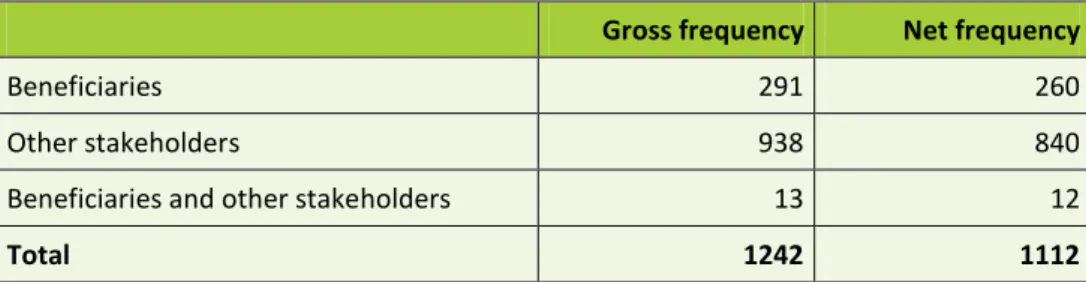
The number of respondents in each group is shown in Table 5-4. Of the 1,242 invitations, approximately 130 e-mails11 were immediately rejected because of faulty addresses, corresponding to 10.5 per cent of respondents. It is assumed that this error percentage is identical in all respondent groups, and thus 10.5 per cent of respondents in each group are assumed not to have received the e-mail. This gives the net frequency as presented in the table. These frequencies are used below to calculate net response rates. The groups 'beneficiaries' (291) and 'beneficiaries and other stakeholders' (13) are funded respondents; whereas the group 'other stakeholders' (938) are non-funded respondents.
Nine respondents received the invitation in several e-mail accounts. It seems reasonable to assume that other respondents experienced a similar problem. As the contact information of beneficiaries and other stakeholders did not contain the names of all respondents, this was inevitable. Furthermore, seven respon-dents (all from the group of other stakeholders) did not feel it relevant to an-swer the questionnaire, primarily due to lack of knowledge of the PHP.
Table 5-4 E-survey: number of respondents
Gross frequency Net frequency
Beneficiaries 291 260
Other stakeholders 938 840
Beneficiaries and other stakeholders 13 12
Total 1242 1112
304 funded respondents12 were invited to participate. Of these, 93 responded, which is a gross response rate of 30.6 per cent corresponding to a net response rate of 34.2 per cent13 (see Table 5-5). 951 not-funded respondents14 were in-vited to participate. Of these, 236 responded, which is a gross response rate of 24.8 per cent corresponding to a net response rate of 27.7 per cent15.
11 Since the e-survey of tasks1 and 2 was executed as an integrated questionnaire, a total of
1330 invitations were sent to respondents with questions concerning task 1, task 2 or both tasks. Of these 1330 invitations, 139 emails were immediately rejected, which corresponds to 10.5 per cent of the total amount of emails. It is assumed that this error percentage is identical in all respondent groups as well as respondents to tasks 1 and 2 respectively. Of the 1,242 invitations sent to respondents to task 1, an estimated 130 emails were rejected (10.5 per cent of 1,242).
12 291 + 13 = 304
13 Net respondents presented with beneficiaries' questions are 260 + 12 = 272. 14 938 + 13 = 951
15 Net respondents presented with beneficiaries' questions are 840+12=852.
Number of respon-dents
Table 5-5 E-survey: response rates
Gross response rate Net response rate
Beneficiaries 30.6% 34.2%
Other stakeholders 24.8% 27.7%
The population of the survey is unknown in the sense that the distribution of stakeholders (funded as well as non-funded) is not known. For instance, the distribution of non-funded stakeholders among the different stakeholder groups as presented in Table 5-3 (international organisation, public administration etc.) is not known for the entire population of non-funded stakeholders. This applies to all other distributions of stakeholders, e.g. home country and target group of the activity.
The unknown population is a source of uncertainty in terms of the representa-tiveness of the collected data, since it is not possible to determine whether the collected data are representative of the complete population. Further, it is not possible to weigh the results, since weights would have to be based on the real distribution of the population. Bias because of the unknown population can oc-cur if one of the respondent groups is overrepresented and dominates the out-come of the aggregated responses. Since it is not possible to determine the exis-tence of such bias in the e-survey, it is assumed in the presentation of the re-sults that the collected data set is representative.
5.2.3 Interviews
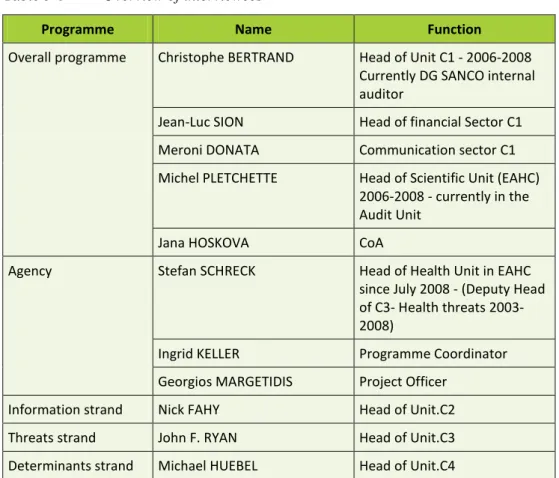
The interviews were conducted as structured interviews which the aim to gain in-depth information on the evaluation questions. For this purpose, an interview guide was elaborated (see appendix 4). In all, 11 interviews were conducted with persons representing the overall programme, the agency and the three strands (see Table 5-6).
Table 5-6 Overview of interviewees
Programme Name Function
Overall programme Christophe BERTRAND Head of Unit C1 - 2006-2008 Currently DG SANCO internal auditor
Jean-Luc SION Head of financial Sector C1
Meroni DONATA Communication sector C1
Michel PLETCHETTE Head of Scientific Unit (EAHC) 2006-2008 - currently in the Audit Unit
Jana HOSKOVA CoA
Agency Stefan SCHRECK Head of Health Unit in EAHC since July 2008 - (Deputy Head of C3- Health threats 2003-2008)
Ingrid KELLER Programme Coordinator Georgios MARGETIDIS Project Officer
Information strand Nick FAHY Head of Unit.C2 Threats strand John F. RYAN Head of Unit.C3 Determinants strand Michael HUEBEL Head of Unit.C4
5.2.4 Case studies
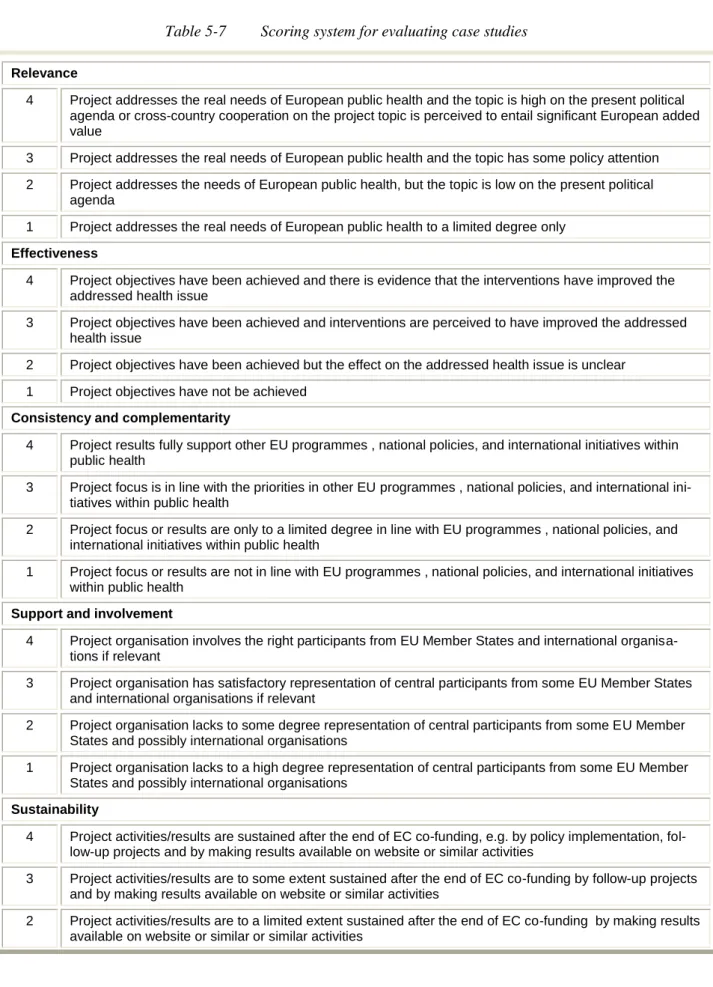
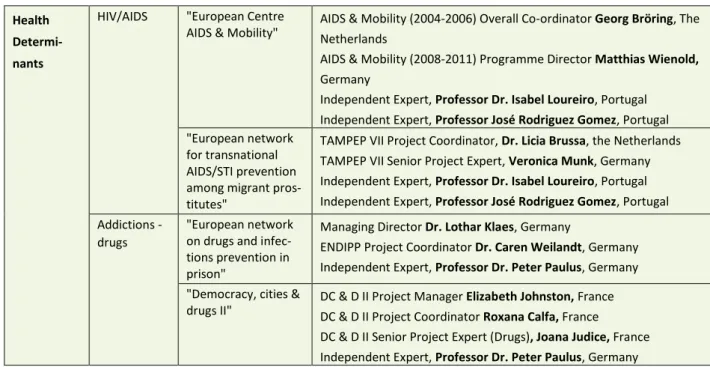
Case studies provide the opportunity for investigating more thoroughly a spe-cific theme, question or dilemma. Thereby, the case studies provide valuable insights and information that contribute substantially to the evaluation. How-ever, at the same we acknowledge that it is not straightforward to assess how the single case studies fulfil the criteria of relevance, effectiveness, consistency and complementarity, support and involvement, and sustainability, - and that it in particular is difficult to compare such fulfilment in between the case studies. In order to facilitate these assessments and comparisons we have developed a scoring system where each of the criteria for each of the case studies is scored on a scale from 1 to 4 - i.e. from low to high. The use of an even number of scores is adopted to force ourselves to assess whether or not the fulfilment is above or below average. Table 5-7 below shows the narrative descriptions of what the scores mean for each of the evaluation criteria.
Scoring of evaluation focus areas