E-commerce for Forest Products in Greece
Andreopoulou Z.
1, Manos B.
2, Vassiliadou S.
1, Samathrakis V.
31
Lab. of F. Informatics, School of Forestry and Natural Environment, Aristotle University of Thessaloniki, Greece, [email protected], [email protected],
2
Faculty of Agriculture, Aristotle University of Thessaloniki, Greece, [email protected], 3
Dept, of Farm management, Alexander Technological Educational Institute of Thessaloniki, Greece, [email protected],
Abstract
Internet has become a major means to support e-commerce services, as it offers to the users various advantages and benefits for numerous purposes. In Greece, there are many SME in the context of forestry sector that have already created a web presence in various stages of maturity. This paper studies websites of commercial purpose that support and promote e-commerce activities within the forestry sector in Greece. It aims to identify and describe the content type included in each of the retrieved websites and to further classify them according to the type of the production they trade and according to their geographical location in an attempt to identify local tendencies. The results of this study reveal the present condition of the commercial forestry sites and can be an effective tool for designers and developers of websites that support and promote e-commerce activities within the wider area of forest products and services.
Keywords: Website, Internet services, E-commerce, Forest products
1. Introduction
1.1 Internet and website development
Information and Communication Technologies (ICTs) offer huge commerce opportunities and information capital [Helander and Jiao (2002)]; for all to progress and benefit and new prospects exist for economic growth, better service delivery, social and cultural advances and nowadays cover a wide variety of services rendered to the citizens, the so called e-services.
The Internet has become a major resource in modern business and many businesses are creating a web presence [Calitz and Scheepers (2002)]. By whatever measure
used, the web is big. It is, then, no small wonder that most companies feel that they need at least some level of web presence today. The perceived strengthening of a company’s competitive position may often be the justification for a company to develop electronic commerce [Loughlin (1999)]. The question facing all companies contemplating web initiatives is how to build a successful website [Rosen and Purinton (2004)].
A lot have been said about the development of a website. First of all is the matter of usability. The usability of a user interface refers to the fluency or ease with which a user is able to interact with a system without ‘thinking’ about it. This implies they can do so ‘naturally’ or without feeling ‘discomfort’, either physical or mental. This is in line with the definition of usability offered by the International Organization for Standardization, which is: ‘‘the effectiveness, efficiency, and satisfaction with which specified users achieve specified goals in particular environments’’ [Hillier (2003)]. But it’s not only usability that affects a websites’ appeal and visits. Studies have identified a number of specific site features (actual or perceived) that impact website appeal. Among these features are: security, vividness and its correlate riskiness, approval by referent others, like family or friends, feature organization, quality of content, price, recognizability and/or desirability of brand, and time delay/download speed [Blake et al. (2005)]. Another important factor is the cultural context of the audience that needs to be taken into consideration. This is particularly important in the light of global e-commerce efforts where success of business is dependent upon the successful interaction with a multitude of imagined audiences via electronic means [Hillier (2003)]. Since the primary measures of portal success are high levels of user acquisition and retention, only those sites that attract and maintain the desired target audience and build valuable customer relationships will have the potential for long-term success. Even private/informational portals, to become successful, must entice busy employees to alter well-established informational search habits [Clark and Flaherty (2003)].
Other studies have analyzed the functions or roles played by specific features as they contribute to site appeal. One of them isolates seven functions impacting customer loyalty to a site: (1) customization; (2) contact interactivity; (3)‘cultivation’ (i.e. provision of information/incentives to extend customer purchasing over time); (4) ‘care’ (operationally, features that keep customers informed of the availability of preferred products and/or of the status of orders, or that minimize service description); (5) provision of a structure to facilitate exchange of opinions/information; (6) product variety; (7) ‘character’ (i.e. text / graphics / slogans, etc. projecting an image or personality of the merchant). Other functions include navigability, communication utility, responsiveness, entertainment value, convenience and flow. Interactivity has been widely proposed as a force for site appeal [Blake et al. (2005)].
Some authors [Pressman (1998)] argued that as well as involving new design skills, web-based development projects also typically involve shorter development times and product life cycles while others [Palmer and Griffith (1998)] had commented upon the need for website designers to understand both the marketing and technical issues of website design. It had stated that since web-based applications execute business logic, the most important models of a web-based system should focus on the business logic, not on presentation details [Conallen (1999)]. It is also observed that there is no rigorous systematic approach to web development projects in general, and that most current web application development and management practices rely on the knowledge and experience of individual developers [Gellersen and Gaedke (1999)]. Since the primary measures of portal success are high levels of user acquisition and retention, only those sites that attract and maintain the desired target audience and build valuable customer relationships will have the potential for long-term success. Even private/informational portals, to become successful, must entice busy employees to alter well-established informational search habits [Clark and Flaherty (2003)].
1.2. E-commerce
Electronic commerce, e-commerce or ecommerce consists primarily of the distributing, buying, selling, marketing, and servicing of products or services over electronic systems such as the Internet and other computer networks. The information technology industry might see it as an electronic business application aimed at commercial transactions. It can involve electronic funds transfer, supply chain management, e-marketing, online marketing, online transaction processing, electronic data interchange, automated inventory management systems, and automated data-collection systems. It typically uses electronic communications technology such as the Internet, extranets, e-mail, E-books, databases, and mobile phones. To many small/medium enterprises, this seems to be a very prospective alternative to the way they do businesses. These portals can extend their reach to potential customers worldwide [Chan and Chung (2002)], through the use of the Internet as a marketing tool. E-commerce is no longer anticipated as a cheap investment for the companies, especially for those aiming at providing an overall satisfactory online shopping environment [Patsioura et al. (2004)].
In particular, the e-commerce not only stimulates European companies to economic growth and to an investment in innovation, but also it can increase industrial competition because nowadays everyone can access the Internet [Edwards (2002)]. Similarly, EU initiatives, such as “eEurope”, focus on increasing economic productivity and improving the quality and accessibility of services for the benefit of all European citizens, based on a fast infrastructure (broadband) with secure Internet access available to as many people as possible [EU (2007)].
Business-to-consumer electronic commerce (B2C) is a form of electronic commerce in which products or services are sold from a firm to a consumer. It is evident that, if a commercial business-to consumer (B2C) website is to successfully generate sales, that website must have features that appeal to potential buyers [Blake et al. (2005)]. Companies that provide products or services directly to customers are called direct sellers. These types of B2C companies are the most well-known. There are two types of direct sellers: e-tailers and manufacturers. a) E-tailers: Upon receiving an order, the e-tailer ships products directly to the consumer or to a wholesaler or manufacturer for delivery and b) Manufacturers: The manufacturer sells directly to consumers via the internet. The goal is to remove intermediaries, through a process called disintermediation, and to establish direct customer relationships. Disintermediation is not a new idea as catalogue companies have been utilizing this method for years [Haag et al. (2004)].
1.3. E-commerce adoption in rural production
The last decade, it is highly aknowledged that everyone can profit from various e-services provided through the WEB and new opportunities emerge concerning economic growth, better health, improved service delivery, learning through distance education models, and social and cultural advances [World Bank (2003)]. E-services should be used as an important component in achieving sustainable development in rural areas and should be encouraged [EU (2007)].
Various researchers have described a 4 stages adoption model [Gossain and Kenworthy (2000), Rao et al (2003)] that represents 4 different distinctive categories or adoption stages for an enterprise with varying strategic objectives and aspirations. Thus, stages start from simple web “presence” and gradually increase the employ of ICT as to the total integration or transformation.
The initial stage of “presence” is defined as the stage that the enterprise seeks to ensure its presence in the Internet and to be advertised. It does not have, however any possibility of interaction and communication with its possible customers. In further stages the where the enterprise beyond its presence in the Internet, gives the possibility for search into its website as well as connection with other websites, usually identified as the second stage. In the next stage, the enterprise allocates applications of e-commerce, EDI (Electronic Data Interchange), ERP (Enterprise Resource Planning). Thus the companies are in position to exchange electronically their documents; they also have the possibility to provide alternatives to credit card methods of payment like cash on delivery, wire transfer, checks by post and fax orders. In this state the whole management of supply chain is automated. In the final stage of total ICT adoption, the value chain is optimized, as it gives its costumers the possibility for online orders and online payments, while they are simultaneously in position to check the stage of their order.
As it concerns the forestry sector and various forest related products in Greece, various enterprises, in their majority small and medium sized enterprises (SME), have already an Internet presence or websites in further state of maturity for trading of raw material, wood and secondary forest products. Recent research has revealed that websites concerning forest products in Greece are still in the simple Internet presence stage in a percentage of 34% [Andreopoulou et al. (2005)]. Within the same research, it is identified that 26% of these websites are classified in the second stage of “interaction”. Further, 20% of the sites are classified in the third stage of “transaction” and, finally, only 20% of the retrieved websites are classified in the final stage of “transformation”.
Forecasts show that e-commerce growth in agricultural sector probably will need more time than initially anticipated [Sachs (2000)]. Concerning the obstacles for e-commerce adoption in agricultural sector [Vlachopoulou et.al. (1999), Hooker et.al. (2001), Porter (2001)], the special features and characteristics are quoted as: a) behavior against change from the managers, b) lack of familiarity with the information technology, c) location and organizational structure, d) differentiation of prices and transactions due to differences in place-distance, in the time of delivery and the quality of the order, e) desire of the customer to see, smell, process and taste the products, before he buys them, f) lack of trust, that is often a build out of human interaction, g) demographic characteristics and personality of the people of the agricultural economic sector, h) transactions in agriculture is more a way of life, i) Internet access, connectivity characteristics such as cost, in relation to the distance, and the unequal growth of information technology locally, j) weakness of the farmers to see the returns they will have from the cost from the transformation of the way they function, due to lack of information, k) especially, when it comes to the development cost of the right technological structure, we must separate the simple capability of query through the Internet and the practice of Internet Marketing, l) change in the current industry structure and m) increasing complexity of products sold in market places.
This paper describes e-commerce status regarding websites of commercial purpose representing SME that support and promote e-commerce activities within the forestry sector in Greece. It aims to identify and describe the content type included in each of the retrieved websites and to further classify them according to the type of the production they trade and according to their geographical location in an attempt to identify local tendencies.
2. Methods and material
The websites that were used for the research were collected from the Greek Internet with the use of proper search engines and key words such as, “forest products, forestry and forest production, wood, herbal plants”. The websites represent
commercial enterprises, usually SME in the forestry sector such as forest industries and wood processing units as well as enterprises that trade secondary forest products such as forest herbs, tea, etc. using e-commerce activities. There are registered 103 similar enterprises in Greece [National Statistics of Greece (2001)].
There was performed a quantitative and qualitative study of their common content characteristics, specifically, it was identified and described the specific content characteristics, which are the type of material that is included in each of the retrieved websites. Further, the retrieved websites were classified twice, according to the type of their production and according to their geographical location in an attempt to identify local tendencies.
3. Results
Research through search engines on the Internet resulted in the retrieval of 23 websites concerning enterprises in the Greek territory that trade timber and wood processing as well as enterprises that trade secondary products directly related to the forests such as aromatic plants and mountainous herbs, such as tea, natural products, etc.
That represents a percentage of 22% among the total of similar enterprises in Greece and indicates that almost 1 out of five (5) enterprises has initiated e-commerce activities so far.
Each website represents a certain enterprise whereas for each firm an identification code auto number is given started by E1. The enterprises are not referenced in this paper, in order to avoid commercial promotion of any kind, but their location is mentioned along with the type of products they trade.
There was various material introduced in the retrieved websites, aiming to promote the products and the enterprise There were identified 12 different type of material introduced in each website aiming to promote e-commerce.
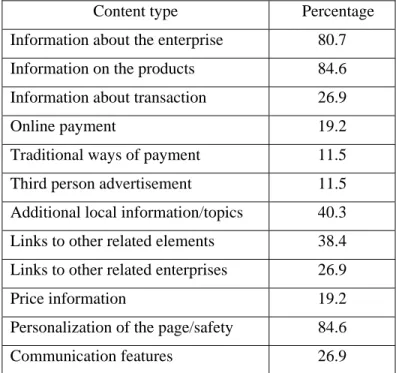
Most of the cases (84.6%) include thematic with detailed information on the products and that is the dominating content characteristic. It follows the promotional and informational material concerning the enterprise, with a percentage of 80.7% of the websites/cases, as an effort to strengthen the trust of the potential client to the enterprise, that is a vital factor for on-line sales. Another content characteristic with high percentage is that of personalization of the website for the potential client and the enhancement of security issues (84.6%), that is also a positive factor for the client to select the specific enterprise through the Internet.
Additional local information and topics are found in 40.3% of the websites/cases and it is provided in various types such as texts, maps and photo libraries, aiming to promote local areas.
Material concerning price lists for the products and on-line payment information to accomplish the on-line sales appear in 19.2% of the cases, yet various information on transaction fulfillment are found in 26.9% of the websites. Also, appear various links to other related elements or enterprises and communication features, as quoted in Table 1.
Table 1. Content of the enterprises websites Content type Percentage Information about the enterprise 80.7 Information on the products 84.6 Information about transaction 26.9
Online payment 19.2
Traditional ways of payment 11.5 Third person advertisement 11.5 Additional local information/topics 40.3 Links to other related elements 38.4 Links to other related enterprises 26.9
Price information 19.2
Personalization of the page/safety 84.6
Communication features 26.9
The collected websites are further classified in three groups according to the products they trade with through the website.
The first group represents enterprises that trade timber or process wood, the second group includes enterprises that trade aromatic plants, herbs and natural products and the third group includes enterprises that trade forest material such as seeds.
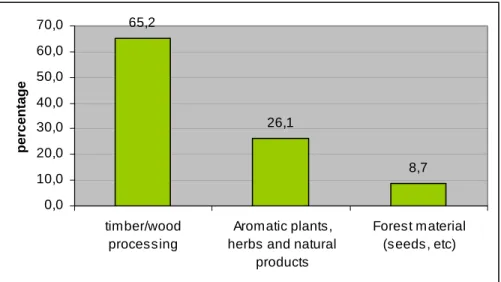
This classification shows that timber and wood processing units represent a percentage of 65.2 % of the enterprises that have already employed e-commerce activities. It is almost 2 out of 3 enterprises. Wood production is traditional for Greece and it is usually carried out in mountainous areas, with productive forests. However, a lower percentage, 26.1%, represents enterprises related to aromatic plants, herbs and natural products and the remaining 8.7% concerns seeds trade as showed in Fig. 1.
65,2 26,1 8,7 0,0 10,0 20,0 30,0 40,0 50,0 60,0 70,0 timber/wood processing Aromatic plants, herbs and natural
products Forest material (seeds, etc) pe rc e n ta ge
Fig. 1 E-commerce regarding forest products
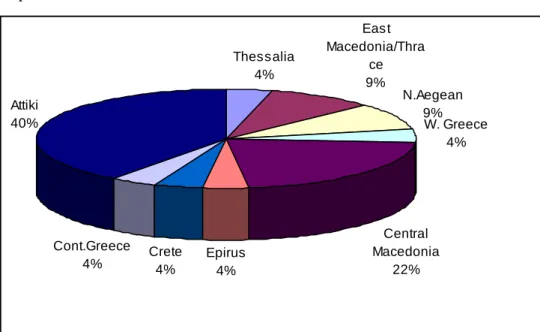
Furthermore the enterprises that already employ e-commerce activities are being classified concerning their geographic location in the 13 regions of Greece. It was registered the city where the head office of the enterprise is located, as many enterprises have branches also in a number of other cities. The results of the geographic distribution of the enterprises that employ e-commerce activities and relative percentages for each region are presented in Figure 2.
Some of the retrieved enterprises that make use of e-commerce advantages, usually enterprises that trade timber, are located in areas neighboring to productive forest areas, such as the mountainous area of Pindos in Thessaly and Continental Greece and in Eastern Macedonia/Thrace region. Yet, enterprises trading aromatic plants, herbs and natural products represent a new, modern and blooming trade area. Various mountainous herbs from Crete, that is famous for aromatic herb production and the original plant mastic (Pistacia Lentiscus) from Chios, in N. Aegean, are used in many pharmaceutical and hygiene products and represent a modern way of quality life. Thus, their Internet promotion is vital as they target wide audiences and markets, not only in Greece. There were found no enterprises in that trading sector having e-commerce activities in Western Macedonia region and Southern Aegean.
It is evident that the majority of the retrieved enterprises in forestry sector that employ of e-commerce activities is located in urban areas and specifically in the area of Attiki (40%). It is there simple to find the required skilled personnel, IT experts, network technicians, etc to accomplish a successful e-commerce adoption for their enterprise. Moreover, it is also simple to have access to broadband networks and
Internet providers in an urban area as Attiki, aiming to enhance these e-commerce activities. Technical infrastructure is easy to find everywhere in Greece. Nevertheless, software and hardware implementation can be accomplished effortlessly in big urban centres along with the necessary technical support that is vital for the trouble-less adoption of e-commerce.
Fig. 2 Geographic distribution
. Discussion and conclusions
ed 23 websites that represent enterprises that
ing to Thessalia 4% East Macedonia/Thra ce 9% N.Aegean 9% W. Greece 4% Central Macedonia 22% Epirus 4% Crete 4% Cont.Greece 4% Attiki 40%
4
The research in the Greek Internet retriev
trade timber and/or process wood as well as enterprises that trade secondary products directly related to the forests such as aromatic plants and mountainous herbs, such as tea, natural products, etc. 65.2% of these websites represent enterprises in timber and wood processing. 40% of the cases, that represent websites of enterprises, are located in the region of Attiki, where technical infrastructure and support, broadband and skilled employees assist to accomplish e-commerce adoption for an enterprise. There were identified 12 different material type introduced in each website aim promote e-commerce. The content of these websites included various promotional and informational material concerning the enterprise, detailed information on the products, price lists and alternative ways of payment, additional local information,
various links to other related elements or enterprises, personalization of the website, and communication features.
The way that e-commerce will be developed in the forestry sector as well as the
the e-commerce activities in forestry sector evaluation and furthermore
5. References
Vlachopoulou M., Manos B., Vassiliadou S., Papathanassiou J.,
Bla
Calitz A., Scheepers B., (2002) A Comparative Analysis of e-Commerce Website
Ch W.C., (2002) A framework to develop an enterprise information
Clarke I., Flaherty T. B., (2003). Web-based B2B portals, Industrial Marketing
Co Web application architectures with UML,
adoption rate of the Internet and its implementations from producers as a tool of their work, depends at a great deal of the size of their activities and the socio-economic characteristics of the individuals involved in this sector, like age, knowledge, awareness, culture, educational level and finally more important of all intention for innovations.
The study of
can be an effective tool while designing similar websites for an enterprise aiming to involve in e-commerce activities. A major obscuring factor in all of this is the reality that the web is an extremely dynamic environment, always evolving. The results of this study are useful in order to realize, through the classification of the content, their effectiveness within the design and implementation of a web site, in order to fulfill certain features and characteristics and become more efficient. A future extend in this process will be users testing (heuristics inspection), to make sure that the sites match the consumers’ expectations.
Andreopoulou Z.,
(2005) Website evaluation in the context of support and promotion for e-business in forestry sector. In the proceedings of the International Congress on Information Technology in Agriculture, Food and Environment, Turkey, Adana, pp. 353-358.
ke B.F., Kimberly A., Neuendorf C., Valdiserri M., (2005). Tailoring new websites to appeal to those most likely to shop online, Technovation, Vol 25, pp. 1205–1214.
Development Using Two Implementation Methods, Proceedings of SAICSIT, 2002, pp. 251.
an M.S., Chung
portal for contract manufacturing, Int. J. Production Economics, Vol 75, pp. 113– 126.
Management, Vol 32, pp. 15–23. nallen J., (1999) Modelling
Edwards G., (2002) E-commerce- at the top of the business agenda. Strategic business development, Ltd. UK.
EU (2007), Employment Policy guidelines 2005-2008. Community employment policies. Retrieved on http://europa.eu/scadplus/leg/en/cha/c11323.htm
Gellersen H., Gaedke M., (1999) Object oriented Web application development, IEEE Internet Computing, 3, (1), pp. 60–68.
Haag S., Cummings M., McCubbrey D. J., Pinsonneault A., Donovan R., (2004) Management Information Systems: For the Information Age. McGraw-Hill, Ryerson, New York.
Helander M.G., Jia J., (2002) Research on E-product development (ePD) for mass customisation, Technovation, Vol 22, pp. 717–724.
Hillier M., (2003) The role of cultural context in multilingual website usability, Electronic Commerce Research and Applications, Vol 2, pp. 2–14.
Hooker N., Heilig J., Ernst S., (2001) “What is Unique About E-Agribusiness”, Department of Agricultural, Environmental and Development Economics, The Ohio State University, Paper for the IAMA Work Food and Agribusiness Symposium, June 27-28, 2001, Sydney, NSW, Australia. Available in Internet: www.ifama.org/conferences/2001Conferences/Papers/
Loughlin P., (1999) Viewpoint: E-commerce strengthens supplier’s position, International Journal of Retail and Distribution Management, 27 (2), pp. 6–7. National Statistics of Greece (2001). Hellas in numbers. http://www.statistics.gr Palmer J., Griffith D., (1998) An emerging model of web site design for marketing,
Communications of the ACM ,41, (3), pp. 45–51.
Patsioura F., Vlachopoulou M., Manthou V., (2004) Evaluation of an agricultural website. In the proceedings of the 2nd HAICTA International Conference on Information Systems and Innovative Technologies in Agriculture, Food and Environment, Vol I, pp. 28-37.
Porter, M. (2001). Strategy and the Internet. Harvard Business Review. 79 (2), 63-78. Pressman R., Can Internet based applications be engineered?, IEEE Software, 16, (6),
pp. 66–70.
Rosen D.E., Purinton E., (2004). Website design: Viewing the web as a cognitive landscape, Journal of Business Research, Vol 57, pp: 787–794.
Vlahopoulou M., Voyiatzis A., Manthou., (1999) “ Information and Communication through Internet in the Agricultural Operational Field “. 1st Special Convention “ The development of the primary field in the 21st century : the contribution of the
management science”. Hellenic Operational Research Society, University of Ioannina, Ministry of Agriculture, October 1999.
World Bank, (2003), ICT and Millennium Development Goals, December 2003, WB Group’s Global ICT Department, http://www.worldbank.org
Rao, S. , S Metts G., Mora Monge C., (2003), Electronic commerce development in small and medium sized enterprises: A stage model and its implications, Business Process Management Journal vol 9, nr. 1, pp 11 – 32
Gossain S., Kenworthy R., (2000), Winning the third wave of E-Business - Beyond net markets, NerveWire