Towards multiprogrammed GPUs
by
Ivan Tanasi
ć
ADVERTIMENT La consulta d’aquesta tesi queda condicionada a l’acceptació de les següents condicions d'ús: La difusió d’aquesta tesi per mitjà del r e p o s i t o r i i n s t i t u c i o n a l UPCommons (http://upcommons.upc.edu/tesis) i el repositori cooperatiu TDX (h t t p : / / w w w . t d x . c a t /) ha estat autoritzada pels titulars dels drets de propietat intel·lectual
únicament per a usos privats emmarcats en activitats d’investigació i docència. No s’autoritza la seva reproducció amb finalitats de lucre ni la seva difusió i posada a disposició des d’un lloc aliè al servei UPCommons o TDX.No s’autoritza la presentació del seu contingut en una finestra o marc aliè a UPCommons (framing). Aquesta reserva de drets afecta tant al resum de presentació de la tesi com als seus continguts. En la utilització o cita de parts de la tesi és obligat indicar el nom de la persona autora.
ADVERTENCIA La consulta de esta tesis queda condicionada a la aceptación de las siguientes condiciones de uso: La difusión de esta tesis por medio del repositorio institucional UPCommons (http://upcommons.upc.edu/tesis) y el repositorio cooperativo TDR ( http://www.tdx.cat/?locale-attribute=es) ha sido autorizada por los titulares de los derechos de propiedad intelectual
únicamente para usos privados enmarcados en actividades de investigación y docencia. No se autoriza su reproducción con finalidades de lucro ni su difusión y puesta a disposición desde un sitio ajeno al servicio UPCommons No se autoriza la presentación de su contenido en una ventana o marco ajeno a UPCommons (framing). Esta reserva de derechos afecta tanto al resumen de presentación de la tesis como a sus contenidos. En la utilización o cita de partes de la tesis es obligado indicar el nombre de la persona autora.
WARNING On having consulted this thesis you’re accepting the following use conditions: Spreading this thesis by the i n s t i t u t i o n a l r e p o s i t o r y UPCommons (http://upcommons.upc.edu/tesis) and the cooperative repository TDX ( http://www.tdx.cat/?locale-attribute=en) has been authorized by the titular of the intellectual property rights only for private uses placed in investigation and teaching activities. Reproduction with lucrative aims is not authorized neither its spreading nor availability from a site foreign to the UPCommons service. Introducing its content in a window or frame foreign to the UPCommons service is not authorized (framing). These rights affect to the presentation summary of the thesis as well as to its contents. In the using or citation of parts of the thesis it’s obliged to indicate the name of the author.
by
Ivan Tanasi¢
Advisor: Prof. Nacho Navarro
Co-advisors: Dr. Isaac Gelado, Prof. Eduard Ayguade
DISSERTATION
Submitted in fulllment of the requirements
for the degree of Doctor of Philosophy (Doctor per la UPC)
in the Department of Computer Architecture
Universitat Politècnica de Catalunya
Barcelona, Spain
Abstract
Programmable Graphics Processing Units (GPUs) have recently become the most pervasive massively parallel processors. They have come a long way, from xed function ASICs designed to accelerate graphics tasks to a pro-grammable architecture that can also execute general-purpose computations. Because of their performance and eciency, an increasing amount of software is relying on them to accelerate data parallel and computationally intensive sections of code. They have earned a place in many systems, from low power mobile devices to the biggest data centers in the world. However, GPUs are still plagued by the fact that they essentially have no multiprogram-ming support, resulting in low system performance if the GPU is shared among multiple programs. In this dissertation we set to provide the rich GPU multiprogramming support by improving the multitasking capabilities and increasing the virtual memory functionality and performance.
The main issue hindering the multitasking support in GPUs is the non-preemptive execution of GPU kernels. Here we propose two preemption mechanisms with dierent design philosophies, that can be used by a sched-uler to preempt execution on GPU cores and make room for some other process. We also argue for the spatial sharing of the GPU and propose a concrete hardware scheduler implementation that dynamically partitions the GPU cores among running kernels, according to their set priorities. Opposing the assumptions made in the related work, we demonstrate that preemptive execution is feasible and the desired approach to GPU multitasking. We fur-ther show improved system fairness and responsiveness with our scheduling policy.
We also pinpoint that at the core of the insucient virtual memory sup-port lies the exceptions handling mechanism used by modern GPUs. Cur-rently, GPUs ooad the actual exception handling work to the CPU, while the faulting instruction is stalled in the GPU core. This stall-on-fault model prevents some of the virtual memory features and optimizations and is espe-cially harmful in multiprogrammed environments because it prevents context switching the GPU unless all the in-ight faults are resolved. In this
disser-tation, we propose three GPU core organizations with varying performance-complexity trade-o that get rid of the stall-on-fault execution and enable preemptible exceptions on the GPU (i.e., the faulting instruction can be squashed and restarted later). Building on this support, we implement two use cases and demonstrate their utility. One is a scheme that performs con-text switch of the faulted threads and tries to nd some other useful work to do in the meantime, hiding the latency of the fault and improving the system performance. The other enables the fault handling code to run locally, on the GPU, instead of relying on the CPU ooading and show that the local fault handling can also improve performance.
Acknowledgements
This thesis has been a great journey which would not be possible without many great people that helped me along the way. For that, I wish to thank them all.
First and foremost, I would like to thank my advisors for their guidance and continuous support during my time in Barcelona. They have thought me so many things and helped me so many times that I will not be able to repay them, ever. Nacho Navarro always made sure that I have resources and freedom to pursue my research. I thank him for inspiring condence in my research and his readiness to help with any issue I faced. It is a great loss that he is not here with us anymore. I know how proud and happy he would be to see me nish this thesis. Isaac Gelado has been another great role model who set the bar high with his strong work ethic. I am grateful for his dedication, patience, and the ability to still nd time for me, years after leaving Barcelona. Eduard Ayguade has stepped in after Nacho passed away and made sure I actually nish this thesis. I appreciate all the help he provided during this last year.
I would like to thank Mateo Valero for providing the opportunity and a great environment to do my PhD, as well as helping with my ISCA 2014 paper. My thanks also go to Alexander Veidenbaum for suggestions that im-proved that paper, Alex Ramirez for his generous help and advice during my PhD, Wen-mei Hwu for being a great teacher and helping with the GPGPU 2013 paper, and Veljko Milutinovic for helping me get here in the rst place. Two internships that I had during my PhD were remarkable learning opportunities. I would like to thank Santosh Abraham and the rest of the Advanced Processor Lab for the fantastic four months at Samsung Research America. It was an eye-opening experience during which I learned so much about GPUs and computer architecture in general. I would also like to thank Steve Keckler, Arslan Zulqar and the rest of the Architecture Research Group for the great three months at NVIDIA. The work and discussions done during this internship have inspired me to pivot the second half of the thesis towards exception handling mechanisms, rather than use-cases.
I was very fortunate to be a member of GSO, an extraordinary group of people that made my PhD studies so memorable and special. My sincere thanks go to all of the GSO members with whom I had the pleasure to work with and who were unfortunate enough to sit through my numerous pre-sentation rehearsals and provided endless paper reviews. I overlapped with Carlos Villavieja the least, yet he is one of the guys that helped me the most. From helping me get internship opportunities to practicing job interviews, Carlos still keeps his title of an eminent GSO member, ve years after leaving Barcelona. Javier Cabezas and Lluis Vilanova have been like a father and a mother to me and other younger students. Their knowledge, technical ability and selessness never cease to amaze me. Ramon Bertran served as a proof that hard work, focus and positive attitude can get you far. Lluc Alvarez kept me on my toes and provided his expertise in microarchitecture. Marc Jorda was a true brother in arms, always ready to get down in the trenches with me. Victor Garcia, Diego Marron and Pau Farre helped me nish my PhD by requiring way less support and attention than I required at the be-ginning. I would go as far as saying that I cannot imagine a better research group, except that I do not see GSO as just a research group, but rather something more special. Comradeship during both work time and playtime was astonishing. And there was plenty of both.
A great group of students at Barcelona Supercomputing Center made my time here more enjoyable. Many discussion about life or work were held over coee, lunch and beers with Nikola Rajovic, Milovan Duric, Michalis Alvanos, Thomas Grass, Alex Rico, Karthikeyan Palavedu Saravanan, Milan Pavlovic, Ugljesa Milic, Darko Zivanovic, Branimir Dickov and many others. Last, but certainly not least, I want to thank my family for providing their endless love, support, and inspiration to start and nish this journey. My father Branislav with his dedication to everything that he started, my mother Miroslava with her condence in better tomorrow and my wife Dorotea with her endless patience for me. I am not done learning from you.
The work on this thesis was performed at Barcelona Supercomputing Center and was nancially supported by the European Commission through TERAFLUX: Exploiting Dataow Parallelism in Teradevice Computing project (contract FP7-249013), Spanish Ministry of Science and Technology through projects Computación de Altas Prestaciones V (contract TIN2007-60625) and Computación de Altas Prestaciones VI (contract TIN2012-34557), and NVIDIA Corporation through the GPU Center of Excellence grant.
Contents
1 Introduction 1
1.1 Contributions . . . 3
1.1.1 Enabling Preemptive Multitasking . . . 3
1.1.2 Design of a GPU Kernel Scheduler . . . 4
1.1.3 Enabling Preemptible Exceptions . . . 4
1.1.4 Page Fault Latency Hiding Scheme . . . 5
1.1.5 Handling Page Faults on the GPU Cores . . . 5
1.2 Organization . . . 5
2 GPU Systems Background 7 2.1 GPU Accelerated Systems . . . 7
2.2 GPU Architecture. . . 10
2.3 Base GPU Execution Engine . . . 12
2.4 Core Architecture . . . 13 3 Multiprogrammed Systems 17 3.1 Process Scheduling . . . 18 3.1.1 CPU Scheduling. . . 18 3.1.2 GPU Scheduling . . . 19 3.2 Virtual Memory . . . 21
3.2.1 CPU Virtual Memory . . . 22
3.2.2 GPU Virtual Memory . . . 22
3.3 Exception Handling . . . 24
3.3.1 Precise Exceptions . . . 24
3.3.2 Other Exception Handling Approaches . . . 25
4 Methodology 27 4.1 Benchmarks . . . 27
4.2 Simulators . . . 28
4.2.1 Full System . . . 28
5 Enabling Preemptive Multitasking 31
5.1 Motivation . . . 33
5.2 Architecture . . . 34
5.2.1 Concurrent Execution of Processes . . . 34
5.2.2 Preemptive Kernel Execution . . . 35
5.2.3 Scheduling Framework . . . 37
5.2.4 Dynamic Spatial Sharing Policy . . . 39
5.3 Evaluation . . . 41
5.3.1 Methodology . . . 41
5.3.2 Eectiveness of the Preemption Mechanisms . . . 44
5.3.3 Overheads of the Preemption Mechanisms . . . 46
5.3.4 Example Policy: Equal Spatial Sharing . . . 47
5.4 Summary and Concluding Remarks . . . 50
6 Enabling Preemptible Exceptions 53 6.1 Motivation . . . 55
6.2 Problem Statement . . . 58
6.3 Support for GPU Page Faults . . . 59
6.3.1 Approach 1: Warp Disable . . . 59
6.3.2 Approach 2: Replay Queue. . . 61
6.3.3 Approach 3: Operand Log . . . 62
6.4 Use Cases . . . 64
6.4.1 Block Switching on Fault . . . 64
6.4.2 Local Handling of Faults . . . 65
6.5 Evaluation . . . 66
6.5.1 Evaluation Methodology . . . 66
6.5.2 The Performance Cost of Preemptible Faults . . . 68
6.5.3 Use Case 1: Thread Block Switching on Fault . . . 70
6.5.4 Use Case 2: Local Handling of GPU Faults . . . 72
6.5.5 Summary and Concluding Remarks . . . 74
7 Conclusions and Future Work 75 7.1 Conclusions . . . 75
7.2 Future Work. . . 76
7.2.1 Fast and Ecient Preemption . . . 76
7.2.2 Kernel Scheduler Design . . . 77
7.2.3 Fault Aware Scheduling. . . 77
7.2.4 Heterogeneous Memory Management . . . 78
A Publications 79 A.1 Thesis Related Publications . . . 79
List of Figures
2.1 GPU accelerated systems in their basic forms: a) descrete GPU model with GPU and graphics memory on the expansion card, and b) fused GPU model with CPU and GPU integrated
in the same chip. . . 8
2.2 Simple SAXPY GPU program with explicit data transfers (programmer managed). . . 8
2.3 Simple SAXPY GPU program with automatic data transfers (demand paging). . . 9
2.4 On demand page migration. . . 10
2.5 GPU architecture with its main components: Command (CMD) Dispatcher, Data Transfer (DT) Engine, and Execution Engine. 11 2.6 Execution engine architecture. . . 12
2.7 SM microarchitecture. . . 14
4.1 Full system simulation workow.. . . 29
4.2 Microarchitectural simulation workow. . . 29
5.1 Execution of soft real-time application with (a) FCFS (cur-rent GPUs), (b) non-preemptive priority and (c) preemptive priority schedulers. K1 and K2 are low-priority kernels, while K3 is high-priority. . . 33
5.2 Operation of the SM driver. Dashed objects are proposed extensions. . . 36
5.3 Scheduling framework. The rest of the execution engine (SM Driver and SMs) is shaded.. . . 38
5.4 Turnaround time improvement of the high-priority process over its non-prioritized execution (higher is better). Showing workloads with 2 to 8 processes. Benchmarks in each group are listed in Table 5.2 as Class 1. . . 45
5.5 System throughput (STP) degradation when the prioritized kernel has exclusive and shared access to the execution engine (lower is better). Showing workloads with 2 to 8 processes. . . 46 5.6 Turnaround time improvement with equal sharing (higher is
better). Showing workloads with 2 to 8 processes. The list of benchmarks in each group is given in Table 5.2 as Class 2. . . 47 5.7 Average Normalized Turnaround Time (ANTT) for all the
sim-ulated workloads (lower is better), sorted by the increasing ANTT. . . 48 5.8 System fairness improvement (higher is better) and system
throughput degradation (lower is better) with equal sharing. Showing workloads with 2 to 8 processes. . . 50 6.1 Performance of in-order issue and in-order commit cores,
nor-malized to the baseline SM. . . 54 6.2 Number of in-ight faults (top timeline) and number of active
warps (showing only four SMs) for an execution of the BFS benchmark (showing cycles on the x axis). . . 56 6.3 Timeline showing the culprits of non-preemptble faults: sparse
replay and RAW on replay. All instructions are from the same warp. Stages are Fetch, Issue, OpRead, Execute and Commit. 58 6.4 Pipeline timing diagram with the warp disable approach. Global
memory instruction disables the warp until it can be guaran-teed that it will not fault. . . 60 6.5 Last TLB check for a warp memory instruction: the earliest
point in the pipeline where memory instruction is guaranteed not to cause a page fault.. . . 60 6.6 Pipeline timing diagram with the replay queue approach. . . . 61 6.7 The snapshot of issue queue and replay queue after a) ld is
issued and b) ld has faulted, and the rest drained. . . 61 6.8 Pipeline timing diagram with the operand logging approach. . 62 6.9 Design of the operand log with active path during a) rst issue
and b) replay of a faulted instruction. . . 63 6.10 Block switching. . . 65 6.11 Performance of warp disable and replay queue pipeline
orga-nization that support preemptible faults, normalized to the baseline SM with stall on fault approach (higher is better). . . 69 6.12 Performance of the operand log scheme with various log sizes
normalized to the baseline SM (higher is better).. . . 70 viii
and PCIe congurations with normal context switching and ideal 1 cycle context switching. . . 71 6.14 Performance improvement when handling faults to pages that
are backing up dynamically allocated memory on GPU over baseline handling by the CPU. . . 73 6.15 Performance improvement when handling faults to output pages
List of Tables
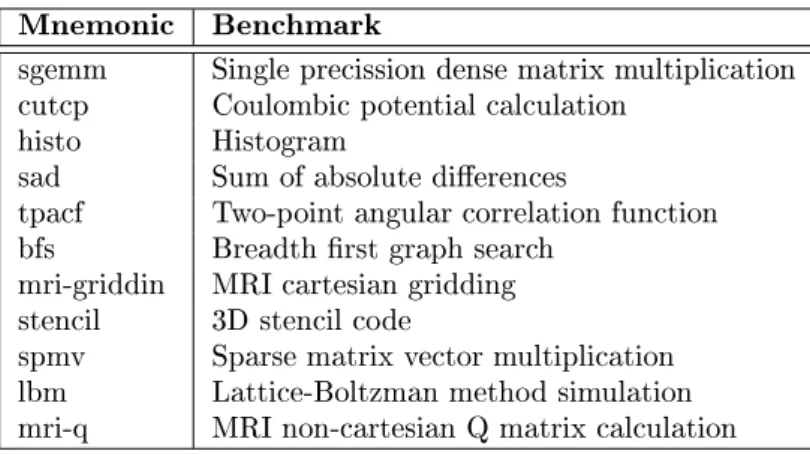
4.1 Parboil benchmarks used for the evaluation. . . 28 4.2 Halloc benchmarks used for the evaluation. . . 28 5.1 Simulation parameters used in the experimental evaluation in
Section 5.3. ∗Default conguration of the shared memory. . . . 41
5.2 Statistics of all the kernels from benchmark applications used in the experimental evaluation. . . 43 6.1 Simulation parameters used in the experimental evaluation in
Glossary
ASIC Application Specic Integrated Circuit CMP Chip Multi-Processing
CMT Chip Multi-Threading CPU Central Processing Unit
DRAM Dynamic Random Access Memory DSM Distributed Shared Memory
FCFS First Come First Served GPU Graphics Processing Unit HPC High Performance Computing ILP Instruction Level Parallelism I/O Input / Output
IPC Inter Process Communication IR Intermediate Representation ISA Instruction Set Architecture NUMA Non-Uniform Memory Access MMU Memory Management Unit OoO Out of Order
OS Operating System RaW Read after Write
SIMD Single Instruction Multiple Data SIMT Single Instruction Multiple Threads SM Streaming Multiprocessor
SMT Simultaneous Multithreading SoC System on Chip
SRAM Static Random Access Memory TB Thread Block
TLB Translation Lookaside Buer TLP Thread Level Parallelism VLIW Very Long Instruction Word WaR Write after Read
Introduction
Over the course of the last several decades, an increasing amount of chal-lenging and computationally intensive tasks in 2D and 3D rendering has been migrated from software into specialized hardware accelerators. Due to the evolution of integrated circuit technology a single-chip solution emerged, today known as the Graphics Processing Unit (GPU).
In order to enhance the quality of the rendered images and make them more realistic, GPUs have been improving exibility and performance with each new generation. Greater exibility was achieved through increased pro-grammability, that is moving from the rendering pipeline with congurable
stages [142] to the rendering pipeline with programmable stages [101, 111,
102,172]. Greater performance was achieved through increasing the memory
bandwidth and the number of cores to exploit the inherent data parallelism
of graphics workloads [111,19]. Increasing parallelism resulted in GPUs with
higher peak performance than general-purpose CPUs, and this performance
gap keeps growing1.
The trend of increasing performance gap was noticed by researchers and developers who started leveraging GPUs to improve the performance of other,
non-graphics related computations [123, 122]. Ultimately, NVIDIA
intro-duced the Tesla G80 [102] architecture with hardware and software
improve-ments geared specically towards general-purpose computing. Other
ven-dors, like AMD [67, 105] and Intel in the desktop market, as well as others
in the mobile market (Qualcomm, Imagination, ARM, etc.) followed closely. These improvements have a goal of abstracting away the graphics pipeline and its limitations. They include the unied shader core capable of
exe-cuting vertex, fragment and compute shaders (i.e., procedures) [102] on the
1Currently the gap is an order of magnitude increase in double precision arithmetic
hardware side, and dedicated programming languages like CUDA [120] and
OpenCL [57] on the software side.
Today, GPUs are the most pervasive massively parallel processors and can be found in wide range of systems. On one end of the spectrum are the mobile SoCs that power smartphones and embedded systems. Their GPUs are used
for computational photography [131,130, 12, 64], augmented reality [107] or
other computer vision tasks [168] such as face recognition [29] or road sign
detection [114] in autonomous vehicles.
In the middle of the spectrum are traditional GPU markets like desk-top (running 3D games) and workstation (running CAD and modeling tools) that have also beneted from general-purpose features. Games today
per-form physical based simulation (e.g., cloth [136], particle [85] and uid [61]
simulations) on the GPU to achieve complex visual eects. Similarly, CAD and other engineering tools can use the GPU for computation (e.g., photo
realistic rendering with ray tracing [132, 127]).
On the other end of the spectrum are large scale machines used in HPC [46,
84, 165] and warehouse scale computers [13]. Recent advances in machine
learning [16, 91, 75] have created a surge of intelligent services that rely
on speech recognition, natural language processing and image classication. GPUs are playing a central role in this revolution, speeding up their adoption
in data centers and public clouds [63, 62].
Even though a major eort was invested in making them useful beyond graphics applications, GPUs are still missing features that prevent them from being considered as truly general-purpose processors. The reason for holding back the evolution of GPU architectures is to avoid hurting the performance and eciency of interactive 3D rendering (e.g., computer games), which is still the primary GPU market. One notable consequence is the lack of mul-tiprogramming support typically found in general-purpose systems.
The concept of multiprogramming was originally introduced with the goal of improving the system throughput by lling the execution gaps (e.g., during I/O operations) of one process with work from another process. However, system throughput is not the only metric that matters in multiprogrammed systems. For example, in interactive systems it is equally important to pro-vide responsiveness to prevent sluggish performance which would otherwise frustrate the users. Similarly, in multi-tenant system it is also important to provide fairness, so that the customers get the resources that they payed for. GPUs, designed rst and foremost as graphics accelerators, were intended to be used by a single application at a time. This is progressively becoming an issue, as GPUs are nding their way into inherently multiprogrammed en-vironments, such are desktop and cloud. Traditionally, the OS is at the heart of multiprogrammed system, providing resource virtualization and, through
it, numerous benets like protection (i.e., security), performance isolation, programmability, etc. Because GPUs are missing most of the multiprogram-ming support, GPU-accelerated systems are unable to provide key multipro-grammed workload requirements.
In this dissertation we focus on solving the two fundamental obstacles that are hindering the multiprogramming support in GPUs. The rst is the non-preemptive execution of GPU kernels which means that once a GPU kernel starts its execution, it has to run until completion. The non-preemptive execution makes it impossible for the system to perform resource allocation (i.e., assign GPU cores to dierent processes) at will and through it enforce system properties (e.g., responsiveness). The second is the non-preemptible exceptions on the GPU which means that the instruction that caused the exception is stalled in the middle of the pipeline, while servicing the exception has to be ooaded to the CPU. This has become a problem because the latest generation of GPUs implement on-demand page migration (i.e., page swapping) between CPU and GPU memories using the page fault mechanism
(a type of exceptions) [175]. Migrating pages is costly and can leave GPU
cores underutilized for signicant amount of time during which a context switch of the GPU core cannot be performed.
1.1 Contributions
The objective in this dissertation is to show that, with moderate amount of added complexity, multiprogramming support can be introduced to current GPU architectures without harming the performance of single-application execution.
We argue and provide experimental data to support the claims that pre-emptive multitasking and preemptible exceptions can be implemented in such a way that accomplishes the objective. We further study, analyze and eval-uate the implementation and performance issues that arise when enabling multiprogramming support in GPUs. Following is the list of contributions in the eld of computer architecture made in this dissertation.
1.1.1 Enabling Preemptive Multitasking
In this dissertation we demonstrate that preemptive multitasking is not only desired but also a feasible approach to multiprogramming on GPUs. We introduce two preemption mechanisms with dierent eectiveness and dis-cuss their implementations. One is inspired by the classic operating system preemption mechanism where the execution on GPU cores is stopped and
1.1. CONTRIBUTIONS
their context is saved to memory, implementing true preemptive multitask-ing. The other mechanism exploits the semantics of the GPU programming model and the nature of GPU applications to implement a form of cooperative multitasking. We study the performance of the two mechanisms in terms of preemption latency and introduced overheads, as well as how they translate to nal system performance. Finally, we show that both mechanisms provide improvements in multiprogrammed systems, increasing responsiveness and fairness at the expense of a small loss in throughput.
1.1.2 Design of a GPU Kernel Scheduler
We further propose hardware extensions that remove the constraint of one process having exclusive access to the GPU and allow the utilization of GPU cores individually. These extensions enable dierent processes to concur-rently execute GPU kernels on dierent sets of GPU cores and provide a framework for implementing kernel schedulers that use the previously in-troduced preemption mechanisms. Here we also present Dynamic Spatial Sharing (DSS), a concrete scheduler implementation that dynamically par-titions the GPU cores and allocates them for dierent processes according to the priorities assigned by the OS. Finally, we demonstrate the improved responsiveness and system fairness of DSS over the baseline scheduling policy.
1.1.3 Enabling Preemptible Exceptions
In this dissertation we also propose novel approaches to supporting pre-emptible exceptions, without resorting to a full-on precise exceptions model. Avoiding the precise exceptions is necessary in order to keep the high per-formance and eciency of the GPU core pipeline. Instead, we impose the minimal amount of execution constraints and track the minimal amount of additional state so that a well-dened restart point is provided, at which context switch can be performed. We present three low-overhead design choices with varying performance-complexity trade-os. The simplest ap-proach introduces limitations to the execution model and requires minimal changes to the GPU pipeline at the cost of decreased performance. The most comprehensive solution introduces additional hardware structures resulting in a small increase in the area of the GPU core due to extra storage, but completely preserves the performance of the baseline GPU pipeline.
1.1.4 Page Fault Latency Hiding Scheme
We introduce a scheme for hiding the latency of page faults by performing a context switch on a fault in this dissertation. Servicing a page fault can take a signicant amount of time, which in turn leads to severe system un-derutilization and performance loss. Instead of waiting for the fault to be resolved, this scheme switches out the faulted threads and frees the resources that can be used to execute some other useful work in the meantime. We present scheduler extensions that allow oversubscribing the GPU core with threads and selecting non-faulted threads for execution, exploiting the na-ture of GPU applications to improve their performance in the presence of page faults. Previously introduced preemptible exception support enables the restartability of the context switched threads, once the fault is resolved. We demonstrate that this technique can provide performance improvement for applications that are neither execution nor data transfer bound.
1.1.5 Handling Page Faults on the GPU Cores
This dissertation also proposes handling certain type of GPU-triggered page faults on the GPU itself, instead of ooading all the handling work to the CPU as the current GPUs do. This enables another standard feature of general-purpose systems, the lazy allocation of memory, by locally handling the page faults caused by writing to pages with no physical memory assigned (i.e., on-demand allocation of physical memory). The GPU code runs its own physical memory allocator, which reserves the required memory and xes the GPU page table without interrupting the CPU and occupying the system interconnect. Only page faults that do not need to transfer data from the CPU (i.e., accesses to the GPU heap and output buers) can be handled locally. Preemptible exceptions support clears the pipeline of faulted requests and thus guarantees that the fault handler can be safely executed on the faulted GPU core. We demonstrate improved performance on kernels with signicant number of concurrent faults, which is the case for a considerable amount of benchmarks.
1.2 Organization
The rest of this dissertation is organized as follows:
Chapter 2: GPU Systems Background introduces all the technical details of modern GPU systems that are necessary for understanding the
1.2. ORGANIZATION
proposals made in this dissertation. The chapter introduces the baseline architecture in a top-down fashion, going through the architecture of a GPU-accelerated system, GPU itself, its execution engine, and nishing with the GPU core microarchitecture.
Chapter 3: Multiprogrammed Systems discusses the state of the art in multiprogramming. It briey summarizes the mechanisms and policies used to provide multitasking on CPUs, and gives a detailed review of related work in GPU multitasking. It further describes some common CPU virtual memory features and discusses the recent proposals found in the literature, made to circumvent the lack of these features in GPUs. Finally, it surveys the exception handling approaches previously proposed in the literature, focus-ing on both precise exceptions and alternative approaches to implementfocus-ing preemptible exceptions.
Chapter 4: Methodology describes the workloads used for the evalua-tion and provides the basic informaevalua-tion on the two simulaevalua-tion methodologies used to validate and evaluate the proposals in this dissertation.
Chapter 5: Enabling Preemptive Multitasking covers contributions 1 and 2, providing the motivation, detailed architecture of the proposals, performance evaluation and details of the evaluation methodology.
Chapter 6: Enabling Preemptive Exceptions covers contributions 3, 4, and 5, providing the motivation, detailed architecture of the proposals, performance evaluation and details of the evaluation methodology.
Chapter 7: Conclusions and Future Work concludes the dissertation. It reviews the key contributions and insights presented in this dissertation and presents potential future work and open research lines.
GPU Systems Background
In this chapter we present the architecture of the baseline system used throughout this dissertation in a top-down manner. The focus is only on the details necessary for understanding our proposals.
2.1 GPU Accelerated Systems
Originally, GPUs have started life as system expansion components, resid-ing on the add-in-boards (here referred to as the discrete GPUs). Increasresid-ing commoditization resulted in inclusion of GPUs into the motherboard chip-set for desktop and laptop computers (the integrated GPU mode, mostly aban-doned today). Finally, the raise of graphics requirements in mobile markets resulted GPUs in becoming part of the system-on-chip (SoC) (referred to as the fused GPU model). The two common form factors (discrete and fused)
are shown in Figure 2.1.
In the discrete GPU model, a GPU card is connected to a system through the system expansion bus (e.g., PCI express or NVLink). In its most basic form, the system has one CPU attached to its own system memory, while the expansion card has one GPU attached to the graphics memory. Tra-ditionally, the two memories have been incoherent, and it was the job of the programmer to keep them coherent by performing explicit data
trans-fers [86,120]. Congurations with multiple CPUs and/or GPUs are common
in high performance environments, and further increase the complexity of
the system [27].
Alternatively, the fused GPU model puts the CPU cores and GPU cores on the same die. Both GPU and CPU in this case use the same physical mem-ory (system memmem-ory). Implementations range from physically partitioned memory (in which case the explicit data transfers between two partitions are
2.1. GPU ACCELERATED SYSTEMS CPU System Memory GPU Graphics Memory PCIe System Memory GPU Cores CPU Cores NoC a) b) Mem. Control SoC
Figure 2.1: GPU accelerated systems in their basic forms: a) descrete GPU model with GPU and graphics memory on the expansion card, and b) fused GPU model with CPU and GPU integrated in the same chip.
still necessary) [22] to the latest designs that keep the CPU and GPU cache
coherent [73]. Despite the improved programmability of the cache coherent
design, the discrete model is likely to stay dominant, especially in the HPC
and data center domains, because of the much higher performance1.
In general case a GPU application consists of (usually in repetitive bursts):
• CPU execution that performs control, preprocessing or I/O operations,
as well as serial portion of the algorithm;
• GPU execution of kernels that performs computationally demanding
tasks (parallel portion of the algorithm); and
• data transfers between CPU and GPU that bring input data to the
GPU memory and return the outputs to the CPU memory.
float *x, *y, *dev_x, *dev_y; ... // 2 x malloc + 2 x cudaMalloc read_from_file(N, x, y, ...);
cudaMemcpy(dev_x, x, N, cuadMemcpyHostToDevice); cudaMemcpy(dev_y, y, N, cudaMemcpyHostToDevice); saxpy<<<GDIM, BDIM>>>(N, 2.0, x, y);
cudaMemcpy(y, dev_y, N, cuadMemcpyDeviceToHost); write_to_file(N, y, ...);
... // 2 x free + 2 x cudaFree
I/O
I/O
GPU kernel Data Transfers
Figure 2.2: Simple SAXPY GPU program with explicit data transfers (programmer man-aged).
An example program performing the SAXPY linear algebra operation on
the GPU is shown in Figure 2.2. It rst allocates the buers on CPU and
1Discrete GPUs usually have higher core count (they are on a separate chip) and
memory bandwidth (graphics memory uses wider buses and runs at higher frequency than CPU memory).
GPU and loads the data from a le into the CPU buers. Data is then copied to the GPU memory, before the saxpy kernel is launched to compute the result. The output is then copied back to the CPU memory, and written to a le.
CUDA is a Single Program Multiple Data (SPMD) style programming
model [38] and a kernel launch consists of a number of threads executing the
same code. Threads are grouped into thread blocks that are independent of each other. Only threads from the same thread block can cooperate using barrier synchronization and communication through local memory (shared memory in CUDA terminology).
The GPU device driver (executing in the CPU, as part of the OS) is in charge of performing the bookkeeping tasks for the GPU (e.g., managing the GPU memory space). GPU kernel invocations (kernel launch in CUDA terminology), initiation of data transfers, and GPU memory allocations are performed in the CPU code (referred to as commands in the rest of this text). GPU programming models provide software work queues (streams in CUDA terminology) that allow programmers to specify the dependences between commands. Commands in dierent streams are considered inde-pendent and may be executed concurrently by the hardware. Because the
latency of issuing a command to the GPU is signicant [77], commands are
sent to the GPU as soon as possible. Once commands are issued to the GPU, the software has no control over them anymore. Each process that uses a GPU gets its own GPU context, which contains the page table of the GPU memory and the streams dened by the programmer.
float *x, *y;
x = malloc(...); y = malloc(...);
read_from_file(N, x, y, ...);
saxpy<<<GDIM, BDIM>>>(N, 2.0, x, y);
write_to_file(N, y, ...);
free(x); free(y);
Single pointer
Automatic Transfers
//flaot *dev_x, *dev_y;
//cudaMalloc(&&dev_x, ...); cudaMalloc(&&dev_y, ...);
//cudaMemcpy(dev_x, x, N, cuadMemcpyHostToDevice); //cudaMemcpy(dev_y, y, N, cudaMemcpyHostToDevice);
//cudaMemcpy(y, dev_y, N, cuadMemcpyDeviceToHost);
//cudaFree(dev_x); cudaFree(dev_y);
Figure 2.3: Simple SAXPY GPU program with automatic data transfers (demand paging).
The latest generation of NVIDIA GPUs, GP100 Pascal, supports the
2.2. GPU ARCHITECTURE
migration eliminates the need for explicit programmer data transfers, signif-icantly improving the programmability of the system. Furthermore, it also allows oversubscription of the GPU memory, increasing the number of
appli-cations that can benet from GPU acceleration. Figure2.3shows the version
of the SAXPY program from Figure2.2, rewritten to rely on the new demand
paging feature, instead of programmer controlled data transfers. Noticeable is the lack of double pointers (host and device), associated allocations and deallocations, as well as data transfer calls.
CPU 0x5000 GPU ld R3, [0x6000] 1 3 4 2 5 6 VA PA S ... ... 0x6000 ... ... 0x3000VA PA S ... ... 0x4000 ... ...
Figure 2.4: On demand page migration.
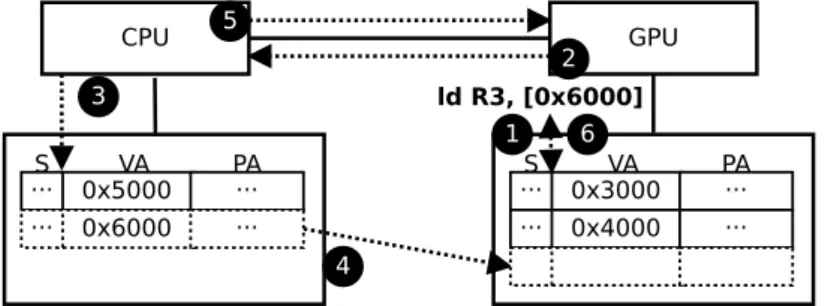
Figure 2.4 illustrates the steps taken by the baseline system while
per-forming demand paging. When the kernel running on the GPU performs an access to a page owned by the CPU, after walking through the GPU page table the MMU determines that the page is not present in the GPU memory (1) and sends an interrupt to the CPU (2). The CPU interrupt handler, implemented by the GPU OS device driver (3), transfers the contents of the faulting page from the CPU memory to the GPU memory, updates both CPU and GPU page tables to reect the new location of the page (4), and noti-es the GPU that the page has been succnoti-essfully migrated (5). The MMU broadcasts this information to GPU cores, in order to resend the faulted
requests [175]. Note that this only replays the memory request (from the
microarchitectural state) and does not replay the instruction itself. On the retried page table walk, the MMU nds a valid translation and sends it back to the core which now can let the faulting instruction continue execution (6). Eectively, this scheme treats GPU page faults as very long latency TLB misses which stall the execution of the instructions causing the page fault.
2.2 GPU Architecture
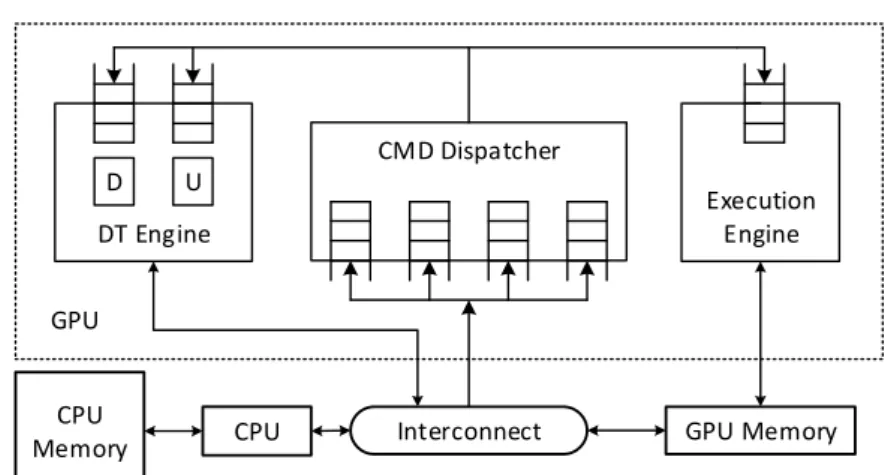
The base architecture assumed in this paper is depicted in Figure 2.5. The
GPU has an execution engine and a data transfer engine used to copy the data between CPU memory and GPU memory. Even though it typically has
Interconnect CMD Dispatcher Execution Engine DT Engine D U CPU Memory CPU GPU GPU Memory
Figure 2.5: GPU architecture with its main components: Command (CMD) Dispatcher, Data Transfer (DT) Engine, and Execution Engine.
multiple cores, the execution engine is treated as one unit for kernel schedul-ing purposes. The interface to the CPU implements several hardware queues
(i.e., NVIDIA Hyper-Q) used by the CPU to issue GPU commands [117,23].
The GPU device driver maps streams from the applications on the command queues. The command dispatcher is in charge of inspecting the top of the command queues and issuing commands to the corresponding engine. Data transfer commands are issued to the data transfer engine via DMA queues while kernel launch commands are issued to the execution engine via the execution queue. After issuing a command, the dispatcher stops inspect-ing that queue until the command completes. Commands from dierent command queues that target dierent engines can be concurrently executed. Conversely, commands coming from the same command queue are executed sequentially, following the semantics of the stream abstraction dened by the programming model. Traditionally, a single command queue was provided, but newer GPUs use several queues to remove the problem of false
depen-dencies introduced by the design with one command queue [171], and further
increase the opportunities to overlap independent commands.
The GPU also includes a set of global control registers that hold the GPU context information used by the engines. These control registers hold process-specic information, such as the location of the virtual memory structures (e.g., page table), the GPU kernels registered by the process, or structures used by the graphics pipeline.
At any given moment, the GPU is executing commands from one context
only2. This constraint, coupled with non-preemptive execution leaves room
2Note that the GPU memory however can hold data from multiple contexts at the same
2.3. BASE GPU EXECUTION ENGINE SM SM L1 $ + TLB L1 $ + TLB Fill
...
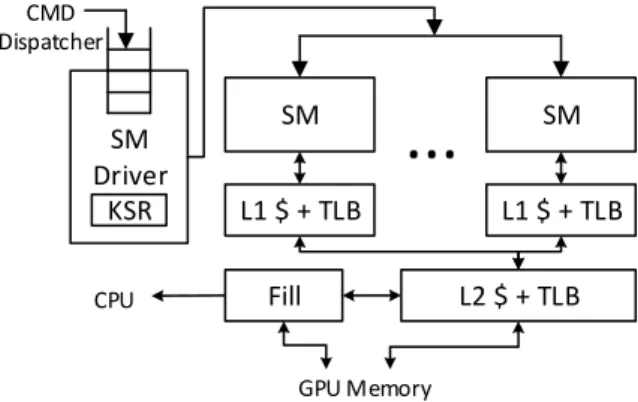
L2 $ + TLB SM Driver KSR CPU GPU Memory CMD DispatcherFigure 2.6: Execution engine architecture.
for very coarse grained sharing, only. All commands submitted to the GPU must complete before switching to another context.
2.3 Base GPU Execution Engine
The base GPU execution engine we assume in this paper is shown in Fig-ure 2.6. It has a number of computation cores (Streaming Multiprocessors, or SMs, in CUDA terminology) that varies, depending on the deployment environment, from one (targeting mobile SoCs) to several few dozens (tar-geting HPC). Each SM has a private L1 cache and L1 TLB, while the L2 cache and TLB are shared between all SMs. A shared ll unit implements the hardware logic of page table walkers and communication with the CPU in case of page faults.
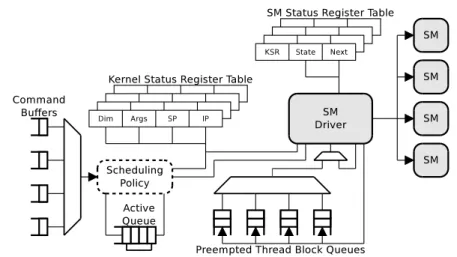
The SM driver sits at the front of the execution engine and distributes the work to the SMs. It receives kernel launch commands via the execution engine queue, and sets up the Kernel Status Registers (KSR) with the control information such as number of work units to execute, kernel parameters (number and stack pointer), etc. The SM driver uses the contents of these registers, as well as the global GPU control registers, to setup the SMs before the execution of a kernel starts. The execution queue can contain a number of independent kernel commands coming from the same context, that are scheduled for execution in a rst-come rst-serve (FCFS) manner.
When a thread block is issued to an SM, it remains resident in that SM until all of its threads nish execution. An SM can execute more than one thread block in an interleaved fashion. Concurrent execution of thread blocks relies on static hardware partitioning, so the available hardware resources (e.g., registers and shared memory) are split among all the thread blocks in the SM. The resource usage of all the thread blocks from a kernel is the
same and it is known at kernel launch time. The number of thread blocks that can run concurrently is thus determined by the rst fully used hardware resource.
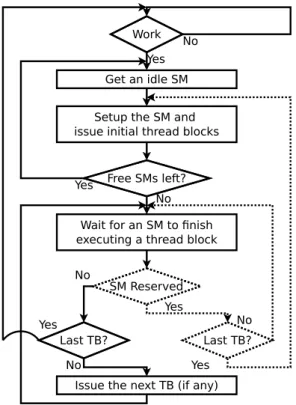
After the setup of the SM is done, the SM driver issues thread blocks to each SM until they are fully utilized (i.e., run out of hardware resources). Whenever a SM nishes executing a thread block, the SM driver gets notied and issues a new thread block from the same, active, kernel to that SM. This policy combined with static partitioning of hardware resources means that kernels with enough thread blocks will occupy all the available SMs, forcing the other kernel commands in the execution queue to stall. As a result, concurrent execution among kernels is possible only if there are free resources after issuing all the work from previous kernels. This back-to-back execution happens when a kernel does not have enough thread blocks to occupy all SMs or the scheduled kernel is nishing its execution, and SMs are becoming free again. Today's GPUs, however, do not support concurrent execution of commands from dierent contexts on the same engine. That is, only kernels from the same process can be concurrently executed.
2.4 Core Architecture
We illustrate the detailed SM pipeline in Figure2.7. Each thread block
exe-cuted on the SM is further divided into warps, groups of 32 threads adhering
to the Single Instruction Multiple Threads (SIMT) execution model [102].
Threads in a warp execute in a lock-step, acting as a single thread of the
Single Instruction Multiple Data (SIMD) execution model [52], until threads
take dierent paths on a conditional branch. At that point a compiler
con-trolled [95] mechanism in the form of a stack (usually referred to as the
reconvergence stack [53]) is used to execute both paths of a branch, one after
the other [97, 53]. Our baseline uses the immediate post-dominator basic
block as the reconvergence point [53]. Threads of the same thread block can
be synchronized with each other using barriers. A hardware barrier unit in each SM keeps track of blocked and active threads of a thread block and reactivates them all when each one has executed the barrier instruction.
Because the SM is a throughput oriented processor, designers have opted for multithreaded execution of warps as a mean of hiding the pipeline
laten-cies [146, 170]. Thus each clock cycle, the warp scheduler (WS) picks one
ready warp, for which an instruction line will be fetched from the instruc-tion cache (IC) in the next cycle and sent to the issue queue. The unied issue queue contains instructions from multiple warps and can issue multiple instructions per cycle, from one or dierent warps. A score-boarding (SB)
2.4. CORE ARCHITECTURE SB O P R e ad Math Special Function Shmem Global C o m m it A G U Execute Issue IC IL WS Fetch Branch Figure 2.7: SM microarchitecture.
mechanism [157] is at the heart of instruction scheduling, making sure that
dependencies among instructions from the same warp are enforced. The issue logic (IL) thus implements out-of-order issue for most instruction types, as long as dependencies are honored. However, unlike typical out of order pro-cessors, SM does not support speculation nor register renaming. Both control ow and memory dependence speculation are avoided by briey disabling the fetch for a warp upon fetching a control ow or memory instruction. Mem-ory instructions re-enable the warp at issue time, forcing the in-order issue with respect to other memory instructions of the same warp. Control ow instructions re-enable the warp during commit.
Once issued, instructions go through the operand read stage, in which the register le is accessed and the data is dispatched to the execution units. The SM has a very large unied (integer and oating point) register le that is partitioned among all resident warps. The execution stage consists of several math units, a branch unit, a special functions unit and dierent memory pipelines. The shared memory pipeline accesses the on-chip scratch-pad memory that holds CUDA shared address space objects, which are not subject to memory translation (each SM is used by only one user process at a time). The global memory pipeline performs the accesses to the o-chip memory that go through the cache hierarchy and memory translation (global memory can hold allocations from dierent processes at the same time).
Upon completion, each instruction is sent to the commit stage, resulting in out-of-order commit. Manipulating the score-boards is split between the operand read stage, in which source operands are released (after reading), and the commit stage, where the destination operand is released (after writing). Early score-board release for source operands mitigates the WAR (Write After Read) hazard in absence of register renaming.
Several features discussed in this dissertation require running system soft-ware (i.e., trap handling routine and page fault handler) on the GPU. To prevent the user code from directly modifying system data structures, such
as the GPU page table and the physical memory allocator, the privileged execution mode is required. There is no public evidence that GPUs sup-port privileged execution, but it is easy to see how sucient supsup-port for our use cases is easy to achieve. We can assume two dierent privilege (user and system) execution levels which rst requires keeping additional bit per warp to distinguish the privilege level and using it to detect violations. The bit is checked in the decode stage to protect the user level code from exe-cuting privileged instructions. The GPU page table entires also need to be extended with one bit that distinguishes pages from user and supervisor (i.e.,
system), similar to what modern CPUs do [72]. This bit is then checked
dur-ing memory translation, together with other access violations checks (e.g., write protected pages) to protect the system memory.
Multiprogrammed Systems
Today most computers, spanning the full spectrum from a portable media player to the fastest supercomputer in the world, are multiprogrammed, al-lowing several programs (potentially from dierent users) to run concur-rently. Essential in enabling the multiprogramming capability is the operat-ing system, who's role is to provide the management of the machine resources and isolation of applications running on the machine. The OS achieves this through the concept of virtualization, creating an illusion that the program is running on the system alone.
Virtualization of the processor is typically achieved through OS controlled time-multiplexing of programs on the processor. Periodically, the execution of a program gets suspended by the timer interrupt and the OS gains control of the processor. The OS can then choose to run another program for some time and perform a context switch by saving the context of the preempted process to memory, and restoring the context of another process. Dierent processor scheduling techniques have been proposed in eort to improve the performance on dierent metrics such as system fairness, improved respon-siveness, or overall system throughput.
Virtualization of the memory is achieved through a set of mechanisms collectively referred to as virtual memory. Virtual memory provides isolation between the programs, so that they cannot access each other's data (inten-tionally or by accident), unless explicitly allowed. Isolation is maintained by using one virtual address space per process and translating (mapping) mem-ory accesses from the virtual address space to the actual memmem-ory present in the system (i.e., physical address space). Memory translation also enables another great feature of the virtual memory, allowing the virtual address space to be much bigger than the physical memory installed in the system. If the program uses more memory than available, the OS can transparently
3.1. PROCESS SCHEDULING
move the data (i.e., demand paging) between the DRAM and slower but bigger store such as hard drives, using the page fault mechanism to detect accesses to data residing in the backing store.
Some of the mechanisms used for processor and memory virtualization are built on the same low-level mechanisms. Timer interrupts and page faults are both built on top of the exceptions mechanism that is used to signal events which require special attention. When the exception is raised, the processor stops executing the current process and invokes the exception handler implemented in the OS (or at least registered with it). If the cause of the exception is resolved by the handler (e.g., the exception was not caused by an illegal memory access), the interrupted process can be restarted.
The reminder of this chapter is a survey of the state of the art in process scheduling, virtual memory and exceptions handling.
3.1 Process Scheduling
The process scheduler plays a part in sustaining the illusion of each process having the system to itself. To do that, the scheduler usually needs to balance few, sometimes contrary requirements. That is, it needs to preserve fairness between processes while keeping the system responsive (more important in interactive systems) and not let any process starve. It also needs to make sure that the machine resources are well used, keeping the system throughput as high as possible. Since balancing all these metrics is quite hard (or even impossible) to achieve, schedulers usually focus on few of them, depending on the environment the system is deployed in.
3.1.1 CPU Scheduling
Some of the classical approaches to process scheduling include the rst come
rst serve (FCFS), round robin (RR) [88], and shortest job rst (SJF) [32]
and its preemptive sibling shortest time to completion rst (STCF) [33]
al-gorithms. Of these three, perhaps round robin only deserves to be called a scheduler, as SJF and STCF are mostly impractical (in general case the length of each job is unknown) and FCFS only performs basic queueing.
Multi-level feedback queues (MLFQ) [35] is a very common scheduling paradigm,
used in Solaris, BSD derivatives, and Windows NT based systems [106, 96,
150, 11]. In essence, the MLFQ schedulers tries to predict the behavior of
processes based on their past (length of the CPU burst) and prioritize the interactive and I/O bound processes (short CPU burst).
Another common category are the proportional share (or fair-share)
sched-ulers [79], that aim to guarantee a certain percentage of CPU time to a
process (usually proportional to their priority). Stochastic implementations
such is the lottery scheduler [166] or deterministic such is the borrowed virtual
time scheduler (BVT) [41] have been proposed. Proportional share
sched-ulers are most commonly used for the processors scheduling at the hypervisor
level [30]. In the past few years, Linux has transitioned from the
MLFQ-like O(1) scheduler [20] to the proportional share completely fair scheduler
(CFS) [110,124].
As the processors became more concurrent and complex, so did the sched-ulers. Increased levels of concurrency are making current implementations
ineective [89,103]. Furthermore, contention of shared resources (e.g., caches
and memory controllers) have elevated the problem of performance
interfer-ence [70, 83, 155, 133, 115, 113, 116, 34], which makes the current SMP
schedulers even less eective. Several approaches to improve performance
through OS level scheduling have been proposed for SMT [26,48], CMT [47],
CMP [49, 177], and NUMA [18].
3.1.2 GPU Scheduling
Improving the multiprogramming (or multitasking, in general) capabilities of the GPU was one of the early goals set by the research community.
GERM [15] and TimeGraph [77] focus on improving responsiveness of the
graphics applications running on the GPU. Both provide a GPU command scheduler integrated in the device driver, that chooses the context from which commands should be submitted to the GPU next. Once the command is sub-mitted to the GPU, their scheduling cannot be controlled any more. Because of the high cost of submitting the command to the GPU commands are sub-mitted in batches, requiring the scheduler to balance the cost of command submission versus the longer execution of the command batch.
RGEM [76] is a software runtime library targeted at providing
respon-siveness to prioritized CUDA applications by scheduling DMA transfers and kernel invocations. One of the problems that RGEM tries to solve are the non-preemptive DMA transfers. Their approach is to implement memory transfers as a series of smaller transfers and thus create the potential schedul-ing points, lowerschedul-ing the stall time due to the competschedul-ing memory transfers.
Gdev [78] is built around these principles, but integrates the runtime
support for GPUs into the OS. Disengaged scheduling proposed in [109]
aims at providing the safe and fair scheduling conducted by the OS, while minimizing the overhead introduced by crossing the user/kernel boundary
3.1. PROCESS SCHEDULING
the OS GPU aware by using a task-based data ow programming model and exposing the task graph to the OS kernel.
Li et al. [100] introduced a software virtualization layer that makes all
the participating processes execute kernels in the same GPU context. They instantiate a proxy process that receives requests from client processes and executes them on the GPU. This approach, later adopted by NVIDIA's own
Multi-Process Service (MPS) runtime system [118], eliminates the overheads
imposed by the constraint that only one context can be active at a time,
and is especially benecial for the GPU accelerated MPI applications [118].
Running one MPI rank per core is the common approach in HPC, especially with legacy applications, and since a typical GPU accelerated node has a ratio of half a dozen or so CPU cores to each GPU, sharing eliminates the overheads
and improves utilization of the GPU [21,171]. However, sharing the context
breaks the memory isolation between the participating processes and thus it is not a general solution. Furthermore, since the GPU execution engine does not expose its internals to software, none of these systems can control assignment of SMs to dierent kernels or implement preemptive scheduling policies.
Several software techniques have been proposed in the past to increase the concurrency between dierent kernels running in the GPU. Kernel fu-sion is a technique that statically transforms the code of two kernels into one that is launched with the appropriate number of thread blocks. Fused kernel contains an if statement to check which one of the original computations is to be performed. Because kernels use their thread and block id to nd inputs and produce outputs, ids have to be recalculated to accommodate
this scheme. Guevara et al. [58] proposed a runtime system for CUDA which
chooses between running the fused kernel or running the kernels sequentially.
Wang et al. [167] used a similar technique, and observed the improved energy
eciency as a result of the better GPU utilization. Extending this approach,
Gregg et al. [56] implemented an OpenCL kernel that occupies the whole
GPU and dynamically invokes kernels to be executed, acting as a scheduler. Kernel fusion approaches were the rst take on improving the concurrency of the GPU execution engine. As such, their contribution is mostly in demon-strating the benets rather than proposing a concrete implementation, since they are highly impractical.
Alternatively, several software approaches have been proposed to imple-ment spatial partitioning of the GPU. The common idea is to underutilize the GPU by one application, and rely on the back-to-back execution so that
concurrent execution could be achieved. Ravi et al. [135] rely on the molding
technique, that is changing the dimensions of grid and thread blocks while preserving the correctness of the computation (if possible). Molding is not
a generic technique and can be only applied to a small number of existing kernels, without developer having to transform the code to comply to
re-quirements. Pai et al. [125] propose a similar technique and associated code
transformation based on iterative wrapping [153] that produces an elastic
kernel. These techniques rely on developer or compiler transformation to prepare the programs for concurrent execution. Furthermore, the back-to-back execution, which is the key enabler of these proposals, only works for kernels from the same context.
Similarly, several software techniques have been proposed to implement
time multiplexing on GPUs. The kernel slicing technique used in [14, 125,
176] transforms the kernel so that the code is oblivious to the kernel launch
parameters (e.g., the number of thread blocks). Such transformed kernel is then launched multiple times, passing the launch oset so that each slice performs only a part of the original computation, but all launches together
perform the full computation. Static slice size [125, 14], or the smallest slice
size in case of dynamic slicing schemes [176], are chosen a priori for the
spe-cic system conguration, by the user. Softshell [151] is a GPU programming
model with multitasking support. It relies on developers explicitly declaring preemption points (similar to the yield() function in collaborative multitask-ing) or preempting on the thread block boundary to enable the scheduling of tasks.
In [3], the authors make a case for spatial sharing of the GPU execution
engine by simulating execution of several kernels from dierent applications running in parallel. They statically partition SMs among applications, since the emphasis of their work is on showing the benets of spatial multitasking, rather then proposing the mechanisms to implement it. Partitioning is chosen by the user and is performed at the beginning of the simulation, at the simul-taneous launch of all benchmark applications, and cannot be changed after that. Furthermore, compute units are not reassigned to another application once the application executing on them completely nishes.
3.2 Virtual Memory
Memory can easily become a scarce resource in multiprogrammed systems due to the additional pressure from multiple processes. Hence, it is impor-tant that the OS manages it fairly and prevents starvation of any process. Similarly, the demand paging can cause performance bottlenecks and the OS must try to minimize the impact and maintain the high system throughput. Some of the classic solutions include scheduling other ready processes while on a page fault, and page prefetching and page stealing optimizations.
3.2. VIRTUAL MEMORY
3.2.1 CPU Virtual Memory
Operating systems have advanced the use of virtual memory beyond provid-ing the basic features of process isolation and memory swappprovid-ing. Several techniques that rely on the virtual memory mechanisms have been adopted to improve performance or programmability of the system. Lazy allocation of physical memory is a commonly employed technique where no physical memory is assigned to a page until that page is written to for the rst time. Lazy memory allocation thus improves the utilization of physical memory and avoids performing functions such as physical frame lookups, page ta-ble updates and page zeroing, unless it is really necessary. Copy-on-write (COW) is another related optimization, used to optimize the process cloning
(i.e., fork() system call) [20] and IPC [1], among other things. COW defers
copying the shared data, unless one of the copies needs to be changed. Linux kernel also implements an inverse operation to COW, called kernel
same-page merging (KSM) [9]. The KSM nds duplicate pages and maps them to
the same physical memory, which proved to be very useful for increasing the number of guest OS instances in virtualized systems.
Operating systems today expose protection violation handles to user level
applications [50, 8], facilitating further innovative uses of virtual memory
mechanisms. Examples include garbage collection [7], program
checkpoint-ing [99], transaction locking [134], and transactional memory [31].
Another common use of virtual memory mechanisms is providing a shared memory abstraction on a distributed memory machine. Some Distributed Shared Memory (DSM) use memory protection hardware to detect accesses to the shared data. Coherence operations, such are page replication and invalidation, are then performed to migrate the page to the requesting node
and allow accessing the data locally. Both OS level [51, 39] and user level
library [98, 28, 17,81] implementations have been proposed in the past.
3.2.2 GPU Virtual Memory
Pichai et al. [128] and Power et al. [129] have recently conducted simulation
studies of GPU MMUs. Typical of modern general purpose processors [72],
they studied TLBs accessed before or in parallel with the L1 cache, and con-cluded that a certain degree of concurrency in both TLB access and page table walking needs to be maintained, or the performance will suer due to
large working set and massive concurrency of GPU cores. Vesely et al. [164]
studied the performance of virtual memory on the AMD APU, a fused CPU-GPU SoC, and proposed directions for further improvements. Among other things, they observed that faults caused by the GPU have much higher
tency and much lower scalability of handling than faults caused by the CPU.
Saha et al. [140] have proposed a programming model for heterogeneous
x86 based systems which have a host Intel x86 CPU and the accelerator card carrying the Intel Larrabee x86 based processor. As part of the im-plementation, they had a software DSM between the host and accelerator memories, using page faults on both host and accelerator to trigger data transfers between the two memories. Such implementation is possible, be-cause Larrabee is eectively x86 CMP with in-order cores derived from Intel
Pentium core [143]. Thus it comes with all the features expected from an
x86 core, including exceptions (page faults) handling.
In order to circumvent the lack of page faulting capabilities on older GPU
architectures Gelado et al. [55] have proposed to implement an asymmetric
DSM (ADSM). It uses only CPU page faulting capabilities to track the state of shared pages (annotated by the programmer), but had to be conservative since no page faults could be used to detect data accesses on the GPU. Jablin
et al. [71] extended this work with compiler support, so that regular malloc
function can be used instead of the special allocator for the shared allocations. Several solutions have been proposed to allow oversubscription of the GPU memory (i.e., allowing an application to use a data set larger than
the GPU physical memory). Ji et al. [74] have proposed a software scheme
that keeps track of used data via CPU runtime software and a GPU runtime
software that acts as a software translation layer. Lee et al. [94] have proposed
another software solution that uses compiler generated inspector kernel to extract the working set required for the workload partitions (thread blocks) and iteratively schedule as much blocks as can t in the GPU memory, until all blocks have executed. These techniques that aim at enabling on-demand page migration and memory oversubscription for the GPU have been out-dated, since the latest generation of GPUs (i.e., NVIDIA Pascal) supports them natively.
Shahar et al. [145] argue for page fault handling on GPUs, in order to
enable their paging techniques and demonstrate performance improvement with applications that oversubscribe the GPU memory. Because of limita-tions of the current hardware, they had to introduce a software layer that performs address translation. Additional complexity and runtime cost of the software address translation can be avoided by introducing the exception handling mechanism on the GPU.
3.3. EXCEPTION HANDLING
3.3 Exception Handling
High performance processor implementations that utilize pipelining or out-of-order execution (or both, in most cases) need to take special care, in order to provide the correct exception recovery and handling. The problem arises because the processor is overlapping execution of multiple instructions (i.e., pipelining) or executing instructions out of their program order (i.e., out-of-order execution). An older instruction in the program out-of-order might signal an exception after a younger instruction has nished and updated the program state. Thus, the processor needs to make sure that the execution can be correctly restarted after the exception cause has been xed.
Additional complexity is introduced by the fact that all general purpose processors (following the von Neumann architecture) promise the sequential instruction execution interface to the programmer. This has the biggest im-pact on debugging capabilities, since it can make the state of the processor at the exception point dierent from what programmer expects (sequential execution in the program order), making it hard to debug. For this rea-son, modern general purpose CPUs support precise exceptions, which entails bringing the processor to the precise sate, before the exception is handled. This state is consistent with the state as if instructions would have been exe-cuted sequentially in program order, and execution stopped right before the faulting instruction. This way, it is enough to set the program counter to that of the faulting instruction and the execution can be restarted correctly.
3.3.1 Precise Exceptions
Early pipelined processors did not fully support precise exceptions. IBM
Sys-tem/360 model 91 [6] had a oating point unit (scheduled using Tomasulo's
algorithm [158]) that was causing imprecise exceptions. Other high
perfor-mance computers like the CDC 6600 [157] and Cray Research Cray-1 [139]
vector machine implemented out-of-order commit, thus they did not support precise interrupts, and virtual memory for that matter.
In their seminal paper Smith and Pleszkun [147] discussed three
mech-anisms to recover from an exception in a precise manner: reorder buer, history le, and future le. Another classical mechanism, the
checkpoint-repair, was proposed by Hwu and Patt [68]. Sohi [149] and Moudgill et
al. [112] discuss the use of the unied register le that holds architectural
and speculative state. All of these proposals are focused on supporting ex-ception recovery to precise architectural state by signicantly increasing the storage to include architectural and speculative state (eectively register re-naming). They can also be used as a missprediction recovery mechanism,
which is crucial because most of the modern general-purpose processors (the high performance ones, at least) employ speculation and dynamic instruc-tion scheduling (and already doing renaming to improve performance). As a result, some variation of these mechanisms is usually used in commercial
high performance processors [174, 82,65, 156]
Implementing exceptions in vector processors has proven to be a challeng-ing task, also. For that reason, many vector machines omitted the support
for virtual memory [139, 162, 87]. IBM System/370 allowed only one vector
instruction to be in-ight [25], which simplies the support for exceptions,
but limits the performance. Several vector processors / extensions have been
proposed in academia which support precise [43] (using the reorder buer
approach) or restartable exceptions [90] (using the history le approach).
Tarantula was a vector extension for the canceled Alpha EV8 processor [42].
It also supported precise exceptions, piggybacking on the host EV8 renaming capabilities.
There have been several proposals for exception handling in multi threaded
processors [80,178], that stall the faulting thread, while handling the
excep-tion in another execuexcep-tion thread. The goal of this approach is to start execut-ing the handler code as soon as possible by avoidexecut-ing the instruction ushexecut-in