This is a repository copy of The Relational Value of Perceived Brand Globalness and
Localness.
White Rose Research Online URL for this paper: http://eprints.whiterose.ac.uk/137035/
Version: Accepted Version Article:
Sichtmann, C, Davvetas, V orcid.org/0000-0002-8905-7390 and Diamantopoulos, A (2019) The Relational Value of Perceived Brand Globalness and Localness. Journal of Business Research, 104. pp. 597-613. ISSN 0148-2963
https://doi.org/10.1016/j.jbusres.2018.10.025
© 2018 Elsevier Inc. All rights reserved. Licensed under the Creative Commons Attribution-Non Commercial No Derivatives 4.0 International License
(https://creativecommons.org/licenses/by-nc-nd/4.0/).
[email protected] https://eprints.whiterose.ac.uk/ Reuse
This article is distributed under the terms of the Creative Commons Attribution-NonCommercial-NoDerivs (CC BY-NC-ND) licence. This licence only allows you to download this work and share it with others as long as you credit the authors, but you can’t change the article in any way or use it commercially. More
information and the full terms of the licence here: https://creativecommons.org/licenses/ Takedown
If you consider content in White Rose Research Online to be in breach of UK law, please notify us by
1
The Relational Value of Perceived Brand Globalness and Localness
Christina Sichtmann
Department of International Marketing
University of Vienna, Oskar-Morgenstern-Platz 1
1090, Vienna, Austria
tel: +43 (1) 4277 38032, fax: + 43 (1) 4277 838032,
e-mail: [email protected]
Vasileios Davvetas (corresponding author) Marketing Division
Leeds University Business School
Woodhouse Lane, Maurice Kenworth Building, University of Leeds
LS2 9JT, Leeds, UK
tel: +44 (0) 113 34 30610
e-mail: [email protected]
Adamantios Diamantopoulos
Department of International Marketing
University of Vienna, Oskar-Morgenstern-Platz 1
1090, Vienna, Austria
tel: +43 (1) 4277 38031, fax: + 43 (1) 4277 138032,
2
The Relational Value of Perceived Brand Globalness and Localness
Abstract
Despite the well-documented importance of consumer-brand relationships, international
branding research has not yet investigated whether a brand’s perceived globalness and localness influence consumers’ identification with the brand. Drawing on brand relationship theory and global/local branding literature, the present research theorizes on how perceived brand
globalness and localness influence consumer-brand relationship building and discusses how
these influences vary for brands of domestic versus foreign origin. Two studies in mature and
emerging markets, using several brands across multiple product categories, reveal that both
perceived brand globalness and localness have positive effects on consumer-brand identification.
These effects (1) hold in both mature and emerging market settings, (2) are independent of brand
quality assessments, (3) interact in a mutually-reinforcing way, and (4) are moderated by brand
origin in a substitutional manner indicating that the relational effects of brand localness
(globalness) are stronger for foreign (domestic) than for domestic (foreign) brands.
Keywords: perceived brand globalness/localness, consumer-brand identification, brand origin, consumer-brand relationships
3
The Relational Value of Perceived Brand Globalness and Localness
1. Introduction
Modern consumer markets have changed radically over the last decades. A significant force
driving this change is the globalization of markets which set in motion a shift from multiple,
independent country markets to a single interconnected marketplace (Steenkamp & de Jong,
2010). A key consequence of marketplace globalization has been the emergence of global brands
which put significant competitive pressure to local players’ market shares (Özsomer, 2012). Consumers around the world welcomed these global brands because they perceived their
worldwide availability as a promise of higher functional value and symbolic benefits (Davvetas,
Sichtmann, & Diamantopoulos, 2015; Steenkamp, Batra, & Alden, 2003). However, in many
cases, local brands have managed to retain their distinctive appeal by providing a better response
to localized needs and preferences (Schuiling & Kapferer, 2004).
A parallel trend to marketplace globalization has been the transformative use of products
and brands in consumers’ lives. In contrast to the traditional view of products as mere means to satisfying functional needs, consumers started to identify augmented meaning in the ownership
of particular brands which they often perceived as extensions of their self-concept (Belk, 1988).
Seeking to develop a distinct identity within a marketplace where brands increasingly serve as
cultural referents (Arnould & Thompson, 2005), consumers started to use brands as identity
construction vehicles and relationship partners (Fournier, 1998). Consumer-brand relationships
have thus ceased to represent a possessor-possession association and resemble more intimate
4
succeed in developing identification with consumers enjoy higher repurchase rates and increased
likelihood of positive word of mouth (Stokburger-Sauer, Ratneshwar, & Sen, 2013; Tuškej, Golob, & Podnar, 2013), stronger ability to command price premiums and achieve brand loyalty
(Haumann, Quaiser, Wieseke, & Rese, 2014) as well as resistance to switching (Lam, Ahearne,
Hu, & Schillwaert, 2010), negative reputation (Einwiller, Fedorikhin, Johnson, & Kamins,
2006), and purchase regret (Davvetas & Diamantopoulos, 2017). Similarly, managerial practice
increasingly highlights the need for a shift from a transactional to a relational view of brands and
suggests that consumer-brand relationships should come to the forefront of branding strategies
(Binder & Hanssens, 2015; Bonchek & France, 2016) As a result, managers have invested
significant resources in brand-consumer relationship building while academic research has
focused on clarifying the form, intensity, and drivers of these relationships (e.g. Fournier, 1998).
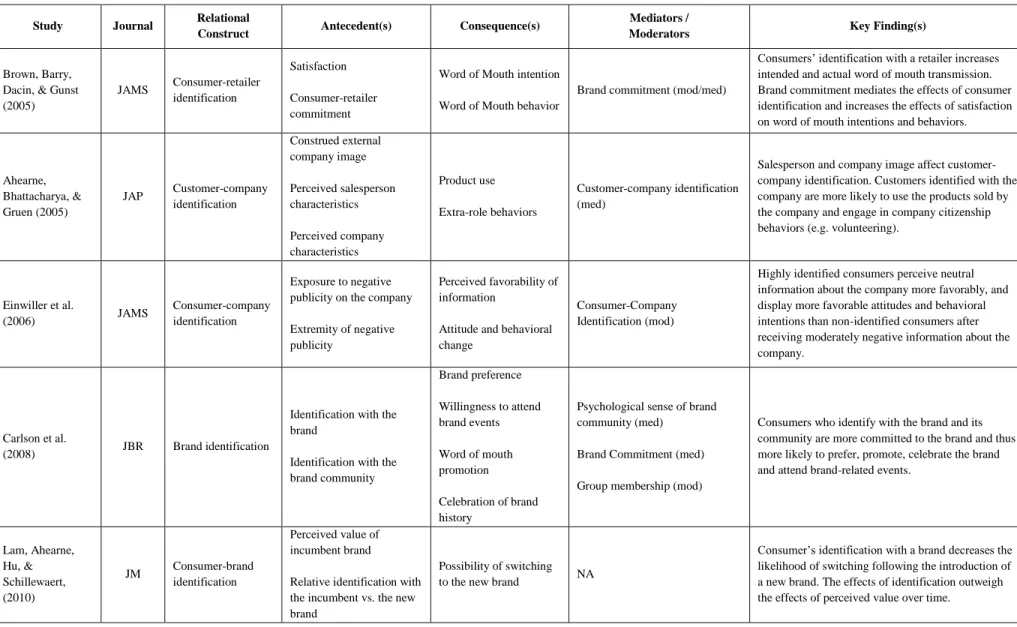
Despite the evident importance of consumer-brand identification for a sustainable
competitive advantage (for an overview of relevant research see Appendix, Table A),
international branding research has not investigated whether/how leveraging a brand’s perceived globalness (i.e., the extent to which a brand is perceived as worldwide available and demanded;
Steenkamp et al., 2003) and/or perceived localness (i.e., the extent to which a brand is perceived
as a player connected with the local country and embedded in its consumption culture) assist in
developing beneficial consumer-brand relationships. Instead, extant research has either (a)
approached global and local brands as distinct groups, thus largely overlooking the fact that
brands increasingly combine their global presence with significant local adaptations (Winit,
Gregory, Cleveland, & Verlegh, 2014), or (b) focused exclusively on favorable brand attribute
signaling (e.g. quality, prestige etc.) as the key mechanism underlying global/local brand
5
introducing the idea of identity-construction to the range of the mechanisms underlying
global/local brand preference (Strizhakova & Coulter, 2015; Xie, Batra, & Peng, 2015), there is a
void of research contrasting the potential of brand globalness and localness – as perceptions potentially coexisting within the brand footprint – to foster consumer-brand relationships (Cayla & Arnould, 2008). Moreover, the role a foreign or domestic brand origin plays in conjunction
with brand globalness or localness (Winit et al., 2014; Westjohn, Magnusson, & Zhou, 2015) and
the potential synergies between these constructs (Halkias, Davvetas, & Diamantopoulos, 2016)
have yet to be investigated in the context of consumer-brand relationships.
Against this background, the present research represents a first attempt to investigate (a)
whether brands can leverage perceptions of brand globalness and/or localness to build beneficial
consumer-brand relationships, (b) whether these relationships drive brand preference above and
beyond the quality inferences triggered by brand globalness/localness, and (c) whether the
relational value of brand globalness/localness depends on a brand’s domestic or foreign origin. Drawing from several theoretical domains (i.e. consumer culture theory, brand relationship
literature, international branding research) we hypothesize about the effects of brand
globalness/localness on consumer-brand identification. Subsequently, we present two empirical
studies – using several foreign and domestic brands across ten distinct product categories in both mature and emerging markets – which offer evidence that perceived brand globalness and
localness generate relational brand value that is manifested above brand quality assessments but
varies significantly between domestic and foreign brands.
From a theoretical standpoint, our research contributes to extant literature by (a)
establishing the ability of a brand’s globalness and localness to build consumer-brand
6
internationally present and locally connected brands, and (c) investigating the interplay between
brand origin and globalness/localness, thus challenging implicit assumptions of prior research
which confound the distinctiveness of brand globalness, localness, and origin, mask their
compensatory interplay, and hinder the investigation of hybrid, glocal strategies. From a
managerial perspective, our findings provide brand managers with (a) evidence of additional
pathways to build relational equity, (b) advice on the effectiveness of investing in globalization,
localization or hybridization strategies to develop consumer-brand bonds, and (c) a strategic
alternative for brands which cannot afford investments in quality optimization but could instead
rely on their global/local image to build consumer relationships. A more detailed overview of our
studies’ contribution in relation to prior literature can be found in the Appendix, Table B.
2. Conceptual Background and Research Hypotheses
2.1 Perceived brand globalness and localness
Prior research offers a plethora of definitions for global and local brands. Global brands have
been defined as brands with physical market presence across multiple countries (Dimofte,
Johansson, & Ronkainen, 2008); brands generating a significant part of their revenue outside
their home market (Nielsen, 2001); or brands owned by multinational firms and marketed in a
standardized and centrally coordinated manner (Özsomer & Altaras, 2008). Local brands have
been defined as brands that are available only within a limited geographic region (Dimofte et al.,
2008); brands originating from the consumer’s home country (Eckhardt, 2005); or iconic players which are culturally associated with the local market (Özsomer, 2012).
7
The demand-side benefits emerging from a brand’s global or local nature cannot be
materialized unless the consumer actually perceives the brand as global or local. Consequently, a
brand is designated as global to the extent it is perceived as being known, available and
demanded in multiple countries (perceived brand globalness (PBG); Steenkamp et al., 2003) and
as local to the degree it is perceived as a player associated with the local market (perceived
brand localness (PBL); Swoboda, Pennemann, & Taube, 2012). Unlike extant work in the field
that defines brand localness as a brand’s local iconicity or its symbolic representation of the
consumer’s local culture (Özsomer, 2012; Steenkamp et al., 2003; Swoboda et al., 2012), we
approach the concept of brand localness more broadly to account for cases of brands that have
managed to connect with the local market and partake in the consumption habits of the local
consumers without necessarily originating in the consumer’s own country or being owned by a domestic company. Most prior research has investigated global and local brands by making the
assumption that global brands build associations exclusively on the basis of their global reach
while local brands offer benefits only through their local iconness. This, however, does not
account for those (ever more frequent) cases of domestic brands which have internationalized to
the point of becoming strong global players whilst simultaneously retaining a pronounced brand
origin (e.g. Apple promoting its California-based design, KFC stating its region of origin in the
brand name, etc.) or several cases of foreign global brands which have connected to local
markets through cultural affiliation, domestic sourcing or production, support of local
communities or participation in typical local consumption practices (e.g. McDonald’s in
European markets, Honda in the USA, etc.). In this context, consumers seem to appreciate both
global brands which have adapted to their home culture and local brands which have managed to
8
complementary rather than mutually exclusive sources of brand value that may coexist in brand
image and jointly inform brand preference (Dimofte et al., 2008; Halkias et al., 2016).
2.2 Consumer-brand relationships and consumer-brand identification
Traditional economic theories view products as tangible or intangible objects whose utility is
derived from their ability to satisfy some consumer need and whose value can be directly
translated in economic terms and exchanged in the marketplace. More recent consumer theories,
however, challenge the view of products as nimbly exchangeable entities and argue that
consumers view products as more than mere material possessions. Consumer culture theory
approaches brands as central agents of marketplace phenomena, as carriers of cultural meanings
in consumption experiences, and as active sociocultural entities (Arnould & Thompson, 2005;
Cayla & Arnould, 2008). For instance, Belk (1988) argues that products are essential
components of the consumer’s extended self-concept and help define an individual’s
self-identity. Overall, the value of brands in modern marketplaces captures an augmented set of brand
roles such as triggers of individuals’ self-relevant narratives, mental anchors of interpersonal relationships, and tokens of consumers’ self-views (Richins, 1994).
This extended role of products and brands in consumers’ lives gave birth to brand
relationship theory which posits that the consumer-brand link resembles more an active intimate
relationship rather than a possessor-possession association (Fournier, 1998). Following this
relational perspective, research has introduced several concepts to describe the dimensions of
consumer-brand bonds such as brand passion, brand love and brand attachment/aversion (Batra
et al., 2012; Park, Eisingerich, & Park, 2013), etc. One of the most prominent constructs to
9
“consumer’s perceived state of oneness with a brand” (Stokburger-Sauer et al., 2013, p.407). CBI has been conceptualized through different approaches, some of which focus on the
emotional attachment to the brand (e.g. Malär, Krohmer, Hoyer, & Nyffenegger, 2011), others
on the cognitive representation of CBI as the extent of the self-brand schema overlap (e.g.
Carlson, Suter, & Brown, 2008), and still others on the consequences of identification (e.g. Batra
et al., 2012). In the present research, and in line with prior similar literature (Stokburger-Sauer et
al., 2013), we approach CBI as a cognitive reflection of the consumer-brand bond.
Self-identity and categorization theories explain the motivation behind consumers’ identification with human groups (e.g. nations, sports teams) or non-human entities (e.g.
products) on the basis of (a) their willingness to construct, validate and communicate a social
identity, and (b) their intention to develop a distinctive self which dissociates them from other
groups with conflicting values (Brewer, 1991; Tajfel & Turner, 1985). To support such
self-categorization, individuals exhibit behavior that supports the entity or group they want to identify
with. In consumption contexts, research shows that CBI generates positive brand responses such
as brand loyalty and advocacy, higher willingness to pay and brand spending, resistance to
negative information and purchase regret, and brand protection in times of crisis (Davvetas &
Diamantopoulos, 2017; Einwiller et al., 2016; Haumann et al., 2014; Tuškej et al., 2013).
2.3 Perceived brand globalness and localness as drivers of consumer-brand identification Consumer-brand relationship literature proposes several motivations underlying consumers’ willingness to identify with brands. Although different researchers have used different
frameworks to capture these motivations, an overview of relevant literature suggests that they
10
for self-enhancement and identity signaling, (c) need for identity distinctiveness and prestige,
and (d) pursuit of warmth and nostalgia. Our central proposition is that both a brand’s perceived globalness and localness strengthen CBI by stimulating all these motivations.
2.3.1 Self-verification and value congruence
This notion refers to the extent to which the brand shares coherent values with the consumer and
reflects the degree to which it helps maintain the consumer’s self-concept (Escalas & Bettman, 2003). The consumer-brand value overlap is seen as a necessary condition for consumer-brand
connections. For example, Stokburger-Sauer et al. (2013) suggest that a high degree of similarity
between the brand and the self boosts CBI while Lam, Ahearne, Mullins, Hayati, and
Schillewaert (2013) find that the overlap between brand and individual values facilitates the
process of relationship building. The importance of this overlap is explained by consumers’ need to verify their self-image and appear consistent with their perceived self. Given that values are
central to one’s self-identity (Schwartz, 1992) and that brands are increasingly positioned as entities embodying a pronounced value structure, the consumer-brand value fit is critical in
consumers’ efforts to maintain a consistent self-view.
Within a globalized world, consumers’ identities are strongly formed by both global and
local influences and incorporate global and local elements. A global identity refers to consumer’s
identification with people around the world while a local identity refers to consumer’s
identification with his/her local community (Zhang & Khare, 2009). Consumers with strong
global identities exhibit a feeling of belongingness to the global community, perceive more
similarities than differences in people around the world and follow an international lifestyle.
11
local traditions and customs and follow a locally-tied way of life (Zhang & Khare, 2009).
Importantly, though, global and local identities do not represent conflicting identity components.
We expect that both brands perceived as highly global and brands carrying strong localness
associations have the capacity to develop identification with consumers by facilitating the
self-verification of the global and local components of their identities. On the one hand, the global
identity component emphasizes concepts such as universalism, power, innovativeness and
self-expression, that is, a set of values embedded in in the positioning of global brands as
manifestations of a global consumer culture (Steenkamp & de Jong, 2010). On the other hand,
the local identity component emphasizes values like tradition and conformity which are often
used to promote local brands as defenders of tradition, authenticity, and preserves of local
cultural experiences (Alden, Steenkamp, & Batra, 1999). Modern consumers increasingly exhibit
hybrid identities whereby the global and the local identity components coexist, interact and
jointly shape identity-relevant behavior (Arnett, 2002). Such identity hybridization implies that
consumers appreciate the benefits of identifying both with brands that signal success, status and
global citizenship (Strizhakova, Coulter, & Price, 2008) and with brands that help
self-categorization in consumers’ local community (Steenkamp & de Jong, 2010). For example, research has shown that cosmopolitan consumers generally holding strong global identities
also display a strong local orientation (Cannon & Yaprak, 2002).
2.3.2 Self-enhancement and identity signaling
This notion refers to the role of brands in signaling consumers’ ideal identity to others. Unlike self-verification which refers to identity confirmation to the self, this notion captures consumers’
12
promotion of a favorable self-image to others (e.g. reference groups) through showing
attachment to aspiration groups and aversion to dissociation groups (Bhattacharya & Sen, 2003).
Research on global/local branding shows that both perceived brand globalness and
localness represent sources of identity signaling. For example, Batra et al. (2000) suggest that
consumers of emerging markets primarily use global brands as status symbols because of their
admiration for the lifestyle of economically developed countries. Similarly, Holt et al. (2004)
suggest that one of the key components of global brand preference resides in consumers’ view of brands as global myth representatives. Steenkamp et al. (2003) label this process “the
belongingness pathway” and argue that this might drive preference for global brands beyond
other product-related inferences. Strizhakova et al. (2008) call global brands “identity currency” and posit that their consumption is motivated by consumers’ willingness to appear cosmopolitan in the eyes of their reference groups. Xie et al. (2015) identify identity-expressiveness as a key
preference generating mechanism for global (and local) brands, while Davvetas and
Diamantopoulos (2016) find that global brands hold an advantage over their local counterparts in
product categories where social signaling is a primary consumer motivation.
Although identity signaling was originally perceived to be a benefit mostly for global
brands, recent evidence suggests that perceived brand localness also nurtures identity signaling.
Brabnds enjoying local connections are perceived as representatives of the local communities in
which they operate and thus elicit strong emotions of pride from the local consumers (Dimofte et
al., 2008; Özsomer, 2012). Perceived brand localness often signifies heritage, authenticity and
originality, that is, values consumers strongly appreciate and want to signal as part of their
self-image though brand consumption (Ger, 1999). Finally, the consumption of brands connected to
13
homogenization (Steenkamp & de Jong, 2010), (b) project themselves as sophisticated
consumers immune to consumption uniformity, and (c) signal support to players perceived as
being unfairly treated by the globalization-imposed marketplace status quo.
2.3.3 Need for distinctiveness and prestige
This notion refers to consumer’s need to feel different, unique, special and prestigious (Tian, Bearden, & Hunter, 2001). This motivation is different in the sense that it differentiates the
consumer’s self by using products which make them feel special (Brewer, 1991). Prestige and
uniqueness are critical antecedents of consumers’ relationships with brands. Stokburger-Sauer et al. (2013) suggest that brands perceived as distinctive are associated with stronger identification,
while Battacharya and Sen (2003) propose that a company’s identity distinctiveness and prestige
shape the company’s identity attractiveness and thus consumers’ willingness to identify with it.
Both perceived brand globalness and localness affect perceptions of brand distinctiveness
and prestige. On the one hand, brand perceptions of worldwide availability have been repeatedly
associated with a prestigious brand image (Özsomer, 2012; Steenkamp et al., 2003). Especially,
in developing markets, where global brands are relatively scarce, perceptions of worldwide
availability are tied to perceptions of brand distinctiveness and lead to strong desire for global
brand ownership (Batra et al., 2000). On the other hand, although locally connected players are
not always perceived as scarce brands, they often are symbolic representatives of the local
culture and hold “unique cultural value” (Ger, 1993). This cultural value translates into prestige perceptions even when it remains relevant only within the consumer’s home market (Özsomer, 2012; Steenkamp et al., 2003). Beyond local symbolism, brands strongly adapted to the local
14
Kapferer, 2004); thus their consumption elicits feelings of exclusivity and is seen as a unique
privilege of the local consumers. Such exclusivity does not occur for domestic brands whose
distribution is restricted to the national market but also for global brands offering unique product
editions enriched with exclusive local elements (e.g. country-specific adaptations).
2.3.4 Pursuit of warmth and nostalgia
This notion refers to consumer’s urge to identify with a brand due to the warm feelings
associated with its possession and use as well as the brand’s embeddedness in consumers’ key autobiographical memories (Sujan, Bettman, & Baumgartner, 1993). In other words, brands are
viewed as items charged with personal relevance due to their central role in consumers’ past experiences or as sources of warmth (Stokburger-Sauer et al., 2013).
One could argue that a brand’s local or global nature should be unrelated to whether a
brand will participate in consumers’ self-shaping past experiences. However, one emotion that drives this self-referential process is nostalgia, defined as “a longing for the past, a yearning for
yesterday, or a fondness for possessions and activities associated with days of yore” (Holbrook, 1993, p. 245). Although consumers differ in their tendencies to satisfy nostalgic motivations
through their purchases, it is commonly believed that marketplace stimuli eliciting nostalgia are
perceived in a favorable manner (Muehling, Sprott, & Sprott, 2004).
Both perceived brand globalness and localness are expected to satisfy nostalgia- and
warmth-seeking motivations. Many of the strongest global brands (e.g. Coca-Cola, Mini Cooper)
have been repeatedly positioned over the years with the use of nostalgic appeals which put the
brand into a setting of previous centuries and evoke an appreciation of the past (Marchegiani &
15
relationship partners because they represent successful products which travelled through
centuries and managed to transcend national boundaries without abandoning their core values or
losing their sense of meaning (Brown, Kozinets, & Sherry, 2003). Thus, although global brands
are commonly viewed as manifestations of a future-oriented world (Alden et al., 1999), some of
these brands satisfy consumers’ nostalgic motivations by building on their global indexical authenticity and cultural capital (Özsomer & Altaras, 2008).
Local brands are also strongly associated with consumers’ appreciation of the past. Due to the exclusive presence of local offerings across country markets prior to marketplace
globalization, local brands are more likely to be embedded in consumer’s autobiographic consumption experiences (Steenkamp & de Jong, 2010). Beyond nostalgia, local brands should
also elicit feelings of warmth. Stereotype theory identifies warmth – defined as the extent to
which a social group is perceived to have positive intentions toward one’s self – as one of the two key dimensions consumers use to develop stereotypical beliefs about social groups (the other
being competence) (Fiske, Cuddy, Glick, & Xu, 2002). Such stereotyping seems to also occur at
the brand level with brands often perceived as intentional agents who can be stereotyped on the
basis of their competence and warmth (Kervyn, Fiske, & Malone, 2012).
We expect a positive association between a brand’s localness and warmth because brands which have local ties are perceived as preserving the local culture against globalization
(Steenkamp & de Jong, 2010), providing jobs to the local, and being typical consumption
choices of the local population due to their long-lasting local presence which transcends so many
generations of local consumers that, in some cases, even global foreign brands are mistaken for
domestic (e.g. Nivea). As a result, locally-embedded brands can also be encoded as symbols of
16
H1: Perceived brand globalness has a positive influence on consumer-brand identification.
H2: Perceived brand localness has a positive influence on consumer-brand identification.
2.4 The moderating role of brand origin
We expect that the effect of brand globalness and localness on consumer-brand identification is
contingent on the brand’s foreign or domestic origin. Global branding literature has frequently confounded the concept of origin with that of globalness/localness such that global brands are
often assumed to be foreign whereas local brands domestic (for a detailed discussion, see Winit
et al., 2014). This confounding has generated interpretational inconsistencies in research findings
across studies and, most importantly, has obstructed the study of brand origin in conjunction with
the effects of brand globalness and localness. Although such confounding might not have been a
problem in past years because for most country markets the majority of global brands were sold
by foreign-owned firms (Batra et al., 2000), it is problematic in a modern marketplace where
many domestic brands have transformed into global giants and many foreign brands have
adapted to country markets strongly enough for consumers to attribute them local associations.
Although such hybrid strategies do not represent the norm in the marketplace, more and
more brands operating in foreign markets try to develop a brand image which includes both
global and local elements. For instance, car manufacturers, such as Toyota and Honda in the US,
stress their contribution to decreased unemployment rates in several American communities
where they have set up their manufacturing sites, while others downplay the role of the “made
in” effect and highlight how the brand is “made for” the needs of the local population despite its
foreign origin (e.g. the Skoda “Made for” campaign). FMCG companies connect with local markets by localizing their supply chains and engaging in local sourcing that benefits regional
17
communities (e.g. Danone’s multi-local supply chain strategy). Finally, many foreign brands capitalize on their market leadership or long-standing presence across national markets to signal
local consumers’ appreciation and justify the deserved designation of a legitimate local player (e.g. Nivea). Thus, how brand origin interacts with perceptions of globalness and localness is key
to understand how consumers identify with brands employing hybrid strategies.
Prior research draws an inconclusive picture about this interaction. On the one hand,
Swoboda et al. (2012, p. 76) argue that a retailer’s foreign (vs. domestic) origin operates as a
“diagnosticity multiplier” for perceived globalness (vs. localness) effects and find that, in China, global retailers of Western origin are valued more than retailers of domestic origin. Similarly,
Westjohn et al. (2015) find that consumers’ global consumption orientation increases attitudes toward foreign global brands but decrease attitudes toward domestic global brands. In contrast,
Winit et al. (2014) empirically find a reverse pattern whereby the positive effects of perceived
globalness on brand attitudes and purchase intent are stronger for domestic than foreign brands.
We draw from cue utilization theory (Jacoby, Olson, & Haddock, 1971; Olson & Jacoby,
1972) to conceptualize the interplay between brand globalness/localness and domestic/foreign
brand origin.1 Branded products represent sets of cues (Cox, 1962). Whether or to which extent a
brand cue will be used for product evaluation depends on its diagnosticity (Purohit & Srivastava,
2001) or – as Olson & Jacoby (1972) originally put it –on the combination of the cue’s
predictive and confidence value. Cue utilization theory suggests that when consumers evaluate
products they do not look at cues in isolation but in combination such that different cues interact
with each other to determine quality judgments (Jacoby et al., 1971). In simple terms, the
diagnostic importance of a cue depends on the presence or value of other cues. For instance, a
18
brand cue (e.g. warranty) will affect brand evaluation when another cue reaches a particular level
(i.e. good reputation) but not when it does not (i.e. bad reputation) (Purohit & Srivastava, 2001).
Brand globalness, localness and origin represent distinct brand cues. Apart from these
cues’ ability to influence quality judgments (e.g. Batra et al., 2000; Özsomer, 2012; Steenkamp
et al., 2003), we expect them to also influence brand identification in an interactive manner
dictated by two premises: (1) substitutionality between domestic/foreign origin and brand
localness/globalness respectively, and (2) complementarity in consumer’s appreciation of global and local identity value. The first premise holds that, from a cue diagnosticity perspective, brand
foreignness has a stronger associative overlap with globalness than with localness and brand
domesticity has a stronger associative overlap with localness than with globalness. The mere fact
that a foreign brand is available in a market (beyond its home one) ascribes it with the ambition
of a global reach and its subsequent associations of status, prestige and aspiration (Steenkamp et
al., 2003). Foreign brands allow consumers to get an authentic taste of different world cultures,
experience exotic offerings and explore their cosmopolitan self (Riefler, Diamantopoulos, &
Siguaw, 2012). Thus, although foreign brands do not always share the same connotations with
global brands, they are still seen as a path to break the borders of the local consumption culture
and explore what the world has to offer. Similarly, although a domestic brand is not necessarily
perceived as a brand with a strong local character, its domestic origin automatically categorizes
the brand as member of the consumer’s in-group and ascribes it with a minimum level of local embeddedness purely on the basis of that membership and regardless of whether local
symbolism or connections represent central dimensions of the brand’s intended positioning. The second premise implies that consumers value both global and local brand associations
19
consequence, consumers are expected to strive both for global and local identity reinforcement in
their purchase decisions rather than focus only on one of them (Kjeldgaard & Askegaard, 2006).
On the basis of these two premises, we expect that when evaluating brands for
relationship candidates, consumers view global and local identity value in a complementary way,
and in their effort to achieve both, they engage in compensatory identity mechanisms whereby
domestic origin compensates for the lack of localness associations while foreign origin
compensates for the lack of globalness associations. Through this compensatory logic, a brand’s local connectedness is valued more when the brand originates from a foreign country and a
brand’s global reach holds stronger relevance for domestic than for foreign-owned brands. We thus expect that brand globalness compensates for the identity benefits of foreignness which are
“lost” when a domestic brand is purchased while the relational value of perceived localness is be stronger for foreign brands because brand localness compensates for consumers’ need to remain attached to their local consumption practices unserved by locally-detached foreign products.2
H3: The positive effect of perceived globalness on consumer-brand identification is stronger for
domestic (vs. foreign) brands (H3a), while the positive effect of perceived localness on
consumer-brand identification is stronger for foreign (vs. domestic) brands (H3b).
2 Our expectation is also consistent with schema theory and how consumers tend to assimilate schematically
inconsistent information. If we assume that “domestic brands” represent a distinct schema in consumers’ minds, for most consumers (especially in emerging markets), a global domestic player (e.g. Huawei in China) represents a special case of a domestic brand which will be sub-typed under the “domestic brand” schema as a Chinese brand with a prominent differentiating characteristic not shared by most other brands in the same schema (i.e. its globalness). Similarly, if we assume that “foreign brands” represent yet another distinct schema, for most consumers, a locally connected foreign player (e.g. Toyota in the US) represents a special case of a foreign brand which will be sub-typed under the “foreign brand” schema as a foreign brand with a prominent differentiating characteristic not shared by most other brands in the same schema (i.e. its localness). Schema theory suggests, that for brands that are sub-typed, their differentiating characteristics tend to weigh stronger on consumer responses (Sujan & Bettman, 1989), which is in accordance with an interaction in the described direction.
20 2.5 Controls and established effects
Apart from CBI, we include purchase intention as the ultimate dependent variable in our studies
to test whether globalness- and localness-induced identification with a brand influences
consumers’ willingness to buy the brand. The inclusion of this outcome variable is important to ensure that brand identification translates to a managerially relevant brand outcome. Research
suggests that CBI exerts a strong positive influence on consumers’ purchase intentions for the brand. Consumers tend to buy and remain loyal to brands that express their identification
(Haumann et al., 2014; Lam et al., 2013; Stokburger-Sauer et al., 2013). We thus include
purchase intentions as a direct outcome of CBI and subsequently test direct and indirect
influences of perceived brand globalness and localness on it. Finally, we expect our hypothesized
effects to hold in the presence of a perceived brand quality – which has been consistently proposed as one of the important drivers of global and local brand preference (Özsomer, 2012;
Steenkamp et al., 2003) – to ensure that identification due to perceived globalness and localness manifests above and beyond quality effects. Figure 1 summarizes our research model.
Insert Figure 1 about here
3. Study 1: Mature Market
3.1 Methodology
We conducted an empirical study in Austria. In terms of economic development, Austria
resembles countries typically used in international branding studies (i.e. USA, Denmark, South
21
nations and their products. In 2017, the value of imported goods accounted for approximately
half its GDP (World Bank, 2018), while it also ranks among the top 10 most globalized countries
(ETH, 2018). Austrian consumers typically choose between a wide variety of global and local
brands in most product categories making Austria an appropriate setting for this study.
Data was collected with face-to-face interviews, using a quota sampling approach based on
age and gender. The respondents (N=150) were recruited and surveyed by trained interviewers in
shopping malls, supermarkets, cafés, etc. Respondents’ characteristics are presented in Table 1.
Insert Table 1 about here
Study participants were exposed to one domestic and one foreign brand from the same
product category; thus, the cases used for model estimation amount to 300. In choosing the
brands and product categories, we followed Steenkamp et al. (2003). First, we made sure that
product categories varied across the durable-nondurable continuum in order to increase
generalizability. The chosen product categories consumer durables, motorcycles, lingerie,
snacks, and soft drinks. Second, the selection of brands in each category aimed to establish a
sufficient amount of variance in perceived brand globalness and localness. As shown in Table 2
(upper panel), on average, brands differ significantly with regard to their globalness scores
(ranging from 2.70 to 6.73 on a 7-point scale). In each product category, the foreign and the
domestic brands also differ with regard to their localness values (ranging from 2.09 to 6.06).
22
To measure the constructs in our model, we referred to prior research and used established
scales (see Table 3). In line with a broader conceptualization of brand localness in our theorizing,
to operationalize PBL, we drew conceptual guidance from the description of local consumer
culture positioning (LCCP; Alden et al., 1999) and also undertook a qualitative study with 78
consumers. Each respondent was exposed to one of eight different domestic and foreign brands
and asked – in an open-answer format – whether and, if so, why the brand in question had a connection to the local culture.3 Based on a cross-case analysis (Miles & Huberman, 1994) of the
transcribed responses and measurement scales used by prior research (Halkias et al., 2016;
Swoboda et al., 2012), we formulated items capturing consumers’ associations with the local connectedness of a brand. The items assessed the degree to which the brand is associated with
the local country; whether it is bought by an average consumer in the local market; and whether
the brand is perceived to be part of the local consumption culture. These items correspond to a
broader conceptualization of brand localness which accounts for sources of local brand value
beyond mere local iconicity or cultural symbolism. Table 3 shows the measures for all model
constructs together with relevant psychometric information.
Insert Table 3 about here
3.2 Results
A CFA including all study constructs produced a satisfactory overall fit ( 2 = 226.64, df = 80; RMSEA = 0.078; SRMR = 0.053; CFI = 0.946). Factor loadings, t-values, Cronbach’s alphas, CRs and AVEs all point to high levels of reliability and convergent validity of the measurements
23
(Table 3). The Fornell and Larcker (1981) criterion confirms discriminant validity since, for each
construct, the relevant AVE is much higher than the squared correlation between the construct of
interest and all other constructs in the model (Table 4). The correlation coefficient between PBG
and PBL came to r = -0.265 (p < 0.001) indicating that if consumers perceive a brand as being
highly global, they also perceive a lower degree of localness. This moderate correlation also
demonstrates empirically that, in line with our theorizing on their distinct and potentially
coexisting nature, PBG and PBL are distinct concepts rather than opposing ends on the same
continuum (which would be empirically supported by a much higher correlation coefficient).
Insert Table 4 about here
As we relied on self-reported data and generated the measures for all constructs from the
same source, we wanted to rule out common method variance (CMV) concerns. We accounted
for CMV using both ex ante and ex post control procedures (Chang, van Witteloostuijn, & Eden,
2010). Ex ante, we assured respondents of anonymity and confidentiality and emphasized that
there are no right or wrong answers. Ex post, we accounted for CMV statistically by employing a
variation of the marker variable procedure proposed by Malhotra, Kim, and Patil (2006). Our
questionnaire did not include a marker variable that was theoretically unrelated to the variables
analyzed in the model. Therefore, we used the second lowest positive correlation (r = 0.012)
between the indicators measuring the analyzed constructs (excluding the control variable) as a
proxy for CMV. We adjusted the zero-order correlations among the constructs in our study by
24
Estimation of the structural model in Figure 1 resulted in satisfactory overall model fit
( 2 = 227.687, df = 82; RMSEA = 0.077; SRMR = 0.054; CFI = 0.947). The findings provide evidence for significant effects of PBG ( = 0.118, p < 0.05)4 and PBL ( = 0.172, p < 0.05) on CBI in support of H1 and H2. The effect of CBI on purchase intentions is positive and significant
( = 0.483, p < 0.001), thus leading to significant indirect effects of PBG = 0.057 (p < 0.05) and PBL = 0.083 (p < 0.05) on purchase intentions. These significant mediation effects are also indicated by the bootstrap 95% confidence intervals for PBG [0.001; 0.172] and PBL [0.012;
0.148] both of which do not contain zero (Preacher & Hayes, 2008).
To test the type of mediation (Zhao, Lynch, & Chen, 2010), we added direct paths from
PBG and PBL to purchase intentions. The relevant path coefficients were insignificant and the
chi-square values of the models with and without these direct links showed a non-significant
change in model fit. Thus, we have an indirect-only mediation for both variables on purchase
intention. With regard to the control relationships, perceived brand quality significantly
influences CBI ( = 0.392, p < 0.001) as well as purchase intentions ( = 0.232, p < 0.001). We also explored the potential interaction between PBG and PBL on CBI. Results of a
hierarchical regression analysis indicate that including the interaction term PBG×PBL results in a
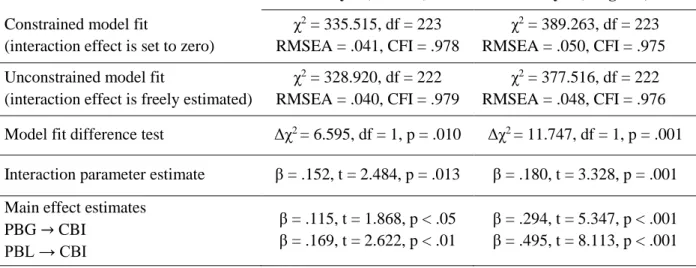
significant R2-change (R2 = 0.026, F (1; 295) = 9.32, p < 0.01) and that the interaction is positive and significant ( = 0.077, p < 0.01). As a robustness check, 2 model fit comparisons (with and without a latent variable interaction term developed using residual centering – Little, Bovaird, & Widaman, 2006) indicate that the inclusion of the latent interactive term significantly
improves model fit and obtains a positive estimate in the presence of significant main effects of
25
PBG and PBL (see Appendix, Table C). Thus, the effects of PBG are stronger as PBL increases
and vice versa, indicating complementarity and mutual reinforcement between them.
To test H3a and H3b, we ran multi-group analysis. We split the dataset into foreign and
domestic brands and re-ran the structural model in Figure 1.5 A 2-difference test comparing specifications with and without equality constraints on the respective relationships reveals
significant differences with regard to the effect of PBG on CBI (2 = 3.044, p = 0.081). In line with H3a, this link is only significant for domestic brands ( = 0.165, p < 0.05) but not significant for foreign brands ( = -0.041, ns). With regard to PBL effects on CBI, the overall 2-difference test is not significant (2 = 2.074, p = 0.150). However, the results indicate that PBL has a significant impact for foreign brands ( = 0.280, p < 0.01) but not for domestic brands ( = 0.176, ns) which is also in line with H3b.
We further conducted three additional analyses to test the robustness of our results with
regards to (a) endogeneity, (b) split-sample validation, and (c) product category specificity. With
regard to (a), we re-estimated our model with a three-stage least square (3SLS) moderated
regression procedure to account for endogeneity using brand origin as an instrumental variable
(Zaefarian, Kadile, Henneberg, & Leischnig, 2017).6 The results are in consonance with those of
the structural equation model. With regard to (b), we validated our model using a split-half
sample approach. The model estimates of the (randomly generated) split-half samples indicate
stability of the effect structure. Regarding (c), we re-estimated our model, after including product
category dummies as covariates on both endogenous variables (i.e. CBI and purchase intentions)
and accounting for their correlations with the focal exogenous variables (i.e. PBG and PBL). The
5 Note that the sample split was based on objective (i.e. “true”) brand origin; pre-tests showed that the selected
brands’ perceived origin (domestic or foreign) coincides with their true origin.
26
results were consistent with those of the original model as no significant changes in parameter
estimates, effect sizes, and statistical significances were observed. (see Appendix Tables D-F).
4. Study 2: Emerging market
Study 2 seeks to test the stability of our research model in an emerging market context and
provide a validation of Study 1 findings in another and yet sufficiently distinct setting in terms of
economic development and with a different set of product categories and stimuli brands. A
replication of our model in an emerging market seems valuable since prior research suggests that
consumer responses to global and local brands often differ between mature and emerging
markets (Batra et al., 2000) and across product categories (Davvetas & Diamantopoulos, 2016).
Thus, Study 2 tests the results’ cross-country replicability and cross-category generalizability.
4.1 Methodology
We replicated our research model in Bulgaria which is less economically developed than Austria
despite displaying high levels of trade with other countries (World Bank, 2018). Specifically,
Bulgaria ranks #26 out of 199 countries listed on the KOF index of globalization (ETH, 2018)
and consumers are exposed to a range of both local and global brands in many categories.
With regard to stimuli selection, we used five product categories (bottled water, beer,
coffee, airlines, and financial services) that were different from those in Study 1. Foreign brands
included several well-known brand names while domestic brands were chosen following
consultation with two marketing experts highly familiar with Bulgarian consumer behavior. In a
27
Data were collected through an online survey in cooperation with a professional
consumer panel provider resulting in a sample of 302 adult consumers (see Table 1). As in Study
1, the chosen brands varied considerably in terms of PBG and PBL (see Table 2); construct were
measured and validated in a similar manner (see Table 3).
4.2 Results
A CFA confirmed the unidimensionality, reliability and validity of the measurement scales used
( 2 = 191.08, df = 80; RMSEA = 0.068; SRMR = 0.056; CFI = 0.969). Factor loadings, t-values,
Cronbach’s alphas, composite reliabilities (CR) and average variances extracted (AVE) all show high levels of reliability and convergent/discriminant validity (see Tables 3 and 4). These results
confirm that all used scales are valid and reliable also in an emerging market context.
Interestingly, unlike Study 1, the correlation between PBG and PBL is positive, but weak
(r = 0.130; p < 0.05). We relied on the same procedures to test for CMV as in Study 1 and results
gave no reason for concern.
We first tested whether the hypothesized full mediation model holds in the emerging
market setting by adding direct paths from PBG and PBL to purchase intentions and comparing
model fit. Results indicate a significant improvement in model fit ( 2 = 29.90, df = 2) and
overall model fit is also satisfactory ( 2 = 191.08, df = 80; RMSEA = 0.068; SRMR = 0.056;
CFI = 0.969). We observe a positive and significant effect from PBG to CBI ( = 0.289; p < 0.001) in support of H1. In turn, CBI positively influences purchase intention ( = 0.142; p < 0.05), thus providing evidence for a significant indirect effect ( = 0.041; p < 0.05; 95% bootstrap interval = [0.002, 0.087]). Beyond its indirect effect, PBG has a positive direct effect
28
support of H2,PBL has a positive influence on CBI ( = 0.479, p < 0.001) leading to a significant indirect effect on purchase intention ( = 0.068; p < 0.05). Additionally, PBL has a direct effect on purchase intentions ( = 0.320; p < 0.001) which, added to the indirect effect, leads to a significant positive total effect ( = 0.389; p < 0.001). The share of the total effect on purchase intention that is actually mediated by CBI is 20.5% for PBG and 17.5% for PBL. The control
paths from brand quality on CBI ( = 0.134; p < 0.05) and purchase intention ( = 0.328; p < 0.001) are also positive and significant.
Hierarchical regression analysis estimating the effects of the PBG×PBL interaction term on
CBI also provides evidence for a significant positive interaction of PBG and PBL on CBI. The
inclusion of the interactive term results in a significant R2-change (R2 = 0.036; F (1; 297) = 17.60, p < 0.001) and the relevant coefficient is, again, positive and significant ( = 0.101, p < 0.001). Similar to the previous study, formal 2 difference tests between models with and
without a latent variable interaction term demonstrate that the inclusion of the latent interactive
term significantly improves model fit (see Appendix, Table C).
In order to test the moderating role of brand origin, we again split the dataset in foreign and
domestic brands and ran multi-group analyses to test differences between these types of brands
for the following: (a) the effects of PBG and PBL on CBI, (b) the direct effects of PBG and PBL
on purchase intention, and (c) the total effects of PBG and PBL on purchase intention.7
7 To compare total effects, we performed a formal z-test (z T T
SE SE ), whereby T1, T2 refer to the
unstandardized parameter estimates of the total effect for group 1 (foreign brands) and group 2 (domestic brands) respectively, while SET1, SET2 refer to the standard errors corresponding to these parameter estimates. We used
unstandardized estimates because their standardized equivalents “can lead to erroneous inferences when one wishes to make comparisons across populations or samples” (Bagozzi, 1980, p. 187). For the present test, the respective unstandardized values are Tforeign = 0.411, Tdomestic = 0.103, SETforeign = 0.123, SETdomestic = 0.123.
29
With regard to (a), we find that PBG has significant positive effects on CBI for both
foreign and domestic brands. Although, in line with H3a, the effect of PBG on CBI for domestic
brands is much stronger than for foreign brands, their difference is not statistically significant
(2 = 0.812, df = 1, ns; foreign = 0.126, p < 0.05; domestic = 0.278, p < 0.01). Thus, H3a is not supported. PBL has also significant positive effects on CBI for both foreign and domestic brands,
but its effects are significantly stronger for foreign than for domestic brands (2 = 5.085, df = 1, p < 0.05; foreign = 0.632, p < 0.001; domestic = 0.372, p < 0.01). Thus, H3b is supported.
Turning to (b), PBG has direct effects on purchase intentions which are significant only for
foreign but not for domestic brands (2 = 4.755, df = 1, p < 0.05; foreign = 0.252, p < 0.01;
domestic = 0.035, ns). PBL’s direct effects on purchase intentions are stronger for domestic brands than for foreign brands, however, this difference is not significant (2 = 2.04, df = 1, ns;
foreign = 0.173, ns; domestic = 0.395, p < 0.01).
Finally, with regard to (c), the total effect of PBG on purchase intention is only significant
for foreign brands (foreign = 0.281, p < 0.001; domestic = 0.061, ns; z = 2.11, p < 0.05), while the total effect of PBL on purchase intention is significant for both foreign and domestic brands and
does not vary significantly in magnitude (foreign = 0.322, p < 0.001; domestic = 0.432, p < 0.001; z = -0.060, ns). Table 5 summarizes the hypothesis testing results as well as the total effects of
PBG and PBL on purchase intention across our two studies.
Finally, we conducted the same robustness check analyses as in Study 1. The results
support the robustness of our findings in this country sample as well (Appendix, Tables D-F).
30 5. Discussion and Conclusions
Over the last two decades, marketing literature has increasingly adopted a relational perspective
to analyze marketing exchanges. Although this paradigm originated in business-to-business
transactions, it soon transcended the consumer research domain and has been used to explain
consumers’ relationships with products (e.g. Fournier, 1998). Despite this profound shift and amid the undeniable impact of globalization on market landscapes, international branding
literature has not investigated how a brand’s efforts to achieve a global position or connections with local markets influence consumers’ choices of brands for relationship-building purposes (Cayla & Arnould, 2008). Our research provides a first investigation of this research gap and
generates several insights of theoretical and managerial relevance.
5.1 Theoretical contribution
The first theoretical implication of our research is that both perceptions of global reach and perceptions of local embeddedness influence the intensity of consumers’ relational bonds with brands. Our findings suggest that the identity overlap consumers have with particular brands is
driven by beliefs that the brand is known, marketed and demanded in multiple markets
(Steenkamp et al., 2003) as well as by the brand’s efforts to connect with the local market and blend itself within the local consumption culture (Swoboda et al., 2012). Consumer perceptions
of globalness and localness feed into the key drivers of consumer-brand relationship building
such as the need to verify, enhance and communicate the consumer’s identity, the preference for prestigious consumption as well as the reenactment of warm and memorable past experiences
31
A second contribution of our study concerns the interlinkage between the constructs of
perceived brand globalness and localness. Unlike most prior research approaching perceived
globalness and localness as two alternative bases of branding strategies, our study proposes and
empirically demonstrates that brand globalness and localness can coexist within the same brand
(Winit et al., 2014) and reinforce each other’s effects on consumer-brand identification. These
findings support that consumers’ bonds with brands get stronger when they carry both a
pronounced global image and the ability to associate with local consumption experiences. From
an identity construction perspective, this finding is consistent with work arguing in favor of the
hybridization of consumer identities and the emergence of a glocalized consumption culture
(Arnett, 2002; Kjeldgaard & Askegaard, 2006).
Third, we also contribute to branding research by providing a broader conceptualization of
brand localness than the one used by prior literature (Özsomer, 2012; Steenkamp et al., 2003)
which goes beyond local symbolism and cultural iconicity and accounts for unexplored aspects
of local brand relevance (e.g. local purchase typicality, local population support, local sourcing,
tailoring and adaptability). These sources of local relevance can also be achieved by foreign
and/or global players, thus leading to glocal brand hybrids which, in light of our evidence, are
the most promising candidates for becoming consumers’ brand partners.
A fourth contribution of our study concerns the identification of an additional mechanism
underlying consumer preference for brands with international presence and local market
connections. Prior research in the field has established that consumers prefer global brands
because of quality, prestige, and purchase safety (Davvetas & Diamantopoulos, 2018; Dimofte et
al., 2008; Özsomer, 2012) and local icon brands because they associated them with functional
32
global/local branding studies which link perceptions of globalness and localness with consumers’ need to express their identity (Strizhakova & Coulter, 2015; Xie et al., 2015). This identification
mechanism translates to higher willingness to buy the brand that manifests over and above the
established effects of brand quality.
The fifth contribution of our work relates to the interplay between perceived brand
globalness/localness and brand origin which until recently, has attracted surprisingly scant
attention (Winit et al., 2014). Our work decomposes these notions and finds that brand origin
imposes boundary conditions on the relational effects of brand globalness and localness. More
specifically, we offer evidence showing that consumers perceive a brand’s foreignness as a
potential substitute for its globalness and a brand’s domesticity as a potential substitute for its local connectedness: when foreignness is missing, brand globalness contributes more to the
consumer-brand overlap and subsequent preference. Inversely, in the absence of a domestic
brand origin, local market embeddedness is more important for building consumer-brand
identification. These findings imply that (a) brand globalness, localness and domestic/foreign
origin should be treated as distinct but potentially interacting constructs, and (b) the picture of
how consumers respond to global and local brands cannot be fully captured unless origin
influences are simultaneously considered.
Finally, interesting insights emerge when looking at the observed effects in a comparative
(mature vs. emerging) market context. Focusing on the commonalities, the effects of brand
globalness and localness on consumer-brand identification (and subsequently on purchase
intentions) are observed both in mature and emerging markets. Also, the interactive effects of
these two constructs are observed in both countries as well. On the differences side, in the
33
and purchase intent appear stronger than in the mature market as well as not fully explained by
consumer-brand identification (and brand quality). But most importantly, although in both
markets domestic brands benefit more by globalness perceptions and foreign brands benefit more
by localness perceptions, in the emerging market, brand localness was also important for
domestic players and an international presence was highly important for foreign players. This
pattern was not obtained in the developed market, implying that hybridization through
appropriately matching brand origin with localness and globalness perceptions is particularly
relevant for consumer identification purposes in economically developed countries.
5.2 Managerial implications
Our findings have implications for managers regarding the effectiveness of alternative branding
strategies. First, our findings suggest that building a brand image which revolves around either
the brand’s global reach or the brand’s connection to the local market increases how identified consumers feel with the brand. As a result, it is advisable that brand managers incorporate
messages which link the brand either with the global consumer culture (which signals modernity,
universalism and international appeal) or with the local market culture (which shows local
appreciation and relevance) (Alden et al., 1999). Notably, localness is not something enjoyed
only by domestic brands but can also be beneficial for foreign or global brands which may not
claim a local iconic position but still manage to integrate in local consumption practices.
Furthermore, a mixture of elements from both local and global positioning strategies can
also be effective because of the positive interaction of globalness and localness perceptions. This
interaction implies that a “glocal” brand image benefits from relational synergies which foster consumer-brand identification to a greater extent than that achieved through employing an
34
exclusively global or solely localized strategy. In simple terms, when it comes to
consumer-brand relationships, consumers reward consumer-brand hybridization and consumer-brands which combine
international and local elements into a glocal brand strategy. Our findings suggest that there are
two paths toward hybridization which depend strongly on brand origin. Due to this dependency,
brand managers are advised to track brand origin knowledge before embarking into such
strategies and adjust them accordingly.
The first path refers to brands originating from the consumer’s own country for which a
global-focused strategy is more effective to build consumer-brand relationships. The
combination of a domestic origin with a global reach nurtures feelings of pride for the success of
the domestic player who “made it” internationally (Riefler, 2012) and can thus be used as the
cornerstone of the brand personality. In essence, this implies, that domestic brands that manage
to internationalize and embed this international image in their positioning “back home” are
expected to score home country gains. Brand internationalization fosters consumer-brand
relationships with home country consumers, thus also leading to domestic brand success.
The second path refers to foreign brands who can achieve hybridization by developing
local market connections, embedding in local market consumption norms, and acquiring local
meaning. Several real-life examples indicate that such localization strategy can be achieved in
many ways. One way appears to be extensive local adaptability. For instance, Pizza Hut and
Danone use local ingredients in their production across markets to tailor their products to local
tastes despite having a clear global brand image and a highly standardized product-price mix. A
second way is through investing in local production structures and being perceived as supporters
of the local economy. Japanese car brands, such as Toyota and Honda, have managed to claim
35
their production facilities in US communities and contributing to these communities’ well-being. These aspects of their brand strategy are also central in their communications to the American
consumer who in many local communities perceives these brands as “one of their own”. Another
way of attaining local connectedness is through building on the brand’s long-standing presence in the local market, its participation in consumers’ autobiographical experiences, and its purchase typicality for the average local consumer. Brands which have successfully achieved this position
include Nutella, which is so embedded in German consumers’ nostalgic childhood memories that is perceived as a German brand despite being of Italian origin. Finally, local embeddedness may
be achieved through active support of locally relevant causes and participation in the solution of
local community problems.
Collectively, these paths suggest that for consumer-brand relationship building,
internationalization is more important for domestic brands while localization is more important
for foreign players. Using an illustrative example, it appears much more important for a German
brand (e.g. BMW) to be global in order that a German consumer identifies with it than it would
be for a foreign brand (e.g. Ford) to achieve the same level of consumer-brand identification.
Inversely, for an American consumer, it is much more important for a foreign brand (e.g. BMW)
to connect with the local market in some way (e.g. support US workforce) to achieve
identification than it would be for a US brand (e.g. Ford).
Finally, brand globalization, localization or hybridization strategies must be considered in
conjunction with the country’s mature or emergent status. In emerging markets, consumers seem to rely more on global/local brand images when forming brand relationships and purchase
intentions. Although some origin-globalness/localness matches are particularly appealing to
36
presence or local market connections. In mature markets, on the other hand,
origin-globalness/localness matches are much more important for relationship-building purposes. Thus,
in these markets, domestic brands should consider internationalizing or promoting their nonlocal
presence to boost identification while foreign players should find ways to embed in the local
market to achieve identify benefits. Not doing so, might hinder consumer-brand identification.
5.3 Limitations and further research
Several limitations of our investigation provide interesting directions for future research. First,
our studies use consumer-brand identification to capture the consumer-brand bond. This
construct, however, focuses on the degree/level of the consumer-brand overlap and does not
capture its qualitative nature. Specifically, although a consumer can exhibit the same level of
identification with two brands, the content/type of this relationship might vary. For example, the
relationship with one brand might resemble either a best friendship or a happy partnership
(Fournier, 1998). Similarly, the dimensions of the relationship (e.g. intimacy, commitment, etc.)
which form different consumer-brand relationship types might be differentially influenced by a
brand’s localness and/or globalness. Future research should focus on these subtle aspects. Future researchers are also urged to test whether the relational effects of perceived brand
globalness and localness are (equally) enduring over time. Due to the cross-sectional nature of
our studies, our findings cannot reveal the impact of perceived brand globalness and localness on
relationship duration which, however, is a key aspect of all relationship types. Consumer-brand
relationships are dynamic in nature and often follow trajectories characterized by peaks and lows
over time (Fournier, 1998). Investigating whether perceived brand globalness/localness can
37
brand strategy development. Also, how changes in brand origin (e.g. domestic brand takeovers
from multinationals) affect consumers’ relationships with brands is worth investi