AUTHOR(S):
TITLE:
YEAR:
Publisher citation:
OpenAIR citation:
Publisher copyright statement:
OpenAIR takedown statement:
This publication is made freely available under ________ open access.
This is the ______________________ version of a work originally published by _____________________________ (ISBN ___________________; eISBN ___________________; ISSN __________).
This publication is distributed under a CC ____________ license. ____________________________________________________
Section 6 of the “Repository policy for OpenAIR @ RGU” (available from http://www.rgu.ac.uk/staff-and-current-students/library/library-policies/repository-policies) provides guidance on the criteria under which RGU will consider withdrawing material from OpenAIR. If you believe that this item is subject to any of these criteria, or for any other reason should not be held on OpenAIR, then please contact [email protected] with the details of the item and the nature of your complaint.
GREEN
PERERA, S., VICTORIA, M. and BRAND, S.
Social media in construction: an exploratory case study.
2017
PERERA, S., VICTORIA, M. and BRAND, S. 2017. Social media in construction: an exploratory case study. In Ingirige, B., Ruikar, K., Perera, S. and Obonyo, E. (eds). Advances in construction ICT and e-business. London: Routledge [online], chapter 16, pages 376-403. Available from: https://www.taylorfrancis.com/books/e/9781317427889 PERERA, S., VICTORIA, M. and BRAND, S. 2017. Social media in construction: an
exploratory case study. In Ingirige, B., Ruikar, K., Perera, S. and Obonyo, E. (eds). Advances in construction ICT and e-business. London: Routledge, chapter 16, pages 376-403. Held on OpenAIR [online]. Available from: https://openair.rgu.ac.uk
AUTHOR ACCEPTED ROUTLEDGE
9781317427889
This is an Accepted Manuscript of a book chaper published by Routledge in Advances in construction ICT and e-business on 5/5/2017, available online: https://www.taylorfrancis.com/books/e/9781317427889
BY-NC 4.0
https://creativecommons.org/licenses/by-nc/4.0
https://mirrors.creativecommons.org/presskit/buttons/88x31/png/by-nc.png[10/10/2017 09:37:50] OpenAIR at RGU
Digitally signed by OpenAIR at RGU DN: cn=OpenAIR at RGU, o=Robert Gordon University, ou=Library, [email protected], c=GB
Social Media in Construction: An
Exploratory Case Study
Professor Srinath Perera
Faculty of Engineering and Environment, Northumbria University, United Kingdom
Michele Victoria
Faculty of Engineering and Environment, Northumbria University, United Kingdom
Samuel Brand
Faculty of Engineering and Environment, Northumbria University, United Kingdom
Abstract
Social media are considered as powerful tools to influence people as well as businesses in a short time span. Therefore, systematic use of social media in a business environment can bring greater benefits in no time. However, there are opposing views and criticisms around social media implementation within businesses. Nevertheless, many businesses are now active in social media platforms as means of marketing, recruiting people, improving brand image and so on. Yet, there are issues in implementing social media in a business environment as it involves devising proper guidelines and protocols for its usage and effective communication to the employees of the organisation. This becomes more complicated in case of a construction industry as it is fragmented and the industry is distinctly different compared to other industries. Therefore, this paper presents an exploratory study of a construction organisation in term of its social media implementation and use. It mainly focuses on the types of social media platforms used for personal, business and career development purposes; usage policy of the organisation; level of integration with business goals; significance of social media on various branches of business and barriers in implementation.
1
Introduction
Social media can take different forms, each with different users, intended uses and unique features. It leaves the users with a specific or wholly personal experience. The most simple definition of social media are a ‘web-based sites where a conversation can take place between two or more people where, in short, there is the opportunity to exchange information’ (Andrews, 2012).
There are multiple views on social media and how it should be defined. One of these is that all media is social; based on an information model. However, Fuchs (2014) confronts this definition and suggests that not all media are social based on a communication model. The idea is that media becomes social only when communication takes place.
Furthermore, Ahlqvist et al. (2008) presents a distinct definition for social media as follows: Social media is built on three key elements: content, communities and Web 2.0. Content refers to user created content which may be of very different types; it may be photos, pictures or videos, but also presents information, tags, reviews and play-lists to mention
some examples of this wide choice of input that people may create and publish on the web (Ahlqvist et al., 2008).
The technology used to create the content, share it within the network and allow people to participate is called the Web 2.0 technology which serves as the foundation of the whole social media platform development (See, O'Reilly, 2005).
2
Classifications of social media platforms
There are various forms of classifications of social media platforms. In an ownership perspective, Golden (2010) classifies social media platforms into two types such as: firm sponsored or individual publications (e.g. blogs) and third-party forums (e.g. Facebook, Twitter and LinkedIn).
Nevertheless, six types based on activities are commonly agreed by most of the writers are as follows (Grahl, 2015, SEOPressor, 2015, Scott, 2014):
1. Social networks: Facebook (http://www.facebook.com), LinkedIn (http://www.linkedin.com), Google+ (http://www.plus.google.com)
2. Media sharing: YouTube (http://www.youtube.com), Instagram (http://www.
instagram.com), Pinterest (http://www.pinterest.com), Flickr (http://www.flickr.com), Spotify (http://www.spotify.com)
3. Microblogging: Twitter (http://www.twitter.com), Tumblr (http://www.tumblr.com) 4. Blog Comments and Forums: Blogger (http://www.blogger.com)
5. Social news: Reddit (http://www.reddit.com)
6. Bookmarking site: Delicious (http://www.delicious.com), StumbleUpon (http://www.stumbleupon.com)
Social networking platforms allow users to connect to people all over the word and share messages and media files with personalised settings to each account. Media sharing platforms enable distribution of various media types including videos, audios and images. Microblogging platforms designed for concise posts where the user can update short messages and link with other sites. Blog Comments and Forum platforms engage users in a public conversation. Social news sites allow registered members to submit content from external sources. Finally, bookmarking sites enable users to save links, add bookmarks or tag webpages (Grahl, 2015, SEOPressor, 2015, Scott, 2014).
In addition to the above Myers (2012) identified following types where some examples might overlap with another category as well:
1. Publishing tools: WordPress (http://www.wordpress.com), Squarespace (http://www. squarespace.com)
2. Collaboration tools: Wikipedia (http://www.Wikipedia.org), WikiTravel (http://www. Wikitravel.org), WikiBooks (http://www.wikibooks.org)
3. Rating/Review sites: Amazon ratings (http://www.amazon.com), Angie’s List (http://www.angieslist.com), Trip Advisor (https://www.tripadvisor.com)
4. Personal broadcasting tools: Blog Talk radio (http://www.blogtalkradio.com), Ustream (http://www.ustream.tv), Livestream (http://www.livestream.com)
5. Virtual worlds: Second Life (http://www.secondlife.com), World of Warcraft (http://www.warcraft.com), Farmville (http://www.farmville.com)
6. Location based services: Check-ins, Facebook Places
(http://www.facebook.com/places), Foursquare (http://www.foursquare.com), Yelp (http://www.yelp.com)
7. Widgets: Profile badges , Like buttons
8. Group buying: Groupon (http://www.groupon.com), Living Social
(http://www.livingsocial.com), BoomStreet (http://www.boomstreet.com)
Out of several types identified above, most commonly used types in construction industry are social networks, media sharing and micro blogging platforms (Pauley, 2014, Whiston Solutions, 2015, Michaelidou et al., 2011) mainly for business purposes. More details on social media usage in construction organisations are discussed later.
3
Popular social media platforms and their origins
It can be said that millennium gave birth to many social media platforms. Figure 1 illustrates the timeline of birth of various social media platforms. Among which Facebook, LinkedIn, Twitter and YouTube are being most popular sites accessed by almost all around the world (Bennett, 2014, eBiz, 2015, Moreau, 2014). Therefore, this section discusses the origins and techniques used in the development of these four popular platforms.
3.1
Facebook is a social networking site founded by Mark Zuckerberg and Eduardo Saverin, in 2004. Initially, the platform was developed for the use of Harvard University students. Later the user circle was expanded step by step. Finally, it was made available to everyone who is older than 13 years and has a valid email address by September 2006 (Wikipedia, 2015a). It allows users to connect with people all over the world by creating own profiles to share messages, links, photos and also videos. It is being upgraded time to time revising the outlook of the page and introducing new features which facilitate efficiency. Further, Facebook is recognised as the most popular social networking platform with over 1.44 billion monthly active users at present (Statista, 2015). The functionality of Facebook is based primarily on relationships where identity, presence, reputation and conversations are secondary criteria (Kietzmann et al., 2011).
HipHop for PHP is a custom made source code transformer developed to build the platform. This was reported to reduce average CPU consumption by 50% on Facebook servers (Wikipedia, 2015a). However, this source code transformer was discontinued in 2013 and
1999 Blogger 2003 LinkedIn MySpace 2004 Facebook (available to public in 2006) 2005 YouTube Reddit 2006 Twitter 2007 Tumblr 2010 Instagram Pinterest 2011 Google+ Yet more to come
replaced by HipHop Virtual Machine (HHVM) which is a just-in-time compilation-based execution engine for PHP (Wikipedia, 2015b).
3.2
LinkedIn is also a social networking site founded by Reid Hoffman, Allen Blue, Konstantin Guericke, Eric Ly and Jean-Luc Vaillant in 2002 and launched in 2003 specifically for developing professional networks (LinkedIn, 2015). LinkedIn profile allows the users to demonstrate their professional skills, abilities, achievements, publications and work experience. A well-presented profile has the potential to attract more connections and thereby brings a great deal of new opportunities leading to a stronger professional career. Earlier LinkedIn provided ‘InMail’ option where users can send messages to other users within the platform who are not connected with them. However, the option is now available only for premium accounts which require a monthly subscription for upgrading the ordinary account in to a premium account. Kietzmann et al., (2011) identifies LinkedIn functionality is primarily based on Identity followed by relationships and reputation as performance criteria. Currently, LinkedIn is reported to have over 364 million users out of which over 115 million is from United States of America (USA). It is also reported that in the first quarter of 2015 more than 75% of new members registered in LinkedIn from outside USA. Furthermore, Students and recent graduates are seen as the fastest-growing demographic of LinkedIn (LinkedIn, 2015).
3.3
Twitter is a microblogging social media platform launched in 2006 by Jack Dorsey, Evan Williams, Biz Stone and Noah Glass. It allows users to share short messages (140 characters long) which are known as a ‘tweets’. Therefore, it is known as ‘the SMS of the internet’. Distinct different from Facebook and LinkedIn is that the unregistered users also get to read others’ tweets while only registered users can comment on tweets. Further, it is reported that Twitter currently has over 302 million active users out of over 500 million users (Wikipedia, 2015c). Its functionality is primarily focused on conversations followed by sharing, presence and relationships.
Initially, the Twitter web interface used Ruby on Rails framework which was then replaced by a Java server in 2011 due to high volume of activity. The tweets are stored in a MySQL database and then sent to the search engines via the Firehose API where the whole process said to be taking about 350ms (Wikipedia, 2015c).
3.4
YouTube
YouTube is a media sharing website created in 2005 and bought by Google in 2006. It enables users to view, upload and share video files. Registration is not mandatory as unregistered users can view videos except for the flagged videos and comments. However, to upload videos and comment on videos, registration is necessary (Wikipedia, 2015d). YouTube is ranked to be the most popular media sharing platform with over 1,000,000,000 unique visitors a month (Peansupap and Walker, 2006). It functionality is based primarily on sharing followed by conversations, groups and reputation (Kietzmann et al., 2011).
YouTube required the Adobe Flash Player plug-in to be installed in the computer in order to watch videos previously. However, from 2010 YouTube capitalises built-in multimedia
features in HTML5 standard supported web browsers which does not require Adobe Flash Player (Wikipedia, 2015d)
In addition to the above Facebook, LinkedIn, Twitter and YouTube are accessible through the website interface as well as mobile application. In addition to that Facebook and Twitter provides SMS accessibility. Further, all these platforms are available in multilingual versions which allow the users to customise their profile.
4
Benefits of social media
Social media can provide wide range of benefits as follows (Brown, 2012, Salcido, 2011, Pauley, 2014, Bradwell and Reeves, 2008, Patten, 2007):
Are easily accessible and free of charge
Enable fast specialist feedback/better communication
Have potential to reach to global audience
Help improve networks
Improve awareness of a brand
Enhance knowledge on current issues and initiatives/innovations
Facilitate knowledge management
Have simplified functions and features and are user friendly.
Drive traffic to website
Raise company profile
Increase online visibility of the organisation, the products and the services
Allows consumers to engage with company
Improve work efficiency
Increase PR opportunities with industry publications
Monitor competitors and act on negative comments
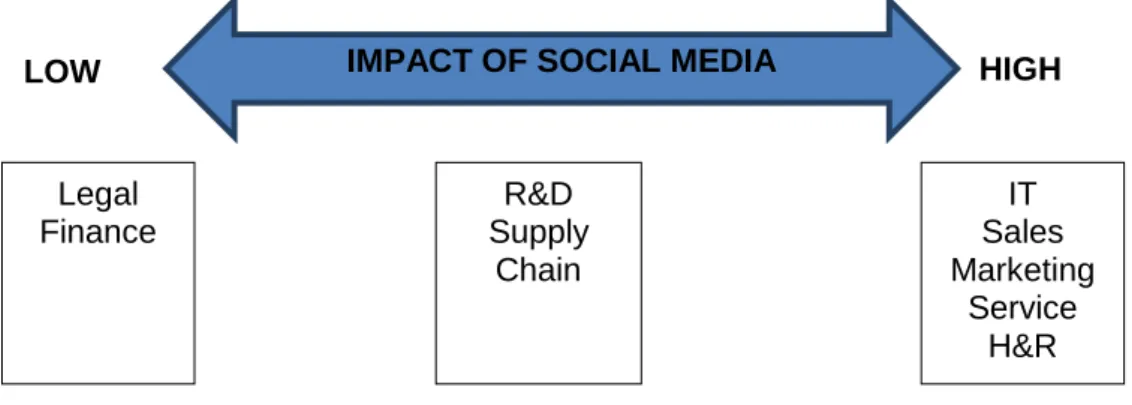
Nevertheless, impact of social media on different business functions hugely varies. For instance, Smith et al. (2011) state that information technology, sales, marketing, services and human resources are highly affected; research and development and supply chain are moderately affected; and legal and finance are less affected by social media which is illustrated in Figure 2. The list of benefits presented above supports the figure.
Specialist on social media suggests that employees must be encouraged to use social media in work in order to gain the best output from it (Broughton et al., 2010). However, this has to be done in a systematic way by devising online policy protocols. In addition to that it is also believed that a successful social business strategy will integrate social media in to business goals and objectives (Altimeter, 2015, Li and Solis, 2015, Myers, 2012). This calls for sound usage guidelines, protocols and awareness among the employees.
4.1
Drivers of social media
Drivers of social media are identified and short listed by Ahlqvist et al. (2008) through a workshop and twelve key drivers in the order of significance according to the study are:
Changing cultural environment –cultural changes influence work life and drive social media usage.
Commercial and customer orientation – customer requiring transparency from businesses, client participate in product developments, quick feedback and the like are facilitated through social media.
Networking – businesses are evolving from individual to relationship base intimacy which demands communication based tools.
Human resources – fragmentary working life, attitude of youngsters, work not being tied to place or time, entrepreneurship at some level all drives the use of social media.
Accessibility of technology – accessible cost and increased technology literacy are major reasons for the reach of social media.
Environmental challenges – reduced travelling (reduced emissions and energy consumption) and connectivity through social media.
Social responsibility and sustainable development - social media as a new bottom-up communication channel in all fields of sustainable development.
International markets and competition – dynamics, remigration and outsourcing and the like demands presence in social media.
Segmented needs of diverse customer sectors – where all customers cannot be served individually social media comes into play.
Aging – extended working age with virtual communications requires the technology
IMPACT OF SOCIAL MEDIA
LOW HIGH Legal Finance R&D Supply Chain IT Sales Marketing Service H&R
Figure 2: Impact of social media on business functions
Outsourcing (subcontracting) – social media facilitates scattered working models and ad-hoc working.
Development of technology – technology development serves as an enabler of wide social media usage.
These factors are further grouped into major six categories such as societal and cultural change (changing cultural environment, networking and aging); business and clients (commercial and customer orientation and segmented needs of diverse customers); science, technology and innovations (accessibility of technology, development of technology); sustainable development (environmental challenges, social responsibility and sustainable development); work life (human resources and outsourcing); and markets (international markets and competition).
5
Social media in different industries
5.1
Drivers and barriers of social media usage in business environments
In addition to the drivers identified by Ahlqvist et al. (2008) above, drivers and barriers in a work related environment are also identified as listed in Table 1. Accordingly, findings suggest that tightening of efficiency requirements and hectic working culture drives multiple parallel meetings and communication channels to be used in the work place. However, organisation culture is often considered to be a barrier because concerns about information security, possibilities of headhunting and thought of waste of time resists the encouragement of social media usage and implementation in a working environment.Table 1: Drivers and barriers of social media implementation in business environment
Drivers Barriers
Efficiency requirements Information security
Hectic working culture Possibilities of headhunting Rising demands to combine work and
leisure
Perceived as waste of working time
Nevertheless, following case studies presents the positive impact of successful social media implementation within different industries.
5.2
Health and beauty industry
Famous beauty company L’Oreal has been reported to be using all forms of social media to attract job seekers. Further, company vacancies webpage is linked directly to company profiles in Facebook, LinkedIn and twitter. In addition to that L’Oreal provides a link in Facebook profile on an internship programme which is linked to an application called ‘Work for Us’. This targets candidates and allows collation of important information. Through this method L’Oreal was able to reach inactive candidates as well as improved the brand. It was also reported that L’Oreal Australia saved nearly 20,000 Australian dollars in recruitment process (LinkedIn, 2012, Szkolar, 2012).
The above example of L’Oreal (LinkedIn, 2012, Szkolar, 2012) showcases effective means of recruitment process through social media platforms which helps to identify potential candidates at a lower cost and time than the conventional method of recruitment.
5.3
Food and drink industry
Coca-cola is a world famous drink company and well-known for its brand. Ahuja et al. (2009) reported that coca-cola to have over 63 million fans to its main Facebook page, over 700,000 followers in Twitter and also seemed to be active in Pinterest and Google+. This also reveals that coca cola is able to attract more fans and followers and improve the brand image by being active in social media.
Coca-cola example conveys the message that social media serve as good marketing tools and help improve brand image of businesses. However, Myers (2012) points out that small businesses feel overwhelmed by various social media platforms and as a result, there is a tendency of being active in all platforms which may not yield greater benefits (Myers, 2012).
5.4
Academia
Now social media are also popular among scholars. The identified key benefits of social media to scholars includes: keeping up-to-date with topics, following other researchers' work, discovering new ideas or publications, promoting current work/research,, making new research contacts, personal management and impact measurement (Coleman, 2013, Szkolar, 2012, Espinoza Vasquez and Caicedo Bastidas, 2015). Platforms like Google Scholar, Academia.edu, Research Gate, Mendeley and ImpactStory are a few examples of academic social media platforms. However, due to the credibility of the information present in social media sometimes users refrain from approaching it for academic purposes. Nevertheless, Szkolar (2012) highlights that social media have a role to play within the academic world though it is too early to predict whether scholarly social media sites will become a norm.
6
Social media in the construction industry
Construction industry is a distinctly different industry compared to manufacturing and other similar industries. There are no consumers as such but building users and building clients who ensures construction achives required specification and standards. There is heavy competition in the industry with greater price competetiion, lower profits and possible inflated prices. All such addd up for construction companies needing greater competive advantage than ever before.
The Kotrlik and Higgins (2001) reported that up to 77% of companies in information and communication sector are leaders in social media adoption in 2012 whereas construction businesses reported to be the lowest with 20% of implementation. It is not uncommon to note that construction industry is often criticised about its slow adoption of ICT and innovation. However, a different survey of top 15 construction companies in the UK reported that over 90% of the construction companies holding a Twitter account and LinkedIn account and 65% having a Facebook account for the company. Further, more than half of the companies have linked the website with social media accounts while all having the capability to analyse internet traffic (Pauley, 2014). In addition to that another study reported that the most popular social platform used by construction professional is LinkedIn with approximately 91% users. Twitter captures the second place with 84% users followed by Facebook, YouTube, Blogs, Google+ and Pinterest with 83%, 68%, 47%, 40% and 26% respectively (Whiston Solutions, 2015).
Even though many studies suggest that large construction organisations are now becoming active in social media platforms majority of the construction industry is composed of Small and Medium Enterprises (SME). Therefore, it is important to study the usage of social media within SMEs. Michaelidou et al. (2011) reported about the usage of social media in SMEs in the UK. Findings suggested 27% of SMEs use social media for business purposes, Facebook is identified as the most popular social media site with 77% SMEs using it followed by Twitter (55%), and LinkedIn (46%). Therefore, social media usage is evident in both large and SME construction organisations, with comparatively lower usage within SMEs Furthermore, social media adoption in construction industry is expected to bring many benefits. This is reflected in CIC Group construction industry survey 2014. The survey findings suggest with majority of respondents agreeing that social media could improve the image of construction industry. However, it was also noticed that respondents had mixed views about role of social media in construction. While some feel that social media should not be encouraged in a working environment as it is highly unregulated, unmanageable and perceived to be of high risk to reputation, others think that it is a good medium of marketing, attracting younger generation and disseminating knowledge through interactive forums, video blogs and the like. Nevertheless, CIC presumes that there is a huge scope for potential development of social media in construction that could facilitate collaboration, innovation and promotion (Construction Industry Council, 2014).
One of the important benefits of social media in construction industry could be knowledge management. Due to the fragmented nature of the industry knowledge management becomes even more important in construction industry (Dave and Koskela, 2009). Hence, social media could be a cost effective tool to manage knowledge within the industry. This is even more evident in case studies presented by Porkka et al. (2012) that demonstrates social media usage improves knowledge management and extends the use of traditional data in urban planning and construction projects.
Despite the benefits, reluctance of top management, lack of understanding and encouragement from top management (Brown, 2012), unfamiliarity of staff/lack of technical skills in handling social media platforms, perceived unimportance, lack of use by the competitors (Michaelidou et al., 2011) are reported to be the barriers of social media implementation in construction organisations.
In addition to that some key points to consider when implement social media in a construction business are as follows (Pauley, 2014, Li and Solis, 2015):
Commitment: poorly updated profile is considered to be more harmful than having presence in social media platforms. Hence, decision to be made on what social media platforms company chooses to be present in and how it will be updated and helps to make a difference in the business.
Having a solid social strategy: it is hard to believe sometimes that social media can reap greater benefits; however, many companies have started implementing it in a pro-active manner. Hence, it is important to pay attention to this new business strategy which will most likely influence the business to a greater extent in the near future.
Know the strategy: it is important that social media usage does not conflict with business strategy and hence awareness of what is fed in to the social media is crucial. Therefore, it is important employees of the organisation are aware of this.
Remain open-minded: many people assume that social media can only serve as a marketing tool while there are many other potential benefits identified.
Measure and act: measuring the impact of social media implementation is important to take crucial decision about continuation and improvement. If social media implementation is not bringing any benefit to the company then no point in spending time and effort in maintaining.
Allocate time and right people: it is important that a person is delegated the duty of maintaining social media platform for the company who understands the organisation strategy and goals. Otherwise there could be misuse of the platform which can impact the organisation brand
A sound social media usage guideline and protocol to govern the usage.
Executive support: this is considered to be extremely important and affects each point discussed above.
Nevertheless, there is a lack of reported case studies on social media implementation in construction organisations. Therefore, this chapter presents a case study of a construction organisation to understand social media implementation within a construction context.
7
Case Study
7.1
Method
Case study method was adopted to explore the state of use of social media in a construction organisation as it allows in-depth exploration (Fellows and Lieu, 2003) and holistic inquiry to be carried out to investigates a contemporary phenomenon within its natural setting (Harling, 2002).
The case study employed both qualitative and quantitative approaches as illustrated in Figure 3. While quantitative approach provides an overview of the state of organisation in terms of social media implementation, qualitative approach helps to gain deeper understanding of the situation. Initially, a questionnaire survey was conducted among the employees to understand employees’ perspectives on social media and usage patterns. Survey sample size of 91 for a large organisation over 900 employees enables findings to achieve over 90% confidence level on the findings (Kotrlik and Higgins, 2001). Then, semi-structured interviews were conducted with three key personnel from the case study organisation to get insights into the survey findings and explore on other issues.
Key themes and patterns were identified through content analysis of the interviews and questionnaire results were analysed using descriptive statistics. Finally, conclusions were arrived based on both the findings and comparisons made with the literature findings.
7.2
Case study
The case study organisation is a large Professional Quantity Surveying (PQS) organisation registered under the Royal Institution of Chartered Surveyors (RICS) with over 900 employees which can be considered to be a representative sample of large PQS organisations in the UK.
7.3
Survey findings
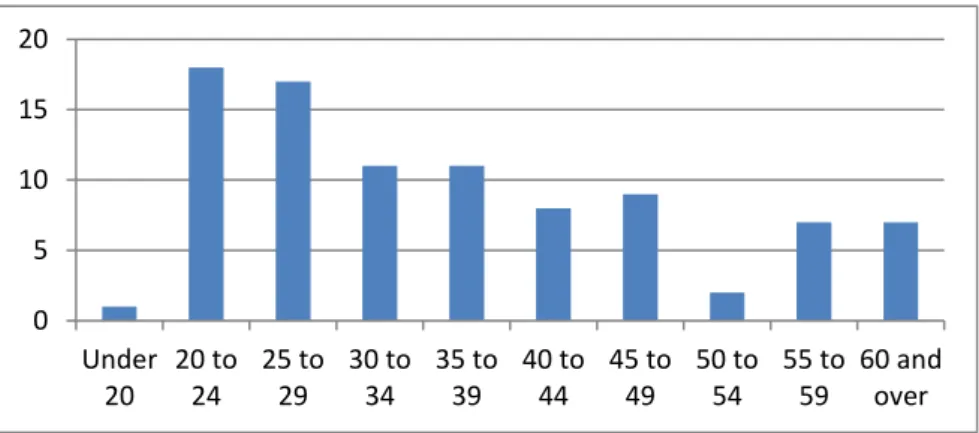
Survey findings are analysed in this section. Figure 4 illustrates the age profile of the respondents. Accordingly, more respondents lie between 20 to 29 age group (38%), representing younger generation in the sample. Also it is clear that sample represents fair
proportion of employees in all age groups.
7.3.1 Usage of social media within the organisation
7.3.1.1 Personal purpose 0 5 10 15 20 Under 20 20 to 24 25 to 29 30 to 34 35 to 39 40 to 44 45 to 49 50 to 54 55 to 59 60 and over
Figure 4: Respondent age profile Questionnaire Survey •Sample size -91 Interviews • Semi-structured with 3 Key personnel
Case
Study
Figure 5 illustrates usage of social media for personal purposes. Unsurprisingly, Facebook is the most used platform by the respondents for personal purposes followed by LinkedIn and YouTube. Further, Flickr found to be unpopular among the respondents resulting in non-usage within the case study organisation. Also findings suggest that 91% of the respondents use social media platforms for personal purposes.
Figure 6 captures the frequency of usage of each platform. Findings suggest that prominent social media platforms are frequently used. Especially, Facebook (67%) and LinkedIn (54%) are used on a daily basis by the majority of the respondents while Twitter, Instagram, Google+, Pinterest and WordPress are not used by the majority. Furthermore, it is also identified that 74% of respondents use social media platforms on a daily basis.
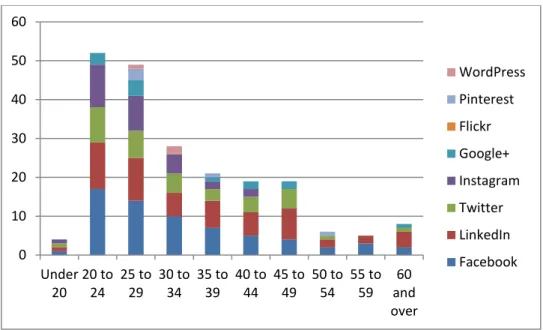
In addition to that there is a claim that younger generation is considered to be active in Facebook than older generation though now older generations are also slowly picking up. Therefore, it is interesting to study the impact of age in social media usage. Figure 7
demonstrate the usage pattern of social media for personal purpose by age. It clearly illustrates that younger generations use more social media for personal purposes., especially, Facebook. Social media use for personal purposes declines as the age increases. Noticeable decrease is evident with Facebook usage. Again LinkedIn and Twitter seems to be popular among youngsters as well as seniors. Another important distinction is that as the age increases the diversity of social media platforms used also decreases, where only two to four platforms are accessed out of the eight identified platforms by the employees above the age of 45.
0 10 20 30 40 50 60 70 80 Face b o o k Lin ked In Tw itt e r Yo u Tu b e In sta gram G o o gle + Fli ckr Pin tere st Wo rd Pres s N o n e Ot h er 0 10 20 30 40 50 60 70 Face b o o k Lin ked In Tw itt e r In sta gram G o o gle + Fli ckr Pin tere st Wo rd Pres s Weekly Monthly Daily
Figure 6: Usage frequency – personal purpose Figure 5: Usage of social media – personal purpose
Figure 7: Social media for personal use by age
7.3.1.2 Business purpose
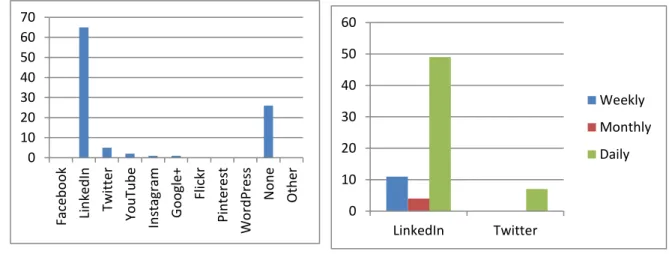
Figure 8 depicts usage of social media for business purposes. Accordingly, majority of the respondents use only LinkedIn for business purposes on a daily basis (See, Figure 9). On the other hand, Twitter, Facebook, YouTube and google+ are also used by a few. Further, it can be observed that the use of social media for business purposes is relatively low than personal usage resulting in only 56% of the respondents using it for business purposes indicating limited application of social media for business functions/purposes
Figure 10 represents social media usage for business purposes by age category. It suggests that maximum usage is by age groups 20 to 24, 25 to 29 and 45 to 49. However, an
ambiguity arises as to what respondents perceived as business development as the age group between 20 to 29 is less likely to influence business development compared to senior people. 0 10 20 30 40 50 60 Under 20 20 to 24 25 to 29 30 to 34 35 to 39 40 to 44 45 to 49 50 to 54 55 to 59 60 and over WordPress Pinterest Flickr Google+ Instagram Twitter LinkedIn Facebook 0 10 20 30 40 50 60 Face b o o k Lin ked In Tw itt e r Yo u Tu b e In sta gram G o o gle + Fli ckr Pin tere st Wo rd Pres s N o n e Ot h er
Figure 8: Usage of social media – business purposes 0 10 20 30 40 50 Weekly Monthly Daily
7.3.1.3 Career development
Figure 11 depicts usage of social media for career development. As expected LinkedIn is the dominant platform used by majority of the respondents (71%) while few others use Twitter, YouTube, Instagram and Google+ as means of career development. On the other hand more than a quarter of the respondents hardly use any platform for career development which is surprising.
Figure 12 illustrates the frequency of usage of LinkedIn and Twitter for career development. Accordingly, LinkedIn is accessed by the majority (54%) while Twitter is only accessed by only 8% on a daily basis. This reflects that personal use of social media overtaking usage for career development. This indicates poor utilisation of social media platforms for professional career enhancement which is not healthy in a business environment.
Figure 13 conveys the message that employees at the age of 20 to 34 are very keen on using LinkedIn for personal development while people at the age over 55 also demonstrate fair usage of the platform. Reason for younger people more actively involved in LinkedIn platform is because they are in the stage of developing their career and looking for attractive opportunities to gain more valuable experience. Nevertheless, popularity of LinkedIn among senior professionals also showcases the increasing significance of social media in career development. 0 10 20 30 40 50 60 70 Face b o o k Lin ked In Tw itt e r Yo u Tu b e In sta gram G o o gle + Fli ckr Pint ere st Wo rd Pres s N o n e Ot h er
Figure 11: Usage of social media – career development 0 10 20 30 40 50 60 LinkedIn Twitter Weekly Monthly Daily
Figure 12: Usage frequency - career development
0 2 4 6 8 10 12 Google+ Twitter LinkedIn Facebook
7.3.2 Social media usage policy within the organisation
Literature suggests use of social media bring huge benefits to the organisation if employees of the organisation are encouraged to use. Eventually, survey intended to capture whether it is encouraged within the case study organisation and majority (71%) confirmed that it is not encouraged while others responses suggest that it is encouraged. Another important fact is that half of the respondents (50%) confirmed that they are unaware of the internet usage policy set by the employer which is a threat as literature suggests that there should be protocols in place to govern social media usage in a business environment. This is a key problem in many organisations which needs to be given serious attention where social media usage is allowed and encouraged. Knowledge of protocol and boundaries of usage is very important to prevent any damage to the brand image and maintain the reputation of the organisation.
7.3.3 Integration of social media with business goals and objectives
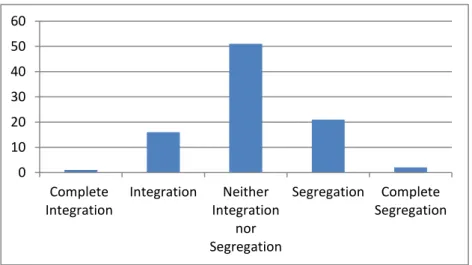
It is important that social media are integrated with the goals and objectives of the organisation for its successful implementation. However, responses suggest lack of understanding among employees in this regard resulting in majority agreeing on ‘neither integration nor segregation’ which is illustrated in Figure 14. It cannot be concluded form the findings whether social media are integrated or segregated form business goals and objectives, however, findings demonstrate lack of clear understanding among employees and lack of interest of top management to disseminated the knowledge about the social media implementation strategy.
0 5 10 15 Under 20 20 to 24 25 to 29 30 to 34 35 to 39 40 to 44 45 to 49 50 to 54
Figure 13: Usage pattern of LinkedIn by age
0 10 20 30 40 50 60 Complete Integration Integration Neither Integration nor Segregation Segregation Complete Segregation
Figure 14: Level of integration= of social media with organisation goals and objectives
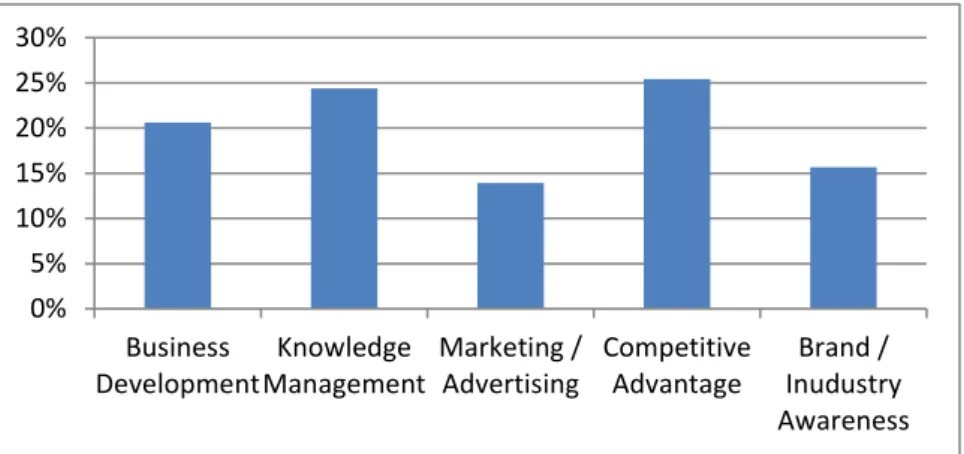
7.3.4 Significance of social media in business activities
Social media are considered important in an organisation’s activities for:
Business development
Knowledge management
Marketing/advertising
Competitive advantage
Brand and industry awareness
Figure 15 illustrates importance of social media in various activities of the case study organisation from employees’ perspective. Accordingly, employees consider that social media are most important to gain competitive advantage and knowledge management, followed by business development, brand or industry awareness and marketing. Findings demonstrate evolving role of social media from primarily being a marketing tool to other areas. It is interesting to note that employees scored high for knowledge management. Therefore, the role of social media in organisation knowledge management could be an interesting area to explore further.
7.4
Interview findings
Interviews were conducted with key personnel of the organisation with varying experiences which is listed in Table 2 below:
Table 2: Interviewee profile
Interviewee Industry Experience
X1 20 years
X2 3 years
X3 1 year
Unsurprisingly, it is clear that younger generation (20-29) demonstrates higher social media usage and awareness compared to older generation. Hence, interviewees with varying experience tend to provoke different views about social media implementation in construction. 0% 5% 10% 15% 20% 25% 30% Business Development Knowledge Management Marketing / Advertising Competitive Advantage Brand / Inudustry Awareness
7.4.1 Use of social media within the organisation
The organisation maintains accounts in various social media platform such as: Blogs, LinkedIn, Twitter, YouTube and Facebook. All interviewees were aware of the active social media platforms used by the organisation partly as a result of email links being circulated among employees frequently about the news feeds. Further, the organisation is considered to be active in feeding information into the platforms mentioned above. This indicates the influence of social media in modern day businesses.
Interviewees feel that social media are a good tool that facilitates communications. It is also considered to be an influential marketing tool. Nevertheless, social media are perceived to be surrounded by negative stigmas making it difficult to satisfy everyone in the organisation, especially top management, regarding its usage and implementation within the organisation.
7.4.2 Usage of social media by interviewees
Usage of social media within the organisation is categorised in to three types namely:
Personal purposes
Business purposes
Career development purposes 7.4.2.1 Personal purposes
It was interesting to note that Twitter is used by all three interviewees for personal purposes while one interviewee commented that Twitter is to be the most used platform among others. Second most used platform is Facebook, followed by Instagram and YouTube. Key fact to note here is that the interviewee with the most experience is using only Twitter for personal purposes while other two interviewees reported to have used other platforms.
While interview findings suggest that Twitter is the most used platform for personal use, survey demonstrates that Facebook is used mostly for personal purposes. This is because Facebook has become a viral in present world attracting both youth and older generations. However, in a business environment this can have undesirable affects as well.
7.4.2.2 Business purposes
Only YouTube and LinkedIn are used for business purposes as well as used only by the senior interviewee. To some extent this indicates that the business feeds are preferred to be dealt by the senior personnel of the organisation.
Similarly, survey also suggested that LinkedIn to be the dominant platform used for business purposes while Twitter, Facebook, YouTube and google+ are also used at a very lower rate. 7.4.2.3 Career development
All three interviewees identified Twitter and LinkedIn to serve as career developing platforms. Survey also suggests that LinkedIn to be the dominant platform while Twitter, YouTube, Instagram and Google+ are also used for career development.
LinkedIn has become a very popular platform for job hunting where well-presented profiles attract competitive opportunities, leading to career development.
7.4.3 Social media usage protocol
Even though clear record of social media platform usage in case study organisation is evident it was noted that not all interviewees are aware of the protocol for social media usage within the organisation. The senior interviewee confirmed that there is a section specifically on social media usage protocol while another interviewee claimed that it should be made even more visible and accessible to employees so that they are aware of it. Survey findings also support this claim as half of the respondents stated that they are unaware of the usage policy. This conveys a message to the management that an effective communication is required in this regard. Further, this could be seen as a serious issue in the case study organisation which calls for a rapid action.
7.4.4 Implementing social media in construction organisations
Positive views on social media implementation within construction organisations are reported as it is believed that social media help to connect targeted audiences like clients, contractors as well as prospective employees and encourage co-operation within groups. In addition to that social media,
Is easily accessible and free of charge
Enable fast specialist feedback/better communication
Has potential to reach to global audience
Helps improve networks
However, one interviewee stated that social media are more suitable for other industries than construction as construction businesses are not really influenced by promotions. But potential benefits of social media are evident through survey findings in other branches of business like business development, knowledge management, and marketing.
Particularly, in the case study organisation social media help to improve the status of the organisation and the brand as well as help to manage knowledge.
Despite the advantages and financial benefits that social media bring in to the construction organisations, some barriers are also identified by the interviewees in social media implementation in construction businesses and identified below as follows:
Age of employees – older generation lags behind rapidly developing technology and thus, resists change in the organisation.
More personal usage – Use of social media for personal purposes rather than business purposes during business hours results in reduction of employee productivity.
Lack of control – difficulty in exercising control over the usage
Conflict of interest - Personal opinions may conflict with business interests
Lack of encouragement to use – Lack of support from top management due to anticipated negative impacts. Sometimes by social media usage there is a risk of devaluing corporate image.
8
Discussion
8.1
Popular social media platforms among construction organisations
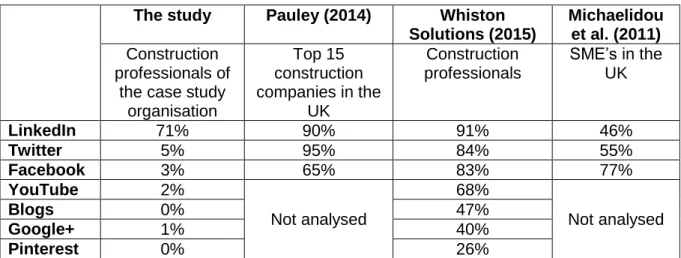
Table 3 compares the findings of the study with other studies which demonstrates a significant difference in some areas. Findings of this study exclude social media usage for personal purposes while Whiston Solutions (2015) does not clearly state the scope of the analysis. It is clear that LinkedIn is identified as the most popular social media platform by most of the studies. While Twitter is identified as another most popular platform, the study does not support the fact. Except for LinkedIn all other platforms lack popularity within the case study organisation. The reason for this could be that LinkedIn is more professionally aligned compared to other platforms.Table 3: Comparison of results of the study with other studies
The study Pauley (2014) Whiston Solutions (2015)
Michaelidou et al. (2011)
Construction professionals of
the case study organisation Top 15 construction companies in the UK Construction professionals SME’s in the UK LinkedIn 71% 90% 91% 46% Twitter 5% 95% 84% 55% Facebook 3% 65% 83% 77% YouTube 2% Not analysed 68% Not analysed Blogs 0% 47% Google+ 1% 40% Pinterest 0% 26%
Findings and literature review suggest that, generally, LinkedIn, Twitter and Facebook are being the most popular social media platforms within construction organisation. Nevertheless, YouTube, blogs, google+, Pinterest and Flickr are also used by a smaller percentage.
8.2
Drivers and barriers of social media implementation in construction
organisation
Based on the review and findings list of barriers and drivers of social media implementation in construction industry are identified and grouped into different categories depending on the relevance of each factor.
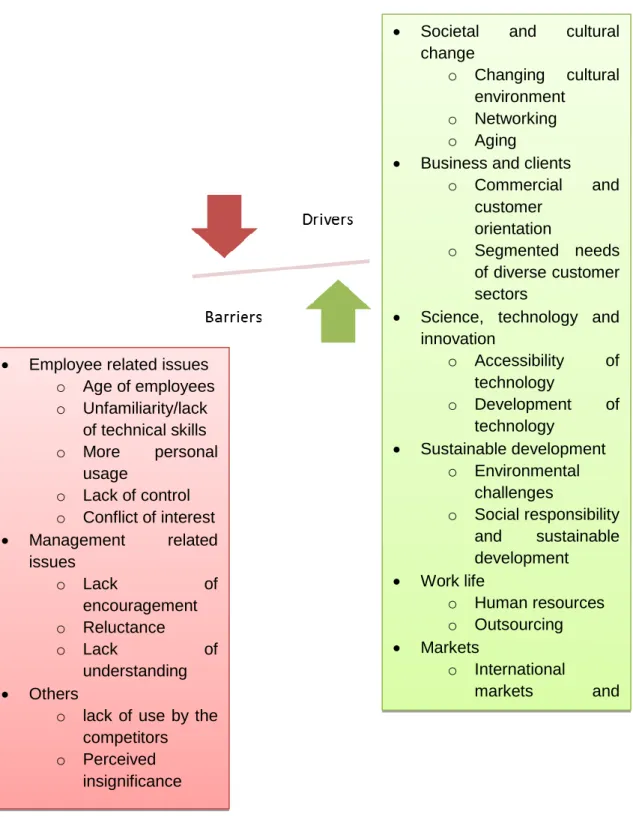
Accordingly, barriers are categorised in to three major types namely: employee related; management related and others. Similarly, drivers are categorised into six major types such as: societal and cultural change; business and clients; science, technology and innovation; sustainable development; work life; and markets which are depicted in Figure 16. Closer look at barriers suggests that most of these could be overcome through management action and power lies in the hands of the management. If the management decides to implement social business strategies then employee related barriers could be managed through proper training and monitoring of activities.
However, it is important to remember key points highlighted by Pauley (2014) and Li and Solis (2015) when implementing social business strategy including: commitment, having a
social strategy, knowing the strategy, remain open-minded, measure and act, allocate time and right people, a sound social media usage guide and protocol and executive support. More importantly, a successful social business will have social media integrated with business goals. When all these are combined together construction organisations can reap huge benefits through use of social media.
Employee related issues
o Age of employees o Unfamiliarity/lack of technical skills o More personal usage o Lack of control o Conflict of interest Management related issues o Lack of encouragement o Reluctance o Lack of understanding Others
o lack of use by the competitors
o Perceived insignificance
Societal and cultural change
o Changing cultural environment
o Networking
o Aging
Business and clients
o Commercial and customer orientation o Segmented needs of diverse customer sectors
Science, technology and innovation o Accessibility of technology o Development of technology Sustainable development o Environmental challenges o Social responsibility and sustainable development Work life o Human resources o Outsourcing Markets o International markets and competition
9
Conclusions
Social media are considered to be powerful tools due to its capability of enormous information transmission. It is also accessible by everyone mostly at no cost and sometimes at a low cost. Social media can be used for personal purposes, business purposes and career development purposes. It is clear that beyond the personal usage now social media have influenced business activities to a great extent. As a result, many of the businesses are active in social media and maintain a company account in more than one platform. Few case studies witness the positive impact of social media implementation within a business environment despite the barriers. However, in a construction context social media implementation is still in its early stages of development. The case study of a leading construction firm in the UK revealed that the organisation is active in few popular social media platforms including: Blog, LinkedIn, Twitter, YouTube and Facebook. Facebook and Twitter are the most commonly used by the employees for personal purposes while LinkedIn is mostly used for business purposes and career development. This conforms to the performance criteria identified by Kietzmann et al., (2011) for social media viz identity. Further, it was identified that usage of social media within the organisation is not encouraged while the responses conveyed some form of unawareness of the usage policy of the organisation. This could be a threat to the organisation’s activities because unawareness of usage policy can lead to abuse of the social media usage within a business environment. Knowledge of protocol and boundaries of usage is crucial to prevent damages to the brand image of construction businesses and maintain the reputation of the organisation. As literature suggests integration of social media with business goals is important for a successful social business strategy. However, the case study organisation does not demonstrate a clear picture of its state in this aspect and lack of understanding about social media implementation strategy among employees was evident in the case study. This indicates poor communication of social media usage strategy within the organisation. However, significance of social media in business development, knowledge management, marketing/advertising, competitive advantage and brand and industry awareness are recognised by the employees. Despite the benefits few other barriers are also reported to exist in social media implementation in the case study organisation which includes: age of employees, more of personal usage, lack of control, personal opinions conflicting with business messages and lack of encouragement to use. However, it is believed that if the barriers are overcome social media can take the construction business to the next level.
References
AHLQVIST, T., BÄCK, A., HALONEN, M. & HEINONEN, S. 2008. Social Media Roadmaps: exploring the futures triggered by social media. Espoo, Finland.
AHUJA, V., YANG, J. & SHANKAR, R. 2009. Study of ICT adoption for building project management in the Indian construction industry. Automation in Construction, 18, 415-423.
ALTIMETER. 2015. Social Business Strategy [Online]. Available:
http://www.altimetergroup.com/work-with-us/challenges-we-solve/social-business-strategy/.
ANDREWS, C. 2012. Social media recruitment. Applied Clinical Trials, 21, 32-42.
BENNETT, S. 2014. The 13 most popular social networks (by age group) [Online]. Available:
http://www.adweek.com/socialtimes/popular-social-networks-age/502497 [Accessed 20
May 2015].
BROUGHTON, A., HIGGINS, T., HICKS, B. & COX, A. 2010. Workplaces and Social Networking: The Implications for Employment Relations. The Institute for Employment Studies.
BROWN, M. 2012. Why the construction sector should engage with social media [Online]. Available:
http://www.theguardian.com/sustainable-business/construction-sector-social-media
[Accessed 17 May 2015].
COLEMAN, V. 2013. Social media as a primary source: A coming of age. EDUCAUSE Review, 48, 60-61.
CONSTRUCTION INDUSTRY COUNCIL 2014. CIC 2050 Group Construction Industry Survey 2014. UK: CIC 2050 Group.
DAVE, B. & KOSKELA, L. 2009. Collaborative knowledge management—A construction case study. Automation in Construction, 18, 894-902.
EBIZ. 2015. Top 15 Most Popular Social Networking Sites | May 2015 [Online]. Available:
http://www.ebizmba.com/articles/social-networking-websites.
ESPINOZA VASQUEZ, F. K. & CAICEDO BASTIDAS, C. E. 2015. Academic social networking sites: a comparative analysis of their services and tools. iConference 2015.
FELLOWS, R. & LIEU, A. 2003. Research methods for construction, USA, Blackwell publishing.
GOLDEN, M. 2010. Social media strategies for professionals and their firms: the guide to establishing credibility and accelerating relationships, Hoboken, N.J, Wiley.
GRAHL, T. 2015. The 6 types of social media [Online]. Available:
http://timgrahl.com/the-6-types-of-social-media/ [Accessed 17 May 2015].
HARLING, K. 2002. Annual meeting of the american agricultural economics association, case studies: Their future role in agricultural and resource economics. California.
KOTRLIK, J. & HIGGINS, C. 2001. Organizational research: Determining appropriate sample size in survey research appropriate sample size in survey research. Information technology, learning, and performance journal, 19, 43.
LI, C. & SOLIS, B. 2015. The 7 success factors of social business strategy [Online]. Available:
http://www.briansolis.com/2015/04/7-success-factors-social-business-strategy-infographic/
[Accessed 17 May 2015].
LINKEDIN. 2012. Case study L’Oreal [Online]. Available:
http://www.slideshare.net/linkedineurope/loreal-case-studyv5 [Accessed 17 May 2015].
LINKEDIN. 2015. About LinkedIn [Online]. Available: https://press.linkedin.com/about-linkedin [Accessed 17 May 2015].
MICHAELIDOU, N., SIAMAGKA, N. T. & CHRISTODOULIDES, G. 2011. Usage, barriers and
measurement of social media marketing: An exploratory investigation of small and medium B2B brands. Industrial Marketing Management, 40, 1153-1159.
MOREAU, E. 2014. Top 15 social networking sites you should be using [Online]. Available:
http://webtrends.about.com/od/socialnetworkingreviews/tp/Social-Networking-Sites.htm.
MYERS, A. 2012. 13 types of social media platforms and counting [Online]. Available:
http://decidedlysocial.com/13-types-of-social-media-platforms-and-counting/ [Accessed 17
May 2015].
O'REILLY, T. 2005. What Is Web 2.0 [Online]. Available:
http://www.oreilly.com/pub/a/web2/archive/what-is-web-20.html.
PATTEN, J. 2007. Blogging in the workplace: Building a safe culture [Online]. Available:
http://www.personneltoday.com/hr/blogging-in-the-workplace-building-a-safe-culture/
[Accessed 17 May 2015].
PAULEY, N. 2014. How the top UK construction companies are using social media marketing in 2014 [Online]. Available:
http://www.pauleycreative.co.uk/2014/01/how-the-top-construction-companies-are-using-social-media-in-2014/ [Accessed 17 May 2015].
PEANSUPAP, V. & WALKER, D. H. 2006. Information communication technology (ICT) implementation constraints: A construction industry perspective. Engineering, construction and architectural management, 13, 364-379.
PORKKA, J., JUNG, N., PÄIVÄNEN, J., JÄVÄJÄ, P. & SUWAL, S. Role of social media in the development of land use and building projects. Proceedings of ECPPM, 2012.
SALCIDO, M. 2011. Benefits and advantages of using social media | advantages of social media [Online]. Available:
http://www.organicseoconsultant.com/advantages-of-using-social-media/ [Accessed 17 May 2015].
SCOTT, M. 2014. Understanding the basic categories of social media marketing [Online]. Available: https://blog.ahrefs.com/understanding-basic-categories-social-media-marketing/ [Accessed 17 May 2015].
SEOPRESSOR. 2015. The 6 Types of Social Media [Online]. Available:
http://seopressor.com/social-media-marketing/types-of-social-media/ [Accessed 17 May 2015].
SMITH, N., ZHOU, C. & WOLLAN, R. 2011. The social media management handbook: everything you need to know to get social media working in your business, Hoboken, N.J, Wiley.
STATISTA. 2015. Number of monthly active Facebook users worldwide as of 1st quarter 2015 (in
millions) [Online]. Available:
http://www.statista.com/statistics/264810/number-of-monthly-active-facebook-users-worldwide/ [Accessed 17 May 2015].
SZKOLAR, D. 2012. Social networking for academics and scholars Information Space [Online]. Available from:
http://infospace.ischool.syr.edu/2012/06/21/social-networking-for-academics-and-scholars/ [Accessed 10 February 2016].
WHISTON SOLUTIONS. 2015. Social media benefits for the property and construction industry [Online]. Available:
http://www.whiston-solutions.com/industry-developments/social-media-benefits-property-and-construction-industry [Accessed 17 May 2015].
WIKIPEDIA. 2015a. Facebook [Online]. Available: https://en.wikipedia.org/wiki/Facebook [Accessed 17 May 2015].
WIKIPEDIA. 2015b. HipHop for PHP [Online]. Available:
http://en.wikipedia.org/wiki/HipHop_for_PHP [Accessed 17 May 2015].
WIKIPEDIA. 2015c. Twitter [Online]. Available: https://en.wikipedia.org/wiki/Twitter#cite_note-10 [Accessed 17 May 2015].
WIKIPEDIA. 2015d. YouTube [Online]. Available: https://en.wikipedia.org/wiki/YouTube [Accessed 17 May 2015].