Contents lists available at ScienceDirect
Expert
Systems
With
Applications
journal homepage: www.elsevier.com/locate/eswa
Picking
on
the
family:
Disrupting
android
malware
triage
by
forcing
misclassification
Alejandro
Calleja
a,
Alejandro
Martín
b,
Héctor
D.
Menéndez
c,∗,
Juan
Tapiador
a,
David
Clark
c aDepartmentofComputerScience,UniversidadCarlosIIIdeMadrid,Madrid,SpainbDepartamentodeInformática,UniversidadAutónomadeMadrid,Madrid,Spain cUniversityCollegeLondon(UCL),GowerStreet,LondonWC1E6BT,UnitedKingdom
a
r
t
i
c
l
e
i
n
f
o
Articlehistory: Received31March2017 Revised29October2017 Accepted14November2017 Keywords: Malwareclassification Adversariallearning Geneticalgorithms Iagodroida
b
s
t
r
a
c
t
Machine learning classification algorithms are widely applied to different malware analysis problems be- cause of their proven abilities to learn from examples and perform relatively well with little human input. Use cases include the labelling of malicious samples according to families during triage of suspected mal- ware. However, automated algorithms are vulnerable to attacks. An attacker could carefully manipulate the sample to force the algorithm to produce a particular output. In this paper we discuss one such at- tack on Android malware classifiers. We design and implement a prototype tool, called IagoDroid, that takes as input a malware sample and a target family, and modifies the sample to cause it to be classi- fied as belonging to this family while preserving its original semantics. Our technique relies on a search process that generates variants of the original sample without modifying their semantics. We tested Iago- Droid against RevealDroid, a recent, open source, Android malware classifier based on a variety of static features. IagoDroid successfully forces misclassification for 28 of the 29 representative malware families present in the DREBIN dataset. Remarkably, it does so by modifying just a single feature of the origi- nal malware. On average, it finds the first evasive sample in the first search iteration, and converges to a 100% evasive population within 4 iterations. Finally, we introduce RevealDroid ∗, a more robust classi-
fier that implements several techniques proposed in other adversarial learning domains. Our experiments suggest that RevealDroid ∗can correctly detect up to 99% of the variants generated by IagoDroid.
© 2017 The Authors. Published by Elsevier Ltd. This is an open access article under the CC BY license. ( http://creativecommons.org/licenses/by/4.0/)
1. Introduction
Detecting and classifying malware is a challenge that has steadily increased over time. Not only has the rate of produc-tion of distinct files been increasing but the methods used to evade detection have become more sophisticated. For instance, malicious apps have been observed colluding to achieve their desired outcomes (Labs, 2016; Zhou & Jiang, 2012). The quan-tity of malware targeting mobile devices doubled in the year to July 2016 (Labs, 2016), with a clear trend towards the reuse of source code instead of developing new variants from scratch (Zhou & Jiang, 2012). Mobile malware variants are produced through component reuse and also via obfuscation. Considering the advances inmachine learningtechniquesin thelast decades, there is widespread interest in applying these to the malware
∗ Correspondingauthor.
E-mailaddresses:[email protected](A.Calleja),[email protected](A. Martín),[email protected](H.D.Menéndez),[email protected](J.Tapiador),
[email protected](D.Clark).
triage problem. Contemporary machine learning algorithms pro-vide thepotential to improvescalabilityand offerhighflexibility regardingthe features employed duringthe classificationof mal-ware into families (Dash et al., 2016; Gandotra, Bansal, & Sofat, 2014). However, an informed adversary can deliberately alter the decision process of an automated classifier by different means. The problem of employing machine learning algorithms in ad-versarial environments has previously been studied in security related contexts such as spam, intrusion detection, or malware classification(Biggio,Rieck etal.,2014;Dalvi, Domingos, Sanghai, &Verma, 2004; Lowd& Meek, 2005). Inthe sameway,different countermeasures have been proposed (Biggio, Corona, Fumera, Giacinto,&Roli,2011;Chinavle,Kolari,Oates,&Finin,2009).
This paper investigates the automated disruption of An-droid malware triage, the process by which decisions are made in regard to the further analysis steps for a suspicious file(Chakradeo,Reaves,Traynor,&Enck,2013).Acriticalstep dur-ingthisprocess,thatmayaffectthechoiceofsubsequentanalysis techniques,istheidentificationofthemalwarefamilyofahighly suspicious file. Ourattack is that a malware writer, in deploying https://doi.org/10.1016/j.eswa.2017.11.032
variantsfromarelatively novelfamily,attempts todisguisethem as a different family, one that is less likely to attract intensive scrutiny. This may hide novel indicators of compromise such as DNS records, malicious URLs, or exploits (Lakhotia, Walenstein, Miles,&Singh,2013).
Inthisscenario,thepowerofthemalwarewriteroradversary is as follows: she has control over her malware sample and is able to extract static features such as intents-actions, API calls, andinformation flows. In addition, she knows the feature space used by the targeted classifier and has access to the classifi-cation/misclassification probability. This is a relatively strong assumption,yettheattackerstillhasthelimitationofnotknowing theunderlyingclassification algorithmandshe needs topreserve thesemantics ofthe executable. Besides, she wants to automate theprocess.Oursolutiontothisproblem,a toolcalledIagoDroid, uses evolutionary algorithms to perform a search that identifies aminimal numberofchangesto thefeatures inordertoeffecta familymisclassification. IagoDroidcan randomly choose a family ortargetaspecificfamily.
Assuming further knowledge about the classifier is unrealistic in practice. Since the mapping (from vectors to labels) imple-mented by the classifier is unknown, there is no other option but to treat it as a black box that can be repeatedly queried during search. Even when this is not the case and the details about the classifier are fully known, obtaining an actionable analytical description of such a mapping might not be always possible, particularly for non-linear classifiers that capture com-plex interactions among features to produce the output label. Population-based search mechanisms such as genetic algorithms haveproven to perform remarkably well inchallenging domains where more traditional search algorithms have not succeeded (Sivanandam&Deepa,2007).
Attacks against classifiers have been discussed before, both fromatheoreticalpointofviewandinparticularsecuritydomains such asspam or intrusion detection. Inthis paper we study the impactofanattackagainstmulticlassAndroidmalwareclassifiers. Android apps are extremely easy to decompile, manipulate and repackage againintoa newapp. This makes it easy tointroduce new artefacts (e.g., components, API calls, intents, information flows)intheappthatwillaffectitsassociatedfeaturevectorand, therefore, the label given by a classifier. If carefully introduced (forinstance,inif-thenblocksonly accessiblethroughan opaque predicatethat always evaluates to false), such modifications will notaffecttheapp’sexecutionsemantics.
To demonstrate our approach, IagoDroid attacks family clas-sification by RevealDroid (Garcia, Hammad, Pedrood, Bagheri-Khaligh, & Malek, 2015), a recently proposed malware classifier employingexisting staticanalysisfeatures. Ourchoiceof Reveal-Droidisforconvenience(itisopen sourceandreadytouse)and because it incorporates most of the static features discussed in the literature (API calls, information flows, and so on). However, IagoDroidis agnostic withrespect to the classifier used andcan beappliedtodifferentclassifiers.Moreover,wehavesubsequently designed a countermeasure that can detect when a potential evasion has been performed and can recover a set of potential originalfamilies.
The main contributions of this paper are summarized as follows:
• We propose a novel classification evasion attack against any triage process where the family classification relies on static analysis. We demonstrate, in particular, that IagoDroid can evade an open source classifier named RevealDroid, a freely availablemulti-classmalwareclassifierwhichcombinesseveral differentfeatures.Todoso,weemployevolutionaryalgorithms, atechniquewhichhasbeenpreviouslyemployedinthecontext
ofevadingclassifiersforsecurityapplications(Pastrana,Orfila, &Ribagorda,2011;Xu,Qi,&Evans,2016)(seeSection2). • We train RevealDroid using 1919malware samplesfrom the
DREBIN (Arp, Spreitzenbarth, Hubner, Gascon, & Rieck, 2014) dataset divided into 29 different malware families. IagoDroid successfullyforcesmisclassificationof28ofthe29families,in theprocessmodifyingonlyasinglefeatureoftheoriginal mal-ware feature vector. On average,IagoDroid is ableto find the firstevasivefilewithinthefirstgenerationandconvergesona 100%evasive population within 4generations (see Section 4). Itwasabletofindapproximately14,000evasivevariantsfrom morethan290initialmalwaresampleswithin2min.
• The countermeasure, named by us as RevealDroid∗, detects potential evasions in between 90% and 99% of the output of IagoDroid, depending on the number of modifications in-troduced, and can identify potential original families for the malware(seeSection5).
The rest of this paper is organized as follows: In Section 2, we present our approach, introducing issues related to our contribution such as the adopted adversarial model, the target classifier, and the parameters of the genetic algorithm compo-nent. Section 3 describes the experiments and our configuration of them. In Section 4 we analyse and discuss the results while Section 5 describes the countermeasure proposed. Section 6 in-troduces the most relevant, related contributions found in the literatureandfinallySection7concludesthepaper.
2. IagoDroid
Thissection describesIagoDroid,a prototypetool thatinduces mislabelling of malware families during the triaging process for potential malware samples. Given the importance of automated systemsto detectandclassify malware,to understandhowthese systemscanfail(andhowcantheybestrengthened)whenattacks are directed against their integrity is an important task. Iago-Droid’smaingoalistodemonstratethat anattack onan Android malware classification tool is feasible, by forcing it to produce a familymisclassificationastheresultofsomeminorchangesinthe originalsampleandwithoutmodifyingitssemantics.
Following the taxonomy of attacks on machine learning de-velopedby Barreno, Nelson,Sears, Joseph, andTygar (2006),our approachcanbepositionedasfollows:
• ExploratoryAttacks: Theattack describedinthispaperis
ex-ploratorysinceitdoesnot aimatalteringthetrainingprocess buttheclassificationitself,offline.
• Targeted Attacks: Regarding specificity, the proposed attack
isfocused on misleadingthelabel givenby theclassifier to a particularsample.Nevertheless,theuseofevolutionarysearch to find a proper mutation strategy can be used to fool the detectionofanysampleinthe datasetasdemonstratedinthe followingsectionsofthepaper.
• IntegrityAttacks:Incontrasttoattacksagainsttheavailability
oftheclassifier,wedonotseektoinducerandomclassification errors. We aim to coercean intended family misclassification forspecificinputsamples.
The basicidea behindthe IagoDroidattack isthat the feature vector ofa maliciousapplicationcan betransformed by injecting new specific, incremental values, and this can eventually result in the assignment of an incorrect family label. These changes in the feature vector require modifications in the app’s code and resources, in order to build a new samplecorresponding to the desired feature vector. For instance, it may be necessary to include a newAPI call. Moreover, thesechanges are made while simultaneously keeping the semantics of the app invariant. The
Fig. 1. GeneralschemeofIagoDroid.
key to achieving semantic invariance is to only consider small,
incrementalchanges intheapp(i.e.,addingnewAPI calls ornew permissions)eachofwhichdoesnotaltertheoriginalsemantics.
Obtaining the list of transformations to apply to the feature vectorcanbeseenasasearchprobleminwhichasearchheuristic findsasolution(i.e.,anewfeaturevector)basedontheproximity ofthecurrentfeaturevectortooneassociatedwithalabel differ-ent fromthe currentone.Thisproximity canbe calculatedbased ontheoutputofamalwareclassifier,bymeasuringtheprobability ofthe featurevector beingclassified astheoriginal labelorasa differentlabel.
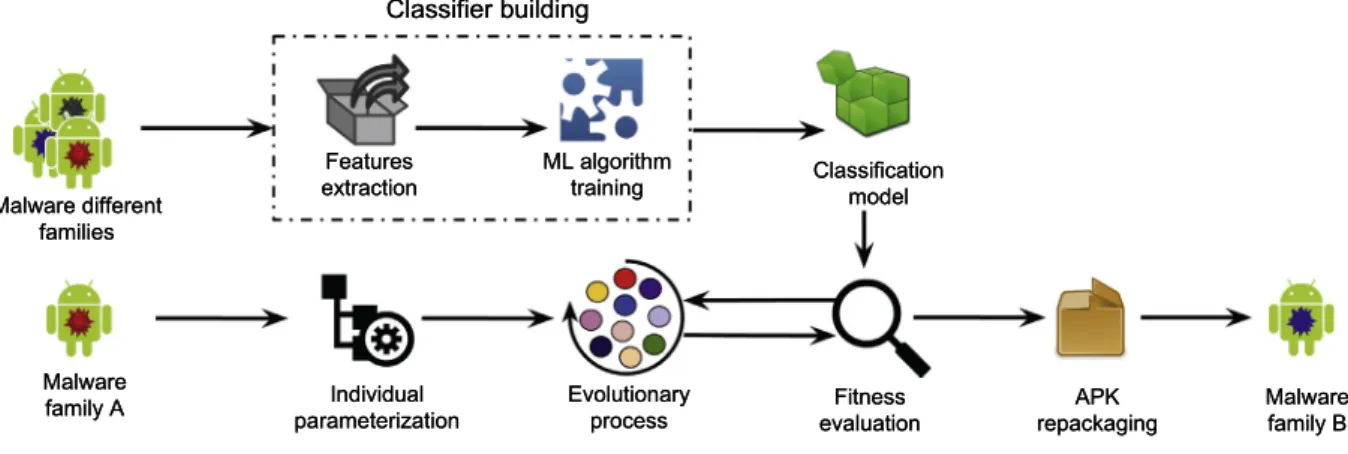
Fig. 1 shows the general architecture of IagoDroid. There are two main pipelines, one depicted above the other. The upper pipelineshowstheprocessofbuildingtheclassificationalgorithm used to drive the heuristic search. This algorithm takes as input a set of samples placed in a feature space. These samples are employed totrain theclassifier andobtaina classification model. Ontheotherhand,theprocessofperforming theattack isshown inthebottompipeline.Inthiscasetheprocessstartsbypickinga malwaresamplewhosefamilylabelwewishtoalter.Additionally, theattack pipelinecan alsotakea targetfamily(see Section2.1). IagoDroid employs a genetic algorithm to perform the heuristic search, as these algorithms to adapt to problems of high com-plexity. Thesearchis guidedbyafitness functionwhichusesthe classificationmodelpreviouslytrainedtofindthesolutionsthat in-ducemisclassification.Finally,theapplicationismodifiedinorder toadaptittoitsnewfeaturevectoranditisrepackagedtoobtain anewappwhichisabletoevadeacorrectfamilyclassification.
The following subsections present the context for IagoDroid, starting from a description of the adversarial model, a speci-fication of the target classifier and finishing with the problem formalisation.
2.1. Adversarialmodel
In ourscenario, we consideran adversary who aims toevade the correct classification of a sample belonging to family A by misclassifyingitasfamilyB.
Thegoaloftheadversaryistoensurethatitispossibletomiss theidentificationofthecorrectfamily.We considertwocases.In the first scenario, the selection of the target family is delegated totheevolutionaryalgorithmwhichwillmerelytrytochangethe label of the input feature vector with the minimum number of changes.Inthesecond scenario,thetargetfamilyisalsoan input andthesearchwillattempttofindthefeaturechangesthatattain thisspecificmisclassification.
As introduced inSection 1, theadversary seeks tothwart the deployment of proper countermeasures. To appreciate how the
attackerachieves this, it is useful to specify what the adversary knows about the classifier. Given that IagoDroid is based on a wellknownclassificationalgorithmwhosesourcecodeispublicly available,weallowthefeaturesetemployedbytheclassifiertobe known to theattacker. We assume the attacker isable to create new feature vectors and submit them directly to the classifier without any constraint. We assume that the classifier interacts withthesubmitted feature vectorsasif theyhad beenextracted fromapplications created or modifiedby the adversary. In other words,thesearchisconductedatthefeaturevectorlevel,without directlymodifyingthemalwaresampleuntilasolutionisfound.
Regarding the classifier output, the attacker receives two val-ues: the label assigned to the input vector and a classification score, indicating the trust/reliability of the classification. Since the adversary is able to deploy her own implementation of the classifier, we do not consider any limitation in the number of feature vectors that can be submitted, hence the attacker has an unbounded number of attempts to lead the classifier to a compromisedverdict.
This scenario for the adversarial capabilities is realistic since the target classifier can be well documented (i.e., no security throughobscurity)orelsereversed.
2.2.Targetclassifier
We decided to use an already proposed and documented classifier inourwork. Ourselection criteriaforchoosing atarget classifier included good classifier precision and high diversity in the features it uses. While there are several classifiers discussed intheliterature,fewofthemconsideranimportantand represen-tativesetoffeaturesandarefreelyavailable todownload.Table1 compares the use of different features by the most important classifiersdescribedinthe literatureandnotes whethertheycan bedownloaded tobe usedforour purposes.From thenine anal-ysed proposals, only the authors of three of them have released the source code of their solutions, RevealDroid, Dendroid and DroidLegacy. Of these, RevealDroid is the most appropriate one since it uses the widest set of features. In addition, it was designedandtestedformalwarefamilyclassification.
RevealDroidclassifierbuilding
RevealDroid consists of a series of components that enable theextractionofthreedifferentkindsofdatafromAndroid apps: APIcalls,intentactions,andstreamsandflows.Thesefeaturescan be used to build a dataset andthen to train a machine learning algorithmtoperform aclassification taskthat predicts thefamily label of previously unseen samples. Each group of features is extracted separately and is sequentially added to the feature vector foreach application, withthe objective ofcontrolling and
Table 1
Androidmalwareclassificationmethodsusingmachinelearningapproaches.
Classifier Codestructures Permissions ApiCalls Intent-actions Flowanalysis Testedforfamilies classification
Freelyavailableto download RevealDroid(Garciaetal.,2015) ✗ ✗ √ √ √ √ √
DroidSIFT(Zhangetal.,2014) ✗ √ √ √ √ ✗ ✗
Dendroid(Suarez-Tangiletal.,2014) √ ✗ ✗ ✗ ✗ √ √
Drebin(Arpetal.,2014) ✗ √ √ √ ✗ √ ✗
DroidMiner(Yangetal.,2014) ✗ ✗ √ √ ✗ √ ✗
DroidAPIMiner(Aaferetal.,2013) ✗ ✗ √ ✗ ✗ ✗ ✗
VILO(Lakhotiaetal.,2013) √ ✗ ✗ ✗ ✗ √ ✗
DroidLegacy(Deshotelsetal.,2014) ✗ ✗ √ ✗ ✗ √ √
MAST(Chakradeoetal.,2013) √ √ ✗ √ ✗ ✗ ✗
supervising the whole process. We used the original code of RevealDroid,downloadedfromitspublicrepository.1
Thefirstfeatureextractedfromeachapplicationisalistofthe API calls found in the code, which allows one to obtain a high level description of the expected behaviour of the application. These API calls can be included in the feature vector of an app intwoways:groupingthecallsbyusingthe30security-sensitive API categories defined by Rasthofer, Arzt, and Bodden (2014), or groupingthecallsbyusingtheAndroidpackageinwhichtheyare defined.Revealdroidfollowsthissecondapproach.
The second step of the dataset building process consists of including intent actions data. Intent actions are identifiers of differenteventsthathappenwithin thelifecycleofan application suchas launchinga newactivity ora newservice. Thisis alsoa usefulinformation source for detecting and classifyingmalicious applications(Chin,Felt,Greenwood,&Wagner,2011).
Thirdly, RevealDroid uses information flows to characterise thesamples.Aninformationflowcanbeseenasthepathfollowed byapieceofsensitivedatathroughtheflow graphofa program. Inthiscase,aninformationflowisrepresentedasapairconsisting ofasource (i.e.an API callproviding datato theapp) andasink
(i.e.theappprovidingdataasinputforanotherAPIcall).
The final step involves the training process of a machine learningclassificationalgorithm.TheauthorsofRevealDroidusea decisiontree basedalgorithm, C4.5, andthe 1-nearest neighbour algorithm. Nevertheless, any other machine learning algorithm mightbeusedinstead.
2.3.Problemformalisation
Inthissubsectionweprovideaformaldescriptionoftheattack. Our experimental dataset can be formalised as the set X, containingsamples ofdifferent malware families. However, since wearesolelyinterestedinthefeaturevectorsdescribingdifferent propertiesof each sample, X can be represented as the set of n
featurevectors:
X=
{
x1,x2,...,xn}
. (1)Eachfeaturevectorxiiscomposedofkdifferentfeatures,extracted directlyfromtheoriginalapplication:
xi=
{
x1i,x2i,...,xki}
. (2)Initially, each sample in the dataset is labelled with the name ofthe family it belongs to. We name the set of all the possible labelsinthedatasetasY.Thus, theclassifierC canbedefinedas afunctionmappingafeaturevectorxi∈Xtothemostlikelylabel
yj∈Y,pairedwithitsprobabilityofbeingthecorrectlabel: C
(
xi)
=(
p(
yj)
,yj)
, yj∈Y, (3)wherep(yj) is the probability of yj being the true label of xi as
estimatedbytheclassifier.
1https://bitbucket.org/joshuaga/revealdroid.
Finally, we formalise our search approach at a high level of abstraction as a function accepting two arguments: a feature vectorwhichistobemisclassified,obtainedfromtheapp,andthe original labelthat we wantto avoid. The output ofthis function (xi) will be the original vector witha set ofchanges (e.g., incre-mentthe value ofafeature) tobe applied totheoriginal feature vector xi. Oncethisnew vectorhas beencreated, theclassifier C
willassignanewlabelyjtothismodifiedvector:
IagoDroid
(
xi,yj)
=xi: yj∈Y, yj=yj. (4)Weconsiderthechangesasa
vectorsatisfying:xi+
=xi.
2.4. Geneticapproach
This section describes the design details of the genetic algo-rithmthatisatthecoreofIagoDroid.
2.4.1. Encoding
Each individual Ii present in the evolutionary process is
de-signed torepresenta possiblenewfeature vector xi containingk
differentfeatures orgenes.SincethegoalofIagoDroidisto intro-ducemodificationsinthefeaturevectorsothattheassociatedapp gets misclassified while preservingits semantics, the individual’s encoding is designed to only allow incremental changes in each feature.Thus,theindividualstartswiththesamefeaturevectoras thesamplereceived asinputxi.Oncetheminimumvalueofeach geneIijoftheindividualsisestablished,itisalsonecessarytofixa maximumthresholdMTtolimitthenumberofchangesand facili-tatetheirimplementation.Then,[xi,xi+MT]istherangeforeach
gene in each individual Ii. This restriction on the values of each
individualwillbepresentthroughtheentireevolutionaryprocess.
2.4.2. Geneticoperators
Fouroperatorsareinchargeofdrivingtheevolutionaryprocess across a number ofgenerations. The selection operator is elitist, picking the n best individuals in each generation to be part of the next generation. Reproduction is performed by means of a standardtournamentoperator.Forcrossoverweoptforauniform operator and, lastly, a random mutation operator is used to in-troducediversityinthepopulationbychangingthevalueofsome genesrandomly(withintherangesspecifiedabove).
2.4.3. Fitnessfunction
The fitness function uses the gradient ofthe classifier output (score)toguidethegenetic search.Specificallyit usesthe proba-bilityof theclass that thealgorithm wants toavoid. Thiscan be formallydefinedas:
f
(
xi,yj)
=1−p
(
yj)
if(
p(
yj)
,yj)
=C(
xi)
1 otherwise (5)
where xi is the feature vector of the application, yj indicates its
familyandprepresentstheprobability assignedto the classifica-tion.
2.5. Targetingspecificfamilies
The approach described so far addresses a genetic search seekingtoreachdifferentmalwarefamilies,providinganeffective techniquetohidetherealfamilyofamaliciousapplication. How-ever,thesearchhasnocontroloverthefinalfamilylabelthatwill beassignedtothemodifiedsample.Thisrepresentsaninteresting issue,sinceanattackermightwell wishtotargetspecific families withdifferentpurposes(forinstance,toforce defenderstodeploy specific incorrect countermeasures). To address this issue, the fitness function can be easily modified to guide the search to individualsrepresentingfeaturevectorsclassifiedasagiventarget family.Thenewfitnessfunctionisasfollows:
f
(
xi,yk)
=p
(
yk)
ifC(
xi)
=(
p(
yk)
,yk)
1 otherwise (6)
whereykrepresentsthetargetfamilylabel.
3. Experimentation
We next discuss the experiments that we have performed to validate our proposal. The experiments address the following researchquestions:
• RQ1: How much effort does it take to find the modifications neededtomisclassifyaparticularsample?
• RQ2: Which featuresare more ofteninvolved when modifying a sample?
• RQ3:Givena malwarefamily,is thecostofforcing misclassifica-tionerrors in itssamplesconstant forallpossible targetfamilies oraresomefamilieseasiertotargetthanothers?
Our main goal is to provide evidence that our approach can induce a misclassification error in a targeted malware classi-fier. Accordingly, the experiments discussed in this section have been executed using only the first fitness function presented in Section 2.4.3 andwe did not directthe geneticsearch towards a particular family classification. The rest of this section describes theexperimental setting,includingthedataset,classifiersand pa-rametersused.Tofacilitatethereproducibilityofourexperiments, we have created open source versions of our implementation, datasetandscriptsusedthroughoutthiswork2.
3.1. Dataset
We testedour approach usingthe DREBIN dataset(Arp etal., 2014).Thisdatasetcontains5560maliciousAndroidappsclassified into 179differentfamilies. Unfortunately, the numberofsamples per familyisnot balanced, resultinginsome familieswitha low number of samples (e.g., 47 families contain just 1 sample). We therefore removed all classes containing less than 10 samples, resultingin afinal datasetcomposed of5198samplesdistributed in54differentfamilies.
We then leveraged a number of existing tools to extract the features fromeach sampleinthedataset.API callsandintent ac-tionswereobtainedusingAndroguard3,afairlywellknownstatic analysis tool. To extract information flows we used FlowDroid (Arztetal., 2014), ataintanalysistool that findssource-sink con-nections. FlowDroid can be tuned through different parameters to maximise either performance or precision. We set parameters to achieve as much precision as possible. This approach differs slightly from the procedure followed by other works that have
2The dataset is available at https://data.mendeley.com/datasets/4sksrpm5vj/1
andthecodeathttps://github.com/hdg7/IagoDroid.
3https://github.com/androguard/androguard
generally aimed at maximising performance by compromising precision(e.g.,Garciaetal.,2015).UsingFlowDroidtoextract in-formationflows introducestwoimportantissues.First,thetime it takestoanalyseasingleapprangesfromafewminutestoseveral hoursin theworst case.Furthermore,it unexpectedlycrashesfor manyapps. These two issues (scalability andstability) forced us to dramatically reduce the number of samples actually used in theexperiments.Thus,fromtheoriginalsetof5189samples,only 1919samplesbelongingto29differentfamilieswere successfully processedbyFlowDroid.
Finally,oncethefinal datasetwasbuilt,we carriedout abasic covarianceanalysis amongthe features to remove those that did notprovideanyadditionalinformation.
3.2.Targetclassifier
To demonstrate our approach, we relied on RevealDroid, an Android malware classifier that uses various static features and allows the use of different machine learning classification algorithms. While the original authors used C4.5 and 1-NN, we restricted ourselves to C4.5 since it showed better accuracy and precision.Nevertheless,ourapproachisnotlimitedtoaparticular classificationalgorithmandshouldworkwithanyother classifica-tion approach.The C4.5 algorithm wastrained usingthe RWeka package forR, keepingits defaultparameters. Weuse 2/3of the datafor trainingcombined with10 cross-fold validation and the remaining 1/3 for testing. The testing accuracy is 88% averaged over50runs.
3.3.Geneticsearch
The geneticalgorithm wasconfigured using the following pa-rameters:amutationprobability of0.1;acrossoverprobability of 0.8;populationsizeequalto50;maximumnumberofgenerations equalto 20; elitism parameterof 3; anda maximumnumber of transformationsper alleleof1 (thoughwe setan incrementthat provides a transformation probability per allele ranging from0.6 to1).
3.4.Attacksteps
Thissubsectiondiscussesthesequenceofstepsfollowedbyan attackertoforce themissclassificationofaparticular sample. Re-call(Section2.1)thatweassumeanadversarywithfullknowledge andunlimitedaccesstotheclassifier.
Thefirststepistoextractthefeaturesfromthemalicious sam-plesthatwillbeeventuallymutated.AndroguardandFlowDroid extractthesefeatures andgeneratethefeaturevectorxi.This fea-turevector providesa basis forthegeneticsearch. Sincethe aim oftheattackeristochange thefinal labelofthesamplewithout altering its functionality, the way in which the components of this vector may be modified during the search is restricted. For instance,ifaparticularAPIcallisusedintheoriginalsample,the mutatedsamplemustkeep thisfeature (i.e.,ifthe componentof thisAPIcallissetto1intheoriginalvectoritcannotbesetto0). Otherwisethesemanticsoftheapplicationwillbealteredandthe maliciousbehaviour will not be preserved.The geneticalgorithm takesthisintoaccount andonlymutatesthesefeaturesbyadding additional intent actions, API calls or information flows, without removingany oftheoriginalvalues.Underthispremise,thesearch processgeneratesnewindividualsbyevolvingtheprevious genera-tion.Oneachiteration,thefitnessfunctionevaluatesforevery sin-gleindividualwhetherthecorrectclassificationhasbeenevaded.
Once a solution is found, the attacker applies the mutation strategyfoundbythegeneticsearchtotheoriginalmalware sam-ple.Thiswill requireaddingacombinationofnewintent actions,
APIcalls, and/ornewinformationflows. Toaltertheoriginal APK file, the attacker first decompresses it to access the files packed inside, such as the manifest or the DEX file(s). Adding a new intentaction, API callor informationflow requiresdisassembling the original DEX file, which contains the bytecode responsible for the app’s functionality and is generated at compilation time fromtheoriginalJavasourcecode.Thereareseveraltoolstocarry out this process. Smali and Backsmali4 are well known tools
for translating the Dalvik bytecode contained the DEX file into humanreadable (smali)code. The resultof disassembling a DEX file using thesetools is a set offiles relatedto the original Java sources.Thesefilescaneasily bemodifiedby theattackertoadd anew callto an Android API method ora new intentaction. To avoidintroducingundesirableextrafunctionalityintotheapp,the attackercanputthe newly addedcode blockswithin conditional sentences (i.e., if-then) driven by opaque predicates that always evaluate to false. This would prevent optimizers from removing themwhileachievingthe two-foldgoalsofhaving thosefeatures in the code but not executing them. Once the new elements havebeen addedto the code, theprocess canbe reversed using BacksmalitorepackagetheAPKfile.
UnlikeAPIcallsorintentactions,informationflowsarerelated totheexecutionpathsoftheprogram.Thismeansthataparticular informationflowwillonlybedetectedifithappensaspartofthe instructionsthat areactuallyexecuted whentheappruns. Thisis aconsequence ofthe wayinwhich taintanalysis toolsbasedon symbolicexecution,suchasFlowDroid,exploretheapplicationto findpossible data flows, buildingthe applicationflow graph and following all the possible paths within the application. To insert a new information flow the attacker needs to place it within a method that will be eventually called. Android apps implement severalcallbacks (suchas those used formanaging the life-cycle ofactivities andservices) to interactwithdifferentevents taking place in the operating system. Thus, finding pieces of code that willcertainly be executed isnot difficult.Toadd a new informa-tionflow, theattacker can followthe procedure describedabove forintentactionsandAPIcalls.
We havemanually testedtheattacks withone ofthe samples in our dataset. Specifically, we modified an app labelled as a member of the Plankton family and, after altering it according to the found mutation strategy, the classifier misclassified it as a member of the BaseBridge family. Achieving misclassification onlyrequiredtheadditionofasingleintentaction(ACTIONINPUT METHOD CHANGED). After following the previously described steps,weexaminedtheappandextractedthenewfeaturevector. This new vector contains the feature ACTION INPUT METHOD CHANGED along with the original features of the app, showing thatthe modificationstepworkedasexpectedwhile keepingthe originalfeaturesunchanged.Finally,werantheclassifieroverthis sampleandobtainedthewronglabel(BaseBridge)asexpected.
4. Results
Wenextdiscussourexperimentalresults.Theexperimentsaim to provide answers to the three research questions introduced inthe previous section. All the experiments were executed on a clusterof6nodes,each nodeequippedwith24coresand128Gb ofRAMmemory.
We took a random subset, selected uniformly across families, ofsamplesfromourmaindatasetfortheexperiments.Thissubset wascomposedof290samples,taking10samplesperfamilyfrom 29different families. As we mentioned above, there are families
4https://github.com/JesusFreke/smali
thatonlyhave10samples,hencetheneedtopickatmost10apps perfamilytobalancethefinalsample.
4.1. Evasioneffort
Thefirstresearchquestionaimstomeasuretheeffortrequired by the attacker to find a mutation strategy that induces a clas-sification error. We attempt to answer this question from three differentpointsofview:(i)thenumberofgenerationsrequiredby thesearchtoachieveevasion(i.e.,tofindasingleindividual evad-ingthecorrectclassification)andconvergence(awholegeneration evadingcorrectclassification);(ii)thenumberofmodificationsin thefeaturevectorrequired;and(iii)thenumberofqueriestothe classifier (this is correlated with the first perspective butit is a standardmetricinevasionenvironments(Biggioetal.,2013)).
Table3summarizestheresultsfortheexperimentscarriedout. It showshow many generations were enough to achieve evasion andatwhichpointthegeneticsearchconverges(i.e.,all individu-alsbeingmisclassified).Remarkably,asolutionisfoundinthefirst generationforallfamiliesbutBaseBridge.Thismeansthatasingle iterationofthegeneticalgorithm isrequiredtoevadethecorrect classification of a single sample. This achievement suggests that thesearcheffortislowandthesearchmightbereplacedbya sim-pleanalyticalprocessconsistingonaddingchangestothefeatures (i.e.,addingAPI calls,orintents amongothers).Asasanity check, we analysed this possibility considering transformations from a single sample of a specific family to another (in this case, from GinMaster to DroidKungFu). The analytical process can only add changes. However, all possible transformations from the vectors ofGinMaster tovectorsofDroidKungFurequiresubtractions.This wouldchangethe appsemantics. Consideringonlythosefeatures thatcanbeadded,theanalyticalprocessrequiresbetween500and 16,000 changes from the original to the target vector. Using the samesamples,theGAfoundsolutionswithonlyonechange.
Theaveragenumberofgenerationsrequiredtoachieve conver-genceisaround4forallfamilies.Notabledeviationsinclude Droid-KungFu,whosesamplesrequirearound7generations,andSMSreg withless than2 generations. This demonstrates that theevasion techniqueisextremely efficientagainst theclassifier forthe fam-iliestested.Theonlyfamilywhosesamplescannotbesuccessfully mutatedsoastobeclassifiedassomeotherfamilyisBaseBridge.A carefulanalysisoftheresultsandtheclassifier’sinnerworkingfor thisfamilyshowsthat sampleswiththislabelhaveastrong cor-relationwiththeACTION_INPUT_METHOD_CHANGEfeature.Every timethisfeatureispresent,thesampleisclassifiedasbelongingto BaseBridge. Sincethe semantics preservingrulesprevent usfrom removinganyfeatures,thisposesaclearlimitationontheattack.
Thetotalamountoftimetakenfortheseexperimentsusingthe samplesubsetof290individualsisaround2min.Withinthistime span, the search found 14,000 mutation strategies able to evade the classifier.Thisnumber canbe broken down into 50different mutationstrategiesfor280individuals(omittingtheten individu-alsthatbelongtotheBaseBridgefamily).Thisgivesusinteresting informationabouttheperformanceoftheattackanddemonstrates howeasyitistoevadeamalwareclassifiersuchasRevealDroid. Todiscover the minimumnumber ofmodifications needed to achievemisclassification,wesetthechangeprobabilitytothe min-imum value (0.6). The resultsare shownin Table3. Inthis case, we selected malware samples uniformlyfromthe whole dataset, consideringarealisticscenarioinwhichanattackerwouldemploy differentmalwaresampleswithoutanypreviousknowledgeabout their classifications. In this scenario, some samples were then misclassified by RevealDroid, showing that no modification is neededtoevadeit.
Inalmostallcasestheaveragenumberofmodificationsisclose to1.Thismeansthattheevasiontechniqueonlyneeds tomodify
a single feature in order to evade classification, revealing how fragile malware classifiers such asRevealDroid are. In order to explorethiscaseinmoredepth,Section4.2studies theimpactof thedifferentfeaturesduringthemisclassificationattack.
Finally,thenumberofqueriesto theclassifierduringthe evo-lutiondependson thenumberofgenerations andthepopulation size.Ineachgenerationasinglequeryisexecutedforeachsample in thepopulation. Sinceour approach onlyneeds one generation to succeed, 50 queries are needed per sample. This number is higherifwe requiretheconvergenceof thewholepopulation, as needsupto350queries(7×50)intheworstcase.
RQ1. Our results show that misclassification can be achieved in just one generation of the genetic search. This translates to a number of queries to the classifier ranging from 50 to 350 per sample. Furthermore, only one mutation is needed to induce a misclassification error for most samples.
4.2. Relevantfeaturesfortheattack
In order to understand which features are more related to a particular family, we performedan analysisof the mostrelevant features affected during the mutation process. We followed the same approach as in the experiments discussed in Section 4.1, where only one feature is needed to change the family classifi-cation.Table 3showsthefeaturethat ischanged mostoftenand the overall probability for thisfeature to be modifiedduringthe search.
The feature most frequently added is
AC-TION_INPUT_METHOD_CHANGED. As we mentioned above, this feature is tightly coupled with the BaseBridge family, in such a waythatwheneveritisaddedtothefeaturevector,thesampleis classifiedasbelongingtoBaseBridge.
ACTION_USER_PRESENT is another feature that is present in the modifications, especially for families such as Kmin, Steek, Yzhc and Fatakr. These families are closely related to remote server connections (Kmin and Yzhc) and sending SMS messages (Steek andFatakr) containingprivate information,sothey do not necessarilyfocusonuseractions.
RQ2. The feature ACTION_INPUT_METHOD_CHANGED is used most often due to its close relationship with the Base- Bridge family. ACTION_USER_PRESENT is used next often, appearing in four families with a common behaviour (leaking information from the device).
4.3. Transitionbetweenfamiliesduringevasion
The final experiment attempts to measure the difficulty of mutatingsamplesfromeachfamilytoeachpotentialtargetfamily. To do this, we measured the most commonly changing patterns among the different families during the search. Fig. 2 depicts a probabilisticrepresentationofthemostfrequentchangesbetween families.Unsurprisingly,BaseBridgeisthefamilytowhichsamples are most commonly reclassified. This is related to our previous analysis in Section 4.2, which showed that any sample withthe featureACTION_INPUT_METHOD_CHANGEDsettoone isclassified asbelongingtoBaseBridgeregardlessofanyotherfeatures.
Some interesting relationships can be found, such as the one between Plankton and Nyleaker, which share almost the same intent actions, Plankton having a couple of actions more than Nyleaker. Kmin and GinMaster have a close relationship with
Fig. 2. Most frequentclassification errors betweenfamilies inducedduring the search.
DroidKungFu: a single modification of a flow based on MMS (Kmin)orthe ACTION_USER_PRESENT feature (GinMaster) causes theoriginal sampleto be classifiedasbelongingto DroidKungFu. A similar case happens with Fatakr and Nandrobox, in which a singlemodificationoftheACTION_USER_PRESENTfeaturecausesa misclassification.
Interestingly, the matrix shown in Fig. 2 is asymmetric. This meansthatsamplesfromfamilyAcanbemutatedintosamplesof familyBbuttheinverseprocesswasnotfoundpossibleduringthe search. The only cases in which both mutations are possibleare PlanktonandDroidKungFu,DroidKungFuandKmin, andAdrdand DroidKungFu. Thissuggests that DroidKungFu isa heterogeneous family.Finally,wenotethatthereare9familiesthatcanneverbe targets: GinMaster, Nyleaker, Geinimi, Imlog, ExploitLinuxLotoor, Xsider, Yzhc, FakeRun andHamob.This is a consequenceof how theclassifierbuildstheclassificationmodel,keepingsomefamilies bounded to specific feature ranges that are modified during the evolutionprocess.
RQ3. The effort required to mutate a sample from an original classification to classification as a target family depends on both families, with some mutations being impossible.
5. Acountermeasure
Theresultsdiscussedintheprevious sectiondemonstratethat itisgenerallypossible(andin facteasy)tocausea misclassifica-tionerrorinatypicalAndroidmalwareclassifier.Thisisultimately accomplished by injecting additional artefacts into the sample, suchasnewAPIcallsorintents,thatwillaffectthefeaturevector associatedwiththeapp.
We next discusshow such attacks can be countered through the use of a more robust classifier. Our proposal first aims at detectingpotentialattackcases(i.e.,samplesdeliberatelymodified so as to induce a classification error) and then at backtracking the changes to identify potential source families. Both strategies constitutevariationsofideasproposedbeforeinthefieldof adver-sarialmachinelearning(Chinavleetal.,2009).However,thisisthe firstcountermeasurediscussingtheabilitytobacktracktheattack.
Fig. 3. CountermeasureschemaincludingRevealDroid∗.
5.1.Detectingpotentialmisclassifications
Theresultofanattack,suchastheoneshowninthispaper,is anappmodifiedinawaythatwilldeceiveaclassificationsystem, causing it to return an incorrect family label. The underlying causesforsuch an errorare relatedto the mannerin which the algorithm at the coreof the classifier works. In the case of Re-vealDroid,eachalterationintroducedintheapplicationtranslates intofeaturesthatwillchangethepathfollowedalongthedecision tree,thus driving the output to a differentleaf and, therefore,a differentlabel.
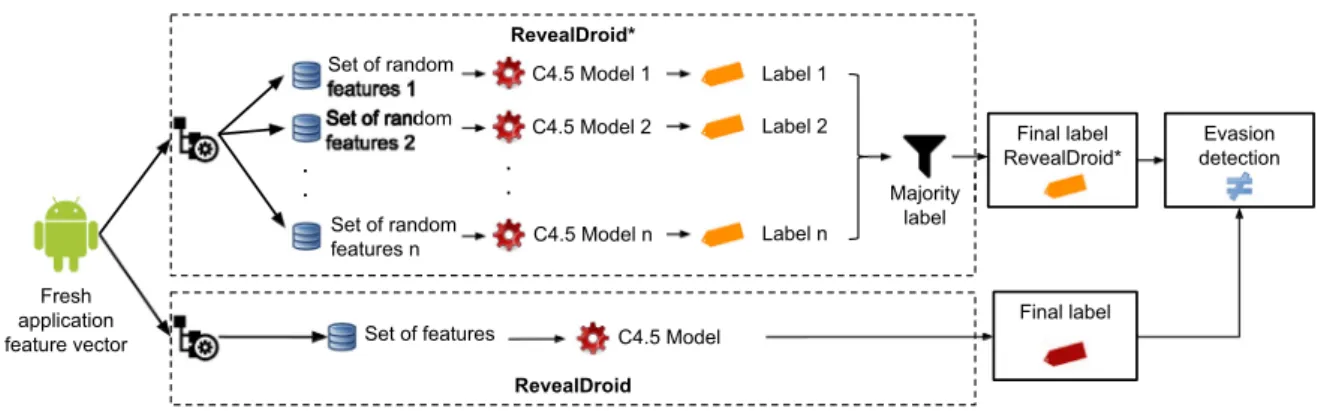
Inordertodetectpotentialattemptstoevadetheclassifier,we propose an extension ofthe target classifier: Revealdroid∗. This enhanced version of RevealDroid employs a pool of C4.5 trees insteadofrelyingonjustone instance.Eachclassifier inthepool makesdecisions basedon differentsubsetsoffeatures presentin thefeaturevector,makingitmorerobust againstdeliberate mod-ifications.Thus, each classifier choosesits own subset offeatures randomlyatruntime.Therefore,apotentialattackerhasnoevident wayofmodifyingthevectorinordertoevadealltheclassifiersat once.Thefinallabelassignedtoasamplebythisenhancedversion ofRevealDroidresultsfrommajorityvoting.Ourcountermeasure isinspiredbythoseproposedbydifferentauthorsintheliterature. The bagging (boosting and aggregating) approach has proven to be effective in enhancing the robustnessof classifiers in various relatedproblems(Biggioetal.,2011;Perdisci,Gu,&Lee,2006).
Fig. 3 showsthe architecture proposed forRevealDroid∗ and the whole schema for the countermeasure. The countermeasure consists of measuring the level of agreement between Reveal-DroidandRevealDroid∗.Whenthesetwotoolsdisagree,we con-siderthatan attackerachieveda potentialevasion. RevealDroid∗ must keep the same classifier, training data and parameters as RevealDroid,inordertogeneratesimilaroutputs andreducethe falsealarm(orfalsepositive)rate.However,forthetriageprocess, thepriorityistoreducefalsenegativesinordertoguaranteethat animportantsampleisnotmisclassifiedasirrelevant.
The feature extraction process of RevealDroid∗ remains un-changed,usingthesamefeaturevectorforeachappwithalistof API calls, intent actions and information flows. Once the feature vectorisgeneratedforeachapp,featuresarerandomlypartitioned into a number of groups. That is, each feature is randomly as-signed toone (andjust one)group, guaranteeing that all groups havethesamenumberoffeatures.The numberofgroupscanbe manually tuned and also equals the number of classifiers (C4.5 inourcase) usedin theensemble.Each classifier isthen trained withalltheinstancesusingthesubsetoffeaturesallocatedforit, seekingtomaximisethe separationamonglabels inthisreduced featurespace.
The classification process for a new malware sample with RevealDroid∗ is also outlined in Fig. 3. Once again, the feature
vector is generated following the rules of RevealDroid. In a second step,the listoffeatures isdivided intogroupsdepending onthesplitpreviouslyperformedwhentrainingthemodels.Each instance of the C4.5 algorithm delivers a label according to its portion of the feature space and a majority rule is applied to obtainthefinallabelfortheinputsample.
The strength ofRevealDroid∗ lies inreducing the fragility of asingle-classifierstructuresuch asthatofRevealDroid,inwhich justa simplechange inthefeature vector maylead toa classifi-cationerror.Whenusingmultipleclassifiers,theeffortrequiredto achieve asuccessfulevasionbecomesconsiderably morecomplex sincetheattackerneedstoevadethemajorityoftheclassifiersin the ensemble.As a sanity check on RevealDroid∗’s classification ability, we calculated its accuracy (see the plot at the bottom of Fig. 6). The accuracy (88%) is similar to that of RevealDroid (75–91%).
Toevaluatetheabilityofthecountermeasuretodetectwhena samplehasbeenalteredsoastoevadeacorrectclassification,we haveusedourattacktogeneratearepresentativesetofapps suc-cessfullymutated,departingfrom,andtryingtoreach,allpossible families following the approach described in Section 2.5. With this procedure, a subset of more than 10,000 individuals were successfully mutated. All these individuals were classified using RevealDroid∗, yielding the results showedin Fig. 4. Each series in the figure is related to a specific configuration of the genetic algorithm, where an increment of 1 means that it is possible to generateindividualswith upto 30changes inthe feature vector, whereas an increment of 0.6 reduces the number of changes to around1.Thereasonsforthisrelationshipbetweentheincrement parameterandthe numberofpossiblechanges liesinthe proba-bilityusedinternallybythegeneticalgorithm.Sinceeverychange mustbemanuallyinjectedintotheapplicationbytheattacker,we mayassume that in mostcasesthe attackerwouldbe interested in applying theminimum number of changes neededto achieve misclassificationasadifferentfamily.Thissituationisrepresented byanincrementequalto0.6.Incontrast,ifthenumberofchanges is not an issue for the attacker, a higher value of this parame-ter can be considered. As Fig. 4 shows, the label delivered by RevealDroid∗ differsconsiderablyfromthefakelabelpursued by the attacker,thereby notifying ofa potential classificationattack. Witha maximumincrementof0.6(around1,2or3 changes in-jected),using14differentclassifiersRevealDroid∗willfail to de-tecttheattack in0.9%ofthecases(falsenegatives),whichmeans thattheevasionwillbedetectedin99.1%oftheevaluations.
The false positives of the countermeasure are computed by evaluating RevealDroid∗ with RevealDroid’s test data (this data has non-mutated fresh samples for RevealDroid and RevealDroid∗). The levelof disagreementis calculatedusing the test output. Fig. 6(top) showsthat thefalse positive rate ofour countermeasureranges between8% and13.5%. Becausethe focus
Fig. 4. FalsenegativeratesforthecountermeasurewithrespecttothenumberofclassifiersusedinRevealDroid∗.
Fig. 5. Transitionmatrixtotargetfamilies.
of thetriageprocess is avoidingfalse negatives,we consider this resultreasonable.
5.2. Reversingtheattack
Once asamplehas beensuspected astheresultof a misclas-sificationattack,determiningitsoriginalfamilyisthenextnatural step. Reversing the transformation process that the attackermay have implemented is a complex task,particularly becauseof the difficultyofdifferentiatingbetweentheoriginalappbehaviourand theactionsdeliberatelyinjectedtocausetheclassificationerror.
However, the searchprocess used duringtheattack offers the means toevaluatea numberofpossibleoriginalfamily classifica-tion candidates.The search wasused betweeneach possiblepair of families in order to evaluate the transition probabilities be-tween them(asthenumberofindividualsbelongingto aspecific familyabletoreachatargetfamilydividedbythetotalnumberof individuals inthe original family).The results ofthisexperiment areshowninFig.5.Thefitnessfunctionusedhereistheone de-scribedinSection2.5,whichallowsonetotargetspecificfamilies. Sincethismatrixrepresentsall possibletransitionsbetween orig-inal malwaresamples of differentfamilies andmutatedsamples, itisalsopossibletousethisartefacttorevealthepossiblesource familiesofanapplicationdetectedasmisclassified.Furthermore,it
Fig. 6. False positive rate for the countermeasure (top) and accuracy of RevealDroid∗dependingonthenumberofclassifiersusedinRevealDroid∗
construc-tion.
isalsopossibletoorderthesecandidatefamiliesbythetransition probabilities.
Forinstance,Fig.7showstheprobabilitiesofbeingtheoriginal family ofa malware sample classified asKmin family, according to the corresponding row of Fig. 5. In this example, there are 6 potential source families in which all the individuals were successfully mutated to be classified as Kmin, and these forma setof6prospectiveoriginalfamilies.
6. Relatedwork
In this section we discuss the context for our work as it re-latesto Android staticanalysis, adversarialmachine learningand countermeasures.
6.1. Androidstaticanalysis
Our work is focused on attacking a machine learning algo-rithm which operates on a space generated by static analysis
Fig. 7. Probabilitiesofbeingthe originfamilyofamalwaresamplemutated to Kminfamily.
features. We discuss the most relevant static analyses for our work:permissions,APIcalls,intentactionsandflows.
Permissions have been identified as potential signifiers of maliciousintentions.ToolslikeKirim(Enck,Ongtang,&McDaniel, 2009) were used to detect anomalous settings containing mali-ciousbehaviourandtoolslikeDroidRanger(Zhou,Wang,Zhou,& Jiang,2012)leverageheuristicstoperformthesametask.APIcalls canbe usedto detectmalware andgeneratesignatures,which is the case for DroidLegacy (Deshotels, Notani, & Lakhotia, 2014) andDroidAPIMiner (Aafer, Du,& Yin, 2013). Current trends use both flow analysis, i.e. information leaks between data sources and potentially malicious sinks, and intent actions, remote pro-cedureswhere one applicationcan use the privileges of another one to perform malicious activities. Flows have been studied usingtoolssuch asFlowDroid(Arzt etal., 2014) andDroidSafe (Gordonetal.,2015),whileintentshavebeenstudiedindifferent ways:from the detection of communicationvulnerabilities using ComDroid (Chin et al., 2011); to validation of the interaction betweencomponents with Epicc (Octeau etal., 2013); to points to communication between objects in different applications us-ing Amandroid (Wei, Roy, & Ou, 2014); and to hybridization thesemethods, asseen inDidFail (Klieber,Flynn, Bhosale, Jia, & Bauer,2014) which hybridizes Epicc andFlowDroid to improve detectionthroughaggregatedinformation.
Otherwork,outofthescopeofouranalysisbutalsorelatedto staticanalysisforAndroid, usesadescriptionlanguage toidentify semantic-based signatures, such as Apposcopy (Feng, Anand, Dillig,& Aiken, 2014),or aims todetect the contextthat triggers themalicious behaviour,such asAppContext (Yang et al., 2015) andTriggerScope(Fratantonioetal.,2016).
In our work, we target techniques that use static analysis features and leverage machine learning algorithms to detect or classify malware. These techniques, provided in Table 1, use the previously discussed tools to extract feature vectors that feed a machine learning algorithm. Tools like DroidSIFT (Zhang, Duan, Yin, & Zhao, 2014) and DroidAPIMiner (Aafer et al., 2013) have only been used for the detection problem, in which malware andgoodware must be discriminated, while tools like Dendroid (Suarez-Tangil,Tapiador,Peris-Lopez,&Blasco,2014),DroidLegacy (Deshotels et al., 2014), Drebin (Arp et al., 2014), DroidMiner (Yang, Xu, Gu, Yegneswaran, & Porras, 2014) and RevealDroid (Garciaet al., 2015) havealso beenused forfamily classification, with RevealDroid covering the largest spectrum in the feature space.ThiswasthemainreasonforchoosingRevealDroidasthe targetedclassifier inour work.We also targetedthe triage
prob-lem, whichis closely relatedto the familyclassification problem asLakhotia et al.state duringthe description of their tool VILO (Lakhotiaetal.,2013).Thisproblemhasalsobeenexaminedfrom a detectionperspective usingranking basedalgorithms inMAST (Chakradeo et al., 2013). Our goal here was to attack the triage processusingadversarialmachinelearning.
6.2. Adversarialmachinelearning
Evasion and Adversarial Learning (Huang, Joseph, Nelson, Rubinstein, & Tygar, 2011) are widely studied topics in both the machine learning and computer security areas (Barreno et al., 2006; Lowd& Meek, 2005; Ptacek& Newsham,1998). Giventhe success of machine learning techniques for addressing security related problems such as malware analysis, spam identification, or intrusion detection, testing the resilience and robustness of these approaches against an informed adversary is a necessary activity.
There is a wide spectrum ofapplications ofmachine learning algorithms in classification problems. Their reliability is closely linked to the reliability of the systems that depend on them. Adversarial learning is then an important problem that must be addressed. According to Barreno et al., the main weaknesses of machinelearningalgorithmslie preciselyintheiradaptation abil-ity,whichcanbeexploitedbyattackerstocausedeliberateerrors (Barreno, Nelson,Joseph, & Tygar,2010). Thispresentsa complex issue, since machine learning theory takes as its basis that the trainingdatasetusedinalearningprocessremains representative ofthe problemdomainandassumes intentionally harmful modi-ficationsofthedatadonothappen(Laskov&Lippmann,2010).
The problem of learning in hostile environments was first considered by Kearns and Li (1993). In this work, the authors developedanextensiontoValiant’sProbablyApproximatelyCorrect
(PAC) framework (Valiant, 1984; 1985). The extension allows the algorithm to learn even when a dataset has been polluted with erroneousdata,introduced by an active adversary. This adversar-ial behaviour is modelled following a worst-case approach (i.e., unbounded computational power and accessto the classification historyare assumed). Themain contributionof thiswork wasto provide methods to limit the maximum portion of the dataset pollutedbytheadversarywithouthavinganegativeeffectonthe classificationresult.
Theproliferationofclassificationanddetectiontoolsrelyingon machine learning techniques has promoted an increased interest in attacking these tools, taking advantage of the weaknesses in classificationalgorithms.Theseattacksareveryvariedanddepend mainlyontheadversarialmodelconsidered,sincethecapabilities ofthe attackerandher knowledge abouttheclassifier define the impactoftheattack.
Alltheseattacksagainstmachinelearningcanbecategorisedby pointofview.Fromacoarseperspective,theattackscanbe classi-fiedintwocategories:poisoningattacks(Biggio,Nelson,&Laskov, 2012)andevasionattacks(Xuetal.,2016).Intheformercase,the attack isperformedduringthetrainingstage.Inthisscenariothe adversaryintroducesfakeormalformeddataintothetrainingset. Thiswillleadtheclassifier tolearnan inaccuratemodelandthen classify furtherinstances incorrectly.Inthelattercase, theattack is performed during the classification stage. The feature vector belongingtoaparticularsampleismodifiedsoastoforcethe clas-sifiertoproduceawronglabel.Theproposed attackinthispaper fallsin theevasioncategory aswe try tofool an alreadytrained modelbydistortingthefeaturevectorofaparticularsample.
Barrenoetal.(2006)provideanextendedtaxonomyofthe dif-ferent attacks against machine learning applications.They model attackspacesusingthreekeyconcepts:influence(whetheritaffects thetrainingstageortheclassificationitself),specificity(whetherthe
attacktriestomisdirecttheclassificationofdatabelongingto a par-ticularclassor,alternatively,causesnodiscriminationtohappen)and the securityproperty violated bythe attacker(whether the attack isagainsttheclassifier’savailabilityoragainsttheresult’sintegrity).
Apracticalexampleofhowclassificationalgorithmscanbe suc-cessfullyevaded istheclassifier-agnosticattackstrategy described by Biggio et al. for assessing the security of machine learning applications (Biggio et al., 2013). They propose an adversarial strategybasedongradientdescentattacks.Theyconsiderdifferent threat models dependingon how much information the attacker has regarding the attacked classifier. The authors demonstrate how their strategy could be employed to evade classifiers such asSVM and neural networkstrained fordetecting malicious PDF files.
In an approachsimilar to ourown workbut appliedto a dif-ferentproblem,Vigna,Robertson,andBalzarotti(2004)developed a framework for measuring the resilience of a signature-based Network intrusion detectionsystem (NIDS) against an adversary. The authors employed mutation strategies for modifying known exploits.Mutationswereappliedatnetwork,applicationandcode level,andincludedmodifyingtheshapeofnetworkpackets, inject-ingmalformeddata,andhidingmaliciouscodeusingpolymorphic engines. Ten real world exploits were mutated using different strategies andused to measure the resilience oftwo NIDS prod-ucts.TheexperimentconfirmedthatevadingtheNIDSsignaturesis feasible,especiallywhencombiningdifferentmutationtechniques. Although this research has the injection of specific information to provoke a malfunctionin adetection systemincommon with the attack that we describe in this paper, the problem varies significantly,sincewearefocusedonmalwareclassification.
Other research focused on NIDS was presented by Pastranaetal.(2011).Italsotakesadvantageofgenetic program-ming, in this case as a search heuristic for finding modification routinescapable ofevadinga particularNIDS. Thesemodification routines take a malicious network packet as input and apply differentadjustments(e.g.:changingaparticularvalue withinthe data payload, altering the TCP header, etc.). The authors tested the framework against C4.5 and Naïve–Bayes. By using this ge-netic search, the authors obtained individuals able of inducing non-negligible error rates in both classifiers, attaining a 37% classification errorratein theNaïve–Bayesclassifier.Inourwork, bycontrast,wearefindingmodificationstoevadeacorrectfamily malware classification, rather than evading its detection (thus assuming that the samplewill still be detected asmalware with highprobability).
Genetic programming has also been successfully employed in fooling the detection of malicious code. In particular Xu et al. presented EvadeML, a framework for automatically evading PDF malwareclassifiers(Xuetal.,2016).PDFfileshavebeenfrequently usedbyattackersashostsforembeddedmalware.The authorsof that paperemployed geneticsearch forfindingthebest modifica-tionstrategy leadingto evasionofdetectionbytwo PDFmalware detection systems (PDFrate and Hidost) built on top of machine learningsolutions.Upto500maliciouspayloadsweresuccessfully evaded using the discovered strategies. Again, an evolutionary algorithmisusedtoevadedetectionratherthantoevadeacorrect classificationbetweenmalwarefamilies.
Anotherexampleofadversariallearningtoevadethedetection of malicious PDF files is the mimicry attack (Maiorca, Corona, & Giacinto, 2013) that injects malicious code into a benign file using 3 different strategies: injecting an EXE (EXEembed), a PDF (PDFembed) or a Javascript (JSinject) payload. The evaluation of these tools shows highdetection evasion effectiveness (100% for EXEembed andPDFembedand80%forJSinject) onthe6variants generated by the authors. Again, in contrast to our attack, this research is not focused on re-shaping malware for evading a
correctclassification andthe domain is different. The evasion of PDF detection has been extensively analysed in Laskov (2014), demonstratingthevulnerabilitiesofa knownonlinePDF analyser tothiskindofattacks. Theinteraction betweenmalwarefamilies hasindeed beenstudied butfrom an unsupervised learning per-spective, using clustering algorithms (Biggio, Rieck et al., 2014). Here, the authors inject new samples into the training process withtheaimofdisruptingtheresult.
On the Android side, there are new evasionstrategies which aim to attack machine learning (Grosse, Papernot, Manoharan, Backes,&McDaniel,2016;Mengetal.,2016)andantivirussystems (Aydogan&Sen,2015;Mengetal.,2016;Xueetal., 2017;Zheng, Lee, & Lui, 2012). The first technique in this area was ADAM (Zheng et al., 2012), which manipulates malware via re-packing and obfuscation. ADAM was created to audit antivirus systems and it showed good effectiveness against VirusTotal, reaching an evasion rate close to a 50%. In a similar line, Aydogan and Sen (2015) include a genetic programming framework to the obfuscationprocess, reportingan evasioneffectiveness up to33% against8antivirussystems.Theeffectivenessofevasionstrategies wasextended tonewmachine learningtechniques, such asdeep learning, by Grosse et al. (2016), who were able to reach up to an80%evasionrateby addingperturbations tothemalware vari-ants throughjunk code.This effectivestrategy wasalso followed by Mystique (Meng et al., 2016), and its extension, Mystique-S (Xue et al., 2017). The former uses a multi-objective genetic algorithm to reduce the classification rate of machine learning algorithms and anti-viruses, while it maximizes the attack be-haviour; the later generates the code dynamically to reach the samegoal.Theyareableto evadethedetectorsup to80% ofthe timeforMystiqueand94%ofthetimeforMystique-S.An interest-ingcaseforevasion,out-of-the-boxfromtheprevioustechniques, was introduced by Vidas and Christin (2014) who generated an attackbased onredpills, i.e.,detecting environmentalconditions. This strategy combines the detection of behaviour, performance, hardwareand software components.They were able to reach an 86% evasion rate. Our tool, IagoDroid, is focused on attacking the static analysis features of a machine learning classifier, and it is able to reach a 97% evasionrate. Compared withthe other relatedtoolsofthestateoftheart,itisacompetitiveresult(fora summarycomparingalltheabovementionedtools,seeTable2.
6.3.Counteractingadversariallearningtechniques
Thesecuritycommunityhasworkedbothontesting classifica-tionsystems builton top ofmachine learningtechniquesagainst different kinds of attacks and on designing countermeasures to deal with this problem. For instance, Chinavle et al.studied the effectofemployinglearningensemblesforcombattingadversaries inaspamdetectionscenario(Chinavleetal.,2009).Theirapproach demonstrated that through the use of different classifiers, it is possibletodetectperformancedegradation(duetoevasionattacks onbehalf ofa motivatedadversary)andautomatically repairthis condition. Their approach allows the system to maintain a high degree of accuracy through time while reducing the number of re-trainingstages.
Barreno et al. elaborated on the security and reliability of machinelearning(Barrenoetal.,2006),proposingaframeworkto evaluatethesecurityofaparticularmachine learningapplication. In the same line, Biggio, Fumera, and Roli (2014) proposed a framework to introduce countermeasures against attackers while designing the classifier, instead of applying them later during trainingortest stages.The maincontribution ofthiswork is the lack of bounds for a particular classifier, making the framework flexible.
Table 2
AcomparisonamongdifferentevasionmethodologiesrelatedtoIagoDroid,separatedingeneraltechniquesandAndroidspecific. Method Target Typeofattack Evasionrate
PDF and Network
Pastrana(Pastranaetal.,2011) C4.5&NaïveBayes Networkinjection 37% Vigna(Vignaetal.,2004) Networkintrusiondetectors Mutationofexploits 90% Biggio(Biggioetal.,2013) SVM&NearestNeighbour Noiseinjection&GradientDescent upto100% EvadeMl(Xuetal.,2016) PDFRate&Hidost GeneticProgramming 90% EXEembed(Maiorcaetal.,2013) PDFmalwaredetectors EXEpayloadembedding upto100% PDFembed(Maiorcaetal.,2013) PDFmalwaredetectors PDFembedding upto100% JSinject(Maiorcaetal.,2013) PDFmalwaredetectors Javascriptembedding upto80% Laskov(Laskov,2014) PDFRate Noiseinjection upto72% Biggio(Biggio,Riecketal.,2014) BehaviouralClustering Datapoisoning 76%
Android
Mystique(Mengetal.,2016) Anti-virus&MachineLearning Codeinjection&GeneticAlgorithms upto80% Mystique-S(Xueetal.,2017) Anti-virus Dynamiccodegeneration 94% Vidas(Vidas&Christin,2014) DynamicAnalysistools RedPills 86% Grosse(Grosseetal.,2016) DeepLearning Perturbation upto80% ADAM(Zhengetal.,2012) Anti-virus Re-packingandobfuscation upto50% Aydogan(Aydogan&Sen,2015) Anti-virus GeneticProgrammingandObfuscation upto33% IagoDroid RevealDroid Codeinjection&GeneticAlgorithms 97%
Table 3
Summaryofexperimentalresults.Thetableshows,foreachmalwarefamily,thenumberofgenerations re-quiredtofindafirstsolution,theaveragenumberofgenerationsrequiredtoachieveconvergence,theaverage numberofmodifications,andthefeaturethatismostfrequentlychanged.
Family Firstsol. Avg.conv. Avg.mod. Feature
Plankton 1 3.3 1.0 ACTION_INPUT_METHOD_CHANGED(0.7) GinMaster 1 3.7 1.0 SMS_MMS(0.6)
Kmin 1 4.3 1.0 ACTION_USER_PRESENT(0.6)
Glodream 1 4.7 0.8 ACTION_INPUT_METHOD_CHANGED(0.4) BaseBridge Inf Inf – –
Nyleaker 1 3.6 1.0 NETWORK__LOG(0.4) Gappusin 1 3.4 0.9 ACTION_INPUT_METHOD_CHANGED(0.3) Geinimi 1 3.9 1.0 NETWORK_INFORMATION(0.5) Imlog 1 4.7 1.2 ACTION_INPUT_METHOD_CHANGED(0.7) DroidKungFu 1 7.2 0.7 IPC__NETWORK(0.2) Iconosys 1 3.5 1.1 NETWORK__LOG(0.3) Adrd 1 3.6 0.8 ACTION_INPUT_METHOD_CHANGED(0.5) DroidDream 1 4.1 0.8 ACTION_INPUT_METHOD_CHANGED(0.4) Dougalek 1 3.5 1.0 ACTION_INPUT_METHOD_CHANGED(0.4) MobileTx 1 3.2 1.0 FILE(0.5) FakeInstaller 1 3.5 1.0 ACTION_INPUT_METHOD_CHANGED(0.5) ExploitLinuxLotoor 1 2.1 0.8 ACTION_INPUT_METHOD_CHANGED(0.4) Steek 1 3.9 1.0 ACTION_USER_PRESENT(0.4) Opfake 1 4.8 0.9 ACTION_INPUT_METHOD_CHANGED(0.5) Nandrobox 1 3.2 1.0 ACTION_INPUT_METHOD_CHANGED(0.4) Xsider 1 3.1 1.0 ACTION_INPUT_METHOD_CHANGED(0.6) Yzhc 1 4.5 0.8 ACTION_USER_PRESENT(0.4) Fatakr 1 3.2 1.0 ACTION_USER_PRESENT(0.7) FakeRun 1 4.4 1.0 ACTION_INPUT_METHOD_CHANGED(0.4) Mobilespy 1 3.1 0.9 ACTION_MAIN(0.4) Hamob 1 3.4 1.0 ACTION_INPUT_METHOD_CHANGED(0.3) Jifake 1 2.6 0.8 android.net(0.3) Fakengry 1 2.6 0.6 UNIQUE_IDENTIFIER_DB_INFORMATION(0.2) SMSreg 1 1.6 0.9 ACTION_INPUT_METHOD_CHANGED(0.3)
Dalvietal.(2004)studiedthedevelopmentofrobustclassifiers. Theyaddressedtheproblemasagamebetweentheattackerand the target classifier. In their approach, the attacker’s strategy is used as input for generating a classifier resilient to particular adversarialbehaviour. Addressingthe problem froma game the-oreticalperspective, the authors improvedthe workingof vanilla Naïve–Bayes classifier in a spam detection case, dramatically reducingthenumberoferrors.
From a more general point of view, the effectiveness of dif-ferentstrategies that deal with evasionattacks has beenstudied elsewhere. For instance, Support Vector Machines have been evaluated (Russu, Demontis, Biggio, Fumera, & Roli, 2016), con-cludingthattheselectionofthekernelfunctioniscrucial.Feature selection based countermeasures have been studied (Budhraja & Oates, 2015), showingthat thiscan be counterproductivesinceit reducesthe accuracyoftheclassifier insomecases.There isalso
a framework focused onevaluating the potential attack scenarios duetotheuseoffeatureselectionmethods(Xiaoetal.,2015).
Although the above countermeasures are able to successfully narrowtheeffectsproduced byattacksonmachine learning clas-sifiers, they are mainly focused on detection problems: a binary classification between benign and malicious software. However, a classification taskinto different malware families constitutes a differentscenarioin whichtherecan bean importantnumberof classescloselylocatedinthesearchspace.
7. Conclusions
IagoDroiddemonstratesthatanyAndroidmalwareclassification schemethat reliesexclusivelyonstaticanalysisduringtriageisa sensitiveprocess that caneasily bedestabilised.IagoDroidisable tofooltheRevealDroidclassifierintomisclassifyingthefamilyfor
28out of29familiesinthedatasetbymodifyinga singlefeature oftheoriginalmalware.Intheprocess,thisattackgeneratesupto 14,000newvariantsfor290malwaresamplesinjust2min.
As a countermeasure, we split the feature space into differ-ent overlapping sets where different classifiers work together to detect potential evasions. This method, named RevealDroid∗, is demonstrably effective for a small number of modifications but less useful when the number of modifications is high. In the latter case, it is able to reduce the number of evasive variants that IagoDroid generates, but cannot prevent it from generating at leastsome. Inconsequence, RevealDroid∗ forces producersof malware variants to find techniques to modify a higher number of features during the variants generation process. In the case wherean evasivefile isdetected,ourcountermeasureisalsoable to tracktheoriginal malware family,providingan opportunity to reconsiderthemalwarepriorityduringthetriageprocess.
This countermeasure shows some of the limitations of the evasion method. The first limitation is related to the adversarial environment. IagoDroid has full knowledge of the underlying classifier. This limits the possibility of having strong results in differentscenarios,evenwhenthetechniquemaystillbe applica-ble.Another significantlimitationof thetechniqueis inthe final generation of the variants, which inthe current version requires humanintervention totransformthesuggestedvector ofchanges intotheactualvariant.
Theselimitationsinspireseveral, possiblelinesoffuturework, startingfrommeasuring theabilityofIagoDroidtocause misclas-sification incommercialtools,suchasantivirusengines.Thisline of research would require an extension to the tool’s capabilities such as providing automatic injection of changes within opaque predicates. From a research perspective, IagoDroid is useful for studying the limitations on the robustness of machine learning classifiers and, indeed, our future work will focus on defining sound measures based on evasionabilities. This will help to un-derstandwhichclassificationsalgorithms arestrongerthanothers when faced with adversaries foralgorithms based onboth static anddynamicanalysis.Finally,thebacktrackingabilityofour coun-termeasurecanbeunderstoodasaMarkovmodelamongfamilies andtransitions.Thisknowledgecanbeusedtostudymoredeeply thedifferentrelationshipsamongAndroidmalwarefamilies.
Acknowledgements
This work has been supported by the following grants: EphemeCH (MINECOTIN2014-56494-C4-4-P) andCIBERDINE (CM S2013/ICE-3095), both under the European Regional Develop-ment Fund FEDER; SeMaMatch EP/K032623/1 and InfoTestSS EP/P006116/1fromEPSRC; SPINY(MINECOTIN2013-46469-R) and SMOG-DEV (MINECO TIN2016-79095-C2-2-R) and Justice Pro-gramme of the European Union (2014-2020) 723180– RiskTrack – JUST-2015-JCOO-AG/JUST-2015-JCOO-AG-1. The contents of this publication arethe soleresponsibilityoftheir authorsandcanin nowaybetakentoreflecttheviewsoftheEuropeanCommission.
References
Aafer,Y.,Du,W.,&Yin,H.(2013).Droidapiminer:Miningapi-levelfeaturesfor ro-bustmalwaredetectioninandroid.InInternationalconferenceonsecurityand privacyincommunicationsystems(pp.86–103).Springer.
Arp,D.,Spreitzenbarth,M.,Hubner,M.,Gascon,H.,&Rieck,K.(2014).Drebin: Ef-fectiveandexplainabledetectionofandroidmalwareinyourpocket..Ndss. Arzt,S.,Rasthofer,S.,Fritz,C.,Bodden,E.,Bartel,A.,Klein,J.,etal.(2014).Flowdroid:
Precisecontext,flow,field,object-sensitiveandlifecycle-awaretaintanalysisfor androidapps.ACMSIGPLANNotices,49(6),259–269.
Aydogan,E.,&Sen,S.(2015).Automaticgenerationofmobilemalwaresusing ge-neticprogramming.InEuropeanconferenceontheapplicationsofevolutionary computation(pp.745–756).Springer.
Barreno,M.,Nelson,B.,Joseph,A.D.,&Tygar,J.D.(2010).Thesecurityofmachine learning.MachineLearning,81(2),121–148.doi:10.1007/s10994-010-5188-5. Barreno,M.,Nelson,B.,Sears,R.,Joseph,A.D.,&Tygar,J.D.(2006).Canmachine
learningbesecure?InProceedingsofthe2006ACMsymposiumoninformation, computerandcommunicationssecurity(pp.16–25).ACM.
Biggio,B.,Corona,I.,Fumera,G.,Giacinto,G.,&Roli,F.(2011).Baggingclassifiers forfightingpoisoningattacksinadversarialclassificationtasks.InInternational workshoponmultipleclassifiersystems(pp.350–359).Springer.
Biggio,B.,Corona, I.,Maiorca,D.,Nelson,B.,Šrndi´c,N., Laskov,P., etal. (2013). Evasionattacksagainst machinelearning attesttime.InJointEuropean con-ferenceonmachinelearningandknowledgediscoveryindatabases(pp.387–402). Springer.
Biggio,B.,Fumera,G.,&Roli,F.(2014).Securityevaluationofpatternclassifiers un-derattack.IEEETran