Future Technology
Devices International
Ltd
.FT230X
(
USB to BASIC UART IC)
The FT230X is a USB to serial UART
interface with optimised pin count for
smaller PCB designs and the following
advanced features:
Single chip USB to asynchronous serial data transfer interface.
Entire USB protocol handled on the chip. No USB specific firmware programming required.
Fully integrated 2048 byte multi-time-programmable (MTP) memory, storing device descriptors and CBUS I/O configuration.
Fully integrated clock generation with no external crystal required plus optional clock output selection enabling a glue-less interface to external MCU or FPGA.
Data transfer rates from 300 baud to 3 Mbaud (RS422, RS485, and RS232) at TTL levels.
512 byte receive buffer and 512 byte transmit buffer utilising buffer smoothing technology to allow for high data throughput.
FTDI’s royalty-free Virtual Com Port (VCP) and Direct (D2XX) drivers eliminate the requirement for USB driver development in most cases.
Configurable CBUS I/O pins.
Transmit and receive LED drive signals.
UART interface support for 7 or 8 data bits, 1 or 2 stop bits and odd / even / mark / space / no parity Synchronous and asynchronous bit bang interface
options with RD# and WR# strobes.
USB Battery Charger Detection. Allows for USB peripheral devices to detect the presence of a higher power source to enable improved charging.
Device supplied pre-programmed with unique USB serial number.
USB Power Configurations; supports bus- powered, self-powered and bus-powered with power switching Integrated +3.3V level converter for USB I/O. True 3.3V CMOS drive output and TTL input;
operates down to 1V8 with external pull ups. Tolerant of 5V input
Configurable I/O pin output drive strength; 4 mA (min) and 16 mA (max).
Integrated power-on-reset circuit.
Fully integrated AVCC supply filtering - no external filtering required.
UART signal inversion option. + 5V Single Supply Operation. Internal 3V3/1V8 LDO regulators
Low operating and USB suspend current; 8mA (active-typ) and 125uA (suspend-typ). UHCI/OHCI/EHCI host controller compatible. USB 2.0 Full Speed compatible.
Extended operating temperature range; -40 to 85⁰C.
Available in compact Pb-free 16 pin SSOP and 16 pin QFN packages (both RoHS compliant).
Neither the whole nor any part of the information contained in, or the product described in this manual, may be adapted or reproduced in any material or electronic form without the prior written consent of the copyright holder. This product and its documentation are supplied on an as-is basis and no warranty as to their suitability for any particular purpose is either made or implied. Future Technology Devices International Ltd will not accept any claim for damages howsoever arising as a result of use or failure of this product. Your statutory rights are not affected. This product or any variant of it is not intended for use in any medical appliance, device or system in which the failure of the product might reasonably be expected to result in personal injury. This document provides preliminary information that may be subject to change without notice. No freedom to use patents or other intellectual property rights is implied by the publication of this document. Future Technology Devices International Ltd, Unit 1, 2 Seaward Place, Centurion Business Park, Glasgow G41 1HH United Kingdom. Scotland Registered Company Number: SC136640
1
Typical Applications
USB to RS232/RS422/RS485 Converters Upgrading Legacy Peripherals to USB Utilising USB to add system modularity Incorporate USB interface to enable PC
transfers for development system communication
Cellular and Cordless Phone USB data transfer cables and interfaces
Interfacing MCU/PLD/FPGA based designs to add USB connectivity
USB Audio and Low Bandwidth Video data transfer
USB Smart Card Readers USB Instrumentation
USB Industrial Control USB MP3 Player Interface
USB FLASH Card Reader and Writers Set Top Box PC - USB interface USB Digital Camera Interface USB Hardware Modems USB Wireless Modems USB Bar Code Readers
USB dongle implementations for Software/ Hardware Encryption and Wireless Modules Detection of dedicated charging port for battery
charging at higher supply currents.
1.1
Driver Support
Royalty free VIRTUAL COM PORT (VCP) DRIVERS for...
Windows 10 32,64 bit Windows 8/8.1 32,64-bit Windows 7 32, 64-bit
Windows Vista and Vista 64-bit Windows XP and XP 64-bit
Server 2003, XP and Server 2008/2012 Windows XP Embedded
Windows CE 4.2-5.2, 6.0, 7.0, 2013 Mac OS-X
Linux 3.2 and greater Android
Royalty free D2XX Direct Drivers (USB Drivers + DLL S/W Interface) Windows 10 32,64 bit
Windows 8/8.1 32,64-bit Windows 7 32,64-bit
Windows Vista and Vista 64-bit Windows XP and XP 64-bit
Server 2003, XP and Server 2008/2012 Windows XP Embedded
Windows CE 4.2-5.2, 6.0, 7.0, 2013 Mac OS-X
Linux 2.6 and greater Android
The drivers listed above are all available to download for free from FTDI website (www.ftdichip.com). Various 3rd party drivers are also available for other operating systems - see FTDI website
(www.ftdichip.com) for details.
For driver installation, please refer to http://www.ftdichip.com/Documents/InstallGuides.htm
1.2
Part Numbers
Part Number Package
FT230XQ-xxxx 16 Pin QFN
FT230XS-xxxx 16 Pin SSOP
Note: Packing codes for x is:
- R: Taped and Reel, (SSOP is 3,000pcs per reel, QFN is 5,000pcs per reel). - U: Tube packing, 100pcs per tube (SSOP only)
1.3
USB Compliant
The FT230X is fully compliant with the USB 2.0 specification and has been given the USB-IF Test-ID (TID) 40001463 (Rev D).
2
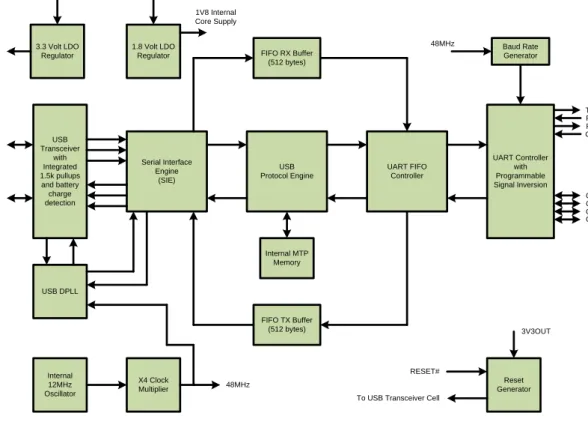
FT230X Block Diagram
3.3 Volt LDO Regulator 1.8 Volt LDO Regulator USB Transceiver with Integrated 1.5k pullups and battery charge detection USB DPLL Internal 12MHz Oscillator X4 Clock Multiplier Serial Interface Engine (SIE) USB Protocol Engine UART FIFO Controller UART Controller with Programmable Signal Inversion Baud Rate Generator Reset Generator FIFO TX Buffer (512 bytes) FIFO RX Buffer (512 bytes) Internal MTP Memory 48MHz GND RESET# To USB Transceiver Cell3V3OUT 48MHz 3V3OUT VCC USBDP USBDM 1V8 Internal Core Supply TXD RXD RTS# CTS# CBUS0 CBUS1 CBUS2 CBUS3
Figure 2.1 FT230X Block Diagram
Table of Contents
1
Typical Applications ... 2
1.1
Driver Support ... 2
1.2
Part Numbers... 2
1.3
USB Compliant ... 3
2
FT230X Block Diagram ... 4
3
Device Pin Out and Signal Description ... 7
3.1
16-LD QFN Package ... 7
3.1.1 QFN Package PinOut Description ... 7
3.2
16-LD SSOP Package... 9
3.2.1 SSOP Package PinOut Description ... 9
3.3
CBUS Signal Options ... 11
4
Function Description... 13
4.1
Key Features ... 13
4.2
Functional Block Descriptions ... 13
5
Devices Characteristics and Ratings ... 16
5.1
Absolute Maximum Ratings... 16
5.2
ESD and Latch-up Specifications ... 16
5.3
DC Characteristics... 17
5.4
MTP Memory Reliability Characteristics ... 21
5.5
Internal Clock Characteristics ... 21
6
USB Power Configurations ... 22
6.1
USB Bus Powered Configuration ... 22
6.2
Self Powered Configuration ... 23
6.3
USB Bus Powered with Power Switching Configuration ... 24
7
Application Examples ... 25
7.1
USB to RS232 Converter ... 25
7.2
USB to RS485 Coverter ... 26
7.3
USB to RS422 Converter ... 27
7.4
USB Battery Charging Detection ... 28
7.5
LED Interface ... 31
8
Internal MTP Memory Configuration ... 32
8.1
Default Values ... 32
8.2
Methods of Programming the MTP Memory ... 33
8.2.1 Programming the MTP memory over USB ... 33
9
Package Parameters ... 35
9.1
SSOP-16 Package Mechanical Dimensions ... 35
9.2
SSOP-16 Package Markings ... 36
9.3
QFN-16 Package Mechanical Dimensions ... 37
9.4
QFN-16 Package Markings ... 38
9.5
Solder Reflow Profile ... 39
10
Contact Information ... 40
Appendix A – References ... 41
Appendix B - List of Figures and Tables ... 42
3
Device Pin Out and Signal Description
3.1
16-LD QFN Package
V
C
C
IO
1
G
N
D
3
RTS#
16
CTS#
4
CBUS2
5
USBDP
6
USBDM
7
3V3OUT
8
RESET#
9
V
C
C
1
0
CBUS1
11
CBUS0
12
G
N
D
1
3
TXD
15
RXD
2
CBUS3
14
G
N
D
1
7
Figure 3.1 QFN Schematic Symbol
3.1.1
QFN Package PinOut Description
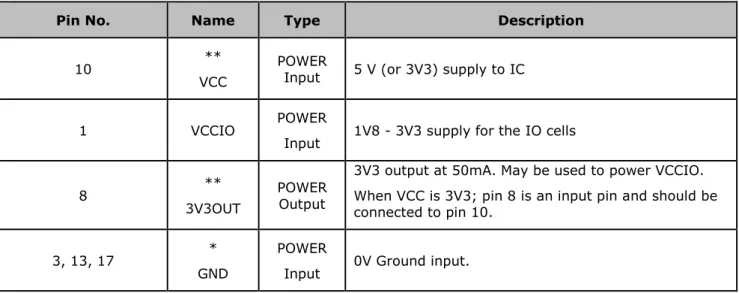
Note: # denotes an active low signal.Pin No. Name Type Description
10 **
VCC
POWER
Input 5 V (or 3V3) supply to IC
1 VCCIO POWER
Input 1V8 - 3V3 supply for the IO cells
8 **
3V3OUT
POWER Output
3V3 output at 50mA. May be used to power VCCIO. When VCC is 3V3; pin 8 is an input pin and should be connected to pin 10.
3, 13, 17 *
GND
POWER
Input 0V Ground input.
Table 3.1 Power and Ground
*Pin 17 is the centre pad under the IC. Connect to GND.
** If VCC is 3V3 then 3V3OUT must also be driven with 3V3 input
Pin No. Name Type Description
7 USBDM INPUT USB Data Signal Minus. 6 USBDP INPUT USB Data Signal Plus. 9 RESET# INPUT Reset input (active low).
Pin No. Name Type Description
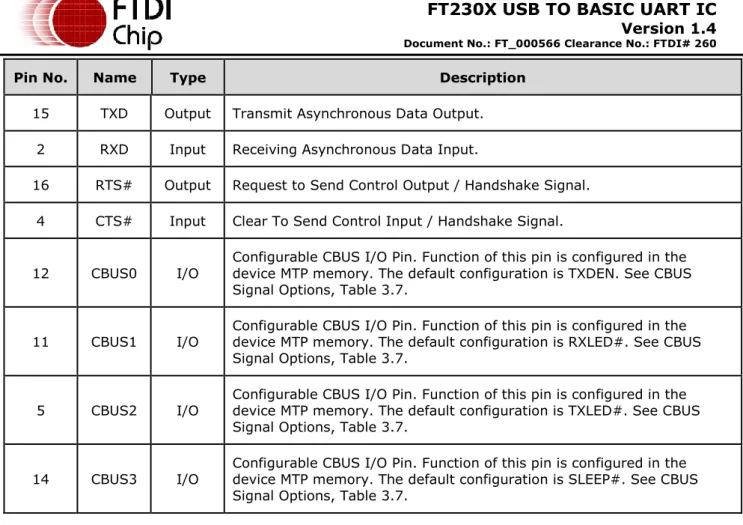
15 TXD Output Transmit Asynchronous Data Output. 2 RXD Input Receiving Asynchronous Data Input.
16 RTS# Output Request to Send Control Output / Handshake Signal. 4 CTS# Input Clear To Send Control Input / Handshake Signal.
12 CBUS0 I/O
Configurable CBUS I/O Pin. Function of this pin is configured in the device MTP memory. The default configuration is TXDEN. See CBUS Signal Options, Table 3.7.
11 CBUS1 I/O Configurable CBUS I/O Pin. Function of this pin is configured in the device MTP memory. The default configuration is RXLED#. See CBUS Signal Options, Table 3.7.
5 CBUS2 I/O Configurable CBUS I/O Pin. Function of this pin is configured in the device MTP memory. The default configuration is TXLED#. See CBUS Signal Options, Table 3.7.
14 CBUS3 I/O Configurable CBUS I/O Pin. Function of this pin is configured in the device MTP memory. The default configuration is SLEEP#. See CBUS Signal Options, Table 3.7.
Table 3.3 UART Interface and CBUS Group (see note 1)
Notes:
1. When used in Input Mode, the input pins are pulled to VCCIO via internal 75kΩ (approx) resistors. These pins can be programmed to gently pull low during USB suspend (PWREN# = “1”) by setting an option in the MTP memory.
3.2
16-LD SSOP Package
RXD 4 G N D 5 CTS# 6 CBUS2 7 USBDP 8 USBDM 9 3V3OUT 10 RESET# 11 V C C 1 2 G N D 1 3 CBUS1 14 CBUS0 15 CBUS3 16 TXD 1 RTS# 2 V C C IO 3 U? FT230XSFigure 3.2 SSOP Schematic Symbol
3.2.1
SSOP Package PinOut Description
Note: # denotes an active low signal.Pin No. Name Type Description
12 **
VCC
POWER
Input 5 V (or 3V3) supply to IC
3 VCCIO POWER
Input 1V8 - 3V3 supply for the IO cells
10 **
3V3OUT
POWER Output
3V3 output at 50mA. May be used to power VCCIO. When VCC is 3V3; pin 10 is an input pin and should be connected to pin 12.
5, 13 GND POWER
Input 0V Ground input.
Table 3.4 Power and Ground
** If VCC is 3V3 then 3V3OUT must also be driven with 3V3 input
Pin No. Name Type Description
9 USBDM INPUT USB Data Signal Minus. 8 USBDP INPUT USB Data Signal Plus. 11 RESET# INPUT Reset input (active low).
Pin No. Name Type Description
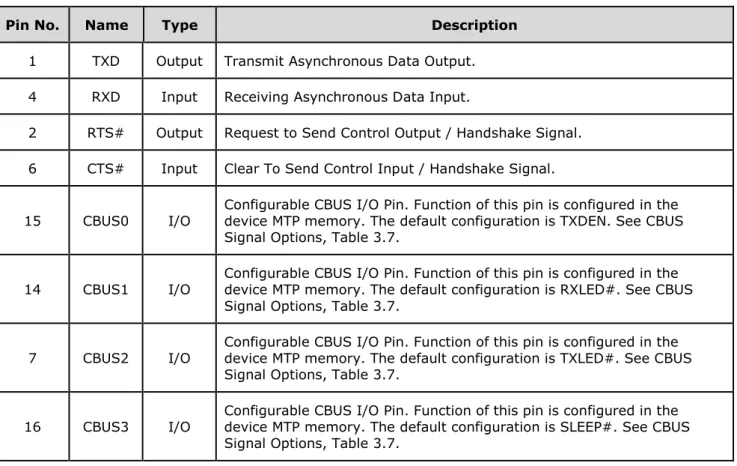
1 TXD Output Transmit Asynchronous Data Output. 4 RXD Input Receiving Asynchronous Data Input.
2 RTS# Output Request to Send Control Output / Handshake Signal. 6 CTS# Input Clear To Send Control Input / Handshake Signal.
15 CBUS0 I/O Configurable CBUS I/O Pin. Function of this pin is configured in the device MTP memory. The default configuration is TXDEN. See CBUS Signal Options, Table 3.7.
14 CBUS1 I/O
Configurable CBUS I/O Pin. Function of this pin is configured in the device MTP memory. The default configuration is RXLED#. See CBUS Signal Options, Table 3.7.
7 CBUS2 I/O
Configurable CBUS I/O Pin. Function of this pin is configured in the device MTP memory. The default configuration is TXLED#. See CBUS Signal Options, Table 3.7.
16 CBUS3 I/O Configurable CBUS I/O Pin. Function of this pin is configured in the device MTP memory. The default configuration is SLEEP#. See CBUS Signal Options, Table 3.7.
Table 3.6 UART Interface and CBUS Group (see note 1)
Notes:
1. When used in Input Mode, the input pins are pulled to VCCIO via internal 75kΩ (approx) resistors. These pins can be programmed to gently pull low during USB suspend (PWREN# = “1”) by setting an option in the MTP memory.
3.3
CBUS Signal Options
The following options can be configured on the CBUS I/O pins. CBUS signal options are common to both package versions of the FT230X. These options can be configured in the internal MTP memory using the software utility FT_PROG or MPROG, which can be downloaded from the FTDI Utilities
(www.ftdichip.com). The default configuration is described in Section 8.
CBUS Signal
Option Available On CBUS Pin Description
TRI-STATE CBUS0, CBUS1, CBUS2, CBUS3 IO Pad is tri-stated
DRIVE 1 CBUS0, CBUS1, CBUS2, CBUS3 Output a constant 1
DRIVE 0 CBUS0, CBUS1, CBUS2, CBUS3 Output a constant 0
TXDEN CBUS0, CBUS1, CBUS2, CBUS3 Enable transmit data for RS485
PWREN# CBUS0, CBUS1, CBUS2, CBUS3
Output is low after the device has been configured by USB, then high during USB suspend mode. This output can be used to control power to external logic P-Channel logic level MOSFET switch. Enable the interface pull-down option when using the PWREN# in this way.
TXLED# CBUS0, CBUS1, CBUS2, CBUS3 Transmit data LED drive – pulses low when transmitting data via USB. See Section 7.5 for more details. RXLED# CBUS0, CBUS1, CBUS2, CBUS3 Receive data LED drive – pulses low when receiving data via USB. See Section 7.5 for more details.
TX&RXLED# CBUS0, CBUS1, CBUS2, CBUS3 LED drive – pulses low when transmitting or receiving data via USB. See Section 7.5 for more details.
SLEEP# CBUS0, CBUS1, CBUS2, CBUS3 Goes low during USB suspend mode. Typically used to power down an external TTL to RS232 level converter IC in USB to RS232 converter designs.
CLK24MHz CBUS0, CBUS1, CBUS2, CBUS3 24 MHz Clock output.*
CLK12MHz CBUS0, CBUS1, CBUS2, CBUS3 12 MHz Clock output.*
CLK6MHz CBUS0, CBUS1, CBUS2, CBUS3 6 MHz Clock output.*
GPIO CBUS0, CBUS1, CBUS2, CBUS3
CBUS bit bang mode option. Allows up to 4 of the CBUS pins to be used as general purpose I/O. Configured individually for CBUS0, CBUS1, CBUS2 and CBUS3 in the internal MTP memory. A separate application note, AN232R-01, available from FTDI website
(www.ftdichip.com) describes in more detail how to use CBUS bit bang mode.
BCD Charger CBUS0, CBUS1, CBUS2, CBUS3 Battery charge Detect, indicates when the device is connected to a dedicated battery charger host. Active high output.
BCD Charger# CBUS0, CBUS1, CBUS2, CBUS3 Inverse of BCD Charger
BitBang_WR# CBUS0, CBUS1, CBUS2, CBUS3 Synchronous and asynchronous bit bang mode WR# strobe output.
CBUS Signal
Option Available On CBUS Pin Description
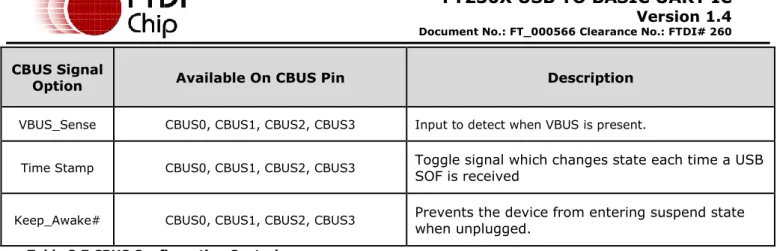
VBUS_Sense CBUS0, CBUS1, CBUS2, CBUS3 Input to detect when VBUS is present.
Time Stamp CBUS0, CBUS1, CBUS2, CBUS3 Toggle signal which changes state each time a USB SOF is received
Keep_Awake# CBUS0, CBUS1, CBUS2, CBUS3 Prevents the device from entering suspend state when unplugged. Table 3.7 CBUS Configuration Control
4
Function Description
The FT230X is a compact USB to a basic serial UART interface device which simplifies USB implementations in a small optimised package, with minimum UART signals and reduces external component count by fully integrating an MTP memory, and an integrated clock circuit which requires no external crystal. It has been designed to operate efficiently with USB host controllers by using as little bandwidth as possible when compared to the total USB bandwidth available.
4.1
Key Features
Functional Integration. Fully integrated MTP memory, clock generation, AVCC filtering, Power-On-Reset (POR) and LDO regulators.
Configurable CBUS I/O Pin Options. The fully integrated MTP memory allows configuration of the Control Bus (CBUS) functionality and drive strength selection. There are 4 configurable CBUS I/O pins. These configurable options are detailed in section 3.3.
The CBUS lines can be configured with any one of these output options by setting bits in the internal MTP memory. The device is shipped with the most commonly used pin definitions pre-programmed - see Section 8 for details.
Asynchronous Bit Bang Mode with RD# and WR# Strobes. The FT230X supports FTDI’s previous chip generation bit-bang mode. In bit-bang mode, the four UART lines can be switched from the regular interface mode to a 4-bit general purpose I/O port. Data packets can be sent to the device and they will be sequentially sent to the interface at a rate controlled by an internal timer (equivalent to the baud rate pre-scalar). In the FT230X device this mode has been enhanced by outputting the internal RD# and WR# strobes signals which can be used to allow external logic to be clocked by accesses to the bit-bang I/O bus. This option will be described more fully in a separate application note available from FTDI website (www.ftdichip.com).
Synchronous Bit Bang Mode. The FT230X supports synchronous bit bang mode. This mode differs from asynchronous bit bang mode in that the interface pins are only read when the device is written to. This makes it easier for the controlling program to measure the response to an output stimulus as the data returned is synchronous to the output data. An application note, AN232R-01,available from FTDI website (www.ftdichip.com) describes this feature.
Source Power and Power Consumption. The FT230X is capable of operating at a voltage supply between +3.3V and +5.25V with a nominal operational mode current of 8mA and a nominal USB suspend mode current of 125µA. This allows greater margin for peripheral designs to meet the USB suspend mode current limit of 2.5mA. An integrated level converter within the UART interface allows the FT230X to interface to UART logic running at +1.8V to +3.3V (5V tolerant).
4.2
Functional Block Descriptions
The following paragraphs detail each function within the FT230X. Please refer to the block diagram shown in Figure 2.1.
Internal MTP Memory. The internal MTP memory in the FT230X is used to store USB Vendor ID (VID), Product ID (PID), device serial number, product description string and various other USB configuration descriptors. The internal MTP memory is also used to configure the CBUS pin functions. The FT230X is supplied with the internal MTP memory pre-programmed as described in Section 8. A user area of the internal MTP memory is available to system designers to allow storing additional data from the user application over USB. The internal MTP memory descriptors can be programmed in circuit, over USB without any additional voltage requirement. The descriptors can be programmed using the FTDI utility software called FT_PROG, which can be downloaded from FTDI Utilities on the FTDI website
(www.ftdichip.com).
+3.3V LDO Regulator. The +3.3V LDO regulator generates the +3.3V reference voltage for driving the USB transceiver cell output buffers. It requires an external decoupling capacitor to be attached to the 3V3OUT regulator output pin. It also provides +3.3V power to the 1.5kΩ internal pull up resistor on USBDP. The main function of the LDO is to power the USB Transceiver and the Reset Generator Cells rather than to power external logic. However, it can be used to supply external circuitry requiring a +3.3V nominal supply with a maximum current of 50mA.
+1.8V LDO Regulator. The +1.8V LDO regulator generates the +1.8V reference voltage for internal use driving the IC core functions of the serial interface engine and USB protocol engine.
USB Transceiver. The USB Transceiver Cell provides the USB 1.1 / USB 2.0 full-speed physical interface to the USB cable. The output drivers provide +3.3V level slew rate control signalling, whilst a differential input receiver and two single ended input receivers provide USB data in, Single-Ended-0 (SE0) and USB reset detection conditions respectfully. This function also incorporates a 1.5kΩ pull up resistor on USBDP. The block also detects when connected to a USB power supply which will not enumerate the device but still supply power and may be used for battery charging.
USB DPLL. The USB DPLL cell locks on to the incoming NRZI USB data and generates recovered clock and data signals for the Serial Interface Engine (SIE) block.
Internal 12MHz Oscillator . The Internal 12MHz Oscillator cell generates a 12MHz reference clock. This provides an input to the x4 Clock Multiplier function. The 12MHz Oscillator is also used as the reference clock for the SIE, USB Protocol Engine and UART FIFO controller blocks.
Clock Multiplier / Divider. The Clock Multiplier / Divider takes the 12MHz input from the Internal Oscillator function and generates the 48MHz, 24MHz, 12MHz and 6MHz reference clock signals. The 48Mz clock reference is used by the USB DPLL and the Baud Rate Generator blocks.
Serial Interface Engine (SIE). The Serial Interface Engine (SIE) block performs the parallel to serial and serial to parallel conversion of the USB data. In accordance with the USB 2.0 specification, it performs bit stuffing/un-stuffing and CRC5/CRC16 generation. It also verifies the CRC on the USB data stream.
USB Protocol Engine. The USB Protocol Engine manages the data stream from the device USB control endpoint. It handles the low level USB protocol requests generated by the USB host controller and the commands for controlling the functional parameters of the UART in accordance with the USB 2.0 specification chapter 9.
FIFO RX Buffer (512 bytes). Data sent from the USB host controller to the UART via the USB data OUT endpoint is stored in the FIFO RX (receive) buffer. Data is removed from the buffer to the UART transmit register under control of the UART FIFO controller. (Rx relative to the USB interface).
FIFO TX Buffer (512 bytes). Data from the UART receive register is stored in the TX buffer. The USB host controller removes data from the FIFO TX Buffer by sending a USB request for data from the device data IN endpoint. (Tx relative to the USB interface).
UART FIFO Controller. The UART FIFO controller handles the transfer of data between the FIFO RX and TX buffers and the UART transmit and receive registers.
UART Controller with Programmable Signal Inversion and High Drive. Together with the UART FIFO Controller the UART Controller handles the transfer of data between the FIFO RX and FIFO TX buffers and the UART transmit and receive registers. It performs asynchronous 7 or 8 bit parallel to serial and serial to parallel conversion of the data on the RS232 (or RS422 or RS485) interface.
Control signals supported by UART mode include RTS, CTS. The UART Controller also provides a transmitter enable control signal pin option (TXDEN) to assist with interfacing to RS485 transceivers. RTS/CTS and XON / XOFF handshaking options are also supported. Handshaking is handled in hardware to ensure fast response times. The UART interface also supports the RS232 BREAK setting and detection conditions.
Additionally, the UART signals can each be individually inverted and have a configurable high drive strength capability (using FT_PROG). Both these features are configurable in the MTP memory.
Baud Rate Generator - The Baud Rate Generator provides a 16x clock input to the UART Controller from the 48MHz reference clock. It consists of a 14 bit pre-scalar and 3 register bits which provide fine tuning of the baud rate (used to divide by a number plus a fraction or “sub-integer”). This determines the baud rate of the UART, which is programmable from 183 baud to 3 Mbaud.
The FT230X supports all standard baud rates and non-standard baud rates from 183 Baud up to 3 Mbaud. Achievable non-standard baud rates are calculated as follows -
Baud Rate = 3000000 / (n + x)
where ‘n’ can be any integer between 2 and 16,384 ( = 214) and ‘x’ can be a sub-integer of the value 0,
0.125, 0.25, 0.375, 0.5, 0.625, 0.75, or 0.875. When n = 1, x = 0, i.e. baud rate divisors with values between 1 and 2 are not possible.
This gives achievable baud rates in the range 183.1 baud to 3,000,000 baud. When a non-standard baud rate is required simply pass the required baud rate value to the driver as normal, and the FTDI driver will calculate the required divisor, and set the baud rate. See FTDI application note AN232B-05 on the FTDI website (www.ftdichip.com) for more details.
RESET Generator - The integrated Reset Generator Cell provides a reliable power-on reset to the device internal circuitry at power up. The RESET# input pin allows an external device to reset the FT230X. RESET# can be tied to VCC or left unconnected if not being used.
5
Devices Characteristics and Ratings
5.1
Absolute Maximum Ratings
The absolute maximum ratings for the FT230X devices are as follows. These are in accordance with the Absolute Maximum Rating System (IEC 60134). Exceeding these may cause permanent damage to the device.
Parameter Value Unit Conditions
Storage Temperature -65°C to 150°C Degrees C
Floor Life (Out of Bag) At Factory Ambient (30°C / 60% Relative Humidity) 168 Hours (IPC/JEDEC J-STD-033A MSL Level 3 Compliant)* Hours
Ambient Operating Temperature (Power
Applied) -40°C to 85°C Degrees C
MTTF FT230XS 9,185,671 Hours
MTTF FT230XQ TBD Hours
VCC Supply Voltage -0.3 to +5.5 V
VCCIO IO Voltage -0.3 to +4.0 V
DC Input Voltage – USBDP and USBDM -0.5 to +3.63 V
DC Input Voltage – High Impedance
Bi-directionals (powered from VCCIO) -0.3 to +5.8 V
DC Output Current – Outputs 22 mA
Table 5.1 Absolute Maximum Ratings
* If devices are stored out of the packaging beyond this time limit the devices should be baked before use. The devices should be ramped up to a temperature of +125°C and baked for up to 17 hours.
5.2
ESD and Latch-up Specifications
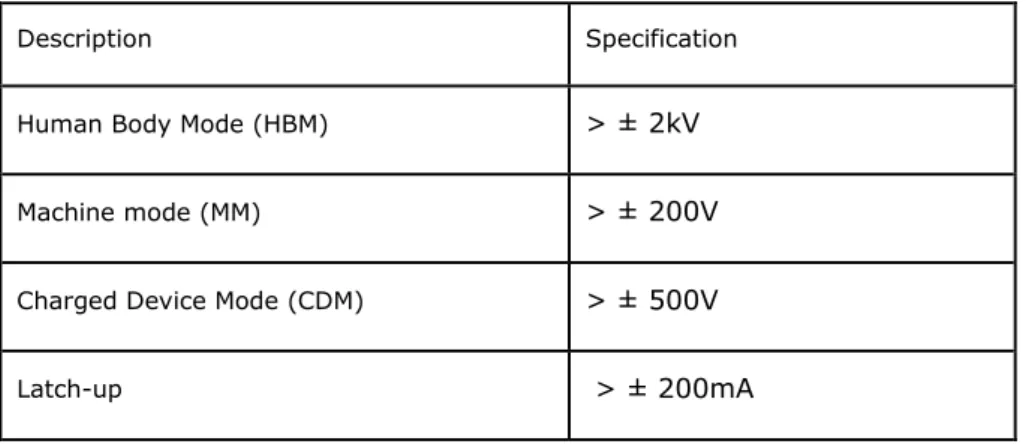
Description Specification
Human Body Mode (HBM) > ± 2kV
Machine mode (MM) > ± 200V
Charged Device Mode (CDM) > ± 500V
Latch-up > ± 200mA
5.3
DC Characteristics
DC Characteristics (Ambient Temperature = -40°C to +85°C)
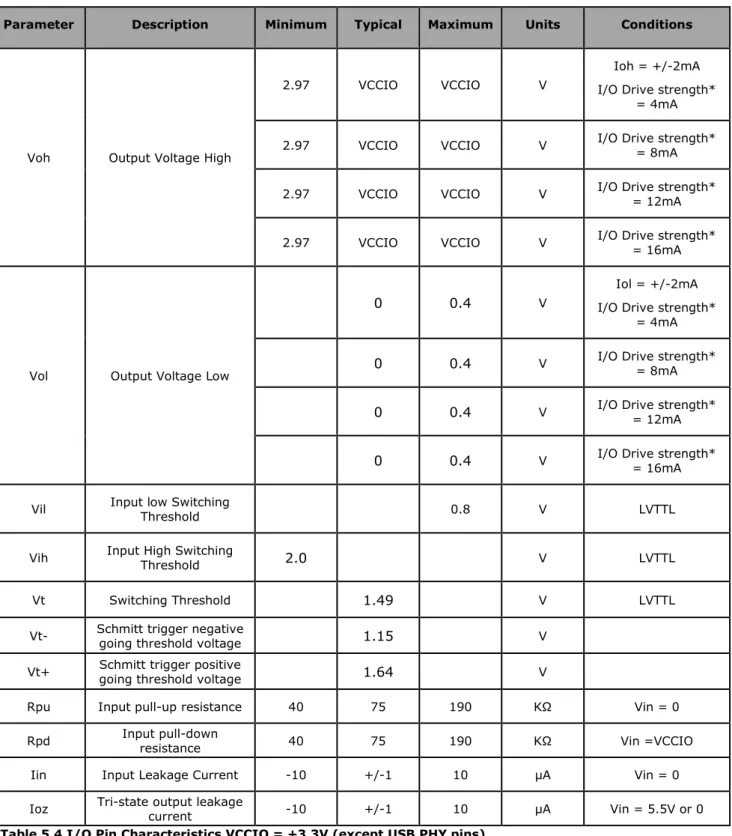
Parameter Description Minimum Typical Maximum Units Conditions
VCC VCC Operating Supply Voltage 2.97 5 5.5 V Normal Operation
VCC2 VCCIO Operating Supply Voltage 1.62 --- 3.63 V
Icc1 Operating Supply Current 6.5 8 8.3 mA Normal Operation
Icc2 Operating Supply Current 125 μA USB Suspend
3V3 3.3v regulator output 2.97 3.3 3.63 V VCC must be greater than 3V3 otherwise 3V3OUT is an input which must be driven with 3.3V
Parameter Description Minimum Typical Maximum Units Conditions
Voh Output Voltage High
2.97 VCCIO VCCIO V
Ioh = +/-2mA I/O Drive strength*
= 4mA
2.97 VCCIO VCCIO V I/O Drive strength* = 8mA
2.97 VCCIO VCCIO V I/O Drive strength* = 12mA
2.97 VCCIO VCCIO V I/O Drive strength* = 16mA
Vol Output Voltage Low
0 0.4 V
Iol = +/-2mA I/O Drive strength*
= 4mA
0 0.4 V I/O Drive strength* = 8mA
0 0.4 V I/O Drive strength* = 12mA
0 0.4 V I/O Drive strength* = 16mA
Vil Input low Switching Threshold 0.8 V LVTTL
Vih Input High Switching Threshold 2.0 V LVTTL
Vt Switching Threshold 1.49 V LVTTL
Vt- Schmitt trigger negative going threshold voltage 1.15 V Vt+ Schmitt trigger positive going threshold voltage 1.64 V
Rpu Input pull-up resistance 40 75 190 KΩ Vin = 0
Rpd Input pull-down resistance 40 75 190 KΩ Vin =VCCIO
Iin Input Leakage Current -10 +/-1 10 μA Vin = 0
Ioz Tri-state output leakage current -10 +/-1 10 μA Vin = 5.5V or 0
Table 5.4 I/O Pin Characteristics VCCIO = +3.3V (except USB PHY pins)
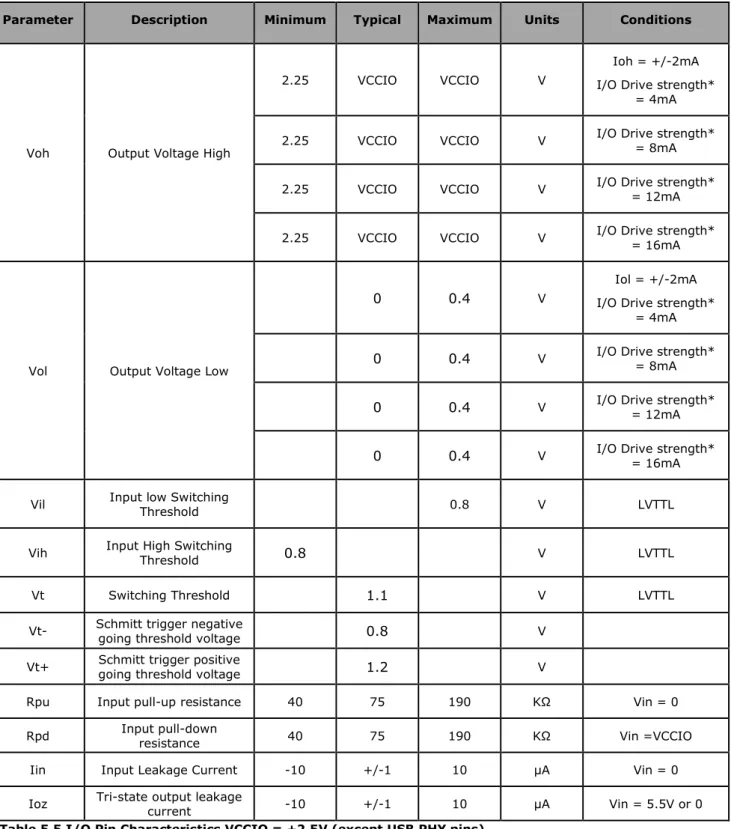
Parameter Description Minimum Typical Maximum Units Conditions
Voh Output Voltage High
2.25 VCCIO VCCIO V
Ioh = +/-2mA I/O Drive strength*
= 4mA
2.25 VCCIO VCCIO V I/O Drive strength* = 8mA
2.25 VCCIO VCCIO V I/O Drive strength* = 12mA
2.25 VCCIO VCCIO V I/O Drive strength* = 16mA
Vol Output Voltage Low
0 0.4 V
Iol = +/-2mA I/O Drive strength*
= 4mA
0 0.4 V I/O Drive strength* = 8mA
0 0.4 V I/O Drive strength* = 12mA
0 0.4 V I/O Drive strength* = 16mA
Vil Input low Switching Threshold 0.8 V LVTTL
Vih Input High Switching Threshold 0.8 V LVTTL
Vt Switching Threshold 1.1 V LVTTL
Vt- Schmitt trigger negative going threshold voltage 0.8 V Vt+ Schmitt trigger positive going threshold voltage 1.2 V
Rpu Input pull-up resistance 40 75 190 KΩ Vin = 0
Rpd Input pull-down resistance 40 75 190 KΩ Vin =VCCIO
Iin Input Leakage Current -10 +/-1 10 μA Vin = 0
Ioz Tri-state output leakage current -10 +/-1 10 μA Vin = 5.5V or 0
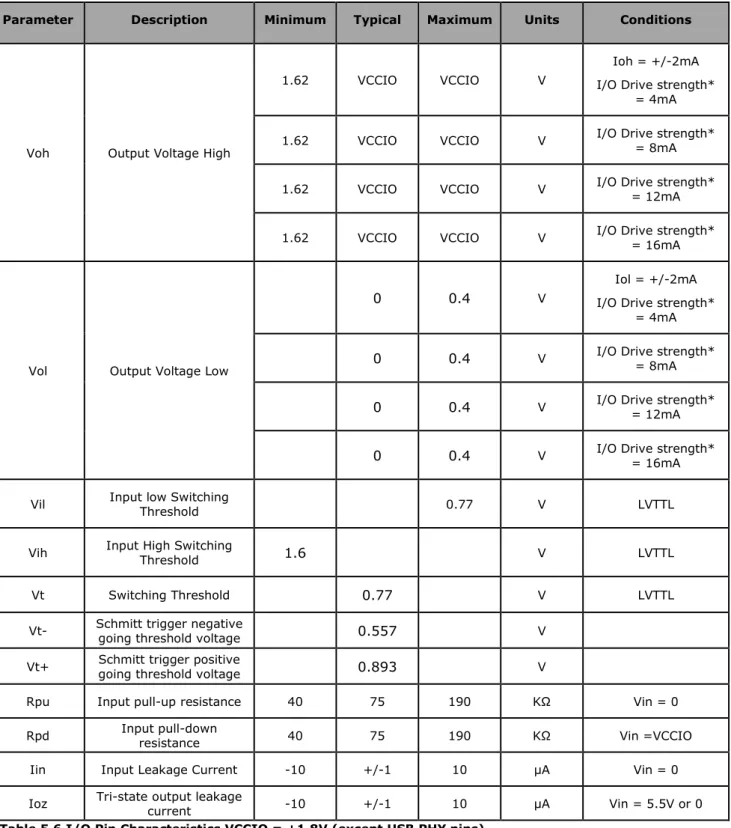
Table 5.5 I/O Pin Characteristics VCCIO = +2.5V (except USB PHY pins)
Parameter Description Minimum Typical Maximum Units Conditions
Voh Output Voltage High
1.62 VCCIO VCCIO V
Ioh = +/-2mA I/O Drive strength*
= 4mA
1.62 VCCIO VCCIO V I/O Drive strength* = 8mA
1.62 VCCIO VCCIO V I/O Drive strength* = 12mA
1.62 VCCIO VCCIO V I/O Drive strength* = 16mA
Vol Output Voltage Low
0 0.4 V
Iol = +/-2mA I/O Drive strength*
= 4mA
0 0.4 V I/O Drive strength* = 8mA
0 0.4 V I/O Drive strength* = 12mA
0 0.4 V I/O Drive strength* = 16mA
Vil Input low Switching Threshold 0.77 V LVTTL
Vih Input High Switching Threshold 1.6 V LVTTL
Vt Switching Threshold 0.77 V LVTTL
Vt- Schmitt trigger negative going threshold voltage 0.557 V Vt+ Schmitt trigger positive going threshold voltage 0.893 V
Rpu Input pull-up resistance 40 75 190 KΩ Vin = 0
Rpd Input pull-down resistance 40 75 190 KΩ Vin =VCCIO
Iin Input Leakage Current -10 +/-1 10 μA Vin = 0
Ioz Tri-state output leakage current -10 +/-1 10 μA Vin = 5.5V or 0
Table 5.6 I/O Pin Characteristics VCCIO = +1.8V (except USB PHY pins)
Parameter Description Minimum Typical Maximum Units Conditions
Voh Output Voltage High VCC-0.2 V
Vol Output Voltage Low 0.2 V
Vil Input low Switching Threshold - 0.8 V
Vih Input High Switching Threshold 2.0 - V
Table 5.7 USB I/O Pin (USBDP, USBDM) Characteristics
5.4
MTP Memory Reliability Characteristics
The internal 2048 Byte MTP memory has the following reliability characteristics:
Parameter Value Unit
Data Retention 10 Years
Write Cycle 2,000 Cycles
Read Cycle Unlimited Cycles Table 5.8 MTP Memory Characteristics
5.5
Internal Clock Characteristics
The internal Clock Oscillator has the following characteristics:
Parameter
Value
Unit
Minimum Typical Maximum
Frequency of Operation
(see Note 1) 11.98 12.00 12.02 MHz
Clock Period 83.19 83.33 83.47 ns
Duty Cycle 45 50 55 %
Table 5.9 Internal Clock Characteristics
6
USB Power Configurations
The following sections illustrate possible USB power configurations for the FT230X. The illustrations have omitted pin numbers for ease of understanding since the pins differ between the FT230XS and FT230XQ package options.
All USB power configurations illustrated apply to both package options for the FT230X device. Please refer to Section 9 for the package option pin-out and signal descriptions.
6.1
USB Bus Powered Configuration
FT230X 1 2 3 4 5 SHIELD Ferrite Bead GND GND VCC GND VCC 3V3OUT USBDM USBDP VCCIO VCC AG ND GN D RESET# 100nF 100nF 10nF 4.7uF + 27R 27R GND 47pF 47pF
Figure 6.1 Bus Powered Configuration
Figure 6.1 Illustrates the FT230X in a typical USB bus powered design configuration. A USB bus powered device gets its power from the USB bus. Basic rules for USB bus power devices are as follows:
i) On plug-in to USB, the device should draw no more current than 100mA. ii) In USB Suspend mode the device should draw no more than 2.5mA.
iii) A bus powered high power USB device (one that draws more than 100mA) should use one of the CBUS pins configured as PWREN# and use it to keep the current below 100mA on plug-in and 2.5mA on USB suspend.
iv) A device that consumes more than 100mA cannot be plugged into a USB bus powered hub. v) No device can draw more than 500mA from the USB bus.
The power descriptors in the internal MTP memory of the FT230X should be programmed to match the current drawn by the device.
A ferrite bead is connected in series with the USB power supply to reduce EMI noise from the FT230X and associated circuitry being radiated down the USB cable to the USB host. The value of the Ferrite Bead depends on the total current drawn by the application. A suitable range of Ferrite Beads is available from Laird Technologies for example Part # MI0805K601R-10.
6.2
Self Powered Configuration
FT230X 1 2 3 4 5 SHIELD GND GND VCC GND VCC 3V3OUT USBDM USBDP VCCIO VCC(3.3-5.25V) AG ND GN D RESET# 100nF 100nF 100nF 4.7uF + GND 4k7 10k 27R 27R GND 47pF 47pF VBUS_SENSEFigure 6.2 Self Powered Configuration
Figure 6.2 illustrates the FT230X in a typical USB self powered configuration. A USB self powered device gets its power from its own power supply, VCC, and does not draw current from the USB bus. The basic rules for USB self powered devices are as follows –
i) A self powered device should not force current down the USB bus when the USB host or hub controller is powered down.
ii) A self powered device can use as much current as it needs during normal operation and USB suspend as it has its own power supply.
iii) A self powered device can be used with any USB host, a bus powered USB hub or a self powered USB hub.
The power descriptor in the internal MTP memory of the FT230X should be programmed to a value of zero (self powered).
In order to comply with the first requirement above, the USB bus power (pin 1) is used to control the VBUS_Sense pin of the FT230X device. When the USB host or hub is powered up an internal 1.5kΩ resistor on USBDP is pulled up to +3.3V, thus identifying the device as a full speed device to the USB host or hub. When the USB host or hub is powered off, VBUS_Sense pin will be low and the FT230X is held in a suspend state. In this state the internal 1.5kΩ resistor is not pulled up to any power supply (hub or host is powered down), so no current flows down USBDP via the 1.5kΩ pull-up resistor. Failure to do this may cause some USB host or hub controllers to power up erratically.
Figure 6.2 illustrates a self powered design which has a +3.3V to +5.25V supply. Note:
1. When the FT230X is in reset, the UART interface I/O pins are tri-stated. Input pins have internal 75kΩ pull-up resistors to VCCIO, so they will gently pull high unless driven by some external logic.
6.3
USB Bus Powered with Power Switching Configuration
FT230X 1 2 3 4 5 SHIELD Ferrite Bead GND GND VCC GND VCC 3V3OUT USBDM USBDP VCCIO AGN D GN D RESET# 100nF 100nF 10nF 4.7uF + CBUS3 PWREN# 100k 1k Switched 5V Power to External Logic 0.1uF 0.1uF P Channel Power MOSFET 27R 27R GND 47pF 47pFFigure 6.3 Bus Powered with Power Switching Configuration
A requirement of USB bus powered applications, is when in USB suspend mode, the application draws a total current of less than 2.5mA. This requirement includes external logic. Some external logic has the ability to power itself down into a low current state by monitoring the PWREN# signal. For external logic that cannot power itself down in this way, the FT230X provides a simple but effective method of turning off power during the USB suspend mode.
Figure 6.3 shows an example of using a discrete P-Channel MOSFET to control the power to external logic. A suitable device to do this is an International Rectifier IRLML6402, or equivalent. It is
recommended that a “soft start” circuit consisting of a 1kΩ series resistor and a 0.1μF capacitor is used to limit the current surge when the MOSFET turns on. Without the soft start circuit it is possible that the transient power surge, caused when the MOSFET switches on, will reset the FT230X or the USB host/hub controller. The soft start circuit example shown in Figure 6.3 powers up with a slew rate of
approximaely12.5V/ms. Thus supply voltage to external logic transitions from GND to +5V in approximately 400 microseconds.
As an alternative to the MOSFET, a dedicated power switch IC with inbuilt “soft-start” can be used. A suitable power switch IC for such an application is the Micrel MIC2025-2BM or equivalent.
With power switching controlled designs the following should be noted:
i) The external logic to which the power is being switched should have its own reset circuitry to automatically reset the logic when power is re-applied when moving out of suspend mode. ii) Set the Pull-down on Suspend option in the internal FT230X MTP memory.
iii) One of the CBUS Pins should be configured as PWREN# in the internal FT230X MTP memory, and used to switch the power supply to the external circuitry.
iv) For USB high-power bus powered applications (one that consumes greater than 100mA, and up to 500mA of current from the USB bus), the power consumption of the application must be set in the Max Power field in the internal FT230X MTP memory. A high-power bus powered application uses the descriptor in the internal FT230X MTP memory to inform the system of its power requirements.
v) PWREN# gets its VCC from VCCIO. For designs using 3V3 logic, ensure VCCIO is not powered down using the external logic. In this case use the +3V3OUT.
7
Application Examples
The following sections illustrate possible applications of the FT230X. The illustrations have omitted pin numbers for ease of understanding since the pins differ between the FT230XS and FT230XQ package options.
7.1
USB to RS232 Converter
FT230X 1 2 3 4 5 SHIELD Ferrite Bead GND GND VCC GND VCC 3V3OUT USBDM USBDP VCCIO VCC AG ND GN D RESET# 100nF 100nF 10nF 4.7uF + SLEEP# CBUS1 CBUS2 TXD RXD RTS# CTS# RS 2 3 2 L E V E L C O N V E R T E R TXDATA RXDATA RTS CTS TXLED RXLED VCCIO VCCIO 270R 270R GND CTS TXDATA RTS RXDATA DB9M SHIELD 10 5 9 4 8 3 7 2 6 1 SHDN# CBUS0 TXD RXD RTS# CTS# 27R 27R GND 47pF 47pF VCCIO TXD RXD RTS# CTS# 10k 10k 10k 10kFigure 7.1 Application Example showing USB to RS232 Converter
An example of using the FT230X as a USB to RS232 converter is illustrated in Figure 7.1. In this
application, a 3V3 TTL to RS232 Level Converter IC is used on the serial UART interface of the FT230X to convert the 3V3 levels of the FT230X to RS232 levels. This level shift can be done using line drivers from a variety of vendors e.g. Zywyn. A useful feature on some of these devices is the SHDN# pin which can be used to power down the device to a low quiescent current during USB suspend mode.
A suitable level shifting device is the Zywyn ZT3243F which is capable of RS232 communication at up to 1000k baud.
In example shown, the CBUS1 and CBUS2 have been configured as TXLED# and RXLED# and are being used to drive two LEDs.
7.2
USB to RS485 Coverter
FT230X 1 2 3 4 5 SHIELD Ferrite Bead GND GND VCC GND VCC 3V3OUT USBDM USBDP VCCIO VCC AG ND GN D RESET# 100nF 100nF 10nF 4.7uF + TXD RXD GND DB9M SHIELD 10 PWREN# VCCIO 10K RS 485 LEVEL CONVERTER Vcc ZT3485 5 1 2 3 4 Link 120R 7 6 TXDEN 27R 27R GND 47pF 47pF 10k 10k 10k VCCIOFigure 7.2 Application Example Showing USB to RS485 Converter
An example of using the FT230X as a USB to RS485 converter is shown in Figure 7.2. In this application, a 3V3-TTL to RS485 level converter IC is used on the serial UART interface of the FT230X to convert the TTL levels of the FT230X to RS485 levels.
This example uses the Zywyn ZT3485 device. Equivalent devices are available from Maxim and Analogue Devices. The ZT3485 is a RS485 device in a compact 8 pin SOP package. It has separate enables on both the transmitter and receiver. With RS485, the transmitter is only enabled when a character is being transmitted from the UART. The TXDEN signal CBUS pin option on the FT230X is provided for exactly this purpose and so the transmitter enable is wired to CBUS2 which has been configured as TXDEN. Similarly, CBUS3 has been configured as PWREN#. This signal is used to control the ZT3485’s receiver enable. The receiver enable is active low, so it is wired to the PWREN# pin to disable the receiver when in USB
suspend mode. RS485 is a multi-drop network; so many devices can communicate with each other over a two wire cable interface. The RS485 cable requires to be terminated at each end of the cable. A link (which provides the 120Ω termination) allows the cable to be terminated if the ZT3485 is physically positioned at either end of the cable.
In this example the data transmitted by the FT230X is also present on the receive path of the ZT3485.This is a common feature of RS485 and requires the application software to remove the transmitted data from the received data stream. With the FT230X it is possible to do this entirely in hardware by modifying the example shown in Figure 7.2 by logically OR’ing the FT230X TXDEN and the ZT3485 receiver output and connecting the output of the OR gate to the RXD of the FT230X.
Note that the TXDEN is activated 1 bit period before the start bit. TXDEN is deactivated at the same time as the stop bit. This is not configurable.
7.3
USB to RS422 Converter
FT230X 1 2 3 4 5 SHIELD Ferrite Bead GND GND VCC GND VCC 3V3OUT USBDM USBDP VCCIO VCC AG ND GN D RESET# 100nF 100nF 10nF 4.7uF + RS 422 LEVEL CONVERTER Vcc ZT3491 5 3 4 7 6 10 9 11 12 RS 422 LEVEL CONVERTER ZT3491 3 4 7 6 Vcc Vcc 10K 2 5 11 12 9 10 GND SHIELD TXDM TXDP RXDP RXDM RTSM RTSP CTSP CTSM 2 RXD TXD RTS# CTS# PWREN# SLEEP# 27R 27R GND 47pF 47pF VCCIO RXD TXD RTS CTSFigure 7.3 USB to RS422 Converter Configuration
An example of using the FT230X as a USB to RS422 converter is shown in Figure 7.3. In this application, two TTL to RS422 Level Converter ICs are used on the serial UART interface of the FT230X to convert the TTL levels of the FT230X to RS422 levels. There are many suitable level converter devices available. This example uses Zywyn ZT3491 devices which have enables on both the transmitter and receiver. Since the ZT3491 transmitter enable is active high, it is connected to a CBUS pin in SLEEP# configuration. The ZT3491 receiver enable is active low and is therefore connected to a CBUS pin PWREN# configuration. This ensures that when both the ZT3491 transmitters and receivers are enabled then the device is active, and when the device is in USB suspend mode, the ZT3491 transmitters and receivers are disabled. If a similar application is used, but the design is USB BUS powered, it may be necessary to use a P-Channel logic level MOSFET (controlled by PWREN#) in the VCC line of the ZT3491 devices to ensure that the USB standby current of 2.5mA is met.
The ZT3491 is specified to transmit and receive data at a rate of up to 16 Mbaud. In this example the maximum data rate is limited to 3 Mbaud by the FT230X.
7.4
USB Battery Charging Detection
An addition to the USB specification (http://www.usb.org) is to allow for additional charging profiles to be used for charging batteries in portable devices. These charging profiles do not enumerate the USB port of the peripheral. The FT230X device will detect that a USB compliant dedicated charging port (DCP) is connected. Once detected while in suspend mode, a battery charge detection signal is provided to allow external logic to switch to charging mode as opposed to operation mode.
To use the FT230X with battery charging detection the CBUS pins must be reprogrammed to allow for the BCD Charger output to switch the external charger circuitry on. The CBUS pins are configured in the internal MTP memory with the free utility FT_PROG. If the charging circuitry requires an active low signal to enable it, the CBUS pin can be programmed to BCD Charger# as an alternative.
When connected to a USB compliant dedicated charging port (DCP, as opposed to a standard USB host) the device USB signals will be shorted together and the device suspended. The BCD charger signal will bring the LTC4053 out of suspend and allow battery charging to start. The charge current in Figure 7.4 is 1A as defined by the resistance on the PROG pin.
X-Chip Pin Function
EEPROM Setting
CBUS0 BCD
Battery Options Battery Charger Enable
Force Power Enable De-acticate Sleep X GND GND 0.1uF 0.1uF GND GND 600R/2A 10nF VBUS 3V3OUT 0.1uF 0R GND SLD GND 27R 27R VBUS 1 D- 2 D+ 3 GND 5 ID 4 CN USB VCC 2 FAULT 3 TIMER 4 GND 5 PROGNTC 6 7 SHDN 8 BAT 9 ACPR 10 CHRG 1 G N D 1 1 LTC4053EDD GND 3V3OUT 3V3OUT 4.7uF 0.1uF GND VBUS VBUS GND VBATT GND GND 1K5 GND 1 TB3.5mm VBUS VBUS NTC 0.1uF GND VBUS 1uF 1R GND VBUS BCD 2K2 GND JP1 1-2 2-3 NCT Enabled NCT Available JP1 SIP-3 NTC GND NCT Disabled (Default) JUMPER-2mm 4K32 1% G N D DP DM 3V3OUT RESET# V C C G N D CBUS0 V C C IO FT230X BCD
1A when connected to a dedicated charger port 0A when enumerated
0A when in sleep
0A when not enumerated and not in sleep + -NCT N.F.
Figure 7.4 USB Battery Charging Detection (1 pin)
Alternatively the PWREN# And SLEEP# pins may be used to control the LTC4053 such that a battery may be charged from a standard host (low current) or from a dedicated charging port (high current). In such a design as shown in Figure 7.5 the charge current would need to be limited to 0.4A to ensure that the USB host power limit is not exceeded.
X-Chip Pin Function EEPROM Setting CBUS5 CBUS6 SLEEP# PWREN# Battery Options Battery Charger Enable Force Power Enable De-acticate Sleep X X X SLEEP# PWREN# DP DM 3V3OUT VC O R E RESET# V C C CBUS 1 CBUS 2 V C C IO U1 FT230X
0.4A when connected to a dedicated charger port GND GND 0.1uF 0.1uF GND GND 600R/2A 10nF VBUS 3V3OUT 0.1uF 0R GND SLD GND 27R 27R VBUS 1 D- 2 D+ 3 GND 5 ID 4 CN USB 3V3OUT 3V3OUT VBUS VBUS N.F. 16K5 1% GND 4K32 1% PWREN#
0.4A when enumerated 0A when in sleep mode
0.1A when not enumerated and not in sleep mode VCC 2 FAULT 3 TIMER 4 GND 5 NTC 6 PROG 7 SHDN 8 BAT 9 ACPR 10 CHRG 1 G N D 1 1 LTC4053EDD GND 4.7uF 0.1uF GND VBUS VBUS GND VBATT GND GND 1 TB3.5mm NTC 0.1uF GND VBUS 1uF 1R GND VBUS 2K2 GND JP1 1-2 2-3 NCT Enabled NCT Available JP1 SIP-3 NTC GND NCT Disabled (Default) JUMPER-2mm 4K32 1% + -NCT SLEEP#
Figure 7.5 USB Battery Charging Detection (2 pin)
In Figure 7.5 the FT230X SLEEP# pin is used to enable/disable the LTC4053, while the PWREN# signal alters the charging current by altering the resistance on the LTC4053 PROG pin.
A third option shown in Figure 7.6 uses the SLEEP# signal from the FT230X to enable / disable the battery charger. The BCD# and PWREN# signals are then used to alter the resistance on the PROG pin of the LTC4053 which controls the charge current drawn from the USB connector.
X-Chip Pin Function EEPROM Setting CBUS0 CBUS1 CBUS2 BCD# PWREN# SLEEP# Battery Options Battery Charger Enable Force Power Enable
De-acticate Sleep X X PWREN# G N D CBUS2 10 DP DM 3V3OUT RESET# V C C G N D CBUS1 17 CBUS0 18 V C C IO FT230X BCD# SLEEP# GND GND 0.1uF 0.1uF GND GND 600R/2A 10nF VBUS 3V3OUT 0.1uF 0R GND SLD GND 27R 27R VBUS 1 D- 2 D+ 3 GND 5 ID 4 CN USB 3V3OUT 3V3OUT VBUS VBUS N.F. 1K5 - 1% 16K5 1% GND BCD# 4K32 1% PWREN#
1A when connected to a dedicated charger port 0.4A when enumerated
0A when in sleep
0.1A when not enumerated and not in sleep VCC 2 FAULT 3 TIMER 4 GND 5 PROGNTC 6 7 SHDN 8 BAT 9 ACPR 10 CHRG 1 G N D 1 1 LTC4053EDD GND 4.7uF 0.1uF GND VBUS VBUS GND VBATT GND GND 1 TB3.5mm NTC 0.1uF GND VBUS 1uF 1R GND VBUS 2K2 GND JP1 1-2 2-3 NCT Enabled NCT Available JP1 SIP-3 NTC GND NCT Disabled (Default) JUMPER-2mm 4K32 1% + -NCT SLEEP#
Figure 7.6 USB Battery Charging Detection (3 pin)
To calculate the equivalent resistance on the PROG pin select a charge current, then Res = 1500V/Ichg
For more configuration options of the LTC4053 refer to: AN_175 Battery Charger Detection over USB with FT-X Devices
Note: If the FT230X is connected to a standard host port such that the device is enumerated the battery charge detection signal is inactive as the device will not be in suspend.
7.5
LED Interface
Any of the CBUS I/O pins can be configured to drive an LED. The FT230X has 3 configuration options for driving LEDs from the CBUS. These are TXLED#, RXLED#, and TX&RXLED#. Refer to Section 3.3 for configuration options. FT230X CBUS[0...3] CBUS[0...3] VCCIO TX TXLED# RXLED# RX 270R 270R
Figure 7.7 Dual LED Configuration
An example of using the FT230X to drive LEDs is shown in Figure 7.7. In this application one of the CBUS pins is used to indicate transmission of data (TXLED#) and another is used to indicate receiving data (RXLED#). When data is being transmitted or received the respective pins will drive from tri-state to low in order to provide indication on the LEDs of data transfer. A digital one-shot is used so that even a small percentage of data transfer is visible to the end user.
FT230X
CBUS [0...3] TX& RXLED#
270R VCCIO
LED
Figure 7.8 Single LED Configuration
Another example of using the FT230X to drive LEDs is shown in Figure 7.8. In this example one of the CBUS pins is used to indicate when data is being transmitted or received by the device (TX&RXLED). In this configuration the FT230X will drive only a single LED.
8
Internal MTP Memory Configuration
The FT230X includes an internal MTP memory which holds the USB configuration descriptors, other configuration data for the chip and also user data areas. Following a power-on reset or a USB reset the FT230X will scan its internal MTP memory and read the USB configuration descriptors stored there. In many cases, the default values programmed into the MTP memory will be suitable and no re-programming will be necessary. The defaults can be found in Section 8.1.
The MTP memory in the FT230X can be programmed over USB if the values need to be changed for a particular application. Further details of this are provided from section 8.2 onwards.
Users who do not have their own USB Vendor ID but who would like to use a unique Product ID in their design can apply to FTDI for a free block of unique PIDs. See TN_100 USB Vendor ID/Product ID Guidelines for more details.
8.1
Default Values
The default factory programmed values of the internal MTP memory are shown in Table 8.1.
Parameter Value Notes
USB Vendor ID (VID) 0403h FTDI default VID (hex) USB Product UD (PID) 6015h FTDI default PID (hex) Serial Number Enabled? Yes
Serial Number See Note A unique serial number is generated and programmed into the MTP memory during device final test.
Pull down I/O Pins in USB
Suspend Disabled
Enabling this option will make the device pull down on the UART interface lines when in USB suspend mode (PWREN# is high).
Manufacturer Name FTDI
Product Description FT230X BASIC UART
Max Bus Power Current 90mA Power Source Bus Powered
Device Type FT230X
USB Version 0200
Returns USB 2.0 device description to the host. Note: The device is a USB 2.0 Full Speed device (12Mb/s) as opposed to a USB 2.0 High Speed device (480Mb/s).
Remote Wake Up Disabled Taking RI# low will wake up the USB host controller from suspend in approximately 20 ms.
DBUS Drive Current
Strength 4mA Options are 4mA, 8mA, 12mA, 16mA
DBUS slew rate Slow Options are slow or fast DBUS Schmitt Trigger Normal Options are normal or Schmitt
Parameter Value Notes
Enable CBUS Drive Current
Strength 4mA Options are 4mA, 8mA, 12mA, 16mA
CBUS slew rate Slow Options are slow or fast CBUS Schmitt Trigger
Enable Normal Options are normal or Schmitt
Load VCP Driver Enabled** Makes the device load the VCP driver interface for the device.
CBUS0 TXDEN Default configuration of CBUS0 – Transmit data enable for RS485
CBUS1 RXLED# Default configuration of CBUS1 – Receive LED drive.
CBUS2 TXLED# Default configuration of CBUS2 – Transmit LED drive.
CBUS3 SLEEP# Default configuration of CBUS3 – SLEEP#, goes active low when the device is in suspend
Invert TXD Disabled Signal on this pin becomes TXD# if enable. Invert RXD Disabled Signal on this pin becomes RXD# if enable. Invert RTS# Disabled Signal on this pin becomes RTS if enable. Invert CTS# Disabled Signal on this pin becomes CTS if enable.
Table 8.1 Default Internal MTP Memory Configuration
**VCP disabled in Rev B silicon in error
8.2
Methods of Programming the MTP Memory
8.2.1
Programming the MTP memory over USB
The MTP memory on all FT-X devices can be programmed over USB. This method is the same as for the EEPROM on other FTDI devices such as the FT232R. No additional hardware, connections or programming voltages are required. The device is simply connected to the host computer in the same way that it would be for normal applications, and the FT_Prog utility is used to set the required options and program the device.
The FT_Prog utility is provided free-of-charge from the FTDI website, and can be found at the link below. The user guide is also available at this link.
http://www.ftdichip.com/Support/Utilities.htm#FT_Prog
Additionally, D2XX commands can be used to program the MTP memory from within user applications. For more information on the commands available, please see the D2XX Programmers Guide below. http://www.ftdichip.com/Support/Documents/ProgramGuides/D2XX_Programmer's_Guide(FT_000071).p df
8.3
Memory Map
The FT-X family MTP memory has various areas which come under three main categories: User Memory Area
Configuration Memory Area (writable) Configuration Memory Area (non-writable)
Memory Area Description
Word Address
User Memory Area 2
Accessible via USB
0x3FF - 0x80
Configuration Memory Area
Accessible via USB
0x7E - 0x50
Configuration Memory Area
Cannot be written
0x4E - 0x40
User Memory Area 1
Accessible via USB
0x3E - 0x12
Configuration Memory Area
Accessible via USB
0x10 - 0x00
Figure 8.1: Simplified memory map for the FT-X
User Memory Area
The User Memory Areas are highlighted in Green on the memory map. They can be read and written via USB on the FT230X. All locations within this range are freely programmable; no areas have special functions and there is no checksum for the user area.
Note that the application should take into account the specification for the number of write cycles in Section 5.4 if it will be writing to the MTP memory multiple times.
Configuration Memory Area (writable)
This area stores the configuration data for the device, including the data which is returned to the host in the configuration descriptors (e.g. the VID, PID and string descriptions) and also values which set the hardware configuration (the signal assigned to each CBUS pin for example).
These values can have a significant effect on the behaviour of the device. Steps must be taken to ensure that these locations are not written to un-intentionally by an application which is intended to access only the user area.
This area is included in a checksum which covers configuration areas of the memory, and so changing any value can also cause this checksum to fail.
Configuration Memory Area (non-writable)
This is a reserved area and the application should not write to this area of memory. Any attempt to write these locations will fail
9
Package Parameters
The FT230X is available in two different packages. The FT230XS is the SSOP-16 option and the FT230XQ is the QFN-16 package option. The solder reflow profile for both packages is described in Section 9.4.
9.1
SSOP-16 Package Mechanical Dimensions
Figure 9.1 SSOP-16 Package Dimensions
The FT230XS is supplied in a RoHS compliant 16 pin SSOP package. The package is lead (Pb) free and uses a ‘green’ compound. The package is fully compliant with European Union directive 2002/95/EC. This package is nominally 4.90mm x 3.91mm body (4.90mm x 5.99mm including pins). The pins are on a 0.635 mm pitch. The above mechanical drawing shows the SSOP-16 package.
9.2
SSOP-16 Package Markings
Figure 9.2 SSOP-16 Package Markings
The date code format is YYXX where XX = 2 digit week number, YY = 2 digit year number. This is followed by the revision number.
The code XXXXXXXXXXXX is the manufacturing LOT code.
FT230XS
9.3
QFN-16 Package Mechanical Dimensions
Figure 9.3 QFN-16 Package Dimensions
The FT230XQ is supplied in a RoHS compliant leadless QFN-16 package. The package is lead (Pb) free, and uses a ‘green’ compound. The package is fully compliant with European Union directive 2002/95/EC. This package is nominally 4.00mm x 4.00mm. The solder pads are on a 0.65mm pitch. The above mechanical drawing shows the QFN-16 package. All dimensions are in millimetres.
The centre pad on the base of the FT230XQ is internally connected to ground.
9.4
QFN-16 Package Markings
Figure 9.4 QFN-16 Package Markings
The date code format is YYXX where XX = 2 digit week number, YY = 2 digit year number. This is followed by the revision number.
The code XXXXXXX is the manufacturing LOT code.
FTDI
I
XXXXXXXXXX
FT230XQ
5 1YYWW-B
8 129.5
Solder Reflow Profile
The FT230X is supplied in Pb free 16 LD SSOP and QFN-16 packages. The recommended solder reflow profile for both package options is shown in Figure 9.5.
Critical Zone: when T is in the range T to T T e m p e ra tu re , T ( D e g re e s C )
Time, t (seconds)
25 P T = 25º C to T tp Tp TL t PreheatS tL Ramp Up L p Ramp Down T MaxS T MinSFigure 9.5 FT230X Solder Reflow Profile
The recommended values for the solder reflow profile are detailed in Table 9.1. Values are shown for both a completely Pb free solder process (i.e. the FT230X is used with Pb free solder), and for a non-Pb free solder process (i.e. the FT230X is used with non-Pb free solder).
Profile Feature Pb Free Solder Process Non-Pb Free Solder Process
Average Ramp Up Rate (Ts to Tp) 3°C / second Max. 3°C / Second Max. Preheat
- Temperature Min (Ts Min.) - Temperature Max (Ts Max.)
- Time (ts Min to ts Max)
150°C 200°C 60 to 120 seconds 100°C 150°C 60 to 120 seconds Time Maintained Above Critical Temperature
TL: - Temperature (TL) - Time (tL) 217°C 60 to 150 seconds 183°C 60 to 150 seconds Peak Temperature (Tp) 260°C 240°C
Time within 5°C of actual Peak Temperature (tp)
20 to 40 seconds 20 to 40 seconds
Ramp Down Rate 6°C / second Max. 6°C / second Max.
Time for T= 25°C to Peak Temperature, Tp 8 minutes Max. 6 minutes Max. Table 9.1 Reflow Profile Parameter Values
10
Contact Information
Head Office – Glasgow, UK
Future Technology Devices International Limited Unit 1, 2 Seaward Place, Centurion Business Park Glasgow G41 1HH
United Kingdom
Tel: +44 (0) 141 429 2777 Fax: +44 (0) 141 429 2758
E-mail (Sales) [email protected]
E-mail (Support) [email protected]
E-mail (General Enquiries) [email protected]
Branch Office – Taipei, Taiwan
Future Technology Devices International Limited (Taiwan)
2F, No. 516, Sec. 1, NeiHu Road Taipei 114
Taiwan , R.O.C.
Tel: +886 (0) 2 8797 1330 Fax: +886 (0) 2 8751 9737
E-mail (Sales) [email protected]
E-mail (Support) [email protected]
E-mail (General Enquiries) [email protected]
Branch Office – Tigard, Oregon, USA
Future Technology Devices International Limited (USA) 7130 SW Fir Loop Tigard, OR 97223 USA Tel: +1 (503) 547 0988 Fax: +1 (503) 547 0987
E-Mail (Sales) [email protected]
E-Mail (Support) [email protected]
E-Mail (General Enquiries) [email protected]
Branch Office – Shanghai, China
Future Technology Devices International Limited (China)
Room 1103, 666 West Huaihai Road, Shanghai, 200052
China
Tel: +86 21 62351596 Fax: +86 21 62351595
E-mail (Sales) [email protected]
E-mail (Support) [email protected]
E-mail (General Enquiries) [email protected]
Web Site
http://ftdichip.com
System and equipment manufacturers and designers are responsible to ensure that their systems, and any Future Technology Devices International Ltd (FTDI) devices incorporated in their systems, meet all applicable safety, regulatory and system-level performance requirements. All application-related information in this document (including application descriptions, suggested FTDI devices and other materials) is provided for reference only. While FTDI has taken care to assure it is accurate, this information is subject to customer confirmation, and FTDI disclaims all liability for system designs and for any applications assistance provided by FTDI. Use of FTDI devices in life support and/or safety applications is entirely at the user’s risk, and the user agrees to defend, indemnify and hold harmless FTDI from any and all damages, claims, suits or expense resulting from such use. This document is subject to change without notice. No freedom to use patents or other intellectual property rights is implied by the publication of this document. Neither the whole nor any part of the information contained in, or the product described in this document, may be adapted or reproduced in any material or electronic form without the prior written consent of the copyright holder. Future Technology Devices International Ltd, Unit 1, 2 Seaward Place, Centurion Business Park, Glasgow G41 1HH, United Kingdom. Scotland Registered Company Number: SC136640
Appendix A – References
http://www.ftdichip.com/Support/Documents/AppNotes.htm http://www.ftdichip.com/Support/Documents/TechnicalNotes.htm http://www.ftdichip.com/Support/Utilities.htm http://www.usb.org/ http://www.ftdichip.com/Support/Documents/AppNotes/AN_232R-01_Bit_Bang_Mode_Available_For_FT232R_and_Ft245R.pdf http://www.ftdichip.com/Documents/AppNotes/AN_107_AdvancedDriverOptions_AN_000073.pdf http://www.ftdichip.com/Documents/AppNotes/AN_121_FTDI_Device_EEPROM_User_Area_Usage.pdf http://www.ftdichip.com/Documents/AppNotes/AN_120_Aliasing_VCP_Baud_Rates.pdf http://www.ftdichip.com/Documents/AppNotes/AN_100_Using_The_FT232_245R_With_External_Osc(FT_ 000067).pdf http://www.ftdichip.com/Support/Documents/AppNotes/AN_126_User_Guide_For_FT232_Factory%20tes t%20utility.pdf http://www.ftdichip.com/Documents/AppNotes/AN232B-05_BaudRates.pdf http://www.ftdichip.com/Documents/InstallGuides.htm http://www.ftdichip.com/Support/Documents/TechnicalNotes/TN_100_USB_VID-PID_Guidelines.pdf http://www.ftdichip.com/Support/Documents/AppNotes/AN_175_Battery%20Charging%20Over%20USB %20with%20FTEX%20Devices.pdf http://www.ftdichip.com/Support/Documents/ProgramGuides/D2XX_Programmer's_Guide(FT_000071).p dfAppendix B - List of Figures and Tables
List of Figures
Figure 2.1 FT230X Block Diagram ... 4
Figure 3.1 QFN Schematic Symbol ... 7
Figure 3.2 SSOP Schematic Symbol ... 9
Figure 6.1 Bus Powered Configuration ... 22
Figure 6.2 Self Powered Configuration ... 23
Figure 6.3 Bus Powered with Power Switching Configuration ... 24
Figure 7.1 Application Example showing USB to RS232 Converter ... 25
Figure 7.2 Application Example Showing USB to RS485 Converter ... 26
Figure 7.3 USB to RS422 Converter Configuration ... 27
Figure 7.4 USB Battery Charging Detection (1 pin)... 28
Figure 7.5 USB Battery Charging Detection (2 pin)... 29
Figure 7.6 USB Battery Charging Detection (3 pin)... 30
Figure 7.7 Dual LED Configuration ... 31
Figure 7.8 Single LED Configuration ... 31
Figure 8.1: Simplified memory map for the FT-X ... 34
Figure 9.1 SSOP-16 Package Dimensions ... 35
Figure 9.2 SSOP-16 Package Markings ... 36
Figure 9.3 QFN-16 Package Dimensions ... 37
Figure 9.4 QFN-16 Package Markings ... 38
Figure 9.5 FT230X Solder Reflow Profile... 39
List of Tables Table 3.1 Power and Ground ... 7
Table 3.2 Common Function pins ... 7
Table 3.3 UART Interface and CBUS Group (see note 1) ... 8
Table 3.4 Power and Ground ... 9
Table 3.5 Common Function pins ... 9
Table 3.6 UART Interface and CBUS Group (see note 1) ... 10
Table 3.7 CBUS Configuration Control ... 12
Table 5.1 Absolute Maximum Ratings ... 16
Table 5.2 ESD and Latch-Up Specifications ... 16
Table 5.3 Operating Voltage and Current ... 17
Table 5.4 I/O Pin Characteristics VCCIO = +3.3V (except USB PHY pins) ... 18
Table 5.5 I/O Pin Characteristics VCCIO = +2.5V (except USB PHY pins) ... 19
Table 5.6 I/O Pin Characteristics VCCIO = +1.8V (except USB PHY pins) ... 20
Table 5.7 USB I/O Pin (USBDP, USBDM) Characteristics ... 21
Table 5.8 MTP Memory Characteristics ... 21
Table 5.9 Internal Clock Characteristics ... 21
Appendix C - Revision History
Document Title: USB to BASIC UART IC FT230X Document Reference No.: FT_000566
Clearance No.: FTDI# 260
Product Page: http://www.ftdichip.com/FT-X.htm Document Feedback: Send Feedback
Version Draft Initial draft available 2nd December 2011
Version 1.0 Initial release 7th February 2012
Version 1.1 Added USB compliance in section 1.3 17th April 2012
Clarified MTP Reliability in table 5.8
Section 8.1, Added a Note “VCP disabled in Rev B Silicon in error
Edited EEPROM Table 8.1, Product Description Version 1.2 Clarified IO is tolerant of 5V input
Updated TID info 14 Feb 2013
Version 1.3 Removed CBUS default reference from section 7.2 9 Feb 2015
Update the QFN16 dimension section 9.3
Corrected VBUS_Sense on p12, corrected FT230X reference on p23 Updated China office address
Version 1.4 Changes – references to VBUS Sense changed to VBUS_Sense. 24 May 2016
Updated driver support and contact details.